Old and New London: Volume 4. Originally published by Cassell, Petter & Galpin, London, 1878.
This free content was digitised by double rekeying. Public Domain.
Edward Walford, 'Tottenham Court Road', in Old and New London: Volume 4(London, 1878), British History Online https://www.british-history.ac.uk/old-new-london/vol4/pp467-480 [accessed 30 April 2025].
Edward Walford, 'Tottenham Court Road', in Old and New London: Volume 4(London, 1878), British History Online, accessed April 30, 2025, https://www.british-history.ac.uk/old-new-london/vol4/pp467-480.
Edward Walford. "Tottenham Court Road". Old and New London: Volume 4. (London, 1878), British History Online. Web. 30 April 2025. https://www.british-history.ac.uk/old-new-london/vol4/pp467-480.
In this section
CHAPTER XXXVI.
OXFORD STREET: NORTHERN TRIBUTARIES.—TOTTENHAM COURT ROAD.
"There is a fiercer crowded misery
In garret-toil and London loneliness
Than in cruel islands in the far-off sea."—Anon.
Rathbone Place—Mrs. Mathew and her Literary and Artistic Friends—The "Percy Coffee House" and the "Percy Anecdotes"—Noted Inhabitants of Rathbone Place—Reminiscence of Mr. J. T. Smith—Hanway Street—Jonas Hanway and the Introduction of Umbrellas into England—A Veritable Centenarian—An Ingenious Piece of Glass-painting—The "Oxford" Music Hall—Experiments in Street-paving—Percy Street and Percy Chapel—Charlotte Street—George Morland—The Small-pox Hospital—Tottenham Street—The Prince of Wales's Theatre—St. John's Church—The Hogarth Club—Dressmakers' and Milliners' Association—Fitzroy Square—A Favourite Locality for Artists—Warren Street—Dr. Kitchiner—Whitfield Street—Tottenham Court Road—Tottenham Court Fair—Whitefield's Tabernacle—A Grim Story—An Eccentric Character—"Peg" Fryer, the Actress—The "Blue Posts" Tavern—Dickens' Fondness for Stale Buns.
We have now fairly turned our backs on the
fashionable quarter of London, for a time, at least,
and in the last and present chapters find ourselves
in quite a different world to that over which we
have been travelling ever since we left the neighbourhood of the Strand and the purlieus of Westminster. We no longer move about under the
windows of dukes and duchesses, lords and ladies,
gay courtiers, or well-dressed wits; we come back
into the midst of a prosaic and work-a-day world—a world which lives in furnished and often in unfurnished lodgings, in garrets and attics, and even in
cellars; a world which knows more of the interior
of the pawnbroker's shop and the gin palace than
of a club or a church; and where poverty is almost
hopeless. And yet the view is not all black or
dark: intermixed with those low and squalid
thoroughfares are some fine streets and handsome
squares; there are a few public buildings or private
mansions; but the carriages that roll by, or stand
at the doors of some of the residents, are perceptibly fewer; and, generally speaking, there is
about the neighbourhood an air of repose and
retirement which contrasts agreeably, in the height
of the season, with the bustle which pervades
Regent Street, and with what the poet calls—
"Beatæ
Fumum et opes strepitumque Romæ."
In this locality have lived and toiled many men who, in after life, have won for themselves names that will remain imperishable in the annals of art and literature; and some of the streets through which we are about to proceed have been rendered sacred by the early struggles of many an artist who has subsequently reached the highest honours of the Royal Academy.
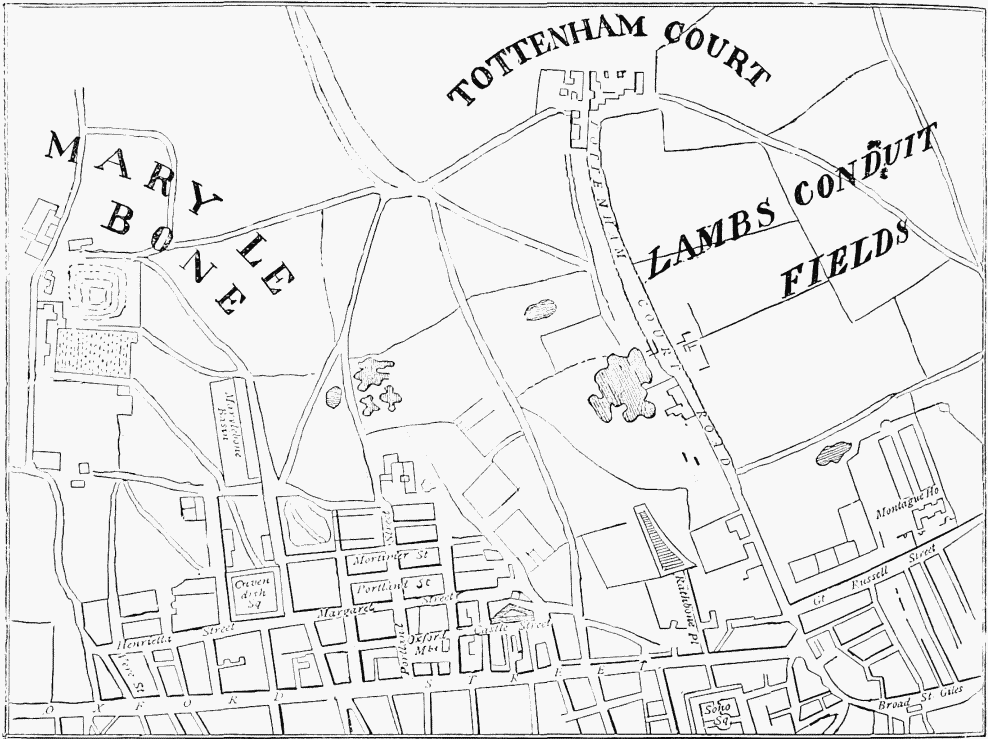
MAP OF RATHBONE PLACE AND NEIGHBOURHOOD. (From Rocques's Map, 1746.)
Few who have read Goldsmith will forget his
description of an author's bedchamber in this immediate neighbourhood:—
"Where the 'Red Lion' staring o'er the way,
Invites the passing stranger—that can pay;
Where Calvert's butt and Parsons' black champagne
Regale the drabs and bloods of Drury Lane;
There in a lowly room, from bailiffs snug.
The Muse found Scroggins stretched beneath a rug.
A window patched with paper lent a ray
That dimly showed the state in which he lay,
The sanded floor, that grits beneath the tread,
And humid walls with paltry pictures spread."
The above lines, evidently drawn from life, might be applied with equal truth in former times to many a poor struggling artist as to those who wield the pen; but let us hope that now-a-days, as a rule, genius, whether literary or artistic, is better housed.
Rathbone Place, the first turning to the eastward of Newman Street, perpetuates the name of its builder, a Captain Rathbone, and an inscription on one of the houses, "Rathbone Place, Oxford Street, 1718," fixes the date of its erection. As the "Tyburn Road" does not appear to have been generally known as "Oxford Street" till some ten or eleven years later, though occasionally so named in legal documents, (fn. 1) the inscription is the more worthy of being placed on record here. In Ralph Aggas's plan of London, the commencement of this street is designated "The Waye to Uxbridge;" further on, in the same plan, the highway is called "Oxford Road." In this map cows are represented grazing in a field on the site now occupied by Rathbone Place.
In 1784, according to Mr. J. T. Smith, in his "Book for a Rainy Day," this street consisted entirely of private houses, and its inhabitants were all of high respectability. "I have heard Mrs. Mathew say," he adds, "that the three rebel lords, Lovat, Kilmarnock, and Balmerino, had at different times resided in it."
Mrs. Mathew was the wife of the Rev. Henry Mathew, for whom Percy Chapel, close by, was built. At their house, towards the close of the last century, used to meet a knot of literary, musical, and artistic celebrities, including Flaxman and William Blake, the long-forgotten artist and poet, who would sometimes recite his verses to the company. Of Blake Mr. Smith predicted, with great judgment, that a day would come when his drawings would be sought after with the most intense avidity, adding that, although little known to the world at large, he was regarded by Flaxman and Stothard with the highest admiration. The prophecy has of late years been fulfilled, and Blake's powers, as an artist and a poet, are now recognised at their true worth. It was through Mr. Mathew's influence, combined with that of Flaxman, that Blake's first volume of poems was issued in 1782. We have already spoken of Blake's career in our account of the neighbourhood of Golden Square. In return for the friendly welcome which he always received from Mr. and Mrs. Mathew, Flaxman decorated the walls of their parlour with models of figures in classical and tasteful niches. But these have long since perished.
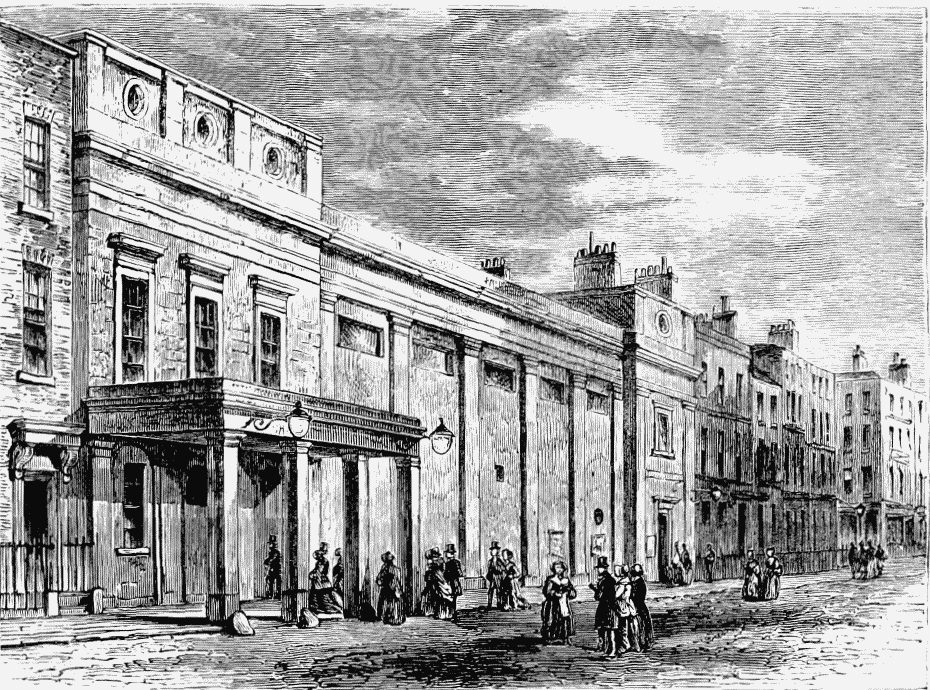
EXTERIOR OF THE TOTTENHAM STREET THEATRE, 1830.
Rathbone Place has always borne an artistic reputation, and at present it is the head-quarters of artists' repositories, and of vendors of paints and drawing materials. Mr. Peter Cunningham reminds us in his "Hand-book of London" that "the well-known publication called the 'Percy Anecdotes,' edited by Sholto and Reuben Percy, derives its name from the 'Percy Coffee-house,' in Rathbone Place—now no more—where the idea of the work was first started by two friends, Mr. George Byerley and Mr. Joseph C. Robinson, who assumed the noms de plume of the Brothers Percy, of a certain apocryphal monastery." These brothers also wrote a "History of London," in three small volumes; one of them was also editor of the Mechanics' Magazine and the other editor of the Mirror. Mr. John Timbs, in his "Autobiography," tells us that the idea of the "Percy Anecdotes" was likewise "claimed by Sir Richard Phillips, who stoutly maintained that he suggested to Dr. Tilloch and Mr. Mayne to cut the anecdotes from the many years' files of the Star newspaper, of which Dr. Tilloch was then editor, and Mr. Byerley assistant editor; and to the latter overhearing the suggestion, Sir Richard contested, might the 'Percy Anecdotes' be traced. The Star was an evening paper, and well-timed anecdotes were its spécialité. Mr. Thomas Boys, the publisher of Ludgate Hill, realised a large sum by the sale of the 'Percy' work; and no inconsiderable portion of its success must be referred to the publisher's taste. The portrait illustrations, mostly engraved by Fry, were admirable. The work had, moreover, this remarkable commendation of Lord Byron, who said, 'No man that has any pretensions to figure in good society can fail to make himself familiar with the 'Percy Anecdotes.'"
Rathbone Place numbered among its residents, in former times, Mr. Nathaniel Hone, R.A., the painter of the picture called the "Conjurer." He died here in 1784. In 1826, Mr. E. H. Baily, R.A., the sculptor, was living here; as also was Mr. Peter De Wint, the water-colour painter. Here lived the learned Baron Maseres, author of the "Scriptores Logarithmici." He died in 1824, at the age of ninety-three. In 1836, all mention of the street is struck out from the "Blue Book." Such is the westward march of fashion.
The locality of Rathbone Place and Windmill Street, which lies immediately to the north of it, is thus mentioned by Mr. J. T. Smith, in "Nollekens and his Times:"—
"One day, in a walk with me, Nollekens stopped at the corner of Rathbone Place, and observed that when he was a little boy his mother used often to take him to the top of that street to walk by the side of a long pond near a windmill, which then stood on the site of the chapel in Charlotte Street, and that he recollected that a halfpenny was paid by every person at the hatch belonging to the miller for the privilege of walking in his grounds. He also told me that his mother took him through another 'halfpenny hatch' in the fields between Oxford Street and Grosvenor Square, the northern side of which was then in the course of building. When we got as far as the brew-house, between Rathbone Place and the end of Tottenham Court Road, he told me that he recollected thirteen large and fine walnut-trees standing on the north side of the way, between Hanover Yard and the Castle Inn, a little beyond the Star Brewery."
Passing along Oxford Street for a short distance, we arrive at Hanway Street, which was originally a zigzag country lane, leading out of the Uxbridge Road into Tottenham Court Road. It was at first, says Mr. J. T. Smith, better known by the vulgar people under the name of "Hanover Yard," and subsequently Hanway Yard, and it was for some time the resort of the highest fashions for mercery, and other articles of dress; and it has continued to this day to be noted for its china-dealers and curiosity shops, as it was in days of yore when high-heeled shoes and stiff brocades were all the rage.
The author of "The Old City," who wrote under the assumed name of "Aleph," and was a native of St. Giles's, remembered this thoroughfare when it was still called Hanway Yard. It was narrow and dirty, and full of old china-shops, including Baldock's, "a sort of museum for Chinese horses and dragons, queer-looking green vases, and dollsized teacups;" and at the Oxford Street end stood a muffin and crumpet shop, which had about it an air of mystery and romance, as a suspected depository of smuggled goods. Another shop, for the sale of Dutch toys, was kept by an old woman named Patience Flint, a thin, little, shrunken old dame, who dressed in a close-fitting gingham gown, and wore a stiff muslin cap tightly drawn over her forehead. She rarely spoke, but conducted her business by signs, holding up four fingers to denote that the price of a cup or a saucer was fourpence, and scarcely eating, drinking, or sleeping at all. One winter's morning "Aleph" went to the shop, but found it closed, and that the neighbours were about to follow the old woman of Hanway Yard to the burial-ground at St. Pancras. The coffin-plate bore the inscription, "Patience Flint, aged 109 years."
In Hanway Street, in 1808, there was living a certain Mrs. Elizabeth Alexander, aged 106, under a portrait of whom, published in that year, appear the words, "Supposed to be the oldest woman in England."
How Hanway Street came to be so called, we have no definite authority for stating. It may probably have been named after one Jonas Hanway, to whom we are mainly indebted for bringing into general use in England that very necessary article of daily need—in our variable climate, at least—the umbrella. Hanway's name had already become favourably known in London, from his many schemes of benevolence. He originated both the Marine Society and the Magdalen, and, in conjunction with Captain Coram, he was active in promoting the foundation of the Foundling Hospital, of which we shall speak in a future chapter. In respect to his courage and perseverance in bringing umbrellas into general use, Hanway was a greater benefactor than at first might be supposed. Gay's poem of "Trivia," it is true, commemorates the earlier use of an umbrella by poor women, "tuck'dup-sempstresses" and "walking maids;" but even with this class it was a winter privilege, and woe to the woman of a better sort, or to the man, whether rich or poor, who dared at any time so to invade the rights of coachmen and chairmen. But Hanway steadily underwent all the staring, laughing, jeering, hooting, and bullying; and having punished some insolent knaves who struck him with their whips as well as their tongues, he finally succeeded in overcoming the prejudices against it. Jonas made a less successful move when he tried to write down the use of tea.
With reference to the above subject, we quote the following from Chambers's "Book of Days:"—"The eighteenth century was half elapsed before the umbrella had even begun to be used in England by both sexes, as we now see it used. In 1752 Lieutenant-Colonel (afterwards General) Wolfe, writing from Paris, says: 'The people here use umbrellas in hot weather to defend them from the sun, and something of the same kind to save them from the snow and rain. I wonder a practice so useful is not introduced in England.' Just about that time a gentleman did exercise the moral courage to use an umbrella in the streets of London. He was the noted Jonas Hanway, newly returned from Persia, and in delicate health, by which, of course, his using such a convenience was justified both to himself and the considerate part of the public. 'A parapluie,' we are told, 'defended Mr. Hanway's face and wig.' For a time no others than the dainty beings called Macaronies ventured to carry an umbrella. Any one doing so was sure to be hailed by the mob as 'a mincing Frenchman.' One John MacDonald, a footman, who has favoured the public with his memoirs, found, as late as 1770, that on appearing with a fine silk umbrella which he had brought from Spain, he was saluted with the cry of 'Frenchman, why don't you get a coach?' It appears, however, as if there had previously been a kind of transition period, during which an umbrella was kept at a coffee-house, liable to be used by gentlemen on special occasions by night, though still regarded as the resource of effeminacy. In the Female Tatler of December 12, 1709, there occurs the following announcement: 'The young gentleman belonging to the Custom House, who, in the fear of rain, borrowed the umbrella at Will's Coffeehouse, in Cornhill, of the mistress, is hereby advertised that to be dry from head to foot, he shall be welcome to the maid's pattens.' It is a rather early fact in the history of the general use of umbrellas, that in 1758, when Dr. Shebbeare was placed in the pillory, a servant stood beside him with an umbrella to protect him from the weather, physical and moral, which was raging around him. . . . About thirty years ago, there was living in Taunton a lady who recollected when there were but two umbrellas in that town; one belonging to a clergyman, who, on proceeding to his duties on Sunday, hung up the umbrella in the church porch, where it attracted the gaze and admiration of the townspeople coming to church."
We must not, however, be too severe in our censure of the folly of the public in mocking at the use of umbrellas, when we remember in our own day, even so very recently as the beginning of the Crimean War, it was regarded as almost a mark of insanity for a private gentleman to wear a beard.
At No. 15 in Oxford Street, a few doors eastward of Hanway Street, was exhibited, in 1830, a most ingenious piece of glass-painting of the "Tournament of the Field of Cloth of Gold," elaborately worked out from Hall's "Chronicles," and containing upwards of a hundred figures and forty portraits. It cost the designer, a Mr. Wilmhurst, upwards of £3,000, and covered 432 square feet. After it had been exhibited in the metropolis for little more than a year, this painting was destroyed by fire.
Further eastward, and near the junction of Oxford Street with Tottenham Court Road, is the "Oxford" Music Hall, occupying the site of the old "Boar and Castle Hostelry and Posting House," which dated back to about the year 1620. The "Oxford" was one of the earliest and most popular of the metropolitan music-halls, and the present is the third building of the kind which has occupied the same site, the two previous halls having been destroyed by fire. It consists of a spacious room in the rear of the hotel, facing the street, and to which it is attached; and it has a lofty arched entrance, which, together with the hall itself, is tastefully decorated. The hall is fitted up with a stage, and around the other three sides there is a gallery or balcony. The performances given here consist of selections from popular operas, comic and sentimental singing, glees, duets, &c., with an occasional acrobatic performance.
In 1839 the roadway of Oxford Street was made the subject of some experimental paving. The space between Tottenham Court Road and Charles Street was laid with a dozen different specimens either in wood, stone, bitumen, asphalte, or some other material; the whole, being laid in different patterns, presented a most even and beautiful roadway. The Mirror remarks that "the portion to which attention was more particularly directed was that of the wooden blocks, the noiseless tendency of which made the vehicles passing along appear to be rolling over a thick carpet or rug." These experiments being somewhat in advance of the age, and the public taste not being ripe for change, the roadway was suffered to remain unaltered. The subject, in fact, appears at that time to have elicited but little public interest; indeed, one magnate, Sir Peter Laurie, was as strongly resolved to oppose all wood-paving as he was to "put down suicide."
In connection with these experiments, a statement was published by the Marylebone Vestry, which will give the reader some idea of the immense traffic in the streets of London in 1839:—"On Wednesday, the 16th of January, from six in the morning until twelve at night, by the Pantheon, 347 gentlemen's two-wheel carriages, 935 four-wheel, 890 omnibuses, 621 two-wheel and 752 four-wheel hackney carriages, 91 stage-coaches, 372 wagons and drays, 1,507 light carts and sundries; total, 5,515. By Stafford Place, on Friday, the 18th of January, the total is 4,753, out of which 1,213 were omnibuses; on Tuesday, the 22nd of the same month, by Newman Street, the total was 6,992; and on Satur day, by Stafford Place, the total is stated to be 5,943." The number of vehicles passing through Oxford Street at the present time, we need hardly state, is probably double what it was forty years ago, notwithstanding the introduction of underground railways.
Passing from these dry matter-of-fact statements, we may add that this thoroughfare has witnessed some amusing scenes: for instance, the punishment of a Tom and Jerry boy of the older school, as recorded in the Post Boy of December 14th, 1747. The culprit, a carpenter, was whipped from the watch-house in Great Marlborough Street to the "Blue Posts" in Poland Street, for stealing the knockers from gentlemen's doors. He had two brass knockers tied round his neck.
A much pleasanter scene, however, was witnessed in Oxford Street, in the early part of 1872, on the occasion of the Prince of Wales returning thanks at St. Paul's Cathedral on his recovery from a dangerous illness. In obedience to the wishes of the inhabitants, the return journey of the Queen and the Royal Family to Buckingham Palace was made by way of Holborn and Oxford Street, and the whole line of route was beautifully decorated with flags and streamers.
At the northern end of Rathbone Place, and running eastward into Tottenham Court Road, is Percy Street, which is chiefly noticeable on account of the chapel near its western end. The fabric, which is known as Percy Chapel, was erected about 1790 by the Rev. Mr. Mathew, of whom we have spoken above. It was for some years the scene of the pastoral labours of the Rev. Robert Montgomery, the author of "Satan," "Luther," "Oxford," "The Christian Life," "The Omnipresence of the Deity," and other poems, who died in 1855. The article on his poems in "Macaulay's Essays" is probably one of the severest pieces of criticism ever published.
In this street lived the parents of Henry West Betty, "the youthful Roscius," at the time when the child made his first appearance at Covent Garden Theatre, and took the town by storm. We shall have occasion to speak of him further, when we come to Camden Town.
Charlotte Street, the thoroughfare leading from Rathbone Place to Fitzroy Square, was named either after Charlotte, Duchess of Grafton, or after the Queen of George III. Here, in the house formerly occupied by Sir Thomas Apreece, George Morland, the celebrated painter, was living in 1796. Mr. J. T. Smith thus records a visit which he paid him in that year, in company with a generous patron of art and artists, Mr. Wigston:—"He received us in the drawing-room, which was filled with easels, canvases, stretching-frames, gallipots of colour, and oilstones; a stool, chair, and a three-legged table were the only articles of furniture of which this once splendid apartment could then boast. Mr. Wigston immediately bespoke a picture, for which he gave him a draft for forty pounds, that sum being exactly the money he then wanted; but this gentleman had, like most of that artist's employers, to ply him close for his picture."
On the east side of Charlotte Street is Windmill Street. Here, in the early part of the reign of George III., the Small Pox Hospital was first established; it was afterwards removed to King's Cross, and thence to Highgate Rise.
Goodge Street was so called after the speculating builder who erected the houses in it. In 1772, the date of the map in Northouck's "History of London," it appears to have been called Crabtree Street.
Further northward, running parallel with Goodge Street, and crossing Charlotte Street, is Tottenham Street. Here is one of the most fashionable of the London theatres, the Prince of Wales's. The building was originally the concert-room of Signor F. Pasquali, and was purchased and enlarged by the directors of the Concerts of Ancient Music, who built a superb box for George III. and Queen Charlotte. Early in the present century it was fitted up by Colonel Greville for a body of amateur dramatists, called the "Picnics," "whose celebrity," writes Mr. J. Timbs, "rendered them objects of alarm to the professional actors of the day, and exposed them to the attacks of the caricaturist, Gilray." In 1807, or the following year, like the Olympic, it was converted into a sort of circus for equestrian performances, but it never in this respect rivalled Astley's. In 1820 it passed into the hands of Mr. Brunton, whose daughter, Mrs. Yates, was one of its greater stars. The ring had, in due course of time, given place to a pit, which is described, six years later, by Mr. J. R. Planché, as being "about as dark and dingy a den as ever sheltered the children of Thespis." Its out-of-the-way and unfashionable situation, however, did not prevent the "upper ten thousand" from patronising it occasionally.
In some of the earliest bills it is called "The New Theatre," the "King's Ancient Concert Rooms," Tottenham Street; afterwards it took the names of the "Regency," the "Theatre of Varieties," and the "West London," and after the accession of William IV., "The Queen's," out of compliment to Queen Adelaide. An attempt was made, in the year 1831, by Mr. Macfarren, to turn it into a sort of English Opera House, but it was not successful. Two years or so later it acquired a transitory celebrity under the name of "The Fitzroy," as the home of burlesque, and afterwards of French plays. In 1835 it was taken by Mrs. Nesbitt, who re-opened it under its old name of "The Queen's." It was for some time under the management of Madame Vestris; but its career seems to have been anything but flourishing until the year 1865, when it was taken by Miss Marie Wilton (afterwards Mrs. Bancroft), in the joint capacity of lessee and manager, who partly reconstructed the theatre and altered its name to the "Prince of Wales's."
In Charlotte Street, on the east side, between Tottenham and North Streets, is the church of St. John the Evangelist. The edifice, which is in the Norman or Romanesque style of architecture, was built from the designs of Hugh Smith, and was consecrated in 1846. At the western end is a tower and spire, about 120 feet in height, and it has a large wheel window beneath the intervening gable.
At No. 84 in this street is the "Hogarth Club," founded in 1870, and strictly limited in its members to artists, architects, and sculptors. Here conversazioni are held during the season, and the pictures and drawings of members are shown previous to being exhibited publicly at the Royal Academy, the Dudley Gallery, or the Gallery of British Artists.
At No. 98 are the offices of the Association for the Aid and Benefit of Dressmakers and Milliners. This institution, which was founded in 1844, provides a home for deserving young persons, and assists them in obtaining employment; it also affords pecuniary and medical aid to those in distress, and there are also, in connection with the association, almshouses for the aged and decayed.
The erection of Fitzroy Square, which we now enter, was begun about the year 1790. According to Mr. Cunningham, it commemorates the name of Charles Fitzroy, the second Duke of Grafton (whose father, the first duke, was a natural son of King Charles II., by Barbara Villiers, Duchess of Cleveland), to whom the lease of the Manor of Tottenham Court descended in right of his mother, Lady Isabella Bennet, the daughter and heiress of Henry Bennet, Earl of Arlington, one of the five statesmen who composed the "Cabal" Ministry of the above-named king.
In consequence of the stagnation to trade generally, caused by the wars at the close of the last and the beginning of the present centuries, this square remained a long time unfinished, the south and east sides alone being built. In the "Beauties of England and Wales," published in 1815, it is described as "not yet completed. The houses," continues the writer, "are faced with stone, and have a greater portion of architectural embellishment than most others in the metropolis." They were designed by the brothers Adam, already familiar to our readers in connection with the Adelphi and Portland Place.
Between Fitzroy Square and Tottenham Court Road was Fitzroy Market. It consisted of a number of small and dark tenements, and was pulled down in 1875.
The neighbourhood of Fitzroy Square has for a long time been a favourite haunt of painters, no doubt on account of the excellence of the light on the northern side, by reason of the vicinity of the Regent's Park. Indeed, from 1810 to 1830, all the neighbourhood between this square and Oxford Street appears, from an examination of the "Blue Books" and "Court Guides," to have been studded with artists, among whom figure a few R.A.'s, rari nantes in gurgite vasto. Among the former, living in Charlotte Street, are the names of Mr. C. L. Eastlake (afterwards President of the Royal Academy), Mr. (afterwards Sir) W. C. Ross, A.R.A., miniature painter to the Queen; in this street, too, lived John Constable, R.A., during the last fifteen years of his life. He died in 1837, and lies buried at Hampstead.
In Russell Place lived Daniel Maclise, the gifted Royal Academician, until a short time before his lamented decease, in 1870, whilst in the zenith of his fame. Maclise was a native of Cork, but settled in London in 1827, and in the following year became a student at the Royal Academy. He became an Associate of the Royal Academy in 1835, and five years later attained the full honours. In 1866, on the death of Sir Charles Eastlake, the presidential chair of the Royal Academy was offered for his acceptance, but was declined. Besides his two large wall-paintings in the new Houses of Parliament—"The Meeting of Wellington and Blucher at Waterloo," and the "Death of Nelson," Maclise will be, perhaps, best remembered by his "Play Scene in Hamlet," in the national collection, the "Banquet Scene in Macbeth," and the "Vow of the Ladies and the Peacock." One of Mr. Maclise's latest works was "The Earls of Desmond and Ormond," painted in the year of his death. In 1835–6 Mr. Maclise was living in the same neighbourhood, at No. 63, Upper Charlotte Street. At this house a sketching society used often to meet, including Eastlake, Stanfield, David Roberts, Decimus Burton, and the brothers Alfred and John Chalon. They met at each other's rooms, the host of the evening giving out the subject, and an hour was the time allowed for each to work out his conception. When the artists went further a-field into the suburbs, this little coterie broke up. In the "Blue Books" of the period above mentioned there is also a sprinkling of "honourables," and baronets, and knights named as living here; but these have all disappeared when we come to the reign of Victoria.
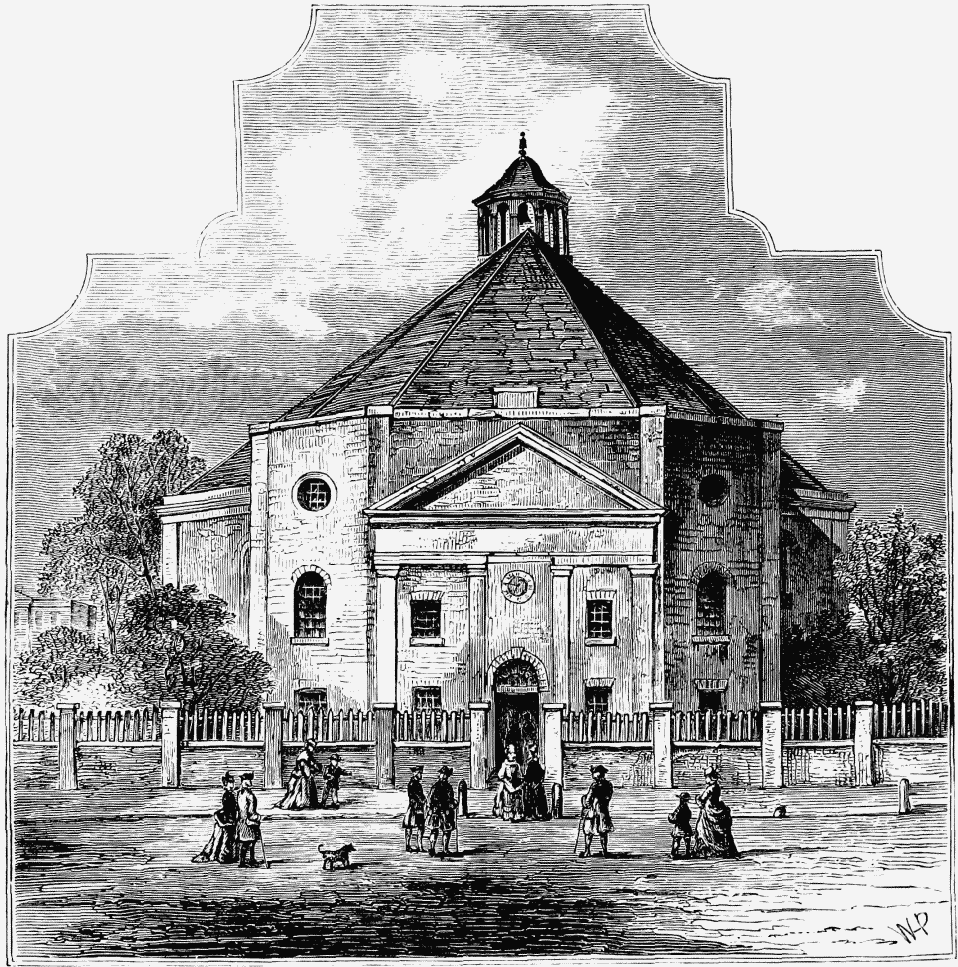
WHITEFIELD'S TABERNACLE, 1820.
In London Street, which runs from Cleveland Street into Tottenham Court Road, lived, in 1841, E. W. Wyon, the sculptor, and Miss Chalon, sister to the brothers Chalon, and herself also an artist of considerable repute. Upper Fitzroy Street, in 1826, had among its residents, Mr. (afterwards Sir) Robert Smirke, R.A., the architect of the General Post Office and other public buildings.
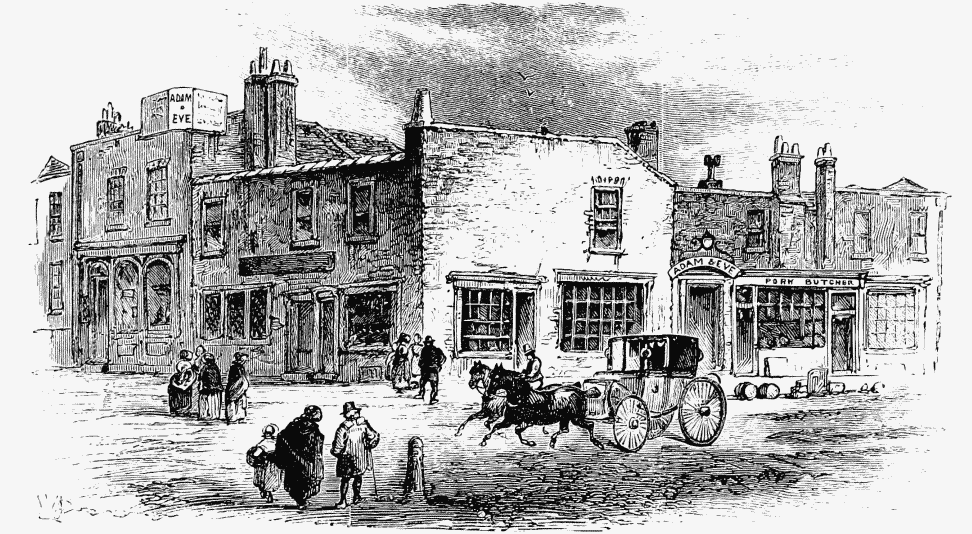
THE "ADAM AND EVE" TAVERN, 1750.
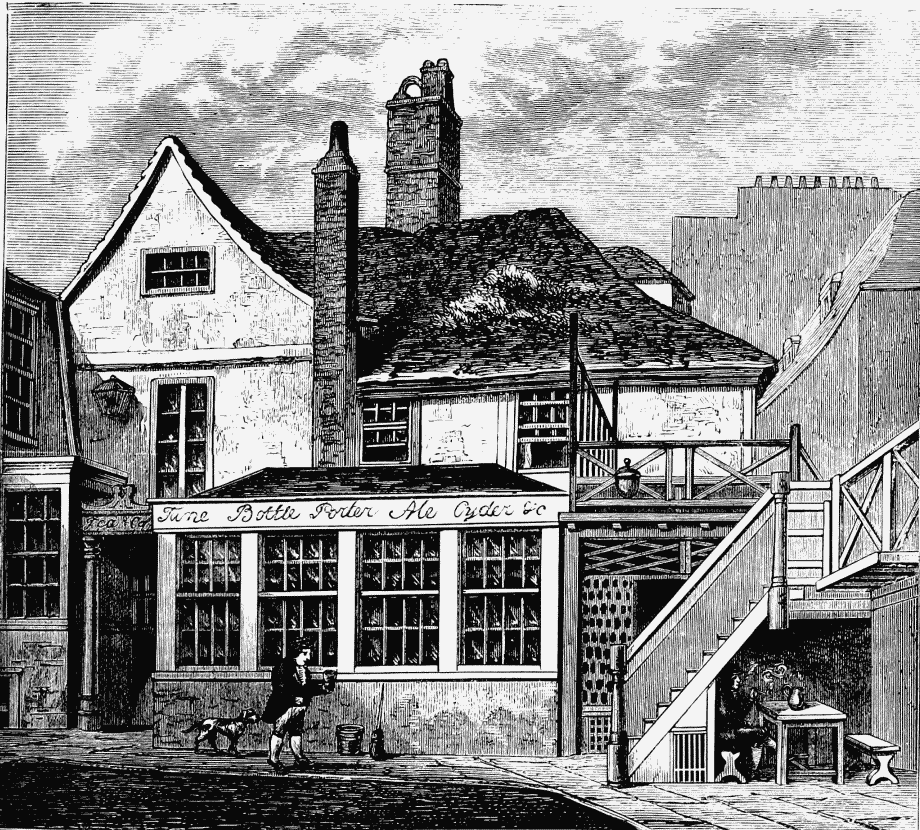
THE MANOR HOUSE OF TOTEN HALL. (From a View published by Wilkinson, 1813.)
Warren Street, on the north of Fitzroy Square, running parallel to the Euston Road, was so called, probably, after the wife of the first Lord Southampton, Anne, daughter and co-heiress of Admiral Sir Peter Warren. Some of the houses in it have a double frontage. In this street in 1817, and for several years subsequently, resided the celebrated Dr. Kitchiner, author of some works which have made his name widely known—the most celebrated being "The Cook's Oracle," which has passed through several editions. He was the son of a coal merchant residing in Beaufort Buildings, Strand, and was born in 1775. He received his education at Eton, and took his degree at Glasgow; but as he inherited a good fortune from his father, he did not follow his profession. In Allibone's "Dictionary of English Literature" he is described as "a native of London, celebrated for writing good books and giving good dinners." His hours of rising, eating, and retiring to rest were all regulated by system. His lunches, to which only the favoured few had the privilege of entrée, were superb. They consisted of potted meats of various kinds, fried fish, savoury pâtes, rich liqueurs, &c., in great variety and abundance. His dinners, unless when he had parties, were comparatively plain and simple, served in an orderly manner, cooked according to his own maxims, and placed upon the table invariably within five minutes of the time announced. His public dinners were things of more pomp, ceremony, and etiquette: they were announced by notes of preparation, of which the following will serve as a specimen:—
"Dear Sir,—The honour of your company is requested to dine with the Committee of Taste, on Wednesday next, the 10th inst. The specimens will be placed upon the table at five o'clock precisely, when the business of the day will immediately commence. I have the honour to be your most obedient servant, W. Kitchiner, Secretary.
"At the last general meeting it was unanimously resolved that—1st. An invitation to Eta, Beta, Pi must be answered in writing as soon as possible after it is received, within twenty-four hours at latest, reckoning from that on which it is dated, otherwise the secretary will have the profound regret to feel that the invitation has been definitely declined. 2nd. The secretary having represented that the perfection of several of the preparations is so exquisitely evanescent, that the delay of one minute after their arrival at the meridian of concoction will render them no longer worthy of men of taste: therefore, to ensure the punctual attendance of those illustrious gastrophilists who on grand occasions are invited to join this high tribunal of taste for their own pleasure and the benefit of their country, it is irrevocably resolved, 'That the janitor be ordered not to admit any visitor, of whatever eminence of appetite, after the hour which the secretary shall have announced that the specimens are ready.' By order of the Committee, William Kitchiner, Secretary."
Dr. Kitchiner possessed an extensive library, for in the introduction to the "Cook's Oracle" he gives a list of the titles of about 217 different books treating of the subject of cookery, all of which, he tells us, he consulted in the preparation of the book above named. Another of his books was entitled, "The Art of Invigorating and Prolonging Life by Food, Clothes, Air, Exercise, Wine, Sleep, &c., and Peptic Precepts," to which is added "The Pleasure of Making a Will." He was likewise a connoisseur in telescopes, and in his "Economy of the Eyes"—a book abounding with many curious facts of great interest to amateur astronomers—he gives a description of fifty-one telescopes, reflecting and achromatic, which he purchased or had made for him during his thirty years' experience as an astronomical amateur, at an expense of more than £2,000. Among other eccentric habits of Dr. Kitchiner which are on record, is one to the effect that it was his practice always to take his own wine with him when he went out to dinner. His will was remarkable for its eccentricity, and it is said that another, making serious alterations in the disposal of his property, was intended for signature on the day following his death, which happened suddenly, on the 26th of February, 1827.
The Euston Road; Cleveland Street, which runs thence southwards, towards Newman Street; Grafton Street, which leads from the south-east corner of Fitzroy Square into Tottenham Court Road; and Southampton Street, which skirts the west side of the square, are all so called after the various family connections of the ducal house of Grafton, and of Lord Southampton.
On the east side of Fitzroy and Charlotte Streets, and running parallel with Tottenham Court Road, is Whitfield Street, so named after the Rev. George Whitfield, or Whitefield, of whom we shall speak on reaching the "Tabernacle" in Tottenham Court Road. Here are two cross streets, bearing the names of Pitt and Lord North respectively, and thereby declaring the date of their erection; but they are quite barren of incident and history.
Passing through Grafton Street, we enter Tottenham Court Road. This name, like that of Covent Garden, is a popular corruption, sinning, however, rather strangely, by way of elongation instead of abridgment. The country road which, three or four centuries ago, ran northwards from St. Giles's Pound, between green hedges and open fields, was so called from Totten, or Totham, or Totting Hall, the manor-house of which stood at the north-west corner of four cross-ways, on the site of what now is the "Adam and Eve," celebrated in Hogarth's picture in the last century, and of which we shall have to speak in a future chapter. This manorhouse, it appears, belonged to one William de Tottenhall, as far back as the reign of Henry III. It is described in "Domesday Book" as belonging to the Dean and Chapter of St. Paul's. After changing hands several times, the manor was leased for ninety-nine years to Queen Elizabeth, when it came popularly to be called Tottenham Court. In the next century it appears to have become the property of the Fitzroys, who erected Fitzroy Square, upon a part of the manor estate, towards the end of the last century; and the property still belongs to the Fitzroys, Lord Southampton. In the map in Northouck's "History of London" (1772), a turnpike-gate is marked at the top of Tottenham Court Road, but this has long since disappeared.
In 1748 Tottenham Court Fair was kept for fourteen days without interruption, but "it does not appear," says Mr. Frost, in his "Old Showmen," "to have been attended by any of the shows which contributed so much to the attractiveness of the fairs of Smithfield and Southwark Green." In fact, although the notices of the fair make mention of a great theatrical booth, it seems to have been devoted rather to wrestling and singlestick than to purely Thespian purposes. These booths were occasionally used for the settlement of "affairs of honour" by means of pugilistic encounters. The challenges were duly announced in the newspapers of the day, in the form of advertisements. Here is one which appeared in 1772:—"Challenge.—I, Elizabeth Wilkinson, of Clerkenwell, having had some words with Hannah Hyfield, and require satisfaction, do invite her to meet me upon the stage, and box me for three guineas; each woman holding half-a-crown in each hand, and the first woman that drops the money to lose the battle." "Answer.—I Hannah Hyfield, of Newgate Market, hearing of the resoluteness of Elizabeth Wilkinson, will not fail, God willing, to give her more blows than words, desiring home blows, and from her no favour; she may expect a good thumping!" The half-crowns were an ingenious device to prevent scratching. Cock-fighting, bull-baiting, and other "sporting" advertisements, accompany these ladylike diversions.
Mr. J. T. Smith thus writes, in his "Book for a Rainy Day:"—"Notwithstanding that Tottenham Court Road was for the most part frequented by persons of the lowest order, who kept in it what they styled a 'Gooseberry Fair,' it was famous at certain seasons, and particularly in the summer, for its booths of regular theatrical performers, who deserted the empty benches of Drury Lane Theatre, under the management of Mr. Fleetwood, and condescended to admit the audience at sixpence a head. Mr. Yates, and other eminent performers, had their names painted on their booths." This must have been about the year 1777.
Tottenham Court Fair appears, from Mr. Frost's "Old Showmen," to have risen into sudden fame and celebrity about the end of George I. or the beginning of George II. Mr. Frost is unable to trace the origin of the fair, but contents himself with telling us that "it began on the 4th of August, and that Lee, Harper, and Petit set up a 'show' in it, behind the 'King's Head,' in the Hampstead Road. The entertainments," he adds, "were Bateman and the Ridolto al fresco." Of the exact time when this fair was discontinued we have no authority for stating; but the truth is, that when the good people of St. James's ceased to patronise the "Old Showmen," those of Bloomsbury voted them low, and followed in the wake of their wealthier and more aristocratic neighbours.
In a previous chapter we have spoken of the insecurity of these northern districts of the metropolis in the last century, in consequence of the numerous bands of highwaymen infesting the locality; and in the London Magazine we read that as lately as 1773 two prisoners were sentenced to death at Newgate for robbing a gentleman and his wife near Tottenham Court turnpike.
The vicinity of Tottenham Court Road, being near to the Middlesex Hospital, appears to have enjoyed an unenviable notoriety as a depository for dead bodies. At all events, Hunter tells us, in his "History of London," that in 1776 the town was startled by the discovery of the remains of more than a hundred corpses in a shed hereabouts, which were "supposed to have been deposited there by traders to the surgeons, many of whom, especially in the Borough, were known to have made an open profession of this traffic."
On the west side of the road, between Tottenham and Howland Streets, is Tottenham Court Chapel, or, as it is generally called, "Tabernacle." It was designed by the Rev. George Whitefield, the eloquent colleague and fellow-worker of John Wesley. The immediate cause of its erection was the opposition which he met with, as minister of a chapel in Long Acre, from the Vicar of St. Martin's-in-the-Fields, who had no sympathy with the new "Evangelical" doctrines. Hindered thus in his ministry, he obtained from the Fitzroys a lease of a plot of ground in what was then called, in maps and surveys, "The Crab and Walnuttree Field," close to a pond known as "The Little Sea," on the road which ran from St. Giles's Church to the "Adam and Eve Tavern." In writing to his patroness, the Countess of Huntingdon, Whitefield says, "I have taken a piece of ground not far from the Foundling Hospital whereon to build a new chapel." When he built it, he desired to place it within the pale of the Established Church, and had hoped to have done so all the more easily on account of his position as chaplain to a peeress of the realm; but in this he was disappointed. He sailed, however, as near to the model of the English Church worship as the law allowed him. The foundation-stone was laid in May, 1756, Mr. Whitefield himself preaching on the occasion. It was a large but plain double-brick building, seventy feet square, and capable of holding a large congregation; over the door, we are told, were the arms of Mr. Whitefield. But the preacher was so popular that the edifice had soon to be enlarged; and three or four years later an octagonal front was added, which gave it a singular appearance. Twelve alms-houses and a chapel-house soon grew up by its side, all the result of private subscriptions among the adherents of "Evangelicalism." Indeed, so celebrated was Mr. Whitefield as an orator that he numbered among his occasional hearers the Prince of Wales and several of his brothers and sisters, Lords Chesterfield, Halifax, and Bolingbroke; also David Hume, Horace Walpole, and David Garrick. Ned Shuter, the actor, also, who was acting the Rambler at the time, came in one day, when Whitefield, turning to him, implored that in the course of his wanderings he might be led to "ramble" towards his Saviour. Shuter was struck at the unexpected attack on himself, and expostulated with the preacher, but in the end he became a Methodist. Whitefield died in America, in September, 1770, and his funeral sermon was preached here by John Wesley. There is in the chapel a monument to George Whitefield, and another to his wife, who was buried here. There is another to Augustus Toplady, author of the well-known hymn "Rock of ages, cleft for me." John Bacon, R.A., the sculptor, is buried under the north gallery. The chapel was satirically called by the opponents of the new doctrines, Whitefield's "soultrap;" on which the latter merely said, "I pray that God may make it indeed a soul-trap to many of his wandering creatures." Whitefield was also burlesqued by Samuel Foote, on the stage of old Drury Lane, in The Minor and The Hypocrite. This, however, provoked him no further than to observe, with a smile, "I am afraid Satan is angry." There are few anecdotes told in favour of Foote's magnanimity; but one deserves to be recorded. The epilogue to his farce of The Minor contained a burlesque of the style and manner of the wellknown preacher, under the title of "Dr. Squintem." During the run of the farce it happened that Whitefield died. The epilogue was withdrawn. On its being loudly called for by the audience, Foote came forward, and said that he was incapable of holding up the dead to ridicule.
Following in the wake of the great preachers of the previous century—South and Barrow—and in a style which was afterwards copied by Rowland Hill at the Surrey Chapel, and by one or two preachers even in the present day, Mr. Whitefield increased his popularity by using eccentric terms and modes of expression in his sermons, and by reference to commonplace and trivial matters. In fact, his discourses often sparkled with wit and fun. Both Whitefield and Wesley contrived, as the Established Church disclaimed their acts, to disown and to defy its authority in turn, and therefore they gradually found themselves forced to take up the position of Nonconformists and Dissenters. A man of superhuman energy and power, John Wesley has been able to exercise the widest influence over the English-speaking race. Macaulay observes of him that "his genius for government and organisation was not inferior to that of Cardinal Richelieu," and others have compared him with St. Ignatius Loyola.
It is recorded in the Gentleman's Magazine that during a violent thunder-storm which passed over London, on Sunday, March 15, 1772, a man was killed by the lightning in this chapel. The electric fluid penetrated the roof just over the man's head, and entering a little above his breast, pierced his heart. He had two children by him at the time, neither of whom received the least hurt.
It is said that Whitefield wished to have the ground adjoining consecrated as a burial-ground, but that the Bishop of London refusing to perform the ceremony, he obtained several cart-loads of consecrated earth from a churchyard in the City, conveyed them hither, and spread them over the adjacent surface, which he thenceforth regarded as sacred. How deep the consecration went downwards was a question he did not even attempt to decide.
It would appear that the ministers of the two chapels in Tottenham Court Road and Moorfields often preached alternately in these edifices. At any rate, the eccentric Matthew Wilks, who was minister at Moorfields from 1775 to 1829, is stated to have had the oversight of the two chapels.
On the expiration of Whitefield's lease, in 1828, the chapel was closed for two years, when it was purchased by trustees, and greatly altered in its appearance, the exterior being coated with stucco. About the year 1860 the fabric was enlarged and re-fronted with stone.
There were persons living in 1832, as is clear from a letter published at that date in Hone's "Year Book," who "remembered when the last house in London was the public-house in the corner, by Whitefield's Chapel." The writer remarks that he himself remembered the destruction of a tree which once shadowed the skittle-ground and roadside of the same house. It was cut down and converted into firewood by a man who kept a coalshed hard by. Persons living at the above date could recollect Rathbone Place ending at Percy Street, and the mill still in position which gave its name to Windmill Street, and the neighbourhood of Charlotte Street being occupied by large open soil-pits. The writer above referred to tells the following grim story about this neighbourhood:—"A poor creature, a sailor, I believe, was found dead near here, and denied burial by the parish on the ground of a want of legal settlement. The body was placed in a shell and carried about the streets by persons who solicited alms for its interment. A considerable sum was collected, but the body was thrown into one of those pits, the money being spent in other ways. After a time the corpse floated, and the atrocity was discovered, but the perpetrators were not to be found. A friend of mine," he adds, "saw the fragments of the coffin floating about on the surface of the pool."
At "King John's Palace," a public-house in this street, lived an eccentric character named Shooter. He had been pot-boy at a tavern in Covent Garden, and became on such friendly terms with the rats in the cellars of the house, by giving them sops from his porter—for at that time everybody, if he liked, might have a bit of toast in his beer—that they would creep about him, and over his hands and face, without fear and without injury. He would carry them about the streets between his shirt and his waistcoat, to the surprise of every one, and even make them answer to their names. Later in life he became a Methodist, through listening to the preaching of Wesley and Whitefield.
Tottenham Court Road in the present day is one of the busiest thoroughfares in London, and can boast of several monster commercial establishments, notably among them being those of Messrs. Moses and Son, outfitters, at the corner of the Euston Road; Messrs. Shoolbred and Co., linendrapers; and Messrs. Hewetson and Milner, upholsterers. At No. 216 are the offices of the North London Consumption Hospital, of which we shall speak on reaching Hampstead, where the hospital itself is situated.
This thoroughfare being of comparatively recent growth, there is but little to say in the way of anecdote connected with it. Here "Peg" Fryer, a wonderful old actress, who quitted the stage in the reign of Charles II., kept a public-house in her latter days. A farce called the Half-pay Officer, by Charles Molloy, was brought out at Drury Lane Theatre in 1720; and to Mrs. Fryer, then eightyfive years of age, was assigned the part of an old grandmother. In the bills it was mentioned:—"The part of 'Lady Richlove' to be performed by Peg Fryer, who has not appeared on the stage these fifty years." The character in the farce was supposed to be a very old woman, and Peg exerted her utmost abilities. The farce being ended, she was brought again upon the stage to dance a jig. She came tottering in, and seemed much fatigued; but on a sudden, the music striking up the Irish trot, she danced and footed it almost as nimbly as any girl of twenty. She resided in Tottenham Court Road until her decease, which took place in 1747, at the reputed age of 117 years.
The "Blue Posts," a tavern still standing at one corner of Hanway Street and Tottenham Court Road, says Mr. J. T. Smith, in his "Book for a Rainy Day," "was once kept by a man of the name of Sturges, deep in the knowledge of chess, upon which game he published a little work, as is acknowledged on his tombstone in St. James's burial-ground, Hampstead Road."
Charles Dickens, as a boy, when living at Camden Town, and acting as a drudge at the blacking shop at Hungerford Stairs, used to frequent the secondclass pastry-cooks along this route, and spend his coppers on stale buns at half-price.
At the southern extremity of the road, where it joins Oxford Street, and on the west side, are three or four isolated houses, the little foot-passage behind which is called Bozier's Court. They stand on what was waste land adjoining the old Pound. The removal of these old houses has been often threatened, but never carried into effect.
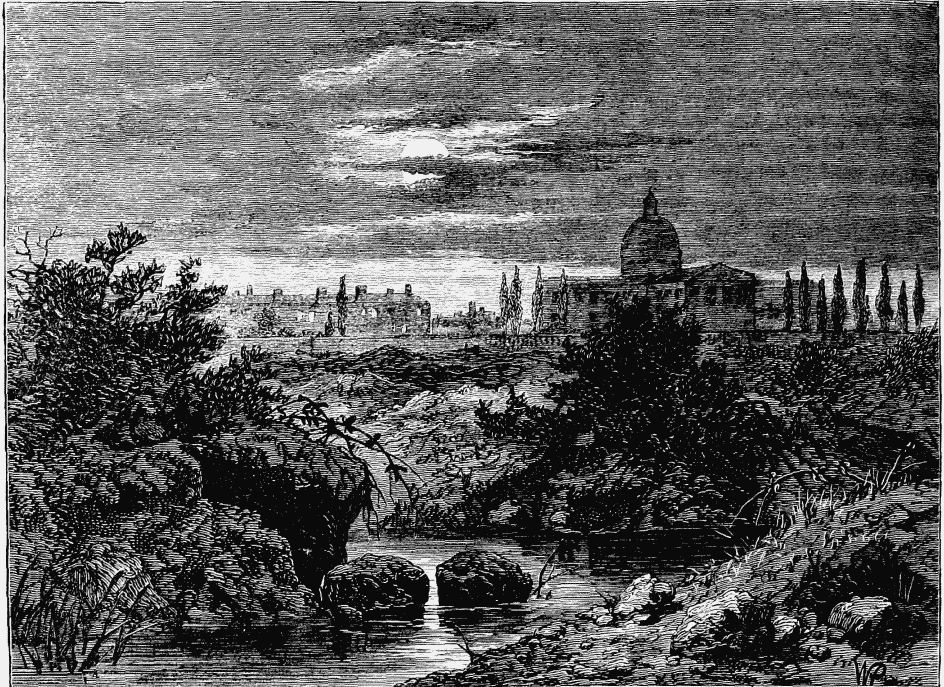
THE FIELD OF THE FORTY FOOTSTEPS. (From an Original Sketch, taken in 1830.)