Old and New London: Volume 4. Originally published by Cassell, Petter & Galpin, London, 1878.
This free content was digitised by double rekeying. Public Domain.
Edward Walford, 'Bloomsbury Square and neighbourhood', in Old and New London: Volume 4(London, 1878), British History Online https://www.british-history.ac.uk/old-new-london/vol4/pp535-545 [accessed 30 April 2025].
Edward Walford, 'Bloomsbury Square and neighbourhood', in Old and New London: Volume 4(London, 1878), British History Online, accessed April 30, 2025, https://www.british-history.ac.uk/old-new-london/vol4/pp535-545.
Edward Walford. "Bloomsbury Square and neighbourhood". Old and New London: Volume 4. (London, 1878), British History Online. Web. 30 April 2025. https://www.british-history.ac.uk/old-new-london/vol4/pp535-545.
In this section
CHAPTER XLI.
BLOOMSBURY SQUARE AND ITS NEIGHBOURHOOD.
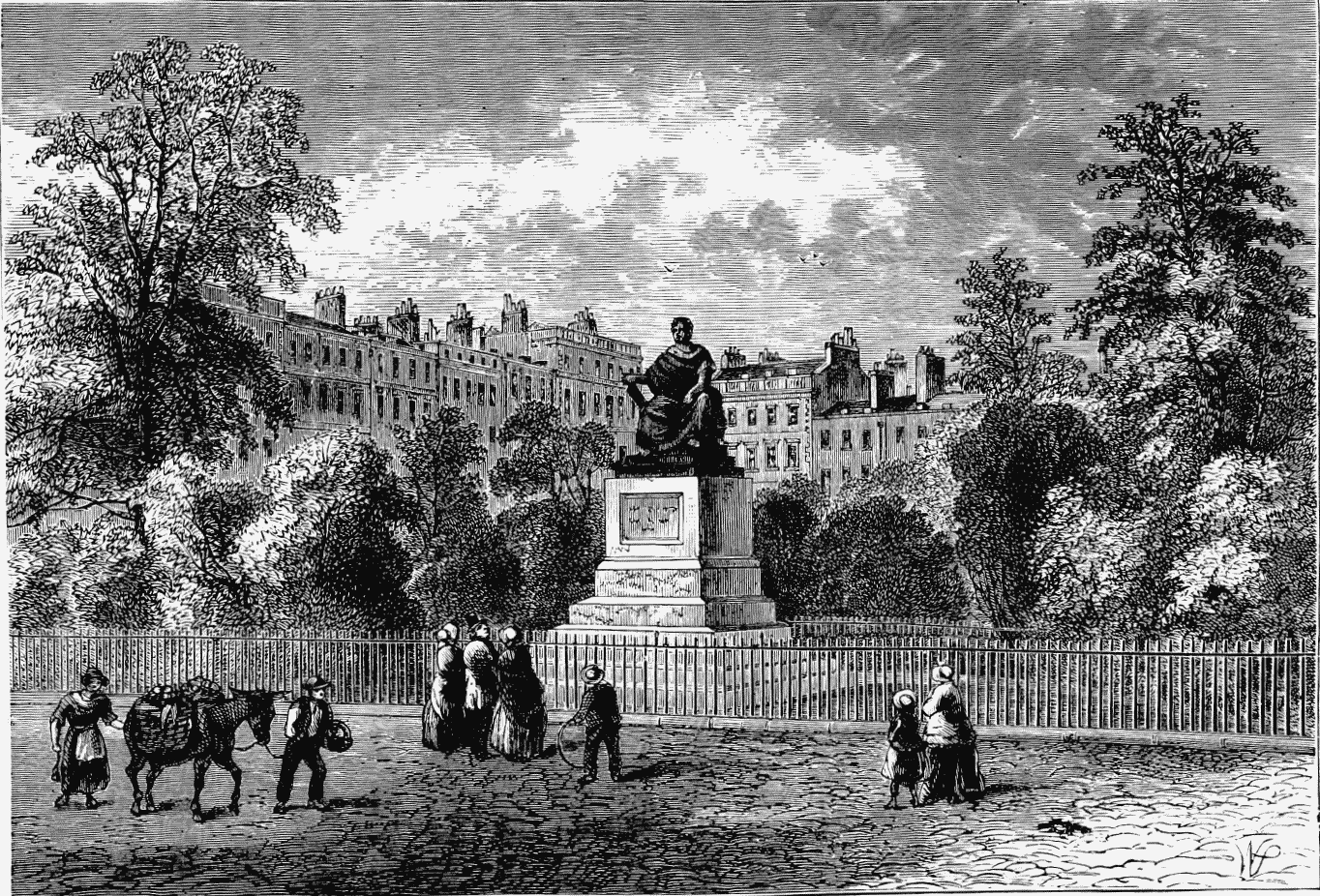
BLOOMSBURY SQUARE.
—"Around what public works I see!
Lo! stately streets. Lo! squares that court the breeze."—Thomson.
Southampton (afterwards Bedford) House—The Patriot Lord Russell and his Noble-hearted Wife—An Historic Romance—Lucy, Countess of Bedford—An Episode in the Life of Anne, Wife of the Fifth Earl of Bedford—John, Fourth Duke of Bedford—Invitations to "take Tea and Walk in the Fields"—A Curious Advertisement—Richard Baxter, the Nonconformist Divine—An Anecdote about Dr. Radcliffe—Fashionable Residents—Poor Sir Richard Steele—Pope's Allusion to Bloomsbury Square—Sir Hans Sloane and his "Curiosities"—The Gordon Riots—Attack on Lord Mansfield's House—Charles Knight's Residence in this Square—Isaac D'Israeli, the Author of "Curiosities of Literature"—His Son, Benjamin Disraeli, born here—Edmund Lodge, the Eminent Biographer—Pharmaceutical Society of Great Britain—The Royal Literary Fund—The Famous Mississippi Schemer, Law—The Statue of Charles James Fox—Bloomsbury Market—Southampton Street and Row—National Benevolent Institution—Bloomsbury Place—Thomas Cadell, the Publisher—The Corporation of the Sons of the Clergy—Hart Street—St. George's Church—Archdeacon Nares—Miss Stride's "Home" for Destitute Girls.
Bloomsbury Square owes its origin to Thomas Wriothesley, Earl of Southampton, the son of Shakespeare's patron and friend, and also the father of Lady Rachel Russell, wife of Lord William Russell, whose tragic death we have recorded as the disgrace of Lincoln's Inn Fields.
Under date of February 9, 1665, Evelyn has the following note in his Diary, touching the building of this square:—"Dined at my Lord Treasurer's, the Earle of Southampton, in Blomesbury, where he was building a noble square or piazza, a little towne; his owne house stands too low, some noble roomes, a pretty cedar chappell, a naked garden to the north, but good aire." It was at first called Southampton Square; and Macaulay places it among the head-quarters of the fashion of the metropolis, in the reign of Charles II. "Foreign princes," he tells us, on the authority of the "Travels of the Grand Duke of Cosmo," "were taken to see the square as one of the wonders of England, whilst Soho Square, just built, was a subject of pride, with which the present generation will hardly sympathise."
Southampton House (afterwards called Bedford House), the residence of the above-mentioned earl, stood on the northern side of the square, and a portion of the ground which it occupied is now covered by some of the outbuildings on the east side of the British Museum. The mansion was not only the scene of the childhood and early life, but also, during many of the years of her widowhood, the home of that illustrious and noble woman, Lady Rachel Russell, many of whose "Letters" are dated from within its walls.
Northouck, the topographer, writing of Bloomsbury Square, in 1772, after the house had changed its name, observes:—"The north side is entirely taken up with Bedford House, which is elegant, though low, having but one storey. It was the work of Inigo Jones. Beside the body of the house are two wings, and on each side the proper offices. The square forms a magnificent area before it, and the grand street in front throws the prospect of it open to Holborn. Behind, it has the advantage of most agreeable gardens, commanding a full view of the rising hills of Hampstead and Highgate; so that it is hardly possible to conceive a finer situation than that of Bedford House."
One of the wings of the house, we are told, formed a magnificent gallery, in which were copies, by Sir James Thornhill, of the cartoons of Raphael, as large as the originals; indeed, the mansion was very rich, for that date, in works of art, both sculptures and paintings. When the house was pulled down, about 1802, its contents were sold, and Sir James Thornhill's cartoons were disposed of for a little under £500! They would fetch a much higher price in the present day, when high art is better appreciated.
The Wriothesleys, Earls of Southampton, were heads of a family who long enjoyed considerable influence in State affairs, and held many important public offices. As far back as the reign of Edward IV. we find John Wriothsley (as the name was then spelt) occupying the post of "Faucon Herald," and as having letters patent for the office of Garter King-at-Arms in the first year of Richard III. His two sons likewise held offices in the College of Arms, and his grandson, Thomas Wriothesley, who was esteemed "a man of learning, and a good lawyer," was elevated to the peerage as Baron Wriothesley, in 1544, and soon afterwards, on the death of the great Lord Audley, constituted Lord Chancellor of England. Three years later his lordship was advanced to the Earldom of Southampton. His son Henry, second earl, was a friend of Thomas, Duke of Norfolk, and involved himself in trouble by promoting the contemplated marriage of that nobleman with Mary, Queen of Scots, "to whom and her religion (says Dugdale) he stood not a little affected." His successor, Henry, third earl, is not only known to history as the friend of Shakespeare in his early days, when he needed friends, but also as the companion in arms of the Earl of Essex, and a participator in the treason by which that unfortunate nobleman forfeited his life in the reign of Elizabeth. Lord Southampton was also tried, condemned, and attainted; but his life was spared. Upon the accession of James I. he was released from prison, restored in blood by Act of Parliament, and created by a new patent, in the year 1603, Earl of Southampton, "with the same rights, precedency, and privileges, that he had formerly enjoyed." His son, Thomas, who succeeded as fourth earl, was a staunch supporter of Charles I., and was the Lord Treasurer mentioned by Evelyn in his note quoted above. His lordship died at Southampton House, "near Holburne, in the suburbs of London," in May, 1667, when his honours became extinct. The mansion remained in the possession of his daughter, Lady Rachel Russell, through whose marriage it passed into the possession of the Duke of Bedford, and afterwards, as we have said, came to be called Bedford House.
Lady William Russell, as every reader of English history knows, was a woman distinguished for her ardent and tender affection, "pious, reflecting, firm, and courageous; alike exemplary in prosperity and adversity, when observed by multitudes, or hidden in retirement." Her firm and noble conduct in attending her husband's trial, for the purpose of taking notes and giving him assistance, have been themes of the highest interest and admiration alike to the historian and the artist. The bitterness of their parting is described in the most pathetic language, and a lasting grief is shown in her subsequent correspondence. Lord William Russell, as we have stated in the previous volume, (fn. 1) was executed in Lincoln's Inn Fields, and his widow lived here in retirement till her death, in the reign of George I., at the age of eighty-six.
Lord Russell's father was the first Duke of Bedford. His Grace came of a good old Dorsetshire family, one member of whom is said to have gained a favourable introduction to Court through one of those unexpected incidents which may be attributed solely to good fortune. Sir Bernard Burke, in his "Peerage," relates how that towards the end of the reign of Henry VII., "the Archduke Philip of Austria, only son of the Emperor Maximilian I., and husband of Joanna, daughter of Ferdinand and Isabella, King and Queen of Castile and Aragon, having encountered a violent hurricane in his passage from Flanders to Spain, was driven into Weymouth, where he landed, and was hospitably received by Sir Thomas Trenchard, knight, a gentleman of rank in the neighbourhood. Sir Thomas immediately apprised the Court of the circumstance, and in the interim, while waiting for instructions what course to adopt, invited his first cousin, Mr. John Russell, then recently returned from his travels, to wait upon the Prince. The Prince, fascinated by Mr. Russell's companionable qualities, desired that he should accompany him to Windsor, whither the King had invited him on a visit. On the journey the Archduke became still more pleased with his attendant's 'learned discourse and generous deportment,' and recommended him strongly to the King. Mr. Russell was, in consequence, taken immediately into royal favour, and appointed one of the Gentlemen of the Privy Chamber. Becoming subsequently a favourite of Henry VIII., and a companion of that monarch in his French wars, Mr. Russell was appointed to several high and confidential offices." He was finally elevated to the peerage in 1538–9, as Baron Russell of Cheneys, Buckinghamshire; and on the dissolution of the monasteries, in the following year, he obtained a grant of the site of the abbey of Tavistock, and of extensive possessions belonging to it. After the accession of Edward VI., Lord Russell had a grant of the monastery of Woburn, in Bedfordshire, and was created Earl of Bedford. Francis, the second earl, was a person of great eminence during the reign of Elizabeth, and three of his sons likewise greatly distinguished themselves; he was succeeded in the earldom by his grandson Edward, son of Francis, Lord Russell.
Lucy, Countess of Bedford, to whom Ben Jonson
addresses several of his best epigrams, sister and
co-heir of the second Lord Warrington, and wife
of Edward, the third earl, was distinguished alike
by the variety of her attainments, and her liberal
patronage of men of genius. Amongst those upon
whom this lady specially bestowed her munificence
were Ben Jonson, Drayton, Daniel, and Donne;
and they have all paid poetical homage to her
merits and her bounty. "Sir Thomas Roe," says
Granger, "has addressed a letter to her as one
skilled in medals; and she is celebrated by Sir
William Temple for projecting the most perfect
figure of a garden that he ever saw." She died in
1627. Ben Jonson thus addresses her:—
"Lucy, you brightness of our sphere, who are
Life of the Muse's day, their morning star!
If works, not th' authors, their own grace should look,
Whose poems would not wish to be your book?"
William, the fifth earl, to whom we now pass, was, in 1694, created Marquis of Tavistock and Duke of Bedford. He married Anne, daughter and sole heiress of Robert Carr, Earl of Somerset, by his too celebrated Countess, Frances Howard, the divorced wife of Essex. "Francis, Earl of Bedford," the father of this nobleman, says Pen nant, "was so adverse to the alliance, that he gave his son leave to choose a wife out of any other family but that. Opposition usually stimulates desire; the young couple's affections were only increased. At length the King interposed, and sending the Duke of Lennox to urge the Earl to consent, the match was brought about. Somerset, now reduced to poverty, acted a generous part, selling his house at Chiswick, plate, jewels, and furniture, to raise for his daughter a fortune of £12,000, which the Earl of Bedford demanded, saying, that since her affections were settled, he chose rather to undo himself than make her unhappy." It is said that the lady was ignorant of her mother's dishonour, till informed of it by a pamphlet, which she accidentally found; and it is added, that she was so struck with this detection of her parent's guilt, that she fell down in a fit, and was found senseless with the book open before her. The duke had by this admirable woman seven sons and three daughters, and the eldest surviving son was the celebrated patriot, Lord William Russell, of whom we have already spoken.
John, the fourth Duke of Bedford, to whom we now pass on, was for some time Lord Lieutenant of Ireland, and subsequently our ambassador to the Court of France, in which character he signed, at Fontainebleau, the preliminaries of peace with France and Spain. His Grace is mentioned by Lady Hervey, in her " Letters," as a " rich great person." He nevertheless had the misfortune of being very unpopular in his day, but he hardly deserved all the invectives with which Junius has " damned him to everlasting fame." In 1748 he gave at Bedford House a masqued ball, said to have been one of the most magnificent that ever had been given; the King, the Duke of Cumberland, and many of the nobility, being present in masquerade.
About this time, it is said that the Duchess of Bedford sent out cards to her guests, inviting them to "take tea and walk in the fields;" and sarcastic persons remarked, that it was expected that syllabubs would soon be milked in Berkeley Square, around the statue of his Majesty. In the same style, we are told that Lady Clermont was not more remarkable for her conversational parties than for her al fresco gatherings. In May, 1773, when living in St. James's Place, she issued invitations to 300 dear friends " to take tea and walk in the Park."
Having said thus much concerning Bedford House, and the families of its successive owners, we now proceed to speak of the other parts of Bloomsbury Square. In 1642, we read, among the forts ordered by the Parliament to be raised around London, of " two batteries and a breastwork at Southampton (afterwards Bedford) House," probably in the present square.
Mr. Peter Cunningham, in his " Handbook of London," quotes one of the advertisements from the London Gazette, No. 946, which we take the liberty of copying here:—" Lost, from my Lady Baltinglasses (sic) house, in the great square of Bloomsbury, the first of this instant December (1674), a great old Indian spaniel or mongrel, as big as a mastiff; he hath curled and black hair all over, except in his fore-feet, which are a little white; he hath also cropt ears, and is bowed and limps a little in one of his fore-feet. If any can bring news thereof, they shall have twenty shillings for their pains."
In this square lived Richard Baxter, the Nonconformist divine, at the time of his persecution by Judge Jefferies; and here his wife died in 1681.
Dr. Mead, in " Richardsoniana," tells an amusing story about Dr. Radcliffe, the celebrated physician, whom we have already had occasion to mention, and who was living in this square when he gave £520 to the poor non-juring clergy. "Dr. Radcliffe," he says, "could never be brought to pay bills without much following and importunity; nor then if there appeared any chance of wearying them out. A paviour, after long and fruitless attempts, caught him just getting out of his chariot at his own door in Bloomsbury Square, and set upon him. 'Why, you rascal!' said the Doctor, 'do you pretend to be paid for such a piece of work? Why, you have spoiled my pavement, and then covered it over with earth, to hide your bad work!' 'Doctor!' said the paviour, 'mine is not the only bad work the earth hides.' 'You dog, you!' said the Doctor, 'are you a wit? You must be poor; come in'—and paid him."
Our readers will have already gathered from Macaulay's remark quoted above, that in Queen Anne's reign this neighbourhood could dispute for the palm of fashion with Lincoln's Inn Fields and Soho Square, and not without good reason; for at this time not only did the Russells live in Bloomsbury Square, but also Lord Paget, Lord Carleton, and the Earl of Northampton. Lord Mansfield's house was at the north-east corner. Lord Ellenborough, when Chief Justice, lived at the corner house of Bloomsbury Square and Orange Street, before he removed to St. James's Square; and Lord Chief Justice Trevor occupied a house on the west side of the square.
At his house here, in 1713, died Philip, second Earl of Chesterfield, the same who figures as a member of the Court of Charles II. and James II., in the "Memoirs" of Count Grammont. In June of the above year, too, Sir Richard Steele was living in this square, as shown by the date of a letter, republished in fac-simile in Smith's "Historical and Literary Curiosities." Having already burdened himself—as we have said—with a small house near Jermyn Street, for which he was unable to pay, (fn. 2) Sir Richard, in 1712, could not content himself without taking a much larger, finer, and grander house in Bloomsbury Square; and here again he got into still greater difficulties than before. It is recorded that, on giving a grand entertainment in his new mansion, he engaged half-a-dozen queerlooking individuals to wait at table on his noble and distinguished guests, to whom he coolly confessed that "his lacqueys were bailiffs in disguise to a man." "I fared like a distressed prince," writes the kindly prodigal, in the Tatler, generously complimenting Addison for his assistance—"I fared like a distressed prince who calls in to his aid a powerful neighbour. I was undone by my auxiliary; when I had once called him in, I could not submit without dependence on him." "Poor needy Prince," writes Thackeray, tenderly; "think of him with pity in his palace, with his allies from Chancery Lane thus ominously guarding him!" The same incident is said to have occurred a century later to another man of letters, Richard Brinsley Sheridan. (fn. 1)
Pope, who was at this period at the height of his
fame, thus alludes to this once fashionable quarter
of the town:—
"In Palace-yard, at nine, you'll find me there;
At ten, for certain, sir, in Bloomsbury-square."
Here, in the early part of the last century, lived Dr.
Akenside and Sir Hans Sloane, already mentioned
as the founder of the British Museum. The house
of the latter was on the south side of the square,
and here Dr. Franklin came to see Sloane's
"curiosities," "for which," says Franklin, "he paid
me handsomely."
In the Gordon Riots of June, 1780, the neighbourhood of Bloomsbury gained a sad notoriety as one of the chief points of attack by the infuriated mob, which, in its zeal for the Protestant faith, very nearly laid London in ruins, being guilty, as Sir N. W. Wraxall remarks, of grosser and more senseless outrages than even the fiends of Paris in the first great Revolution. In the following account he writes with all the vividness of an eye-witness of these fearful scenes:—"I was personally present at many of the most tremendous effects of the popular fury on the memorable 7th of June, the night on which it attained its highest point. About nine o'clock on that evening, accompanied by three other gentlemen, who, as well as myself, were alarmed at the accounts brought in every moment of the outrages committed, and of the still greater acts of violence meditated, as soon as darkness should favour and facilitate their further progress, we set out from Portland Place, in order to view the scene. Having got into a hackney-coach, we drove to Bloomsbury Square, attracted to that spot by a rumour, generally spread, that Lord Mansfield's residence, situate at the north-east, was either already burnt, or destined for destruction. Hart Street and Great Russell Street presented each to the view, as we passed, large fires composed of furniture taken from the houses of magistrates, or other obnoxious individuals. Quitting the coach, we crossed the square, and had scarcely got under the wall of Bedford House, when we heard the door of Lord Mansfield's house burst open with violence. In a few minutes, all the contents of the apartments being precipitated from the windows, were piled up and wrapt in flames. A file of foot-soldiers arriving, drew up near the blazing pile, but without either attempting to quench the fire or to impede the mob, who were, indeed, far too numerous to admit of their being dispersed, or even intimidated, by a small detachment of infantry. The populace remained masters, while we, after surveying the spectacle for a short time, moved on into Holborn, where Mr. Langdale's dwelling-house and warehouses afforded a more appalling picture of devastation. They were altogether enveloped in smoke and flame. In front had assembled an immense multitude of both sexes, many of whom were females, and not a few held infants in their arms. All appeared to be, like ourselves, attracted as spectators solely by curiosity, without taking any part in the acts of violence. The kennel of the street ran down with spirituous liquors, and numbers of the populace were already intoxicated with this beverage. So little disposition, however, did they manifest to riot or pillage, that it would have been difficult to conceive who were the authors and perpetrators of such enormous mischief, if we had not distinctly seen, at the windows of the house, men who, while the floors and rooms were on fire, calmly tore down the furniture and threw it into the street, or tossed it into the flames. They experienced no kind of opposition during a considerable time that we remained at this place; but a party of the Horse Guards arriving, the terrified crowd instantly began to disperse, and we, anxious to gratify our curiosity, continued our progress on foot, along Holborn, towards Fleet Market."
Lord and Lady Mansfield, we are told, narrowly escaped falling into the hands of the lawless and infuriated mob, and only just succeeded in beating a retreat by a back door. His lordship's valuable library was destroyed; indeed, "even the civilisation of the eighteenth century," writes Mr. D'Israeli, in his " Curiosities of Literature," "could not preserve from the savage and destructive fury of a disorderly mob, in the most polished city of Europe, the valuable papers of the Earl of Mansfield, which were madly consigned to the flames."

ISAAC D'ISRAELI.
Whilst all these riots were proceeding, we are told, George III. was at the Queen's Palace; nevertheless, the author of "Biographiana" states, without reserve or qualification, that "in these disgraceful riots the property and buildings of the metropolis were preserved by the spirited behaviour of the Sovereign." Yet it is difficult to see that the King had any claim to spirited conduct except negatively; at all events, Dr. Johnson wrote at the time to Mrs. Thrale thus:—" The King said in Council that the magistrates had not done their duty, but that he would do his own; and a proclamation was accordingly published, directing us to keep our servants within doors, as the peace was now to be preserved by force. The soldiers were sent out to different parts, and the town is now quiet." Readers of " Barnaby Rudge" will not have forgotten Charles Dickens' description of the Gordon Riots.
Lord Mansfield was one of Pope's executors,
and Lady Lepel Hervey in her "Letters" makes
allusions to his "artful eloquence"—meaning,
elaborate and artificial; for we may be sure that he
did not forget the words of Pope to himself—
"Plain truth, dear Murray, needs no flowers of speech."

ST. GEORGE'S CHURCH, BLOOMSBURY.
"His lordship's night of life," writes Cradock, "was disturbed by many difficulties; yet he had undoubtedly many blessings to counterbalance them. Though his house was burnt down in Bloomsbury Square, he still possessed an elegant seat and extensive domain in the neighbourhood of London; and his nephew and heir, Lord Stormont, was appointed as the representative of Majesty at the Court of France. He lived to much greater age than could have been expected, and died in the zenith of his fame; and his memory has been embalmed by the testimonies of some of the wisest and best of his contemporaries. Pope had celebrated him in a well-known distich, and other poets, haud passibus æquis, had followed in the train. Lord Chesterfield, in glowing terms, had freely spoken of the rising talents both of Mr. Pitt and Mr. Murray, in a letter to his son: 'No man,' says he, 'can make a figure in this country but by Parliament. Your fate depends on your success as a speaker, and, take my word for it, that success turns much more upon manner than matter. Mr. Pitt, and Mr. Murray, the Solicitor General, are, beyond compare, the best speakers.'" It has been thought strange that Lord Mansfield's will should be written only by himself on half a sheet of paper, and that the contents there enumerated, in neglect of all the forms of legal practice, should have proved valid for the disposal of half a million of property.
Of other residents of Bloomsbury Square in more recent times, may be mentioned Charles Knight, who, in 1826, lived at No. 29, when helping to lay the foundation of the Society for the Diffusion of Useful Knowledge; and Isaac D'Israeli, the author of the "Curiosities of Literature," who at that time occupied the house No. 6, which, strange to say, appears to have lately reverted to Jewish associations, as its present occupant is a Mr. Tabernacle. D'Israeli lived here for many years before he settled down as a country gentleman in Buckinghamshire; and here his gifted son was born in December, 1804. "In London," says that son, "my father's only amusement was to ramble about among the bookseller's shops; and if he ever went into a club, it was only to go into the library." With regard to the younger D'Israeli—the future Premier of England—it may be stated that as a child he used to toddle and run about the enclosure of the square with his nursemaid; and at a fit age was sent to a small school, first at Islington, and afterwards at Walthamstow, at a seminary kept by a clergyman of Unitarian opinions, where he used to keep his schoolfellows awake at night by telling them ghoststories. In the register of the Portuguese Synagogue for 1805, the name of Benjamin D'Israeli occurs in the January of that year, as having been initiated into the Jewish Church when only eight days old. When about fourteen years of age he exchanged Judaism for Christianity, being baptised at the Church of St. Andrew's, Holborn. He next spent a year or two as a clerk in a solicitor's office in the City, in the neighbourhood of Old Jewry and the present Moorgate Street; and then, before he was twenty-one, had astonished the world by editing a journal of Radical sentiments, and publishing the novel of "Vivian Grey." Mr. Disraeli, in the course of one of his speeches at Taunton, made an uncomplimentary reference to Daniel O'Connell, then in the zenith of his fame. The agitator, a few days after, returned his invective with interest, and declared, alluding to Disraeli's Hebrew origin, that "he made no doubt that, if his genealogy could be traced, he would be found to be the true heir-atlaw of the impenitent thief on the cross." The reply to this outrage was a challenge, not to the speaker, who was known uniformly to decline duelling, but to his son. No, duel, however, took place; but the correspondence was published in the newspapers. A published letter, written to O'Connell by Disraeli, concluded with the magniloquent boast, "We shall meet at Philippi." This prophecy was fulfilled, in 1837, by the return of Disraeli for Maidstone. Of his subsequent Parliamentary career we have already spoken. (fn. 4)
At his house in this square, in January, 1839, died, at an advanced age, Edmund Lodge, Clarenceux King of Arms, the author of the "Peerage" which bears his name. This eminent biographer became a cornet in the King's Own regiment of Dragoons, in 1772; but having a pure taste for antiquities and literature, he left the army, and obtained the situation of Blue Mantle Pursuivantat-Arms. He was subsequently promoted to the offices of Lancaster Herald, Norroy, and Clarenceux, and was created a Knight of the Hanoverian Guelphic Order. Among his other literary productions may be mentioned, "Illustrations of British History;" "The Life of Sir Julius Cæsar;" "Memoirs of Illustrious Personages of Great Britain;" and many other works of the greatest merit, learning, and research.
The house at the north-west corner of the square forms the head-quarters of the Pharmaceutical Society of Great Britain, which was instituted "for the purposes of uniting the chemists and druggists into one ostensible, recognised, and independent body for protecting their general interests, and for the advancement of pharmacy, by furnishing such an uniform system of education as shall secure to the profession and to the public the safest and most efficient administration of medicine." A royal charter of incorporation was granted in 1843, in which, in addition to the above, the objects of the society were declared to include the providing a fund for the relief of distressed members and associates, and of their widows and orphans. The society has an excellent library and museum, and a laboratory. The museum claims to be very extensive, comprising rare specimens of the animal, vegetable, and mineral kingdoms, and substances and products used in medicine and pharmacy. It contains also groups and series of authenticated specimens, valuable for identifying, comparing, and tracing the origin and natural history of products. The museum includes the valuable collections of Cinchona barks made by eminent foreign naturalists, and formerly belonging to the late Dr. Jonathan Pereira.
In the above house, down to about 1862, was for many years carried on the work of the Royal Literary Fund. The object of this society, which is now located in John Street, Adelphi, is to administer assistance to authors of genius and learning, who may be reduced to distress by unavoidable calamities, or deprived by enfeebled faculties or declining life of the power of literary exertion. This assistance is extended at the death of an author to his widow and children. In the application of this liberality the utmost caution is used, both as to the reality of the distress and the merits of the individual. No writer can come within the views of the society who has not published a work of intelligence and public value, or been an important contributor to periodical literature; and every author, without exception, is excluded whose writings are offensive to morals or religion, and whose personal character is not proved by satisfactory testimony to be beyond suspicion. The business of the society is transacted by a committee; the most anxious consideration is given to the feelings of individuals; all names, and all circumstances which might lead to names, are carefully suppressed, and every precaution taken to avoid distressing publicity. The bounty of this institution is bestowed without regard to national or political distinctions. Here the Council of the Fund showed a small collection of curiosities and treasures, among which were the two daggers employed by Colonel Blood and his accomplice Parrot in their attempts to seize upon the crown and the other regalia in the Tower, in the reign of Charles II.
This square has not been known merely by the names of Southampton and Bloomsbury, but its different sides have been separately named: for instance, at one time the east side was called Seymour Row; the west was known as Allington, or Arlington, Row; and the south side was called Vernon Street. The latter name is still retained in Vernon Place, at the south-east corner of the square. On account of its remoteness from houses, the site now covered by this square, like the fields at the back of old Montagu House, was in former times—particularly in the reign of William III.—often chosen by the "gallants" and "bloods" of the period as a place for the settlement of "affairs of honour" with pistols and swords. Here the financial adventurer named Law, subsequently so famous as the Mississippi schemer, having picked up a quarrel with his antagonist, killed the "magnificent and mysterious Beau Wilson" in a duel.
The centre of the square is laid out in grass plats, planted with plane-trees and shrubs. On the north side of the enclosure, facing Bedford Place, is a fine bronze statue of Charles James Fox, by Sir Richard Westmacott, set up in 1816. This statue, which rests upon a granite pedestal, is considered to be one of Westmacott's best productions. Dignity and repose appear to have been the leading objects of the artist's ideas. "The English sculptors," writes the French author of a "Tour in England" in 1825, "have generally disguised their statues of historical personages by certain anachronisms in costume. Thus we see the Charleses and the Jameses clothed in the Roman toga, the royal periwigs being disregarded, an omission very creditable to the taste of the artist, though in our (French) busts and statues of Louis XIV. a wig usually encircles the brow of Le Grand Monarque." There is nothing offensive, however, in the figure of Charles James Fox, represented as he is in a consular robe, for there was a certain degree of Roman eloquence in the Parliamentary speeches of that great leader. He is represented as seated, with his right arm extended, and supporting Magna Charta. His name forms the only inscription on the pedestal, but that name alone is sufficient to enshrine his memory. The countenance is said to present a striking resemblance to the original. The attitude is dignified, and the statue, as a whole, reflects great credit on the genius of Westmacott.
At the south-west corner of the square was Bloomsbury Market, built by one of the Russell family for the accommodation of that part of the town. Although the market has long been discontinued, it is still kept in remembrance by one of the streets on the site being called Market Street.
Southampton Street, which connects this square with Holborn, witnessed the birth of Colley Cibber, in November, 1671. At the south-west corner of this street, with its principal entrance in Holborn, is the Chief Post and Telegraph Office of the Western Central District. At a short distance eastward is Southampton Row, a broad and wellbuilt thoroughfare extending from High Holborn to Russell Square. It was formerly known as King Street, and is described in the "New View of London," published in 1708, as a "spacious and pleasant street between High Holborne and the fields to the north." At No. 65, on the west side, are the offices of the National Benevolent Institution. This institution was founded by the late Peter Hervé, and established in 1812, with the view of affording relief, by annual pensions, to distressed and aged gentry, merchants, tutors, and governesses, and persons who have been engaged in professional pursuits, or in the higher departments of trade. The unfortunate Dr. Dodd was at one time a resident in this row.
Connecting Southampton Row with the northeast corner of Bloomsbury Square is Bloomsbury Place. At his residence here, in 1802, died Mr. Thomas Cadell, the eminent publisher of the Strand. He was the publisher of the first edition, and of many consecutive editions, of Gibbon's "Decline and Fall of the Roman Empire." At No. 2, in Bloomsbury Place, are the offices of the Corporation of the Sons of the Clergy. This institution was established in 1655, and incorporated by Royal Charter in 1678, for the purpose of "relieving necessitous clergymen, pensioning their widows and aged single daughters, and educating, apprenticing, and providing outfits for their children." The pensions and donations are granted by the Court of Assistants, after investigation of the merits of each case; and it may be interesting to learn that the number benefited by this institution in the course of a year amounts to upwards of one thousand. The Festival of the Sons of the Clergy, which has been already mentioned in our account of St. Paul's Cathedral, (fn. 5) commenced in 1655, and was virtually the basis of the above-mentioned corporation. The proceeds of these festivals are placed at the disposal of the corporation for the apprenticing of the sons and daughters of necessitous clergymen in situations of credit and respectability, and other analogous purposes which the committee may approve. The stewards of the festival contribute a sum of not less than thirty guineas towards the expenses of the festival, and are subsequently elected governors of the corporation.
Hart Street—a fine and broad thoroughfare
running from New Oxford Street into the southwest corner of Bloomsbury Square—is destined to
form, along with Vernon Place, Theobald's Road,
and other streets through the parish of Clerkenwell, a continuous line of route through Northern
London to Shoreditch and Hackney. Hart Street
was probably so named—like Hart Street, Covent
Garden—from an inn bearing the sign of the
"White Hart," which may have stood there. On
the north side of this street stands the Church of
St. George. To use the words of the "Pocket
Guide to London," this church "enjoys the privilege of being at once the most pretentious and the
ugliest ecclesiastical edifice in the metropolis. All
the absurdities of the classic style are here apparent. It was designed by Hawkesmoor, the pupil
of Sir C. Wren, and was completed in 1731. The
architect chose for his model the description given
by Pliny of the tomb of Mausolus, in Caria; but
if the original possessed all the faults of the copy,
we can scarcely understand its having been considered one of the seven wonders of the world,
unless viewed in the light of a monstrosity.
This church has a tower and steeple at the side
of the main edifice: upon the former, at the four
sides, is a range of Corinthian pillars, placed there
apparently for no earthly use. The steeple consists
of a series of steps, with the royal arms, guarded
by excessively fierce-looking lions and unicorns,
and on the summit is a statue of King George I.
in a Roman costume." The statue of the king is
said to have been the gift of a loyal brewer, Mr.
William Hucks, sometime M.P. for Abingdon and
Wallingford. On the statue being placed in its
exalted situation a wag wrote the following epigram
on it:—
"The King of Great Britain was reckoned before
The 'Head of the Church' by all good Christian people;
But his brewer has added still one title more
To the rest, and has made him the 'Head of the
Steeple!'"
Horace Walpole, who speaks of this steeple as
"a master-stroke of absurdity, consisting of an
obelisk, crowned with the statue of King George I.,
and hugged by the royal supporters," treats us with
the following version of the same epigram:—
"When Harry the Eighth left the Pope in the lurch,
The people of England made him 'Head of the Church;'
But George's good subjects, the Bloomsbury people,
Instead of the Church made him 'Head of the Steeple.'"
The steeple as applied to a building on the Grecian or Roman plan is always absurd, and even Sir C. Wren could not always rescue it from deserved and contemptuous criticism; but Hawkesmoor appears to have been the only architect who ventured to place this part of the structure at the side instead of making it rise out of the building.
The front of the church, facing Hart Street, has a grand portico, elevated on a flight of steps, which support six Corinthian columns. The church is singular from its standing north and south; hence, contrary to the established custom, the altar stands at the north end; so that, in this case at least, the "eastward position" is not rigidly carried out. The fabric is of too recent erection to contain many monuments or objects of interest; there is, however, in it a tablet to the memory of the great Lord Mansfield.
At his residence in Hart Street, in 1829, died Archdeacon Robert Nares, librarian of the MSS. in the British Museum, and the learned editor of part of the "Catalogue of the Harleian Miscellany," and for many years joint editor of the British Critic. He was the son of Dr. James Nares, many years organist and composer to George II. and George III. He was a busy and voluminous writer, an acute critic, and a Fellow of the Royal and other learned societies.
At No. 17, in this street, are the offices of Miss Stride's Home in Great Coram Street, which was instituted for the training and supporting of destitute girls, for the reformation of fallen women, and for the purpose of aiding women on their discharge from prison.