Old and New London: Volume 4. Originally published by Cassell, Petter & Galpin, London, 1878.
This free content was digitised by double rekeying. Public Domain.
Edward Walford, 'Red Lion Square and neighbourhood', in Old and New London: Volume 4(London, 1878), British History Online https://www.british-history.ac.uk/old-new-london/vol4/pp545-553 [accessed 2 May 2025].
Edward Walford, 'Red Lion Square and neighbourhood', in Old and New London: Volume 4(London, 1878), British History Online, accessed May 2, 2025, https://www.british-history.ac.uk/old-new-london/vol4/pp545-553.
Edward Walford. "Red Lion Square and neighbourhood". Old and New London: Volume 4. (London, 1878), British History Online. Web. 2 May 2025. https://www.british-history.ac.uk/old-new-london/vol4/pp545-553.
In this section
CHAPTER XLII.
RED LION SQUARE, AND ITS NEIGHBOURHOOD.
"Where the 'Red Lion' frowns upon the way."—Crabbe.
Red Lion Square in the Last Century—The Old "Red Lyon" Inn—A Quack Doctor's "Puff"—The Fate of the Regicides: Cromwell, Ireton, and Bradshaw—An "Old Lady of Quality"—Lord Raymond, Jonas Hanway, and Sharon Turner, Residents in this Square—An Antiquated Law Court—London Infirmary for Diseases of the Legs—A Batch of Charitable and Provident Institutions—Milton a Resident in this Neighbourhood—Eagle Street—Martin Van Butchell, the Eccentric Quack Doctor—Fisher and Kingsgate Streets—A Royal Misadventure—Messrs. Day and Martin's Blacking Manufactory—The Holborn Amphitheatre—Red Lion Street—Theobald's Road—Lamb's Conduit Street—Lamb's Conduit rebuilt—Its Removal—Lamb's Conduit Fields—Harpur Street—Milman Street—The Chevalier D'Eon—Doughty Street—Charles Dickens a Resident here—John Street Baptist Chapel—St. John's Episcopal Chapel the Head-quarters of Fashionable Evangelicalism—The Gray's Inn Cock-pit—Bedford Row—The Entomological Society—Bedford Street—Featherstone Buildings—Hand Court—Brownlow Street—The Duke's Theatre—Warwick Court.
To the south-east of Bloomsbury Square, surrounded by a nest of narrow alleys between it and Holborn, is Red Lion Square, described by Northouck as a "neat, small square, much longer than it is broad," and having "convenient" streets entering it on three sides, with foot-passages at the corners. It had at that time (1786) not only in the centre a plain obelisk, but a stone watch-house at each corner, all of which have long been swept away. Although respectable, the square has a very dull appearance, which is thus whimsically portrayed by the author of "Critical Observations on the Buildings, &c, of London," published about the middle of the last century:—"I never go into it without thinking of my latter end. The rough sod that 'heaves with many a mouldering heap,' the dreary length of its sides, with the four watchhouses like so many family vaults at the corners, and the naked obelisk that springs from amid the rank grass, like the sad monument of a disconsolate widow for the loss of her first husband, all form together a memento mori, more powerful to me than a death's head and cross marrow-bones; and were but a parson's bull to be seen bellowing at the gate, the idea of a country churchyard, in my mind, would be complete."
Hatton, in 1708, describes it as "a pleasant square of good buildings, between High Holborn south and the fields north;" and Pennant, writing in 1790, says that in the centre was "a clumsy obelisk, lately vanished."
The "Red Lyon" Inn was in olden times the most important hostelry in Holborn, and accordingly had the honour of giving its name to Red Lion Street and to the adjoining square. If we may draw an inference from the entries in the register of St. Andrew's, Holborn, the inn had behind it a fine row of trees, for we find notices of foundlings being exposed under the "Red Lion Elmes in Holborn." The "Red Lyon" is mentioned in the following "puff" of a quack doctor, at the beginning of the last century:—"Cornelius Tilbury, sworn Chirurgeon in ordinary to K. Charles II., to his late Sovereign K. William, as also to her present Majesty Queen Anne," gives his address as "at the Blue Flower Pot, in Great Lincoln's Inn Fields, at Holbourn Row (where you see at night a light over the door). …And for the convenience of those that desire privacy, they may come through the Red Lyon Inn, in Holbourn, between the two Turnstiles, which is directly against my back door, where you will see the sign of the Blue Ball hang over the door. I dispose of my famous Orvietan, either liquid or in powder, what quantity or price you please. … This is that Orvietan that expelled that vast quantity of poyson I took before K. Charles II., for which his Majesty presented me with a gold medal and chain."
The story that some of the regicides were buried in Red Lion Square has been extensively believed; it is told by Mr. Peter Cunningham, with a little variety, as follows:—"The bodies of Oliver Cromwell, Ireton, and Bradshaw were carried from Westminster Abbey to the Red Lion Inn, in Holborn, and the next day dragged on sledges thence to Tyburn." In support of this story he quotes Wood's "Athenæ Oxonienses," and the additional MSS. in the British Museum, where those who are curious in such matters will find the narrative.
On the fate of Cromwell's head we have already quoted at some length in the preceding volume. (fn. 1) It is the opinion of a writer in the Times, that if the body of Cromwell was removed from the Abbey and buried in Red Lion Square, it is not probable that another embalmed body could have been procured for the purpose of being sent as its substitute to Tyburn, as has been suggested.
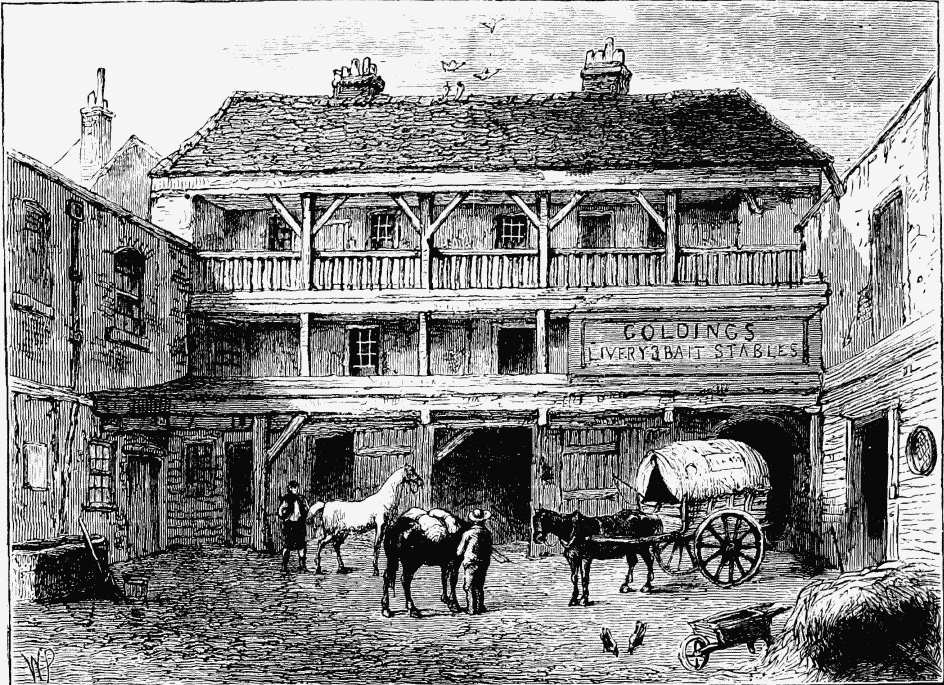
THE OLD "BLACK BULL INN," GRAY'S INN LANE.
Pennant, as we have observed, speaks of the "clumsy obelisk" in Red Lion Square, and mentions that it was inscribed with the following lines:—"Obtusum Obtusioris Ingenii Monumentum. Quid me respicis, viator? Vade." "Could this quaint inscription," asks Mr. Jesse, in his "London," "have any hidden reference to the bones of Cromwell lying beneath it? We think not; but they are meant to mystify; and what, therefore, do they mean?" Mr. Jesse is inclined, however, in spite of his scepticism as to the inscription, to agree with those who believe in the tradition that the body of Cromwell was buried beneath this obelisk, and that upon this spot not improbably moulder, not only the bones of the great Protector, but also those of Ireton and Bradshaw, whose remains were disinterred at the same time from Westminster Abbey, and exposed on the same gallows. He strengthens this supposition by observing that the contemporary accounts of the last resting-place of these remarkable men simply inform us, that on the anniversary of the death of Charles I. their bodies were borne on sledges to Tyburn, and after hanging till sunset they were cut down and beheaded; that their bodies were then flung into a hole at the foot of the gallows, and their heads fixed upon poles on the roof of Westminster Hall. "From the word Tyburn being so distinctly laid down," Mr. Jesse adds, "it has usually been taken for granted that it was intended to designate the well-known place for executing criminals, nearly at the north end of Park Lane, or, as it was anciently styled, Tyburn Lane. However, when we read of a criminal in old times having been executed at Tyburn, we are not necessarily to presume that it was at this particular spot, the gallows having unquestionably been shifted at times from place to place, and the word Tyburn having been given indiscriminately, for the time being, to each spot. For instance, sixty years before the death of Crom well the gallows were frequently erected at the extremity of St. Giles's parish, near the end of the present Tottenham Court Road; while for nearly two centuries the Holborn end of Fetter Lane, within a short distance of Red Lion Square, was no less frequently the place of execution. Indeed, in 1643, only a few years before the exhumation and gibbeting of Cromwell, we find Nathaniel Tomkins executed at this spot for his share in Waller's plot to surprise the City. In addition, however, to these surmises is the curious fact of the bodies of Cromwell and Ireton having been brought in carts, on the night previous to their exposure on the gibbet, to the Red Lion Inn, Holborn, from which Red Lion Square derives its name, where they rested during the night. In taking this step, it is surely not unreasonable to presume that the Government had in view the selection of a house in the immediate vicinity of the scaffold, in order that the bodies might be in readiness for the disgusting exhibition of the following morning. Supposing this to have been the case, the place of their exposure and interment could scarcely have been the end of Tyburn Lane, inasmuch as the distance thither from Westminster is actually shorter than the distance from Westminster to Red Lion Square. The object of the Government could hardly have been to create a sensation by parading the bodies along a populous thoroughfare, inasmuch as the ground between St. Giles's Pound and Tyburn, a distance of a mile and a half, was at this period almost entirely open country."
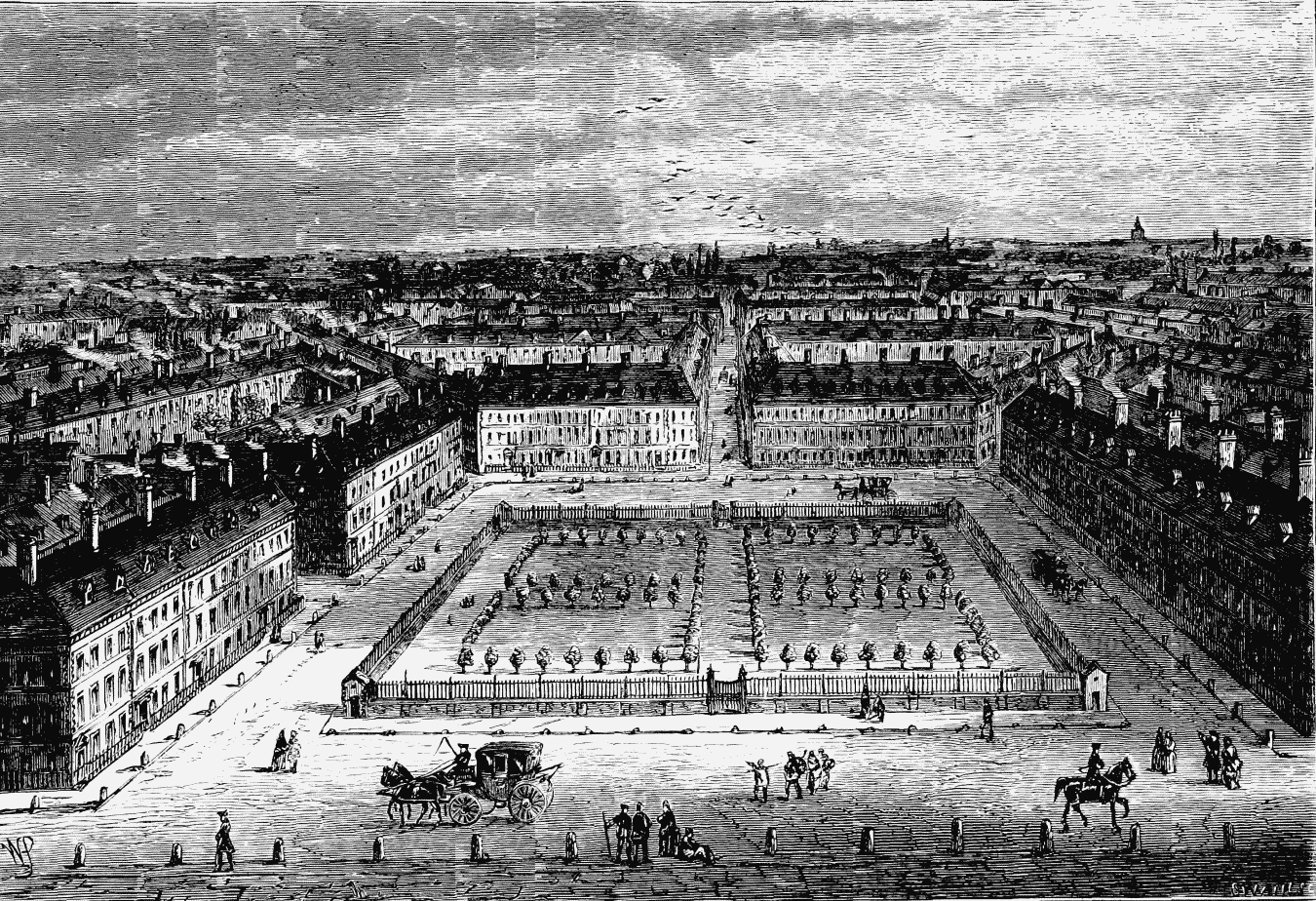
RED LION SQUARE IN 1800.
This story of the disposal of Cromwell's body, if
true, negatives the well-known lines of Dryden:—
"His ashes in a peaceful urn shall rest."
In Rede's "Anecdotes and Biography," published just before the close of the last century, it is stated that the obelisk was thought to be a memorial erected to Cromwell by an apothecary who was attached to his principles, and had so much influence in the building of the square as to manage the marking out of the ground, thus further contriving to pay this tribute to his favourite. Curiously enough, it has been discovered that an apothecary named Ebenezer Heathcote, who had married the daughter of one of Ireton's sub-commissaries, was living at the King's-gate, Holborn, soon after the Restoration.
Leigh Hunt has left a curious reminiscence of an "old lady of quality," who lived in this square, "a quarter in different estimation from what it is now." She astounded him one day by letting her false teeth slip out, and clapping them in again. It was at her house, he adds, that his father one evening met John Wilkes. Not knowing him by sight, and happening to fall into conversation with him, while the latter sat looking down, he said something in Wilkes's disparagement, on which the jovial demagogue looked up in his face, and burst out laughing. In this square lived, in the last century, Lord Raymond, the Chief Justice of the Court of King's Bench. Here too, says Mr. Peter Cunningham, lived, and here, in 1786, died the benevolent Mr. Jonas Hanway, the eccentric traveller, remarkable as "the first person who ventured to walk in the streets of London with an umbrella over his head." We have already spoken at some length of this celebrity in dealing with Hanway Street. (fn. 2) The principal rooms in Hanway's house were decorated with paintings and emblematical devices, "in a style," says his biographer, "peculiar to himself. I found," he used to say, when speaking of these ornaments, "that my countrymen and women were not au fait in the art of conversation; and that instead of recurring to their cards when the discourse began to flag, the minutes between the time of assembling and the placing of the card-tables are spent in an irksome suspense. To relieve this vacuum in social intercourse, and prevent cards from engrossing the whole of my visitors' minds, I have presented them with objects the most attractive I could imagine; and when that fails there are the cards." At No. 32 in this square, the house at the corner of North Street, lived, for many years in the present century, Sharon Turner, the author of "The Sacred History of the World." He was a solicitor in practice, as well as an historian; he died here in 1847. Besides his "Sacred History," he was the author of the "History of England from the Earliest Period to the Death of Elizabeth," consisting of several works, each published separately and independently—namely, the "History of the Anglo-Saxons," "History of England in the Middle Ages," "History of the Reign of Henry VIII.," and "History of the Reigns of Edward VI., Mary, and Elizabeth."
Besides the ordinary Superior Courts, so well known by name to every reader, there is in existence in Red Lion Square, at the house at the north-east corner, an ancient Baronial Court, held under the authority of the Sheriffs of Middlesex. "It is held monthly" (says the Gentleman's Magazine in 1829) "before the Sheriff or his deputy. Its power in judgment is as great as that of the present Courts at Westminster. It is more expeditious and less expensive; persons seeking to recover debts may do so to any amount at the trifling expense of only six or seven pounds. Nor is it confined to actions of account; it extends to detenue, trover, scandal, &c., and personal service of process is unnecessary. This Court was instituted," adds the writer, "by King Alfred on dividing the kingdom into shires, and subsequently continued and sanctioned by Canute the Dane, by William the Conqueror, and various statutes, including Magna Charta; and is treated upon by several eminent legal authorities, as Judge Hale, Judge Lambert, and many others."
The author of "A Tour through Great Britain" says, "This present year, 1737, an Act was passed for beautifying Red Lyon Square, which had run much to decay." Though the square has at this time a decayed aspect, there is a picturesqueness and a touch of sentiment about it not to be found in squares of a higher grade through which we have passed. The variety of the houses, dilapidated and disfigured as some of them are, is more interesting than the even respectability of continuous brick walls and unbroken roofs. Besides the old Sheriff's Court, mentioned above, several other houses in this square are, or have been, devoted to public and charitable purposes. Here, for instance, is the London Infirmary for Diseases of the Legs, Ulcers, &c., which was instituted in 1857, under the auspices of Miss Florence Nightingale. It is said to be the only infirmary of the kind in the United Kingdom where patients suffering from these painful and tedious maladies are received, and it is dependent entirely on voluntary support. The value and importance of this institution is shown by the increased number of patients not only from London and the suburbs, but likewise from various parts of England; the average attendance throughout the year amounting to upwards of 28,000.
The whole of the square, having long since been deserted by the families who used to inhabit it, has become quite a warren, so to speak, of charitable societies, which we have no room to enumerate in detail.
Milton at two different periods of his life was a resident in this immediate neighbourhood, and on both occasions he occupied houses looking upon the green fields. The first time that he resided here was in 1647, when his house "opened backwards into Lincoln's Inn Fields," where it was that he principally employed himself in writing his virulent tirades against monarchy and Charles I. The second occasion of his residing here was after the Restoration, when we are told the front of his humble dwelling looked into Red Lion Fields, the site of the present Red Lion Square.
To the south of Red Lion Square, and parallel to it, half way between the square and Holborn, and separating Dean and Leigh Streets, is Eagle Street. Here was born Martin Van Butchell, the eccentric quack doctor and dentist, of whom we have already spoken in our account of Mount Street, Grosvenor Square. (fn. 3)
At the south-west corner of the square is Fisher Street, leading into Kingsgate Street, which opens into Holborn. Hatton, in 1708, says that Kingsgate Street was "so called because the king used to go this way to New Market." He adds, "Some call the easterly end of this street Theobald's Road." This street would seem to have witnessed one royal misadventure at the least; for under date 8th of March, 1668–9, Pepys writes in his "Diary:"—"To Whitehall, from whence the King and the Duke of York went by three in the morning, and had the misfortune to be overset with the Duke of York, the Duke of Monmouth, and the Prince [Rupert], at the King's Gate, in Holborne; and the king all dirt, but no hurt. How it came to pass I know not, but only it was dark, and the torches did not, they say, light the coach as they should."
Between Kingsgate and Dean Streets, extending back into Eagle Street, and with their principal entrance facing Holborn, are the extensive premises of Messrs. Day and Martin, the well-known blacking manufacturers. Mr. Charles Day, the founder of this establishment, died in 1836, having made a huge fortune. He had for many years before his death been totally blind, and—apparently touched by that "fellow-feeling" which "makes us wondrous kind"—in his will he directed that £100,000 should be devoted to the establishment of a charity, to be called the "Poor Blind Man's Friend." This institution, as we have already seen, has its offices in Savile Row.
A short distance eastward, between Dean Street and Red Lion Street, is a building which has undergone a variety of uses and vicissitudes. It was erected about the year 1862 as a horse and carriage repository, but the speculation was anything but successful, and in a short time collapsed. The building, which covers a large space of ground, and has an entrance in Holborn, was afterwards converted into a theatre—called first the National, and afterwards the Holborn Amphitheatre—with stage for dramatic representations, and a circus for equestrian performances. Occasionally musical entertainments were given here; but, notwithstanding the attractions put forth, the theatre never appeared to become popular, and in the course of a very few years its career as such came to an end.
Red Lion Street, like the Square—as already stated—was so called after the "Red Lion Inn." On the wall of the building at the south-west corner, a public-house called the "Red Lion," is a block of wood let in, with the date "1611." This street—and, indeed, the whole neighbourhood of Red Lion Square, if we may judge by stray allusions in the "London Spy"—would appear to have borne no very high reputation for morality in the reigns of the first and second Georges. Nor does it appear to have been very safe for pedestrians. For instance, in 1760 an apothecary was attacked in Red Lion Street by two ruffians with firearms, who carried him off by force to "Black Mary's Hole."
We gather from King's "Anecdotes of his own Times," that this street was formerly noted for its modellers and dealers in plaster casts, many of whom still linger in the neighbourhood of Gray's Inn Lane and Hatton Garden. Speaking of the Pretender's visit to London, the author says, "He came one evening to my lodgings and drank tea with me; my servant, after he was gone, said to me that he thought my new visitor very like Prince Charles. 'Why,' said I, 'have you ever seen Prince Charles?' 'No, sir,' replied the fellow; 'but this gentleman, whoever he may be, exactly resembles the busts which are sold in Red Lion Street, and are said to be the busts of Prince Charles.' The truth is, these busts were taken in plaster of Paris from his face."
Theobald's Road, which runs parallel with the north side of Red Lion Square, and separates Red Lion Street from Lamb's Conduit Street, was so named, says Mr. Peter Cunningham, "because it led to Theobalds, in Hertfordshire, the favourite hunting-seat of King James I. The king," he adds, "on leaving Whitehall, went through the Strand, up Drury Lane, and so on into Holborn, Kingsgate Street, and Theobald's Road." John Le Neve, author of "Monumenta Anglicana," lived in this road at the time of the publication of that work (1717–19), and here he advertised that his book might be bought.
A conduit, founded by one William Lamb, a gentleman of the Chapel Royal under Henry VIII., gave its name to Lamb's Conduit Street. Lamb, it is stated, here caused several springs to be so connected as to form a head of water, which was conveyed by a leaden pipe, about 2,000 yards in length, to Snow Hill, where he rebuilt a conduit, which had long been in a ruinous state and disused. He is said to have expended a very large sum of money upon these structures, and thus, by his benevolent exertions, conferred an important advantage upon a very populous neighbourhood. "Moreover," as we learn from Stow's "Summary," "he gave to poor women, such as were willing to take pains, 120 pails therewith to carry and serve water." His benefactions for other purposes were also numerous. He was buried in St. Faith's Church, and upon his tomb was inscribed an epitaph in the quaint punning language of the time.
Lamb's Conduit was rebuilt in 1667 from a design by Sir Christopher Wren, and at the expense of Sir Thomas Daws. It was taken down in 1746. Most of the City conduits, it has been remarked, were destroyed by the Great Fire in 1666, and the rest, it is darkly hinted, were swept quietly away in order to force the citizens to have the water of the New River laid on to their houses.
The fields around Lamb's Conduit, a century ago, formed a favourite promenade for the inhabitants of St. Andrew's, Holborn, and St. Giles's. An old English "Herbal," speaking of winter rocket, or cresses, says: "It groweth of its own accord in gardens and fields, by the way-side in divers places, and particularly in the next pasture to the Conduit Head, behind Gray's Inn, that brings water to Mr. Lamb's Conduit, in Holborn."
A correspondent in Notes and Queries (April, 1857) says: "About sixty years since I was travelling from the West of England in one of the old stage-coaches of that day, and my fellow-travellers were an octogenarian clergyman and his daughter. In speaking of the then increasing size of London, the old gentleman said that, when he was a boy, and recovering from an attack of small-pox, he was sent into the country to a row of houses standing on the west side of the upper part of the present Lamb's Conduit Street; that all the space before him was open fields; that a streamlet of water ran under his window; and he saw a man snipe-shooting, who sprang a snipe near to the house, and shot it. He further said, that he once stated the fact to an old nobleman (whose name he mentioned, but I have forgotten it), and he replied: 'Well! when I was a young man, I sprang a brace of partridges where Grosvenor House now stands, and bagged one of them.' I have myself seen a pump reputed to be erected on the Conduit Head, and standing against the corner house of a small turning out of Lamb's Conduit Street, on the right-hand side as you go towards the Foundling, and nearly at the upper end of the street."
On the west side of Lamb's Conduit Street are two or three short streets, which, from the substantial appearance of the houses, would seem to have been formerly the abode of some of the higher classes of society. One of these is Harpur Street, which runs in a line with Theobald's Road, on the north side of Red Lion Square. It was so named after Sir William Harpur, who was Lord Mayor of London in 1562.
Lamb's Conduit Street is crossed by Ormond Street, and terminated at its northern end by Guilford Street. On the east side of the street, and running parallel between it and Gray's Inn Road, are Milman, Doughty, Great James, and John Streets, together with two or three others of little or no importance. In Milman Street, at the house of a friend, on the 21st of May, 1810, died the Chevalier D'Eon, some time equerry to Louis XV., and also Ambassador at the Court of St. James's. During his residence in England, doubts arose respecting his sex, and wagers to a large amount were laid thereon, one of which terminated in a trial before Lord Mansfield. There the witnesses declared that the Chevalier was a woman concealed in man's clothes; and no attempt being made to contradict their evidence, a verdict was given for the plaintiff for the recovery of the wager. After the trial, D'Eon put on female attire, which he continued to wear till his decease, when all doubts regarding his sex were at once set at rest, an examination of the body being made in the presence of several distinguished personages. From the notice of his death in the Gentleman's Magazine we learn that in private life the Chevalier was always understood to have been extremely amiable; his natural abilities were great, and his acquirements most numerous. The story which mixed up the name of the Chevalier D'Eon in an intrigue with Queen Charlotte in the early part of her married life, is shown by Mr. W. J. Thoms to be a pure invention of a French scandal-monger, M. Gaillardet.
In Milman Street Bellingham was lodging when, in 1812, he assassinated Mr. Perceval in the lobby of the House of Commons.
In Doughty Street lived Charles Dickens in the earlier days of his first achieved popularity, when as yet he was only "Boz" to the public. Whilst here he wrote, in a letter to a friend, "I always pay my taxes when they 'won't' wait any longer, in order to get a bad name in the parish, and so to escape all 'honours.'" Here was a touch of character; though Mr. Forster tells us that in after life, respectability following in the wake of success, he followed quite a different course, and paid his taxes not only regularly but punctually.
Extending from Doughty Street to King's Road, which forms the northern boundary of Gray's Inn, is a broad and well-built thoroughfare, called John Street. On the west side of the street is the Baptist chapel where the Hon. and Rev. Baptist Noel preached to crowded congregations, after his secession from the Established Church in 1848. He had previously been for several years the minister of the Episcopal Chapel of St. John, which stood in Chapel Street, Great James Street, at the north end of Bedford Row. The old chapel, which was pulled down soon after Mr. Noel left it, was a plain square brick building, and may be described as having been for half a century the head-quarters of fashionable Evangelicalism, for the string of carriages waiting at its doors about one o'clock on Sundays sometimes extended the entire length of the street. In the early part of the present century the minister of St. John's Chapel was the Rev. Daniel Wilson, afterwards vicar of Islington, and eventually Bishop of Calcutta.
In the rear of Gray's Inn, as we learn from John Timbs, there was formerly a cockpit, which, doubtless, was frequented by the young law-students. The place is still kept in remembrance by Little Cockpit Yard, in the King's Road, close by Great James Street.
The old "Black Bull," in Gray's Inn Lane, of which we give a view on page 546, was a good specimen of the old-fashioned galleried yard.
Bedford Row, which lies between Red Lion Street and Gray's Inn, is a fine specimen of a broad thoroughfare of the early part of the eighteenth century, and must have been a pleasant residence when all to the north was open country as far as Hampstead and Highgate. It does not derive its name, as might be imagined, from the Russell family, but from the town of Bedford, to which—his native place—Sir William Harper, Lord Mayor of London in 1562, bequeathed the land on which it stands for the foundation of a school and other local charities.
The houses in Bedford Row are now nearly all cut up into chambers and occupied by solicitors. No. 12 was for many years the head-quarters of the Entomological Society. This society was organised in 1833, and the first general meeting of its members was held in the following year, with the Rev. W. Kirby, the "father of British entomology," as its president. Periodical meetings were at first held, at which memoirs were received and read, experiments for the destruction of noxious insects suggested, communications made, and objects exhibited. A collection of insects was also formed, together with a library of books of reference. The valuable collections of Mr. Kirby were presented to the society at its commencement. In 1875, they removed to Chandos Street, Cavendish Square.
At the south end of Bedford Row is Bedford Street, which runs westward into Red Lion Street, and is connected with High Holborn by three or four narrow streets and courts. One of these, Featherstone Buildings, Mr. Cunningham tells us, was so called from Cuthbert Featherstone, Gentleman Usher and Crier of the King's Bench, who died in 1615. A stone let into the wall is inscribed with the name of the passage, and the date is 1724. The next, Hand Court, is so called from the "Hand-in-Hand" Tavern, which stands at the corner in Holborn. The "Hand-in-Hand" in former days was not only a favourite public-house sign, but also one of the usual signs of the marriagemongers in Fleet Street; and it now figures as the name of one of the London Fire Insurance Offices. Brownlow Street was named after Sir John Brownlow, a parishioner of St. Giles's (fn. 4) in the reign of Charles II. Eastward of this street is the Duke's Theatre, which occupies a plot of ground abutting on Bedford Row and the western boundary of Gray's Inn, formerly used as a yard for mail-carts and post-office omnibuses. It was at first opened about 1866, as the Holborn Theatre, by Mr. Sefton Parry, and it has since undergone many changes in style and management. Its name was subsequently altered to "The Mirror," which in turn has been changed to the "Duke's."
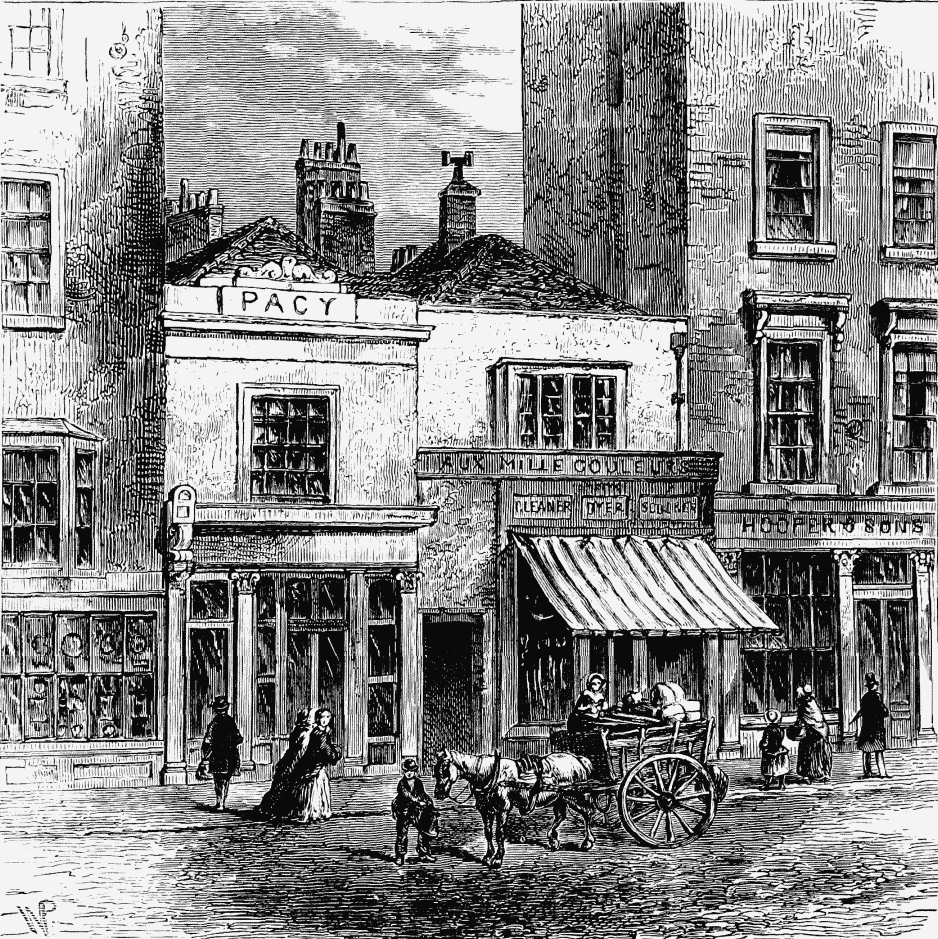
OLD HOUSES IN HOLBORN.
Warwick Court, close by the above theatre, was probably so named after the old Earls of Warwick, whose mansion, Warwick House, already mentioned in our account of the neighbourhood of Holborn, (fn. 5) stood at a short distance eastward of Gray's Inn Lane. Passing up this court, we find ourselves at the back gate of Gray's Inn, where we stop our journeyings eastward, not wishing to enter upon ground already traversed.
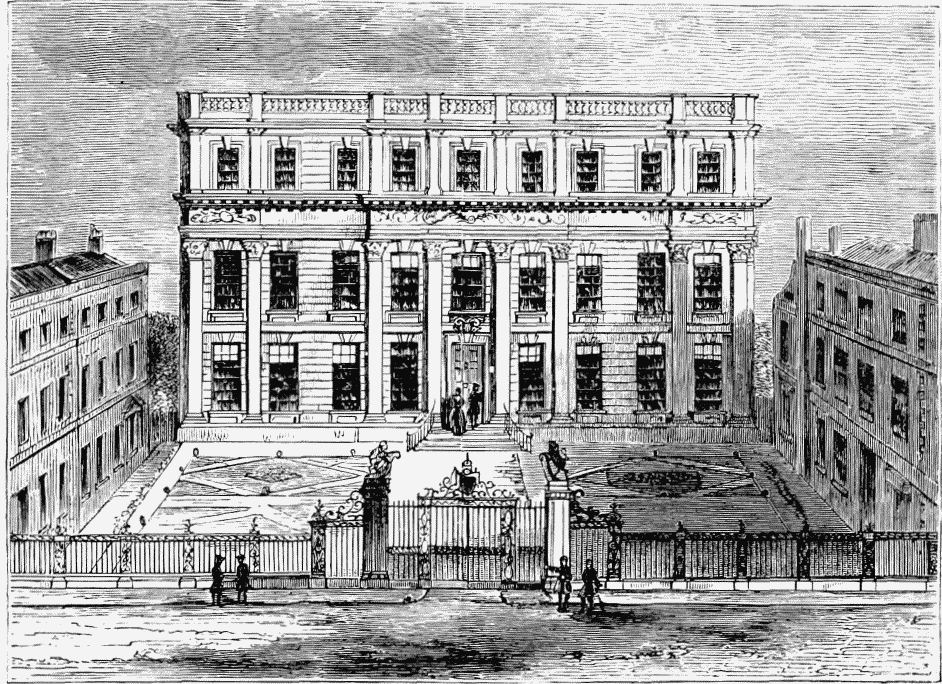
POWIS HOUSE, 1714.