Old and New London: Volume 5. Originally published by Cassell, Petter & Galpin, London, 1878.
This free content was digitised by double rekeying. Public Domain.
Edward Walford, 'The western suburbs: Belgravia', in Old and New London: Volume 5(London, 1878), British History Online https://www.british-history.ac.uk/old-new-london/vol5/pp1-14 [accessed 30 April 2025].
Edward Walford, 'The western suburbs: Belgravia', in Old and New London: Volume 5(London, 1878), British History Online, accessed April 30, 2025, https://www.british-history.ac.uk/old-new-london/vol5/pp1-14.
Edward Walford. "The western suburbs: Belgravia". Old and New London: Volume 5. (London, 1878), British History Online. Web. 30 April 2025. https://www.british-history.ac.uk/old-new-london/vol5/pp1-14.
In this section
THE WESTERN SUBURBS - CHAPTER I.
BELGRAVIA.
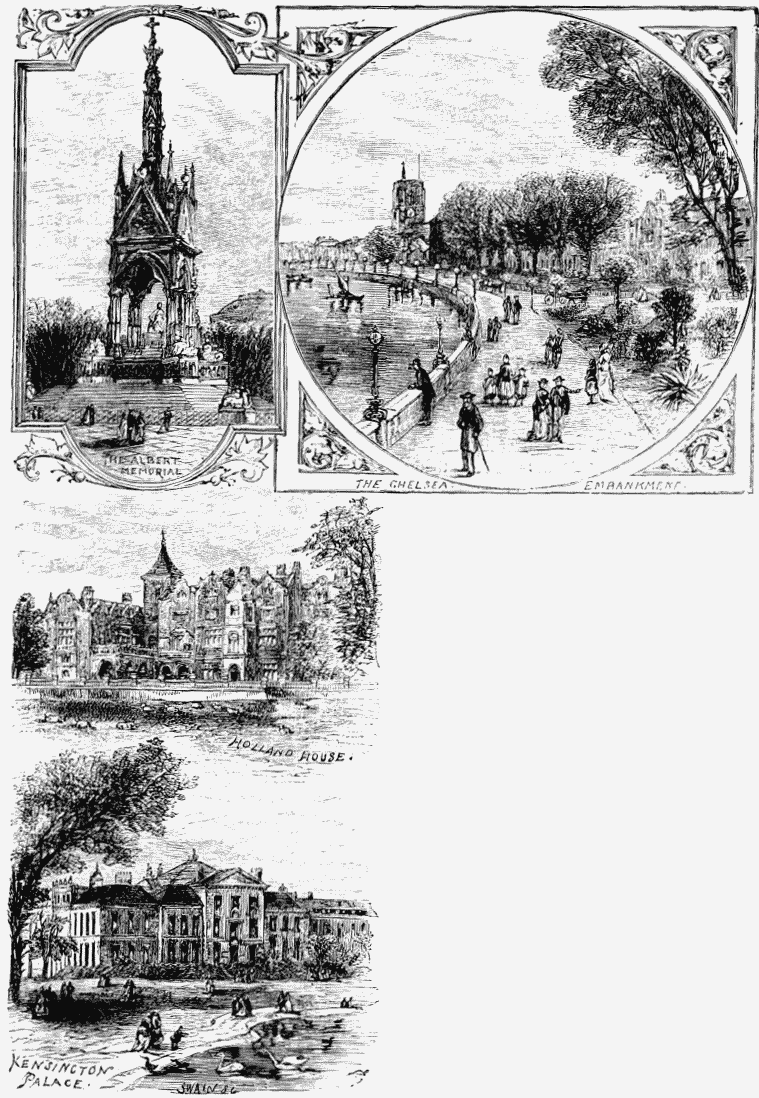
[Decorative illustration, page 1.]
"Tis hard to say—such space the city wins—
Where country ends and where the town begins."
"Prolusions Paulinæ," 1876.
Prefatory Remarks—The Building of the District—De Moret, and his Flying-machine—Nature of the Soil of Belgravia—"Slender Billy"—The Spanish Monkey "Mukako" and Tom Cribb's Fighting Dogs—The Grosvenor Family—Enormous Rent-rolls—Belgravia and Bethnal Green compared—Lanesborough House—St. George's Hospital—Old "Tattersall's"—St. George's Place—Liston, the Comedian—Pope's School-days—The Alexandra Hotel—The Old Toll-gate at Hyde Park Corner—Grosvenor Place—The "Feathers" Tavern," and how George Prince of Wales was made an Odd Fellow there—Arabella Row—A Witty Lord Chancellor—The "Bag o' Nails"—The "Three Compasses"—Belgrave Square—"Gentleman Jones"—Eccleston Street—Sir Francis Chantrey—St. Paul's Church, Wilton Place—The Pantechnicon—Halkin Street—Upper and Lower Belgrave Streets—Suicide of Lord Munster—Eaton Square—Chester Square—Ebury Street—Lowndes Square—Cadogan Place—William Wilberforce—The Locality in Former Times.
Having, in the previous volume, completed our peregrination of what may be called the interior gyrus—the innermost circle—of the great metropolis, we may now venture on a somewhat wider journey afield, and roam over that portion of the next circle—but still far from the outermost of all—which, not above half a century ago, certainly was not London, but as certainly now forms part of it. We hope, at all events, to find much that will be interesting to our readers even in modern "Belgravia;" but Knightsbridge and Paddington, Chelsea and Kensington, are each and all old enough to have histories of their own; and the two last-named villages have played a conspicuous part in the annals of the Court under our Hanoverian sovereigns, and in those of the aristocracy for even a longer period.
We purpose, therefore, to traverse in turn the fashionable area which has its centre fixed about Eaton and Belgrave Squares; then the undefined region of Knightsbridge, and that portion of Hyde Park which lies to the south of the Serpentine, and formed the site of the first Great Exhibition of 1851. Then across Pimlico to Chelsea, rich in its memories of Sir Hans Sloane and Nell Gwynne; to look in upon the household of good Sir Thomas More; and to speak of Chelsea's famous bun-house, and its ancient china-ware. Next we shall visit Brompton, the "Montpelier" of the metropolis; and then be off to the "old Court suburb" of Kensington, familiar to all Englishmen and Englishwomen as the home of William III., and of most of our Hanoverian sovereigns, and dear to them as the birthplace of Queen Victoria. We shall linger for a time under the shade of the trees which compose its pleasant gardens, and call up the royal memories of nearly two centuries. Then, bearing westwards, we shall look in upon the long galleries of Holland House, and see the chamber in which Addison died, and the rooms in which Charles James Fox and the leading Whigs of the last three reigns talked politics and fashionable news; thence to Percy Cross, and Walham Green and Parsons' Green, and to Fulham, for a thousand years the country seat of the Bishops of London both before and since the Reformation. Then we will saunter about the quaint old suburban village of Hammersmith, with its red-brick cottages and cedar-planted lawns, and so work our way round by way of Shepherd's Bush and Notting Hill—two names of truly rural sound—to Paddington and St. John's Wood—once the property of the Knights of St. John—and so to Kilburn, Hampstead, and Highgate, and Camden and Kentish Towns, till we once more arrive at St. Pancras.
With these few words by way of preface to the present volume, we again take our staff in hand, and turning our back on the "congestion" of traffic at Hyde Park Corner, which has come to be an object of legislation in Parliament, we turn our faces westward, and prepare to go on our way.
The name of "Belgravia" was originally applied as a sobriquet to Belgrave and Eaton Squares and the streets radiating immediately from them, but is now received as a collective popular appellation of that "City of Palaces" which lies to the southwest of Hyde Park Corner, stretching away towards Pimlico and Chelsea. The district was first laid out and built by Messrs. Cubitt, under a special Act of Parliament, passed in 1826, empowering Lord Grosvenor to drain the site, raise the level, and erect bars, &c. "During the late reign—that of George IV.," observes a writer in 1831—"Lord Grosvenor has built a new and elegant town on the site of fields of no healthy aspect, thus connecting London and Chelsea, and improving the western entrance to the metropolis, at a great expense."
Where now rise Belgrave and Eaton Squares, the most fashionable in the metropolis, there was, down to about the year above mentioned, an open and rural space, known as the "Five Fields." It was infested, as recently as the beginning of the present century, by footpads and robbers. These fields formed the scene of one of the first, but unsuccessful, attempts at ballooning in London. De Moret, a Frenchman, and a bit of an adventurer, proposed, in 1784, to ascend from some tea-gardens in this place, having attached to his balloon a car, not unlike some of the unwieldy summer-houses which may be seen in suburban gardens, and even provided with wheels, so that, if needful, it could be used as a travelling carriage. "Whether," says Chambers, in his "Book of Days," "M. Moret ever really intended to attempt an ascent in such an unwieldy machine, has never been clearly ascertained. … However, having collected a considerable sum of money, he was preparing for his ascent, on the 10th of August in that year, when his machine caught fire and was burnt; the unruly mob avenging their disappointment by destroying the adjoining property. The adventurer himself made a timely escape; and a caricature of the day represents him flying off to Ostend with a bag of British guineas, leaving the Stockwell Ghost, the Bottle Conjurer, Elizabeth Canning, Mary Toft, and other cheats, enveloped in the smoke of his burning balloon."
There was a time, and not so very distant in the lapse of ages, when much of Belgravia, and other parts of the valley bordering upon London, was a "lagoon of the Thames;" (fn. 1) indeed, the clayey swamp in this particular region retained so much water that no one would build there. At length, Mr. Thomas Cubitt found the strata to consist of gravel and clay, of inconsiderable depth. The clay he removed and burned into bricks, and by building upon the substratum of gravel, he converted this spot from the most unhealthy to one of the most healthy in the metropolis, in spite of the fact that its surface is but a few feet above the level of the river Thames at high water, during spring-tides.
This mine of wealth—the present suburb, or rather city, of Belgravia, for such it has become—passed into the possession of the Grosvenor family in 1656, when the daughter and sole heiress of Alexander Davies, Esq., of Ebury Farm, married Sir Thomas Grosvenor, the ancestor of the present Duke of Westminster. This Mr. Davies died in 1663, three years after the Restoration, little conscious of the future value of his five pasturing fields. "In Queen Elizabeth's time," observes a writer in the Belgravia magazine, "this sumptuous property was only plain Eabury, or Ebury Farm, a plot of 430 acres, meadow and pasture, let on lease to a troublesome 'untoward' person named Wharle; and he, to her farthingaled Majesty's infinite annoyance, had let out the same to various other scurvy fellows, who insisted on enclosing the arable land, driving out the ploughs, and laying down grass, to the hindrance of all pleasant hawking and coursing parties. Nor was this all the large-hearted queen alone cared about; she had a feeling for the poor, and she saw how these enclosures were just so much sheer stark robbery of the poor man's right of common after Lammas-tide. In the Regency, when Belgrave Square was a ground for hanging out clothes, all the space between Westminster and Vauxhall Bridge was known as 'Tothill Fields,' or 'The Downs.' It was a dreary tract of stunted, dusty, trodden grass, beloved by bull-baiters, badger-drawers, and dog-fighters. Beyond this Campus Martius of prize-fighting days loomed a garden region of cabbage-beds, stagnant ditches fringed with pollard withes. There was then no Penitentiary at Millbank, no Vauxhall Bridge, but a haunted house half-way to Chelsea, and a halfpenny hatch, that led through a cabbage-plot to a tavern known by the agreeable name of 'The Monster.' Beyond this came an embankment called the Willow Walk (a convenient place for quiet murder); and at one end of this lived that eminent public character, Mr. William Aberfield, generally known to the sporting peers, thieves, and dog-fanciers of the Regency as 'Slender Billy.' Mr. Grantley Berkeley once had the honour of making this gentleman's acquaintance, and visited his house to see the great Spanish monkey 'Mukako' ('Muchacho') fight Tom Cribb's dogs, and cut their throats one after the other—apparently, at least—for the 'gentleman' who really bled the dogs and the peers was Mr. Cribb himself, who had a lancet hidden in his hand, with which, under the pretence of rendering the bitten and bruised dogs help, he contrived, in a frank and friendly way, to open the jugular vein. A good many of the Prince Regent's friends were Slender Billy's also. Mr. Slender Billy died, however, much more regretted than the Regent, being a most useful and trusty member of a gang of forgers."
The Grosvenors, as already mentioned by us, (fn. 2) are one of the most ancient of the untitled English aristocracy, their ancestor having been the chief hunter (Le Gros veneur) to the Dukes of Normandy before the Conquest. It was not till a century ago that they condescended to bear a title, but since that time their growth to the very foremost rank in the peerage has been steady and wellearned, if personal worth and high honour, combined with immense wealth, are to be reckoned as any claim to a coronet.
The chief wealth of the Grosvenors, prior to the
marriage of their head with Miss Davies, of Ebury
Farm, was drawn out of the bowels of the earth in
the north of England. Hence Pope writes—
"All Townshend's turnips, and all Grosvenor's mines."
There can be little doubt that, in right of his Manor of Ebury, the Duke of Westminster enjoys one of the largest rent-rolls, if not the very largest, in the kingdom. The current rumour of the day sets it down at £1,000 a day, or £365,000 a year. Other noblemen, especially the Dukes of Sutherland, Buccleuch, and Northumberland, are thought to approach very nearly to a like rental. As far back as the year 1819, the head of the Grosvenors was returned to the property-tax commissioners as one of the four richest noblemen in the kingdom, the three others being the Duke of Northumberland, the Marquis of Stafford (afterwards Duke of Sutherland), and the Earl of Bridgewater, the annual income in each case being in excess of £100,000. No other peers exceeded that sum at that time; but now, owing to the increased value of land in London, and the steady growth of the productiveness of the agricultural and mining industries, the owners of the above properties have much larger rent-rolls; and the probability is that there are ten or, perhaps, a dozen other peers whose incomes would reach the above-mentioned standard. A very different state of things, it must be said, from that which prevailed when Charles II. was on the throne, if Macaulay may be trusted when he writes of the year 1683:—"The greatest estates in the kingdom then very little exceeded twenty thousand a year. The Duke of Ormond had twenty-two thousand a year. The Duke of Buckingham, before his extravagance had impaired his great property, had nineteen thousand six hundred a year. George Monk, Duke of Albemarle, who had been rewarded for his eminent services with immense grants of crown land, and who had been notorious both for covetousness and for parsimony, left fifteen thousand a year of real estate, and sixty thousand pounds in money, which probably yielded seven per cent. These three dukes were supposed to be three of the very richest subjects in England." The building of this great city of Belgravia, for such we are compelled to call it, fully justified William IV. in bestowing on his lordship the territorial title of "Marquis of Westminster," which has blossomed into a dukedom under Queen Victoria.
Viewing the great metropolis as a world in itself, as Addison and Dr. Johnson, and, indeed, all observant and thoughtful persons for these two centuries past have done, Belgravia and Bethnal Green become, both morally and physically, the opposite poles of the sphere of London—the frigid zones, so to speak, of the capital: the former, icy cold, from its stiff and unbending habit of fashion, form, and ceremony; the other, wrapped in a perpetual winter of never-ending poverty and squalor.
But it is now time for us to proceed with our
perambulation. Close by Hyde Park Corner, at
the north end of Grosvenor Place, stands St.
George's Hospital. It was built upon the site of
a pleasant suburban residence of the first Lord
Lanesborough, who died in 1723. Here he was
out of the sound of the noisy streets, and could
enjoy in private his favourite amusement of
dancing. The reader will not forget the line of
Pope, in which he is immortalised as—
"Sober Lanesborough, dancing with the gout."
Mr. Jesse writes: "So paramount is said to have
been his lordship's passion for dancing, that when
Queen Anne lost her Consort, Prince George of
Denmark, he seriously advised her Majesty to
dispel her grief by applying to his favourite
exercise." But this may be possibly a piece of
scandal and a canard of the day. Lord Lanesborough's house was beyond the turnpike gate,
and Pennant says it was his lordship's "country
house."
In 1733, Lanesborough House was converted into an infirmary by some seceding governors of Westminster Hospital. The old house for many years formed the central part of the hospital, two wings having been added to it when it was converted to its new purposes. A report of the governors for the year 1734, for which we are indebted to Maitland, tells us that "the hospital is now fitted up, and made much more complete than could have been expected out of a dwelling-house. It will at present contain sixty patients; but, as the boundaries of their grounds will admit of new buildings for several spacious and airy wards, the subscribers propose to erect such buildings as soon as their circumstances shall enable them." These extra wards have since been supplied at a considerable expense, and in process of time the entire building has been reconstructed. From its commencement the hospital has been mainly dependent upon voluntary contributions, not being richly endowed like Guy's, St. Bartholomew's, and St. Thomas's. Fifty years after its foundation, the subscriptions amounted to a little over £2,000 a year. The hospital was aided by one-third of the proceeds of musical entertainments in the Abbey. In its first half century it had numbered 150,000 patients. The present edifice was commenced towards the end of the reign of George IV., by William Wilkins, R.A., the architect of the National Gallery, University College in Gower Street, and other important buildings; but several additions have since been made to the original design, the latest being the erection of a new wing on the south-west side, in Grosvenor Crescent, which was completed about the year 1868.
The principal front of the hospital, facing the Green Park, is now nearly 200 feet in length, and forms a rather handsome elevation. The building contains a lecture theatre and an anatomical museum. The expenses of the institution are defrayed by voluntary contributions, and by the interest of funded property arising from legacies. In the year 1874, including some special gifts, its income amounted to upwards of £21,000; and the number of persons benefited during the year was above 18,000.
Mr. John Timbs, in his "Curiosities of London," mentions an "ingenious telegraph," which has been devised here for the transmission of orders through the different wards. "In the hall," he writes, "is a column three feet high, with a dial of engraved signals, and on the walls of the different wards are corresponding dials; so that when the pointer to the hall dial is moved to any signal, all the others move accordingly, and a little hammer strikes a bell, by which means about fifty signals are transmitted daily to each ward, without the possibility of error or the least noise."
The Atkinson Morley Convalescent Home at Wimbledon is connected with this hospital, and there is also a medical school in connection with the institution. Of the many celebrated men whose names are more or less intimately associated with St. George's Hospital, may be mentioned those of Dr. Baily, Dr. W. Hunter, and his brother, John Hunter (who died here suddenly, having been violently excited by a quarrel in the boardroom, while suffering under disease of the heart), Sir Benjamin Brodie, Sir Everard Home, and Dr. James Hope, the author of "A Treatise on the Diseases of the Heart," and on "Morbid Anatomy," who was chiefly instrumental in overcoming the prejudice that formerly existed in England, and especially at this hospital, against the use of the stethoscope in the examination of diseases of the chest.
In June, 1876, a curious accident occurred here. Through the bursting of a large tank on the roof, several tons of water suddenly broke through and deluged the lower floors, injuring some of the patients and the medical students, and causing the death of two or three of the patients. It need scarcely be added that, in the sanitary arrangements of the hospital, and also more especially in the important matter of ventilation, recourse has been had to the latest scientific improvements and discoveries.
Like other London hospitals, St. George's draws its patients very largely from the most unfriended classes in its vicinity, very much from the poor of all parts of London, and in no small degree from the poor of all parts of England. In 1870, an inquiry showed that there were above 330 inpatients. Of these, 100 resided within a mile of the hospital; 150 beyond that radius, but within four miles of Charing Cross; while the remainder came from all parts of the country.
At the south-eastern corner of St. George's Hospital, where now is Grosvenor Crescent, was formerly the entrance to Tattersall's celebrated auctionmart, "so renowned through all the breadth and length of horse-loving, horse-breeding, horse-racing Europe," which from all parts sends hither its representatives, when the more important sales are going on, and, with a confidence justified by the known character of the house, commissions the proprietor himself to procure for the nobles and gentry of the Continent fresh supplies for their studs of the finest English horses. The building itself, at the back, occupied part of the grounds of Lanesborough House. The entry was through an arched passage and down an inclined "drive," at the bottom of which was a public-house or "tap," designated "The Turf," for the accommodation of the throngs of grooms, jockeys, and poorer horse-dealers and horse-fanciers. On the left, an open gateway led into a garden-like enclosure, with a single tree in the centre rising from the middle of a grass-plot, surrounded by a circular path of yellow sand or gravel. Immediately beyond the gateway was the subscription-room; this building, though small, was admirably adapted for the purposes for which it was designed, and it contained merely a set of desks arranged in an octagonal form in the centre, where bets were recorded, and money paid over. On the right of the passage, a covered gateway led into the court-yard, where the principal business of the place was carried on; this was surrounded on three sides by a covered way, and at the extremity of one side stood the auctioneer's rostrum, overlooking the whole area. The stables, where the horses to be sold were kept in the interim, were close at hand, and admirably arranged for light and ventilation. In the centre of the enclosure was a domed structure to an humble but important appendage—a pump, and the structure itself was crowned by a bust of George IV. About the year 1864, "Tattersall's"—as this celebrated auctionmart was familiarly called throughout Europe—was removed further westward to Knightsbridge, where we shall come to it shortly.
The public days at old "Tattersall's" were the Mondays in each week through the year, with the addition of Thursday during the height of the season. The horses of the chief sale, that of the Monday, arrived on the Friday previous. "When the settling-times arrive," observes a writer in the Penny Magazine for 1831, "great is the bustle and excitement that prevails throughout Tattersall's. Vehicles of all kinds dash to and fro in incessant motion, or linger altogether inactive in rows about the neighbourhood, while their masters are bidding for a good hunter or a pair of carriage-horses. A more motley assemblage than the buyers or lookers-on at such times it would be impossible to find. Noblemen and ambitious costermongers, bishops and blacklegs, horse-breeders, grooms, jockeys, mingling promiscuously with the man of retired and studious habits fond of riding and breeding the wherewithal to ride; tradesmen about to set up their little pleasure-chaise or businesscart; and commercial travellers, whose calling has inoculated them with a passion for dabbling in horseflesh, and who, in their inns on the road, talk with great gusto and decision of all that pertains to Tattersall's, on the strength of some occasional half-hour's experience in the court-yard."
Richard Tattersall, the founder of the above establishment, was training-groom to the last Duke of Kingston, brother of Lady Mary Wortley Montagu, and husband of the notorious duchess. On the death of his patron, in 1773, he appears to have opened his auction-mart; but the foundation of his fortune was laid by his purchase of the racehorse "Highflyer," for the enormous sum of £2,500, and, it is supposed, on credit—an evidence of the high character for integrity which he must have already acquired. "Of his personal qualities," it has been observed, "perhaps the establishment itself is the best testimony; what Tattersall's is now, it seems to have essentially been from the very outset—a place where men of honour might congregate without breathing, or, at all events, in but a greatly lessened degree, the pestilential vapour that usually but too often surrounds the stable; where men of taste might enjoy the glimpses afforded of the most beautiful specimens of an exquisitely beautiful race, without being perpetually disgusted with the worst of all things—that of the jockey or horsedealer." We shall have more to say of "Tattersall's," however, when we come to Knightsbridge.
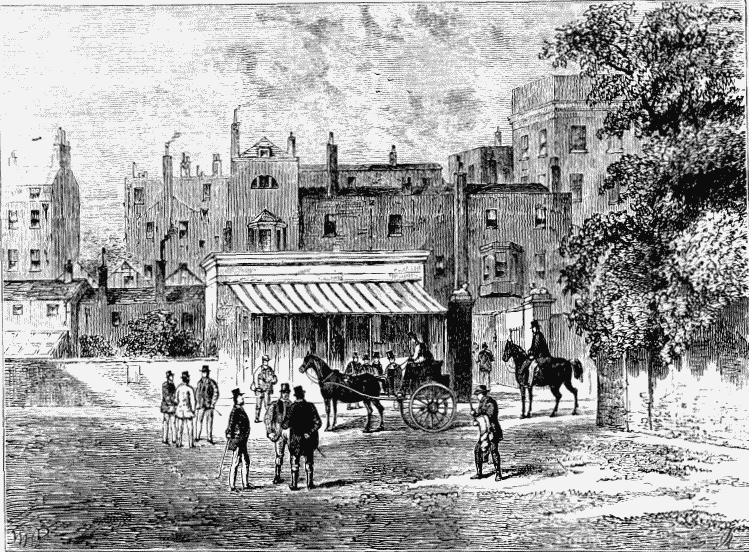
ENTRANCE TO OLD "TATTERSALL'S."
St. George's Place, or Terrace, now a series of princely mansions, was, till lately, a long row of low brick houses, of only one or two storeys, on the west side of the hospital, fronting Hyde Park, and extended as far as the Alexandra Hotel. Here Dr. Parr used to stay when he came up to London from his parsonage at Hatton. Here, too, lived for some years John Liston, the comedian, who had removed hither after his retirement from the stage. "He had long outlived the use of his faculties," writes Leigh Hunt, "and used to stand at his window at 'the Corner' sadly gazing at the tide of human existence which was going by, and which he had once helped to enliven." Mr. Planché, who was one of his most intimate friends, writes thus of this singular monomaniac: "His sole occupation was sitting all day long at the window of his residence, timing the omnibuses, and expressing the greatest distress and displeasure if any of them happened to be late. This had become a sort of monomania; his spirits had completely forsaken him. He never smiled or entered into conversation, and eventually he sunk into a lethargy, from which he woke no more in this world."
In this terrace, probably, was the school to which
Pope was sent at ten or eleven years of age, and
where, as he tells us, he forgot nearly all that he
had learnt from his first instructor, a worthy priest;
and it is to his stay at this school that the poet thus
refers later in life:—
"Soon as I enter at my country door,
My mind resumes the thread it dropt before;
Thoughts, which at Hyde Park Corner I forgot,
Meet and rejoin me in my pensive grot."
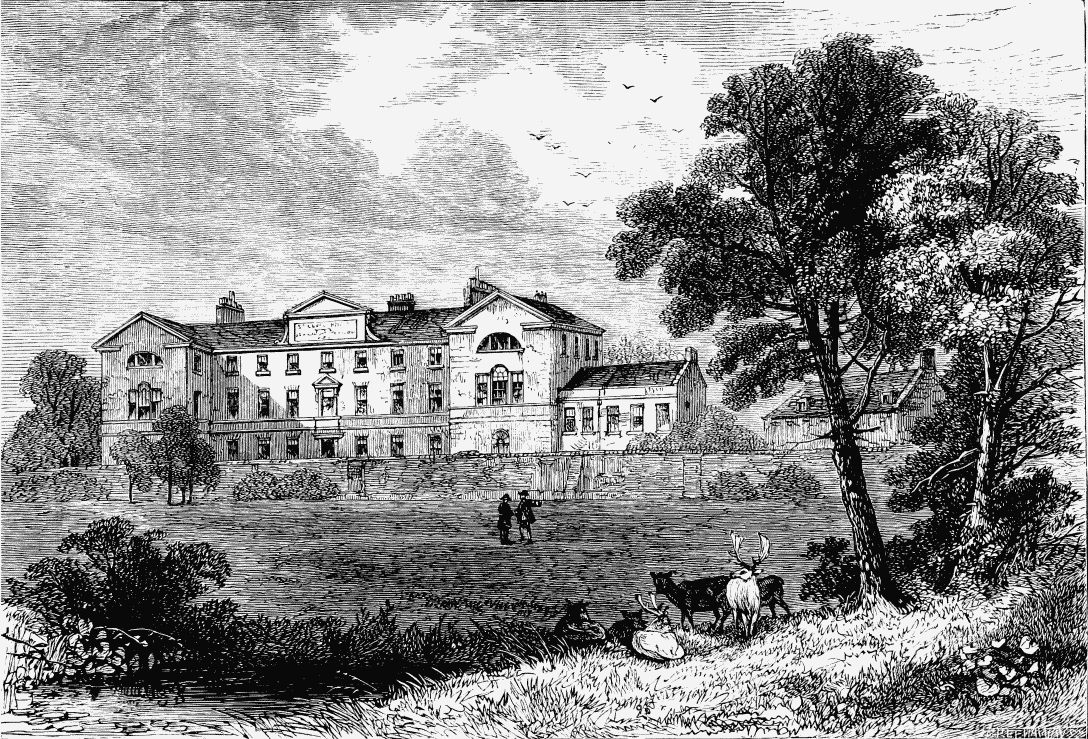
ST. GEORGE'S HOSPITAL, 1745.
The Alexandra Hotel, which covers the ground formerly occupied by some half-dozen of the houses in St. George's Place, is one of the most important and largest hotels in the metropolis. It was built shortly after the marriage of the Prince of Wales with the Princess Alexandra of Denmark, after whom it is named. The hotel is largely patronised by families of distinction from the country, and also by foreign notabilities, who, during their stay in London, desire to be within easy reach of the Court and the principal quarters of the West End. A few short yards westward beyond the Alexandra Hotel the roadway enters Knightsbridge, which we shall deal with in the next chapter.
The old toll-gate at Hyde Park Corner, between Piccadilly and Knightsbridge, considerably narrowed the entrance into Piccadilly at its western end; and its removal, as we have mentioned in our account of that thoroughfare, (fn. 3) was a great improvement not only to Piccadilly itself, but to Knightsbridge as well. Our illustration (see page 10) shows the auctioneer in the act of brandishing his hammer, and exclaiming, de more, "Once, twice, thrice! Going, going, gone!" to the great satisfaction, no doubt, of the speculative contractor who purchased the old materials in order to mend the roads.
Grosvenor Place forms the eastern boundary of Belgravia, extending southward from St. George's Hospital, and overlooking the gardens of Buckingham Palace, of which we have already spoken. It was till recently described as "a pleasant row of houses," mostly built during the Grenville Administration, in the early part of the present century. "When George III. was adding a portion of the Green Park to the new garden at Buckingham House," says Mr. Peter Cunningham, quoting from Walpole's "George III.," "the fields on the opposite side of the road were to be sold, at the price of £20,000. This sum Grenville refused to issue from the Treasury. The ground was consequently leased to builders, and a new row of houses, overlooking the king in his private walks, was erected, to his great annoyance."
Lord Hatherton removed, in 1830, from Portman Square to a house in Grosvenor Place, which
Macaulay terms a palace. Macaulay tells about
this neighbourhood a good story, which would not
gratify the pride of the head of the house of Grosvenor. "When Lord Hatherton changed his residence his servants gave him warning, as they could
not, they said, go into such an unheard-of part of
the world as Grosvenor Place. I can only say
that I have never been in a finer house." Verily
there is as much truth to-day, as there was two
thousand years ago, in the old Roman satirist's
line—
"Maxima quæque domus servis est plena superbis."
Lord Hatherton continued to reside here for many
years. He had a choice gallery of paintings, which
are mentioned, in some detail, by Dr. Waagen,
in his work on "Art and Artists in England."
During the years 1873–76 the appearance of a great part of this street was totally changed. In place of some dozen or so houses of ordinary appearance, which formerly stood at the north end, five princely mansions have been erected, in the most ornate Italian style; one of these is occupied by the Duke of Grafton, and another by the Duke of Northumberland, since his expulsion from Charing Cross. Lower down is the residence of the head of the Rothschild family. In the adjoining house lived for some time the late Earl Stanhope (better known by his courtesy title of Lord Mahon), the historian and essayist, author of a "History of the War of the Succession in Spain," "A History of England, from the Peace of Utrecht," and other works. Lord Stanhope, who was many years President of the Society of Antiquaries, was grandson of the inventor of the Stanhope printing-press.
At the southern end, in Hobart Place, formerly Grosvenor Street West, was an inn called "The Feathers," about which a good story is told by Mr. J. Larwood in his "History of Sign-boards:"—"A lodge of Odd Fellows was held at this house, into the private chamber of which George Prince of Wales one night intruded very abruptly, with a roystering friend. The society at that moment was celebrating some of its awful mysteries, which no uninitiated eye might behold, and these were witnessed by the profane intruders. The only way to repair the sacrilege was to make the Prince and his companion 'Odd Fellows'—a title which they certainly deserved as richly as any members of the club. The initiatory rites were quickly gone through, and the Prince was chairman for the remainder of the evening. In 1851 the old public-house was pulled down, and a new gin-palace built on its site, in the parlour of which," adds Mr. Larwood, "the chair used by the distinguished 'Odd Fellow' is still preserved, along with a portrait of his Royal High ness in the robes of the order." Another publichouse in Grosvenor Street perpetuated, writes Mr. J. Larwood, the well-known fable of the "Wolf and the Lamb," which was pictured by a sign representing a lion and a kid. The house was known as the "Lion and Goat."
At the bottom of Grosvenor Place, and reaching to Buckingham Palace Road, is a large triangular piece of ground, intersected by a part of Ebury Street, and covered with lofty and handsomelyconstructed houses, known respectively as Grosvenor Gardens and Belgrave Mansions. On the east side of this triangular plot is Arabella Row, one side of which is occupied by the royal stables of Buckingham Palace, which we have already described. (fn. 4) This row was once, not so very long ago, well tenanted. Among others, here lived Lord Erskine, after he had ceased to hold the seals as Lord Chancellor. His lordship, who held them only a year, was not only an orator, but a wit, as the following anecdote will show:—Captain Parry was once at dinner in his company, when Lord Erskine asked him what he and his crew lived upon in the Frozen Sea. Parry said that they lived upon seals. "And capital things, too, seals are, if you only keep them long enough," was the reply. One of the houses in Arabella Row is the official residence of the Queen's Librarian at Windsor Castle.
At the-corner of Arabella Row and Buckingham Palace Road, is a public-house, rejoicing in the once common sign of the "Bag o' Nails"—a perversion of "The Bacchanals" of Ben Jonson. "About fifty years ago," writes the author of "Tavern Anecdotes," in 1825, "the original sign might have been seen at the front of the house; it was a Satyr of the Woods, with a group of 'jolly dogs,' ycleped Bacchanals. But the Satyr having been painted black, and with cloven feet, it was called by the common people 'The Devil;' while the Bacchanalian revellers were transmuted, by a comic process, into the 'Bag of Nails.'"
In Grosvenor Row, a thoroughfare which has disappeared in the march of modern improvements that have recently taken place in this neighbourhood, was another inn, "The Three Compasses," well known as a starting-point for the Pimlico omnibuses. It was generally known as the "Goat and Compasses"—possibly a corruption of the text, "God encompasseth us;" though Mr. P. Cunningham sees in it a reproduction of the arms of the Wine Coopers' Company, as they appear on a vault in the Church of S. Maria di Capitolo, at Cologne—a shield, with a pair of compasses, an axe, and a dray, or truck, with goats for supporters. "In a country like England, dealing so much at one time in Rhenish wine, a more likely origin," he observes, "could hardly be imagined." Mr. Larwood, however, points out that possibly the "Goat" was the original sign, and that the host afterwards added the Masonic "Compasses," as is often done now.
Belgrave Square, into which we now pass, was so named after the Viscountcy of Belgrave, the second title of Earl Grosvenor before he was raised to his superior titles. It was built in the year 1825, and covers an area of about ten acres. It was designed by George Basevi, the detached mansions at the angles being the work of Hardwick, Kendall, and others. It is nearly 700 feet in length by a little over 600. The houses are uniform, except the large detached mansions at the angles. Those in the sides are adorned with Corinthian columns and capitals.
Belgrave Square has always been occupied by the heads of the highest titled nobility, and by many foreigners of distinction. Lord Ellesmere lived here till he built Bridgewater House. Among other notabilities who have resided here may be named the first Lord Combermere, Sir Roderick Murchison, the geologist, Sir Charles Wood, afterwards Lord Halifax, and General Sir George Murray, who acted as Quartermaster-General to the British army during the Peninsular War. At the south-west corner lived for some years another distinguished General, Lord Hill, the hero of Almarez. In this square the Count de Chambord and his mother held their court, during a short visit which they paid to England in 1843. The Austrian Embassy has been for several years located in this square.
In Chapel Street, which runs from the south-east corner of Belgrave Square into Grosvenor Place, resided Mr. Richard Jones, a teacher of elocution, generally known as "Gentleman Jones," who is mentioned by Lord William Lennox, and by nearly all the writers of modern London anecdote. Here he used to have scores of pupils practising for the pulpit, the bar, or the senate. "Under his able tuition," says Lord W. Lennox, "many a reverend gentleman, who mumbled over the service, became a shining light; many an embryo lawyer, who spoke as if he had a ball of worsted in his mouth, became a great orator; and many a member of Parliament, who 'hummed and hawed,' and was unintelligible in the gallery, turned out a distinguished speaker."
Eccleston Street derives its name from Eccleston, in Cheshire, where the Grosvenors own a property. The large house at the corner of this street was for many years the residence of Sir Francis Chantrey, the sculptor. He was born at Norton, near Sheffield, in 1781, and, as a boy, used to ride a donkey, carrying milk into the town. "On a certain day, when returning home upon his donkey, Chantrey was observed by a gentleman to be very intently engaged in cutting a stick with his penknife. Excited by his curiosity, he asked the lad what he was doing, when, with great simplicity of manner, but with courtesy, the lad replied, 'I am cutting old Foxe's head.' Foxe was the schoolmaster of the village. On this, the gentleman asked to see what he had done, pronounced it to be an excellent likeness, and presented the youth with sixpence; and this may, perhaps, be reckoned the first money which Chantrey ever obtained for his ingenuity."
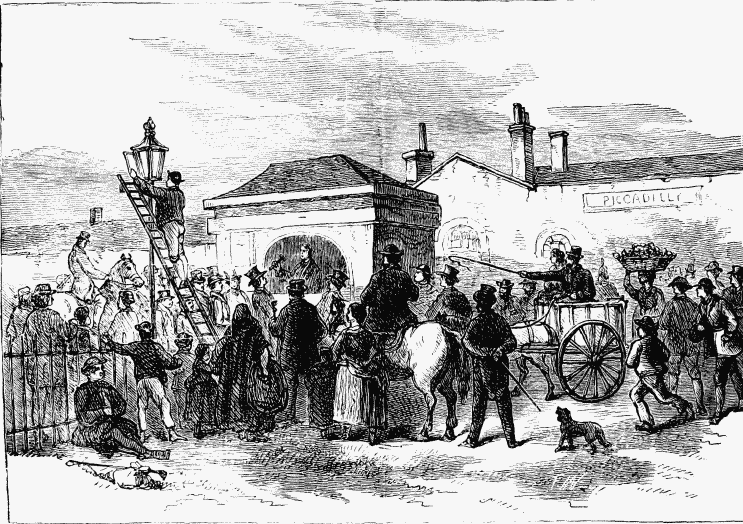
SALE OF HYDE PARK TURNPIKE.
He took up his residence here shortly after his marriage in 1809. The house was then two separate residences—Nos. 29 and 30, Lower Belgrave Place—but Chantrey threw the two houses into one, and named them anew as part of Eccleston Street. In the studios at the back, all his best works—his bust of Sir Walter Scott, his "Sleeping Children," and his statue of Watt—were executed. There is, or was, in it a small gallery with a lanthorn, by Sir John Soane. Sir F. Chantrey was pronounced by the "Foreigner," who is known as the author of "An Historical and Literary Tour in England," to be the only English sculptor of his age who was distinguished by true originality, though still young in reputation.
Macaulay tells a good story of him, and one most creditable to his magnanimity, which kept him from being ashamed of his early struggles in life. When Chantrey dined with Rogers, he took particular notice of a certain vase, and of the table on which it stood, and asked Rogers who made the latter. "A common carpenter," said Rogers. "Do you remember the making of it?" asked Chantrey. "Certainly," replied Rogers, in some surprise; "I was in the room while it was finished with the chisel, and gave the workmen directions about placing it." "Yes," said Chantrey, "I was the carpenter; I remember the room well, and all the circumstances." Chantrey died at the close of the year 1841: he expired whilst sitting in an easychair in his drawing-room. By his will Sir Francis left a considerable sum to the Royal Academy, to be devoted to endowing the Presidentship of that institution, and in other ways to "the encouragement of British Fine Art in Painting and Sculpture," the bequest to take effect on the death or second marriage of his wife. Lady Chantrey died in 1875, when the above legacy, which had gone on accumulating, became available for the purposes to which it was to be devoted.
On the north-west side of Belgrave Square are Wilton Crescent and Wilton Place. In the latter, which opens into Knightsbridge Road, a little westward of the Alexandra Hotel, is St. Paul's Church, which is deserving of notice, from the fact of its clergy having always been prominent leaders of the Ritualistic or extreme "high church" party. The first incumbent was the Rev. W. J. E. Bennett, afterwards vicar of Frome, Somerset, who was succeeded by the Hon. and Rev. Robert Liddell. The church, which was consecrated in 1843, is built in the Early Perpendicular style of architecture, and was erected at a cost of £11,000. It consists only of a nave and chancel, and a lofty tower crowned with eight pinnacles; the windows are filled with stained glass, and the interior is rich in ornamentation. This church has been the scene of many a strong conflict between the parishioners and the incumbent respecting the ceremonials carried on here, which culminated in one of the vestrymen, more courageous than the rest—a Mr. Westerton—bringing the matter in dispute before the courts of law.
Between Motcomb, Lowndes, and Kinnerton Streets, all of which are on the western side of the square, is a large building, called the Pantechnicon, used of late years for storing furniture, carriages, works of art, &c. It was originally built about the year 1834, as a bazaar, and was established principally for the sale of carriages and household furniture. There was also a "wine department," consisting of a range of dry vaults for the reception and display of wines; and the bazaar contained likewise a "toy department." The building, which covered about two acres, was burnt to the ground in 1874, when a large quantity of valuable property was destroyed. The work of rebuilding was soon afterwards commenced, the new structure being erected on detached blocks, and of fire-proof materials, so that the chances of the building being again destroyed in a similar way are considerably reduced.
Halkin Street, on the northern side of the square, was so called from Halkin Castle, in Flintshire, one of the seats of the ducal owner. In this street is a chapel, which has been since 1866 used by the Presbyterian body. The building is somewhat singular in shape, neither square nor oblong, the end opposite the entrance being considerably wider than the other.
Connecting the south-east corner of Belgrave Square with Ebury Street, and skirting the east ends of Eaton and Chester Squares, are Upper and Lower Belgrave Streets. In the former, in 1842, the Earl of Munster committed suicide. He was the eldest son of William IV. by Mrs. Jordan. He married Miss Wyndham, one of the natural daughters of Lord Egremont, with whom he had a fortune of £40,000 or £50,000. He had the place of Constable of Windsor Castle, which was continued to him by the Queen, and he had just been appointed to the command of the troops at Plymouth, with which he was much pleased. Mr. Raikes, in his "Journal," speaks of him as "a very amiable man in private life, not without some talent, and given to study Eastern languages." As Colonel Fitz-Clarence, he had shown great bravery and energy in arresting the leaders of the Cato Street conspiracy. He was raised to a peerage on his father's accession to the throne.
Eaton Square was designed and built by Messrs. Cubitt in 1827. It was named after Eaton Hall, in Cheshire, the principal seat of the Duke of Westminster. It occupies an oblong piece of ground, and the centre is divided by roadways into six separate enclosures. No. 71 was for some time, during the rebuilding of the Houses of Parliament, the official residence of the Speaker of the House of Commons. Most of the mansions, in fact, have at different times been occupied by members of one or other division of the Legislature. No. 75 was for many years the residence of the late Mr. Ralph Bernal, M.P. for Rochester, and Chairman of Committees in the House of Commons. He was a distinguished antiquary and connoisseur, and made here his superb collection of works of art, including china, armour, articles of vertu, and antiquities of every description, the sale of which, occupying thirty-two days, was one of the "events" of the season of 1855.
At No. 83 lived, during the closing years of his life, the late Lord Truro. The son of an attorney on College Hill, in London, Thomas Wilde began life in his father's office; but having afterwards studied for the higher branch of the profession, he was, at the age of thirty-five, called to the bar at the Inner Temple. In 1820 he was engaged as one of the counsel for Queen Caroline on her "trial" in the House of Lords, which, doubtless, brought him a handsome fee; and he is said to have had a retaining fee of 3,000 guineas in the case of the British Iron Company against Mr. John Attwood. Before his accession to the Upper House on being made Lord Chancellor, he sat in the House of Commons as member for Newark, and also for the City of Worcester. He died in 1855, immensely rich, having married, as his second wife, a daughter of the late Duke of Sussex.
At the east end of the square is St. Peter's Church, an Ionic building designed by Hakewill, and consecrated in 1827. The altar-piece, "Christ crowned with thorns," was painted by W. Hilton, R.A., and presented to the church by the British Institution.
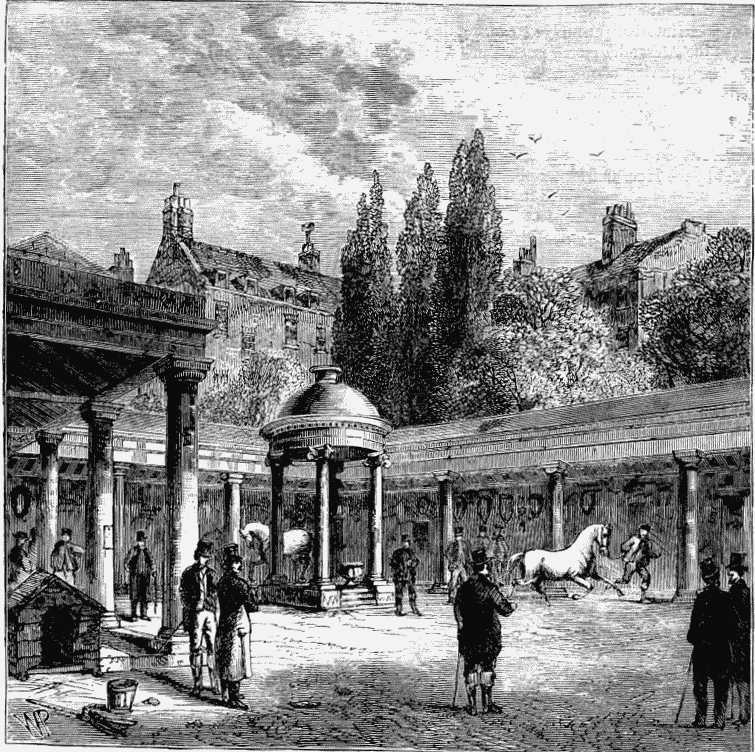
INTERIOR OF THE COURT-YARD OF OLD "TATTERSALL'S."
Chester Square, which almost abuts upon the north side of Eaton Square, was commenced about the year 1840, and was so called after the City of Chester, near which place Eaton Hall is situated. The picturesque Gothic church of St. Michael, which stands in a commanding position at the western end of the square, was erected in 1844, the foundation-stone being laid by Earl Grosvenor, father of the present Duke of Westminster; and it was built from the designs of Mr. Thomas Cundy in the Decorated style of the fourteenth century. Its principal external feature is the tower, with a lofty spire, which, till some additions to the body of the church were made in 1874, appeared to be somewhat out of proportion to the remainder of the fabric.
Ebury Street and Ebury Square were so called from Ebury or Eabery Farm, which stood on this site. The farm embraced upwards of 400 acres, meadow and pasture, and was let on lease by Queen Elizabeth for the sum of £21 per annum, to a person named Whashe, by whom, as Strype tells us, "the same was let to divers persons, who, for their private commodity, did inclose the same and had made pastures of arable land; thereby not only annoying her Majesty in her walks and passages, but to the hindrance of her game, and great injury to the common, which at Lammas was wont to be laid open." In Ebury Street is an extensive open-air skating rink and club-house, called the "Belgravia." It was established as a club, on the proprietary system, and is therefore open only to members and their friends. The Manor House of the Eabury Estate stood between Hobart Place and the bottom of Grosvenor Place.

MAP OF BELGRAVIA, 1814.
The western limits of Belgravia are Lowndes Square, Cadogan Place, and the few connecting streets on the east side of Sloane Street. Lowndes Square itself dates from about the year 1838, when it was built on a vacant piece of ground, described in Rocque's "Map of London and its Environs," engraved in 1746, as then belonging to "—Lowndes, Esq.;" and it was so called, says Mr. Peter Cunningham, "after Mr. Lowndes, of The Bury, near Chesham, in Buckinghamshire, the ground landlord, a descendant of William Lowndes, Secretary to the Treasury in the reign of Queen Anne." "The site of this square," as Mr. John Timbs informs us, "was once a coppice, which supplied the Abbot and Convent of Westminster with wood for fuel."
Lowndes Square has numbered among its residents at different times men who have distinguished themselves in their several walks of life. Of them we may mention Sir John Rennie, the eminent civil engineer, and architect of New London Bridge; Sir William Tite, another distinguished architect, and some time M.P. for Bath; Thomas Brassey, the engineer; and the Right Hon. Robert Lowe, M.P. for London University.
At the corner of Lowndes Square and Cadogan Place, we quit the Duke of Westminster's estate. Cadogan Place, which occupies an extensive area of ground, is open on the west side to Sloane Street. It is called after the family of Lord Cadogan, into whose hands the manor of Chelsea came, by the marriage of the first Lord Cadogan with the heiress of Sir Hans Sloane.
Here lived Mr. and Mrs. Zachary Macaulay from about 1818 to 1823, when they removed to Great Ormond Street, as already stated. From Cadogan Place, the young Macaulays used to walk on a Sunday—or, as they were taught to call the day, the "Sabbath"—across the "Five Fields," now Belgrave Square, to the Lock Chapel, then situated in Grosvenor Place, contiguous to the Lock Asylum. In a house in this place, on the 29th of July, 1833, died William Wilberforce, the eminent philanthropist, many years M.P. for Yorkshire, who is best known for his devotion to the abolition of the slave-trade. There is something peculiarly touching in the fact that Wilberforce died—felix opportunitate mortis—just as the abolition of the slave-trade was in the act of being carried through Parliament, and the last fetters struck from the slaves' hands and feet. His funeral took place on the 3rd of August, in Westminster Abbey. On that day, his friend's son, Thomas Babington Macaulay, writes:—"We have laid him side by side with Canning, at the feet of Pitt, and within two steps of Fox and Grattan. He died with the promised land full in view." Before the end of the next month the British Parliament formally abolished slavery throughout the dominions of the Crown, and the last touch was put to the work that had consumed so many pure and noble lives. It was agreed that he should have been buried in the grave of his friends the Stephens, at Stoke Newington, but the voice of the country ruled otherwise. A subscription was immediately opened among Mr. Wilberforce's friends in London, and his statue has been placed in Westminster Abbey. At York, a County Asylum for the Blind has been founded in honour of him, while his townsmen of Hull have raised a column to his memory. Great part of our coloured population in the West Indies went into mourning at the news of his death; and the same was the case at New York, where also an eulogium was pronounced upon him by a person publicly selected for the task.
In Cadogan Place lived Sir Herbert Taylor, the Private Secretary and attached friend of King William IV. Here, too, was the last London residence of the celebrated actress, Mrs. Jordan. Another resident in Cadogan Place, in more recent times, was Mr. Wynn Ellis, of Tankerton Castle, Whitstable, formerly M.P. for Leicester. He had for many years a mania for collecting pictures, chiefly the works of the old masters, of which he was an excellent connoisseur. Dr. Waagen (1835), in his "Art and Artists in England," mentions a visit paid by him to Mr. Wynn Ellis's gallery:—"He possesses, besides many good old pictures, the best copy of Wilson's celebrated landscape, together with the 'Children of Niobe,' formerly in the possession of the Duke of Gloucester."
Mr. Wynn Ellis died in 1875, having by his will left to the nation, for exhibition in the National Gallery, his large collection of the works of the old masters. These alone number some four or five hundred. The mere mention of the names of certain of the artists tell their own tale; for among the collection there are more than one painting, in some cases several, from the brushes of Raphael, Rubens, Murillo, Claude, Van der Velde, Hobbima, Holbein, Guido, Leonardo da Vinci, the Poussins, and a score of others. Mr. Ellis's collection of works by modern artists was brought to the hammer at Christie's, and the sale formed one of the events of the season. Mr. Ellis began life as a warehouseman on Ludgate Hill, and accumulated a large fortune, many thousands of which he left to different charities.
Of Sloane Square, at the south end of Cadogan Place, we shall speak in a future chapter, when dealing with Sloane Street.
In a map of London and its neighbourhood, published in 1804, the whole of the site of Belgravia, between Grosvenor Place and Sloane Street, appears still covered with fields. They are crossed by "the King's private road," which is now occupied by Hobart Place, the roadway in the centre of Eaton Square, and Westbourne Place, terminating in Sloane Square. About the centre of Grosvenor Place, at that time, stood the Lock Hospital or Asylum, which was founded in 1787 by the Rev. Thomas Scott, the commentator; a little to the south, at the corner of the "King's private road," was the Duke's Hospital. What is now Ebury Street was then an open roadway, called Ranelagh Street, having a few houses on one side only. Twenty years later the whole character of this locality was considerably changed. Belgrave Square and Wilton Crescent had sprung into existence, as also had Cadogan Square and Cadogan Place, together with a few connecting streets. Sir Richard Phillips, in his "Walk from London to Kew," published in 1817, speaks of the creeks which at that time ran from the Thames, "in the swamps opposite Belgrave Place," and adds that they "once joined the canal in St. James's Park, and, passing through Whitehall, formed by their circuit the ancient isle of St. Peter's. Their course," he continues, "has been filled up between the wharf of the water-works and the end of the canal in St. James's Park, and the isle of St. Peter's is no longer to be traced." The cut on the preceding page shows the locality in 1814.