Old and New London: Volume 5. Originally published by Cassell, Petter & Galpin, London, 1878.
This free content was digitised by double rekeying. Public Domain.
Edward Walford, 'Pimlico', in Old and New London: Volume 5(London, 1878), British History Online https://www.british-history.ac.uk/old-new-london/vol5/pp39-49 [accessed 30 April 2025].
Edward Walford, 'Pimlico', in Old and New London: Volume 5(London, 1878), British History Online, accessed April 30, 2025, https://www.british-history.ac.uk/old-new-london/vol5/pp39-49.
Edward Walford. "Pimlico". Old and New London: Volume 5. (London, 1878), British History Online. Web. 30 April 2025. https://www.british-history.ac.uk/old-new-london/vol5/pp39-49.
In this section
CHAPTER IV.
PIMLICO.
"I'll have thee, Captain Gilthead, and march up
And take in Pimlico."—Old Play.
Etymology of Pimlico—The Locality Half a Century Ago—Warwick Square—Vauxhall Bridge Road—The Army Clothing Depôt—St. George's Square—The Church of St. James the Less—Victoria Railway Station—New Chelsea Bridge—The Western Pumping Station, and Metropolitan Main-Drainage Works—St. Barnabas Church—St. Barnabas Mission House and Orphanage—Bramah, the Engineer and Locksmith—Thomas Cubitt, the Builder—The "Monster" Tavern—The "Gun," the "Star and Garter," and the "Orange" Tea-Gardens—"Jenny's Whim"—Tart Hall—Stafford Row—St. Peter's Chapel and Dr. Dodd—Richard Heber and his famous Library.
The name Pimlico is clearly of foreign derivation, and it has not a little puzzled topographers.
Gifford, in a note in his edition of Ben Jonson,
tells us that "Pimlico is sometimes spoken of as a
person, and may not improbably have been the
master of a house once famous for ale of a particular description;" and we know, from Dodsley's
"Old Plays," and from Ben Jonson's writings, that
there was another Pimlico at Hoxton, or (as the
place was then termed) Hogsdon, where, indeed,
to the present day there is a "Pimlico Walk." It
is evident, from a reference to The Alchemist of
Ben Jonson, that the place so named at "Hogsdon"
was a place of resort of no very good repute,
and constantly frequented by all sorts of people,
from knights, ladies, and gentlewomen, down to
oyster-wenches:—
"Gallants, men, and women,
And of all sorts, tag-rag, been seen to flock here,
In these ten weeks, as to a second Hogsdon,
In days of Pimlico."
In another play of about the same period a worthy knight is represented as sending his daughter to Pimlico "to fetch a draught of Derby ale." It is antecedently probable, therefore, that the district lying between Chelsea and St. James's Park should have got the name from an accidental resemblance to its antipodes at Hoxton. And this supposition is confirmed by Isaac Reed, who tells us, in Dodsley's "Old Plays," how that "a place near Chelsey is still called Pimlico, and was resorted to within these few years on the same account as the former at Hogsdon." It may be added that Pimlico is still celebrated for its ales, and also that the district is not mentioned by the name of Pimlico in any existing document prior to the year 1626.
"At this time"—i.e. the reign of Charles I., writes Mr. Peter Cunningham—"Pimlico was quite uninhabited, nor is it introduced into the ratebooks of St. Martin's (to which it belonged) until the year 1680, when the Earl of Arlington—previously rated as residing in the Mulberry Gardens—is rated, though still living in the same house, under the head of Pimlico. In 1687, seven years later, four people are described as living in what was then called Pimlico—the Duke of Grafton, Lady Stafford, Thomas Wilkins, and Dr. Crispin. The Duke of Grafton, having married the only child of the Earl of Arlington, was residing in Arlington House; and Lady Stafford in what was then and long before known as Tart Hall." Arlington House, as we have seen, (fn. 1) was ultimately developed into Buckingham Palace.
The district of Pimlico may be regarded as embracing the whole of Belgravia, which we have already dealt with in a previous chapter, as well as the locality extending from Buckingham Palace Road to the Thames, and stretching away westward to Chelsea. This latter portion includes the Grosvenor Road and the Eccleston sub-district of squares, terraces, and streets, nearly all of which have sprung up within the last half-century.
In the map appended to Coghlan's "Picture of London," published in the year 1834, the whole of this division of Pimlico, between Vauxhall Bridge Road and Chelsea (now Buckingham Palace) Road, appears unbuilt upon, with the exception of a few stray cottages here and there, and a few blocks of houses near the river; the rest of the space is marked out as gardens and waste land, intersected by the Grosvenor Canal, the head of which, forming an immense basin, is now entirely covered by the Victoria Railway Station. Its rustic character at the above date may be inferred from the fact, that a considerable portion of the space between the two roads above mentioned is described as "osier beds," whilst a straight thoroughfare connecting the two roads is called Willow Walk. These osier beds are now covered by Eccleston Square and a number of small streets adjacent to it; whilst "Willow Walk" has been transformed into shops and places of business, and is now known as Warwick Street. On the north side of Warwick Street, covering part of the "old Neat House" Gardens, to which we have already referred, (fn. 2) is Warwick Square, which is bounded on the north-east by Belgrave Road, and on the south-west by St. George's Road. In Warwick Square stands St. Gabriel's Church, a large building of Early English architecture, erected from the designs of Mr. Thomas Cundy, who was also the architect of St. Saviour's Church, in St. George's Square, close by. Vauxhall Bridge Road, which dates from the erection of the bridge, about the year 1816, is a broad and well-built thoroughfare, opening up a direct communication, by way of Grosvenor Place, between Hyde Park Corner and Vauxhall Bridge, and so on to Kennington and the southern suburbs of London. Of Vauxhall Bridge, and of Trinity Church, in Bessborough Gardens, close by, we have already spoken. (fn. 3)
Not far from St. George's Square stands an extensive range of buildings, known as the Army Clothing Depôt—one of the largest institutions that has ever been established for the organisation and utilisation of women's work. "Previous to the year 1857," observes a writer in the Queen newspaper, "all the clothes for the British army were made by contractors, whose first thought seemed to be how to amass a fortune at the expense of the makers and the wearers of the clothes primarily, and of the British public indirectly. But in that year the Army Clothing Depôt was established, somewhat experimentally, in Blomberg Terrace, Vauxhall Road; the experiment answering so well, that an extension of the premises became imperative. In 1859 the present depôt was opened, although since then it has largely increased, and has not yet, apparently, come to the full stage of its development. The whole of the premises occupy about seven acres, the long block of buildings on the one side being used as the Government stores, while the corresponding block consists of the factory. The main feature of the latter is a large glass-roofed central hall of three storeys, with spacious galleries all round on each storey. The ventilation is ensured by louvres, so that the whole atmosphere can be renewed in the space of five minutes or so; the temperature is kept at an average of 60° to 63°, and each operative enjoys 1,200 cubic feet of air, so that we have at the outset the three requirements of light, air, and warmth, in strongly-marked contrast to the crowded rooms of the contractor, or the more wretched chamber of the home-worker. Five hundred and twenty-seven women are at present working in the central hall, and five hundred in the side rooms, which also accommodate about two hundred men. This forms the working staff of the factory, which comprises, therefore, what may be called the pick of the sewing-machine population in London. It may well be imagined that the prospect of so comfortable an abiding place would attract great numbers of workpeople; and, indeed, this has been so much the case that very rigorous rules have been obliged to be made to guard against unworthy admissions. 'The good of the public service' is the motto of the factory, and everything else must yield to that; so that, both for in-door and out-door hands, all candidates must first of all appear before a committee, consisting of the matron, the foreman cutter, the foreman viewer, and the instructor, who are held responsible for the selection of proper persons. In-door candidates as needlewomen must be healthy and strong, and, if single, between the ages of seventeen and thirty; if married or widows, they must have no children at home young enough to demand their care. These points being settled, the candidates are examined as to any previous training or fitness for army work, and are required to show what they can do. If all these requirements are satisfactory, the matron inquires into their character, and finally they are examined by the doctor, who certifies to their fitness, after which they are placed in a trial division in the factory for further report and promotion."
St. George's Square, with its trees and shrubs, presents a healthful and cheering aspect, almost bordering on the Thames, just above Vauxhall Bridge. It covers a considerable space of ground, and is bounded on the north side by Lupus Street—a thoroughfare so called after a favourite Christian name in the Grosvenor family, perpetuating the memory of Hugh Lupus, Earl of Chester after the Norman Conquest. St. Saviour's Church, which was built in 1865, is in the Decorated style of Gothic architecture, and with its elegant tower and spire forms a striking object, as seen from the river.
In Upper Garden Street, which runs parallel with Vauxhall Bridge Road, is the Church of St. James the Less, built in 1861, from the designs of Mr. G. E. Street, R.A. The edifice was founded by the daughters of the late Bishop of Gloucester and Bristol (Dr. Monk) as a memorial to their father, who was also a Canon of Westminster. It is constructed of brick, with dressings of stone, marble, and alabaster; and it consists of a nave, side aisles, a semi-circular apse, and a lofty tower and spire. The roof of the chancel is groined, and is a combination of brick and stone. A very considerable amount of elaborate detail pervades the interior. The chancel is surrounded by screens of brass and iron, and over the chancel-arch is a well-executed fresco painting, by Mr. G. F. Watts, R.A., of "Our Saviour attended by Angels." Some of the windows are filled with stained glass. The building, including the decorations, cost upwards of £9,000.
The Victoria Railway Station, situated at the northern end of Vauxhall Bridge Road, covers, as we have stated above, a considerable portion of the basin of the old Grosvenor Canal; it unites the West-end of London with the lines terminating at London Bridge and Holborn Viaduct, and also serves as the joint terminus of the Brighton Railway and of the London, Chatham, and Dover Railway. Like the stations at Charing Cross and Cannon Street, which we have already described, the Victoria Railway Station has a "monster" hotel—"The Grosvenor"—built in connection with it. The lines of railway, soon after leaving the station, are carried across the Thames by an iron bridge of four arches, called the Victoria Bridge, and then diverge.
On the western side of the railway bridge is a handsome new bridge, which now connects this populous and increasing neighbourhood with Battersea and Vauxhall. The railway bridge somewhat mars the structural beauty of the one under notice; but when looked at from the embankment on either side, "above bridge," or, better still, from a boat in the middle of the river, the bridge appears like a fairy structure, with its towers gilded and painted to resemble light-coloured bronze, and crowned with large globular lamps. The bridge, which is constructed on the suspension principle, is built of iron, and rests upon piers of English elm and concrete enclosed within iron casings. The two piers are each nearly ninety feet in length by twenty in width, with curved cutwaters. The roadway on the bridge is formed by two wrought-iron longitudinal girders, upwards of 1,400 feet, which extend the whole length of the bridge, and are suspended by rods from the chains. At either end of the bridge are picturesque lodgehouses, for the use of the toll-collectors. The bridge was built from the designs of Mr. Page, and finished in 1857, at a cost of £88,000.
Nearly the whole of the river-side between Vauxhall Bridge and Chelsea Bridge forms a broad promenade and thoroughfare, very similar in its construction to the Victoria Embankment, which we have already described, and of which it is, so to speak, a continuation—the only break in the line of roadway being about a quarter of a mile between Millbank and the Houses of Parliament, where the river is not embanked on the north side. This roadway is known partly as Thames Bank, or Thames Parade, and partly as the Grosvenor Road. One of the principal buildings erected upon it is the Western Pumping Station, which was finished in 1874–5, completing the maindrainage system of the metropolis. The foundation-stone of the structure was laid in 1873, and the works cost about £183,000. This station provides pumping power to lift the sewage and a part of the rainfall contributed by the district, together estimated at 38,000 gallons per minute, a height of eighteen feet in the Low Level Sewer, which extends from Pimlico to the Abbey Mills Pumping Station, near Barking, in Essex. The requisite power is obtained from four high-pressure condensing beam-engines of an aggregate of 360-horse power. Supplementary power, to be used in case of accident to the principal engines, or on any similar emergency, is provided by an additional high-pressure, non-condensing engine of 120-horse power, supplied from two boilers similar to those for the principal engines. This engine and its boilers are erected in a separate building to the rear of the main buildings, near the canal. The works further comprise coal vaults, settling pond, and reservoirs for condensing water, repairing-shops, stores, and dwelling-houses for the workmen and superintendent in charge of the works. In all they cover nearly four acres. The principal enginehouse is situate facing the main road and river, and the height of this building rises to upwards of seventy-one feet. But all this is dwarfed by the chimney-shaft, which is very nearly the height of the Monument, being only ten feet short of it. The shaft is square, and the sides are relieved by three recessed panels, arched over a short distance below the entablature which surmounts the shaft. Altogether, this chimney really makes a most conspicuous and beautiful object as one comes down the river. The foundations of this great pile of brickwork are carried down into the London clay, and even then bedded in a mass of concrete cement 35 feet square.
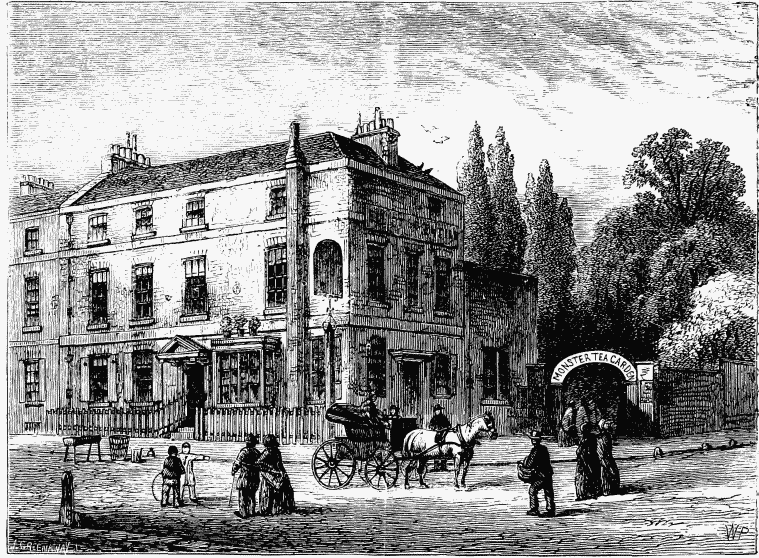
THE "MONSTER TEA-GARDENS," 1820.
The system of the main-drainage of London, which has been carried out by the Metropolitan Board of Works, comprises 117 square miles of sewers, and, as each was concluded, it added to the health and comfort of the inhabitants of the metropolis. The main sewers are eighty-two miles long, and cost about £4,607,000; and the local boards and vestries assisted in completing the work, which comprised 635 miles of sewers.
At the western extremity of Buckingham Palace Road, near Ebury Square, stands a handsome Gothic church, built in the severest Early English style, which has acquired some celebrity as "St. Barnabas, Pimlico." It was built in 1848–50, as a chapel of ease to St. Paul's, Knightsbridge, under the auspices of its then incumbent, the Rev. W. J. E. Bennett. Attached to it are large schools, a presbytery or college for the officiating clergy, who must almost of necessity be celibates. The church gained some notoriety during the earlier part of the Ritualistic movement, and, indeed, the services were not allowed to be carried on without sundry popular outbursts of indignation. Of late, however, this church has ceased to occupy the public attention, having been fairly eclipsed by other churches, which are marked by a still more "advanced" Ritual. The church is a portion of a college founded on St. Barnabas' Day, 1846, and is built upon ground presented by the first Marquis of Westminster. The fabric has a Caenstone tower and spire, 170 feet high, with a peal of ten bells, the gifts of as many parishioners. The windows throughout are filled with stained glass, with subjects from the life of St. Barnabas. An oak screen, richly carved, separates the nave from the chancel; the open roof is splendidly painted, and the superb altar-plate, the font, the illuminated "office" books, and other costly ornaments, were the gifts of private individuals.
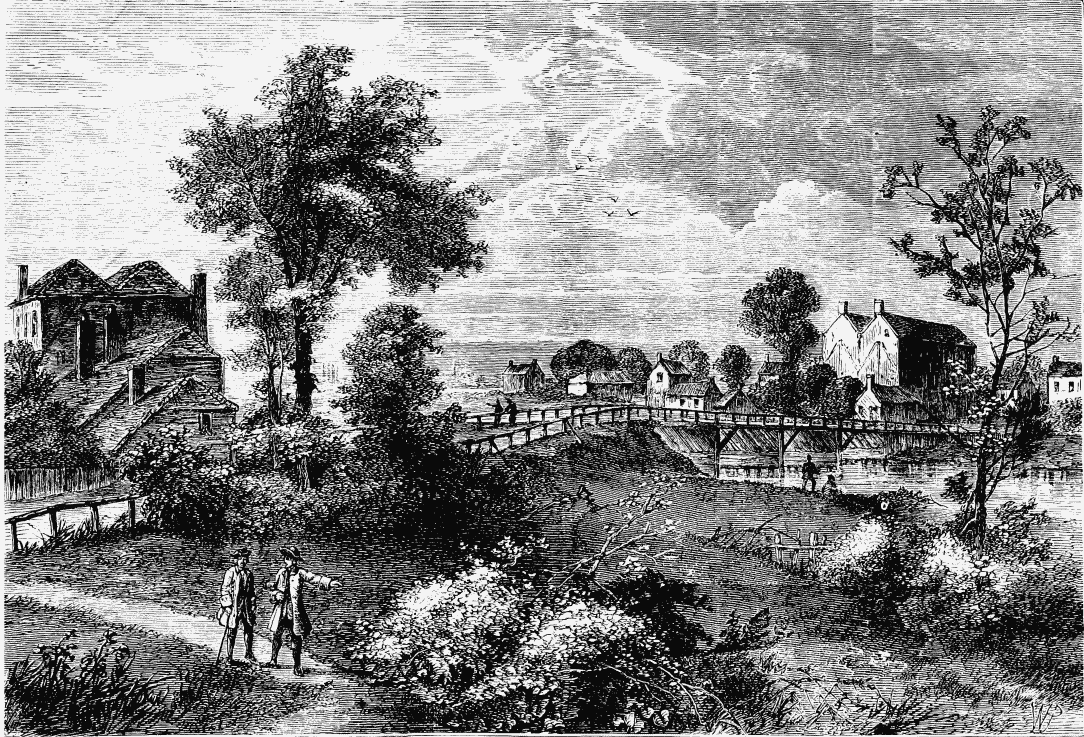
"JENNY'S WHIM" BRIDGE, 1750.
In Blomfield Place, close by St. Barnabas' Church, are two or three useful institutions, of modern growth, which must not be overlooked. One of these is St. John's School for girls, which was established in 1859, under the auspices of the Sisterhood of St. John, and with the sanction of the Bishop of London. The school is "specially adapted for the children of clergymen, professional men; for those whose parents are abroad, who need home-training and care; also for young ladies desirous of improving their education, or to be fitted for governesses." Adjoining the schoolhouse is St. Barnabas' Mission House, and also the St. Barnabas' Orphanage. The latter institution was established in 1860, and is supported by ladies living in the immediate neighbourhood. It is also placed under the care of the "sisters" of St. John.
In 1815, according to the "Beauties of England and Wales," the "chief ornament of this neighbourhood" was the "amazingly extensive and interesting manufactory of Mr. Bramah, the engineer, locksmith, and engine-maker. … These works have been deemed worthy the inspection of royalty, and have excited the admiration of the most powerful emperor of Christendom, Alexander of Russia." John Joseph Bramah, the founder of these engineering works, was nephew of Joseph Bramah, "a many-sided mechanist, one who did the world large service, and who, aided by a good business faculty in buying and selling, did himself and his heirs service also;" whose bust, modelled by Chantrey, was destroyed (but for what reason does not appear) by Lady Chantrey, after the sculptor's death. The younger Bramah inherited the business faculty of his uncle, and his love for mechanism, if not his inventive skill. He it was who here gathered together a huge business in railway plant, with the aid and help of the two Stephensons, George and Robert, and subsequently transferred it to Smethwick, near Birmingham, as the "London Works," joining with himself Charles Fox and John Henderson as his partners; and out of their works finally grew up the original Crystal Palace, as we have shown in the last chapter.
Another large establishment, which flourished for many years at Thames Bank, was that of Mr. Thomas Cubitt, the founder of the well-known firm in Gray's Inn Road which bears his name. The large engagements which resulted in the laying-out and erection of Belgrave Square were commenced by Mr. Cubitt, in 1825. Mr. Cubitt died towards the close of 1855. "Through life," observes a writer in the Builder, "he had been the real friend of the working man; and among his own people he did much to promote their social, intellectual, and moral progress. He established a workman's library; school-room for workmen's children; and by an arrangement to supply generally to his workmen soup and cocoa at the smallest rate at which these could be produced, assisted in establishing a habit of temperance, and superseding, to a great extent, the dram-drinking which previously existed among them. Although his kindness was appreciated by many, yet at times his motives have been misconstrued, and unkind remarks have been made. In alluding to these, he has often said to one who was about him and possessed his confidence, 'If you wait till people thank you for doing anything for them, you will never do anything. It is right for me to do it, whether they are thankful for it or not.' To those under him, and holding responsible situations, he was most liberal and kind. He was a liberal benefactor at all times to churches, schools, and charities, in those places with which he was connected, and always valued, in a peculiar degree, the advantages resulting to the poor from the London hospitals." Mr. Cubitt was a man of unassuming demeanour, and bore his great prosperity with becoming modesty. One instance of his equanimity occurred when his premises were unfortunately burnt down, in the year before his death. He was in the country at the time, and was immediately telegraphed for to town. The shock to most minds, on seeing the great destruction which occurred, attended with pecuniary loss to the amount of £30,000, would have been overpowering. Mr. Cubitt's first words on entering the premises, however, were, "Tell the men they shall be at work within a week, and I will subscribe £600 towards buying them new tools."
So late as 1763, Buckingham House enjoyed an uninterrupted prospect south and west to the river, there being only a few scattered cottages and the "Stag" Brewery between it and the Thames. Lying as it did at the distance of only a short walk from London, and on the way to rural Chelsea, this locality was always a great place for taverns and tea-gardens. The "Monster" Tavern, at one period an inn of popular resort, at the corner of St. George's Row and Buckingham Palace Road, and for many years the startingpoint of the "Monster" line of omnibuses, is probably a corruption, perhaps an intentional one, of the "Monastery." Mr. Larwood writes thus, in his "History of Sign-boards:"—"Robert de Heyle, in 1368, leased the whole of the Manor of Chelsea to the Abbot and Monastery or Convent of Westminister for the term of his own life, for which they were to pay him the sum of £20 a year, to provide him every day with two white loaves, two flagons of convent ale, and once a year a robe of esquire's silk. At this period, or shortly after, the sign of the 'Monastery' may have been set up, to be handed down from generation to generation, until the meaning and proper pronunciation were alike forgotten, and it became the 'Monster.' . . This tavern," he adds, "I believe, is the only one with such a sign."
We have already spoken of the Mulberry Gardens, which occupied the site of Buckingham Palace. (fn. 4) Here also were the "Gun" Tavern and Tea-gardens, with convenient "arbours and costume figures." These gardens were removed to make way for improvements at Buckingham Gate. Then there was the "Star and Garter" Tavern, at the end of Five-Fields' Row, which was at one time famous for its fireworks, dancing, and equestrianism; and the "Orange," as nearly as possible upon the site of St. Barnabas' Church.
Another tavern or place of public entertainment in this neighbourhood, in former times, was "Jenny's Whim." This establishment, which bore the name down to the beginning of the present century, occupied the site now covered by St. George's Row, near to Ebury Bridge, which spanned the canal at the north end of the Commercial Road. This bridge was formerly known as the "Wooden Bridge," and also as "Jenny's Whim Bridge" (see page 43); and down to about the year 1825, a turnpike close by bore the same lady's name.
A hundred years ago, as is clear from allusions to it in the Connoisseur and other periodicals, "Jenny's Whim" was a very favourite place of amusement for the middle classes. At a somewhat earlier date, it would appear to have been frequented alike by high and low, by lords and gay ladies, and by City apprentices; and indeed was generally looked upon as a very favourite place of recreation. The derivation of the name is a little uncertain; but Mr. Davis, in his "History of Knightsbridge," thus attempts to solve it:—"I never could unearth the origin of its name, but I presume the tradition told me by an old inhabitant of the neighbourhood is correct, namely, that it was so called after its first landlady, who caused the gardens round her house to be laid out in so fantastic a manner, as to cause the expressive little noun to be affixed to the pretty and familiar Christian name that she bore."
In the "Reminiscences" of Angelo, however, it is said that the founder of "Jenny's Whim" was not a lady at all, but a celebrated pyrotechnist, who lived in the reign of George I. If so, this assertion carries back the existence of the "Whim" as a place of amusement to a very respectable antiquity. Angelo states that it was "much frequented from its novelty, being an inducement to allure the curious to it by its amusing deceptions." "Here," he adds, "was a large garden; in different parts were recesses; and by treading on a spring—taking you by surprise—up started different figures, some ugly enough to frighten you outright—a harlequin, a Mother Shipton, or some terrific animal." Something of the same kind, it may here be remarked, was to be seen in the days of Charles I., in the Spring Garden near Charing Cross. (fn. 5) "In a large piece of water facing the tea alcoves," adds Mr. Angelo, "large fish or mermaids were showing themselves above the surface." Horace Walpole, in his letters, occasionally alludes to "Jenny's Whim," in terms which imply that he was among "the quality" who visited it. In one of his epistles to his friend Montagu, he writes, rather spitefully and maliciously, it must be owned, to the effect that at Vauxhall he and his party picked up Lord Granby, who had arrived very drunk from "Jenny's Whim." In 1755, a satirical tract was published, entitled, "Jenny's Whim; or a Sure Guide to the Nobility, Gentry, and other Eminent Persons in this Metropolis." "Jenny's Whim" has occasionally served the novelist for an illustration of the manners of the age. Let us take the following passage from "Maids of Honour," a tale temp. George I.:—
"Attached to the place there were gardens and a bowling-green," writes the author; "and parties were frequently made, composed of ladies and gentlemen, to enjoy a day's amusement there in eating strawberries and cream, cake, syllabub, and taking other refreshments, of which a great variety could be procured, with cider, perry, ale, wine, and other liquors in abundance. The gentlemen played at bowls—some employed themselves at skittles; whilst the ladies amused themselves with a swing, or walked about the garden, admiring the sunflower and hollyhocks, and the Duke of Marlborough cut out of a filbert-tree, and the roses and daisies, currants and gooseberries, that spread their alluring charms in every part."
No doubt, therefore, we may conclude that a century, or a century and a half ago, "Jenny's Whim" was a favourite meeting-place for lovers in the happy courting seasons, and that a day's pleasure near Ebury Bridge was considered by the fair damsels of Westminster and Knightsbridge one of the most attractive amusements that could be offered to them by their beaux; and many a heart which was obdurate elsewhere, gave way to gentle pressure beneath the influence of its attractions, aided by the genius loci, who is always most complaisant and benignant on such occasions. "Sometimes," writes Mr. Davis, "all its chambers were filled, and its gardens were constantly thronged by gay and sentimental visitors." We may be sure, therefore, that always during the season—in other words, from Easter-tide till the end of St. Martin's summer, when the long evenings drew on—"Jenny's Whim" was largely frequented by the young people of either sex, and that its "arbours" and "alcoves" witnessed and overheard many a tale of love. It is well perhaps that garden walls have not tongues as well as ears. But, in any case, it is perhaps a little singular that a place, once so well known and so popular, should have passed away, clean forgotten from the public memory.
All that appears to be known in detail about the house is, that it contained a large room for parties to breakfast in; and that the grounds, though not large, were fairly diversified, as they contained a bowling-green, several alcoves and arbours, and straight, prim flower-beds, with a fish-pond in the centre, where the paths met at right angles. There was also a "cock-pit" in the garden, and in a pond adjoining the brutal sport of duck-hunting was carried on. This feature of the garden is specially mentioned in a short and slight sketch of the place to be found in the Connoisseur of March 15th, 1775:—"The lower part of the people have their Ranelaghs and Vauxhalls as well as 'the quality.' Perrott's inimitable grotto may be seen for only calling for a pint of beer; and the royal diversion of duck-hunting may be had into the bargain, together with a decanter of Dorchester [ale] for your sixpence at 'Jenny's Whim.'"
Mr. Davis states, in his work above quoted, that the house was still partly standing in 1859, when his book was published, and might be easily identified by its "red brick and lattice-work."
Notwithstanding all the attractions which the district of Pimlico thus afforded to the Londoners, to betake themselves thither in order to enjoy the good things provided for their entertainment, access to it must have been somewhat difficult and dangerous in the last century—a state of things, as we have more than once remarked, that seems to have been pretty similar in all the suburbs of the metropolis; for we read in the London Magazine that, as lately as 1773, two persons were sentenced to death for a highway robbery in "Chelsea Fields," as that part of Pimlico bordering the Chelsea Road was then called. It is also not a matter of tradition, but of personal remembrance, that for the first twenty years of the present century persons who resided in the "suburb" of Pimlico rarely thought of venturing into London at night, so slight was the protection afforded them by the watchmen and "Charlies," aided by the faint glimmer of oil lamps, few and far between.
Not far from the Mulberry Gardens, on the west side of what is now James Street, as we have stated in the previous volume, (fn. 6) stood a mansion, called Tart Hall, which was built, or, at all events, extensively altered and enlarged, in the reign of Charles I., for the wife of Thomas, "the magnificent Earl of Arundel." On her death it passed into the hands of her second son, William, Lord Stafford, one of the victims of the plot of the infamous Titus Oates, in 1680, and whose memory is still kept up in the names of Stafford Place and Stafford Row. Strange to say, that John Evelyn himself, usually so circumstantial in all matters of detail, dismisses this legal murder without a single remark, beyond the dry entry in his "Diary," under December 20th, 1680: "The Viscount Stafford was beheaded on Tower Hill." It is said that the old gateway, which stood till early in the last century, was never opened after the condemned nobleman passed through it for the last time.
The building is described in the "New View of London" (1708), as being "near the way leading out of the Park to Chelsea;" and its site is marked in Faithorne's Map of London, published in 1658.
In his "Morning's Walk from London to Kew" (1817), Sir Richard Phillips writes:—"The name of Stafford Row reminded me of the ancient distinction of Tart Hall, once the rival in size and splendour of its more fortunate neighbour, Buckingham House. … It faced the Park, on the present site of James Street; its garden-wall standing where Stafford Row is now built, and the extensive livery-stables being once the stables of its residents."
The origin of Tart Hall is unknown; but the name is probably a corruption or abridgment of a longer word. It is noted, as to situation, in "Walpole's Anecdotes," as "without the gate of St. James's Park, near Buckingham House," and is described by him as "very large, and having a very venerable appearance."
After the removal of the Arundel marbles and other treasures from Arundel House, in the neighbourhood of the Strand, (fn. 7) the remainder of the collection, as Walpole tells us, was kept at Tart Hall; but they were sold in 1720, and the house was subsequently pulled down. From the same authority we learn that some carved seats, by Inigo Jones, purchased at this sale, were placed by Lord Burlington in his villa at Chiswick. In the Harleian MSS., in the British Museum, is to be seen "A Memorial of all the Roomes at Tart Hall, and an Inventory of all the household stuffs and goods there, except of six Roomes at the North end of the ould Building (which the Right Honourable the Countess hath reserved unto her peculiar use), and Mr. Thomas Howard's Closett, &c.," dated September, 1641. The memorial is curious as giving a catalogue, not only of the picture-gallery, but of the carpets and decorations of this once magnificent palace. It is, however, too long in its details to be reprinted here.
In Stafford Row, which lies immediately at the back of Buckingham Palace Hotel, lived, in the year 1767, William Wynne Ryland, the engraver, who was executed for forgery in 1783; here, too, during the early part of the present century, died Mrs. Radcliffe, the author of "The Mysteries of Udolpho." Richard Yates, the actor, who was famous in the last century for his delineation of "old men," died at his residence in this Row in 1796. The following singular story of the ill fortune which attended the actor and his family is told by Peter Cunningham, in his "Hand-book of London:"—"Yates had ordered eels for dinner, and died the same day of rage and disappointment, because his housekeeper was unable to obtain them. The actor's great-nephew was, a few months afterwards—August 22nd, 1796—killed while endeavouring to effect an entrance into the house from the back garden. The great-nephew, whose name was Yates, claimed a right to the house, as did also a Miss Jones, and both lived in the house for some months after Yates' death. Yates, while strolling in the garden, was bolted out after an early dinner, and, while forcing his way in, was wounded by a ball from a pistol, which caused his death. The parties were acquitted."
St. Peter's Chapel, on the west side of Charlotte Street, which runs southwards out of Buckingham Palace Road, just opposite to the Palace, and skirts the west end of Stafford Place, enjoys a melancholy celebrity, as having been the scene of the ministrations of Dr. Dodd, of whose executior for a forgery on Lord Chesterfield we shall have to make fuller mention when we come to speak of "Tyburn Tree." The following account of the life of Dr. Dodd is said to have been sketched by himself while lying in Newgate, awaiting his execution, and to have been finished by Dr. Johnson:—"I entered very young on public life, very innocent—very ignorant—and very ingenuous. I lived many happy years at West Ham, in an uninterrupted and successful discharge of my duty. A disappointment in the living of that parish obliged me to exert myself, and I engaged for a chapel near Buckingham Gate. Great success attended the undertaking; it pleased and elated me. At the same time Lord Chesterfield, to whom I was personally unknown, offered me the care of his heir, Mr. Stanhope. By the advice of my dear friend, now in heaven, Dr. Squire, I engaged, under promises which were not performed. Such a distinction, too, you must know, served to increase a young man's vanity. I was naturally led into more extensive and important connections, and, of course, with greater expenses and more dissipations. Indeed, before I never dissipated at all—for many, many years, never seeing a playhouse, or any public place, but living entirely in Christian duties. Thus brought to town, and introduced to gay life, I fell into its snares. Ambition and vanity led me on. My temper, naturally cheerful, was pleased with company; naturally generous, it knew not the use of money; it was a stranger to the useful science of economy and frugality; nor could it withhold from distress what it too much (often) wanted itself.
"Besides this, the habit of uniform, regular, sober piety, and of watchfulness and devotion, wearing off, amidst this unavoidable scene of dissipation, I was not, as at West Ham, the innocent man that I lived there. I committed offences against my God, which yet, I bless Him, were always, on reflection, detestable to me.
"But my greatest evil was expense. To supply it, I fell into the dreadful and ruinous mode of raising money by annuities. The annuities devoured me. Still, I exerted myself by every means to do what I thought right, and built my hopes of perfect extrication from all my difficulties when my young and beloved pupil should come of age. But, alas! during this interval, which was not very long, I declare with solemn truth that I never varied from the steady belief of the Christian doctrines. I preached them with all my power, and kept back nothing from my congregations which I thought might tend to their best welfare; and I was very successful in this way during the time. Nor, though I spent in dissipation many hours which I ought not, but to which my connections inevitably led, was I idle during this period; as my 'Commentary on the Bible,' my 'Sermons to Young Men,' and several other publications prove. I can say, too, with pleasure, that I studiously employed my interest, through the connections I had, for the good of others. I never forgot or neglected the cause of the distressed; many, if need were, could bear me witness. Let it suffice to say, that during this period I instituted the Charity for the Discharge of Debtors."
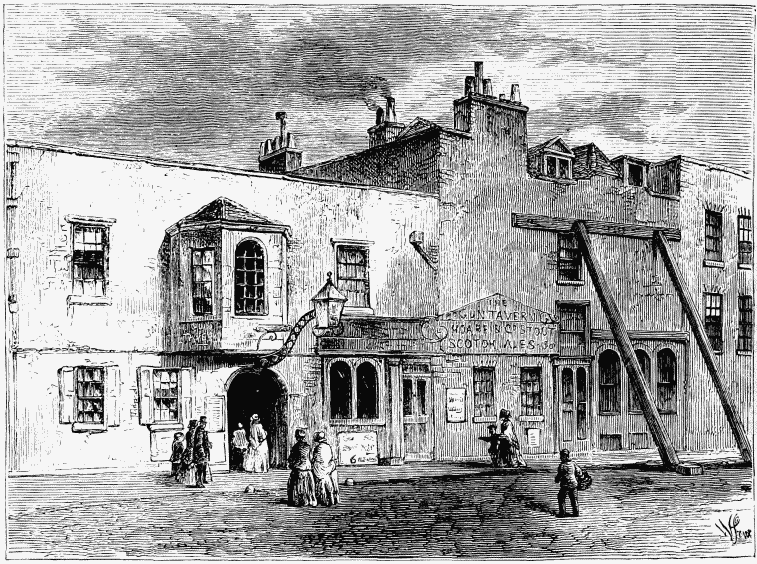
THE "GUN TAVERN," 1820.
Close by Charlotte Street, in a small gloomy house, inside the gates of Messrs. Elliot's Brewery, between Brewer Street, Pimlico, and York Street, Westminster, lived Richard Heber, some time M.P. for the University of Oxford, and the owner of one of the finest private libraries in the world. Here he kept a portion of his library; a second part occupying an entire house in James Street, Buckingham Gate; a third portion, from kitchen to attics, was at his country seat at Hodnet, in Shropshire; and a fourth at Paris. "Nobody," he used to say, "could do without three copies of a book—one for show at his country house, one for personal use, and the third to lend to his friends." And this library, as we learn from "A Century of Anecdote," had but a small beginning—the accidental purchase of a chance volume picked up for a few pence at a bookstall, and about which Mr. Heber was for some time in doubt whether to buy it or not. The catalogue of Mr. Heber's library was bound up in five thick octavo volumes. Dr. Dibdin once addressed to him a letter, entitled "Bibliomania;" but he was no bibliomaniac, but a ripe and accomplished scholar. Mr. Heber took an active part in founding the Athenæum Club, and he was also a member of several other literary societies; indeed, to use the phrase of Dr. Johnson, "He was an excellent clubber." He was the half-brother of Reginald Heber, Bishop of Calcutta, and died a bachelor in 1833, in the sixtieth year of his age. His extensive library was dispersed by auction in London. The sale commenced upon the 10th of April, 1834, and occupied two hundred and two days, and extended through a period of more than two years. The catalogue of this remarkable sale filled more than two thousand printed octavo pages, and contained no less than 52,672 lots.
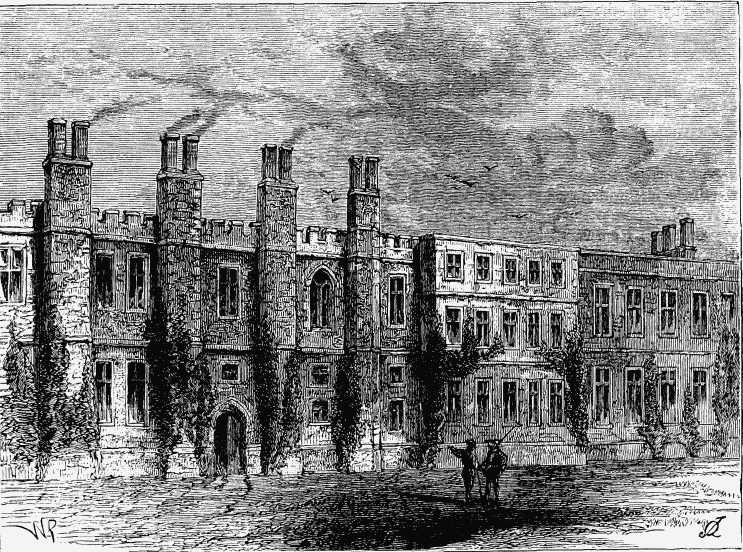
THE OLD CHELSEA MANOR HOUSE.
Mr. Peter Cunningham, in noticing the growth of this locality in his "Hand-book of London," says: "George IV. began the great alterations in Pimlico by rebuilding Buckingham House, and drawing the courtiers from Portland Place and Portman Square to the splendid mansions built by Messrs. Basevi and Cubitt, in what was known at that time, and long before, as the 'Five Fields.' It seems but the other day," he adds, "that the writer of this brief notice of the place played at cricket in the Five Fields, 'where robbers lie in wait,' or pulled bulrushes in the 'cuts' of the Willow Walk, in Pimlico."
As might be naturally expected, the removal of King William and his Court from St. James's to Buckingham Palace, on his accession to the throne in 1830, gave a considerable impetus to the improvement of Pimlico, although a town of palaces had already been commenced upon the "Five Fields," as that dreary region had been formerly called. The ground landlord of a considerable portion of the land thus benefited by these metropolitan improvements was Lord Grosvenor, who, in the year 1831, was created Marquis of Westminster, and who, as we have already stated in our description of Grosvenor House in a former chapter, was grandfather of the present ducal owner. (fn. 8)