Old and New London: Volume 5. Originally published by Cassell, Petter & Galpin, London, 1878.
This free content was digitised by double rekeying. Public Domain.
Edward Walford, 'Chelsea', in Old and New London: Volume 5(London, 1878), British History Online https://www.british-history.ac.uk/old-new-london/vol5/pp50-70 [accessed 30 April 2025].
Edward Walford, 'Chelsea', in Old and New London: Volume 5(London, 1878), British History Online, accessed April 30, 2025, https://www.british-history.ac.uk/old-new-london/vol5/pp50-70.
Edward Walford. "Chelsea". Old and New London: Volume 5. (London, 1878), British History Online. Web. 30 April 2025. https://www.british-history.ac.uk/old-new-london/vol5/pp50-70.
In this section
CHAPTER V.
CHELSEA.
"The sands of Chelsey Fields."—Ben Jonson.
Boundary of the Parish—Etymology of its Name—Charles II. and Colonel Blood—Chelsea Fields—The "Dwarf's Tavern"—Chapels of French Huguenot Refugees—Gardens and Nurseries—Appearance of Chelsea from the River—Chelsea in the Last Century—A Stag Hunt in Chelsea—History of the Manor—The Old Manor House and its Eminent Residents—Lord Cremorne's Farm at Chelsea—Lady Cremorne—Lindsey House—The Moravians—The Duchess of Mazarine—Sir Robert Walpole's House—Shrewsbury House—Winchester House—Beaufort House and the "Good" Sir Thomas More—Anecdotes of Sir Thomas More—The Old and New Parish Churches.
Few, if any, of the suburban districts of the metropolis can lay claim to greater interest, biographical as well as topographical, than the locality upon which we have now entered. In Faulkner's "History of Chelsea," we read that the parish is "bounded on the north by the Fulham Road, which separates it from Kensington; on the east by a rivulet, which divides it from St. George's, Hanover Square, and which enters the Thames near Ranelagh; on the west a brook, which rises near Wormholt Scrubs, and falls into the Thames facing Battersea Church, divides this parish from that of Fulham; and on the south it is bounded by the Thames." Lysons observes that the most ancient record in which he has seen the name of this place mentioned is a charter of Edward the Confessor, in which it is written "Cealchylle." (fn. 1) The name seems to have puzzled the Norman scribes, for in Domesday Book it is written both "Cercehede" and "Chelched;" and in certain documents of a later date it is called "Chelcheth," or "Chelcith." "The word 'Chelsey,'" observes Mr. Norris Brewer, in the "Beauties of England and Wales," "was first adopted in the sixteenth century, and the present mode of spelling the name appears to have grown into use about a century back." It may here be remarked that the name of Chelsea has been derived by some writers from "Shelves" of sand, and "ey," or "ea," land situated near the water. But Lysons prefers the etymology of Norden, who says that "it is so called from the nature of the place, its strand being like the chesel [ceosel, or cesol], which the sea casteth up of sand and pebble stones, thereof called Chevelsey, briefly Chelsey." In like manner it may be added that the beach of pebbles thrown up by the action of the sea outside Weymouth harbour, is styled the Chesil bank. Perhaps it is the same word at bottom as Selsey, the name of a peninsula of pebbles on the Sussex coast, near Chichester.
As a symbol of infinity, Ben Jonson, in his
"Forest," speaks of
"All the grass that Romney yields,
Or the sands of Chelsey Fields."
Macaulay reminds us that, at the end of the reign of Charles II., Chelsea was a "quiet country village, with about a thousand inhabitants; the baptisms averaging little more than forty in the year." At that time the Thames was sufficiently clear and pure for bathing above Westminster. We are told that, on one occasion, Charles II. was bathing at Chelsea, when the notorious Colonel Blood lay hid among the reeds at Battersea, in order to shoot him. Notwithstanding its remoteness from the metropolis, however, Chelsea does not appear to have escaped the ravages of the "Great Plague," for it raged here as well as in other suburbs of London, as Pepys informs us, in his "Diary," under date of April 9th, 1666:—"Thinking to have been merry at Chelsey; but, being almost come to the house by coach, near the waterside, a house alone, I think the 'Swan,' a gentleman walking by called out to us that the house was shut up because of the sickness."
Chelsea Fields must have been quite a rustic
spot even to a yet later date, for Gay thus addresses his friend Pulteney:—
"When the sweet-breathing spring unfolds the buds,
Love flies the dusty town for shady woods;
Then … … …
… Chelsea's meads o'erhear perfidious vows,
And the press'd grass defrauds the grazing cows."
In "Chelsea Fields" was formerly a tavern, known as "The Dwarf's," kept by John Coan, a diminutive manikin from Norfolk. "It seems to have been a place of some attraction," says Mr. Larwood, "since it was honoured by the repeated visits of an Indian king." Thus the Daily Advertiser of July 12, 1762, says: "On Friday last the Cherokee king and his two chiefs were so greatly pleased with the curiosities of the Dwarf's Tavern, in Chelsea Fields, that they were there again on Sunday, at seven in the evening, to drink tea, and will be there again in a few days." The reputation of the tavern, under its pygmean proprietor, was but brief, as the "unparalleled" Coan, as he is styled, died within two years from the above date.
In the reign of William III., the French Huguenot refugees had two chapels in Chelsea: the one in "Cook's Grounds," now used by the Congregationalists, and another at Little Chelsea, not far from Kensington.
"Chelsea," observes a writer in the Mirror, in 1833, "though now proverbial for its dulness, was formerly a place of great gaiety. Thousands flocked to Salter's—or, as it was dubbed, 'Don Saltero's'—coffee-house in Cheyne Walk; the Chelsea buns were eaten by princesses; and the public were allowed to walk in thirteen acres of avenues of limes and chestnut-trees in the gardens adjoining the College. This privilege was disallowed in 1806; but within the last few weeks these grounds have been again thrown open to the public." The ground round about Chelsea and its neighbourhood, like that of Bermondsey, and other low-lying districts bordering upon the Thames, is peculiarly adapted for the growth of vegetables, fruits, and flowers; indeed, Chelsea has long been remarkable for its gardens and nurseries. Dr. Mackay, in his "Extraordinary Popular Delusions," tells us that about the time of Her Majesty's accession, there was a gardener in the King's Road, Chelsea, in whose catalogue a single tulip was marked at two hundred guineas—a remnant, perhaps, of the tulip-mania, which, two centuries before, had ruined half of the merchants of Holland, and threatened to prove as disastrous here as the "South Sea Bubble." It may be added, too, that the first red geranium seen in England is said to have been raised by a Mr. Davis here, about the year 1822.
Chelsea, which was once a rustic and retired village, has been gradually absorbed into the metropolis by the advance of the army of bricklayers and mortar-layers, and now forms fairly a portion of London, Pimlico and Belgravia having supplied the connecting link. Environed though it is by the growing suburbs, the place has still an old-fashioned look about it, which the modern, trimly-laid-out flower-gardens on the new embankment only tend to increase. Looked at from the Battersea side of the river, with the barges floating lazily along past the solid red-brick houses, screened by sheltering trees, Chelsea presents such a picture as the old Dutch "masters" would have revelled in, especially as the Thames here widens into a fine "reach," well known to oarsmen for the rough "seas" which they encounter there on those occasions when the wind meets the tide; in fact, the river is wider at this particular spot than anywhere "above bridge." In the reign of Charles II. it was such a fashionable rendezvous that it was frequently called "Hyde Park on the Thames."
Bowack thus writes, in an account of Chelsea, published in 1705:—"The situation of it upon the Thames is very pleasant, and standing in a small bay, or angle, made by the meeting of Chelsea and Battersea Reaches, it has a most delightful prospect on that river for near four miles, as far as Vauxhall eastward, and as Wandsworth to the west."
In the last century, Chelsea being, in fact, quite a suburban place, had its own society; "its many honourable and worthy inhabitants," as we are told by Bowack, "being not more remarkable for their titles, estates, and employments, than for their civility and condescension, and their kind and facetious tempers, living in a perfect amity among themselves, and having a general meeting every day at a coffee-house near the church, well known for a pretty collection of varieties in nature and art, some of which are very curious." The coffee-house here mentioned was the renowned Don Saltero's, of which we shall have more to say in the next chapter.
Mr. Peter Cunningham speaks of Chelsea as "at one time the Islington of the West-end," and thus enumerates the articles for which it has from time to time been famous:—Its manor house, its college, its botanic garden, its hospital, its amusements at Ranelagh, its waterworks, its buns, its china, and its custards.
"About the year 1796," writes Faulkner, in his "History of Chelsea," "I was present at a staghunt in Chelsea. The animal swam across the river from Battersea, and made for Lord Cremorne's grounds. Upon being driven from thence, he ran along the water-side as far as the church, and turning up Church Lane, at last took refuge in Mrs. Hutchins's barn, where he was taken alive."
The connection of Chelsea with Westminster, already stated in our account (fn. 2) of the "Monster" Tavern, Pimlico, is probably of very old standing, for even during the rule of our Norman kings it appears to have been one of the manors belonging to the abbey of St. Peter. Little, however, is known with certainty of the history of this now extensive parish till the time of Henry VII., when the manor was held by Sir Reginald Bray, from whom it descended to Margaret, only child of his next brother, John, who married William, Lord Sandys. From Lord Sandys the manor passed, in exchange for other lands, to that rapacious king, Henry VIII., by whom it was assigned to Katharine Parr, as part of her marriage jointure. Faulkner, in his work above quoted, says that "Henry was probably induced to possess this manor from having observed, in his frequent visits to Sir Thomas More, the pleasantness of the situation on the bank of the Thames; and, from the salubrity of the air, deeming it a fit residence for his infant daughter, the Princess Elizabeth, then between three and four years of age. But after having obtained it, finding that the manor house was ancient, and at that time in the possession of the Lawrence family, he erected a new manor house, on the eastern side of the spot where Winchester House lately stood, and supplied it with water from a spring at Kensington." The manor was subsequently held by John Dudley, Duke of Northumberland; by Anne, Duchess of Somerset, widow of the "Protector;" by John, first Lord Stanhope, of Harrington; by Katharine, Lady Howard, wife of the Lord Admiral; by James, first Duke of Hamilton; by Charles, Viscount Cheyne; and by Sir Hans Sloane, the celebrated physician, who purchased it in 1712 from the Cheyne family, and from whom it passed by marriage to Charles, second Lord Cadogan, of Oakley, through which alliance the manor of Chelsea became vested in the Cadogans, with whom it still remains.
The old manor house stood near the church, and was sold by Henry VIII. to the Lawrence family, after whom Lawrence Street derives its name. The new manor house stood on that part of Cheyne Walk fronting the Thames, between the Pier Hotel and the house formerly known as "Don Saltero's Coffee-house." The building, of which a view of the north front is engraved in Faulkner's "History of Chelsea" (see page 49), was of a quadrangular form, enclosing a spacious court, and was partly embattled. The mansion was pulled down shortly after the death of Sir Hans Sloane, in the middle of the last century, and a row of houses erected on the site.
Like Kensington, Chelsea has been from time to time the residence of many individuals of high rank, who were attracted to it on account of its nearness to the Court, and its easiness of access at a time when the roads of the suburbs were bad, and the Thames was the "silent highway" to families who could afford to keep their barge. So far as rank and station are concerned, perhaps the first and foremost of its residents was the Princess (afterwards Queen) Elizabeth. After her father's death, Miss Lucy Aikin tells us, in her "Memoirs of the Court" of that sovereign, the princess "had been consigned to the care and protection of the Queen Dowager (Katharine Parr), with whom she usually made her abode at one or other of her jointure houses at Chelsea, or at Hanworth, near Hounslow."
In the reign of Elizabeth, the Lord High Admiral, the Earl of Effingham, was among the residents of this place; and we are told by Bishop Goodman that, in her "progresses" from Richmond to Whitehall, the "Virgin Queen" would often dine with his lordship at Chelsea, and afterwards set out thence towards London, late at night, by torchlight, in order that the Lord Mayor and aldermen, and the other loyal citizens, might not see those wrinkles and that ugly throat of hers, with which Horace Walpole has made us familiar in his representation of a coin struck shortly before her death.
Thomas Beauchamp, Earl of Warwick, who acquired high renown at the battles of Cressy and Poictiers, appears to have occasionally resided at Chelsea. It is supposed that he occupied a house and premises which afterwards belonged to Richard Beauchamp, Bishop of Salisbury, and which were granted by Richard III. to Elizabeth, widow of Thomas Mowbray, Duke of Norfolk, for life, "to be held by the service of a red rose." The site of this mansion, however, is now unknown, as also is the spot once occupied by a house in Chelsea which was possessed by William, Marquis of Berkeley, an adherent of the Earl of Richmond (afterwards Henry VII.).
In April, 1663, we find Lord Sandwich at his
Chelsea lodging, eating cakes made by the mistress
of the house, and, it may be added, the mother of
his own mistress—cakes so good that, says Pepys,
"they were fit to present to my Lady Castlemaine"—a curious parody of the lines of the
old nursery rhyme:—
"Now was not that a dainty dish
To set before a king?"
Among the residents of Chelsea in the last century was Lord Cremorne, who occupied a house called Chelsea Farm, which was situated at a short distance from the bridge, on the site now covered by Cremorne Gardens. Lady Cremorne is celebrated in the "Percy Anecdotes" as the best mistress of a household that ever lived. She had a servant, Elizabeth Palfrey, who had lived with her for forty-eight years, during the latter half of the time as housekeeper, and who so regulated affairs that in all that long time not one of the female servants was known to have left her place, except in order to be married. Such mistresses are rare now, and probably were not common even in her day. As late as 1826, the name of Viscountess Cremorne appears in the "Royal Blue Book," with "Chelsea Farm" as her country residence. The edifice, which was built of brick, overlooked the river, from which it was separated by a lawn, pleasantly shaded by stately trees. The house had a somewhat irregular appearance externally, and little to boast of in the way of architecture; but the interior was commodious, and the best suite of rooms well adapted to the use of a distinguished family. Here was a small but judicious collection of pictures, formed by Viscount Cremorne, among which were some by noted Flemish and Italian masters.
Lindsey Row and Lindsey Place, facing the river immediately westward of Battersea Bridge, mark the site of Lindsey House, the residence of the Berties, Earls of Lindsey. About the middle of the last century the mansion was purchased by Count Zinzendorf, a leader of the peculiar sect known as Moravians, for the purpose of establishing a settlement of that society in Chelsea; but the project failed; the building was again sold, and subsequently demolished, or cut up into private tenements.
In a small house in Chelsea, rented from Lord Cheyne, died, in difficulties, the beautiful Duchess of Mazarine, one of the frail beauties of the Court of Charles II.
In Lyson's "Environs," we read that about the year 1722 Sir Robert Walpole, the well-known prime minister of George II., "became possessed of a house and garden in the stable-yard at Chelsea." The house was "next the college," adjoining Gough House. Sir Robert frequently resided there, improved and added to the house, and considerably enlarged the gardens by a purchase of some land from the Gough family; he erected an octagonal summer-house at the head of the terrace, and a large green-house, where he had a fine collection of exotics. A good story is told about Queen Caroline, when dining one day here with Lady Walpole. Sir Paul Methuen, who was one of the company, was remarkable for his love of romances. The queen asked him what he had been reading of late in his own way. "Nothing, madam," said Sir Paul; "I have now commenced, instead of romances, a very foolish study, 'The History of the Kings and Queens of England.'" Horace Walpole informs us that he remembered La Belle Jennings (afterwards Duchess of Marlborough) coming to his parents' house to solicit a pension.
Shrewsbury House, or, as it was sometimes called, Alston House, in Cheyne Walk, near the waterside, if we may trust Priscilla Wakefield's "Perambulations in London," was a paper manufactory at the time of its demolition in 1814. It was an irregular brick building, forming three sides of a quadrangle. The principal room was upwards of 100 feet long, and was originally wainscoted with carved oak. One of the rooms was painted in imitation of marble, and others were ornamented with certain "curious portraits on panel." Leading from the premises towards the King's Road was a subterranean passage, which is traditionally said to have communicated with a cave, or dungeon, situated at some distance from the house.
Winchester House, the Palace of the Bishops of Winchester from about the middle of the seventeenth down to the commencement of the present century, stood on the spot now occupied by the Pier Hotel, and its gardens adjoined Shrewsbury House. It was a heavy brick building, of low proportions, and quite devoid of any architectural ornament. The interior was fairly commodious, and "much enriched by the collection of antiques and specimens of natural history" placed there by Bishop North, the last prelate who occupied it. Bishop Hoadley, who died here in 1761, was so lax in his ideas of Church authority, that some free-thinking Christians were wittily styled by Archbishop Secker, "Christians secundum usum Winton," in allusion to the customary title of books printed "for the use of the Winchester scholars."
The chief interest of Chelsea, however, not only to the antiquary, but to the educated Englishman, must lie in the fact that it was the much-loved home of that great man whose memory English history will never allow to die, Sir Thomas More. Here he resided, surrounded by his family, in a house about midway between the Thames and the King's Road, on the site of what is now Beaufort Street. In Aubrey's "Letters from the Bodleian," we read:—"His country house was at Chelsey, in Middlesex, where Sir John Danvers built his house. The chimney-piece, of marble, in Sir John's chamber, was the chimney-piece of Sir Thomas More's chamber, as Sir John himself told me. Where the gate is now, adorned with two noble pyramids, there stood anciently a gate-house, which was flatt on the top, leaded, from whence was a most pleasant prospect of the Thames and the fields beyond; on this place the Lord Chancellor More was wont to recreate himself and contemplate."
Erasmus—himself one of the most cherished friends of Sir Thomas—describes the house as "neither mean nor subject to envy, yet magnificent and commodious enough." The building, which was erected early in the sixteenth century, was successively called Buckingham House and Beaufort House, and was pulled down about the middle of the last century. At the end of the garden Sir Thomas erected a pile of buildings, consisting of a chapel, gallery, and library, all being designed for his own retirement. His piety, staunch and firm as was his adherence to the Roman Catholic creed, is acknowledged even by Protestant writers. Wood, in his "Ecclesiastical Antiquities," says:—"More rose early, and assembled his family morning and evening in the chapel, when certain prayers and Psalms were recited. He heard mass daily himself, and expected all his household to do so on Sundays and festivals; whilst, on the eves of great feasts, all watched till matins. Every Friday, as was also his custom on some other occasions, he retired to the new buildings, where he spent the whole day in prayer and meditation."
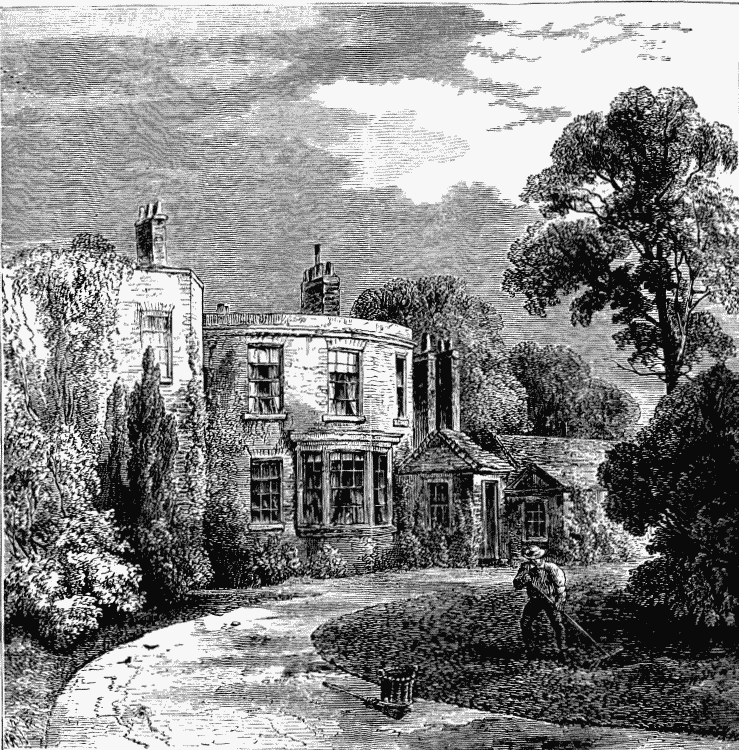
CREMORNE FARM, 1829.
Sir Thomas usually attended Divine service on Sundays at Chelsea Church, and very often assisted at the celebration of mass. The Duke of Norfolk coming one day to dine with him during his chancellorship, found him in church with a surplice on, and singing in the choir. "God's body, my Lord Chancellor!" said the duke, as they returned to his house. "What! a parish clerk! a parish clerk! you dishonour the king and his office." "Nay," said Sir Thomas, "you may not think your master and mine will be offended with me for serving God, his master, or thereby count his office dishonoured."
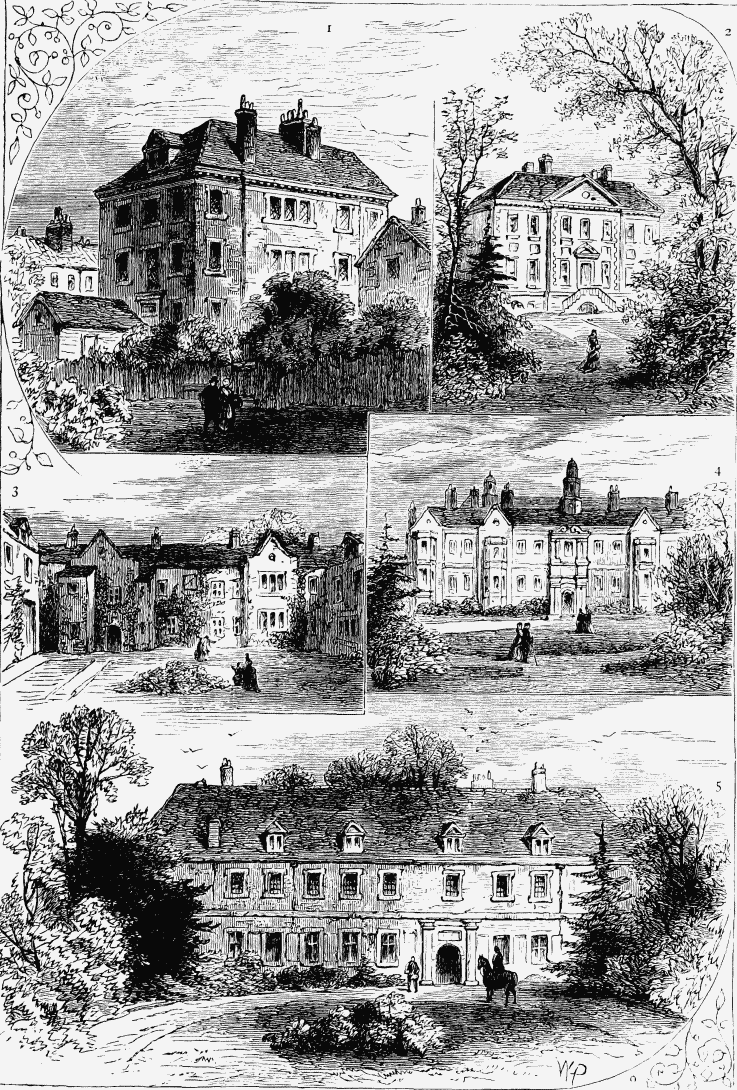
OLD MANSION IN CHELSEA. (From Faulkner's "Chelsea.")
1. Church Place, 1641.
2. Gough House, 1760.
3. Shrewsbury House, 1540.
4. Beaufort House, 1628.
5. Winchester House
In later years the chapel in More's house appears to have been free to the public, for in various marriage licences, granted towards the commencement of the last century, persons were to be married "in the parish church, in the chapel of Chelsea College, or the chapel of Beaufort House." The only fragment of the house remaining down to the present century was a portion of the cellars, which existed beneath the house No. 17, forming one of the line of dwellings now known by the name of Beaufort Row. An avenue, with a high wall on each side, constituted the chief approach to the house, or that from the river-side; and fronting the entrance of this avenue were the stairs used by Sir Thomas More when descending to his barge. A terrace-walk, which stretched from the house towards the east, is described in the legal writings of the estate as being so much raised that it was ascended by several steps. After the demolition of the house a portion of the ground was occupied as a burial-place for the Moravian Society, and the remains of the stables were converted into public schools.
The most important circumstances in the life of Sir Thomas More are too well known to need repetition in these pages. His domestic life at Chelsea has been described by Erasmus in the following words:—"There he converses with his wife, his son, his daughter-in-law, his three daughters and their husbands, with eleven grandchildren. There is not any man living so affectionate as he, and he loveth his old wife as well as if she was a young maid. You would say there was in that place Plato's Academy; but I do his house an injury in comparing it to Plato's Academy, where there were only disputations of numbers and geometrical figures, and sometimes of moral virtues. I should rather call his house a school, or university of Christian religion, for though there is none therein but readeth or studreth the liberal sciences, their special care is piety and virtue; there is no quarrelling or intemperate words heard; none seen idle; that worthy gentleman doth not govern with proud and lofty words, but with well-timed and courteous benevolence; everybody performeth his duty, yet is there always alacrity; neither is sober mirth anything wanting."
Erasmus was the correspondent of Sir Thomas More long before he was personally acquainted with his illustrious friend; and although strongly dissimilar in religious opinions, when the great reformer and scholar visited England he was the frequent guest of Sir Thomas at Chelsea. The house of More was, indeed, the resort of all who were conspicuous for learning and taste. Collet, Linacre, and Tunstall often partook of the hospitality of his table. Here Sir Thomas often entertained "Master John Heywood," the early English playwright, and cracked with him many a joke. It is said that it was through Sir Thomas More that he was introduced to the Lady Mary, and so was brought under the notice of Henry VIII., who appointed him the Court jester. Those were, indeed, strange days, when a buffoon dared to laugh in the face of a sovereign who could send to the scaffold so venerable, so grave and learned a scholar, and so loyal a subject of the Crown. The wit of Sir Thomas More was almost boundless, and he was also no mean actor. It is related of him that when an interlude was performed he would "make one among the players, occasionally coming upon them by surprise, and without rehearsal fall into a character, and support the part by his extemporaneous invention, and acquit himself with credit." It was probably by his intercourse with Heywood that the latent dramatic powers of the great Lord Chancellor were called out.
Henry VIII., to whom More owed his rise and fall, frequently came to Chelsea, and spent whole days in the most familiar manner with his learned friend; and "it is supposed," says Faulkner, in his "History of Chelsea," "that the king's answer to Luther was prepared and arranged for the public eye, with the assistance of Sir Thomas, during these visits." Notwithstanding all this familiarity, Sir Thomas understood the temper of his royal master very well, as the following anecdote sufficiently testifies:—"One day the king came unexpectedly to Chelsea, and dined with him, and after dinner walked in his garden for the space of an hour, holding his arm about his neck. As soon as his Majesty was gone, Sir Thomas's son-in-law observed to him how happy he was, since the king had treated him with that familiarity he had never used to any person before, except Cardinal Wolsey, with whom he once saw his Majesty walk arm-inarm." "I thank our Lord," answered Sir Thomas, "I find his grace my very good lord indeed; and I believe he doth as singularly love me as any subject within this realm; however, son Roper, I may tell thee I have no cause to be proud thereof, for if my head would win him a castle in France, it should not fail to go off."
Sir Thomas More is said to have converted one
part of his house into a prison for the restraint of
heretics; and according to a passage in "Foxe's
Book of Martyrs," he here kept in prison, and
whipped in his garden, one John Baynham, a
lawyer, who was suspected of holding the doctrines
of Wycliffe, and who was ultimately burnt at Smithfield. But it must be remembered that he lived
in an age when religious persecution was practised
by all parties, and when, as Byron writes—
"Christians did burn each other, quite persuaded
That all th' Apostles would have done as they did."
More's fondness for animals is an interesting and curious peculiarity. Erasmus tells us, that watching their growth, development, and dispositions, was one of his chief pleasures. "At Chelsea may be seen many varieties of birds, and an ape, a fox, a weasel, and a ferret. Moreover, if anything foreign, or otherwise remarkable, comes in his way, he greedily buys it up, and he has his house completely furnished with these objects; so that, as you enter, there is everywhere something to catch the eye, and he renews his own pleasure as often as he becomes a witness to the delight of others." With one of his favourite dogs, Sir Thomas would frequently sit in fine weather on the top of the gate-house, in order to enjoy the agreeable prospect. A curious story is told in the "Percy Anecdotes," which will bear repeating:—"It happened one day that a 'Tom o' Bedlam,' a maniac vagrant, got upstairs while Sir Thomas was there, and coming up to him, cried out, 'Leap, Tom, leap!' at the same time, attempting to throw his lordship over the battlements. Sir Thomas, who was a feeble old man, and incapable of much resistance, had the presence of mind to say, 'Let us first throw this little dog over.' The maniac threw the dog down immediately. 'Pretty sport,' said the Lord Chancellor; 'now go down and bring him up; then we'll try again.' While the poor madman went down for the dog, his lordship made fast the door of the stairs, and, calling for help, saved his life."
Sir Thomas More is to be remembered also with gratitude on quite another score, and on higher grounds; for he was the generous patron of Holbein, the Court painter, who occupied rooms in his house for three years, and was employed in drawing portraits of his patron and his family.
Hoddesdon, in his "History of More," says:—"He seldom used to feast noble men, but his poor neighbours often, whom he would visit in their houses, and bestow upon them his large liberality—not groats, but crowns of gold—even more than according to their wants. He hired a house also for many aged people in Chelsea, whom he daily relieved, and it was his daughter Margaret's charge to see them want nothing; and when he was a private lawyer he would take no fees of poor folks, widows, nor pupils."
By indefatigable application Sir Thomas More cleared the Court of Chancery of all its causes. One day, having ended a cause, he called for the next, and was told that "there was no other depending in the court." He was delighted to hear it, and ordered it to be inserted in the records of the court. This gave rise to the epigram—not the worst in the English language—which we have already quoted in our account of Lincoln's Inn. (fn. 3) After having held the Great Seal for two years and a half, Sir Thomas, on being pressed by the king to hasten on his divorce from Catherine of Arragon, resigned his office in May, 1532. He retired cheerfully to the privacy of domestic life, and to the studies which he was not long to enjoy. On the day after he resigned the chancellorship, Sir Thomas went to church, as usual, with his wife and family, none of whom he had yet informed of his resignation. During the service, as was his custom, he sat in the choir in a surplice. After the service it was usual for one of his attendants to go to her ladyship's pew and say, "My lord is gone before." But this day the ex-Chancellor came himself, and, making a low bow said, "Madam, my lord is gone." Then, on their way home, we are told, "to her great mortification, he unriddled his mournful pleasantry, by telling her his lordship was gone, in the loss of his official dignities." He was included in the bill of attainder introduced into Parliament to punish Elizabeth Barton—"the holy maid of Kent"—and her accomplices; but on his disclaiming any surviving faith in the nun, or any share in her treasonable designs, his name was ultimately struck out of the bill. On the passing of the Act of Succession, which declared the king's marriage with Catherine invalid, and fixed the succession in the children of Anne Boleyn, More declined to accept it, and refused to take the oath. A few days afterwards he was committed to the Tower, and in the space of a few short months, as is known to every reader of English history, was placed on his trial for high treason, found guilty, and executed on Tower Hill. More retained his mild and characteristic jocularity to the last. "Going up the scaffold, which was so weak that it was ready to fall," we read in Roper's "Life of More," "he said hurriedly to the lieutenant, 'I pray you, Master Lieutenant, see me safe up; and for my coming down, let me shift for myself.' When the axe of the executioner was about to fall, he asked for a moment's delay while he moved aside his beard. 'Pity that should be cut,' he murmured; 'that surely has not committed treason.'"
"Thou art the cause of this man's death," said
Henry VIII. to Anne Boleyn when the news of his
execution was brought to the guilty couple; and
the king rose, left his paramour, and shut himself
up in his chamber "in great perturbation of spirit."
At that perturbation we need not wonder—the
greatest man of the realm had been beheaded
as a victim to the royal lust. It may be truly
said that during the reign of Henry VIII. there
lived and moved, in a prominent position, but one
man whose memory is held in high esteem by all
parties, and that man was Sir Thomas More.
Protestants as well as Roman Catholics alike venerated his name, while they held his life up as a
model for all time, and even the more extreme
Protestants had less to say in his disfavour than
about any other leading son of the Church. Risen
through his own exertions from comparative obscurity, Sir Thomas More held the highest lay
position in the land, bore off the palm in learning
as in probity, was faithful to his God as well as
to his king and to his own lofty principles, and
died because he would not and could not make
his conscience truckle to the lewd desires of
his earthly master. A grand lawyer, a great
statesman, a profound politician, an example of
domesticity for all generations, a deep student
of the things of the spiritual as well as of the temporal life, and a Catholic of Catholics—Sir Thomas
More earned and commanded, and will continue to
command, the profoundest respect of all highminded Englishmen. Sir Thomas More, indeed,
was justly called by Thomson, in his "Seasons"—
"A dauntless soul erect, who smiled on death."
Sir Thomas More's house appears to have become afterwards the residence of royalty. Anne of Cleves died here in 1557; and Katharine Parr occupied it after her re-marriage with Admiral Seymour, having charge of the Princess Elizabeth, then a child of thirteen.
The old parish church of Chelsea, dedicated to St. Luke, stands parallel with the river. It is constructed chiefly of brick, and is by no means conspicuous for beauty. It appears to have been erected piecemeal at different periods, and the builders do not seem to have aimed in the slightest degree at architectural arrangement; nevertheless, though the building is sadly incongruous and much barbarised, its interior is still picturesque. The chancel and a part of the north aisle are the only portions which can lay claim to antiquity; the former was rebuilt shortly before the Reformation. The eastern end of the north aisle is the chapel of the Lawrence family, which was probably founded in the fourteenth century. The southern aisle was erected at the cost of good Sir Thomas More, who also gave the communion plate. With a forecast of the coming troubles, he remarked, "Good men give these things, and bad men will soon take them away." At the commencement of the present century modern windows, with frames of woodwork, were introduced. These, it need hardly be said, in no way improved the already mean appearance of the fabric. More's chapel, which was an absolute freehold, and beyond the control of the bishop, was allowed to fall into a very dilapidated condition; but it has recently been purchased by a Mr. R. H. Davies, who has transferred it to the rector, churchwardens, and trustees of the new church of St. Luke, under whose charge the old parish church is placed; and it has since been partially restored. The church was considerably enlarged in the middle of the seventeenth century, at which time the heavy brick tower at the west end was erected. The interior consists of a nave, chancel, and two aisles, comprehending the two chapels above mentioned. The roof of the chancel is arched, and it is separated from the nave by a semi-circular arch, above which hang several escutcheons and banners; the latter, very faded and tattered, are said to have been the needlework of Queen Charlotte, by whom they were presented to the Royal Volunteers. They were deposited here on the disbandment of the regiment. Near the south-west corner of the church, resting upon a window-sill, is an ancient book-case and desk, on which are displayed a chained Bible, a Book of Homilies, and some other works, including "Foxe's Book of Martyrs." In the porch, placed upon brackets on the wall, is a bell, which was presented to the church by the Hon. William Ashburnham, in 1679, in commemoration of his escape from drowning. It appears, from a tablet on the wall, that Mr. Ashburnham was walking on the bank of the Thames at Chelsea one very dark night in winter, apparently in a meditative mood, and had strayed into the river, when he was suddenly brought to a sense of his situation by hearing the church clock strike nine. Mr. Ashburnham left a sum of money to the parish to pay for the ringing of the bell every evening at nine o'clock, but the custom was discontinued in 1825. The bell, after lying neglected for many years in the clock-room, was placed in its present position after a silence of thirty years.
The monuments in the church are both numerous and interesting. On the north side of the chancel is an ancient altar-tomb without any inscription, but supposed to belong to the family of Bray, of Eaton. On the south wall of the chancel is a tablet of black marble, surmounted by a flat Gothic arch, in memory of Sir Thomas More. It was originally erected by himself, in 1532, some three years before his death; but being much worn, it was restored, at the expense of Sir John Lawrence, of Chelsea, in the reign of Charles I., and again by subscription, in 1833.
The Latin inscription was written by More himself; but an allusion to "heretics," which it contained, is stated to have been purposely omitted when the monument was restored. A blank space is left for the word. Although More's first wife lies buried here, the place of interment of Sir Thomas himself is somewhat doubtful. Weever and Anthony Wood say that his daughter, Margaret Roper, removed his body to Chelsea. Earlier writers, however, differ as to the precise spot of his burial, some saying that he was interred in the belfry, and others near the vestry of the chapel of St. Peter, in the Tower. It is recorded that his daughter took thither the body of Bishop Fisher, that it might lie near her father's, and, therefore, it is probable that the Tower still contains his ashes. The head of Sir Thomas More is deposited in St. Dunstan's Church at Canterbury, where it is preserved in a niche in the wall, secured by an iron grate, near the coffin of Margaret Roper.
In the south aisle is a fine monument to Lord and Lady Dacre, dated 1594. It was this Lady Dacre who erected the almshouses in Westminster which bore her name. (fn. 4) She was sister to Thomas Sackville, Earl of Dorset, the poet. In the north aisle is the monument of Lady Jane Cheyne, daughter of William Cavendish, Duke of Newcastle, and wife of Charles Cheyne, after whom Cheyne Row is named. The monument is the work of Bernini, and is said to have cost £500. Here is buried Adam Littleton, Prebendary of Westminster and Rector of Chelsea, the author of a once celebrated Latin Dictionary. He was at one time "usher" of Westminster School; and after the Restoration he took pupils at Chelsea. He wrote the preface to Cicero's Works, as edited by Gale, and was a perfect master of the Latin style. Collier says of him that his erudition gained for him the title of "the Great Dictator of Learning." In the churchyard is a monument to Sir Hans Sloane, the physician. It consists of an inscribed pedestal, upon which is placed a large vase of white marble, entwined with serpents, and the whole is surmounted by a portico supported by four pillars.
In the old burial-ground lie Andrew Millar, the eminent London bookseller, and John B. Cipriani, one of the earliest members of the Royal Academy. (fn. 5)
The new church of St. Luke, situated between King's Road and Fulham Road, was built by James Savage, in 1820, in imitation of the style of the fourteenth and fifteenth centuries, and has a pinnacled tower, nearly 150 feet high. It is, however, a poor specimen of modern Gothic. The most remarkable feature of the building is the roof of the nave, which is vaulted with stone, with a clear height of sixty feet from the pavement to the crown of the vault. The porch extends the whole width of the west front, and is divided by piers and arches into five bays, the central one of which forms the lower storey of the tower. The large east window is filled with stained glass, and beneath it is a fine altar-screen of antique design. Immediately over the altar is a painting, "The Entombing of Christ," said to be by Northcote. The church will seat about 2,000 persons, and was erected at a cost of about £40,000—the first stone being laid by the Duke of Wellington. The first two rectors of the new church were Dr. Gerard V. Wellesley (whose name is still retained in Wellesley Street), brother of the Duke of Wellington, and the Rev. Charles Kingsley, father of Charles Kingsley, Canon of Westminster, and author of "Alton Locke," &c.
CHAPTER VI.
CHELSEA (continued).
"Then, farewell, my trim-built wherry;
Oars, and coat, and badge, farewell.
Never more at Chelsea Ferry
Shall your Thomas take a spell."—Dibdin.
Cheyne Walk—An Eccentric Miser—Dominicetti, an Italian Quack—Don Saltero's Coffee House and Museum—Catalogue of Rarities in the Museum—Thomas Carlyle—Chelsea Embankment—Albert Bridge—The Mulberry Garden—The "Swan" Inn—The Rowing Matches for Doggett's Coat and Badge—The Botanic Gardens—The Old Bun-house.
Visitors to Chelsea by water, landing at the Cadogan Pier, will not fail to be struck by the antique appearance of the long terrace of houses stretching away eastward, overlooking the river, and screened by a row of trees. This is Cheyne Walk, so named after Lord Cheyne, who owned the manor of Chelsea near the close of the seventeenth century. The houses are mostly of dark-red brick, with heavy window-frames, and they have about them altogether an old-fashioned look, such as we are accustomed to find in buildings of the time of Queen Anne. The place, from its air of repose and seclusion, has always reckoned among its inhabitants a large number of successful artists and literary celebrities.
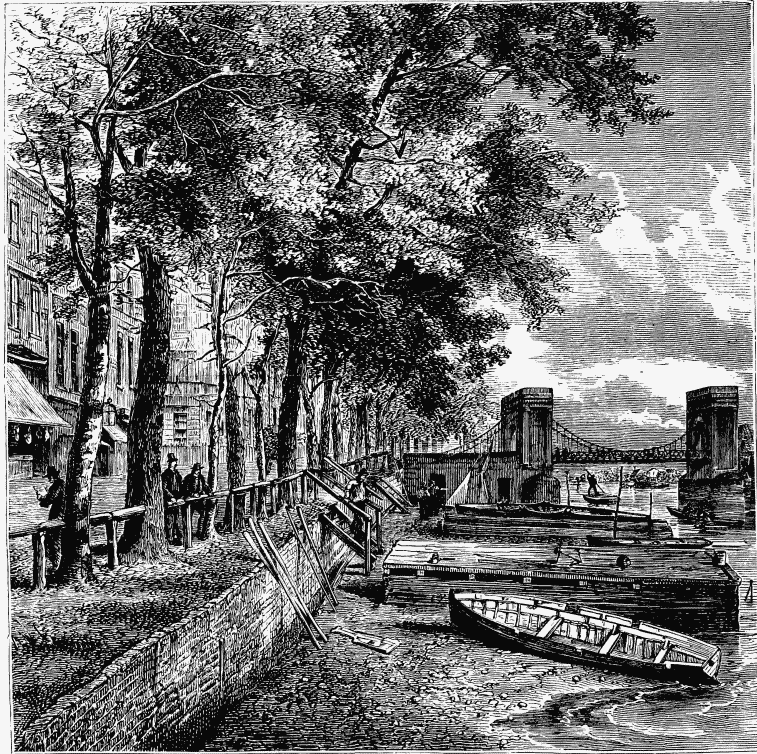
CHEYNE WALK AND CADOGAN PIER.
Here, in a large house very scantily furnished, lived during the latter portion of his existence—we can scarcely call it life—Mr. John Camden Neild, the eccentric miser, who, at his decease in August, 1852, left his scrapings and savings, amounting to half a million sterling, to the Queen, "begging Her Majesty's most gracious acceptance of the same for her sole use and benefit, and that of her heirs." He was buried at North Marston, near Aylesbury, where he held a landed property, and where the Queen ordered a painted window to be put up to his memory. A sketch of the career of this modern rival of John Elwes will be found in Chambers' "Book of Days." Here, too, lived Dominicetti, an Italian quack, who made a great noise in his day by the introduction of medicated baths, which he established in Cheyne Walk, in 1765. It is thus immortalised in Boswell's "Life of Johnson:"—"There was a pretty large circle this evening. Dr. Johnson was in very good humour, lively, and ready to talk upon all subjects. Dominicetti being mentioned, he would not allow him any merit. 'There is nothing in all this boasted system. No, sir; medicated baths can be no better than warm water; their only effect can be that of tepid moisture.' One of the company took the other side, maintaining that medicines of various sorts, and some, too, of most powerful effect, are introduced into the human frame by the medium of the pores; and therefore, when warm water is impregnated with salutiferous substances, it may produce great effects as a bath. The Doctor, determined to be master of the field, had recourse to the device which Goldsmith imputed to him in the witty words of one of Cibber's comedies, 'There is no arguing with Johnson; for when his pistol misses fire, he knocks you down with the butt-end of it.' He turned to the gentleman: 'Well, sir, go to Dominicetti, and get thyself fumigated; but be sure that the steam be directed to thy head, for that is the peccant part.' This produced a triumphant roar of laughter from the motley assembly of philosophers, printers, and dependents, male and female." Dominicetti is said to have had under his care upwards of 16,000 persons, including Edward, Duke of York. He spent some £37,000 on his establishment, but became bankrupt in 1782, when he disappeared.
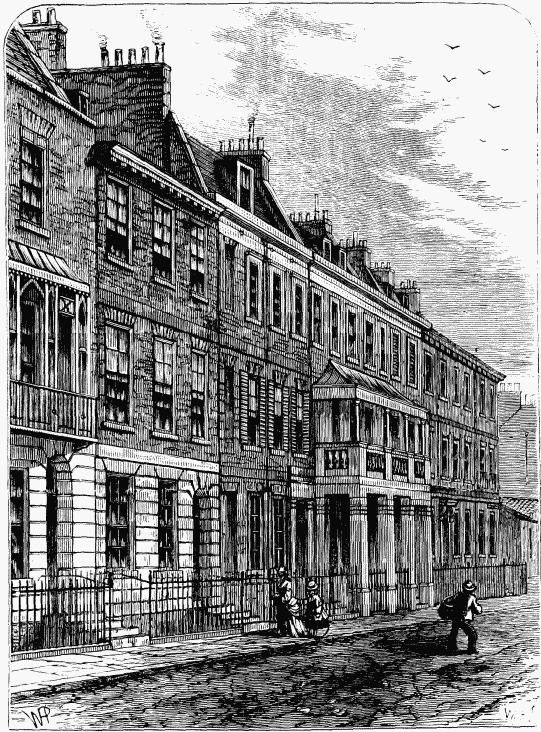
CARLYLE'S HOUSE, GREAT CHEYNE ROW.
In the middle of Cheyne Walk is, or was till recently (for it was doomed to destruction in 1866), the house known to readers of anecdote biography as "Don Saltero's Coffee House," celebrated not only as a place of entertainment, but also as a repository of natural and other curiosities. John Salter, its founder, was an old and trusty servant of Sir Hans Sloane, who, from time to time, gave him all sorts of curiosities. With these he adorned the house, which he opened as a suburban coffeehouse, about the year 1690. The earliest notice of Salter's Museum is to be found in the thirty-fourth number of the Tatler, published in June, 1709, in which its owner figures as "Don Saltero," and several of its curious contents are specified by the writer, Sir Richard Steele. Beside the donations of Sir Hans Sloane, at the head of the "Complete List of Benefactors to Don Saltero's Coffee-room of Curiosities," printed in 1739, figure the names of Sir John Cope, Baronet, and his son, "the first generous benefactors." There is an account of the exhibition in the Gentleman's Magazine for 1799, where it is stated that Rear-Admiral Sir John Munden, and other officers who had been much upon the coasts of Spain, enriched it with many curiosities, and gave its owner the name of "Don Saltero;" but the list of donors does not include the admiral, though the name of "Mr. Munden" occurs in the list subjoined to the nineteenth edition of the catalogue. The title by which Salter was so well known in his own day may be accounted for even at this distance of time by the notice of him and his collection, as immortalised in the pages of Sir Richard Steele. "When I came into the coffee-house," he says, "I had not time to salute the company before my eye was diverted by ten thousand gimcracks, round the room and on the ceiling." The Don was famous for his punch, and his skill on the fiddle. "Indeed," says Steele, "I think he does play the 'Merry Christ-Church Bells' pretty justly; but he confessed to me he did it rather to show he was orthodox than that he valued himself upon the music itself." This description is probably faithful, as well as humorous, since he continues, "When my first astonishment was over, there comes to me a sage, of a thin and meagre countenance, which aspect made me doubtful whether reading or fretting had made it so philosophic."
In the Weekly Journal of Saturday, June 22nd,
1723, we read the following poetical announcement of the treasures to be seen at this coffee-house,
which may be regarded as authentic and literally
true, since it is sanctioned by the signature of the
proprietor himself:—
"Sir,
Fifty years since to Chelsea great,
From Rodman, on the Irish main,
I strolled, with maggots in my pate,
Where, much improved, they still remain.
"Through various employs I've passed—
A scraper, virtuoso, projector,
Tooth-drawer, trimmer, and at last,
I'm now a gimcrack whim collector.
"Monsters of all sorts here are seen,
Strange things in nature as they grow so,
Some relicks of the Sheba queen,
And fragments of the famed Bob Crusoe.
"Knicknacks, too, dangle round the wall,
Some in glass cases, some on shelf;
But what's the rarest sight of all,
Your humble servant shows himself.
"On this my chiefest hope depends—
Now if you will my cause espouse,
In journals pray direct your friends
To my Museum Coffee-house;
"And, in requital for the timely favour,
I'll gratis bleed, draw teeth, and be your shaver:
Nay, that your pate may with my noddle tally,
And you shine bright as I do—marry! shall ye
Freely consult your revelation, Molly;
Nor shall one jealous thought create a huff,
For she has taught me manners long enough."
"Don Saltero.
"Chelsea Knackatory."
The date of Salter's death does not appear to be known precisely, but the museum was continued by his daughter, a Mrs. Hall, until about the accession of George III. We know little of the subsequent history of the house until January, 1799, when the whole place, with the museum of curiosities, was sold by auction by Mr. Harwood. They are described in the catalogue as follows:—"A substantial and well-erected dwelling-house and premises, delightfully situate, facing the river Thames, commanding beautiful views of the Surrey hills and the adjacent country, in excellent repair, held for a term of thirty-nine years from Christmas last, at a ground-rent of £3 10s. per annum. Also the valuable collection of curiosities, comprising a curious model of our Saviour's sepulchre, a Roman bishop's crosier, antique coins and medals, minerals, fossils, antique fire-arms, curious birds, fishes, and other productions of nature, and a large collection of various antiquities and curiosities, glass-cases, &c. N.B. The curiosities will be sold the last day. May be viewed six days preceding the sale. Catalogues at sixpence each." The number of lots was a hundred and twenty-one; and the entire produce of the sale appears to have been little more than £50. The highest price given for a single lot was £1 16s.—lot 98, consisting of "a very curious model of our Blessed Saviour's sepulchre at Jerusalem, very neatly inlaid with mother of pearl."
"It is not improbable," writes Mr. Smith in his "Historical and Literary Curiosities," "that this very celebrated collection was not preserved either entire or genuine until the time of its dispersion; since the gift of John Pennant, of Chelsea, the great-uncle of Thomas Pennant, the topographical writer, appears to have been wanting in the fortyseventh edition of the catalogue of the museum. This donation consisted of a part of a root of a tree, shaped like a swine, and sometimes called 'a lignified hog;' but the several editions of the catalogue differ considerably in the insertion or omission of various articles. The exhibition was contained chiefly in glass cases ranged on the tables, placed in the front room of the first floor of the building; but the walls also were covered with curiosities, and the entrance passage displayed an alligator suspended from the ceiling, with a variety of ancient and foreign weapons hung at the sides."
Perhaps, however, the most novel and interesting
particulars which can now be given concerning
this museum may be gleaned from the "Exhibition
Catalogue" itself, which shows that it consisted
rather of strange and wonderful, than of really
valuable specimens. The title is "A Catalogue of
Rarities, to be seen at Don Salter's Coffee-house in
Chelsea; to which is added a complete list of the
donors thereof. Price 2d.
"'O Rare!'"
In the first glass were contained the model of the holy sepulchre, and a variety of curiosities of a similar character: such as "painted ribbands from Jerusalem, with a pillar to which our Saviour was tied when scourged, with a motto on each;" "boxes of relicks from Jerusalem;" "a piece of a saint's bone in nun's work;" several pieces of the holy cross in a frame, glazed; a rose of Jericho; dice of the Knights Templars; an Israelitish shekel; and the Lord's Prayer in an ivory frame, glazed. There were also several specimens of carving on cherry-stones, representing the heads of the four Evangelists and effigies of saints; with some cups and baskets made out of the same minute materials. The same case also contained a number of fine coins and medals, both British and foreign, and "a model of Governor Pitt's great diamond," which was taken out of the sale. There were also a few natural curiosities, as "a bone of an angel-fish; a sea-horse; a petrified crab from China; a small pair of horns, and several legs of guinea-deer; a handkerchief made of the asbestus rock, which fire cannot consume; a piece of rotten wood not to be consumed by fire; the rattle of a rattlesnake with twenty-seven joints; a large worm that eats into the keels of ships in the West Indies; serpents' tongues; the bark of a tree, which when drawn out appears like fine lace; a salamander; a fairy's or elf's arrow; a little skull, very curious." The most remarkable artificial rarities contained in the second glass were "a piece of Solomon's temple; Queen Katherine's wedding shoes; King Charles the Second's band which he wore in disguise; and a piece of a coat of mail one hundred and fifty times doubled." Of foreign productions this case contained "a Turkish almanack; a book in Chinese characters; letters in the Malabar language; the effigies and hand of an Egyptian mummy; fortyeight cups, one in another; and an Indian hatchet used by them before iron was invented." The natural curiosities included "a little whale; a giant's tooth; a curious ball of fish-bones found near Plymouth; Job's tears that grow on a tree, where with they make anodyne necklaces; a nut of the sand-box tree; several petrified plumes and olives; a young frog in a tobacco-stopper; and a piece of the caul of an elephant." The third glass comprised "black and white scorpions; animals in embryo; the worm that eats into the piles in Holland; the tarantula; a nest of snakes; the horns of a shamway; the back-bone of a rattlesnake."
The fourth glass consisted of artificial curiosities, and included "a nun's whip; a pair of garters from South Carolina; a Chinese dodgin, which they weigh their gold in; a little Sultaness; an Indian spoon of equal weight with gold; a Chinese nun, very curious; Dr. Durham's paper made of nettles." The fifth glass contained "a Muscovy snuff-box, made of an elk's hoof; a humming-bird's nest, with two young ones in it; a starved swallow; the head of an Egyptian; a lock of hair of a Goa goat; belts of wampum; Indian money; the fruit of the horn-tree."
The following curiosities were also disposed in various parts of the coffee-room, with many others less remarkable in their names and appearance—"King James's coronation sword; King William's coronation sword and shoes; Henry VIII.'s coat of mail, gloves, and spurs; Queen Elizabeth's Prayer-book, stirrup, and strawberry dish; the Pope's infallible candle; a set of beads, consecrated by Clement VII., made of the bones of St. Anthony of Padua; a piece of the royal oak; a petrified child, or the figure of death; a curious piece of metal, found in the ruins of Troy; a pair of Saxon stockings; William the Conqueror's family sword; Oliver's broad-sword; the King of Whiddaw's staff; Bistreanier's staff; a wooden shoe, put under the Speaker's chair in James II.'s time; the Emperor of Morocco's tobacco pipe; a curious flea-trap; an Indian prince's crown; a starved cat, found between the walls of Westminster Abbey when the east end was repaired; the jaws of a wild boar that was starved to death by his tusks growing inward; a frog, fifteen inches long, found in the Isle of Dogs; the Staffordshire almanack, used when the Danes were in England; the lance of Captain TowHow-Sham, king of the Darien Indians, with which he killed six Spaniards, and took a tooth out of each head, and put in his lance as a trophy of his valour; a coffin of state for a friar's bones; a cockatrice serpent; a large snake, seventeen feet long, taken in a pigeon-house in Sumatra—it had in its belly fifteen fowls and five pigeons; a dolphin with a flying-fish at his mouth; a gargulet, that Indians used to cool their water with; a whistling arrow, which the Indians use when they would treat of peace; a negro boy's cap, made of a rat-skin; Mary Queen of Scots' pin-cushion; a purse made of a spider from Antigua; manna from Canaan; a jaw of a skate, with 500 teeth; the mermaid fish; the wild man of the woods; the flying bull's head; and, last of all, a snake's skin, ten feet and a half long—a most excellent hydrometer."
It may be added that, if we may believe Pennant, the ex-Protector, Richard Cromwell, was one of the regular visitors at Don Saltero's coffee-house in its earliest days. The place was one of the exhibitions which Benjamin Franklin went to see when working as a journeyman printer in London; and it is on record how that after leaving the house one day he swam from Chelsea to Blackfriars, performing sundry feats in the water as he went along.
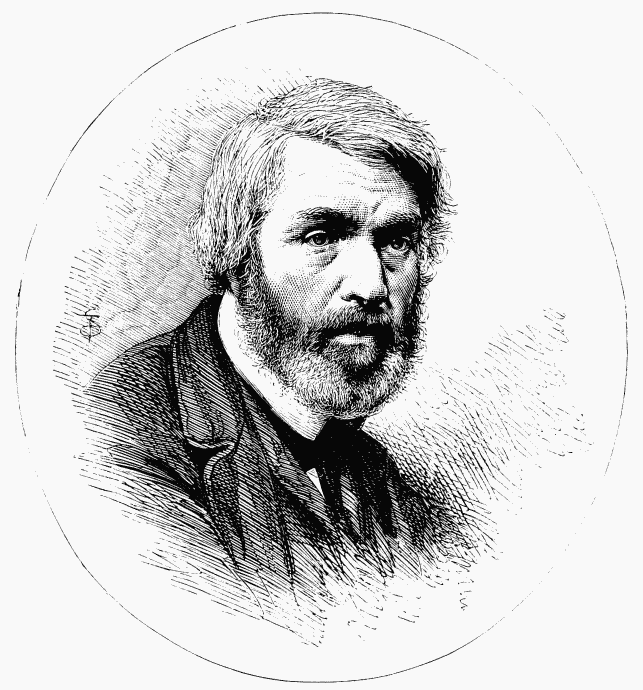
At No. 5, Great Cheyne Row, an old-fashioned red-brick house, has lived for many years Thomas Carlyle, who has so far identified himself with this neighbourhood as to be known to the world in common parlance as "The Philosopher of Chelsea." Not far from his house a new square named after him bears witness to the fact that his worth is known and appreciated in his new country. The house and the habits of its tenant are thus described by a writer who calls himself "Quiz," in the West Middlesex Advertiser:—
"The house tenanted by Carlyle has on its front an appearance of antiquity, which would lead us to ascribe it to the days of Queen Anne. In one of his later pamphlets, 'Shooting Niagara,' associated with a hit at modern brick-makers and brick-layers, Carlyle has an allusion to the wall at the end ('head,' as he writes) of his garden, made of bricks burnt in the reign of Henry VIII., and still quite sound, whereas bricks of London manufacture in our day are used up in about sixty years. This wall was, of course, the boundary wall of the old park or garden belonging to Chelsea Manor-house. But this remark only comes incidentally, and we know scarcely anything about Carlyle's house and its belongings from himself. Other people have reported a variety of particulars, not to be credited without large deductions, concerning his home and personal habits. Thus, an American divine, giving an account of an interview he had with the Chelsea sage, indulges in minutiæ such as the following:—'We were shown into a plainly-furnished room, on whose walls hung a rugged portrait of Oliver Cromwell. Presently an old man, apparently over threescore years and ten, walked very slowly into the room. He was attired in a long blue woollen gown, reaching down to his feet. His grey hair was in an uncombed mop on his head. His clear blue eye was sharp and piercing. A bright tinge of red was on his thin cheek, and his hand trembled as he took our own. This most singularlooking personage reminded us of an old alchemist, &c.' Much in the Yankee mannerism, certainly, yet it comes as a slight retribution, that one who has been so hard on America should be commented on in true Yankee fashion. Others have given us accounts of rooms in the house heaped up with books, not at all marshalled in the regular order we should have expected, when they belonged to a man so fond of the drill-sergeant. One correspondent of a London paper tells us of a collection of portraits of great men, gathered by degrees from picture-galleries, shops, and book-stalls. As it is rumoured, the contrivances resorted to by some of Carlyle's admirers, at the period of life when most of us are inclined to be enthusiastic in our likings, with the intent of seeing the interior of his house, or coming into personal communication with him, have been both ingenious and ludicrous. Some have, it is said, called at his house, and inquired for an imaginary Jones or Smith, in the hope that they might catch a glimpse at the interior, or see the man himself in the background. Possibly, there have been those who have made friends with the 'dustmen,' so that they may glean up some scraps of MSS. from the miscellaneous contents of his waste-basket. I have not heard, though, whether any one ever went so far as to assume the garb of a policeman, to ensnare the affections of some damsel at 5, Great Cheyne Row, and in this way make discoveries about the philosopher's personal habits.
"Mr. J. C. Hotten, in some notes on Carlyle, states that 'he always walks at night, carrying an enormous stick, and generally with his eyes on the ground.' This is an exaggeration of the stick, and so far from being only out at night, those accustomed to be in the streets of Chelsea know that Carlyle has, for years past, taken a stroll in all weathers in the morning, and in the afternoon he is frequently to be seen wending his way towards St. James's Park. Hence certain persons have waylaid him in these walks from curiosity, the Chelsea sage himself being supremely unconscious of being watched. He has been seen to conduct a blind man over a crossing, the person being necessarily ignorant as to who was showing him a kindness, and a little knot of human beings will touch his sympathies, and cause him to pause. I saw Carlyle once step up to a shop-window, around which several individuals stood looking at something. This something was a new portrait of himself, as he quickly perceived; but before they were awake to the fact that the original was close by, he had moved off, giving his stick a rather contemptuous twirl."
The connection of Thomas Carlyle with Chelsea is, at all events, of upwards of forty years' duration, as he was a resident there in the early part of 1834; two years previously, when in London, he visited Leigh Hunt, who at that time lived close to Cheyne Row; and, probably, it was at that time that he resolved to make it his fixed abode. The two writers were neighbours here until 1840, when Leigh Hunt removed to Kensington, which he has immortalised under the title of the "Old Court Suburb;" and their friendship continued until Hunt's death.
At Chelsea, it is almost needless to add, Carlyle wrote his history of "The French Revolution," "Past and Present," his "Life of John Stirling," "Oliver Cromwell's Letters and Speeches," and his "Life of Frederick the Great;" in fact, nearly all the works which have made his name famous through the world.
His wife died at Chelsea suddenly in April, 1866, just as she heard of the delivery of his inaugural address as Lord Rector of Edinburgh University. She left a work unfinished. Charles Dickens admired her literary talents very much. He writes to his friend Forster: "It was a terrible shock to me, and poor dear Carlyle has been in my mind ever since. How often have I thought of the unfinished novel! No one now to finish it. None of the writing women come near her at all." Mr. Forster adds: "No one could doubt this who had come within the fascinating influence of that sweet and noble nature. With some of the highest gifts of intellect, and the charm of a most varied knowledge of books and things, there was something beyond. No one who knew Mrs. Carlyle could replace her loss when she had passed away."
On the 4th of December, 1875, Thomas Carlyle completed his eightieth year (having been born in 1795, in the once obscure village of Ecclefechan, in Scotland), on which occasion he received congratulations from a number of the chief litlérateurs of Germany, and also a present of a gold medal, struck in honour of the day, from a number of English friends and admirers, who addressed him as "a teacher whose genius and literary achievements have lent radiance to his time."
Sir John Goss, who was many years organist at St. Paul's Cathedral, was for some time a resident in Cheyne Row.
The embankment facing Cheyne Walk, extending from Battersea Bridge, close by old Chelsea Church, to the grounds of Chelsea Hospital, a distance of nearly a mile, presents a pleasing contrast to the red-bricked houses of which we have been speaking. Although the proposition to embank the northern shore of the Thames between Chelsea Hospital and Battersea Bridge was first made by the Commissioners of Her Majesty's Woods and Forests in 1839, the practical execution of the idea was not commenced even on a small scale until some twenty years afterwards. These works originally formed a portion of a scheme for which the Commissioners of Woods and Forests obtained an Act of Parliament in 1846, and which embodied the formation of an embankment and roadway between Vauxhall and Battersea bridges, and the construction of a suspension bridge at Chelsea. The funds which it was estimated would be required were procured, but they proved insufficient for the whole of the work, the bridge costing more than was anticipated. A narrow embankment and roadway were therefore constructed as far as the western end of the Chelsea Hospital gardens, where they terminated in a cul de sac. In time, however, the necessity arose for making a sewer to intercept the sewage of the district west of Cremorne, and to help it on its way to Barking. But there was no good thoroughfare from Cremorne eastwards along which to construct it; so it was proposed to form a route for the sewer, and at the same time to complete an unfinished work by continuing the embankment and road on to Battersea. Application was made to Government for the return of £38,150, a sum which remained unexpended from the amount originally raised for the bridge and embankment, and which would have assisted in the prosecution of the new work. The application, however, was unsuccessful, and Sir William Tite, who from the first took a very active interest in the matter, appealed to the Metropolitan Board of Works to undertake the work independently of Government assistance. The Board, therefore, made several applications to Parliament for an Act, which they succeeded in obtaining in 1868. The designs for the embankment, roadway, and sewer were at once prepared by Mr. (afterwards Sir James) Bazalgette, the engineer to the Board, and the whole work was completed and opened to the public in 1874.
At its commencement by Battersea Bridge very little land has been reclaimed from the Thames; but one alteration is worthy of mention—the old awkward way down to the steamboat pier under the archway of a private house has been cleared away, and the pontoon, moored close to the wall, is reached by a bridge resting in an opening in the granite. An old block of houses, too, which stood between this spot and Chelsea Church has been entirely removed. They formed a narrow quaintlooking old thoroughfare, called Lombard Street, one part of which was spanned by the upper rooms of an old house. The backs of one side of this thoroughfare overlooked, and here and there overhung, the river; but they have all been cleared away, and the narrow street converted into a broad one, so that one side of it faces the river. After passing the church the road widens out, and as the space between the houses and the embankment wall becomes greater, a piece of land has been laid out as a garden, so that there are two roads, one in front of the shops, the other between the garden and the granite wall. This garden extends nearly to Oakley Street, which the road rises gradually to meet, while the path falls slightly in order to pass under the shore end of the new Albert Bridge. There is another pretty little piece of garden at this part of the route. After this the reclaimed land becomes of yet greater extent as Cheyne Row is reached. From this spot the Embankment and its surroundings can be seen to the best advantage. The rough hammer-dressed granite wall runs in a straight line from here to where it meets the old roadway formed by the Office of Woods and Forests. In the ground beneath the pavement have been planted trees on both sides of the road, similar to those planted on the Victoria Embankment. But nothing adds so much to the picturesqueness of this part of the Thames-side roadway, and helps to relieve the appearance of newness which is so marked a feature in the Victoria Embankment, as the line of old trees planted on what was formerly the edge of the river, with the background formed by a fine old row of private houses. The trees are now in the garden divided by a gravel walk, which fills up the space between the two roadways. At the end of Cheyne Walk the Queen's Road branches off to the left, and runs into the bottom of Lower Sloane Street. At the junction of two roads, but where was formerly the diverging point of one from the river-side, stood the "Swan" tavern, famous as the goal of many a hotly-contested aquatic race from its namesake near London Bridge. Not far from this time honoured inn are the Botanical Gardens of the Society of Apothecaries.
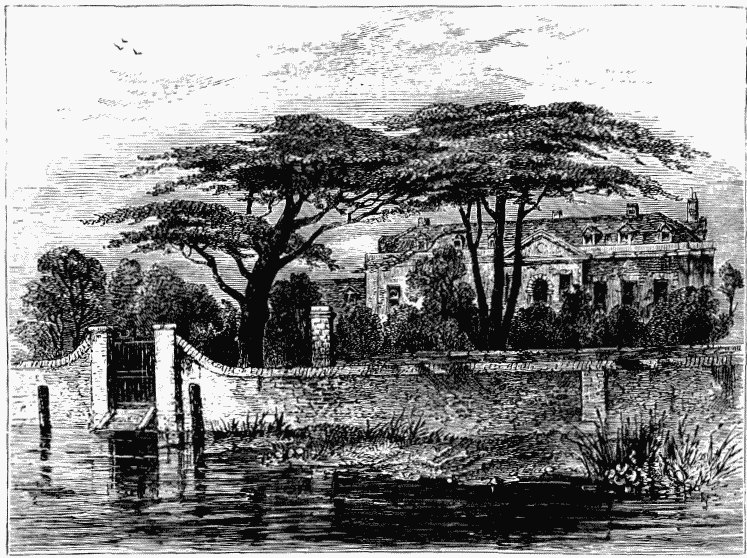
THE BOTANICAL GARDENS, CHELSEA, 1790.
THOMAS CARLYLE.
The Albert Bridge, opposite Oakley Street, constructed upon the suspension principle, was opened in 1873; it forms a useful communication between Chelsea and Battersea Park. Cadogan Pier, close to the bridge, serves as a landing-place for passengers on the river steamboats.
Near the river and Cheyne Walk was a large mulberry-garden, one of those established in the suburbs of London by order of James I., about the year 1610. Thoresby, writing in 1723, tells us in his diary that he saw "at Mr. Gate's a sample of the satin made at Chelsea of English silkworms for the Princess of Wales, very rich and beautiful." But it has long disappeared, owing to the steady progress of bricks and mortar.
As late as 1824, there was to be seen near Chelsea Bridge a sign of "The Cricketers," painted by George Morland. "At the above date," says Mr. Larwood, "this painting by Morland had been removed inside the house, and a copy of it hung up for the sign. Unfortunately, however, the landlord used to travel about with the original, and put it up before his booth at Staines and Egham races, cricket matches, and similar occasions"—all of which removals, it may be presumed, did no great good to it.
The "Old Swan" inn, which was the goal of Doggett's annual rowing match, stood on the east side of the Botanical Gardens, and was long since turned into a brewery, and the race, down to about the year 1873, ended at the new "Swan," higher up the river, as mentioned above.
The "Swan," very naturally, was a favourite sign for inns by the waterside, and Mr. J. T. Smith, in his "Book for a Rainy Day," or rather a waterman who speaks in his pages, enumerates a goodly list of "Swans" between London and Battersea bridges in 1829:—"Why, let me see, master," he writes, "there's the 'Old Swan' at London Bridge—that's one; then there's the 'Swan' in Arundel Street—that's two; then our's here" (at Hungerford Stairs), "three; the 'Swan' at Lambeth—that's down though. Well, then there's the 'Old Swan' at Chelsea, but that has been long turned into a brewhouse; though that was where our people" (the watermen) "rowed to formerly, as mentioned in Doggett's will; now they row to the sign of the 'New Swan' beyond the Physic Garden—we'll say that's four. Then there's two 'Swans' at Battersea—six."
We have already spoken at some length of Tom Doggett, the famous comedian, (fn. 6) and of the annual rowing match by Thames watermen for the honour of carrying off the "coat and badge," which, in pursuance of his will, have been competed for on the 1st of August for the last 150 years; suffice it to say, then, that in the year 1873 the old familiar "Swan" inn was demolished to make room for the new embankment. The old "Swan" tavern enjoyed a fair share of public favour for many years. Pepys, in his "Diary," thus mentions it, under date April 9, 1666:—"By coach to Mrs. Pierce's, and with her and Knipp, and Mrs. Pierce's boy and girl abroad, thinking to have been merry at Chelsea; but being come almost to the house by coach, near the waterside, a house alone, I think the 'Swan,' a gentleman walking by called to us to tell us that the house was shut up because of the sickness. So we, with great affright, turned back, being holden to the gentleman, and went away (I, for my part, in great disorder) to Kensington." In 1780 the house was converted into the Swan Brewery; and the landing of the victor in the aquatic contest thenceforth took place, as above stated, at a house bearing the same sign nearer to Cheyne Walk. Since the demolition of this house the race has been ended close to the spot where the old tavern stood. This rowing match—although not to be compared in any way to the great annual aquatic contest between the Universities of Oxford and Cambridge—occasions a very lively scene, the river being covered with boats, and the utmost anxiety evinced by the friends of the contending parties. In former times it was customary for the winner on his arrival to be saluted with shouts of applause by the surrounding spectators, and carried in triumph on the shoulders of his friends into the tavern.
On a vacant space of ground in front of the Swan Brewery stood formerly a mansion, erected in the reign of Queen Anne, which was for many years inhabited by Mrs. Banks, the mother of Sir Joseph Banks.
"The Physic Garden," to which we now come, was originated by Sir Hans Sloane, the celebrated physician, and was handed over in 1721 by him, by deed of gift, to the Apothecaries' Company, who still own and maintain it. The garden, which bears the name of the "Royal Botanic," was presented to the above company on condition that it "should at all times be continued as a physicgarden, for the manifestation of the power, and wisdom, and goodness of God in creation; and that the apprentices might learn to distinguish good and useful plants from hurtful ones." Various additions have been made to the "Physic Garden" at different periods, in the way of greenhouses and hot-houses; and in the centre of the principal walk was erected a statue of Sir Hans Sloane, by Michael Rysbraeck.
"We visited," writes P. Wakefield in 1814, "the 'Physic or Botanic Garden,' commenced by the Company of Apothecaries in 1673, and patronised by Sir Hans Sloane, who granted the freehold of the premises to the company on condition that they should present annually to the Royal Society specimens of fifty new plants till their number should amount to two thousand. From a sense of gratitude they erected in the centre of the garden a marble statue of their benefactor. Above the spacious greenhouse is a library, furnished with a large collection of botanical works, and with numerous specimens of dried plants. We could not quit these gardens without admiring two cedars of great size and beauty."
"At the time the garden was formed," writes the author of "London Exhibited in 1851," "it must have stood entirely in the country, and had every chance of the plants in it maintaining a healthy state. Now, however, it is completely in the town, and but for its being on the side of the river, and lying open on that quarter, it would be altogether surrounded with common streets and houses. As it is, the appearance of the walls, grass, plants, and houses is very much that of most London gardens—dingy, smoky, and, as regards the plants, impoverished and starved. It is, however, interesting for its age, for the few old specimens it contains, for the medical plants, and, especially, because the houses are being gradually renovated, and collections of ornamental plants, as well as those which are useful in medicine, formed and cultivated on the best principles, under the curatorship of Mr. Thomas Moore, one of the editors of the 'Gardener's Magazine of Botany.'" In spite of the disadvantages of its situation, here are still grown very many of the drugs which figure in the "London Pharmacopœia." The two cedars of Lebanon, which have now reached the age of upwards of 150 years, are said to have been presented to the garden by Sir Joseph Banks, the distinguished naturalist, who here studied the first principles of botany. Of Sir Hans Sloane, and of his numerous public benefactions, we have already spoken in our account of the British Museum. (fn. 7) It only remains, therefore, to add that he was a contributor of natural specimens of rocks, from the Giant's Causeway, to Pope's Grotto at Twickenham; that he attended Queen Anne in her last illness at Kensington; and that he was the first member of the medical profession on whom a baronetcy was conferred.
During the last century, and early in the present, a pleasant walk across green fields, intersected with hedges and ditches, led the pedestrian from Westminster and Millbank to "The Old Bun House" at Chelsea. This far-famed establishment, which possessed a sort of rival museum to Don Saltero's, stood at the end of Jew's Row (now Pimlico Road), not far from Grosvenor Row. The building was a one-storeyed structure, with a colonnade projecting over the foot pavement, and was demolished in 1839, after having enjoyed the favour of the public for more than a century and a half. Chelsea has been famed for its buns since the commencement of the last century. Swift, in his "Journal to Stella," 1712, writes, "Pray are not the fine buns sold here in our town as the rare Chelsea buns? I bought one to-day in my walk," &c. It was for many years the custom of the Royal Family, and the nobility and gentry, to visit the Bun-house in the morning. George II., Queen Caroline, and the princesses frequently honoured the proprietor, Mrs. Hand, with their company, as did also George III. and Queen Charlotte; and her Majesty presented Mrs. Hand with a silver half-gallon mug, with five guineas in it. On Good Friday mornings the Bunhouse used to present a scene of great bustle—upwards of 50,000 persons have assembled here, when disturbances often arose among the London mob; and in one day more than £250 have been taken for buns.
The following curious notice was issued on Wednesday, March 27th, 1793:—"Royal Bun House, Chelsea, Good Friday.—No Cross Buns. Mrs. Hand respectfully informs her friends and the public, that in consequence of the great concourse of people which assembled before her house at a very early hour, on the morning of Good Friday last, by which her neighbours (with whom she has always lived in friendship and repute) have been much alarmed and annoyed; it having also been intimated, that to encourage or countenance a tumultuous assembly at this particular period might be attended with consequences more serious than have hitherto been apprehended; desirous, therefore, of testifying her regard and obedience to those laws by which she is happily protected, she is determined, though much to her loss, not to sell Cross Buns on that day to any person whatever, but Chelsea buns as usual."
The Bun-house was much frequented during the palmy days of Ranelagh, after the closing of which the bun trade declined. Notwithstanding this, on Good Friday, April 18th, 1839, upwards of 24,000 buns were sold here. Soon after, the Bun-house was sold and pulled down; and at the same time was dispersed a collection of pictures, models, grotesque figures, and modern antiques, which had for a century added the attractions of a museum to the bun celebrity. Another bun-house was built in its place, but the olden charm of the place had fled, and Chelsea buns are now only matters of history.
Sir Richard Phillips, in his "Morning's Walk from London to Kew," a few years before the demolition of the old Bun-house, after describing his ramble through Pimlico, writes: "I soon turned the corner of a street which took me out of sight of the space on which once stood the gay Ranelagh. … Before me appeared the shop so famed for Chelsea buns, which for above thirty years I have never passed without filling my pockets. In the original of these shops—for even of Chelsea buns there are counterfeits—are preserved mementoes of domestic events in the first half of the past century. The bottle-conjuror is exhibited in a toy of his own age; portraits are also displayed of Duke William and other noted personages; a model of a British soldier, in the stiff costume of the same age; and some grotto-works, serve to indicate the taste of a former owner, and were, perhaps, intended to rival the neighbouring exhibition at Don Saltero's. These buns have afforded a competency, and even wealth, to four generations of the same family; and it is singular that their delicate flavour, lightness, and richness, have never been successfully imitated."
In the Mirror for April 6, 1839, are two views of the old Bun-house, which were taken just before its demolition.
Chelsea would seem at one time to have enjoyed
a reputation not only for buns, but for custards, if
we may judge from the following allusion to them
by Gay, in his "Trivia:"—
"When W—and G—, mighty names, are dead,
Or but at Chelsea under custards read."