
Old and New London: Volume 5. Originally published by Cassell, Petter & Galpin, London, 1878.
This free content was digitised by double rekeying. All rights reserved.
'Chelsea: Cremorne Gardens', in Old and New London: Volume 5, (London, 1878) pp. 84-100. British History Online https://www.british-history.ac.uk/old-new-london/vol5/pp84-100 [accessed 26 April 2024]
In this section
CHAPTER VIII.
CHELSEA (Continued).—CREMORNE GARDENS, &c.
"Where smiling Chelsea spreads the cultured lands,
Sacred to Flora, a pavilion stands;
And yet a second temple neighb'ring near
Nurses the fragrance of the various year."—Anon.
Chelsea Farm, the Residence of Lord Cremorne—Cremorne Gardens—Attempts at Aërial Navigation—Ashburnham House—The Ashburnham Tournament—The "Captive" Balloon—Turner's Last Home—Noted Residents in Lindsey Row—The King's Road—The Old Burial-ground—St. Mark's College—The "World's End" Tavern—Chelsea Common—Famous Nurseries—Chelsea Park—The "Goat in Boots"—The Queen's Elm—The Jew's Burial-ground—Shaftesbury House—The Workhouse—Sir John Cope—Robert Boyle, the Philosopher and Chemist—The Earl of Orrery—Mr. Adrian Haworth—Dr. Atterbury—Shadwell, the Poet—The "White Horse" Inn—Mr. H.S. Woodfall—The Original of "Strap the Barber" in "Roderick Random"—Danvers Street—Justice Walk—The Old Wesleyan Chapel—Chelsea China—Lawrence Street—Tobias Smollett—Old Chelsea Stage-coaches—Sir Richard Steele and other Noted Residents—The Old Clock-house—The Glaciarium—Hospital for Diseases of Women—Chelsea Vestry Hall, and Literary and Scientific Institution—Congregational Church—Royal Avenue Skating-rink—Sloane Square—Bloody Bridge—Chelsea, Brompton, and Belgrave Dispensary—Royal Court Theatre—Hans Town—Sloane Street—Trinity Church—Sloane Terrace Wesleyan Chapel—Sir C. W. Dilke, Bart—Ladies' Work Society—Hans Town School of Industry for Girls—"Count Cagliostro"—An Anecdote of Professor Porson—Chelsea House—St. Mary's Roman Catholic Chapel—The "Marlborough Tavern"—Hans Place—Miss Letitia E. Landon—The Pavilion—St. Saviour's Church—Prince's Cricket ground and Skating-rink—The "South Australian."
A few hundred yards to the west of old Battersea Bridge, on the north side of the river, are the celebrated Cremorne Gardens, so named after Thomas Dawson, Lord Cremorne, the site of whose former suburban residence and estate they cover. They have proved, to a very great extent, the successors of "Kuper's," Vauxhall, and Ranelagh. In the early part of the present century, Lord Cremorne's mansion, known as Chelsea Farm, was often visited by George III., Queen Charlotte, and the Prince of Wales. In 1825 the house and grounds devolved on Mr. Granville Penn, a cousin of Lady Cremorne, who much improved the estate, but subsequently disposed of it. The natural beauty of the situation soon afterwards led to the grounds being opened to the public as the "Stadium," and a few years later the gardens were laid out with great taste; the tavern adjoining them was enlarged, and the place became the resort of a motley crowd of pleasureseekers, and generally well attended. To the present time it has retained most of its original features. At night during the summer months the grounds are illuminated with numberless coloured lamps; and there are various ornamental buildings, grottoes, &c., together with a theatre, concert-room, and dining-hall. The amusements provided are of a similar character to those which were presented at Vauxhall Gardens in its palmy days: such as vocal and instrumental concerts, balloon ascents, dancing, fireworks, &c. Several remarkable balloon ascents have been made from these grounds, notably among them being that of Mr. Hampton, who, in 1839, ascended with a balloon and parachute, by which he descended from a height of about two miles. More recently an attempt at aërial navigation was made from Cremorne by a foreigner, M. de Groof. The apparatus was suspended beneath the car of a balloon, and when the aeronaut had reached a considerable height, the machine was liberated; but owing to some defect in its construction, it immediately collapsed and fell to the ground with a fearful crash, killing its unfortunate occupant on the spot.
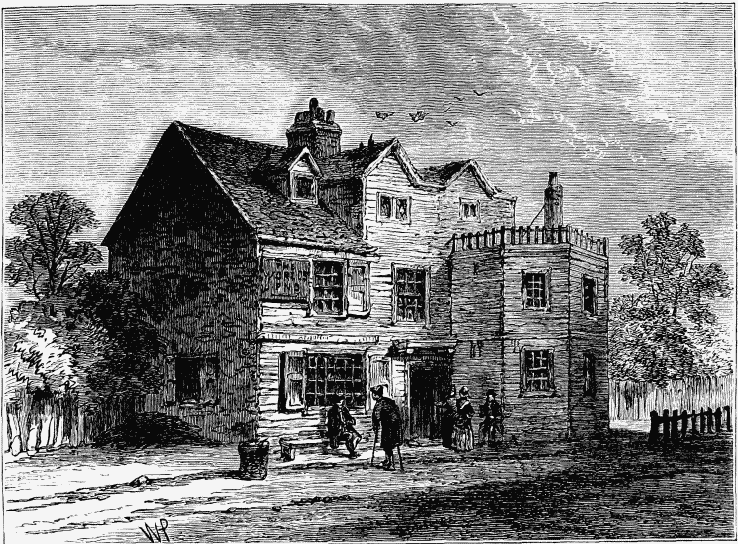
THE "WORLD'S END," IN 1790.
On the west of the gardens is Ashburnham House. It was built about the middle of the last century by Dr. Benjamin Hoadley, an eminent physician, after whose death it was purchased by Sir Richard Glynn, who sold it to the Earl of Ashburnham, from whom it obtained its present name. It was next in the possession of Dr. Cadogan, and again changing hands at different periods, ultimately became the residence of the Hon. Leicester Stanhope, afterwards Earl of Harrington. A strip of waste ground between Ashburnham House and the river, called the "Lots," has been "a bone of contention" for many years between the residents in the neighbourhood and the Chelsea Vestry, in consequence of the disgraceful scenes carried on by a large number of "roughs" who are in the habit of meeting there. Here, in 1863, in a large pavilion prettily draped with the flags of all nations and a variety of heraldic trophies and allegorical devices, a sensational entertainment on a scale of great splendour was given here, in the shape of a revival of the Eglinton "tournament." A large number of persons took part in it as heralds, seneschals, yeomen, pages, men-at-arms, squires, and bannerbearers, clad in an almost endless variety of shining armour and mediæval costume. In 1869, a monster balloon, nearly 100 feet in diameter, made daily ascents for some time from these grounds. The balloon, appropriately called "The Captive," was secured by a rope about 2,000 feet long, which was let out and wound in by steam power. The Captive balloon, however, one day escaped from its moorings, and the exhibition was discontinued.
In a small house close to Cremorne Pier, Mr. J. M. W. Turner, R.A., resided for some time, under an assumed name, and here, as we have already stated, (fn. 1) he died in 1851. Whilst living here, Turner would not see any person, excepting a very few intimate friends, and, in fact, was too reserved to allow himself to be recognised. This inclination at the close of his life, perhaps, was only natural. Doubtless, Chelsea is proud to add his name to its list of distinguished residents.
Close by, in Lindsey Row, lived Sir Mark Isambard Brunel, the originator and designer of the Thames Tunnel; and Mr. Timothy Bramah, the distinguished locksmith. Here, too, resided Mr. John Martin, R.A. The Rev. A. C. Coxe, in his "Impressions of England," published in 1851, speaking of Chelsea, says:— "We landed not far from this church, and called upon John Martin, whose illustrations of Milton and 'Belshazzar's Feast' have rendered him celebrated as a painter of a certain class of subjects, and in a very peculiar style. He was engaged on a picture of 'The Judgment,' full of his mannerism, and sadly blemished by offences against doctrinal truth, but not devoid of merit or of interest. He asked about Allston and his 'Belshazzar,' and also made inquiries about Morse, of whose claim as the inventor of the electric telegraph he was entirely ignorant."
Mr. Henry Constantine Jennings, an antiquary and virtuoso, settled in Lindsey Row at the close of the last century. His "museum," which comprised a large collection of shells, minerals, preserved birds, quadrupeds, &c., was disposed of by auction in 1820.
Passing from Cremorne Gardens eastward through the centre of Chelsea, is a broad thoroughfare, called the King's Road; and by this road we shall now proceed on our way backward towards Sloane Street, picking up such scraps of information respecting the neighbourhood on either side as the records of the district have left for our use. Respecting the King's Road itself, we may state that, prior to the reign of Charles II., it was only a narrow lane through the fields, for the convenience of the farmers and gardeners who had lands in the neighbourhood. Soon after the Restoration, however, it was found that it might be made to serve as a more direct road for the king between St. James's or Whitehall and Hampton Court Palace; and, accordingly, after some discussion between the Government and the parishioners of Chelsea, it was converted into an ordinary coach-road. It continued to be the private road of royalty down to the reign of George III. Pass tickets, admitting passengers along it by sufferance, are still in existence; they bear on the one side a crown and "G. R," and on the other, as a legend, "The King's Private Road."
Along this road is the burial-ground belonging to the parish of Chelsea, in which lies Andrew Millar, the original publisher of Hume's "History of England," Thomson's "Seasons," and some of Fielding's novels.
The Duke of York was thrown from his horse whilst riding along this road towards Fulham; he had two ribs broken. John Timbs records that, "near the spot where is now the Vestry Hall, the Earl of Peterborough was stopped by highwaymen in what was then a narrow lane; and the robbers, being watched by some soldiers, who formed a part of the guard at Chelsea College, were fired at from behind the hedge. One of these highwaymen turned out to be a student in the Temple, whose father having lost his estate, his son lived by 'play, sharping, and a little on the highway'—the desperate resources of the day."
Nearly opposite Ashburnham House, on the north side of the King's Road, is St. Mark's College, which was established in 1841 by the National Society, as a training institution for schoolmasters. The residence of the principal was formerly known as Stanley House, and was originally built in the reign of Queen Elizabeth, by Sir Arthur Gorges, whose family at that time possessed considerable property in Chelsea. After passing through several hands, the mansion, about the middle of the last century, became the property of the Countess of Strathmore, who afterwards married Captain A. R. Bowes, whose barbarity to her drew on him the execration of the country. About the year 1815, Stanley House was sold to Mr. William Hamilton, from whom it subsequently passed to the National Society. The college consists of an upper, middle, and lower schools, and accommodates about 100 students, who are here trained for schoolmasters. The chapel, which abuts on the Fulham Road, is an unpretending building; but a certain amount of effect is produced in the interior by the stainedglass windows. The buildings of the college form a quadrangle, erected in the Italian style; and there is also in the grounds an octagon building, used as a practising school for children who reside in the neighbourhood.
In the King's Road, near Milman Street, is an inn styled "The World's End." The old tavern, like the other "World's End" at Knightsbridge, which we have already described, (fn. 2) was a noted house of entertainment in the reign of Charles II. The tea-gardens and grounds were extensive, and elegantly fitted up for the reception of company. The house was probably called "The World's End" on account of its then considerable distance from London, and the bad and dangerous state of the roads and pathways leading to it. As it stood within a few yards of the river, most of the visitors made the journey in pleasure-boats.
At the commencement of the present century, the King's Road was by no means a place for general business. The line of road was almost exclusively occupied by nurserymen and florists, and it became, in consequence, to a certain extent, a fashionable resort for the nobility and gentry. The road, in most parts, was very narrow, and the different grounds were mostly enclosed in wooden palings. At night there were only a few gloomy oil-lamps, and the lives and property of the inhabitants were principally entrusted to a small number of private watchmen. Northward of the King's Road, at no very distant date, a considerable extent of land, stretching away to the Fulham Road, was a vast open heath, known as Chelsea Common. Standing in the central space, which has, singularly enough, been left as a memorial of the old common, and looking at the streets now branching off in various directions, it is not easy to call up visions of the past—say two hundred years ago—when this locality was probably as agreeable a spot as Clapham or Wimbledon Commons in our own time.
Faulkner conjectures that the Fulham Road formed the north boundary of the common, and on the south it reached to some nursery grounds abutting on the King's Road, which said nursery grounds, one may conjecture, had been cut off the common by some party or parties in the days when land boundaries were not always kept with care. Westward, the common must have extended about to the line of Robert and Sydney Streets, and eastward to "Blackland's Lane," as it was first called, afterwards Marlborough Road; or perhaps originally the common was bounded by the road or lane which is now Sloane Street. It is first spoken of as "Chelsea Heath," and it appears to have been covered, at least in part, with heath and furze, therein resembling some of the Surrey commons. One of the earliest records concerning Chelsea Common tells us the fact that the City train-bands used to repair to it for exercise, and that, in the disturbed times of Charles I., reviews of troops were more than once held there.
This common was used in former times as a means of raising money for the benefit of the parish. We have particulars relating to such a usage as far back as the reign of Charles II., when the re-building of the church having been resolved upon, Lord Lindsey, Charles Cheyne, and those interested in the common, agreed to enclose it for twenty-one years, the term commencing in March, 1674. On the expiration in 1695, the ground was again thrown open. Somewhat more than a century later—namely, in 1713—articles were drawn up, Sir Hans Sloane being then lord of the manor, in which, amid sundry other recitals, it is stated that the ground at Chelsea Common having been put to various unlawful uses, the holders decide to let it for three years to one John Hugget. It was stipulated that he was to fence the common "with a good bank and a ditch all around," which it is probable that he did, to the satisfaction of all parties, as he had his term renewed from time to time.
An Act passed in the reign of George I., which empowered the surveyor of the London roads to dig up gravel on any common or waste land convenient to him, gave rise to some disputes in Chelsea. The parties interested in the common were informed that much gravel had been removed from Chelsea, and they objected to this, but the Government paid little heed to the complaint. The agents of the surveyor were warned off, though not expelled by physical force; and they went away for awhile, to come back at the next good opportunity. This matter was not finally settled till 1736; for some years previous to that, however, a regular account was kept of all the gravel removed, and payment demanded (and obtained) from those who kept the roads. It was also in the early part of the eighteenth century that an enterprising individual, probably short of money, set up an experimental turnpike on part of the waste ground on the common near Blackland's Lane. The Chelsea authorities fined him heavily, and his scheme was forthwith abandoned.
It was not until some years after an Act had been obtained for the purpose, that the first streets were formed on what had been Chelsea Common. The earliest building lease appears to bear date in 1790, being to the Hon. George Cadogan. The streets, square, grove (for there is at least one of each of these—Marlborough Square and Whitehead's Grove), and the bye-lanes, display all the variety to be expected under the circumstances, as a number of men took sites of very different sizes, and no general plan was attempted to be carried out.
About the spot now occupied by Pond Place, there were, as may be conjectured, one or more ponds, which supplied water to the cattle grazing on the common. It is worthy of being remembered that William Curtis, the botanist, once lived in Pond Place; he was originally an apothecary's assistant, but his fondness for botany led him to give himself entirely to its study, as soon as his means allowed him. He was one of the pioneers in the formation of those Natural History Societies which have spread themselves in every part of our islands; and his "Botanical Magazine," begun in 1787, met with a sale which in that day was looked upon as something remarkable. Curtis at first opened a botanical garden in Lambeth Marsh, and subsequently removed his collection of plants to a nursery-ground at Queen's Elm, Brompton.
Two noted nurseries in the King's Road abutted on Chelsea Common, which were favourite resorts in the reign of George III. and later. Colvill's nursery, at the end of Blackland's Lane, had, at the beginning of the present century, what was considered a large and splendid conservatory, in which the visitor was told there might be counted five hundred species of geranium. Also, there was a green-house, specially arranged so as to show the mode of growth of exotic parasitical plants. The memory of this nursery was kept up by "Colvill Terrace," now extinguished by the uniform numbering of the King's Road. To the west of that ground was Davey's nursery, also fronting the King's Road.
Beyond these nursery-grounds, and also surrounding Chelsea Common on the south side, were large orchards; but these shared the fate of the waste land, and are now, for the most part, covered with houses. Jubilee Place was built about 1810, and doubtless received its name in memory of the attainment by George III. of the fiftieth year of his sovereignty. King Street, too, in the immediate locality, we may suppose received its name in honour of that particular monarch. Russell Street was originally called Wellesley Street, a name meant to do honour to a family bearing an illustrious name, which, as we have already stated, once furnished Chelsea with a rector. The names of Marlborough, Blenheim, and College Street, applied to some of the streets and places hereabouts, may perhaps lead to the belief that they were so named by persons who have had to do with the Royal Hospital.
Chelsea Park, also situated on the north side of the King's Road, was part of the property of Sir Thomas More. It originally consisted of about thirty acres, and was enclosed with a brick wall, but this has gradually given way to the erection of buildings. Towards the beginning of the last century a manufactory for raw silk was established here, and a number of mulberry-trees were planted for the purpose, but the scheme proved unsuccessful. Park Walk, which now crosses this locality from the King's Road to Fulham Road, appears in old maps as "Lover's Walk," and was planted with trees. The "Goat in Boots" is the sign of a public-house at the end of Park Walk, in the Fulham Road. It is said that the old sign was painted by George Morland, in order to liquidate a bill incurred during a residence here. In old deeds the inn is called simply "The Goat."
A short distance eastward, at the corner of Upper Church Street, is the Queen's Elm Hotel, which keeps in remembrance a story traditionally told respecting the Virgin Queen. The tavern is mentioned in the parish books of Chelsea as far back as 1667, under the name of the Queen's Tree, and the tradition is that it derived its name from the fact of Queen Elizabeth, on her way to or from a visit to Lord Burleigh at Brompton Hall, being caught in a shower of rain, and taking shelter under the branches of a wide-spreading and friendly elm which grew on the spot. The Queen's Elm, it may be added, is mentioned in the parish books of Chelsea as far back as the year 1586, where it is stated that "the tree at the end of Duke's Walk, in Chelsea parish, is called the Queen's Tree," and that "there was an arbour built round it by one Bostocke, at the charge of the parish." There was formerly a turnpike-gate at Queen's Elm; and "a court of guard" there is mentioned among the defences around London that were ordered to be prepared by the Parliament in 1642.
The Jews' burial-ground, situate at Queen's Elm, was formed, early in the present century, on a piece of land purchased for that purpose. Much of the ground hereabouts, now known as West Brompton, was in former times called the hamlet of Little Chelsea. Towards the end of the seventeenth century, Lord Shaftesbury, the author of "Characteristics," purchased an estate here. He rebuilt the house, and generally resided there during the sitting of Parliament. Locke here wrote part of his "Essay," and Addison several of the "Spectators." Of Lord Shaftesbury's letters there are several extant, dated from Chelsea, in 1708. The mansion was subsequently converted into an additional workhouse for the parish of St. George, Hanover Square.
Mrs. S. Carter Hall, in her "Pilgrimages to English Shrines," gives us the following account of Shaftesbury House:—"The lodge at the entrance, as you see, is peculiar, the gate being of old wrought iron. The porter permitted us to pass in; and while he sought the master, we had leisure to look around us. The stone steps are of old times: they are wide, and much worn; a low wall flanks either side; and on the right, downwards, are steps of narrower dimensions leading to the underground apartments. When we entered, we perceived that the hall is panelled in, so as to form a passage; but this is a modern innovation; there can be no doubt of its having been, in Lord Shaftesbury's time, a good-sized hall; the banisters and supporters of the very handsome staircase are in admirable preservation, delicately rather than richly carved in oak, and not at all injured; the stairs are also of oak. What remains of the old house is chopped up, as it were, into small apartments, but there are rich and varied indications of the 'light of other days' to illumine the whole. Over several of the doors are strips of paintings, which, as well as can be seen through thick varnish, are the productions of no feeble pencil. With a little trouble these old paintings can be made out, but they would seem bitter mockeries, occupied as the house at present is; and yet one of the inmates said, 'She liked to look up at that bit of picture when she was sick a-bed: it took away the notion of a workhouse.' Surely art might be made even a teacher here. Some of the rooms retain an antique air."
In 1733, a workhouse was erected on a piece of ground "near the conduit in the King's Road," which had been given by Sir Hans Sloane. Over the chimney-piece was a picture, by a Flemish painter, of a woman spinning thread, with the legend, "Waste not, want not."
A noted resident in Little Chelsea, at the commencement of the last century, was Sir John Cope, so famous in the rebellion of 1745. His house, having been subsequently used as a private asylum, was pulled down; on its site Odell's Place was erected. Mr. Robert Boyle, the distinguished philosopher and chemist, a son of Richard, Earl of Cork, resided here in 1660. Here he was visited by the learned and eminent of his time—amongst others, by M. de Monconys, who, in his "Travels," after informing us how that, after dinner, he went with his son and Mr. Oldenburg "two miles from London in a stage-coach, for five shillings, to a village called Little Chelsea, to visit Mr. Boyle," gives an account of several experiments which that gentleman made in his presence, and then proceeds:—"He has a very fine laboratory, where he makes all his extracts and other operations, one of which he showed me with salt, which being put in quite dry with gold leaves sixteen times thicker than that used by gilders into a crucible on a slow fire, even over a lighted candle, the salt calcined the gold so perfectly that water afterwards dissolved them both and became impregnated with them, in the same manner as with common salt." Evelyn, in his "Diary," has also recorded a visit to the same place. "I went," he writes, "with that excellent person and philosopher, Sir Robert Murray, to visit Mr. Boyle at Chelsea, and saw divers effects of the Eolipile, for weighing air."
Charles, fourth Earl of Orrery, grand-nephew of Mr. Boyle, was born at Little Chelsea in 1676. He was the improver of an instrument or machine which had been constructed for the purpose of exhibiting the motions of the planets round the sun, and which henceforth was called the Orrery, in his honour; the instrument, which was held in high repute in the last century, is, however, now regarded as little more than an ingenious toy. Edward Hyde, third Earl of Clarendon, died at his house at Little Chelsea in 1723.
Another resident of this part of Chelsea, at the beginning of the present century, was Mr. Adrian Haworth, the eminent entomologist and botanist, author of "Lepidoptera Britannica," "Miscellanea Naturalia," and other important works. He was a native of Hull, lived to a great age, and here he died.
But even greater names are connected with Chelsea. Within only a short distance from where we are now, stood the abodes of Pym, Locke, Addison, Steele, Swift, and Atterbury; and the extinct hamlet of Little Chelsea was gilded by the greater lights of the Augustan age of British literature.
That part of Church Street which lies between the King's Road and the river has in its time had some distinguished residents. The thoroughfare itself appears to have been built at a very early period. Here, for several years, lived Dr. Atterbury, afterwards Bishop of Rochester, whose committal to the Tower on suspicion of being concerned in a plot in favour of the Pretender was one of the principal events at the commencement of the last century. It was whilst living here that Dr. Atterbury became acquainted with Dean Swift, who, in 1711, took up his residence opposite the doctor's house. Previous to becoming a resident at Chelsea, Swift was a frequenter of its rural scenes. He writes, in May, 1711:—"I leave my best gown and periwig at Mrs. Van Homrigh's (in Suffolk Street), (fn. 3) then walk up Pall Mall, out at Buckingham House, and so to Chelsea, a little beyond the church. I set out about sunset, and get there in something less than an hour; it is two good miles, and just 5,748 steps."
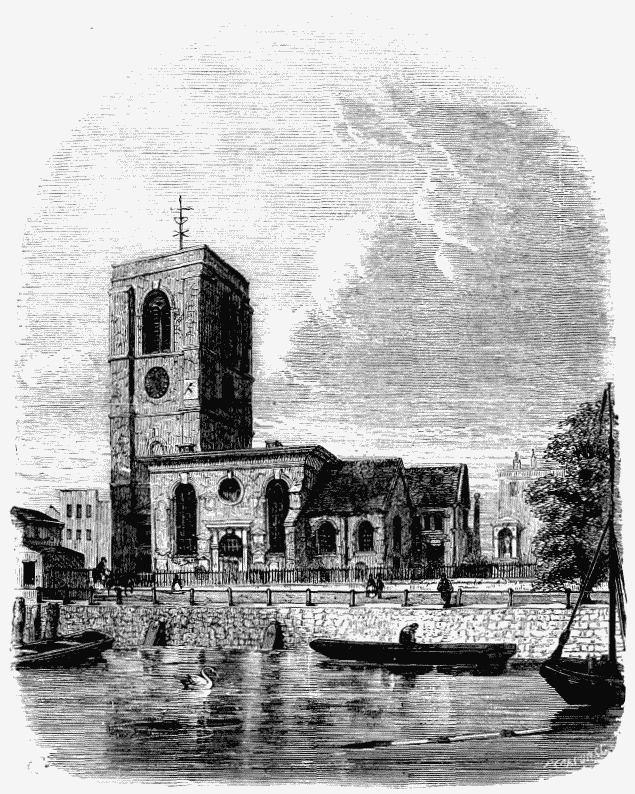
CHELSEA CHURCH, 1860.
Shadwell, the poet laureate of the seventeenth century, was another inhabitant of Church Street or Church Lane. He lived in a house which had been previously occupied by Dr. Arbuthnot.
The old "White Horse" inn, in this street, which was burnt down some years since—a new one being substituted for it—was a very ancient structure, built in the Tudor style of architecture. The house was rich in ancient panelling, together with grotesque ornaments and carving, in the form of brackets. In the principal room, which was large, and consequently well adapted for such a purpose, the old Parochial Guardian Society mostly held its meetings.
Another remarkable old inn in the same street was the "Black Lion," which was situated opposite the rectory garden wall, and was pulled down a few years ago to make room for the present tavern, which still retains the name. It is supposed that the old tavern was in its full glory during the reign of Charles II.; for, in an old house situated at the corner of Danvers Street, coeval with it, was an old pump, which the present proprietor, who has resided there for sixty years, recently pulled down. It bore the date of 1697 on a leaden panel of the pump. The old tea-gardens was, no doubt, the resort of the many fashionable families which lived in the neighbourhood; and attached to it was an extensive bowling-green for those who enjoyed that fashionable game.
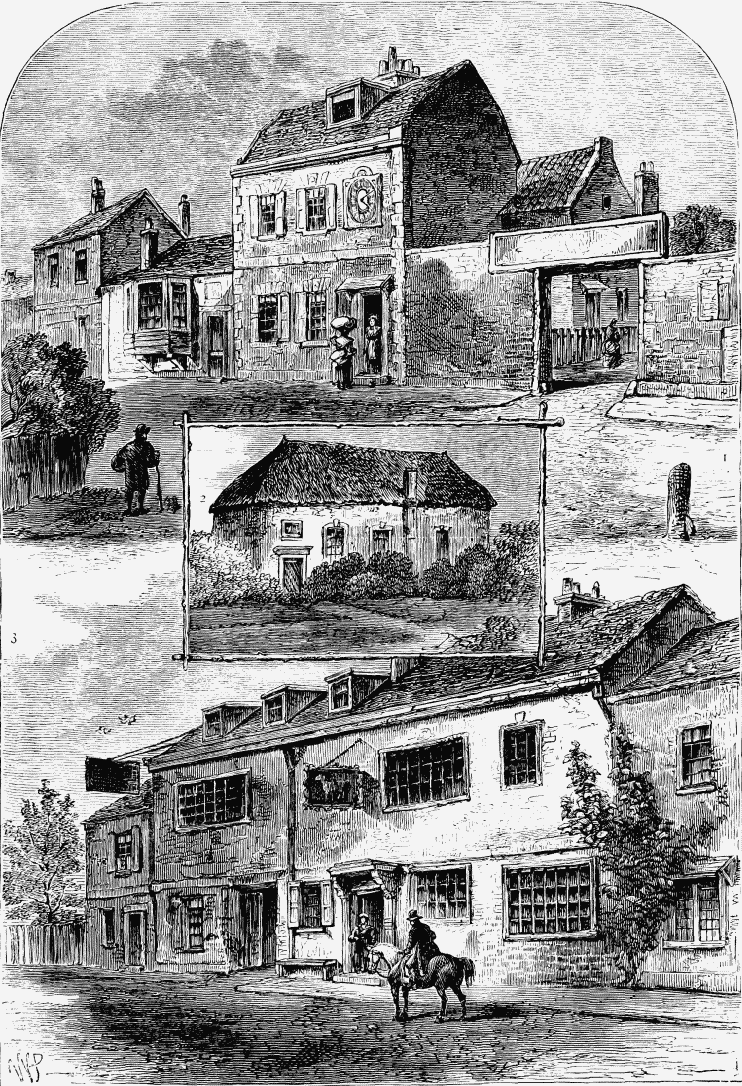
OLD CHELSEA IN 1750.
1. The Clock House.
2. The Moravian Chapel.
3. The White Horse Inn.
At the bottom of Church Lane, close by the old church in Lombard Street, lived, during the last twelve years of his life, Mr. Henry Sampson Woodfall, whose name was brought prominently before the public as the printer of the celebrated "Letters of Junius." He used jocularly to say to his Chelsea friends that he had been fined and confined by the Court of King's Bench, fined by the Houses of Lords and Commons, and indicted at the Old Bailey.
Mr. W. Lewis, bookbinder, the intimate friend of Dr. Smollett, and his fellow-companion whilst journeying from Edinburgh to London, lived for many years in this street. Lewis figures in the novel of "Roderick Random," under the character of "Strap the Barber." The description of the hero of the novel and of Strap, upon their arrival in London, and of their escapes from dangers and impositions, must be familiar to all who have read that work.
Danvers Street takes its name from Danvers Gardens, on the site of which it was built in the latter end of the seventeenth century. Danvers House adjoined, if it was not actually part of, the property of Sir Thomas More, or that of his son-inlaw, Roper. Sir John Danvers, who possessed this property early in the reign of Elizabeth, is said to have first introduced into this country the Italian method of horticulture, of which his garden, as represented by Kip, was a beautiful specimen. Danvers House passed from the Danvers family to the first Marquis of Wharton, in the reign of Queen Anne. The house was pulled down early in the last century.
Justice Walk, which extends from Church Street to Lawrence Street, was so named from a magistrate who lived in it. An avenue of lime-trees formerly adorned it, and rendered it an agreeable promenade for strollers. In this thoroughfare there is a commodious Wesleyan Chapel, built in 1841. The exterior is plain and unpretending; and beneath the chapel is a spacious school-room. The old Wesleyan Chapel of Chelsea was of some antiquity, and deserves mention as one of the favourite places of the founder of that community. In its pulpit John Wesley preached for the last time on February 18th, 1791, a fortnight before his death.
Several houses at the corner of Justice Walk and Lawrence Street were formerly used as the showrooms and manufactory of Chelsea china. The whole of the premises were pulled down towards the close of the last century, and new houses erected on the site. "The manufactory of Chelsea porcelain," says Mr. Faulkner, in his work already quoted, "was set on foot and carried on by a Mr. Spremont, a foreigner. The establishment employed a great number of hands; but the original proprietor, having acquired a large fortune, retired from the concern; and his successors, wanting his enterprise and spirit, did not so well succeed, and in a few years finally abandoned it. Previous to the dissolution of the establishment, the proprietors presented a memorial respecting it to the Government, requesting protection and assistance, in which they stated that 'the manufacture in England has been carried on by great labour and a large expense; it is in many respects to the full as good as the Dresden; and the late Duke of Orleans told Colonel York that the metal or earth had been tried in his furnace, and was found to be the best made in Europe. It is now daily improving, and already employs at least one hundred hands, of which is a nursery of thirty lads, taken from the parishes and charity schools, and bred to designing and painting—arts very much wanted here, and which are of the greatest use in our silk and printed linen manufactories.' Specimens of this porcelain have always been much esteemed, and still retain a great value. At the sale of the effects of Queen Charlotte, the articles in Chelsea china, of which her Majesty had a large collection, brought very high prices." It is recorded that Dr. Johnson had conceived a notion that he was capable of improving on the manufacture of china. He even applied to the directors of the Chelsea China Works, and was allowed to bake his compositions in their ovens in Lawrence Street. He was accordingly accustomed to go down with his housekeeper, about twice a week, and stay the whole day, she carrying a basket of provisions with her. The doctor, who was not allowed to enter the mixing room, had access to every other part of the premises, and formed his composition in a particular apartment, without being overlooked by any one. He had also free access to the oven, and superintended the whole of the process; but he completely failed, both as to composition and baking, for his materials always yielded to the intensity of the heat, while those of the Company came out of the furnace perfect and complete. Dr. Johnson retired in disgust, but not in despair, for he afterwards gave a dissertation on this very subject in his works.
Chelsea china seems to have been manufactured as far back as the reign of Queen Anne, but was not brought out to anything like perfection till the reign of George II. He and the Duke of Cumberland were the great patrons of the Chelsea China Works, and took much interest in promoting the success of this interesting manufacture. Beaumont painted some of the best landscapes on it; Nollekens' father worked there; and Sir James Thornhill was also employed in designing for it. The clay for the Chelsea china was brought from China by merchant captains, who procured it ostensibly for ballast. The productions of the Chelsea furnaces were thought worthy to vie with those of the celebrated manufactories of Germany. Walpole, in his correspondence with Sir Horace Mann, mentions a service of Chelsea porcelain sent by the King and Queen to the Duke of Mecklenburg, which cost £1,200. Possibly, it was in order to encourage the manufacture that George II. had his coffee-pot of Chelsea china on board the royal yacht. It was evidently made for the ship, as it has "ship" burnt in at the bottom. In Mr. Forster's notes to the catalogue of the sale at Stowe, in 1848—where the finest specimens of "rare old china," a pair of small vases, painted with Roman triumphs, sold for £23 10s.—it is stated that George II. brought over artificers from Brunswick and Saxony; whence, probably, M. Brongniart terms Chelsea a "Manufacture Royale." In 1745 the celebrity of Chelsea porcelain was regarded with jealousy by the manufacturers of France, who, therefore, petitioned Louis XV. to concede to them exclusive privileges.
Chelsea ware has always held a high rank among the varieties of English pottery. It reached its perfection about the year 1750; some fifteen years later, owing to the influx of foreign china, and the death of the director of the Chelsea works, Spremont, the workmen were transferred to Derby, where afterwards arose the celebrated ChelseaDerby manufacture, which marked the first twenty years of the reign of George III., and of which Dr. Johnson remarked that it was "very beautiful, but nearly as dear as silver."
Lawrence Street derives its name from having been erected on the site of the residence of the Lawrence family, which flourished here in the days of bluff King Hal. It is uncertain when this family first settled in Chelsea; but as the "Lawrence Chapel," in the old parish church, is built in the style of architecture which prevailed at the beginning of the fourteenth century, it was probably about that period, or, at all events, some time before they purchased the old manor house. At the "great house" in this street—commonly called Monmouth House—lived Ann, Duchess of Monmouth and Buccleuch, widow of James, Duke of Monmouth. Gay was for some time secretary to the duchess, as stated in Johnson's "Life of the Poet." Dr. Tobias Smollett afterwards resided in the same house.
A view of the old mansion, which was taken down in 1833, and a fac-simile of an autograph letter, dated thence in 1756, and addressed to Richardson, the actor, are to be seen in Smith's "Historical and Literary Curiosities." The letter is of more than ordinary interest, as Smollett writes thus frankly on a literary subject:—"I was extremely concerned to find myself suspected of a silly, mean insinuation against Mr. Richardson's writings, which appeared some time ago in the Critical Review; and I desired my friend, Mr. Millar, to assure you, in my name, that it was inserted without my privity or concurrence." It is pleasant to know that this frank letter was received as kindly as it was intended, and that one of those many "Quarrels of Authors," which have afforded subjects without end to satirists and essayists, was thus avoided. Smollett has immortalised this spot by making it the scene of one of the chapters in his "Humphrey Clinker." Here Smollett wrote his "Adventures of Ferdinand, Count Fathom," the "Reprisals, or the Tars of Old England," and his continuation of Hume's "History of England." He was editor of the Briton, a paper set up to support Lord Bute's ministry, and which Wilkes answered by his celebrated North Briton.
Between Lawrence Street and Church Street, in former times, was the stabling for the old Chelsea stage-coaches. The fare for inside passengers was 1s. 6d.; outside, 1s.; and no intermediate fare of a lower sum was taken. Such are the changes, however, brought about by the "whirligig of time," that passengers can now go almost from one extremity of London to the other for sixpence, and Chelsea can now be reached by steamboat for the moderate sum of twopence.
Besides the residents in this part of Chelsea in former times, of whom we have already spoken, a few more remain to be mentioned. Sir Richard Steele occupied a house not far from the waterside. In a letter to Lady Steele, dated 14th of February, 1716, Sir Richard writes:—"Mr. Fuller and I came hither to dine in the air, but the mail has been so slow that we are benighted, and chuse to lie here rather than go this road in the dark. I lie at our own house, and my friend at a relation's in the town." Addison, Steele's coadjutor on the Spectator, lived for some time close by. Macaulay says that he (Addison) enjoyed nothing so much as the quiet and seclusion of his villa at Chelsea.
At the house of a clergyman here, Mrs. Darby, the mother of Mary Robinson, better known as "Perdita," took up her home, with her children, on being deserted by her husband at Bristol. Soon afterwards she opened a girls' school in the neighbourhood, in which she was aided by her daughter.
In 1823, Mrs. Somerville went to live in Chelsea, her husband being appointed Physician to Chelsea Hospital. She speaks of it as a "dreary and unhealthy situation," and adds that she suffered from sick headaches all the time. Here she numbered among her friends and visitors Lady Noel Byron and her daughter Ada, the Napiers, Maria Edgeworth, Lady Bunbury, and Sir James Mackintosh. Here Gilray, the caricaturist, is supposed to have been born, in 1757. We have already spoken of the unfortunate career of this celebrity in our account of St. James's Street. (fn. 4)
John Pym, a distinguished member of the House of Commons in the seventeenth century, resided here for several years. Count D'Estrades, who came to England to negotiate the sale of Dunkirk, as ambassador from Louis XIV., fixed his abode at Chelsea during the years 1661 and 1662. "It was usual for the foreign ambassadors at that time to make their public entry from the Tower of London, but on this occasion the king sent his own coaches to Chelsea to carry the ambassador, and the count was accompanied by the equipages of the whole of the foreign diplomatic corps at that time in London." (fn. 5)
The Rev. David Williams, the founder of the Royal Literary Fund, (fn. 6) lived here for some time, keeping a school. Here he had Franklin for a guest at the time when the American philosopher was subjected to the abuse of Wedderburn before the Privy Council.
Besides its literary celebrities, Chelsea has also had its heroines, of whom mention of one or two will suffice. In the year 1739 was interred, in the College burying-ground, Christian Davies, alias Mother Ross, who, according to her own narrative, served in several campaigns under King William and the Duke of Marlborough, and behaved with signal bravery. During the latter portion of her life she resided here, her third husband being a pensioner in the college. At this time she subsisted, as she tells us, principally on the benevolence of "the quality" at Court, whither she went twice a week in a hackney-coach, old age and infirmities having rendered her unable to walk.
The famous Hannah Snell, whose history is recorded in various publications of the year 1750, was actually at that time put upon the out-pensioners' list at Chelsea, on account of the wounds which she received at the siege of Pondicherry. Her singular story excited a considerable share of public attention, and she was engaged to sing and perform the military exercises at various places of public entertainment; some time afterwards she married one Eyles, a carpenter, at Newbury. A lady of fortune, who admired the heroism and eccentricity of her conduct, having honoured her with particular notice, became godmother to her son, and contributed liberally to his education. Mrs. Eyles, to the day of her death, continued to receive her pension, which, in the year 1786, was augmented by a special grant to a shilling a day. In the latter part of her life she discovered symptoms of insanity, and was admitted a patient into Bethlehem Hospital, where she died in 1792.
Returning to the King's Road, we may here state that the house adjoining the entrance to the Moravian Chapel and burial-ground, at the north end of Milman's Row, and some few years since pulled down, was for many years in the occupation of the Howard family, of the Society of Friends. The elder Mr. Howard was gardener to Sir Hans Sloane; his brother, having a natural genius for mechanics, became a clock-maker, and made the clock in the old parish church, in 1761, for £50. In front of Howard's house was placed a large clock, and hence the building came to be known as the "Clock-house," a name now applied to what was once the Moravian Chapel.
On a plot of land behind the old Clock-house, and forming part of what was formerly Queen Elizabeth's nursery ground, and on which still exists a mulberry-tree said to have been planted by that queen, is situated the Glaciarium, or realice skating-rink. The rink is the result of Mr. John Gamgee's long and persevering labours to produce artificial cold at a low cost. The rink has an area of more than one hundred square yards, and the ice is about two inches thick. The ice is produced and its solidity maintained by the constant circulation of an aqueous solution of glycerine through a series of copper tubes of a flat, oval section, and which are embedded in the ice. The glycerine solution is kept at a low temperature by means of liquid sulphurous acid, which is constantly circulated, between a refrigerator on the one side and a condenser on the other, by means of an air-pump placed between the two and driven by a steam-engine.
At No. 178, King's Road, is the Chelsea Hospital for Diseases of Women, established in 1871. The institution is open gratuitously to those without means, small fees for medical treatment being required from such as can afford to pay. Upwards of a thousand patients are relieved here in the course of a year.
On the south side of the King's Road, nearly opposite Robert Street and the Workhouse, is the Vestry Hall, a handsome and spacious building in the Italian style, constructed of red brick with stone dressings. It was built from the designs of Mr. W. Pocock. A portion of the building is occupied by the Chelsea Literary and Scientific Institution, for the use of which a rental is paid. The whole interior is well arranged and admirably adapted for the requirements of the parish. Adjoining the Vestry Hall are some commodious swimming-baths, which were constructed under the superintendence of Mr. E. Perrett, the designer of the floating-baths at Charing Cross.
In Markham Square, abutting on the King's Road, is the Chelsea Congregational Church. The edifice stands in a very prominent position, and covers a large piece of ground. The form of the building is slightly cruciform, having transepts projecting about five feet from the body of the chapel. The prominent feature of the exterior is a tower and spire, rising from the west side of the southern transept to the height of about 130 feet. The style of the building is in the second period of the Gothic, and the exterior is constructed entirely of stone. There are lofty and spacious school-rooms, with the requisite offices, beneath the chapel.
In the Royal Avenue, a turning on the south side of the road leading towards the Royal Hospital, is another skating-rink, having an area of about 3,000 square yards, laid with Green and King's patent ice.
At the eastern end of the King's Road is Sloane Square, which, together with Sloane Street and Hans Place, all bear testimony to the memory of the eminent physician, Sir Hans Sloane, of whom we have already had occasion to speak. (fn. 7) In 1712 Sir Hans Sloane bought the manor of Chelsea, to which he retired thirty years later, having resigned his public offices and employments. Thither he removed his museum, and there he received the visits of the royal family and persons of high rank, learned foreigners, and distinguished literary and scientific men; nor did he refuse admittance and advice to either rich or poor who went to consult him respecting their health. At ninety his health began to decline sensibly, and he died here, at the age of ninety-two, in January, 1753.
In the early part of the present century, the houses around Sloane Square were nearly the same in appearance as at the present time; but the square was an open space, simply enclosed with wooden posts, connected by iron chains. Here Queen Charlotte's Royal Volunteers often assembled, and marched off in military order to Hyde Park, headed by their band. On the eastern side of the square, at that time, was the bridge, of which we have already spoken, (fn. 8) called Bloody Bridge. It was about twelve or fourteen feet wide, and had on either side a wall of sufficient height to protect passengers from falling into the narrow rivulet which it spanned, and which belonged to the Commissioners of Sewers. In old records this structure is called "Blandel Bridge;" and it probably received its more sanguinary appellation in consequence of the numerous robberies and murders formerly committed on the spot. In more recent times it has assumed the name of "Grosvenor Bridge," from the extensive adjoining property of the Grosvenors.
In 1812 the Chelsea, Brompton, and Belgrave Dispensary was established in Sloane Square, principally through the great exertions of the Rev. George Clark, the then chaplain of the Royal Military Asylum. The objects of the institution, as officially set forth, are "the relief of sick poor (not paupers), the delivery of married women at their own homes, and attention to diseases of women and children." Mr. William Wilberforce, whose name will be for ever associated with the abolition of slavery, took a leading part in the foundation of the dispensary. The earliest annual average of patients relieved at this admirable institution did not exceed 1,200; the number benefited yearly amounts now to nearly 7,000.
The Royal Court Theatre, in this square, was opened in January, 1871, for the performance of comedies, farces, and the lighter order of dramas. The building, which was originally erected in the year 1818 as a chapel, replaced a theatre at the beginning, and, singularly enough, the chapel has been replaced by a theatre at its close. The station on the Metropolitan District Railway, close by, doubtless confers great advantages on the surrounding neighbourhood.
At the beginning of the present century considerable addition was made to the parish of Chelsea by the erection of houses in this direction, and most of the new buildings were called Hans Town. Sloane Street is a long and wide thoroughfare, running from north to south, and connecting Knightsbridge with the west part of Pimlico and the east end of Chelsea. On the east side the houses are made to revert, so as to form three sides of a square, called Cadogan Place, of which we have already spoken. (fn. 9) At the south end of Sloane Street, near the square, is Trinity Church, of which the Rev. Henry Blunt was the first incumbent. The edifice, which was consecrated in 1830, is a brick building of Gothic architecture. The western front consists of a centre, flanked by two wide towers rising to a level with the roof, and terminating with lofty octagonal spires. Sittings are provided for about 1,500 worshippers. Sloane Terrace Wesleyan Chapel, which dates from 1811, is a neat and substantial building, and its erection is attributed to the liberality of several beneficent gentlemen, among whom may be named Mr. Joseph Butterworth, who at that time resided principally at Chelsea.
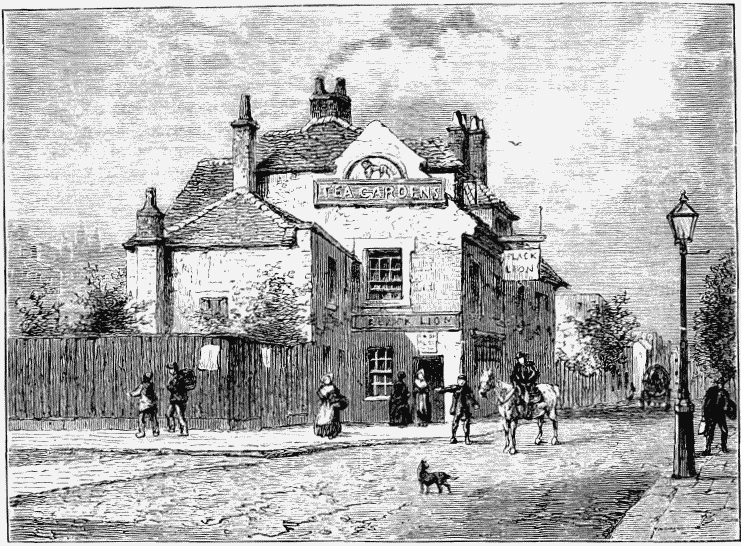
THE "BLACK LION," CHURCH STREET, CHELSEA, IN 1820.
At No. 72, Sloane Street, lived, for many years, Sir Charles Wentworth Dilke, Bart. In early life Sir Charles was associated with the literary labours of his father, who was the chief proprietor, and at one time editor, of the Athenæum newspaper. He was one of the earliest promoters of the first Great Exhibition, and, indeed, took a leading share in the work of the Executive Committee. For the ability he displayed in that capacity, the honour of knighthood was offered to him, at the suggestion of the late Prince Consort. This honour, however, he declined, together with all pecuniary remuneration. Mr. Dilke was likewise associated with the second Industrial Exhibition, as one of the five Royal Commissioners appointed by Her Majesty. Almost immediately after the death of the Prince Consort, Her Majesty was pleased to confer a baronetcy on Mr. Dilke, "in recognition of the Prince's friendship and personal regard for him." Sir Charles was M.P. for the borough of Wallingford for a short time, and died in 1869 at St. Petersburg. His son and successor was elected in 1868 as one of the first members for the newly-enfranchised constituency of Chelsea. He is the author of an interesting work on "Greater Britain," and of numerous pamphlets on social and political topics.
At No. 31 is the Ladies' Work Society, an institution established for the sale of needlework, embroidery, and other articles, the production of ladies in necessitous circumstances. Its president is her Royal Highness the Princess Louise (Marchioness of Lorne), who herself designs much of the ornamental work. The institution was established in the year 1871, in North Audley Street, and removed hither in 1875. The members of the society can do their work at home, and send it to Sloane Street for sale—the name of the exhibitors being known only to the ladies who form the committee. An annual subscription of 7s. 6d. constitutes a membership; and when an article is sold at the price set upon it by the exhibitor, a penny in the shilling is deducted towards defraying the necessary expenses of the establishment. In the earlier period of its career the society had a somewhat hard struggle for existence, but it gradually grew in proportion to the publicity given of the good work it was doing, so that now (1876), under its royal patronage and presidency, the number of members, which at first were 200, have increased to 1,000.
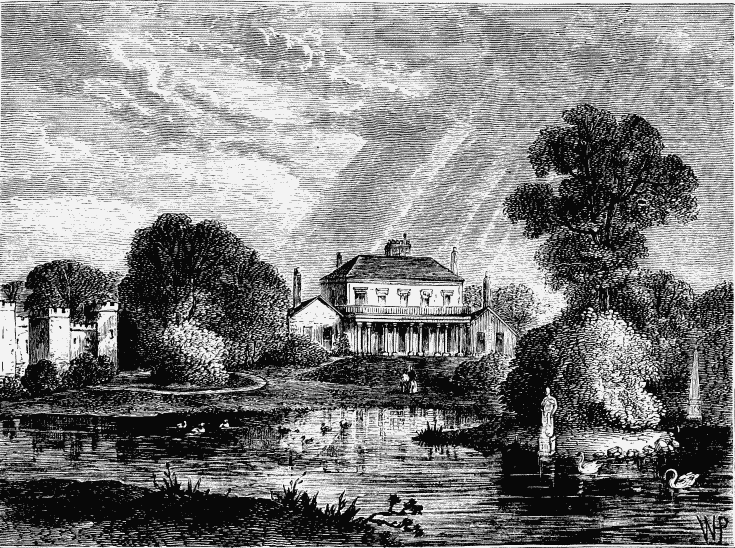
THE PAVILION, HANS PLACE, IN 1800.
No. 103 is the Hans Town School of Industry for Girls. This institution was founded in the year 1804, and its special object is the training of young girls for servants. A sum of two guineas is charged on admission, and the number of children benefited by this institution amounts to about fifty annually.
In this street the arch-impostor, Count Cagliostro, was living in the year 1786, when he published his celebrated "Letter to the English People," so cruelly criticised by M. de Morande, the editor of the Courrier de l'Europe, and thus defended by himself in the Public Advertiser, under date September 3rd, 1786:—"In physics and chemistry, Mr. Joker, arguments go for little and sneers for nothing—experience is all. Permit me, then, to propose a little experiment, which will divert the public, either at your expense or at mine. I invite you to breakfast for the 9th November next, at nine o'clock in the morning: you will furnish the wine and the accessories; I will furnish one dish in my own style—a little sucking pig, fattened according to my method. Two hours before breakfast I will present him to you alive, fat, and healthy. You will engage to have him killed and cooked, and I will not go near him till the moment when he is put on the table; you shall cut him yourself into four pieces, choose that which attracts you the most, and give me any piece you please. The day after this breakfast one of four things will have happened: either we shall be both dead or both alive, or I shall be dead and you alive, or you dead and I alive. Out of these four chances I give you three, and I bet 5,000 guineas that the day after the breakfast you will be dead and I shall be in good health. You will confess that no fairer offer could be made, and that you must either accept the wager or confess your ignorance, and that you have foolishly and dully cut your jokes upon a subject beyond your knowledge." This characteristic letter failed to persuade M. de Morande to breakfast, and he was fain to back out as best he might, getting well laughed at for his pains.
Count Cagliostro—or, to give him his proper name, Joseph Balsamo—used to advertise in the London newspapers that he was prepared to sell "the Egyptian pill of life at thirty shillings a dram;" doubtless about as efficacious as the preparation called "mummy," which was actually dispensed as a curative for sores, by physicians duly provided with diplomas, so late as the reign of Queen Anne. Cagliostro's doings as a quack of quacks took place just after the "diamond necklace" affair; and through the bursting of that bubble he was temporarily "down on his luck." No legal proceedings were taken against him in England, but subsequently he went to Rome, where he was flung into prison by the Inquisition, not, oddly enough, because he was a charlatan—the Piazza Navona and the Corso swarmed every day with vendors of Elixirs of Life and Love—but because he pretended to be a spirit-rapper. A very different state of things prevails at the present day in our own country.
The following story, having reference to this particular street, we give for what it is worth:—"I had invited Porson," says an English author, "to meet a party of friends in Sloane Street, where I lived; but the eccentric professor had mistaken the day, and made his appearance in full costume the preceding one. We had already dined, and were at our cheese. When he discovered his error, he made his usual exclamation of a whooe! as long as my arm, and turning to me, with great gravity, said, 'I advise you in future, sir, when you ask your friends to dinner, to ask your wife to write your cards. Sir, your penmanship is abominable; it would disgrace a cobbler. I swear that your day is-written Thursday, not Friday,' at the same time pulling the invitation out of his pocket. It turned out, however, that he was wrong, which he was obliged to admit."
Towards the commencement of the century, a considerable part of Sloane Street, between the square and Cadogan Place, was laid out as a botanical garden by a Mr. Salisbury. The extent of the grounds was about six acres, and at one time formed an agreeable promenade for company.
At the corner of Cadogan Place and Lowndes Street is Chelsea House, the town residence of Earl Cadogan, whose family formerly had a mansion on the site of the Royal Military Asylum. The house was rebuilt in 1874, from the designs of Mr. W. Young. The principal entrance, in Cadogan Place, is marked by a tetrastyle portico, which is carried up to the first floor as a bay window; another bay window on the same front is carried up two storeys, and finished with balustrades. The front to Lowndes Street has a semioctagonal bay at each end, carried up the whole height of the building. The ground storey is of rustic stonework, and at the level of the first floor is a stone balcony carried all round the building. The drawing-room windows, which are well studied in proportion and design, have a most imposing effect. The chief rooms are large and lofty, and the principal staircase is of Sicilian marble.
The manor and estate of Chelsea came into the possession of Lord Cadogan's family on the death of Mr. Hans Sloane by his own hand, Charles, second Lord Cadogan, having married Elizabeth, the daughter and co-heir of Sir Hans Sloane. It may be noted here that Horace Walpole was one of the trustees under Sir Hans Sloane's will.
On the west side of the street, in Cadogan Terrace, is the Roman Catholic Chapel of St. Mary's, an unpretending structure, dating from 1811, and one of the oldest of the missionary chapels of that religion. Not far from the chapel are the convent and schools, together with a Roman Catholic burial-ground, with some large vaults and catacombs. The chapel itself was built by M. Voyaux de Franous, one of the French émigré clergy. Before its erection, mass was said in a room above a shop. The Duchess of Angoulême was a generous contributor to the building, and laid the first stone. Dr. Poynter, then VicarApostolic of the London district, officiated at the consecration. Poor as the building was, it cost £6,000. It was specially designed for the use of the French veterans confined at Chelsea. Among the assistant clergy here were Cardinal Weld, the late Bishop of Troy, Dr. Cox, and Mgr. Eyre. St. Mary's Church has been lately improved and enlarged.
In Cadogan Street stood formerly an ancient house, which, in its latter days, was known as the "Marlborough Tavern;" the grounds adjoining were used for the purposes of cricket, &c. It is probable that the house was first established as a tavern during the lifetime of the great Duke of Marlborough, who, it is said, at one time resided in Chelsea, though his house is not identified. Marlborough Road, Blenheim Street, &c.—all contiguous in this neighbourhood—doubtless hence received their names. The old "Admiral Keppel" tavern, with its tea-gardens, in Marlborough Road, was demolished in 1856, and on its site a large inn has been erected.
Hans Place, at the north-west corner, between Sloane Street and Brompton Road, is an irregular octagonal space, laid out after the fashion of a London square. Here (at the house No. 25, according to Mr. Peter Cunningham) was born, in August, 1802, Miss Letitia E. Landon, the "L. E. L." of "Annual" celebrity. She went to school three doors off (No. 22), under a Miss Rowden, the same who numbered amongst her pupils Miss Mary R. Mitford. Miss Landon was the daughter of an army agent, and niece of the late Dr. Whittington Landon, Dean of Exeter and Provost of Worcester College, Oxford, who took a sincere interest in the welfare and fame of his relative. Having had the misfortune to lose her father when very young, and her brilliant talents soon becoming manifest, she appeared before the world, while little more than a child, as an enthusiastic and delightful literary labourer. Her first efforts were made in the pages of the Literary Gazette. "To her honour, it must be added," says the editor of the Athenæum, "that the fruits of her incessant exertion were neither selfishly hoarded nor foolishly trifled away, but applied to the maintenance and advancement of her family." Hans Place is associated with all the earliest recollections of Miss Landon, whose home it was, in fact, until her marriage, in 1838, with Captain George Maclean, Governor of Cape Coast Castle, on the west coast of Africa. She died in October of the same year, universally beloved on account of her amiable and gifted nature, and as simple as a child. Her poems live, and will live.
Mr. and Mrs. Alfred Wigan, the popular actor and actress, resided for some time in Hans Place.
Adjoining Hans Place is the Pavilion, formerly the residence of Lady Charlotte Denys, and now of the Earl of Arran. This building was erected in the latter part of the last century by a Mr. Holland, who had taken from Lord Cadogan a lease of one hundred acres of land hereabouts, formerly called "Blacklands," and now Upper Chelsea, for the purpose of forming new streets, &c. Mr. Holland reserved to himself twenty-one acres of land, on which he erected an elegant house for his own residence. The front of the house was originally built as a model for the Pavilion at Brighton, and was ornamented by a colonnade of the Doric order, extending the whole length of the building. The mansion consisted of three sides of a quadrangle, open to the north, and the approach was from Hans Place. The south front of the house faced an extensive and beautifully-planted lawn, gently rising to the level of the colonnade and principal floor. On the west side of the lawn was an ice-house, round which was erected a representation of the ruins of an ancient "priory," in which the appearance of age and decay is said to have been strikingly reproduced. The Gothic stonework was brought from the ancient but now demolished residence of Cardinal Wolsey, at Esher, in Surrey. The lawn was ornamented by a fine sheet of water, besides which the grounds had about them "considerable variety of fanciful intricate paths and scenery, properly ornamented with shrubs, and had a private communication with the house by the walks of the shrubbery."
On the north side of Hans Place, near to Walton Street, is St. Saviour's Church. It was built about the year 1840, and has no particular pretensions to architectural effect. It has no spire, but two dwarf towers flank the entrance facing Walton Place. The interior is perfectly plain. Deep galleries, supported on octagonal pillars and iron girders, extend round three sides. The pillars supporting the front of the galleries are extended upwards, and from their capitals spring pointed arches along each side. In connection with this church there are some excellent schools and charitable societies.
Close by is Prince's Cricket Ground and Skating Rink, which has become one of the principal centres of attraction and conversation during the London "season." The place has long been a cricket-ground of second-rate importance, but more than once of late it has been suggested that it would not be bad to transfer to it the "Eton and Harrow Match" from "Lord's." Besides this, there is every accommodation for lawn-tennis, Badminton, and other games. Of late there has been a novelty added, in the shape of a permanent "skating-rink," with artificial ice, for practice at all seasons of the year. "Prince's" was always rather select and exclusive, but of late its exclusiveness has been increased, the price of admission being raised, and all sorts of stringent regulations being introduced by the committee, in order to keep it "select." So "select" indeed has it become, that a cricketing husband, though an old subscriber, may not take his wife into its precincts, nor can a skating wife introduce her husband, or even her daughter. Nay, further, an edict has gone forth from the despots of "Prince's"—"That no lady is to be admitted at all unless she has been presented at Court." Of course, therefore, the members are "very select;" no "nobodies" are there; "Lady Clara Vere de Vere" has the skating-rink all to herself, or shares it only with other "daughters of a hundred earls." How delightful! Yes, delightful for Lady Clara and her friend, but not so for the outside public.
The "South Australian" is the sign of a small inn not far from Prince's Grounds. This building tells its own tale, having been put up about the year 1835, when the colony of South Australia was founded, by some one who had a pecuniary interest in it.