Old and New London: Volume 5. Originally published by Cassell, Petter & Galpin, London, 1878.
This free content was digitised by double rekeying. Public Domain.
Edward Walford, 'The old court suburbs: Kensington', in Old and New London: Volume 5(London, 1878), British History Online https://www.british-history.ac.uk/old-new-london/vol5/pp117-137 [accessed 30 April 2025].
Edward Walford, 'The old court suburbs: Kensington', in Old and New London: Volume 5(London, 1878), British History Online, accessed April 30, 2025, https://www.british-history.ac.uk/old-new-london/vol5/pp117-137.
Edward Walford. "The old court suburbs: Kensington". Old and New London: Volume 5. (London, 1878), British History Online. Web. 30 April 2025. https://www.british-history.ac.uk/old-new-london/vol5/pp117-137.
In this section
CHAPTER X.
"THE OLD COURT SUBURB."—KENSINGTON.
"When shall we walk to Totnam, or crosse o'er
The water? or take coach to Kensington
Or Paddington? or to some one or other
O' th' City out-leaps for an afternoon?"
Brome's "New Academy" (a play), 1658.
Descent of the Manor—A Parochial Enigma—Derivation of the Name of Kensington—Thackeray's "Esmond"—Leigh Hunt's Reminiscences—Gore House—Mr. Wilberforce, the Philanthropist—Lord Rodney—The Countess of Blessington and her Admirers—An Anecdote of Louis Napoleon—Count D'Orsay's Picture—A Touching Incident—Sale of the Contents of Gore House, and Death of the Countess of Blessington—M. Soyer's "Symposium"—Sale of the Gore House Estate—Park House—Hamilton Lodge, the Residence of John Wilkes—Batty's Hippodrome—St. Stephen's Church—Orford Lodge—Christ Church.
Kensington, which is technically described as a suburb of London, in the Hundred of Ossulston, has long enjoyed distinction from its Palace, in which several successive sovereigns of the Hanoverian line held their court, and which was the birth-place of Queen Victoria. In the time of the Domesday survey the manor of Kensington was owned by the Bishop of Coutances, to whom it was granted by William the Conqueror. It was at that time held by Aubrey de Vere, and subsequently, as history tells us, it became the absolute property of the De Veres, who afterwards gave twenty Earls of Oxford to the English peerage. Aubrey de Vere was Grand Justiciary of England, and was created Earl of Oxford by the Empress Maud. Upon the attainder of John, Earl of Oxford, who was beheaded during the struggle for power between the houses of York and Lancaster, the manor was bestowed by Edward IV. on his brother Richard, Duke of Gloucester. After passing through the hands of the Marquis of Berkeley and Sir Reginald Bray, the property returned (as is supposed by purchase) to John, Earl of Oxford, son of the attainted nobleman above mentioned. The manor is said to have again passed from that family, probably by sale, in the reign of Elizabeth; and early in the seventeenth century the Earl of Argyll and three other persons joined in a conveyance of the property to Sir Walter Cope, whose daughter conveyed it by marriage to Henry Rich, Earl of Holland. The manor subsequently passed into the hands of Lord Kensington, who was maternally descended from Robert Rich, last Earl of Warwick and Holland, and whose barony, singularly enough, is an Irish one, although the title is derived from this place.
Parochially considered, Kensington is somewhat of an enigma, for it is not only more than Kensington in some places, but it is not Kensington itself in others. In Kensington parish, for instance, are included Earl's Court, Little Chelsea, Old and New Brompton, Kensal Green, and even some of the houses in Sloane Street; while, on the other hand, Kensington Palace and Kensington Gardens are not in Kensington, but in the parish of St. Margaret's, Westminster.
The place, which now forms, as it were, part and parcel of London, was down to comparatively recent times a village, one mile and a half from Hyde Park Corner. The name is stated by some topographers to be derived from Kœnnigston, or from the Saxon Kyning's-tun, a term synonymous with King's End Town, and to be the same word as Kennington and Kingston; our monarchs from the earliest date having had residences at all three places. Possibly, however, the "Ken" may be an equivalent to "Kaen," or "Caen," which lies at the root of "Kentish" Town, "Caen-wood," &c.; but we will leave the origin of the name to be discussed by antiquaries, and pass on to a survey of the district in detail.
"Whatever was the origin of its name," writes Leigh Hunt, in the "Old Court Suburb," "there is no doubt that the first inhabited spot of Kensington was an inclosure from the great Middlesex forest which once occupied this side of London, and which extended northwards as far as Barnet." Kensington has been always a favourite, not only with royalty, but with those who more or less bask in the sunshine of princes—poets, painters, &c. The healthfulness and fashion of the place attracted numerous families of distinction; and its importance was completed when William III. bought the house and grounds of the Finch family (Earls of Nottingham), and converted the former into a palace, and the latter into royal gardens. It is emphatically "the old Court suburb," and is familiar to all readers of Thackeray, who has portrayed its features in many of his writings, especially in "Esmond." Leigh Hunt observes that "there is not a step of the way, from its commencement at Kensington Gore to its termination beyond Holland House, in which you are not greeted with the face of some pleasant memory. Here, to 'minds' eyes' conversant with local biography, stands a beauty looking out of a window; there, a wit talking with other wits at a garden-gate; there, a poet on the green sward, glad to get out of the London smoke and find himself among trees. Here come De Veres of the times of old; Hollands and Davenants, of the Stuart and Cromwell times; Evelyn, peering about him soberly, and Samuel Pepys in a bustle. Here advance Prior, Swift, Arbuthnot, Gay, Sir Isaac Newton; Steele, from visiting Addison; Walpole, from visiting the Foxes; Johnson, from a dinner with Elphinstone; 'Junius,' from a communication with Wilkes. Here, in his carriage, is King William III. going from the palace to open Parliament; Queen Anne, for the same purpose; George I. and George II. (we shall have the pleasure of looking at all these personages a little more closely); and there, from out of Kensington Gardens, comes bursting, as if the whole recorded polite world were in flower at one and the same period, all the fashion of the gayest times of those sovereigns, blooming with chintzes, full-blown with hoop-petticoats, towering with topknots and toupees. Here comes 'Lady Mary,' quizzing everybody; and Lady Suffolk, looking discreet; there, the lovely Bellendens and Lepels; there, Miss Howe, laughing with Nancy Lowther (who made her very grave afterwards); there Chesterfield, Hanbury Williams, Lord Hervey; Miss Chudleigh, not over clothed; the Miss Gunnings, drawing crowds of admirers; and here is George Selwyn, interchanging wit with my Lady Townshend, the 'Lady Bellaston' (so, at least, it has been said) of 'Tom Jones.'" Probably there is not an old house in Kensington in which some distinguished person has not lived, during the reigns in which the Court resided there; but the houses themselves are, as Leigh Hunt puts it, "but dry bones, unless invested with interests of flesh and blood."
The Royal Albert Hall and the gardens of the Horticultural Society occupy the site of Gore House and grounds. This is probably the estate called the Gara, or the Gare, which Herbert, Abbot of Westminster, gave to the nuns of Kilburn. The spot was, according to John Timbs, anciently called Kyng's Gore. Old Gore House was a low, plain, and unpretending building, painted white, and abutted on the roadway, about 150 yards to the east of the chief public entrance to the Albert Hall. Its external beauty, if it had any, belonged to its southern, or garden side. Standing close to the roadside, it looked as if meant originally for the lodge of some great mansion which had never actually been built; and the row, of which it formed a part, as Leigh Hunt observes, in his "Old Court Suburb," might easily lead one to imagine that it had been divided into apartments for the retainers of the Court, and that either a supernumerary set of maids of honour had lived there, or else that some four or five younger brothers of lords of the bedchamber had been the occupants, and expecting places in reversion. "The two houses," adds the writer, "seem to be nothing but one large drawingroom. They possess, however, parlours and second storeys at the back, and they have good gardens, so that, what with their flowers behind them, the park in front, and their own neatness and elegance, the miniature aristocracy of their appearance is not ill borne out."
Here, for the best part of half a century, distinguished statesmen and philanthropists, and afterwards the light and frivolous butterflies of West-end society, used to mix with men of letters and the votaries of science. Here the "lions" of the day were entertained from time to time; and there were few houses to which the entrée was more coveted. At the end of the last century it was little more than a cottage, with a pleasant garden in the rear attached to it, and it was tenanted by a Government contractor, who does not seem to have cared to go to any expense in keeping it in order. Early in the present century it was enlarged on coming into the possession of Mr. Wilberforce, who soon grew very fond of the spot, and here used to entertain Mr. Pitt, Lord Auckland (who lived hard by), and such eminent philanthropists as Clarkson, Stephen, Zachary Macaulay, and Romilly; indeed, it has often been said that the agitation which ended in the abolition of West Indian slavery was commenced in the library of Gore House. Of this place Mr. Wilberforce often speaks in his private correspondence; and in one place he mentions his rus in urbe in the following terms:—"We are just one mile from the turnpike at Hyde Park Corner, having about three acres of pleasure-ground around our house, or rather behind it, and several old trees, walnut and mulberry, of thick foliage. I can sit and read under their shade with as much admiration of the beauties of Nature as if I were down in Yorkshire, or anywhere else 200 miles from the great city." Here, too, his four sons, including the future Bishop of Oxford and of Winchester, were mainly brought up in their childhood and boyhood; and in the later years of its hospitable owner's life it is on record that "its costliness made him at times uneasy, lest it should force him to curtail his charities," a thing which he was always most anxious to avoid. Mrs. Wilberforce supported in this mansion a school for poor girls, which was under her own personal superintendence. At Gore House the gallant admiral, Lord Rodney, was for some time "laid up in port."
Mr. Wilberforce having occupied the house for thirteen years, from 1808 down to 1821, it next passed into the hands of a new meditator, but not so much on the beauties of nature as on those of art and literature—one who was more spirituelle in salons, that "spiritual" in Wilberforce's sense of the term—the "gorgeous" Countess of Blessington became in turn its proprietor. She lived here during her widowhood, surrounded by a bright and fashionable crowd of aristocratic and literary admirers. Gore House became indeed a centre of attraction to the world of letters; for besides giving such dinners as Dr. Johnson would have thought "worth being asked to," Lady Blessington prided herself on her success in "bringing people together," in order to please and be pleased in turn. Here were such men of the last generation as Lord Melbourne, the poet Campbell, Samuel Rogers, and many of the beaux of "the Regency" and of the reign of George IV., including Count D'Orsay, who married Lady Blessington's daughter, and made the house his home.
"At Gore House," writes Mr. Blanchard Jerrold, "Prince Louis Napoleon met most of the intellectual society of the time, and became the friend of Count D'Orsay, Sir E. Lytton Bulwer, Sir Henry Holland, Albany Fonblanque, and many others who formed Lady Blessington's circle." The Prince dined at Gore House with a small party of West-end friends and acquaintances, including Lord Nugent and "Poodle" Byng, on the evening before he started off on his wild and abortive effort to make a descent on Boulogne in August, 1840. "It was the fashion in that day," says Mr. Planché, in his "Recollections," "to wear black satin handkerchiefs for evening dress; and that of the Prince was fastened by a large spread eagle in diamonds, clutching a thunderbolt of rubies. There was in England at that time but one man who, without the impeachment of coxcombry, could have sported so magnificent a jewel; and though to my knowledge I had never seen him before, I felt convinced that he could be no other than Prince Louis Napoleon. Such was the fact. . . . There was a general conversation on indifferent matters for some twenty minutes, during which the Prince spoke but little, and then took his departure with Count Montholon. Shortly afterwards, Lord Nugent, Mr. Byng, and I, said good night, and walked townward together. As we went along, one of my companions said to the other, 'What could Louis Napoleon mean by asking us to dine with him at the Tuileries on this day twelve months?' Four days afterwards the question was answered. The news arrived of the abortive landing at Boulogne and the captivity of the Prince." On the first day after his escape from Ham (1846), and his arrival in London, Prince Louis Napoleon again dined here at a party, with Lady Blessington, Count D'Orsay, Walter Savage Landor, Mr. John Forster, &c., whom he amused by recounting his recent adventure in detail.
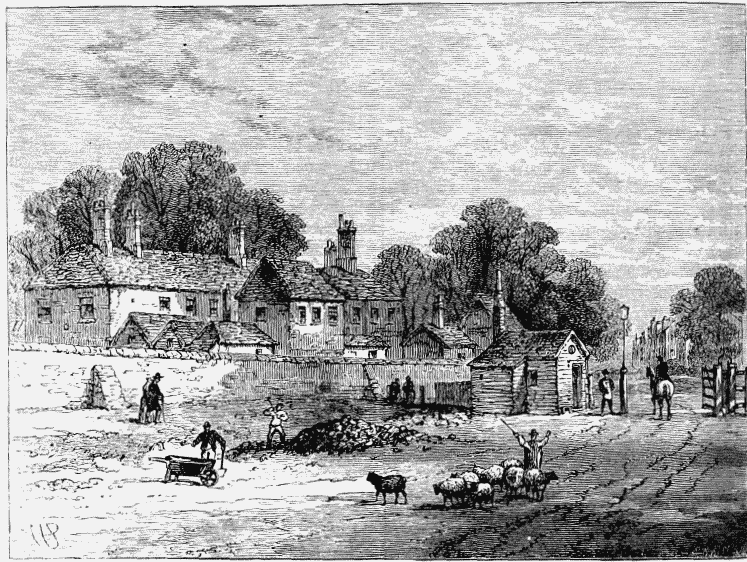
THE OLD TURNPIKE, KENSINGTON, IN 1820.
Mr. Madden, in his "Life and Correspondence of the Countess of Blessington," says:—"For nineteen years Lady Blessington had maintained, at first in Seamore Place, and afterwards at Kensington, a position almost queen-like in the world of intellectual distinction, in fashionable literary society, reigning over the best circles of London celebrities, and reckoning among her admiring friends, and the frequenters of her salons, the most eminent men of England in every walk of literature, art, and science, in statesmanship, in the military profession, and in every learned pursuit. For nineteen years she had maintained in London establishments seldom equalled, and still more rarely surpassed, in all the appliances of a state of society brilliant in the highest degree; but, alas! it must be acknowledged, at the same time, a state of splendid misery for a great portion of that time to the mistress of those elegant and luxurious establishments. And now, at the end of that time, we find her forced to abandon that position, to leave all the elegancies and refinements of her home to become the property of strangers, and in fact to make a departure from the scene of all her former triumphs, with a privacy which must have been most painful and humiliating."
Count D'Orsay painted a large garden view of Gore House, with portraits of the Duke of Wellington, Lords Chesterfield, Douro, and Brougham, Sir E. Landseer, the Miss Powers, and other members of the fashionable circle that gathered there. "In the foreground, to the right," says a description of the picture, "are the great Duke and Lady Blessington; in the centre, Sir E. Landseer, seated, in the act of sketching a fine cow, with a calf by her side; Count D'Orsay himself, with two favourite dogs, is seen on the right of the group, and Lord Chesterfield on the left; nearer the house are the two Miss Powers (nieces of Lady Blessington), reading a letter, a gentleman walking behind. Further to the left are Lord Brougham, Lord Douro, &c., seated under a tree, engaged in conversation."
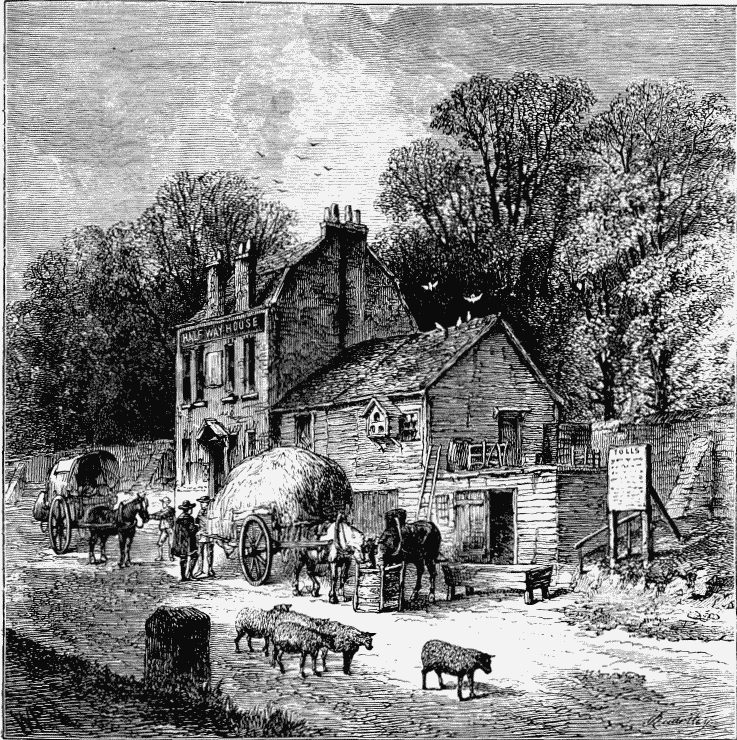
THE "HALFWAY HOUSE," KENSINGTON, 1850.
Mr. Madden, in his book above quoted, gives us anecdotes of, or letters from, most of the visitors at Gore House when it was in its prime. Thomas Moore, who sang so touchingly as to unlock the fount of tears in the drawing-room, was often there; so were Horace and James Smith, the authors of the "Rejected Addresses;" so was Sir Henry Lytton Bulwer and his brother, the late Lord Lytton. Walter Savage Landor would repair thither, with his stern eyebrows and kindly heart; and Albert Smith and Thackeray, Charles Dickens and William Jerdan, Mr. Monckton Milnes, Mr. A. Baillie Cochrane, Mr. N. P. Willis, the Countess Guiccioli (Byron's chere amie), Lords Brougham, Lyndhurst, and Chesterfield, and all the other celebrities, who, being added up together into one sum, made up, what Joseph Hume would have styled, the "tottle of the whole" of the Gore House circle. Mr. N. P. Willis thus records an incident during an evening here:—"We all sat round the piano, and, after two or three songs of Lady Blessington's choosing, Moore rambled over the keys awhile, and then sang 'When first I met thee,' with a pathos that beggars description. When the last word had faltered out, he rose and took Lady Blessington's hand, said good-night, and was gone before a word was uttered. . . . I have heard of women fainting at a song of Moore's; and if the burden of it answered by chance to a secret in the bosom of the listener, I should think, from its comparative effect upon so old a stager as myself, that the heart would break with it."
Lady Blessington's "curiosities" and treasures—the contents of the once favourite mansion—were disposed of by auction in the summer of 1849; and she herself went off to Paris, to die in debt, and deserted by her butterfly admirers, but a few weeks afterwards. The contents of the mansion are thus described in the catalogue of the sale:—"Costly and elegant effects: comprising all the magnificent furniture, rare porcelain, sculpture in marble, bronzes, and an assemblage of objects of art and decoration; a casket of valuable jewellery and bijouterie, services of rich chased silver and silver-gilt plate, a superbly-fitted silver dressingcase; collection of ancient and modern pictures, including many portraits of distinguished persons, valuable original drawings, and fine engravings, framed and in portfolios; the extensive and interesting library of books, comprising upwards of 5,000 volumes, expensive table services of china and rich cut glass, and an infinity of useful and valuable articles. All the property of the Right Hon. the Countess of Blessington, retiring to the Continent."
In 1851, during the time of the Great Exhibition, Gore House was made a "Symposium," or restaurant, by M. Alexis Soyer, whose cuisine, whilst chef of the Reform Club, enjoyed European fame. (fn. 1) Its walls were once more adorned with a splendour and costliness which it had not known for some years, though, possibly, not with equal taste as that which was so conspicuous under the régime of the clever and brilliant lady who had made it a home. Soyer first came to England on a visit to his brother, who was then cook to the Duke of Cambridge; and at Cambridge House he cooked his first dinner in England for the then Prince George. Soyer afterwards entered the service of various noblemen: amongst others, of Lord Ailsa, Lord Panmure, &c. He then was employed by the Reform Club, and the breakfast given by that club, on the occasion of the Queen's coronation, obtained him high commendation. Mr. Mark Boyd, in his "Social Gleanings," tells a good story about M. Soyer. "Meeting him in an omnibus, after his return from the Crimea, I congratulated him on the laurels he had gained with our army, and was anxious to learn how he had managed this under the privations to which our brave fellows were exposed from short rations, and often from no rations at all! 'Dere is my merit, Monsieur Boyd,' he replied, 'for I did make good dishes out of nothing.'" It is to be feared that his words were literally true.
The Gore House estate, comprising some twentyone acres, was purchased in 1852 by the Commissioners of the Great Exhibition, out of the surplus fund of that Exhibition, for the sum of £60,000, as a site for a new National Gallery; and the Baron de Villars' estate, adjoining, nearly fifty acres, fronting the Brompton Road, was bought for £153,500, as a site for a Museum of Manufactures; "these localities being recommended for the dryness of the soil, and as the only ground safe for future years amidst the growth of the metropolis." On the latter site, as we have shown in the previous chapter, the South Kensington Museum and the Schools of Art and Science have been erected; but instead of the National Gallery, the ground at Kensington Gore was made to serve as the site for the Albert Hall, &c.
Park House, at the eastern end of the Gore, close by Prince's Gate, indicates the northern boundary of the once famous Kensington or Brompton Park Nursery, which figures in the pages of the Spectator as the establishment of Messrs. Loudon and Wise, the most celebrated gardeners of their time. Near to this was Noel House, so called from having been built by one of the Campbells.
Hamilton Lodge, Kensington Gore, was the occasional residence of John Wilkes, who here entertained Counts Woronzow and Nesselrode, and Sir Philip Francis, the supposed author of the "Letters of Junius."
A little to the west of Kensington Gore, immediately opposite to the broad walk of Kensington Gardens, was, in 1850–1, Batty's Grand National Hippodrome. Its site, which lies at the back of the Prince of Wales' Terrace, covering a considerable space of ground between the two thoroughfares known as Palace Gate and Victoria Road, was for many years used as a riding school, but was ultimately given up for building purposes. Near the old turnpike, which stood a little westward of Gore House, was a small inn known as the halfway house between London and Hammersmith. It was a curious and picturesque structure, but was swept away about the year 1860.
Opposite Queen's Gate Gardens, and adjoining the Gloucester Road, on the west side of the Horticultural Gardens, is St. Stephen's Church, built in 1866, from the designs of Mr. Joseph Peacock, and is an architectural ornament to the neighbourhood. In this immediate locality was Orford Lodge, built on the site of the "Old Florida Tea Gardens," for the late Duchess of Gloucester, after whom Gloucester Road is named. The Lodge was subsequently tenanted by the Princess Sophia, and also by the Right Hon. George Canning, who was here visited by Queen Caroline. The house was taken down in the year 1852. The thoroughfare which connected Chelsea with the great western road through the village between the Gore and Kensington Square rejoiced in the not very pleasant-sounding name of "Hogmire Lane"—a name, however, suggestive of farm-yards and piggeries, which then, doubtless, were plentiful in the neighbourhood.
Christ Church, in the Victoria Road, is a neat edifice, of Gothic design, dating from the year 1851, and accommodating about 800 persons. All its seats are open. It was built from the designs of Mr. Benjamin Ferrey. The architecture is of the Decorated style, varying from geometrical to flowing. It comprises a nave and chancel, tower and spire. The windows throughout are of flowered quarries; that at the east end is a rich diaper pattern, copied from one in York Minster.
CHAPTER XI.
KENSINGTON (continued).
"Faith, and it's the Old Court Suburb that you spoke of, is it? Sure, an' it's a mighty fine place for the quality."—Old Play.
The Old Court Suburb—Pepys at "Kingly Kensington"—The High Street—Thackeray's "Esmond"—Palace Gate—Colby House—Singular Death—Kensington House: its Early History—Famous Inhabitants—Old Kensington Bedlam—The New House—Young Street—Kensington Square—Famous Inhabitants—Talleyrand—An Aged Waltzer—Macaulay's Description of Talleyrand—The New Parish Church—The Old Building—The Monuments—The Bells—The Parish Registers—The Charity School—Campden House—"The Dogs"—Sir James South's Observatory—A Singular Sale—Other Noted Residents at Kensington—Insecurity of the Kensington Road—A Remarkable Dramatic Performance—A Ghost Story—The Crippled Boys' Home—Scarsdale House—The Roman Catholic University College—Roman Catholic Chapels—The Pro-Cathedral—The "Adam and Eve."
Hitherto, since leaving the side of the river at Chelsea, we have been mostly passing over modern ground, which a century ago was scantily dotted with private residences, and which, therefore, can scarcely be expected as yet to have much of a past history. But now, as we look round the "Old Court Suburb" of Kensington, and its venerable and somewhat narrow High Street, we find ourselves again confronted with houses and persons of an earlier era, and, consequently, we shall be able to dwell at greater length on the annals and anecdotes of which Kensington has been the scene. The Palace and the Church, of course, will form our central objects, to which, perhaps, we ought to add that old-world haunt of fashion, Kensington Square. The old town of Kensington consisted principally of one long street, extending about three-quarters of a mile in length, from the Gore to Earl's Terrace; but even that thoroughfare is of comparatively modern growth, for the only highway for travellers westward, in former times, was the old Roman (or present Uxbridge) Road, then bending southerly (as it still branches) to Turnham Green. Within the last century a number of small streets have been built on either side. Bowack, in his "History of Middlesex," thus describes the place in the middle of the last century:—"This town, standing in a wholesome air, not above three miles from London, has ever been resorted to by persons of quality and citizens, and for many years past honoured with several fine seats belonging to the Earls of Nottingham and Warwick. We cannot, indeed, find it was ever taken notice of in history, except for the great western road through it, nor hath anything occurred in it that might perpetuate its name, till his late Majesty, King William, was pleased to ennoble it with his court and royal presence. Since which time it has flourished even almost beyond belief, and is inhabited by gentry and persons of note; there is also abundance of shopkeepers, and all sorts of artificers in it, which makes it appear rather like part of London than a country village. It is, with its dependencies, about three times as big as Chelsea, in number of houses, and in summer time extremely filled with lodgers, for the pleasure of the air, walks, and gardens round it, to the great advantage of its inhabitants. The buildings are chiefly of brick, regular, and built into streets; the largest is that through which the road lies, reclining back from the Queen's House, a considerable way beyond the church. From the church runs a row of buildings towards the north, called Church Lane; but the most beautiful part of it is the Square, south of the road, which, for beauty of buildings, and worthy inhabitants, exceed several noted squares in London."
Kensington—"kingly Kensington," as Dean Swift called it—is not very frequently mentioned by Pepys, as that country village had not, in his days, become the "court suburb." He mentions, however, accompanying "my lord" (the Earl of Sandwich) to dine at Kensington with Lord Campden, at Campden House, and afterwards to call at Holland House. With two other trivial exceptions, this is all that we learn about Kensington from the old gossip's "Diary;" neither does the place figure in the "Memoirs of the Count de Gramont." It is on record that George II. admired the flat grounds of Kensington and Kew, as reminding him of "Yarmany." It is described by Bowack, in 1705, as being about three times as big as Chelsea. The manor of Abbots' Kensington, which occupies an area of about 1,140 acres in all, extends northwards so far as to include all the Gravel Pits and Notting Hill.
Although Kensington is so near London, and contains so many new buildings, the High Street has a considerable resemblance to that of a country town. The houses, for the most part, are of moderate size, and considerable variety is displayed in the style of building, so that the fronts of scarcely any two houses are alike. Faulkner, writing in 1820, remarks: "The town, being in the direct road for the western parts of England, is in a considerable bustle, and resembles the most populous streets in London, especially in an evening, when the mail-coaches are setting out for their various destinations." The chief coaching-inn and postinghouse, at that time, was the "Red Lion," at the back of which is still to be seen a curious sun-dial, bearing the date 1713. Readers of Thackeray's "Esmond" will not have forgotten the picture he has given of the scene which might have been witnessed from the tavern at the corner of the old High Street, on the occasion of the accession of King George I.:—"Out of the window of the tavern, and looking over the garden wall, you can see the green before Kensington Palace, the palace gate (round which the ministers' coaches are standing), and the barrack building. As we were looking out from this window in gloomy distraction, we heard presently the trumpets blowing, and some of us ran to the window of the front room looking into the High Street, and saw a regiment of horse coming. 'It's Ormond's Guards,' says one. 'No, by G—; it's Argyle's old regiment!' says my general, clapping down his crutch. It was indeed Argyle's regiment that was brought up from Westminster, and that took the part of the regiment at Kensington." The sequel is soon told, and it shall here be told, in the words of "Esmond:"—"With some delays in procuring horses, we got to Hammersmith about four o'clock on Sunday morning, the 1st of August (1714), and half an hour after, it then being bright day, we rode by my Lady Warwick's house, and so down the street of Kensington. Early as the hour was, there was a bustle in the street, and many people moving to and fro. Round the gate leading to the palace, where the guard is, there was especially a great crowd; and the coach ahead of us stopped, and the bishop's man got down, to know what the concourse meant. Then presently came out from the gate horse-guards with their trumpets, and a company of heralds with their tabards. The trumpets blew, and the herald-at-arms came forward, and proclaimed 'George, by the grace of God, of Great Britain, France, and Ireland, King, Defender of the Faith.' And the people shouted 'God save the King!'" Thus was the first sovereign of the Hanoverian line proclaimed in the High Street of Kensington; and there, with the sound of King George's trumpets, were the last hopes of the Stuart line scattered to the winds of heaven. The spot where this proclamation took place is surely an object of historic interest to after ages.
Almost at the entrance of the High Street is the Palace Gate, with its sentinels on duty, and opposite to it stood, till recently, a good, moderatesized house—a sort of undergrown mansion—which, as Leigh Hunt says, looked as if it "had been made for some rich old bachelor who chose to live alone, but liked to have everything about him strong and safe." Such was probably the case, for it was called Colby House, and was the abode of Sir Thomas Colby, of whom Dr. King tells us in his "Anecdotes of his Own Times," that being worth £200,000, and having no near relatives, he met with his death by getting up from his warm bed on a winter night to fetch the key of his cellar, which he had forgotten, for fear his servant might help himself to a bottle of wine. The house was inhabited, when Faulkner wrote his "History of Kensington," by one of the leading magistrates of the county. Its former eccentric owner was buried in the parish church. The house was standing till about 1872, when it was pulled down, along with the large red house, Kensington House, adjoining, to make a site for Baron Grant's mansion.
Kensington House, a dull and heavy building of red brick on the south side of the high road, nearly facing the Palace gates, was for some years inhabited by the notorious Duchess of Portsmouth, one of the many mistresses of Charles II. The house was long and low in proportion, and was screened from the road by a high wall. It is recorded that King Charles supped here the night before he was seized with the illness which proved his last. The house was afterwards turned into a school, kept by Elphinstone, who was known as the translator of Martial, and as a friend of Dr. Jortin, Benjamin Franklin, and Dr. Johnson. He was ludicrously caricatured by Smollett, in "Roderick Random," which was consequently a forbidden book in his school. At the outbreak of the first French Revolution the house was occupied by some French emigrant priests, members of the Jesuit Order, who kept here a college for the youth of the French and some of the English aristocracy, under the assumed name of "Les Pères de la Foi." The late Mr. Richard Lalor Sheil was sent here when a boy, and he tells us how the school was visited by "Monsieur"—as Charles X., afterwards King of France, was then called—in his brother's lifetime.
The building has been described as follows by Mr. Sheil (fn. 2) :—"I landed at Bristol, and with a French clergyman, the Abbé de Grimeau, who had been my tutor, I proceeded to London. The abbé informed me that I was to be sent to Kensington House, a college established by the Pères de la Foi—for so the French Jesuits settled in England at that time called themselves—and that he had directions to leave me there upon his way to Languedoc, from whence he had been exiled in the Revolution, and to which he had been driven by the maladie de pays to return. Accordingly, we set off for Kensington House, which is situated exactly opposite the avenue leading to the palace, and has the beautiful garden attached to it in front. A large iron gate, wrought into rustic flowers, and other fantastic forms, showed that the Jesuit school had once been the residence of some person of distinction. . . . It was a large oldfashioned house, with many remains of decayed splendour. In a beautiful walk of trees, which ran down from the rear of the building through the play-ground, I saw several French boys playing at swing-swang; and the moment I entered, my ears were filled with the shrill vociferations of some hundreds of little emigrants, who were engaged in their various amusements, and babbled, screamed, laughed, and shouted, in all the velocity of their rapid and joyous language. I did not hear a word of English, and at once perceived that I was as much amongst Frenchmen as if I had been suddenly transferred to a Parisian college. Having got this peep at the gaiety of the school into which I was to be introduced, I was led, with my companion, to a chamber covered with faded gilding, and which had once been richly tapestried, where I found the head of the establishment, in the person of a French nobleman, Monsieur le Prince de Broglie."
Here, in 1821, whilst the house was still in the hands of the Jesuits, died—it is said, from the effects of tight lacing—Mrs. Inchbald, the authoress of the "Simple Story." She had resided in several other houses in Kensington before coming here. She had written many volumes, which she had by her in manuscript; but on her death-bed, from some motive or other, she requested a friend to tear them to pieces before her eyes, not having the strength to perform the heroic deed of immolation with her own hands. Mr. and Mrs. Cosway, too, resided here for a short time, after leaving Stratford Place, and before settling down in the Edgware Road.
The building was subsequently turned into a private lunatic asylum, and was then popularly known as Old Kensington Bedlam. It was purchased in 1873 by "Baron" Albert Grant, who pulled it down and erected a modern Italian palace on its site. The cost of the building and grounds is stated to have exceeded one million sterling. The mansion contains a grand hall and staircase, built entirely of white marble, drawing-rooms, library, picture-gallery, three dining-rooms en suite, and a spacious ball-room. In the construction of the windows, numbering over a hundred, no less than three tons of stone have been used. In the formation of the grounds, which are twelve acres in extent, Mr. Grant purchased an Irish colony situated in the rear of the Kensington High Street—formerly called the "Rookery" and "Jenning's Buildings"—both of which had been a nuisance to the parish for years past. These places are now entirely demolished, and the ground has been converted into a picturesque lake, three acres in extent, with two small islands in the centre. To secure an uninterrupted view of the Kensington Gardens, Mr. Grant purchased the pretty antique lodge which used to stand at the entrance to the gardens, together with the dead wall enclosing the grounds. These have been removed, and in their stead a handsome range of gilt iron railings erected.
Continuing our way westward, we come to the turning at Young Street, which leads into the square above alluded to. It is an old-fashioned, oblong enclosure, and bears the name of Ken sington Square. It was commenced in the reign of James II., and finished about 1698, as appeared by a date at one time affixed at the north-east corner. It is described by Bowack, in 1705, as "the most beautiful part of the parish south of the main road," and as "exceeding several noted squares in London for beauty of its buildings and (for) worthy inhabitants." While the Court was at Kensington, most of the houses were inhabited by "persons of quality," ambassadors, gentry, and clergy; and at one time, as Faulkner tells us, upwards of forty carriages were kept by residents in and about the neighbourhood. In the reigns of William and Anne and the first two Georges, this square was the most fashionable spot in the suburbs; indeed, in the time of George II., the demand for lodgings here was so great, "that an ambassador, a bishop, and a physician have been known to occupy apartments in the same house." The celebrated Duchess de Mazarin appears to have resided here in 1692; and here she probably had among her visitors her "adoring old friend, Saint Evremond, with his white locks, little skull cap, and the great wen on his forehead." Here, too, Addison lodged for some time; and here it was that he read over some of Montaigne's "Essays." It is said that, finding little or no information in the chapters as to the subjects their titles promised, he closed the book more confused than satisfied. "What think you of this famous French author?" said a gentleman present. "Think?" said he, smiling: "why, that a pair of manacles, or a stone doublet, would probably have been of some service to that author's infirmity." "Would you imprison a man for singularity in writing?" "Why, let me tell you," replied Addison, "if he had been a horse he would have been pounded for straying; and why he ought to be more favoured because he is a man, I cannot understand." We shall have more, however, to say of Addison when we come to Holland House.
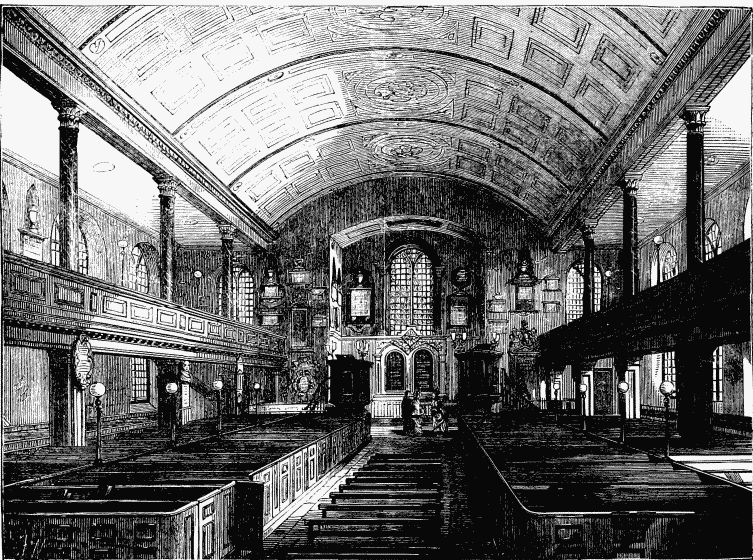
INTERIOR OF KENSINGTON CHURCH, 1850.
Somewhere about the south-west corner of the square lived, for several years, physician to King William III., and butt of all the wits of the time, Sir Richard Blackmore, the poet, of whom we have spoken in our account of Earl's Court. Hough, the good old Bishop of Winchester, lived here for many years; as also did Mawson, Bishop of Ely; and Dr. Herring, Bishop of Bangor, and afterwards. Archbishop of Canterbury. Among other noted residents were the Rev. W. Beloe, the translator of Herodotus; and the Earl of Clanricarde.
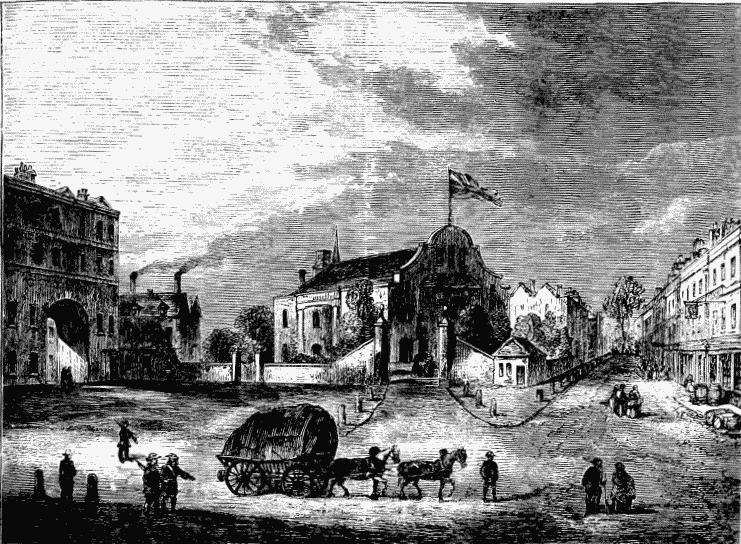
OLD KENSINGTON CHURCH, ABOUT 1750.
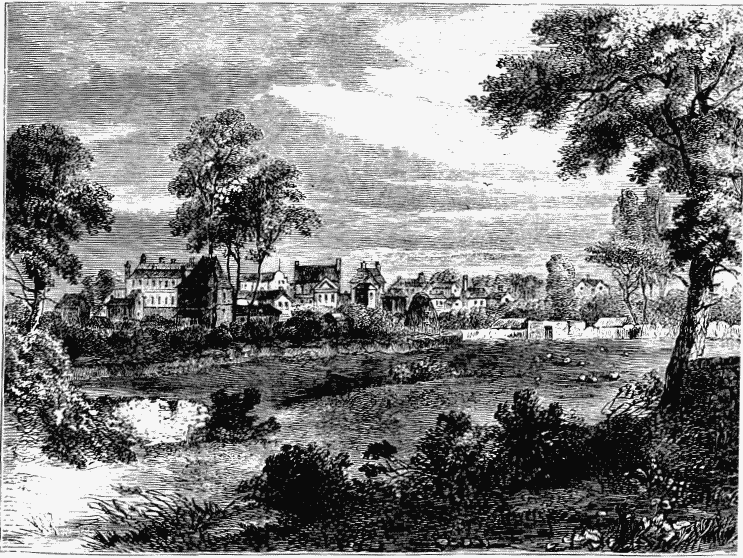
OLD VIEW OF KENSINGTON, ABOUT 1750.
Another resident in Kensington Square, during the early part of the present century, was Prince de Talleyrand, at one time Bishop of Autun, in France, and subsequently Ambassador-Extraordinary for that country to the Court of St. James's. Lord Palmerston used to declare that he was "exceedingly quiet and courteous, but he had a strange versatility not revealed to the world at large." When eighty years of age, and extremely lame, he still was fond of sharing the amusements of the young, and his smile was then so benign as quite to discredit the "sarcastic sneer" for which he was famous. "One night at the Duchess of Gramont's," writes Lady Clementina Davies, in her "Recollections of Society," "a game of forfeits was proposed. The duchess joined in the game, and lost her king. She asked how she could get it back. She was told she must ask some gentleman in the room to take a tour de valse with her, and she invited the lame and aged diplomatist to dance with her. He smiled, and instantly rose to comply. Several young men offered to take his place, but neither he nor the gay little duchess would allow of this, and Talleyrand seemed able to perform his share in the valse, and to be pleased with the exertion. He remained with his partner, and conversed with her in a style of brilliant animation. When Louis XVIII. was restored to the French throne, the sage minister said to him, 'Now, sir, as a king of the French people, you must learn to forget!' The Bourbons might have fared better could they have taken this wise counsel!"
Lady Clementina Davies, who lived on terms of intimacy with the Prince, declares that it is quite an error to suppose that he was a mere political hypocrite, or that he transferred his services from one sovereign to another with reckless indifference; but that, on the contrary, his only motive was a patriotic desire to advance the interests of his country. He was shamefully used by his parents on account of his club-foot; he was deprived of all his rights as the eldest son, and forced against his will to become a priest. In spite of his cynicism, the great diplomatist was a remarkably pleasanttempered man, full of kindness to children, and possessing conversational powers of the highest orders.
Talleyrand, in the year 1831, is thus described by Macaulay among the guests he met at Holland House:—"He is certainly the greatest curiosity that I ever fell in with. His head is sunk down between two high shoulders. One of his feet is hideously distorted. His face is as pale as that of a corpse, and wrinkled to a frightful degree. His eyes have an odd glassy stare, quite peculiar to them. His hair, thickly powdered and pomatumed, hangs down his shoulders on each side as straight as a pound of tallow candles. His conversation, however, soon makes you forget his ugliness and infirmities. There is a poignancy without effort in all that he says, which reminds me a little of the character which the wits of Johnson's circle give of Beauclerk. . . . He told several stories about the political men of France, not of any great value in themselves; but his way of telling them was beyond all praise—concise, pointed, and delicately satirical. . . . I could not help breaking out into admiration of his talent for relating anecdotes. Lady Holland said that he had been considered for nearly forty years as the best teller of a story in Europe, and that there was certainly nobody like him in that respect."
In this square, also, resided James Mill, the historian of British India, and father of Mr. John Stuart Mill, the political economist, and some time Member of Parliament for Westminster. He died in June 1836, and was buried in the vaults below the parish church.
Part of the western side of the square is occupied by the front of the Kensington Proprietary Grammar School; and three or four of the largest mansions near the south-west angle form now the Convent of the Dames de Sacré Cœur, on whose garden a handsome Roman Catholic church, and also a convent chapel, have been lately built.
It is in Kensington Square that Thackeray, in his "Esmond," lays the scene which presents us with James Stuart, "the Prince" from Saint Germains, as lodging, and passing for the time as Lord Castlewood, holding himself in readiness for action when the death of Queen Anne was expected. He pictures the Prince walking restlessly upon "the Mall" at Kensington. The "little house in Kensington Square" figures from first to last in the above-mentioned work as the residence of Lady Castlewood and of Beatrix Esmond, and is the centre at once of love-making and of political plots, in the interest of the exiled Stuarts.
About the middle of the High Street stands Kensington Church, dedicated to St. Mary the Virgin. The present fabric dates only from the year 1869, having replaced an older structure. It was built from the designs of Sir Gilbert Scott, and has about it a degree of architectural dignity which befits the importance of the parish as the "Old Court Suburb," the abode of royalty, and a quarter inhabited by many wealthy and aristocratic families. The style of design is that which was in vogue towards the close of the thirteenth century, and known as the Decorated, though it is freely adapted to present uses. It consists of a large nave and chancel, each with aisles, and additional aisles at the eastern part of the nave, which at that part, consequently, has double aisles on each side. The whole is of very lofty proportions, with clerestory both to nave and chancel. The tower and spire, which are on a considerable scale, are at the north-east angle, and connected with the chancel by an extra aisle, which contains the organ. The cost of the building was about £35,000, towards which Her Majesty the Queen gave £200, while the late vicar of the parish, Archdeacon Sinclair, made a donation of £1,000.
The old parish church of St. Mary's, though a plain and unpretending edifice, which Bishop Blomfield used to designate the ugliest in his diocese, was an interesting structure, not only on account of the numerous monuments which it contained, but far more on account of the historical reminiscences connected with it. What with partial rebuildings and wholesale repairs, it had been altered a dozen times in less than two centuries. It superseded a previous building of which little or nothing is recorded. It is more than probable that the ancient parish church of Kensington stood nearly on the spot in Holland Street, now occupied by the church of the Carmelite Fathers, and opposite the vicarage. At all events, it stood a little to the north of the parish church of subsequent centuries, and not far from the Manor House, to which the vicarage is a successor; indeed, there is a tradition, but unconfirmed, that the original parish church stood some distance to the north, near the Gravel Pits, and was removed hither at the time of the Conquest. The road, by its very narrowness and curvings, shows that it is an ancient way, and it is still traditionally called, or at all events was called within the memory of the present generation, the "Parson's Yard." It will not be a little singular if hereafter it should be discovered that the Carmelites have been building on the old foundations. The resolution to build this church was adopted by the vestry in 1696, and among the contributors were William III. and Queen Mary, as well as the Princess Anne. The king and queen not only subscribed to the building fund, but presented the reading-desk and pulpit, which had crowns carved upon them, with the initials "W." and "M. R." A pew, curtained round in the fashion of old times, was, in consequence, set apart for the royal family, and long continued to be occupied by residents in Kensington Palace, and among whom were the Duke and Duchess of Kent and the late Duke of Cambridge. It was in this church that the Duchess of Kent returned thanks after the birth of Queen Victoria.
Here were monuments to Edward, eighth Earl of Warwick and Holland, who died in 1759; and to "the three Colmans:" Francis Colman, some time British Minister to the Court of Florence; his son, George, "the Elder," and his grandson, George, "the Younger." The two latter wrote several comedies, and were proprietors of the Haymarket Theatre. Here also was buried one Sir Manhood Penruddock, who was "slain at Notting Wood, in fight, in the year 1608." At that time the nation was at peace; the "fight" which is recorded in the parish register probably means a "duel." Two interesting monuments by Chantrey, which were erected in the old parish church, have been replaced in the new edifice: the one in memory of a former vicar, Dr. T. Rennell; the other to a Peninsular officer, Colonel Hutchins, a native of Earl's Court.
Near one of the entrances to the church was a tablet recording a reputed donation of lands to the parish by Oliver Cromwell, of which Lysons states: "An anonymous benefactor, in 1652, gave some land at Kensington Gravel-pits, on which was formerly a malthouse. This is called Cromwell's gift, and a tradition has prevailed that is was given by Oliver Cromwell; but the parish have no evidence to ascertain it."
The peal of bells was cast by Janeway, of Chelsea, in 1772. In the parish books are several entries of sums paid for ringing the church bells on public occasions since the Revolution. The Battle of the Boyne, for instance, is thus recorded: "May 2, 1690.—Paid William Reynolds for the ringers on that day the news came of the victory gained by his Majesty at and near the Boyne, 12s." And again, the Battle of Blenheim is thus noted: "1704.—Paid Mr. Jackman for a barrel of beer for the victory over the French and Bavarians, 15s." Another entry runs as follows: "For Limerick's being taken, and 'twas false," (sic): on this occasion the ringers were contented with eighteen pence. Various sums are mentioned as having been paid on the arrival of King William and his Queen, such as became the royal parish, "kingly Kensington." In Murray's "Environs of London" it is stated that this church has had its "Vicar of Bray," in one Thomas Hodges, collated to the living by Archbishop Juxon. He kept his preferment during the Civil War and interregnum, by joining alternately with either party. Although a frequent preacher before the Long Parliament, and one of the Assembly of Divines, he was made Dean of Hereford after the Restoration, but continued Vicar of Kensington.
Amongst the many interesting associations of the old church are several of the present century. Mr. Wilberforce, who, as we have stated, resided at Kensington Gore, is still remembered by many of the old inhabitants as sitting in the pew appropriated to the Holland House family. George Canning, who resided at Gloucester Lodge, might often be seen sitting in the royal pew; Coke, of Norfolk, the eminent agriculturist, had a pew here, which he regularly occupied. Professor Nassau W. Senior, the political economist, although living so far distant as Hyde Park Gate, might often be seen, in company with the late Mr. Thackeray, attending the early service; but neither of these eminent writers, it is said, rented a pew in the church. Lord Macaulay, too, whilst living at Holly Lodge, Campden Hill, regularly attended here during the last two summers of his life.
To the churchyard, in 1814, was added a new cemetery, where was previously an avenue of elms, through which ran the original approach from the town to Campden House. In the churchyard is a monument to Mrs. Elizabeth Inchbald, who is truthfully and touchingly described on it as "a beauty, a virtue, a player, and authoress of 'A Simple Story.'" She commenced her career as an actress in 1777, on the York circuit, but quitted the stage in 1789, continuing, however, for many years to entertain the public in the character of a dramatic author. Mrs. Inchbald died on the 1st of March, 1821, as we have stated above, at old Kensington House. The following instances of longevity are to be found in the registers of burials:—1786, Margaret Smart, aged 103; 1804, Jane Hartwell, from Methwold's Almshouses, aged 100; 1807, William Griffiths, of the Gravel-pits, aged 103. The present vicarage, built about 1774, superseded a humble structure little more than a cottage with latticed windows.
Returning again into the High Street, we notice, a few yards beyond the church, a curious-looking brick building, of two storeys, above which is a square tower, probably intended to hold a bell; this was the old Kensington Charity School, built by Sir John Vanbrugh. It is now a savings'-bank, with a new school-room by the side of it. Adjoining this building is the new Vestry Hall, which has been recently erected in the style of architecture in vogue in the reign of James I.
On the opposite side of the way, in a house which stood on the site of the Metropolitan Railway Station, lived for some years the celebrated political writer, William Cobbett, whom we have mentioned above. In a garden at the back of his house, and also at a farm which he possessed at the same time at Barn-Elms, Cobbett cultivated his Indian corn, his American forest-trees, his pigs, poultry, and butchers' meat, all which he pronounced to be the best that were ever beheld; but the aristocratic suburb, we are told, did not prove a congenial soil, and he quitted it a bankrupt. He entered Parliament as member for Oldham, but did not live long afterwards, dying in 1835.
Campden House—which stands on the western
side of Church Street, in its own grounds—is mentioned in the "New View of London," published
in 1708, among the noble palaces belonging to Her
Majesty, Queen Anne, "for the Court to reside in
at pleasure." But this statement is not quite true.
The house never absolutely belonged to royalty.
It was the residence of Baptist Hicks, Viscount
Campden, after whom it was called, and who was
the founder of Hicks's Hall, in Clerkenwell; (fn. 3) and
it caused his name to be given to the neighbourhood as Campden Hill. The mansion, which
underwent considerable alterations in its exterior at
the beginning of the present century, was spacious
and picturesque, with its bay windows and turrets;
several of the rooms had ceilings richly worked in
stucco, and chimney-cases much ornamented. It
was built about the year 1612, for Sir Baptist Hicks,
whose arms (with that date), and those of his
sons-in-law, Edward Lord Noel and Sir Charles
Morison, figured in one of the windows. In the
great dining-room it is said that Charles II. more
than once supped with Lord Campden. It has
fine wainscoat panels, and the ceiling was divided
into compartments, in which figured the arms of
the family, and their alliances. The house was
rented from the Noel family by the Princess of
Denmark (afterwards Queen Anne), who resided
there about five years with her son, the Duke of
Gloucester; and about that time, according to
Lysons, the adjoining house, afterwards the residence of Mrs. Pitt, is said to have been built
for the accommodation of Her Majesty's household. The amusements and pursuits of the Duke
of Gloucester, who died in early boyhood, were
principally of a military cast, for he is said to have
formed a regiment of his youthful companions,
chiefly from Kensington, who seem to have been
upon constant duty at Campden House. At the
beginning of the eighteenth century Campden
House was in the occupation of the Dowager
Countess of Burlington and her son, Richard
Boyle, afterwards Earl, famous for his taste in the
fine arts. The house was afterwards held by the
Noels, who parted with it to Nicholas Lechmere,
the politician, who was created Lord Lechmere,
and who resided here for several years. His lordship, probably, is now best remembered by the
place he occupies in Gay's (or Swift's) ballad, entitled "Duke upon Duke," where, having challenged
one Sir John Guise to fight a duel, he contrives to
give his foe the slip:—
"Back in the dark, by Brompton Park,
He turned up through the Gore;
So slunk to Campden House so high,
All in his coach and four."
Towards the close of the last century the mansion
became a boarding-school for ladies. George
Selwyn speaks of going there to see a protégé of
his, Maria Fagniani, who was held to be a very
lucky person, for he and his friend Lord March
(afterwards Duke of Queensberry—"Old Q.") took
themselves respectively for her father, and each of
them left her a fortune. She afterwards married
the Marquis of Hertford. (fn. 4) In the Mirror for
1840, we read: "There are two dogs, carved out
of stone, on the end walls of the gate or entrance,
leading to Campden House, near Campden Hill,
Kensington; they are pointer dogs, and very
beautifully carved. The boys in the neighbourhood have done them much damage by pelting
them with stones for fun, but they have stood all
their knocks well—their legs are nearly worn away.
From these two dogs the entrance is generally
called by the inhabitants 'The Dogs,' by way of
distinction. 'The House,' the entrance-lane to
which they guard, was formerly occupied by Queen
Anne; it is a plain substantial house, and now occupied as a ladies' school." Later on it was again
converted into a private residence. It contained in
all about thirty rooms, besides a private theatre, in
which the Campden amateur artists used to perform
for charitable objects. The terrace steps and parapets were extremely massive and handsome, and
in the garden, which was sheltered and sunny, the
wild olive is said to have flourished. A caper-tree
produced fruit here for nearly a century. The
building was destroyed by fire in 1862.
At Campden Hill was the observatory of Sir
James South, one of the founders of the Royal
Astronomical Society. Among his working instruments here was a 7-feet transit instrument, a 4-feet
transit circle, and one of the equatorials with which,
between the years 1821 and 1823, he and Sir John
Herschel made a catalogue of 380 double stars.
It was about the year 1825 that Sir James settled
at Campden Hill; but in the equipment of his
observatory he appears to have been unfortunate,
for one large equatorial instrument, constructed at
great expense, which became the subject of a lawsuit, gave him such dissatisfaction that he ordered
it to be broken up, and the parts sold by auction.
Large printed placards were posted throughout the
neighbourhood of Kensington, and advertisements
also appeared in the daily papers, announcing that
on such a day (named) a sale of an extraordinary
nature would take place at the observatory. These
placards, from their singular character, attracted
much attention. The following is a copy:—
"Observatory, Campden Hill, Kensington.
"To shycock toy-makers, smoke-jack makers,
mock-coin makers, dealers in old metals, collectors of and dealers in artificial curiosities, and
to such Fellows of the Astronomical Society as,
at the meeting of that most learned and equally
upright body, on the 13th of May last, were enlightened by Mr. Airy's (the Astronomer Royal)
profound exposé of the mechanical incapacity of
English astronomical instrument-makers of the
present day:—To be sold by hand, on the premises, by Mr. M'Lelland, on Wednesday, December 21, 1842, between eleven and twelve
o'clock in the forenoon, several hundred-weight of
brass, gun-metal, &c., being the metal of the great
equatorial instrument made for the Kensington
Observatory by Messrs. Troughton and Simms;
the wooden polar axis of which, by the same
artists, and its botchings, cobbled up by their
assistants (Mr. Airy and the Rev. R. Sheepshanks)
were, in consequence of public advertisements, on
the 8th of July, 1839, purchased by divers vendors
of old clothes, and licensed dealers in dead cows
and horses, &c., with the exception of a fragment
of mahogany, specially reserved at the request
of several distinguished philosophers, which, on
account of the great anxiety expressed by foreign
astronomers and foreign astronomical instrumentmakers, to possess when converted into snuff-boxes
as a souvenir piquante of the state of the art of
astronomical instrument-making in England during
the nineteenth century, will, at the conclusion of
the sale, be disposed of at per pound."
At the hour appointed a number of marine-store dealers and other dealers in metal (some of whom had come in carts from town), with a sprinkling of astronomical instrument-makers, and scientific persons, were assembled outside Sir James South's residence, and were admitted into the grounds by a small door in the hedge close to the well-known circular building in which the equatorial instrument was at first placed. On entering the grounds, to the left appeared the wreck of the instrument which a few years ago excited the interest of men of science throughout the world, lying arranged in lots numbered from 0 to 14, lot 15 being the fragment of mahogany spoken of in the bill, and lot 16 a plaster bust of Professor Airy, which was mounted on the ledge of a window above the centre lot. On the right, on the spacious lawn, was erected a large beam and scales, with weights for the purpose of ascertaining the weights of the different metals. Sir James South was present during the sale. He appeared in high spirits, and conversed with the company with his accustomed urbanity. The sale not being conducted by hammer, but by hand, was a very silent proceeding, and afforded no scope for either the eloquence or ingenuity of the auctioneer. The iron portion of the instrument, consisting of bolts, screws, &c., as well as the copper part, was unmutilated. The former fetched £3, and the latter 7d. per pound. The great equatorial instrument itself—viz., the tube, circle, &c., made of brass, had been broken into numerous pieces, which were divided into several lots, so that any attempt to reunite them would most certainly be futile. Even the portions of the enormous tube were bored with holes, and battered to attair that object. Sir James South, in answer to an in quiry by a gentleman present as to the cause of so much deterioration in the value of the property having been made, said he had been told that he should get only the value of old metal for it; and knowing that those who purchased the material, had the parts been sold in a perfect state, would take them to the manufacturers, and from them receive a valuable consideration for them, he therefore determined to prevent its being devoted to any such ignoble purpose, and had mutilated it so that it should be of no value to any one beyond the intrinsic value of the metal. Notwithstanding these singular proceedings, one of Sir James's "equatorials" still remained mounted in his observatory, besides a few other instruments, including a transit circle, celebrated as having formerly belonged to Mr. Groombridge, and as having been the instrument with which the observations were made for the formation of the catalogue of circumpolar stars which bear his name. Sir James, whose contribubutions to scientific literature are well known, died here in 1867, at an advanced age. Kensington, of late years, has recovered some of its aristocratical character as a place of residence. Argyll Lodge, on Campden Hill, is the town-house of the Duke of Argyll, and Bedford Lodge, close by, was for many years the mansion of the Dowager Duchess of Bedford.
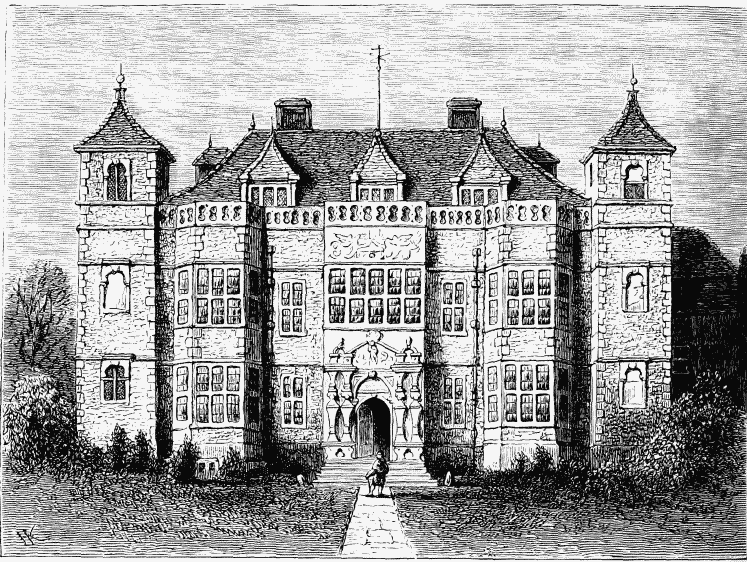
CAMPDEN HOUSE, 1720.
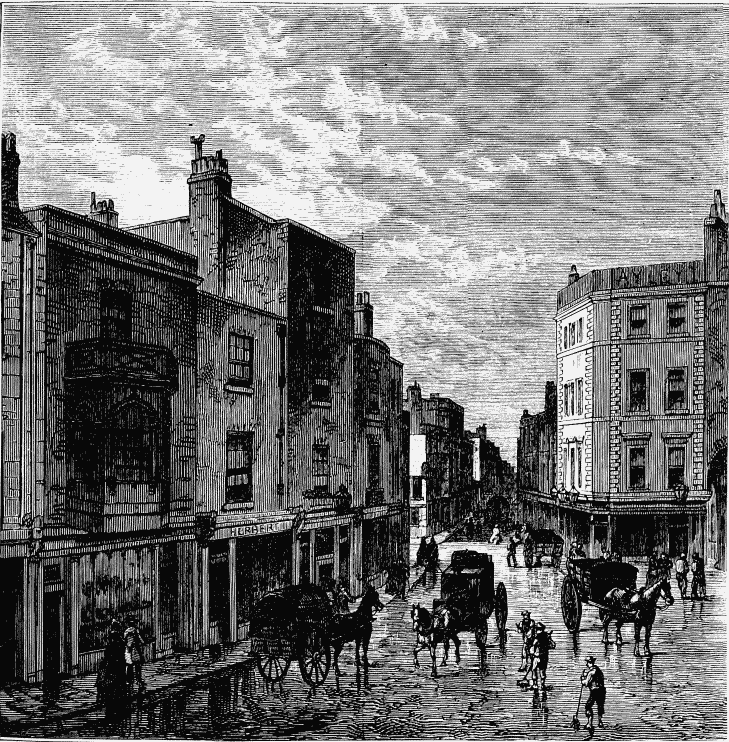
KENSINGTON HIGH STREET, IN 1860.
At Holly Lodge, Campden Hill, on the 28th of December, 1859, died Thomas Babington, Lord Macaulay, the essayist, orator, and historian, of whom we have already had occasion to speak in our accounts of the Albany and of Great Ormond Street. (fn. 5) When, after having been raised to the peerage, he went to reside at Holly Lodge, he desired to have a list of the parochial charities, and a seat in the parish church. Although confined to the house by asthma during the winter, he was, as we have stated above, very regular in his attendance during the summer. A few days before his death, discussing the subject of churchrates, he said, "Church-rates cannot last; and the proper substitute for them is a large subscription—I will give £100 as my share. I am not an exclusive, but of all Christian communions I consider the Church of England to be the best."
Lord Macaulay took great delight in his house and garden here; and he was never more pleased than when in his library, surrounded by his nephews and nieces.
At a house in Orbell's Buildings, previously called Pitt's Buildings, on the south-east side of Campden Hill, died, March 20th, 1727, the great Sir Isaac Newton, at the age of eighty-five. His house seems to have had a back entrance in Church Street, where a gateway next the "George" Tavern is inscribed "Newton House." His estate at Kensington he left to a daughter of his nephew, Mr. Conduit, who married Lord Lymington, afterwards Earl of Portsmouth; and hence it is that the manuscripts of the great philosopher have been kept in the custody of the Wallop family.
A writer in the Times stated, in 1870, that the house actually occupied by Sir Isaac Newton was not the house named after him, but Bullingham House, where, he adds, "a slab put up in remembrance of him may still be seen in the garden wall."
The neighbourhood of Kensington Gravel Pits, by which name is understood a district of some extent bordering on the Uxbridge Road, has long been noted for salubrity of the air, and was a favourite residence of artists half a century ago. The high road through this district, known as High Street, Notting Hill, forms a kind of second Kensington High Street, being to the northern boundary of the suburb what the High Street, in the road to Hammersmith, is to Kensington proper.
Swift had lodgings in the Gravel Pits during the winter of 1712–13; and Lord Chatham's sister, Anne Pitt, is recorded to have died "at her house in Pitt Place, Kensington Gravel Pits," in 1780. To the south of the Gravel Pits was the Mall, which still exists as a street running at right angles to the Uxbridge Road.
Sheffield House, which stood between Church Street and Kensington Gravel Pits, owed its name to property possessed in this quarter by Sheffield, Duke of Buckingham, with the descendants of whose family it long remained. The house, however, has disappeared, and in its place have risen rows of houses overlooking Campden House Gardens and Palace Green.
Time was, and not so very long ago, when the artist body made their homes at Kentish and Camden Town, at Highgate, Hampstead, and St. John's Wood; but of late years they have flocked in far larger numbers to Kensington, no doubt on account of the convenience of access thence to all parts of the town, and of the good northern light which is secured to them by Kensington Gardens and the Park round Holland House. The Royal Academy Catalogue for 1876 shows that out of the total number of exhibitors, about a hundred lived in and around Kensington.
At his residence in the Mall, in 1844, died Sir Augustus Callcott, R.A., the eminent English landscape painter. Sir Augustus and his brother John W. Callcott, the musician, were the sons of a builder who resided near the "Gravel Pits," Kensington, where they were born in 1779 and 1766 respectively. At the time of the fire at Campden House, above mentioned, the adjoining mansion was in the occupation of Mr. Augustus Egg, a distinguished Royal Academician, and fears were entertained for the safety of his house and its valuable contents.
Sir David Wilkie was living in Kensington in 1834. Here he showed to his friends his picture of "John Knox preaching to his Congregation" before sending it in to the Academy. Mr. J. R. Planché, who was among the visitors, drew his attention to certain anachronisms in the armour, which the painter promised to alter; but time went on, the promise was never fulfilled, and the painting still exists to hand down a wilful blunder to posterity. Wilkie's first residence here was in Lower Phillimore Place, near the milestone; there he painted his "Chelsea Pensioners," his "Reading of the Will," his "Distraining for Rent," and his "Blind-man's Buff." He afterwards removed to Shaftesbury House, on the Terrace, and here the sunny hours of his life were spent. We get a glimpse of his daily habits in a letter which he wrote to his sister soon after settling here: "I dine, as formerly," he tells her, "at two o'clock, paint two hours in the forenoon and two hours in the afternoon, and take a short walk in the Park or through the fields twice a day." His last residence here, as Peter Cunningham tells us, was a detached mansion in Vicarage Place, at the head of Church Lane; there he took leave of his friends before his visit to the Holy Land, which shortly preceded his death.
At Kensington, John Evelyn, as he tells us in his "Diary," went to visit Dr. Tenison (afterwards Archbishop of Canterbury), "whither he had retired to refresh himself after he had been sick of the small-pox." This was just before the erection of the school in Leicester Square which bears Tenison's name. Kensington was the birthplace of Lord Chancellor Camden, who died in 1794, at the age of eighty. Sir John Fielding, the wellknown magistrate, was also a resident here. Here, too, lived, and here died at an advanced age, Lady Margaret Macdonald, the mother of Chief Baron Macdonald, a lady who was visited by Dr. Johnson in his tour to the Hebrides. She was buried in the centre vault of the old church, close to the reading-desk, which was given to the parish by William III. It was her attendant and connection, Flora Macdonald, who so heroically aided the escape of "Bonny Prince Charlie," after his defeat at Culloden.
Another Kensingtonian was Robert Nelson, the author of "Fasts and Festivals," and one of the founders of the Society for Promoting Christian Knowledge. He died in 1715, and was a man of such polished and courtly manners, that Dr. Johnson affirms him to have been the original whence Samuel Richardson drew his "Sir Charles Grandison."
It is worthy of note that the high road between London and Kensington was the first place where oil lamps with glazed lights were placed, for the convenience of the Court as they travelled backwards and forwards to St. James's and Whitehall. This was about the year 1694. The old method of lighting the thoroughfare with lanterns and wicks of cotton was then gradually laid aside. It does not appear, however, that the example of Kensington was at all speedily followed by the rest of the metropolis at the West End; for more than a quarter of a century later, in 1718, we find Lady Mary Wortley Montagu (fn. 6) contrasting the lighting of London at night with that of Paris in most unfavourable terms. If Chelsea, as Thackeray observes in his "Esmond," was even in Anne's time "distant from London, and the roads to it were bad, and infested by footpads," the same was true also of Kensington. Indeed, as a proof of the insecurity of the roads in the suburbs until after the introduction of gas, and the establishment of a police force, we may be pardoned for informing our readers, on the authority of Walker's "Original," that, "at Kensington, within the memory of man, on Sunday evenings a bell used to be rung at intervals to muster the people returning to town. As soon as a band was assembled sufficiently numerous to ensure mutual protection, it set off, and so on till all had passed." So insecure was the state of the road—in fact, in spite of the patrol—that we read of a plot being concocted for the purpose of robbing Queen Anne as she returned from London to Kensington in her coach. Indeed, even as late as the end of the last century, a journey from London to the suburbs after night-fall was not accomplished without danger to purse and person too. Horace Walpole often travelled along this road in his carriage between Berkeley Square and Strawberry Hill. On one occasion, as he intimates in one of his letters to the Miss Berrys, he composed a long set of verses in praise of General Conway, then in chief command at the Horse Guards, whilst in his carriage, having "conceived and executed them between Hammersmith and Hyde Park Corner."
We learn from a private letter in the Record Office, descriptive of the Fire of London, that on that occasion a great quantity of the goods and property of the citizens was brought as far westward as Kensington for safety. The writer adds: "Had your lordship been at Kensington you would have thought for five days—for so long the fire lasted—that it had been Doomsday, and that the heavens themselves had been on fire; and the fearful cries and howlings of undone people did much increase the resemblance. My walks and gardens were almost covered with the ashes of papers, linen, &c., and pieces of ceiling and plaster-work, blown thither by the tempest."
"In a curious little nook of the 'Court Suburb,' wherein the drama had furtively taken root," writes Mr. J. R. Planché, in his "Recollections," "I witnessed the performance of a piece entitled the 'Queen's Lover,' by a company of actors, all previously unknown to me, even by name, but who generally exhibited talent, and one, in my humble opinion, genius." Mr. Planché went thither in the company of Madame Vestris and Mr. Alfred Bunn, who at the time had succeeded to the united stage kingdom of Covent Garden and of Drury Lane. The person of "genius" was Henry Gaskell Denvil, in whom Bunn thought that he had found a second Kean. Instead, however, of encouraging him, he crushed his spirits and drove him out of life.
It would, perhaps, be a little singular if such an interesting "old-world" sort of place as Kensington should be without its "ghost-story;" and it may be gratifying to find that it is not. Here is one, of no older date than the year 1868, which we quote from the newspaper reports at the time:—"In a small house, about twenty yards away from the main road, live an old lady, eighty-four years of age, and her daughter, with one servant. They have lived in the same house for nearly twenty years without any annoyance; but for the last few months they are being constantly startled by a sharp loud knocking upon the panel of the street-door. Upon opening the door, however quickly, no sign of any one is to be discovered. No sooner are the ladies quietly settled again than rap-rap-rap! comes upon the door. And this is repeated at irregular intervals through the evening. For some time it was attributed to some imps of school-boys, who are always ready for mischief, and but little notice was taken of it; but the continuance of what was only annoying became at last a serious nuisance. The most nimble efforts were made, without success, to 'catch' the offenders, but until a few nights ago the attacks were so arranged as never to take place in the presence of male visitors; consequently the ladies received much pity, but little sympathy, from their friends. After a time they became nervous, and at last really frightened. On Thursday evening a gentleman, the son of the old lady, called, and found them quite ill from nervous excitement, and was comforting them as well as he could, when a quick rap-rap-rap! at the front door made him jump up. In two seconds he was at the door, rushed out, looking in every direction without discovering a sound or a trace of any human being in any of the adjacent roads. Then, for the first time, he was able to understand from what his mother and sister had suffered, and set to work to examine the approaches to the door inside and out, and to solve the mystery, if possible. No sooner had he gone back to the little dining-room, and placed a chair in the open doorway, with a big stick handy to 'trounce' the perpetrator the next time, and begun to discuss what it was, than rap-rap-rap! sent him flying out into the street, to the astonishment of a passing cabman, who must have thought a madman had just escaped his keeper. This happened four or five times more; in fact, it only ceased about a quarter to eleven. He went round to the policestation, and had an officer put on special duty opposite the house for the next day, and spent the following morning in calling upon the neighbours, and carefully examining the gardens and walls which abutted upon the 'haunted' house. Not a mark of any sort was to be found, and he was quite convinced that the door could not have been reached from any point but right in front from the street, as there is no cellar or drain under the house. In the evening he took a friend down with him, and two more of his friends looked in later. The ladies were found in a painful state of nervous fright, as the nuisance had already been going on, and the maid-servant was crying. Altogether, it was a scene of misery. In the course of conversation the following facts came out:—It began on a Friday, the 18th of October, and has never missed a Friday since then. It has never been heard on Sunday, seldom on Saturday; never before the gas-lamps are lit, never after eleven. Just as all were talking at once, rap-rap-rap! In an instant all four gentlemen were in the front garden; the policeman was quietly standing opposite the door; the lady of the house opposite watching the door from her portico, and another gentleman from the leads. All declared that not a living creature had been near the house for at least a quarter of an hour. The whole thing seems inexplicable, and has created quite a sensation in the neighbourhood." The mystery was afterwards solved, for it appeared that the servant-girl had caused the rapping by means of wires.
In Scarsdale Terrace, Wright's Lane, near the railway station, Kensington High Street, is the Crippled Boys' National Industrial Home. This charity was instituted in 1865, and was originally located in a house in the High Street. There are about fifty crippled boys in the Home, received from all parts of the kingdom, once destitute, neglected, or ill treated in their own dwellings, without any chance of rising, like other youths, to social independence by their own exertions, but now happily engaged for a term of three years in learning an industrial employment for this end. This charity has, notwithstanding its limited means, been of great service to many, the greater portion of whom are seen or heard of from time to time; and it is astonishing to find how many crippled children there are throughout the country, whose anxious appeals to the committee for admission are very distressing.
Scarsdale House, a small mansion close by, was
for many years a boarding-school, and as such,
says Leigh Hunt, it must have been an eyesore to
William Cobbett, the political writer, the back of
whose premises in the High Street it overlooked.
Scarsdale House, now no longer a boarding-school,
appears to have returned to the occupation of the
family who are understood to have built it, for its
present inmate is the Hon. Edward Cecil Curzon,
brother of the late Lord Zouche. It is conjectured
that the house was built by the Earl of Scarsdale,
whose family name was Leake, the Scarsdale celebrated by Pope for his love of the bottle—
"Each mortal has his pleasure;—none deny
Scarsdale his bottle, Darty his ham-pie."
Another edifice in Wright's Lane, standing on the site of Abingdon House, is the Roman Catholic University College, which was formally inaugurated in October, 1874. The building, although comparatively small, is very complete in its arrangements, and comprises a theatre, lecture-rooms, a school of science, a discussion-room, and a chapel. There is besides a spacious building erected in the grounds, where a club has been established, under the management of the students themselves. In it are billiard-rooms and fencing-rooms for the use of the students, whilst a number of other rooms are set apart for the amusement or edification of the students in other ways. The students, it may be added, include young men from Ushaw, Stonyhurst, Beaumont Lodge, Oscott, Prior Park, and St. George's, Croydon; and the college was founded mainly through the instrumentality of Monsignor Capel, who was appointed its first rector.
Kensington always has had a large Irish element, and of late years, owing to the increasing population of the place, rapid strides have been made by the Roman Catholic body in augmenting their numbers.
The London Review of 1865 gives the following account of the progress of the Roman Catholic body of Kensington at that time:—"Formerly, for the accommodation of the whole of the Roman Catholics of this parish, there was but one small chapel near the High Street, which appeared amply sufficient for the members of that creed. But ten or twelve years ago a Roman Catholic builder purchased, at an enormous price, a plot of ground, about three acres in extent, beside the Church of the Holy Trinity, Brompton. For a time considerable mystery prevailed as to the uses it was to be applied to; but, shortly after the buildings were commenced, they were discovered to be the future residence and church of the Oratorian Fathers, removed to it from their former dwelling; and the chapel, a small and commodious erection, was opened for divine service. At first the congregation was of the scantiest description: even on Sundays at high mass, small as the chapel was, it was frequently only half filled; while on week days, at many of the services, it was no uncommon circumstance to find the attendance scarcely more numerous than the number of priests serving at the altar. By degrees the congregation increased, till the chapel was found too small for their accommodation, and extensive alterations were made to it; but these, again, were soon filled to overflowing, and further alterations had to be made, till at last the building was capable of holding, without difficulty, from 2,000 to 2,500 persons. It is now frequently so crowded at high mass that it is difficult for an individual entering it after the commencement of the service to find even standing room. In the meantime the monastery itself, if that is the proper term, was completed—a splendid appearance it presents—and we believe is fully occupied. The Roman Catholic population in the parish or mission, under the spiritual direction of the Fathers of the Oratory, now comprise between 7,000 and 8,000 souls. The average attendance at mass on Sunday is about 5,000, and the average number of communicants for the last two years has been about 45,000 annually. But in addition to this church, Kensington has three others—St. Mary's, Upper Holland Street; St. Simon Stock, belonging to the Carmelite Friars; and the Church of St. Francis Assisi, in Notting Hill. Of monasteries, or religious communities of men, it has the Oratorians before mentioned, and the Discalced Carmelites, in Vicarage Place. Of convents of ladies it has the Assumption, in Kensington Square; the Poor Clares Convent, in Edmond Terrace; the Franciscan Convent, in Portobello Road; and the Sisters of Jesus, in Holland Villas. Of schools, the Roman Catholics possess, in the parish of Kensington, the Orphanage, in the Fulham Road; the Industrial School of St. Vincent de Paul; as well as the large Industrial School for Girls in the southern ward. All these schools are very numerously attended; the gross number of pupils amounting to 1,200, those of the Oratory alone being 1,000. The kindness and consideration shown by the Roman Catholic teachers to the children of the poor is above all praise, not only in Kensington, but in all localities where they are under their charge; and the love they receive from their pupils in return forms one of their most powerful engines in their system of proselytising."
The chapel of St. Mary's above mentioned, in Holland Street, is close to the principal street in Kensington, and is thus described in the "Catholic Hand-book," published in 1857:—" It is a plain, unpretending edifice, the cross upon its front being the only feature to distinguish it from an ordinary Dissenting meeting-house. Its interior has a remarkable air of neatness. The building itself is an oblong square, built north and south, and capable of accommodating about 300 persons. It is lit by three windows at the northern end, and one window at the eastern and western sides. It is devoid of ornament, except at the south end, where the altar is raised between two pillars. The body of the chapel is fitted with low open seats, and at the northern end is a spacious gallery." Being superseded by other and larger ecclesiastical edifices, the old chapel is now used as a school-room. It was built about 1812 by the family of Mr. Wheble, the manufacturer of the celebrated Kensington candles, who began life with a small shop in High Street, but died worth a quarter of a million.
In Newland Terrace, on the south side of the main road, is the Church of Our Lady of Victories, which serves as a pro-cathedral, superseding the Church of St. Mary's, Moorfields. It is a lofty Gothic structure of the Early English type, with some details approaching more nearly to the Decorated style. It consists of a nave and side aisles, and a shallow chancel, in which is the throne of the archiepiscopal see of Westminster. The windows of the apse are filled with stained glass.
In the Kensington Road is the "Adam and Eve" public-house, where Sheridan, on his way to or from Holland House, regularly stopped for a dram; and there he ran up a long bill, which, as we learn from Moore's diary, Lord Holland had to pay.
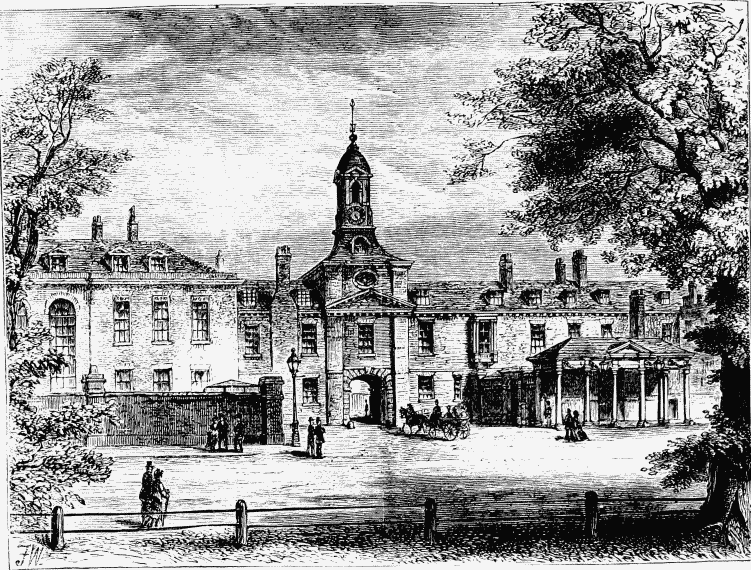
WEST FRONT OF KENSINGTON PALACE.