Old and New London: Volume 5. Originally published by Cassell, Petter & Galpin, London, 1878.
This free content was digitised by double rekeying. Public Domain.
Edward Walford, 'Kensington Gardens', in Old and New London: Volume 5(London, 1878), British History Online https://www.british-history.ac.uk/old-new-london/vol5/pp152-161 [accessed 30 April 2025].
Edward Walford, 'Kensington Gardens', in Old and New London: Volume 5(London, 1878), British History Online, accessed April 30, 2025, https://www.british-history.ac.uk/old-new-london/vol5/pp152-161.
Edward Walford. "Kensington Gardens". Old and New London: Volume 5. (London, 1878), British History Online. Web. 30 April 2025. https://www.british-history.ac.uk/old-new-london/vol5/pp152-161.
In this section
CHAPTER XIII.
KENSINGTON GARDENS.
"Where Kensington, luxuriant in her bowers,
Sees snow of blossoms, and a wild of flowers;
The dames of Britain oft in crowds repair
To gravel walks and unpolluted air:
Here, while the town in damps and darkness lies,
They breathe in sunshine and see azure skies;
Each walk, with robes of various dyes bespread,
Seems from afar a moving tulip-bed,
Where rich brocades and glossy damasks glow.
And chintz, the rival of the showery bow."—Tickell.
"Military" Appearance of the Gardens, as laid out by Wise and Loudon—Addison's Comments on the Horticultural Improvements of his Time—The Gardens as they appeared at the Beginning of the Last Century—Queen Anne's Banqueting House—Statue of Dr. Jenner—Bridgeman's Additions to the Gardens—The "Ha! ha!"—"Capability" Brown—The Gardens first opened to the Public—A Foreigner's Opinion of Kensington Gardens—"Tommy Hill" and John Poole—Introduction of Rare Plants and Shrubs—Scotch Pines and other Trees—A Friendly Flash of Lightning—The Reservoir and Fountains—Tickell, and his Poem on Kensington Gardens—Chateaubriand—Introduction of Hooped Petticoats—The Broad Walk becomes a Fashionable Promenade—Eccentricities in Costume—The Childhood of Queen Victoria, and her Early Intercourse with her Future Subjects—A Critical Review of the Gardens.
The gardens attached to Kensington Palace, when purchased by William III., did not exceed twentysix acres. They were immediately laid out according to the royal taste; and this being entirely military, the consequence was that closely-cropped yews, and prim holly hedges, were taught, under the auspices of Loudon and Wise, the royal gardeners, to imitate the lines, angles, bastions, scarps, and counter-scarps of regular fortifications. This curious upper garden, we are told, was long "the admiration of every lover of that kind of horticultural embellishment," and, indeed, influenced the general taste of the age; for Le Nautre, or Le Notre, who was gardener to the Tuileries, and had been personally favoured by Louis XIV., in conjunction with the royal gardeners, was employed by most of the nobility, during the reign of William, in laying out their gardens and grounds. Addison, in No. 477 of the Spectator, thus speaks of the horticultural improvements of this period:—"I think there are as many kinds of gardening as of poetry: your makers of pastures and flower-gardens are epigrammatists and sonneteers in this art; contrivers of bowers and grottoes, treillages and cascades, are romantic writers; Wise and Loudon are our heroic poets; and if, as a critic, I may single out any passage of their works to commend, I shall take notice of that part in the upper garden at Kensington which was at first nothing but a gravel-pit. It must have been a fine genius for gardening that could have thought of forming such an unsightly hollow into so beautiful an area, and to have hit the eye with so uncommon and agreeable a scene as that which it is now wrought into."
In 1691 these gardens are thus described:—"They are not great, nor abounding with fine plants. The orange, lemon, myrtle, and what other trees they had there in summer, were all removed to London, or to Mr. Wise's greenhouse at Brompton Park, a little mile from there. But the walks and grass were very fine, and they were digging up a plot of four or five acres to enlarge their gardens." Queen Anne added some thirty acres more, which were laid out by her gardener, Wise. Bowack, in 1705, describes here "a noble collection of foreign plants, and fine neat greens, which makes it pleasant all the year. . . . Her Majesty has been pleased lately to plant near thirty acres more to the north, separated from the rest only by a stately greenhouse, not yet finished." It appears from this passage that, previous to the above date, Kensington Gardens did not extend further to the north than the conservatory, which, as stated in the previous chapter, was originally built for a banqueting-house, and was frequently used as such by Queen Anne. This banquetinghouse was completed in the year 1705, and is considered a fine specimen of brickwork. The south front has rusticated columns supporting a Doric pediment, and the ends have semi-circular recesses. "The interior, decorated with Corinthian columns," Mr. John Timbs tells us in his "Curiosities," "was fitted up as a drawing-room, musicroom, and ball-room; and thither the queen was conveyed in her chair from the western end of the palace. Here were given full-dress fêtes à la Watteau, with a profusion of 'brocaded robes, hoops, fly-caps, and fans,' songs by the court lyrists, &c." When the Court left Kensington, this building was converted into an orangery and greenhouse.
Just within the boundary of the gardens at the south-eastern corner, on slightly rising ground, is the Albert Memorial, which we have already described, (fn. 1) and not far distant is the statue of Dr. Jenner, the originator of vaccination. This statue, which is of bronze, represents the venerable doctor in a sitting posture. It is the work of William Calder Marshall, and was originally set up in Trafalgar Square in 1858, but was removed hither about four years afterwards.
The eastern boundary of the gardens would seem
to have been in Queen Anne's time nearly in the
line of the broad walk which crosses them on the
east side of the palace. The kitchen-gardens,
which extended north of the palace, towards the
gravel-pits, but are now occupied by some elegant
villas and mansions, and the thirty acres lying
north of the conservatory, added by Queen Anne
to the pleasure-gardens, may have been the fifty-five
acres "detached and severed from the park, lying
in the north-west corner thereof," granted in the
reign of Charles II. to Hamilton, the Ranger of
Hyde Park, and Birch, the auditor of excise, "to
be walled and planted with 'pippins and redstreaks,' on condition of their furnishing apples or
cider for the king's use." This portion of the
garden is thus mentioned in Tickell's poem:—
"That hollow space, where now, in living rows,
Line above line, the yew's sad verdure grows,
Was, ere the planter's hand its beauty gave,
A common pit, a rude unfashion'd cave.
The landscape, now so sweet, we well may praise;
But far, far sweeter, in its ancient days—
Far sweeter was it when its peopled ground
With fairy domes and dazzling towers was crown'd.
Where, in the midst, those verdant pillars spring,
Rose the proud palace of the Elfin king;
For every hedge of vegetable green,
In happier years, a crowded street was seen;
Nor all those leaves that now the prospect grace
Could match the numbers of its pigmy race."
At the end of the avenue leading from the south part of the palace to the wall on the Kensington Road is an alcove built by Queen Anne's orders; so that the palace, in her reign, seems to have stood in the midst of fruit and pleasure gardens, with pleasant alcoves on the west and south, and the stately banqueting-house on the east, the whole confined between the Kensington and Uxbridge Roads on the north and south, with Palace Green on the west; the line of demarcation on the east being the broad walk before the east front of the palace.
Bridgeman, who succeeded Wise as the fashionable designer of gardens, was employed by Queen Caroline, consort of George II., to plant and lay out, on a larger scale than had hitherto been attempted, the ground which had been added to the gardens by encroaching upon Hyde Park. Bridgeman's idea of the picturesque led him to abandon "verdant sculpture," and he succeeded in effecting a complete revolution in the formal and square precision of the foregoing age, although he adhered in parts to the formal Dutch style of straight walks and clipped hedges. A plan of the gardens, published in 1762, shows on the north-east side a low wall and fosse, reaching from the Uxbridge Road to the Serpentine, and effectually shutting in the gardens. Across the park, to the east of Queen Anne's Gardens, immediately in front of the palace, a reservoir was formed with the "round pond;" thence, as from a centre, long vistas or avenues were carried through the wood that encircled the water—one as far as the head of the Serpentine; another to the wall and fosse above mentioned, affording a view of the park; a third avenue led to a mount on the south-east side, which was raised with the soil dug in the formation of the adjoining canal, and planted with evergreens by Queen Anne. This mount, which has since been levelled again, or, at all events, considerably reduced, had on the top a revolving "prospect house." There was also in the gardens a "hermitage:" a print of it is to be seen in the British Museum. The low wall and fosse was introduced by Bridgeman as a substitute for a high wall, which would shut out the view of the broad expanse of park as seen from the palace and gardens; and it was deemed such a novelty that it obtained the name of a "Ha! ha!" derived from the exclamation of surprise involuntarily uttered by disappointed pedestrians. At each angle of this wall and fosse, however, semicircular projections were formed, which were termed bastions, and in this particular the arrangement accorded with the prevailing military taste. Bridgeman's plan of gardening, however, embraced the beauties of flowers and lawns, together with a wilderness and open groves; but the principal embellishments were entrusted to Mr. Kent, and subsequently carried out by a gentleman well known by the familiar appellation of "Capability" Brown. The gardens, it may be added, are still sufficiently rural to make a home for the nightingale, whose voice is often heard in the summer nights, especially in the part nearest to Kensington Gore.
"Here England's daughter, darling of the land,
Sometimes, surrounded with her virgin band,
Gleams through the shades. She, towering o'er the rest,
Stands fairest of the fairer kind confest;
Form'd to gain hearts that Brunswick's cause denied,
And charm a people to her father's side.
"Long have these groves to royal guests been known,
Nor Nassau, first, preferred them to a throne.
Ere Norman banners waved in British air;
Ere lordly Hubba with the golden hair
Pour'd in his Danes; ere elder Julius came;
Or Dardan Brutus gave our isle a name;
A prince of Albion's lineage graced the wood,
The scene of wars, and stained with lover's blood."
On King William taking up his abode in the palace, the neighbouring town of Kensington and the outskirts of Hyde Park became the abode of fashion and of the hangers-on at the Court, whilst the gardens themselves became the scene of a plot for assassinating William, and replacing James II. on the throne. The large gardens laid out by Queen Caroline were opened to the public on Saturdays, when the King and Court went to Richmond, and on these occasions all visitors were required to appear in full dress. When the Court ceased to reside here, the gardens were thrown open in the spring and summer; they, nevertheless, long continued to retain much of their stately seclusion. The gardens are mentioned in the following terms by the poet Crabbe, in his "Diary:"—"Drove to Kensington Gardens: . . . effect new and striking. Kensington Gardens have a very peculiar effect; not exhilarating, I think, yet alive [lively] and pleasant." It seems, however, that the public had not always access to this pleasant place; for, in the "Historical Recollections of Hyde Park," by Thomas Smith, we find a notice of one Sarah Gray having had granted her a pension of £18 a year, as a compensation for the loss of her husband, who was "accidentally shot by one of the keepers while hunting a fox in Kensington Gardens."
According to Sir Richard Phillips, in "Modern
London," published in 18 4, the gardens were open
to the public at that time only from spring to
autumn; and, curiously enough, servants in livery
were excluded, as also were dogs. Thirty years
later the gardens are described as being open "all
the year round, to all respectably-dressed persons,
from sunrise till sunset." About that time, when it
happened that the hour for closing the gates was
eight o'clock, the following lines, purporting to have
been written "by a young lady aged nineteen," were
discovered affixed to one of the seats:—
"Poor Adam and Eve were from Eden turned out,
As a punishment due to their sin;
But here after eight, if you loiter about,
As a punishment you'll be locked in."
It may be added that now, on stated days during the "London season," the scene in these gardens is enlivened by the exhilarating strains of military bands. It is stated by Count de Melfort, in his "Impressions of England," published in the reign of William IV., that the Duke of St. Albans—we suppose, as Grand Falconer of England—is the only subject, except members of the royal family, who has the right of entering Kensington Palace Gardens in his carriage. The fact may be true, but it wants verifying.
The author of an agreeable "Tour of a Foreigner
in England," published in 1825, remarks:—"The
Palais Royale gives a better idea of the London
squares than any other part of Paris. The public
promenades are St. James's Park, Hyde Park, and
Kensington Gardens, which communicate with
each other. I am sometimes tempted to prefer
these parks to the gardens of the Luxembourg and
the Tuileries, which, however, cannot give you any
idea of them. St. James's Park, Hyde Park, and
Kensington Gardens are to me the Tuileries, the
Champs Élysees, and the Jardin des Plantes united.
On Sundays the crowd of carriages which repair
thither, and the gentlemen of fashion who exhibit
their horsemanship with admirable dexterity in the
ride, remind me of Long Champs; but hackney
coaches are not allowed to enter here to destroy
the fine spectacle which so many elegant carriages
afford. Sheep graze tranquilly in Hyde Park,
where it is also pleasing to see the deer bounding
about. At Kensington Gardens you are obliged
to leave your horse or carriage standing at the gate.
Walking through its shady alleys I observed with
pleasure that the fashionable ladies pay, in regard
to dress, a just tribute to our fair countrywomen.
Judging from the costumes of the ladies, you might
sometimes fancy yourself walking under the chestnut
trees of the Tuileries. A line of Tasso may very
well be applied to Kensington Gardens:—
'L'arte che tutto fa, nulla si scuopre.'"
Within the last half century these gardens have been greatly improved by drainage, relaying, and replanting. Much of the surrounding walls, too, have been removed, and in their place handsome iron railings have been substituted. The leading features of the gardens at the present time are the three avenues above mentioned, radiating from the east front of the palace, through dense masses of trees. Immediately in front of the palace is a quaintly-designed flower garden, separated from the Kensington Road by some fine old elm-trees. The broad walk, fifty feet in width, was once the fashionable promenade. "Tommy Hill," and his friend John Poole, who made him his great character in Paul Pry, with "I hope I don't intrude," used to walk daily together here. All the surrounding parts are filled in with stately groups of ancient trees; and the total absence of anything that indicates the proximity of the town, renders this spot particularly pleasant and agreeable for a stroll on a summer's evening. Keeping along the eastern margin of the gardens, and crossing the end of the broad avenue, the visitor soon reaches a new walk formed about the time of the first Great Exhibition. Here will be found a large number of new and rarer kind of shrubs, with their popular and technical names all legibly inscribed. Weale, in his work on London, published in 1851, says:—"It is in the introduction of these rarer plants that the idea of a 'garden' is, perhaps, better sustained than in most of the other features of the place, which are those of a park. The demand, indeed, for evergreens and undergrowth in these gardens is most urgent; and if (which we greatly doubt) there exists a well-founded objection to the use of shrubs and bushes in tufts or in single plants, there certainly can be no reason why solitary specimens, or varied groups of the many kinds of thorn, pyrus, mespilus, laburnum, pine and fir, evergreen, oaks, hollies, yews, &c., should not be most extensively planted, and a large portion of the younger and smaller trees in the densest parts cut away to make room for them." With reference to the trees in these gardens, a correspondent of the Times newspaper, in May, 1876, observes:—"The crowds who flock to Bushy Park or Kew do not see anything more fair than the tree-pictures now in Kensington Gardens, to which I beg to call the attention of all lovers of trees. The hawthorns and horse-chestnuts are now in marvellous beauty, though one rarely sees anybody taking the least notice of them. All the blaze of the autumnal 'bedding out' is in point of beauty as nothing to what is now afforded here by a few kinds of ordinary hardy trees that cost little at first and take care of themselves afterwards. There is a little open lawn with a small lime-tree in its centre, quite near the 'Row' corner of the gardens, around which there are several charming aspects of tree-beauty. One hawthorn is about forty feet high. Some of the central and unfrequented portions of the gardens are the most attractive. Nobody can despair of growing flowering trees to his heart's content in London after seeing the mountains of horse-chestnut bloom and other masses of tree-flowers here. Let those interested see the old trees in the central parts as well as the newer plantations, which, however, are also beautiful."
At the north side, nearly facing Porchester Terrace, there are some fine trees, including Scotch pines, which, a few years ago, were a glory to the neighbourhood, and are duly celebrated by Mr. Matthew Arnold in his verses on Kensington Gardens. Some of these, however, became so decayed that they were cut down by order of Her Majesty's Woods and Forests, in 1875.
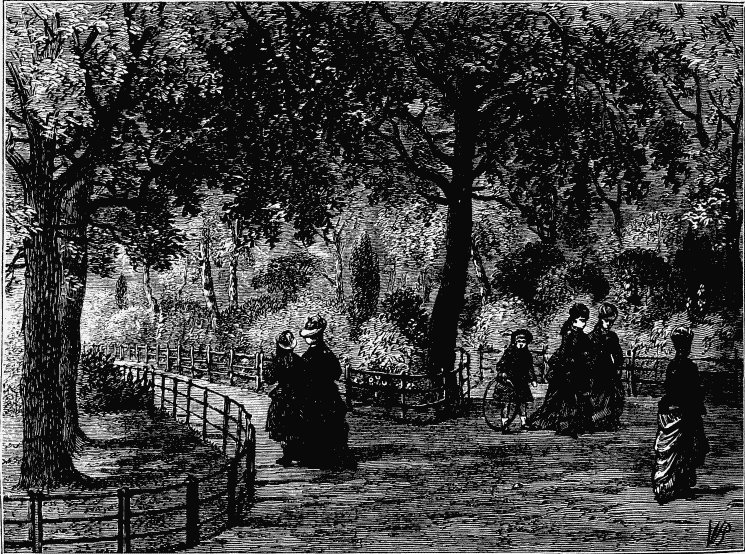
THE FLOWER WALKS, KENSINGTON GARDENS.
The author of "Reminiscences of Fifty Years" tells an amusing story with reference to one of the trees in this part of the gardens. He was one day praising the charming view which some friends of his commanded from their drawing-room window overlooking the gardens. "Yes, the view would be perfect, if the branch of that large tree," to which they specially drew his attention, "did not interrupt it." "Well," remarked the other, "it is somewhat singular that I walked to your door with the nearest relative in London of the Chief Commissioner of Woods and Forests (the Right Hon. Mr. Milne), and I shall ask him to inquire whether the branch can be removed without injury to the royal tree." "I accordingly wrote to my friend in the evening (Tuesday)," continues the author, "and on Thursday morning my friends discovered, to their infinite satisfaction, that the obtrusive branch had disappeared; and, as a natural sequence, I came in for a warm benediction, and the Woods and Forests for their full share of praise as an exceptional department of the State, where red tape was not used, and circumlocution unknown. The Chief Commissioner, on reading my note to his relative, gave orders on the Wednesday to the superintendent of Kensington Gardens to look at the tree, and if the branch could be taken off without serious prejudice, it was to be done. The superintendent reported at head-quarters on the Thursday that on visiting the tree at an early hour that morning he found the branch in question lying on the ground, having been struck off by lightning during the heavy storm of the previous night. The Chief Commissioner wrote an amusing letter on the occasion, alleging that I really must be one 'who could call spirits from the vasty deep,' and had evidently transferred my powers to Kensington Gardens, acting on the suggestion given in Richard III., 'With lightning strike the murderer dead.' The same day," adds the author, "I visited the tree, which appeared, saving the amputation of the large branch, to have escaped all other injury. Had other trees not suffered severely in Kensington Gardens that night, it might have led to a special inquiry or inquest to ascertain whether it was lightning or a saw that I had employed in obliging my friends. I told them they owed everything to the lightning; as I was much inclined to think that the Chief Commissioner, with every desire to meet their wishes, might possibly have deemed it his duty to postpone the consideration of the removal of so large and umbrageous a branch from the royal demesne to the Greek Calends."
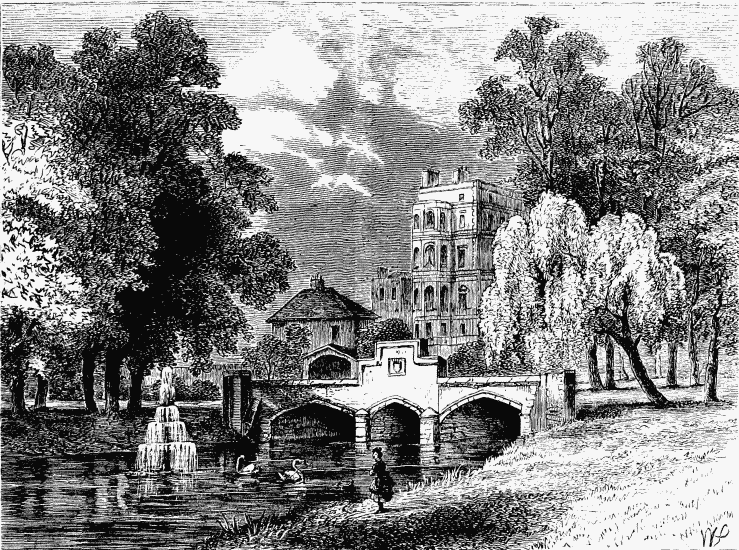
OUTFALL OF WESTBOURNE.
Of the bridge over the Serpentine, at the northeast corner of the Gardens, we have already given an illustration. (fn. 2) At some distance on the west side of this bridge, as it leaves the Uxbridge Road, the Serpentine has been divided into a series of four large basins or reservoirs, of octangular form, each of which has a small fountain in the centre, encompassed with marble. In the central pathway, running between the basins, there is a larger fountain, of octagonal form. The end of the reservoir nearest the bridge forms an ornamental façade, enriched with vases of various patterns, filled with flowers. The centre of this façade has two draped female figures, seated, holding vases, from which flow streams; and between these two figures, but projecting forward, is another large fountain. The height of this balustraded façade is about eight feet above the water-level. At the other end of the reservoirs is an engine-house, containing engines for working the fountains. This building is of Italian design, and roofed with red Italian tiles. It stands just within the Gardens, at a short distance from the Bayswater Road.
Kensington Gardens have been celebrated by
Tickell in the poem which bears their name, and
from which we have quoted above; "verses," says
Charles Knight, "full of fairies and their dwarfs,
and Dryads and Naiads; verses made to order,
and which have wholly perished as they deserve to
perish." Tickell enjoyed the patronage of Addison,
contributed papers to the Spectator, was contemporary with Pope, and published a translation of
the "First Book of the Iliad," from his own pen, in
apparent opposition to Pope's "Homer," of which
the first part was published at the same time.
As we read in Johnson's "Lives of the Poets,"
"Addison declared that the rival versions were
both good, but Tickell's was the best. His poem
on 'Kensington Gardens,' with the fairy tale introduced, is much admired; the versification is smooth
and elegant. He is said to have been a man of
gay conversation, but in his domestic relations
without censure." Musical attractions were not
wanting here in Tickell's time, if we may judge
from the following couplet, which refers to Kensington Gardens:—
"Nor the shrill corn-pipe, echoing loud to arms,
To rank and file reduce the straggling swarms."
Readers of the "Life of Chateaubriand" will remember that he was one of those who admired and enjoyed the repose of the leafy walks of these Gardens. Professor Robertson, in his "Lectures on Modern History and Biography," tells us how the venerable sage "would stroll under these beautiful trees, where in the days of his exile he used to meet his fellow-sufferers, the French priests, reciting their breviary—those trees under which he had indulged in many a reverie, under which he had breathed many a sigh for his home in La Belle France, under which he had finished 'Atala,' and had composed 'Réné.'"
Kensington Palace and its Gardens were the first places where the hooped petticoats of our greatgrandmother's days were displayed by ladies of fashion and "quality." We do not purpose giving here a history of Englishwomen's dress; but it may be as well to record the fact that the hoop appears to have been the invention of a Mrs. Selby, whose novelty is made the subject of a pamphlet, published at Bath, under the title of "The Farthingale Reviewed; or, more Work for the Cooper: a Panegyrick on the late but most admirable invention of the Hooped Petticoat." The talented lady who invented it died in 1717, and is thus mentioned by a Mrs. Stone, in the "Chronicles of Fashion:" "How we yearn to know something more of Mrs. Selby, her personal appearance, her whereabouts, her habits, and her thoughts. Can no more be said of her, whose inventive genius influenced the empire for well-nigh a century, who, by the potency of a rib of whalebone, held the universal realm of fashion against the censures of the press, the admonitions of the pulpit, and the common sense of the whole nation? Mrs. Tempest, the milliner, had her portrait taken by Kent, and painted on the staircase of Kensington Palace; and what was Mrs. Tempest that her lineaments should be preserved, whilst those of Mrs. Selby, the inventor of the hoop, are suffered to fall into oblivion?"
It was during the reign of George I. that the fashionable promenades in the Gardens became so popular, and the glittering skirts, which still lived in the recollection of our grandparents, would seem to have made their first appearance. Caroline of Anspach, the Prince of Wales's consort, probably introduced them, when she came with her bevy of maidens to Court. People would throng to see them; the ladies would take the opportunity of showing themselves, like pea-hens, in the walks; persons of fashion, privileged to enter the Gardens, would avail themselves of the privilege; and at last the public would obtain admission, and the raree-show would be complete. The full-dress promenade, it seems, was at first confined to Saturdays; it was afterwards changed to Sundays, and continued on that day till the custom went out with the closing days of George III.
In fact, during the last century the broad walk
in Kensington Gardens had become almost as
fashionable a promenade as the Mall in St. James's
Park had been a century earlier, under Charles II.
There might, probably, have been seen here, on
one and the same day, during the portentous
year 1791, Wilkes and Wilberforce; George Rose
and Mr. Holcroft; Mr. Reeve and Mr. Godwin;
Burke, Warren Hastings, and Tom Paine; Horace
Walpole and Hannah More (whom he introduced
to the Duke of Queensberry); Mary Wolstonecroft
and Miss Burney (Madame d'Arblay), the latter
avoiding the former with all her might; the
Countess of Albany (the widow of the Pretender);
the Margravine of Anspach; Mrs. Montagu; Mrs.
Barbauld; Mrs. Trimmer; Emma Harte (Lady
Hamilton), accompanied by her adoring portraitpainter, Romney; and poor Madame du Barry,
mistress of Louis XV., come to look after some
jewels of which she has been robbed, and little
thinking she would return to be guillotined. The
fashions of this half century, with the exception of
an occasional broad-brimmed hat worn both by
gentlemen and ladies, comprised the ugliest that
ever were seen in the old Court suburb. Headdresses became monstrous compounds of pasteboard, flowers, feathers, and pomatum; the hoop
degenerated into little panniers; and about the
year 1770, a set of travelled fops came up, calling
themselves Macaronis (from their intimacy with
the Italian eatable so called), who wore ridiculously
little hats, large pigtails, and tight-fitting clothes
of striped colours. The lesser pigtail, long or
curly, prevailed for a long time among elderly
gentlemen, making a powdered semicircle between
the shoulders; a plain cocked-hat adorned their
heads; and, on a sudden, at the beginning of the
new century, some of the ladies took to wearing
turbans, surmounted with ostrich feathers, and
bodies literally without a waist, the girdle coming
directly under the arms. There was a song in
those days, beginning—
"Shepherds, I have lost my love;
Have you seen my Anna?"
This song was parodied by one beginning—
"Shepherds, I have lost my waist;
Have you seen my body?"
Lady Brownlow, in her "Reminiscences of a Septuagenarian," tells us that after the Peace of Amiens, in 1802, she here met the celebrated Madame Recamier, who created a sensation at the West-end, partly by her beauty, but still more by her dress, which was vastly unlike the unsophisticated style and poke bonnets of the English ladies. "She appeared in Kensington Gardens à l'antique, a muslin gown clinging to her form like the folds of drapery on a statue; her hair in a plait at the back, and falling in small ringlets round her face, and greasy with huile antique; a large veil thrown over her head completed her attire, which not unnaturally caused her to be followed and stared at." No doubt, dressed in such a costume, and at such a period, Madame Recamier might well have been the "cynosure of neighbouring eyes."
During the early childhood of Her Majesty Queen Victoria, when living with her royal mother in Kensington Palace, the little princess was daily to be seen running about these gardens, or riding on her donkey about its walks; and her intercourse with the visitors there, we are assured by the author of an "Anecdotal Memoir of Her Majesty," was of a very interesting description. Some anecdotes upon this subject may be well introduced by the following remarks of a correspondent to the editor of a daily newspaper, when the princess was nearly three years old:—
"Passing accidentally through Kensington Gardens, a few days since, I observed at some distance a party, consisting of several ladies, a young child, and two men-servants, having in charge a donkey, gaily caparisoned with blue ribbons, and accoutred for the use of the infant. The appearance of the party, and the general attention they attracted, led me to suspect they might be the royal inhabitants of the palace; I soon learnt that my conjectures were well founded, and that her Royal Highness the Duchess of Kent was in maternal attendance, as is her daily custom, upon her august and interesting daughter, in the enjoyment of her healthful exercise. On approaching the royal party, the infant princess, observing my respectful recognition, nodded, and wished me a 'good morning' with much liveliness, as she skipped along between her mother and her sister, the Princess Feodore, holding a hand of each. Having passed on some paces, I stood a moment to observe the actions of the royal child, and was pleased to see that the gracious notice with which she honoured me was extended, in a greater or less degree, to almost every person she met: thus does this fair scion of our royal house, while yet an infant, daily make an impression on the hearts of many individuals which will not easily be forgotten. Her Royal Highness is remarkably beautiful, and her gay and animated countenance bespeaks perfect health and good temper. Her complexion is excessively fair, her eyes large and expressive, and her cheeks blooming. She bears a very striking resemblance to her late royal father, and, indeed, to every member of our reigning family; but the soft beauty, and (if I may be allowed the term) the dignity of her infantine countenance, peculiarly reminded me of our late beloved Princess Charlotte."
"This favourite donkey," we are further told
by the above-mentioned authority, "a present from
the Duke of York, bore his royal mistress daily
round the gardens, to her great delight; so fond,
indeed, was she of him, and of the exercise which
he procured for her, that it was generally necessary
to persuade her that the donkey was tired or
hungry in order to induce her to alight. Even at
this very early age, the princess took great pleasure
in mixing with the people generally, and seldom
passed anybody in the gardens, either when riding
in her little carriage or upon her donkey, without
accosting them with, 'How do you do?' or 'Goodmorning, sir,' or 'lady;' and always seemed pleased
to enter into conversation with strangers, returning
their compliments or answering their questions in
the most distinct and good-humoured manner.
The young princess showed her womanly nature as
a particular admirer of children, and rarely allowed
an infant to pass her without requesting permission
to inspect it and to take it in her arms. She
expressed great delight at meeting a young ladies'
school, and always had something to say to most
of the children, but particularly to the younger
ones. When a little older, she was remarkable for
her activity, as, holding her sister Feodore in one
hand, and the string of her little cart in the other,
with a moss-rose fastened into her bosom, she
would run with astonishing rapidity the whole
length of the broad gravel walk, or up and down
the green hills with which the gardens abound, her
eyes sparkling with animation and glee, until the
attendants, fearful of the effects of such violent
exercise, were compelled to put a stop to it, much
against the will of the little romp; and although a
large assemblage of well-dressed ladies, gentlemen,
and children would, on such occasions, form a
semicircle round the scene of amusement, their
presence never seemed in any way to disconcert
the royal child, who would continue her play,
occasionally speaking to the spectators as though
they were partakers in her enjoyment, which, in
very truth, they were. If, whilst amusing herself
in the enclosed lawn, she observed, as sometimes
happened, many persons collected round the green
railings, she would walk close up to it, and curtsey
and kiss her hand to the people, speaking to all
who addressed her; and when her nurse led her
away, she would again and again slip from her
hand, and return to renew the mutual greetings
between herself and her future subjects, who, as
they contemplated with delight her bounding step
and merry healthful countenance, the index of a
heart full of innocence and joy, were ready
unanimously to exclaim—
"'Long may it be ere royal state
That cherub smile shall dissipate;
Long ere that bright eye's peerless blue,
A sovereign's anxious tear bedew;
Ere that fair form of airy grace,
Assume the regal measured pace;
Or that young, open, cloudless brow,
With truth and joy that glitters now,
The imperial diadem shall wear
Beset with trouble, grief, and care.'"
In an article on Kensington Palace and Gardens, in the Monthly Register for September, 1802, the writer somewhat critically remarks:— "All the views from the south and east facades of the edifice suffer from the absurdity of the early inspectors of these grounds. The three vistas opening from the latter, without a single wave in the outline, without a clump or a few insulated trees to soften the glare of the champagne, or diminish the oppressive weight of the incumbent grove, are among the greatest deformities. The most exquisite view in the Gardens is near the north-east angle; at the ingress of the Serpentine river, which takes an easy wind towards the park, and is ornamented on either side by sloping banks, with scenery of a different character. To the left the wood presses boldly on the water, whose polished bosom seems timidly to recede from the dark intruder; to the right, a few truant foresters interrupt the uniformity of the parent grove, which rises at some distance on the more elevated part of the shore; and through the boles of the trees are discovered minute tracts of landscape, in which the eye of taste can observe sufficient variety of light and shade of vegetable and animal life to gratify the imagination, and disappoint the torpor, which the more sombre scenery to the east is accustomed to invite.
"The pencil of Claude and Poussin was employed on general landscape; and the transport inspired by their works is from the composition and general effect, not from the exact resemblance of objects, to which Swanevelt and Watteau were so scrupulously attentive. In the landscape of nature, as well as in the feeble imitations of the artist, individuals deserve some attention. The largest and most beautiful of all the productions of the earth is a tree. As the effulgent tints of the insect must yield to the elegance and proportion of the other orders of animals, when contemplated by our imperfect optics, so the gorgeous radiance of the flower must bend its coronal honours to this gigantic offspring of nature, whose ample foliage receives all the splendid effects of light and shade, and gives arrangement and composition to landscape. The trees that conduce to the sublime in scenery are the oak, the ash, the elm, and the beech. It is a defect in the gardens at Kensington that, excepting the elm, the whole of this beautiful fraternity is excluded, so that all the variety of tint in the spring and autumn is lost, and the gardens burst into the luxuriance of summer, and hasten to the disgrace of winter, without those gradations which indulgent Nature has contrived to moderate our transport on the approach of the one, and to soften our griefs on the appearance of the other. The dusky fir is the only melancholy companion the elm is here permitted to possess, who seems to raise his tall funereal head to insult his more lively associate with approaching decay. If in spring we have not here all the colours of the rainbow, in the forms of nascent existence; if in autumn the yellow of the elm, the orange of the beech, and the glowing brown of the oak do not blend their fading honours, it must be acknowledged that the elm is one of the noblest ornaments of the forest; it is the medium between the massive unyielding arm of the oak and the versatile pliancy of the ash; it out-tops the venerable parent of the grove, and seems to extend its mighty limbs towards heaven, in bold defiance of the awful monarch of the wood.
"Besides the disadvantage from the uniformity in the umbrageous furniture of these gardens, there is another, which we hardly know whether to attribute to design or accident. A tree rising like an artificial pillar from the smooth earth, without exposing any portion of the bold angles of its root, not only loses half its strength, but almost all its dignity. Pliny, endeavouring to give a grand idea of the Hercynian forest, describes the magnitude of the trees in that ancient domain of the Sylvani to be sufficient to admit mounted cavalry to pass beneath the huge radical curves. Whatever ornament Pliny's extravagance might attribute in this respect on the broad expanse of solitary Nature, this gigantic wildness would not be at all adapted to these pigmy haunts of man; but some resemblance, some approach, should be attempted to the magnificence of her operations.
"'—— A huge oak, dry and dead,
Still cull'd with relics of its trophies old,
Lifting to heaven its aged hoary head.'
"Such an object, with some of our readers, would be considered a venerable inmate of these gardens, and to us it would be infinitely preferable to the trim expedients of art. The insulated majesty of this ancient possessor of the soil would prevent the intrusion of the timid hand of man, and the character which this parent of the forest would impart to the general scenery would secure it from sacrilegious profanation."