Old and New London: Volume 5. Originally published by Cassell, Petter & Galpin, London, 1878.
This free content was digitised by double rekeying. Public Domain.
Edward Walford, 'Holland House and its history', in Old and New London: Volume 5(London, 1878), British History Online https://www.british-history.ac.uk/old-new-london/vol5/pp161-177 [accessed 30 April 2025].
Edward Walford, 'Holland House and its history', in Old and New London: Volume 5(London, 1878), British History Online, accessed April 30, 2025, https://www.british-history.ac.uk/old-new-london/vol5/pp161-177.
Edward Walford. "Holland House and its history". Old and New London: Volume 5. (London, 1878), British History Online. Web. 30 April 2025. https://www.british-history.ac.uk/old-new-london/vol5/pp161-177.
In this section
CHAPTER XIV.
HOLLAND HOUSE, AND ITS HISTORICAL ASSOCIATIONS.
"Here Rogers sat, and here for ever dwell
With me those pleasures that he sang so well."—Lord Holland.
Earl's Court—John Hunter's House—Mrs. Inchbald—Edwardes Square—Warwick Road and Warwick Gardens—Addison Road—Holland House—An Antique Relic—The Pictures and Curiosities—The Library—The Rooms occupied by Addison, Charles Fox, Rogers, and Sheridan—Holland House under the Family of Rich—Theatrical Performances carried on by Stealth during the Commonwealth—Subsequent Owners of the Mansion—Oliver Goldsmith—Addison—The House purchased by Henry Fox, afterwards. Lord Holland—The Story of Henry Fox's Elopement with the Daughter of the Duke of Richmond—Lady Sarah Lennox and the Private Theatricals—Charles James Fox—Henry Richard, third Lord Holland, and his Imperious Wife—Lord Macaulay, and other Distinguished Guests—"Who is Junius?"—Lord Holland and the Emperor Napoleon—Death of Lord Holland, and his Character, as written by a Friend—A Curious Custom—The Duel between Lord Camelford and Captain Best—Rogers' Grotto—The Gardens and Grounds—Canova's Bust of Napoleon—The Highland and Scottish Societies' Sports and Pastimes—A Tradition concerning Cromwell and Ireton—Little Holland House—The Residence of General Fox—The Nursery-grounds.
Retracing our steps along the Kensington Road,
we come to Earl's Court Road, a thoroughfare
communicating with the western end of Cromwell
Road, which comprises several highly respectable
detached mansions. It probably owes its name to
the Earls of Warwick and Holland, whose mansion
faces it. Sir Richard Blackmore, the poet, appears
to have had a residence here, for Pope writes, in his
"Imitations of Horace"—
"Blackmore himself, for any grave effort,
Would drink and doze at Tooting or Earl's Court."
In later times Earl's Court afforded a retirement to the eminent surgeon, John Hunter, who here made several experiments in natural history, and formed in the grounds surrounding his villa a menagerie of rare and valuable foreign animals. In the kitchen of Hunter's house the great surgeon literally boiled down the Irish giant, O'Brien, whose skeleton we have mentioned in our account of the Museum (fn. 1) in Lincoln's Inn Fields. Even the copper in which the operation was performed is religiously kept, and shown to curious visitors. After the death of Mr. Hunter, the house in which he resided was for some time occupied occasionally by the Duke of Richmond, who purchased the estate. The house, it may be added, has since been a maison de santé.
In Leonard's Place, and also in Earl's Court Terrace, Mrs. Inchbald resided for some time, in boarding-houses. At the back of Earl's Terrace is Edwardes Square, so called after the family name of Lord Kensington. This square is chiefly remarkable for the largeness as well as the cultivated look of the enclosure, which affords to the residents, and also to the inhabitants of the Terrace, who have the right of entry, the advantages of a larger kind of garden. Leigh Hunt mentions a tradition as current in Kensington that Coleridge once had lodgings in Edwardes Square; but, he adds, "we do not find the circumstance in his biographies, though he once lived in the neighbouring village of Hammersmith."
Warwick Road and Warwick Gardens, which lie on the west side of Edwardes Square, are so named after the Earls of Warwick, the former owners of Holland House. In Warwick Gardens is a wellbuilt Wesleyan chapel. Running parallel with Warwick Road, crossing by a bridge the Kensington Road, and continuing its course by Holland Road, is the West London Railway, and this we fix upon as the limits of our perambulations in the "far west." Addison Road, of course, is so named after another and a distinguished occupant of Holland House, of which we shall presently speak; and it forms a communication between the Kensington and Uxbridge Roads, skirting the west side of Holland Park. St. Barnabas Church, which stands in this road, and dates from about the year 1827, is built in the "late Perpendicular" style of Gothic architecture.
Having been built only in the early part of the seventeenth century, shortly after the death of Queen Elizabeth, Holland House has no history that carries us back beyond the first of the Stuarts; nor, indeed, did the mansion become really celebrated till the reign of George I., when the widow of its owner, Rich, Earl of Holland and Warwick, married Addison, who died here. It afterwards came into the possession of the family of Fox, Lord Holland, firstly as tenants, and subsequently as owners of the freehold. The first Lord Holland and his lady were both persons of ability; and before the end of the reign of George II., Holland House had risen into a celebrity which it has never since lost.

EARL'S COURT HOUSE (FORMERLY JOHN HUNTER'S HOUSE).
The mansion takes its name from Henry Rich, Earl of Holland, by whose father-in-law, Sir Walter Cope, it was built, in the year 1607, from the designs of John Thorpe, the famous architect of several of the baronial mansions of England which were erected about that time. Although scarcely two miles distant from London, with its smoke, its din, and its crowded thoroughfares, Holland House still has its green meadows, its sloping lawns, and its refreshing trees; and the view of the quaint old pile which meets the wayfarer in passing along the Kensington Road, on his road towards or from Hammersmith, is highly suggestive of rural solitude, and the effect is enhanced by the note of the nightingale, which is frequently heard in the grounds which surround the mansion. From Sir Walter Cope the property passed to his son-in-law, above mentioned, who much improved the house, and completed its internal decorations. The building follows the form so usually adopted at the era of its construction, and may be best described by saying that it resembles one-half of the letter H. The material is brick, with dressings and embellishments of stone and stucco. The projection in the central compartment of the principal division of the house forms at once a tower and porch. There is a building at each end of the same division, with shingled and steep-roofed turrets, surmounted by a vane. A projecting arcade, terminated by a parapet of carved stonework, ranges along the principal faces of the building; and the original court is bounded by a palisade. The present terrace in front of the house was raised about 1848, when the old footpath, which ran immediately in front of its windows, was diverted from its course. The following are the particulars of the interior of this interesting mansion, as given in "Homes and Haunts of the Poets:"—"There is a fine entrance-hall, a library behind it, and another library extending the whole length of one of the wings and the house up-stairs, one hundred and fifty feet in length. The drawing-room over the entrance-hall, called the gilt-room, extends from front to back of the house, and commands views of the gardens both ways; those to the back are very beautiful." There was evidently a chapel attached to the house in former times, for there are some remnants of arches still existing, built into the walls of rooms which now serve a very different purpose. The old bronze font, or "stoup," for holy water, too, stands by the staircase in the inner hall, supported by a comparatively modern tripod of the same material. It appears to have been made in the year 1484, by a Fleming, named Cassel, or Caselli; "around it, far interspersed with odd old Scriptural and armorial devices, is written, in Gothic letters, an abbreviated rendering of the passage in the Psalm, so familiar to Catholic ears: 'Asperges me hyssopo, et mundabor; lavabis me, et super nivem dealbabor.'" Many of the pictures which adorn the walls are by some of the best masters. One apartment, called "The Sir Joshua Room," contains several of Reynolds's works, the best of which are considered "Muscipula," a child holding up a mouse in a cage, with puss looking wistfully on from below; a portrait of Baretti, author of the Italian Dictionary, who was tried for murder, (fn. 2) but received favourable testimony from Dr. Johnson, Burke, and Garrick, and was acquitted; and the beautiful Lady Sarah Lennox, whom George III. noticed with admiration when a little girl in Kensington Gardens. His Majesty, it is related, requested to see her again in later years, and, in fact, wished much to marry her when she had grown into a young lady. She was one of the bridesmaids at his wedding, when, if report be true, he kept his eyes steadily fixed on her during the ceremony of his own marriage with Charlotte of Mechlenburg. This room contains also Murillo's "Vision of St. Antony of Padua." The gilt-room—which has lost some of its former glories, in the shape of frescoes on the chimney-piece, supposed to represent the Aldobrandini Marriage, and which are presumed to be buried underneath a coating of plaster— was prepared by the first Earl of Holland of the line of Rich for the purpose of giving a ball to Prince Charles on the occasion of his marriage with Henrietta Maria of France; the ball, however, for some unexplained reason, never came off. This apartment is now said to be tenanted by the solitary ghost of its first lord, who, according to tradition, "issues forth at midnight from behind a secret door, and walks slowly through the scenes of former triumphs, with his head in his hand." This, however, is not the only "ghost story" connected with Holland House, for credulous old Aubrey tells us: "The beautiful Lady Diana Rich, as she was walking in her father's garden at Kensington, to take the fresh air before dinner, about eleven o'clock, being then very well, met with her own apparition, habit, and every thing, as in a looking-glass. About a month after, she died of the small-pox. And it is said that her sister, the Lady Elizabeth Thynne, saw the like of herself before she died. This account," he adds, "I had from a person of honour."
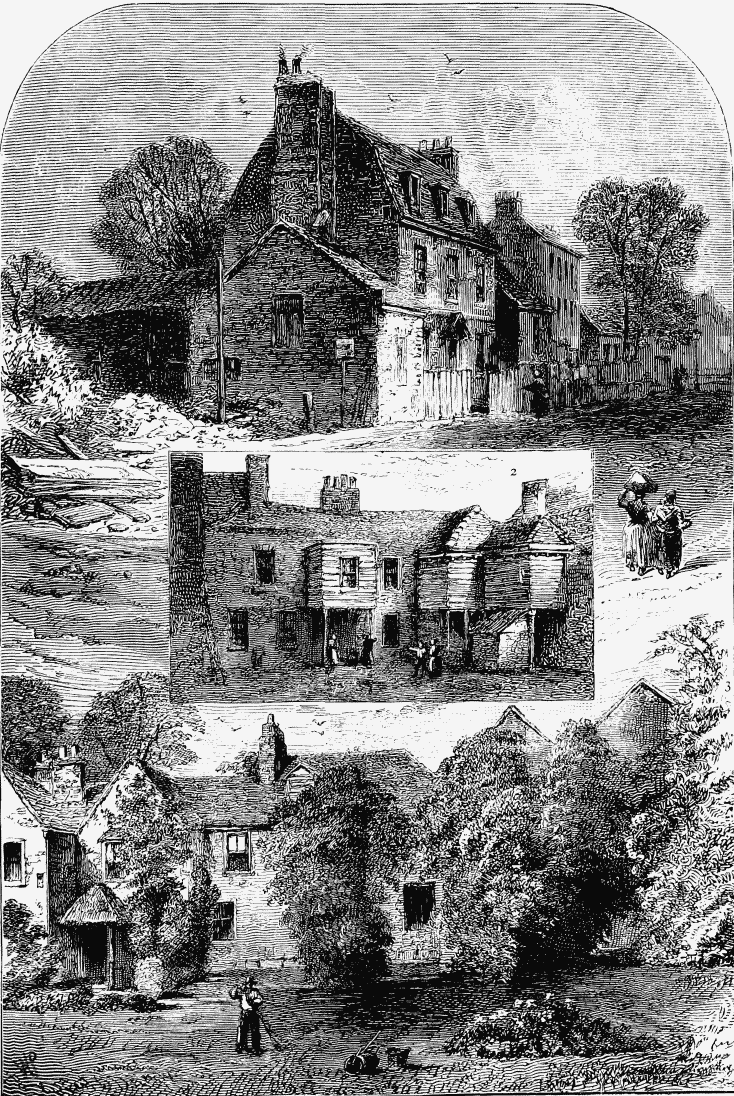
OLD KENSINGTON. 1. Manor House. 2. Old Tavern. 3. Little Holland House.
Among the most noticeable pictures which abound in the map-room and the picture-room, are some by Watts, who is considered by many one of the greatest of contemporary English artists. In the latter room mass was said daily during the brief stay of Marie Amélie, the late Queen of the French, in the house in 1862. In the print-room are some specimens of the Italian, German, Dutch, Flemish, French, Spanish, and English schools; the Rembrandts being the most worthy of note. Hogarth is represented in the next room. Here, among the portraits, are those of Tom Moore, by Shee, and of Rogers, by Hoffner; there are also some fine Dutch sea-pieces. The library, a very handsome long room, contains, besides its literary treasures, among other relics, a table used by Addison at the Temple. There is a glowing notice of this room by Macaulay, too long for quotation. In the yellow drawing-room there is "a pair of candlesticks in Byzantine ware, which belonged to Mary Queen of Scots. They were in her possession at Fotheringay Castle, and thus were witnesses to the last hours of her life's tragedy." There is, too, "an ancient poison-ring," with a death's head in carbuncle, supposed to have been sent to the same unfortunate queen. Here are also numerous relics of the great Napoleon: among them is a locket, containing some of his hair, a ring, and a cross worn by him in his island prison at St. Helena. The miniature-room, it need scarcely be added, has its treasures; as have also "Lady Holland's private rooms" and the "blue-room." The former had a narrow escape from destruction by fire a few years ago. Among the remaining curiosities and works of art preserved here, is an interesting collection of fans, some of which are very beautifully painted. "One of these," as the Princess Marie Lichstenstein informs us in her account of Holland House, "is historically interesting, having been painted by a daughter of George III., before the union of Ireland with England. It bears the rose and the thistle, but no shamrock; and the motto, 'Health is restored to one, happiness to millions,' seems to indicate the occasion for which it was painted." Autographs, too, and manuscripts of famous characters, are not wanting: among them are those of Catherine, Empress of Russia; Napoleon I., Voltaire, Addison, Petrarch, letters of Philip II., III., and IV. of Spain; and music by Pergolese, copied by Rousseau.
"The library," says Leigh Hunt, in his "Old Court Suburb," "must originally have been a greenhouse or conservatory; for, in its first condition, it appears to have been scarcely anything but windows, and it is upwards of ninety feet long, by only seventeen feet four inches wide, and fourteen feet seven inches in height. The moment one enters it, one looks at the two ends, and thinks of the tradition about Addison's pacings in it to and fro. It represents him as meditating his 'Spectators' between two bottles of wine, and comforting his ethics by taking a glass of each as he arrived at each end of the room. The regularity of this procedure is, of course, a jest; but the main circumstance is not improbable, though Lord Holland seems to have thought otherwise. He says (for the words in Faulkner's 'Kensington' are evidently his):—'Fancy may trace the exquisite humour which enlivens his papers to the mirth inspired by wine; but there is too much sober good sense in all his lucubrations, even when he indulges more in pleasantry, to allow us to give implicit credit to a tradition invented, probably, as excuse for intemperance by such as can empty two bottles of wine, but never produce a 'Spectator' or a 'Freeholder.'" Of other apartments which have any particular interest attached to them, is the chamber in which Addison died; the bed-room occupied by Charles Fox; that of Rogers, the poet, who was a frequent visitor here; and also that of Sheridan, "in the next room to which," as Leigh Hunt informs us, "a servant was regularly in attendance all night, partly to furnish, we believe, a bottle of champagne to the thirsty orator, in case he should happen to call for one betwixt his slumbers (at least, we heard so a long while ago, and it was quite in keeping with his noble host's hospitality; but we forgot to verify the anecdote on this occasion), and partly—of which there is no doubt—to secure the bed-curtains from being set on fire by his candle."
In a previous chapter we have narrated the descent of the manor of Kensington from the time of the Conquest, when it was held by the De Veres, down to the present day. Sir Walter Cope, the purchaser of the Vere property in Kensington, was a master of the Court of Wards in the time of James I., and one of the Chamberlains of the Exchequer. He built the centre of the house and the turrets, and bequeathed it, as already stated, to Sir Henry Rich, the husband of his daughter and heiress, Isabel. Not long afterwards, Sir Henry was raised to the peerage, when he assumed his title of nobility from his wife's inheritance—that of Lord Kensington. The wings and arcades were added by this nobleman, who also completed the internal decorations. His lordship was a courtier, and had the honour of being employed to negotiate a marriage between Prince Charles and the Infanta of Spain; but the negotiation proved abortive. Lord Kensington's services were, nevertheless, appreciated and rewarded by an earl's coronet and the insignia of the Garter. The new title chosen by his lordship was Holland, and thence the manor house of Kensington received its present appellation. This Earl of Holland was a younger son of Robert Rich, first Earl of Warwick, by his marriage with Penelope, daughter of Queen Elizabeth's favourite, the Earl of Essex, and the "Stella" of Sir Philip Sidney. He was a favourite with King James's "Steenie," Duke of Buckingham, whom he almost rivalled in coxcombry. During the prosperous portion of Rich's career, Holland House, no doubt, was the centre of rank and fashion. The name of Bassompierre, the French ambassador, figures among the guests here at that time. The earl was a political waverer in the "troublous times" of Charles I. He was twice made a prisoner in the house: first by Charles, in 1633, upon the occasion of his challenging Lord Weston, and a second time by command of the Parliament, after the unsuccessful issue of his attempt to restore the king, in 1648. In the following year he lost his life on the scaffold in Palace Yard, Westminster; foppish to the last, he is reported to have died in a white satin waistcoat or doublet, and a cap made of the same material, trimmed with silver lace. Within a few months of the earl's execution, Holland House became the head-quarters of the Parliamentary army, General Fairfax becoming its occupant. In the Perfect Diurnal, a journal of the day, is this entry:—"The Lord-General (Fairfax) is removed from Queen Street to the late Earl of Holland's house at Kensington, where he intends to reside." The mansion, however, was soon restored to the earl's widow and children; and it remained quietly in the possession of the family almost as long as they lasted.
It is well known that throughout the gloomy reign of Puritanism, under Oliver Cromwell, the dramatic profession was utterly proscribed. We are told that during this period the actors, who had been great loyalists, contrived to perform secretly and by stealth at noblemen's houses, where purses were collected for the benefit of "the poor players." In the "Historia Histrionica," published in 1699, it is stated that, "In Oliver's time they [the players] used to act privately, three or four miles or more out of town, now here, now there, sometimes in noblemen's houses, in particular, Holland House at Kensington, where the nobility and gentry who met (but in no great numbers) used to make a sum for them, each giving a broad piece, or the like."
From the Restoration to the time of the Georges, Holland House appears to have been let by the noble owners on short leases to a variety of persons, and sometimes even in apartments to lodgers. Leigh Hunt, in his work already quoted, mentions the names of several who, in this manner, resided here: among them, Arthur Annesley, the first Earl of Anglesey; Sir John Chardin, the traveller; Catherine Darnley, Duchess of Buckinghamshire; William Penn, the founder of Pennsylvania; and Shippen, the famous Jacobite, whom Pope has immortalised for his sincerity and honesty. Robert Rich, the son and successor of the first Earl of Holland, succeeded his cousin as Earl of Warwick, in consequence of failure of the elder branch, and thus united the two coronets of his family. He was the father of Edward Rich, Earl of Warwick and Holland, whose widow, Charlotte, daughter of Sir Thomas Myddleton, of Chirk Castle, Denbighshire, married, in 1716, the Right Honourable Joseph Addison, and thus, "by linking with the associations of Kensington the memory of that illustrious man, has invested with a classic halo the groves and shades of Holland House." Edward Henry, the next earl—to whom, as we have stated, there is a monument in Kensington Church—was succeeded by his kinsman, Edward Rich; and the daughter and only child of this nobleman dying unmarried, the earldom became extinct in the middle of the last century. Holland House then came into the possession of the youthful earl's first cousin, William Edwardes (a Welsh gentleman, who was created a Peer of Ireland, as Baron Kensington), and was eventually sold to the Right Honourable Henry Fox, the distinguished politician of the time of George II., who, on being created a peer, adopted the title of Holland, and with his descendants the mansion has continued ever since.
To the literary circle, of which this house was the centre, it is impossible to say how many poets, essayists, and other writers have owed their first celebrity. It is said that even Goldsmith's charming novel, "The Vicar of Wakefield," here found its earliest admirer. This beautiful little work remained unnoticed, and was attacked by the reviews, until Lord Holland, who had been ill, sent to his bookseller for some amusing book. This was supplied, and he was so pleased that he spoke of it in the highest terms to a large company who dined with him a few days after. The consequence was that the whole impression was sold off in a few days.
It has been said that Addison obtained an introduction to his future wife in the capacity of tutor to her son, the young Earl of Warwick; but this supposition appears to be negatived by two letters written by Addison to the earl, when a boy, wherein the writer evinces an entire ignorance of the advances which his correspondent might have made in classical attainment. The letters are dated 1708. Addison had been appointed UnderSecretary of State two years previously, and it seems improbable that he should have undertaken the office of tutor at a subsequent period. His courtship of the countess, however, is said to have been marked by tedious formalities; and it is further asserted that her ladyship at first encouraged his overtures with a view of extracting amusement from the diffidence and singularity of his character. From the following anecdote, which is told respecting Addison's courtship, there would seem to be a show of truth in the story. The tenor of this anecdote is that "he endeavoured to fathom her sentiments by reading to her an article in a newspaper (which he himself had caused to be inserted), stating the probability of a marriage taking place between the reader and the auditress! From a comparison of dates, and a further examination of internal evidence," adds the narrative, "there is reason to suppose that Addison meant as a playful description of his own courtship that of Sir Roger de Coverley to the widow with a white hand; and, if so, how highly is the world indebted to the warm fancy of the one party, and the want of determination in the other!" It was, in all probability, at this period of his life that Addison had a cottage at Fulham; at all events, he figures in "Esmond," as walking thither from Kensington at night-time. "When the time came to take leave, Esmond marched homewards to his lodgings, and met Mr. Addison on the road, walking to a cottage which he had at Fulham, the moon shining on his handsome serene face. 'What cheer, brother!' says Addison, laughing; 'I thought it was a footpad advancing in the dark, and, behold, it is an old friend! We may shake hands, colonel, in the dark, 'tis better than fighting by daylight. Why should we quarrel because I am a Whig and thou art a Tory? Turn thy steps and walk with me to Fulham, where there is a nightingale still singing in the garden, and a cool bottle in a cave I know of. You shall drink to the Pretender, if you like; I will drink my liquor in my own way!'"
The growing renown of Addison—perhaps his
fame as a writer, or, more probably, his accession
of political importance—assisted in persuading the
countess to become his wife. But the marriage
was productive of little comfort; and this unfortunate marriage is said to have been the cause
of his indulging to excess in drink. Be that as it
may, Addison himself wrote vehemently against
cowardice seeking strength "in the bottle;" yet it is
asserted that he often withdrew from the bickerings
of his Countess to the coffee-house or the tavern.
His favourite places of resort are said to have been
the White Horse Inn, at the bottom of Holland
House Lane, and Button's Coffee-house, in Russell
Street, Covent Garden, where we have already
made his acquaintance. (fn. 3) The fruit of this unpropitious union was one daughter, who died, at
an advanced age, at Bilton, an estate in Warwickshire which Addison had purchased some years
previously. Addison himself died at the end of
three years after his marriage. The story of his
death-bed here has been often told, but very
probably it is a little apocryphal in its details.
Lord Warwick was a young man of very irregular
life, and of loose opinions. Addison, for whom he
did not want respect, had very diligently endeavoured to reclaim him; but his arguments and
expostulations had no effect. One experiment,
however, remained to be tried. When he found
his life near its end, he directed the young lord
to be called, and told him, "I have sent for
you that you may see how a Christian can die."
It was to this young nobleman that Somerville
addressed his "Elegiac Lines on the Death of
Mr. Addison," wherein occur the lines having
reference to his burial in Westminster Abbey:—
"Can I forget the dismal night that gave
My soul's best part for ever to the grave?
How silent did his old companions tread,
By midnight lamps, the mansions of the dead,
Thro' breathing statues, then unheeded things,
Thro' rows of warriors, and thro' walks of kings!
What awe did the slow, solemn knell inspire,
The pealing organ, and the pausing choir;
The duties by the lawn-rob'd prelate paid,
And the last words, that dust to dust convey'd!":
A short time before his death, Addison sent to
request a visit from the poet Gay, and told him, on
their meeting, that he had once done him an
injury, but that if he survived his present affliction
he would endeavour to repair it. Gay did not
know the nature of the injury which had been
inflicted, but supposed that he might have lost
some appointment through the intervention of
Addison.
"Addison," writes Leigh Hunt, "it must be
owned, did not shine during his occupation of
Holland House. He married, and was not happy;
he was made Secretary of State, and was not a
good one; he was in Parliament, and could not
speak in it; he quarrelled with, and even treated
contemptuously, his old friend and associate, Steele,
who declined to return the injury. Yet there, in
Holland House, he lived and wrote, nevertheless,
with a literary glory about his name, which never
can desert the place; and to Holland House,
while he resided in it, must have come all the
distinguished men of the day, for, though a Whig,
he was personally 'well in,' as the phrase is, with
the majority of all parties. He was in communication with Swift, who was a Tory, and with
Pope, who was neither Tory nor Whig. It was
now that the house and its owners began to appear
in verse. Rowe addressed stanzas to Addison's
bride; and Tickell, after his death, touchingly
apostrophizes the place—
"'Thou hill, whose brow the antique structures grace,
Rear'd by bold chiefs of Warwick's noble race;
Why, once so loved, whene'er thy bower appears,
O'er my dim eyeballs glance the sudden tears?'
* * * * * *
"It seems to have been in Holland House (for he died shortly afterwards) that Addison was visited by Milton's daughter, when he had requested her to bring him some evidences of her birth. The moment he beheld her, he exclaimed, 'Madame, you need no other voucher; your face is a sufficient testimonial whose daughter you are. It must have been very pleasing to Addison to befriend Milton's daughter; for he had been the first to popularise the great poet by his critiques on 'Paradise Lost,' in the Spectator."
After the death of Addison, Holland House remained in the possession of the Warwick family, and of their heir, Lord Kensington, until, as we have stated above, it was purchased by Henry Fox, who subsequently became a lord himself, and took his title from the mansion. This was towards the close of the reign of George II.

ROGERS' SEAT AND INIGO JONES GATEWAY, HOLLAND HOUSE.
Henry Fox, the first Lord Holland of the new creation, was the youngest son of Sir Stephen Fox, a distinguished politician during the reigns of Charles II., James II., William III., and Queen Anne. After having had a numerous offspring by one wife, Sir Stephen married another at the age of seventy-six, and had three more children, two of whom founded the noble families of Holland and Ilchester. It was reported that Stephen Fox had been a singing-boy in one of our English cathedrals; Walpole says he was a footman; and the late Lord Holland, who was a man of too noble a nature to affect ignorance of such traditions, candidly owns that he was a man of "very humble origin." Henry Fox was the political opponent of the first William Pitt, afterwards Earl of Chatham. The chief transactions of his lordship's public life are all duly recorded in the pages of history. Leigh Hunt, in his own lively manner, writes thus of him:—"Fox had begun life as a partisan of Sir Robert Walpole; and in the course of his career held lucrative offices under Government—that of Paymaster of the Forces, for one—in which he enriched himself to a degree which incurred a great deal of suspicion." A good story is told concerning Fox whilst he held the above-mentioned office; it is one which will bear repeating here. After Admiral Byron's engagement in the West Indies, there arose a great clamour about the badness of the ammunition served out. Soon afterwards, Mr. Fox fought a duel with a Mr. Adam. The former received his adversary's ball, which, happily, made but a very slight impression. "Egad, sir!" observed Fox, "it would have been all over with me if we had not charged our pistols with Government powder."

Holland House
Fox, however, was latterly denounced, in a City address, as the "defaulter of unaccounted millions." "Public accounts, in those times, were strangely neglected; and the family have said that his were in no worse condition than those of others; but they do not deny that he was a jobber. Fox, however, for a long time did not care. The joyousness of his temperament, together with some very lax notions of morality, enabled him to be at ease with himself as long as his blood spun so well. He jobbed and prospered; ran away with a duke's daughter; contrived to reconcile himself with the family (that of Richmond); got his wife made a baroness; was made a lord himself—Baron Holland, of Foxley; was a husband, notwithstanding his jobbing, loving and beloved; was an indulgent father; a gay and social friend—in short, had as happy a life of it as health and spirits could make, till, unfortunately, health and spirits failed, and then there seems to have been a remnant of his father's better portion within him, which did not allow him to be so well satisfied with himself in his decline." The story of Henry Fox's elopement with the Duke of Richmond's daughter, Lady Georgiana Caroline Lennox, is thus told in the "Old Court Suburb:"—"The duke was a grandson of Charles II., and both he and the duchess had declined to favour the suit of Mr. Fox, the son of the equivocal Sir Stephen. They reckoned on her marrying another man, and an evening was appointed on which the suitor in question was to be formally introduced to her. Lady Caroline, whose affections the dashing statesman had secretly engaged, was at her wits' end to know how to baffle this interview. She had evaded the choice of the family as long as possible, but this appointment looked like a crisis. The gentleman is to come in the evening; the lady is to prepare for his reception by a more than ordinary attention to her toilet. This gives her the cue to what is to be done. The more than ordinary attention is paid; but it is in a way that renders the interview impossible. She has cut off her eyebrows. How can she be seen by anybody in such a trim? The indignation of the duke and duchess is great; but the thing is manifestly impossible. She is accordingly left to herself for the night; she has perfected her plan, in expectation of the result; and the consequence is, that when next her parents inquire for her, she has gone. Nobody can find her. She is off for Mr. Fox." This runaway marriage took place in the Fleet Prison, in the year 1744. In January, 1761, two years before the elevation of Mr. Fox to the peerage, Horace Walpole was present at a performance of private theatricals at Holland House—a sight which greatly entertained him. The play selected to be performed by children and very young ladies was Jane Shore, Lady Sarah Lennox, a sister of Lady Georgiana Fox, enacting the heroine; while the boy afterwards eminent as Charles James Fox played the part of "Hastings," and his brother, Henry Edward, then six years old, enacted the "Bishop of Ely," dressed in lawn sleeves, and with a square cap (this little boy died a general in the army in 1811). Walpole praises the acting of the performers, but particularly that of Lady Sarah Lennox, who, he says, "was more beautiful than you can conceive, . . . in white, with her hair about her ears, and on the ground; no Magdalen by Correggio was half so lovely and expressive." The charms of this lovely person had already made an impression on the heart of George III., then newly come to the throne at two-and-twenty. There seems no reason to doubt that the young monarch formed the design of raising his lovely cousin (for such she was, in a certain sense) to a share of the throne. The following story concerning the pair we quote from Timbs' "Romance of London:"—"Early in the winter of 1760–1, the king took an opportunity of speaking to Lady Sarah's cousin, Lady Susan Strangways, expressing a hope at the drawing-room that her ladyship was not soon to leave town. She said that she should be leaving soon. 'But,' said the king, 'you will return in summer for the coronation.' Lady Susan answered that 'she did not know—she hoped so.' 'But,' said the king again, 'they talk of a wedding. There have been many proposals; but I think an English match would do better than a foreign one. Pray, tell Lady Sarah Lennox I say so.' Here was a sufficiently broad hint to inflame the hopes of a family, and to raise the head of a blooming girl of sixteen to the fifth heavens. It happened, however, that Lady Sarah had already allowed her heart to be pre-occupied, having formed a girlish attachment for the young Lord Newbottle, grandson of the Marquis of Lothian. She did not, therefore, enter into the views of her family with all the alacrity which they desired. According to the narrative of Mr. Grenville, she went the next drawing-room to St. James's, and stated to the king, in as few words as she could, the inconveniences and difficulties in which such a step would involve him. He said that was his business; he would stand them all; his part was taken, and he wished to hear her's was likewise. In this state it continued, whilst she, by the advice of her friends, broke off with Lord Newbottle, very reluctantly, on her part. She went into the country for a few days, and by a fall from her horse broke her leg. The absence which this occasioned gave time and opportunities for her enemies to work; they instilled jealousy into the king's mind upon the subject of Lord Newbottle, telling him that Lady Sarah Lennox still continued her intercourse with him; and immediately the marriage with the Princess of Strelitz was set on foot; and at Lady Sarah's return from the country, she found herself deprived of her crown and her lover, Lord Newbottle, who complained as much of her as she did of the king. While this was in agitation, Lady Sarah used to meet the king in his rides early in the morning, driving a little chaise with Lady Susan Strangways; and once, it is said, that, wanting to speak to him, she went dressed like a servant-maid, and stood amongst the crowd in the guard-room, to say a few words to him as he passed by." Walpole also relates that Lady Sarah would sometimes appear as a haymaker in the park at Holland House, in order to attract the attention of the king as he rode past; but the opportunity was lost. The gossiping chronicler adds also, that his Majesty blushed scarlet red at his wedding-service when allusion was made to "Abraham and Sarah." The lady survived her disappointment, and became the mother of the gallant Napiers.
Three children were the fruit of Lord Holland's marriage with Lady Georgiana Lennox, and he proved the fondest of parents. When his lordship was dangerously ill, he was informed that George Selwyn had called at his door to inquire after him. Selwyn, as is well known, was notorious for his passion for "being in at the death" of all his acquaintances, and for attending, more especially, every execution that took place. "Be so good," said his lordship, "in case Mr. Selwyn calls again, to show him up without fail; for if I am alive, I shall be delighted to see him, and if I am dead, I am sure he will be very pleased to see me.'
Of Stephen, second Lord Holland, we have nothing to say, beyond that he was good-natured and whimsical, and that he died before reaching his thirtieth year. His brother, the celebrated Charles James Fox, the "man of the people," is not much associated with Holland House, except as a name. Here, it is true, he passed his boyhood and part of his youth, during which period he was allowed to have pretty much his own way; in fact, he was what is generally styled a "spoilt child." His father is said never to have thwarted his will in anything. Thus, the boy expressing a desire one day to "smash a watch," the father, after ascertaining that the little gentleman did positively feel such a desire, and was not disposed to give it up, said, "Well, if you must, I suppose you must;" and the watch was at once smashed. On another occasion, his father, having resolved to take down the wall before Holland House, and to have an iron railing put up in its stead, found it necessary to use gunpowder to facilitate the work. He had promised his son, Charles James, that he should be present whenever the explosion took place. Finding that the labourers had blasted the brickwork in his absence, he ordered the wall to be rebuilt; and, when it was thoroughly cemented, had it blown up again for the gratification of his favourite boy; at the same time advising those about him never, on any account, to break a promise with children.
Henry Richard Fox, the third lord, who came to the title before he was a year old, lived to rescue the mansion from the ruin which at one time threatened it, and may be said to have resided in it during the whole of his life, in the enjoyment of his books, and dispensing his hospitalities to wits and worthies of all parties. His lordship married Elizabeth, the daughter and heiress of Mr. Richard Vassall, whose name he afterwards assumed; his children retaining the name of Fox. It is, perhaps, to this nobleman, with the exception of Addison, that Holland House owes most of its celebrity and its literary interest. Among the visitors round its hospitable board, Macaulay mentions the name of Prince Talleyrand, Lord Lansdowne, Lord John Russell, Lord Melbourne, the Marchioness of Clanricarde (Canning's daughter, who for many years did not forget to take vengeance on the colleagues and political opponents who had killed her father); Lord King, the bishophater; Wilberforce, the philanthropist; Lord Radnor, Charles Grant, and Mackintosh. Byron and Campbell, too, were guests here; and the name of Lord Holland is embalmed by the former in his dedication of "The Bride of Abydos," and by the latter in that of "Gertrude of Wyoming."
It is evident from Macaulay, Tom Moore, and the other members of the Holland House clique, that, though they were nominally the guests of Lord Holland, their real entertainer was her ladyship, in whom was illustrated the proverb which declares that "the grey mare is often the better horse." In fact, she was not only lady paramount in the house, but often insolently imperious towards her guests, whom, as one man wittily remarked, she treated like her vassals, though she was only a Vassall herself, alluding, of course, to her maiden name. "The centurion," it has been remarked, "did not keep his soldiers in better order than she keeps her guests. It is to one, 'Go,' and he goeth; and to another, 'Do this,' and it is done. 'Ring the bell, Mr. Macaulay.' 'Lay down the screen, Lord Russell; you will spoil it.' 'Mr. Allen, take a candle, and show Mr. Cradock the pictures of Buonaparte.'" Lord Holland was, on the other hand, all kindness, simplicity, and vivacity. One of the occasional visitors here, Mr. Granville Penn, said about her ladyship a good thing, which, while it helped to establish his credit as a wit, excluded him from its hospitable doors for ever. "Holland House," a friend remarked to him, "is really a most pleasant place; and in Lord Holland's company you might imagine yourself inside the home of Socrates." "It certainly always seemed so to me; for I often seemed to hear Xanthippe talking rather loud in the adjoining room," was Mr. Penn's reply. In fact, Lady Holland herself, who presided at the réunions of Holland House, was most arbitrary and domineering in her manner, and, consequently, made herself unpopular with some of her guests. When she heard that Sir Henry Holland was about to be made a baronet, she expressed herself vexed that there would be "two Lady Hollands." But that could not be helped. Ugo Foscolo, in spite of having obtained the entrée of Holland House, could not help regarding her with aversion, and once said, with a strong emphasis, that, "though he could go anywhere"—even to a certain place, which shall be nameless—"with his lordship, he should be sorry to go to heaven with Lady Holland."
Macaulay did not find an entrée here till after he had made his mark in Parliament. Lady Holland on one occasion took him into her own drawingroom to see her pictures, which included thirty by Stothard, all on subjects from Lord Byron's poems. "Yes," said her ladyship, "poor Lord Byron sent them to me a short time before the separation. I sent them back, and told him that, if he gave them away, he ought to give them to Lady Byron. But he said that he would not, and that if I did not take them the bailiffs would, and that they would be lost in the wreck." Samuel Rogers promised to be there to meet Macaulay, "in order to give him an insight into the ways of that house," and of its imperious mistress, whose pride and rudeness must have been simply intolerable to ordinary mortals. Rogers was the great oracle of the Holland House circle—a sort of non-resident premier. To some members of the literary world who had not the privilege of joining in the charming circle at Holland House, the sense of their exclusion seemed to find vent in some shape or form. Theodore Hook would appear to be one of these, for about the year 1819, among other experiments, he tried to set up a tiny magazine of his own—the Arcadian—published, we believe, at a shilling; but we know not how many numbers of it were issued before the publisher lost heart. One number contained a lengthy ballad of provoking pungency, satirising Holland House in very severe terms.
Some excellent remarks àpropos of Holland House gatherings and its associations may here be abridged from Mr. J. Fisher Murray's "Environs of London," in which a scholar who had the entrée of that hospitable mansion writes, at once prophetically and pathetically, as follows:—"Yet a few years, and these shades and these structures may follow their illustrious masters. The wonderful city which, ancient and gigantic as it is, still continues to grow, as a young town of logwood by a water-privilege in Michigan, may soon dispense with those turrets and gardens which are associated with so much that is interesting and noble; with the courtly magnificence of Rich, with the loves of Ormond, with the councils of Cromwell, with the death of Addison. The time is coming when, perhaps, a few old men, the last survivors of our generation, will seek in vain, amid new streets and squares, and railway stations, for the site of that dwelling which in their youth was the favourite resort of wits and beauties, of painters and poets, of scholars, philosophers, and statesmen; they will remember, with strange tenderness, many objects familiar to them—the avenue and terrace, the busts and the paintings, the carvings, the grotesque gilding, and the enigmatical mottoes. With peculiar tenderness they will recall that venerable chamber in which all the antique gravity of a college library was so singularly blended with all that female grace and wit could devise to embellish a drawing-room. They will recollect, not unmoved, those shelves loaded with the varied learning of many lands and many ages; those portraits in which were preserved the features of the best and wisest Englishmen of two generations. They will recollect how many men who have guided the politics of Europe, who have moved great assemblies by reason and eloquence, who have put life into bronze or canvas, or who have left to posterity things so written that society will not willingly let them die, were there mixed with all that was lovely and gayest in the society of the most splendid of modern capitals. . . . They will remember the singular character, too, which belonged to that circle; in which every talent and accomplishment, every art and science, had its place. They will remember how the last Parliamentary debate was discussed in one corner, and the last comedy of Scribe in another; while Wilkie gazed in admiration on Reynolds's 'Baretti;' while Mackintosh turned over Thomas Aquinas to verify a quotation; while Talleyrand related his conversation with Barras at the Luxembourg, or his ride with Lannes over the field of Austerlizt. They will remember, above all, the grace and the kindness—far more admirable than grace—with which the princely hospitality of that ancient mansion was dispensed; they will remember the venerable and benignant countenance of him who bade them welcome there; they will remember that temper which thirty years of sickness, of lameness, and of confinement served only to make sweeter; and, above all, that frank politeness which at once relieved all the embarrassment of the most timid author or artist who found himself for the first time among ambassadors and earls. They will remember, finally, that in the last lines which he traced he expressed his joy that he had done nothing unworthy of the friend of Fox and of Grey; and they will have reason to feel a similar joy if, in looking back on many troubled years of life, they cannot accuse themselves of having done anything unworthy of men who were honoured by the friendship of Lord Holland."
Mr. Rush, in his "Court of London," tells us a good story of a little incident which happened in the drawing-room here after dinner. Advancing towards Sir Philip Francis, Mr. Rogers asked permission to put a question to him. Francis, no doubt, guessed what was coming, for everybody at the time was asking, "Who is Junius?" and many persons were even then more than disposed to identify him with the author of the "Letters" which were published under that signature, and were exciting the nation. Francis, who was an irritable man, shut him fairly up with the words, "At your peril, sir!" On this, Rogers quietly turned away, observing that if Francis was not "Junius," at all events he was "Brutus." It is not a little singular, if the letters were not written by Francis, that they ceased to appear after the very day on which Francis quitted the shores of England for India, and that Garrick, who was in the secret, prophesied a day or two before that they were about to cease.
On the death of his uncle, Charles James Fox, Lord Holland was introduced into the Cabinet as Lord Privy Seal; but the strength of the Whig portion of the Government had then departed, and the only measure worthy of notice in which his lordship co-operated after his accession to office was the Bill for the Abolition of the Slave Trade. He took an active part in the multifarious debates upon the Catholic question, the Regency Bill, &c.; and when the Bill to legalise the detention of Napoleon as a prisoner of war was before the House of Lords, Lord Holland raised his voice against it, and, until death relieved the prisoner, he never ceased to deprecate what he deemed the unwarrantable conduct towards him of the British Government and its agents.
Lord Holland died in October, 1840, after an
illness of only two days' duration. Mr. T. Raikes,
in notifying the occurrence in his "Diary," remarks:—"Flahault had been staying at Holland House
while he was in England, and left him in good
health on Tuesday. He arrived here yesterday
morning, and to-day receives the account of his
death. Lord Holland was in the Cabinet, and held
the lucrative post of Chancellor of the Duchy of
Lancaster; he was sixty-seven. When I went to
Eton he was the head of the school, and was the
first prepositor that gave me my liberty. He was a
mild, amiable man, ruled by his wife. She was a
Miss Vassall, with a large fortune, who eloped with
him from her first husband, Sir Godfrey Webster;
she is a great politician, and affects the esprit fort.
They kept a hospitable house, and received all the
wits of the day." The following lines were written
by Lord Holland on the morning of the day when
his last illness commenced, and were found after his
death on his dressing-room table:—
"Nephew of Fox and friend of Grey,
Sufficient for my fame,
If those who knew me best shall say
I tarnished neither name."
Mr. Raikes also adds:—"Mrs. Damer writes me
that the new Lord Holland inherits an estate of
£6,000 per annum, on which there is an enormous
debt. Holland House is left to Lady Holland, who
will not live there." "Lord Holland," says Mr.
Peter Cunningham, "called on Lord Lansdowne a
little before his death, and showed him his epitaph
of his own composing. 'Here lies Henry Vassall
Fox, Lord Holland, &c., who was drowned while
sitting in his elbow-chair.' He died in this house, in
his elbow-chair, of water in the chest."
The following is a character of Lord Holland, written by a friend:—"The benignant, the accomplished Lord Holland is no more; the last and best of the Whigs of the old school, the long-tried friend of civil and religious liberty, has closed a life which has been an ornament and a bulwark of the Liberal cause. He was one of England's worthies in the pristine sense of the word; and a more finished example of the steady statesman, the urbane gentleman, and the accomplished scholar, never existed. Lord Holland's was a fine mind, and a fine mind in perpetual exercise of the most healthful kind. It was observed of him that he was never found without a good book in his hand. His understanding was thoroughly masculine, his taste of a delicacy approaching perhaps to a fault. His opinions he maintained earnestly and energetically, but with a rare, a beautiful candour. Nothing was proscribed with him. As of old, the meanest wayfarers used to be received hospitably, lest angels should be turned away; so Lord Holland seemed to have a hearing for every argument, lest a truth should be shut out from his mind. The charm of his conversation will never be forgotten by those who have enjoyed it. His mind was full of anecdote, which was always introduced with the most felicitous appositeness, and exquisitely narrated.

HOLLAND HOUSE, FROM THE NORTH.
"Lord Holland had lived with all the most distinguished and eminent men of the last forty years; but his knowledge of the greatest, the most eloquent, the most witty, or the most learned, had not indisposed him to appreciate merits and talents of a less great order. He was a friend of merit wherever it could be found, and knew how to value and to encourage it in all its degrees.
"None ever enjoyed life more than Lord Holland, or enjoyed it more intellectually, and none contritributed more largely to the enjoyment of others. He possessed the sunshine of the breast, and no one could approach him without feeling its genial influence. Lord Holland was a wit, without a particle of ill nature, and a man of learning, without a taint of pedantry. His apprehension of anything good was unfailing; nothing worth observing and remarking ever escaped him. The void which Lord Holland has left will never be filled; a golden link with the genius of the last age is broken and gone. The fine intellect, whose light burned at the shrine of freedom, is extinguished. An influence the most propitious to the peace, so precious to the world's best interests, is lost when the need of it is great indeed."

GRAND STAIRCASE, HOLLAND HOUSE.
Lord Holland was succeeded in his title and estates by his only son, Henry Edward, who was some time the British Minister at the Court of Tuscany. He died at Naples in 1859, when the barony became extinct. From that time, down to the year 1874, it was always a matter of apprehension that a day would sooner or later come when, as prophesied by Sir Walter Scott, Holland House must become a thing of the past, and be swept away in order to make room for new lines of streets and villas between Kensington and Notting Hill. In the above year, however, this feeling was quieted by the rumour that Lady Holland, the widow of the last lord, had disposed of the reversion of the house, by sale, to the Earl of Ilchester, who, it was stated, had expressed his intention of keeping the mansion in its integrity. Lord Ilchester's name is Fox-Strangways, and it is the latter name that has been assumed by his branch of the family, the first Lord Holland and the first Lord Ilchester, as stated above, having been brothers. Lord Macaulay, in writing of Holland House, says it "can boast of a greater number of inmates distinguished in political and literary history than any other private dwelling in England." In the lifetime of the third Lord Holland it was the meetingplace of the Whig party; and his liberal hospitality made it, as Lord Brougham tells us, "the resort not only of the most interesting persons composing English society, literary, philosophical, and political, but also to all belonging to those classes who ever visited this country from abroad."
With the death of the third Lord Holland, the glories of Holland House may be said to have passed away, although the building has been occupied as an occasional residence by the widow of the last lord since his death in 1859; and an air of solitude seems indeed to have gathered round the old mansion. A custom was observed for many years, till a recent date, of firing off a cannon at eleven o'clock every night; this custom originated, we believe, through a burglary which was once attempted here.
Several spots in the grounds round the house
have acquired celebrity in connection with some
name or circumstance. Of these we may note the
part lying to the west, towards the Addison Road,
which formerly went by the name of "the Moats,"
where the duel between Captain Best and the
notorious Lord Camelford took place, early in the
present century. The exact spot is supposed to
have been the site of the older mansion belonging
to the De Veres. The quarrel between Lord
Camelford and Mr. Best, of which we have spoken
in our accounts of New Bond Street and Conduit
Street, (fn. 4) was on account of a friend of Lord Camelford, a lady of the name of Symons, and it occurred
at the "Prince of Wales's" coffee-house in Conduit
Street. The duel was fought on the following day
(March 7, 1804), and Lord Camelford was killed.
Although there really was no adequate cause for a
quarrel, the eccentric nobleman would persist in
fighting Mr. Best, because the latter was deemed
the best shot in England, and that "to have made
an apology would have exposed his lordship's
courage to suspicion." The parties met on the
ground about eight o'clock in the morning, and
having taken up their position, Lord Camelford
gave the first shot, which missed his antagonist,
when Mr. Best fired, and lodged the contents of
his weapon in his lordship's body. He immediately
fell, and calling his adversary to him, seized him
by the hand, and exclaimed, "I am a dead man!
you have killed me; but I freely forgive you."
He repeated several times that he was the sole
aggressor. He was conveyed to a house close at
hand, and a surgeon soon arrived from Kensington,
and immediately pronounced the wound mortal.
Upon the spot where the duel was fought the late
Lord Holland set up an "expiatory classical altar,"
which, however, was removed a few years ago.
With the passion for eccentricity which had
characterised him, Lord Camelford had directed
that he should be buried in a lonely spot on an
island in Switzerland, which had interested him
during his travels; his wishes, however, were not
complied with, for his body was interred in the
vaults of St. Anne's Church, Soho, where it still
remains. (fn. 5) "This very spot," the Princess Marie
Lichstenstein tells us, "was, a few years ago, the
scene of merry parties, where the Duke and Duchess
d'Aumale used to fish with the late Lord Holland."
At the back of the mansion is a broad expanse of
greensward, dotted here and there with stately
elms; and here, in an alcove facing the west, is
inscribed the couplet that we have given as a motto
to this chapter, and which was put up by the late
Lord Holland in honour of Mr. Rogers. Here is
also a copy of verses by Mr. Luttrell, expressing
his inability to emulate the poet. The undulating
grounds on this side of the house are terminated by
a row of mansions built on the fringe of the estate;
and the eastern side is bounded by a rustic lane,
in part overhung with trees. Close by the western
side of the house are small gardens, laid out in
both the ancient and modern styles, the work of
the late Lady Holland, the former of them being a
fitting accompaniment to the old house. Here are
evergreens clipped into all sorts of fantastic forms,
together with fountains and terraces befitting the
associations of the place. In one of these gardens,
says Leigh Hunt, was raised the first specimen of
the dahlia, which the late Lord Holland is understood to have brought from Spain; in another, on
a pedestal, is a colossal bust of Napoleon, by a
pupil of Canova. Engraved on the pedestal is a
quotation from Homer's "Odyssey," which may be
thus rendered in English:—
"The hero is not dead, but breathes the air
In lands beyond the deep:
Some island sea-begirded, where
Harsh men the prisoner keep."
The Highland and Scottish Societies' gatherings,
with their characteristic sports and pastimes, were
held in these grounds for many years.
The grounds around the house are rich in oaks, plane-trees, and stately cedars, whose dark foliage sets off the features of the old mansion. Of the grounds in front of the house, there is a tradition that Cromwell and Ireton conferred there, "as a place in which they could not be overheard." Leigh Hunt, in his "Old Court Suburb," observes that, "whatever the subject of their conference may have been, they could not have objected to being seen, for there were neither walls, nor even trees, we believe, at that time in front of the house, as there are now; and," he adds, "we may fancy royalists riding by, on their road to Brentford, where the king's forces were defeated, and trembling to see the two grim republicans laying their heads together."
Near Holland House, in Nightingale Lane, stands a small mansion, called Little Holland House, where Mrs. Inchbald once spent a few days with its occupant, a Mrs. Bubb; here, too, lived and died Miss Fox, sister of the late Lord Holland.
Facing the Uxbridge Road at the extreme end, at the north-west corner of the grounds of Holland House, there was a smaller mansion, with a "pleasaunce" garden and lawn, of about seven acres, which for many years was owned and tenanted by a natural son of Lord Holland—General Fox, the celebrated numismatist, some time M.P. for Stroud, and Secretary to the Ordnance Board, who married Lady Mary Fitzclarence. The grounds, however, were sold in 1875 for building purposes, and the house was soon after pulled down.
At the western extremity of the parish of Kensington, on the road towards Hammersmith, were the nursery-grounds of Messrs. Lee. These grounds, says Leigh Hunt, "have been known in the parish books, under the title of the Vineyard, ever since the time of William the Conqueror. Wine, described as a sort of burgundy, was actually made and sold in them as late as the middle of the last century. James Lee, the founder of the present firm who own the grounds, was the author of one of the earliest treatises on botany, and a correspondent of Linnæus." In Faulkner's "History of Kensington," published in 1820, we read that the nursery-grounds round this neighbourhood covered no less than 124 acres, and that they belonged to eight different proprietors.