Old and New London: Volume 5. Originally published by Cassell, Petter & Galpin, London, 1878.
This free content was digitised by double rekeying. Public Domain.
Edward Walford, 'Paddington', in Old and New London: Volume 5(London, 1878), British History Online https://www.british-history.ac.uk/old-new-london/vol5/pp204-224 [accessed 10 May 2025].
Edward Walford, 'Paddington', in Old and New London: Volume 5(London, 1878), British History Online, accessed May 10, 2025, https://www.british-history.ac.uk/old-new-london/vol5/pp204-224.
Edward Walford. "Paddington". Old and New London: Volume 5. (London, 1878), British History Online. Web. 10 May 2025. https://www.british-history.ac.uk/old-new-london/vol5/pp204-224.
In this section
CHAPTER XVII.
PADDINGTON.
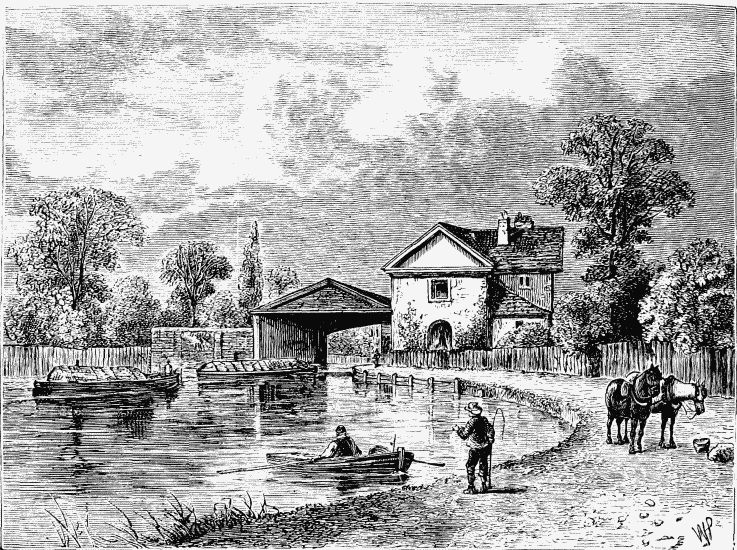
PADDINGTON CANAL, 1820.
"And the Bishop's lands, too, what of them? I'll warrant you'll not find better acres anywhere than those which once belonged to his lordship."—Boz.
Rustic Appearance of Paddington at the Commencement of this Century—Intellectual Condition of the Inhabitants—Gradual Increase of the Population—The Manor of Paddington—The Feast of Abbot Walter, of Westminster—The Prior of St. Bartholomew's and his Brethren—Dr. Sheldon's Claim of the Manor—The Old Parish Church—Hogarth's Marriage—Building of the New Parish Church—A Curious Custom—Poorness of the Living—The Burial-ground—Noted Persons buried here—Life of Haydon, the Painter—Dr. Geddes—The New Church of St. James—Holy Trinity Church—All Saints' Church—The House of the Notorious Richard Brothers—Old Public-houses—Old Paddington Green—The Vestry Hall—The Residences of Thomas Uwins, R.A., and Wyatt, the Sculptor—Eminent Residents—The Princess Charlotte and her Governess—Paddington House—" Jack-in-the-Green"—Westbourne Green—Desborough Place—Westbourne Farm, the Residence of Mrs. Siddons—The Lock Hospital and Asylum—St. Mary's Hospital—Paddington Provident Dispensary—The DudleyStuart Home—"The Boatman's Chapel"—Queen's Park—Old Almshouses—Grand Junction Canal—The Western Water-Works—Imperial Gas Company—Kensal Green Cemetery—Eminent Persons buried here—Great Western Railway Terminus.
Paddington, or Padynton, as the name of the place is often spelled in old documents, down to the end of the last century was a pleasant little rural spot, scarcely a mile to the north-west of the Tyburn turnpike, upon the Harrow Road. Indeed, it would seem to have preserved its rustic character even to a later date; for it is amusing to read without a smile the grave expressions in which Priscilla Wakefield describes, in 1814, a visit to this then remote and rustic village—a journey which now occupies about three minutes by the Underground Railway:—"From Kensington we journeyed northward to Paddington, a village situated on the Edgware Road, about a mile from London. In our way thither we passed the Lying-in Hospital at Bayswater, patronised by the queen." The place is described by Lambert, in his "History and Survey of London and its Environs," at the commencement of the present century, as "a village situated upon the Edgware Road, about a mile from London"—a description which, perhaps, was not wholly untrue even at the accession of Queen Victoria; in fact, until its selection as the terminus of the Great Western Railway caused it to be fairly absorbed into the great metropolis.
The parish, being so rural, and so very thinly populated, was, doubtless, far behind its "courtly" sister suburb of Kensington in mental and intellectual progress; so that, perhaps, there may be little or no exaggeration in the remarks of Mr. Robins, in his "History of Paddington," when he remarks:—"Although the people of Paddington lived at so short a distance from the two rich cathedral marts of London and Westminster, they made apparently no greater advances in civilisation for many centuries than did those who lived in the most remote village in the English 'shires.' The few people who lived here were wholly agricultural, and they owed every useful lesson of their lives much more to their own intelligence and observation than to any instruction given them by those who were paid to be their teachers." But if "the schoolmaster" was not "abroad," and if the education given in the parish church and other public buildings was deficient, it is a consolation to learn, from the same authority, that the defect was supplied, in some measure, at least, by the ale-houses in which debating clubs were established. A correspondent of Hone's "Year-Book," in 1832, remarks of Paddington as well as Bayswater, that they were both quite rural spots within his own remembrance, little as they then deserved the name. What would this writer have said if he could have looked forward to their condition in the year of grace 1876?
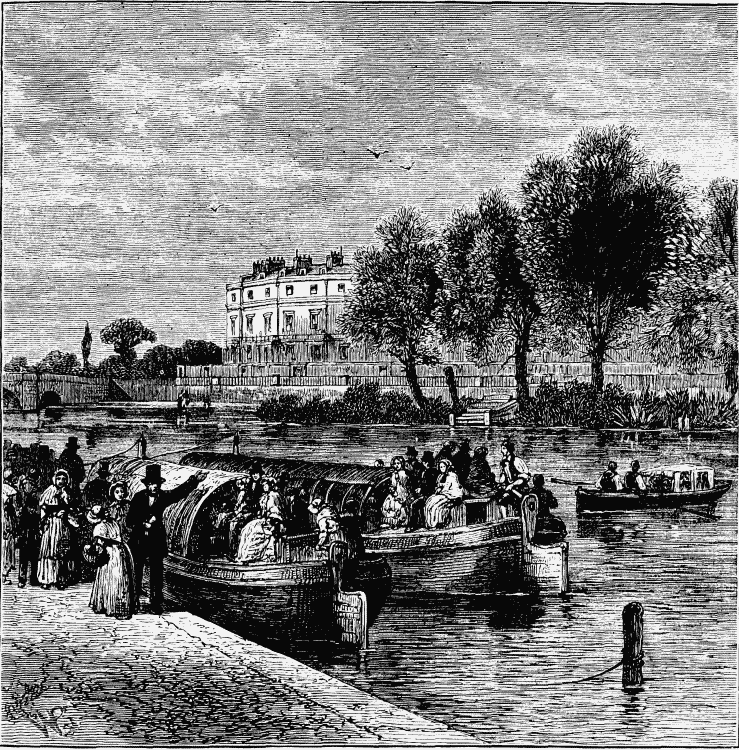
THE PADDINGTON CANAL, 1840.
Its population seems to have been always scanty.
As the earliest parish register goes back no further
than 1701, we are driven to draw our inferences
from the Subsidy Rolls. Probably, in the reign of
Henry VIII., the entire population did not exceed
a hundred, and at the accession of James II. it had
risen, according to the same calculation, to only a
little over three hundred. Even as lately as the
year 1795 the hamlet appears to have contained
only 341 houses, which, allowing five souls to a
house, would give a population of about 1,700.
Indeed, so small and insignificant did the village
continue down to our own times, that George
Canning instituted a witty comparison between a
great and a small premier, when he uttered the
mot:—
"As London to Paddington
So is Pitt to Addington."
The old stone indicating the first mile from Tyburn turnpike towards Harrow still remains in the road. In 1798, when Cary published his "Road Book," there were ten "stages" running every day from London to Paddington. William Robins, in his work on Paddington, already quoted, which was published in the year 1853, says:—"A city of palaces has sprung up here within twenty years. A road of iron, with steeds of steam, brings into the centre of this city, and takes from it in one year, a greater number of living beings than could be found in all England a few years ago; while the whole of London can be traversed in half the time it took to reach Holborn Bars at the beginning of this century, when the road was in the hands of Mr. Miles, his pair-horse coach, and his redoubtable boy," long the only appointed agents of communication between Paddington and the City. The fares were 2s. and 3s.; the journey, we are told, took more than three hours; and to beguile the time at resting-places, "Miles's Boy" told tales and played upon the fiddle. Charles Knight also tells us that "at the beginning of the present century only one stage-coach ran from the then suburban village of Paddington to the City, and that it was never filled!"
A map of London, published so lately as 1823, exhibits Paddington as quite distinct from the metropolis, which has the Edgware Road as its western boundary. A rivulet is marked as running from north to south through Westbourne Green, parallel with Craven Place; and Westbourne House is marked with the name of its resident owner, Mr. Cockerell, just like a country manor house fifty miles from London; while half a mile further are two isolated farms, named Portobello and Notting Barns respectively. The present parish includes in its area a portion of Kensington Gardens.
How little known to the inhabitants of the great metropolis this suburb was in the middle of the last century may be inferred from the silence of "honest" John Stow, and even of Strype, who, in treating of London, make no mention of Paddington. Indeed, though they devote a chapter of "The Circuit Walk," which concludes the "Survey of London," to Kensington, Hammersmith, Fulham, and Marylebone, we do not find any mention of the names of Paddington or Bayswater; the only hint in that direction being an entry of "Lisham" (i.e. Lisson) "Grove" in the index as "near Paddington." The whole neighbourhood, indeed, is passed entirely sub silentio by Evelyn and Pepys; it is not mentioned by name by Horace Walpole; and, though so near to Tyburn, it is apparently ignored by Dr. Johnson and Boswell. It may be inferred that even Mrs. Montagu scarcely ever drove so far out into the western wilds. Charles Dickens and George A. Sala, too, say but little about it. It is clear, then, that we must go to other sources for any antiquarian notes on this neighbourhood, or for anecdotes about its inhabitants.
Paddington is not mentioned in the "Domesday Book;" and it is probable that in the Conqueror's time the whole site was part of the great forest of Middlesex, of which small portions only appear to have been at any time the property of the Crown. The district, nevertheless, was, in remote times, a part of the extensive parish of St. Margaret's, Westminster, as appears from the fact that its church was for a century or two, if not longer, a sort of chapel of ease, subject to the Rector or Vicar of St. Margaret's, as, indeed, it continued to be down to the dissolution of monasteries, under Henry VIII., when the manor of Paddington was given to the newly-founded see of Westminster. The manor of Paddington was given in 1191, by the Abbot Walter, to the Convent of St. Peter's, Westminster; and from the close of the thirteenth century the whole of the temporalities of the district, such as the "rent of land and the young of animals," were devoted to charity. We read that, in 1439, a "head of water at Paddyngton" was granted to the Lord Mayor and citizens of London, and to their successors, by the Abbot of Westminster. On the abolition of the see of Westminster, shortly after its establishment, Edward VI. gave this manor to Ridley, Bishop of London, and his successors. It will be observed that the names of many of the streets around Paddington, especially to the north, perpetuate the names of several successive Bishops of London, such as Randolph, Howley, Blomfield, and Porteus. "Crescents and Colonnades," writes Hone in his "Table-Book," in 1827, "are planned by the architect to the Bishop of London on the ground belonging to the see near Bayswater."
The above-mentioned abbot of Westminster, Walter, appears to have purchased the interest in the soil here from two brothers, who were called respectively Richard and William de Padinton; and on his death the manor of Paddington was assigned to the almoner for the celebration of his anniversary, when a solemn feast was to be held. The almoner for the time being was directed to find for the convent "fine manchets, cakes, crumpets, cracknells, and wafers, and a gallon of wine for each friar, with three good pittances, or doles, with good ale in abundance at every table, and in the presence of the whole brotherhood; in the same manner as upon other occasions the cellarer is bound to find beer at the usual feasts or anniversaries, in the great tankard of five quarts."
Maitland, in his "History of London," tells us that, in 1439, "the Abbot of Westminster granted to Robert Large, the mayor, and citizens of London, and their successors, one head of water, containing twenty-six perches in length and one in breadth, together with all its springs in the manor of Paddington; in consideration of which grant the City is for ever to pay to the said abbot and his successors, at the feast of St. Peter, two peppercorns. But if the intended work should happen to draw the water from the ancient wells in the manor of Hida, then the aforesaid grant to cease and become entirely void." Mr. Robins, in his "Paddington, Past and Present," remarks that, "although the abbots at length, and by slow degrees, acquired to themselves and their house, either with or without the sanction of the Crown, both spiritual and temporal dominion over these places, we must not imagine that all the tenements in Westbourn and Paddington had been by this time transferred by the devout and the timid to their safe keeping; for besides the few small holders, who obstinately preferred their hereditary rights to works of charity or devotion, there is good reason to believe that the ancient family of De Veres held a considerable tract of land in this parish down to 1461."
The high road at Paddington must have presented an amusing spectacle in the year 1523, when the Prior of St. Bartholomew's and all his brethren, with the lay brethren, and an array of wagons and boats upon trucks, went along through Paddington towards Harrow, where they had resolved to remain for two months, till the fatal day should have passed on which it was foretold that the Thames should suddenly rise and wash away half London!
During the Commonwealth "the manor of Paddington, wth ye appurten'ces," was sold to one Thomas Browne, for the sum of three thousand nine hundred and fifty-eight pounds, seventeen shillings, and four pence; but when Dr. Sheldon was appointed to the bishopric of London, after the Restoration, he claimed the manor and also the rectory. Sheldon's relatives, it is stated, received the profits of the manor and rectory for nearly eighty years.
"In the middle of the last century," says John Timbs, in his "Curiosities of London," "nearly the whole of Paddington had become grazing-land, upwards of 1,100 acres; and the occupiers of the bishop's estate kept here hundreds of cows."
Robins, in his work on this parish, writes:—"The fact of Paddington, in Surrey, or 'Padendene,' as it was called, being mentioned in the Conqueror's survey, while Paddington, in Middlesex, was not noticed, inclines me to believe the dene or den, in Surrey, was the original mark of the Pædings; and that the smaller enclosure in Middlesex was at first peopled and cultivated by a migration of a portion of that family from the den, when it had become inconveniently full. . . . At what period this migration happened," he adds, "it is impossible to say; but there is very little doubt that the first settlement was made near the bourn, or brook, which ran through the forest." This brook, of which we have already had occasion to speak in a previous chapter, was, at the beginning of this century, a favourite resort for anglers.
There is extant a curious etching of the old parish church of Paddington, dated 1750. It stood about eighty yards to the north of the present edifice, and its site may still be seen among the tombs, which were ranged inside and outside of it. It was a plain, neat building, of one aisle, consisting of only a nave, and with a bell-turret and spire at the west end, not unlike the type of the country churches of Sussex, and its picturesqueness was heightened by the dark foliage of an ancient yewtree.
This church was built by Sir Joseph Sheldon and Daniel Sheldon, to whom the manor was leased by Sheldon, Bishop of London, and afterwards Archbishop of Canterbury, in the reign of Charles II., and it replaced a more ancient church, which had become "old and ruinous," and which was taken down about the year 1678.
In this second church, which was dedicated to St. James, were married, on the 23rd of March, 1729, Hogarth and Jane Thornhill, the daughter of Sir James Thornhill; the marriage, it is said, was a runaway match, carried out much against the will of the bride's father.
Mr. J. T. Smith, the antiquary, states that the
walls of the demolished church were adorned with
several texts from Scripture, in accordance with
the instructions of Queen Elizabeth:—
"And many a holy text around she strews
To teach the rustic moralist to die."
In 1788 an Act was passed for rebuilding the parish church and enlarging the churchyard, and accordingly St. Mary's Church, on the Green, was erected. The preamble of the Act tells us that its predecessor "is a very ancient structure, and in such a decayed state that it cannot be effectually repaired, but must be taken down and rebuilt; besides which, the same is so small, that one-fourth of the present inhabitants within the said parish cannot assemble therein for divine worship. The new church was built partly by subscription and partly by assessment of the inhabitants.
A print of the church, in the European Magazine for January, 1793, shows the building exactly in its present state; but on the other side of the road, opposite to the south entrance, is a large pond, in which stakes and rails stand up after the most rural fashion. The village stocks, too, are represented in this engraving. So much admired was this church at the time when it was built, and so picturesque an object it is said to have been, "particularly from the Oxford, Edgware, and Harrow Roads," that almost all the periodicals of the day noticed it. The following description of the building, given in the European Magazine, was doubtless correct at the time it was written:—"It is seated on an eminence, finely embosomed in venerable elms. Its figure is composed of a square of about fifty feet. The centres, on each side of the square, are projecting parallelograms, which give recesses for an altar, a vestry, and two staircases. The roof terminates with a cupola and vane. On each of the sides is a door: that facing the south is decorated with a portico, composed of the Tuscan and Doric orders, having niches on the sides. The west has an arched window, under which is a circular portico of four columns, agreeable to the former composition." The church, in fact, is a nondescript building, though it pretends to be erected after a Greek model.
The old and present churches are described (with illustrations) in the supplement to the Gentleman's Magazine for 1795. The writer of the description says that the monuments in the former building were transferred to a light vault under the new one.
Lysons mentions the custom of loaves being thrown from the church tower to be scrambled for—a remnant, no doubt, of the old Easter "largess;" and Priscilla Wakefield, in her "Perambulations of London" (1814), writes—"The strange custom is observed, on the Sunday before Christmas Day, of throwing bread from the church steeple, to be scrambled for by the populace, in consequence of a gift from two maiden ladies." Under date of Tuesday, December 21, 1736, the Grub Street Journal gives the following account of the "Bread and Cheese Charity:"—"On Sunday, after divine service, was performed the annual ceremony of throwing bread and cheese out of Paddington Church steeple among the spectators, and giving them ale. The custom was established by two women, who purchased five acres of land to the above use, in commemoration of the particular charity whereby they had been relieved when in extreme necessity." It is almost needless to add that this custom has long since been allowed to fall into disuse.
The living of Paddington is said to have been
formerly so small that it was a difficult task for the
bishop to find anybody to discharge its duties. In
fact, it would appear that during the Tudor and
early Stuart reigns, the parson of Paddington did
not come up even to the standard of Goldsmith's
model—
"Passing rich on forty pounds a year;"
for as late as the year 1626 its value was just ten
pounds a year. Yet even its poverty had its
advantages; for when Bishop Aylmer's enemies,
among other charges accused him of ordaining his
porter, the fact was admitted, but justified on the
ground that the man was of honest life and conversation, and proved to be an earnest and zealous
pastor, by the scantiness of the stipend which he
was content to receive, and less than he had
actually received in a lay capacity.
In the new burial-ground rest the remains of William Collins, R. A., the painter of "As Happy as a King," who died in 1847, at the age of fifty-nine; of Banks, the Royal Academician, the sculptor, who was buried here in 1805, at the age of seventy; and of George Barret, one of the founders of the Society of Painters in Water-Colours, who died in 1842. Here, too, are buried the celebrated singers, Antonio Sapio and Antonio Zarra; and at least one centenarian, John Hubbard, who is recorded on his tomb as having been born in 1554, and having died in 1665, at the ripe age of one hundred and eleven. Here, too, lies buried George Bushnell, the clever but vain and fantastic sculptor, to whom we owe the statues on Temple Bar, and who executed those of Charles I., Charles II., and Sir Thomas Gresham for the first Royal Exchange. In after life he embarked in several mad schemes, which nearly ruined him; among other "crazes" of his, which are recorded, is an attempt to build a model of the Trojan horse in wood and stucco; the head was large enough to hold twelve men and a table, and the eyes served as windows. It cost £500, and was demolished by a storm of wind; and no entreaty could induce him to put the monster together again. He died in 1701.
Mrs. Siddons and Benjamin Robert Haydon, the painter, lie quite at the northern end of the burial-ground, not far apart; their monuments are simple and plain; that of Haydon bears upon it a quotation from King Lear, in allusion to his life of fretful disappointment; that of Mrs. Siddons is a flat stone, surrounded with a plain iron railing. We shall have more to say of Mrs. Siddons when we come to Upper Baker Street. With reference to Haydon, of whose last abode in Burwood Place we have spoken in the preceding chapter, we may state that he was the son of a bookseller, and was born at Plymouth in 1786. He came to London at the age of eighteen to seek his fortune—at all events, to make his way as a painter—bringing little with him except introductions to Northcote and Opie, the Royal Academicians. His career was eccentric and fitful; at one time he basked in the sunshine of public favour, and then again lost it, and with it, what was worse, he lost heart. From time to time he exhibited historical pictures at the Egyptian Hall, and had the mortification of seeing them eclipsed by the most common-place sights which drew crowds together, whilst his pictures were neglected. The slight, added to the pressure of debt, was more than poor Haydon could stand, and on the 22nd of June he died in his own studio, by his own hand, in front of one of his historical paintings. "Thus died poor Haydon," says his biographer, "in the sixty-first year of his age, after forty-two years of struggles, strivings, conflicts, successes, imprisonments, appeals to ministers, to Parliament, to patrons, to the public, self-illusions, and bitter disappointments." His first picture was exhibited in 1807; the subject of it, "Joseph and Mary resting with our Saviour after a Day's Journey on the Road to Egypt." It was sold; and the next year he exhibited the celebrated "Dentatus," which he considered badly hung by the Royal Academicians, and forthwith proceeded to make enemies of those forty potentates of art—a most imprudent step for so young an artist to take. Lord Mulgrave bought "Dentatus;" and in the following year it obtained the prize at the British Institution, and soon became very popular. The "Judgment of Solomon" appeared next; but during its progress Haydon's resources failed, and the directors of the British Institution voted him a present of one hundred guineas. Previous to this the artist had for some time devoted ten or twelve hours a day to the study of the Elgin marbles, which had just arrived in England; and he wrote and talked about them so enthusiastically and eloquently that he mainly contributed to their being purchased for the nation. He went, accompanied by Wilkie, to Paris in 1814, to study at the Louvre, and on his return commenced his largest work, "Christ entering into Jerusalem." This picture was exhibited in 1820, both in London and the provinces, to visitors at a shilling each, and he gained a considerable sum by it. It was considered a triumph of modern art. But, with all his acknowledged powers, Haydon mistook or disdained to follow the more certain path to fame and fortune. While his more successful brethren were engaged on cabinet pictures, his works were on too large a scale to be hung in private rooms; hence, the orders he obtained were comparatively few, and he became embarrassed.
In 1827, Haydon gave the following melancholy account of the fate of his great pictures:—"My 'Judgment of Solomon' is rolled up in a warehouse in the Borough! My 'Entry into Jerusalem,' once graced by the enthusiasm of the rank and beauty of the three kingdoms, is doubled up in a back room in Holborn! My 'Lazarus' is in an upholsterer's shop in Mount Street! and my 'Crucifixion' is in an hay-loft in Lisson Grove!"
In 1832, Haydon painted at Paddington his great picture of the "Reform Banquet;" and here most of the leading Whigs—Macaulay, among others—gave him sittings.
Few diaries are more sad than that which Haydon kept, and which accumulated to twentysix large MS. volumes. At one time he mourned over the absence of wealthy patrons for his pictures; at another, of some real or fancied slight he had received from other painters; while in his entries repeated reference was made to debts, creditors, insolvencies, applications to friends for loans—in fact, despondency marked every line.
And now the time arrived when his cup of bitterness overflowed. One great and honourable ambition he had cherished—to illustrate the walls of the new Houses of Parliament with historical pictures; but this professional eminence was denied to him, and the rejection of his cartoon by the Royal Commission was the death-blow to his hopes. He would have borne up had he but realised the hope of painting one of the frescoes, or been cheered under his disappointment by popular support!
Such was the mental condition of the unhappy
painter in the early part of the year 1846, when
the so-called "General Tom Thumb" came to
England. Haydon had then just finished a large
picture, on which he had long been engaged,
"The Banishment of Aristides." He hoped by it
to redeem his fallen fortunes, and to relieve himself of some of his debts, by exhibiting the picture
in London. He engaged a room in the Egyptian
Hall, under the same roof where "Tom Thumb"
was attracting crowds, and sent out invitations to
several distinguished persons and critics to attend
a private view. The following entry in his diary
on April 4th showed how acutely the poor man
felt his comparative want of success:—"Opened;
rain hard; only Jerrold, Baring, Fox Maule, and
Hobhouse came. Rain would not have kept them
away twenty-six years ago. Comparison:—
"1st day of 'Christ entering Jerusalem,' 1820 . . £19 16 0
1st day of 'Banishment of Aristides,' 1846 . . 1 1 6
I trust in God, Amen!"
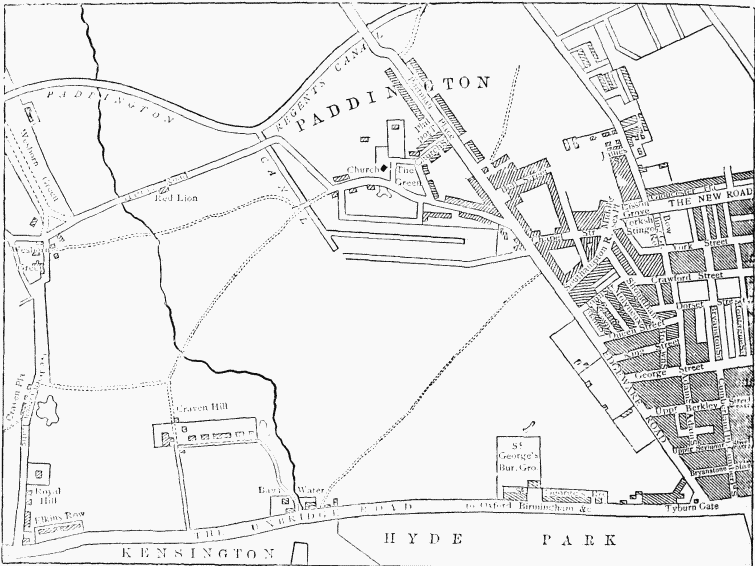
MAP OF PADDINGTON, IN 1815.
Shortly afterwards Haydon wrote—and we can readily imagine the spirit in which he jotted down the lines—"They rush by thousands to see Tom Thumb. They push, they fight, they scream, they faint, they cry 'Help!' and 'Murder!' They see my bills and caravan, but do not read them; their eyes are on them, but their sense is gone. It is an insanity, a furor, a dream, of which I would not have believed England could have been guilty."
Mr. Cyrus Redding thus speaks, in his "Fifty Years' Reminiscences," of Paddington Green and its churchyard in the year 1806:—"At such times I crossed Paddington Green, and the new part of the churchyard, since thickly encumbered with memorials of the dead. There were then only three or four tombstones to be seen in that part. One nearest the iron palisades was placed by Lord Petre in memory of an excellent man and scholar, Dr. Geddes. He was the author of a new translation of some part of the Holy Scriptures. The Catholics and High Church Protestants did not approve of his conduct, because, in place of vindicating the authority of their churches in matters of religion, he supported the right of private judgment. His stone I saw in perfect preservation but a few years ago, in the same place as at first. It must have been designedly removed. Perhaps the epitaph displeased some strait-laced official. I will repeat it from memory, though I am not certain I am correct to a word. 'Christian is my name, Catholic my surname. If I cannot greet thee as a disciple of Jesus, still I should love thee as my fellow-man.'"
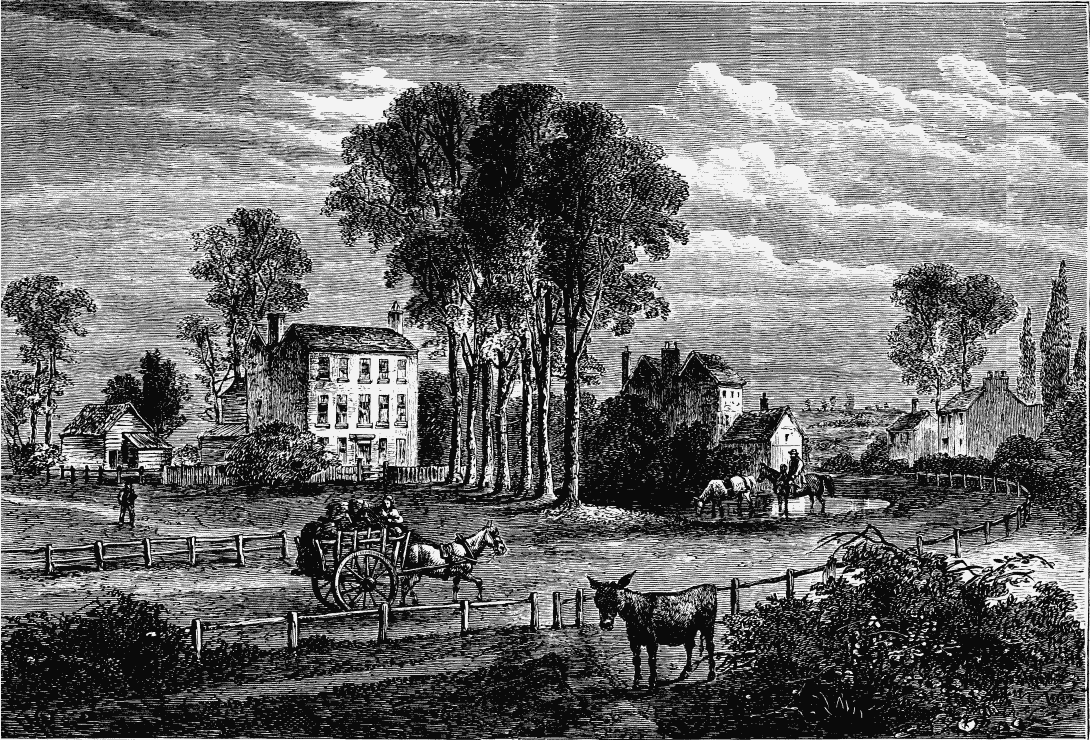
PADDINGTON GREEN IN 1750. (From a Drawing in Mr. Crace's Collection.)
The Church of St. Mary ceased to be the parish church of Paddington in 1845, when it was superseded by the new Church of St. James, at the west end of Oxford and Cambridge Terraces, and the south end of Westbourne Terrace. "By these means," says the Report of 1840, "accommodation will be provided for 4,000 persons, or including Bayswater Chapel, which may hereafter be made a parochial chapel, for more than 5,000 persons, in a parish supposed to contain 20,000 souls." The edifice, we are informed, was originally designed for a secular building, but was altered to suit the "taste of the times." In 1844–46 was built a new church, in the elaborate Gothic style, dedicated to the Holy Trinity, in Gloucester Gardens, Bishop's Road. It is a large church, capable of accommodating nearly 1,600 worshippers, and is built in the "Perpendicular" style of architecture, from the designs of Mr. Cundy. It has a very richly crocketed spire and pinnacled tower, upwards of 200 feet high, and a beautiful stained glass window in the chancel. The crypt is said to be on a level with the roofs of the houses in Belgrave Square. This fabric is the "pet church of Paddington," and its "fair proportions and elegance of form" were said in those days to be "pleasing to the eye of all who admire the architectural art." The building cost nearly £20,000. In 1847, All Saints' Church was erected in Cambridge Place, at the end of Star Street. It occupies a portion of the site of the old Grand Junction Waterworks' reservoir.
There is an ancient house still standing at the right-hand corner of Old Church Street, going from Paddington Green. The uppermost storey of the building slightly overhangs the lower one, and the ground surrounding the house has been so raised that a descent of a step has to be made on going into it. In this house, which was for some time a disagreeable-looking butcher's shop, and now serves as the office of the district surveyor, lived formerly the religious fanatic, Richard Brothers, who is said to have represented himself to be the "Nephew of God, and His prophet and preacher." His grave is in St. John's Wood Churchyard, appropriately opposite that of Joanna Southcote.
Paddington has long been noted for its old public-houses. In the etching above referred to is represented, apparently about a hundred yards to the south-west of the church, a large and lofty building, presumably an inn, as a large sign-board projects into the street in front. This there can be little difficulty in identifying with the "Dudley Arms," in Dudley Grove, Harrow Road, or, at all events, with its predecessor on the same spot. At the corner of Old Church Street and the Edgware Road is the "Wheatsheaf" Tavern. There is an engraving extant of this old tavern, which represents it as a lowly, thatched, roadside hostelry; and, notwithstanding the visits of Ben Jonson, tradition says the house bore no very good repute, as both that and the old "Pack-horse," in the Harrow Road, were the favourite resorts of the masked and mounted gentlemen who made the Uxbridge and Edgware Roads perilous to travellers down to the close of the last century.
The "White Lion," another old tavern in the Edgware Road, dates from 1524, "the year when hops were first imported." George Morland is said to have been the painter of the sign of the "White Lion," which used to hang in front of this tavern, where he used to carouse, along with his friends Ibbetson and Rathbone. At the "Red Lion," near the Harrow Road, tradition says that Shakespeare acted as a strolling player; another "Red Lion," formerly near the Harrow Road bridge over the bourn, is described in an "inquisition" dated as far back as the reign of Edward VI.
As recently as 1840, the year of the opening of the Great Western Railway, a wide and open space of land in this vicinity was occupied by market and nursery gardens, and the red-tiled weather-boarded cottages of labourers and laundresses. Eight or ten years later, the appearance of the district was entirely changed: terraces and squares of fine houses had risen up in every direction west of the bourn; but the approaches to it from the Edgware Road, whether by Praed Street or the Harrow Road, were very deplorable. They are not much better even now; but as the grimy-looking houses at the entrance to the Harrow Road are in the course of removal, some improvement will eventually be brought about. We are informed, by a resident of some years' standing, that "anything more disgraceful than the appearance of the portion that remained of old Paddington Green it is impossible to imagine; all the refuse of the neighbourhood was heaped upon it, and the hollows filled with stagnant water, which made the place horrible to every sense. It was the play-ground of idle boys, and children uncared-for and squalid, who spent the day in fighting, swearing, shouting, crying, and throwing stones, so as to make the passing-by as dangerous as it was disagreeable. On all Sundays, and, in summer time, on week-day evenings, two or three self-constituted preachers, whose doctrines were as extraordinary as their English, were wont to establish themselves there, and rant and vociferate even louder than the boys; and, not unfrequently, a bold Freethinker stood up in opposition to them to propagate his reckless creed."
In 1865, the ground was at last enclosed and ornamentally laid out, and in the summer of the next year it was thrown open to the public. How great the improvement to the neighbourhood can be known only to those who saw it in the days of its degradation. The fine old houses skirting the further side of the Green put on a renovated appearance, and rents rose immediately; and now, instead of squalor and unruliness, decently-dressed people and children daily enjoy the grassy lawns, and flower-beds, and seats beside the gravel paths, and order and neatness reign there. The poor, too, are not excluded.
The Vestry Hall is another improvement of the last ten years; and the building of St. Mary Magdalene's Church another.
On Paddington Green was for some years the residence of Thomas Uwins, R.A., and here he painted his picture of "The Little Girl in the Brigand's Hat," so well known to us by the engraver's art. Here, too, was the studio of Wyatt, in which the equestrian statue of the Duke of Wellington, now at Hyde Park Corner, was moulded. The Rev. J. Richardson records, in his amusing "Recollections," the fact that twelve gentlemen sat down to a repast in the interior of the horse, like the Greeks in the belly of the Trojan horse, in imitation of Virgil's Æneid.
Literature and art have been represented among the inhabitants of this neighbourhood. Robert Browning has lived for some time in Warwick Crescent; and the venerable Chevalier de Chatelain, who has done useful work in translating various poems, and also Shakespeare's works, into French, resides next door to him, at Castelnau Lodge. At one time Mr. Babbage was resident here; and close by the canal lived the great lineengraver, Henry Robinson. George Colman, too, died here; he was buried, as already mentioned, at Kensington. (fn. 1) The Princess Charlotte was an occasional visitor at Dudley House, Paddington Green. The fields about there were pleasant places for a country ramble, even at the beginning of the present century. The author of the "Old City" writes:—"On a September day in 1807, I was walking on the banks of the Grand Junction Canal, at Paddington, and then quite in the country, when a plain private carriage drew up. Two ladies, one very young, and the other of middle age, got out, and commenced promenading. It was the Princess Charlotte and her governess, the Duchess of Northumberland, I think. They were both in plain morning dress, and evidently sought to avoid notice. The princess, tall and stout for her age (she was then eleven), wore a white muslin frock, and a straw bonnet, crossed by a plain white satin riband. The waist of the frock, according to the ugly fashion of the time, was placed high up under her arms, much as may be seen in her more mature portrait by Sir Thomas Lawrence. Her forehead was broad and rather high, her face full, and her nose prominent, but not disagreeably so. She might have been styled pleasing, but she had no pretensions to beauty; and she was more womanly than is usual with girls of the same age. She frequently asked questions of her elder companion, and the tones of her voice were soft and musical. Once, apparently forgetting her studied school-step, she was breaking into a run, but the duchess checked her by a look, and the decorous step was resumed. For a few minutes she escaped notice, but the instant that her rank was known, importunate promenaders began to throng about, and soon obliged her and the duchess to beat a retreat to the carriage." It is satisfactory to find that the fathers and grandfathers of the present generation were quite as ill-mannered and vulgar as the Englishmen and Englishwomen who "mobbed" Queen Adelaide when she paid a visit to the palm-house at Kew, or intruded their gaze upon Queen Victoria at Brighton, on her accession to the throne, and so drove her from the place. Dudley House is kept in remembrance by the "Dudley Arms" Tavern and Dudley Grove, in the Harrow Road.
At the close of the last century, Mrs. Hutchins and Mr. Samuel Pepys Cockerell were the two principal residents in Westbourne Green; and Paddington Green boasted John Chamberlain and John Symonds amongst its inhabitants.
Paddington House is described, at the commencement of the present century, as "a handsome brick edifice, on the east side of the Green." It is said to have been built by a certain Mr. Dennis Chirac, who, having made a fortune as jeweller to Queen Anne, chose late in life to retire here into the country. Having long since been converted into shops, it was pulled down in 1876.
Hone, in his "Every-Day Book," mentions Paddington as one of the suburbs of London which formerly were enlivened by the "Jack in the Green on May Day." "The last specimens of the 'Jacks in the Green' that I remember," he writes, in 1827, "were at the Paddington May-dance, near the 'Yorkshire Stingo,' about twenty years ago, whence, as I heard, they diverged to Bayswater, Kentish Town, and the adjoining neighbourhood. A 'Jack o' the Green' always carried a long walkingstick with floral wreaths; he whisked it about in the dance, and afterwards walked with it in high estate, like a Lord Mayor's footman." We have already mentioned the May-pole in our account of the Strand. (fn. 2)
"It was a pleasant sight to see
A little village company
Drawn out upon the first of May
To have their annual holyday:
The pole hung round with garlands gay,
The young ones footing it away;
The aged cheering their old souls
With recollections and their bowls,
Or, on the mirth and dancing failing,
Then ofttimes told old tales re-taleing."—Hone.
Westbourne Place, situated close to the Green, was the residence, successively, of Isaac Ware (the architect, and editor of Palladio's works); of Sir William Yorke, Chief Justice of the Court of Common Pleas; of J. Coulson, Esq.; of Mr. Samuel Pepys Cockerell; and, lastly, of the veteran Peninsular General, Lord Hill, who here entertained William IV. and Queen Adelaide. In the Universal Magazine for September, 1793, appears the following notice of the mansion and its surroundings:—"Westbourne Place, the handsome villa of Jukes Coulson, Esq., an eminent anchor-smith in Thames Street, London, is situated at Westbourne Green, one mile and a half from Tyburn Turnpike, and three-quarters of a mile from the new church at Paddington. This green is one of those beautifully rural spots for which that parish, although contiguous to the metropolis, is distinguished. The house is situated on a rising ground, which commands a pleasing view of Hampstead and Highgate; the village of Paddington, with the elegant new church, produces a pretty effect when viewed from hence; and as no part of London can be seen, a person disposed to enjoy the pleasures of rural retirement might here forget his proximity to the 'busy hum of men.' The house was built by Mr. Isaac Ware, who quitted the ignoble profession of a chimney-sweeper, and commencing the man of science and taste, was employed in building many houses, and distinguished himself, moreover, by some books on the subject of architecture. The gardens and pleasure-grounds are laid out with great taste; and close to Mr. Coulson's elegant mansion is a farm-house, which is occupied as an occasional country residence by the Most Noble George Grenville Nugent, Marquis of Buckingham."
Hughson, who published his "History of London and its Neighbourhood" in 1809, and who, by the way, does not appear to have had a single subscriber for his work in this neighbourhood, writes of Westbourne Green, that "it is one of those beautifully rural spots for which Paddington is distinguished. It occupies rising ground, and commands a lovely view of Hampstead and Highgate, with the distant city. An important mansion, called Westbourne Place, is situated here, built by that born architect, Isaac Wàre, the editor of Palladio's works, who, originally a sweep, became conspicuous as a student of art and science, and the proprietor of the estate of Westbourne Green." Mr. Coulson inhabited Westbourne Place when Hughson wrote. At that time this house and gardens must have occupied the ground on which the Lock Hospital stands; this institution remaining at Grosvenor Place till 1842. "In the reign of William IV.," writes the Rev. J. Richardson, in his "Recollections," "this spot was really what its name implied," a green. It was not built over till long into the reign of Queen Victoria.
Desborough Place, a small row of the houses to be seen on the south-west side of the Harrow Road, before reaching the Lock Hospital, adjoins an old mansion, now partly pulled down, called Desborough House, after John Desborough, or Disbrowe, the brother-in-law of the "Lord Protector Cromwell"—that "ploughman Desborough," as Oliver would often style him, half in jest and half in earnest.
There is a discrepancy between Robins and Mr. Peter Cunningham as to the whereabouts of Mrs. Siddons' residence in Paddington, the one placing her in Desborough Lodge, the other in a house and grounds levelled to make room for the Great Western Railway; but Incledon, the singer, describes a visit to the great tragedienne, at her villa on "Westbourne Green," which is situated at the top of the Harrow Road, close to the Lock Hospital, and where formerly several genteel houses stood; but now only the name remains.
Westbourne Farm—for so, as we have stated previously, Mrs. Siddons' cottage was called—was standing down to about the year 1860, when it was demolished to make room for a row of shops and houses. It was a little retired house in a garden, screened with poplars and other trees, resembling a modest rural vicarage. This was at one time the residence of Madame Vestris; but, before her, Mrs. Siddons liked to withdraw here from the noise and din of London. The following amusing description of the place is said to be from the pen of her husband:—
"On Mrs. Siddons' Cottage at Westbourne.
"Would you I'd Westbourne Farm describe?
I'll do it, then, and free from gall;
For sure it would be sin to gibe
A thing so pretty and so small.
"A poplar-walk, if you have strength,
Will take a minute's time to step it;
Nay, certes 'tis of such a length
'Twould almost tire a frog to leap it.
"But when the pleasure-ground is seen,
Then what a burst comes on the view!
Its level walk, its shaven green,
For which a razor's stroke would do.
"Now, pray be cautious when you enter,
And curb your strides with much expansion;
Three paces take you to the centre;
Three more, you're close against the mansion.
"The mansion, cottage, house, or hut—
Call't what you will—has room within
To lodge the King of Lilliput,
But not his court nor yet his queen.
"The kitchen-garden, true to keeping,
Has length, and breadth, and width in plenty;
A snail, if fairly set a-creeping,
Could scarce go round while you told twenty.
"Perhaps you'll cry, on hearing this,
'What, everything so very small!'
No; she that made it what it is
Has greatness that makes up for all."
The great actress was certainly living here in 1806, and the following year, for Cyrus Redding thus mentions her abode, in his "Fifty Years' Recollections:"—"I did not slumber in bed, often rising at four o'clock, walking to Manchester Square, calling up a friend there, and then going into the country to an inn near Mrs. Siddons' villa, a little on the town side of Kensal Green, but then far in the green fields. We breakfasted together. I returned to Gough Square, sometimes before my fellow-lodger had left his bed, and generally before ten o'clock; thus I gained six hours on the day."
The Lock Hospital and Asylum, which stand on the opposite side of the Harrow Road, derive their name from the "Loke," or "Lock," in Kent Street, Southwark, an ancient hospital for lepers. The name may have been derived, as suggested by a writer in Notes and Queries, from the old French word loques, "rags"—referring to the linen rags applied to sores; but with more probability it comes, as Archer is inclined to believe, in his "Vestigia," from the Saxon log or loc, equivalent to "shut," or "closed," in reference to the isolated condition of the leper.
This hospital was founded in 1746, and the asylum about forty years later, mainly by the efforts of the Rev. Thomas Scott, the well-known Biblical commentator; and it is mentioned in Strype's edition of "Stow," in 1765, as being "at Pimlico." It was removed hither from Grosvenor Place (fn. 3) in 1842. A chapel has been attached to it since 1764. In 1849 its authorities were able to double the number of patients and penitents, through the help of the late Duke of Cambridge, who issued an autograph appeal on behalf of the charity. This establishment is in reality a branch of the Lock Hospital, and is intended for the reception of females only; the branch for males is situated in Dean Street, Soho. From the published report, we learn that since the foundation of the asylum, the institution has been the means of giving the advantages of domestic training to about three thousand females. During the year 1875, no less than fifty young women were fitted for service, nearly all of whom have given satisfactory proof of real amendment by their conduct in their situations; whilst of those sent out in previous years, many have earned the reward given by the committee of the institution for remaining twelve months in the same situation; several have been restored to friends; whilst others have testified to the great change that has been effected in them by contributing from their scanty earnings to the support of the institution, which has rescued them from a life of misery. The buildings here cover a large extent of ground, and the gardens surrounding them are well planted with trees and shrubs.
Although not in the immediate vicinity of the Lock Hospital, it may not be altogether out of place here to speak of one or two other institutions, devoted to charitable purposes, which exist in the parish. St. Mary's Hospital, originally styled the Marylebone and Paddington Hospital, stands in Cambridge Place, on a site which once formed the reservoir of the Grand Junction Waterworks, between the Great Western Railway Terminus and the Harrow Road, in the centre of a crowded neighbourhood. The first stone was laid by the Prince Consort, in June, 1845, and the first ward was opened in 1850. It is built of red brick, with stone dressings, and was erected from the designs of Mr. Thomas Hopper and Mr. J. H. Wyatt. The building will accommodate 180 beds, and in its construction the greatest attention was paid to the ventilation and warming. Twelve hundred cubic feet of space, at least, is allotted to each bed. This is the only general hospital for an extensive and populous district of the metropolis, and its doors are ever open for the relief of the sick and maimed. It receives annually, as in-patients, about 1,800 cases of serious accident or disease, and as outpatients and casualties about 20,000. All poor persons applying for relief for accident or disease of extreme urgency, are admissible, after due examination, without any letter of recommendation. The laws of the institution provide that there shall be "a chaplain, who is required to be in full orders in the Church of England; and, in addition to the ordinary duties of his office in ministering to the spiritual wants of the inmates of the hospital, he is to be the principal of the collegiate establishment." The staff of the hospital, according to the original report, consists of three physicians, three assistant physicians, three surgeons, three assistant surgeons, a physician-accoucheur, a surgeon-accoucheur, an ophthalmic surgeon, and an aural surgeon. The laws of the hospital provide for four resident medical officers, all of whom are to be fully qualified medical practitioners.
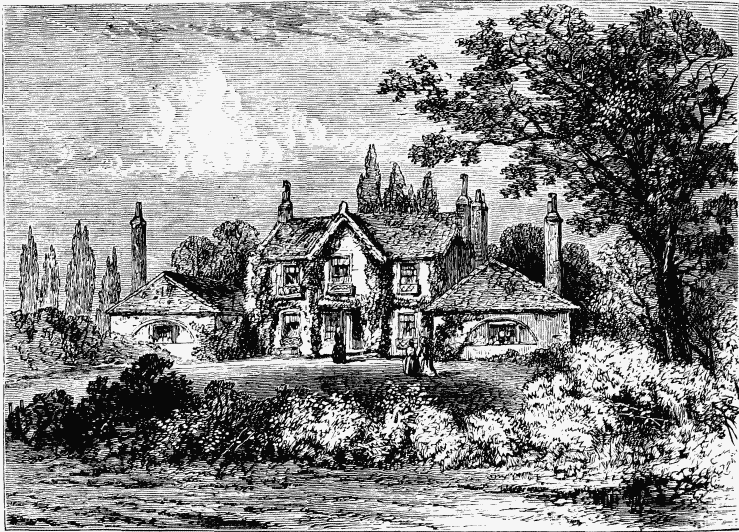
MRS. SIDDONS' HOUSE AT WESTBOURNE GREEN, 1800.
"In the Hospital Medical School and Medical Collegiate Establishment the determination of the course of education, the rules and regulations for the government and conduct of the pupils, and the appointment of all lecturers and teachers, is vested, under the advice of the medical committee, in the governors at large; and every pupil of the school is responsible to the board for his good conduct." The laws, it may be added, are framed in the most liberal spirit towards the medical profession. "The medical committee consists of the ten principal medical officers in the various departments of the hospital for the time being, and ten medical governors of the charity who do not hold any office in the hospital or hospital school, elected annually. All legally qualified medical and surgical practitioners, being governors, are eligible to be members of this committee; and legally qualified medical and surgical practitioners, whether governors or not, are at liberty, on a proper introduction, to attend the practice of the hospital. The medical governors are also at liberty to attend all lectures delivered by the teachers in the hospital school; and if residing within half a mile of the hospital, they are entitled to be summoned to all important operations, on paying a trifling contribution towards the expense of summoning. Thus the medical profession at large has every opportunity to form its opinion of the principles and practice taught in the hospital, an efficient voice in the management of the medical affairs of the institution, and a direct influence in the system of education to be adopted in the hospital school, of which their own sons or private pupils might be members."
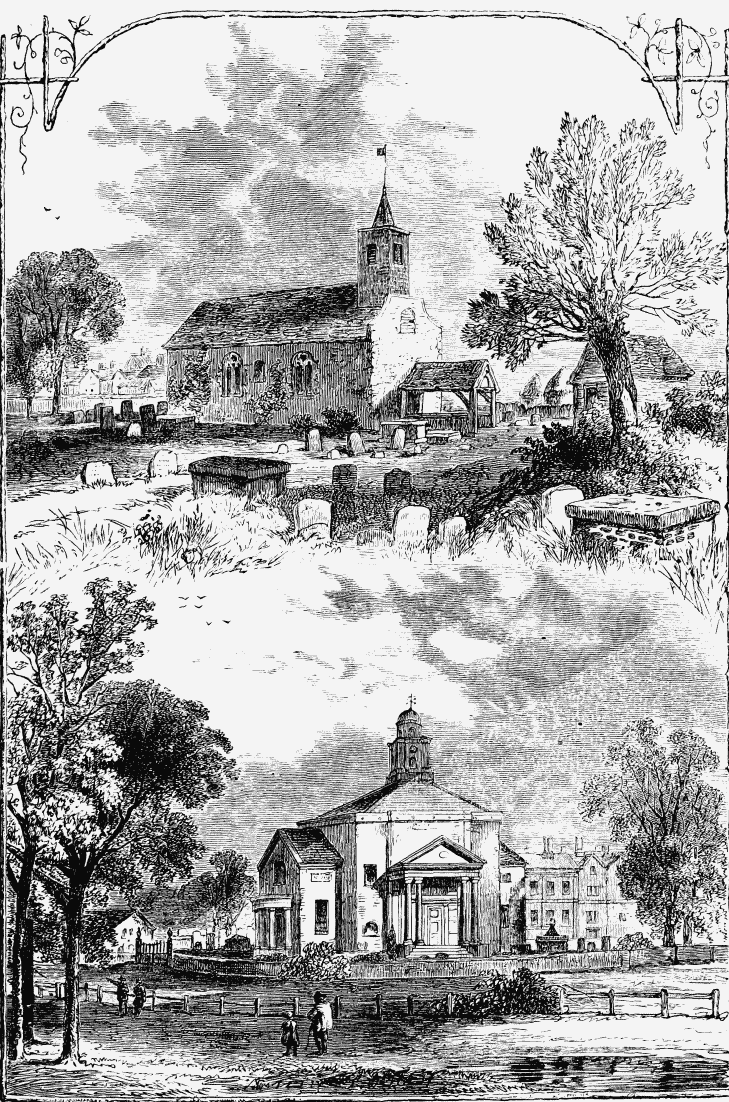
PADDINGTON CHURCH; 1750 AND 1805.
St. Mary's Hospital, being without endowment, is supported entirely by the voluntary contributions and donations of the public at large; and when the number of patients annually relieved is taken into consideration, it is easy to imagine that the expenses of the institution are very great, amounting as they do to something like £10,000 annually. Within a short distance of St. Mary's is another charitable institution, the Paddington Provident Dispensary, which dates its career of usefulness from the year 1838. Upwards of 7,000 persons are relieved here during the course of the year. Another very useful charity in the neighbourhood is the Dudley Stuart "Home for the Houseless," in Market Street, close by. Here a temporary home is afforded to destitute and houseless persons of good character, and means are adopted for restoring them to their position in life.
There is a chapel in the Harrow Road, on the south side, at the entrance to Paddington Green; it is for the use of the Irvingites, or members of the Apostolic Church; and among those set apart for the use of other denominations is one called "The Boatman's Chapel," which stands on ground leased to the Grand Junction Canal Company. "This place of worship," Mr. Robins tells us, in his book on Paddington, "was constructed out of a stable and coach-house, at the expense of a few pious individuals, who saw how much the poor boatmen wanted the advantages which accrue from religious instruction, and how little likely they were to get it in a parish-church, which could not hold one-fourth part of the settled inhabitants. This little place of worship is in connection with 'Paddington Chapel'—a place of worship belonging to the Independents."
The formation of the Great Western Railway caused a slight diversion of the Harrow Road, which was carried by a bridge over the canal, and so round by what is now Blomfield Terrace to Westbourne Green. It is on record that John Lyon, the founder of Harrow School, left forty acres of land in the parish of Marylebone, and another plot at Kilburn, for the purpose of repairing the roads between London, Harrow, and Edgware; and now the rents of Hamilton Terrace, Abercorn Place, &c., are applied to the purpose.
The road, at a little distance from London, was a dangerous one, being infested by footpads as recently as the year 1827, when Mr. Allardin, a respectable veterinary surgeon, residing at Lisson Grove, was made to dismount from his horse, robbed, and brutally ill-treated, about a mile from Paddington Green.
On the north side of the Harrow Road, a short distance beyond the Lock Hospital, a model town has sprung up within the last two years, under the auspices of the Artisans', Labourers', and General Dwellings Company. Queen's Park—for so this batch of dwellings is called—occupies a site about eighty acres in extent, and the houses are designed to accommodate no less than 16,000 persons. This model city has (or will have) its own lecturehall and institute, its co-operative stores, coaldepôt, dairy-farm, baths and wash-houses, and other buildings. It is the intention of the promoters of the company that there shall be no public-house on the estate; while, at the same time, every opportunity will be taken to promote and develop temperance principles by the formation of temperance societies and "bands of hope;" and reading-rooms, discussion clubs, libraries, and other substitutes for "the house round the corner," will be a marked feature. This certainly is a sign of improvement from the state of things which existed a quarter of a century ago; for, apart from the public establishments to which we have referred above, there were no places for rational amusement—unless, indeed, we consider such places as the "Flora Tea-gardens," and "Bott's Bowlinggreen," to come under this designation. "In that region of the parish, still devoted to bull-dogs and pet spaniels," writes Mr. Robins in 1853, "the bodies of broken-down carriages, old wheels, rusty grates, and old copper boilers, little gardens, and low miserable sheds, there is an establishment which boasts of having the truly attractive glass, in which, 'for the small charge of two-pence, any young lady may behold her future husband.' But although such attractions as these exist, the youths who live on the celebrated Paddington estate have not to thank the lords of the soil for setting apart any portion of it for their physical improvement. In Paddington there is no public gymnasium; there is now no village-green worthy of the name; the young are not trained to use their motive powers to the best advantage; there are no public baths. And when, on the establishment of the baths and wash-houses in Marylebone, the governing body in Paddington was solicited to join in that useful work, that good offer was rejected, and the people of Marylebone were permitted to carry out that necessary and useful undertaking by themselves." In 1874, however, any difficulties that may have existed with reference to the above subject were surmounted, and some extensive baths and wash-houses were erected in the Queen's Road, at a cost, inclusive of land, of about £40,000.
In the Harrow Road, on a portion of what had been Paddington Green, stood, till about 1860, the oldest charitable building in the parish; it was a block of small almshouses, said to have been built in 1714. It afforded shelter for sixteen poor old women belonging to the parish, who were supported there out of the poor-rates. The inmates, doubtless, felt themselves more "at home" here than they would do if compelled to take up their quarters in the great parish poor-house, which is situated on a portion of the land once known as "The Upper Readings," purchased by the Bishop of London and the trustees of the Paddington estate, immediately to the west of the Lock Hospital. In the end, however, the almshouses were swept away in the course of parochial improvements.
Running westward through the parish, almost in a line with the Harrow Road, is the Paddington and Grand Junction Canal. The success of the Duke of Bridgewater's canal between Liverpool and Manchester led to the passing of an Act of Parliament, in 1795, for the formation of the Paddington Canal, which was opened for traffic on the 1st of June, 1801, when the first barge arrived, with passengers from Uxbridge, at the Paddington basin. There were public rejoicings, and all the northwestern suburb was en fête in honour of the occasion. Bells were rung, flags were hung out, and cannon were fired; and one enthusiastic Paddingtonian had good reason to remember the day, for the gun which he was firing burst and shattered his arm. But the Grand Junction Canal Company were so elated at the thought of the public benefit which they had bestowed on the country, that they took a classical motto from Horace:—
"Æquè pauperibus prodest, locupletibus æquè."
In 1853, Mr. Robins, in his work above referred to, writes:—"The glory of the first public company which shed its influence over Paddington has, in a great measure, departed; the shares of the Grand Junction Canal Company are below par, though the traffic on this silent highway to Paddington is still considerable; and the cheap trips into the country offered by its means during the summer months are beginning to be highly appreciated by the people, who are pent in close lanes and alleys; and I have no doubt the shareholders' dividends would not be diminished by a more liberal attention to this want. If every one had their right," continues the writer, "I am told there would be a wharf adjoining this canal, open free of cost to the people of Paddington for loading and unloading goods. It is certain that the old road to Harrow was never leased to the Grand Junction Canal Company; but a wharf, upwards of one hundred feet wide, now exists in a portion of that road; and, as I am informed, the rent of this wharf is not received by the parish." At its first opening, passenger boats went about five times a week from Paddington to Uxbridge; and the wharves at Paddington presented for some years a most animated and busy appearance, on account of the quantity of goods warehoused there for transit to and from the metropolis, causing the growth of an industrious population around them. But this was only a brief gleam of prosperity, for when the Regent's Canal was opened, the goods were conveyed by barges straight to the north and eastern suburbs, and the wharfage-ground at Paddington suffered a great deterioration in consequence.
In 1812 the Regent's Canal was commenced. This undertaking, which was completed and opened in 1820, begins at Paddington, and passing under the Edgware Road, Maida Hill, and St. John's Wood, by a tunnel 372 yards in length, opens into a basin near the "Jew's Harp;" thence the canal passes on to Camden Town and Islington, and then by a tunnel into the City Road, by Kingsland and Hackney, and so on to Stepney Fields and Limehouse, where it joins the Thames. In its course through London there are no less than twelve locks and about forty bridges. "On the banks of the canal," says Mr. John Timbs, "the immense heaps of dust and ashes, once towering above the house-tops, are said to have been worth £10,000 a heap."
At the western extremity of the parish an artesian well was formed, to which the name of "The Western Water-works" was given. The water from this well supplied the houses which were built on that clayey district; the West Middlesex and Grand Junction Water-works Companies supplying the other parts of this parish.
In 1824 gas was first introduced into the parish, on the establishment of the Imperial Gas Company. Up to this time, during the long winter evenings, the muddy roads which led to the cottages on the Paddington estate were in total darkness, unless the "parish lantern" chanced to offer its acceptable light. The parish surveyors, in a report to the vestry on the state of these cottages, in 1816, say—"We cannot refrain from thus recording our expression of regret that the ground-landlords should be so inordinate in their demands; the effect of which is, the buildings are ill-calculated to afford shelter from the inclemency of the weather, and the want of drainage and consequent damp produce disease, filth, and wretchedness." The cottages here referred to, which were for many years so prominent a feature in the parish, and so much sought after by the poor, as a sort of "country retreat," were, at the beginning of this century, the generators of "disease, filth, and wretchedness."
As a proof of the poverty-stricken character of the inhabitants of Paddington, it may be stated that a wretched hovel here was, in 1813, the scene of the death of a well-known beggar at the West End, and that upwards of £200 was found hoarded up in his chests—a sum which was claimed by a female partner of his trade. Among his effects was a paper in which were recorded the various profits which he had made in different parts of London by begging—a most interesting and curious document, and one well worthy of the attention of the Society for the Suppression of Mendicity.
"The transition state from an agricultural village to the fashionable Tyburnia," writes Mr. Robins, "was no very agreeable time for the majority of those who lived in Paddington. When the cottages were swept away, and the heavy poor-rates which they had entailed were diminished, new burdens sprang up, scarcely less grievous. Rents became enormous; the Highway, Watching, and Lighting Rates were excessive; and these were rendered more oppressive, on account of those who received the greatest benefit from the causes which necessitated the greater expenditure not bearing their just share of this local taxation."
On the north-west side of the parish is Kensal New Town, with its appendage of Kensal Green. In his work already quoted, Mr. Robins writes:—"Kensell, or Kensale, comes, as I take it, from King's-field. In the Harleian MS. (No. 606, f. 46 b.), the Green of this name is called Kellsell, and Kingefelde. In Mary's reign, we perceive by this document also that 'the Green Lane,' and 'Kingefelde Green,' were the same place. And as 'the Green Lanes' still exist—in name—we may ascertain with something like accuracy the situation of this field, or green, which formerly belonged to the king." Here is the best known of the London cemeteries. It occupies a considerable space of ground between the Grand Junction Canal and the North-Western Railway, and has its entrance lodge and gateway in the Harrow Road. The necessity of providing cemeteries out of town, though not as yet enforced by Parliament, was felt so keenly, that a company was formed in 1832, and fifty-six acres of ground at Kensal Green—then two miles distant from the metropolis—were purchased, laid out, and planted. And no sooner was the cemetery opened than the boon was eagerly embraced by the public, and marble obelisks and urns began to rise among the cypresses in all the variety which heathen and classical allusions could suggest. In the course of the next five years other cemetery companies were formed at Highgate, Norwood, Nunhead, &c., and now we have in the suburbs of London some ten or twelve humble rivals of the Père la Chaise of Paris. The Bishop of London, however, opposed in Parliament the Bill for the formation of these new cemeteries; and one of his archdeacons, a City rector, wrote a pamphlet or a charge to prove that City churchyards were rather healthy than otherwise! After overcoming all sorts of difficulties, the cemetery here was laid out on the principle of Père la Chaise. The principal entrance is a noble erection of the Doric order, one wing of which forms the office, and the other the residence of the superintendent. Against the northern boundary wall, and parallel with the Episcopal Chapel, is a small colonnade, and beneath this are the old or original catacombs. Every space in these vaults has been long since occupied, but the same care, it may be remarked, is nevertheless observable, on the part of the company, to preserve them in that orderly condition which is observable in the more recent interments. The extensive colonnades and chambers for the erection of tablets to the memory of persons whose remains are resting in the catacombs below, are spots where the visitor to the cemetery may find an almost endless number of subjects for meditation. The names of statesmen, soldiers, poets, and philosophers, are inscribed side by side on the sculptured slabs which adorn the walls. In a notice of it, printed in 1839, Kensal Green Cemetery is described as "a flourishing concern; the original £25 shares being already at £52." Here are buried the Duke of Sussex, Sydney Smith, Sir W. Beatty (Nelson's surgeon), Sir Anthony Carlisle, Dr. Valpy, Anne Scott and Sophia Lockhart, daughter of Sir Walter Scott and John Hugh Lockhart, his grandson, the "Hugh Little-John" of the "Tales of a Grandfather;" Thomas Hood, Liston, Ducrow, Madame Vestris; Calcott, Daniell, and Mulready, the painters; William C. Macready, Allan Cunningham, J. C. Loudon, William Makepeace Thackeray, Shirley Brooks, John Leech, the well-known comic artist; John Cassell, and many other men of mark; indeed, Kensal Green may now be called the "God's Acre" of London celebrities, a character, however, which it divides to some extent with Norwood, Highgate, and Nunhead Cemeteries. The Princess Sophia also is buried here. Why his Royal Highness the Duke of Sussex chose this spot for his last resting-place is told by Mr. Mark Boyd, in his "Social Sketches:"—" At the funeral of William IV. there was so much of delay and confusion, and so many questions of etiquette and precedence broke out, that the duke remarked to a friend, 'This is intolerable. Now, recollect what I say to you. If I should die before I return to Kensington, see I am not buried at Windsor; as I would not be buried there after this fashion for all the world.'" It was at first proposed that Thackeray should be buried in the Temple Church, where lie the ashes of Goldsmith, whom he so tenderly censured in his "Lectures on the Humorists;" but after consultation with his relatives, it was deemed better that he should be laid to rest with his own family at Kensal Green. Accordingly, on December 30th, 1863, a bright, balmy day, almost like spring, Thackeray was here consigned to his last rest, being followed to the grave by his friends Dickens, A. Trollope, Mark Lemon, Theodore Martin, G. H. Lewes, Robert Bell, Millais, Robert Browning, George Cruickshank, John Leech, and Shirley Brooks.
Leigh Hunt, too, lies buried here. His grave
was for years without a stone, or any other distinguishing mark, until, through the advocacy of
Mr. Samuel Carter Hall, in the columns of the
Art Journal, a subscription was set on foot,
and in 1874–75 a monument was erected to
the poet's memory. We may mention also the
names of George Dyer, the historian of Cambridge; Thomas Barnes, the "Thunderer" of the
Times; Dr. Birkbeck, the founder of Mechanics'
Institutions; John Murray, the publisher; and the
famous George Robins, the auctioneer, of whom
we have already spoken in our account of Covent
Garden. The following lines, though of a mockheroic character, which have been handed down
respecting him, serve to show that he was regarded
in his day as a typical personage:—
"High in a hall, by curious listeners fill'd,
Sat one whose soul seem'd steeped in poësy;
So bland his diction, it was plain he will'd
His hearers all should prize as high as he
The gorgeous works of art there plac'd around.
The statues by the Phidian chisel wrought:
Endymion, whom Dian lov'd distraught;
Dian herself, Laocöon serpent-bound;
The pictures touch'd by Titian and Vandyke,
With rainbow pencils, in the which did vie
Fair form and colour for the mastery;
Warm'd his discourse till ear ne'er heard the like.
'Who is that eloquent man?' I asked one near.
'That, sir? that's Mr. Robins, auctioneer.'"
Besides those whose names we have mentioned, there are also buried here the Right Hon. Joseph Planta, Sir George Murray, Sir Edward Hyde East, Sir John Sinclair, Chief Justice Tindal, the Marquis of Thomond, the Bishops of St. David's (Dr. Jenkinson) and Quebec (Dr. Stewart), and a very large number of the aristocracy.
The practice of burying the dead in cities is of necessity injurious to the public health; and it is strange that, in a city like London, where no expense has been spared in promoting sanitary measures, it should so long have been permitted and tolerated. It was a custom of very early antiquity to attach burying-grounds to Christian churches, though both the Jews of old and the heathen Romans buried their dead in caves and tombs by the road-side, as shown by the constant inscription of "Siste Viator," instead of "Sacred to the Memory of." But when streets and whole towns grew up around these consecrated spots, the public convenience and decency could not fail to suggest the expediency of having the depositories of the dead at a distance from the dwellings of the living. Accordingly, most Continental cities have their cemeteries in the suburbs; but the servile adherence of our people to ancient customs, even when shown to be bad, kept up this loathsome practice in the midst of our dense population until some twenty years after the accession of Queen Victoria, when many of the City churches, and some at the West End also, were little better than charnel-houses; and their dead increased in numbers so rapidly that one sexton started the question whether he might not refuse to admit an iron coffin into a church or churchyard, because in that case the deceased took a fee-simple in the ground, which ought to be granted him only for a term of years! It is perhaps a matter of complaint that it has never entered into the contemplation of the Legislature, or even of an individual, to form a general and extensive cemetery in the suburbs of the metropolis.
Although perhaps not actually within the limits of Paddington, we may add that a plot of ground on the west side of the cemetery, nearer Willesden, was, about the year 1860, secured by the Roman Catholics of London as a place of burial. Among the earliest who were interred here was Cardinal Wiseman, who, as we have already stated, (fn. 4) died at his residence in York Place, Baker Street, in February, 1865. The body of the cardinal was taken first to the chapel of St. Mary, Moorfields, where part of the service was celebrated, after which the funeral cortége, of considerable length and imposing appearance, passed on its way hither, through the streets of London.
Beyond the cemetery there is but little of interest to note in this part of Paddington. An old tavern once stood here, called "The Plough," of which Faulkner, in 1820, says:—"It has been built upwards of three hundred years. The timber and joists, being of oak, are still in good preservation." George Morland, the painter, was much pleased with this then sequestered and quiet place, and spent much of his time here towards the close of his life, surrounded by those rustic scenes which his pencil has so faithfully and so ably delineated. In the same neighbourhood, apparently, resided Robert Cromwell, a near relative of Oliver, the Protector. At all events, in the register of burials at Kensington, under date 1691, is an entry of "Cromwell," the "reputed" son of Robert Cromwell, of Kensal Green, and of Jane Saville, his servant.
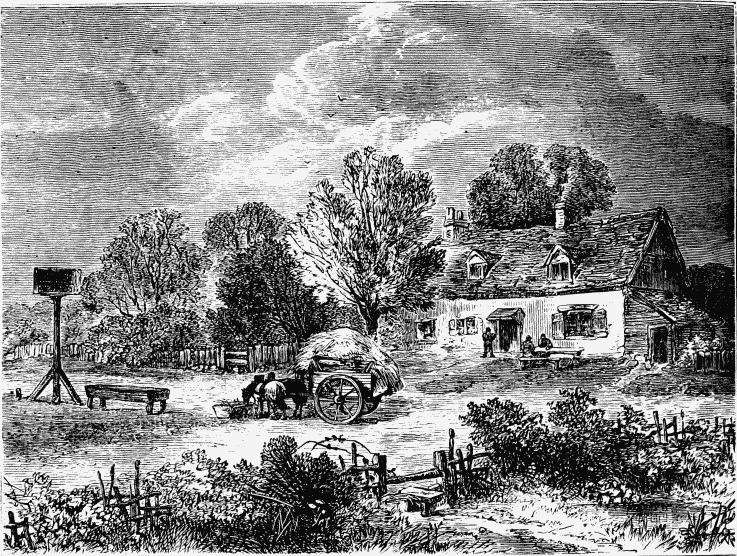
THE "PLOUGH" AT KENSAL GREEN, 1820.
In the matter of education, it is only within the last few years that Paddington appears to have made much progress. A Sunday-school, in connection with the parish church, was established here during the last century; but it was not till the beginning of this that any public means of instruction existed for the children of the poor on weekdays. Lysons, in his "Environs of London," tells us that "a charity-school for thirty boys and thirty girls was established in the parish in 1802," and that it was "supported by voluntary contributions, and the collections at an annual charity-sermon." This public day-school for poor children was one of the first established in the outskirts of London. The building, which was capable of accommodating only one hundred children, was erected on land said to have been given by Bishop Compton. In 1822, new school-rooms were built on a part of Paddington Green, on a spot which was formerly known as the "town pool." Since the above period, in consequence of the altered condition of Paddington, the parish has gone on increasing in the number of its schools, so that now it may doubtless claim to be on as good a footing as any other parish in the metropolis. A large Board School was opened in the neighbourhood of the Edgware Road in 1874–5.
We have already mentioned the naming of some of the streets and terraces after various bishops of London; one or two others, however, still remain to be spoken of. For instance, Tichborne Street, a turning out of the Edgware Road, although not built so far back as the reign of Henry VIII., reminds us of one "Nicholas Tychborne, gent., husband of the second daughter and co-heir of Alderman Fenroper;" and of "Alderman Tichbourn," one of Cromwell's peers and King Charles's judges.
Praed Street preserves the memory of a banker of that name, one of the first directors of the Grand Junction Canal Company. This street connects Edgware Road with the Great Western Railway Terminus and Hotel. The latter is a magnificent building, and was one of the first constructed on the "monster" principle in connection with the railway terminus, with which it has communication by a covered passage. The edifice in itself comprises five separate floors, containing in all upwards of one hundred and fifty rooms, the chief of which are large and lofty, and beautifully ornamented; the designs generally, in the Louis Quatorze style, were executed by Mr. Philip Hardwick, R.A., and the pediment upon the front is surmounted by a piece of allegorical sculpture. The Great Western Railway line, which communicates with the west and extreme south-west of England, is situated close to and below the level of the terminal wharf of the Paddington branch of the Grand Junction Canal. The Act of incorporation, under which this line was formed, was passed in the year 1835; and it was intended to connect the seaport of Bristol and the great towns of the south-west with London. The original estimate for the construction of the railway was £2,500,000, or about £39,000 a mile. The line was constructed on that known as the "broad gauge," and the engineer was Mr. I. K. Brunel, son of Isambard Brunel. This estimate, however, was largely exceeded, the directors accounting for it by stating "that it is accounted for by the intended junction with the Birmingham line at Acton." In 1838 the railway was open only to Maidenhead; to Twyford in 1839; in the following year to Faringdon Road; and in 1841 it was completed to Bristol. It was at first proposed that this line should be connected with the London and Birmingham Railway at Kensal Green; but some obstacles having arisen to the satisfactory arrangement of this plan between the two companies, the intention was ultimately abandoned, and the Great Western Railway had an independent terminus erected here. To effect this it was necessary to construct about two and a-half miles of additional railway, while the total distance to be travelled would be lessened by about three miles. The Box Tunnel, on this line, is upwards of 3,000 yards in length. The various lines and branches now included in the Great Western system comprehend about 2,000 miles of railway.
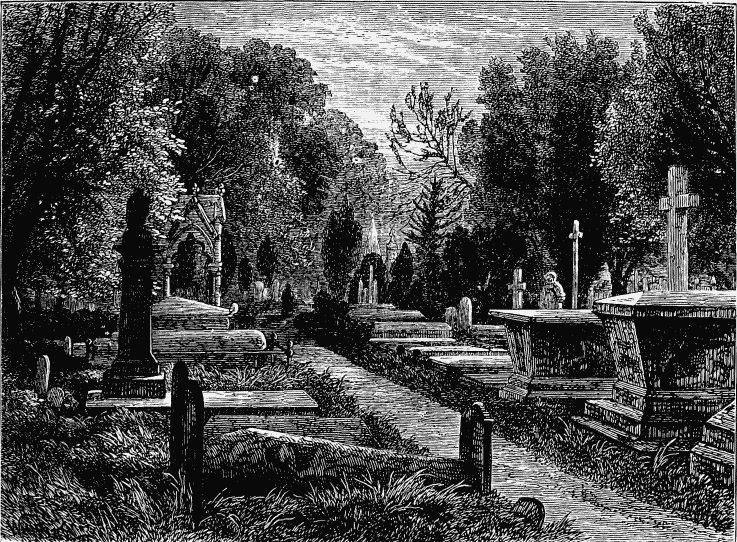
KENSAL GREEN CEMETERY.
The station itself, which, with its numerous departure and arrival platforms, offices, engine-sheds, and workshops, covers several acres of ground, is built close up to the hotel. Its chief feature, from an architectural point of view, is its triple-spanned roof of glass and iron; which, having been erected shortly after the Great Exhibition of 1851, may be said to have been one of the first adaptations of that principle of construction upon a gigantic scale; and it is almost needless to add that it has since been copied, more or less exactly, at almost all the large railway stations of the metropolis. The length of this building of glass is 263 yards, its breadth is 93 yards, and the central span of the roof is no less than 70 feet in height.
As an instance of the improvement made in travelling since the days of George I., we may mention that, whereas in 1725 the stage-coach journey from London to Exeter occupied four long summer days, the express train on the Great Western Railway now accomplishes the distance in little more than four hours. In those good old days, as we learn from letters still preserved in families of the west country, the passengers were roused each morning at two o'clock, started at three, dined at ten, and finished their day's journey at three in the afternoon!