
Old and New London: Volume 5. Originally published by Cassell, Petter & Galpin, London, 1878.
This free content was digitised by double rekeying. All rights reserved.
'Primrose Hill and Chalk Farm', in Old and New London: Volume 5, (London, 1878) pp. 287-300. British History Online https://www.british-history.ac.uk/old-new-london/vol5/pp287-300 [accessed 26 April 2024]
In this section
CHAPTER XXII.
PRIMROSE HILL AND CHALK FARM.
"—templa serena,
Despicere unde queas alios."—Lucretius, ii.
Situation of Primrose Hill, and its Appearance in Bygone Times—Barrow Hill and the West Middlesex Waterworks—The Manor of Chalcot—Murder of Sir Edmund Berry Godfrey—Duel between Ugo Foscolo and Graham—Primrose Hill purchased by the Crown, and made a Park for the People—The Tunnel through the Hill—Fireworks in Celebration of the Peace in 1856—The Shakespeare Oak—Lady Byron's Residence—Chalk Farm—Duels fought there—The Wrestling Club of Cumberland and Westmoreland—The Eccentric Lord Coleraine—The Old Chalk Farm Tavern—The Railway Station—Pickford's Goods Depôt—The Boys' Home—The "York and Albany" Tavern—Gloucester Gate—Albany Street—The Guards' Barracks—Park Village East—Cumberland Market—Munster Square—Osnaburgh Street—Sir Goldsworthy Gurney—The "Queen's Head and Artichoke"—Trinity Church.
As the Green Park forms a sort of supplement and appendage to St. James's Park, so does Primrose Hill to the Regent's Park: it has the character of a "park for the people," and its associations are the reverse of aristocratic. The hill lies on the north side of the park, and its name still bears testimony to its rural and retired situation, when its sides were covered with brushwood and an undergrowth of early spring flowers. Going back to the time of the Roman settlers, we find that when they planted their colony on the banks of the Thames and founded London, most part of the northern district consisted of a large forest filled with wolves and other wild animals. Early in the thirteenth century the forest of Middlesex was disafforested, but although portions were cleared, St. John's Wood, as we have already seen, remained sufficiently dense in Queen Elizabeth's reign to afford shelter and concealment to Babington, the conspirator, and his associates. At that time, however, the slopes of Primrose Hill were used as meadow land, and were probably in the mind of writers who allude to the many "haicockes in July at Pancredge" (St. Pancras), as a thing known to everybody. This district dates back to very early times, if we may accept the name of Barrow Hill—formerly Greenberry Hill—which lies on its western side, as evidence that it was once the scene of a battle and place of sepulture for the slain. There was formerly a Barrow Farm, and Barrow Hill itself is now occupied by the reservoir of the West Middlesex Waterworks. The name survives in Barrow Hill Place and Road.
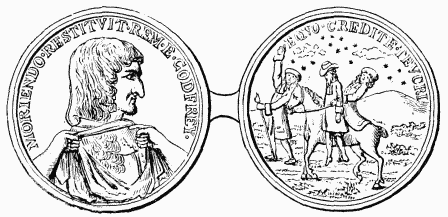
MEDAL TO COMMEMORATE THE MURDER OF GODFREY.
"The definite history of the place," says a writer in the Builder, "dates from the time when 'sundry devout men of London' gave to the Leper Hospital of St. James (afterwards St. James's Palace) four hides of land in the field of Westminster, and eighty acres of land and wood in Hendon, Chalcot, and Hampstead. Edward I. conrmed these gifts, but in course of time dissensions arose between the convent and the Abbey of Westminster, which Henry VI. brought to an end by giving the custody of the hospital into the hands of the provost and fellows of his newly-founded college of Eton, and with it the before-mentioned acres. In the twenty-third year of Henry VIII.'s reign the hospital was surrendered to the king, who turned it into a manor-house. The property of Chalcot and its neighbourhood was probably of little value, and no doubt the Eton authorities had not much difficulty in getting it into their own hands again."
More than two centuries pass away, farmhouses are built, and the manor of Chalcot is divided into Upper and Lower, which are described as the Chalcots. Towards the close of the year 1678 the eyes of all England were directed towards this retired and lonely spot, for there had been discovered the dead body of Sir Edmund Berry Godfrey, of whose murder we have already spoken in our account of Somerset House. (fn. 1) The hill at that time doubtless was famous for the primroses that grew upon it; and although the fields around were used for grazing, the place, covered as it was with brambles, was inaccessible, and wonder was excited as to the means by which the body came there. The name of the victim has been variously written: Macaulay, in common with many others, calls him Edmundsbury Godfrey, whilst by some it is written Edmund Berry Godfrey. On a monument in the cloister of Westminster Abbey to the memory of a brother of Sir Edmund, the knight is designated as Edmundus Berry Godfrey; but the late Mr. J. G. Nichols went still further, and brought forward as his authority Sir Edmund's father. The following is an extract from the diary of Thomas Godfrey, of Lidd, Kent:—"My wife was delivered of another son the 23rd December, 1621, who was christened the 13th January, being Sunday. His godfathers were my cousin, John Berrie, his other godfather my faithful loving friend and my neighbour sometime in Grub Street, Mr. Edmund Harrison, the king's embroiderer. . . . They named my son Edmund Berrie, the one's name, and the other's Christian name."
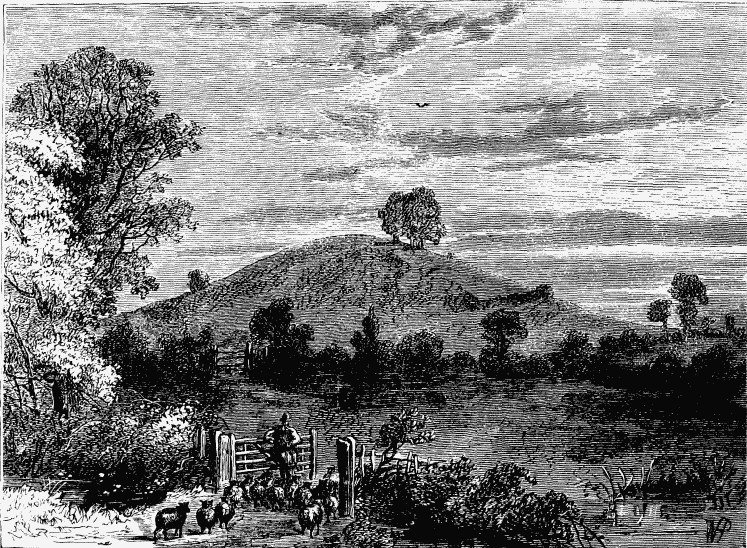
PRIMROSE HILL IN 1780.
It has been suggested that the confusion has arisen partly from the likeness of the name to that of the celebrated town in Suffolk, and partly from the infrequent use at that time of two Christian names. Sir Edmund was a rich timber merchant, and lived at the river end of Northumberland Street, in the Strand. He was Justice of the Peace for the Court quarter of town, and was so active in the performance of his duties, that during the time of the Great Plague, in 1664–5, upon the refusal of his men to enter a pest-house in order to bring out a culprit who had furnished a large number of shops with at least 1,000 winding-sheets stolen from the dead, he ventured in alone and brought the wretch to justice. He was knighted for his conduct during the plague, and Bishop Burnet says that he was esteemed the best justice of the peace in England. At the time of his death he was entering upon the great design of taking up all beggars, and putting them to work.
He is said to have been a zealous Protestant
and Church of England man, but not forward to
execute the laws against the Nonconformists, and
to have somehow got mixed up in the so-called
Popish plot. We are told that he grew apprehensive and reserved, and assured Burnet that "he
believed he should be knocked on the head," yet
he took no care of himself, and went about alone.
One day he was seen, about one o'clock, near St.
Clement's Church, but was never heard of again
until his body was found in a ditch on the south
side of Primrose Hill, about two fields distant
from the White House, or Lower Chalcot farmhouse, whither the corpse was taken, and where it
lay for two days, being seen by large multitudes.
From the "White House" the body of Sir Edmund
was conveyed back to London, to be buried in St.
Martin's Churchyard, having first "lain in state for
two days at the Bridewell Hospital." The spot on
which the corpse was found is thus described in a
publication of the period:—"As to the place,
it was in a ditch on the south side of Primrose
Hill, surrounded with divers closes, fenced in
with high mounds and ditches; no road near,
only some deep dirty lanes, made for the convenience of driving cows, and such like cattle,
in and out of the grounds; and those very lanes
not coming near 500 yards of the place." Burnet
was one of those who went to the White House,
and he describes what he saw as follows:—"His
sword was thrust through him; but no blood was
on his clothes or about him. His shoes were clean.
His money was in his pocket, but nothing was
about his neck, and a mark was round it about an
inch broad, which showed how he was strangled.
His breast was likewise all over marked with
bruises, and his neck was broken. There were
many drops of white waxlights on his breeches,
which he never used himself; and since only
persons of quality and priests use those lights, this
made all people conclude in whose hands he must
have been." Four medals were struck to commemorate his death, on one of which he was represented as walking with a broken neck and a sword
in his body. On the reverse of this medal St.
Denis is shown bearing his head in his hand.
Underneath is the following inscription:—
"Godfrey walks up hill after he is dead;
Denis walks down hill carrying his head."
A great procession, consisting of eight knights, all
the aldermen of the city of London, and seventytwo clergymen, accompanied the body to the grave
in St. Martin's Church, and a portrait of Sir
Edmund was placed in the vestry-room. The
press now teemed with pamphlets on the subject.
In one, the murder was charged to the Earl of
Danby; in another, Garnet's ghost addressing the
Jesuits is made to show the greatest delight in the
horrors of the plot. Wishes are expressed—
"That the whole nation with one neck might grow,
To be slic'd off, and you to give the blow."
The nation thus roused to a state of frenzy, thirsted
for revenge, and Somerset House, as we have mentioned, then the residence of Queen Catherine of
Braganza, consort of Charles II., was fixed upon
as the scene of the murder. Three persons—namely, Robert Green, cushion-man of the queen's
chapel; Lawrence Hill, servant to Dr. Godden,
treasurer of the chapel; and Henry Berry, porter
at Somerset House—were tried for the crime on
the 10th of February, 1679, when the infamous witnesses, Oates, Prance, and Bedloe, declared "that
he (Godfrey) was waylaid, and inveigled into the
palace, under the pretence of keeping the peace
between two servants who were fighting in the
yard; that he was there strangled, his neck broke,
and his own sword run through his body; that he
was kept four days before they ventured to remove
him; at length his corpse was carried in a sedanchair to Soho, and then on a horse to Primrose
Hill." In spite of the abandoned character of the
witnesses and the irreconcilable testimony they gave,
the jury found all the prisoners guilty, and Lord
Chief Justice Scroggs said he should have found
the same verdict had he been one of the jury.
The three men, all declaring their innocence to
the last, were executed, and the law had its victims;
but from that day to this the murder of Godfrey
has remained an unsolved mystery. It was pointed
out in a printed letter to Prance, 1681, that his
story of Hill carrying the body before him on
horseback could not be true on account of the
condition of the district; and it was further stated
that it would have been "impossible for any man
on horseback, with a dead corpse before him, at
midnight to approach, unless gaps were made in
the mounds, as the constable and his assistants
found from experience when they came on horseback thither." It has been a popular belief that
Greenberry Hill, mentioned above, took its origin
from the names of the three supposed murderers,
but it is doubtful whether this was the case; and
Narcissus Luttrell, in his contemporary "Diary,"
remarks on the singular coincidence of the names
of Green, Berry, and Hill with the old designation
of the hill. The name has long since been changed
to Barrow Hill, thus assisting to bury in obscurity,
if not in oblivion, the awful fate of a man who
lived and died guiltless of any crime, except the
strict execution of his duty.
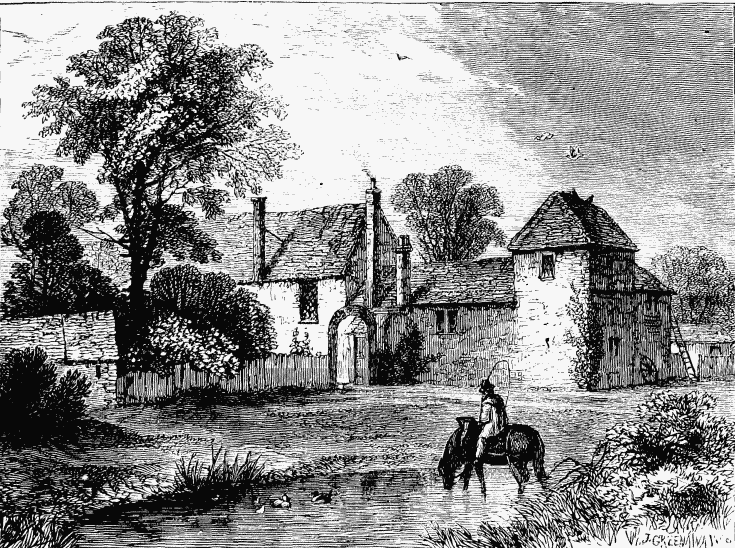
OLD CHALK FARM IN 1730.
On the western side of Primrose Hill is another and a smaller eminence, the summit of which has been, beyond the memory of man, bare of all vegetable substance. "The popular tradition is," observes a writer in the Mirror, "that there two brothers, enamoured of the same lady, met to decide by arms to whom she should belong. Ridiculous idea! that a woman's heart would consent to receive a master from the point of a sword, or trust its hopes of happiness to the hired arbitration of a trigger! Both died at the same time, each by the weapon of his adversary!" Here, too, about the year 1813, Ugo Foscolo fought a duel—happily, bloodless—with Graham, the editor of the Literary Museum.
In 1827, the provost and fellows of Eton began to see that their property would soon become valuable, and they obtained an Act of Parliament (7 Geo. IV., c. 25, private), enabling them to grant leases of lands in the parishes of Hampstead and Marylebone. Soon after the accession of Queen Victoria, endeavours were made to obtain Primrose Hill for the Crown, and a public act was passed (5 and 6 Vict., c. 78), for effecting an exchange between Her Majesty and the provost and college of Eton. By this act Eton College received certain property at Eton, and gave up all their rights in the Hill. In the schedules setting forth the particulars of the transfer we read of Shepherd's Hill, Square Field, Bluehouse Field, and Rugmere Close, all in the vicinity of Primrose Hill. The Eton property is now largely built upon, and the appropriate names of Eton, College, King Henry's, Provost, Fellows', Oppidans', and Merton Roads, all on the north, south, and east of the Hill, mark its position.
It may be added here that the North-Western Railway, entering a tunnel at Chalk Farm, passes under Primrose Hill, emerging again between St. John's Wood and Kilburn. This tunnel, which runs in a parallel direction with a portion of the Adelaide Road, is nearly 3,500 feet in length, and was made in 1834. It was for many years considered one of the greatest triumphs of engineering skill in the neighbourhood of the metropolis; in fact, it was the largest work of the kind carried out by any engineers up to that time. It passes through 1,100 yards of stiff London clay, "the most unmanageable and treacherous of all materials." Up to that time the short Highgate tunnel had been regarded as almost a miraole!
There is little more to be said about Primrose Hill in the way of history. On May 29, 1856, fireworks were exhibited here in celebration of the peace, as well as in Hyde, Green, and Victoria Parks. In 1864, under the auspices of a committee, an oak was planted by Mr. Phelps, the tragedian, on the south side of the hill, to commemorate the tercentenary of Shakespeare. Improvements have been made here at various times. Thus, fifty acres at the foot of the hill were enclosed and laid out as a park; appliances for gymnastics were erected near the Albert Road; and later in time, lamps were placed in the park and over the brow of the hill. These have a particularly pretty effect when lighted up at night. Few places are more appreciated by the popular pleasure-seeker on Easter and Whit Mondays than Primrose Hill, which is often so crowded that at a distance it seems as if one could walk upon the heads of the people congregated there. The summit is 206 feet above Trinity high-water mark of the Thames, and an exceedingly fine view can be obtained from it on a clear day. The hill was a place of meeting for many years, for popular demonstrations, &c., before Hyde Park was chosen. It is said that on the morning of the frightful gunpowder explosion on the Regent's Canal, of which we have spoken in the preceding chapter, an artist was waiting there to watch the rising of the sun, and to see London gradually awake. He saw and heard more than he expected. We may add that this spot is now entirely hemmed in by houses on all sides, but we hope that the prophecy of Mother Shipton—that when London shall surround Primrose Hill the streets of the metropolis will run with blood—may not be fulfilled, in our day at least.
With a certain class of poets, akin to those of the "Lake" School, it became the fashion to exalt the London suburbs as paragons of beauty. The Alps were nothing to Primrose Hill, and the elms which then crowned its summit were as the cedars of Lebanon to the ready writer. Highgate outvied Parnassus, buttercups and dandelions outshone the exotics of southern climes. New phrases were coined even for the cow-keepers of the district; and, to use Cyrus Redding's phrase, "the peak of Hampstead became as famous in their view as Chimborazo to that of Humboldt." Professor Wilson, it may be remembered, lashed this school rather severely in Blackwood, on account of its tendency to magnify trifles.
In St. George's Terrace, in the house nearest to the eastern slope of Primrose Hill, died, in 1860, Lady Byron, the widow of the poet. The marriage was, no doubt, ill-assorted, and could never have been a happy one. But, abused and maligned as she was in life, it is a pleasure to quote here the words of the Hon. Amelia Murray in her "Recollections:"—"She was traduced and misunderstood; one of those pure spirits little valued by the world, though worshipped by those who knew her well. Her friendship was the chief blessing of my earliest years, and her loss can never be replaced."
A house in St. James's Terrace, at the corner of the Park and Primrose Hill, has been the residence for many years of Mr. Hepworth Dixon, the editor of the Athenæum, and author of "Her Majesty's Tower," "New America," &c.
Burnet describes Primrose Hill as "about a mile
out of town, near St. Pancras Church." Such a
description might answer in Burnet's time, when
St. Pancras Church was the only landmark of importance in the neighbourhood, and they were separated merely by fields and cultivated grounds; but
now a perfect city of houses has grown up between
them. In fact, only a century ago the old church
of St. Pancras was so very rural that it was only
enclosed by a low and very old hand-railing, which
in some parts was covered with docks and nettles.
Whitefield's Chapel, in Tottenham Court Road;
Montagu House, Great Russell Street; Bedford
House, Bloomsbury Square; and Baltimore House,
situated where Russell Square is now built, could
all be seen from the churchyard. By this time
the White House had become a tavern and teagardens for the benefit of ruralisers, and was known
as Chalk Farm. This name is a corruption from
Chalcot, and its transitional form can be seen in
Rocque's map of London (1746), where England's
Lane, Haverstock Hill, is marked as Upper Chalk
House Lane. The old manor-house of Upper
Chalcot still remains in England's Lane on Haverstock Hill, and the site of Lower Chalcot is indicated by Chalk Farm and Chalcot Terrace. The
etymology of Chalk Farm is evidently a contraction or vulgar abridgment of Chalcot Farm, and
has nothing whatever to do with the nature of the
soil, as may perhaps by some people be supposed;
there being no chalk in the neighbourhood, the whole
district resting on London clay. The next point
in the history of Chalk Farm is its selection as
the scene of frequent duels. It was particularly
suitable for the purpose, as it was near town, and at
the same time quite secluded. Before the Regent's
Park was planned, Marylebone Fields were looked
upon as quite a wilderness, and few Londoners
strolled as far northwards as Primrose Hill. Chalk
Farm for some years, indeed, as a place for "affairs
of honour," even rivalled in popularity Wimbledon
Common, where the Duke of York fought Colonel
Lennox in 1789; Battersea Fields, where the Duke
of Wellington met face to face with the Earl of
Winchilsea, in 1829; and Putney Heath, where
Pitt met Tierney in 1798, and Castlereagh and
Canning exchanged shots in 1809. "Then there
was Chalk Farm," writes Mr. S. Palmer, in his
"History of St. Pancras," "which was better known
latterly as the favourite place for discontented men
to meet in order to settle their differences with the
pistol, as if gunpowder were the stronger argument,
and a steady aim the best logic. This absurd
custom is now dying out, and it is quite possible
in the present day for a man to be a man of honour
and yet decline to risk his own more valuable life
against a man who values his at nothing." One of
the earliest duels on record as having taken place
at Chalk Farm was that between Captain Hervey
Aston and Lieutenant Fitzgerald, in the summer of
1790, a lady, as usual, being in the case. Fitzgerald had the first fire, and shot Aston through
the neck; he, however, recovered, but was shot
in another duel a few years later. In April, 1803,
Lieutenant-Colonel Montgomery and Captain Macnamara met near Chalk Farm to settle, by force
of arms, a dispute which had occurred between
them in Hyde Park. The quarrel arose out of the
fact that the dog of the one "officer and gentleman" had snarled and growled at the dog of the
other. The dog's growl, however, was terribly
avenged in the sequel, for the colonel was killed
and the captain severely wounded. Captain Macnamara was tried for murder at the Old Bailey, but
although the judge summed up for manslaughter,
the jury returned a verdict of "Not guilty." Three
years later, an encounter took place here between
"Tom" Moore and Francis Jeffrey; but, fortunately, although the principals were in earnest, the
affair came to an abrupt termination by the arrival
of the police officers before the signal for firing was
given. It was stated at the time that the pistols
were loaded with only blank cartridges. This
little matter gave rise to an epigram which ended—
"They only fire ball-cartridge at reviews."
Byron alludes to this report in his "English Bards
and Scotch Reviewers:"—
"Health to great Jeffrey! Heaven preserve his life,
To flourish on the fertile shores of Fife,
And guard it sacred in its future wars,
Since authors sometimes seek the field of Mars!
"Can none remember that eventful day,
That ever glorious, almost fatal, fray,
When Little's leadless pistol met his eye,
And Bow Street myrmidons stood laughing by?"
Moore, who wrote a long account of this "affair of honour," has described the spot where the would-be duellists met as "screened on one side by large trees." He also induced Byron to add to his lines a note, to the effect that the pistol was actually loaded. Moore, it is stated, borrowed his pistols from a brother poet, who sent the Bow Street officers to prevent the two little men from killing each other. Here is Moore's narrative of this hostile meeting as recorded in his diary:—
"I must have slept pretty well; for Hume, I remember, had to wake me in the morning; and the chaise being in readiness, we set off for Chalk Farm. Hume had also taken the precaution of providing a surgeon to be within call. On reaching the ground we found Jeffrey and his party already arrived. I say his party, for although Horner only was with him, there were, as we afterwards found, two or three of his attached friends (and no man, I believe, could ever boast of a greater number) who, in their anxiety for his safety, had accompanied him, and were hovering about the spot. And then was it that, for the first time, my excellent friend Jeffrey and I met face to face. He was standing with the bag, which contained the pistols, in his hand, while Horner was looking anxiously around. It was agreed that the spot where we found them, which was screened on one side by large trees, would be as good for our purpose as any we could select; and Horner, after expressing some anxiety respecting some men whom he had seen suspiciously hovering about, but who now appeared to have departed, retired with Hume behind the trees, for the purpose of loading the pistols, leaving Jeffrey and myself together. All this had occupied but a very few minutes. We, of course, had bowed to each other at meeting; but the first words I recollect to have passed between us was Jeffrey's saying, on our being left together, What a beautiful morning it is!'—'Yes,' I answered, with a slight smile, 'a morning made for better purposes;' to which his only response was a sort of assenting sigh. As our assistants were not, any more than ourselves, very expert at warlike matters, they were rather slow in their proceedings; and as Jeffrey and I walked up and down together, we came once in sight of their operations; upon which I related to him, as rather apropos to the purpose, that Billy Egan, the Irish barrister, once said, when, as he was sauntering about in like manner while the pistols were loading, his antagonist, a fiery little fellow, called out to him angrily to keep his ground. 'Don't make yourself unaisy, my dear fellow,' said Egan; 'sure, isn't it bad enough to take the dose, without being by at the mixing up?' Jeffrey had scarcely time to smile at this story, when our two friends, issuing from behind the trees, placed us at our respective posts (the distance, I suppose, having been previously measured by them), and put the pistols into our hands. They then retired to a little distance; the pistols were on both sides raised, and we waited but the signal to fire, when some police officers, whose approach none of us had noticed, and who were within a second of being too late, rushed out from a hedge behind Jeffrey; and one of them, striking at Jeffrey's pistol with his staff, knocked it to some distance into the field, while another running over to me, took possession also of mine. We were then replaced in our respective carriages, and conveyed crestfallen to Bow Street." It is known that Moore and Jeffrey afterwards became cordial friends.
In January, 1818, a fatal duel was fought at Chalk Farm between Theodore O'Callaghan and Lieutenant Bailey; and in February, 1821, it was the scene of an encounter between John Scott, the avowed editor of the London Magazine, and Mr. Christie, a friend of Lockhart, the supposed contributor to Blackwood's Magazine, which grew out of some articles in the London, reflecting on the management of Blackwood. Mr. Scott was severely wounded, and he was conveyed from the battlefield on a shutter to the Chalk Farm Tavern, where he lingered for a little more than a fortnight. Mr. Christie, together with Mr. Trail and Mr. Patmore, who acted as seconds, were tried at the Old Bailey, on the charge of murder, but Mr. Patmore did not surrender to take his trial. Lord Chief Justice Abbot summed up the evidence with much feeling, and in the end the jury returned a verdict of "Not Guilty." By this time, so great had been the inroads made upon this retired spot by the erection of houses, that even if duelling had not been put down by the voice of society and "strong arm of the law," the duellists, from and after that date, would have been forced to seek another place of meeting.
It deserves to be mentioned to the credit of
William Hone, author of the "Year Book," "Table
Book," &c., that he was among the first persons
who had the courage to try and write down by
banter and jest, as well as by serious argument, the
system of duelling, as foolish and unchristian. Here
is one of his jeux d'esprit, entitled "An Answer
to a Challenge," which arose out of a squabble
between two lawyers at Andover in 1826:—
"I am honoured this day, sir, with challenges two,
The first from friend L—,and the second from you.
As the one is to fight and the other to dine,
I accept his engagement, and yours must decline.
Now in giving this pref'rence I trust you'll admit
I have acted with prudence, and done what was fit;
Since encountering him, and my weapon a knife,
There is some little chance of preserving my life,
Whilst a bullet from you, sir, might take it away,
And the maxim, you know, is to live while you may."
We all know that a jest will sometimes succeed where a sermon fails; but jests and sermons appear to have been equally fruitless in their attacks on this silly practice, as it survived for at least three or four years into the reign of Victoria.
But the old tavern at Chalk Farm has other reminiscences besides those which associate it with the many duels fought in its neighbourhood. From the year 1834 to 1838—at which time the fields attached to it were called "Mr. Bowden's Grounds"—there used to be held the annual matches of the Wrestling Club of Cumberland and Westmoreland. These sports had previously been held in various places in the suburbs—on Kennington Common, at Chelsea, and at the Eyre Arms, St. John's Wood; they were subsequently held, at various dates, at Highbury Barn, at Copenhagen House, at Hornsey Wood House, at Cremorne Gardens, and at Hackney Wick. Since 1864, however, these sports have been among the attractions of the New Agricultural Hall, at Islington. They have always been, and, strange to say, are still, celebrated on Good Friday. The chief and most noted wrestlers are "North Country" men, though the prizes are mostly open to all comers, and the Cornish wrestlers are almost equally celebrated. They are under the management of a committee with a president, a secretary, and other officers, and the money collected at their yearly gatherings has often, perhaps generally, been handed over to one or other of our metropolitan charities. Although such sports have been held in London periodically for upwards of a century, it was not till the year 1824 that a society was actually founded for the purpose of encouraging those wrestling matches for which the natives of Cumberland and Westmoreland have been so famed from time out of mind, and the celebration of which in London has, no doubt, had the merit of keeping up old friendships and connections which would otherwise have been dropped. This society has at various times received encouragement from such men as the late Earl of Lonsdale and Professor Wilson; and it will be remembered that Charles Dickens has described a wrestling match in Household Words, having drawn his picture from what he saw when present at a field-day at Windermere. Those who object to such games should remember that wrestling formed one of the series of five contests which made up the "pentathlon" at the old Olympic games of Greece. A full account of these matches will be found in a small work called "Wrestliana."
As lately as 1846 Charles Dickens alludes to "the bowers for reading and smoking scattered about the tea-gardens at Chalk Farm" as still in existence, comparing them with those in his then Swiss residence at Lausanne. But in another decade they were already things of the past.
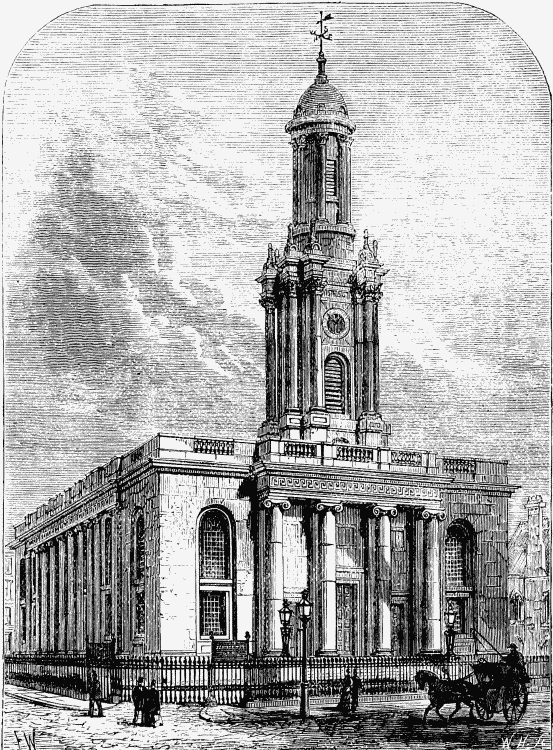
TRINITY CHURCH, ALBANY STREET.
In the neighbourhood of Chalk Farm, in 1824, George Hanger, the eccentric Lord Coleraine, breathed his last. His death is thus recorded in the pages of the Gentleman's Magazine for that year:—"March 31. Died, of a convulsive fit, at his residence, near the Regent's Park, aged seventythree, the Right Hon. George Hanger, fourth Lord Coleraine, of Coleraine, Co. Londonderry, in the Peerage of Ireland, and a major-general in the army; better known by the title of Colonel Hanger, or the familiar appellation of 'George Hanger.'" Such is the curt and brief manner in which Mr. "Sylvanus Urban" records the decease of a nobleman who had played in his day a conspicuous part among the early boon companions of George Prince of Wales, of whom he was wittily said to be not the constant Hanger, but the constant "Hanger on." Like Lord Rochester and Lord Camelford before him, he lived a life not very creditable to a member of "the upper ten thousand"—fighting duels, and selling coals on commission, and spending a year or two occasionally within "the rules" of the King's Bench or the Marshalsea prison. He died lamented and regretted by none, or, at all events, by few of his contemporaries; and the extinction of his title, which was caused by his death, could scarcely be said to have been lamented, or to have created in the Irish peerage any gap or void which it was difficult to fill up.
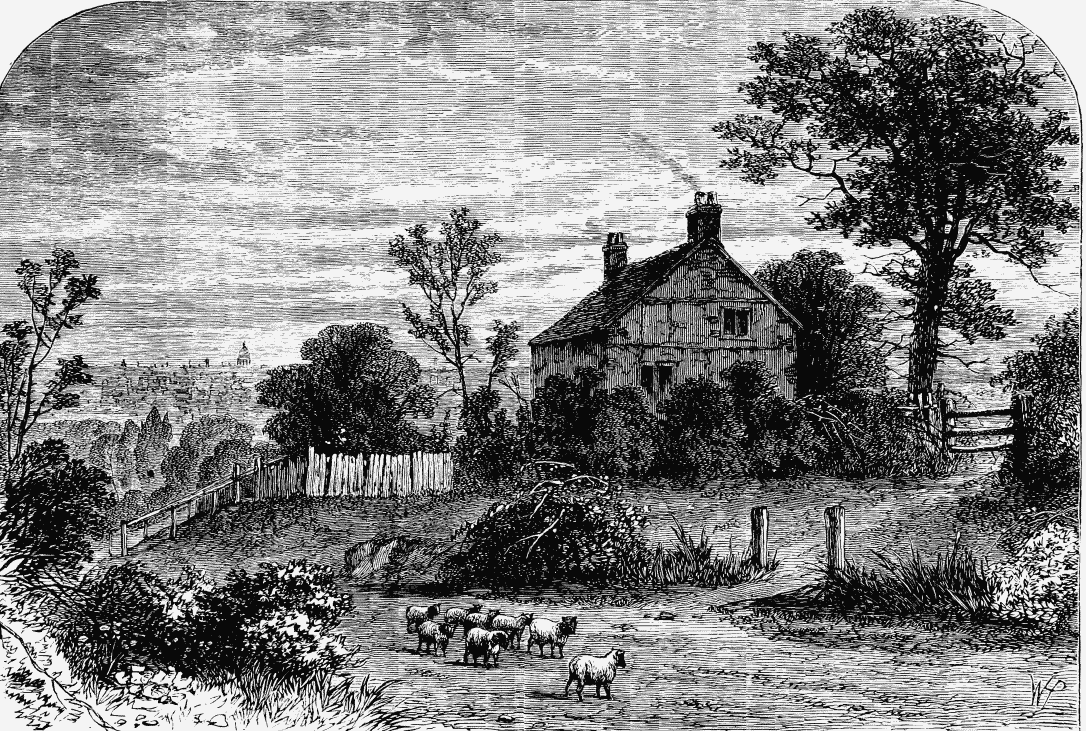
SIR RICHARD STEELE'S HOUSE, HAVERSTOCK HILL.
The old Chalk Farm Tavern, which had witnessed so many duels in its day, stood in what is now called Regent's Park Road, on the north side, about half-way between the foot of Primrose Hill and the North London Railway Station. It was rather a picturesque old house, with a veranda running along outside, from which the visitors looked down into some pleasant gardens. "This house," writes Mr. Samuel Palmer, in his "History of St. Pancras," "has long been known as a place of public entertainment, similar in character to the 'Adam and Eve' and 'Bagnigge Wells.' From its proximity to Hampstead, it was the usual resort of holiday-folk on their return from the Heath. Being on the incline of Primrose Hill, the terrace in front of the house was very often crowded to inconvenience, the prospect being charming and the air invigorating. Semi-theatrical entertainments were at times provided for the visitors, whilst at other times balls, promenades, masquerades, wrestlingmatches, and even prize-fights and other brutal sports were offered for their amusement. These latter sports, singularly enough, were principally the amusements for the Sunday. The fatal issue of one such encounter, between John Stone and Joseph Parker, resulting in a trial, and ultimately in a verdict of manslaughter against the survivor and the seconds on both sides, aided in a great measure to suppress this brutal exhibition." Mr. Palmer, however, omits to tell us the date of this occurrence.
About the year 1853 it was pulled down, to make way for a modern and more pretentious hotel, which now occupies its site. On the opposite side of the way, even to a more recent date, were some tea-gardens and pleasure-grounds, where there were occasional displays of fireworks on summer evenings; but these also have given way to the steady advance of bricks and mortar. Indeed, the growth of London in this direction has been steadily going on for many years, for as far back as 1832 a correspondent of Hone's "Year Book" writes: "The Hampstead Road and the once beautiful fields leading to and surrounding Chalk Farm have not escaped the profanation of the builders' craft." Indeed, one does not feel at all inclined to agree with the sentiment expressed by Mr. Parkle, in the "Uncommercial Traveller" of Charles Dickens, that "London is so small." We should rather say, it is so large. He complains, "What is a man to do? . . . . If you go west, you come to Hounslow. If you go east, you come to Bow. If you go south, there's Brixton or Norwood. If you go north, you can't get rid of Barnet!" We must own that our impression is rather in the opposite direction, and that, go which way we will, we can never get rid of the monotony of the streets of the metropolis.
Fairs in old times were held in this neighbourhood, much to the delight, no doubt, of the lads and lasses living at Hampstead, Highgate, and St. Pancras. But of late these fairs have dwindled away to nothing. "Chalk Farm Fair," writes G. A. Sala, in "Gaslight and Daylight" in 1860, "is a melancholy mockery of merriment;" and we believe it is now a matter of history.
The Chalk Farm Railway Station, at which we have now arrived, has become a great centre of passenger and goods traffic; it is joined by the large goods station of Messrs. Pickford, covering several acres to the south, and reaching half-way to the "York and Albany." The station here was for many years the termination of the North London Railway, and in the end the line became joined on to the North-Western line to Birmingham and Liverpool. The railway station premises run for nearly a quarter of a mile along Chalk Farm Road, with ranges of coal-sheds and depôts for warehousing goods. Close by, at the foot of Haverstock Hill, is the Adelaide Hotel, so named after the consort of King William IV. On Haverstock Hill stood, till recently, a house said to have been occupied by Steele. The circular building which projects into the Chalk Farm Road near the Adelaide Hotel was built to accommodate the locomotive engines in the early days of the London and Birmingham Railway. It is about 120 feet in diameter, and has in its centre a turn-table, by means of which the engines can be shifted to the up and down lines, and to the various sidings. Externally, the building is not very attractive, but its interior is light, the arched roof being supported on graceful iron pillars.
At the end of Regent's Park Road, close by Chalk Farm Railway Station, is an institution which has achieved a large amount of good in its own especial field of action. The Boys' Home, for such the institution in question is called, was originally established in 1858 in the Euston Road, for the prevention of crime, arresting the destitute child in danger of falling into a criminal life, and training him, by God's blessing, to honest industry; a work which, as experience has shown, can only be successfully done by such voluntary agency. It is, in fact, an industrial school for the training and maintenance, by their own labour, of destitute boys not convicted of crime. Owing, however, to the Midland Railway Company requiring the site of the "home" in the Euston Road for their new terminus, in 1865 new premises were secured here, consisting of three unfinished houses and a yard, which were taken on a ninety-nine years' lease from the governors of Eton College, to whom the property belongs. The applications for admission soon became so numerous—about 300 in a year—that it was determined to increase the numbers. The school and the workshops, which were subsequently built, will enable 100 boys to work, instead of fifty as at first provided for.
The boys are lodged in separate houses, holding about twenty-five boys in each, in ordinary bed-rooms; each boy is provided with his own bed, each room under the charge of a monitor, and each house under the direct control of the master or matron living in it, who endeavour to become the true parents of these poor lads, to guide them no less by affection than by firm discipline, to establish a happy "family" feeling, and to attract their once ragged and disorderly pupils by the force of kindly teaching and good example. The late Lady Truro, daughter of the Duke of Sussex, in 1866 left a bequest to the institution, by which the committee of management have been enabled to extend the "home," by adding to it another house; and a chapel was likewise built for their accommodation, by a generous donor, in 1864. This chapel has since germinated, through the generosity of the provost and fellows of Eton College, into a handsome new church—St. Mary's, at the north-eastern corner of Primrose Hill.
The institution itself is called not a school but a "home," and in every sense of the word it is a home. "I call a home," once said Mr. "Tom" Hughes, when pleading for this very institution, "a place in which you will find sympathy. It must be a place in which the great bond of love which binds all the world together comes out and is recognised. This is the very first condition. . . . The second condition which I understand as essential to a home is that you shall have there order and discipline. . . . The third law of the world is that it is a world of work; 'he that will not work, neither shall he eat.' . . . There is one other condition, as I understand the matter, without which there can be no true and righteous home, and that condition is economy. In God's natural world there is no waste whatever, and it is His world in which we are. We are under His laws, and ought to study His methods of administering them."
The boys accommodated in the Home are all lodged there, fed and clothed, and receive instruction in various trades—carpentry, brushmaking, tailoring, shoemaking, &c. A large quantity of firewood is cut on the premises, and delivered to customers, and several boys are employed by private families in the neighbourhood in cleaning knives and shoes. The amount of the industrial work done in the Home is highly satisfactory. The products of the labour of the boys and their teachers—clothes, shoes and boots, brushes of every kind, carpentry and firewood—are sold, and contribute to the general funds of the institution; yet a large expenditure, chiefly caused by the extreme youth of many of the boys, is annually necessary to enable the managers to continue and extend their useful exertions.
Children of all ages are admitted, ranging from six or seven up to fourteen or fifteen; and it may be mentioned that there is a branch at East Barnet for training still younger children. An ants' nest could not display more activity and life than may be witnessed here among the youths who have been rescued from the streets. At first, the restraint, gentle as it is, is frequently irksome to the little urchin, and he plots to run away, and now and then he succeeds. However, he soon returns of his accord, or is brought back, and after a very short interval, becomes steady and reconciled to the happiness of the Home. Indeed, he soon becomes proud of it—proud of being associated with it, proud of his work, proud of his learning, proud of the self-respect which the very character of the Home inspires. All this, there can be no doubt, is brought about by the kindness which he experiences from all around him; and so, instead of being abased by mischievous companions, or the angry words of elders, he feels himself raised at once in the social scale. There is a school, too, to which he goes, and an excellent schoolmaster to guide his thoughts in the right direction. "In all his labours," observes a writer in Once a Week, "he is taught patience, and soon understands that, if his progress be slow at first, it will eventually become more rapid. Scriptural or moral mottoes are placed in every room, so that his eye hourly feeds his heart with sound counsel. To avoid monotony and tediousness, his tasks are frequently diversified, and he is taught either a musical instrument or singing. Indeed, the band of this juvenile institution acquits itself very creditably. In the school-room is a harmonium, usually presided over by the teacher, whose performances naturally excite the delight of these civilised British Bedouins."
As we have intimated above, various trades are taught, and, when fit, the boys are put out into real life as may suit each. With all these young men a constant intercourse is kept up after they have left the Home by letters and visits, and a register of all cases is kept at the Home by which the history of every one from his admittance can be traced. To show the class of boys rescued, the particulars of one or two cases will suffice:—
G. L., aged ten years, but looking much younger, was received on the 22nd of August, 1862. This poor boy was described in the paper sent to the Home from the office of the Reformatory and Refuge Union, as "awfully filthy and neglected," and was stated to have been in the casual-ward of several workhouses for single nights. He was in a sad condition when he entered the Home—shoeless, dirty and tattered, footsore and hungry. The boy's father was a clown in some itinerant show, and had deserted his mother. The mother, who was of anything but good character, wandered to London, where the child was found destitute in the streets. The case coming strictly within the operation of the "Industrial Schools' Act," the boy was sent to the Home by the presiding magistrate of the Thames Police Court.
J. P., aged fourteen, was a message-boy at the barracks, Liverpool. Believing him to be an orphan, the soldiers persuaded him to conceal himself on board a ship bound with troops to Gibraltar, from which place, by similar means, he contrived to find his way to China. When at Hong Kong he was allowed to ship as second-class boy on board H.M. line-of-battle ship Calcutta, in which, a few days after, he met with so severe an accident by scalding, that he was removed to the hospital-ship stationed at Hong Kong. His life was despaired of, and for nearly a year he suffered from the effects of this disaster. Recovering in some degree from this accident, he was shipped in a man-of-war for England, and landed at Portsmouth, discharged from the navy only half-cured and destitute. He was indebted to the active benevolence of a chaplain of the navy for his admission into the Boys' Home, where, by the assistance of good living, a comfortable and cheerful home, and good medical help, he soon became a healthy boy again. He recently re-visited the Home as an able-bodied seaman, with a good character.
Ragged schools have done great things for this destitute class, but to the Boys' Home we look for really and permanently raising a lad out of the slough of depravity, and landing him safely and firmly on the rock of honest industry.
It may be stated here that the boys admitted to the Home are chosen by joint vote of the Committee on account of their extreme destitution and want. Those who have neither parent alive stand the first chance of admission, those who have lost their father stand next, and those who have lost their mother are last on the roll of candidates. Many of them, however, never knew that they ever had either father or mother, or a home of any kind whatsoever.
The latest report of Her Majesty's inspector states:—"My inspection of the school this day has given me much satisfaction. I have found all in good order. The boys look healthy and cheerful. They appear to be managed with good sense and good judgment. They have passed a very creditable examination. The dictation and arithmetic of the upper classes were above the average. The school appears to be doing its work well, with most encouraging results."
It is not intended that the Boys' Home should be dependent upon alms; the object of the promoters is to make it self-supporting. But whilst the grass is growing, we all know the steed may starve. Yet such need not be the case if the public would buy the brushes, book-stands, worktables, &c., made by the boys' hands, and employ the little fellows themselves in carpenters' jobs, and in cleaning boots and shoes in the neighbourhood.
Passing from the Boys' Home by the Gloucester Road, a short walk brings us to the "York and Albany Hotel," which is pleasantly situated, overlooking the north-eastern corner of the Regent's Park. The house, which has at the back some extensive tea-gardens, forms the starting-point of a line of omnibuses to the west and south of London. It may be mentioned here that the bridge over the Regent's Canal, between the "York and Albany" and Gloucester Gate, having been long considered too narrow and ill-constructed to suit the requirements of the present day, the Metropolitan Board of Works have decided upon rebuilding it upon a much larger scale, at an estimated cost of about £20,000. It will form a very handsome approach and entrance to the Regent's Park on the eastern side.
In Regent's Park Terrace, close by Gloucester Gate, Louis Kossuth, the Hungarian patriot, was living in 1859.
Albany Street, like the hotel above mentioned, takes its name from royalty—the late Duke of York having been Duke of Albany as well; it extends from this point to the Marylebone Road, near the top of Portland Place, and close to the south-east entrance of the Regent's Park. At the top of this street, almost facing the east window of the chapel of St. Katherine's Hospital, are spacious barracks, which are constantly used, in turn with others, by a regiment of the Guards. Together with the drill-ground and the various outbuildings, they occupy no less than seven or eight acres. To the north of this lies Park Village East, a collection of detached villas, built in a rustic style; and close by is the basin of an arm of the Regent's Canal.
At the end of the canal basin is Cumberland Market, or, as it is sometimes called, Regent's Park Market. It was established for the sale of hay, straw, and other articles, removed, in the reign of George IV., from the Haymarket, as already stated by us, (fn. 2) between Piccadilly and Pall Mall; but it has never been very largely attended.
Munster Square, as a poor group of houses built round a plot of market ground close by is called, derives its name from one of the inferior titles inherent in the Crown; and the reader will remember that William IV. created his eldest natural son, Colonel Fitzclarence, a peer, by the title of the Earl of Munster.
In Osnaburgh Street—which, by the way, is likewise named after a member of the royal family, the late Duke of York having also been "Bishop of Osnaburgh," in the kingdom of Hanover—is the St. Saviour's Hospital. Here tumours and cancerous growths are treated in such a manner as to dispense with the use of the knife. In this street, too, is another institution for the exercise of charity and benevolence; it is called the St. Saviour's Home and Hospital for the Sisters of Charity.
In Albany Street the late Sir Goldsworthy Gurney was practising as a medical man about the year 1825, employing his spare time in making practical experiments, more especially in manufacturing a steam-carriage, which, under many difficulties, he perfected sufficiently to make a journey along the high road to Bath, in July, 1829, two months before the successful efforts of George Stephenson in the North to solve the question of steam conveyance. Miss Gurney thus describes the difficulties under which her father laboured before carrying out his invention:—"Our house was in Argyle Street, Regent Street, where my father was in practice as a medical man, at the same time making experiments of all sorts; and his steam-carriage was begun at that house, but a manufactory was soon taken, and he found it necessary to be there and to have his family with him. We occupied rooms which were probably intended for Sir William Adams, a celebrated oculist, for whom this building was erected as an eye infirmary, in Albany Street. . . . . From a window of my room I looked into the yard where my father was constructing his steam-carriage. The intense combustion caused by the steam-blast, and the consequent increase of high-pressure steam force acting on the jet, created such a tremendous current or draught of air up the chimney that it was something terrific to see or to hear. The workmen would sometimes throw things into the fire as the carriage passed round the yard—large pieces of slate or sheet-iron—which would dart up the chimney like a shot, falling occasionally nearer to the men than was safe, and my father would have to check their enthusiasm. The roaring sound, too, sometimes was astounding. Many difficulties had to be overcome, which occupied years before 1827. The noise had to be got rid of, or it would have frightened horses, and the heat had to be insulated, or it might have burnt up the whole vehicle. The steam machinery was at first contrived to be in the passenger-carriage itself, as the turnpike tolls would have been double for two vehicles. My father was forcibly reminded of this fact, for there was then a turnpike-gate immediately outside the manufactory. This gate was first on the south side of the doors, and the steamcarriage was often exercised in the Regent's Park barrack-yard; then the gate was moved just a few yards to the north, between the doors and the barracks. But perhaps the greatest difficulty—next to that of prejudice, which was strong against all machinery in those days—was to control the immense power of the steam and to guide the carriage. It would go round the factory yard more like a thing flying than running, and my father was often in imminent peril while making his experiments. He, however, at last brought the carriage completely under control, and it was perfected. One was built to carry the machinery, the driver, and stoker only, and to draw another carriage after it. My father could guide it, turn it, or back it easily; he could set it going or stop it instantly, up hill or down; it frequently went to Hampstead, Highgate, Edgware, Barnet, Stanmore, and its rate could be maintained at twenty miles an hour, though this speed could only be indulged in where the road was straight and wide, and the way clearly to be seen. I never heard of any accident or injury to any one with it, except in the fray at Melksham, on the noted journey to Bath, when the fair people set upon it, burnt their fingers, threw stones, and wounded poor Martyn, the stoker. The steam-carriage returned from Bath to the Hounslow Barracks—eighty-four miles—stoppages for fire and water included, in nine hours and twenty minutes, or at the rate, when running, of fourteen miles an hour. This journey from London to Bath, the first ever maintained with speed by any steam locomotive, was made in July, 1829, on the common turnpike road, in the face of the public, and two months before the trial at Rainhill."
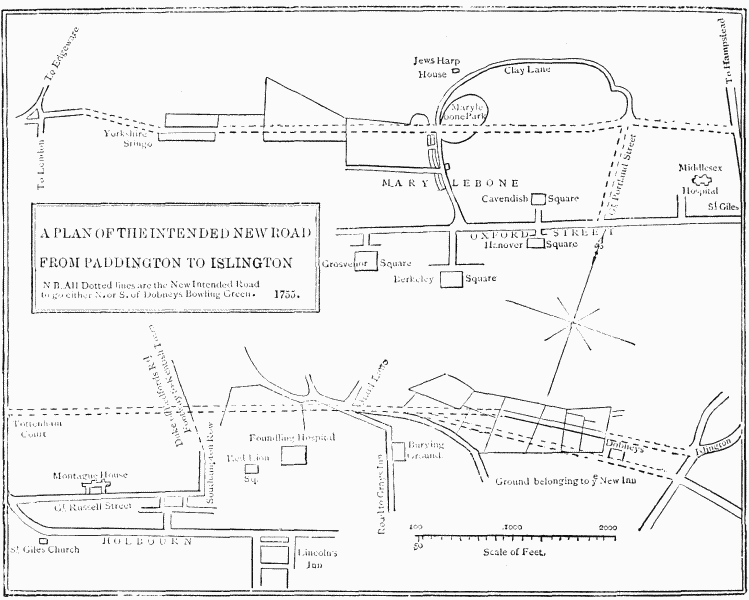
GROUND PLAN OF NEW ROAD FROM ISLINGTON TO EDGWARE ROAD (1755).
At the south end of this street, with Osnaburgh Street on its east side, is Trinity Church, which was built from the designs of Sir John Soane. The principal front consists of a portico of four columns of the Ionic order, approached by a small flight of steps; on each side is a long window, divided into two heights by a stone transum (panelled). Each of the windows is filled with ornamental iron-work, for the purpose of ventilating the vaults or catacombs. The flank of the church has a central projection, occupied by antæ, and six insulated Ionic columns; the windows in the inter-columns are in the same style as those in front; the whole is surmounted by a balustrade. The tower is in two heights; the lower part has eight columns of the Corinthian order, after the temple of Vesta at Tivoli. These columns, with their stylobatæ and entablature, project, and give a very extraordinary relief in the perspective view of the building. The upper part consists of a circular peristyle of six columns, the example apparently taken from the portico of the octagon tower of Andronicus Cyrrhestes, or tower of the winds, from the summit of which rises a conical dome, surmounted by the vane. The more minute detail may be seen by the engraving (page 294). The prevailing ornament is the Grecian fret. The Rev. Dr. Chandler, late Dean of Chichester, was for many years rector of this church, in which he was succeeded by Dean Elliot, and he again by the Rev. William Cadman.