Old and New London: Volume 5. Originally published by Cassell, Petter & Galpin, London, 1878.
This free content was digitised by double rekeying. Public Domain.
Edward Walford, 'Somers Town and Euston Square', in Old and New London: Volume 5(London, 1878), British History Online https://www.british-history.ac.uk/old-new-london/vol5/pp340-355 [accessed 30 April 2025].
Edward Walford, 'Somers Town and Euston Square', in Old and New London: Volume 5(London, 1878), British History Online, accessed April 30, 2025, https://www.british-history.ac.uk/old-new-london/vol5/pp340-355.
Edward Walford. "Somers Town and Euston Square". Old and New London: Volume 5. (London, 1878), British History Online. Web. 30 April 2025. https://www.british-history.ac.uk/old-new-london/vol5/pp340-355.
In this section
CHAPTER XXVI.
SOMERS TOWN AND EUSTON SQUARE.
"Quis novus hic nostris successit sedibus hospes?"—Virgil, "Æn."
Gradual Rise and Decline of Somers Town—The Place largely Colonised by Foreigners—A Modern Miracle—Skinner Street—The Brill—A Wholesale Clearance of Dwelling-houses—Ossulston Street—Charlton Street—The "Coffee House"—Clarendon Square and the Polygon—Mary Wollstoncraft Godwin—The Chapel of St. Aloysius—The Abbé Carron—The Rev. John Nerinckx—Seymour Street—The Railway Clearing House—The Euston Day Schools—St. Mary's Episcopal Chapel—Drummond Street—The Railway Benevolent Institution—The London and North-Western Railway Terminus—Euston Square—Dr. Wolcot (Peter Pindar)—The Euston Road—Gower Street—Sir George Rose and Jack Bannister—New St. Pancras Church—The Rev. Thomas Dale—Woburn Place.
Down to about the close of the last century, the locality now known as Somers Town—or, in other words, the whole of the triangular space between the Hampstead, Pancras, and Euston Roads—was almost exclusively pastoral; and with the exception of a few straggling houses near the "Mother Red Cap," at Camden Town, and also a few round about the old church of St. Pancras, there was nothing to intercept the view of the Hampstead uplands from Queen's Square and the Foundling Hospital. An interesting account of the gradual rise and decline of this district is given in the Gentleman's Magazine for 1813, wherein the writer says:—"Commencing at Southampton Row, near Holborn, is an excellent private road, belonging to the Duke of Bedford, and the fields along the road are intersected with paths in various directions. The pleasantness of the situation, and the temptation offered by the New Road, induced some people to build on the land, and the Somers places, east and west, arose; a few low buildings near the Duke's road (now near the 'Lord Nelson') first made their appearance, accompanied by others of the same description; and after a while Somers Town was planned. Mr. Jacob Leroux became the principal landowner under Lord Somers. The former built a handsome house for himself, and various streets were named from the title of the noble lord (Somers); a chapel was opened, and a polygon began in a square. Everything seemed to prosper favourably, when some unforeseen cause arose which checked the fervour of building, and many carcases of houses were sold for less than the value of the building materials. In the meantime gradual advances were made on the north side of the New Road (now the Euston Road), from Tottenham Court Road, and, finally, the buildings on the south side reached the line of Gower Street. Somewhat lower, and nearer to Battle Bridge, there was a long grove of stunted trees, which never seemed to thrive; and on the site of the Bedford Nursery a pavilion was erected, in which Her Royal Highness the Duchess of York gave away colours to a volunteer regiment. The interval between Southampton Place and Somers Town was soon one vast brick-field. On the death of Mr. Leroux," continues the writer, "and the large property being submitted to the hammer, numbers of small houses were sold for less than £150, at rents of £20 per annum each. The value of money decreasing at this time, from thirty to forty guineas were demanded as rents for these paltry habitations; hence everybody who could obtain the means became a builder: carpenters, retired publicans, leather workers, haymakers, &c., each contrived to raise his house or houses, and every street was lengthened in its turn. The barracks for the Life Guards, in Charlton Street, became a very diminutive square, and now we really find several of these streets approaching the old Pancras Road. The Company of Skinners, who own thirty acres of land, perceiving these projectors succeed in covering the north side of the New Road from Somers Place to Battle Bridge, and that the street named from them has reached the 'Brill Tavern,' have offered the ground to Mr. Burton to build upon, and it is now covered by Judd Street, Tonbridge Place, and a new chapel for some description of Dissenters or other." Mr. Burton, as we have previously stated, was the builder, not only of the houses covering the land belonging to the Skinners' Company, but also of Russell Square, Bedford Place, &c. (fn. 1)
At the end of the last century this district, rents being cheap, was largely colonised by foreign artisans, mostly from France, who were driven on our shores by the events of the Reign of Terror and the first French Revolution. Indeed, it became nearly as great a home of industry as Clerkenwell and Soho. It may be added that, as the neighbourhood of Manchester and Portman Squares formed the head-quarters of the emigrés of the wealthier class who were thrown on our shores by the waves of the first French Revolution, so the exiles of the poorer class found their way to St. Pancras, and settled down around Somers Town, where they opened a Catholic chapel, at first in Charlton Street, Clarendon Square, and subsequently in the square itself. Of this church, which is dedicated to St. Aloysius, we shall have more to say presently.
"Somers Town," wrote the Brothers Percy in 1823, "has now no other division from the rest of the metropolis but a road, and Kentish and Camden Towns will soon be closely connected with it." During the ten subsequent years we find that great strides had been made in the progress of building in Somers Town, for a correspondent of Hone's "Year Book," in 1832, tells us that, though it had then become little better than another arm to the "Monster Briareus" of London, he remembered it as "isolated and sunny, when he first haunted it as a boy."
Under the heading of "A Miracle at Somers Town," Hone, in his "Every-day Book," tells the following laughable tale:—"Mr.—, a middleaged gentleman who had long been afflicted by various disorders, and especially by the gout, had so far recovered from a severe attack of the latter complaint, that he was enabled to stand, yet with so little advantage, that he could not walk more than fifty yards, and it took him nearly an hour to perform that distance. While thus enfeebled by suffering, and safely creeping in great difficulty, on a sunny day, along a footpath by the side of a field near Somers Town, he was alarmed by loud cries intermingled with the screams of many voices behind him. From his infirmity he could only turn very slowly round, and then, to his astonishment, he saw, within a yard of his coat-tail, the horns of a mad bullock—when, to the equal astonishment of its pursuers, this unhappy gentleman instantly leaped the fence, and, overcome by terror, continued to run with amazing celerity nearly the whole distance of the field, while the animal kept its own course along the road. The gentleman, who had thus miraculously recovered the use of his legs, retained his power of speed until he reached his own house, where he related the miraculous circumstance; nor did his quickly restored faculty of walking abate until it ceased with his life several years afterwards. This miraculous cure," adds Mr. Hone, "can be attested by his surviving relatives."
Skinner Street, where, we now resume our perambulation, lies in the south-east corner of Somers Town, and connects the Euston Road with Brill Row; this street is so called after the Skinners' Company, who, as above stated, own a great part of this district. The company hold the land on behalf of their grammar school, at Tonbridge, in Kent. The property, which was originally known as the Sandhills Estate, and was comparatively worthless three centuries ago, was bequeathed by Sir Andrew Judd, Lord Mayor of London, in 1558, to endow the said school; (fn. 2) hence the nomenclature of the streets in this neighbourhood—Judd Street, Skinner Street, Tonbridge Place, &c. The property now brings in a regular income of several thousands a year.
Brill Row, at the northern end of Skinner Street, together with the "Brill" tavern close by, are nearly all that remains of the locality once familiarly known by that name, which was nothing more nor less than a range of narrow streets crossing each other at right angles, and full of costermongers' shops and barrows, but which were swept away during the formation of the Midland Railway Terminus.
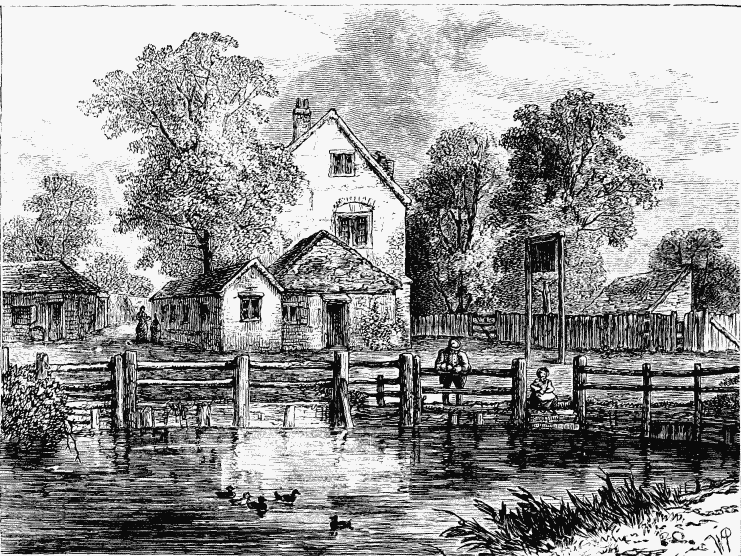
THE "BRILL," SOMERS TOWN, IN 1780.
Dr. Stukeley derives the name of the "Brill" as a contraction from Burgh Hill, a Saxon name for a place on an elevated site; but surely that derivation will scarcely apply here, as it certainly does not lie as high as the land on its eastern or western side. The place on a Sunday morning was thus facetiously described by a writer in the Illustrated News of the World, just before the time of its demolition:—"The 'Brill' is situated between Euston Square and the station of the Great Northern Railway, and is a place of great attraction to thousands who inhabit Somers, Camden, and Kentish Towns. Though bearing the name of a wellknown fish, our early riser will most probably find that the Somers 'Brill' claims no special relation ship to the scaly tribe. . . Here is the 'Brill tavern, and how it came to have this name would, no doubt, be as interesting as to know the origin of the names given to other public-houses. Some landlord of old may have had a particular liking for this fish, or may have been fortunate in procuring a super-excellent cook who could satisfy the most fastidious appetite of the most fastidious customer by placing before him a superior dish. Very likely some local antiquarian could tell us all about it and much else. He could tell us, no doubt, when, and under what circumstances, this north-west suburb of London itself was so named from the noble family of Somers; that this very 'Brill' was known in days gone by as Cæsar's Camp, and for this latter statement might quote as an authority the distinguished and well-known Dr. Stukeley himself. The oldest inhabitant could also talk with great volubility respecting the site on which Somers Town now stands—how, some sixty or seventy or more years ago, it was a piece of wild common or barren brick-field, whither resorted on Sundays the bird-fanciers and many of the 'roughs' from London to witness dog-fights, bullbaiting, and other rude sports, now happily unknown in the locality. This 'oldest inhabitant' would most probably contrast the dark ages of Somers Town with its present enlightened and civilised days, and conclude an animated harangue with the words—'Nobody would believe that here, where I can now purchase tea, coffee, beef, everything I want, on a Sunday morning, that such barbarous practices were followed while bishops and divines were preaching in St. Paul's, St. Pancras, and in all the churches and chapels around on the Divine obligation of the Sabbath; nobody would believe such a thing now.'
"As the philanthropic or curious visitor enters Skinner Street, about eleven o'clock some bright Sunday morning, his ears will be greeted, not by the barking of dogs and the roaring of infuriated bulls, as of old, but by the unnaturally loud cries of men, women, boys, and girls, anxious to sell edibles and drinkables—in fact, everything which a hard-working man or poor sempstress is supposed to need in order to keep body and soul together. The various so-called necessaries of life have here their special advocates. The well-known 'buy, buy, buy,' has, at the 'Brill,' a peculiar shrillness of tone, passing often into a scream—and well it may, for the meat is all ticketed at 4½d. per pound. Here the female purchasers are not generally styled 'ladies,' but 'women,' and somewhat after this fashion—'This is the sort of cabbage, or meat, or potatoes to buy, women;' and each salesman seems to think that his success depends upon the loudness of his cry. . . . The purchasers not only come from all parts of Somers Town itself to this spot on a Sunday morning, but from Camden Town, Holloway, Hampstead, and Highgate, and even from distances of five and six miles. The leading impression made by the moving scene is that of great activity and an 'eye to business.' Every one at the 'Brill,' as a rule, comes there on a Sunday morning for a definite purpose. The women come to buy meat, fish, vegetables, and crockery; and the men, chiefly 'navigators,' as they are termed, come to purchase boots, boot-laces, blouses, trousers, coats, caps, and other articles of wearing apparel.
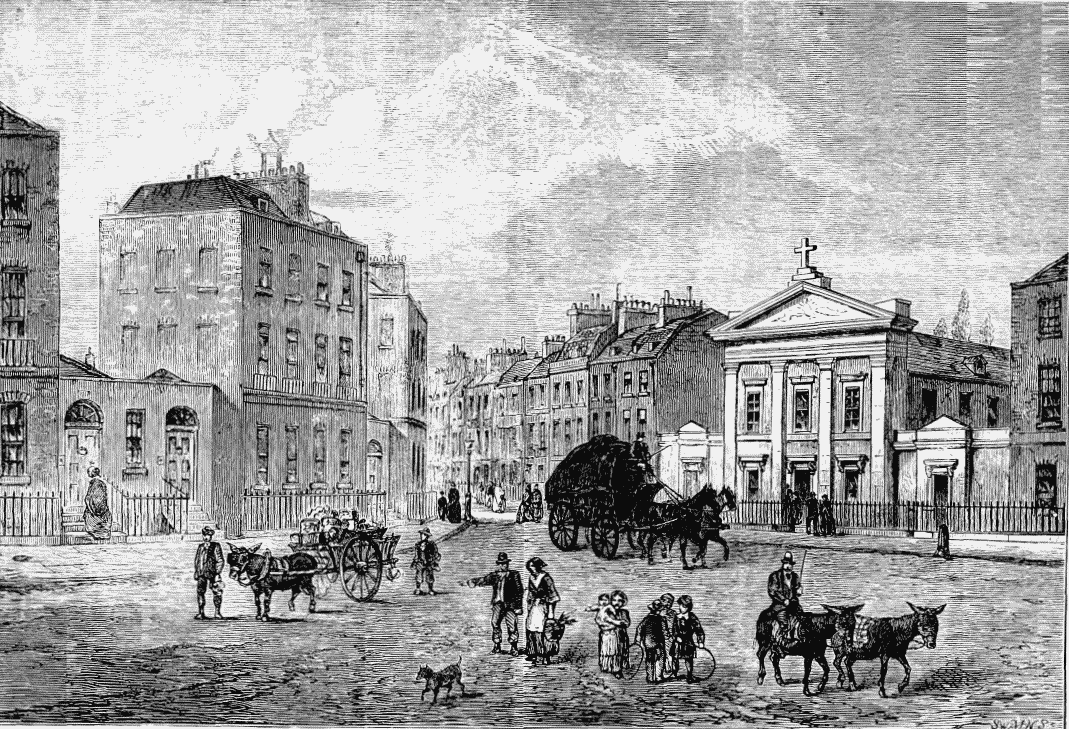
THE POLYGON, SOMERS TOWN, IN 1850. (From an Original Sketch.)
"Altogether, at the Brill matters are carried on in a business-like way. The salesmen, many of them young boys, are too intent on selling, and the purchasers too intent on buying, to warrant the supposition that they derive much spiritual benefit from the preachers of all persuasions and of no persuasions who frequent the neighbourhood. The most ardent, and apparently the most successful, of the street preachers are those who occupy posts in the immediate vicinity, and 'hold forth' in familiar strains on the advantages of teetotalism, and the evil consequences following intemperance."
Although, as we have stated, a large portion of the houses in this locality have been swept away, some few remain. Of these we may take as a specimen, Chapel Street, in which the same atractions as those above mentioned are still held out, especially on Saturday evenings and Sunday mornings.
"On inquiry," says the writer above quoted, "it will be found that this market is in every way a very profitable concern, both to those who expose their goods for sale and those who own the property in the surrounding neighbourhood. The small paltry-looking houses, with a front shop, and very restricted accommodation, yield a yearly rental of from £60 to £80 per annum. It is not likely, therefore, everything considered, that either the owners of the property, the proprietors of the shops and stalls, or the purchasers themselves, who have special advantages given them, will take the initiative in abolishing the Sunday morning Brill trade. Whatever is done in this direction must be brought to bear ab extra; wages must be paid earlier in the week, facilities afforded to the poorer classes for purchasing in the cheapest markets, and other changes, which in due course the philanthropic and humane will bring about when they once know the actual state of things, and recognise the necessity of abolishing Sunday trading altogether."
The fourteen acres of land taken by the Midland Railway Company were covered with dwellings occupied by poor people, and the whole of this population were driven out of their old homes and compelled to seek fresh accommodation elsewhere: most of them migrated to Kentish Town and the Gospel Oak Fields, already mentioned above.
Ossulston Street, the next turning westward from Skinner Street, keeps in remembrance the name of the ancient hundred of Ossulston, a geographical division which still, as in the days of our Saxon ancestors, embraces a great part of the north-western districts of London, but is now forgotten, though it furnishes the Earl of Tankerville with his second title.
Passing still further along the Euston Road, we arrive at Charlton Street. In this street is a publichouse called the "Coffee House." The name seems inappropriate now, but is not really so, for in early times it really was what that name imports—the only coffee-house in the neighbourhood. "Early in the last century Somers Town was a delightful and rural suburb, with fields and flowergardens. A short distance down the hill," writes Mr. Larwood, "were the then famous Bagnigge Wells, and close by the remains of Totten Hall, with the 'Adam and Eve' tea-gardens, and the so-called King John's Palace. Many foreign Protestant refugees had taken up their residence in this suburb on account of the retirement it afforded, and the low rents asked for small houses. At this time the coffee-house was a popular place of resort, much frequented by the foreigners of the neighbourhood as well as by the pleasure-seeking cockney from the distant city. There were near at hand other public-houses and places of entertainment, but the speciality of this establishment was its coffee. As the traffic increased, it became a posting-house, uniting the business of an inn with the profits of a tea-garden. Gradually the demand for coffee fell off, and that for malt and spirituous liquors increased. At present the gardens are all built over, and the old gateway forms part of the modern bar; but there are in the neighbourhood aged persons who remember Sunday-school excursions to this place, and pic-nic parties from the crowded city, making merry here in the grounds."
Charlton Street terminates in the south-east corner of Clarendon Square, which, as stated above, occupies the site formerly covered by the barracks of the Life Guards. This is somewhat irregular in its plan as a square, inasmuch as in its centre is inscribed a circle of houses, called the Polygon. In this square lived Scriven, the engraver, and near him De Wilde, the best pictorial annalist of our national style, and from whose pencil came all the portraits illustrating Bell's edition of the "English Theatre," so highly praised by T. F. Dibdin, in his "Library Companion." Indeed, as late as the year 1832, Somers Town was full of artists, if we may trust Hone's "Year Book," which appeals, in proof of the statement, to the Royal Academy catalogues. Their names, however, as well as their memories, have passed away along with the houses which they formerly inhabited.
In the Polygon lived Mary Wollstoncraft, after her marriage with William Godwin. She was the author of the "Vindication of the Rights of Women." Here Godwin wrote his "Political Justice" and some of his other works. "The Polygon," observes Mr. Peter Cunningham, "now enclosed by the dirty neighbourhood of Clarendon Square, was, when Godwin lived in it, a new row of houses, pleasantly seated near fields and nursery gardens." Mary Wollstoncraft (Godwin) here died in childbed in 1797; her infant grew to womanhood, and, as we have stated in the previous chapter, became the wife of the poet Shelley.
On one side of the square stands the Roman Catholic Chapel of St. Aloysius, founded in 1808, by the Abbé Carron, for the use of the French refugees who settled in the neighbourhood. For more than half a century the Rev. J. Nerinckx officiated here, and as a memorial of his unremitting attention to his charge, a handsome monumental tablet was erected in 1857. It is nearly seven feet high, of Gothic design, carved in Caen stone, and richly ornamented. It is placed immediately outside the railings of the sanctuary, and is inscribed "In memory of the Venerable and Saintly John Nerinckx, born at Nenore, in Belgium, August, 1776: Pastor of the Church of St. Aloysius, Somers Town, and Founder of the schools attached to the same; who after Fifty-four Years of Faithful Service in the Priesthood, was called to his Lord on the 21st of December, 1855. On his soul Sweet Jesus have Mercy." With the reverend gentleman's life the history of this "mission" is closely united. He joined the Abbé Carron in January, 1800, having succeeded in escaping from Cayenne, where he had been sent by the French Republicans; and he was ordained in the chapel in Charlton Street by the emigrant Bishop of Avranches.
In the Gentleman's Magazine for 1813, Mr. J. T. Malcolm, in speaking of the founder of this church, says:—"The Abbé Carron is a gentleman who does his native country honour. He resides in the house lately occupied by the builder Leroux, and presides over four schools—for young ladies, poor girls, young gentlemen, and poor boys. A dormitory, bakehouse, &c., are situated between his house and the emigrant Catholic chapel, recently built, which contains a monument to the Princess of Condé; further on is the school for the poor girls, and at the back of the whole are convenient buildings for the above purposes, and a large garden. The general voice of the place is in the Abbé's favour; and he has been of incalculable service to his distressed fellow-sufferers, who are enthusiastic in his praise."
On the return of the Abbé Carron to France, in 1815, Mr. Nerinckx succeeded to this charge, which he held for the long space of time already mentioned, and it was he who erected the schools now occupied by the nuns of the Order of the Faithful Companions of Jesus. The church underwent considerable repairs and alterations in the year 1850, the altar and sanctuary being decorated in an elaborate arabesque style. The projecting pillars on either side of the altar are embellished with paintings, in compartments, representing the blessed Virgin and our Saviour, and St. Aloysius and St. Philomena. Besides the monument above mentioned, there are also in this church monuments to the Abbé Carron and the Bishop of St. Pol; the busts are said to be faithful likenesses.
On the west side of Clarendon Square is Seymour Street, which, with Crawley and Eversholt Streets, forms a continuous thoroughfare between the north-east corner of Euston Square and Camden Town, and the other northern suburbs. In this street is the Railway Clearing House. It was established in 1842, for the mutual use of the several railway companies. It is regulated by an Act of Parliament which was passed in 1850. The following description of its scope and operations is condensed from Charles Knight's "Cyclopedia of London:—"Many of our readers may have seen in Seymour Street, close to the Euston Square, an office doorway inscribed with the name of the 'Railway Clearing House;' the history of this establishment is full of instruction in connection with our railway system. When the various lines of railway became connected from end to end, it was absolutely necessary to devise some means of combined operation, to prevent passengers from being shifted from one train to another when they left one company's territory and entered upon that of another. Again, all the formalities of booking, weighing, loading, packing, and conveying goods, and of booking and conveying passengers, if they had to be observed and gone through afresh by every company for the same goods and the same passengers, would entail a great deal of needless work as well as ruinous delays and charges; indeed, the large traffic, and especially the through traffic, would be almost paralysed. To remedy this evil a remarkable and successful scheme was adopted, even in the early days of railroad travelling, based on the 'clearing-house' system of the London bankers. A sort of imaginary company is formed, called the Clearing House, to which all the railways stand related as debtors and creditors, and which manages all the cross accounts and fragments from one company to another. . . . Passengers all pay their respective fares to the company from whose station they start; but the goods toll may be paid at either end of the journey, according to circumstances. The Clearing House has to calculate how large a share is due to each company respectively, according to the mileage run, for each passenger, parcel, and ton of goods, according to the rates of charge decided on by the said companies. Most of the companies provide locomotives, carriages, wagons, and trucks; and as all these may run on any of the lines according to arrangements, the Clearing House has to determine how much each company is entitled to charge for the use of such rolling-stock as is thus employed. There is thus a double account, every company charging all the rest for the use of every mile of its rails; and the Clearing House has to work out these complicated sums, and to determine the exact ratios day by day. The booking company pays all the Government duty on each passenger's fare, and this matter has also to be adjusted by other companies over whose lines the same train runs. A black ink return is forwarded from every station to the Clearing House every day, stating the amount of booking, moneys received, goods sent, &c., while a red ink return daily states the amount of goods arrived and received; and the Clearing House has to square up these accounts. The sum total of all the black accounts ought to agree with that of the red; and if this agreement does not appear, the Clearing House has to seek out the cause of the discrepancy and set it straight. All the tickets and cheques are likewise sent in hither, and these ought to agree exactly with the amount of moneys received. There are agents of the Clearing House at every junction and every important station; and the system pursued is so rigorous that the daily history, so to speak, of every locomotive and carriage can be traced."The Clearing House, it may be added, enters into a monthly settlement with all the various companies, and its managers are elected by the companies interested in its working.
Some idea of the extent of the work accomplished at the Railway Clearing House may be gathered from the fact that in 1842, the first year of its establishment, the number of companies which were parties to it were forty-nine, whereas in 1876 they had amounted to ninety-four; that in the first-mentioned year the approximate number of stations was 887, but that these now amounted to 7,000; the approximate number of miles of railway open being 15,950, as against 3,633 in 1849; and that the gross revenue adjusted, which was at first £1,691,720, has now reached upwards of £16,000,000. Attached to the Clearing House is a Literary Society, with nearly a thousand members, and a library with nearly ten times as many volumes.
In this street are the Euston Day Schools, built by the London and North-Western Railway Company, about the year 1850. The number of boys and girls on the books is usually about 400, mostly the children of railway employés.
St. Mary's Episcopal Chapel is in this street. The building was erected from the designs of Messrs. Inwood: it is constructed of brick, with stone dressings, and in plan approaches nearly to a square. According to a critical writer in the Gentleman's Magazine, it is "perhaps the completest specimen of 'Carpenter's Gothic' ever witnessed, the church at Mitcham only excepted." It is said to have cost £15,000 (!), though it seats only 1,500 persons. In this street was formerly a chapel of ease to St. Pancras. It was a gloomy building, erected in 1787, and called Bethel Chapel; it afterwards belonged to the Baptists.
Drummond Street, which we now enter, unites Seymour Street with the Hampstead Road. At No. 57 in this street, a house which was formerly used as the Railway Clearing House, are now the offices of the Railway Benevolent Institution. This association was established in 1859, for the purpose of allowing grants of £10 as pensions to widows of deceased members, and to aid in the support of their families. The income, which in 1860 was only £1,168, has now (1876) risen to £16,466. Its members, who are composed of the officers and working staff of nearly all the chief railways in the United Kingdom, are now upwards of 40,000, and its object, as shown above, is to provide for these individuals, when disabled, and for their widows and children, when left in necessitous circumstances, by pensions, grants, and allowances. There is also a "casualty fund," the tables of which show that 1,405 individuals (in other words, one in thirty of all the subscribers) were relieved during the year 1875, when injured by accidents. The institution is under the patronage of the Queen, the Prince of Wales, the Dukes of Sutherland, Buckingham, &c., and of the principal railway directors. Almost all the railway employés, both officers and servants, now subscribe regularly to this institution, and their contributions are supplemented by about 9,000 of the public at large. The subscription is fixed at 10s. 6d. for officers yearly, and for servants at 2d. a week. It is managed by a committee, consisting of fifty officers, chosen from the chief lines of railway throughout the kingdom.
In this street is the principal entrance to the London and North-Western Railway Terminus. The station itself occupies a surface of about twelve acres, in which the operations necessary for the dispatch and reception of nearly one hundred trains per day are carried on with so little noise, confusion, or semblance of bustle, that it would almost seem that these complicated arrangements acted of their own accord. The entrance to the station is through a gateway beneath a lofty and apparently meaningless Doric temple—for it seems placed without reference to the court-yard it leads to—in the centre line of Euston Square. This arch, which cost, it is said, £30,000, and stands where, judging by the analogy of other railway termini, we should have expected to see a modern hotel, was erected from a design by Mr. Hardwick; and although handsome in itself, and possibly one of the largest porticoes in the world, it nevertheless falls far short in grandeur to the Arc de Triomphe in Paris. Some of the blocks of stone used in its construction weighed thirteen tons. Facing this entrance is a large, massive, plain range of buildings containing the offices, waiting-rooms, and board and meeting-rooms of the company.
"As Melrose should be seen by the fair moonlight," writes Mr. Samuel Sidney, in his "Rides on Railways," in 1851, "so Euston, to be viewed to advantage, should be visited by the grey light of a summer or spring morning, about a quarter to six o'clock, three-quarters of an hour before the starting of the parliamentary train, which every railway, under a wise legislative enactment, is compelled to run 'once a day from each extremity, with covered carriages, stopping at every station, travelling at a rate of not less than fifteen miles an hour, at a charge of one penny per mile.' We say wise, because the competition of the railway for goods, as well as passengers, drove off the road not only all the coaches, on which, when light-loaded, footsore travellers got an occasional lift, but all the variety of vans and broad-wheeled wagons which afforded a slow but cheap conveyance between our principal towns. At the hour mentioned, the railway passenger-yard is vacant, silent, and as spotlessly clean as a Dutchman's kitchen; nothing is to be seen but a tall soldier-like policeman in green, on watch under the wooden shed, and a few sparrows industriously yet vainly trying to get a breakfast from between the closely-packed pavingstones. How different from the fat debauchedlooking sparrows who throve upon the dirt and waste of the old coach-yards! It is so still, so open; the tall columns of the portico entrance look down on you so grimly; the fronts of the booking-offices, in their garment of clean stucco, look so primly respectable that you cannot help feeling ashamed of yourself—feeling as uncomfortable as when you have called too early on an economically genteel couple, and been shown into a handsome drawing-room, on a frosty day, without a fire. You cannot think of entering into a gossip with the railway guardian, for you remember that 'sentinels on duty are not allowed to talk'—except to nursery-maids."
Passengers pass firstly into an immense and beautiful hall, on either side of which are entrances to the booking-offices. The hall was designed by Mr. P. C. Hardwick; it is about 140 feet in length by sixty in breadth, and between seventy and eighty feet high. A light and elegant gallery runs round three sides of the hall, guarded by bronze railings, on a level with the board-room, which is reached by a noble flight of thirty steps, surmounted by a range of Doric columns, the sculptured groups being emblematical of the progress of industry and science. Prominent in the hall is Baily's colossal statue in marble of George Stephenson, "the father of railways." Above the staircase and around the galleries are offices for the chief managers. In the angles of the hall, about fifty feet from the floor, are allegorical figures in relief, representing the counties travelled by the several railways of which this station is the terminus. The total length of platform for this terminus is upwards of a mile, and it is divided into three arrival and two departure platforms.
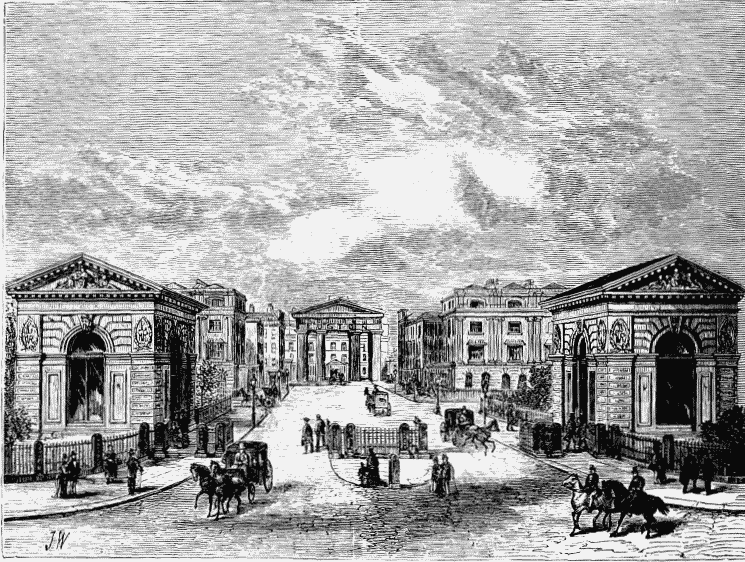
ENTRANCE TO EUSTON SQUARE STATION.
"The booking-offices," says Mr. Weale, in his "London," "are very fine specimens of architecture, but the waiting-rooms are far from corresponding with them in magnificence. Indeed," he adds, "the habits of our travelling public are not such as to require much accommodation in the intervals during which they wait for the departure of the trains. At foreign railway stations passengers are not allowed to go upon the platform until just before the time for departure. In England the practice is to allow the public access to all parts of the station devoted to the dispatch of the trains, and consequently it is found that they prefer walking about the platforms with their friends until the last moment. A very social result, perhaps; but the presence of so many strangers must sadly interfere with the execution of the duties of the company's servants."
The extensions, branch lines, and the immense number of country lines which communicate with the London and North-Western Railway are so numerous, that it is, perhaps, impossible to say precisely the number of miles over which passengers are booked here. Originally the departure platforms for the main line adjoined the waiting-rooms on the east side of the great hall, and those for the midland counties on the west side; but the gradual opening up of new lines of railway and branches has somewhat altered this arrangement. There are several spare rails under the same roof, upon which the carriages are examined, cleaned, and arranged for departure; and at the end of the platform is a series of turn-tables, by means of which the carriages can be easily transferred from one set of rails to another. The whole of the operations connected with the reception and the dispatch of the trains are thus carried on under a shed of immense superficial extent; some idea of its size may be gathered from Sir Francis Head's amusing and instructive book called "Stokers and Pokers." It is said that there are not less than 8,980 square yards of plate glass in the skylights only. We may mention here that the roof of the range of building on the west side of the platform remains in its original condition; but that on the east side has been considerably heightened by means of a novel and ingenious contrivance by which the roof was raised bodily, without having to be taken to pieces and rebuilt.
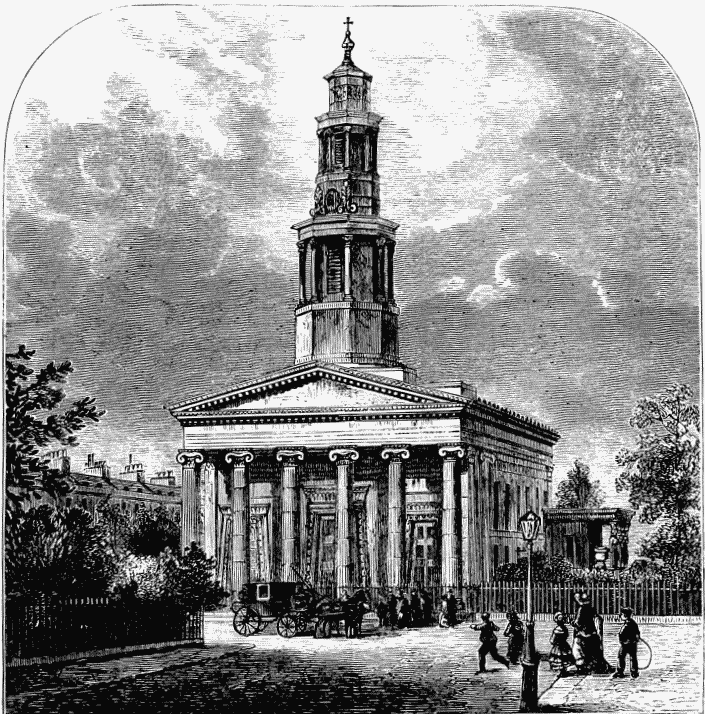
NEW ST. PANCRAS CHURCH.
On the west of the lines leading from the station are the workshops where the carriage repairs for the London end of the line are effected; they are very extensive, and, of course, fitted up with the very best appliances. The line between Euston Station and Camden Town is principally carried in an open cutting about twenty feet below the level of the neighbouring streets. The works were executed in the London day, and, although neatly carried out, it was afterwards found necessary, on account of the great width of the railway at this point, to consolidate the retaining walls by a series of immense cast-iron struts, which cause that portion of the line in the neighbourhood of Camden Town to resemble an open tunnel.
It will be remembered that, when in 1831–2 the London and Birmingham Railway (as this line was originally called) was first projected, the metropolitan terminus was at Chalk Farm, near the north-east corner of Regent's Park. It was not until 1835 that a bill was brought into Parliament, and carried after great opposition, for bringing this terminus as near to London as what was then termed "Euston Grove." Up to the year 1845, for fear of frightening the horses in the streets, the locomotive engines came no nearer to London than Chalk Farm, where the engine was detached from the train, and from thence to Euston Station the carriages were attached to an endless rope moved by a stationary engine at the Chalk Farm end of the line.
In 1845 a scheme was set on foot for converting a part of the bed of the Regent's Canal into an extension of the North-Western Railway, so as to bring the terminus nearer to the City. Indeed, it was proposed to carry it as far as Farringdon Street, but the opposition offered to the plan was so strong that it had to be abandoned, and it was reserved for other companies to carry out that great desideratum subsequently.
The Lost Luggage Office at the Euston Station is not the least important feature of this monster establishment. "If," writes Charles Knight, "a passenger has lost any of his luggage, there is an office where he can apply respecting it; if a railway porter finds luggage left in a carriage without an owner, there is a room where it is deposited, and the company spares no pains in affording facilities for the recovery of the lost property." Yet it is surprising how much luggage is left at various stations and never called for. In one apartment such articles are kept for two months, ticketed and numbered; if not re-claimed within that time, they are transferred to a large vaulted chamber, where they are placed in different apartments classified as to their character. If not claimed within two years, they are sold by public auction, and a pretty miscellaneous sale a railway auction is, consisting of coats, shawls, hats, caps, rugs, walking-sticks, umbrellas, parasols, opera-glasses, gloves, ladies' scent-bottles, boxes of pills and other patent medicines, hair-dyes, and other articles.
Sir Francis Head, in his "Stokers and Pokers," gives a lively and graphic picture of what he saw on paying a visit to this chamber:—"One compartment is choke full of men's hats, another of parasols, umbrellas, and sticks of every possible description. One would think that all the ladies' reticules in the world were deposited in a third. How many smelling-bottles, how many embroidered pockethandkerchiefs, how many little musty eatables and comfortable drinkables, how many little bills, important little notes, and other very small secrets each may have contained, we felt that we would not for the world have tried to ascertain. One gentleman had left behind him a pair of leather hunting breeches, another his boot-jack. A soldier of the 22nd Regiment had left behind him his knapsack containing his 'kit.' Another soldier of the 10th, poor fellow! had forgotten his scarlet regimental coat. Some cripple, probably overjoyed at the sight of his family, had left behind him his crutches. But what astonished us most of all was that some honest Scotchman, probably in the ecstasy of seeing among the crowd the face of his faithful Jenny, had actually left behind him the best portion of his bag-pipes. Some little time ago the superintendent, in breaking open, previous to a general sale, a locked hat-box which had lain in this dungeon for two years, found in it, under the hat, £65 in Bank of England notes, with one or two private letters, which enabled him to restore the money to the owner, who, it turned out, was so positive that he left his hat-box at an hotel in Birmingham that he made no inquiry for it at the railway office."
Again, the Parcel Office, which is on the western side of the departure platform, is scarcely less interesting; and here, too, we are indebted to Charles Knight for a sketch of its interior working: "The superintendent has within view two offices or compartments, the one laden with parcels which are about to be dispatched, and the other with parcels which have arrived by train. In the daytime the down parcels are dispatched in the breakcarriages of the passenger trains, while at night a train of locked-up vans is dispatched. When the parcels are about to be thus sent, a porter calls out the name of the party to whom it is addressed, its weight, and how much (if anything) has been paid upon it. One clerk enters these particulars in a ledger, another clerk writes out a label; a porter pastes this label on to the packet, which is forthwith dispatched, with others, to the van or carriage." All this is done with extraordinary quickness, the result of daily experience.
It should be mentioned here that this was the first really long line of railway from London that was opened for passenger traffic. The line was opened throughout between London and Birmingham on the 17th of September, 1838. At that time the journey to Birmingham took five and ahalf hours, being an average rate of about twenty miles an hour; in 1777, the coach was twentyseven hours on the road!
The daily working details of the London and North-Western Railway at the Euston Station were graphically sketched many years ago by the late Sir Francis Head, in an article on "Railways in General" in the Quarterly Review, and which was subsequently enlarged and re-published in the small volume above mentioned, entitled "Stokers and Pokers." Although written in a rattling and gossiping style, it contained many amusing and instructive details relating to the permanent way, rolling stock, goods and passenger trains, signals, telegraphs, accidents, &c., which are still more or less true in fact, and applicable, mutatis mutandis, to other lines beside this.
"Euston, including its dependency, Camden Station," says Mr. Sidney, in his "Rides on Railways," (1851), "is the greatest railway port in England, or indeed in the world. It is the principal gate through which flows and re-flows the traffic of a line which has cost more than twenty-two millions sterling; which annually earns more than two millions and a half for the conveyance of passengers, and merchandise, and live stock; and which directly employs more than ten thousand servants, besides the tens of thousands to whom, in mills or mines, in iron-works, in steam-boats and coasters, it gives indirect employment. What London is to the world, Euston is to Great Britain; there is no part of the country to which railway communication has extended, with the exception of the Dover and Southampton lines, which may not be reached by railway conveyance from Euston station."
Euston Square, which we now enter on the north side from the front of the station, between the Victoria and Euston Hotels, dates from about the year 1813. It is named after the Fitzroys, Dukes of Grafton, Earls of Euston, and Lords Southampton, who are the ground landlords, and it occupies a considerable portion of what was formerly known as Montgomery's Nursery Gardens. Dr. Wolcot, who wrote and published numerous poems under the cognomen of "Peter Pindar," resided for some years, at the latter end of his life, in a small house in these gardens, the site of which John Timbs identifies with the north side of the square. Here he dwelt in a secluded, cheerless manner, being blind, with only a female servant to attend him; occasionally visited by some of his old friends, and visiting them in return. One of his most frequent visitors was John (commonly called Jack) Taylor, editor of The Sun. This gentleman, author of "Monsieur Tonson," &c., was a most inveterate and reckless punster, and often teased Peter by some pointless ones, which provoked the caustic remarks of the old poet. At one of these visits, on taking leave, Taylor exclaimed pointing to Peter's head and rusty wig, "Adieu! I leave thee without hope, for I see Old Scratch has thee in his claws."
Mr. C. Redding tells us, in his "Fifty Years' Recollections," that Dr. Wolcot's house, though now built in among streets near Euston Square, was in his time standing alone in a gardener's ground, called "Montgomery's Nursery." Beyond its enclosure were the open fields. "The poet," adds Mr. Redding, "loved the smell of flowers, and the fresh air of the place. No one can imagine either flowers or fresh air on that spot now. I never pass the house but I stop and look at it. The front is unchanged, though completely built in. I cannot but think of the many pleasant hours I passed there. George Hanger used to drop in there occasionally, when I first came to town. He died in 1824, an eccentric, genuine in his oddities, but he had no taste for the fine arts, like Wolcot. Both were humourists, but of a different character. He would not be called Lord Coleraine, when the title ultimately came to him, but 'plain George Hanger, sir, if you please.' He used also to go and smoke a pipe occasionally at the 'Sol's Arms' in the Hampstead Road in the evening, where, in consideration of his rank, a large arm-chair was placed for him every evening by the fire." We have already mentioned him in our account of Chalk Farm. (fn. 3)
Of Dr. Wolcot, Mr. Cyrus Redding tells the following anecdote:—"Speaking of Dr. Johnson, Wolcot said that everybody appeared in awe of him, nor was he himself an exception. He determined to try what Johnson would say in the way of contradiction. I laid a trap for him. 'I think, doctor,' I observed, 'that picture of Sir Joshua's is one of the best he ever painted,' naming the work. 'I differ from you, sir; I think it one of his worst.' Wolcot made no other attempt at conversation. The picture was really one of Sir Joshua's best. 'Traps are good things,' said Wolcot, 'to bring out character. The idea of a discussion with Johnson never entered my head. I had too great an apprehension of his powers of conversation to attempt disputing with the giant of the day.' "
Mr. Redding gives us the following sketch of the "inner life" of this eccentric writer:—"He sat always in a room facing the south. Behind the door stood a square pianoforte, on which there generally lay his favourite Cremona violin; on the left, a mahogany table with writing-materials. Every thing was in perfect order, and the doctor knew where to put his hand upon it without aid. Facing him, over the mantelpiece, hung a fine landscape by Richard Wilson, and two of Bone's exquisite enamels, presents from that artist, who, being a Cornishman and a native of Truro, was indebted to the doctor for some valuable and influential introductions on making his début in town. In other parts of the room, under glass, there were suspended a number of the doctor's crayon drawings, most of them scenes in the vicinity of Fowey, which place stands in the midst of picturesque scenery. In writing, except a few lines hap-hazard, the doctor was obliged to employ an amanuensis, of which he complained. Of all his acquisitions music alone remained to him unaltered. 'He could still,' he said, 'strum the piano and play the fiddle'—what resources should he have had without these attainments, he observed. He even composed light airs for amusement. These things were more in the way of resource than many other people possessed. They were great comforts. 'You have seen something of life in your time. See and learn all you can more. You will fall back upon it when you grow old—an old fool is an inexcusable fool to himself and others—store up all; our acquirements are, perhaps, most useful when we become old.'"
Wolcot, as is well known, lavished much of his satire on George III. A lady at a dinner-party, who was one of that king's greatest admirers, once asked him if he felt no pricks of conscience for having so grievously held up to scorn and contempt so excellent a sovereign, and whether he was not a most "disloyal subject?" "I have not thought about that, madam," was the doctor's reply; "but I know the king has been a deuced good 'subject' for me." The loyal lady was annoyed and petrified.
When he was dying he expressed a wish "to lie as near as possible to the bones of old Hudibras Butler." He had his desire gratified, for he was buried, as we have told the reader, (fn. 4) at St. Paul's, Covent Garden.
Dr. Wolcot's verses, when he was in the zenith of his powers, would command a ready sale of from 20,000 to 30,000 copies. Though they were full of gross attacks on George III., they were great favourites with the Regent and the Carlton House circle; and the doctor despised his patron accordingly. He was offered a pension by the ministers on condition of his writing them up, but he declined the offer, saying, "Peter can do without a pension." We may add that Opie, the painter, in the early part of his career, was an inmate of Dr. Wolcot's house; it is said, at first in a somewhat menial capacity.
Strutt tells us, in his book on "Sports and Pastimes," that in the fields about here parties of Irishmen used to meet, about the year 1775, and play at "hurling to goals." Instead of throwing the ball with the hand, they used a kind of bat, differing, however, apparently, from that employed in cricket.
The Euston Road, which, as we have already stated, was formerly called the New Road, passes through the centre of the square, on its way to Pentonville and Islington. It is strange that it should have preserved its original name of the "New Road" for above a century. It was projected in 1754–5, as it is traced in the map prefixed to the edition of Stow's "Survey of London," published in the former year; and the Public Advertiser, of Feb. 20, 1756, enumerates at length the advantages which were thought likely to accrue to the public from its formation. Horace Walpole himself, who does not often travel so far afield from his favourite haunts about Piccadilly and St. James's Street, thus mentions it in one of his letters to General Conway, a month later: "A new road through Paddington (to the City) has been projected, to avoid the stones. The Duke of Bedford, who is never in town in the summer, objects to the dust it will make behind Bedford House, and to some buildings proposed (no doubt, in the rear of his gardens), though if he were in town he is too short-sighted to see the prospect." An opening in the central enclosure of Euston Square, on the north side of the road, leads directly up to the entrance to the North-Western Railway Station, and by the side of this opening is placed a colossal bronze statue of Robert Stephenson, the great railway engineer; it stands upon a granite pedestal. Along this route, which still was really "the New Road," the body of Queen Caroline was conveyed, after her death in 1821, en route for Harwich and the Continent. "I saw her funeral as it passed along," writes Lady Clementina Davies, in her "Recollections of Society." "It was followed by a multitude of people. On the coffin-lid was the inscription, dictated by herself, 'Caroline of Brunswick, the murdered Queen of England.' This inscription caused some ecclesiastical authorities to refuse it shelter on its way for embarkation; but Sergeant Wilde (afterwards Lord Truro), and the late Dr. Lushington accompanied the remains of their royal client to their place of final repose."
In the south-west corner of the square is Gower
Street, the lower end of which, adjoining Bedford
Square, we have noticed in the preceding volume. (fn. 5)
Among the residents in the upper part of it was
"Jack" Bannister, the actor, as already mentioned.
Sir George Rose, not less known for his wit and
vivacity than for those talents which he displayed as
a lawyer, was a near neighbour of Bannister, living
on the opposite side of the street. One day, as he
was walking, he was hailed by Bannister, who said,
"Stop a moment, Sir George, and I will go over to
you." "No," said the good-humoured punster, "I
never made you cross yet, and I will not begin now."
He joined the valetudinarian, and held a short
conversation, and immediately after his return home,
wrote—
On meeting the Young Veteran toddling up Gower
Street, when he told me he was seventy.
"With seventy years upon his back
Still is my honest friend young Jack,
Nor spirits checked, nor fancy slack,
But fresh as any daisy.
Though time has knocked his stumps about,
He cannot bowl his temper out,
And all the Bannister is stout,
Although the steps be crazy."
This good-natured jeu d'esprit, we may here remark,
was left by its author almost immediately afterwards
at Bannister's door.
A chapel at the north end of this street, within a few yards of the Euston Road, was at one time the head-quarters of open and avowed Antinomian doctrines.
No. 40, Upper Gower Street was for many years the residence of that most powerful landscape painter, Peter de Wint, the effect of whose broad and masterly touch throws nearly every other artist, excepting Turner, into the shade. At No. 15 lived and died Francis Douce, the antiquary. In 1822 Charles Dickens as a boy was living with his parents for a short time in this street, but the place has no reminiscences of his early youth, as the future "Boz" was employed during that time as a drudge in the blacking warehouse at Hungerford Stairs.
Three or four well-built streets running out of the south side of Euston Square, lead into Gordon and Tavistock Squares, which we have already dealt with, when describing the adjacent neighbourhood, in the previous volume. (fn. 6)
At the south-east corner of the square stands the New Church of St. Pancras. The foundationstone was laid by the Duke of York in July, 1819, and the church was consecrated by the Bishop of London in April, 1822. The model of the edifice is after the ancient temple of Erectheus, at Athens; and this church is said to have been the first place of Christian worship erected in Great Britain in the strict Grecian style. Mr. William Inwood was the architect. The steeple, upwards of 160 feet in height, is from an Athenian model, the Temple of the Winds, built by Pericles; it is, however, surmounted by a cross in lieu of the Triton and his wand, the symbols of the winds, in the original. The western front of the church, of which we give an engraving on page 349, has a fine portico of six columns, with richlysculptured capitals. Towards the east end are lateral porticoes, each supported by colossal female statues on a plinth, in which are entrances to the catacombs beneath the church; each of the figures bears an ewer in one hand, and rests the other on an inverted torch, the emblem of death. These figures are composed of terra-cotta, formed in pieces, and cemented round cast-iron pillars, which in reality support the entablatures. The eastern end of the church differs from the ancient temple in having a semi-circular, or apsidal, termination, round which, and along the side walls, are terracotta imitations of Greek tiles. The interior of the new church is in keeping with its exterior. Above the communion-table are some verd antique scagliola marble columns, copied from the Temple of Minerva. The pulpit and reading-desk are made of the celebrated Fairlop Oak, which stood in Hainault Forest, in Essex, and gave its name to the fair at Easter-tide long held under its branches. Gilpin mentions this tree in his "Forest Scenery." "The tradition of the country," he says, "traces it half way up the Christian era." The tree was blown down in 1820. When the new church was erected in the New Road the fields to the north were quite open; and we have seen a print showing the unfinished edifice rising out of a surrounding desert of brick-fields.
Of the several vicars of St. Pancras, since this new church was built, none, perhaps, have been more popular than the Rev. Thomas Dale, who afterwards became Canon of St. Paul's, and subsequently, for a very few months, Dean of Rochester. The son of well-to-do parents, he was born in Pentonville, then almost a country village, at the close of the last century. Losing both his parents when quite a child, he was placed by his friends in Christ's Hospital, and in due course he found his way to Cambridge. In 1818, while still an undergraduate, he published "The Widow of Nain, and other Poems," which were well received by the public, and ran through several editions. On leaving Cambridge, Mr. Dale employed himself for a time in taking pupils, and was soon appointed to the incumbency of St. Matthew's Chapel, Denmark Hill, Camberwell. In 1835 Sir Robert Peel conferred upon him the vicarage of St. Bride's, Fleet Street, and here he became extremely popular as a preacher. In 1843 he accepted a canonry of St. Paul's, which was vacated by the death of Canon Tate. Three years later he resigned St. Bride's, on accepting the larger and more im portant living of St. Pancras, which he held for more than fourteen years. Already—namely from 1840 to 1849—he had held what is known as the "Golden Lectureship" at St. Margaret's, Lothbury. He accepted this lectureship not so much for the emolument (though that was considerable), as to break up the evils connected with it. The principal source from which the income was derived was the rent of a notoriously bad but licensed house near Temple Bar. This evil, so great a blot on the lectureship, he determined to root out, and therefore he not only refused to renew the lease, but turned out the tenants, keeping the house empty and himself with a greatly reduced income, until he could find a respectable person willing to take it.
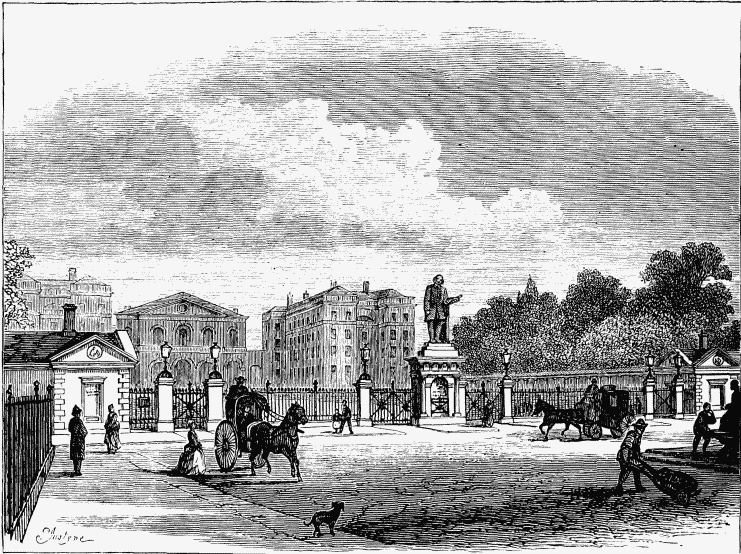
GATEWAY OF THE FOUNDLING HOSPITAL.
Mr. Dale was succeeded in the living of St. Pancras by the Rev. William Weldon Champneys, grandson of a former vicar of this parish. Born at Camden Town in 1807, he was ordained in 1831, and having held one or two curacies in Oxford, became afterwards rector of Whitechapel, where he continued till his appointment to this vicarage, in 1860. He succeeded Canon Dale in the canonry vacated by him in St. Paul's Cathedral, and in 1868 he was nominated to the Deanery of Lichfield, which he held till his decease. His son, the Rev. Weldon Champneys, succeeded him in the vicarage of St. Pancras, but resigned it in 1874.
From St. Pancras Church, a walk of a few minutes, in a southward direction, by way of Woburn Place and Tavistock Square, brings us once more to Guildford Street, the southern boundary of the parish of St. Pancras. The Foundling Hospital, which stands on the north side of this street, but just within the limits of the parish of which we have been treating, having been unavoidably passed by in our previous perambulation in this neighbourhood, will form the subject of the following chapter.
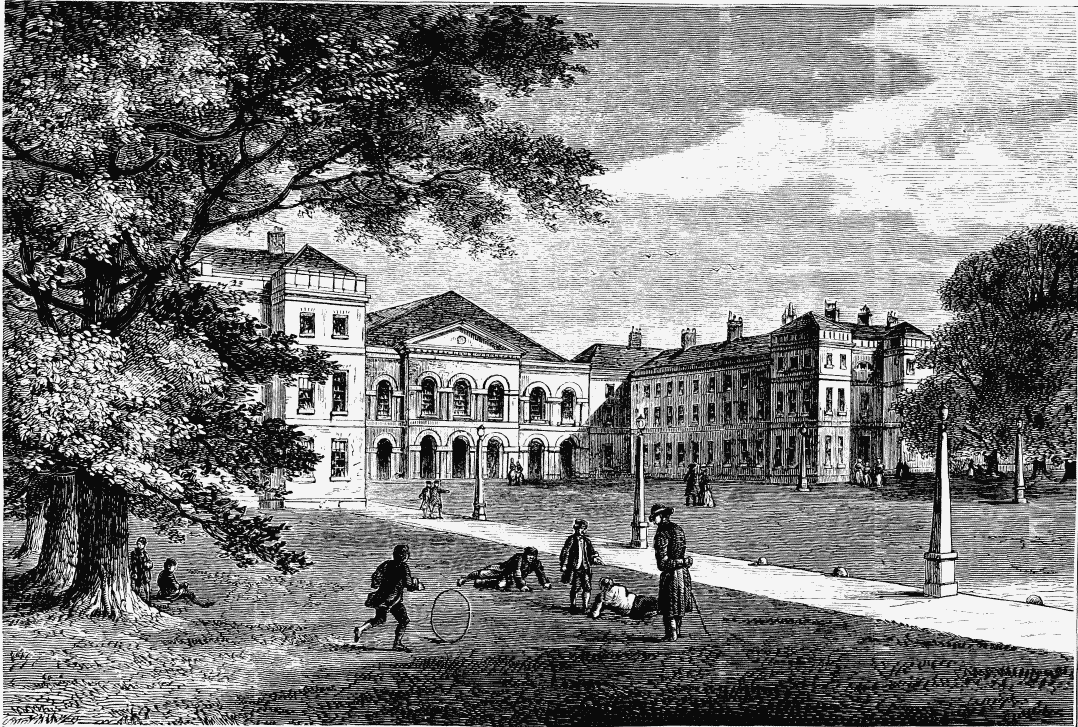
FRONT OF THE FOUNDLING HOSPITAL.