Old and New London: Volume 5. Originally published by Cassell, Petter & Galpin, London, 1878.
This free content was digitised by double rekeying. Public Domain.
Edward Walford, 'The northern suburbs: Haggerston and Hackney', in Old and New London: Volume 5(London, 1878), British History Online https://www.british-history.ac.uk/old-new-london/vol5/pp505-524 [accessed 30 April 2025].
Edward Walford, 'The northern suburbs: Haggerston and Hackney', in Old and New London: Volume 5(London, 1878), British History Online, accessed April 30, 2025, https://www.british-history.ac.uk/old-new-london/vol5/pp505-524.
Edward Walford. "The northern suburbs: Haggerston and Hackney". Old and New London: Volume 5. (London, 1878), British History Online. Web. 30 April 2025. https://www.british-history.ac.uk/old-new-london/vol5/pp505-524.
In this section
CHAPTER XL.
THE NORTH-EASTERN SUBURBS.—HAGGERSTON, HACKNEY, &c.
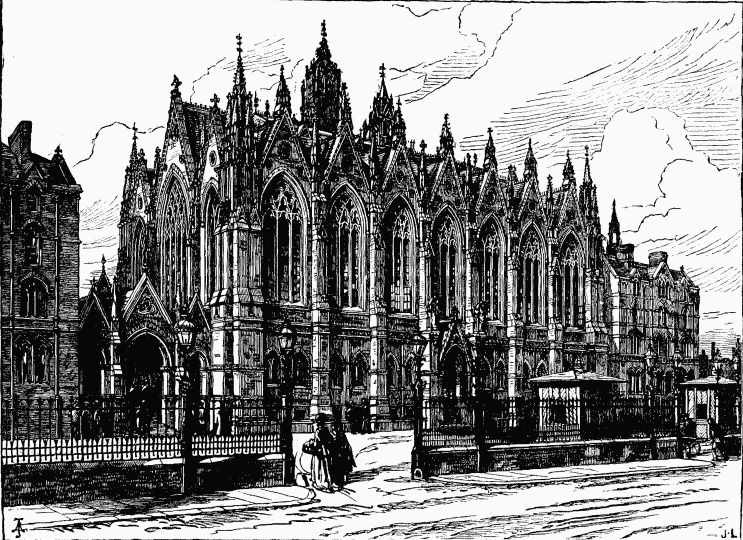
COLUMBIA MARKET, HACKNEY.
"Oppidum rure commistum."—Tacitus.
Appearance of Haggerston in the Last Century—Cambridge Heath—Nova Scotia Gardens—Columbia Buildings—Columbia Market—The "New" Burial-ground of St. Leonard's, Shoreditch—Halley, the Astronomer—Nichols, Square—St. Chad's Church—St. Mary's Church—Brunswick Square Almshouses—Mutton Lane—The "Cat and Mutton" Tavern—London Fields—The Hackney Bun-house—Goldsmiths' Row—The Goldsmiths' Almshouses—The North-Eastern Hospital for Sick Children—The Orphan Asylum, Bonner's Road—City of London Hospital for Disuses of the Chest—Banner's Hall—Bishop Bonner's Fields—Botany Bay—Victoria Park—The East-enders' Fondness for Flowers—Amateur Yachting—The Jews' Burial-ground—The French Hospital—The Church of St. John of Jerusalem—The Etymology of "Hackney."
Having in the preceding chapters devoted our attention to the north-western part of London, we now take up fresh ground, and begin anew with the north-eastern districts, which, although not so extensive as the ground over which we have travelled since starting from Belgravia and Pimlico, will doubtless be found to contain much that may prove interesting to the general reader.
Taking our stand close by the north-easternmost point described in the previous parts of this work—namely, by St. Leonard's Church, Shoreditch (fn. 1) —we have on our left the districts of Hoxton and Islington, and on our right that of Bethnal Green. Stretching away in an easterly direction is the Hackney Road, which divides these last-named districts from that of Haggerston.
In Rocque's map of Hackney, published in 1745, the Hackney Road appears entirely unbuilt upon, with the exception of a couple of houses at the corner of the roadway leading to the hamlet of Agostone (now Haggerston), and a small cluster of dwellings and a roadside public-house called the "Nag's Head," at the bottom of a narrow thoroughfare called Mutton Lane, which passes through the fields in the north, by the front of the Goldsmiths' Almshouses, of which we shall have more to say presently. The greater part of the lane itself is now called Goldsmiths' Row. At the eastern end of the Hackney Road, Cambridge Heath is marked as a large triangular space, the apex of which terminates close by Coats's Lane, Bethnal Green. From Cambridge Heath the roadway trends to the north by Mare (or Meare) Street, on the east side of London Fields, forming the principal roadway through the town of Hackney.
At a short distance eastward of Shoreditch Church, on our right hand as we pass along the Hackney Road, and therefore within the limits of the parish of Bethnal Green, the eye is struck by Columbia Square and Market, the tall roofs of which rise against the sky, reminding us of the Houses of Parliament, though on a smaller scale. They were erected in 1869, from the designs of Mr. H. A. Darbishire. On the site now occupied by the market and a few of the surrounding buildings existed till very recently a foul colony of squalor and misery, consisting of wretched low tenements—or, more correctly speaking, hovels—and still more wretched inhabitants; the locality bore the name of Nova Scotia Gardens, and it abounded in pestilential drains and dust heaps. Nova Scotia Gardens and its surroundings, in fact, were formerly one of the most poverty-stricken quarters of the whole East-end, and, doubtless, one of those spots to which Charles Dickens refers in his "Uncommercial Traveller," when he draws attention to the fact that while the poor rate in St. George's, Hanover Square, stands at sevenpence in the pound, there are districts in these eastern slums where it stands at five shillings and sixpence. By the benevolence of Lady Burdett-Coutts, whose charity and will to benefit the poor of London we have already had occasion to remark upon in our account of Highgate, (fn. 2) the whole of this seat of foulness and disease was cleared away, and in its place four large blocks of model lodginghouses, forming a square called Columbia Buildings, have been erected, and are occupied by an orderly and well-behaved section of the working-class population of the district. Contiguous to the square stands the Market, which was also established by the same benevolent lady for the convenience of the neighbourhood. The market covers about two acres of ground, and the buildings, which are principally constructed of brick, with stone dressings, are very elaborately ornamented with carved work, in the shape of medallions and armorial bearings. The market-place forms three sides of a square, having an arcade opening on the central area through Gothic arches. Tables for the various commodities which may be brought to the market for sale, occupy the centre of the quadrangular space, and are partly covered in by a light roof. The chief feature of the building, which occupies the whole of the eastern side of the quadrangle, is a large and lofty Gothic hall. The exterior of this edifice is particularly rich in ornamentation. The basement is lighted by a range of small pointed windows, above which is an ornamental string-course. The hall itself, which is reached by a short flight of steps, is lighted by seven large pointed windows on each side, with others still larger at either end; the buttresses between the windows terminate in elaborate pinnacles; in fact, the whole building, including the louvre in the centre of the roof, and the tall clock-tower, bristles with crocketed pinnacles and foliated finials.
Whether the building is too ornate, or whatever may be the cause, it is not for us to say; but, at all events, as a place of business in the way designed by its noble founder, Columbia Market from the very first has proved a comparative failure. Scarcely any of the shops which open upon the arcades are occupied; indeed, very little in the way of business is ever carried on there. An attempt was at one time made to convert it into a fish-market, in order to relieve the run upon Billingsgate; but even this, too, proved ineffectual; and in April, 1877, it was re-opened as a market for American meat.
On the opposite side of the Hackney Road, facing the entrance to Columbia Square, is the "new" burial-ground belonging to St. Leonard's, Shoreditch. This has been long disused, and within the last few years the grave-mounds have been levelled, the place being made to serve as a recreation-ground for the children in the neighbourhood.
Haggerston, on our left, at one time an outlying hamlet in the parish of St. Leonard's, Shoreditch, is mentioned in "Domesday Book" under the name of Hergotestane. It is now an extensive district, stretching away from the north side of the Hackney Road to Dalston, and from the Kingsland Road on the west to London Fields, and is crowded with factories and with the residences of the artisan class. In the seventeenth century the hamlet contained only a few houses, designed for country retirement. The celebrated astronomer, Halley, was born and resided here, though the house which he occupied is not known. He died in 1741, and lies buried in the churchyard of Lee, Kent.
Nichols Square, which we pass on our left, keeps in remembrance the name of Mr. John Nichols, F.S.A., the well-known antiquary, and "the Dugdale of the present age." Mr. Nichols was the author of "Literary Anecdotes of the Eighteenth Century," the "History of the County of Leicester," "Progresses and Processions of Queen Elizabeth," &c., and was many years editor of the Gentleman's Magazine in its palmy days. He was a native of the adjoining parish of Islington, where he chiefly resided. He died in 1826, and was succeeded in his property in this neighbourhood by his son, Mr. John Bowyer Nichols, who shortly afterwards became proprietor of the Gentleman's Magazine. This gentleman died at Ealing in 1863. The Messrs. Nichols have been for many years printers to the two Houses of Parliament.
In the north-east corner of Nichols Square stands St. Chad's Church. It is a large red-brick edifice, with an apsidal eastern end, and comprises nave and aisles, transepts, and chancel, with a dwarf spire at the intersection. The transepts are lighted by large wheel windows, and the body of the fabric by narrow Gothic pointed windows. The church was built about 1865. It is noted for its "High Church" or ritualistic services.
St. Mary's Church, in Brunswick Square, close by, was built in 1830, but considerably altered in 1862. It is of Gothic architecture, and, externally, is chiefly remarkable for the lofty tower at the western end. The organ, which was originally in St. George's Chapel, Windsor, was built by Father Smith. It has been within the last few years much enlarged by Willis.
The parish of Haggerston contains a Church Association, of which all the communicants are members, and each member is required to do some work for the cause of the Established Church.
On the west side of Brunswick Square is a row of almshouses, of neat and picturesque appearance. These almshouses, belonging to the parish of Shoreditch, were founded in 1836, and stood originally on the south side of the Hackney Road, but were rebuilt on this site on the demolition of the houses, in order to make room for the approaches to Columbia Square, &c.
Passing eastward, by the Imperial Gas-works,
we arrive at Goldsmiths' Row, which, as stated
above, was formerly known as Mutton Lane, a
name still given to that part of the thoroughfare
bordering upon the southern extremity of London
Fields, where stands a noted public-house, rejoicing
in the sign of the "Cat and Mutton." Affixed to
the house are two sign-boards, which are rather
curious; they have upon them the following
doggrel lines:—
"Pray, Puss, do not tare,
Because the mutton is so rare."
"Pray, Puss, do not claw,
Because the Mutton is so raw."
The open space in front, known as London Fields, and extending over several acres, has within the last few years been taken in hand by the Board of Works, and has had its surface levelled, and, where necessary, sown with fresh grass; it is crossed by numerous paths, and in part planted with trees. The spot has been for ages the resort of the dwellers in the neighbourhood for the purposes of recreation, and from the neighbouring tavern and its associations had in process of time become better known as the "Cat and Mutton" fields.
Strype tells us that the Bishop of London held demesnes in Hackney as far back as the time of Edward I., in the nineteenth year of whose reign (A.D. 1290) the right of free warren in this parish was granted to Richard de Gravesend, who then held the see; and from an "inquisition" in the same reign, it is clear that a yeoman named Duckett held lands here under the bishop, who in his turn held them from the king as his superior. There are, or were, several manors within the parish of Hackney; the principal of these is termed the "Lord's-hold," and was attached to the bishopric of London until the year 1550, when it was surrendered to the Crown by Bishop Ridley, whose memory is kept up in connection with this locality by the name of Ridley, given to a roadway on the north side of Dalston Lane.
In the short thoroughfare connecting the London Fields with Goldsmiths' Row there is a shop which in bygone times was almost as much noted for its "Hackney Buns" as the well-known Bun-house at Chelsea was for that particular kind of pastry about which we have already spoken. (fn. 3)
Goldsmiths' Row extends from the canal bridge, near the south-west corner of London Fields, to the Hackney Road. The thoroughfare is very narrow, and in parts consists of very inferior shops and tenements. On the west side, about half way down, stand a row of almshouses belonging to the Goldsmiths' Company. They were founded in 1703, by a Mr. Morrell, for six poor almsmen belonging to the above-mentioned company, each of whom has a pension of £21 per annum. On the opposite side, near the corner of the Hackney Road, are some new buildings in connection with the North-Eastern Hospital for Sick Children, which was founded in 1867, in the Hackney Road. The new buildings were inaugurated a few years ago by the Princess Louise. The institution was established, as its name implies, for the purpose of affording medical relief to sick children; and about 10,000 patients are annually relieved here. Patients are admitted free, on the production of a subscriber's ticket; otherwise a small fee is paid by out-patients and in-patients.
At the eastern end of Hackney Road formerly stood the Cambridge Heath turnpike gate, which was removed a few years ago, when tolls upon the metropolitan highways were abolished; its site is now marked by an obelisk set up in the centre of the roadway. From this point, Mare Street, of which we shall have more to say presently, branches off to the left; Cambridge Road, on our right, leads past the Bethnal Green Museum, and so on to the Whitechapel Road and Mile End. Prospect Place, which extends eastward from the Hackney Road, and its continuation, Bishop's Road, leads direct to the principal entrance to Victoria Park.
On the east side of Bonner's Road, which here branches off to the right, leading to Old Ford Road, stands an Orphan Asylum, or Home for outcast children; and also the City of London Hospital for Diseases of the Chest. The latter edifice is a large and well-proportioned building of red brick, consisting of a centre and wings, in the Queen Anne style, and was constructed from the designs of Mr. Ordish. It has a central campanile, and a small Gothic chapel on the north side, connected with the main building by a covered corridor. The hospital, which was opened by Prince Albert in 1848, for "the relief of indigent persons afflicted with consumption and other diseases of the chest," was first of all located in Liverpool Street, Finsbury, and by the end of the year 1849 about 900 patients were relieved. Since its removal to the neighbourhood of Victoria Park its accommodation has vastly increased, so that in the year 1875 about 700 in-patients and 12,000 out-patients had experienced the benefits of this most excellent charity. The hospital stands upon a large triangular plot of ground, surrounded by a light iron railing; and the grounds are laid out in grass plats, and flower-beds, and are well planted with shrubs and trees. Some of the latter are the remains of an avenue formerly extending from the Old Ford Lane to the principal entrance of Bonner's Hall, which stood on the east side of where the hospital now stands. The old building is traditionally said to have been the residence of Bishop Bonner, and certainly to have been his property. The surrounding land down to a comparatively recent date was known as Bishop Bonner's Fields, names which are now preserved in the two roads above mentioned. The site of Bishop Bonner's Hall was occupied by some private buildings in the early part of the present century; and Bishop Bonner's Hall Farm, a curious oldfashioned structure of plaster and brickwork, stood near what is now the western entrance to Victoria Park down to about the year 1850.
In this neighbourhood, at the time of the formation of Victoria Park, was swept away a wretched village of hovels, formerly known as "Botany Bay," from so many of its inhabitants being sent to "another place" bearing that name.
By the side of the park gates is a picturesque lodge-house of the Elizabethan character, built from the designs of Mr. Pennethorne; it is constructed chiefly of red bricks, and has a lofty tower and porch. The ground now forming Victoria Park was purchased by the Government with the proceeds of the sale of York (now Stafford) House, (fn. 4) St. James's, in pursuance of an Act of Parliament passed in 1840 for that purpose. It is bounded on the south-east by Sir George Duckett's Canal—a branch cut from the Regent's Canal, near Bonner's Hall Farm, crossing the Grove Road, and communicating with the river Lea, near Old Ford; on the north-east by Old Ford Lane, or Wick Lane; on the north-west by Grove Street and lands belonging to Sir John Cass's charity and to St. Thomas's Hospital; and on the west by the Regent's Canal.
Victoria Park is nearly 300 acres in extent, with avenues which one day with an ampler growth will be really superb, a lake, or chain of lakes, on which adventurous spirits daily learn to "tug the labouring oar," and such a pleasant arrangement of walks, shrubberies, green turf, gay flowers, and shady trees, that if the place were situated in the western suburbs, it would, perhaps, become the resort of the élite of fashion. On an island upon one of the lakes is a two-storeyed Chinese pagoda, which, with the trees and foliage surrounding it, has a pretty effect. Here, as in the West-end parks, floriculture has been greatly extended of late; and through the summer months, its variegated parterres are aglow with flowers of every hue, making altogether a glorious show. Among the large foliage plants which have found their way here, may be remarked, on one sheltered slope, a group of Ficus elastica, the india-rubber tree, and close by is a specimen of the Yucca gloriosa, which has the more popular name of "Adam's needle," the tradition probably being that one of its pointed leaves helped to make the fig-leaf apron. Tropical plants of different varieties are to be found in the snug nooks and recesses which abound here. As to the flowering plants, such as the geranium, calceolaria, verbena, lobelia, &c., reliance is placed chiefly upon masses of colour instead of the narrow bands adopted in the other parks. In the Regent's Park, as we have already seen, (fn. 5) great skill has been shown in grouping and composition; there is an attempt in landscape-gardening at something of the effects of landscape painting, using Nature's own colours, with the ground for canvas. In Hyde Park the red line of geraniums between Stanhope Gate and Grosvenor Gate is as well known among gardeners as the "thin red line" at Balaclava among soldiers. But in Victoria Park the old gardening tactics prevail; for the most part, masses of colour are brought to bear upon the eye in oval, round, and square; and with a wide area of turf in which to manœuvre our floral forces, these tactics are probably the most effective that could be adopted. More ingenious designs, however, are not wanting. Near the ornamental water, a pretty effect is produced by scrolls of purple verbena enclosed by the white-leaved Cerastium tomentosum, looking like amethysts set in silver. In another part of the park this design is reversed, and the blue lobelia is made a frame for a central pattern of the same delicate silvery foliage plant, lit up by an occasional patch of scarlet, with a background of dahlias and evergreens. Elsewhere we come upon a fanciful figure which, after some study, resolves itself into an outstretched butterfly of enormous size, with wings as vividly coloured as those of any that fly in the sun. For borderings the Amaranthus melancholicus and the usual foliage plants of small growth are employed.
In fine weather, when the band plays, over 100,000 persons are frequently collected in this park. The people are orderly, most of them being of the humbler class, and their appreciation of the flowers is quite as keen as that of the frequenters of the West-end parks. Some of the dwellers in the East-end have a great fondness for flowers, and contrive somehow or other, in the most unlikely places, to rear very choice varieties. In small, wretched-looking yards, where little air and only the mid-day sun can penetrate, may be seen patches of garden, evidently tended with uncommon care, and yielding to their cultivators a fair reward in fragrance and in blossom. In some places may be descried bits of broken glass and a framework which just holds together, doing duty as a greenhouse; and in this triumph of patience and ingenuity the poor artisan spends much of his leisure, happy when he can make up a birthday bouquet for some friend or relation. The flowers in the neighbouring park, with their novel grouping and striking contrasts of colour, are, of course, a continual source of pleasure for these struggling artisans, and gladden many a moment when, perhaps, work is not too plentiful, and home thoughts are not very happy. In Victoria Park the plants and flowers are labelled in letters which he who walks may read without need of getting over fence or bordering. This is not always the case in the other parks, where the labels, from dirt or the smallness of the characters, are often practically illegible. One of the lakes is devoted to miniature yacht sailing. This amusement seems almost confined to East London; and here on a summer evening, when a capful of wind is to be had, the surface of the lake is whitened by some forty or fifty toy boats and yachts, of all rigs and sizes, while here and there a miniature steamboat is puffing and panting. There is even a yacht-club, whose members compete with their toy-yachts for silver cups and other prizes. The expense of keeping up a yacht here is not considerable, and the whole squadron may be laid up until wanted in a boat-house provided for the purpose. But the matches and trials of these tiny crafts are a special attraction of the park, and draw together every evening hundreds of people. Bathing, too, is largely indulged in during the summer. Ample space is available for cricket, and in the two gymnasia candidates for swinging, jumping, and climbing appear to be never wanting.
In one open part of the grounds stands a very handsome drinking-fountain, surrounded by parterres of flowers. It was erected by Lady Burdett-Coutts, whose care for the social welfare of the poor of London, and particularly in the East-end districts, we have already had occasion to mention. In the part devoted to cricket and such like sports, some of the semi-octagonal recesses, which afforded shelter for foot-passengers on old Westminster Bridge, (fn. 6) have been re-erected, and serve as alcoves.
On the north side of Victoria Park is a large plot of ground, which since the end of the last century has been used as a burial-place for the Jewish community, belonging to the Hamburg synagogue.
Making our way through Grove Street, we reach the south-west corner of Hackney Common. Close by this point stands the French Hospital, a large and ornamental building of dark red brick, with stone dressings, which presents a pleasing contrast to the foliage of the trees which surround it. The institution was established as far back as 1708, for the "support of poor French Protestants and their descendants."
A short walk through Lammas Road and Groombridge Road, which skirt the western side of the Common, brings us to Grove Street, by the end of King Edward Road, where stands the large and handsome church of St. John of Jerusalem, the parish church of the recently-formed district of South Hackney. The church, which is built of Kentish rag-stone, is in the best Pointed style of the thirteenth and fourteenth centuries, and was erected in 1846 from the designs of Mr. E. C. Hakewell, to supersede a church erected in Well Street early in the present century. The plan of the edifice is cruciform, with a tower and spire of equal height, together rising nearly 200 feet; the latter has graceful lights and broaches, and the four Evangelists beneath canopies at the four angles. The nave has side aisles, with flying buttresses to the clerestory; each transept is lit by a magnificent window, about thirty feet high, and the choir has an apse with seven lancet windows. The principal entrance, at the western end, is through a screen of open arches. The roof, of open work, is very lofty, and has massive arched and foliated ribs; the chancel has a stone roof, and the walls of the apse are painted and diapered—red with fleur-de-lis, and blue powdered with stars. All the windows are filled with painted, stained, or richly-diapered glass. The tower has a fine peal of eight bells.
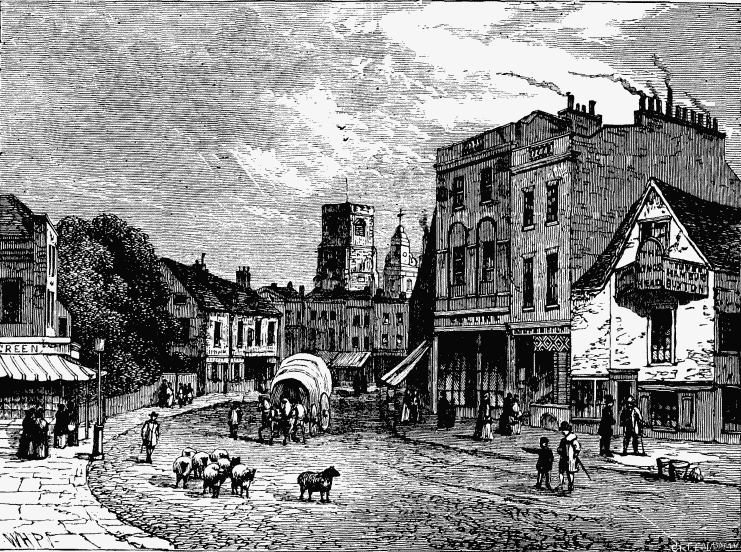
HACKNEY, LOOKING TOWARDS THE CHURCH, 1840.
Before proceeding with a description of the old town of Hackney, upon which we are now entering, we may remark that it has been suggested, and with considerable probability, that the name of the place is derived from "Hacon's ey," or the island which some Danish chief named Hacon had, in the mild method prevalent among the warriors of fifteen hundred years ago, appropriated to himself. But authentic history is silent upon the point; and, indeed, almost the earliest record we find of the place is that the Knights Templars held the manor, which afterwards became the property of their rivals, the Knights of St. John of Jerusalem. Of late years the parish has been styled by the name of St. John at Hackney, as though it belonged to the fraternity of the Knights of St. John of Jerusalem, who had, as it is said, a mansion and other possessions in the parish; but from ancient records preserved in the Tower of London it is found to be written, Ecclesia Parochialis S. Augustini de Hackney. The Temple Mills, in Hackney Marshes, even now preserve the memory of the priestly warriors of the Templar order.
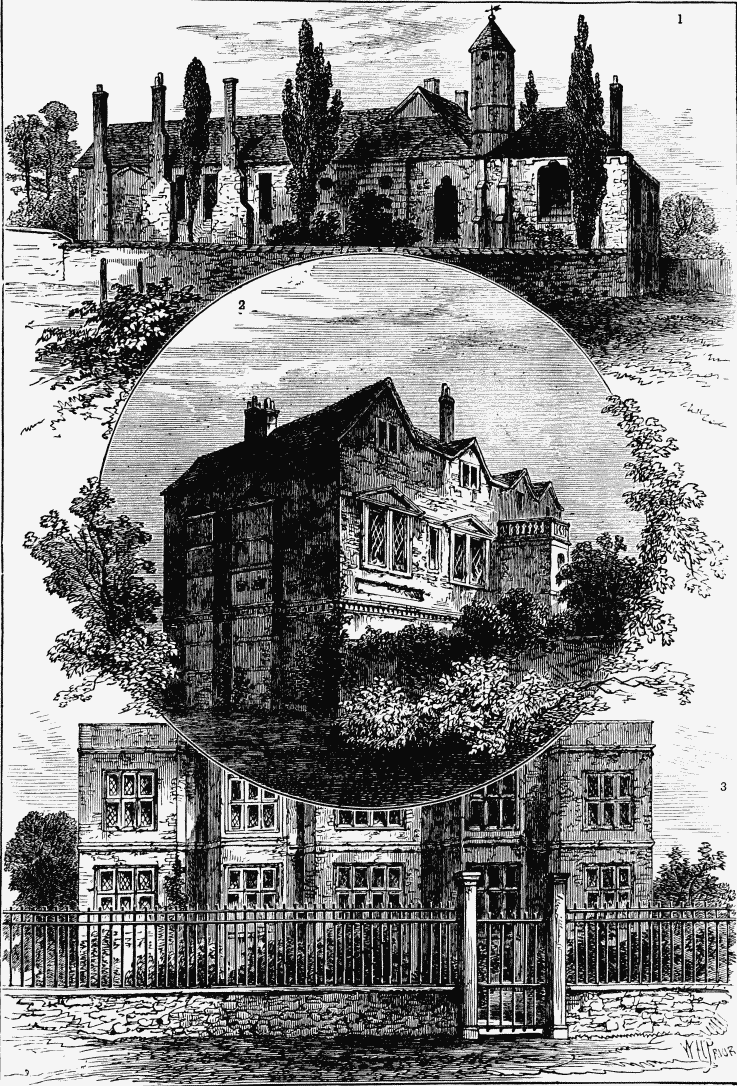
BITS OF OLD HACKNEY.
1. Brook House, 1765.
2. Barber's Barn, 1750.
3. Shore Place, 1736.
In the reign of Henry III., when the first mention of the place occurs as a village, it is called Hackenaye, and Hacquenye; and in a patent of Edward IV., granting the manors of Stepney and Hackney to Thomas Lord Wentworth, it is styled Hackeney, otherwise Hackney. "The parish, no doubt," says Dr. Robinson, "derived its appellation from circumstances of no common nature, but what they were it is at this time difficult to conjecture; and no one will venture to assert that it received its name from the Teutonic or Welsh language, as some have supposed."
We may conclude this chapter by remarking that Dr. Robinson, in his "History and Antiquities of Hackney,"describes it as an ancient, extensive, and populous village, "situated on the west side of the river Lea, about two miles and a half from the City of London, within the division of the Tower Hamlets, in the hundred of Ossulston, in the county of Middlesex." "In former times," he adds, "many noblemen, gentlemen, and others, of the first rank and consequence, had their country seats in this village, on account of its pleasant and healthy situation." In the parish of Hackney are comprised the nominal hamlets of Clapton (Upper and Lower), Homerton, Dalston, Shacklewell, the greater part of Kingsland, and that part of Stoke Newington which lies on the eastern side of the high road to Tottenham; but modern Hackney, considered as an assemblage of dwellings, is quite united to Homerton and Lower Clapton, on the east and north, and also by rows of buildings on the west to the parish of St. Leonard, Shoreditch.
CHAPTER XLI.
THE NORTH-EASTERN SUBURBS.—HACKNEY (continued).
"I had a parcel of as honest girls about me as ever pious matron had under her tuition at a Hackney boarding-school."
Tom Brown: Madam Cresswell to Moll Quarles.
Hackney in the Last Century—Its Gradual Growth—Well Street—Hackney College—Monger's Almshouses—The Residence of Dr. Frampton—St. John's Priory—St. John's Church—Mare Street—Hackney a Great Centre of Nonconformity—The Roman Catholic Church of St. John the Baptist—The "Flying Horse" Tavern—Elizabeth Fry's Refuge—Dr. Spurstowe's Almshouses—Hackney Town Hall—The New Line of the Great Eastern Railway—John Milton's Visits to Hackney—Barber's Barn—Loddidge's Nursery—Watercress-beds—The Gravel-pit Meeting House—The Church House—The Parish Church—The "Three Cranes"—The Old Church Tower—The Churchyard—The New Church of St. John—The Black and White House—Boarding Schools for Young Ladies—Sutton Place—The "Mermaid" Tavern—"Ward's Corner"—The Templars' House—Brooke House—Noted Residents at Hackney—Homerton—The City of London Union—Lower Clapton—John Howard, the Prison Reformer—The London Orphan Asylum—Metropolitan Asylum for Imbeciles—The Asylum for Deaf and Dumb Females—Concluding Remarks on Hackney.
In treating of this parish we have no Pepys or Boswell to guide or interest us, and to gossip with us over this neighbourhood, and to furnish us with stores of anecdote; but, fortunately, we have the assistance of Strype, who, in his edition of Stow's "London," includes Hackney in his "Circuit Walk on the North of London." He styles it a "pleasant and healthful town, where divers nobles in former times had their country seats," enumerating among its residents an Earl of Northumberland, a Countess of Warwick, and a Lord Brooke. Still, the houses and their walks, for the most part, have no stories connected with them, carent quia vate sacro, and the whole district supplies us but scanty materials, historical, topographical, and biographical, as compared with St. Pancras or Hampstead.
Hackney is described in the "Ambulator," in 1774, as "a very large and populous village, on the north of London, inhabited by such numbers of merchants and wealthy persons, that it is said there are near a hundred gentlemen's coaches kept." The writer enumerates its several hamlets, viz., "Clapton on the north, Dorleston [Dalston] and Shacklewell on the west; and on the east, Homerton, leading to Hackney Marshes."
There is still an old-fashioned air about Hackney itself; but Dalston has thrown out lines of commonplace villas across the fields and orchards on the south-west; Clapton has developed itself on the north; Victoria Park has initiated a new town on the south; a busy railway station stands near the tower of the old church, of which we shall speak presently; and down in the Marshes are now large hives of manufacturing industry.
The town (if considered independently of its hamlets), down to a comparatively recent date, consisted chiefly of four streets, termed Church Street, Mare (or Meare) Street, Grove Street, and Well Street; but such has been the growth of the place during the past half century that large numbers of other streets and terraces have sprung up in all directions, on land which hitherto had served as the gardens attached to the mansions of the nobility and City merchants, or as nursery grounds, market gardens, and even watercress-beds. The population of Hackney, too, which at the commencement of this century was about equal to that of a good-sized country village, had, according to the census returns of 1871, reached something like 300,000; and the place, since 1868, has enjoyed the privilege of Parliamentary representation.
From Grove Street, incidentally mentioned near the close of the preceding chapter, we pass into Well Street, which winds somewhat circuitously to the west, where it unites with Mare Street. Hackney College, which we notice on our left immediately on entering Well Street, was founded in 1803 with the object of preparing students for the Congregational ministry, and of granting votes in support of chapels. The average number of students in the college is about twenty, and the annual receipts about £1,500. At the close of the last century there was a college for Dissenters established at Lower Clapton, to which Dr. Rees, Dr. Priestley, and his scarcely less renowned Unitarian coadjutor, Mr. Belsham, and Gilbert Wakefield were attached; but it was broken up in 1797, owing to the bad conduct of some of the students. The well-known college at Homerton was established about the latter part of the seventeenth century. Dr. Pye Smith, the great geologist, whose conclusions anticipated some of the views of Mr. Goodwin in his "Mosaic Cosmogony," was for many years the principal of the seminary; and many eminent ministers of the Nonconformist bodies there received their education.
In Well Street are almshouses for six aged and poor men, founded by Henry Monger in 1669.
Further on, on the right, a large old-fashioned mansion may be observed, although it is now cut up into tenements, and the lower part converted into shops. This was once the residence of the celebrated Dr. Frampton, whose memory is preserved in the locality in the name of Frampton Park Road.
The residence of the Knights of St. John existed till a very recent period, under the name of the Priory, in Well Street. In 1352 the Prior of St. John disposed of the mansion, then called Beaulieu, to John Blaunch and Nicholas Shordych. In Stow's time it bore the name of Shoreditch Place, (fn. 7) since shortened into Shore Place and Shore Road. The Priory, within the memory of the present generation, was a strange-looking brick building, divided into small tenements, and inhabited by chimneysweeps and others of kindred calling.
A chapel of ease, dedicated to St. John, in this street, was consecrated in 1810 by Bishop Randolph, and endowed as a district parish church for South Hackney. In 1846 it was superseded by the new parish church, which we have already described.
Mare Street, as we have already stated, commences at the eastern end of the Hackney Road, and forms the main thoroughfare through the centre of the town. Throughout its entire length it is well sprinkled with the remains of dwellings of the wealthy classes of society, who formerly inhabited this now unfashionable quarter of London. Here, too, the number of religious edifices, of all denominations, is somewhat remarkable, and in some cases the buildings are fine specimens of ecclesiastical architecture.
Hackney has altogether upwards of twenty places of worship for Dissenters; it has, in fact, long been renowned as a great centre of Nonconformity, and some eminent Dissenting divines have preached there. Dr. Bates, the learned author of the "Harmony of the Divine Attributes," died there in 1679. Matthew Henry, the compiler of the well-known "Commentary" on the Bible, preached at Hackney between 1710 and 1714. Robert Fleming, the author of "The Rise and Fall of the Papacy," died at Hackney on the 24th of May, 1716. His prophecies were believed to have been fulfilled in 1794; and in 1848, when a second revolution occurred in Paris, Fleming's book was eagerly sought for, and reprinted, and read by thousands.
The Presbyterian Dissenters' Chapel was established in this street early in the seventeenth century. Here Philip Nye and Adoniram Byfield, two eminent Puritan divines, preached in 1636. The old meeting-house has been taken down, and a new one built on the opposite side of the street, and occupied by Independents.
On the east side of Mare Street, near King Edward Road, stands the Roman Catholic Church of St. John the Baptist, which was built about the year 1848, from the designs of Mr. Wardell. It is built in the decorated Gothic style, and comprises nave, chancel, aisles, and sacristy. The rood-screen and altar are elaborately carved, and some of the windows are filled with painted glass. In 1856 a brass plate was placed in the chancel, over the grave of the founder and first rector, the Rev. J. Leucona, who died in 1855. Mr. Leucona was a Spanish Catholic missionary, and the author of a few published works, among them a pamphlet in reply to some of the writings of Dr. Pusey.
On the west side of this street, near the narrow lane leading into London Fields, stands a very old public-house, bearing the sign of the "Flying Horse." It is a large, rambling house, of two storeys, and consists of a centre and two wings. It is traditionally said to have been one of the old posting-houses of the time of "Queen Bess," on the old road to Cambridge and Newmarket.
Further to the north, one of a row of old mansions with small gardens before them, has a large board displayed upon its front inscribed with the words "Elizabeth Fry's Refuge." This institution was founded in the year 1849, for the purpose of providing temporary homes for female criminals on their release from prison.
Hackney has always been remarkable for the number of its charitable institutions: besides those which we have already mentioned, and others which we have still to notice, are some almshouses for widows near Mare Street, founded by Dr. Spurstowe, who died in the reign of Charles II.
The Town Hall, which stands in The Grove, is a modern structure, having been erected only a few years ago to supersede an older and less commodious building further on, near the old parish church. The edifice, with its noble portico, and its ample supply of windows—for, like Hardwick Hall, it might almost be said to have "more windows than wall"—presents a striking contrast to many of the quaint old buildings which surround it. Notwithstanding the grand appearance of the building externally, and the thousands of pounds spent in its erection, the interior does not seem to have given that satisfaction to the parishioners which they were led to expect, and the accommodation, or rather, the want of accommodation in some of the rooms which the edifice affords, was such as to serve as a bone of contention among them for some considerable time after its erection.
Running parallel with Mare Street, on the west side, and overlooking the London Fields, is the new line of the Great Eastern Railway, from which, at the Hackney Downs station, a line branches off on the left to Enfield. In the construction of this railway several old houses were swept away, among them an ancient mansion which had long been used as a private lunatic asylum, and another which, with its gardens, covered a large space of ground, and was formerly used as a hospital by the Honourable East India Company.
To the Tower House, at the corner of London Lane, which connects Mare Street with London Fields and the railway station, often came an illustrious Parliamentarian, no other than John Milton; for there he wooed his second wife, the daughter of Captain Woodcock, who lived there.
On the east side of Mare Street, and covering the ground now occupied by St. Thomas's Place, once stood an ancient edifice known as Barber's Barn, or Barbour Berns, which dated from about the end of the sixteenth century. It was in the Elizabethan style of architecture, with pediments, bay-windows, and an entrance porch, and contained numerous rooms. It is said to have been the residence of John Okey, the regicide. He is reported to have been originally a drayman and stoker in a brewery at Islington, but having entered the Parliamentary army, to have risen to become one of Cromwell's generals. He sat in judgment on Charles I., and was the sixth who signed the warrant for the king's execution. About the middle of the last century Barber's Barn, with its grounds and some adjoining land, passed into the possession of one John Busch, who formed a large nursery ground on the estate. Mr. Loudon, in his Gardeners' Magazine, says that Catharine II., Empress of Russia, "finding that she could have nothing done to her mind, determined to have a person from England to lay out her garden." Busch was the person engaged to go out to Russia for this purpose. In 1771 he disposed of his nursery at Hackney to Messrs. Loddige, who ranked with the most eminent florists and nurserymen of their time. Indeed, the name of the Loddige family has been known for nearly a century in the horticultural and botanical world; and few persons who take an interest in gardening and flowers can fail to recognise the names of Conrad Loddige and his sons, of Hackney, as the authors of the "Botanical Cabinet," published in twenty large quarto volumes during the Regency and the subsequent reign of George IV. They had here extensive greenhouses, and also hothouses which were heated by steam. The ancient house having become the property of Mr. Conrad Loddige, was taken down many years ago, and Loddige's Terrace, together with some residences called St. Thomas's Place, were built on its site. A few houses in Well Street occupy the other portion of the former gardens.
In 1787 Mr. Loddige removed from what was called Busch's Nursery, and formed another nursery on some grounds which he purchased from the governors of St. Thomas's Hospital; these grounds had until then been open fields, and he enclosed them towards the north with a brick wall. The last vestiges of Loddige's gardens disappeared about the year 1860, when some of the plants were transferred to the Crystal Palace at Sydenham.
Hackney, it may be added, was celebrated till a comparatively recent date for its market gardens, and even for its watercress beds. A large watercress garden was in existence until 1860, and perhaps even more recently, only a few yards to the south of the North London Railway Station.
In Paradise Place, at the end of Paragon Road, stands the New Gravel-pit Meeting House, "Sacred to One God the Father." The chapel was built on what was formerly Paradise Fields. The old Gravel-pit Meeting House, where Dr. Price and Dr. Priestley were formerly ministers, and which dates its erection from the early part of the last century, stands at a short distance to the east. Dr. Priestley preached his farewell sermon in the old chapel in 1794, previous to his departure for America.
At a short distance northward from the new Town Hall, Mare Street is spanned by the North London Railway. Near this spot, on the east side of the street, and close by the entrance to the churchyard, was standing, in Lysons' time or at the end of the last century, an ancient building, thus described in the chantry-roll at the Augmentation Office, which bears date the first year of the reign of Edward I.:—"A tenement buylded by the parishioners, called the Churche Howse, that they might mete together and comen of matters as well for the kyng's business as for the churche and parishe, worth 20s. per an." It appeared by an inscription, remaining on the front towards the street, that it was built in the year 1520, when Christopher Urswick was rector. The house was for many years, in the last century, used as a free school, but in its latter years it seems to have reverted again to its original purpose. The site was afterwards occupied by a more modern Town Hall, which is still standing, but which, as we have already seen, has since been superseded by the new building in Mare Street.
If we may follow the statements of Stow and Strype, Hackney was, as far back as the close of the thirteenth century, a distinct parish, with a rector and also a vicar, and a church dedicated to St. Augustine; but the Knights of St. John of Jerusalem having obtained possession of a mill and other possessions in the parish formerly held by the Knights Templars, the appellation of the church came to be changed from St. Augustine to St. John. In the reign of Edward III. this church, in lieu of that of Bishop's Stortford, in Hertfordshire, was annexed to the precentorship of St. Paul's Cathedral. In confirmation of the assertion that the church was dedicated to St. Augustine, it may be added that a statue of that saint, erected in it as lately as the reign of Henry VIII., is mentioned in the will of Christopher Urswick, rector, and also Dean of Windsor.
This old church, then, of which the tower alone now remains, though dedicated to St. Augustine, has for many years been known as St. John's Church. Newport, in his "Repertorium," speaking of Hackney Church, says:—"The church has of late years gone by the name of St. John of Jerusalem at Hackney, as if dedicated to St. John, which I take to be a mistake; because I find that Arthur Wood, in December, 1509, instituted to the vicarage of St. Augustin at Hackney—to which saint, I rather believe, that church had been dedicated—no presentation having been made by the name of St. John of Jerusalem at Hackney till after the restoration of King Charles II. One—Heron, Esq., is taken by some to be the founder of it, by his arms engraven upon every pillar, which is a chevron ermine between three herons; but I rather think that he was a very great benefactor to the new building or repairing of the church, for which reason his arms (are) upon every pillar; and in the north aisle thereof, in a tomb of white freestone, without any inscription, his body lies."
In the Cottonian Library there is a volume relating to the Knights Templars, in which mention is made of St. Augustine's at Hackney, and of the lands and rents there which belonged to that order, including a mill which was known as Temple Mill. It appears that these, after the suppression of the Templar order, passed into the hands of the Knights of St. John, whose influence in and upon the parish was so great, that the very dedication of the church to St. Augustine was forgotten.
There is in the Tower records a patent or licence to one Henry Sharp, the "parson" of St. Augustine's at Hackney, to erect in his church a "Guild of the Holy Trinity and of the Glorious Virgin Mary;" in whose honour, therefore, doubtless a light was kept constantly burning before an altar in an aisle or side chapel. This guild, or "perpetual fraternity," was to consist of "two guardians or brethren, and sisters, of the same parish, and of others who, from their devotion, will be of the same fraternity."
It is impossible to fix the date of erection of the first church of St. Augustine at Hackney. It appears to have been taken down and rebuilt in the early part of the sixteenth century; and "it is probable," says Dr. Robinson, in his "History of Hackney," "that Sir Thomas Heron, who was master of the jewel house to King Henry VIII., and Christopher Urswick (then rector) were the principal benefactors to its re-erection; for besides the arms above-mentioned, the same arms occurred on one side of the chancel window, and on the other side the arms of Urswick." The conjecture that some member of the Heron family had at least something to do with the rebuilding of the fabric, receives a certain amount of support or confirmation from a tradition that the house called the "Three Cranes," nearly opposite, was the first public-house in the parish, and that it was built for the accommodation of the workmen whilst they were erecting the church: it is said to have had originally the sign of "The Herons."The ancient church of St. Augustine was taken down towards the close of the last century, except the old tower, which, as we have stated, still remains. It is of Gothic architecture, and contains a peal of eight bells. From an account of the old church printed in the Gentleman's Magazine for April, 1796, we learn that its exterior, in its latter days, was "an incomprehensible jumble of dissonant repairs, without a trace of the original building remaining, except the windows of part of it." There were two side aisles, and the pillars, twelve in number, are described as being "remarkably strong, good, and well-proportioned, and the arches pointed." The galleries, of which there were several, seem to have been erected at different periods, and did not reach, as is usual, from one end to the other of the church, nor extend to the pillars which divided the aisles; and one of the galleries appeared as if it "were hung to the roof by iron hooks." Along the frieze of the organ gallery there was an inscription, setting forth that the church was repaired in 1720; and above, in the panels, were three pictures, "drawn with much taste and freedom in black and white, though very slight;" the subjects were, the Miraculous Draught of Fishes, Christ in the Storm at Sea, and Elijah fed by Ravens.
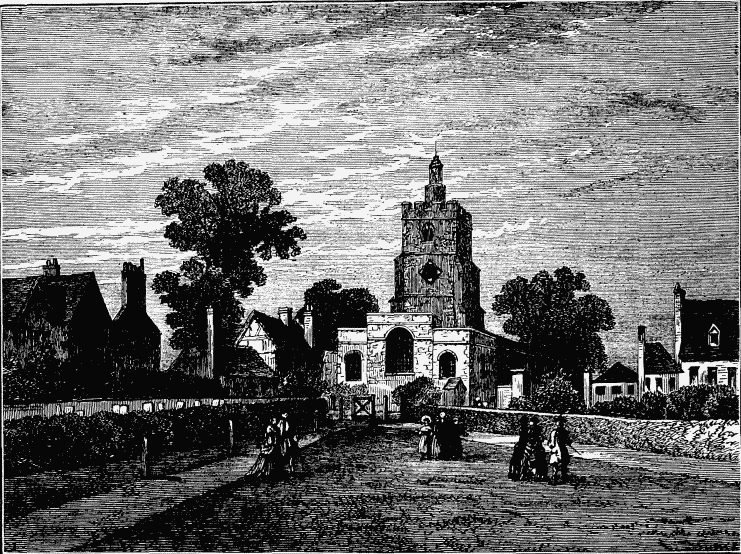
HACKNEY CHURCH, 1750.
A view of the old church, taken in 1806, shortly before its removal, will be found in a work on the suburbs of London, entitled, "Ecclesiastical Topography," published in 1811, anonymously. The writer describes it as having been a large irregular building, with few traces remaining of the original structure, except the windows; and, to do the writer justice, it must be owned that never was a fine mediæval church more ruthlessly and tastelessly perverted into a chaos of confusion. "The nave and the tower," he adds, "may probably be referred to the middle of the fourteenth century. The sepulchral inscriptions were extremely numerous, but fortunately most of these are preserved in Strype's additions to Stow, and others in Weever's 'Funeral Monuments,' and in Lysons' 'Environs of London.'"
The parish of Hackney in former times had
among its vicars many men who attained some
eminence in the ecclesiastical world. Among them
were Cardinal Gauselinus, who flourished about
1320; David Doulben, afterwards Bishop of
Bangor; Gilbert Sheldon, afterwards Archbishop
of Canterbury; and William Spurstowe, a wellknown divine among the Nonconformists, and
mentioned in the well-known definition of the
name "Smectymnus."
"If any are ignorant who this Smectymnus is,
Stephen Marshall, can tell you."
Edmund Calamy,
Thomas Young,
Matthew Newcomen,
William Spurstowe,
THE BLACK AND WHITE HOUSE, 1800.
The old church, before its demolition, was extremely rich in monuments and brasses, most of which have now altogether disappeared, whilst some few have been preserved and fixed against the new church of St. John. Among many other members of the nobility buried here were Henry Lord Percy, Earl of Northumberland, who died in this town in 1537, and of whom we shall have more to say presently. The funeral service over his remains was performed by the Bishop of St. Asaph and the Abbot of Stratford.
Alice Ryder, who died in 1517, was commemorated by her "portraiture in brass, with a milk-pail
upon her head." She appears to have been a
milkwoman, who, having obtained great wealth by
selling milk in the City, was a great benefactress
to the church. The following was her epitaph:—
"For the Sowl of Alice Ryder, of your Charite,
Say a Pater-noster, and an Ave … 1517."
Besides the tower mentioned above, the Rowe
Chapel, which was built in the reign of James I.,
and attached to the south side of the church,
also remained after the demolition of the body of
the fabric, and is still standing. This chapel or
mausoleum was founded by Sir Henry Rowe, of
Shacklewell, as a place of interment for his family.
The Rowes possessed some property at Muswell
Hill, in the parish of Hornsey, and the family
became extinct in the male line in the person of
Anthony Rowe, of Muswell Hill, who was buried
here in 1704. He left some daughters, co-heirs,
one of whom married an ancestor of the Marquis
of Downshire, in the possession of whose descendants the Rowe Chapel has continued. Among the
freeholders of Hackney, the Marquis of Downshire
is mentioned as possessing "a freehold, fifteen feet
square, in the old church yard;" this refers, of
course, to the above-mentioned burial-place of the
Rowes, and it is added that it "descended to the
marquis as an heir-loom." A monument against
the interior south wall of the mausoleum is inscribed with the following quaint epitaph:—
"Here (under fine of Adam's first defection)
Rests in hope of happie resurrection,
Sir Henry Rowe (sonne of Sir Thomas Rowe,
And of Dame Mary, his deare yoke-fellowe,
Knight and right worthy), as his father late
Lord Maior of London, with his vertuous Mate
Dame Susan (his twice fifteen yeres and seeven),
Their issue five (surviving of eleven),
Four named here, in these four names forepast,
The fifth is found, if eccho sound the last,
Sad Orphanes all, but most their heir (most debtor)
Who built them this, but in his heart a better.
Quam pie obiit Anno Salutis 1612
die Novembris 12, Ætatis 68."
It is worthy of mention that John Strype, the antiquary, to whom we owe so much of the retrospective portions of this work, was lecturer at this church for thirty-six years, and died in 1737, at the great age of ninety-four.
The reason why the tower of the old church was permitted to remain was that the eight bells were believed to be too heavy for the tower of the new building; and as the parishioners were unwilling to lose their peal, it was decided that they should retain their original position, but some years later they were moved to the new church, where they still remain. So there stand the weather-beaten old tower and the little Rowe Chapel, a few paces further to the east, amidst the graves of the ancient inhabitants of Hackney, among which a winding path leads to the more modern church, in which are preserved some of the tombs and carved work of the older edifice. It is recorded that on the 27th of September, 1731, a sailor slid down on a rope from the top of the church steeple, with a streamer in each hand.
The old burial-ground has many walks through it, most of which are public thoroughfares, and occupied by the hurrying and thoughtless passengers. "Its numerous paths, all concentrating towards the sacred edifice," says Dr. Robinson, writing about forty years ago, "are lined with lofty trees, and in the summer season the vastly peopled city of the dead seems one beautiful verdant canopy stretching over the peaceful ashes of the 'forefathers of the hamlet.' Great taste has been displayed in planting Hackney churchyard with so many fine trees, but amongst them the yew-tree, with its sombre foliage, is nowhere to be found. Every visitor to this burialground must be struck with the curious and solitary appearance of the old square grey tower, rearing its lofty walls, a singular relic of the ancient church of which nothing but this building now remains. We can only guess at the edifice, which must, in times long since passed away, have extended its aisles and raised its sacred oriel for the devotions of our ancestors. The marble tombs which once must have filled the edifice with 'hoar antiquity,' and the 'stone urn and animated bust,' which once told of the honoured dead, seem all swept away by the hand of oblivion—obscuring the humble and the great—yet Time, as if willing to spare us some resemblance of the older days, left only this old grey tower, as a conspicuous monument, which, by its lonely desolation, tells so forcibly of the terrible power which, by one fell swoop, has eradicated all besides. The bells whose music once cheered or soothed the ears of those who have now for some centuries slept the sleep of death around its enduring walls, still remain and retain their vigorous tones in the same elevated chamber where they have swung from the time of our Edwards and Henries. This tower must have sent forth its loud clamorous notes in the passing of many a royal progress, when banners and knights and ladies gay, in purple and pall,' have circled past, or when the proud and mitred abbot, with princely train, passed to and fro from his princely abbey."
The new church of St. John, which stands at a short distance to the north-east of the old tower, was built at the close of the last century, and is constructed chiefly of brick, in the "late classical" style of architecture. The plan, though pretending to be cruciform, is really an unsightly square; the projecting face of the elevation of each front is finished by a triangular pediment, the cornice of which receives and terminates the covering of the roof. There are five entrances, each of which opens to a spacious vestibule, like that of a theatre or a town-hall. The principal entrance is on the north, and is protected by a semi-circular Ionic portico of Portland stone. The interior of the church is plain and utterly unecclesiastical, and is surmounted by a vaulted and stuccoed ceiling—certainly no improvement on the structure which it was built to supersede. Some of the windows are enriched with coloured glass, and that over the communion-table is painted with a design illustrative of the Scriptural verse, "Let there be light,"&c.
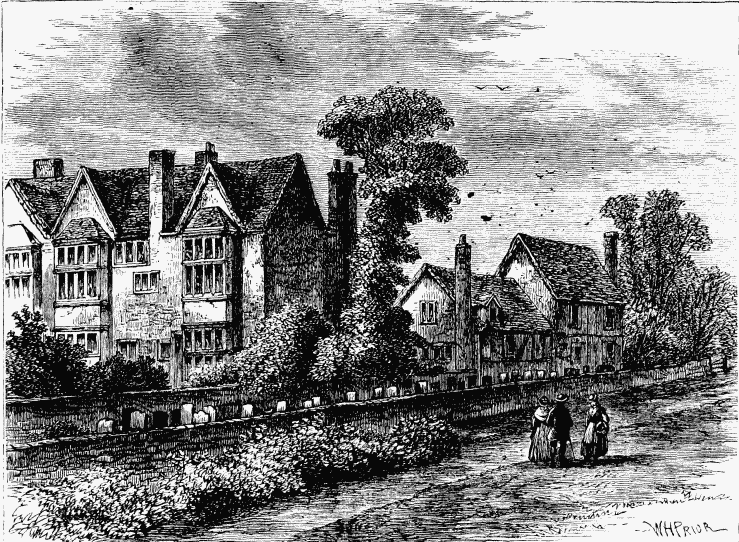
Near the church, on the west side, formerly stood an ancient mansion called the "Black and White House." It appears to have been built in the year 1578 by a citizen of London, whose arms, with those of the Merchant Adventurers and the Russian Company, appeared over the chimney in one of the principal rooms, and also in the windows of the great parlour; other armorial bearings also occurred in some of the windows. In the seventeenth century the house was the residence of the Vyner family, and the building was enlarged and considerably repaired in 1662 by Sir Thomas Vyner. At the close of the last century, when it was pulled down, it had been for many years used as a boarding-school for girls.
Hackney in former times seems to have been noted for its boarding-schools for young ladies. In the Tatler, No. 83, there is this reference to them:—"For the publication of this discourse, I wait only for subscriptions from the undergraduates of each university, and the young ladies in the boardingschools at Hackney." Again, "Don Diego," in Wycherly's Gentleman's Dancing Master, makes this remark:—"If she be not married to-morrow (which I am to consider of), she will dance a corant in twice or thrice teaching more; will she not? for 'tis but a twelvemonth since she came from Hackney School." Shadwell also, in The Humourists, makes "Striker" (a haberdasher's wife) give vent to the following ejaculation:—"Good, Mistress Gig-em-bob! your breeding! ha! I am sure my husband married me from Hackney School, where there was a number of substantial citizens' daughters. Your breeding!" These three quotations we owe to the care and research of the late Mr. Peter Cunningham.
But we must not linger here. Sutton Place, on the south-east side of the churchyard, reminds us of a great and good man, whose latter days were passed at Hackney; for at his house here died, on the 12th of December, 1611, Thomas Sutton, the worthy and benevolent founder of the hospital and school of the Charterhouse, of whom we have already spoken at some length in a previous part of this work, (fn. 8) and whom we shall again have occasion to mention when we come to Stoke Newington.
Close by the "Three Cranes," in Mare Street, stood, till recently, another ancient hostelry, called the "Mermaid," which in its time was noted for its tea-gardens and its assembly-room. Modern shops have now taken the place of the old tavern, and its gardens have been covered with rows of private houses.
At the upper end of Mare Street, close by
Dalston Lane, in a large house which remained
standing till comparatively recently, and known as
"Ward's Corner," lived in the last century a man
who was noted for his great wealth and insatiable
avarice—the famous and infamous John Ward,
member of Parliament, pilloried to all posterity in
two stinging lines by Pope, who linked him with
the infamous Colonel Francis Chartres, and a
kindred worthy, Waters:—
"Given to the fool, the mad, the vain, the evil,
To Ward, to Waters, Chartres, and the devil."
John Ward was prosecuted by the Duchess of
Buckingham for forgery, and being convicted, expelled the House of Commons, and stood in the
pillory in March, 1727. He was suspected of
joining in a conveyance with Sir John Blunt to
secrete £50,000 of that director's estate, forfeited
to the South Sea Company by Act of Parliament.
The company recovered the £50,000 against
Ward; but he set up prior conveyances of his real
estate to his brother and son, and concealed all
his personal, which was computed to be £150,000.
These conveyances being also set aside by a bill
in Chancery, Ward was imprisoned, and amused
himself in confinement by giving poison to cats
and dogs, in order that he might watch their dying
agonies. To sum up the worth of this gentleman
at the several eras of his life: at his standing in
the pillory he was worth above £200,000; at his
commitment to prison he was worth £150,000;
but has been so far diminished in his reputation
as to be thought a worse man by fifty or sixty
thousand. After his death, a most characteristic
prayer was found among his papers. The old
sinner did not pray for forgiveness of his sins, but
in this fashion:—"O Lord, Thou knowest I have
nine estates in the City of London, and likewise
that I have lately purchased an estate in fee-simple
in the county of Essex. I beseech Thee to preserve
the two counties of Middlesex and Essex from
fire and earthquake; and as I have a mortgage
in Hertfordshire, I beg of Thee likewise to have
an eye of compassion on that county; and for the
rest of the counties Thou mayest deal with them
as Thou art pleased." He then prays for the bank,
that his debtors may be all good men; and for the
death of a profligate young man, whose reversion
he had bought—"as Thou hast said the days of
the wicked are but short"—against thieves, and
for honest servants.
Tradition says that an old building close by the spot, nearly opposite Dalston Lane, which was not completely pulled down till 1825, was the Templars' House. It may have occupied the site, but could scarcely have been the identical edifice; for it was built with projecting bays, in what is called the Renaissance style. About the middle of the last century it was a public-house, the "Blue Posts;" afterwards it was known as "Bob's Hall," and the road between the churchyard and Clapton Square was styled Bob's Hall Lane.
On the south side of the road to Clapton formerly stood a mansion called "Brooke House," and at one time the "King's House," the manorhouse of the manor termed King's Hold. It is said to have belonged originally to the Knights Templars; and after the dissolution of the order to have been granted, in common with other possessions, to the monastery of St. John of Jerusalem. On the dissolution of the latter order the estate appears to have been granted to Henry, Earl of Northumberland, who possibly died here, since he was buried, as we have seen, at Hackney. This earl was the person employed, in conjunction with Sir Walter Walsh, to arrest Cardinal Wolsey at his house at Cawood. He had, as every reader of English history knows, been, in his youthful days, a lover of Anne Boleyn (then one of the maids of honour to Queen Catherine), but withdrew his suit in consequence of the interference of his father, who had been purposely made acquainted with the king's partiality to that lady. When the inconstant monarch's affection for Anne Boleyn (then his queen) began to decline, a supposed pre-contract with the Earl of Northumberland was made the pretence for a divorce, though the earl, in a letter to Secretary Cromwell (dated Newington Green, May 13th, 1537), denied the existence of any such contract in the most solemn manner. "Henry, Earl of Northumberland, died," says the account of his funeral in the Heralds' College, "at his manor of Hackney, now the King's House, between two and three in the morning, on the 29th of June, 1537; 29 Hen. VIII." The earl, as we have stated above, was buried in the old church close by. The estate afterwards reverted to the Crown, and was granted by Edward VI., in 1547, to William Herbert, Earl of Pembroke. The house occupied by Lord Pembroke is described in the particulars for the grant of the manor, as "a fayre house, all of brick, with a fayre hall and parlour, a large gallery, a proper chapel, and a proper gallery to laye books in," &c. It is also stated to be "situated near the London road," and to be "enclosed on the back side with a great and broad ditch."
A few years later it was purchased by Sir Henry Carey, Lord Hunsdon, who again conveyed it, in 1583, to Sir Rowland Hayward. It was subsequently possessed by Fulke Greville (afterwards Lord Brooke) and by Sir George Vyner. Under date of May 8, 1654, John Evelyn, in his "Diary," gives us the following note of a visit he paid to this place:—"I went to Hackney," he writes, "to see my Lady Brooke's garden, which was one of the neatest and most celebrated in England; the house well furnish'd, but a despicable building."
At the end of the seventeenth century this manor became part of the Tyssen property, of which we shall have occasion to speak more fully hereafter.
When Lord Brooke sold the manor of King's Hold, he reserved the mansion, which, it is stated, continued vested in his family, and at the commencement of this century was the property of the Earl of Warwick. The author of the "Beauties of England and Wales," writing in 1816, says: "This house has experienced considerable alterations, but large portions of the ancient edifice have been preserved. These consist principally of a quadrangle, with internal galleries, those on the north and south sides being 174 feet in length. On the ceiling of the south gallery are the arms of Lord Hunsdon, with those of his lady, and the crests of both families frequently repeated. The arms of Lord Hunsdon are likewise remaining on the ceiling of a room connected with this gallery. It is therefore probable that the greater part of the house was rebuilt by this nobleman during the short period for which he held the manor, a term of no longer duration than from 1578 to 1583. The other divisions of this extensive building are of various but more modern dates." At the time when the above description was written, the house seems to have been occupied as a private lunatic asylum.
Several of the nobility and wealthy gentry, indeed, appear to have chosen Hackney for a residence. There is a record of a visit to Hackney by Queen Elizabeth, but to whom is not certain, in 1591. The son and daughter of her dancing chancellor, Sir Christopher Hatton, were both married in Hackney Church, so that he, too, probably lived here. Vere, Earl of Oxford, the soldier and poet, who accompanied Leicester on his expedition to Holland, who supplied ships to oppose the Armada, and sat on the trials of Mary Queen of Scots and the Earls of Arundel, Essex, and Southampton, was, in his latter days, a resident of Hackney. It is also said that Rose Herbert, a lady of noble family, and one of the nuns who at the Reformation were turned adrift upon the world from the Convent of Godstow, near Oxford, died here towards the end of Elizabeth's reign, in a state of destitution, at the age of ninety-six.
Early in the seventeenth century, George Lord
Zouch, a noted man in his day, and Lord Warden
of the Cinque Ports, had a house at Hackney,
where he amused himself with experimental gardening. He died there, and was buried in a small
chapel adjoining his house. Ben Jonson, who was
his intimate friend, discovered that there was a
hole in the wall affording communication between
the last resting-place of Lord Zouch and the winecellar, and thereupon vented this impromptu:—
"Wherever I die, let this be my fate,
To lye by my good Lord Zouch,
That when I am dry, to the tap I may hye,
And so back again to my couch."
Owen Rowe, one of those who sat as "judges" at the trial of King Charles, died and was buried at Hackney, in 1660, the year in which Monk brought back the second Charles.
Another memorable inhabitant of Hackney at
this time was Susanna Prewick, or Perwick, a
young musical phenomenon, whose death, at the
age of twenty-five, in 1661, was celebrated in
some lengthy poems, chiefly commendatory of her
personal graces. We have no means of judging
of her musical powers, which created an extraordinary sensation at the time; but it is gratifying
to know that—
"All vain, conceited affectation
Was unto her abomination.
With body she ne'er sat ascue,
Or mouth awry, as others do."
Defoe, who at one time lived at Stoke Newington, in all probability also was a resident here; for in 1701 his daughter Sophia was baptised in Hackney Church; and in 1724, an infant son, named Daniel, after his distinguished father, was buried in the same church.
Eastward of Hackney churchyard, lies Homerton, which, together with Lower Clapton, may be said to form part of the town of itself. Hackney Union is here situated on the south side of the High Street.
In 1843 a college was founded close by, for the purpose of giving unsectarian religious training to young men and women who wish to become teachers in Government-aided schools.
Homerton was noted in the last and early part of the present century for its academy for the education of young men designed for Dissenting ministers. The late Dr. John Pye Smith was some time divinity tutor here.
A row of almshouses in the village, termed the Widows' Retreat, has upon the front of a small chapel in the centre, the following inscription:—"For the Glory of God, and the comfort of twelve widows of Dissenting Ministers, this retreat was erected and endowed by Samuel Robinson, A.D. 1812."
Homerton High Street leads direct to Hackney Marsh, where, says the "Ambulator" of 1774, "there have been discovered within the last few years the remains of a great causeway of stone, which, by the Roman coins found there, would appear to have been one of the famous highways made by the Romans." The Marsh Road, too, leads straight on to Temple Mills, of which we have already had occasion to make mention.
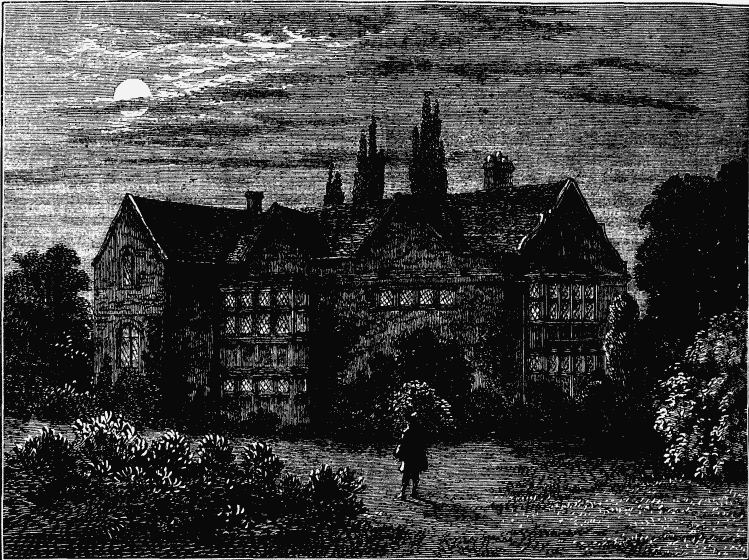
The City of London Union covers a large space of ground to the north-east of Hackney churchyard, abutting upon Templar Road. Northward lies the rapidly extending hamlet of Lower Clapton. Here, in a curious old house, which was pulled down many years ago, was born, in the year 1727, John Howard, the future prison reformer and philanthropist. The house had been the "country residence" of John Howard's father, who was an upholsterer in London; and it descended to the son, who sold it in 1785. In an article in the Mirror in 1826, this house, so interesting to humanity, is said to have been "taken down some years ago." Much of Howard's early life seems to have been passed here; and his education, which was rather imperfect, was gained among one of the Dissenting sects, of which his father was a member. On the death of his father he was apprenticed to a wholesale grocer in the City. On quitting business he indulged in a tour through France and Italy. He subsequently, for the benefit of his health, took lodgings at Stoke Newington. We shall have more to say about him on reaching that place. The old house at Clapton where Howard was born is said to have been built in the early part of the last century; it had large bay-windows, a pedimented roof, numerous and well-proportioned rooms, and a large garden. The site of the house was afterwards covered by Laura Place, and its memory is now kept up by the name of Howard Villas, which has been given to some houses lately erected on the opposite side of the road. A view of the house in which Howard was born will be found in "Smith's Historical and Literary Curiosities," and also in the seventh volume of the Mirror.
At no great distance from the site of Howard's old house, but on the west side of the road, was a school, known by the name of Hackney School, which had flourished for upwards of a century on the same spot. This academy was long under the direction of the Newcome family. "It was celebrated," says Mr. Lysons, "for the excellence of the dramatic performances exhibited every third year by the scholars. In these dramas Dr. Benjamin Hoadly, author of the Suspicious Husband, and his brother, Dr. John Hoadly, a dramatic writer also, who were both educated at this school, formerly distinguished themselves."
In 1813, the London Orphan Asylum was in stituted at Lower Clapton; but about the year 1870 its inmates were removed to new buildings erected at Watford, in Hertfordshire, and the edifice here became converted into the Metropolitan Asylum for Imbeciles. The grounds belonging to the institution are some seven acres in extent; and the building, which consists of a centre, with a spacious portico and wings, is separated from the roadway by an extensive lawn and light iron railing.
HOWARD'S HOUSE, AT CLAPTON, ABOUT 1800.
Dr. Robinson, in his "History of Hackney," says that on the west side of the road, nearly opposite the Asylum for Imbeciles, stands an old house, which many years ago was known by a very vulgar appellation, from the circumstance of the person who built it having made a considerable fortune by manufacturing and selling sundry articles of bed-room ware adorned with the head of Dr. Sacheverell. "The date of its erection is not exactly known; but it probably was after the year 1710, because the trial of Sacheverell did not take place till the February or March of that year… There are at the present time (1842)," he adds, "two urns with flowers, surmounting the gate-piers at the entrance." The building was subsequently converted into an Asylum for Deaf and Dumb Females.
Among the historical characters connected with this place whom we have not already named, was Major André, hanged by Washington as a spy; he was born at Clapton. He was originally intended for a merchant; but being disappointed in love for Honora Sneyd (the friend of Anna Seward), who became afterwards the mother-in-law of Miss Maria Edgeworth, he entered the army, and ultimately met with the fate above mentioned.
To go back a little into the reign of antiquity, we may remark that, though far removed from the crowded city, and generally considered a salubrious spot, Hackney suffered much from visitations of the plague, which in 1593 carried off 42 persons; in 1603, 269; in 1625, 170; and in the terrible year 1665, as many as 225.
VIEW IN KINGSLAND.
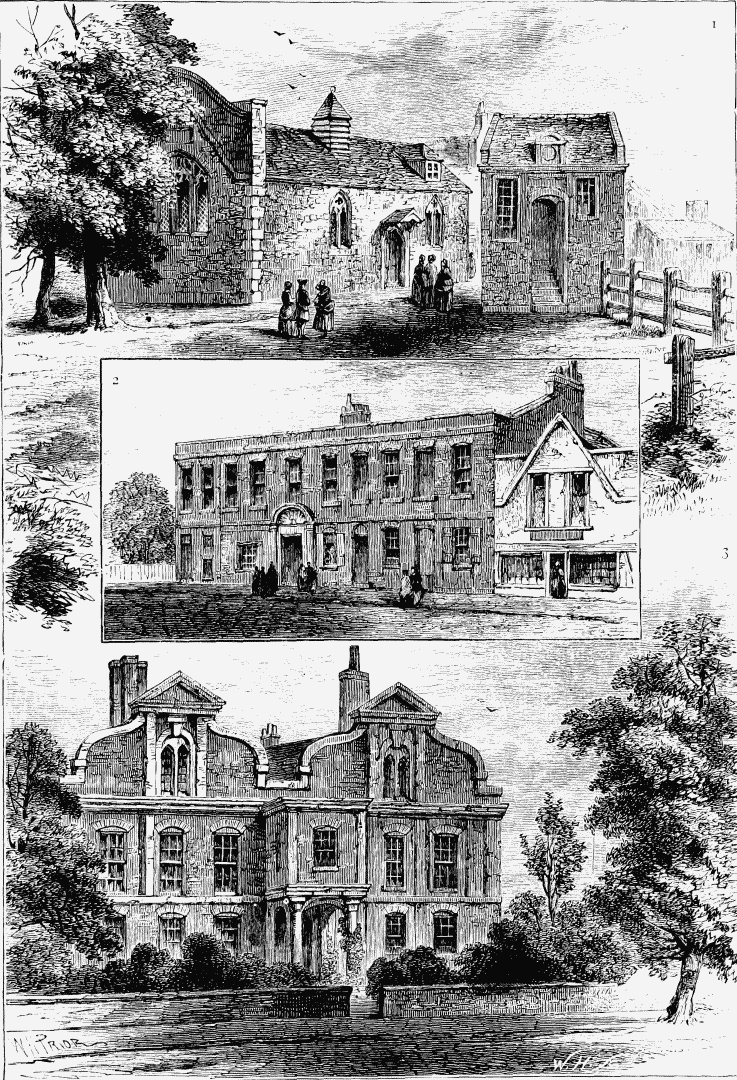
1. Kingsland Chapel, 1780.
2. Lock Hospital, 1780.
3. Shacklewell House, 1700.
In the early part of the eighteenth century Hackney was much infested by robbers, which rendered travelling after dark very insecure. The roads between London and this rural suburb were then lonely and unprotected; and it was not until January, 1756, that lamps were placed between Shoreditch and Hackney, and patrols, armed with guns and bayonets, placed on the road. In the Marshes towards Hackney Wick were low publichouses, the haunt of highwaymen and their Dulcineas. Dick Turpin was a constant guest at the "White House," or "Tyler's Ferry," near Joe Sowter's cock-pit, at Temple Mills; and few police-officers were bold enough to approach the spot.
Maitland, in his "History of London," says,
"The village of Hackney being anciently celebrated for the numerous seats of the nobility
and gentry, occasioned a mighty resort thither of
persons of all conditions from the City of London,
whereby so great a number of horses were daily
hired in the City on that account, that at length
all horses to be let received the common appellation
of 'Hackney horses;' which denomination has
since communicated itself both to public coaches
and chairs; and though this place at present be
deserted by the nobility, yet it so greatly abounds
with merchants and persons of distinction, that it
excels all other villages in the kingdom, and
probably on earth, in the riches and opulence of
its inhabitants, as may be judged from the great
number of persons who keep coaches there." But
it is to be feared that in this matter Maitland is
not to be trusted; for though it has often been
supposed, and occasionally assumed even by wellinformed writers, that as Sedan-chairs and Bathchairs were named from the places where they were
first respectively used, so the village of Hackney
has had the honour of giving the name to those
hackney carriages which were the immediate
forerunners of the London cabriolet, it is simply a
fact that the word "hackney" may be traced to
the Dutch, French, Spanish, and Italian languages.
In our own tongue it is at least as old as Chaucer
and Froissart, who borrowed it from the French
haquenée, a slow-paced nag. At all events, in
Chaucer's "Romaunt of the Rose," we find the
phrase thus used:—
"Dame Richesse on her hand gan lede
A yonge man full of semely hede,
That she best loved of any thing,
His lust was much in householdyng;
In clothyng was he full fetyse,
And loved wel to have horse of prise;
He wende to have reproved be
Of thrifte or murdre, if that be
Had in his stable an hackenay."
Froissart, in one of his Chronicles, says, "The knights are well horsed, and the common people and others on litell hakeneys and geldyngs." The word subsequently acquired the meaning of "let for hire," and was soon applied to other matters than horses. In Love's Labour's Lost Shakespeare says, "Your love, perhaps, is a hacknie." In "Hudibras" we meet with "a broom, the nag and hackney of a Lapland hag." Pope calls himself "a hackney scribbler." Addison and Steele, in the Spectator and Tatler, speak of "driving in a hack," and our readers surely remember the hackney coach in which Sir Roger de Coverley went to Westminster Abbey. Hogarth gave the expressive name of "Kate Hackabout" to the poor harlot whose progress he depicted. Cowper, in the "Task," uses "hackneyed" as an active verb; and Churchill employs it as an adjective. So there are authorities enough for the meaning of "hackney;" and the pleasant village, now the centre of a suburban town, must, we fear, be deprived of the honour of having invented hackney coaches.