
Old and New London: Volume 5. Originally published by Cassell, Petter & Galpin, London, 1878.
This free content was digitised by double rekeying. All rights reserved.
'The northern suburbs: Tottenham and Edmonton', in Old and New London: Volume 5, (London, 1878) pp. 548-569. British History Online https://www.british-history.ac.uk/old-new-london/vol5/pp548-569 [accessed 27 April 2024]
In this section
CHAPTER XLV.
TOTTENHAM.
"It will not be long ere we shall be at Tottenham High Cross; and when we come thither, I will make you some requital of your pains."—Izaak Walton.
The Division of the Parish into Wards—Extent and Boundaries of the Parish—Early History of Tottenham—The Manor owned by King David Bruce of Scotland—Other Owners of the Manor—The Village of Tottenham—The Hermitage and Chapel of St. Anne—The "Seven Sisters"—The Village Green—The High Cross—The River Lea at Tottenham—Bleak Hall—Old Almshouses—The "George and Vulture"—The Roman Catholic Chapel of St. Francis de Sales—Bruce Castle—The Parish Church—The Chapel and Well of St. Loy—Bishop's Well—White Hart Lane—Wood Green—Tottenham Wood—Concluding Remarks.
Descending the sloping ground to the north of Stamford Hill, and following the roadway—the river Lea running parallel with our course through the green fields on our right—we soon enter the village of Tottenham. This village, or, as it is generally called, Tottenham High Cross, is described at some length in the "Ambulator" (1774). It is stated that "the present Duke of Northumberland and the late Lord Coleraine had seats here; and there are also a great number of pretty houses belonging to the citizens of London."
The parish of Tottenham is very extensive, or, at all events, was so, until sundry ecclesiastical districts were formed out of it. It was divided into four "wards," thus enumerated in the "Ambulator:"—" 1. Nether Ward, in which stands the parsonage and vicarage; 2. Middle Ward, comprehending Church End and Marsh Street; 3. High Cross Ward, containing the hall, the mill, Page Green, and the High Cross; 4. Wood Green Ward, which comprehends all the rest of the parish, and is considerably bigger than the three other wards put together."
Bedwell, in his "History of Tottenham," describes the parish as being nearly fifteen miles in circumference. "It is divided," he writes, "on the east, from Walthamstow, in Essex, by the river Lea; on the north it meets the parish of Edmonton; on the west it is bounded by Hornsey and Friern-Barnet; and on the south by Hackney and Stoke Newington. The western division is watered by the circuitous progress of the New River; and a little brook, termed the Mosell, which rises at Muswell Hill, passes through the village, and shortly unites with a branch of the Lea."
The first that we hear of Tottenham is in the reign of Edward the Confessor, when it formed part of the possessions of Waltheof, Earl of Huntingdon. He took a prominent part in opposing the Norman invasion, but not long after he joined William, and married Judith, the niece of that king. From that time until his death, although he professed to be on William's side, still he was continually intriguing with the English, and a few years after his marriage he was betrayed by his wife and beheaded. Judith, however, was allowed to keep the manor of Tottenham, or, as it was then called, Toteham, on condition that she should pay to the king every year the value of five hides, equal to about 100 Norman shillings. There is a curious old record in the Domesday Book which mentions this fact, and also that the land consisted of ten carucates, or ploughlands. A carucate is estimated at about 240 acres, and thus the whole estate would be 2,400 acres. The value of the land, including a wood for 500 hogs and a weir worth 3s., amounted to £25 15s. and three ounces of gold. After the death of Judith the manor passed to her daughter Maud, who married a Norman noble, Simon de St. Liz. He died in the reign of Henry I., leaving a son Simon, from whom the king took away the estate and gave it to David, the son of Malcolm III., King of Scotland, who then married Simon's mother Maud. Their son Henry, grandson Malcolm, and great-grandson William the Lion, all held it until the last joined Prince Henry against his father, Henry II., who ejected William, and restored it to its rightful owner Simon; but after his death the king gave it back to William, and he to his brother David, who then took the title of Earl of Huntingdon. On his death the manor probably fell to the share of his second daughter Isabel, who married the father of Robert Bruce, the competitor with John Baliol for the crown of Scotland, and afterwards king. It was he who made Tottenham his place of residence, and, as we shall presently see, gave the house the name of Bruce Castle, or rather, as it was then called, Le Bruses. On his revolt from Edward I. his property in England was forfeited, and came into the hands of the Crown. After this the manor was split up among different persons, to whom the king gave it in return for some service or other, but it appears that it never went down to the descendants of the owner, but always reverted to the Crown after his death. In the reign of Henry VI. we find that there were several lesser manors, which went by the following names:—Bruce's, Pembroke's, Mocking's, and Dawbeney's. These were named from owners, and were held on condition that whenever the king went to war in person the owner should furnish him with a pair of silver spurs (gilt).
David Bruce, King of Scotland, having thus become possessed of this manor and church, the latter, after it had belonged to the Earls of Northumberland and Chester, was given to the monastery of the Trinity, in London; but King Henry VIII. granted it to William, Lord Howard of Effingham, who being afterwards attainted, it again reverted to the king, who thereupon granted it to the Dean and Chapter of St. Paul's, to whom it still belongs.
In the "Beauties of England and Wales" it is stated that the manor of Tottenham, after having been held for several generations by three distinct families—and called respectively by the names of the manor of Bruses (or Bruce), the manor of Baliols, and the manor of Pembrokes—was in the reign of Edward I. given to William Dawbeny, "in consideration of his military services." King Henry VIII. gave the whole estate to Sir William Compton, groom of his bedchamber, who entertained at Bruce Castle the king and his sister Margaret, the wife of James IV., King of Scotland, who made Tottenham their place of meeting when the Scottish queen came up from the North. The manors thus united have, it is stated, ever since that time passed through the same hands. Early in the seventeenth century they were purchased by Hugh, second Lord Coleraine, from whom they descended to his next brother, the third lord, who compiled an essay towards a "History of Tottenham." His lordship's family name of Hanger may perhaps be still commemorated here by the name of Hanger Lane, though there is another possible derivation of the term from the hanging woods which fringed it. On the death of the third Lord Coleraine, the manor of Tottenham did not devolve upon his eccentric brother, the fourth and last lord, of whom we have already spoken in our account of Chalk Farm, (fn. 1) but were bequeathed to a natural daughter of the third lord; but as the lady was an alien, the estates were escheated to the Crown. The lady, however, having married Mr. James Townsend, an alderman of London, the lands were subsequently granted to that gentleman, and have since changed hands by sale on several occasions.
At Tottenham the first ambassador from the "Emperor of Cathair, Muscovia, and Russeland," who had been wrecked on the coast of Scotland, was met in 1556 by a splendid procession of the members of the Russia Company, then lately founded for carrying on traffic with that country.
The main street of the village of Tottenham is formed of good houses, irregularly built, along each side of the great northern road, with a few smaller streets branching off at right angles on either hand. The situation is unpleasingly flat, and the buildings for the most part straggling and unequal, yet partaking little of a rural character. On the east side of High Street, and at a short distance southward from the Cross, stood formerly the Hermitage and Chapel of St. Anne. It was a small square building, constructed chiefly of brick, and had a narrow strip of ground annexed to it, stretching away along by the highway southward from the building to the "Seven Sisters." The "Hermitage" was a cell dependent on the Monastery of the Holy Trinity in London, and its site is now covered by the "Bull" public-house; whilst on the strip of ground mentioned above a row of houses has been erected called Grove Place.
The "Seven Sisters," as we have already remarked, (fn. 2) is the sign given to two public-houses at Tottenham. In front of that at Page Green, near the entrance of the village, were planted seven elms in a circle, with a walnut-tree in the middle. Of these trees we have given an illustration, when describing the Seven Sisters' Road, which was named after them. It was traditionally asserted that a martyr had been burnt on the spot where the trees were originally planted more than five hundred years ago; but the tradition wants verification.
The centre of Tottenham is occupied by a large triangular enclosure, called the Green. Mr. Harrison Ainsworth, from whose romance of the "Star Chamber" we have quoted in the previous chapter, introduces to our notice some of the rustic scenes which may have been witnessed here at the period at which the plot of his story is laid. The following are some of his remarks:—
"Long before Jocelyn and his companion reached Tottenham, they were made aware, by the ringing of bells from its old ivy-grown church tower, and by other joyful sounds, that some festival was taking place there; and the nature of the festival was at once revealed as they entered the long straggling street, then, as now, constituting the chief part of the pretty little village, and beheld a large assemblage of country folk, in holiday attire, wending their way towards the Green for the purpose of setting up a May-pole upon it, and making the welkin ring with their gladsome shouts. All the youths and maidens of Tottenham and its vicinity, it appeared, had risen before daybreak that morning, and sallied forth into the woods to cut green boughs and gather wild flowers for the ceremonial. At the same time they selected and hewed down a tall, straight tree—the tallest and straightest they could find; and, stripping off its branches, placed it on a wain, and dragged it to the village with the help of an immense team of oxen, numbering as many as forty yoke. Each ox had a garland of flowers fastened to the tip of its horns; and the tall spar itself was twined round with ropes of daffodils, bluebells, cowslips, primroses, and other early flowers, while its summit was surmounted with a floral crown, and festooned with garlands, various-coloured ribands, kerchiefs, and streamers. The foremost yokes of oxen had bells hung round their necks, which they shook as they moved along, adding their blithe melody to the general hilarious sounds. When the festive throng reached the village, all its inhabitants—male and female, old and young—rushed forth to greet them; and such as were able to leave their dwellings for a short while joined in the procession, at the head of which, of course, was borne the Maypole. After it came a band of young men, armed with the necessary implements for planting the shaft in the ground; and after them a troop of maidens, bearing bundles of rushes. Next came the minstrels, playing merrily on tabor, fife, sackbut, rebec, and tambourine. Then followed the Queen of the May, walking by herself—a rustic beauty, hight Gillian Greenford—fancifully and prettily arrayed for the occasion, and attended, at a little distance, by Robin Hood, Maid Marian, Friar Tuck, the hobby-horse, and a band of morrisdancers. Then came the crowd, pell-mell, laughing, shouting, and huzzaing—most of the young men and women bearing green branches of birch and other trees in their hands.
"The spot selected for the May-pole," he adds, "was a piece of greensward in the centre of the village, surrounded by picturesque habitations, and having on one side of it the ancient cross. The latter, however, was but the remnant of the antique structure, the cross having been robbed of its upper angular bar, and otherwise mutilated, at the time of the Reformation, and it was now nothing more than a high wooden pillar, partly cased with lead to protect it from the weather, and supported by four great spurs."
On the eastern side of the street, not far from the centre of the village, and close by the northeast angle of the Green, stands the high cross, whence this particular "ward" or division of the parish receives its second name. The structure forms a very interesting feature in the antiquities of Tottenham. Lysons, in his "Environs of London," states that "the hie crosse" is mentioned in a Court Roll, dated 1456; and Norden, in his "Speculum Britanniæ" (1593–1620), says, "Tottenham High Cross was a hamlet belonging to Tottenham, and hath this adjunct High Cross of a wooden cross there lately raised on a little mound of earth." Bedwell, in his history of the parish, written in 1631, describes the appearance of the cross some fifty years previously as "a columne of wood, covered with a square sheet of leade to shoote the water off every way, underset by four spurres." He adds: "There hath been a cross here of long continuance, even so long as since that decree was made by the Church that every parish should in places most frequented set up a cross, but whether it were such at the first as afterwards it is manifest it was I much doubt of, for that it hath been of an extraordinary height, and from thence the towne gained the addition of alta crucis." (fn. 3) Notwithstanding the preservatives spoken of by Bedwell, the cross speedily afterwards sank to decay, for at the commencement of the seventeenth century, Dean Wood, who had a residence close by, "built a plain octangular cross of brick, which," says Mr. Brewer, in the "Beauties of England and Wales" (1816), "yet remains, but has recently experienced considerable alteration. In consequence of a subscription among some of the inhabitants of Tottenham," he adds, "a complete covering of stucco was bestowed in 1809, and at the same time various embellishments, of the character usually termed Gothic, were introduced. These are in the style which prevailed in the Tudor era, and it is to be regretted that the date at which the alterations were effected is not placed in a conspicuous situation. On each face of the octagon is a shield with one of the letters composing the word Totenham in the old character." It is perhaps even still more a matter of regret that the "restoration" of the cross was not postponed for half a century, until the public had become a little more enlightened as to the principles of Gothic architecture. In that case it would not probably have been covered with a composition of stucco, but conscientiously renewed in Bath stone.
Bedwell, in speaking of the "Eleanor crosses," does not venture to assert that this is one of the series, but remarks that "it was against the corps should come thro' the towne re-edified and peradventure raised higher."
It will be remembered by the reader of Izaak Walton's "Complete Angler" how, in the opening scene, "Piscator" cries out to his friends "Venator" and "Auceps," who are on their way to the "Thatched House," in Hodsden, "You are well overtaken, gentlemen. A good morning to you. I have stretched my legs up Tottenham Hill to overtake you, hoping your business may occasion you towards Ware;" and how "Auceps," in reply, agrees to bear him company as far as Theobalds, at Cheshunt. In fact, the long street of Tottenham is the direct road not only to Theobalds, but to Enfield and Edmonton, and so on to Ware and Hatfield.
On reaching Tottenham Cross, "Piscator" thus addresses his fellows, "Venator" and the "Scholar:" "And pray let us now rest ourselves in this sweet shady arbour, which Nature herself has woven with her own fine fingers; it is such a contexture of woodbines, sweet-briars, jessamine, and myrtle, and so interwoven as will secure us both from the sun's violent heat and from the approaching shower. And being sat down, I will requite a part of your courtesies with a bottle of sack, milk, oranges, and sugar, which, all put together, make a drink like nectar—indeed, too good for anybody but us anglers. And so, master, here is a full glass to you of that liquor; and when you have pledged me, I will repeat the verses which I promised you." It is to be feared that the "Piscator" of the present day would find this pretty picture of sweet shady arbours, overgrown with jessamine, sweetbriars, and myrtle, to say the least, a little overdrawn.
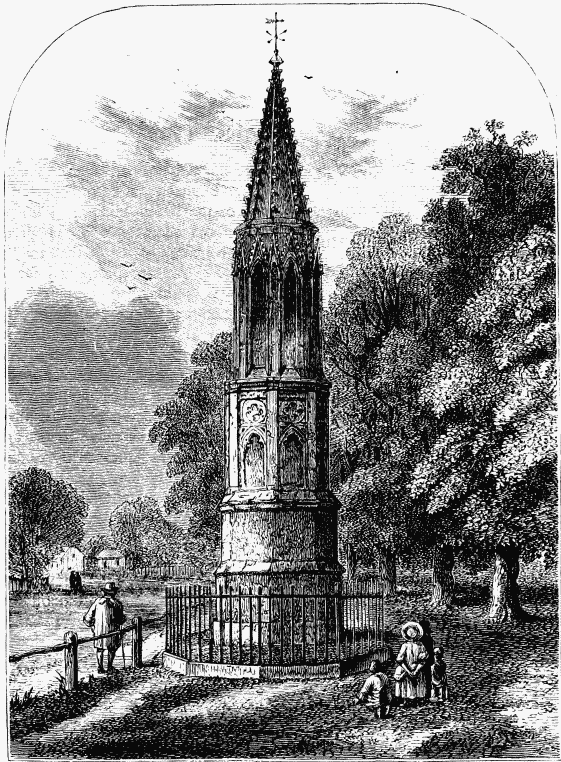
TOTTENHAM HIGH CROSS, 1820.
Almost every illustrated edition of the "Complete Angler" has an engraving of a fishery and
ferry here, called "Bower Banks;" and no wonder,
for the river Lea, as it flows by Tottenham, is
very charming, especially in its old course about
the Mill. The author of "Rambles by Rivers"
thus sketches the scene at this point:—"An old
pollard willow, with an angler under its shadow—a few cows, perhaps, standing in the water, and
enjoying with philosophic quiescence the cooling
luxury—perchance a punt in the middle of the
river—a bright blue sky overhead, reflected with a
softened lustre in the clear stream—an abundance
of yellow water-lilies at our feet, and the low banks
decked with all gay flowers—these are the materials of the picture; and he who has not his heart
gladdened as he gazes on them, has yet to learn
that there are things in heaven and earth not
dreamt of in his philosophy. Walton was not one
of these:
'The meanest flow'ret of the vale,
The simplest note that swells the gale,
The common sun, the air, the skies,
To him were opening Paradise.'
And only such as, in a measure, can participate in
these feelings and sympathies are fitted to wander
along Izaak Walton's Lea."
A short distance further up the stream, at a place called Cook's Ferry, stood Bleak Hall, the house fixed upon as being the one to which "Piscator" took his scholar, and which was then "an honest ale-house, where might be found a cleanly room, lavender in the windows, and twenty ballads stuck about the wall; with a hostess both cleanly, and handsome, and civil." The old house has long been swept away; a portion of it, however, remained standing down into the present century. It consisted of a kitchen, with a room over it (ascended by a staircase on the outside), called the "fisherman's locker," from its having been used as a locker for their tackle. If not the actual place to which Izaak Walton refers, it must long have been a well-known hostel for Lea fishermen. The evidence appears to tell against its identity as the Bleak Hall of old Izaak, but local tradition was, and is, very strong in its favour. The Lea, we need scarcely add, is the only river, next to the Thames, that is engrafted in the affections of the Londoner.
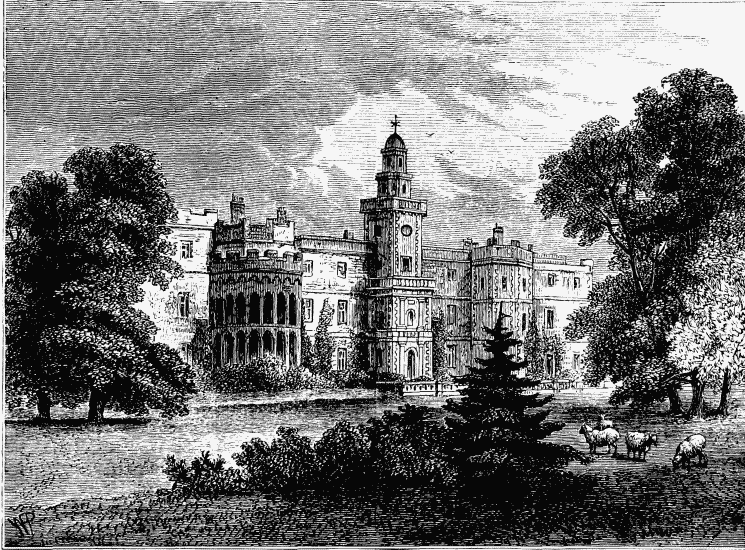
BRUCE CASTLE.
In 1596, an almshouse was founded in the High Street of Tottenham by one Zanchero, a Spaniard, the first confectioner ever known in this kingdom. Near to the Cross there is another row of almshouses, founded by a Mr. Nicholas Richardson, and which date their erection from the early part of the last century.
The "George and Vulture" tavern, in the high road, nearly opposite Bruce Grove, occupies the site of a much older inn, which was frequented by the Londoners in early times, for the purpose of recreation. It is mentioned in the "Search after Claret," as far back as the reign of William III., but was probably far older. Its charms are thus described in a newspaper paragraph, immortalised by Mr. Larwood in his "History of Sign-boards:"
"If lur'd to roam in summer hours,
Your thought inclines tow'rd Totnam bowers,
Here end your airing tour, and rest
Where Cole invites each friendly guest.
Intent on signs, the prying eye
The 'George and Vulture' will descry:
Here the kind landlord glad attends
To wellcome all his cheerfull Friends,
Who, leaving City smoke, delight
To range where vision's scenes invite.
The spacious garden, verdant field,
Pleasures beyond expression yield;
The Angler here to sport inclined,
In his Canal may pastime find.
Next, racy Wine and home-brew'd Ale
The nicest palates may regale;
Nectarious Punch—and (cleanly grac'd)
A Larder stor'd for every taste.
The cautious Fair may sip with glee
The freshest Coffee, finest Tea.
Let none the outward Vulture fear;
No Vulture host inhabits here:
If too well us'd ye deem ye—then
Then take your revenge, and come again."
On the western side of the chief street, near White Hart Lane, stands in a retired situation, as though retreating from the public gaze, the Roman Catholic Chapel of St. Francis de Sales. It is a small and unpretending structure, in the style of the Dissenting chapels of half a century ago, about forty feet in length by thirty. It was erected by the late Baroness de Montesquieu in 1826–7, on a site purchased by her for that purpose, and was solemnly opened by Bishop Poynter, in the May of the latter year, previous to which time the Roman Catholics here had been content with the use of a room in the house of the resident priest. For more than a century Tottenham and Edmonton have been noted for the number of poor lodging-houses in which lived the Irish labourers who worked in the fields and market gardens around this part. On the outbreak of the first French Revolution their number was increased by an influx of emigrants from the north of France, who brought with them much skilled industry, but more poverty. It was not, therefore, till about 1793 that any regular provision was made in Tottenham for their religious wants. In that year the Abbé Cheireux, afterwards Bishop of Boston, in the United States, and subsequently Archbishop of Bordeaux, and a cardinal, being employed as tutor in a Protestant family in Tottenham, obtained the use of a room in Queen Street, Tottenham Terrace, in order to minister to the spiritual needs of both the Irish and the French poor. On his departure for America, the Abbé Cheireux handed over his charge to another French emigré priest, and eventually, about the year 1805, the Abbé Le Tethier erected a modest chapel-house and still more modest presbytery in the same street. This, however, became alienated, through debt or other causes, and the Roman Catholics were left without a chapel or chaplain from the year 1818 down to the time when the present structure was built by the Baroness de Montesquieu, as mentioned above. In 1871, some nuns of the Servite order settled down in a house in Hanger Lane, at the southern end of Tottenham, where they have opened a school and a chapel.
Westward of the main street, near Bruce Grove Station on the branch line of the Great Eastern Railway, is Bruce Castle, which has long been used as a private school. The mansion was rebuilt in the latter part of the seventeenth century, and is a good specimen of Elizabethan domestic architecture. The structure, as stated above, takes its name from a castellated mansion, the residence of Robert Bruce the elder, father of the Scottish king of that name, which in ancient times occupied this site. The original building is said to have been erected by Earl Waltheof, who married Judith, niece to William the Conqueror, who gave him for her portions the earldoms of Northumberland and Huntingdon. Their only daughter, Maud, after the death of her first husband, married David I., King of Scotland, and being heiress of Huntingdon, had in her own right, as appended to that honour, "the manor of Tottenham, in Middlesex." Through her these possessions descended to Robert Bruce, brother of William III., King of Scotland. Bruce contended for the throne of Scotland with John Baliol, who was ultimately adjudged heir to the crown. Upon this adjudication Robert Bruce retired to England, and, settling on his grandfather's estate at Tottenham, repaired the castle, and acquiring an adjacent manor, named it and the castle Bruce. In the reign of Henry VIII. the property, as we have already had occasion to remark, was granted to Sir William Compton, then groom of the king's bedchamber.
It is recorded that, in 1516, Henry VIII. here met his sister Margaret, Queen of Scots. Dr. Robinson, in his "History of Tottenham," says: "It is probable that Sir William Compton rebuilt the house soon after he became possessed of the manor in 1514, and that it was finished to receive the royal guests in 1516, for on the Saturday after Ascension Day in that year King Henry VIII. met his sister, Margaret Queen of Scots, at 'Maister Compton's house, beside Totnam!'" The next royal visitor was Queen Elizabeth, who became the guest of Margaret's grandson, Henry, Lord Compton, so that it would seem that the daughter of the Queen of Scots had married the heir of the Comptons. A passage in Robinson, referring to Queen Elizabeth's visit to Henry, Lord Compton, would seem to throw some doubt on his earlier statement that Sir William Compton rebuilt the house, for in it he observes, "The style of the building, which is of that period—namely, 1578—seems to justify the conjecture that the house was built by Henry, Lord Compton;" but it receives additional strength from the following passage from Lord Coleraine's MS.:—"In respect to its great antiquity more than conveniency, I keep the old brick tower in good repair, although I am not able to discover the founder thereof; and among the other anticaglia of this place I range Sir William Compton's coat of armes, which I took out of the old porch when I raised the tower in the front of the house." It appears, therefore, as if Lord Coleraine's evidence goes to confirm the first statement of Robinson. The coat of arms he referred to is believed to be that which is now affixed on the north side of the house, above the windows of one of the class-rooms.
Among the "Burghley papers" in the British Museum there is a curious letter, which was written by the Marquis of Winchester to Sir W. Cecil, afterwards Lord Burghley. It seems to refer to the occasion of some visit of Queen Elizabeth to Henry, Lord Compton. The following is a copy of it:—
"After my hartie commendacions with like thanks to you for your letter of libertie given me for the repaire of Mr. Compton's House at Totenham, in order as well for the Queene's Highness, as for the owner, which I shall gladlie do. And because my Ladie of Pembroke hereth that th' Officers take the loppes and toppes of the Trees that be felled for reparations for their fees, which indeede ought not to be, and that resteth in your order, and then the wood may be feld to the profit of the reparation, yet the Woodwarde had neede to have something for his labour; and if yt shall please my Ladie to send one honest man to your feodarie and me, he shall see all the tymber that shall be taken, and howe it shalbe employed, and if my Ladie will the house still unrepaired, mynding a better House to be built upon the ground, You and I shall be well content therewith: for that you and I shall do ys for the Quene's honor and Mr. Compton's profitt, otherwise You and I meane not to do any thing, and herein knowe my Lord's pleasure and write to me againe I pray you in that matter, and I shall yelde myself to all that shall be thought for the best. So fare you well. Written this Xth of November 1563.
| "Your loving friend | |
| "To my loving friend | "Winchester. |
| Sir William Cecil Knight | |
| Principall Secretary to the Quene's Matie." | |
The Comptons seem to have held the estate until 1630, when the last Compton died. The next owners were the Hares of Norfolk, but how they got possession of it we are not able to discover. Certain it is that Bedwell, in his book entitled "A Breef Description of Tottenham Highcrosse" (written in 1631), mentions that Hugh Hare, who was created Lord Coleraine in 1625, was then in possession of the whole estate. This Hugh Hare was a great favourite of Charles I., who created him an Irish baron when he was only nineteen years of age. On the breaking out of the Civil War, he supplied the king with money and gave up his seat at Longford, in Wiltshire, for a royal garrison. But this was afterwards taken and plundered by the Roundheads, and his other estates were sequestered. However, soon after the Restoration they were all restored. His son, grandson, and great-grandson all held the estate. The last married Miss Rose Duplessis, the daughter of a French clergyman, by whom he had a daughter, Rose. On his death in 1749 a question arose, as we have shown above, as to whether his wife, the first Rose, ought not to forfeit the estate, since she was an alien; and in 1755 the cause was finally determined in favour of the heirs at law. The estate having thus reverted to the Crown, a grant of it was obtained by Mr. Chauncey Townsend, for his son James, who married Miss Duplessis. By her he had a son, James Hare Townsend, who in 1789 had to sell a great part of the estate to pay off his father's debts. It passed through the hands of various owners, and in 1827 was bought by Mr. (now Sir Rowland) Hill, of whom we have already spoken in our account of Hampstead. (fn. 4) Six years later the Messrs. Hill finally removed hither from Hazelwood, near Birmingham, where their school had been first established.
It is utterly impossible to tell how many houses have been in succession built on these grounds, but there must have been three at least, if not more. It is probable that they were not all built on exactly the site where the present house stands, but on some other spot near. This supposition is corroborated by the fact that very frequently when drains are dug at some depth old brick foundations and walls are found. For instance, a few years ago, when the well was being repaired, three or four feet below the surface, the workmen came upon the top of a wall, which extended to the depth of about twelve feet. Near the bottom of this wall a silver coin of the beginning of King Henry VIII.'s reign was found, and on the side of the wall, not so deep down, a gilt button, probably of the time of Queen Anne.
There is no mention of any castle in the Domes day Book at the time when the estate was in the possession of Earl Waltheof; nor, indeed, do we find any record of a house until the reign of Edward II. But if Bruce lived here—and he must have done so, or how would the place have received the name?—there must have been a house for him to live in, and therefore we may fairly conjecture that there was a castle at that time. As we mentioned above, the house was rebuilt in the reign of Henry VIII. In the "Antiquities of Tottenham" we find that there formerly hung over the chimney-piece in one of the parlours a picture, which exhibited two other towers, besides the one which is still left. Lord Coleraine says that the house was either rebuilt or new-fronted by the Hare family a little before the Revolution. We suppose that the middle part was only the thickness of the refectory, which was then the entrance-hall; for a few years ago, when a part of the wainscoting of the inner wall in one of the class-rooms was taken down, there were found on the wall inside some dead stalks of a vine or other creeping plant, clearly proving that that had been once the outside wall. But we can find no mention of the other part having been added. The room which is now called the porch-room used to be the porch, and from it a passage led straight through the house into the pleasure-grounds beyond. There used formerly to be a west wing of the house, but it was pulled down, together with the stables and coachhouse, about sixty years ago, by Mr. Ede, the then owner. The east wing was added by Alderman Townsend, and in it, tradition says, John Wilkes has been often entertained.
A very peculiar custom prevailed here, the origin of which is not known. At the burial of any of the family the corpse was not suffered to be carried through the gate, but an opening was made in the wall nearest to the church, through which the corpse and mourners passed into the churchyard. "There are still," says Dr. Robinson, "the appearance of several apertures which have been bricked up, and among them is that through which passed the corpse of Mr. James Townsend, the last that was carried from the castle to the mausoleum of the Coleraine family. This aperture has been recently opened, and a Gothic door is now fixed in the place."
Although still called a castle, the building now presents none of the features usually associated with such structures; it is constructed of brick, with stone dressings, and is altogether a spacious edifice. It consists chiefly of a centre, with projecting wings. The old entrance-hall in the centre—the doorway of which has been blocked up, the hall itself being converted into a small sitting-room—is surmounted by a large square tower, surrounded by two external galleries, and crowned by an octagonal turret. The rooms throughout the house are exceptionally good, the boys' dormitories being all lofty and well ventilated. The walls of the dining-room are wainscoted to the ceiling, and are hung with a large number of engraved portraits of old divines and other ancient worthies; and to add to the effect, and to give the place a somewhat baronial character, above the portraits are placed several pairs of spreading antlers. The school-room in itself is a large and lofty apartment at the north-west corner of the house. The school and grounds occupy upwards of twenty acres. The grounds are laid out in the style of a park, in which are some very fine trees; and they include a cricket-ground and a field for football. There is also an old-fashioned walled kitchen-garden, comprising about two acres, near to which is an excellent infirmary for such of the boys as may require medical treatment, entirely detached from the school buildings. A detached tower, of red brick, which covers a deep well—now disused and filled up—is the only surviving relic of the previous edifice which was built by the Comptons early in the sixteenth century. This structure is now used as a larder. A fresh well has been dug close by. In Hone's "Year-Book" there is an engraving of Bruce Castle, reproduced from a view taken in 1686, from which it appears that the main portion of the building has been considerably altered since that time. Among the pictures that adorn the walls of the principal staircase, too, is an oil painting showing the castle as it appeared in the early part of the last century. In this view the upper part of the central portion of the house on either side of the tower is terminated by a gable with one window in each. These gables have now entirely disappeared, the front of the house having been carried up to the level of the top of the gable, and two false windows inserted.
Having been for fifty years managed by Sir Rowland Hill and his family, Bruce Castle School changed hands in 1877. The average number of pupils in the school is about seventy. On Sunday mornings the whole of the pupils attend the service in the parish church, which is close by the north-west corner of the ground, and on Sunday evenings divine service is conducted by the head-master of the school in the house. The pupils have daily access to a well-selected library, containing nearly 3,000 volumes. With reference to the rise and subsequent growth of this library, we may state that it was first started about the commencement of the present century by Mr. Thomas W. Hill, the father of Sir Rowland Hill, and that it was for two or three years so small that it was kept in a master's desk. When the school was removed to Hazelwood, the library was taken there and added to occasionally by the head-master, until 1817, when a school fund was started, part of which was spent every year in new books. Former members of the school used also sometimes to send a book or two, and thus the library kept increasing slowly year by year. In 1827 rewards were first given to those boys who passed a successful examination in books of an instructive nature, and from that time the reading of those books has formed here a part of nearly every boy's education. When, in 1827, the school was first started at Bruce Castle, Mr. Rowland Hill began to form the present library, and when, six years later, the Messrs. Hill finally removed, as we have stated above, to Tottenham, they brought with them a part of the Hazelwood library.
We may add, in conclusion, that the pupils at this school, as a rule, are preparing for the universities, the public schools, or professional life. While very accessible from London, Bruce Castle has all the advantages of the country, and few schools have better in-door and out-door arrangements for the health and comfort of their pupils.
In Bruce Grove, near the Castle, are the Sailmaker's Almshouses, comprising some forty or more neat brick-built dwellings. They were erected in the year 1869, and are in the gift of the Drapers' Company.
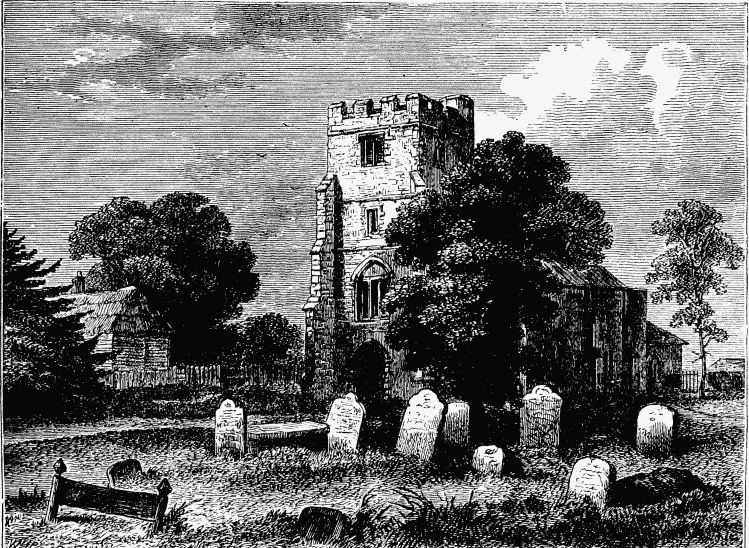
The parish church of All Hallows, which stands at a short distance north of Bruce Castle, and is bounded by the little river called the Mosel on the west, north, and east, is an ancient building, in the Gothic or pointed style, and the chief parts may perhaps be ascribed to the fourteenth century. It has at the west end a square embattled tower, of red brick, picturesquely covered with dark ivy of many years' growth.
This tower was supposed by Lord Coleraine to have been more lofty than it was at the time he wrote his history of the parish, for after speaking of the upper windows, he adds: "And as the steeple seems to have been heretofore considerably more lofty, so upon the middle of the outside top of it there stood of old a long cross of wood, covered with lead, fastened into the centre of the roof so strongly as that it was a signification of some cause why the town mark and the parish had the sign of a high cross, which defied all its enemies from Henry VIII.'s days till the unhappy civil wars, when the violent zeal of some cunning Parliamentarians blew up some rascally fellows to set about the pulling down of this cross, which they did with such great difficulty and hazard as that they repented their foolish attempt long afterwards, one breaking his leg and the rest never thriving after the fact, and leaving a stump for the grafting another cross upon it, as a token of their rashness in reformation." It is indeed somewhat remarkable that this cross on the church tower should have escaped the zeal of the early reformers, considering the ado that was made about "superstitious" images and crosses in the latter part of the reign of Henry VIII., and the general destruction of such objects.
From the statement made by Lord Coleraine that the steeple of Tottenham Church was before his time "more lofty," many persons have fallen into the mistake of supposing the extra height to have been beyond its present height. Such a view, however, is at variance with the true sense of his lordship's statement, which describes the windows which had been sunk as the upper windows of the tower, within which the bells (which had not at that time, 1693, been re-cast) undoubtedly hung.
It is very probable that the upper portion of the tower was at one time covered with one of those pyramidal roofs or dwarf kind of steeples peculiar to some of the ancient church towers, upon the apex of which roof or steeple the cross referred to by Lord Coleraine might originally have stood, and which he might fairly describe as being "fastened into the centre of the roof." This steeple might have become out of repair, owing to the treatment it had received by the rebels, and, with its "stump," have been removed lest another cross might afterwards be grafted upon it. Its appearance would then warrant the statement made by Lord Coleraine that it seemed to have been "more lofty." All the old doorways and windowopenings in the tower are in the plain pointed style, as is also the massive and well-formed arch which opens from the tower into the church on the east side. The style of this arch, although similar to that of the arches in the nave, differs considerably from them in its mouldings.
On the south side of the church is a large porch, built of brick, with stone dressings. Lord Coleraine, in his account of the parish, noticed above, says, with reference to this porch:—"Long since the building of the great door there has bin an edifice joyned to it, not as a twin, but as a younger brother to the church; therefore I suppose the old porch to this church, being so small or decayed, might by the charity of some great and well-minded person be taken down, and the present large fabrick set up in its stead." The same writer supposes the porch to be "not older than Henry VII.'s time," and states that he had heard that it was built by a widow lady, whom he believes was Joan Gedney, "who was lady of some of the manors before they fell to the Comptons, or by one of the Comptons' ladys." This porch has a small chamber over the entrance, concerning which these remarks appear in Lysons' "Environs:"—"This was originally intended, as I suppose, for a church-house, a building of which traces are to be found in the records of almost every parish. They were, as our vestries are now, places where the inhabitants assembled to transact the parish business." In this room there formerly resided, for many years, an old almswoman, named Elizabeth Fleming; she died in 1790, a veritable centenarian. Of late years this upper chamber was used as a school-room for the children of the parish. There is an hagioscope, or "squint," made in the wall of the church, so that the occupant of this room over the porch might be enabled to see the altar.
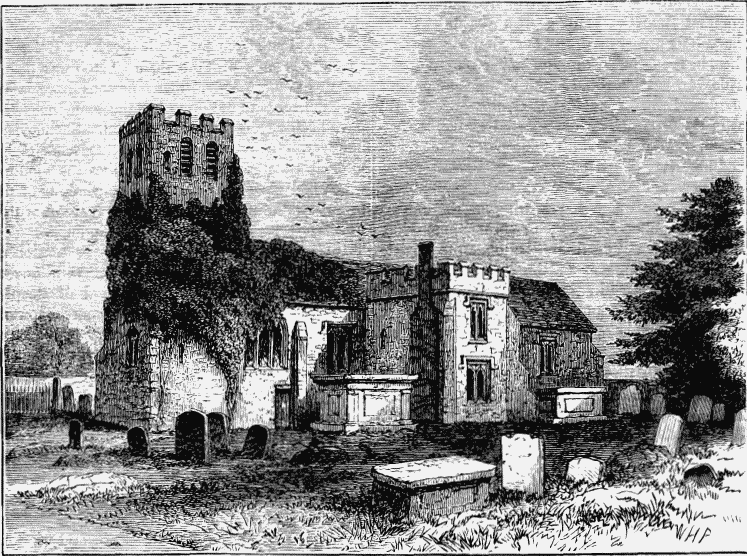
TOTTENHAM CHURCH.
The font is octagonal in shape, having ornamental panels enclosing quatrefoils, within which are roses, a three-leafed plant enclosing berries, a pelican, a mermaid, a dragon or wyvern, and a figure representing a human head; there are also corbel heads at the angles beneath the basin. The carving is of the Perpendicular period, and is in a fair state of preservation, although somewhat worn with age and disfigured with paint. The figures, as well as the font, were re-chiselled in 1854 by a local tradesman, at a charge of £5. This font is probably as old as the present church; the roses carved upon it correspond with those on the doorways of the porch, from which we may infer that it was made early in the fifteenth century.
The monuments and brasses are somewhat
numerous; but in consequence of the alterations
recently made in the building, few of them retain
their original position. Some of the more ancient
brasses have altogether disappeared. They are
fully described in Robinson's "History of Tottenham." The oldest brass still remaining is a small
plate to the memory of Thomas Hynnyngham;
it bears the date 1499. Mr. George Waight, in
his "History of Tottenham," to which we are
indebted for much of the information here given,
describes a few of the existing monuments, some of
which are of peculiar interest. At the east end of
the south aisle is one to the memory of Richard
Candeler, Esq., who died in 1602, and Eliza his
wife, 1622: they are represented kneeling before
desks, on which are placed books. Adjoining this
monument is another to the memory of Sir Ferdinando Heyborne, Gentleman of the Privy Chamber
to Queen Elizabeth and James I., dated 1618, and
his wife, the daughter of Richard Candeler, who
died in 1612. A mural monument, with effigies,
commemorates Sir John Melton, Keeper of the
Great Seal for the north of England; he died in
1640. A large and curious monument in the
north aisle, ornamented after the fashion of the
period in which it was set up, is to the memory of
Maria, wife of Sir Robert Barkham, of the county
of Lincoln, and daughter of Richard Wilcocks, of
Tottenham. She died in 1644. Upon this monument are busts of the deceased and her husband,
and beneath are the effigies of their twelve children.
A sum of money was left by the family of the
deceased for the purpose of keeping this monument
in good condition. In the chancel was the gravestone of the Rev. William Bedwell, who was many
years vicar of this church, and also rector of St.
Ethelburga's, in Bishopsgate Street. The epitaph—which commenced with some account of his
daughter, who was married to one Mr. or Dr.
Clark, and died December 20th, 1662—concluded
as follows:—
"Here lies likewise interred in
this chancel the body of Mr. William
Bedwell her father, some time
Vicar of this Church, and one of
King James's translators of the
Bible, and for Easterne tongues
as learned a man as most lived
in these modern times, aged 70,
dyed May 5th, 1632."
He was the author of the "History of Tottenham"
mentioned above, and also of a book called the
"Traveller's Calendar."

VIEWS IN TOTTENHAM.
In 1875–7 the church underwent a thorough "restoration" and enlargement, after the fashion of the time. The additions to the fabric on this occasion consist of one new bay at the east end of the nave and aisles (or rather the old chancel and its aisles), with a new chancel, north and south transepts, an organ-chamber, double vestries, with a furnace-room for heating the church beneath one of them, and a north porch. The old chancel, with the addition of the new bay mentioned above, now becomes part of the nave, and is furnished with seats for the congregation. To meet the case of so greatly enlarged a church, all the new roofs are at a considerably higher level than they were originally. A clerestory, with windows on each side of it, has been put upon the new bay of the nave, the windows being absolutely necessary, as is proved by the unsightly skylights which had in former days been inserted in various parts of the roof. The new work has been carried out in red brick and stone, in harmony with the fine red brick and stone south porch. The choir part of the chancel is fitted up with oak and walnut-wood seats and desks, and is paved with tiles. The eastern part, or sanctuary, is arcaded in stone on its sides and east end, with a central reredos behind the altar-table. Marble shafts and marble in various forms are used in this part of the chancel, on the south side of which is a graduated sedilia of two seats, and also a credence, very beautifully designed and executed. A large east window of five lights fills the gable end at a high level. The ceiling above is vaulted in wood and plaster, and is delicately painted in colours, in which a grey blue predominates, with stars and flowers. The east five-light chancel window, the south three-light transept window, and another three-light window in the new bay of the south aisle, are filled with stained glass, presented by various persons as memorials.
"From the occurrence of a priest with half a hide of land at 'Totanam,' in the Doomsday Survey, the existence of a church may be fairly presumed at least as early as the Conquest, although we have no mention of it as a benefice till the twelfth century, when it was given to the canons of the Holy Trinity by Aldgate, soon after the foundation of their house by David, King of Scot land, (fn. 5) to whom it was appropriated, and a vicarage endowed about the beginning of the thirteenth century by Bishop William de Sanctæ de Mariæ Ecclesiæ." (fn. 6)
"The rudeness of construction and plainness of the oldest parts of the building," observes Mr. George Waight, in his work above mentioned, "make it very probable that the original church, of which they formed part, was built by one of the great lords of the manor, for there is always a marked difference observable between churches built by the lords of the soil and those built by monks and ecclesiastics—i.e., between rectorial churches and vicarial churches. The vicarial churches having been built by the monks, who possessed more architectural skill and probably larger means than the lords of the soil, for that reason, almost uniformly present a greater elegance of design and magnitude than the former. It must be borne in mind that the church of Tottenham did not become vicarial until after it was given by David, King of Scotland, to the canons of the Holy Trinity, London. Up to that time the church and advowson had been appended to the manor, which had remained entire. There are many things," he adds, "which point to this conclusion; the mention of a priest in the Domesday Survey, the existence of the manorial house called Bruce Castle, the former lordship of the place (the road leading to it being still called Lordship Lane), and the close proximity of the church to both, all testify to the antiquity of the church as a religious foundation. The charter by which David, King of Scotland, granted the church, probably soon after it was built, to the canons of the Holy Trinity, was directed to Gilbert, Bishop of London (surnamed Universalis), who was Bishop of London in the reign of Henry I., from 1128 to 1134, and was confirmed by William de Sancta Maria, who was Bishop of London from the tenth year of Richard I. (1198) to the sixth year of Henry III. (1221)."
A chantry was founded in this church by John Drayton, citizen and goldsmith of London, as appears by his will, dated 27th September, 1456, "to find two priests daily, one to say divine service at St. Paul's, London, and the other at the Church of All Saints, Tottenham, at the altar of the blessed virgin and martyr St. Katherine; and the same priest also, on Wednesdays and Fridays, to perform the like service in the Chapel of St. Anne, called the Hermitage, in this parish, near the king's highway; also for the souls of King Richard II., Anne his queen, and others, his own two wives, parents and benefactors, and all the faithful deceased."
The bells in the old tower are six in number, and one of them, called the Saints' Bell, is ornamented with medallions and other figures and ornamentation. This bell was taken at the siege of Quebec—it having served originally as the alarmbell of that town—and was given to the parish at the commencement of this century. The old vestry, at the eastern end of the church, was built and endowed by Lord Coleraine, in 1696, upon condition that he and his family should possess the ground beneath as a place of interment; the building was circular, and had originally a dome and an obelisk, but these were removed in 1855, they having become decayed, and ultimately the building was entirely demolished.
Tottenham Grammar School dates from the early part of the last century, when it was endowed under the will of Sarah, Dowager Duchess of Somerset. At one time there is reason to believe that it must have been in a fairly flourishing condition, as among its head-masters we find the name of the learned William Baxter, the nephew of the celebrated Richard Baxter. Of late years it had fallen into disrepute, and had, in fact, become a mere parish elementary school; but about the year 1872 a change of trustees having taken place, steps were taken to place the school upon a more efficient footing. A scheme was accordingly drawn up, the school premises were enlarged, and at the commencement of the year 1877 it was re-opened as a second-grade school.
Down to comparatively recent times, Tottenham could boast of other antiquities besides those we have already described; for in the "Ambulator" (1774) we read that St. Loy's Well, in this parish, is said to be "always full, and never to run over; and the people report many strange cures performed at Bishop's Well." The field in which the firstmentioned well is situated is called "South Field at St. Loy's," in a survey of the parish taken in 1619. It is situated on the west side of the high road, near the footpath leading past the Wesleyan chapel, and across the field to Philip Lane. Bedwell speaks of St. Loy's Well, in his history of the parish, as being in his time "nothing else but a deep pit in the highway, on the west side thereof;" he also adds that "it was within memory cleaned out, and at the bottom was found a fair great stone, which had certain letters or characters on it; but being broken or defaced by the negligence of the workmen, and nobody near that regarded such things, it was not known what they were or meant." The condition of the well has not much improved since Bedwell's time, having become nothing more nor less than "a dirty pool of water, full of mud and rubbish." Dr. Robinson, in his "History of Tottenham" (1840), describes the well as being surrounded by willows, about 500 feet from the highway, and adds that it was bricked up on all sides, square, and about four feet deep. The water of this spring was said to excel, in its medicinal qualities, those of any other near it; and in a footnote, Robinson says that the properties of the water are similar to the water of Cheltenham springs.
The Chapel or "Offertory" of St. Loy is described by Bedwell as "a poore house, situate on
the west side of the great road, a little off from the
bridge where the middle ward was determined."
It has long since disappeared. St. Loy, or St. Eloy,
was one of the greatest oaths which men swore by
in the Middle Ages. In Chaucer's "Canterbury
Tales," for instance, the carter, encouraging his
horses to draw his cart out of a slough, says,
"I pray God save thy body and St. Eloy."
Bishop's Well is described by Bedwell as "a spring issuing out of the side of a hill, in a field opposite to the vicarage, and falling into the Mosel afore it hath run many paces." The ground near it was formerly called Well Field, but now forms part of the cemetery. The water was said never to freeze, and, like that of St. Loy's Well, to be efficacious in the cure of certain bodily ailments.
White Hart Lane, mentioned above, the road leading to Wood Green, has long been built upon. Indeed, in the "Beauties of England and Wales," as far back as 1816, we find it spoken of as containing "several capacious villas, and some modern houses, of less magnitude, which are desirable in every respect, except that of standing in a crowded row. On the left hand of this lane," adds the writer, "at the distance of three quarters of a mile from the village of Tottenham, is the handsome residence of Henry P. Sperling, Esq. This is accounted the manor-house of the Pembrokes, but has, in fact, been long alienated from that estate. The building was, till within these very few years, surrounded by a moat, over which was a drawbridge. The moat was filled up by the present proprietor, probably to the advantage of his grounds, which are of a pleasing and rural character." Pembroke House is stated by Dyson, in his "History of Tottenham," to have been built for Mr. Soames, one of the Lords of the Admiralty, about the year 1636, at which time "the moat was dug and walled in."
At Wood Green are the almshouses belonging to the Printers' Pension, Almshouse, and Orphan Asylum Corporation. The objects of this institution, which was founded in the year 1827, are the maintaining and educating of orphans of deceased members of the printing profession, as well as granting of pensions, ranging from £8 to £25, to aged and infirm printers and their widows. The almshouses are a picturesque block of buildings, with a handsome board-room and offices in the centre, containing, with the two wings, residences for twenty-four inmates. The original portion of the building was erected in 1849, and the additional wings in 1871.
Tottenham Wood, in the fifteenth century, was
celebrated for its medicinal spring; it bore the
name of St. Dunstan's Well. Of the Wood itself,
there are three old proverbs extant. To express a
thing impossible, the people here used to say,
"You may as well try to move Tottenham Wood,"
which was of great extent. Another, "Tottenham
is turned French," meaning that it is as foolish as
other places to leave the customs of England for
foreign ones. And a third—
"When Tottenham Wood is all on fire,
Then Tottenham Street is nothing but mire."
This means, when a thick fog-like smoke hangs
over Tottenham Wood, it is a sign of rain, and
therefore of mud and dirt. We need hardly add
that the task of removing Tottenham Wood has
been accomplished, and that such part of it as is
still unbuilt upon, is under arable cultivation. So
much for the familiar "sayings" connected with
Tottenham. But there is also a metrical satire
which requires some brief mention. This is a
mock heroic poem, known as the "Tournament of
Tottenham," which appears to be a kind of satire
on the dangerous and costly tournaments of the
fifteenth and sixteenth centuries, and is supposed
by Warton to have been written in the reign of
Henry VII. The full title of the work is "The
Turnament of Tottenham, or the wooeing, winning,
and wedding of Tybbe, the Reeve's daughter
there;" and the poem is descriptive of a contest
between some five or six lusty bachelors, bearing
the aristocratic names of "Perkyn, Hawkya,
Dawkya, Tomkyn," &c., from "Hysseldon, Hackenaye," and other country districts, for the hand of
the fair Tybbe, a rustic maiden, the daughter of a
"reeve," or manciple of the place, whose marriage
portion was a gray mare, a spotted sow, a dun
cow, and "coppel, a brode hen that was brought
out of Kent." The scene is the "Croft" at
Tottenham; the rushing of the doughty warriors
at each other in the lists, the broken heads and
limbs, the falls from their horses, more accustomed
to the plough than the jousts, and the winning of
the fair Tybbe by the stalwart Perkyn; the carrying home of the defeated and drunken combatants;
and finally, the wedding procession to Tottenham
Church, in which Perkyn, Tybbe, and the reeve
are the foremost characters—all these things are
described in a style which excellently takes off
the ballad style which has so often been used to
portray a genuine tournament of knights, that the
reader might almost be pardoned for indulging in
the supposition that the affair really happened at
Tottenham.
It does honour to the good sense of our nation, as Bishop Percy remarks, that whilst all Europe was captivated by the bewitching charms of chivalry and romance, two of our writers in the ruder times could see through the false glare that surrounded them, and could discover and hold up to the eyes of all what was absurd in them both. Chaucer wrote his "Rhyme of Sir Thopas" in ridicule of the latter, and in the "Turnament of Tottenham" we have a most humorous burlesque of the former. It is well known, of course, that the tournament, as an institution of the Middle Ages, did much to encourage the spirit of duelling—under another name—and that it continued to flourish in spite of the vigorous denunciations of the authorities both of Church and State. Such being the case, the author of the "Tournament" has availed himself of the keen weapon of ridicule in order to show up the absurd custom in its true colours. With this view he here introduces with admirable humour a parcel of country clowns and bumpkins, imitating at the Croft in Tottenham all the solemnities of the tourney. Here we have the regular challenge, the appointed day, the lady for the prize, the formal preparations, the display of armour, the oaths taken on entering the lists, the various accidents of the encounter, the victor leading off the prize, and the magnificent feasting, with all the other solemn fopperies that usually attended the pompous "tournament."
The "Turnament of Tottenham," it may be added, though now rendered popular by its being placed by Bishop Percy in his "Reliques," was first printed from an ancient MS. in 1631, by the Rev. William Bedwell, Rector of Tottenham, who, as stated above, was one of the translators of the Bible, and who tells us that its author was Gilbert Pilkington, thought by some to have been also in his day parson of the parish, and the author of another piece called "Passio Domini." Bedwell, however, though a learned man, does not seem to have appreciated the wit of his predecessor, and really imagines that the verses are a description of a veritable tournament written before the time of Edward III., in whose reign tournaments were prohibited. A perusal of the "Turnament" itself will be sufficient to dispel this matter-of-fact view of the poem, which is, perhaps, the best piece of mock-heroic writing that has come down to us since the "Battle of the Bees," so admirably portrayed by Virgil in his fourth Georgic.
We quote the following stanza, which describes
the situation of the contending parties subsequent
to the combat, and may serve as a specimen of
the production:—
"To the rich feast came many for the nonce;
Some came hop-halte, and some tripping on the stones;
Some with a staffe in his hand, and some two at once;
Of some were the heads broken, of some the shoulder-bones;
With sorrow came they hither.
Wo was Hawkin; wo was Harry;
Wo was Tymkin; wo was Tirry;
And so was all the company,
But yet they came togither."
It may be added that the poem, in its entirety, is
given in the various histories of Tottenham, by
Bedwell, Oldfield, and Dyson, as well as in Percy's
"Reliques of Ancient Poetry."
Before quitting Tottenham, we may state that here was born, in 1557, the learned civilian and statesman, Sir Julius Cæsar, who was some time Master of the Rolls, and as we have already had occasion to observe, lived to such a great age, that he was said to be "kept alive, beyond Nature's course, by the prayers of the many poor whom he daily relieved." He was in attendance on his friend Lord Bacon at the time of his last illness, and was present with him when he died. (fn. 7) In 1598 Sir Julius resided at Mitcham, in Surrey, where he was visited by Queen Elizabeth. He died in 1636.
Here, in 1842, died William Hone, the author of very many popular works, and among others of the "Every-day Book." "I am going out to Tottenham this morning," writes Charles Dickens, "on a cheerless mission I would willingly have avoided. Hone is dying, and he sent Cruickshank yesterday to beg me to go and see him, as, having read no books but mine of late, he wanted to see me, and shake hands with me 'before he went.'" The request so asked, Charles Dickens performed with his usual tender-heartedness. In a month afterwards he paid a second visit to Tottenham. It was to attend Hone's funeral.
In concluding this chapter, we may be pardoned for referring to the sanitary condition of Tottenham. In 1837, when the Registrar-General's Department was first established, the village was a decidedly healthy place, and its healthiness was further improved by the establishment, about twenty years later, of an excellent system of drainage and watersupply, which reduced for some years the deathrate from fever by nearly one-half. About the year 1860 the population of Tottenham began to increase very rapidly, and owing mainly to the supineness of the leading inhabitants, the Local Board of Health neglected to extend the area of the drainage and water-supply, and likewise supplemented its water-supply from wells in the chalk by land-spring water drawn from highly-manured land. The Board also became remiss in dealing with nuisances. The result was that the death-rate rose rapidly, and by 1870 it was 20 per cent. higher than formerly, while the death-rate from the seven principal zymotic diseases had nearly doubled. Typhoid fever became prevalent, and in 1873 was epidemic. The leading inhabitants becoming alarmed, formed themselves into a sanitary association, elected efficient men on to the Local Board of Health, and devoted themselves to the speedy carrying out of numerous sanitary reforms. Sewers were freely ventilated, additional sewers were constructed, the polluted land-spring water was excluded from the watersupply, ditches and water-courses were cleansed, nuisances of all kinds were abated. The Local Board issued a handbill to every occupier, urging the need of house-drain ventilation, and, better still, began to insist upon efficient drain ventilation in the case of all new buildings. An immediate improvement in the public health followed upon these measures. The death-rate during 1876 was only 167 per 1,000; the rate from the seven principal zymotic diseases only 1.9 per 1,000; and that from fever less than 2 per 1,000. The water-supply, as shown by the monthly reports furnished to the Registrar-General, stands, in respect of freedom from organic impurity, at the very head of all the waters supplied by the metropolitan water companies. Sanitary reform has not only diminished the number of deaths and the amount of illness, but has also, as a consequence, greatly increased the prosperity of Tottenham.
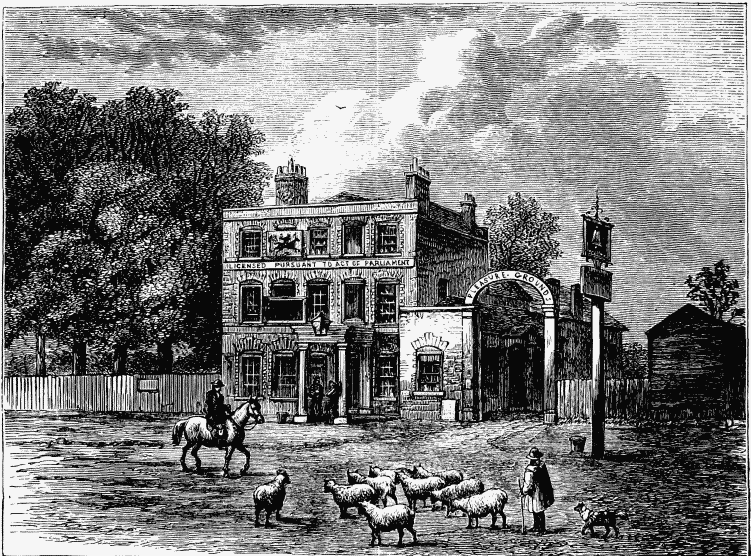
THE "BELL" AT EDMONTON.
CHAPTER XLVI.
NORTH TOTTENHAM, EDMONTON, &c.
"Away went Gilpin, neck or nought,
Away went hat and wig."—Cowper.
The "Bell" and "Johnny Gilpin's Ride"—Mrs. Gilpin on the Stile—How Cowper came to write "Johnny Gilpin"—A Supplement to the Story—Historic Reminiscences of the "Bell" at Edmonton—Charles Lamb's Visit there—Lamb's Residence at Edmonton—The Grave of Charles Lamb—Edmonton Church—The "Merry Devil of Edmonton"—The Witch of Edmonton—Archbishop Tillotson—Edmonton Fairs—Southgate—Arno's Grove—Bush Hill Park.
We have stated in the preceding chapter that the main road northwards runs through the centre of the village, and indeed forms the principal street of Tottenham High Cross. It continues straight on for some two miles or more towards Edmonton. This bit of roadway has acquired some celebrity, for Londoners at least, as the scene of Johnny Gilpin's famous ride, as related by Cowper. Indeed, we might ask, what traveller has ever refreshed himself or herself at the "Bell," and not thought of Johnny Gilpin, and his ride from London and back, nor sympathised with his worthy spouse on the disasters of that day's outing? The "Bell" inn, where Gilpin and his wife should have dined, is on the left-hand side of the road, as we proceed along from Tottenham. The balcony which the house possessed in Cowper's time has been removed, and the place, in fact, otherwise much altered. It has, however, a capacious "banqueting hall," and large pleasure-gardens "abounding with all kinds of shrubs and flowers;" no wonder, therefore, that it is a favourite resort for London holiday-makers. A painting of Johnny Gilpin's ride is fixed outside the tavern, and the house is commonly known as "Gilpin's Bell;" the landlord, however, designates it "The Bell and Johnny Gilpin's Ride."
EDMONTON CHURCH, 1790.
In his "Library of English Literature," Professor Henry Morley thus tells the story of that everpopular favourite ballad:—"Lady Austen one evening told Cowper the story of 'John Gilpin,' which, as told by her, tickled his fancy so much that he was kept awake by fits of laughter during great part of the night after hearing it, and must needs turn it into a ballad when he got up. Mrs. Unwin's son sent it to the Public Advertiser, where it appeared without an author's name. John Henderson, an actor from Bath, who took the London playgoers by storm in 1777 as Shylock, Hamlet, and Falstaff, was then giving readings at the Freemason's Tavern. He had succeeded almost to Garrick's fame. His feeling was so true, his voice so flexible, that Mrs. Siddons and John Kemble often went to hear him read. Henderson finding 'John Gilpin' in print, but not yet famous, chose it for recitation. Mrs. Siddons heard it with delight, and in the spring of 1785 its success was the event of the season. It was reprinted in many forms, and talked of in all circles; prints of 'John Gilpin,' were familiar in shop-windows; and Cowper, who was finishing the 'Task,' felt that his more serious work would be helped if it were published with this 'John Gilpin,' as an avowed piece by the same author." It is now fairly established as the most popular classic, and almost every English child knows it by heart. Indeed, so famous has the ballad, and consequently the "Bell" at Edmonton, become, that Mr. Mark Boyd tells us in his "Social Gleanings," that some American friends, who had come to England, declared that they had seen the two places most worth a visit in the metropolis, namely, "St. Paul's Cathedral, and the house connected with John Gilpin's famous ride."
Mr. John Timbs, in his "Century of Anecdote," gives a similar version of the story of John Gilpin:—"This little poem was composed by Cowper about the year 1782, upon a story told to the poet by Lady Austen, in order to relieve one of the poet's fits of depressive melancholy. Lady Austen, it so happened, remembered the tale from the days of her childhood in the nursery, and its effects on the fancy of Cowper had the air almost of enchantment, for he told her the next morning that he had been kept awake during the greater part of the night by convulsions of irrepressible laughter, brought on by the recollection of her story, and that he had turned the chief facts of it into a ballad. Somehow or other it found its way into the newspapers, and Henderson, the actor, perceiving how true it was to nature, recited it in some of his public readings. Southey, whose judgment on such subjects is worth having and recording, conjectured that possibly the tale might have been first suggested to Cowper by a poem written by Sir Thomas More in his youthful days, entitled 'The Merry Jest of the Serjeant and Freere;' and it is quite within the range of probability that the tale which Lady Austen remembered and related may have originally come from this source, for there is next to nothing really new under the sun."
It has been much disputed, as probably our readers are aware, whether or not "John Gilpin" was an entirely fictitious romance, a creation of Cowper's brain, or whether its author founded his poem upon an adventure, or rather a mis-adventure, in the life of a real personage. The quotation above given from John Timbs, and the opinion of Southey, would certainly seem to give support to the former supposition; but in one of the volumes of the Gentleman's Magazine towards the close of the last century there is an entry which certainly looks quite the other way. According to that, the name of the individual who was really the subject of Cowper's inimitable ballad was Jonathan Gilpin, and he died at Bath, in September, 1790. The following notice appears in the Gentleman's Magazine for November of that year:—"The gentleman who was so severely ridiculed for bad horsemanship under the title of John Gilpin died, a few days ago, at Bath, and has left an unmarried daughter, with a fortune of £20,000." If this was really the case, then, in all probability, the memorable ride from London to the "Bell" at Edmonton and back again, the loss of wig, and the other accessories of the story, were not matters of pure invention, but some of the stern realities of life to a certain civic dignitary whose name has passed away.
It may not be generally known, though Mr.
William Hone has recorded the fact in his amusing
"Table-Book," that Cowper afterwards added an
amusing little episode to John Gilpin's ride, which
was found in the poet's own handwriting among the
papers of his friend, Mrs. Unwin, illustrated with
a comical sketch by George Romney. The episode
consisted of three stanzas, which ran as follows:—
"Then Mrs. Gilpin sweetly said
Unto her children three,
'I'll clamber o'er the style so high,
And you climb after me.'
"But having climbed unto the top,
She could no farther go;
But sat, to every passer-by
A spectacle and show.
"Who said, 'Your spouse and you to-day
Both show your horsemanship;
And if you stay till he comes back
Your horse will need no whip.'"
It is much to be regretted that no more lines of this interesting ballad were discovered, as they were evidently intended to form an addendum to the "Diverting History of Johnny Gilpin," for it is supposed that in the interval between dinner and tea Mrs. Gilpin, finding the time to hang rather heavily on her hands, during her husband's involuntary absence, rambled out with her children into the fields at the back of the "Bell," where she met with the embarrassment recorded on ascending one of those awkward gates and stiles which abound in the neighbourhood of Edmonton and Tottenham. The droll picture of Mrs. Gilpin seated astride on the stile will be found in the pleasant pages of Mr. Hone.
We may state here that the "Bell" at Edmonton was a house of good repute as far back as the days of James I., as will appear from the following extract from John Savile's tractate, entitled, "King James's Entertainment at Theobalds, with his Welcome to London." Having described the vast concourse of people that flocked forth to greet their new sovereign on his approach to the metropolis, honest John says:—"After our breakfast at Edmonton, at the sign of the 'Bell,' we took occasion to note how many would come down in the next hour; so coming up into a chamber next to the street, where we might both best see, and likewise take notice of all passengers, we called for an hour-glass, and after we had disposed of ourselves who should take the number of the horse, and who the foot, we turned the hour-glass, which before it was half run out, we could not possibly truly number them, they came so exceedingly fast; but there we broke off, and made our account of 309 horses, and 137 footmen, which course continued that day from four o'clock in the morning till three o'clock in the afternoon, and the day before also, as the host of the house told us, without intermission." Besides establishing the existence of the renowned "Bell" at this period, the foregoing passage we have quoted is curious in other respects.
Charles Lamb, the last years of whose life were passed at Edmonton, and whose boyhood is so pleasantly connected with Christ's Hospital, (fn. 8) was in the habit of repairing to the "Bell" with any of his friends who may have visited him, when on their return; and here he used to take a parting glass, generally of porter, with them.
Lamb—"that frail good man," as Wordsworth affectionately called him—was the beloved and honoured friend of the leading intellectual lights of his day. From his early school days to his death he was the bosom friend of the poet Coleridge, and the intimate of Leigh Hunt, Rogers, Southey, and Talfourd. By the last-named gentleman his biography, including his letters, &c., was published in 1848. The writings of Lamb, like those of Goldsmith, and especially the "Essays of Elia," mirror forth the gentleness and simplicity of their author's nature. To his wit, Moore's lines on Sheridan most admirably apply:—
"Whose wit, in the combat, as gentle and bright,
Ne'er carried a heart-stain away on its blade."
Macaulay has paid the following tribute to his memory:—"We admire his genius; we love the kind nature which appears in all his writings; and we cherish his memory as much as if we had known him personally." One one occasion Lamb and Coleridge were conversing together on the incidents of the latter's early life, when he was beginning his career in the Church, and Coleridge was describing some of the facts in his usual tone, when he paused, and said, "Pray, Mr. Lamb, did you ever hear me preach?" To this the latter replied, "I never heard you do anything else."
Lucy Aikin, in one of her letters, gives her estimate of the character of Charles Lamb in the following words:—"There is no better English than that of poor Charles Lamb—a true and original genius; the delight of all who knew, and much more of all who read him, and a man whom none who had once seen him could ever forget."
Having already travelled somewhat further northward than we had at first intended, we must forbear passing on to Enfield, where Lamb appears also at one time to have resided; but we may be pardoned for introducing one or two scraps of correspondence having reference to that fact.
Charles Lamb writes to a friend from Enfield Chase, Oct. 1, 1827: "Dear R——, I am settled, and for life I hope, at Enfield. I have taken the prettiest, compactest house I ever saw." And the same friend writes in similar terms: "I took the stage to Edmonton, and walked thence to Enfield. I found them—i.e., Charles and Mary Lamb—in their new house, a small but comfortable place, and Charles Lamb quite delighted with his retirement. He does not fear the solitude of the situation, though he seems to be almost without an acquaintance (here), and dreads rather than seeks visitors."
In a letter addressed by Lamb, about this time, to his friend Tom Hood, we get a glimpse of the "inner life" of the Lambs at Enfield. "If I have anything in my head," he writes, "I will send it to Mr. Watts. Strictly speaking, he should have had my album-verses, but a very intimate friend importun'd me for the trifles, and I believe I forgot Mr. Watts, or lost sight at the time of his similar souvenir. Jamieson conveyed the farce from me to Mrs. C. Kemble; he will not be in town before the 27th. Give our kind loves to all at Highgate, and tell them that we have finally torn ourselves outright away from Colebrooke, where I had no health, and are about to domiciliate for good at Enfield, where I have experienced good.
'Lord, what good hours do we keep!
How quietly we sleep!'
"See the rest in the 'Complete Angler.'
"We have got our books into our new house. I am a dray-horse, if [I] was not ashamed of the undigested, dirty lumber, as I toppled 'em out of the cart, and blest Becky that came with 'em for her having an unstuff'd brain with such rubbish. We shall get in by Michael's Mass. 'Twas with some pain we were evuls'd from Colebrooke. You may find some of our flesh sticking to the door-posts. To change habitations is to die to them; and in my time I have died seven deaths. But I don't know whether every such change does not bring with it a rejuvenescence. 'Tis an enterprise; and shoves back the sense of death's approximating, which, tho' not terrible to me, is at all times particularly distasteful. My house-deaths have generally been periodical, recurring after seven years; but this last is premature by half that time. Cut off in the flower of Colebrook! The Middletonian stream, and all its echoes, mourn. Even minnows dwindle. A parvis fiunt minima ! I fear to invite Mrs. Hood!"
Lamb, it is stated, was addicted to the practice of smoking, and on being asked one day how he had acquired the habit, he replied, "By striving after it, as other men strive after virtue."
Charles Lamb survived his earliest friend and schoolfellow, Coleridge, only a few months. One morning, it is said, he showed a friend the mourning ring which the author of "Christabel" had left him, and exclaimed sorrowfully, "Poor fellow! I have never ceased to think of him from the day I first heard of his death!" Only five days after he had thus expressed himself—namely, on the 27th of December, 1834—Charles Lamb died, in his sixtieth year.
We leave the house in which he lived and died, Bay Cottage, on the right-hand side of Church Street, as we walk from the main road towards Edmonton Church. It is a small white house, standing back from the roadway, and next door to the large brick-built dwelling, known as the "Lion House," from the heraldic lions supporting shields on the tops of the gate-piers.
Poor Lamb was buried in the old churchyard close by, and the tall upright stone which marks his grave, near the south-west corner of the church, bears upon it the following lines, written by his friend, the Rev. Henry F. Cary, the translator of Dante:—
"Farewell, dear Friend—that smile, that harmless mirth,
No more shall gladden our domestic hearth;
That rising tear, with pain forbid to flow,
Better than words—no more assuage our woe;
That hand outstretch'd from small, but well-earn'd store,
Yield succour to the destitute no more.
Yet art thou not all lost: through many an age,
With sterling sense and humour, shall thy page
Win many an English bosom, pleas'd to see
That old and happier vein reviv'd in thee;
This for our earth; and if with friends we share
Our joys in heaven, we hope to meet thee there."
Mary Lamb continued to live on here after her brother's death. She died at St. John's Wood in 1847, but was buried in the same grave with her brother; so it may truly be said of them, that they "were lovely and pleasant in their lives, and in their death they were not divided."
Church Street has another literary memory, for here, from 1810 till 1816, resided John Keats, whilst serving his apprenticeship to a Mr. Hammond, a surgeon; here he wrote his "Juvenile Poems," which were published in 1817.
The parish church of Edmonton, dedicated to
All Saints', is a large edifice, chiefly of Perpendicular architecture. At the west end is a square
tower of stone, embattled, and profusely overgrown
with ivy. The remainder of the building was
encased with brickwork in the year 1772, and, at
the same time, most reprehensible liberties were
taken with the original character of the fabric.
"A bricklayer and a carpenter," says the author
of the "Beauties of England and Wales," "at
that period possessed influence over the decisions
of the vestry. A general casing of brick was
evidently advantageous to the former; and the
carpenter obtained permission to remove the
stone mullions of the venerable windows, and to
substitute wooden framework! The interference
of higher powers prevented his extending the job
to the windows of the chancel, which yet retain
their ancient character, and would appear to be
of the date of the latter part of the fourteenth
century." In 1866 the interior of the church was
carefully restored, new Perpendicular windows of
stained glass being inserted in the chancel, and a
south aisle added to it. The nave has a north
aisle, separated from it by pointed arches sustained
by octangular pillars. There are galleries at the
western end, and in the north aisle. The chancel
and its side aisles are separated from the nave by
a bold arch. Weever mentions several monuments
in this church, which do not exist in the present
day; and Norden, in his MS. additions to his
"Speculum Britanniæ," observes that, "There is a
fable of one Peter Fabell that lyeth here, who is
sayde to have beguyled the Devyll for monie: he
was verye subtile that could deceyve him that is
deceyt itselfe." This Peter Fabell is supposed by
Weever to have been "some ingenious conceited
gentleman, who did use some sleightie tricks for
his own disport." There is a scarce pamphlet,
entitled "The Life and Death of the Merry Devil
of Edmonton, with the Pleasant Pranks of Smug
the Smith," &c. In this book we are informed
that Peter Fabell was born at Edmonton, and
lived and died there in the reign of Henry VII.
His story was made the groundwork of a drama,
called the "Merry Devil of Edmonton," which is
stated to have been "sundry times acted by his
Majesties Servants, at the Globe on the Bankeside."
Notwithstanding that this drama has the letters
"T. B." appended to it as the initials of the author's
name, it was long the fashion to attribute it to
Shakespeare, just as it was in later times to ascribe
it to Michael Drayton. In the prologue to the
play we are informed that the "merry devil" was
"Peter Fabel, a renowned scholar;" and are
further told that—
"If any here make doubt of such a name
In Edmonton, yet fresh unto this day,
Fix'd in the wall of that old ancient church,
His monument remaineth to be seen."
As we have intimated above, however, this monument has long since disappeared.
Edmonton appears to have produced not only
a "merry devil," but also a witch of considerable
notoriety—
"The town of Edmonton has lent the stage
A Devil and a Witch—both in an age."
If we may believe the compiler of the "Beauties
of England and Wales," the wretched and persecuted woman alluded to in the above lines was
named Sawyer; and many particulars concerning
her may be found in a pamphlet, published in 1621,
under the title of "The wonderfull discoverie of
Elizabeth Sawyer, a witch, late of Edmonton; her
conviction, her condemnation, and death; together
with the relation of the Devil's accesse to her,
and their conference together. Written by Henry
Goodcole, minister of the Word of God, and her
continual visitor in the Gaole of Newgate." A
play, by Ford and Dekker, was founded on this
unhappy female.
At a short distance from the church, on the road leading towards Bush Hill, in a mansion called the Rectory House, Dr. Tillotson resided for several years, whilst Dean of St. Paul's, and occasionally also after he became Archbishop of Canterbury. "The day previous to his consecration as Archbishop," remarks the compiler of Tillotson's works, "he retired hither, and prepared himself, by fasting and prayer, for an entrance on his important and dignified duties with becoming humility of temper."
The ancient fair of Edmonton, with all its mirth and drollery, its swings and roundabouts, its spiced gingerbread, and wild-beast shows, is now a thing of the past. There were, in fact, three fairs annually held within the parish of Edmonton. Two of these, termed Beggar's Bush Fairs, arose from a grant made by James I., when he laid out a part of Enfield Chase into Theobalds Park. The third was called Edmonton Statute Fair, and was formerly held for the hiring of servants; it, however, became perverted to the use of holiday-people, chiefly of the lower ranks, and, in common with similar celebrations of idleness in the vicinity of the metropolis, became a source of great moral degradation.
In 1820, one of the chief attractions of the fair was a travelling menagerie, whose keeper walked into the den of a lioness, and nursed her cubs in his lap. He then paid his respects to the husband and father, a magnificent Barbary lion. After the usual complimentary greetings between them, the man, somewhat roughly, thrust open the monster's jaws, and put his head into his mouth. This he did with impunity. A few days afterwards, having travelled a little further north with his show, the keeper repeated his performance, and fell a victim to his rashness.
Southgate, the favourite haunt of Leigh Hunt's childhood, is a detached hamlet, or village, belonging to Edmonton, and derives its name from having been the southern gate to Enfield Chase, which stretches away northward. The village of Southgate lies on the road towards Muswell Hill. Christ Church, a handsome edifice of Early-English architecture, dates its erection from 1862, when it was built in place of the old Weld Chapel.
Minchenden House, in the village, was the seat of the Duchess of Chandos early in the present century. It is said that George II., on coming here to visit the duke's father or grandfather, was obliged to pass through Bedstiles Wood, which was a trespass. The man who kept the gate, being ordered to open it for his Majesty, refused, saying, "If he be the D——himself, he shall pay me before he passes." The king had to pay; but the result was that the duke threw open the road.
Arno's Grove is another mansion of some note in the hamlet of Southgate. It stands on the site of a more ancient structure, termed Arnold's, which some two centuries ago belonged to Sir John Weld. After some intermediate transmissions, it was purchased, early in the last century, by Mr. James Colebrooke, father of Sir George Colebrook, Bart., who eventually inherited the property. Among its subsequent owners was Sir William Mayne, Bart., who was in 1776 raised to the peerage with the title of Lord Newhaven.
Bush Hill Park, in the neighbourhood of Southgate, between Edmonton and Enfield, was formerly the seat of a rich merchant, named Mellish (who was M.P. for Middlesex), and afterwards of Mr. A. Raphael, and of the Moorat family. Its grounds are said to have been laid out by Le Notre. In the hall there is, or was, a curious carving in wood, by Grinling Gibbons, representing the stoning of St. Stephen. "It stood for some time," writes Lambert, "in the house of Mr. Gibbons, at Deptford, where it attracted the attention of his scientific neighbour, Mr. Evelyn, the author of 'Silvia,' who was induced by this specimen of his work to recommend him to Charles II. This carving was purchased for the Duke of Chandos, for his seat at Canons, near Edgware, whence it was brought to Bush Hill." In the grounds of an adjoining mansion are the remains of a circular encampment, of considerable dimensions, about which antiquaries are divided in opinion as to whether they formed part of a Roman or a British camp. The New River winds through the park, and widens out into a lake.