Old and New London: Volume 6. Originally published by Cassell, Petter & Galpin, London, 1878.
This free content was digitised by double rekeying. Public Domain.
Edward Walford, 'Southwark: Old London Bridge', in Old and New London: Volume 6(London, 1878), British History Online https://www.british-history.ac.uk/old-new-london/vol6/pp8-15 [accessed 9 May 2025].
Edward Walford, 'Southwark: Old London Bridge', in Old and New London: Volume 6(London, 1878), British History Online, accessed May 9, 2025, https://www.british-history.ac.uk/old-new-london/vol6/pp8-15.
Edward Walford. "Southwark: Old London Bridge". Old and New London: Volume 6. (London, 1878), British History Online. Web. 9 May 2025. https://www.british-history.ac.uk/old-new-london/vol6/pp8-15.
In this section
CHAPTER II.
SOUTHWARK (continued).—OLD LONDON BRIDGE.
"Ablegandæ Tiberim ultra."—Horace.
Controversy respecting the Trench from Rotherhithe to Battersea—How London Bridge was "built on Woolpacks"—Religious and Royal Processions at the Bridge-foot—Partial Destruction of Old London Bridge by Fire—Conflict between the Forces of Henry III. and those of the Earl of Leicester—Reception of Henry V. after the Battle of Agincourt—Fall of the Southern Tower of London Bridge—Southwark wholly destitute of Fortifications—Jack Cade's Rendezvous in Southwark—Death of Jack Cade—Heads on London Bridge—Reception of Henry VI. and Henry VII.—Reception of Katharine of Aragon—Cardinal Wolsey—Insurrection of Sir Thomas Wyatt—Rebuilding of the Northern Tower—Standards of the Spanish Armada placed on London Bridge—Southwark fortified by the Parliamentarians, to oppose King Charles—Reception of Charles II.—Corn Mills on London Bridge—Tradesmen's Tokens—Bridge-foot—The "Bear" Inn—The "Knave of Clubs"—Bridge Street—The Shops on London Bridge—The Bridge House—General Aspect of Southwark in the Middle Ages—Gradual Extension of Southwark—Great Fire in Southwark in 1676—Building of New London Bridge.
Stow, in his "Survey of London," advances as highly probable the hypothesis that when the first stone bridge was erected over the Thames the course of the river was temporarily changed, being diverted into a new channel, "a trench being cut for that purpose, beginning, as it is supposed, east, about Rotherhithe, and ending in the west, about Patricksey, now Battersea."
Strype, too, seems to support this view, when he writes: "It is much controverted whether the river Thames was turned when the bridge over it was built. . . . . But from all that hath been seen and written upon the turning of the river, it seems very evident to me that it was turned whilst the bridge was building." But Sir Christopher Wren, and after him Maitland, are of the contrary opinion, and think that Stow confused the ditch of the tenth century with that dug in the time of Knut.
Old London Bridge was said to have been "built on woolpacks:" this, however, is, of course, a play upon words, for, in reality, it was built largely out of the produce of a tax on wool. Stow also states that the bridge-gate at the Southwark end was one of the four chief gates of the City of London, and that it stood there long before the Norman Conquest, when the bridge was only of timber. But this supposition again is strongly denied by Maitland.
Of London Bridge itself, and many of the historical scenes that were enacted upon it, we have already spoken in a previous part of this work; (fn. 1) but Southwark has played too important a part on several occasions, in scenes connected with the bridge, to be altogether lost sight of here. Indeed, the bridge-foot must have seen very fine and gay sights in the old days before the Reformation, in the shape of religious and royal processions. For instance, in 1392, when Richard II. suspended and seized on the Charter of the City of London, and the citizens offered to re-purchase their rights for a sum of money, the king was graciously pleased to travel up to London from Windsor, "to re-assure them of his favour." The ceremony of publicly receiving their Majesties, we are told, began at Wandsworth, "with great splendour and a considerable train," when four hundred of the citizens of London, well mounted, and habited in livery of one colour, rode forth to meet the king. "At St. George's Church, in Southwark," says Thomas of Walsingham, "the procession was met by Robert Braybrooke, Bishop of London, and his clergy, followed by five hundred boys in surplices. . . . . When the train arrived at the gate of London Bridge, nearly the whole of the inhabitants, arranged in order according to their rank, age, and sex, advanced to receive it, and presented the king with a fair milk-white steed, harnessed and caparisoned in cloth of gold, brocaded in red and white, and hung about with silver bells; whilst to the queen (Anne of Bohemia) they presented a palfrey, also white, and caparisoned in like manner in white and red."
In 1212, the Priory of Southwark, and other parts adjoining the south end, were destroyed by fire, along with the greater part of the bridge itself, which was then of wood. The flames having caught the beams of the bridge, many of the Londoners lost their lives by fire, and others by water, being drowned in attempting to escape.
In the reign of Henry III. (A.D. 1307), Southwark was the scene of a conflict between the forces of the king and those of Simon de Montfort, the sturdy Earl of Leicester, which were marched, we are told, through the county of Surrey, and being victorious near the foot of the bridge, forced the king to beat a retreat, while De Montfort passed in triumph over the bridge into the City: the citizens of London being, nearly to a man, upon his side.
Splendid pageants were, doubtless, seen frequently here whilst the Court lived at the Tower, and when London Bridge was the only way from the south of England into the City. Of some of these we have already spoken in the chapter above referred to, particularly of those in the reign of Richard II., which was, indeed, a memorable reign for London Bridge.
King Henry V. was received here in great state
on his return to London after the victory of Agincourt; an event which was celebrated in verse by
John Lydgate or Lidgate, the monk of Bury:—
"To London Brygge then rode our kyng,
The processions there they met him right;
Ave, rex Anglorum, they' gan syng,
Flos mundi, they said, Godde's knight.
To London Brygge when he com right
Upon the gate he stode on hy—
A gyant that was full grym of myght
To teche the Frenchmen curtesy.
Wot ye well that thus it was;
Gloria tibi, Trinitas!"
Fabyan tells us, in his "Chronicles," that in 1437, on Monday, the 14th of January, the great stone gate and the tower standing upon it, next Southwark, fell suddenly down at the river, with two of the fairest arches of the said bridge." To which Stow piously adds, "And yet no man perished in body, which was a great work of Almighty God."
It appears from the narratives which have come down to us concerning the insurrections of Wat Tyler, Jack Cade, and Falconbridge, that in the Middle Ages Southwark was still somewhat destitute of fortifications; and, probably, its first regular defences were those of the circuit of fortifications thrown up by order of the Parliament during the civil war.
Jack Cade seems to have made Southwark his head-quarters all through his rebellion. In Shakespeare's vivid scenes of this rebellion (Henry VI., Part II.), a messenger tells the king:—
"Jack Cade hath gotten London Bridge; the citizens
Fly and forsake their houses," &c.
Jack Cade, after his skirmish on Blackheath, took up his quarters at the "Hart Inn," both before and after his entry into the City. On the night of Sunday, July 5th, 1450, Cade being then in Southwark, the city captains, the mayor, aldermen, and commonalty of London, mounted guard upon the bridge. "The rebelles," says Hall, in his "Chronicle," "which neuer soundly slepte, for feare of sodayne chaunces, hearing the bridge to be kept and manned, ran with great haste to open the passage, where betwene bothe partes was a ferce and cruell encounter. Matthew Gough, more expert in marciall feates than the other cheuetaynes of the citie, perceiuing the Kentish men better to stand to their tacklyng than his ymagination expected, aduised his company no farther to procede toward Southwarke till the day appered; to the entent that the citizens hearing where the place of the ieopardye rested, might seccurre their enemies and releue their frendes and companions. But this counsail came to smal effect: for the multitude of the rebelles drave the citizens from the stulpes [wooden piles] at the bridge-foote, to the drawe-bridge, and began to set fyre in diuers houses. Alas! what sorow it was to beholde that miserable chaunce: for some desyringe to eschew the fyre lept on hys enemies weapon, and so died; fearfull women, with chyldren in their armes, amased and appalled, lept into the riuer; other, doubtinge how to saue them self betwene fyre, water, and swourd, were in their houses suffocate and smoldered; yet the captayns nothyng regarding these chaunces, fought on this drawe-bridge all the nyghte valeauntly, but in conclusion the rebelles gat the drawe-bridge, and drowned many, and slew John Sutton, alderman, and Robert Heysande, a hardy citizen, with many other, besyde Matthew Gough, a man of greate wit, much experience in feates of chiualrie, the which in continuall warres had valeauntly serued the king, and his father, in the partes beyond the sea. But it is often sene, that he which many tymes hath vanquyshed his enemies in straunge countreys, and returned agayn as a conqueror, hath of his owne nation afterward been shamfully murdered and brought to confusion. This hard and sore conflict endured on the bridge till ix of the clocke in the mornynge in doubtfull chaunce and fortune's balaunce: for some tyme the Londoners were bet back to the stulpes at Sainct Magnus Corner; and sodaynly agayne the rebelles were repulsed and dryuen back to the stulpes in Southwarke; so that both partes beyng faynte, wery, and fatygate, agreed to desist from fight, and to leue battayll till the next day, vpon condition that neyther Londoners should passe into Southwarke, nor the Kentish men into London."
During the truce that followed this defence of
London Bridge, a general pardon was procured for
Cade and his followers by the Lord High Chancellor, Archbishop Stafford; and all began to
withdraw by degrees from Southwark with their
spoil. Cade, however, was soon afterwards slain,
and his dead body having been brought up to
London, his head was placed over the south gate
of London Bridge. Mr. Mark A. Lower has been
at the trouble of recording the fact that he was
slain, not at Hothfield, in Kent, but at Heathfield,
near Cuckfield, in Sussex, where a roadside monument is erected in his honour. It bears the following inscription:—
"Near this spot was slain the notorious rebel,
Jack Cade,
By Alexander Iden, Sheriff of Kent, A.D. 1450.
His body was carried to London, and his head fixed on
London Bridge.
This is the success of all rebels, and this fortune chanceth
ever to traitors."—Hall's Chronicle.
By that awful gate which looked towards Southwark, for a period of nearly three hundred years, under Tudor and Stuart sovereigns, it must have been a rare thing for the passenger to walk without seeing one or more human heads stuck upon a pike, looking down upon the flow of the river below, and rotting and blackening in the sun. The head of the noble Sir William Wallace was for many months exposed on this spot. In 1471 Falconbridge—"the bastard Falconbridge"—made Southwark his head-quarters in his impudent attack on London. He arrived here in May, giving out that he came to free King Henry from his captivity; and by way of proof of his intention, burnt part of the bridge, together with some of the houses in the suburbs of Southwark. After meeting with defeat, his head and those of nine of his comrades were stuck together on ten spears, where they remained visible to all comers, till the elements and the carrion crows had left nothing of them there but the bones. At a later period the head of the pious Fisher, Bishop of Rochester, was stuck up here, along with that of the honest and philosophic Sir Thomas More. The quarters of Sir Thomas Wyatt, the son of the well-known poet of that name, were exhibited here, at the end of the bridge, during the reign of Queen Mary.
One of the most imposing pageants witnessed at London Bridge was that accorded here by the citizens to Henry VI., on his return to London, after having been crowned King of France in the church of Notre Dame at Paris; the "pageant" consisting, if Fabyan may be trusted, of a "mighty gyaunt standyng, with a swoard drawen," and figures of three "emperesses," representing Nature, Grace, and Fortune; with seven maidens, all in white, representing the seven orders of the angelic host, who addressed the king in verses recorded at full length by Lydgate, of which the following stanza may serve as a sample:—
"God the (thee) endue with a crowne of glorie,
And with a sceptre of clennesse and pité,
And with a shield of right and victorie,
And with a mantel of prudence clad thou be:
A shelde of faith for to defendé the,
An helme of hettlé wrought to thine encres
Girt with a girdel of loue and perfect peese (peace)."
Henry VII. was received here in pomp, after defeating the insurgents, in 1497; the heads of the leaders of the outbreak, Flamoke and Joseph, being set over the entrance to the bridge.
In 1501, Prince Arthur, eldest son of Henry VII., with his bride, Katharine of Aragon, was welcomed here on his way from "Lambhithe" to witness the rejoicings prepared for them in the City. Stow tells us, in his "Annals," "that at the entrance of London Bridge they were greeted by a costly pageant of St. Katharine and St. Ursula, with many virgins." How little did she then think of the fate that awaited her!
Cardinal Wolsey rode in great state over the bridge, and through the High Street, Southwark, and along the Kentish Road, when he left the kingdom in 1526, for the purpose of arranging a marriage between Henry VIII. and the Duchess d'Alencon. Two years later, the public entry of Cardinal Campeggio, as legate from the Pope, into London, to deal with the question of Henry's divorce from Queen Katharine, must have been a brave sight. The nobility rode in advance from Blackheath towards London Bridge, "well mounted, and wearing elegant attire;" then came the cardinal himself, in magnificent robes, "glittering with jewels and precious stones;" then his "cross-bearers, the carriers of his pole-axes, his servants in red livery, his secretaries, physicians, and general suite." Next came two hundred horsemen and a "vast concourse of people." The procession is said to have grown to two miles in length before it reached the City gates. From St. George's Church to the foot of the bridge the road was lined on both sides by the monks and the other clergy, dressed in their various habits, with copes of cloth of gold, silver and gold crosses, and banners, who, we are told, as the legate passed, "threw up clouds of incense and sang hymns." At the foot of the bridge two bishops received the cardinal, the people shouted for joy, whilst all the bells of the City were rung, and the roar of artillery from the Tower and the river-forts "rent the air"—to use Wolsey's own words—"as if the very heavens would fall."
In the insurrection of Sir Thomas Wyatt in 1553–4, (fn. 2) Southwark formed the rallying-point for that misguided rebel and his force, some four thousand strong. His soldiers, meeting with but little opposition on the south of the Thames, attacked and sacked the palace of the Bishop of Winchester, whose fine library they destroyed. As the artillery in the Tower began to fire on Southwark next day, in order to dislodge Sir Thomas, the inhabitants urged him to retreat, in order to save them from loss and destruction. His subsequent movements and his ultimate fate we have already recorded.
Stow tells us, in his "Survey" (vol. i., p. 64), that in April, 1577, the tower at the northern end having become decayed, a new one was commenced in its place; and that during the interval the heads of the traitors which had formerly stood upon it were set upon the tower over the gate at Bridgefoot, Southwark, which consequently came to be called the Traitors' Gate. It may be remembered that John Houghton, the Prior of the Charterhouse, Sir Thomas More, and Bishop Fisher, were among the "traitors" who were thus treated.
About the time when these heads were removed, several alterations and improvements would seem to have been made in the bridge, especially in the erection of a "beautiful and chargeable piece of wood"—i.e., a magnificent wood mansion, which formed a second Southwark Gate and Tower.
It is worthy of note that after the defeat of the Spanish Armada, eleven of the captured standards were hung upon London Bridge at the end looking towards Southwark, on the day of Southwark Fair, "to the great joy of all the people who repaired thither."
When the Parliamentary cause was in the ascendant, and King Charles was expected to attack the City, Southwark was rapidly fortified, particularly about the foot of London Bridge, like the other outlying portions of the metropolis; (fn. 3) and one of Cromwell's officers, Colonel Rainsborough, with a brigade of horse and foot, was able to hold the whole borough of Southwark almost without opposition.
On Tuesday, the 29th of May, 1660, King Charles II. entered London in triumph, after having been magnificently entertained in St. George's Fields. About three in the afternoon he arrived in Southwark, and thence proceeded over the bridge into the City, attended by all the glory of London and the military forces of the kingdom. Lord Clarendon, who makes this "fair return of banished majesty" the concluding scene of his noble "History of the Great Rebellion," gives us but little information as to the details of the king's reception at London Bridge, though we learn incidentally from his pages that "the crowd was very great."
Bloome, one of the continuators of Stow, expressly says that in the Great Fire some of the old houses at the south end of the bridge—several of them built in the reign of King John—escaped the flames.
Two Gothic towers—not uniform in plan, however—defended the southern end of the original bridge, and also of the second. At this end of the bridge were, likewise, four corn-mills, based on three sterlings, which projected far into the river westward. They were covered with a long shed, formed of shingles or thin boards, and could certainly have been no ornament to the structure to which they were an appendage. We have already spoken of the houses and shops which lined the roadway of old London Bridge, (fn. 4) but we may here make mention of the tradesmen's tokens which were once in use here. A full list of those used in Southwark will be found in the appendix to Manning and Bray's "History of Surrey." Several of these tokens relate to London Bridge. The author of "Chronicles of London Bridge" gives illustrations of several, among which is a copper token, farthing size, having on the one side, to speak heraldically, a bear passant, chained; and on the reverse, the words "Abraham Browne, at ye Bridgefoot, Southwark; his half penny." Another copper token shows the same device, with the legend "Cornelius Cook, at the 'Beare' at the Bridgefoot." Another displays a sugar-loaf, with the name, "Henry Phillips, at the Bridj-foot, Southwark."
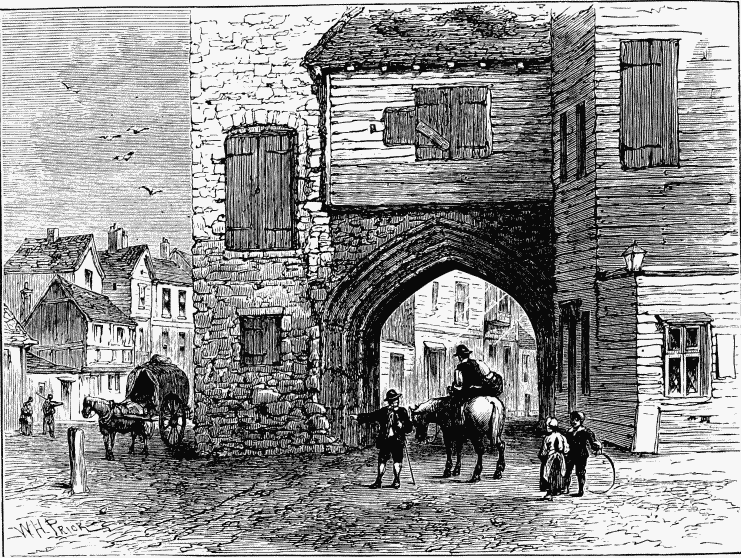
PRIORY OF ST. MARY OVERY, 1700.
The end of London Bridge, on the Southwark side, was known as Bridge-foot. The "Bear" here was, for some centuries, one of the most popular of London taverns; indeed, if we may accept Mr. Larwood's statement, it was the resort of aristocratic pleasure-seekers as early as the reign of Richard III. Thus, in March, 1463–4, it was repeatedly visited by the "Jockey of Norfolk," then Sir John Howard, who went thither to drink wine and shoot at the target. Peter Cunningham, in his "London, Past and Present," adds that the "Bear" is mentioned frequently by name by writers of the seventeenth century.
Thus Pepys writes, under date April 3, 1667:—"I hear how the king is not so well pleased of this
marriage between the Duke of Richmond and Mrs.
Stuart, as is talked; and that he, by a wile, did
fetch her to the 'Bear' at the Bridge-foot, where
a coach was ready, and they are stole away into
Kent without the King's leave." Mr. Larwood
observes that the wine sold at this establishment
did not meet with the approbation of the fastidious
searchers after claret in 1691:—
"Through stinks of all sorts, both the simple and compound,
Which through narrow alleys our senses do confound,
We came to the Bear, which we now understood
Was the first house in Southwark built after the flood
And has such a succession of visitors known,
Not more names were e'er in Welch pedigrees shown;
But claret with them was so much out of fashion,
That it has not been known there for a whole generation."
(Last Search after Claret in Southwark, 1691.)
This old tavern was taken down in December, 1761, when a quantity of coins, dating as far back as the reign of Elizabeth, were found, as may be seen by a reference to the Public Advertiser of that date.
We learn from the Harleian manuscripts that there was here another old inn, known as the "Knave of Clubs," kept by one Edward Butling, whose advertisement states that he "maketh and selleth all sorts of hangings for rooms, &c.," and who, probably, also sold playing-cards, if his sign had any meaning.
Bridge Street, probably, extended itself gradually on to the bridge itself; the houses being distinguished by signs, some of which have come down to our times, in the works of antiquaries and on tradesmen's tokens and bill-heads. For instance: there is extant a small copper-plate tobacco paper, probably of the reign of Queen Anne, with a coarse and rude engraving of a negro smoking, and holding in his hand a roll of tobacco; above his head is a crown, two ships in full sail are behind, and the sun issues from the right-hand corner above; in the foreground are four little negroes planting and packing tobacco, and beneath is the name "John Winkley, Tobacconist, near ye Bridge, in the Burrough, Southwark." We have also seen another shop bill, of about the same date, displaying, within a rich cartouche frame, a pair of embroidered small-clothes and a glove: beneath is the legend, "Walter Watkins, Breeches-maker, Leather-seller, and Glover, at the sign of the 'Breeches and Glove,' on London Bridge, facing Tooley Street, sells all sorts (of) leather breeches, leather, and gloves, wholesale and retail, at reasonable rates." It is clear, from these notices, that it was very doubtful where London Bridge ended and Bridge Street actually began.
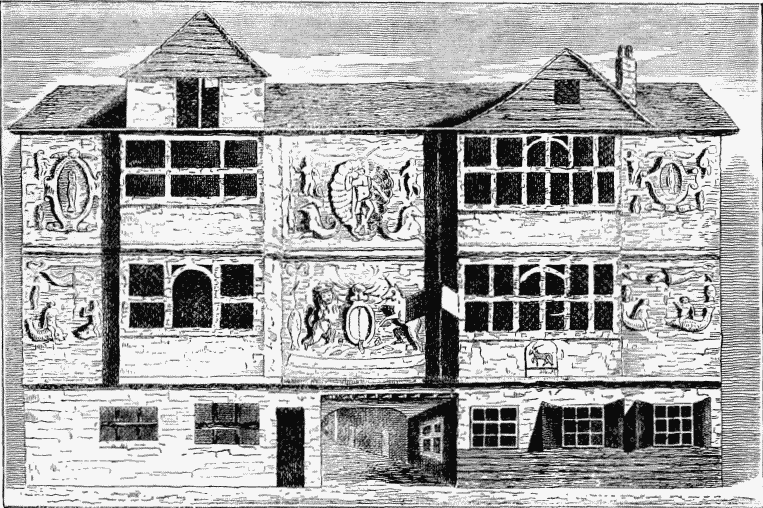
OLD HOUSES FORMERLY AT BANKSIDE.
In the sixteenth century, the street on the bridge ranked with St. Paul's Churchyard, Paternoster Row, and Little Britain, as one of the principal literary emporia of the City. "The Three Bibles," "The Angel," and "The Looking-Glass," are some of the signs of the publishers established "on London Bridge," and mentioned on the title-pages of books published at this date.
John Bunyan at one time certainly used to preach in a chapel in Southwark; but, in all probability, the author of "Wine and Walnuts" is using the vagueness of after-dinner talkers when he says that the converted tinker lived on London Bridge. Perhaps he was led into the error by the fact that one of Bunyan's lesser books was published there.
The Bridge House and Yard in Tooley Street are closely connected with the history of the bridge itself. For Stow tells us, in his "Survey" (vol. ii., p. 24), that they were so called as being "a store-house for stone, timber, or whatsoever pertaineth to the building or repairing of London Bridge." He adds that this Bridge House "seemeth to have taken beginning with the first foundation of the bridge, either of stone or timber;" and that it covers "a large plot of ground on the banks of the river Thames, containing divers large buildings for the stowage of materials" for the bridge. The Bridge House, in fact, was long used as a receptacle of provisions for the navy, and as a store-house for the public in times of dearth; ovens were attached to it, in which the biscuit for the Royal Navy was baked. It was also used on certain occasions as a banqueting-hall, when the Lord Mayor came in his official capacity to the borough. One of these occasions was at the opening of Southwark Fair, of which we shall have more to say presently. We may state here, however, that the fair was instituted in the reign of Edward VI., and was held annually in the month of September. "At the time of this fair, anciently called 'Our Lady's Fair in Southwark,'" observes the author of "Chronicles of London Bridge," "the Lord Mayor and Sheriffs used to ride to St. Magnus' Church after dinner, at two o'clock in the afternoon, the former being vested with his collar of SS., without his hood, and all dressed in the scarlet gowns, lined, without their cloaks. They were attended by the swordbearer, wearing his embroidered cap, and carrying the 'pearl' sword; and at church were met by the aldermen, all of whom, after evening prayer, rode over the bridge in procession, and passed through the fair, and continued either to St. George's Church, Newington Bridge, or the stones pointing out the City Liberties at St. Thomas of Waterings. They then returned over the bridge, or to the Bridge House, where a banquet was provided, and the aldermen took leave of the Lord Mayor; all parties being returned home, the Bridge Masters gave a supper to the Lord Mayor's officers."
"The two governors of the bridge," writes the author of the work above quoted, "have an excellent house in the suburb of Southwark, as well as a store-house, containing everything belonging to their occupation." From the same work we learn that a cross, charged with a small saltire, is supposed to have been the old heraldic device for Southwark or the estate of London Bridge; and we know that the arms used for those places are still Azure, an amulet, ensigned with a cross patée, Or, interlaced with a saltire, conjoined in base of the second.
The following just remarks on the general aspect of Southwark in the Middle Ages are taken from Dr. R. Paule's "Pictures of Old London:"—"On the other side of the river lay many points, isolated and unconnected with one another, which are now joined together into a district of the town that numbers its hundreds of thousands of inhabitants. It was only at the outlet of the bridge at Southwark that, from different causes, there had arisen in ancient times a town-like settlement. Two great priories—the monastery of St. Mary Overies and the convent of Bermondsey—had early given rise to the active and busy intercommunication which naturally resulted from the vicinity of such ecclesiastical institutions as these were. Near to St. Mary's, and not far from the bridge, there stood till the time of the Reformation the magnificent palace of the Bishop of Winchester, one of the wealthiest and most powerful prelates in the land, and whose extensive spiritual jurisdiction included the county of Surrey. The most important agent in this great intercommunication was the high road which ran from the bridge, and extended through the southern counties to the ports of Kent, Sussex, and Hampshire. Here heavily-laden wagons were constantly moving to and fro; and here, too, assembled, at the appointed seasons of the year, the motley crowd of pilgrims who were bound for the shrine of the holy Thomas à Becket at Canterbury. The 'Tabard' inn had been known far and near for many ages, from the vivid descriptions given by Chaucer of the busy life and stir which blended there with devotion and adventure. All remains of it are not yet (1861) effaced, although there has been erected in its immediate neighbourhood the railway terminus of that great overland route which connects England with India. . . . . The greater part of the land lying on the opposite (i.e., the Surrey) bank of the river consisted of fields and gardens, with a few larger hamlets, and some places of amusement, where bear-baiting and cock-fighting were practised. Immediately opposite to Westminster rose the chapel and castellated towers and walls of the princely residence which the Archbishops of Canterbury had chosen before the close of the twelfth century for their town residence, in the immediate neighbourhood of the chief offices of state and the tribunals of justice." Such must have been, speaking generally, the appearance of Southwark five centuries ago.
In the time of Elizabeth, if we may rely on the statements of the "Penny Cyclopædia," Southwark appears to have consisted of a line of street extending from the bridge nearly to where now is the Borough Road, formerly called "Long Southwark;" Kent Street, then the high road to Canterbury and Dover, and of which only the part near St. George's Church was lined with houses; a line of street, including Tooley or St. Olave's Street, extending from the "Bridge-foot" to Rotherhithe Church; another line of street running westward by Bankside to where is now the Blackfriars Road; and, lastly, Bermondsey Street, branching off from Tooley Street to Bermondsey Church. Excepting near St. Saviour's Church, there were at that time scarcely any back or cross streets. Near Bankside were the Bishop of Winchester's palace, the Globe Theatre, the "Stews," and two "Bear Gardens" for baiting bulls and bears. The "villages" of Lambeth, Kennington, Newington, and Walworth were then separated from Southwark, and from each other also, by open fields.
Towards the end of the seventeenth century Southwark had extended itself considerably. The houses on the east side of Blackman Street now stretched to Newington and Walworth, which thus became joined on to the metropolis, though St. George's Fields, on the western side, still remained open country. Back streets, also, and alleys had been formed on either side of High Street, as far as St. George's Church. In the early part of the eighteenth century the buildings of Southwark extended along the river-side as far as Lambeth; and in the opposite direction Rotherhithe Street was continued to and even beyond Cuckold's Point, where the river bends to the southward. Later still, in the middle of the eighteenth century, the opening of Blackfriars Bridge led to the formation of Great Surrey Street; and towards the close of the century, St. George's Fields were enclosed and laid out in new streets. Since the commencement of the present century, Lambeth Marsh—which formerly separated Southwark from Lambeth—has been covered with new streets and buildings; and in every direction Southwark has spread itself till it has united itself with all the surrounding villages, from Greenwich in the far east to Battersea in the far west, and combined them into one large town, having a population of about 300,000, of which Southwark proper may be regarded as the nucleus.
In a little less than ten years after the Great Fire of London—namely, in May, 1676—Southwark was visited by a fire which did, in proportion, almost equal damage with the conflagration which has become historical. "It broke out," writes Mr. C. Walford, in the "Insurance Cyclopædia," "at an oilman's, between the 'George' and 'Tabard' inns, opposite St. Margaret's Hill. The front of the 'Tabard' was consumed, but was immediately rebuilt, presumably in fac-simile of the original, with its court-yard, galleries, pilgrim's hall, and quaint old sleeping-rooms. It is doubtful," he adds, "how far any part of the hotel then burnt may have been part of the actual inn described by Chaucer: where, on the eve of a pilgrimage, the pretty prioress, the 'Wife of Bath,' the 'Knight,' the 'Squire,' the 'Sumpnour,' and the 'Pardoner,' met, chatted, laughed, and flirted. The 'White Hart,' whose name was connected with that of Jack Cade, was also burnt in this fire. The fireengines were first worked with hose-pipes on this occasion, and did good service. It was probably owing to these that the conflagration was stayed at St. Thomas's Hospital."
The king (Charles II.) was so much touched by the sight, which recalled vividly the scenes which he had witnessed ten years before, that he went down the river in his state-barge to London Bridge, in order "to give such orders as His Majesty found fit for putting a stop to it." It is difficult, however, to see how a king could be of more use in such an emergency than a good chief-fireman, or even of as much service. The buildings being as yet, like those of Old London, chiefly of timber, lath, and plaster, the fire spread extensively; and its further progress was only stayed "after that about 600 houses had been burnt or blown up."
Old London Bridge, and the street winding southward from it, were situated about a hundred feet eastward of the present bridge and its approach from the High Street. The building of New London Bridge was actually commenced on the 15th of May, 1824, when the first coffer-dam for the southern pier was driven into the bed of the river; the first stone was laid in June, 1825; and the bridge was publicly opened by William IV. and Queen Adelaide on the 1st of August, 1831. "I was present, a few days ago," writes Lucy Aikin, in September of that year, "at the splendid spectacle of the opening of new London Bridge. It was covered half-way over with a grand canopy, formed of the flags of all nations, near which His Majesty dined with about two thousand of his loyal subjects. The river was thronged with gilded barges and boats, covered with streamers, and crowded with gaily-dressed people; the shores were alive with the multitude. In the midst of the gay show I looked down the stream upon the old, deserted, halfdemolished bridge, the silent remembrancer of seven centuries. I thought of it fortified, with a lofty gate at either end, and encumbered with a row of houses on each side. I beheld it the scene of tournaments; I saw its barrier closed against the rebel Wyatt; and I wished myself a poet for its sake."