Old and New London: Volume 6. Originally published by Cassell, Petter & Galpin, London, 1878.
This free content was digitised by double rekeying. Public Domain.
Edward Walford, 'Greenwich: The hospital for seamen', in Old and New London: Volume 6(London, 1878), British History Online https://www.british-history.ac.uk/old-new-london/vol6/pp177-190 [accessed 6 May 2025].
Edward Walford, 'Greenwich: The hospital for seamen', in Old and New London: Volume 6(London, 1878), British History Online, accessed May 6, 2025, https://www.british-history.ac.uk/old-new-london/vol6/pp177-190.
Edward Walford. "Greenwich: The hospital for seamen". Old and New London: Volume 6. (London, 1878), British History Online. Web. 6 May 2025. https://www.british-history.ac.uk/old-new-london/vol6/pp177-190.
In this section
CHAPTER XIV.
GREENWICH (continued).—THE HOSPITAL FOR SEAMEN, &c.
"Go, with old Thames, view Chelsea's glorious pile,
And ask the shattered hero whence his smile?
Go view the splendid domes of Greenwich—go,
And own what raptures from reflection flow."
S. Rogers, "Pleasures of Memory."
Greenwich Hospital as a Monument to Queen Mary, and of the Victory of La Hogue—Appointment of the Commissioners by William III.—Sir Christopher Wren's Share in the Building—John Evelyn as Treasurer—Description of the Building—Memorials of Joseph René Bellot, and the Officers who fell in the Indian Mutiny—The Chapel—The Painted Hall—Nelson's Funeral Car—The Nelson Room—The Hospital—Sources of its Revenue—The Old Pensioners and their Accommodation—The Royal Naval College—The Naval Museum—The Nelson and other Relics—The Infirmary for the Pensioners—The Seamen's Hospital—The Dreadnought—The Royal Naval School—Officers connected with Greenwich Hospital since its establishment—Fund for Disabled Seamen.
The reader will not have forgotten the account which Macaulay gives of the causes which led to the foundation of Greenwich Hospital, immediately after the death of Queen Mary, the Consort of William III. "The affection with which her husband cherished her memory," he writes, "was soon attested by a monument, the most superb that was ever erected to any sovereign. No scheme had been so much her own, none had been so near her heart, as that of converting the palace into a retreat for seamen. It had occurred to her when she had found it difficult to provide good shelter and good attendance for the thousands of brave men who had come back to England wounded after the battle of La Hogue. Whilst she lived, scarcely any step was taken towards the accomplishment of her favourite design; but it should seem that, as soon as her husband had lost her, he began to reproach himself for having neglected her wishes. No time was now lost. A plan was furnished by Wren, and soon an edifice, surpassing that asylum which the magnificent Louis had provided for his soldiers, rose on the margin of the Thames. Whoever reads the inscription which runs round the frieze of the hall will observe that King William claims no part of the merit of the design, and that the praise is ascribed to Mary alone. Had the king's life been prolonged, a statue of her who was the real foundress of the institution would have had a conspicuous place in that court which presents two lofty domes and two graceful colonnades to the multitudes who are perpetually passing up and down the imperial river. But that part of the plan was never carried into effect; a few of those who now gaze on the noblest of European hospitals are aware that it is a memorial of the virtues of the good Queen Mary, of the love and sorrow of William, and of the great victory of La Hogue."
This magnificent structure, which is considered the finest specimen of classical architecture in this or almost any other country, occupies the site of the old royal palace, on the southern bank of the Thames, between that river and Greenwich Park. It was established, as before stated, in the reign of William and Mary, who, "for the encouragement of seamen and the improvement of navigation," by their letters patent, dated October 25th, 1694, granted to Sir John Somers, Knight, Keeper of the Great Seal; Thomas, Duke of Leeds; Thomas, Earl of Pembroke and Montgomery; Charles, Duke of Shrewsbury; Sidney, Lord Godolphin; and others—" all that piece or parcell of ground situate, lying, and being within the Parish of East Greenwich, and being parcell or reputed parcell of our Mannor of East Greenwich aforesaid, containing in the whole, by admeasurement, eight acres, two roods, and thirty-two square perches; and all that capital messuage lately built, or in building, by our royall uncle, King Charles II., and still remaining unfinished, commonly called by the name of our Palace at Greenwich, standing upon the piece or parcell of ground aforesaid; and those edifices and tofts called the chapel and vestry there;" and other tenements, to erect and found a hospital " for the reliefe and support of seamen serving on board the shipps or vessells belonging to the Navy Royall of us, our heires, or successors; or imploy'd in our or their service at sea; who, by reason of age, wounds, or other disabilities, shall be incapable of further service at sea, and be unable to maintain themselves; and also for the sustentation of the widows, and maintenance and education of the children of seamen happening to be slaine or disabled in such sea service." Queen Mary, who, as we have shown, was the first projector of this charitable institution, died on the 28th of December, 1694, two months after the grant was made for carrying her wishes into effect.
In March of the following year, the king appointed nearly two hundred commissioners; including George, Prince of Denmark; the principal Officers of State; the Archbishops, Bishops, Judges, the Lord Mayor and Aldermen of London; and the Masters, Wardens, &c., of the Trinity House. John Evelyn gives us, in his "Diary," an accurate account of the successive steps taken by himself and his brother commissioners in establishing the hospital, of which he was appointed treasurer. The first meeting of the commissioners was held at the Guildhall, May 5th, 1695, the Archbishop of Canterbury, Lord Godolphin, the Duke of Shrewsbury, and Sir Christopher Wren, and others being present. In the course of that month several other meetings were held, at which Evelyn, Wren, and two other commissioners, having gone to Greenwich to survey the place, made a report to the effect that "the standing part (of the palace) might be made serviceable at present for £6,000," and what extent of ground would be requisite in order to complete the design. The draft of the hospital was settled in the following April, and the first stone of the new edifice laid on the 30th of June, by Evelyn himself, supported by Wren and Flamsteed, "the king's astronomical professor." Evelyn records even the exact hour at which the ceremony took place: "Precisely at five o'clock in the evening, after we had dined together; Mr. Flamsteed observing the punctual time by instruments." Evelyn's salary, as treasurer, was £200, much of the work being done by his son-in-law Draper, as his deputy, though the works as they progressed kept him at Saye's Court, away from his beloved Wotton, during the entire summer. Draper, we may add, succeeded Evelyn in the treasurership. The subscriptions received during the first twelve months towards the hospital amounted, according to Evelyn, to upwards of £9,000, including £2,000 from the king, and £500 apiece from nearly all the leading statesmen. According to a note by the treasurer, four months after the foundation, the work done amounted to upwards of £5,000, towards which the treasurer had received only £800, there being among the defaulters the king's £2,000, paid by exchequer tallies on the Post Office, "which," says he, "nobody will take at 30 per cent. discount," a statement which, if true, does not redound to King Charles's credit. Part of the expense of the erection of the structure was raised by state lotteries. Evelyn writes, in his "Diary" for May, 1699: "All lotteries, till now cheating the people, to be no longer permitted than to Christmas, except that for the benefit of Greenwich Hospital." From an entry which he makes in his "Diary" in January, 1705, it appears that the building was so far advanced that the committee had already admitted some pensioners: "I went to Greenwich Hospital, where they now begin to take in wounded and worn-out seamen, who are exceedingly well provided for." He adds, more suo, "The buildings now going on are very magnificent." In a note in Evelyn's "Diary" is published his debtor and creditor account for the erection of the hospital. The total of subscriptions, &c., seems to have been £69,320, exclusive of the produce of lottery tickets, £11,434, and malt tickets, £1,000; but the exact meaning of this last item is not very clear.
The hospital is elevated on a terrace upwards of 280 yards in length, and in its completed form consists of four distinct blocks of building. The two blocks nearest the river, known respectively as King Charles's and Queen Anne's Buildings, stand on either side of the "Great Square," 570 feet in width. The two blocks south of them, King William's and Queen Mary's Buildings, are brought nearer to each other by the width of the colonnades; and the cupolas at the inner angles form a fine central feature, and impart unity to the general composition. The view from the north gate, in the centre of the terrace, is very striking. Beyond the square are seen the hall and chapel, with their finely-proportioned cupolas and gilt vanes, and the two colonnades, which form a kind of avenue terminated by the Royal Naval School, above which, on an eminence in the park, appears the Royal Observatory.
In the centre of the great square is a statue of George III. It was the gift of Admiral Sir John Jennings, who was governor of the hospital in the reign of that king. It was sculptured by Rysbrach, out of a single block of white marble, which weighed eleven tons, and had been captured from the French by Sir George Rooke.
At each extremity of the terrace in front of the hospital is a small pavilion; their use, however, is not very apparent, they were erected in 1778, and named respectively after King George III. and Queen Charlotte, but it is not on record that their majesties ever used them for tea-parties or other purposes. On the terrace, in front of the gates, is a granite obelisk, erected as "a memorial of the gallant young Frenchman, Joseph René Bellot, who perished in the search for Sir John Franklin, August, 1853." In the north-west corner of the grounds, in front of the "Ship" hotel, is another obelisk, put up in memory of several officers who fell during the Indian Mutiny.
King Charles's Building is on the west side of the great square. The eastern portion formed the unfinished palace of Charles II.; it is built about an inner quadrangle, and is constructed of Portland stone. In the centre is a portico of the Corinthian order, crowned with an entablature and pediment; and in the pediment is a piece of sculpture, consisting of two figures, one representing Fortitude, and the other the Dominion of the Sea. At each end is a pavilion formed by four pilasters of the Corinthian order, and surmounted by an attic. The four fronts of this block of buildings nearly correspond with each other. In the pediment on the eastern side is a piece of sculpture representing Mars and Fame. Some part of this block having become very much decayed, it was rebuilt in 1814. Richardson, in his "History of Greenwich," states that Admiral George Byng was "confined in that quarter of Greenwich Hospital known as King Charles's Building, in the year 1756, previous to his execution at Portsmouth in 1757." He also adds, "The individual to whom the author is indebted for his information waited on the admiral in the capacity of servant to the Marshal of the Admiralty, in whose custody the admiral then was, and, accompanying his master and the prisoner to Portsmouth, it eventually fell to his lot to place the cushion for the admiral to kneel upon when he was shot."
Queen Anne's Building, the corresponding block facing the river, was commenced in 1698, and was so named on the accession of Anne to the throne. It resembles King Charles's Building, except that the pediments are without sculpture. This building now serves as the Naval Museum, of which we shall have more to say presently.
To the south of Queen Anne's Building is another block, named after Queen Mary, the north side of which forms the chapel. The lofty cupola at the western extremity of the chapel serves as the vestibule, in which are statues of Faith, Hope, Meekness, and Charity, from designs by Benjamin West. From this vestibule a flight of steps leads into the chapel, through folding doors of mahogany, highly enriched and carved. The original chapel being destroyed by fire in January, 1779, the present structure was erected in its place, from the designs of James Stuart ("Athenian Stuart"), and was opened for service in 1789. The chapel is upwards of 100 feet long, and more than 50 feet wide. The nave, and space round the communiontable and organ-gallery, is paved with black and white marble, and in the centre of the nave is the representation of an anchor and a seaman's compass. The ceiling is divided into compartments, ornamented with foliage and other designs in the antique style. The whole interior of the chapel is richly decorated with coloured marbles, scagliola, and fancy woods, sculpture, carving, and painting. Entrance to the chapel is gained through an elaborately-sculptured marble screen with a frieze, by Bacon; and at each end of the chapel are four marble columns of the Corinthian order, supporting the roof. In recesses above the gallery door, &c., are figures of prophets and evangelists, by Benjamin West; whilst over the communion-table is a large painting, also by West, representing the "Preservation of St. Paul from Shipwreck on the Island of Melita."
King William's Building, at the south-west side, like the corresponding block, has massive Doric columns, and comprises the great, or Painted Hall, the dining-hall of the original institution, with its vestibule and cupola. This part of the hospital was so far completed by the commencement of the year 1705, as to be capable of receiving forty-two seamen. Three years later there were 300 pensioners within the walls. The colonnades to King William's and Queen Mary's Buildings are each 347 feet long, with returns of seventy feet. Each contains 300 coupled Doric columns twenty feet high.
That portion of the structure of which Evelyn laid the foundation was completed in two years, the architect being Sir Christopher Wren, who, it is said, generously undertook the work of that post without any emolument, his labours being equivalent to a large subscription. In 1698, Sir Christopher Wren submitted to the committee a plan for a large dining-hall (now the Painted Hall), which being approved of by them, the necessary portion of ground was immediately laid out, and the work prosecuted with such diligence, that the whole was roofed in and the dome erected by August, 1703, forming what is now called "King William's Building." The hall, originally intended as the hospital refectory, now serves as the gallery of naval pictures. It is upwards of 100 feet in length, by fifty feet in width, and about the same in height. It is sufficiently well lighted for the purpose for which it was originally designed, but hardly so for a picture-gallery. It is entered by a noble vestibule, open to one of the lofty cupolas, from which it receives a very dim and shadowy light. A short flight of steps leads up into the hall, the ceiling of which at once rivets the attention of the visitor. This was painted by Sir James Thornhill, and is divided into compartments. Its praises were first sounded by Sir Richard Steele, who, in his play of The Lover, has given an admirable description of it. In the central compartment appear King William and Queen Mary, surrounded by allegorical personages, intended to typify national prosperity, and the compartments are filled with figures representing the Seasons, the Elements, the Zodiac, with portraits of Copernicus, Newton, &c.; emblems of science and naval trophies. Every one remembers the marvellous story of Sir James Thornhill stepping back to see the effect of his painting upon the ceiling, and being prevented from falling to the floor by some person defacing a portion of his work, thus causing the painter to rush forward and save himself from death.
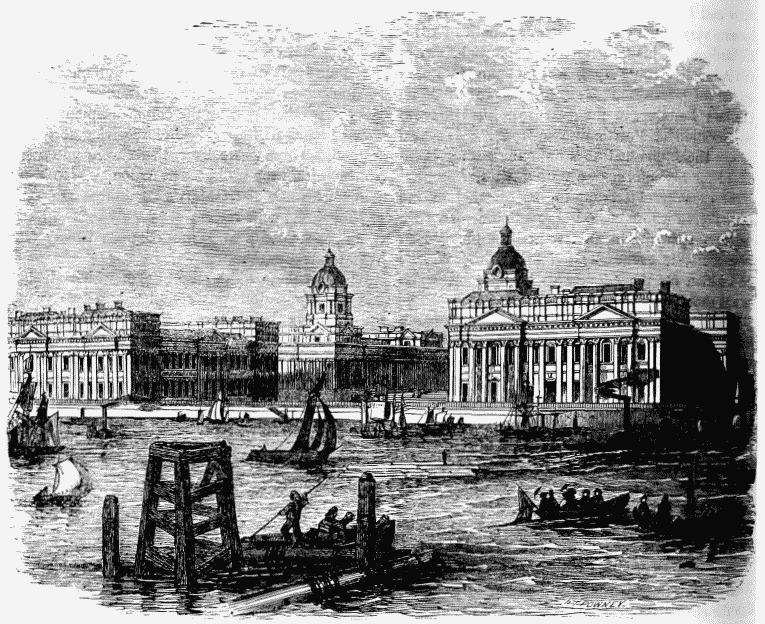
GREENWICH HOSPITAL, FROM THE RIVER.
The painting of this hall occupied Sir James Thornhill nineteen years, from 1708 to 1727; and he was paid at the rate of £3 a square yard for the ceiling, and £1 a yard for the walls. On the latter are fluted Corinthian pilasters, trophies, &c. Beyond the great hall is a raised apartment, called the "upper hall."
The great hall, as we have said, was at first intended to be used as the common refectory of the institution, the upper chamber being appropriated to the table of the officers, and the lower to those of the pensioners. But when the growing revenue of the Hospital gradually led to an increase of the number of its inmates, the space proved inadequate to their accommodation; the table of the officers was discontinued, and other dining-halls for the men were provided on the basement storey. The noble apartment had been thus unoccupied nearly a century, when, in 1794, the Lieutenant-Governor, Mr. Locker, suggested its appropriation to the service of a National Gallery of Marine Paintings, to commemorate the eminent services of the Royal Navy of England. This tasteful design was not then executed; but in 1823 it was again proposed by Governor Locker's son, who, with the consent of the then commissioners and governor, began the collection of the various paintings. The plan was warmly patronised by George IV., who promptly and liberally gave directions that the extensive and valuable series of portraits of the celebrated admirals of the reigns of Charles II. and William III. at Windsor Castle and Hampton Court should be transferred hither; and the king subsequently presented several other valuable and appropriate paintings from his private collection at St. James's Palace and Carlton House. Thus was formed the nucleus of "The Naval Gallery." The example thus set by royalty was promptly followed by gifts of pictures from many noble and other liberal benefactors; and thus, in the course of a few years, the walls of the Painted Hall were adorned with portraits of our celebrated naval commanders, and representations of their actions. To these, five other valuable pictures were added by King William IV., in the year 1835. The collection removed hither from Hampton Court included Sir Godfrey Kneller's series of portraits known as "Queen Anne's Admirals," a series of some little value to the student of costume, as showing all the modifications of the flowing wig which marked the era of the later Stuarts. Besides the portraits of most of the celebrated naval heroes who have arisen in our isle since we became "super-eminent as a sea-faring and a sea-conquering people," beginning with Raleigh, Willoughby, Hawkins, and Drake, there are here large numbers of naval pictures of great interest, such as the Defeat of the Spanish Armada, the Battle of Barfleur, Duncan's Victory at Camperdown, Nelson's Victory of the Nile, the Battle of Trafalgar, &c. The "upper hall" is painted in a style to correspond with the great hall, but here the walls, as well as the ceiling, are covered. The ceiling exhibits Queen Anne and her consort, Prince George of Denmark; other figures personify the four quarters of the globe; and on the walls below are represented, on one side, the landing of William III. at Torbay in 1688, on the other the arrival of George I. at Greenwich. The central wall, facing the entrance, presents a group of portraits of King George I. and two generations of his family. The dome of St. Paul's, then newly erected, appears in the background, amidst a cloud of tutelary virtues; and in front is to be seen Sir James Thornhill, the painter. The models of old men-of-war, the Franklin relics, and other objects formerly exhibited here, are now removed to the Naval Museum, which we shall presently notice. One object, however, which was formerly shown here, has altogether disappeared. This was the funeral car in which the body of Nelson was conveyed, "with all the pomp befitting the gratitude of a great nation to the illustrious dead," to St. Paul's Cathedral. "Of all the pageantry that Greenwhich has witnessed since it became a town," writes Charles Mackay, in his "Thames and its Tributaries," "this was, if not the most magnificent, the most grand and impressive. The body, after lying in state for three days in the hospital, during which it was visited by immense multitudes, was conveyed, on the 8th of January, 1806, up the river to Whitehall, followed in procession by the City Companies in their state barges. The flags of all the vessels in the river were lowered half-mast high, in token of mourning, and solemn minuteguns were fired during the whole time of the procession. The body lay all that night at the Admiralty, and on the following morning was removed on a magnificent car, surmounted by plumes of feathers and decorated with heraldic insignia, to its final resting-place in St. Paul's Cathedral. From the Admiralty to St. Paul's the streets were all lined with the military. The procession was headed by detachments of the Dragoon Guards, the Scots Greys, and the 92nd Highlanders, with the Duke of York and his staff, the band playing that sublime funeral strain, the 'Dead March in Saul.' Then followed the pensioners of Greenwich Hospital and the seamen of Lord Nelson's ship, the Victory, a deputation from the Common Council of London, and a long train of mourning coaches, including those of the royal family, the chief officers of state, and all the principal nobility of the kingdom. When the coffin, covered with the flag of the Victory, was about to be lowered into the grave, an affecting incident occurred: the attendant sailors who had borne the pall rushed forward, and seizing upon the flag, before a voice could be raised to prevent them, rent it into shreds, in the intensity of their feelings, that each might preserve a shred as a memento of the departed." The car and its trappings gradually decayed, and becoming wormeaten and past repair, were broken up.
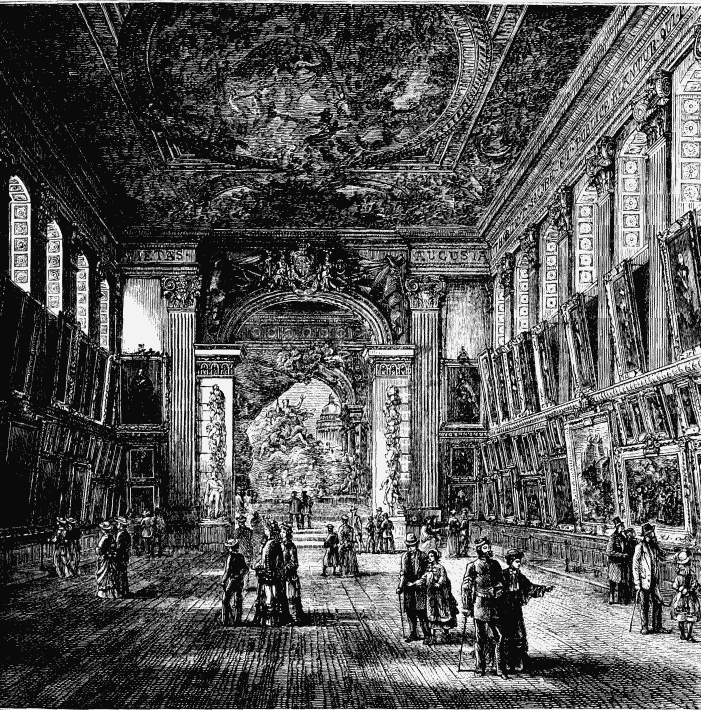
THE PAINTED HALL, GREENWICH HOSPITAL.
A small apartment adjoining the upper hall, called the Nelson Room, contains an admirable portrait of Nelson, painted by Abbot, and also some half-dozen pictures illustrative of events in the great admiral's life, together with Benjamin West's strange admixture of realism and allegory, called the Apotheosis of Nelson.
"When we consider the entire dependence of every great work of this class on the caprice of successive rulers," writes the author of "Bohn's Pictorial Handbook of London," "we shall think it much more remarkable that every royal family, except that of England, should have been able to begin and finish a palace (and in some cases more than one), than that English sovereigns should have not yet achieved such a work. Greenwich is the attempt that most nearly reached realisation; and, as when it is seen from the river the patchwork is mostly out of sight, the group becomes the most complete architectural scene we possess. The two northern masses of building are from a design of Jones; though the first was not erected till after his death, by his pupil and son-in-law Webb; and the other not till Queen Anne's reign, after whom it is named. The older (or King Charles's) building was partly rebuilt in 1811–14, and distinguished by sculpture of artificial stone in the pediment. The southern masses are chiefly from a design of Sir Christopher Wren, and were commenced by William and Mary, whose names they bear; but their construction proceeding slowly, successive periods have left the melancholy marks of steadily declining taste and increasing parsimony; that which begins in Portland stone and Corinthian splendour sinking at length into mean brickwork, or unable to afford in inferior stone the most ordinary degree of finish. The design of the brick portions is in the most corrupt taste of Vanbrugh, but whatever is visible from the centre of the group is by Jones or Wren. The inferiority of the latter is obvious in the comparative want of repose, and greater crowding and flutter of small and multiplied parts. The two pyramidising masses crowned by domes are finely placed, and quite characteristic of his style, as is also the coupling of columns in the colonnades. There is nothing so majestic as either the inward or river elevations of Jones's work, but more picturesqueness and variety. The two not only show the distinction between the tastes of these masters, but also exemplify, in some measure, that between the Roman and Venetian schools of modern architecture; the northern buildings having some resemblance to the former, though, in general, both our great architects were followers of the latter."
Such, then, is the general appearance of Greenwich Hospital, an edifice which, as stated in an
earlier chapter, was considered by Peter the Great
more fitted to be the abode of royalty than that
of worn-out seamen. Samuel Rogers, in his poem,
the "Pleasures of Memory, thus speaks of the institution:
"Hail! noblest structure, imaged in the wave,
A nation's grateful tribute to the brave;
Hail! blest retreat from war and shipwreck, hail!
That oft arrest the wondering stranger's sail.
Long have ye heard the narratives of age,
The battle's havoc, and the tempest's rage;
Long have ye known Reflection's genial ray,
Gild the calm close of Valour's various day.
Time's sombrous touches soon correct the piece,
Mellow each tint, and bid each discord cease;
A softer tone of light pervades the whole,
And steals a pensive languor o'er the soul."
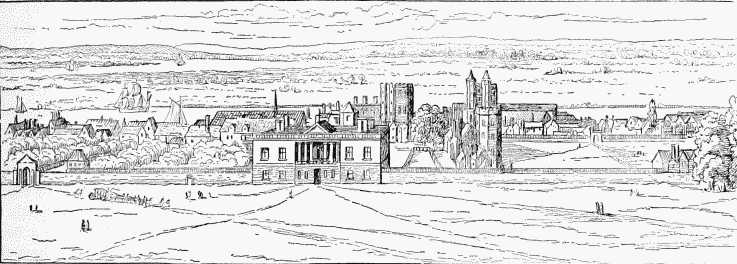
OLD VIEW OF GREENWICH PALACE. (After Hollar.)
The idea here shadowed forth may be a little exaggerated, and "discord" may, perhaps, not have wholly "ceased" within the walls of the hospital to the extent pictured by the poet—at all events, whilst the old pensioners occupied its apartments; but still these lines give expression to a truth which has been felt and acknowledged by hundreds and thousands of visitors both before and since they were penned.
The hospital, as we have seen, was first opened as an asylum in 1705, when forty-two disabled seamen were admitted. In 1738 the number of pensioners had increased to 1,000, which had become doubled in the course of the next forty years. The number was subsequently increased to about 3,000, independently of about 32,000 out-pensioners. Each of the pensioners had a weekly allowance of seven loaves, weighing 1 lb. each, 3 lbs. of beef, 2 lbs. of mutton, a pint of pease, 1¼ lb. of cheese, 2 oz. of butter, 14 qrts. of beer, and one shilling a week tobacco money; besides which he received, once in two years, a suit of blue clothes, a hat, three pairs of stockings, two pairs of shoes, five neck-cloths, three shirts, and two nightcaps.
According to Richardson's work on Greenwich, quoted above, the funds, by means of which this institution has been raised and maintained, were derived from the following sources:—"The sum of £2,000 per annum granted by the king in 1695, and other subscriptions; a duty of sixpence per month from every mariner, granted by Act of Parliament in 1696; the gift of some land by King William in 1698; the grant of £19,500 in 1699, being the amount of fines paid by various merchants for smuggling; £600, the produce of a lottery, in 1699; the profits of the markets at Greenwich, granted by Henry, Earl of Romney, in 1700; the grant by the Crown, in 1701, of the ground where the market was formerly kept, and some edifices adjoining, in perpetuity; £6,472 1s., the amount of the effects of Kid, the pirate, given by Queen Anne in 1705; the moiety (valued at £20,000) of an estate bequeathed by Robert Osbolston, Esq., in 1707; and the profits of the unexpired lease of the North and South Foreland Lighthouses (since renewed for ninety-nine years to the hospital); a grant of land in 1707; forfeited and unclaimed shares of prize-money, granted by Act of Parliament in 1708, and several subsequent acts; £6,000 per annum, granted by Queen Anne in 1710, out of a duty on coal, and continued for a long term by George I.; the wages of the chaplains of the hospital, and the value of their provisions, &c., as chaplains of Deptford and Woolwich Dockyards—an increase of salary having been given them in lieu thereof; the amount of the half-pay of all the officers of the hospital—salaries being allowed in lieu thereof; £10,000, grant in 1728, and several subsequent years, by Parliament; the grant by the king, in 1730, of a small piece of land, with the crane, adjoining the river; an estate given by Mr. Clapham at Eltham, in 1730, consisting of several houses and warehouses near London Bridge; and the forfeited estates of the Earl of Derwentwater, given by Act of Parliament in 1735, deducting an annual rent-charge of £2,500 to the Earl of Newburgh and his heirs male. Several contributions have also been made by private individuals, among which may be noticed £10,000 Three per Cent. Consols, and £2,600, both anonymous benefactions; £1,110 by Captain J. Turroyman; £500 by Captain J. Matthews; and £210, being part of a sum subscribed at Lloyd's Coffee-house, on account of an action fought October 11th, 1797."
By Queen Anne's Commission, dated July 21st, 1703, there were appointed seven commissioners, who were to form a general court; the Lord High Admiral, the Lord Treasurer, or any two privy councillors, to form a quorum; the governor and treasurer were appointed by the Crown, and all the other necessary officers by the Lord High Admiral, on the recommendation of the general court. The same commission appointed twentyfive directors, called the "standing committee," who met once every fortnight, and vested the internal government in the governor and a council of officers who were appointed by the Lord High Admiral. By a charter, granted by George III., the commissioners became a body corporate, with full power to finish the building, to provide for seamen either within or without the hospital, to make bye-laws, &c.; and this charter was followed by an Act of Parliament, which vested in the commissioners, thus incorporated, all the estates held in trust for the benefit of the hospital. By an Act passed in 1829, "for the better management of the affairs of Greenwich Hospital," this corporation of commissioners and governors was dissolved, and five commissioners appointed in their stead, and in them the estates and property of the hospital—amounting, from the various sources mentioned above, to nearly £170,000 annually—was vested. These commissioners were generally members of Parliament who had served in the inferior offices of the ministry, ex-lords of the Treasury, Admiralty, &c. Complaints of great want of economy in the employment of this large revenue, the evidently increasing disinclination of seamen to enter the hospital as in-patients, and a doubt whether the institution was adapted to the existing social condition of the class which it was intended to benefit, led, ultimately, to a Commission of Enquiry, on whose recommendation, in 1865, an Act of Parliament was passed, by which improved arrangements were made as to the out-pensioners, and advantageous terms were offered to such inmates of the hospital as were willing to retire from it, with a view of closing it as an almshouse.
Out of 1,400 in-pensioners then in the hospital, nearly a thousand at once elected to leave. A second act, passed in 1869, effected a final clearance; and in the following year Greenwich Hospital ceased to be an asylum for seamen, though the last-mentioned act provides that in case of war the building shall be at all times available for its original purpose. On the departure of the old veteran seamen, for whom this great work was erected, Greenwich lost many of its distinctive and most glorious associations. The change was a severe one for many of the old men, and it is said that more than half the number died within a very short time of vacating their old quarters. It seems, however, to have been the opinion of many who knew the old pensioners and the present race of "salts," that the new arrangement—by which they receive their pensions in money, and live where and as they please with their relatives or friends—is better for them mentally as well as physically, and is more acceptable to the present generation of sailors.
It was a pleasing sight, on a fine day, to see the old pensioners standing about in groups, or taking a solitary walk in the courts of the Hospital, or intent upon some newspaper, or perchance a book of adventures by sea, which recalled to them the experiences of early life. In the beautiful park hard by they appeared to find much gratification in rambling; and many of them would establish themselves on some green knoll, provided with a telescope, the wonders of which they would exhibit to strangers, and point out, with all the talkativeness of age, the remarkable objects which might be seen on every side. The appearance of these veterans—some without a leg or arm, others hobbling from the infirmities of wounds, or of years, and all clothed in old-fashioned blue coats and breeches, with cocked hats—would oddly contrast with the splendour of the building which they inhabited, did not the recollection that these men were amongst the noblest defenders of their country give a dignity to the objects which everywhere presented themselves, and make the crutch of the veteran to harmonise with the grandeur of the fabric in which he found his final port after the storms of a life of enterprise and danger.
The habitations of the pensioners were divided
into wards, each bearing a name which had been,
or might be, appropriated to a ship. These wards
consisted of large and airy rooms, on either side of
which there were little cabins, in which each man
had his bed. Every cabin had some convenience
or ornament, the exclusive possession of its tenant;
and these little appendages might have led one
to speculate upon the character of the man to
whom they belonged. In one might be seen a
ballad and a ludicrous print; in another a Christmas carol and a Bible. In large communities, and
particularly in a collegiate life, men must greatly
subdue their personal habits and feelings into harmony with the general character of their society;
but the individuality of the human mind will still
predominate, displaying itself in a thousand little
particulars, each of which would furnish to the
accurate inquirer an increased knowledge of the
human heart. The pensioners messed in common,
and they assembled on Sundays for their devotions
in the chapel of the Hospital. Now that the aged
veterans have departed, we may well exclaim in the
words of the poet:—
"—The race of yore
Who danced our infancy upon their knee,
And told our marvelling boyhood legends store
Of their strange ventures happ'd by land or sea,
How are they blotted from the things that be!"
After the pensioners left their old home, the Hospital remained closed and unoccupied for some short time, but it was eventually decided to make it the seat of a Royal Naval College. With this view, the interior of King Charles's Building was remodelled and converted into class-rooms for the naval students; the rooms in Queen Mary's Building were renovated and fitted up as dormitories and as general and mess rooms for the engineer officers and students, whilst the Hospital Chapel in this block became the College Chapel. It was also proposed that the Painted Hall should become the college dining-hall, but this intention was ultimately abandoned. The rest of the building was remodelled so as to provide a lecture theatre and comfortable mess-rooms.
The college was opened in February, 1873, having been organised, to use the words of the Order in Council which sanctioned its foundation, "for the purpose of providing for the education of naval officers of all ranks above that of midshipmen in all branches of theoretical and scientific study bearing upon their profession." The money necessary for the establishment of the new college upon an adequate scale was willingly voted by Parliament, and the votes for its subsequent maintenance, although amounting to a comparatively large sum, have been likewise passed, year by year, without a question, so that nothing has hindered the Admiralty from carrying out its intentions of giving to the executive officers of the Navy generally every possible advantage in respect of scientific education. The college receives as students naval officers of all grades, from captains and commanders, to sub-lieutenants, as also officers of the Royal Marine Artillery, Royal Marine Light Infantry, and Naval Engineers, and also a limited number of apprentices selected annually by competitive examinations from the Royal Dockyards. By special permission, officers of the mercantile marine, and private students of naval architecture and marine engineering, are admitted to the college classes; but they must reside outside the precincts of the Hospital. At the head of the college is a flag officer as president, who is assisted by a naval captain in matters affecting discipline; and by a Director of Studies, who is charged with the organisation and superintendence of the whole system of instruction and the various courses of study. For the carrying out of a complete system of scientific and practical instruction, there is a large staff of professors, lecturers, and teachers. In the first annual report on the Royal Naval College which was presented to both Houses of Parliament, the president stated that "the results of the year show that the standard of examination is so adjusted as to enable officers of good abilities, who on entering the navy dilligently apply themselves to studying their profession, to obtain their lieutenant's commission; while, on the other hand, it affords to those who are backward and ignorant on joining the college an opportunity of retrieving lost time and of maintaining their place in the navy if they earnestly avail themselves throughout the whole period of study of the means afforded them at the college."
Queen Anne's Building, as we have stated above, has been fitted up as a naval museum, primarily for the use of the college, but open also to the inspection of the public, except on Fridays and Sundays. It contains the models of ancient and modern ships formerly exhibited at South Kensington, and a great variety of other objects of maritime interest brought from that institution, from the Painted Hall, from Woolwich, Portsmouth, and different naval stations both at home and abroad. It presents, in fact, a complete epitome of naval history, and a most instructive and valuable series of illustrations of the progress and development of naval architecture and engineering. The museum occupies seventeen rooms, and they still retain the respective names which were bestowed upon them after the ships in which their pugnacious old occupants had won their victories—such, for instance, as the "Howe," the "Windsor Castle," the "Victory," the "Vanguard," and so on. Space will not admit of our giving more than a hurried glance at the very interesting collection of objects here brought together. In the east wing are placed models showing the construction of dockyards, docks, plans for hauling up and dock ing ships, classification of masts, yards, &c.; lifeboats, rafts, lowering apparatus for saving life at sea, models of engines and machinery, &c. In the west wing, the models of line-of-battle ships are very interesting, even to those who cannot boast of any knowledge of naval matters. The series begins with the well-known Great Harry, which was built in 1513 to replace one destroyed by the French a year or two previously; and from this comparatively primitive craft—which, however, could boast of carrying 122 guns, thirteen of which were ninepounders!—the models present various intermediate stages of development until we arrive at the modern iron-clad and turret-ship. The complete revolution which has taken place in all fighting-ships, and the rapidity with which it has been brought about, are very strikingly shown here. Models which only a few years ago represented the utmost achievements of our naval architects and engineers, look now to be a very trivial advance upon the Great Harry. In an adjoining room are models of ships' ventilating arrangements, screws, paddles, windlasses, anchors, and so forth; besides which there is an imposing array of missiles and explosives of various kinds. The shells of various sizes and forms, exhibited in longitudinal sections, afford at a glance a great deal of information on the internal nature of these deadly messengers; then there are some diabolical-looking machines in the form of torpedoes and submarine mines. In a small room dividing the "Victory" from the "Vanguard" are deposited the interesting collection of relics of Sir John Franklin and his party, which the Lords of the Admiralty presented to Greenwich Hospital many years ago, and which had hitherto remained in the Painted Hall with the "Nelson relics," which likewise have been removed here. The coat which Nelson wore at the battle of the Nile, when placed here with other relics by King William IV., was an object of attraction to thousands of modern relic-worshippers. It was given to the king by the Hon. Mrs. Damer, the well-known sculptor, to whom it was given by Nelson, when he sat to her for his bust. The walls of this room are adorned with a valuable collection of sketches by Benjamin West, representing the rough designs for paintings and sculptures in the hospital chapel. The same apartment contains, on a pedestal, the famous old "astrolabe," constructed for Sir Francis Drake's expedition to the West Indies, and presented to the hospital by the same king.
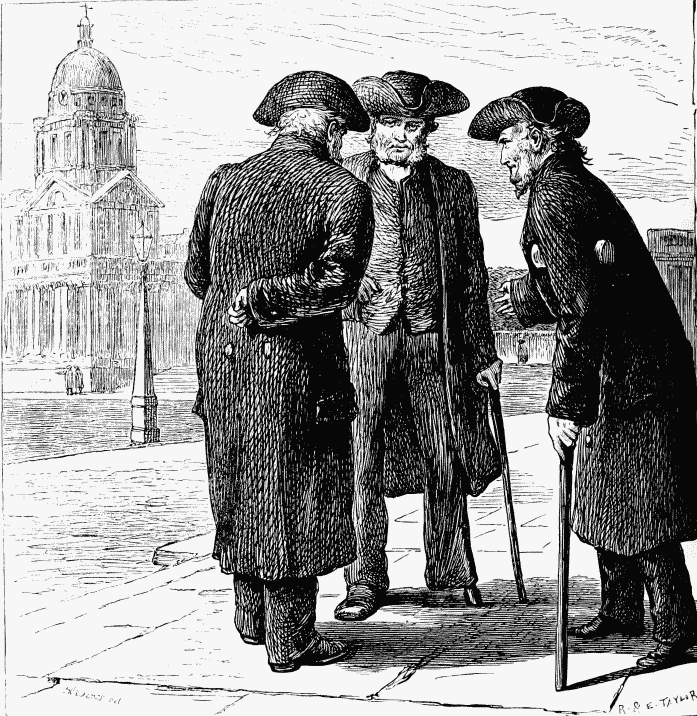
GROUP OF GREENWICH PENSIONERS.
THE ROYAL NAVAL SCHOOL, GREENWICH. (From a Drawing made in 1830.)
At a short distance westward of King William's Building is a large, substantial brick structure of two storeys, forming a closed square, which served as the infirmary for the old pensioners. It was built in the early part of the reign of George III., but was partly destroyed in the fire of 1811. When the buildings above described were appropriated for the purposes of a Naval College, this infirmary was assigned by the Government to that excellent institution, the Seamen's Hospital Society, whose hospital ship, the Dreadnought, moored off Greenwich, was for years so familiar to all passengers on the Thames. The infirmary was opened in 1870, as a "Free Hospital for Seamen of All Nations." It contains in all upwards of sixty rooms, together with a chapel, library, museum, surgery, dispensary, and apartments for the medical staff and their assistants. The building, which appears to be well adapted to its purpose, can provide space for 300 beds; between 2,000 and 3,000 patients are received here annually. The Seamen's Hospital Society dates from the year 1821, when their floating asylum was originally established on board the Grampus, a 50-gun ship, which had been granted for the purpose by the Board of Admiralty. It claims particular attention on account of its great usefulness, being exclusively appropriated to the relief of a class of men who had till that time been entirely destitute of a hospital suited to their peculiar habits, being the only establishment for the reception of sick seamen arriving from abroad, or to whom accidents may happen in the river. In 1831, the Grampus being found incapable of furnishing sufficient accommodation, the Dreadnought, a 98-gun ship, which had once captured a Spanish three-decker in Trafalgar Bay, was granted by the Government, and to her the patients were transferred; but in 1870 it was decided, on sanitary and other grounds, to discontinue the hospital afloat, and the Dreadnought was abandoned, the occupants being removed on shore to the infirmary. Here are received the sick and disabled seamen of every nation, on presenting themselves, no recommendation being necessary; and here they are maintained, and, when necessary, clothed, until entirely convalescent. It is worthy of note that this excellent institution is supported mainly by voluntary contributions, and that no money is received from the Government towards the annual expenditure. The Duke of Northumberland, in a letter to the Times in February, 1877, thus presses the claim of the Seamen's Hospital on the support of the public: "The seaman, for whose benefit this institution was founded, has ever been recognised as having a special title to the succour and sympathy of this nation, which owes its grandeur, nay, its existence, to his labour and sufferings in her cause. To him no other introduction is needed than sickness, disease, or accident, without distinction of colour, creed, or nation. This society affords a refuge, not only during actual illness, but until the sufferer has gained strength to resume his occupation; 170,000 patients have already received relief at its hands, and the annual admissions have increased with the increased accommodation consequent on the transfer to the society of the infirmary of Greenwich Hospital, a noble grant from the Imperial Government, conveying with it, as it were, a national recognition of its services. To maintain it in full efficiency a more liberal support on the part of the public is required, not only on account of the additional number of patients received, but of the extra expense which the general rise in prices has brought on the funds of the establishment. An increase of the annual subscription-list from its present amount of £2,500 to £6,000 is the only sound method of ensuring this object, donations only affording a casual and uncertain resource. I feel assured that the attention of the benevolent has only to be drawn to these facts to secure for the Seaman's Hospital Society all the help it requires to develop to the full the capabilities of an institution, national in its origin and cosmopolitan in the scope and range of the benefits it confers." It may not be out of place to state here that Her Majesty the Queen contributes 100 guineas annually to the funds of this institution, annually expressing "her anxiety for the maintenance of so excellent a charity, which grants relief when most needed to seamen of all nations."
Close by this building are the western gates, the piers of which are crowned by two large stone globes—one the celestial and the other the terrestrial—each six feet in diameter; on the former the meridians and circles, and on the latter the parallels of latitude and longitude are said to have been laid down, and the globes adjusted with great accuracy, by the authorities of the Observatory.
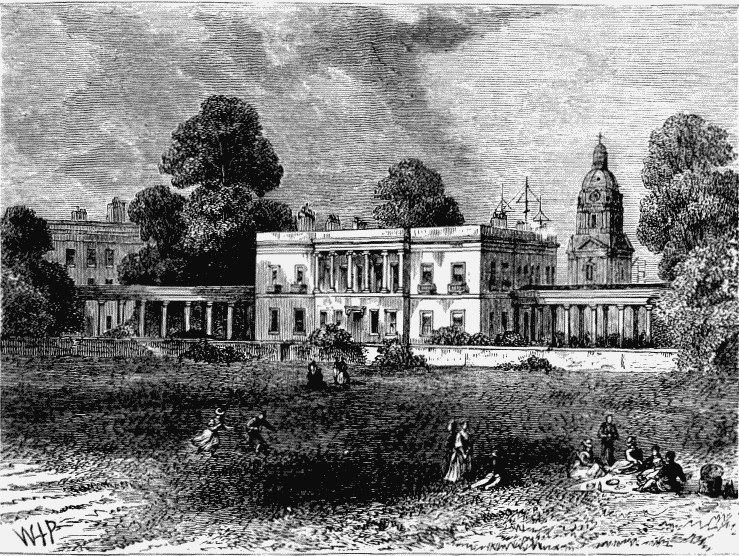
The Queen's House, as the building on the south side of Greenwich Hospital was once called, now serves as the Royal Naval School, and thither we will now proceed. The building, which was commenced by Anne of Denmark, and finished by Henrietta Maria, forms the centre of the present range of buildings devoted to the purposes of the school, and immediately faces the central avenue of the hospital. It bears on the front the date 1635, but it has been much altered since then. The wings are united to the central building by a colonnade 180 feet long. The Queen's House, after being long used as the ranger's lodge, when it was known as Pelham House, was, in 1807, appropriated to the use of the Royal Naval Asylum, which had been originally established at Paddington. The Royal Naval Schools, although cut off from the actual precincts of Greenwich Hospital, in spite of many internal changes, are among the earliest foundations in connection with it. In the original charter it was provided that out of the funds provision was to be made for "the maintenance and education of the children of seamen happening to be slain or disabled in the service of the royal navy." In pursuance of this provision a school was founded at Greenwich in 1712, for boys and girls, the qualification being that they were the children of "pensioners or other poor seamen." At first the number of boys was only ten; but, with a gradual increase in the revenue of the hospital, this number was increased to 200 in the year 1803. In 1821 the Royal Naval Asylum, which at that time educated 680 boys and 200 girls, was incorporated with these schools. After some other changes, the Greenwich schools were open to receive the sons of officers, and they supplied an education by no means contemplated either in character or cost by the original act. An investigation made by a committee in 1871 discovered not only that the schools were being improperly administered, but that boys were entered who were totally unfit for sea life; and in nearly every conceivable respect they found the intentions of the founders of these schools had been compromised. They recommended, therefore, a radical alteration in their organisation, they re-imposed the old conditions of entry, and insisted on a preparation for sea life being considered an indispensable condition of entry. Under this revision, which was speedily carried out, the schools became, as was intended, a sort of nursery for the navy. The boys, under this system, are now entered at ten years of age; and if, at the age of thirteen, they are unwilling or unable to enter the navy, they are compelled to leave the school, and make way for boys who are fit for naval service. The number of boys under instruction is nearly 1,000, and besides the ordinary rudiments of education they are taught seamanship as well as it possibly can be taught on shore, and they are also trained to all kinds of industrial occupations, such as cooking, bread-making, tailoring, washing (the heavy work being done by labour-saving machinery), ironing, carpentering, and other like work—the whole of the clothes for the school being made on the spot, the repairs of the building done by the inmates, and the food cooked, the boys doing the greater part of the labour.
In connection with the Royal Naval School there is a spacious swimming-bath, where all the boys are taught to swim; there is also a capacious gymnasium; and last, not least, a full-rigged model ship, a corvette, on the lawn in front of the principal building, in which the juvenile crew are taught the "duties of men of the sea." In the year 1877 it was announced that the Admiralty proposed to make an important alteration in the school, requiring henceforth that the boys who entered it should give a guarantee that, if judged to be physically fit, they would enter Her Majesty's navy at the conclusion of their training.
The administration of the affairs of Greenwich Hospital, down to the time of its "disestablishment" as such, were, as we have stated above, in the hands of a Board of Commissioners, appointed under royal charter. The principal officers were a governor, lieutenant-governor, four captains, eight lieutenants, a treasurer, a secretary, an auditor, a surveyor, a clerk of the works, a clerk of the cheque, two chaplains, a physician, a surgeon, a steward, and various other assistants.
It would, of course, be impossible for us in these pages to speak of all the distinguished men who have taken part in these different offices; but we may be pardoned for mentioning two or three. Among the former chaplains, then, was the Rev. Nicholas Tindal, the fellow-worker with Morant in the "History of Essex," and also in the translation of Rapin's "History of England." He died at an advanced age, and was buried in the new cemetery. Of Evelyn and his son-in-law, Draper, we have already spoken as acting as treasurers; another person who occupied that position was Mr. Swynfen Jervis, a solicitor, the father of a great naval commander, Lord St. Vincent, whose after-life, too, in a manner became interested in the affairs of Greenwich Hospital. How Lord St. Vincent's early difficulties were overcome by native hardihood and determination, we learn from his own words. "My father," he says, "had a very large family, with very limited means. He gave me at starting in life £20, and that was all he ever gave me. After I had been a considerable time at the station [Jamaica] I drew for twenty more, but the bill came back protested. I was mortified at this rebuke, and made a promise, which I have ever kept, that I would never draw another bill without a certainty of its being paid. I immediately changed my mode of living; quitted my mess, lived alone, and took up the ship's allowance, which I found quite sufficient; washed and mended my old clothes; and made a pair of trousers out of the ticking of my bed; and having by these means saved as much money as redeemed my honour, I took up my bill, and from that time to this I have lived within my means."
Edward, first Earl of Sandwich—the "My lord" of Pepys's "Diary"—in his official capacity as Lord High Admiral of England, took an active part in the administration of the affairs of Greenwich Hospital. As Sir Edward Montagu he had been distinguished as a military commander under the Parliamentarian banner in the civil war, and was subsequently joint High Admiral of England, in which capacity, having had sufficient influence to induce the whole fleet to acknowledge the restored monarchy, he was elevated to the peerage by Charles II. After the Restoration, he obtained the highest renown as a naval officer, and fell in the great sea-fight with the Dutch, off Southwold Bay, in 1672. His great-grandson, John, the fourth Earl of Sandwich, was likewise officially, and perhaps not very creditably, connected with Greenwich Hospital. This nobleman, an eminent diplomatist and statesman, assisted at the congress of Aix-la-Chapelle, in the year 1748; he was subsequently Secretary of State, and first Lord of the Admiralty.
The appointment of Sir Hugh Palliser, in 1778, to the governorship of Greenwich Hospital, was the subject of a vote of censure on the ministry, proposed by no less a person than Charles James Fox. The motion was negatived, and Palliser held the post till his death in 1796; but no First Lord of the Admiralty ever ventured again to give him active employ at sea.
It will be remembered by the readers of history that the affairs of this hospital gave Lord Erskine his first start in that profession of which he rose to be so great a luminary. Having left the navy, and been called to the Bar, he was engaged in a prosecution for libel, which was in fact instituted by the First Lord of the Admiralty, Lord Sandwich, who had abused the munificent institution which was under his official control by appointing landsmen as pensioners, in order to serve the electioneering purposes of his party. Such was the effect of Mr. Erskine's indignant speech in this case that the hitherto unknown advocate had thirty retaining fees offered him on the spot, and he may be said to have left the court with his fortune made. He ultimately became, as is well known, Lord Chancellor, in the ministry of "All the Talents," and a peer of the realm.
When the Act of Parliament above referred to came into operation, the offices of commissioners, governor, and lieutenant-governor were abolished, and the Admiralty had conferred upon them the power to dismiss any other officials it may think proper; but every such official would be allowed to receive an annuity for life equal in amount to the salaries and emoluments he then enjoyed, and he would also continue to receive any superannuation allowance he might at the time be in receipt of. The governor and lieutenant-governor were allowed to retain their titles and their residences in the hospital.
The entire control of the hospital and institutions attached to it is now in the Admiralty, subject to the veto of the council, and the expenses are, in the first instance, paid out of money provided by Parliament for that purpose. All the property belonging to the hospital is vested in the Admiralty under the same provisions as lands vested in the Board under the Admiralty Lands and Works Act of 1864, together with the £20,000 paid annually out of the Consolidated Fund.
In concluding this chapter, we may remark that before the "chest," or fund for disabled seamen, was removed to Greenwich, in order to be better regulated, the pensioners, who resided at a distance from the spot, and whose appearance before the commissioners was only occasionally required, were accustomed to barter away their stipends to certain usurers, who made large fortunes at their expense. These were the speculators in "seamen's tickets," of whom it is generally, though erroneously, supposed that Thomas Guy was a specimen. (fn. 1)