
Old and New London: Volume 6. Originally published by Cassell, Petter & Galpin, London, 1878.
This free content was digitised by double rekeying. All rights reserved.
'Greenwich: The parish church', in Old and New London: Volume 6, (London, 1878) pp. 190-205. British History Online https://www.british-history.ac.uk/old-new-london/vol6/pp190-205 [accessed 19 April 2024]
In this section
CHAPTER XV.
GREENWICH (continued).—THE PARISH CHURCH, &c.
"To Greenwiche, that many a shrew is in."—Chaucer's "Canterbury Tales."
Gradual Extension of London—Greenwich as a Parliamentary Borough—The Assizes for Kent formerly held here—The Present Condition and Population of Greenwich—The Church of St. Alphege—Portraits of Queen Elizabeth, Charles I., Queen Anne, and George I., formerly in Greenwich Church—Greenwich one of the Head-quarters of the Huguenot Refugees—The "Spanish Galleon"—Dr. Johnson a Resident in Greenwich—General Withers and Colonel Disney Residents here—Queen Elizabeth's College—The Jubilee Almshouses—Baths and Washhouses—The Lecture Hall—The Theatre—Croom's Hill—The Roman Catholic Church—The "New Church" of St. Mary—Greenwich Market—Spring Gardens—Lennier's Collection of Pictures—Strange Monsters exhibited here—The Duke of Norfolk's College—A Remarkable High Tide—Sir John Winter's Project for Charring Sea-coal—The Royal Thames Yacht Club—The Tilt-Boat—The Admiralty Barge—The Royal State Barge—River-side Hotels—Whitebait Dinners—The Origin of the Ministerial Fish Dinner—Samuel Rogers and Curran—Charles Dickens at Greenwich—The Touting System—Greenwich Fair.
Although Greenwich is four miles distant from London either by road or rail, and five miles from London Bridge by the river, it has, nevertheless, for these many years lost its separate existence, and been absorbed into the great metropolis, just as many larger places around London have been swallowed up before and since; and Greenwich, at the present moment, is almost as much a part of the great metropolis as St. John's Wood and Islington.
Of the early history of the manor of Greenwich we have already spoken; the present local importance of the town, however, must be attributed to the establishment, firstly of the royal residence here, and ultimately of the Royal Hospital. It sent members to Parliament in the fifth and sixth years of Philip and Mary's reign, but discontinued to do so afterwards. This was the more strange on account of the affection with which the royal town of Greenwich was regarded by Queen Elizabeth. Two centuries later, however, that honour was restored to it; for under the Reform Bill of 1832 Greenwich, conjointly with Deptford, Woolwich, Charlton, and Plumstead, was created a Parliamentary borough, returning two members to Parliament. Among the distinguished men who have been returned as its representatives, we may mention Sir David Salomons, the first member of the Jewish community who ever took his seat in the House of Commons; Admiral Sir Houston Stewart, some time Governor of Greenwich Hospital; General Sir William Codrington, Governor of Gibraltar, and head of the army in the Crimea; and last, not least, Mr. W. E. Gladstone, who took refuge here on his rejection by South Lancashire, in 1868.
In the reign of Queen Elizabeth, the assizes for the county of Kent were held here on three occasions. The town in itself has not much in the way of public buildings to be described in these pages. Originally a small fishing village—like its neighbour, Deptford—the place has gone on increasing gradually to its present size; the streets, consequently, are somewhat irregular in plan and diversified in character, but possess no features either imposing or picturesque. At the commencement of the present century the number of inhabitants was 14,000, which had swelled to 40,000 at the taking of the census in 1871.
Numerous improvements were made in the twon during the first decade of the present century; these considerably altered its appearance. Mr. Richardson, in his work already referred to, published in 1834, says that, "To show the rural character of the place to a very recent period, it may be mentioned that within the last twenty years there were posts and rails to divide the footpath from the road on Croom's Hill, and that till the year 1813 there were trees standing in the very centre of the town, nearly opposite the church. London Street, the leading thoroughfare on entering the town from the metropolis, has also, within the last thirty years, assumed a much altered appearance in its change of character from a street of private residences to one of commerce, almost every house within it now presenting a shop frontage; whereas, at the period alluded to, the shops were very few in number, and almost wholly confined to that end nearest the centre of the town."
The parish church, dedicated to St. Alphege, stands in the centre of the town, at the junction of London Street, Church Street, and Stockwell Street. It is one of the "fifty new churches" provided for by Act of Parliament in the reign of Queen Anne; and it occupies the site of the old parish church, the roof of which fell in and seriously damaged the rest of the fabric in November, 1710. A writer in the Gentleman's Magazine, for May, 1805, p. 422, after alluding to the pernicious consequences arising from the old practice of burying in churches, by which the pavement was defaced, and the windows filled up with monuments, remarks, "But, what is worse, I have known the whole building demolished, and thrown into a heap of rubbish, by the digging of a grave too near the foundation of a pillar, so that, being undermined, great hath been the fall thereof. Thus fell the ancient church of Greenwich a few years since, but, by the providence of Heaven, no person was therein." In this church was a portrait, on glass, of Humphrey, Duke of Gloucester; there were also several monuments and brasses to the distinguished worthies who were buried there, among whom were Thomas Tallis, the great composer of church music, and musician in the royal chapels in the reigns of Henry VIII., Edward VI., and Queens Mary and Elizabeth; he died in 1585, and a brass plate recording his burial here has been affixed in the present church; there also rest Robert Adams, architect (1595); William Lambarde, the antiquary, and author of the "Perambulation of Kent" (1601); and Thomas Philipott, writer of the "Villare Cantianum" (1682). The monuments in the old church perished with the building, with the exception of that of Lambarde, which was rescued from the wreck and removed to Sevenoaks Church. In commemoration of St. Alphege was put up in the old church the following inscription—"This church was erected and dedicated to the glory of God, and the memory of Saint Alphege, Archbishop of Canterbury, here slain by the Danes." Mention is made of the old parish church by our gossiping friends Evelyn and Pepys. The former, under date of April 24, 1687, writes: "At Greenwich, at the conclusion of the church service, there was a French sermon preach'd after the use of the English Liturgy translated into French, to a congregation of about 100 French refugees, of whom Monsieur Ruvigny was the chiefe, and had obtain'd the use of the church after the parish service was ended." Unlike the excellent John Evelyn, Pepys occasionally notes in his "Diary" facts which do not raise our estimate of his morals or his religion; for instance, he writes: "By coach to Greenwich church, where a good sermon, a fine church, and a great company of handsome women."
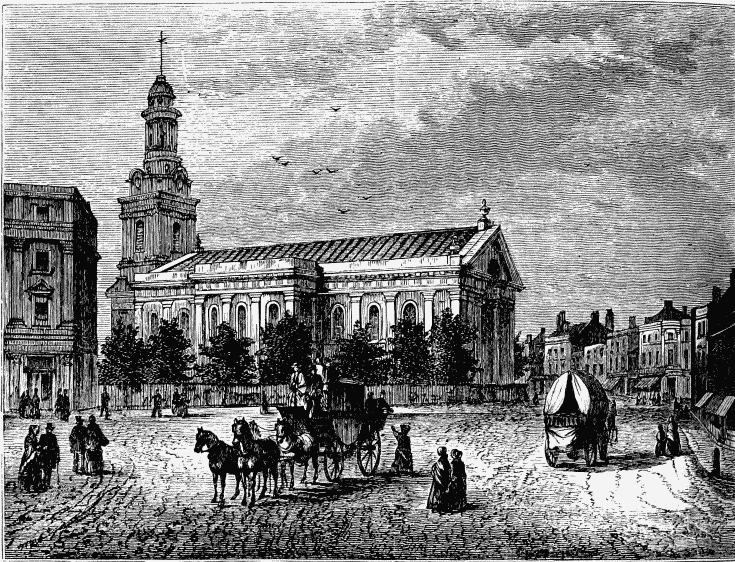
THE PARISH CHURCH, GREENWICH.
The present church of St. Alphege was completed in 1718, and consecrated by Bishop Atterbury. It is a thoroughly solid-looking edifice of Portland stone, and was built from the designs of John James, a local architect. The building is cruciform in plan, with a tower of three stages, tapering to a spire, at the western end. In 1813, during a violent thunderstorm, the spire of this church was struck by the electric fluid and shivered to pieces, but it has been replaced. The style of architecture is the Roman Doric of the period. The interior is spacious: it has a broad nave with aisles, shallow transepts, and a coved recess for the chancel. Deep galleries extend along the two sides, and across the western end, the latter containing the organ. In 1870 the old-fashioned square pews were converted into open sittings, and various other alterations were made. The galleries, pulpit, and fittings generally are of dark oak, highly carved and polished. The columns are of the Corinthian order; and the decorations of the altarrecess are ascribed to Sir James Thornhill.
Among the notable personages buried in the new church were Admiral Lord Aylmer, Governor of Greenwich Hospital and Ranger of the Park, who died in 1720; General Wolfe, the victor of Quebec (1759); and Lavinia, Duchess of Bolton (famous as an actress for her impersonation of "Polly Peachum"), who was interred here in 1760.
There were formerly hung upon the walls of this church portraits of Queen Elizabeth, Charles I., Queen Anne, and George I.; but becoming, by lapse of time, dingy and faded, they were stowed away as lumber in the organ-loft of the church, and ultimately sold by the churchwardens. The portrait of Queen Anne went to the Painted Hall, in Greenwich Hospital, for the sum of £10, the permission of the Lords Commissioners of the Admiralty having been obtained to pay that sum for it. The portraits of Queen Elizabeth, Charles I., and George I. were sold to a general dealer living in New Cross for £20 15s., and were subsequently sold by him at a profit of 50s. to a picture-dealer in New Bond Street, by whom they were restored. The portrait of King George represents the king in full coronation dress, the heavy ermine cloak being thrown back in front, revealing a rich close-fitting dress, while round the shoulders is a massive chain, from which is suspended the prancing horse of Hanover. On the table beside his Majesty are the crown and sceptre, the king's hand grasping the ball and cross. In the background is a view of Westminster Abbey. The value of this picture is stated to be over £500. The portrait of Charles I., ten feet square, is supposed to be the work of Sir Peter Lely. The painting represents the king in a prayerful attitude, and is believed to be even more valuable than that of George I. All the monarchs mentioned were associated with Greenwich, but their portraits are now scattered.
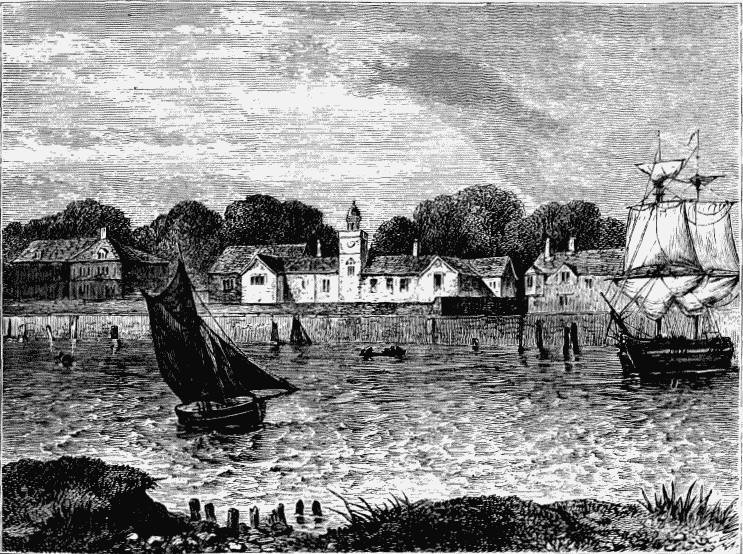
THE DUKE OF NORFOLK'S ALMSHOUSES, IN 1796.
With reference to the manner in which these portraits came into the possession of the parish, a correspondent of the Times, in 1876, wrote:—"According to a list, taken in 1706, 'the picture of Queen Elizabeth in a handsome black frame, with ornaments of gilding about it, was painted at the parish charge.' 'The picture of King Charles the Martyr, with a fair frame, fillited with gold, was the gift of Mrs. Mary Squib' (probably about 1671). The remaining portraits were doubtless bestowed on the parish by the Crown (the lords of the manor), or loyal parishioners. The antiquities of the church of St. Alphege have been very unfortunate. After the roof of the former structure fell in at midnight, 28th of November, 1710, and the present church was erected, several monuments and all the stained glass in the windows containing armorial bearings, were missing; and upon inspecting the parish chest some years ago, the whole of the ancient charters and papal bulls relative to this church, known to have been there in 1816, were not to be found."
Queen Elizabeth, as we have already remarked, made the palace her favourite summer residence. Charles I. passed much of his time at the "House of Delight." Queen Anne, as we have seen, built one of the wings of the Hospital, which still bears her name; while George I. landed at Greenwich on his arrival from Hanover.
Greenwich became one of the head-quarters of the Huguenot refugees, after the revocation of the Edict of Nantes; and in London Street was, in the reigns of James II. and William III., a chapel for their use. It was erected by one of their most distinguished members, the aged Marquis de Ruvigny, a person of learning, who had been ambassador at St. James's and at other courts, as well as Deputy of the Protestants of France in the Parliament at Paris, and who formed the centre of a large circle of his countrymen. Before their chapel was ready for use the Huguenots were allowed to use the parish church, at the end of the afternoon service, on Sundays. John Evelyn, in his "Diary," as we have seen above, records the fact of his being present at this service, in 1687. The little foreign colony is extinct, and the chapel is now occupied as a Nonconformist meeting-house.
In Church Street is an inn bearing the very singular title of the "Spanish Galleon." The sign owes its existence, in all probability, to the fact of its standing so near to the pictures of our naval victories in the Royal Hospital, in which captured Spanish galleons figure somewhat frequently.
It may possibly be remembered by readers of Boswell that, when Dr. Johnson first wrote to Edmund Cave, the proprietor and editor of the newly-founded Gentleman's Magazine, it was from "Greenwich, next door to the 'Golden Heart,' in Church Street," where he had taken apartments when he first came from his native Lichfield to town, in order to write the parliamentary articles for the above-mentioned publication.
The following list of Dr. Johnson's places of residence after he had entered the metropolis as an author is based on Boswell's Life:—Exeter Street, Strand; Greenwich; Woodstock Street, Hanover Square; No. 6, Castle Street, Cavendish Square; Strand; Boswell Court; Strand again; Bow Street; Staple's Inn; Gray's Inn; No. 1, Inner Temple Lane; No. 7, Johnson's Court; and No. 8, Bolt Court.
Greenwich appears to have been a favourite place with the old lexicographer; much of his tragedy of Irene was written whilst he was living here; and, as Boswell tells us, it was partly composed beneath the spreading elms in Greenwich Park. Railways being at that time a mode of conveyance undreamed of, the river was Johnson's favourite highway between Greenwich and London. The following anecdote, told concerning an incident which took place on one occasion when Boswell and Johnson were proceeding thither in a boat from the Temple, may bear repeating:—"Boswell asked Johnson if he really thought a knowledge of the Greek and Latin languages an essential requisite to a good education. Johnson: 'Most certainly, sir; for those who know them have a very great advantage over those who do not. Nay, sir, it is wonderful what a difference learning makes upon people even in the common intercourse of life, which does not appear to be much connected with it.' Boswell: 'And yet people go through the world very well, and carry on the business of life to good advantage, without learning.' Johnson: 'Why, sir, that may be true in cases where learning cannot possibly be of any use; for instance, this boy rows us as well without learning, as if he could sing the song of Orpheus to the Argonauts, who were the first sailors.' He then called to the boy, 'What would you give, my lad, to know about the Argonauts?' 'Sir,' said the boy, 'I would give what I have.' Johnson was much pleased with his answer, and we gave him a double fare."
Other noted residents of Greenwich about this
time were General Withers and Colonel Disney,
convivial friends of Pope; the latter is mentioned
in Lady Mary Wortley Montagu's letters as "Duke
Disney." They are thus jointly commemorated by
Pope in his Panegyrics:—
"Now pass we Gravesend with a friendly wind,
And Tilbury's white fort, and long Blackwall;
Greenwich, where dwells the friend of human kind;
More visited than either park or hall,
Withers the good, and with him ever joined
Facetious Disney, greet thee first of all;
I see his chimney smoke, and hear him say,
'Duke! that's the room for Pope, and that for Gay.
"'Come in, my friends, here ye shall dine and lie,
And here shall breakfast, and shall dine again;
And sup and breakfast on, if ye comply;
For I have still some dozens of champagne.'
His voice still lessens as the ship sails by,
He waves his hand to bring us back in vain;
For now I see, I see proud London's spires,
Greenwich is lost, and Deptford Dock retires."
In the Greenwich Road, nearly opposite the railway station, stands Queen Elizabeth's College, founded by William Lambarde, the historian of Kent, in 1576, for twenty poor men and their wives. It is said, and perhaps truly, to have been the first public charity of the kind founded after the Reformation. The almshouses were rebuilt early in the present century; each of the inmates has a separate tenement and garden, and £20 a year in hard cash. The endowment, which has been greatly augmented in value since Lambarde's time, is under the control of the Drapers' Company, who have of late built some additional houses, and made other improvements. The founder, with the consent of the Bishop of Rochester, composed a form of morning and evening prayer, to be used in the college; and he made his endowment void, if it should ever become unlawful, by the statutes of the realm, to use it.
The Jubilee Almshouses, in this road, were founded by a subscription raised among the townspeople in 1809, in commemoration of King George III. having, on the 25th of October of that year, entered upon the fiftieth year of his reign. Additional almshouses have since been added on several public occasions; and there are now twenty houses in all, and each of the occupants receives a small annuity.
At the corner of Royal Hill are some commodious baths and wash-houses, near to which is a large lecture-hall and also a theatre; but with regard to these buildings nothing need be said further than that they meet their several requirements. There was formerly a theatre in London Street, but it was destroyed by fire in 1831. A few years later the proprietor, a Mr. Savill, constructed, on a novel principle, another theatre of iron, all the parts of which were put together with screws, so as to be capable of being taken to pieces, and conveyed to different towns.
Eastward of Royal Hill, and skirting the western side of Greenwich Park, is Croom's Hill, a steep and winding thoroughfare leading from the town up to Blackheath. A conspicuous object here is the lofty tower and spire of St. Mary's Roman Catholic Church, which, with its external statue of St. Mary, "star of the sea," is built so as to strike the eye of mariners as they sail up the river.
Near the bottom of Croom's Hill, close by the principal entrance to the park, stands the "new church" of St. Mary. It is a neat edifice of a semiclassic style of architecture, constructed of Suffolk brick and Bath stone, and the chief feature of the exterior is an Ionic portico at the western end, above which rises a tower of two stages. The "first stone" of the structure was laid by the Princess Sophia in 1823, and the church was consecrated in 1825. Over the altar is a picture of "Christ giving Sight to the Blind," painted by Richter, and presented by the British Institution.
From this church a broad thoroughfare called King Street leads direct to the pier, close by the Ship Hotel; and on the west side of this street, is the Market-place, which has its principal entrance in Clarence Street, and another entrance in Nelson Street, a broad well-built street so called after England's great naval hero. The market was erected by the Commissioners of the Royal Hospital near the site of a former market, and was opened in 1831. It contains spacious accommodation for vendors of meat, fish, vegetables, &c., and the whole is surrounded by a block of good substantial houses, with shops. The profits of the market being vested in Henry, Earl of Romney—whose name is still perpetuated in Romney Place—were given by him, in 1700, to the Royal Hospital, as stated in the preceding chapter.
Like St. James's Park and Hampstead, Greenwich in former times could boast of its "Spring
Gardens." In the General Advertiser for May 25,
1771, occurs the following announcement:—
"Spring Gardens, Greenwich.—The Evening Entertainments at this place will begin this day, the 25th inst.,
with a good Band of Vocal and Instrumental Musick. To
be continued on Saturday and Monday Evenings during the
Summer Season. N.B.—The Grand Room in the garden is
upwards of fifty feet long."
These gardens, as a correspondent of Notes and Queries tells us, were situate near Christ Church, in East Greenwich, and, for many years after they were closed as a place of amusement, were turned into garden ground, but, as is the fate of many such places in the vicinity of London, the site is now nearly built over.
On account of the contiguity of this town to Deptford, it is frequently mentioned by Evelyn and likewise by Pepys in their amusing diaries. The former, writing in 1652, makes this entry:—"Came old Jerome Lennier, of Greenwich, a man skill'd in painting and musiq, and another rare musitian, called Mell. I went to see his collection of pictures, especially those of Julis Romano, which surely had been the king's, and an Egyptian figure, &c. There were also excellent things of Polydore, Guido, Raphael, Tintoret, &c. Lennier had been a domestic of Qu. Elizabeth's, and show'd me her head, an intaglia in a rare sardonyx, cut by a famous Italian, which he assur'd me was exceedingly like her."
For the same reason, too, naturally enough, Greenwich became a depôt for strange and foreign curiosa; at all events, Evelyn informs us in his "Diary" that he came hither in 1657 to see "a sort of catt, brought from the East Indies, shap'd and snouted much like the Egyptian racoon, in the body like a monkey, and so footed; the eares and taile like a catt, onely the taile much longer and the skin variously ringed with black and white; with the taile it wound up its body like a serpent, and so got up into trees, and with it would wrap its whole body round. Its haire," he adds, "was woolly, like a lamb's; it was exceedingly nimble and gentle, and purr'd as does the catt."
If we may believe the paragraph writers of the London journals in 1683, this place has been often haunted by other strange monsters; as witness the following item extracted from their columns:—"A perfect mermaid was, by the last great wind, driven ashore near Greenwich, with her comb in one hand and her looking-glass in the other. She seemed to be of the countenance of a most fair and beautiful woman, with her arms crossed, weeping out many pearly drops of salt tears; and afterwards she, gently turning herself upon her back, swam away without being seen any more." Probably the writer believed the substance of this paragraph, and only exercised his journalistic talent in decorating his fact with tender and romantic incidents.
In or about 1749 there was exhibited at the "Rose and Crown," near the gates of the park, a strange collection of wild beasts, from the catalogue of which we take the following items:—"1. A large and beautiful young camel, from Grand Cairo, in Egypt, near eight feet high, though not two years old, and drinks water but once in sixteen days. 2. A surprising hyæna, from the Coast of Guinea. 3. A beautiful he panther, from Buenos Ayres, in the Spanish West Indies. 4. A young riobiscay, from Russia; and several other creatures too tedious to mention. Likewise a travelling post-chaise, from Switzerland, which, without horses, keeps its stage for upwards of fifty miles a day, without danger to the rider. Attendance from eight in the morning till eight at night." This list we take from Mr. Frost's "Old Showmen;" but what the "riobiscay" can have been is beyond our power to discover.
At the eastern end of the town, fronting the Thames, is a college for the maintenance of twenty old and decayed housekeepers, twelve of whom are to be chosen from Greenwich, and the rest alternately from two parishes in Norfolk. It is called the Duke of Norfolk's College, though it was founded not by one of the Dukes of Norfolk, but by his brother Henry, Earl of Northampton, who committed it to the care of the Mercers' Company. The earl's body rests in the chapel of the college, having been brought there from Dover Castle about the year 1770. The edifice, which is commonly styled Trinity Hospital, is situated at a short distance eastward of Greenwich Hospital. It is a large quadrangular pile of brick buildings, with a tower.
A stone let into the wall of the wharf, opposite the entrance to the college, bears upon it a line denoting a "remarkable high tide, March 20, 1874;" the line is two feet four inches above the pavement, and consequently several feet above the ordinary high-water mark. Apropos of this mention of the tide, we may state that the whole valley of the Thames was once a gulf or bay of the sea, being, in fact, but a breach or cleft in the ordinary mass of deposit which once rose for 200 or 300 feet above what is now the bed of the river.
There was a ferry here more than two centuries ago, for Evelyn records in his "Diary," July, 1656, how he returned by it out of Essex to Saye's Court. "Here," Evelyn writes, "I saw Sir John Winter's new project of charring sea-coale to burn out the sulphur, and render it sweete. He did it by burning the coals in such earthen pots as (those in which) the glasse-men mealt (sic) their mettall, so firing them without consuming them; using a barr of yron in each crucible or pot, which bar has a hook at one end, so that the coales, being melted in a furnace with other crude sea-coales under them, may be drawn out of the potts sticking to the yron, whence they are beaten off in greate half-exhausted cinders, which, being rekindled, make a cleare, pleasant chamber fire, deprived of their sulphur and arsenic malignity. What success it may have time will discover."Unfortunately, Evelyn does not tell us whether ultimately Sir John Winter found his project remunerative; but it may be added that within the present century the late Lord Dundonald tried to revive the plan, with the projected improvement of extracting and saving the tar. His lordship, however, failed to make it answer; but the coal thus charred is now sold by almost every gas company under the name of coke.
It may not be out of place to record here that the Royal Thames Yacht Club close their annual season by an excursion down the river. The yachts rendezvous in the afternoon at Greenwich, and come to an anchor for the night at Erith. The commodore takes the chair in the evening at the "Crown Inn." On the following morning the members and their friends proceed on various cruises, many of these trips extending to several days. It may interest some of the members to know that their excursions have had a forerunner in times long gone by; for Evelyn tells us how, in the summer of 1661, he sailed with "the merry monarch" in one of his "yachts or pleasure boats," and raced another yacht all the way to Gravesend and back, the king himself sometimes steering. "The king," he adds, "lost it in going, the wind being contrary; but sav'd stakes in returning." It was by joining with his subjects in these amusements that King Charles gained that personal popularity which, in spite of his many vices, never forsook him.
Not only with Dr. Johnson, of whom we have spoken above, but with the public at large the river Thames has always been the favourite way of reaching Greenwich from London, both before and since the introduction of steamboats. In former times the chief mode of conveyance on the river was by small boats rowed by watermen; but the "tilt boat" is often mentioned, in the reign of George III., as one of the regular conveyances which carried passengers down the river—to Greenwich, Woolwich, Gravesend, &c. These boats started from the Dark House, at Billingsgate; they took twelve hours on the journey to Gravesend if the weather was fair, and the wind not utterly adverse; but more, of course, if that was the case, and if they had not reached their destination when the tide turned. These boats were superseded by steamers, after the model of those already in use upon the Clyde, about the year 1816. The name of the "Tilt Boat" is still preserved on the signboards of one or two river-side inns.
The Admiralty barge was constantly employed on the silent highway of the Thames, down to a comparatively recent date, in showing the "lions" of the metropolis to distinguished foreigners. Thus Lady Lepel Hervey, in the reign of George II., relates how one of the lords of the Admiralty, Mr. Stanley, did the honours on behalf of his country to the Spanish Ambassador, his family, and several people of fashion, "the greatest part of whom he carried in barges down to Greenwich, nothing being wanting of water equipage; salutes upon the river, in the greatest pomp and order; and a reception at the landing at the hospital by the admiral, the governor, and all the officers."
Greenwich has been the place of debarkation of many illustrious visitors, and several royal personages, among whom may be noticed the Princess Augusta of Saxe Gotha, afterwards married to Frederick, Prince of Wales; and the Princess Caroline of Brunswick, who landed here in order to become the much-injured and unhappy wife of George, Prince of Wales (afterwards George IV.). From this place the latter passed on to London, in the midst of universal shouts of popular joy, her progress being almost a triumphal procession. Alas! in how short a time was she destined to rue the day! After her separation she lived for many years at Charlton, on the edge of Blackheath.
One of the last state visits of the sovereign to Greenwich was made in October, 1797, when King George III. proceeded in the royal yacht to Greenwich, and thence to Sheerness to review the fleet at the Nore, and to see the Dutch ships which had been lately captured by Lord Duncan at the battle of Camperdown.
The royal state barge was used as late as 1843, when the Prince Consort made a progress in it from Whitehall to the Brunswick Pier, at Blackwall, for the purpose of inspecting the Victoria and Albert steam-yacht, then in process of construction in the East India Docks. The barge, which had just been re-fitted and re-gilt at Woolwich Dockyard, was sixty-four feet in length, and about seven feet in width; the head and stern were elaborately carved, and gilt, and, with her highly-varnished timbers, had a right royal splendour. The vessel was rowed by twenty-two watermen in scarlet liveries, and the Admiralty barge, which accompanied it, by ten men in scarlet coats. The state barge, we are told, "in its progress to and from Blackwall, attracted many spectators on the river and its banks, and, with the Admiralty barge, formed a splendid piece of water pageantry, such as is but rarely witnessed on London's majestic river." It has long been disused, and is now laid up, destined never, probably, to be launched again, but to become the food of moths and worms.
Overlooking the Thames, and in the immediate vicinity of the Royal Hospital, are those noted water-side hotels which have become celebrated for public dinners, and particularly for whitebait. The chief of these taverns are the "Ship," a little to the westward of the Hospital, and the "Crown and Sceptre," and the "Trafalgar," the latter of which has become celebrated for its "Ministerial fish dinners."
"At what period the lovers of good living first went to eat whitebait at 'the taverns contiguous to the places where the fish is taken,' is not very clear. At all events," writes John Timbs, in his "Club Life of London," "the houses did not resemble the 'Brunswick,' the 'West India Dock,' the 'Ship,' or the 'Trafalgar' of the present day, these having much of the architectural pretension of a modern club-house. Whitebait have long been numbered among the delicacies of our table; for we find 'six dishes of whitebait' in the funeral feast of the munificent founder of the Charterhouse, given in the Hall of the Stationers' Company, on May 28, 1612—the year before the Globe Theatre was burnt down, and the New River completed. For aught we know, these delicious fish may have been served up to Henry VIII. and Queen Elizabeth in their palace at Greenwich, off which place, and Blackwall opposite, whitebait have been for ages taken in the Thames at flood-tide. To the river-side taverns we must go to enjoy a 'whitebait dinner,' for one of the conditions of success is that the fish should be directly netted out of the river into the cook's caldron.
"About the end of March, or early in April, whitebait make their appearance in the Thames, and are then small, apparently but just changed from the albuminous state of the young fry. During June, July, and August, immense quantities are consumed by visitors to the different taverns at Greenwich and Blackwall. Pennant says: 'Whitebait are esteemed very delicious when fried with fine flour, and occasion, during the season, a vast resort of the lower order of epicures to the taverns contiguous to the places where they are taken.' If this account be correct," adds Mr. Timbs, "there must have been a strange change in the grade of epicures frequenting Greenwich and Blackwall since Pennant's days; for at present the fashion of eating whitebait is sanctioned by the highest authorities, from the Court of St. James's in the West, to the Lord Mayor and his Court in the East; besides the philosophers of the Royal Society, and Her Majesty's Cabinet Ministers. Who, for example, does not recollect such a paragraph as the following, which appeared in the Morning Post of the day on which Mr. Yarrell wrote his account of whitebait, September 10, 1835: 'Yesterday, the Cabinet Ministers went down the river in the Ordnance barges to Lovegrove's "West India Dock Tavern," Blackwall, to partake of their annual fish dinner. Covers were laid for thirty-five gentlemen.' For our own part, we consider that the Ministers did not evince their usual good policy in choosing so late a period as September, the whitebait being finer eating in July or August; so their 'annual fish dinner' must rather be regarded as a sort of prandial wind-up of the Parliamentary session than as a specimen of refined epicurism.
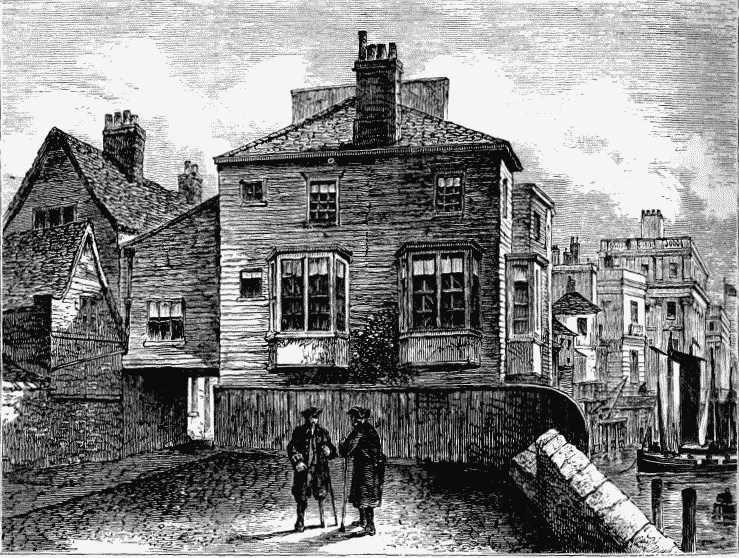
CROWN AND SCEPTRE INN, GREENWICH.
"We remember many changes in matters concerning whitebait at Greenwich and Blackwall. Formerly, the taverns were mostly built with weather-board fronts, with bow-windows, so as to command a view of the river. The old 'Ship,' and the 'Crown and Sceptre' taverns at Greenwich were built in this manner; and some of the Blackwall houses were of humble pretensions; these have disappeared, and handsome architectural piles have been erected in their places. Meanwhile, whitebait have been sent to the metropolis, by railway or steamer, where they figure in fishmongers' shops, and tavern cartes of almost every degree.
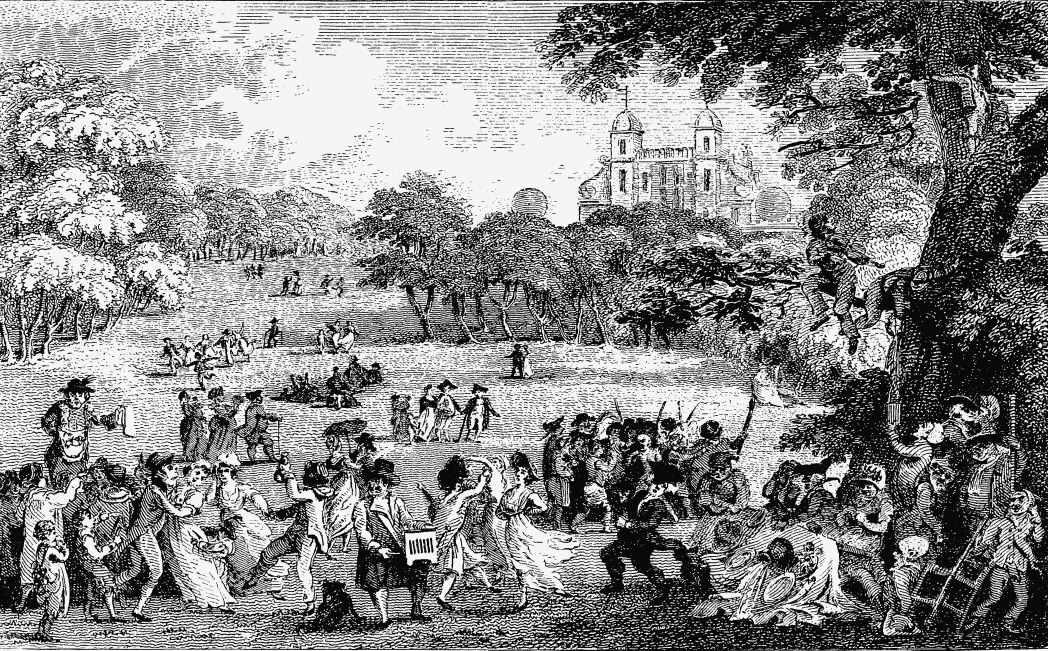
EASTER MONDAY IN GREENWICH PARK. (From an Engraving by Rawle, in the "European Magazine" of 1802.)
"Perhaps the famed delicacy of whitebait rests as much upon its skilful cookery as upon the freshness of the fish. Dr. Pereira has published a mode of cooking in one of Lovegrove's 'bait kitchens' at Blackwall. The fish should be dressed within an hour after being caught, or they are apt to cling together. They are kept in water, from which they are taken by a skimmer as required; they are then thrown upon a layer of flour, contained in a large napkin, in which they are shaken until completely enveloped in flour; they are then put into a colander, and all the superfluous flour is removed by sifting. The fish are next thrown into hot lard contained in a copper caldron or stew-pan placed over a charcoal fire. In about two minutes they are removed by a tin skimmer, thrown into a colander to drain, and served up instantly, by placing them on a fish-drainer in a dish. The rapidity of the cooking process is of the utmost importance, and if it be not attended to, the fish will lose their crispness, and be worthless. At table, lemon-juice is squeezed over them, and they are seasoned with cayenne pepper, brown breadand-butter is substituted for plain bread; and they are eaten with iced champagne or punch."
Every year the approach of the close of the Parliamentary session is indicated by what is termed the "Ministerial Fish Dinner," in which whitebait forms a prominent dish, and Cabinet Ministers are the company. The dinner takes place at one of the principal taverns, usually at Greenwich, but sometimes at Blackwall. The dining-room is decorated for the occasion, which is of the nature of a State entertainment. Formerly, it was customary for the Ministers to go down the river from Whitehall in an Ordnance barge, ornamented with gold and other colours, and with streamers; now, however, a more prosaic steamer is employed. The origin of the annual festivity is told by Mr. Timbs in his work quoted above:— "On the banks of Dagenham Lake or Reach, in Essex, many years since, there stood a cottage occupied by a princely merchant, named Preston, a baronet of Scotland and Nova Scotia, and sometime M.P. for Dover. He called it his 'fishing-cottage,' and often in the spring he went thither, with a friend or two, as a relief to the toils of his Parliamentary and mercantile duties. His most frequent guest was the Right Hon. George Rose, Secretary of the Treasury, and an Elder Brother of the Trinity House. Many a day did these two worthies enjoy at Dagenham Reach; and Mr. Rose once intimated to Sir Robert that Mr. Pitt, of whose friendship they were both justly proud, would no doubt delight in the comfort of such a retreat. A day was named, and the Premier was invited; and he was so well pleased with his reception at the 'fishing-cottage'—they were all two if not three-bottle men—that, on taking leave, Mr. Pitt readily accepted an invitation for the following year.
"For a few years, the Premier continued a visitor to Dagenham, and was always accompanied by Mr. George Rose. But the distance was considerable; the going and coming were somewhat inconvenient for the First Minister of the Crown. Sir Robert Preston, however, had his remedy, and he proposed that they should in future dine nearer London. Greenwich was suggested: we do not hear of whitebait in the Dagenham dinners, and its introduction probably dates from the removal to Greenwich. The party of three was now increased to four, Mr. Pitt being permitted to bring Lord Camden. Soon after, a fifth guest was invited—Mr. Charles Long, afterwards Lord Farnborough. All were still the guests of Sir Robert Preston; and, one by one, other notables were invited—all Tories—and, at last, Lord Camden considerately remarked that, as they were all dining at a tavern, it was but fair that Sir Robert Preston should be relieved from the expense. It was then arranged that the dinner should be given as usual by Sir Robert Preston—that is to say, at his invitation—and he insisted on still contributing a buck and champagne; the rest of the charges were thenceforth defrayed by the several guests; and on this plan, the meeting continued to take place annually, till the death of Mr. Pitt.
"Sir Robert was requested, next year, to summon the several guests, the list of whom, by this time, included most of the Cabinet Ministers. The time for meeting was usually after Trinity Monday—a short period before the end of the session. By degrees, the meeting, which was originally purely gastronomic, appears to have assumed, in consequence of the long reign of the Tories, a political or semi-political character. Sir Robert Preston died; but Mr. Long (now Lord Farnborough) undertook to summon the several guests, the list of whom was furnished by Sir Robert Preston's private secretary. Hitherto, the invitations had been sent privately; now they were dispatched in Cabinet boxes, and the party was, certainly, for some time, limited to the members of the Cabinet. A dinner lubricates Ministerial as well as other business; so that the 'Ministerial Fish Dinner' may 'contribute to the grandeur and prosperity of our beloved country.'"
From that day to the present the Ministerial dinner has been an annual festival, except when some sudden death has lately carried off a member of the existing Cabinet. The dinner is usually held a day or two before the prorogation of the Houses of Parliament.
But some other statesmen, who have not been Ministers of the Crown, have regaled themselves here on whitebait. Samuel Rogers, for instance, tells us that he once dined with Curran in the public room of the chief inn at Greenwich, when the Irish orator, as usual, began to indulge in his favourite exaggerations. "I had rather be hanged on twenty gallows"—he began, when a stranger sitting at the next table quietly asked, "Do you not think, sir, that one would be enough?" Curran was, for once, fairly taken aback and struck dumb at the witty retort.
But few dinners at Greenwich, perhaps, were more jovial and pleasant than that which, in 1842, celebrated the return of Charles Dickens from his first visit to America. Talfourd, Milnes, Procter, Maclise, Stanfield, Marryat, Barham, Hood, John Forster, and George Cruickshank were there; and a home tour into Cornwall was then and there arranged between "Boz," Maclise, Stanfield, and his future biographer—all now, alas! no more. It was at a dinner here—preceded by a drive over Blackheath—that Dickens and Douglas Jerrold met for the last time, just previous to the sudden death of the latter, in 1856.
A great change has come over the inns and taverns of half a century ago; they are now "hotels," and grand ones too; the "Trafalgar" still has its bow-windows fronting the river; but of the old "Ship" and the "Crown and Sceptre," their earlier and more attractive features have now disappeared, giving way to architectural piles of greater pretensions, and in which, therefore, the cost of a dinner must be largely increased, in order to pay the builder.
It is remarked by more than one writer, that Greenwich is about the last place where the practice of "touting" for customers is kept up at the doors of small coffee-houses; but, perhaps, the wellknown cry of the butchers in the lesser streets on Saturday evenings, "Come, buy! buy! what will you buy?" may be regarded as the last remnant of a custom once nearly universal. Here you cannot walk along the streets which lie between the town and the park without being solicited by ten or a dozen rival houses to step in and regale yourself. If you take every card that is offered you, you will have a good store in your pocket on returning home at night. "Tea, eightpence, with a pleasant view of the river." "Tea made, with shrimps, ninepence," and so forth. The inhabitants of Greenwich would seem to be the most accommodating and hospitable people in the world. You can walk straight into almost every other house along the route and order tea, and can depart again only a few pence the poorer. Numbers of cockneys, however, come to the park already well provided; and you may see pater and materfamilias and half a dozen of their hopeful progeny all munching breadand-butter, and drinking cold tea, in one group beneath the chestnuts.
For very many years, and down to a comparatively recent date (1857), there were two fairs held annually in Greenwich—namely, on the Monday, Tuesday, and Wednesday in Easter and Whitsun weeks. They were formerly held in the road now occupied partly by St. Mary's Church, and the remainder by the Hospital Burial-ground; latterly, the fairs were held in the public thoroughfares, principally in Bridge Street, which extends from near the church of St. Alphege to the bridge over the Ravensbourne at Deptford Creek. In an account of Greenwich Fair, the "Kalendar of Amusements" (1840) somewhat bombastically observes: "This great national event, which neither desires nor deserves any colouring at our hands, is one of those gaudy and glittering occasions which, like powerful magnets, attract all the base ore of the metropolis. The objects of commiseration, who have groaned through a long winter with afflictions (stated in coloured chalks on the portion of pavement they diurnally occupy), who, in the Van Amburgh spirit, have taught a little dog to implore and to accept contributions for them—the absence of arms, tongues, eyes, legs, &c., in a great measure preventing them officiating personally—now, vigorous and volatile, spring nimbly on the apex of the metropolitan mail, articulating 'Greenwich, ho!' Now, the fervid children of Erin, with a 'Horroo! Faugh a ballagh!' ('Clear the road!') enlarge themselves from the liberties of little Hibernia, and turn their frontispieces towards Greenwich. (Their less energetic brethren have preceded them a week, that being the time they annually consume in drinking their way down.)
"Now, from the cigar-divans in the Strand and the Quadrant, fair count(er)esses may be observed stepping into private carriages driven by private gentlemen, who, dispensing with their slaves in livery, and hoping the populace will mistake them for 'those blackguard lords,' whirl through the streets, as a Bristol Byron says, 'in all the majesty of mud.' Now, upon the road may be seen stagesand-four, coaches-and-two, and cabs-and-one with cram licences—a term well known to the whipsters, who upon this day, by superhuman exertions, prove their right to the title. Here, like Atlas struggling under a giddy world, a wretched donkey wags (we use the next word advisedly) under a wagon, which must have been erected to mock the efforts of a troop of horse. Countless hands, armed with countless missiles, stimulate the martyr in the rear, whilst a child precedes him holding a wisp of hay to his mouth. The bait has its effect: of the posterior applications he appears happily unconscious. But who and what are they that occupy that vehicle? Alas! none but themselves know who they are, or what they would be. The police reports, it is true, afford some information, and that of a nature perhaps to satisfy a moral curiosity.
"How shall we describe Greenwich? Confusion and consternation! hilarity and horror! Children not visible, pocket-handkerchiefs not forthcoming (distress for each equally evident). People here full of frenzy, exclaiming, 'What imposition!' Others there, full of frolic, lisping out, 'What fun!' Sirens insinuating, 'Tea and coffee! tea and coffee!' and slaughterers shouting, 'One shilling a head, sump-tu-ous dinners!' At night, the 'fair and free' assemble in the 'Crown and Anchor,' 'The Palladium of British Freedom,' 'The Thunderdox,' and 'The Roaring-Rattling-Rioters'' booths, where the waltz is done strict justice to, and the orchestra, assisted by the united exertions of all present, absolutely intoxicates the ear. Outside, they revel also, the 'shilling considerers,' preferring a penny privilege, are swung up into the face of heaven, and vice versâ, in a machine very like a gallows, which is put in motion by a fellow very like an executioner. Others speculate in porter and pudding, and laugh at the vanity of human nature."
There was not, however, a goodlier day of merrymaking, for the regular traditional Monday-keepers, passed in the neighbourhood of London, than at Greenwich Fair. The Pool and the Port of London are always objects of astonishment to a foreigner; but to see them on Whit Monday, or at the commencement of a fine Easter-week, was the most extraordinary sight he could meet with. "The river below bridge," writes Mr. Albert Smith, "presented a singularly animated scene. Nearly all the vessels in the Pool hoisted their flags, in compliment to the holiday—bands of music, that only appeared competent to play 'Love not' and 'Jeannette and Jeannot,' were stationed at some of the wharfs, or on board the boats; and almost every minute a steamer passed, deep in the water, by reason of her crowded freight of human beings. It was only by extreme look-out that numberless accidents were avoided; for the highway was covered with small boats as well, together with ships being towed into dock, and heavy barges always getting directly across the way, so that sometimes a perfect stoppage of several minutes was necessary. Every available corner of the decks, cabins, and paddle-boxes of the steamers was occupied; and more than two-thirds of the voyagers were obliged to be content with standingroom during the journey—which, under these circumstances, was not made very rapidly. Indeed, we were but little under the hour going from Swan Stairs to Greenwich Pier; but everybody was in thorough good temper with themselves and everybody else, so that there was no grumbling at the want of accommodation. They appeared only too happy to get there at all, albeit all the way the boats rolled and swayed until the water nearly washed in at the cabin windows.
"The fair began directly you landed. From the 'Ship Torbay Tavern' up to the park gates, the road was bordered on either side with stalls, games, and hand-wagons, containing goods or refreshments of every description. Mr. Punch, too, set up the temple of his illegitimate drama at three or four points of the thoroughfare, at each of which (in our belief that there is but one Punch, and that he is ubiquitous) he was pursuing that reckless career of vice and dissipation with which his audience are always so delighted. Snuff-boxes to throw at—refreshments of singularly untempting appearance, which nevertheless found eager purchasers—vendors of spring rattles, who ensured 'the whole fun o' the fair for a penny'—speculators in heavy stocks of Waterloo crackers and detonating balls—proprietors of small percussion guns, to shoot with at targets for nuts—kept increasing, together with the visitors, as we neared the park; until the diminished breadth of the street brought them all together in one struggle to get through the gates, like the grains of sand in an egg-glass. … The 'fair,' properly so called, was a long narrow thoroughfare of stalls, booths, and shows, in a lane leading from the town to the bridge at Deptford Creek. Perhaps this was the least attractive part of the day's amusement. The crowd was so dense and disorderly as to threaten each minute the erection of barricades of 'brandy-snaps,' and the overthrow and deposition of the gilt gingerbread kings ranged on each side. More refreshment stalls bordered the way—wonderfully uninviting shell-fish, of shapes you had never before encountered—mysterious effervescing drinks, like dirty soapsuds and carbonic acid mixed together—eels in different states of cookery, pickled, stewed, and in pies—strangely indigestible lumps of pudding, studded at uncertain intervals with black lumps, presumed to be plums—masses of cold fried fish, liberally peppered with dust; and dreadful oysters as large as soup-plates—oysters in June! But all were doing good business, and rapidly disposing of their stock.
"The shows, possibly, were our greatest delight, for we love to be harmlessly imposed upon at these wandering exhibitions. The last time we were at Greenwich Fair we saw one held in a dismantled dwelling-house, where various forms in wax-work, of the true Mrs. Jarley breed, were set up for inspection. In the recess of a window were placed two figures, evidently intended, originally, for Amy Robsart and the Earl of Leicester, but which represented, we were now told, Queen Victoria and Prince Albert, enjoying the retirement of private life, apart from the pomp of royalty. Why they should have chosen to enjoy retirement in fancy dresses of the Elizabethan period, those best acquainted with the habits of those august personages can possibly inform us. All the characters of the exhibition were, however, old friends. We fancied that we once knew them in High Holborn, where the organ turned at the door, and the monkey sat on the hot gas-pipe. At all events, if they were not the identical ones, the artist had cast two in the same mould whilst he was about it. We do not think he had been happy in the likenesses. Sir Robert Peel was, unmistakably, Mr. Buckstone grown a foot taller, and wearing a light flaxen wig. Lady Sale we once knew as Queen Adelaide; and Oxford had transmigrated into Wicks, the eyes having been manifestly wrenched violently round to form the squint of the latter miserable culprit. In one point the artist had excelled nature. He had preserved the apparent dryness and coolness of the skin, whilst the folks looking on were melting with the heat.
"In another show were some learned birds. This was also held in an unfinished house. A curtain nailed to the rafters divided the rude interior into two parts; by pushing it aside we saw a flock-bed upon the ground, a mouldering fire, and a tin saucepan: a thin, unhappy dog was persuading himself that he was asleep on the bed. In front of the penetralia was a dirty breeding-cage, in which five or six poor little ragged canaries were sitting on a perch, huddled up together as if for better self-defence. A man came to the front and said, 'Stand back, gents, and then all can see—the canaries, the performing canaries, brought from the Canary Islands for the Queen.' The birds were then taken out, and had to pull carts and draw water, sit on the end of a trumpet whilst it was played, and fire cannon; the explosion of the gunpowder throwing them into a state of tumbling, chuffing, and sneezing, from which they did not recover by the conclusion of the entertainment.
"As soon as it was dusk, the crowd in the fair thickened; and its sole object appeared to be to push a way violently through everything to the extreme end, and then return again in the same manner. In the town every tavern and publichouse was filled to overflowing with hungry, or rather thirsty, occupants; the clouds of tobaccosmoke from the open windows proving the crowded state of the apartments. The steamboats had now ceased to ply, but the trains on the railway continued until a late hour. If you returned to town by the latter method of conveyance, you met hundreds more proceeding to Greenwich, even at very advanced periods of the evening. Where they got to when they arrived, how they contrived to return home again when the fair closed, is beyond conjecture. Those, however, who went simply to look on were not sorry, by this time, to get clear of the increasing riot and confusion, to which, on arriving once more in London, the bustle of Cheapside appeared almost seclusion and tranquillity."
The fag-end, as we may call it, of the fair was almost always noisy and disreputable. It is thus described by Mr. J. R. Planché, in his "Recollections," as it appeared to him and a French friend, his fellow-traveller, on his return from Paris in 1820:—"It was broad daylight by the time we reached the junction of the Greenwich and Old Kent Roads, and a sight suddenly presented itself to the eyes of our visitor which astonished, interested, and amused him to the greatest extent. On each side of the road, four or five deep, a line of human beings extended as far as the eye could reach: men and women, boys and girls, the majority of the adults of both sexes in every possible stage of intoxication, yelling, screaming, dancing, fighting, playing every conceivable antic, and making every inconceivable noise. For the instant I was almost as much surprised as my companion, and as little able to account for the extraordinary and unexpected scene; but after a few minutes I recollected it was the morning of the Wednesday in Easter week, and the end of Greenwich Fair, and these dregs of the London populace, which had for three days made the pretty Kentish borough a bear-garden, and its fine old park a pandemonium, were now flowing in a turbid flood of filth, rags, debauchery, and drunkenness, back to their sources in the slums of the metropolis. There was no picturesque costume to fascinate the eye of the artist, no towering cauchoise with its frills and streamers, no snow-white caps, short scarlet petticoats, and blue stockings, no embroidered velvet bodices, no quaint gold or silver head-gear, no jacket gay with countless buttons, no hat bedecked with ribbons, no coquettish Montero; all was dirt and squalor, dragged dresses, broken bonnets, hats without crowns, coats and trousers in tatters. Such was the British public as it first appeared to 'the great French comedian.'"
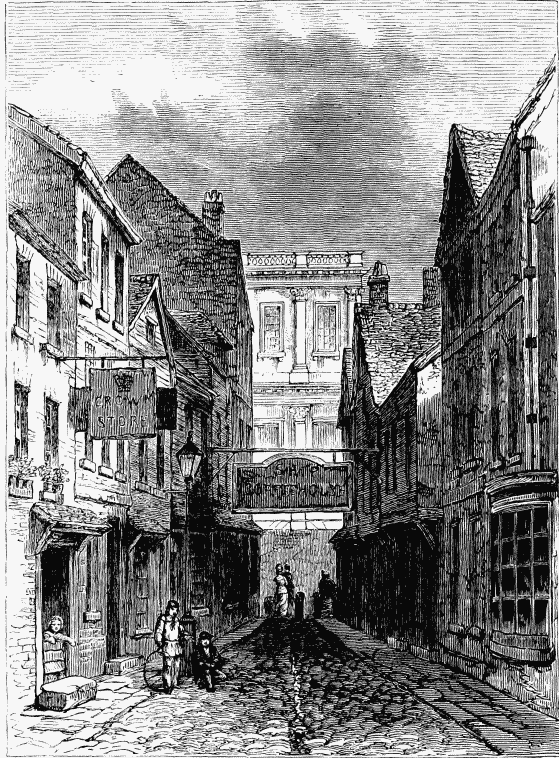
LANE LEADING INTO SHIP STREET, GREENWICH (1830).
A writer in the Somerset House Gazette and
Literary Museum, in 1824, could complain, and
apparently with some show of truth, that even in
his time Greenwich merry-making was but the
ghost of what it had been. He bewails the utter
absence of that "joyous vulgarity, that freedom,
fun, and variety," which had been its boast and
attraction; but "still," he adds, by way of compensation, "there was a tolerable display, a sickly
smile of gaiety about the place. I passed through
a formidable array of gingerbread soldiers, drawn
up in front of a booth, as if for the protection of
the watches, horses, turkey-cocks, old ladies, and
gridirons, which were ranged behind. The uniform
of the military was very imposing; they were
attired in suits of gold leaf; to swallow one of the
doughty heroes would have been to realise the fate
of Crassus. Next succeeded the legerdemain and
'rowly-powly' gentry; the mermaids and mountebanks, and wonders of every class, from a penny to
sixpence, which showed that the fair had not altogether declined from its ancient character. To
quote the old ballad about another fair—
'In houses of boards men walk upon cords
As easie as squirrels crack filberds;
And the cut-purses they do bite and away,
But these we suppose to be ill-birds.
'For a penny you may see a fine puppet-play,
And for two pence a rare piece of art;
And a penny a cann, I dare swear a man
May put six of them into a quart.
'Their sights are so rich they are able to bewitch
The heart of a very fine man-a;
Here's patient Grizel here, fair Rosamunda there,
And the history of Susannah.'
The literary part of the amusements," he continues,
"was sadly neglected. In vain did learned dogs
boast of their erudition, or dandy-pigs shuffle the
cards and play dominoes. … The showman
of one of these establishments, sadly mortified,
paraded in front of his booth; by turns he listened
to the chattering of his monkey and the grunting
of the youthful porkers."He then records a row
and its issue, a general mêlée; and adds, in conclusion, "I had seen quite enough of the fair, and
was soon on my way back from Greenwich."
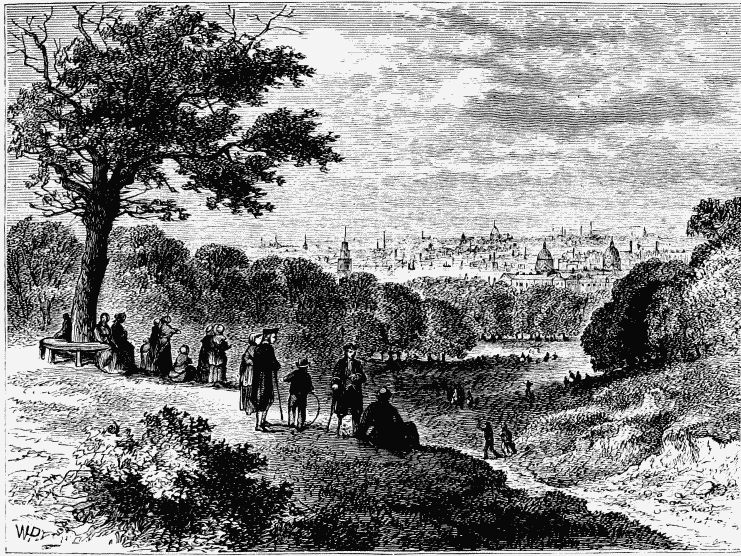
VIEW FROM ONE-TREE HILL, GREENWICH PARK, IN 1846.
Allusion is made to the fair in Thackeray's "Sketches and Travels in London," where Mr. Brown says threateningly to his nephew, "If ever I hear of you as a casino-hunter, or as a frequenter of races and Greenwich fairs, and such amusements in questionable company, I give you my honour you shall benefit by no legacy of mine, and I will divide the portion that was (and is, I hope) to be yours among your sisters." The fair figures also in his "Pendennis," where the major, Sir Francis, and Foker dine at Greenwich, and Blanche cries out, "I adore Richmond, that I do; and I adore Greenwich, and I say I should like to go there." It will be remembered that the major, being an old soldier, allowed the young men to pay for the dinner between them.
Charles Dickens devotes one of his "Sketches by Boz" to a description of the cockneys making a holiday on Easter Monday at Greenwich Fair, describing, in his usual graphic style, the frolics and dangers of the road thither, the jostling of the crowds of fathers, mothers, apprentices and their sweethearts playing at "Kiss in the ring" or "Thread the needle," and dining and supping, and smoking al fresco, and crowding into Richardson's show, the dancing-booths, and the wild beast caravans, from noon-day till long past the hour of midnight. He writes, "If the parks be the lungs of London, we wonder what Greenwich Fair is—a periodical breaking-out, we suppose; a sort of spring rash; a three days' fever, which cools the blood for six months afterwards, and at the expiration of which London is restored to its old habit of plodding industry as suddenly and as completely as if nothing had ever occurred to disturb them."