Old and New London: Volume 6. Originally published by Cassell, Petter & Galpin, London, 1878.
This free content was digitised by double rekeying. Public Domain.
Edward Walford, 'The Old Kent Road', in Old and New London: Volume 6(London, 1878), British History Online https://www.british-history.ac.uk/old-new-london/vol6/pp248-255 [accessed 30 April 2025].
Edward Walford, 'The Old Kent Road', in Old and New London: Volume 6(London, 1878), British History Online, accessed April 30, 2025, https://www.british-history.ac.uk/old-new-london/vol6/pp248-255.
Edward Walford. "The Old Kent Road". Old and New London: Volume 6. (London, 1878), British History Online. Web. 30 April 2025. https://www.british-history.ac.uk/old-new-london/vol6/pp248-255.
In this section
CHAPTER XIX.
THE OLD KENT ROAD, &c.
"Inde iter in Cantium."—Cæsar.
The Course of the Old Watling Street—M. Sorbierre's Visit to London in the Reign of Charles II.—Evelyn's Account of the Return of Charles II., on his Restoration—Anecdote of Pitt and Dundas—Mrs. Mapp, the celebrated Bone-setter—Condition of the Old Kent Road in the Last Century—The Licensed Victuallers' Asylum—The South Metropolitan Gas Works—Christ Church—The Canal Bridge—Marlborough Chapel—St. Thomas à Watering—Old Taverns and Roadside Inns—The "World Turned Upside Down"—The Deaf and Dumb Asylum—The New Kent Road—Lock's Fields—Great Dover Street—Trinity Square and Trinity Church—Horsemonger Lane Gaol—Leigh Hunt a Prisoner there—Execution of the Mannings—The Surrey Sessions' House—Newington Causeway.
Following the course of the old Watling Street, we now make our way back to the southern extremity of the Borough, by the broad thoroughfare of the Old Kent Road. All trace of Watling Street at this point, we need hardly remark, has long since disappeared. The branch of the ancient Watling Street, which extended from Dover to Canterbury, and thence through Faversham and Rochester to London, was the road followed by nearly all travellers from the days of the Romans, the days of pilgrimages and crusades, and thence again until the formation of railways diverted their steps into another track. M. Sorbierre, a French gentleman of letters, who visited London in the reign of Charles II., thus writes:—"That I might not take post, or be obliged to use the stage-coach, I went from Dover to London in a wagon; I was drawn by six horses, one before another, and driven by a wagoner, who walked by the side of it. He was clothed in black, and appointed in all things like another St. George: he had a brave 'mounteror' on his head, and was a merry fellow, fancied he made a fine figure, and seemed highly pleased with himself."
Along this road travelled Charles II. and a gay train of cavaliers, on his Restoration and return, by way of Dover to London, in May, 1660. Evelyn draws the following picture of the happy event:—"This day his Majesty Charles II. came to London after a sad and long exile, and calamitous suffering both of the king and Church. This was also his birthday, and with a triumph of about 20,000 horse and foote, brandishing their swords and shouting with inexpressible joy; the wayes strew'd with flowers, the bells ringing, the streets hung with tapestrie, fountaines running with wine: the Maior, Aldermen, and all the Companies in their liveries, chaines of gold, and banners; lords and nobles clad in cloth of silver, gold, and velvet; the windows and balconies well set with ladies; trumpets, music, and myriads of people flocking even so far as from Rochester, so as they were seven hours in passing into the Citty, even from two in the afternoon till nine at night."
In the days nearer to our own, when there were no railroads, even this unfashionable thoroughfare was used by the most distinguished travellers. Stothard, the painter, for instance, tells us that, happening to be one evening at an inn on this road, he met Pitt and Dundas (afterwards Lord Melville), who had been obliged to rest there for the night on their way from Walmer to London. Next morning, as they were stepping into their carriage, the waiter said to Stothard, "Sir, do you observe those two gentlemen?" "Yes," was the reply; "I see they are Mr. Pitt and Mr. Dundas." "And how much wine do you think they drank last night, for the good of the house?" Stothard could not guess. "Seven bottles," was the waiter's answer.
We find in Jeaffreson's "Book about Doctors," the following ludicrous story relative to this part of the metropolis:—"One of the sights of the Old Kent Road at the beginning of the eighteenth century was the cavalcade of Mrs. Mapp, the celebrated bone-setter, on her way to the City. On one occasion, we are told, as the lady was proceeding along the Old Kent Road towards the Borough in her carriage-and-four, and manifesting by her manner that she had partaken too freely of Geneva water, she found herself in a very trying position. Her fat frame, eccentric dress, and dazzling equipage, were, in the eyes of the mob, sure signs of royalty, so that she was immediately taken for a court lady of German origin and unpopular repute, whose word was omnipotent at St. James's. Soon a crowd gathered round the carriage, and, with the proper amount of yelling and hooting, were about to break the windows with stones, when, acting very much as Nell Gwynne did on a similar occasion, she exclaimed, in a manner more emphatic than polite, 'What! don't you know me? I'm Mrs. Mapp, the bone-setter!'" The tale is familiar to all readers of the "Eccentric Biography."
The Old Kent Road, known as Kent Street Road until the end of the last century, was a continuation of Kent Street, in the Borough, of which we have already spoken, (fn. 1) and was the highway from Kent to the metropolis. There were but few houses in the Kent Road a century ago. Rocque's Map, published in 1750, shows the thoroughfare lined with hedgerows, bespeaking its rural character in the days of George II.
In 1827 the Licensed Victuallers' Asylum was founded, on six acres of freehold land lying just off the Old Kent Road. It consists of a group of onestoreyed houses, chapel, chaplain's residence, board and court rooms, library, &c., set round two green lawns. The Duke of Sussex was its first patron in 1827, and he was succeeded by the Prince Consort, on whose death the Prince of Wales assumed the office. The idea of establishing an institution wherein the distressed members of the licensed victuallers' trade, and their wives or widows, might be enabled to spend the latter part of their days in peace and quietness, was conceived by the late Mr. Joseph Proud Hodgson, in the year 1826, when he called a meeting of several influential gentlemen in the trade, and ventilated his views; and, after serious consideration, it was determined that a society should be formed under the title of the Licensed Victuallers' Asylum.
Subscriptions were solicited, and the hearty response that was accorded to the scheme by those most deeply interested in its success enabled the committee to purchase the land above mentioned, upon which it was resolved to erect an asylum, to consist of one hundred and one separate houses, containing three rooms each, besides the requisite conveniences. In May, 1828, the foundation-stone was laid, with full Masonic honours, by the Duke of Sussex, in the presence of a distinguished company, many of whom in after years exhibited a sincere attachment to the institution. At this time it was determined by the promoters of the institution to erect the central portion of the building, to consist of forty-three houses, which were perfected, and speedily became the abode of as many deserving individuals.
The applicants for admission being numerous, it was deemed advisable to perfect the asylum as early as circumstances would permit, and consequently, in the year 1831, the south wing was erected, and in 1833 the north wing, thus completing the original design of the institution. The friends of the society, being relieved of the anxiety of erecting additional houses, in the year 1835 turned their attention to the advisability of granting weekly allowances of money to the inmates of the asylum, in order to provide them with the necessaries of life, and, as might be imagined, the proposal met with cordial approval, and allowances were then commenced, since which period they have been increased from time to time, until they have reached the sum of twelve shillings per week for married couples and eight shillings for single persons—members of the Incorporated Society of Licensed Victuallers receiving one shilling per week extra. In addition to the allowances, a weekly supply of coal is granted to each inmate, besides being supplied with medical attendance, medicine, and wine, when recommended by the medical officer. In 1842 a charter of incorporation was granted to the institution, and in the following year, on the death of the Duke of Sussex, Prince Albert became patron.
In 1849 was commenced the "ladies' wing," comprising twenty-three habitations, the foundationstone being laid by H.R.H. the Prince Consort: this wing was completed in the following year. Several years having elapsed since an addition was made to the asylum, this important subject was considered, and so readily approved of by those who had the management of the institution, that in the year 1858 a new wing was commenced, the asylum being again honoured by its royal patron condescending to lay the foundation-stone. These buildings were designated the Albert Wing, in compliment to his Royal Highness, and consist of thirty-four houses.
A donation of one thousand guineas having been made to the institution in 1866, by a Mr. William Smalley, it was resolved that the only remaining space on the asylum grounds available for building purposes should be utilised. This was accordingly carried out, and ten additional houses built, which were named the Smalley Wing, the foundation-stone being laid by the Duke of Edinburgh. This addition completed the asylum as a building, and it now consists of one hundred and seventy separate and distinct houses.
The beautiful little chapel is enriched with stained-glass memorial windows, and also several handsome marble tablets, in memory of donors to the institution; whilst upon the grounds in front of the building, and facing the Asylum Road, is erected a marble statue of the late Prince Consort, which was unveiled in 1864 by the Prince of Wales.
The expenses attending the institution are about £7,000 annually, which is met by the subscriptions among the members of the trade, by bequests, by the proceeds of a ball given annually at Willis's Rooms or the Freemasons' Tavern, and also by the proceeds of the anniversary festival.
Close by the canal bridge, at a short distance westward of the Asylum Road, are the works belonging to the South Metropolitan Gas Company, whose operations extend over thirteen square miles, from the New Kent Road southwards as far as Croydon parish, taking in considerable portions of Newington, St. George the Martyr, a small part of Bermondsey, nearly all Camberwell, a large portion of Lambeth, and all Streatham. The company has altogether about 170 miles of main-pipes; it consumes annually about 84,000 tons of coal, and supplies about 800,000,000 feet of gas in a year. The number of retorts is about 500, and the seven gas-holders are capable of storing nearly 4,000,000 feet of gas; while the greatest quantity made in a day somewhat exceeds that amount. This gas company was founded in 1833, for the supply of cannel gas, and incorporated in 1842, with an authorised capital of £200,000. In 1853 the south side of the Thames was divided into districts, which arrangements were sanctioned by Parliament in the Metropolis Gas Act, 1860. The company first supplied gas in 1834; and after four years' trial it was convincingly proved that to supply cannel gas made from the common coal was a financial mistake, and therefore cannel gas was abandoned in 1838. In consequence of the gradual extension of these works, the district church of Christ Church, Camberwell, which was built in 1838, on the north side of the Old Kent Road, has been demolished, and a new church built on the opposite side of the road. The new edifice, a brick building of Gothic architecture, was erected in 1868.
Beyond mentioning the canal bridge, which spans the Grand Surrey Canal close by the abovementioned gas-works, and making a passing reference to Marlborough (Congregational) Chapel, and also to the new Nonconformist chapel at the corner of Albany Road—built for the congregation formerly assembling at the old Maze Pond Chapel,—there is little or nothing in this thoroughfare calling for special remark till we arrive near the junction of the Old and New Kent Roads with Great Dover Street.
St. Thomas à Watering was once the boundary of the City liberties, and in the "olden time," when the lord mayor and sheriffs "in great state" crossed the water to open Southwark Fair and to inspect the City boundaries, the City magistrates continued either to St. George's Church, Newington Bridge, or "to the stones pointing out the City liberties at St. Thomas à Watering." The precise situation was as near as possible that part of the Old Kent Road which is intersected by the Albany Road, and the memory of the place is still kept alive by St. Thomas's Road, close by, and by the tavern-signs in the neighbourhood. "At the commencement of the present century," writes Mr. Blanch, in his history of "Ye Parishe of Cam[b]erwell," "there was a stream here which served as a common sewer, across which a bridge was built; and in going from Camberwell into Newington or Southwark, it was not unusual for people to say they were going over the water. The current from the Peckham hills was at times so strong as to overflow at least two acres of ground."
St. Thomas à Waterings was situated close to
the second milestone on the Old Kent Road, and
was so called from a brook or spring, dedicated to
St. Thomas à Becket. Chaucer's pilgrims, as we
have seen in a previous chapter, (fn. 2) passed it on their
way to the shrine of St. Thomas à Becket at
Canterbury:—
"And forth we riden a litel more than pas,
Unto the watering of Seint Thomàs,
And then our host began his hors arrest."
Ben Jonson, in The New Inn, makes mention of
the spot in the following lines:—
"These are the arts
Or seven liberal deadly sciences,
Of pagery, or rather paganism,
As the tides run! to which if he apply him,
He may perhaps take a degree at Tyburn
A year the earlier; come to read a lecture
Upon Aquinas at St. Thomas à Waterings."
This spot was in the old Tudor days the place of execution for the northern parts of Surrey; and here the Vicar of Wandsworth, his chaplain, and two other persons of his household, were hung, drawn, and quartered in 1539 for denying the supremacy of Henry VIII. in matters of faith.
In 1553 (January 3rd) "was caried from the Marshalleshe unto Saynt Thomas of Wateryng a talman, and went thedur with the rope a-bowt ys neke, and so he hanggd a whylle, and the rope burst, and a whylle after and then they went for a-nodur rope, and so lyke-wyss he burst ytt and fell to the ground, and so he skapyd with his lyffe."
On the 3rd of October, 1559, a "nuw payre of galows was sett up at Sant Thomas of Watering;" and on the 12th of February, 1650–1, "was reynyd [arraigned] in Westmynster Hall v men, iij was for burglare, and ij were cutpurses, and cast to be hanged at Sant Thomas of Watering: one was a gentyllman."
One of the quarters of Sir Thomas Wyatt, who was beheaded for rebellion in April, 1554, was exposed at this place; and on the 18th of June, 1556, a younger son of Lord Sandys was executed here for robbing a cart, coming from a fair, at Beverley. The booty was estimated at about four thousand pounds.
In 1559 five men were executed here. Macbyn, in his Diary, thus records the event:—"The ix day of Feybruary at after-none a-bowt iij of the cloke, v men wher hangyd at Sant Thomas of watherynges; one was captyn Jenkes, and (blank) Warde, and (blank) Walles, and (blank) Beymont, and a-nodur man, and they were browth [brought] up in ware [war] all their lyffes,—for a grett robere done."
John Henry, the author of some of the "Martin Mar-Prelate Tracts," was hung here in 1593; and Franklin, one of the agents implicated in the murder of Sir Thomas Overbury, was executed at the same place in 1615.
The last persons executed at St. Thomas à Watering were a father and son, who suffered the penalty of the law for murder about the year 1740.
The most noticeable feature in the Old Kent Road is the number of public-houses, each with its swinging sign and drinking-trough for horses. Among these houses of "entertainment for man and beast" is the "Kentish Drovers," which has existed here for about a couple of centuries, and was a well-known halting-place on the road to Kent, at a time (not very far distant) when the thoroughfare was bordered on either side by green fields and market gardens. The "Thomas à Becket," at the corner of Albany Road, commemorates the spot where the pilgrims first halted on their way from London to Canterbury (as mentioned above); the "Shard Arms" perpetuates the cognisance of the once powerful and wealthy Shard family, who were large landowners in the neighbourhood. The oldest of the inns in the Old Kent Road, perhaps, is one near the Bricklayers' Arms Station, which rejoices in the somewhat singular sign of "The World Turned Upside Down." The house is supposed to be upwards of two hundred years old, and down to about 1840 its sign-board represented a man walking at the South Pole. It may have been first set up after the discovery of Australia, Van Diemen's Land, or Terra del Fuego; but Mr. Larwood, in his work on "Sign-boards," interprets it as "meaning a state of things the opposite of what is natural and usual: a conceit in which," he adds, "the artists of former ages took great delight, and which they represented by animals chasing men, horses riding in carriages, and similar conceits and pleasantries." The old sign-board was blown down many years ago; and in 1868 the house itself was in great part rebuilt and wholly new-fronted.
Nearly opposite this old hostelry stands the Deaf and Dumb Asylum. This admirable institution, the foundation-stone of which was laid by the Duke of Gloucester in 1807, is a large but plain and unpretending edifice, separated from the roadway by a grove of trees. Miss Priscilla Wakefield, in her "Perambulations," published in 1809, commences one of her "letters" as follows:—"We continued our excursions into the county of Kent, stopping on the Kent Road to view a handsome building now erecting for the Asylum for poor Deaf and Dumb Children, an unfortunate class of persons, too long overlooked, or ineffectually commiserated among us. The applicants becoming so numerous that not onehalf of them could be admitted, it was resolved to extend the plan. A new subscription was set on foot for the purpose, and the present building was raised, without encroaching on the former funds of the institution." This asylum or school was the first established in England for the Deaf and Dumb, and was originally opened in 1792, in Fort Place, Bermondsey, under the auspices of the Rev. John Townsend, of Jamaica Road Chapel, and of the Rev. H. C. Mason, then curate of Bermondsey, both of whose names are perpetuated by Townsend Street and Mason Street, on either side of the Asylum. "The teacher," as Timbs tells us in his "Curiosities of London," "was Joseph Watson, LL.D., who held the situation upwards of thirty-seven years, and counted upwards of 1,000 pupils, though he commenced with six pupils only. In 1807 the first stone of a new building was laid in the Old Kent Road, whither the establishment was removed in the year 1809; and the Society celebrated the event by a public thanksgiving at the church of St. Mary Magdalen, Bermondsey, the Rev. C. Crowther preaching the sermon. A memorial bust of the Rev. Mr. Townsend has been placed in the committee-room. The pupils, male and female, are such children only as are deaf and dumb, not being deficient in intellect. Other children are admitted on payment of £20 annually for board; and private pupils are also received. The term of each pupil's stay is five years; they are taught to read, write, draw, and cipher, to speak by signs, and in many instances to articulate so as to be clearly understood. They are wholly clothed and maintained by the charity, are instructed in working trades, and in some cases apprentice-fees are given. The Asylum is amply supported by the wealthy; and besides its annual receipts from subscriptions, donations, and legacies, &c., it has some funded stock. The pupils are elected half-yearly, without reference to locality, sect, or persuasion. The importance of this Asylum is attested by the fact that in 1833, in twenty families of 159 children, ninety were deaf and dumb."
In connection with the above-mentioned institution, there is a branch establishment at Margate, which was used for the first time in August, 1876. From the report for 1876 we learn that during that year seventy-six children were admitted and sent to the branch asylum at Margate. Eighty-one children left the London asylum during the year, and thirty-five were apprenticed to various trades. As many as 4,170 children had been admitted since the foundation of the Asylum, and 1,550 apprenticed since the year 1812. The ordinary receipts in 1876, including a balance from the previous year of £1,296, amounted to upwards of £9,354, and the general expenses to £12,055, the deficit having to be met by absorbing the sum of £3,334 bequeathed as legacies instead of being funded.
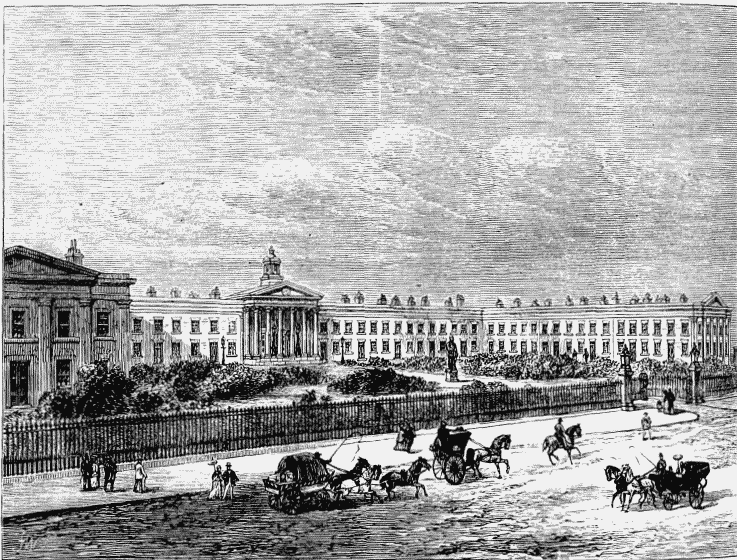
THE LICENSED VICTUALLERS' ASYLUM.
Close by the Deaf and Dumb Asylum the Old Kent Road terminates in the branch thoroughfares of New Kent Road, which trends south-westwardly to the "Elephant and Castle," and of Great Dover Street, which unites with the Borough, close by St. George's Church. The former of these thoroughfares—formerly called the Greenwich Road—is a broad and open roadway; it has been lately planted on either side with trees, so that in course of time it will doubtless form a splendid boulevard, of the Parisian type, and one worthy of being copied in many other parts of London. Great Dover Street is of comparatively recent growth, having been formed since the commencement of the present century to supersede the old, narrow, and disreputable Kent Street, which runs parallel with it on the north side, and to which we have referred above.
Among the residents of this street was Mr. T. C. Noble, the author of "Memorials of Temple Bar," and of other antiquarian works. It may be recorded that in 1869, when a bill was introduced into the House of Commons to divest some of the great City companies of the estates in the north of Ireland which they had purchased from James I., Mr. Noble published a series of letters, which had an important effect in causing the abandonment of the bill. For his successful opposition to the scheme, Mr. Noble received two special votes of thanks from the Court of the Irish Society, likewise the thanks of the London Livery Companies, being also presented with the freedom of the City and of the Company of Ironmongers.
"At the east end of Kent Street, in 1847," writes Mr. Blanch, in his "History of Camberwell," "was unearthed a pointed arched bridge of the fifteenth century, probably erected by the monks of Bermondsey Abbey, lords of the manor. In Rocque's Map, this arch, called Lock's Bridge, from being near the Lock Hospital, (fn. 3) carries the road over a stream which runs from Newington Fields to Bermondsey!" Lock's Fields, which are still in existence—at all events in name—on the south side of the New Kent Road, were doubtless so named for the same reason.
In Trinity Street—which diverges from Great Dover Street, and terminates at the junction of Blackman Street with Newington Causeway—is Trinity Square, and also Trinity Church, a modern edifice of the Grecian style of architecture. This church is situated on the south side of Trinity Square, at a short distance from Blackman Street, and nearly on the verge of the parish of St. Mary, Newington. It is enclosed in a small square of respectable-looking houses, with a plantation in the centre, in which is erected a statue of King Alfred. The portico and principal front of the church, with the steeple, is placed on the north side of the body of the edifice; the portico consisting of six fluted Corinthian columns supporting a plain entablature and pediment. The body of the church is a parallelogram, and is divided into two storeys by a plain course. The interior presents a vast unbroken area, roofed in one span, and the ceiling is panelled. The galleries, resting on Doric pillars, extend round three sides of the church, and the altar-screen, situated below the eastern window, consists of a pediment surmounting four slabs, inscribed with the Decalogue, &c. The first stone of the edifice was laid by the Archbishop of Canterbury in June, 1823, and the building was consecrated in December of the following year. The ground on which the church is built was given by the corporation of the Trinity House, which possesses considerable property in the vicinity.
On the south side of Trinity Square, with its principal entrance in Union Road (formerly Horsemonger Lane), stands the prison and place of execution for the county of Surrey, commonly known as Horsemonger Lane Gaol. It is a substantially-built structure, chiefly of brick, arranged upon the approved plan of John Howard, the prison philanthropist. It is of a quadrangular form, with three storeys above the basement, and was completed for the reception of prisoners in 1798, and has accommodation for 300 prisoners. This prison not being a house of correction, the average duration of imprisonment undergone by each prisoner is very short. Instruction is confined to the juvenile prisoners, who are assembled in classes for two hours daily. The number of attendances during the first six months of the year ending Michaelmas, 1875, was 751; the number of prisoners confined during the year ending Michaelmas, 1875, was 3,465; and the greatest number of prisoners at any one time was 165.
In 1802, Colonel Despard, and about thirty of his accomplices, were arrested at the "Oakley Arms" public-house in Lambeth, on a charge of treasonable conspiracy, tending to dethrone the king and subvert the Government. In the following February they were tried by a special commission, held in the Sessions' House adjoining the prison, and the colonel and six of his colleagues were hung and beheaded here. It may be added that the "hurdle" on which the colonel was drawn from the cell in which he was last confined to the place of execution—in conformity with the sentence formerly passed upon criminals convicted of high treason—remained in the gaol till very recently, and was regarded as an object of curiosity.
This place has its romance, for Leigh Hunt was for two years (1812–1814) imprisoned here for libellously styling the Prince Regent, afterwards George IV., an "Adonis of fifty;" and here it was that Moore and Lord Byron paid that memorable visit to "the wit in the dungeon," when the noble poet saw him for the first time in his life. Mr. Cyrus Redding, in his "Recollections," says:—"I remember paying Leigh Hunt a visit in Horsemonger Lane Jail, a miserable low site. I missed Byron and Moore by only about half an hour, on the same errand. Horace Smith and Shelley used to be visitors there, and many others of Hunt's friends. He was composing 'Rimini,' a copy of which he gave me, and which I still possess. His apartment, on the ground floor, was cheerful for such a place, but that only means a sort of lacquered gloom after all. I thought of his health, which seemed by no means strong. I am certain, if the place was not unwholesome, it lay close upon the verge of insalubrity. Hunt bore his confinement cheerfully, but he must have had unpleasant moments. He was naturally lively, and in those days I never knew a more entertaining companion. For such an one to be alone for weary, dreary hours, must have been punishment enough even to satisfy an Ellenborough or a Jeffries."
"Times and rules are changed since then," writes Mr. Hepworth Dixon, in his "London Prisons:" "the 'luxurious comforts—the trellised flower-garden without, the books, busts, pictures, and pianoforte within'—which Moore describes on the occasion when Byron dined with him in the prison—would be looked for in vain now." Here is a picture of the interior of the prison at the time Mr. Dixon's book was published, only a quarter of a century ago (1850):—"There are for criminals," he writes, "ten classes, or wards, each ward having its yard and day-room. On entering one of these, the visitor is painfully impressed with the absence of all rule and system in the management. He finds himself in a low, long room, dungeon-like, chilly, not very clean, and altogether as uncomfortable as it can conveniently be made. This room is crowded with thirty or forty persons, of all ages and shades of ignorance and guilt—left to themselves, with no officer in sight. Here there is no attempt to enforce discipline. Neither silence nor separation is maintained in the largest prison in the metropolitan county of Surrey! In this room we see thirty or forty persons with nothing to do—many of them know not how to read, and those who do are little encouraged so to improve their time. Some of them clearly prefer their present state of listless idleness: with hands in their pockets, they saunter about their dungeon, or loll upon the floor, listening to the highly-spiced stories of their companions, well content to be fed at the expense of the county—upon a better diet, better cooked, than they are accustomed to at home—without any trouble or exertion on their own part. Conversing with them, we find that a few of these pariahs of civilisation hate the listless, apathetic bondage in which they are kept; that they would be glad to have work to do—to get instruction if they could. But the majority prefer the state of vegetation as more congenial to their cherished habits of inaction. Here they are gratified to their wish." That this state of things no longer exists, we need scarcely inform our readers; for since the passing of the Prisons' Discipline Act, in 1865, the silent system has been adopted here, and the regulations of the prison are carried out on much the same principle as those at Holloway, which we have already described, (fn. 4) and the prisoners, excepting in cases of emergency, are confined in separate cells, and kept entirely apart from each other.
Down to the passing of the Act by which executions ceased to take place in public, the scaffold for the execution of criminals at this gaol was erected upon the roof of the gateway; and the roadway in front, during these "exhibitions," became the scene of the wildest depravity. Charles Dickens, who was present at the execution of the Mannings on the 13th of November, 1849, gives us the following description of what he saw:—"I was a witness," he writes, "of the execution at Horsemonger Lane this morning. I went there with the intention of observing the crowd gathered to behold it, and I had excellent opportunities of doing so at intervals all through the night, and continuously from daybreak until after the spectacle was over. I believe that a sight so inconceivably awful as the wickedness and levity of the immense crowd collected at that execution could be imagined by no man, and could be presented in no heathen land under the sun. The horrors of the gibbet and of the crime which brought the wretched murderers to it faded in my mind before the atrocious bearing, looks, and language of the assembled spectators. When I came upon the scene at midnight, the shrillness of the cries and howls that were raised from time to time, denoting that they came from a concourse of boys and girls already assembled in the best places, made my blood run cold. As the night went on, screeching, and laughing, and yelling in strong chorus of parodies on negro melodies, with substitutions of 'Mrs. Manning' for 'Susannah,' and the like, were added to these. When the day dawned, thieves, low prostitutes, ruffians, and vagabonds of every kind, flocked on to the ground, with every variety of offensive and foul behaviour. Fightings, faintings, whistlings, imitations of Punch, brutal jokes, tumultuous demonstrations of indecent delight when swooning women were dragged out of the crowd by the police with their dresses disordered, gave a new zest to the general entertainment. When the sun rose brightly—as it did—it gilded thousands upon thousands of upturned faces, so inexpressibly odious in their brutal mirth or callousness, that a man had cause to feel ashamed of the shape he wore, and to shrink from himself, as fashioned in the image of the devil. When the two miserable creatures who attracted all this ghastly sight about them were turned quivering into the air, there was no more emotion, no more pity, no more thought that two immortal souls had gone to judgment, no more restraint in any of the previous obscenities, than if the name of Christ had never been heard in this world, and there were no belief among men but that they perished like the beasts. I have seen, habitually, some of the worst sources of general contamination and corruption in this country, and I think there are not many phases of London life that could surprise me. I am solemnly convinced that nothing that ingenuity could devise to be done in this city, in the same compass of time, could work such ruin as one public execution; and I stand astounded and appalled by the wickedness it exhibits. I do not believe that any community can prosper where such a scene of horror and demoralisation as was enacted this morning outside Horsemonger Lane Gaol is presented at the very doors of good citizens, and is passed by, unknown or forgotten."
The Sessions' House, for the meetings of the magistrates of the county of Surrey, adjoins the western side of the prison, and has its front towards Newington Causeway. This building, together with the gaol, was completed in 1799, having been built in conformity with an Act of Parliament, passed in the year 1791, entitled "An Act for building a new common gaol and sessions' house, with accommodations thereto, for the county of Surrey." In pursuance of this Act, three acres and a half of land, used by a market gardener, were purchased; and the two buildings were erected under the direction of the late Mr. George Gwilt, the county surveyor, the total cost having amounted to nearly £40,000. The Sessions' House has been recently rebuilt; and since 1875 the whole of the interior has been reconstructed upon improved principles, and the building new fronted, under the direction of the county surveyor, Mr. Howell.