Old and New London: Volume 6. Originally published by Cassell, Petter & Galpin, London, 1878.
This free content was digitised by double rekeying. Public Domain.
Edward Walford, 'Brixton and Clapham', in Old and New London: Volume 6(London, 1878), British History Online https://www.british-history.ac.uk/old-new-london/vol6/pp319-327 [accessed 9 May 2025].
Edward Walford, 'Brixton and Clapham', in Old and New London: Volume 6(London, 1878), British History Online, accessed May 9, 2025, https://www.british-history.ac.uk/old-new-london/vol6/pp319-327.
Edward Walford. "Brixton and Clapham". Old and New London: Volume 6. (London, 1878), British History Online. Web. 9 May 2025. https://www.british-history.ac.uk/old-new-london/vol6/pp319-327.
In this section
CHAPTER XXIV.
BRIXTON AND CLAPHAM.
The Royal Asylum of St. Ann's Society—The Female Convict Prison, Brixton—Clapham Park—Etymology of Clapham—Clapham Common—The Home of Thomas Babington Macaulay—The Old Manor House—The Residence of Sir Dennis Gauden—Pepys a Resident here—Death of Samuel Pepys—The Residence of the Eccentric Henry Cavendish—The Beautiful Mrs. Baldwin—The Home of the Wilberforces—Henry Thornton—The Parish Church—St. Paul's Church—St. John's Church—St. Saviour's Church—The Congregational Chapel, and the Roman Catholic Redemptorist Church and College—Nonconformity at Clapham—The "Clapham Sect"—Lord Teignmouth's House—Nightingale Lane—The Residence of Mr. C. H. Spurgeon—The "Plough" Inn—The "Bedford" Arms—Clapham Rise—Young Ladies' Schools—The British Orphan Asylum—The British Home for Incurables—Clapham Road.
Leaving Streatham Park on our left, we now make our way northward, by way of Streatham Hill and Tulse Hill, to Brixton. The Royal Asylum of St. Ann's Society, which we pass on our right, was founded in 1702, "for the education and support of the daughters of persons once in prosperity, whether orphans or not." The institution is pleasantly situated upon Streatham Hill, and flourishes under royal patronage. The schools, in which are taught, on an average, about 400 children, are examined by the Syndicate of Cambridge, and the pupils are prepared for the Oxford and Cambridge local examinations. The asylum, erected in 1829, is a handsome building of three storeys, having an Ionic portico and pediment, ornamented by a sculpture of the royal arms.
Almost on the summit of Brixton Hill, in one of the most open and salubrious spots in the southern suburbs of London, stands what was till recently one of the metropolitan houses of correction for the county of Surrey; the other, Horsemonger Lane Gaol, we have already described. (fn. 1) Like nearly all the prisons constructed at the close of the last or beginning of the present century, this is planned in the form of a rude crescent, the governor's house being in the common centre. The prison was built in 1820, being calculated for 185 prisoners, and no more: that is, there are (or were) 149 separate cells, and twelve double cells, in each of which, however, three bed-racks were fitted up, making altogether bed-racks for 185. This number of inmates, however, was often considerably more than doubled; and hence it became unhealthy, in spite of its admirable situation, and long enjoyed the reputation of being very disorderly. Mr. Hepworth Dixon, in his work on the "London Prisons," published in 1850, writes: "Any person who knows aught of the working of a gaol system will at once understand why the Brixton House of Correction is disorderly, why it is dirty, and why it is unhealthy, when we say that, instead of 185 prisoners—its full complement—there are within its walls not less than 431. The daily average for 1848 was not less than 382, more than double the number for which there is any accommodation."
Here the tread-wheel was first employed, about the year 1824; and from that period, down to the time when it ceased to be used as a house of correction, this prison was, par excellence, one for hard labour; in fact, it was all tread-wheel, except for the females, who were employed in picking oakum and sewing.
In former times the external appearance of this prison had anything but a show of security against the escape of prisoners, the boundary-wall being much too low. "More than one person," writes Mr. Dixon, at the date above mentioned, "has been known to leap from the top without being at all hurt; it is, in fact, so low as to offer a pressing temptation to escape; and attempts are, therefore, not unfrequent, sometimes," he adds, "as in a recent case, with most disastrous consequences. A man had got on the wall with the design of regaining his freedom: he was observed, and chased by the officers and governor. A quantity of bricks (loose) are placed on the wall to increase its height, and these furnished the man with defensive weapons, by which he was enabled to keep his pursuers at bay. Seeing no other means of capturing him, one of the officers (not the governor, as was stated in the newspapers at the time) fired at him and seriously wounded him. It was thought at first, and so reported, that the wretched man was killed, but, fortunately, it proved otherwise."
As may be inferred from what we have stated above, this prison was one of the worst, in point of management, of any in the kingdom, and the result was that it became a perfect scandal. Access to its precincts was very rarely, if ever, afforded to the outside world; and it is on record that members of Parliament, and even the Duke of Wellington, had been refused admission. Some idea of its character, however, was afforded to the public in a pamphlet, entitled "A Month at Brixton Treadmill," which was published a few years ago. But a change was in store, for the old prison was sold in 1862 to Her Majesty's Government, by whom it has been converted into a convict establishment for females.
Westward of the prison, and stretching away to Balham Hill Road, a large tract of land, some 250 acres in extent, known as Bleak Hill, was, in 1824, taken by Mr. Thomas Cubitt, the builder of Belgravia, and converted into a series of broad roads and open spaces, planted, and built over with capacious detached villas, and named Clapham Park. This was long the "Belgravia of Clapham;" but a newer and perhaps more attractive quarter has since sprung up in "The Cedars," which lies on the opposite side of Clapham Common.
Clapham is supposed to have received its appellation from one of its ancient proprietors, Osgod Clapa, being the name of the Danish lord at whose daughter's marriage-feast Hardicanute died. Mr. Brayley, in his "History of Surrey," however, observes that there is an objection to this supposition, inasmuch as in the Chertsey Register the place is named "Clappenham" as far back as the reign of Alfred. In the Domesday Survey it is entered as "Clopeham." Hughson, in his "History of London" (1808), describes Clapham as a village about four miles from Westminster Bridge, and consisting of "many handsome houses, surrounding a common that commands many pleasing views. This common," he adds, "about the commencement of the present reign, was little better than a morass, and the roads were almost impassable. The latter are now in an excellent state, and the common so beautifully planted with trees, that it has the appearance of a park. These improvements were effected by a subscription of the inhabitants, who, on this occasion, have been much indebted to the taste and exertions of Mr. Christopher Baldwin, for many years an inhabitant, and an active magistrate; and as a proof of the consequent increased value of property on this spot, Mr. Baldwin has sold fourteen acres of land near his own house for £5,000. . . . A reservoir near the Wandsworth Road supplies the village with water." The Common, still about 220 acres in extent, is bounded on the eastern side by Balham Hill Road, which is a continuation of the road through Newington which we have already described; on the north-west by Battersea Rise; and on the south-west by a roadway, dotted at intervals with private residences standing within their own grounds, and "embosomed high in tufted trees." Like Peckham Rye, and such other open spaces of the kind as are left in the suburbs of London, Clapham Common in its time has had its fair share of patronage, either of those who delight in the healthful and invigorating game of cricket, or of those who desire a quiet stroll over its velvet-like turf. Pleasure-fairs, too, were held here on Good Friday, Easter and Whit Mondays, and on "Derby Day;" but these were abolished in 1873. The Common is ornamented with a few large ponds, which add not a little to the charm of the place.
In the year 1874 the Enclosure Commissioners for England and Wales, under the Metropolitan Commons' Act, 1866, and Metropolitan Commons' Amendment Act, 1869, certified a scheme for placing the Common under the control of the Local Board. The Common was purchased for the sum of £17,000, and it was proposed that it should be dedicated to the use and recreation of the public for ever. By the above-mentioned scheme the Board were to drain, plant, and ornament the Common as necessary, but no houses were to be built thereon, except lodges necessary for its maintenance. The Metropolitan Board of Works having thus taken the Common under their protection, at once set to work in order to effect an improvement in its appearance, by the planting of an avenue of young trees, and the formation of new footpaths in an ornamental style. The Board also issued its mandate that no more gravel was to be dug, or turf or furze cut off the Common, and that nothing should be done to disturb its rural aspect. To this day, consequently, "the Common" is, perhaps, one of the least changed of all spots round London, that is, so far as encroachment goes.
In a house a few doors from the "Plough" Inn, and facing the Common (now occupied by a fishmonger), Thomas Babington Macaulay spent the greater portion of his childhood, caring less for his toys than for books, which he read well at three years' old! Here Hannah More visited the Macaulays, and, the parents being absent, was horrified at being offered a glass of spirits by the precocious child, who had learned the existence of spirits from the pages of Robinson Crusoe! The Common, at that time, had something poetic about it, at all events, to the imaginative mind of the future historian. "That delightful wilderness of gorse-bushes, and poplar-groves and gravel-pits, and ponds great and small, was to little Tom Macaulay a region of inexhaustible romance and mystery. He explored all its recesses; he composed, and almost believed, its legends;" and his biographer, Mr. G. O. Trevelyan, records the fact that he would trace out in the hillocks of the Common an imaginary set of Alps, and an equally fanciful range of Mount Sinai. The house formerly stood back from the road, but of late years it has thrown out a shop-front, and, externally, has lost all traces of having been a private gentleman's residence. Lady Trevelyan, a sister of Lord Macaulay, lived for a time at Clapham, after breaking up her ménage in Great George Street.
The "Clapham Sect," on whose merits a brilliant panegyric was penned by Sir James Stephen, had its head-quarters at this house, and at that of Lord Teignmouth's, close by. The virtues of the "Claphamites," as they were sneeringly called, have been acknowledged even by their most strenuous opponents.
The old Manor House, which was standing at the corner of Manor Street when Priscilla Wakefield wrote her "Perambulations," in 1809, and was then occupied as a ladies' school, was distinguished by a singular tower, octagonal in form.
Skirting the Common, particularly on the eastern side, are still standing several of the spacious old red-brick mansions, the abode of wealthy London merchants, which once nearly surrounded its entire area. Many have fine elms growing in the grounds before them. The place must have been well inhabited, even so far back as John Evelyn's time, for he mentions dining here, at the house of Sir Dennis Gauden, whom he accompanied thence to Windsor on business with the king. Perhaps he was a City magnate, willing to lend money to his ever impecunious sovereign. The house, which was a large roomy edifice, with a noble gallery occupying the whole length of the building, was built by Sir Dennis for his brother, Dr. John Gauden, Bishop of Exeter, the presumed author of "Eikon Basilikè;" and after his death, in 1662, it became the residence of Sir Dennis himself, who sold it to one "Will" Hewer, who rose from being Pepys' clerk to a high position in the civil service, but found his occupation gone at the Revolution. Sir Dennis still, however, lived here, "very handsomely, and friendly to everybody," writes Evelyn, who was often a guest at his table; and he died here a few months after the fall of the Stuarts.
Pepys used often to visit here his friend Gauden, "Victualler of the Navy, afterwards Sheriff of London, and a knight." Under date July 25, 1663, he writes, in his "Diary:"—"Having intended this day to go to Banstead Downes to see a famous race, I sent Will to get himself ready to go with me; but I hear it is put off, because the Lords do sit in Parliament to-day. After some debate, Creed and I resolved to go to Clapham, to Mr. Gauden's. When I come there, the first thing was to show me his house, which is almost built. I find it very regular and finely contrived, and the gardens and offices about it as convenient and as full of good variety as ever I saw in my life. It is true he hath been censured for laying out so much money; but he tells me he built it for his brother, who is since dead (the bishop), who, when he should come to be Bishop of Winchester, which he was promised (to which bishopricke, at present, there is no house), he did intend to dwell here. By and by to dinner, and in comes Mr. Creed; I saluted his lady and the young ladies, and his sister, the bishop's widow, who was, it seems, Sir W. Russell's daughter, the Treasurer of the Navy, whom I find to be very well bred, and a woman of excellent discourse. Towards the evening we bade them adieu, and took horse, being resolved that, instead of the race which fails us, we would go to Epsom."
Later on, it seems, Pepys took up his residence here with his friend Hewer. John Evelyn writes again in his "Diary," under date Sept. 23rd, 1700: "I went to visit Mr. Pepys, at Clapham, where he has a very noble and wonderfully well-furnished house, especially with Indian and Chinese curiosities: the offices and gardens well accommodated for pleasure and retirement." Three years later, namely, on the 26th of May, 1703, Evelyn made the following entry in his "Diary:"—"This day died Mr. Sam. Pepys, a very worthy, industrious, and curious person, none in England exceeding him in knowledge of the Navy, in which he had passed thro' all the most considerable offices, Clerk of the Acts and Secretary of the Admiralty, all of which he performed with greate integrity. When K. James II. went out of England, he laid down his office and would serve no more, but withdrawing himselfe from all public affaires, he liv'd at Clapham with his partner, Mr. Hewer, formerly his clerk, in a very noble house and sweete place, where he enjoy'd the fruite of his labours in greate prosperity. He was universally belov'd, hospitable, generous, learned in many things, skill'd in music, a very greate cherisher of learned men of whom he had the conversation. His library and collection of other curiosities were of the most considerable, the models of ships especially." He was buried, as already stated, in St. Olave's Church, Hart Street. (fn. 2)
Lord Braybrooke, in his "Memoir of Samuel Pepys," tells us that when he removed to Mr. Hewer's house at Clapham, he left a large portion of his correspondence behind him in York Buildings, in the custody of a friend. This correspondence eventually found its way into the Bodleian Library, at Oxford. It only remains to add that Hewer's house was pulled down about the middle of the last century.
In a large house on the east side of the Common, at the corner of what is now known as Cavendish Road, lived Mr. Henry Cavendish, the eccentric chemist, of whom we have already had occasion to speak, in our notice of Gower Street. (fn. 3) He died in 1810, leaving more than a million to be divided among his relatives. One of his eccentricities was his utter disregard of money. The bankers with whom he kept his account finding that his balance had accumulated to upwards of £80,000, commissioned one of the partners to wait on him, and to ask him what he wished done with it. On reaching Clapham, and finding Mr. Cavendish's house, he rang the bell, but had the greatest difficulty in obtaining admission. "You must wait," said the servant, "till my master rings his bell, and then I will let him know that you are here." In about a quarter of an hour the bell rang, and the fact of the banker's arrival was duly communicated to the abstracted chemist. Mr. Cavendish, in great agitation, desired that the banker might be shown up, and as he entered the room, saluted him with a few words, asking him the object of his visit. "Sir, I thought proper to wait upon you, as we have in hand a very large balance of yours, and we wish for your orders respecting it." "Oh, if it is any trouble to you, I will take it out of your hands. Do not come here to plague me about money." "It is not the least trouble to us, sir; but we thought you might like some of it turned to account, and invested." "Well, well; what do you want to do?" "Perhaps you would like to have forty thousand pounds invested?" "Yes; do so, if you like; but don't come here to trouble me any more, or I will remove my balance."
Cavendish lived a very retired existence, and to strangers he was most reserved. To such an extent did he carry his solitary habits, that he would never even see or allow himself to be seen by a female servant; and, as Lord Brougham relates, "he used to order his dinner daily by a note, which he left at a certain hour on the hall table, whence the housekeeper was to take it."
His shyness was, not unnaturally, mistaken by strangers for pride. In Bruhn's "Life of Von Humboldt" it is related that, "While travelling in England, in 1790, with George Forster, Humboldt obtained permission to make use of the library of the eminent chemist and philosopher, Henry Cavendish, second son of the Duke of Devonshire, on condition, however, that he was on no account to presume so far as to speak to or even greet the shy and aristocratic owner, should he happen to encounter him. Humboldt states this in a letter to Bunsen, adding, sarcastically, 'Cavendish little suspected, at that time, that it was I who, in 1810, was to be his successor at the Academy of Sciences.'"
Cavendish, who has been styled "the Newton of Chemistry," was distinguished as the founder of pneumatic chemistry, and for his successful researches on the composition of water, and his famous experiment, made at Clapham, for the determination of the earth's density. "The man who weighed the world," wrote his cousin, the late Duke of Devonshire, in his "Handbook for Chatsworth," "buried his science and his wealth in solitude and insignificance at Clapham."
Almost the whole of his house here was occupied as workshops and laboratory. "It was stuck about with thermometers, rain-gauges, &c. A registering thermometer of Cavendish's own construction served as a sort of landmark to his house. It is now in Professor Brande's possession." A small portion only of the villa was set apart for personal comfort. The upper rooms constituted an astronomical observatory. What is now the drawingroom was the laboratory. In an adjoining room a forge was placed. The lawn was invaded by a wooden stage, from which access could be had to a large tree, to the top of which Cavendish, in the course of his astronomical, meteorological, electrical, or other researches, occasionally ascended. His library was immense, and he fixed it at a distance from his house, in order that he might not be disturbed by those who came to consult it. His own particular friends were allowed to borrow books, but neither they nor even Mr. Cavendish himself ever withdrew a book without giving a receipt for it. The mansion of Henry Cavendish, since re-fronted and considerably altered, was in 1877 the residence of Mr. H. S. Bicknell, and is known as Cavendish House.
Here and at Balham, towards the close of the last century, were many residents who belonged to the Wesleyan connexion; and it was at a friend's house at Balham that John Wesley dined and slept less than a week before his death, in March, 1791.
The famous beauty, Mrs. Baldwin—who, when young, turned the head of the Prince of Wales, had her portrait painted and her bust sculptured for foreign emperors and kings, and was kissed publicly by Dr. Johnson, whom she used to meet at Mrs. Thrale's house at Streatham—lived for many years at Clapham, and died here in July, 1839.
The house known as Broomfield, on the southwest side of the Common, was occupied for some years by Mr. William Wilberforce, M.P., the distinguished philanthropist; and there his no less distinguished son, Samuel Wilberforce, Bishop successively of Oxford and of Winchester, was born, on the 7th of September, 1805.
Close by stood the house once occupied by Henry Thornton, the author and prime mover of the agitation for the "reformation of manners and the suppression of slavery," in which William Wilberforce took such a distinguished part. The conclave, we are told, held their meetings, for the most part, in an oval saloon which William Pitt planned to be added to Thornton's residence. "It arose at his bidding," writes Sir J. Stephen, in his "Essays," "and yet remains, perhaps a solitary monument of the architectural skill of that imperial mind. Lofty and symmetrical, it was curiously wainscoted with books on every side, except where it opened on a far extended lawn, reposing beneath the giant arms of aged elms and massive tulip-trees." (fn. 4)
In Mr. J. T. Smith's "Book for a Rainy Day," we are introduced to one of these old-fashioned mansions:—"On arriving at Mr. Esdaile's gate," he tells us, "Mr. Smedley remarked that this (Clapham) was one of the few commons near London which had not been enclosed. The house had one of those plain fronts which indicated little, but upon ascending the steps I was struck with a similar sensation to those of the previous season, when first I entered this hospitable mansion. If I were to suffer myself to utter anything like an ungrateful remark, it would be that the visitor, immediately he enters the hall, is presented with too much at once, for he knows not which to admire first, the choice display of pictures which decorate the hall, or the equally artful and delightful manner in which the park-like grounds so luxuriantly burst upon his sight."
The parish church, built on the north-western corner of the Common, is a dull, heavy building, a sort of cross between the London parish church of Queen Anne's time and the "chapel of ease" of the last century. It dates from the year 1776. Yet Macaulay was fond of it to the last. He writes, under date Clapham, February, 1849: "To church this morning. I love the church, for the sake of old times; I love even that absurd painted window, with the dove, the lamb, the urn, the two cornucopias, and the profusion of sun-flowers, passion flowers, and peonies." He adds, "I heard a Puseyite sermon, very different from the oratory which I formerly used to hear from the same pulpit." The edifice is an ugly brick structure, with a singular dome-crowned tower at the west end. It contains a mural tablet to the memory of Dr. John Jebb, "the good, great, and pious Bishop of Limerick," who died in 1833; also a monument, by Sir Richard Westmacott, to John Thornton. The remains of the bishop are deposited in the tomb of the Thorntons.
Priscilla Wakefield, in her "Perambulations of London," published in 1809, writes as follows:—"There are now no remains of the old church, except the south aisle, which does not bear the marks of any remote antiquity. It is now out of use, unless for the funeral service, there being no other burying-ground but that which belongs to it. The new church stands on the north side of the Common; it is a plain modern edifice, without aisles or chancel."
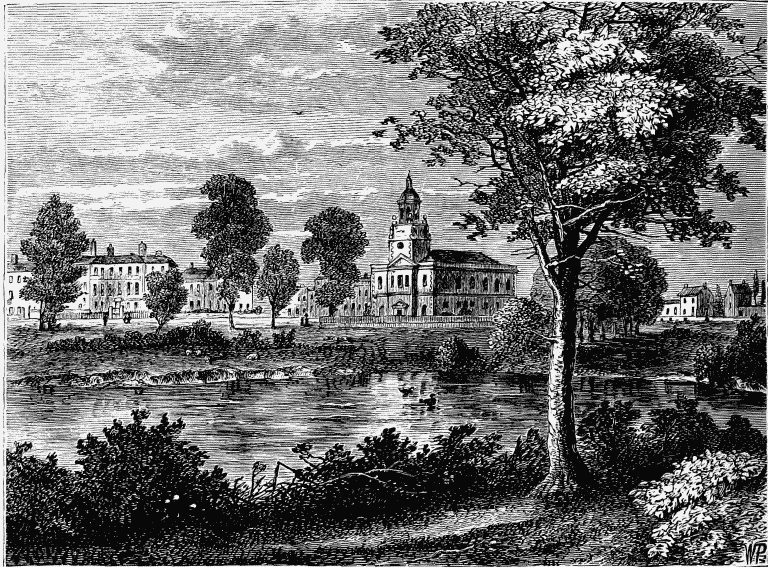
VIEW OF CLAPHAM IN 1790.
Mr. J. T. Smith, the antiquary, states that the walls of the little old parish church, which was demolished to make way for its successor, were adorned with Scripture texts, painted in accordance with the instructions of Queen Elizabeth. The old church, however, stood at some little distance from the present parish church, on the high ground between Larkhall Lane and Wandsworth Road. St. Paul's Church, which occupies its site, is a plain brick-built structure, and was erected in 1814. On the south wall is a monument, with bust, of William Hewer, which was saved on the demolition of the old church.
St. John's Church, built in 1842, stands on the western side of the Clapham Road, between Stockwell and the Common; it is after the model of a Greek temple, with an Ionic portico and no steeple, but a cross on the top of the pediment. Dr. Bickersteth, Bishop of Ripon, was for some years the officiating minister here.
St. Saviour's Church, in Cedars' Road, is a large and handsome cruciform structure, with a central tower in three stages, with pinnacles. It is in the Decorated style of architecture, and was built, in 1864, from the designs of Mr. J. Knowles, at the cost of the Rev. W. Bowyer. The windows are filled with painted glass, by Clayton and Bell. This church remained unconsecrated for several years, in consequence of the bishop of the diocese objecting to the position of a monument of Mrs. Bowyer, which had been placed under the tower, immediately in front of the altar-rails. The monument—an altar-tomb, with a recumbent effigy of Mrs. Bowyer—was removed, in 1873, to the north transept.
By far the finest ecclesiastical-looking structures at Clapham do not belong to the Established Church. These are the Congregational Chapel, in Grafton Square, built in 1852, one of the most commodious and elegant edifices of which London Nonconformists can boast; and the Roman Catholic Redemptorist Church of St. Mary, built in 1849. These, with their lofty spires, quite dwarf the plain and unpretending parish structures.
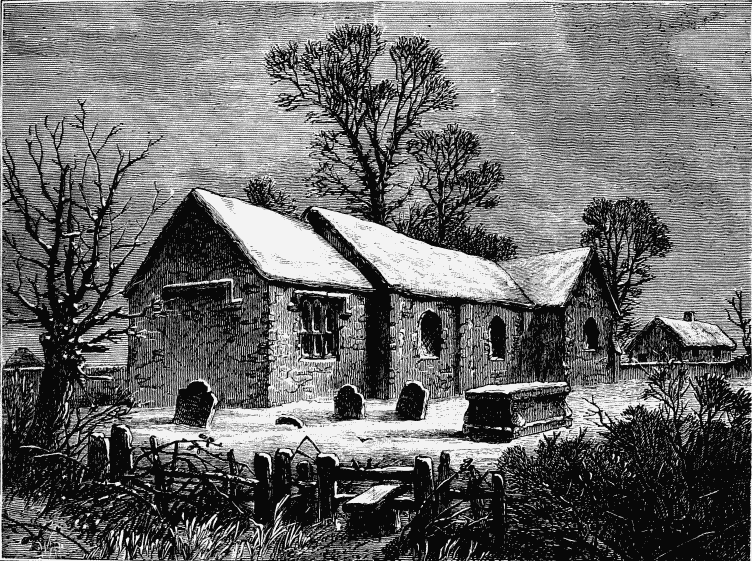
OLD CLAPHAM CHURCH IN 1750.
Mr. G. O. Trevelyan writes thus, in his "Life of Lord Macaulay:"—"At Clapham, as elsewhere, the old order is changing. What was once the home of Zachary stands almost within the swing of the bells of a stately and elegant Roman Catholic chapel; and the pleasant mansion of Lord Teignmouth, the cradle of the Bible Society, is now turned into a convent of monks;"—he should have said, of "regular" clergy. A gentleman who lived close by, in 1851, brought an action before one of the courts of law, to silence the bells of St. Mary's as a nuisance. He was successful in his suit; and the case of "Soltau v. De Weld" must be regarded as settling the question as to the right of any clergyman except one of the Established Church to ring bells to the annoyance of his neighbours.
The pulpit of Clapham Church, in Macaulay's childhood, it is almost needless to add, rang with "Evangelical" doctrines. Indeed, Clapham has long been regarded as a suburb whose residents are chiefly distinguished by social prosperity and ardent attachment to "Evangelical opinions;" and hence it is sneeringly spoken of by "Tom Ingoldsby" as "that sanctified ville;" and Thackeray has introduced a picture of the religious life of the place into the opening chapters of "The Newcomes," though he has, perhaps, overdrawn the Nonconformist element in it, and "Hobson" and "Brian Newcome" are scarcely fair specimens of the outcome of the religious influences of "the Clapham Sect" in its palmy days, when it numbered Wilberforce, and James Stephen, the Thorntons, and Charles and Robert Grant. Still, it was the chosen home of the Low-Church party during its golden age, and Churchmen and Nonconformists met there on common ground.
The meetings of Henry Drummond, the elder
Macaulay, and the little coterie that gathered round
them, and who were designated the "Clapham
Sect," first made the ancient home of Osgod Clapa
a synonym for devout respectability, and doubtless
it will be long before this distinctive description
will die out. As Horace writes—
"The cask will long
Retain the sweet scents of its earliest days."
When the "Clapham Sect" first became famous, even along the high road the houses had not crept along in an unbroken line to the Common; the place was literally a village, prim, select, and exclusive. For several generations Nonconformity had had a foothold therein. It is said that between the years 1640 and 1650 Mr. William Bridge, M.A., one of the five divines who, under the leadership of Philip Nye, made a stand for liberty of conscience in the Westminster Assembly of Divines, preached at Clapham, and founded therein an Independent congregation. Be that as it may, it is certain that when Charles II. published, in 1671–72, a declaration of Indulgence, licenses to conduct Nonconformist worship were granted to Dr. Wilkinson, of Clapham, for his own house and school-room, and to Mr. Thomas Lye, of the same place, for his own house. Mr. Lye had been minister of Allhallows, and one of Cromwell's Triers. He formed a congregation, which continued to assemble in a private house in the time of his successor, Philip Lamb. Subsequently it met in a temporary wooden building, and in 1762 a more substantial edifice was erected, in which for some years laboured Dr. Furrieaux, a learned and voluminous writer, with a strong leaning towards Arianism. In this chapel they continued to meet until, in 1852, was erected Grafton Square Chapel. The congregation is large and comparatively wealthy. A commodious lecture-hall, used also as a Sundayschool, is erected in the immediate vicinity of the church, and a mission-hall and schools in the Wandsworth Road.
The "Clapham Sect"—which comprised the leaders of the Evangelical party, mostly Churchmen, but with a sprinkling of Nonconformists, and numbered among them such men as Wilberforce, Zachary Macaulay, Thornton, Stephen, &c.—met, as we have stated before, at Lord Teignmouth's house, at the corner of Clapham Common, now the Redemptorists' College and Monastery; and in this house the Bible Society was founded. One of the "sect," Mr. Henry Thornton, of Clapham, was said to have spent £2,000 annually in the distribution of Bibles and other religious books.
The practical influence of the "Clapham Sect" was great, though they had no posts or offices with which to bribe followers; they doubtless, also, did much to awaken society to a sense of the great importance of personal religion; but surely Macaulay is guilty of an exaggeration when he writes of them as follows:—"The truth is that from that little knot of men emanated all the Bible societies and almost all the missionary societies in the world. The share which they had," he continues, "in providing means for the education of the people was great. They were the real destroyers of the slave-trade and of slavery. Many of those whom Stephen describes, in his article on the 'Clapham Sect,' were public men of the greatest weight. Lord Teignmouth governed India at Calcutta. Grant governed India in Leadenhall Street. Stephen's father was Perceval's right-hand man in the House of Commons. It is needless to speak of Wilberforce. As to Simeon, if you knew what his authority and influence were, you would allow that his real sway in the Church was far greater than that of any primate." And such was really the case. At the beginning of this century, and for the first thirty years, the men who met at Lord Teignmouth's table here were really the life and soul of the Established Church, and the spring of its active energy.
On the western side of the Common, in Nightingale Lane, a thoroughfare leading from Clapham to Wandsworth Common, lives the Rev. C. H. Spurgeon, of whom we have already spoken in our accounts of the Metropolitan Tabernacle and the Surrey Music Hall. (fn. 5) One of Mr. Spurgeon's first undertakings, on settling in London, was the Pastors' College. The work of the college was for many years carried on in the dark subterranean rooms under the Tabernacle; but in 1874 it was transferred to a more convenient, suitable, and commodious building at the rear of the Tabernacle, which had been erected and furnished at a cost of about £15,000. Here there is a fine hall, large class-rooms, a spacious library, and other conveniences. Of the work that has been done at the Pastors' College some idea may be formed from the following quotation of Mr. Spurgeon's account of the college, written in 1876:—"There are now 330 men proclaiming the Gospel in connection with the Baptist denomination who have been trained in the college, of whom two are in India, one in China, two in Spain, one in Rio Janeiro, one in St. Helena, one in Turk's Island, one in South Africa, six in Australia, twenty-three in the United States, and ten in the Canadian Dominion."
We now make our way northward from the
Common by the Clapham Road, leaving the
"Plough" Inn on our left. This sign, we need
scarcely remark, leads the mind back to days when
the village of Clapham, far removed from the busy
hum of London life, was surrounded by green
fields and homesteads. "Among agricultural signs,"
Mr. Larwood tells us, in his "History of Signboards," "the 'Plough' leads the van, sometimes
accompanied by the legend, 'Speed the Plough.'"
In some cases the sign bears an inscription in
verse, such as—
"He who by the Plough would thrive,
Himself must either hold or drive."
But if these lines were ever inscribed here, they
have long since been obliterated.
Nearer to London is the "Bedford Arms," a
tavern doubtless so named in honour of the ducal
house of Bedford, whose lands at Streatham, as we
have seen, can be reached by this road. From the
"Bedford Arms" up to the "Plough" there is a
somewhat steep ascent, and the roadway at that
point is known as Clapham Rise. This spot has
long been noted for its seminaries for young ladies,
a fact which is wittily referred to by Tom Ingoldsby,
in his amusing mock-heroic poem, "The Babes in
the Wood"—
"And Jane, since, when girls have 'the dumps,'
Fortune-hunters in scores to entrap 'em rise,
We'll send to those worthy old frumps,
The two Misses Tickler, of Clapham Rise!"
This locality is also a favourite spot for charitable institutions. At Clapham Rise was founded, in 1827, the British Orphan Asylum, now located at Slough, near Windsor. The design of this institution is "to board, clothe, and educate destitute children of either sex who are really or virtually orphans, and are descended from parents who have moved in the middle classes of society, such as, for example, children of clergymen, and of members of the legal and medical professions, naval and military officers, merchants, and of other persons who in their lifetime were in a position to provide a liberal education for their children."
The British Home for Incurables, now flourishing at Clapham Rise, was established in 1861, with two objects—to provide a home for life, with good nursing, skilled medical attendance, and all necessary mechanical contrivances for the alleviation of the sufferings and afflictions of the patients; and to grant pensions of £20 per annum for life to those who may have relatives or friends partially able to provide for them, but who are not able wholly to maintain them. All who are afflicted with incurable disease are eligible, without regard to nationality or creed, except the insane, the idiotic, and the pauper class, and those under twenty years of age. The institution extends its operations to all parts of the United Kingdom.
The Clapham Road, a broad and well-built thoroughfare, descends gradually towards Stockwell and Kennington. On every recurring "Derby Day" its appearance, from the vehicular and other traffic which passes along it, is lively and animated in the extreme. The scenes to be witnessed here on these occasions have been graphically and amusingly described by Mr. G. A. Sala, in his "Daylight and Gaslight," to the pages of which we would refer the reader.