Old and New London: Volume 6. Originally published by Cassell, Petter & Galpin, London, 1878.
This free content was digitised by double rekeying. Public Domain.
Edward Walford, 'Fulham: Introduction', in Old and New London: Volume 6(London, 1878), British History Online https://www.british-history.ac.uk/old-new-london/vol6/pp504-521 [accessed 30 April 2025].
Edward Walford, 'Fulham: Introduction', in Old and New London: Volume 6(London, 1878), British History Online, accessed April 30, 2025, https://www.british-history.ac.uk/old-new-london/vol6/pp504-521.
Edward Walford. "Fulham: Introduction". Old and New London: Volume 6. (London, 1878), British History Online. Web. 30 April 2025. https://www.british-history.ac.uk/old-new-london/vol6/pp504-521.
In this section
CHAPTER XXXVII.
FULHAM.
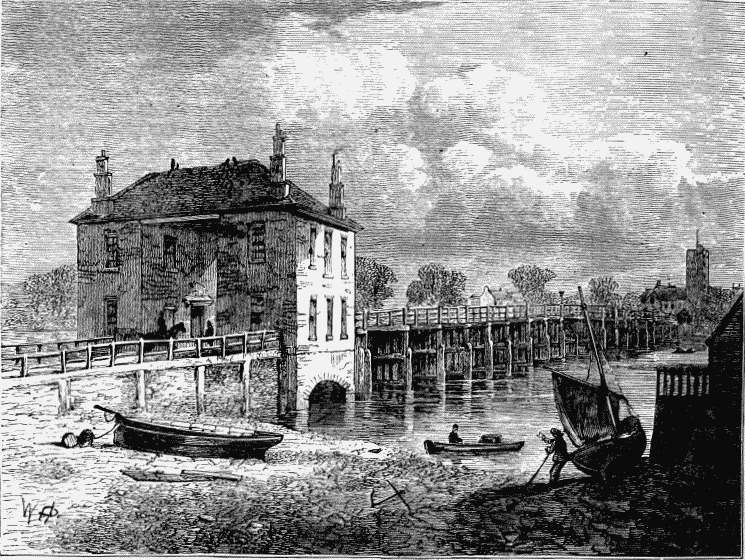
PUTNEY BRIDGE.
"The mansion's self was vast and venerable,
With more of the monastic than has been
Preserved elsewhere."—Byron.
Probable Der.vation of the Name of Fulham—Boundaries of the Parish—The High Street—Egmont Villa, the Residence of Theodore Hook—Anecdotes of Hook—All Saints' Church—Fulham Bells—Sir William Powell's Almshouses—Bishop's Walk—Fulham Palace—The Gardens—A Bishop's Success in a Competition for Lying—The Manor of Fulham—Bishops Bonner, Aylmer, Bancroft, and Juxon—The Moat—Craven Cottage—Jew King, the Money-lender—The "Crab Tree"—The Earl of Cholmondeley's Villa—Fulham Cemetery—The "Golden Lion"—The Old Workhouse—Fulham at the Commencement of the Last Century—Fulham Road, Past and Present—Holcrofts Hall—Holcrofts Priory—Claybrooke House—The Orphanage Home—Fulham Almshouses—Burlington House—The Reformatory School for Females—Munster House—Fulham Lodge—Percy Cross—Ravensworth House—Walham Lodge—Dungannon House and Albany Lodge—Arundel House—Sad Fate of a Highwayman—Park House—Rosamond's Bower—Parson's Green—Samuel Richardson, the Author of "Pamela," &c.—East-end House—Mrs. Fitzherbert and Madame Piccolomini Residents here—Sir Thomas Bodley—Eelbrook Common—Peterborough House—Ivy Cottage—Fulham Charity Schools—The Pottery—A Tapestry Manufactory—A Veritable Centenarian.
The parish of Fulham, upon which we now enter, lies in Middlesex, about four miles south-west from Hyde Park Corner, and covers a large extent of ground, the greater part of which, down to comparatively recent times, was laid out as marketgardens; and the parish still contributes largely to the daily supply of Covent Garden. Originally, Fulham was much larger than now, for it included Hammersmith within its limits; and even at the present time it has an area of nearly 4,000 acres. Antiquaries have differed as to the origin of the name of Fulham; but the usual, and perhaps most probable, derivation is from the Saxon "Fullenhame," which means the resort or habitation of birds. It was so called, it is supposed, from the abundance of water-fowl found here, and it would be difficult to imagine a place more fitted for the resort of such birds than Fulham must have been before the river was embanked, when the land for some distance from the stream was a mere swamp, and, in many places, under water at every high tide. The place, we are also told, "abounded in trees, which gave them shelter." Camden, in his "Britannia," derives the name from the Saxon word "Fullenham," or "Foulenham," volucrum domus, "the habitation of birds, or place of fowls." Norden agrees with this etymology, and adds, "It may also be taken for volucrum amnis, or the river of fowl; for 'ham' also, in many places, signifies amnis, a river." In Sommer's and Lye's Saxon Dictionaries it is called Fullanham, or Foulham, "supposed from the dirtiness of the place."
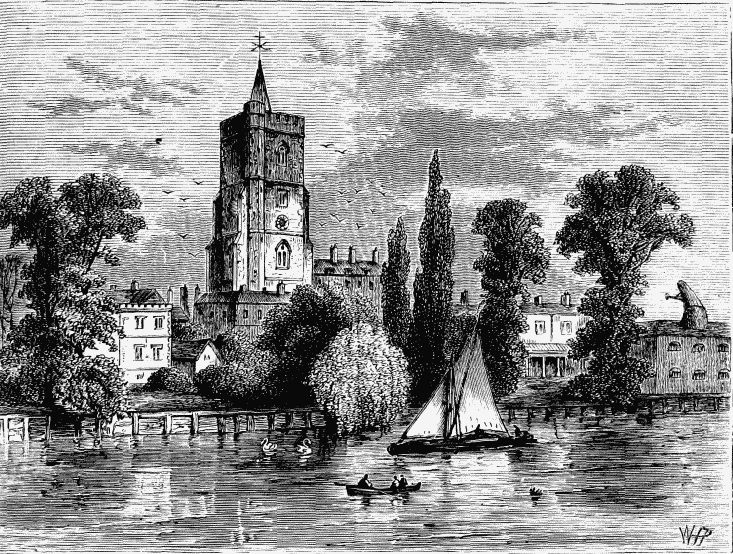
FULHAM CHURCH, IN 1825.
It is Pennant's opinion that as far back as the days of the Romans "all the land round Westminster was a flat fen, which continued to beyond Fulham."
The parish of Fulham is, or was, separated on the east from Chelsea by a rivulet, which rises in Wormholt Scrubs, and falls into the Thames opposite to Battersea; on the west it is bounded by Chiswick and Acton; on the north by Hammersmith and Kensington; and its southern boundary is the river Thames. Notwithstanding its distance from London, Fulham is now joined on to the "great city" by lines of houses which extend along the high road on either side. Near the entrance to the village, by the Fulham Road, there are several antiquated-looking family mansions, standing in their own grounds, and almost shut in from observation by stately elms and cedars. The High Street, which branches off at right angles towards the bridge, has the dull, sleepy aspect of a quiet country town: many of the quaint old red-brick houses, with high-tiled roofs, carry the mind of the observer back to times long gone by. As viewed from the Thames, the scene is far different: here we have, on the one hand, prim villas embosomed in trees, with lawns and gardens sloping down to the water; and on the other the old parish church, backed by the trees surrounding the palace of the Bishop of London.
Close by, to the left, on entering Fulham from the bridge, on the spot now occupied by the abutment of the aqueduct, formerly stood Egmont Villa, some time the residence of Theodore Hook, of whom we have already had occasion to speak in our accounts of Berners Street and Sydenham. (fn. 1) It was about the year 1831 that Hook, who had been for years the lion of West-end parties, and the wit of all London circles, took up his abode here; having got rid of his house in Cleveland Row, he became the tenant of a modest cottage close to the bridge, with a small garden sloping towards the river. Here he spent the last ten years of his life, entertaining politicians, statesmen, men of letters, and even royal dukes, and, in fact, most of those who had idolised him as the accomplished editor of John Bull in its early and palmy days.
As a wit and humourist, and as a diner, Theodore
Hook enjoyed a high reputation in his day; but
his jokes, on some occasions, took that practical
turn which became reprehensible. He had, besides,
a happy knack of dining, uninvited, at the houses
of strangers. In this he was successful, no less by
his unblushing impudence than by his really remarkable powers as an improvisatore. The following story of his ability in this way has been often
told, but will bear repeating:—"On one occasion he
and his friend Mathews, (fn. 2) the actor, found their way
into the mansion of a gentleman who was entertaining a select company, and having spent a
pleasant evening, to the great confusion and wonderment of the host, to whom Hook and his friend
were perfect strangers, but very agreeable companions, the intruders were about to depart, when
the gentleman of the house begged to be favoured
with their names. Whereupon Hook seated himself at the pianoforte and explained himself in the
following extemporaneous verse:—
'I am very much pleased with your fare;
Your cellar's as prime as your cook;
My friend here is Mathews, the player,
And I'm Mr. Theodore Hook!'"
Passing one day in a gig with a friend by the villa of a retired London watchmaker at Fulham, Hook pulled up, and remarked that "they might do worse than dine in such a comfortable little box!" He accordingly alighted, rang the bell, and on being introduced to the gentleman, coolly told him that, as his name was so celebrated, he could not help calling to make his acquaintance! Hook and his friend were invited to stay to dinner, and after spending a jovial afternoon, they set out for home; but on their way thither the gig, owing to their unsteady driving, was nearly smashed to pieces by the refractory horse.
Barham, in his "Life and Remains," tells us that a friend once said to Hook, while looking at Putney Bridge from the garden of his villa, that he had been informed that it was a very good investment, and asked him if it really answered. "I don't know," replied Theodore; "but you have only to cross it, and you are sure to be told (tolled)."
It is on record that when Sir Robert Peel's first administration was formed in the year 1834, the Lord Chamberlain sent immediately for Hook, and offered to him the Inspectorship of Plays, then held by George Colman the younger, in case the ailing veteran could be prevailed upon to resign. The office was perhaps the only one which he might have received, without exposing his patrons to disagreeable comment; but their kindness was fruitless. George Colman being an old friend, Hook felt some delicacy in communicating the suggestion to him, and the government was again changed before the negotiation could be completed. Almost immediately afterwards Colman died, and Charles Kemble was appointed in his room; and he again had resigned in favour of his accomplished son before Lord Melbourne's ministry was finally displaced. Their fate was announced on the 30th of August, 1841, but ere then Theodore Hook's hopes and fears were at an end. His death is thus mentioned by Mr. Raikes in his "Diary:"—"Sunday, 29th August.—The English papers mention the death of Theodore Hook, which has been accelerated by his love for brandyand-water. He was a very good-natured, clever man, and a popular novel-writer of the day. His social and convivial talents rendered him a welcome guest; but when the juice of the grape had lost its exhilarating power he took to spirits to keep up the stimulus; under which excitement he gradually sunk."
Theodore Hook's character is summed up by Mr. W. Thornbury, in his "Haunted London," as a "man of unfeeling wit, a heartless lounger at the clubs, and a humbly-born flaneur, who spent his life in amusing great people, who in their turn let him die at last a drunken, emaciated, hopeless, worn-out spendthrift, sans character, sans everything."
The parish church, dedicated to All Saints, stands near the river-side, at the end of Church Lane, and the west side of the churchyard abuts upon the moat which bounds the east side of the palace grounds. It is an ancient stone building, consisting of nave, aisles, and chancel, with a tower at the western end. The edifice is built of stone, but, with the exception of the tower, to a great extent covered with plaster. Bowack, in describing this church in 1705, says: "It does not seem to be of very great antiquity, the tower, at the west, being in a very good condition, as well as the body of the church; it has not been patched up since its first erection, so as to make any con siderable alteration in the whole building; nor have there been any additions made, as is usual in ancient structures, except of a small building for a school, &c., at the north door; but both tower and church seem of the same age and manner of workmanship." So far as the body of the fabric is concerned, it has not much architectural beauty. It has been well described as "little else than a collection of high pews and deep galleries contained within four walls, pierced at intervals with holes for the admission of light; in fact, one of the worst specimens of those suburban churches which have of late years so rapidly and happily disappeared before the growing taste for a purer and more devotional style of church architecture. The only portion of it which has any architectural pretension is the east end of the north aisle, which was built in 1840."
The large east window, of five lights, is filled with stained glass, and one or two others have also coloured glass in them, in the shape of armorial bearings; but most of the windows are modern, with semi-circular heads, and without tracery. The tower of the church, however, is a feature of which Fulham is deservedly proud. It consists of five stages, and, like its twin-sister at Putney, is surmounted by battlements, with a turret rising well above them. The date of its erection is uncertain, but it was probably in the fourteenth century. It has, however, been restored, and some alterations have been made in its details; the large west window, with flowing tracery, is modern. This tower is remarkable as containing one of the finest and softest-toned peals of ten bells in England; they were cast, or re-cast, by Ruddle, in the middle of the last century. Each bell bears an inscription, more or less appropriate: on one "Peace and good neighbourhood;" on another, "John Ruddle cast us all;" another has "Prosperity to the Church of England;" another, "Prosperity to this parish;" and on the tenth are the words, "I to the church the living call, and to the grave I summon all."
"The Thames is famous for bells," observed a Thames waterman, in 1829, to a gentleman whom he was carrying from the Temple to Hungerford Stairs. "You like bells then?" was the answer. "Oh, yes, sir! I was a famous ringer in my youth at St. Mary Overies. They are beautiful bells; but of all the bells give me those of Fulham, they are so soft, so sweet. St. Margaret's are fine bells, so are St. Martin's; but, after all, Fulham for me, I say, sir. But lor', sir, I forget where you said I was to take you to." Such is part of a dialogue on the Thames as narrated by Mr. J. T. Smith, in his "Book for a Rainy Day," from which we have frequently quoted.
The monuments both within and without the church are numerous and interesting, notably one to John Viscount Mordaunt, the father of the great Lord Peterborough. Lord Mordaunt, who died in 1675, was Constable of Windsor Castle, and his statue here—the work of Francis Bird, who carved the Conversion of St. Paul on the west pediment of St. Paul's Cathedral—represents him in Roman costume, holding a baton in his right hand. Within the communion rails is the effigy of Lady Leigh, who is represented as seated under an arch supported by Corinthian columns; she is holding an infant in her arms, and has another child beside her, habited in the dress of the times. The monument is dated 1603. Bishops Gibson and Porteus are also commemorated by monuments in the church. Several of the Bishops of London lie buried in the churchyard, not in the church itself. The example was set by Dr. Compton, who used to say, "The church for the living, and the churchyard for the dead." These graves are marked by altar-tombs, for the most part with no other ornamentation than the arms of the diocese of London. Bishop Blomfield, who died in 1857, lies in the new burial-ground, opposite the vicarage. There is a tablet to his memory near the western entrance of the church; it is a plain brass plate, enclosed within a frame of Gothic design. In the churchyard there are other monuments to men of note in our military, naval, and civil annals. In this churchyard, in August, 1841, Theodore Hook was buried "in the presence of a very few mourners, none of them known to rank or fame, including none of those who had profited as politicians by his zeal and ability, or had courted him in their lofty circles for his wit and fascination." His executors found that he had died deeply in debt. His books and other effects produced £2,500, which sum was, of course, surrendered to the Crown as the privileged creditor. There was some hope that the Lords of the Treasury might grant a gift of this, or some part of it, to his five children, who were left wholly unprovided for; but this hope was not realised. A subscription was raised, and the King of Hanover sent £500; but few of his old Tory friends aided the widow and orphans with their purse. Such is gratitude!
Among the ornaments of this church is a very handsome service of communion plate. In the report of the commissioners to King Edward VI., in 1552, it is stated that they found in Fulham Church "two challiss (sic) of sylver, with pattents, parsell gylte, and a lyttell pyxe of sylver parsell gylte." These still exist, and to them have since been added two very handsome silver flagons. It may be added that in this church was consecrated John Sterne, Bishop of Colchester, one of the last suffragan bishops who were appointed under the Act of Henry VIII., until the revival of the office in recent times.
Faulkner, in his account of Fulham, mentions two fine yew-trees as growing on each side of the principal entrance of the churchyard, and another, very much decayed, on the north side, probably coeval with the church itself.
On the north side of the churchyard are Sir William Powell's Almshouses, founded and endowed in 1680, for twelve poor widows. They were rebuilt in 1793, and again in 1869. The almshouses are built of light brick and stone, of Gothic design, and somewhat profusely ornamented with architectural details.
From the western end of the churchyard a raised pathway, called Bishop's Walk, leads to the entrance of Fulham Palace. The pathway extends for about a quarter of a mile along the river-side, and has on the right the moat and grounds of the palace, and on the left the raised bank of the Thames.
The Manor House of Fulham—or, as it is now called, Fulham "Palace"—has been the summer residence of the Bishops of London for more than eight centuries. The present structure is a large but dull and uninteresting brick building, with no pretension to architectural effect. The house and grounds, comprising some thirty-seven acres, are surrounded by a moat, over which are two bridges, one of which, a draw-bridge, separates the gardens from the churchyard. The principal entrance, which is situated on the west side, is approached from the Fulham Road under a fine avenue of limes and through an arched gateway. The building consists of two courts or quadrangles; the oldest part dates from the time of Henry VII., when it was built by Bishop Fitzjames, whose arms, impaling those of the see of London, appear on the wall and over the gateway. The hall, the principal apartment in the great quadrangle, is immediately opposite the entrance. As an inscription over the chimney-piece states, it was erected, as well as the adjoining courtyard, by Fitzjames, on the site of a former palace, which was as old as the Conquest. It was completed by Bishop Fletcher, father of the dramatist, in 1595; used as a hall by Bishop Bonner and Bishop Ridley during the struggles of the Reformation, and retained its original proportions till it was altered in the reign of George II., by Bishop Sherlock, whose arms, carved in wood, appear over the fire-place. Bishop Howley, in the reign of George IV., changed it into a private unconsecrated chapel; but it was restored to its original purposes as a hall in the year 1868, on the erection by Bishop Tait—now Archbishop of Canterbury—of a new chapel of more suitable dimensions. The hall is a good-sized room, and contains in the windows the arms of the Bishops of London; it is wainscoted all round, and has a carved screen at one end. Upon the walls hang portraits of Henry VII., George II., Queen Anne, Queen Mary II., William III., Henry VIII., James II., Charles I., and Cromwell, besides two full-length pictures—one representing Margaret of Anjou, and the other Thomas à Becket.
The new chapel, which is on the south-west side of the older portion of the palace, is a small brickbuilt edifice, erected at the cost of Bishop Tait, from the designs of Mr. Butterfield, and consecrated in 1867. Externally the building has little or no architectural pretensions; but the interior is finished and fitted up in the regular orthodox manner, the chief ornamental feature being an elaborate mosaic reredos, representing the adoration of the shepherds at Bethlehem; it was executed by Salviati from designs by Mr. Butterfield.
One of the most interesting rooms in the palace is the Porteus library, which contains an extensive collection of books, gathered by the divine whose name it bears; it has a large window opening upon the lawn and overlooking the river. Some thousands of volumes, mostly on theological and religious subjects, fill up its ample shelves. There are collections of sermons in abundance, commentaries on the gospels, black-letter Bibles, and a large number of theological works. All around suggests meditation and repose. On one side of the room the windows are emblazoned with the armorial bearings of the different prelates, and on its walls hang the portraits of all the Bishops of London since the Reformation.
"All are there," writes Bishop Blomfield's son in the Life of his father—"Ridley, the martyr; Sandys and Grindal; the ambitious Laud; Juxon, the friend of Charles I.; Compton, who had adorned the palace gardens with those rare and stately trees; the statesman Robinson; the learned Gibson; the divines Sherlock and Lowth; the mild and amiable Porteus, who loved Fulham so well, and thanked God the evening before his death that he had been suffered to return thither to die; and Howley and Blomfield."
The great drawing-room and the dining-room are large and handsome apartments on the east side of the palace, with windows looking out upon the lawn and gardens. This part of the building dates from the time of Bishop Terrick, who was appointed to the see in 1764. It has since been considerably altered and repaired at different times. It is a long, plain brick structure of two storeys, its only ornamentation being an embattled summit.
The palace was considerably altered in appearance early in the last century. Bishop Robinson, in 1715, presented a petition to the Archbishop of Canterbury, stating that "the manor-house, or palace, of Fulham was grown very old and ruinous, that it was much too large for the revenues of the bishopric, and that a great part of the building was become useless." In consequence of this petition, as Lysons tells us, certain commissioners (among whom were Sir John Vanbrugh and Sir Christopher Wren) were appointed to examine the premises. The purport of their report was, that "after taking down the bake-house and pastryhouse, which adjoined to the kitchen, and all the buildings to the northward of the great diningroom, there would be left between fifty and sixty rooms, besides the chapel, hall, and kitchen." These being adjudged sufficient for the use of the bishop and his successors, a licence was granted to pull down the other buildings; and this, it appears, was carried into effect. The present kitchen is on the north side of the great quadrangle; it is a large high-pitched room, and the ceiling is enriched with stucco ornamentation of an ancient character.
From the low situation of the palace and grounds, much inconvenience is at times felt when the Thames overflows its banks. A notable instance of this occurred in 1874, when considerable damage was occasioned. In some of the rooms of the palace the flooring was upheaved and destroyed by the force of the water, whilst a very large part of the palace grounds was flooded for several days.
The gardens are of great antiquity, and have been famous for their beauty and scientific culture since the time of Bishop Grindall, in the reign of Queen Elizabeth. It appears that Grindall got himself into some trouble by sending some fine grapes to the queen, with whom they disagreed, and the bishop was accused of having the plague in his house, an accusation which he disproved.
According to Fuller's "Worthies," it was Grindall who first imported the tamarisk into this country. This tree, writes Fuller, "hath not more affinity in sound with tamarind than sympathy in extraction, both originally Arabick; general similitude in leaves and operation; only tamarind in England is an annual, dying at the approach of winter, whilst tamarisk lasteth many years. It was first brought over by Bishop Grindall out of Switzerland, where he was exiled under Queen Mary, and planted in his garden at Fulham, in this county, where the soil being moist and fenny, well complied with the nature of this plant, which since is removed, and thriveth well in many other places."
The great gardener of the palace, however, was Bishop Compton, who was banished to Fulham by James II., and remained in the place for two years, attending specially to his garden. In this he planted many exotics and trees from other countries, then almost unknown in England. A great cork-tree, now much decayed, but at one time the largest in England, and also a large ilex, are traditionally said to have been planted by his hands. Bishop Blomfield planted a cedar of Lebanon, which is now a fine tree, though, comparatively speaking but a few years old; but it can scarcely be said to rival its elder sisters.
The grounds of the palace are remarkable for the thickness with which the trees are planted. One bishop having thinned them considerably, Lord Bacon wittily told him that "having cut down such a cloud of trees, he must be a good man to throw light on dark places." It may be added that Sir William Watson, who made a botanical survey of the grounds a hundred years ago, speaks of this garden in the following terms, in a report to the Royal Society:—"The famous Botanical Garden at Fulham, wherein Dr. Henry Compton, heretofore Bishop of London, planted a greater variety of curious exotic plants and trees than had at any time been collected in any garden in England."
Fond as Evelyn was of gardening, as we have already shown in our account of Saye's Court, Deptford, (fn. 3) it is not surprising that we find him a visitor here. In his "Diary," under date of October 11, 1681, he writes:—"I went to Fulham to visit the Bishop of London, in whose garden I saw the Sedum arborescens in flower, which was exceedingly beautiful."
Among the curiosities at one time to be seen in the palace was a whetstone, which was placed there by Bishop Porteus under somewhat singular circumstances. The story, showing the bishop's success in a "competition in lying," is thus told in the New Quarterly Magazine:—
"In Elizabethan times the game of brag was very popular. 'Lying with us,' writes Lupton, in 1580, 'is so loved and allowed, that there are many tymes gamings and prizes therefore, purposely to encourage one to outlye another.' In the last century there were several organised Lying Clubs, one of which for many years held its meetings at the 'Bell Tavern,' Westminster. Among other rules of this society were the following:—'That whoever shall presume to speak a word of truth between the established hours of six and ten, within this worshipful society, without first saying, "By your leave, Mr. President," shall for every such offence forfeit one gallon of such wine as the chairman shall think fit.' A coarser form of the same intellectual amusement is the custom of lying for the whetstone, which formerly obtained at village feasts in many parts of England. It was perhaps, some popular version of the story of King Priscus's whetstone cut through by a razor which caused this article to be selected as the appropriate prize; it may have been only an ingenious symbolism to express the necessary whetting of the wits; but, at any rate, it was the recognised emblem of lying, and is illustrated by a sarcasm of Lord Bacon upon Sir Kenelm Digby. The latter, upon his return from the Continent, was boasting of having seen the philosopher's stone. 'Perhaps,' said the Lord Keeper, 'it was a whetstone.' At Coggeshall, in Essex, there was a famous institution of this kind. There is a story that Bishop Porteus once stopped in this town to change horses, and observing a great crowd in the streets, put his head out of the window to inquire the cause. A townsman standing near replied that it was the day upon which they gave the whetstone to the biggest liar. Shocked at such depravity, the good bishop proceeded to the scene of the competition, and lectured the crowd upon the enormity of the sin, concluding his discourse with the emphatic words, 'I never told a lie in my life.' Whereupon the chief umpire exchanged a few words with his fellows, and approaching the carriage, said, 'My lord, we unanimously adjudge you the prize!' and forthwith the highly objection able whetstone was thrust in at the carriage window. Tradition adds, that in course of time the good-natured bishop forgot the indignity, and began to relish the joke, inasmuch as for many years the identical whetstone occupied the post of honour over the fire-place in his dining-room at Fulham."
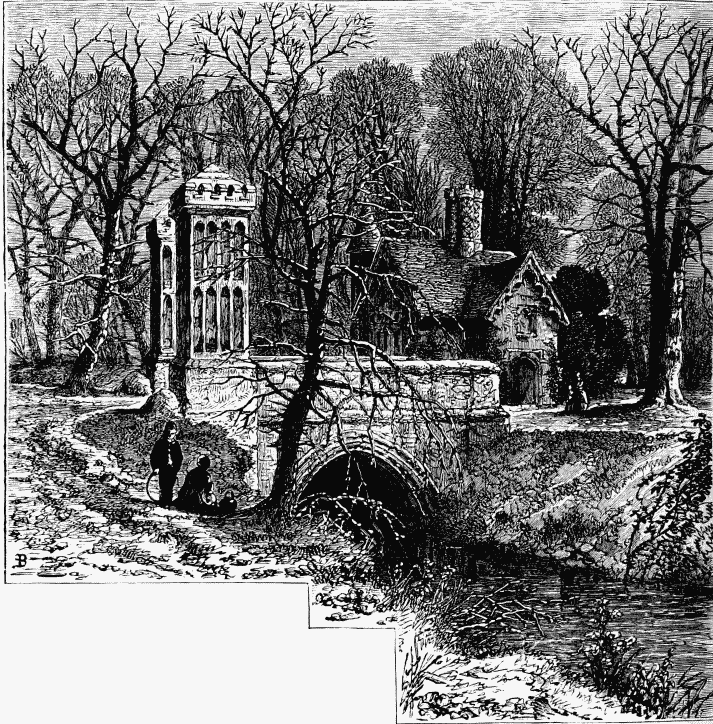
THE MOAT, FULHAM PALACE.
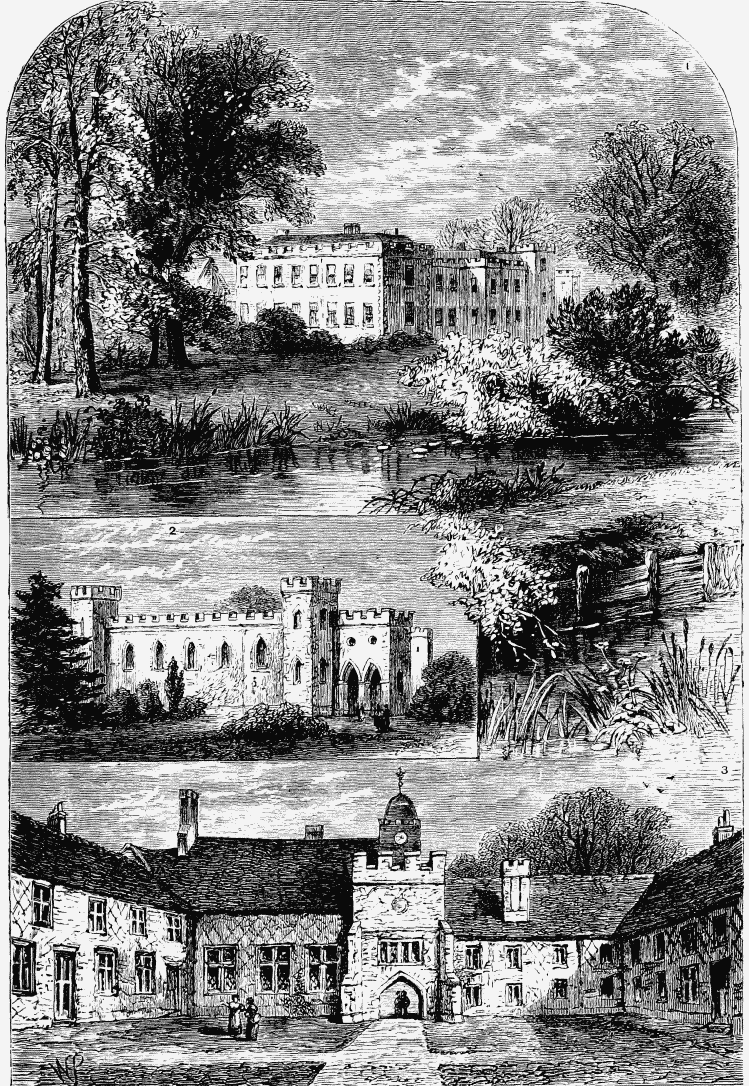
FULHAM PALACE IN 1798.
1. South east Front.
2. The Chapel.
3. Inner Courtyard.
The manor of Fulham, we may here state, is one of the oldest in England, having been granted in 631, by the Bishop of Hereford, to Bishop Erkenwald, of London, so that it has existed as an appanage of the see for upwards of twelve hundred years. This manor was originally held by service of prayers and masses for the dead; but at a later period military service was exacted from all holders of manors. The only service now required from the Bishop of London is the maintenance of a watchman to guard the garden and grounds. There is every reason to believe that the manorhouse here was occupied at the time of the Conquest; but the first mention of this was in the account of the capture of Robert de Sigillo, Bishop of London, who was a partisan of the Empress Maud, and was made prisoner and held to ransom by the followers of Stephen. Bishop Richard de Gravesend resided much at Fulham, and died here in 1303. His successor, Richard Baldock, who was Lord Chancellor of England, dates most of his public acts from Fulham Palace; but Bishop Braybroke, who enjoyed the same high office, and presided over the see of London nearly twenty years, seems to have spent but little of his time at this place, as he resided mostly at Stepney. Lysons, in his "Environs of London," says that "of Bishop Bonner's residence at Fulham, and of his cruelties, some facts are recorded in history, and many traditions are yet current. A large wooden chair, in which he is said to have sat to pass sentence upon heretics," he adds, "was placed, a few years ago, in a shrubbery near the palace, which gave occasion to an elegant poem, written by Miss Hannah More, who was then on a visit at the bishop's." This poem, called "Bishop Bonner's Ghost," was printed at the Earl of Oxford's private press at Strawberry Hill. One deprived bishop of the English Church, John Byrde (who was the last "provincial" of the Carmelites, and afterwards became Bishop of Chester), seems to have found an asylum with Bonner, and was living with him at Fulham in 1555. "Upon his coming," says Anthony Wood, in his "Athenæ Oxonienses," "he brought his present with him—a dish of apples and a bottle of wine." Bishop Aylmer, or Elmer, was principally resident at Fulham Palace, where he died in 1594. The zeal with which he supported the interests of the Established Church exposed him to the resentment of the Puritans, who, among other methods which they took to injure the bishop, attempted to prejudice the queen against him, alleging that he had committed great waste at Fulham by cutting down the elms; and, punning upon his name, they gave him the appellation of Bishop Mar-elm; "but it was a shameful untruth," says Strype, "and how false it was all the court knew, and the queen herself could witness, for she had lately lodged at the palace, where she misliked nothing, but that her lodgings were kept from all good prospect by the thickness of the trees, as she told her vice-chamberlain, and he reported the same to the bishop."
Fulham Palace has been honoured with the presence of royalty on several occasions. Norden says that Henry III. often lay there. Bishop Bancroft here received a visit from Queen Elizabeth in 1600, and another two years later. King James likewise visited him previously to his coronation. In 1627, Charles I. and his queen dined here with Bishop Mountaigne.
During the Civil Wars we find that most of the principal inhabitants of Fulham, as might have been expected, were staunch Royalists. One of the most prominent was the Bishop (Juxon) who attended his royal master on the scaffold, and to whom the king addressed his last mysterious word, "Remember!" Juxon was deprived of his see, and the manor and palace of Fulham were sold to Colonel Edward Harvey, in 1647. The bishop then retired to his own house at Compton, in Gloucestershire, where he had the singular good fortune to remain undisturbed until the Restoration. With reference to this fact, old Fuller quaintly remarks:—"For in this particular he was happy above others of his order, that whereas they may be said in some sort to have left their bishoprics, flying into the king's quarters for safety, he stayed at home till his bishopric left him, roused him from his swan's nest at Fulham, for a bird of another feather to build therein." It should be mentioned here that a large tithe-barn which stands in the palace grounds was built by Colonel Harvey during his temporary tenure of the place under the Commonwealth. On a beam over the doors is carved the date, 1654.
The moat which encompasses the palace grounds is about a mile in circumference, and has been considered by some antiquaries to have been formed by the Danish army, when they were encamped in this neighbourhood in 879. Mr. Blomfield, in his "Olden Times of Fulham," observes: "As winter came on, it is not improbable that they [the Danes] found the high tides encroaching seriously on their position; and not liking to leave the river and run the risk of being cut off from their ships, they set vigorously to work, and threw up a bank with a ditch along the river-flank of their army. The work once begun would not be hastily relinquished. Having to pass the winter in a hostile country, they would naturally be anxious to fortify their position by carrying the ditch round the whole camp. The Danish army gone, it was not likely that any bishop would be at the expense of levelling the banks and filling up a ditch of such magnitude, enclosing as it does, and protecting from the river, a space of ground in the centre of his manor most convenient for making a residence."
Enveloped as its origin is in mystery, it is certain, from existing documents, that this moat has been the subject of various disputes, and a cause of annoyance, or at least of discomfort, to many successive bishops. In 1618, Dr. Edwardes, Chancellor of the diocese of London, left £10, "towards erecting a sluice to communicate with the river Thames, to preserve the moat from noisomeness." Before this, the water was never changed; the moat was only filled by the water which filtered in through the banks, and stood stagnant from years' end to years' end. After the formation of the sluice, the water was changed once a month. To cleanse this immense moat, to make additional sluices, to replace the river embankments, to raise by several feet a water-meadow of many acres, to renew all the fences, and to put the whole of a neglected estate into a condition of perfect order, appeared in Bishop Blomfield's eyes a duty laid upon him as a trustee of Church property, and in the discharge of that duty he spent as much as £10,000.
At a short distance westward of the palace stands Craven Cottage, a charming retreat by the waterside. It was originally built for the Countess of Craven, afterwards Margravine of Anspach, but has been considerably altered and enlarged by subsequent proprietors. After the Margravine, the cottage was for some years the residence of Mr. Denis O'Brien, the friend of Charles James Fox, and in 1805 it was sold to a Sir Robert Barclay. Mr. Walsh Porter, who was its next occupant, is said to have spent a large sum in altering and embellishing it. About 1843 it became the residence of Sir E. Bulwer Lytton. He was living here in 1846, when he entertained Prince Louis Napoleon at dinner, after his then recent escape from the fortress of Ham. The house was at one time the residence of a celebrated moneylender, who was generally known as "Jew King." He was, as Captain Gronow tells us, in his amusing "Reminiscences," a man of some talent, and had good taste in the fine arts. He had made the peerage a complete study, knew the exact position of every one who was connected with a coronet, the value of his property, how deeply the estates were mortgaged, and what encumbrances weighed upon them. Nor did his knowledge stop there; by dint of sundry kind attentions to the clerks of the leading banking-houses, he was aware of the balances they kept, and the credit attached to their names, so that, to the surprise of the borrower, he let him into the secrets of his own actual position. He gave excellent dinners, at which many of the highest personages of the realm were present; and when they fancied that they were about to meet individuals whom it would be upon their conscience to recognise elsewhere, were not a little amused to find clients quite as highly placed as themselves, and with purses quite as empty. King had a well-appointed house in Clarges Street, Piccadilly; but it was here that his hospitalities were most lavishly and luxuriously exercised. Here it was that Sheridan told his host that he liked his dinner-table better than his multiplication table; to which his host, who was not only witty, but often the cause of wit in others, replied, "I know, Mr. Sheridan, your taste is more for Jo-king than for Jew King," alluding to the admirable performance of the actor, King, in Sheridan's School for Scandal.
Craven Cottage, as left by Walsh Porter in 1809, was considered the prettiest specimen of cottage architecture then existing. The three principal reception-rooms are described as having been equally remarkable for their structure as well as their furniture. "The centre, or principal saloon," Croker tells us in his "Walk from London to Fulham," "was supported by palm-trees of considerable size, exceedingly well executed, with their drooping foliage at the top, supporting the cornice and architraves of the room. The other decorations were in corresponding taste. … This room led to a large Gothic dining-room of very considerable dimensions, and on the front of the former apartment was a very large oval rustic balcony, opposed to which was a large half-circular library, that became more celebrated afterwards as the room in which the highly-gifted and talented author of 'Pelham' wrote some of his most celebrated works." Along the Thames side of the house a raised terrace was constructed, and the grounds were laid out with great taste.
Continuing our course westward a short distance farther, we come to a house known as the "Crab Tree," which has long been familiar to all Thames oarsmen, amateurs and professionals alike. The crab is the indigenous apple-tree of this country, and its abundance in this neighbourhood formerly gave its name to the adjoining part of the parish. Faulkner, in his "History of Fulham," remarks that "it has been said by some ancient people that Queen Elizabeth had a country seat here. Some few years ago," he adds, "a very ancient outbuilding belonging to Mr. Eayres fell to the ground through age. Upon clearing away the rubbish, the workmen discovered, in the corner of a chimney, a black-letter Bible, handsomely bound and ornamented with the arms of Queen Elizabeth, in good preservation."
Early in the present century a villa was built on the banks of the Thames, near the "Crab Tree," for the Earl of Cholmondeley. The design for the edifice was taken from a villa in Switzerland, which his lordship had seen on his travels. The house was built chiefly of wood, of the earl's own growing, and the interior was principally fitted up with cedar of the largest growth ever produced in this country. The exterior was covered with coloured slates, having nearly the same appearance and solidity as stone. The front next the river was ornamented with a colonnade, extending the whole length of the building, and thatched with reeds, to correspond with the roof. The house, however, has long since been pulled down.
Passing up Crab Tree Lane, and returning to the village by the Hammersmith and Fulham Road, we pass on our left the cemetery for the parish of Fulham, which was opened in 1865. It is laid out in Fulham Fields, and covers several acres of land which had previously served to rear fruit and vegetables. The land all around for a considerable distance, stretching away towards Hammersmith and North End, is still covered with market-gardens, excepting here and there where a few modern buildings have been erected. Among these is the St. James's Home and Penitentiary, which was originally established at Whetstone.
Continuing our course eastward, we reach the High Street, which extends from the London—or rather Fulham—Road to Church Row. This thoroughfare appears at one time to have been called Bear Street, and in the more ancient parishbooks it is denominated Fulham Street.
The old "Golden Lion," in this street, which was pulled down only a few years ago to make room for a new public-house bearing the same sign, is closely connected by tradition with the annals of the palace. The old house, which dated back to the reign of Henry VII., is said to have been the residence of Bishop Bonner, and when converted into an inn, to have been frequented by Shakespeare, Fletcher, and other literary celebrities. Bishop Bonner, according to one account, died at Fulham in his arm-chair, smoking tobacco; and the late Mr. Crofton Croker, in a paper read by him before the British Archæological Association at Warwick, tried to show that an ancient tobacco-pipe, of Elizabethan pattern, found, in situ, in the course of some alterations made in 1836, was the veritable pipe of that right reverend prelate! Strange stories are told of a subterranean passage which existed, it is said, between this house and the palace. On the pulling down of the old "Golden Lion," the panelling was purchased by the second Lord Ellenborough, for the fitting up of his residence, Southam House, near Cheltenham.
The Workhouse formerly stood on the east side of the High Street. It was built in 1774, but had been in a dilapidated condition for many years, and was pulled down about 1860; a large building to be used as the Union for the joint parishes of Fulham and Hammersmith having been erected in Fulham Fields. Cipriani, the distinguished Florentine painter, lived for some time in a house adjoining the old workhouse; he died in London in 1783.
In order to gain some idea of what the external appearance of Fulham was at the commencement of the last century, we have only to suppose ourselves carried back to that date, and to be walking through the village with old Master Bowack, the author of a "History of Fulham" published about that time. We shall observe, as he tells us, "that the houses are commonly neat and well built of brick, and from the gate of the Queen's Road run along on both sides of the way almost as far as the church. Also from the Thames side into the town stands an entire range of buildings, and upon the passage leading to the church, called Church Lane, are several very handsome airy houses. But the buildings run farthest towards the north, extending themselves into a street through which lies the road a very considerable way towards Hammersmith. Besides, there are several other handsome buildings towards the east, called the Back Lane, and a great number of gardeners' houses scattered in the several remote parts of the parish." Judging from the above description, a visitor to Fulham now would find that the locality has undergone (in external appearance, at least) marvellously little alteration during the time that has elapsed since it was written. "Except that the Back Lane has apparently lost most of its architectural gems, and that Elysium Row has sprung into existence and grown old and venerable since then," writes Mr. Blomfield, in his work above quoted, "The principal features of the town (whitewash and stucco apart) appear to be much the same. The aspect of the river-side was, of course, very different. The bridge was not built till twenty years later, and the road came down to the bank, and, indeed, in a pleasant green, on one side of which stood the old 'Swan' Inn, and the other side was overshadowed by elm-trees. A clump of trees stood at one corner of the road, above which rose the tower of the church, with its leaden spire, and at the riverside lay the ferry-boat, waiting for passengers. Fulham was then a point for pleasure-parties on the water, as Richmond and Kew are now. In comparing our appearance now with what it was then," continues Mr. Blomfield, "we must not, of course, venture beyond the pump at the end of High Street, and get entangled in the mushroom growth of semi-detached villas which have been for years slowly but relentlessly driving back the struggling market-gardener from point to point into the river. We must think of the London Road as it was at that time, not bordered by comfortable houses, rows of snug-looking whitewashed villas, smart public-houses, or red-brick hospitals, but with a yawning ditch on each side, and, beyond these, green fields and garden-grounds, hedges and orchards, and now and then a clump of elms and a farmhouse or a gardener's cottage peeping through; for as to regular roadside houses, you would not pass a score between Fulham Pump and Hyde Park. Nor must we forget that the traveller would observe between Fulham and London certainly not less than three gallows-trees, bearing their ghastly fruit of highwaymen hung in chains. Then the road itself was very different from what it is now: the only idea at that time of making a good road was to pave it, and, accordingly, the Fulham Road was paved, but only in one or two places; till, at length, what with part being badly paved, and part left unpaved, and deep in its native mud; what with the narrowness of the way in many places, and the depth of the ditches on each side, the road grew so dangerous that, a few years later, it was found necessary to take the matter up in Parliament. It then appeared that a rate of two shillings in the pound was not considered sufficient to put the road into a safe state; that it was almost impassable in winter; and that a great deal of mischief had been done to persons who travelled on that road." If this were so, the state of the road will almost seem to justify the derivation of the name of the village as the Foulham." (fn. 4)
Seeing the Fulham Road as it is now, swarming with omnibuses and butchers' carts, carriages, and coal-wagons, it is very difficult to imagine its condition a century and a half ago, with perhaps "a solitary market-wagon toiling through the mud, or drawing to one side, at the imminent risk of sliding into the ditch, to allow the Duchess of Munster—who lived in a large mansion near the entrance to the village—to pass by in her great lumbering coach and six, tearing along at the dangerous rate of five miles an hour!" But bad as the Fulham Road was in the olden time, the inconvenience of having to travel over it was, to Bishop Laud, at least, an advantage; for, as we have already had occasion to mention in our account of Whitehall, (fn. 5) in one of his letters to Lord Strafford, alluding to his health as not being so good as it was formerly, he expresses a regret that in consequence of his elevation to the see of Canterbury he has now simply to glide across the river in his barge, when on his way either to the Court or the Star-Chamber; whereas, when Bishop of London, there were five miles of rough road between Fulham Palace and Whitehall, the jolting over which in his coach he describes as having been very beneficial to his health.
Holcrofts, which stands on the left side of the Fulham Road, as we pass from the top of the High Street, dates from the early part of the last century, when it was built by Robert Limpany, a wealthy merchant of London, whose estate in this parish was so considerable that, as Bowack tells us, "he was commonly called the Lord of Fulham." The house, which formerly had a long avenue of trees in front of it, was sold to Sir William Withers, in 1708, and became afterwards successively the residence of Sir Martin Wright, one of the Justices of the King's Bench, and of the Earl of Ross. The building was subsequently known as Holcrofts Hall, and was for some time occupied by Sir John Burgoyne, who here gave some clever dramatic performances. Here it was that the celebrated Madame Vestris lived, after her marriage with Charles Mathews, the well-known actor, and here she died in 1856, at which time the house was called Gore Lodge.
Holcrofts Priory, on the opposite side of the road, was built about the year 1845, on the site of an old Elizabethan mansion called Claybrooke House, from a wealthy family of that name who owned the property in the seventeenth century. One of the family was buried in Fulham Church in 1587. Claybrooke House was in the occupation of the Frewens at the commencement of the last century, and afterwards became the property of the above-mentioned Robert Limpany. For many years prior to its demolition it was used as a seminary for young ladies.
In Elysium Road, near the High Street, is a large and handsome ecclesiastical-looking edifice, in the Gothic style. This is an Orphanage Home, under the patronage of the Bishop of London, founded a few years ago by Mrs. Tait, the wife of Bishop (since Archbishop) Tait.
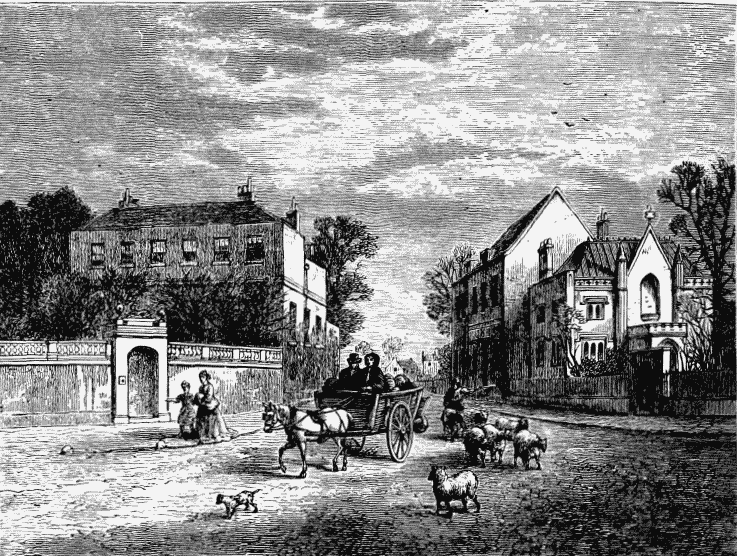
HOLCROFTS AND THE PRIORY, FULHAM.
In Burlington Road, formerly known as Back Lane, the thoroughfare running parallel with the High Street on its eastern side, and extending from the corner of Fulham Road to King's Road, Fulham Almshouses originally stood; they were founded, as already stated, by Sir William Powell, in 1680, but rebuilt near the parish church in 1869. Burlington House, whence the road derives its name, was for upwards of a century a well-known academy kept at one time by a Mr. Roy. On the grounds attached to the house is now a Reformatory School for Females; it was built about 1856.
Farther along the Fulham Road, on the north side, stands Munster House, which is supposed to owe its name to Melesina Schulenberg, who was created by George I., in 1716, Duchess of Munster. According to Faulkner, it was at one time called Mustow House; but as Mr. Croker suggests, in his "Walk from London to Fulham," "this was not improbably the duchess's pronunciation." Faulkner adds that tradition makes this house a hunting-seat of Charles II., and asserts that an extensive park was attached to it; but there seems to be no foundation for the statement. In the seventeenth century the property seems to have belonged to the Powells, from whom it passed into the possession of Sir John Williams, Bart., of Pengethly, Monmouthshire. In 1795, Lysons tells us, the house was occupied as a school; and in 1813 Faulkner informs us that it was the residence of M. Sampayo, a Portuguese merchant. It was afterwards for many years tenanted by Mr. John Wilson Croker, M.P., Secretary of the Admiralty, and whose name is well known as the editor of "Boswell's Johnson." About 1820 Mr. Croker resigned Munster House as a residence, "after having externally decorated it with various Cockney embattlements of brick, and collected there many curious works of art, possibly with a view of reconstruction." On the gate-piers were formerly two grotesque-looking composition lions, which had the popular effect, for some time, of changing the name to Monster House.
On the opposite side of the road is an extensive garden for the supply of the London market, by the side of which runs Munster Road, whence a turning about half-way down leads on to Parson's Green. Fulham Lodge, which stood on the south side of the main road, close by Munster Terrace, was a favourite retreat of the Duke of York, and for some time the home of George Colman the Younger. Fulham Park Road covers the spot whereon the lodge stood.
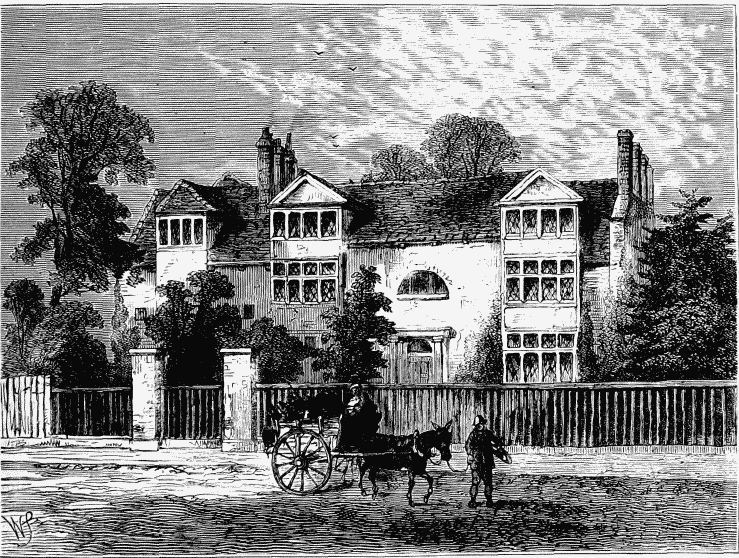
RICHARDSON'S HOUSE AT PARSON'S GREEN (1799).
Continuing along the Fulham Road about a
quarter of a mile, we reach Percy Cross, or rather,
as it was formerly called, Purser's Cross. Here
Lord Ravensworth has a suburban residence, in
the garden of which is a fine specimen of an
old "stone pine," reminding us of Virgil's line—
"Pulcherrina pinus in hortis."
The mansion is concealed from the road by a high
brick wall, and although to outward appearance it
is small and unostentatious, yet, in reality, it is
more capacious and attractive than it looks. The
Queen and Prince Albert honoured the late Lord
Ravensworth with a visit here in June, 1840.
The grounds at the back of the house owe their
charm to a former occupier, Mr. John Ord, a
Master in Chancery, who about the middle of the
last century planted them with such skill and
taste that, though not extensive, they held a foremost rank among the private gardens in the neighbourhood of London.
"Purser's Cross" is mentioned as a point "on the Fulham Road, between Parson's Green and Walham Green," so far back as 1602; and the place has never been in any way connected with the "proud house of Percy." In the "Beauties of England and Wales," Purser's Cross is said to be a corruption of Parson's Cross, and the vicinity of Parson's Green is mentioned in support of this conjecture. However, that "Purser," and not "Percy" Cross, has been for many years the usual mode of writing the name of this locality, is established by an entry in the "Annual Register" in 1781. At Percy Cross was at one time the residence of Signor Mario and Madame Grisi.
On the opposite side of the road to Lord Ravensworth's house is Walham Lodge, formerly called Park Cottage, a modern, well-built house, standing within extensive grounds, surrounded by a brick wall. Here for some years lived Mr. Brande, the eminent chemist, whose lectures on geology, delivered at the Royal Institution in 1816, acquired great popularity.
A house, now divided into two, and called Dungannon House and Albany Lodge, abuts upon the western boundary of Walham Lodge. Tradition asserts that this united cottage and villa were, previous to their separation, known by the name of Bolingbroke Lodge, and as such became the frequent resort of Pope, Gay, Swift, and others of that fraternity; but it would seem as if tradition had mixed up this house with Bolingbroke House, Battersea, which we have lately described. (fn. 6)
A few yards from Dungannon House, on the same side of the road, opposite to Parson's Green Lane, stands Arundel House, an old mansion, supposed to date from the Tudor period. It appears to have been newly fronted towards the close of the last century; and in 1819 the house was in the occupation of the late Mr. Hallam, the historian of the Middle Ages.
On the opposite side of the road is the carriage entrance to Park House, which stands in Parson's Green Lane. A stone tablet let into one of the piers of the gateway is inscribed, "Purser's Cross, 7th August, 1738." This date has reference to the death of a highwayman which occurred here, and of which the London Magazine gives the following particulars:—"An highwayman having committed several robberies on Finchley Common, was pursued to London, where he thought himself safe, but was, in a little time, discovered at a publichouse in Burlington Gardens, refreshing himself and his horse; however, he had time to re-mount, and rode through Hyde Park, in which there were several gentlemen's servants airing their horses, who, taking the alarm, pursued him closely as far as Fulham Fields, where, finding no probability of escaping, he threw money among some country people who were at work in the field, and told them they would soon see the end of an unfortunate man. He had no sooner spoke these words but he pulled out a pistol, clapped it to his ear, and shot himself directly, before his pursuers could prevent him. The coroner's inquest brought in their verdict, and he was buried in a cross-road, with a stake through him; but it was not known who he was."
Park House, in Parson's Green Lane, is said to be a fac-simile of an older mansion, called Quibus Hall, which occupied the same site. The old hall at one time belonged to the Whartons. Lysons, on the authority of the parish books, states that a Sir Michael Wharton was living here in 1654. When the house was rebuilt, it was for a time called High Elms House. A small house opposite, Audley Cottage, was for many years the residence of the late Mr. Thomas Crofton Croker, F.S.A., who wrote a minute description of the place, which is reprinted in the "Walk from London to Fulham," to which we are indebted for some of the particulars here given. The name of the place, which was at one time Brunswick Cottage, was altered by Mr. Croker to Rosamond's Bower, the property hereabouts having at some distant date formed part of a manorial estate called Rosamonds, which in the fifteenth century belonged to Sir Henry Wharton. Lysons, in his "Environs of London," states that "the site of the mansion belonging to this estate, now (1795) rented by a gardener, is said, by tradition, to have been a palace of Fair Rosamond." This house was taken down about the year 1825, and the stables of Park House built on the site. With reference to the present building, an ordinary two-storeyed dwelling-house, Mr. Croker wrote:—"When I took my cottage, in 1837, and was told that the oak staircase in it had belonged to the veritable 'Rosamond's Bower,' and was the only relic of it that existed, and when I found that the name had no longer a precise 'local habitation' in Fulham, I ventured, purely from motives of respect for the memory of the past, and not from any affectation of romance, to revive an ancient parochial name, which had been suffered to die out 'like the snuff of a candle.' In changing its precise situation, in transferring it from one side of Parson's Green Lane to the other—a distance, however, not fifty yards from the original site—I trust when called upon to show cause for the transfer to be reasonably supported by the history of the old oak staircase."
Parson's Green is a triangular plot of ground at the southern end of the lane, at its junction with King's Road; and it was so called from the parsonage-house of the parish of Fulham, which stood on its west side, but was pulled down about the year 1740. The Green, on which successive rectors and their families disported themselves, is for the most part surrounded by small cottages. There used to be held on the Green annually on the 17th of August, a fair, which had, as Faulkner tells us, "been established from time immemorial."
"An ancient house at the corner of the Green," writes Lambert, in his "History and Survey of London and its Environs," in 1805, "formerly belonged to Sir Edmund Saunders, Lord ChiefJustice of the Court of King's Bench in 1682, who raised himself to the bench from being an errand-boy in an attorney's office, where he taught himself the mysteries of the law by copying papers in the absence of the regular clerks. This house," he adds, "was the residence of Samuel Richardson, the author of 'Sir Charles Grandison,' 'Pamela,' &c." We have already spoken of Richardson in our accounts of Fleet Street and of Hampstead, (fn. 7) and we shall have still more to say about him when we reach North End, on our way to Hammersmith.
In Dodsley's "Collection of Poems" are the following verses on an alcove at Parson's Green, by
Mrs. Bennet, sister of Mr. Edward Bridges, who
married Richardson's sister:—
"O favourite Muse of Shenstone, hear!
And leave awhile his blissful groves;
Aid me this alcove to sing,
The author's seat whom Shenstone loves.
"Here the soul-harrowing genius form'd
His 'Pamela's' enchanting story,
And here—yes, here—'Clarissa' died
A martyr to her sex's glory."
* * * * *
"O sacred seat! be thou revered
By such as own thy master's power;
And, like his works, for ages last,
Till fame and language are no more."
Seeing, however, that "Clarissa Harlowe" and "Sir
Charles Grandison" were both written between
1747 and 1754, and that Richardson did not take
up his abode here till 1755, it is North End, and
not Parson's Green, that may lay claim to being
the seat of their production. Edwards, the author
of "Canons of Criticism," died at Parson's Green
in 1757, whilst on a visit to Richardson.
A century or two ago Parson's Green was noted for its aristocratic residents. East End House, on the east side, was built at the end of the seventeenth century for Sir Francis Child, who was Lord Mayor of London in 1699. The house was inhabited by Admiral Sir Charles Wager; and by Dr. Ekins, Dean of Carlisle, who died there in 1791. Mrs. Fitzherbert was at one time a resident here; and, according to Mr. Croker, she erected the porch in front of the house as a shelter for carriages. Here, naturally enough, the Prince of Wales (afterwards George IV.) was a frequent visitor. Madame Piccolomini, too, lived for some time on the east side of the Green.
Another distinguished resident at Parson's Green in former times was Sir Thomas Bodley, the founder of the Bodleian Library at Oxford. Rowland White, Lord Strafford's entertaining and communicative correspondent, was his contemporary there. "When the great Lord Chancellor Bacon fell into disgrace, and was restrained from coming within the verge of the Court, he procured a licence (dated September 13, 1621) to retire for six weeks to the house of his friend, Lord Chief-Justice Vaughan, at Parson's Green." So wrote Lysons in 1795; but Faulkner says, "This could not be the Sir John Vaughan who was Lord Chief-Justice in 1668. We know of no other who was Lord Chief-Justice. In the parish books," he adds, "the person to whose house Lord Bacon retired is called 'The Lord Vaughan,' who probably resided in the house now (1813) occupied by Mr. Maxwell, as a boarding-school, and called Albion House, a spacious mansion, built in that style of architecture which prevailed at the commencement of the reign of James I."
Close by Parson's Green is another open space, called Eelbrook Common, which "from time immemorial" has been used as a place of recreation for the dwellers in the neighbourhood. This plot of ground recently became the subject of a question in the House of Commons, in consequence of encroachments made upon it, the Ecclesiastical Commissioners, as lords of the manor, having disposed of some portion of it for building purposes, thus encroaching on the rights of the public.
On the south-west side of the Green, near Eelbrook Common, is Peterborough House, formerly the residence of the Mordaunts, Earls of Peterborough, whom we have already mentioned in our account of Fulham Church.
The present building, a modern structure, dating from the end of the last century, has replaced an older mansion, which is described by Bowack as "a very large, square, regular pile of brick, with a gallery all round it upon the top of the roof. It had," he continues, "abundance of extraordinary good rooms, with fine paintings." The gardens and grounds covered about twenty acres, and were beautifully laid out, after the fashion of the period. Swift, in one of his letters, speaks of Lord Peterborough's gardens as being the finest he had ever seen about London. The ancient building was known as Brightwells, or Rightwells, and was the residence of John Tarnworth, one of Queen Elizabeth's Privy Councillors, who died here in 1569. The place afterwards belonged to Sir Thomas Knolles, who sold it to Sir Thomas Smith, Master of the Court of Requests. He died here in 1609, and his widow soon afterwards married the first Earl of Exeter, whilst Sir Thomas's only daughter married the Honourable Thomas Carey, the Earl of Monmouth's second son, who, in right of his wife, became possessor of the estate. After him, the place was named Villa Carey. In 1660, Villa Carey was occupied by Lord Mordaunt, who had married the daughter and heiress of Mr. Carey. This Lord Mordaunt took a prominent part in bringing about the restoration of Charles II., after which event he seems to have quietly settled down on his estate at Parson's Green, where he died in 1675. John Evelyn, in his "Diary," under date of November 29, 1661, thus makes mention of a visit to Lord Mordaunt:—"I dined at the Countess of Peterborow's, and went that evening to Parson Greene's house with my Lord Mordaunt, with whom I staid that night." By "Parson Greene's house," Evelyn no doubt meant Parson's Green House. Later on, December 2nd, 1675, Evelyn makes the following (more correct) entry in his "Diary:"—"I visited Lady Mordaunt at Parson's Green, her son being sick."
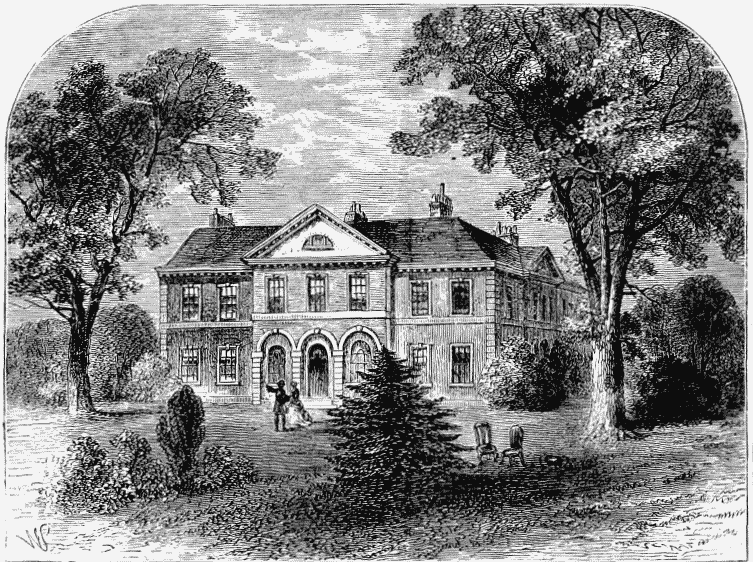
PETERBOROUGH HOUSE.
Lord Mordaunt's son, Charles, subsequently known as Earl of Monmouth, distinguished himself as a military character prior to the Revolution, and also in the reigns of William and Mary and Queen Anne. He succeeded to the earldom of Peterborough on the death of his uncle in 1697. He was twice married; his second wife was the accomplished singer, Anastasia Robinson, who survived him. The earl was visited at Peterborough House by all the wits and literati of his time, including Pope, Swift, Locke, and many others. Faulkner, in his "History of Fulham," says that Miss Robinson "continued to sing in the Opera till the year 1723, when she retired, in consequence, as it is supposed, of her marriage with the Earl of Peterborough, for she at that time went to reside at a house in Parson's Green, which the earl took for herself and her mother." Sir John Hawkins, in his "History of Music," says she resided at Peterborough House, and presided at the earl's table, but she never lived under the same roof with him till she was prevailed on to attend him in a journey, which he took a few years before his death, on account of his declining health. During her residence at Fulham she was visited by persons of the highest rank, under a full persuasion, founded on the general tenor of his life and conduct, that she had a legal right to a rank which, for prudential reasons, she was content to decline. She held frequent musical parties, at which Bononcini, Martini, Tosi, Greene, and the most eminent musicians of that time assisted; and they were attended by all the fashionable world. It was some years before the earl could prevail upon himself to acknowledge her as his countess; nor did he, till 1735, publicly own what most people knew before; he then proclaimed his marriage like no other husband. He went one evening to the rooms at Bath, where a servant was ordered distinctly and audibly to announce "Lady Peterborough's carriage waits!" Every lady of rank immediately rose and congratulated the declared countess.
After Lord Peterborough's death, the house was sold to a Mr. Heaviside, from whom it was subsequently purchased by Mr. John Meyrick, father of Sir Samuel Meyrick, the well-known antiquary and writer on armour. He pulled the old mansion down, and built the present house on the site.
It is recorded in Faulkner's "History of Kensington," that in a vineyard at Parson's Green some Burgundy grapes were ripe in October, 1765, and that the owner of the vineyard was about to make wine from them, as he did yearly.
King's Road, which skirts the southern side of the Green, leads direct eastward on to Chelsea, and passing westward unites with Church Street, at the end of Burlington Road. At a short distance from the Green, in the King's Road, stands Ivy Cottage, which was built at the end of the last century by Walsh Porter, and is in a debased Gothic style of architecture. Faulkner states that "there is a tradition that on the site of this bijou of a cottage was formerly a house, the residence of Oliver Cromwell, which was called the Old Red Ivy House. The house was for some time the residence of the late Mr. E. T. Smith, the well-known theatrical manager, who gave it the name of Drury Lodge, after the theatre of which he was then the lessee. The house, several years ago, resumed its old name of Ivy Cottage. Here, in 1878, died the Rev. R. G. Baker, who was many years Vicar of Fulham, and well known as an antiquary.
In Church Street (formerly Windsor Street, according to Faulkner) stand the Fulham Charity Schools, which were erected in 1811. Close by is a pottery, which has existed here for upwards of two centuries. It was established by John Dwight, who, after numerous experiments, took out a patent, dated 23rd of April, 1671, which was renewed in 1684, for the making of "earthenwares, known by the name of white goyes (pitchers), marbled porcelain vessels, statues and figures, and fine stone gorges never before made in England or elsewhere." Another branch of industry at one time carried on at Fulham was the manufacture of Gobelin tapestry; but the articles produced were too costly to command a large sale. Mr. Smiles, in his "Huguenots," writes: "A French refugee named Passavant purchased the tapestry manufactory at Fulham, originally established by the Walloons, which had greatly fallen into decay. His first attempts at reviving the manufacture, however, were not successful, and so the industry was removed to Exeter."
Before leaving the village of Fulham, and making our way to Walham Green and North End, we may remark that this neighbourhood—if it has not always been remarkable for the healthiness or longevity of its inhabitants—can boast of having produced at least one centenarian. In the Mirror for 1833, we find this record: "Mr. Rench, of Fulham, who planted the elms in Birdcage Walk from saplings reared in his own nursery, died in 1783, aged 101, in the same room in which he had been born."