The Environs of London: Volume 1, County of Surrey. Originally published by T Cadell and W Davies, London, 1792.
This free content was digitised by double rekeying. All rights reserved.
Daniel Lysons, 'Richmond', in The Environs of London: Volume 1, County of Surrey(London, 1792), British History Online https://www.british-history.ac.uk/london-environs/vol1/pp436-469 [accessed 30 April 2025].
Daniel Lysons, 'Richmond', in The Environs of London: Volume 1, County of Surrey(London, 1792), British History Online, accessed April 30, 2025, https://www.british-history.ac.uk/london-environs/vol1/pp436-469.
Daniel Lysons. "Richmond". The Environs of London: Volume 1, County of Surrey. (London, 1792), British History Online. Web. 30 April 2025. https://www.british-history.ac.uk/london-environs/vol1/pp436-469.
RICHMOND.
Name.
It is well known that this place received its present name by royal command in the reign of Henry VII. who was Earl of Richmond in Yorkshire. In Doomsday Book it is not mentioned; a record of nearly the same antiquity calls it Syenes (fn. 1); the name was afterwards spelt Schenes (fn. 2), and Shene (fn. 3), and Shene. Some writers, founding their conjectures upon the latter word, which signifies bright or splendid, have supposed it to be expressive of the magnificence of the ancient palace (fn. 4).
Situation and boundaries.
Soil.
Land-tax.
The village of Richmond is distinguished for its beautiful situation upon the banks of the Thames. It lies in the hundred of Kingston, at the distance of about eight miles from Hyde-park-corner. The parish is bounded by Mortlake, Kew, and Petersham. The land which is not inclosed either in the park or the royal gardens is principally arable; the predominant soil is sand, but in some parts of the parish there is clay and gravel. Richmond is assessed the sum of 939l. 2 s. 2 d. to the tand-tax, which is at the rate of one shilling in the pound.
Manor.
It seems probable that the manor of Sheen was included at the time of the Conquest in that of Kingston, which then belonged to the Crown, and was held in demesne. The first mention I find of it is in the reign of King John, when it was the property of Michael Belet, who held it by the service of being the King's butler, having been granted to his ancestors with that office annexed by Henry I. (fn. 5) John, son of Michael Belet, left two daughters, between whom the manor was divided; one of them married— Oliver, and the other John Valletort (fn. 6). Emma Oliver's share was alienated afterwards to Gilbert de Clare Earl of Gloucester (fn. 7). In the early part of the reign of Edward I. the manor of Sheen belonged to Robert Burnell, Bishop of Bath and Wells, who granted it to Otto Grandison and his heirs, with remainder to himself and his heirs (fn. 8). Philip Burnell, the Bishop's nephew, had livery of it 21 Edw. I. (fn. 9) Soon afterwards it appears to have reverted to the Crown, either by exchange or forfeiture. Edward I. was in possession of it towards the latter end of his reign (fn. 10), since which time it has generally been in the hands of the Crown, or settled upon some of the branches of the royal family (fn. 11). It was granted for life to Elizabeth Queen of Edw. IV. (fn. 12); to Anne of Cleve, who surrendered it to Edw. VI. (fn. 13); to Henry Prince of Wales, son of James I. and to Queen Henrietta Maria (fn. 14). It is now held by her present Majesty, whose lease bears date October 1770.
Tenure of land.
Lands in this manor are held by the rod, or copy of court-roll, and descend to the youngest son; or in default of sons, to the youngest daughter. The same customs prevail in the manors of Petersham and Ham (fn. 15).
Richard II. granted as a privilege to his tenants within this manor that his officers should make no demands upon them for corn or other provision (fn. 16).
History of the palace.
Henry I.
Edward I. Edward II. and Edward III.
Death of Anne, Queen of Rich. II. and decay of the palace.
Henry V. restores it.
Sir James Parker slain in a tournament.
The palace burnt.
Second fire.
Fall of the gallery.
Philip I. King of Spain.
Death of Henry VII. Henry VIII. keeps a Christmas at Richmond.
Charles V. Emperor of Germany lodged there. Cardinal Wolsey.
Queen Elizabeth a prisoner there.
The palace afterwards her favourite residence. Eric IV. king of Sweden. Death of Queen Elizabeth. Henry Prince of Wales. Charles I.
It is not certain when the manor-house at Sheen first became a royal palace. A MS. record in the British Museum mentions it as having been the house of Henry I. who granted it, with the manor, to the Belets (fn. 17). From that time till towards the close of the reign of Edward I. it was the property of subjects. Edward I. and II. are known to have resided there (fn. 18). Edward III. closed a long and victorious reign at his palace at Sheen, June 21, 1377 (fn. 19). Queen Anne, his successor's consort, died there in the year 1394. The King was so much affected at her death that he abandoned the palace, and suffered it to fall to ruin (fn. 20), or as others assert, pulled it down. Holinshed says, that "he caused it to be throwen down and defaced. Whereas the former kings of this land, being weary of the citie, used customarily thither to resorte, as to a place of pleasure, and serving highly to their recreation (fn. 21). "Henry V. restored the palace to its former magnificence (fn. 22). Henry VII. held a grand tournament at his manor at Richmond in 1492, when Sir James Parker, in a controversy with Hugh Vaughan for right of coat armour, was killed at the first course. In the year 1499 (fn. 23), the King being then at his palace, it was set on fire by accident; most of the old buildings were consumed. His Majesty immediately caused it to be rebuilt, and gave it the name of Richmond. The picture of Henry V. and his family, the marriage of Henry VI. and that of Henry VII. in the Earl of Orford's collection, at Strawberry-hill, are supposed to have been painted for this monarch, and intended for his palace here. It had been finished but a short time, when a second fire broke out, which did considerable damage (fn. 24). The same year a new gallery fell down, in which the King, and the Prince his son, had been walking only a few minutes before (fn. 25). Philip I., King of Spain, having been driven upon the coast of England by a storm, was entertained in this palace, with great magnificence, in the year 1506 (fn. 26). Henry VII. died there April 21, 1509 (fn. 27). His successor kept his Christmas at Richmond the year after he came to the throne (fn. 28). A tournament was held there on the 12th of January, when the King, for the first time, took a part in those exercises (fn. 29). Charles V. Emperor of Germany, was lodged at Richmond anno 1523 (fn. 30). When Cardinal Wolsey gave the lease of Hampton Court to the King, his Majesty permitted him to reside in Richmond palace, a privilege of which he frequently availed himself. Hall says, that "when the common people, and especially such as had been servants to Henry VII., saw the Cardinal keep house in the manor royal of Richmond, which that monarch so highly esteemed, it was a marvel to hear how they grudged, saying, So, a butcher's dogge doth lie in the manor of Richmond (fn. 31)." They were still more disgusted at the Cardinal's keeping his Christmas there, openly, with great state, when the King himself observed that feast with the utmost privacy at Eltham, on account of the plague (fn. 32). Queen Elizabeth was a prisoner at Richmond for a short time, during the reign of her sister Mary (fn. 33). After she ascended the throne, this palace became one of her favourite places of residence (fn. 34). In her reign, Eric IV. King of Sweden, was lodged there. Queen Elizabeth ended her days at Richmond palace on the 24th of March 1603. In the autumn of that year, the court of Exchequer, the court of Chancery, and other public courts, were removed to Richmond, on account of the plague (fn. 35). The same precaution was taken in 1625 (fn. 36). Henry Prince of Wales resided there in 1605 (fn. 37). It is probable that Charles I. was frequently at this palace, where he formed a large collection of pictures. In the year 1636, a masque was performed before the King and Queen at Richmond, by Lord Buckhurst and Edward Sackville. When the King was in Scotland, in 1641, the Parliament ordered that the young Prince should be sent to Richmond with his governor (fn. 38), probably Bishop Duppa, who is said to have educated Charles II. at this place (fn. 39). In the month of June 1647, Richmond palace was prepared, by order of parliament, for the King's reception (fn. 40), but he refused to go thither. A newspaper of the 29th of August in that year mentions, that the Prince Elector was then at Richmond, and that the King, with the Duke of York, and the Lords, hunted in the New Park, and killed a stag and a buck— "his majesty was very chearful, and "afterwards dined with his children at Syon (fn. 41)."
Description of the palace in 1649.
Library.
The survey taken by order of parliament in the year 1649 (fn. 42), gives a very minute description of the palace as it then existed. The great hall was 100 feet in length, and 40 in breadth; it is described as having a screen at the lower end, over which, says the Survey, is "a fayr foot pace in the higher end thereof; the pavement is square tile, and it is very well lighted and feeled; at the north end is a turret, or clock case, covered with lead, which is a special ornament to that building." The privy-lodgings are described as a free-stone building, three stories high, with fourteen turrets covered with lead, "a very graceful ornament to the whole house, "and perspicuous to the country round about." A round building is mentioned, called the "canted tower," with a stair-case of 124 steps. The chapel was 96 feet long, and 40 broad, "with ca"thedral seats and pews." Adjoining the privy garden was an open gallery, 200 feet long, over which was a close gallery of the same length (fn. 43). No mention is made of a library; yet we are told by a French author, that a Royal Library was established at Richmond, by Henry VII. (fn. 44), and the librarian is reckoned amongst the officers of this palace in the household establishments of Queen Mary (fn. 45) and Houshold Establishment of Queen Mary, a MS. in the library at Dulwich college. Queen Elizabeth. His see was 10 l. per annum. The Survey mentions three pipes which supplied the palace with water, one from the white conduit in the New-park, another from the red conduit in the town fields, and the third from a conduit near the almshouses in Richmond, close to the river. The materials of the palace were valued at 10,782 l. 19s. 2d. It was purchased April 12, 1650, by Thomas Rookesby, William Goodrick, and Adam Baynes, on behalf of themselves and other creditors (fn. 46). It was afterwards purchased by Sir Gregory Norton, who had been one of the King's judges (fn. 47).
Views of Richmond palace.
All the views of Richmond palace, which are extant, were taken before the middle of the last century, while it remained entire. Vandergutch's view, which was engraved for Aurbrey's Antiquities of Surrey, probably from a drawing of Hollar's, seems to give a very good representation of the front towards the water. Having been favoured with the use of this plate, which is deposited in the Bodleian Library, it is here annexed. A view of the same front is engraved in the Monumenta Vetusta (published by the Society of Antiquaries) from a picture belonging to the Earl of Cardigan. Lord Viscount Fitzwilliam has an ancient painting of Richmond palace, by Vinkeboom, taken from the meadow on the other side of the water (fn. 48). Another picture, in the possession of the same nobleman, said to be the work of one Rubens's scholars, has been called The Front of Richmond Palace towards the Green; but there are many reasons for supposing it not to be a representation of that house; for it not only seems very improbable, that the numerous and losty turrets which were so "perspicuous to the country round about," should not be seen; but the front itself is totally unlike that of the old palace towards the green, as described in the Survey, and as in some measure it still exists. In this view there is no range of buildings contiguous to the gateway, nor does the fore ground in the least resemble the green, (fn. 49) which in the Survey is described as "a piece of level turf of 20 acres (only) planted with 113 elms, fortyeight of which stand on the west side, and form a handsome walk." It is much more probable that the painting at Lord Fitzwilliam's was intended to represent the lodge in the Old-park, with the description of which it sufficiently corresponds, and which particularly mentions "a fair gate, of good ornament to the house, standing towards the park."
Removal of pictures to Whitehall.
Manor and palace restored to Queen Henrietta Maria.
Pretender nursed at Richmond.
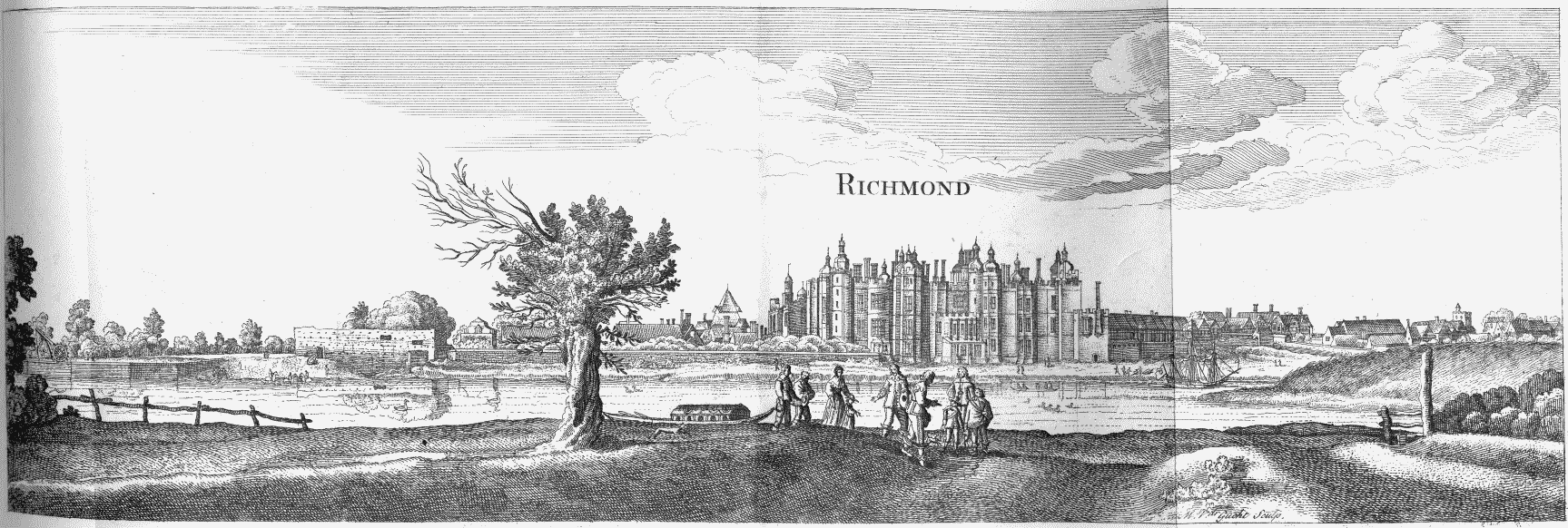
Richmond [Palace]
Soon after the return of Charles II., several boats, "laden with rich and curious effigies, formerly belonging to Charles I. but since allienated," are said to have been brought from Richmond to Whitehall. (fn. 50) About the same time, the manor and palace, which had been settled on the Queen-mother, before the civil war, were restored to her. (fn. 51) It is most probable that the palace was at this time in a very dismantled state. Fuller, who wrote soon after the Restoration, speaks of it as pulled down. (fn. 52) It seems, however, to have been inhabited after his time; several parts of it have been taken down within the present century, and some of the offices still exist. Christopher Villiers was made keeper of the manorhouse at Richmond in 1660. (fn. 53) In the reign of James II. it appears to have been in the hands of the crown, and it is said that the Pretender was nursed there. (fn. 54) The site of the palace is now occupied by several houses, which are held, on lease, under the Crown.
Duke of Queensberry's.
The Duke of Queensberry's was built by George, the third Earl Cholmondeley, who obtained a lease of part of the old palace in the year 1708; the noble gallery in this house was ornamented by his fine collection of pictures. Lord Cholmondeley sold the house afterwards to the Earl of Brooke and Warwick; from him it passed to Sir Richard Littleton, and from the latter to John Earl Spencer, who purchased it for his mother Countess Cowper. The Duke of Queensberry bought it after her death, and transferred hither the pictures and furniture from Amesbury. The tapestry which hung behind the Earl of Clarendon, in the court of Chancery, now decorates the hall of this house.
Mrs. Way's.
A lease of another part of the palace was granted by Queen Anne to Richard Hill, Esq. who built upon the site a large house now the property of Mrs. Sarah Way, widow of Lewis Way, Esq. and the residence of herself and her sister, the Countess Dowager of Northampton, who has some good pictures there, particularly a fine portrait of Sir Thomas Gresham, which has lately been engraved by R. Thew. In the front of this house is an ancient porch with figures of two boys in servitors dresses, blowing trumpets: in the lease it is called the Trumpeting-house.
Other houses on the site of the palace.
The houses now on lease to William Robertson, Esq. and Matthew Skinner, Esq. as well as that in the occupation of Mr. Dundas, which adjoins the gateway, are a part of the old palace, and are described in the Survey above-mentioned, as "the wardrobe buildings, and other offices, consisting of three fayr ranges of buildings lying round a fayr and spacious court, embattled and guttured, of two stories high, with garrets, and a fayr pair of strong gates, arched and battled with stone over head, leading into the said court from the green lying before Richmond house." In Mr. Skinner's garden there still exists the old yew-tree which is mentioned in the Survey, and there valued at 10l. The circumference of its trunk is 10 feet 3 inches.
The elegant villa (fn. 55) which belonged lately to Sir Charles Asgill, Bart. and which is now the property of Whitshed Keene, Esq. is described in the lease, as being on the site of the palace. There is a print of it in the Vitruvius Britannicus (fn. 56).
Convent of Carmelites founded by Edward II.
Edward II. founded a convent of Carmelite friars near his manor of Sheen, and endowed it with 120 marks per annum out of his Exchequer (fn. 57). They had been settled in this convent only two years when the King caused them to be removed to Oxford, where they were placed without the North-gate (fn. 58).
Convent of observant friars, founded by Henry VII.
Henry VII. is said to have founded a convent of observant friars near the palace about the year 1499 (fn. 59). I have not been able to find any record of the foundation. Holinshed mentions its suppression in the year 1534. In the Survey of Richmond above-mentioned, a building is described as adjoining to the palace, called "the Friars, containing three rooms below stayrs, and four handsome rooms above stayrs;" it was then used as a chandler's-shop. The lane which leads from the Green to the Duke of Queensberry's is still called in the leases Friars'-lane; the house, which is now in the occupation of Joseph May, Esq. and that which was lately on lease to John and Henry Andrews, are described as being part of the site of the friars.
Richmond Old-park.
Cardinal Wolsey, at the Lodge.
In the reign of Henry VIII. there were two parks at Richmond, distinguished by the name of the Great and the Little-park. It is probable that they were afterwards laid together, one only being mentioned in the Survey of 1649, which adjoined the Green, and contained 349 acres. It was then called the Little-park, to distinguish it from the New-park lately inclosed by Charles I. The Lodge in the Old-park was for some time the residence of Cardinal Wolsey in his disgrace. "The Cardinal (says Stow) having licence to repair unto Richmond, was there lodged within the lodge of the Great-park, which was a very prettie house; there my Lord lay untill Lent, with a prettie number of servants (fn. 60)." He afterwards removed to the priory.
The park at Richmond was leased by Queen Elizabeth to Edward Bacon (fn. 61). When the Crown lands were sold in the last century, the park which adjoined the Green, then called Richmond Little-park, was valued at 220l. 5s. per annum, and was bought by William Brome of London, Gent. at 32 years purchase (fn. 62). The Lodge, which is described as being a very pleasant seat and habitation for a private gentleman, appears to have been afterwards in the possession of Sir Thomas Jarvis or Jervoyse, and the park in that of Sir John Trevor (fn. 63).
Duke of Ormond.
A lease of the lodge was granted by K. William in 1694 to John Latton, Esq. Queen Anne in the year 1707 granted it for 99 years, or three lives, to James, Duke of Ormond (fn. 64), who rebuilt the house, and resided there till his impeachment in the year 1715; when, on the 27th of July, "he privately withdrew from his house at Richmond and went to Paris (fn. 65)." Soon after this, George II. then Prince of Wales, purchased the remainder of the lease, which after the Duke's impeachment was vested in the Earl of Arran, and made the lodge his residence. After he came to the throne it was one of his favourite retirements. His present Majesty sometimes resided there in the early part of his reign. The lodge was pulled down about twenty years ago, at which time there was an intention of building a new palace upon the site; the foundations were laid and arches built for that purpose.
The observatory.
Not far from the site of the lodge, stands the observatory, built by his present Majesty in the years 1768 and 1769. Sir William Chambers was the architect, and the late Dr. Stephen Demainbray superintended the astronomical department. Amongst a very fine set of instruments are particularly to be noticed a mural arch of 140 degrees, and eight feet radius; a zenith sector of 12 feet; a transit instrument of eight feet; and a ten-feet reflector by Herschel. On the top of the building is a moveable dome which contains an equatorial instrument. The observatory contains also a collection of subjects in natural history, well preserved, an excellent apparatus for philosophical experiments, some models, and a collection of ores from his Majesty's mines in the forest of Hartz in Germany. The present astronomer is the Reverend Stephen Demainbray, M. A.
Richmond gardens.
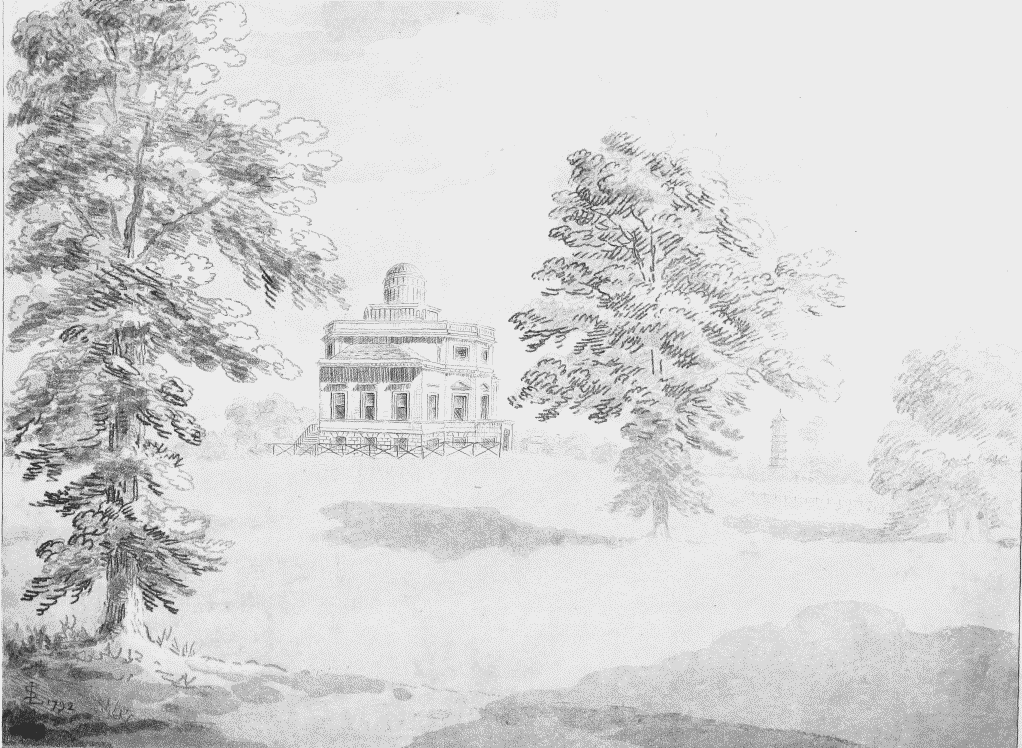
The observatory in Richmond Gardens
A part of the Old-park is now a dairy and grazing farm in his Majesty's own hands; the remainder constitutes the royal gardens, which were first laid out by Bridgman in avenues, and afterwards improved and altered to their present from by Brown. They have the advantage of being situated on the banks of the Thames, are laid out with great taste, and exhibit some very beautiful scenery. Queen Caroline, who was very partial to this spot, had here a dairy and menagerie. Several ornamental and grotesque buildings were dispersed about the gardens; one of which, called Merlin's Cave, contained several figures in wax; another, called the Hermitage, was adorned with busts of Sir Isaac Newton, Locke, and other literary characters (fn. 66).
West Sheen.
Convent of Carthusians.
Hermitage.
About a quarter of a mile to the north-west of the old palace stood the hamlet of West Sheen. Here Henry V. in the year 1414, founded a convent of Carthusians, which he called the House of Jesus of Bethleem at Sheen (fn. 67). The premises on which the convent was built, are said to have been 3,000 feet in length, and 1,305 in breadth (fn. 68). In a MS. of Florentius Wigornensis, printed in Aubrey's Antiquities of Surrey (fn. 69), the dimensions of the hall are said to have been 44 paces in length, and 24 in breadth; the great quadrangle was 120 paces long, and 100 broad; the cloisters appear to have been 200 paces square, and nine feet in height. Henry V. endowed his new monastery with the priories of Lewisham, Greenwich, Ware, and several other alien priories, with all their lands and revenues. By his charter he gave them also the fisheries at Sheen; Petershamwear; and four pipes of red wine of Vascony every year, granting them at the same time many valuable privileges and exemptions, and licence to make a conduit from a place called Hillsden-well (fn. 70). John Wydrington was constituted the first prior. A hermitage was founded within this monastery for a recluse in the year 1416, and endowed with 20 marks annual rent issuing out of the manors of Lewisham and Greenwich (fn. 71). In the Survey taken in 1649, this is called the Anchorite's Cell. John Kingslowe was the first chaplain or hermit (fn. 72). In the registry at Winchester is a commission to the Bishop of St. David's to consecrate a chapel and three altars in the monastery at Sheen (fn. 73).
Perkin Warbeck.
Within these walls Perkin Warbeck sought an asylum, and intreated the prior to beg his life of the king. He was executed afterwards, for endeavouring to escape out of the Tower (fn. 74).
Dean Colet.
Cardinal Pole.
The learned Dean Colet, founder of St. Paul's school, built a house within the precincts of the monastery at Sheen, intending it as a place of retirement in the latter part of his life. He died there in the year 1519, according to Wood (fn. 75), who says, that his body was removed thence to London, previously to its interment in St. Paul's cathedral. Cardinal Pole in the early part of his life obtained a grant of his lodgings at Sheen, and spent two years there in studious retirement (fn. 76).
Body of the King of Scots.
When the Earl of Surrey returned with the body of the Scottish King, after the battle of Flodden-field, he is said to have conveyed it to the monastery at Sheen; where it lay for a considerable time unburied. Stow says, that about the year 1552 he saw a body wrapped in lead which was thrown into a lumber-room, and that he was told it was the Scottish King (fn. 77).
Suppression of the priory.
Grants of the site.
Duke of Somerset.
Nuptials of Lord Lisle and the Earl of Leicester.
Sir Robert Dudley.
When the priory of Sheen was suppressed its revenues were estimated at 777l. 12s. 1d. per annum (fn. 78). Henry Man, the last prior, became afterwards Dean of Chester and Bishop of Man. Henry VIII. granted the priory to his favourite Edward Earl of Hertford, afterwards Duke of Somerset (fn. 79). In the year 1550 two splendid nuptial ceremonies were celebrated there in the King's presence; Lord Lisle being married to a daughter of the Duke of Somerset (fn. 80), and Sir Robert Dudley, afterwards Earl of Leicester, to Amy, daughter of Sir John Robsart (fn. 81). The Earl's son, Robert Dudley, whom he had by Lady Douglas Shesfield, was born at Sheen in 1573 (fn. 82), and concealed there with great secrecy, to prevent the Countess of Essex, to whom Leicester was then a suitor, from knowing of his birth. It is generally supposed that the Earl was married to Lady Douglas, though her son in vain endeavoured to establish his legitimacy before the star-chamber; it was nevertheless afterwards avowed in the patent, by which his widow Alice was created a Duchess in the reign of Charles I. (fn. 83) Sir Robert Dudley, disappointed in the hope of proving his legitimacy, went to the Continent, where he was patronized by the house of Medici, who were amply rewarded by his projecting the free-port of Leghorn. He resided many years in their Court and in that of the Emperor, who having created him a Duke, he assumed the title of Duke of Northumberland (fn. 84). This remarkable person died in the neighbourhood of Florence, and lies buried at Boldrone (fn. 85). Anthony Wood (after enumerating his manifold accomplishments) says, that he was the first who taught a dog to sit in order to catch partridges (fn. 86).
Henry Duke of Suffolk.
Revival and second suppression of the convent.
Percival Gunston..
Sir Thomas Gorge.
James Duke of Lenox.
The Duke of Somerset having been attainted in 1551, the site of the priory appears to have been given to Henry Duke of Suffolk, father of Lady Jane Grey, who resided there (fn. 87). Queen Mary restored the convent (fn. 88), which was dissolved again at her death, having continued little more than twelve months. In the year 1572 the site of the priory appears to have been in the possession of Percival Gunston, Gent. (fn. 89) Queen Elizabeth, in the 26th year of her reign, granted it for life to Sir Thomas Gorge and his wife Helen Marchioness of Northampton (fn. 90). Charles I. granted it upon the same tenure to James Duke of Lenox. (fn. 91).
Parliamentary Survey.
In 1650 it was sold as crown land, and purchased by Alexander Easton, being valued at 92l. per annum (fn. 92). The survey taken by order of parliament, describes very minutely the buildings belonging to the priory as they then existed. The old church is said to be standing, but very ruinous and sit to be demolished; the survey describes a structure of brick called the Prior's Lodgings; the Monk's-hall, a stone building; the Lady of St. John's lodgings; the Anchorite's cell; and a parcel of buildings called the gallery (fn. 93).
Philip Viscount Lisle.
Charles II. soon after his Restoration, granted a lease of the priory for 60 years to Philip Viscount Lisle (fn. 94), who about the same time obtained from his Majesty a general pardon. Lord Lisle had been always hostile to the royal cause, but was an advocate for moderate measures, and refused to act as one of the King's judges (fn. 95). He was a great patron of literary men, and is said to have set apart one day in every week for their reception (fn. 96). The year after he obtained the lease he assigned it to John Lord Bellasys, who in the year 1662 surrendered it to the crown, and obtained a new grant for 60 years. Lord Lisle, however, appears by his correspondence with Sir William Temple, to have resided at Sheen several years.
Lord Brounker and Sir William Temple.
In the year 1675 a lease of the priory was granted to Robert Raworth and Martin Folkes, in trust for Henry Brounker, Esq. afterwards Viscount Brounker, and Sir William Temple. It appears by the records in his Majesty's Land-Revenue Office, that Lord Brounker inhabited the mansion-house late Lord Lisle's, which was afterwards assigned to the Buckworth family. The premises on lease to Sir William Temple, were alienated to John Jeffreys, Esq. who had a new lease in 1750.
Stella.
Dean swift.
Sir William Temple appears to have been an under tenant of these premises before he obtained the lease from the crown. In the year 1666 his lady appears to have been resident at Sheen, during his absence at Brussels (fn. 97). Writing from that place the same year, he says, that perhaps he may end his life in a corner at Sheen, but he knows his Lordship will leave it for some of the great houses that await him (fn. 98). Many of his letters express in the most lively terms the pleasure which he took in this favourite retirement; "my heart, (says he, writing to Lord Lisle, Aug. 1667.) is so set upon my little corner at Sheen, that while I keep that, no other disappointment will be very sensible to me; and because my wife tells me she is so bold as to enter into talk of enlarging our dominions there, I am contriving this summer how a succession of cherries may be compassed from May till Michaelmas, and how the riches of Sheen vines may be improved by half a dozen sorts which are not known there, and which I think much beyond any that are (fn. 99)." In a letter to his father (Nov. 22, 1670) he thanks him for a present of 500l. towards his intended improvements at Sheen; and tells him, that as he had before resolved to lay out 1,000l his present will enable him to extend his improvements to ornament as well as convenience (fn. 100). In the short intervals between his foreign negotiations, this was his constant retreat. "I spend all the time I possibly can at Sheen, (says he in one of his letters,) and never saw any thing pleasanter than my garden (fn. 101)." Here, in 1672, he wrote his Observations upon the Netherlands (fn. 102). In the year 1680 he began to reside wholly at Sheen, having retired from public business (fn. 103). After a few years he gave up this house to his son, and went himself to Moor Park in Surrey. Upon the arrival of the Prince of Orange in England, that place being thought unsafe as lying between the two armies, Sir William returned to Sheen (fn. 104). It was about this time that Swift was taken into his family as an amanuensis (fn. 105). King William, who had known Sir William Temple on the Continent, and had a great esteem for his talents and character, frequently visited him at this place, and pressed him to become his secretary of state. When his patron was lame with the gout, Swift usually attended his Majesty in his walks round the gardens. The King is said upon one of these occasions to have offered to make him a captain of horse, and to have taught him to cut asparagus in the Dutch manner (fn. 106). Here Swift became acquainted with the beautiful and accomplished Stella, who was born at this place, and whose father was Sir William Temple's steward. She is said, by most writers, to have been in her sixteenth year when she first went to Ireland in 1699; but Deane Swift, the biographer of his relation, says, she was eighteen. As her name is not to be found in the parish register which begins in 1682 (fn. 107), he probably is right. Sir William Temple left Sheen finally in 1689, and returned to Moor Park.
Last remain of the priory pulled down, and the hamlet of West Sheen destroyed.
An ancient gateway, the last remain of the priory, was taken down about twenty-three years ago; the whole hamlet of West Sheen, consisting of eighteen houses, one of which was a calico manufactory, was at the same time totally annihilated, and the site, which was made into a lawn, added to the King's inclosures.
Lord Fitzwilliam's house.
Sir Matthew Decker.
Flemish pictures.
The pineapple.
The house upon Richmond Green, which belongs now to Lord Viscount Fitzwilliam, was formerly the seat of Sir Charles Hedges, Secretary of State to Queen Anne, and afterwards the property of the present owner's maternal grandfather, Sir Matthew Decker, Bart. an eminent Dutch merchant, who built a room there for the reception of George I. In this house are the paintings of Richmond above-mentioned, some good pictures of the Flemish school, and a painting of a pine-apple, which, by the inscription (fn. 108) that is under it, seems to have been gathered for the royal entertainment. It has been erroneously said that it was the first fruit of that kind raised in England (fn. 109). In the Earl of Orford's collection at Strawberryhill, there is a portrait of Charles II. receiving a pine-apple from the hands of Rose his gardener.
Heydegger.
Heydegger, master of the revels, had a house upon Richmondgreen.
Richmondhill.
The beauties of Richmond-hill, with its varied and extensive prospect, have been so often celebrated both in verse and prose (fn. 110), that it would be needless to dwell on them here. There is a view from the Hill by Old Tillemans, in the collection of Richard Owen Cambridge, Esq. at Twickenham, which gives a very accurate representation of the adjacent country.
Sir Joshua Reynolds.
The late Sir Joshua Reynolds, President of the Royal Academy, had a house upon Richmond-hill.
Duke of Buccleugh's.
At the foot of the Hill the Duke of Buccleugh has a villa, which he inherited from the late Duke of Montagu. It is situated on the banks of the Thames. From the lawn there is a subterraneous communication with the gardens and shrubberies on the opposite side of the road, which extend almost to the summit of the hill. They are laid out with taste, and have local advantages superior to most places of the kind in the kingdom.
Richmond-park made by Charles I.
First ranger.
Richmond-park, formerly called the Great or the New-park, to distinguish it from that near the Green, was made by Charles I. who was extremely partial to the sports of the chace, and was very desirous of having a large park well stocked with red and fallow deer in the neighbourhood of his two palaces, Richmond and Hampton Court. Within the space which was marked out for that purpose, the King had large wastes and woods of his own; but as some parishes had commons, and many private persons had houses and lands intermixed, he found it a work of some difficulty; for though he offered more than the value of the several estates, and many of the owners consented to part with their lands to oblige his Majesty, yet others could not be prevailed on to alienate their property upon any terms. The King being very urgent it made a great clamour, and the outcry was, that he was about to take away his subjects' estates at his own pleasure. Under these circumstances Bishop Laud and Lord Cottington advised his Majesty to desist from a measure which threatened to be both so unpopular and so expensive, as it was intended to surround the park with a brick wall. The King however was not to be dissuaded, having already ordered the bricks to be burnt, and having begun the wall upon his own estate. This is Lord Clarendon's account (fn. 111). It is to be presumed that the owners of the lands at last complied, for the park appears to have been completed, and Jerome Earl of Portland made the first ranger in the year 1638 (fn. 112).
The park given to the City of London.
On the 30th of June 1649, the House of Commons voted that the New-park at Richmond should be given to the City of London and to their successors for ever, and the Attorney-General was ordered to make out a grant to that effect to pass the great seal (fn. 113). An act of parliament for confirming it to the City passed on the 17th of July (fn. 114). On the 18th of June 1659 it was referred to a committee to treat with the City about the exchange of Greenwich for the New-park (fn. 115).
Sir Daniel Harvey, ranger.
The Earl of Rochester, &c.
Robert Lord Walpole. Sir Robert Walpole's improvements.
The Princess Amelia.
Right of foot-way through the park.
John Earl of Bute.
At the Restoration the park reverted to the crown, and Sir Daniel Harvey was appointed ranger (fn. 116). Queen Anne granted the rangership to the Earl of Rochester for three lives. After his death his successor, who upon the extinction of the elder branch of the Hydes became Earl of Clarendon, joined with his son Lord Cornbury, and sold the grant and remainder for the sum of 5,000l. to George I. who granted it to Robert, the second Earl of Orford, then Lord Walpole. His father Sir Robert Walpole spent much of his leisure time in the park, where he indulged himself with his favourite exercise of hunting, and paid nobly for his amusement by building the Great-lodge, and making other improvements in the park at the expence of 14,000l. The Stone-lodge upon the hill was built (as mentioned before) by George I. The design was the Earl of Pembroke's (fn. 117). After the Earl of Orford's death, the Princess Amelia was appointed ranger. Whilst it was in her hands a law-suit was commenced relating to the right of a foot-way through the Park, which was tried at the Assizes at Kingston April 3, 1758, when the right was established; in consequence of which decision ladder-gates were put up at some of the entrances. The Princess Amelia having surrendered her interest in the rangership, it was granted by his present Majesty to John Earl of Bute, lately deceased.
Extent of the park.
Richmond-park is eight miles in circumference, and contains 2,253 acres, of which scarcely one hundred are in this parish; there are 650 acres in Mortlake, 265 in Petersham, 230 in Putney, and the remainder in Kingston.
Projected improvements.
Nature has disposed the ground of this Park to great advantage, and has diversified it with a pleasing variety of hill and vale; it is ornamented also with a great number of very fine oaks and other plantations. It has however some defects and deformities, which are now about to be removed, as some improvements are projected which promise to make it one of the most beautiful parks in the kingdom. It is said that his Majesty, who since the death of the Earl of Bute has taken it into his own hands, has it in contemplation to cause all the swampy parts to be effectually drained, the rough banks to be levelled, and the roads turned where beauty and advantage may be gained by so doing. The open parts, especially the large tract of ground towards East Sheen, are to be ornamented with plantations properly adapted to the elevation of the surface; and the vallies opened so as to carry the appearance of greater extent, and to give additional grandeur to the old plantations.
The farm.
Within the walls of the park is an eligible and compact farm of 225 acres. To this, it is said, that his Majesty, who has shown a very laudable zeal for the encouragement and improvement of agriculture, will pay particular attention, by the application of the soil to the purposes most apposite to its nature, and in particular by introducing the Flemish system of husbandry (fn. 118).
The church.
The church of Richmond is dedicated to St. Mary Magdalen, and consists of a nave, two aisles, and a chancel. At the west end is a low embattled tower built of stone and flints, the other parts are of brick. It was repaired and enlarged in the year 1750. The chapel of "Schene" is mentioned in a record of the year 1339; it existed probably at a much earlier period.
Monuments in the chancel.
Mrs. Yates, the actress.
On the east wall of the chancel is the monument of Henry Lord Viscount Brounker, of the kingdom of Ireland, who died in 1688. He was cofferer to King Charles II. and the last of his title. On the north wall are the monuments of Robert Cotton, officer of the removing wardrobe of beds to Queen Mary and Queen Elizabeth; Dorothy wife of Sir George Wright, Knt. who died in 1631; John Dingley, who died in 1671; Lady Sophia, daughter of Robert Earl of Lindsey, and relict of Sir Richard Chaworth, Knt. who died in 1689; George Wakefield, M. A. vicar of Kingston, and minister of Richmond, who died in 1776; Elizabeth wife of George Wollaston, D. D. who died in 1784; and George Ross, Esq. who died in 1786. On the south wall are the monuments of Margaret, daughter of Sir William Courtney, and wife first of Sir Warwick Hele, and secondly of Sir John Chudleigh, who died in 1628; Walter Hickman, of Kew, who died in 1617; Mary wife of Thomas Jay, Esq. Commissary to Charles I. who died in 1646; William Rowan, Esq. who died in 1767; and William Aston, Esq. who died in 1769. Within the rails of the communion table are the tombs of the Right Hon. Lady Howard, relict of William Lord Howard, of Escrick, who died in 1716, and her son Charles the last Lord Howard, who died in 1715; and that of Mrs Catherine Macartney, who died in 1788. Near the rails is the tomb of Mary Ann Yates, the celebrated tragic actress, who died in 1787; and in the lower part of the chancel those of Miles Halsey, Esq. who died in 1771; Delacourt Walsh, Esq. Captain the 38th Regiment of Foot, who died in 1784; the Honourable General John Fitzwilliam, who died in 1789; and Mary, relict of Nathaniel Gundry, Esq. who died in 1791. Aubrey mentions also those of Matthias Pringham, Esq. who died in 1620; and Henry Lygon, Esq. who died in 1661, which are now either obliterated or covered with pews (fn. 119).
Nave.
In the nave are the tombs of Jane, wife of Sir Andrew Forrester, Knt. who died in 1685; Catherine, daughter of Sir John Dormer, Bart. who died in 1673; Gilbert Wigmore, Esq. of Little Shelford in Cambridgeshire, who died in 1713; and Samuel Pechell, Esq. who died in 1783. Aubrey mentions the tomb of Sir Richard Chaworth, Vicar-general to Archbishop Sheldon, who died in 1672, as being at the west end of the nave (fn. 120).
South aisle.
Whimsical epitaph of Robert Lewes.
On the east wall of the south aisle is a monument for several persons of the families of Bardolph, Mawhood, and Stobart. Henry Stobart died in 1702. Under the south gallery are the monuments of Mary wife of Hugh Wood, Esq. and afterwards of Sir Edward Wingfield, Knt. who died in 1677; and Richard Brawne, Esq. who died in 1682. Over the same gallery is that of Robert Lewes, Esq. a Cambro-Briton and a barrister at law, who died in 1649; so great a lover of peace, says his epitaph, that when a contention began to arise between life and death, he immediately yielded up the ghost to end the dispute. On the west wall is the monument of Randolph Greenaway, Esq. who died in 1754. Under the south gallery are the tombs of Guise Hall, Esq. and Mary daughter of Sir Thomas Grantham, who died in 1682. At the west end that of Richard Curson, Esq. who died in 1784.
North aisle.
Admiral Holbourn.
On the east wall of the north aisle is the monument of Francis Holbourn, Esq. Admiral of the White, and Rear-admiral of GreatBritain, who died in 1771; and that of his wife Frances, who died in 1763. On the north wall are those of Marc Antoine Bonoit, Esq. a native of France, tutor to Henry Duke of Newcastle, who died in 1687; Lieut. Col. Floyer, who died in 1731; Charles Floyer, Esq. who died in 1766; and Joseph Bentley, Esq. who died in 1660. The last-mentioned monument commemorates also Eleanor, daughter of Joseph Bentley, and wife of Richard Graves, Esq. of Lincoln's-inn, who died in 1656, and lies buried at Richmond with four of her children. This monument, which is adorned with several busts, has been engraved by Vertue. It is now concealed by the gallery. In the north aisle are also the tombs of Edward Lascelles, Esq. who died in 1755, and others of that family; and of Thomas Eeles, apothecary, who died at the age of 90.
The monument of Sir Matthew Decker, Bart. who died in 1749, is affixed to the north wall of the church on the outside. On the south wall is the monument of Whichcott Turner, Esq. who died in 1780; and of William Turner, Esq. who died in 1790.
Tombs in the church-yard.
In the church-yard are the tombs of the following persons:—the dates of their death are annexed. Clement Kynnersley, yeoman of the wardrobe of beds to Charles I. and Charles II. (1662); Katherine, third daughter of Roger Earl of Orrery, and wife of Richard Brett, Esq. (1681); Edward Bertie, eighth son of Robert Earl of Lindsey, (1686); Mary wife of Robert White, Esq. first page of the bed-chamber to William III. (1686); Jane, relict of Sir Edward Ormsby, Knt. of the county of Roscommon, (1695); Martha, daughter of Robert Wilson, Esq. and wife of Sir Edward Cropley, Bart. (1697); Frances, daughter of Sir Richard Levet, Knt. and wife of Thomas Lewis, Esq. of St. Pierre, in the county of Monmouth, (1707); Ann, relict of Charles Ingram, Esq. (1720); Tempest Slingar, of Lincoln's-inn, Gent. (1728); William Coles, M. D. of Harwich, (1745); George Smith, Esq. (1745); Sarah Wall, a descendant of Archbishop Boulter, (1751); George Philip Goldman, Esq. (1753); Elizabeth, daughter of John Halliday, Esq. (1763); William Smith, apothecary, (1772); William Risby Whithorn, Esq. of Jamaica, (1773); Monica, wife of Capt. Daniel Francis Haughton, of the 69th regiment, (1780); Elizabeth, wife of Capt. Lewis, (1781); Elizabeth, wife of Nicholas Paxton, Esq. (1783); Henry Stebbing, D. D. (1787); the Reverend James Collinson, M. A. Fellow of St. John's College, Cambridge, (1788); Mr. Joseph Dubois, (1789); Ann, wife of Alexander Cassy, merchant, (1789); William Johnson, Esq. (1789); Mr. James Fearon, of the Theatre-Royal, Covent-Garden, (1789); the Reverend Corfield Clare, A. B. Rector of Alvechurch and Madresfield in the county of Worcester, (1790); and Henry Reddal, Esq. (1791). Aubrey mentions also the tombs of John Spiller, agent for the EastIndia Company in Bussorah, Surat, &c. who died in 1677; Christopher Peachman, Gent. who died in 1668; and William Hall, who died in 1700; he was gentleman of the King's private band of music, and is called," a superior violin (fn. 121)."
New cemetery.
Vestry-office.
A new cemetery, at a small distance from the church-yard, was consecrated in the year 1791. The only tomb yet erected there is that of John Doveton, Esq. who died in 1792. At the east end of the ground a handsome room has been built for the meetings of the select vestry, by which, according to an act of parliament obtained for that purpose, this parish is governed.
Curacy.
The church of Richmond is in the diocese of Winchester, and in the deanery of Ewell. It was a chapel dependant upon Kingston, and the curacy was in the gift of the vicar of that place; till by an act of parliament passed in 1769, it was made a perpetual curacy, and the patronage vested, after the death of the then vicar of Kingston, in the Hardinge family, who were proprietors of the great tithes. The reversionary patronage has since been alienated to St. John's College, Cambridge. The great tithes have undergone the same alienations as those of Kingston. It was presented to the commissioners appointed in 1658 to inquire into the state of ecclesiastical benefices, that Richmond was a chapel dependant on Kingston; that the income was formerly about 40l. per annum; and that it was without a settled minister. The commissioners divided Richmond from the mother church, and uniting it to the hamlets of Kew and West Sheen, ordered, that it should be called by the name of the Parish and Parish Church of Richmond (fn. 122).
Nicholas Brady.
Nicholas Brady, the translator of the Psalms, whilst he was engaged in that work resided at Richmond, where he so far ingratiated himself with the inhabitants that they requested him to become their curate (fn. 123). His signature occurs in the register in 1696. He was also rector of Clapham.
The present incumbent is the Reverend Thomas Wakefield.
parish register.
The parish register begins in the year 1682, and has been very well kept.
Comparative state of population.
| Average of Baptisms. | Average of Burials. | |
| 1682—1691 | 62 | 65 |
| 1780—1789 | 128 | 117 |
| 1790— | 129 | 115 |
| 1791— | 134 | 110 |
The parish appears to have increased in the proportion of 2 to 1 within the last hundred years. The present number of houses, exclusive of the workhouse and the alms-houses, is 815. The average number of persons in the workhouse is about 90.
Sir Charles Lyttelton.
"Charles, son of Sir Charles Lyttelton and dame Ann his wife, baptized Sept. 7, 1684."
"Thomas, son of Sir Charles Lyttelton and dame Ann his "wife, baptized Dec. 20, 1685." Sir Charles Lyttelton was in his youth engaged in the service of Charles II. in the civil war, and was at the siege of Colchester. Soon after the surrender of that town he went into France, where he staid till about the time of Sir George Booth's attempt to restore the King, in which he had a considerable share. Upon the failure of that design he was taken prisoner, but soon obtained his liberty and returned to the King, who entrusted him with many secret and important messages to his friends in England. He was knighted by Charles II. and distinguished himself as a military man during his reign and that of his successor. At the Revolution he resigned his station in the army, on account of the oaths, and retired to West Sheen, where he resided till the death of his brother Sir Henry, to whose title as well as the Hagley estate he then succeeded (fn. 124). Sir Charles's wife was the celebrated Mrs. Temple, mentioned in the Memoirs de Grammont. Of his two sons, whose births are here recorded, Charles died young; Thomas succeeded to the title, and was one of the Commissioners of the Admiralty (fn. 125).
Edward Gibson.
"Edward Gibson, painter, living in the Savoy le Strand, in Catherine Street, buried Jan. 27, 1701." He painted principally in crayons, and is supposed to have been son of the dwarf. He died at the age of 33 (fn. 126).
William Gibson.
"William Gibson, Gent. of the parish of St. Giles in the Fields, buried Dec. 11, 1703." This was a nephew of the dwarf: he copied Lely, who was his master, happily; but chiefly practised miniature painting (fn. 127).
John Lord Haversham.
"John Lord Haversham buried in the chancel at the north side, Nov. 13, 1710." Sir John Thompson was created Lord Haversham in 1696. He took a very active part in politics, opposed all measures in favour of popery or arbitrary power during the reigns of Charles II. and James II. and joined the Prince of Orange on his arrival in this kingdom. In the latter part of his life he forsook his party and went over to the tories. Several of his speeches are extant, and a short pamphlet in defence of his change of principles (fn. 128).
Howards, of Escrick.
"The Honourable Thomas Howard, Lord Charles Howard, and Mrs. Mary Howard, buried in the middle of the chancel May 3, 1715." They were children of William Lord Howard of Escrick. Charles was the last of that title.
James Thomson.
"James Thomson, Esq. buried Aug. 29, 1748." The history and writings of this favourite poet are too well known to need any mention here. The house in which he resided at Richmond was purchased after his death by George Ross, Esq. who, out of veneration to his memory, forebore to pull it down, but enlarged and improved it at the expence of 9,000l. It is now the property of the Honourable Mrs. Boscawen, who has repaired the poet's favourite seat in the garden, and placed in it the table on which he wrote his verses. Over the entrance is inscribed—"Here Thomson sung the Seasons "and their Change." The inside is adorned with suitable quotations from authors who have paid due compliments to his talents; and in the centre appears the following inscription: "Within this "pleasing retirement, allured by the music of the nightingale, which warbled in soft unison to the melody of his soul, in unaffected chearfulness and genial though simple elegance, lived James Thomson. Sensibly alive to all the beauties of Nature, he painted their images as they rose in review, and poured the whole profusion of them into his inimitable Seasons. Warmed with intense devotion to the Sovereign of the universe, its flame glowed through all his compositions; animated with unbounded benevolence, with the tenderest social sensibility, he never gave one moment's pain to any of his fellow-creatures, save only by his death, which happened at this place on the 27th day of August 1748." Mr. Thomson was buried at the west end of the north aisle of Richmond church. There was nothing to point out the spot of his interment till a brass tablet with the following inscription was lately put up by the Earl of Buchan:—"In the earth below "this tablet are the remains of James Thomson, author of the beautiful poems entitled, The Seasons, The Castle of Indolence, &c. who died at Richmond on the 27th of August, and was buried there on the 29th O. S. 1748. The Earl of Buchan, unwilling that so good a man and sweet a poet should be without a memorial, has denoted the place of his interment for the satisfaction of his admirers, in the year of our Lord 1792." Underneath is a quotation from his Seasons: "Father of light," &c.
Mrs. Yates.
"Mary Ann Yates, buried May 14, 1787." Mrs. Yates' maiden name was Graham. She first appeared upon the boards of DruryLane, Feb. 25, 1754, in the character of Icilia in the tragedy of Virginia. Her performance gave little promise of that eminence to which she afterwards arrived. An accidental circumstance which afforded her an opportunity of acting Mandane in the new tragedy of the Orphan of China first established her reputation in the year 1759 (fn. 129). She continued for many years to perform the principal characters in tragedy with great applause. Her last appearance upon the stage was for the benefit of Mrs. Bellamy in the year 1785, when she acted the part of the Duchess of Braganza. She was married about the year 1755, to Mr. Richard Yates the celebrated comedian, who is still living.
Dr. Stebbing.
"Henry Stebbing, D. D. aged 70, buried Nov. 20, 1787." He was son of Dr. Stebbing the well-known polemical writer, and was himself a man of considerable talents and very amiable manners. He published a few occasional sermons, and had prepared for the press two volumes of discourses delivered at Gray's-inn, to which Society he was many years preacher. These were published after his death by his son Henry Stebbing, Esq. barrister at law, who has prefixed to them a short and elegant biographical preface. A third volume has since been added.
James Fearon.
"James Fearon buried Oct. 6, 1789." Mr. Fearon had considerable merit as an actor, and performed some characters with great truth and nature, particularly Capt. Driver in Oroonoko, and the prisoner in Mrs. Inchbald's comedy of "Such Things Are." He resided constantly at Richmond, from which place he attended the duties of the Theatre, and frequently walked home after the play was over. He was buried in the church-yard, where is the following inscription to his memory:— "This memorial is inscribed to "Mr. James Fearon, of the Theatre-Royal, Covent-Garden, who paid the debt of nature, Sept. 30th 1789, aged 43. In dramatic life he held the mirror up to Nature. In private life he fulfilled "the duties relative and social, and as he lived respected he died lamented."
Joseph Taylor.
Joseph Taylor, an eminent actor who died in 1653, is said to have been buried at Richmond (fn. 130); but there is no memorial of him to be found in the church or church-yard, and the register is not so ancient. He was yeoman of the revels to Charles I., and is said to have been taught by Shakespear to act Hamlet (fn. 131).
Hon. Richard Hill.
The Hon. and Reverend Richard Hill, LL. D. who died at Richmond in the year 1727, was, in the earlier part of his life, a statesman of considerable eminence. He was employed in various embassies to the courts of Italy by William III. and Queen Anne, and had the merit of bringing the Duke of Savoy into the grand alliance. Having been both a commissioner of the admiralty and the treasury, and a pay-master of the army, he retired from civil employment in the reign of George I. and entered into holy orders (fn. 132).
Bishop Duppa.
The pious Bishop Duppa lived in a very retired manner at Richmond during the civil war, and the subsequent exile of his pupil Charles II. whom he had educated at this place (fn. 133). After he was made Bishop of Winchester he still resided occasionally at Richmond, and died there in 1662. The King visited him on his death-bed, and begged his blessing (fn. 134).
Alms-house founded by him.
The year before he died the Bishop founded an alms-house at this place for 10 poor women, in consequence of a vow which he had made during the King's exile. He endowed it with a farm at Shepperton, for which he gave 1,540l. (fn. 135) This now produces 115l. per annum. A few other benefactions have augmented the annual income to 129l. 7s. The alms-house stands upon the Hill; over the door is an inscription, with a short account of its foundation.
Sir George Wright's alms-house.
Another alms-house was founded in the year 1606 by Sir George Wright for eight poor women. Its revenues having been augmented by the benefactions of Whichcott Turner, Esq. (300l.); Charles Selwyn, Esq. (150l.); and Sarah Gaudry Debatt (150l.); now amount to 73l. 1 s. per annum. This is usually called Queen Elizabeth's alms-house: it stood on the lower road under the hill till the year 1767, when it was re-built by subscription in the vineyard, on a piece of ground given by William Turner, Esq.
Michel's alms-house.
A third alms-house was founded between the years 1695 and 1697 by Humphry Michel, and his nephew John Michel, Esq. for ten old men. It stands on the declivity of the hill: its income is now 189 l. 0 s. 4 d. per annum, a considerable part of which arises from sundry messuages bequeathed by William Smith, Esq.
Houblon's alms-house.
A fourth alms-house was founded by Rebecca Houblon for nine poor women in the years 1757 and 1758. Its endowment consists of sundry lands, and a capital of 1,050 l. in the old South-Sea annuities; producing in the whole 150 l. per annum.
Charityschool.
A charity-school was established in this parish in the year 1713, with the legacies and benefactions of various persons:—Dorothy Lady Capel left 11 l. per annum, to this amongst other parishes for the education of children. The capital belonging to the school now amounts to 3,000 l. in the 3 per cents, with the interest of which, aided by an annual subscription and the collections at a charity sermon, 34 boys and the same number of girls are clothed and educated. His present Majesty contributes 30 l. per annum to this school, and the Queen 12 l. 12 s.
Various benefactions.
Mr. Henry Smith's benefaction to this parish, originally 40 l. per annum, now produces 62 l. 5 s. 6 d. Richard Tomlins, in the year 1649, left 50 l. to buy lands to put out children apprentices. William Hickey, in 1727, left an estate to this parish which produces 202 l. 17s. per annum. Out of this income six poor men and ten women are to receive annual pensions of 6 l. each. The remainder is appropriated partly to buy coals and clothes for the poor, and partly to augment the allowance of the women in Bishop Duppa's alms-house. The sum of 7 l. 16 s. has been left by various benenefactors to buy bread for the poor. Mrs. Mary New, in 1785, left the reversion of 1,000 l. in the 3 per cent. reduced Bank Annuities to be divided among five poor widows.
The tract of ground called "The Pest-house Common," is now the sole property of the parish. His Majesty surrendered his right therein about five years ago, and at the same time built at his own expence a large workhouse for the poor, as a compensation for shutting up the road between Richmond and Kew Gardens.
The church-lands belonging to Richmond produce 62 l. 10s. per annum, and are vested in trustees.
The ferry.
The ferry at this place belonged to the crown, being an appendage to the manor: it was usually granted for life to some persons about the court, the crown receiving 13s. 4d. per annum (fn. 136). When the bridge was built an act of parliament passed to enable the crown to grant the fee-simple to the commissioners.
The bridge.
The first stone of Richmond-bridge was laid Aug. 23, 1774; and it was finished in December 1777. Messrs. Paine and Couse were the architects. The river at this place is nearly 300 feet wide. The length of the bridge is about 300 feet exclusive of the causeway at each end; it consists of five stone arches. The central arch is 25 feet high and 60 wide. The expence of this structure amounted to about 26,000 l. of which sum 25,000 l. was raised upon tontine in shares of 100 l. each. The revenues are about 1,300 l. per annum. The view from Richmond-bridge on either side, but particularly towards the hill, is singularly beautiful.
Richmondwells.
In the early part of the present century there was a place of entertainment much frequented, called Richmond-wells (fn. 137); assemblies were advertised there as lately as the year 1755, but the place was then much on the decline.
Penkethman's theatre.
Cibber's cephalic snuff.
Theatre-royal.
Penkethman, of facetious memory, opened a new theatre at Richmond on the 6th of June 1719, and spoke a humorous prologue on the occasion, alluding to the place having been formerly a hovel for asses (fn. 138). This theatre was the same probably that stood on the declivity of the hill, and was opened in the year 1756 by Theophilus Cibber, who, to avoid the penalties of the act of parliament against unlicensed comedians, advertised it as "a cephalic snuff ware"house (fn. 139)." A theatre was erected a few years afterwards at the north-west corner of the green, which has the sanction of royal authority. It is opened, during the summer season, three, and sometimes four nights in the week, and is generally supplied with performers from the theatres in London.
Richmond was paved, watched, and lighted by act of parliament 25 Geo. III.