Survey of London: Volume 45, Knightsbridge. Originally published by London County Council, London, 2000.
This free content was digitised by double rekeying. All rights reserved.
'Introduction', in Survey of London: Volume 45, Knightsbridge, ed. John Greenacombe (London, 2000), British History Online https://www.british-history.ac.uk/survey-london/vol45/pp1-18 [accessed 30 April 2025].
'Introduction', in Survey of London: Volume 45, Knightsbridge. Edited by John Greenacombe (London, 2000), British History Online, accessed April 30, 2025, https://www.british-history.ac.uk/survey-london/vol45/pp1-18.
"Introduction". Survey of London: Volume 45, Knightsbridge. Ed. John Greenacombe (London, 2000), British History Online. Web. 30 April 2025. https://www.british-history.ac.uk/survey-london/vol45/pp1-18.
In this section
INTRODUCTION
A name without a town
In the social hierarchy of London place-names, Knightsbridge ranks among the highest. Few others, whether of streets or districts – Knightsbridge is both – can match its power to evoke glamorous images of affluence and exclusivity. But for all its réclame (which is of fairly recent origin), Knightsbridge can present something of a puzzle to the visitor expecting a particular spirit of place. The district shades almost imperceptibly into the neighbouring areas of South Kensington, Chelsea, and Belgravia. And despite Knightsbridge's fame as a shopping centre, the thoroughfare itself, for much of its length, is conspicuously not a shopping street at all.
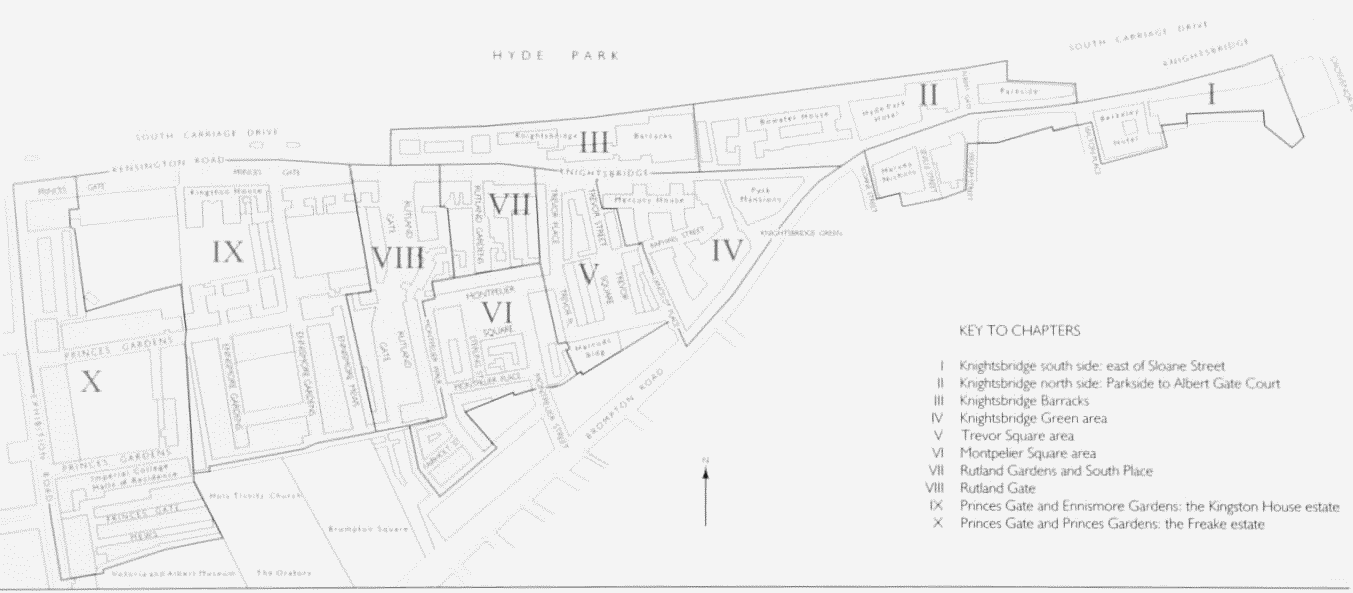
In broad terms, Knightsbridge describes the area immediately south of Hyde Park, stretching from Hyde Park Corner to the museums area of South Kensington, but its southern extent is indeterminate, and always has been. Modern-day Knightsbridge, as defined by popular usage and estate-agents' particulars, takes in substantial portions of northern Chelsea and eastern South Kensington, including Lowndes Square and areas formerly thought of as parts of Brompton and Hans Town. The present volume is restricted to a relatively small part of this 'greater Knightsbridge' (see figure I on page 18).
The vagueness of Knightsbridge's southern limits is partly accounted for by a lack of defining topographical features; unlike districts such as Mayfair, Soho and Fitzrovia, it is not confined within a more or less continuous perimeter of streets. Nor has it ever been an administrative entity. As far back as 1857, when bricks and mortar were spreading fast over the remaining unbuilt ground in the vicinity, a local inhabitant (apropos a reported 'town without a name') dubbed Knightsbridge a 'name without a town' on the grounds that, deserving parish status itself, it was split between no fewer than four parishes. This circumstance he believed (incorrectly) to be the result of 'encroachments' on an anciently independent community. (fn. 3) In his Memorials of the Hamlet of Knightsbridge, completed at this same time, Henry George Davis also made the point that the district was 'absurdly divided' and should have become a separate parish, but attempted no exact definition of its extent. If anything he contributed to the uncertainty by adding much of the 'immediate neighbourhood' to his area of study, including the district parish of St Paul's, Wilton Place, and thus a portion of Pimlico extending as far as the Thames. (fn. 4) Knightsbridge, however, never did achieve administrative independence, nor did it emerge from its Victorian expansion with a clear sense of its own identity. (fn. 1)
Reginald Colby, writing in the mid-1960s, pointed out that 'Knightsbridge has become larger as it has become more fashionable', and that many 'Knightsbridge' residents and shops are really in Brompton. (fn. 5) The process of expansion continues today. Between Knightsbridge and Brompton in particular, however, there has long been a confusion. The sensational authoress Harriette Wilson, living in Trevor Square in the 1820s, seems to have used the names interchangeably in her address. (fn. 6) Knightsbridge was not then a name to conjure with, and it was not really until after the Second World War that it took on much of its contemporary lustre. At the eastern end of Knightsbridge, for instance, the Alexandra Hotel, destroyed in the Second World War, gave its location as Hyde Park Corner, not Knightsbridge, in its advertisements.
The identification of Knightsbridge as a district rather than merely a street was doubtless helped in the twentieth century by the use of the single word to describe the road west of Hyde Park Corner, and, in consequence, the underground station at the top of Sloane Street and Brompton Road. Until 1903, present-day Knightsbridge, often loosely known as Knightsbridge Road, was officially divided into no fewer than eight components: St George's Place, Lowndes Terrace, Middle Row, High Road, Trevor Terrace and South Place on the south side, Park Side and Albert Gate on the north, all of which had distinct connotations of status. Two further names, High Row and Albert Terrace, had been abolished in 1877. Knightsbridge Road might well have seemed the obvious choice for the consolidated name, and had in fact been suggested years earlier, (fn. 7) but plain 'Knightsbridge' was chosen instead, and this became the name of one of the new Piccadilly Line stations, opened in December 1906. (The adjacent stations on the line were Hyde Park Corner, with a surface building at Nos 11–13 Knightsbridge, now the Pizza on the Park, and Brompton Road, long since closed.) The influence of tube stations in redefining the names of various parts of London is, of course, an irresistible one. In recent years, the association of Harrods with Knightsbridge, assiduously promoted by the Brompton Road store, and Harrods' international fame, has done much to further the public perception of Knightsbridge as a district, and added to its desirability as an address.
The area shown in figure I has no real claim to integrality as a district of modern London. It does, however, correspond to all intents and purposes with the historic hamlet of Knightsbridge as it existed by the early nineteenth century, when the first new streets and squares south of the Knightsbridge— Kensington road were laid out. Exhibition Road, a creation of the 1850s, is taken as the westernmost limit. Apsley House and the Lanesborough Hotel (formerly St George's Hospital) are both excluded, as more properly belonging to Hyde Park Corner than Knightsbridge. The Knightsbridge or Hyde Park Barracks, on the other hand, is included, although actually built on part of Hyde Park itself, generally considered quite distinct from Knightsbridge. It carries on the line of building adjoining the park along most of the north side of Knightsbridge.
The greater part of the area belonged to a detached portion of the ancient parish of St Margaret, Westminster, which extended westwards of Exhibition Road and also covered part of Hyde Park. On the north side of Knightsbridge the buildings east of the entrance to Albert Gate, and on the south side those east of William Street, belong historically to the parish of St George, Hanover Square, itself formed in the early eighteenth century out of the much older parish of St Martin-inthe-Fields. The line of the Westbourne river, which passes beneath Albert Gate, marks the boundary between the two parishes here. The short stretch of frontage between William Street and Sloane Street also belongs to the old parish of St. Margaret, but the ground immediately south is part of St Luke, Chelsea.
On the north side of Brompton Road, the boundary between St Margaret's parish and St Mary Abbots, Kensington, runs through individual properties and has never been of significance in building-development terms. The developments fronting Brompton Road on its north side, including the V & A, Brompton Oratory and Brompton Square, are described in volumes XXXVIII and XLI of the Survey, some slight overlap between these volumes and the present work occurs north-east of Lancelot Place, and in Exhibition Road immediately north of the V & A. With very minor exceptions, the entire area described is today part of the City of Westminster.
Not only was Knightsbridge split administratively from an early date, but there was little in the way of other defining limits, topographical or proprietorial, to encourage the eventual suburb towards a particularly distinct identity. Inevitably, the various portions took on much of the character of the adjacent areas as they developed. Nowhere is this more obvious today than in western Knightsbridge, between Rutland Gate and Exhibition Road, an area scarcely distinguishable in architectural character from much of neighbouring South Kensington (of which it is often assumed to be a continuation). There is a close affinity, too, between the area of Trevor and Montpelier Squares and the adjoining parts of Brompton, and at the eastern end of the area the pull exerted by Belgravia was considerable, though only apparent today at Albert Gate, where mansions of a distinctly Belgravian character flank the park entrance. To some extent, stylistic similarities may simply reflect the involvement of the same developers – James Bonnin and John Gooch in Brompton and in Trevor and Montpelier Squares, C. J. Freake in South Kensington and western Knightsbridge, and Thomas Cubitt in Belgravia and at Albert Gate.
Old Knightsbridge
Several factors contributed to Knightsbridge's potential for development as a fashionable suburb. In the first place, it was situated on one of the most important approach roads to the capital, 'scarcely more remote from the houses of parliament, & the places of gay resort, than several of the fashionable squares of London'. (fn. 8) There were natural and scenic advantages to the situation, too, less obvious today. The ground, sloping gently down towards the south, was sheltered and well-drained, giving rise to a reputation for salubrity. This was one of the reasons for the choice of Lanesborough House as the new St George's Hospital in 1733, giving patients 'the Benefit of a Country Air'. (fn. 9) As well as Hyde Park, there were splendid views to the south over the Thames Valley and the Downs, a strong likely selling-point for building ground, as an advertisement of 1764 for a site adjoining Kingston House makes clear:
'The beautiful Situation and Prospect of this Ground are beyond all Description; and therefore whoever has a Mind to treat for it and take it, may have opportunity of judging for themselves, if they will take the Trouble to go to the Ground, and see it from a Stage erected upon it for that purpose.' (fn. 10)
But set against these general attractions were negative factors. In the first place, other than at the western end of Knightsbridge, land for building was confined to narrow roadside strips, formerly manorial 'waste', which offered limited scope for formal and large-scale urban planning. Moreover, by the late eighteenth century, when pressure for the expansion of the West End was growing intense, most of this roadside ground had already been built up, much of it in the 1720s and '30s. The western part of the hamlet, west of the Green, between the Kensington and Brompton roads, consisted of comparatively broad acres, but a good deal of this area was occupied as the gardens and grounds of a series of large private houses. Though the remainder was only nursery ground and pasturage or market gardens, Knightsbridge as a whole offered limited virgin territory to the prospective developer, and much of the new building in Knightsbridge from the early nineteenth century therefore involved some measure of redevelopment. Hardly a trace remains of the old Knightsbridge today, and then only in the pattern of development here and there, but as recently as the 1930s several eighteenth-century buildings survived.
Our picture of the old hamlet is essentially that drawn up by H. G. Davis in the mid-nineteenth century, its more vivid features endlessly repeated by later writers with little or no attempt at modification. The terrible state of the road, the dangers of footpads and highwaymen, the bad reputation of the inns, secret or runaway marriages at the local chapel, all feature prominently.
The road had long been notorious for its badness and the risk of assault. In 1736 Lord Hervey, writing to his mother from Kensington, made the remark, quoted by Davis, that 'the road between this place and London is grown so infamously bad, that we live here in the same solitude as we should do if cast on a rock in the middle of the ocean, and all the Londoners tell us there is between them and us a great gulf of mud'. (fn. 11) Legislation was sought in 1724 for improving the paying; more than sixty years later representations were made to the architect and builder Henry Holland about obtaining a Knightsbridge paving Act, to prevent so many ladies 'from being lamed and crippled by the excessive pickedness and asperity of the stones and pebbles between Hyde Park Corner and Sloane Street'. (fn. 12) In the early nineteenth century, 'modern paving' was only laid at Knightsbridge Terrace, a short row of houses on the south side of the road. (fn. 13) In 1826 an Act of Parliament placed the roadway itself under the control of a board of metropolitan turnpike commissioners. (fn. 14)
While the conniving nature of Knightsbridge innkeepers may to some extent be a matter of legend rather than fact, wayfarers were often in real danger. The nineteenth-century writer Thomas Allen quotes an annotation, probably Elizabethan, to Norden's Speculum Britanniae on the perils of Knightsbridge, 'where I wish no good man to walk too late, unless he can make his pathe good'. (fn. 15) There are many accounts of highway robberies in the Knightsbridge area throughout the eighteenth century. As late as 1799, it was necessary to have a light-horse patrol between Hyde Park Corner and Kensington every night, and Davis recorded that 'it is within the memory of many when pedestrians walked to and from Kensington in bands sufficient to ensure mutual protection, starting at known intervals, of which a bell gave warning'. (fn. 16) However, the 'Wild West' character of old Knightsbridge can perhaps easily be over-emphasized. If it was dangerous at night for travellers, that was equally the case with other parts of London and its fringe. Long before this period, most of Knightsbridge was lined with buildings on both sides of the road, from inns, shops and other business premises to substantial terraces with gardens, and detached villas and mansions in ornamentally-planted grounds. There was a foot-guards barracks towards Hyde Park Corner, and the newer cavalry barracks lay at the other end of the hamlet. Shops proliferated in the 1820s and '30s as the district grew.
The nucleus of old Knightsbridge, from which the hamlet took its name, was the bridge carrying the road over the river Westbourne at present-day Albert Gate. This bridge was known originally as the King's bridge, later corrupted to Knightsbridge. It is as Kyngesbyrig that the locale first appears in the written record, a charter of Edward the Confessor. The oldest buildings to survive into comparatively recent times were gathered here, and by the 'village' green at the apex of the Kensington and Brompton roads. Situated beside the Westbourne on the north side of the road was the hamlet's principal establishment, a lazar-house, which was in operation from the Middle Ages until early in the eighteenth century. The chapel attached to this hospital, in effect a chapel-of-ease for the local people, continued to flourish after the hospital's closure. The small complex of buildings comprising the lazar-house, some of which dated from the sixteenth and seventeenth centuries, was still standing in the early 1840s, when the site was cleared as part of the Albert Gate development. In addition to these buildings, there were several old houses and long-established inns dotted along the main road. Probably the greater number of existing buildings by Queen Victoria's reign, however, were not ancient, but of eighteenth-century date.
The character of Knightsbridge as it had evolved by the late eighteenth century was not only socially mixed but becoming suburban in tone; it was emphatically not an agricultural community. Consequently, much of the existing building of old Knightsbridge was absorbed seamlessly into the denser fabric of Victorian and later times, and was only gradually removed in the course of various redevelopments. But there were acknowledged eyesores from village days, targeted for destruction by developers and residents: the lazar-house buildings, demolished by Cubitt; the Halfway House tavern, demolished by John Elger; houses in the High Road and near the Green, demolished piecemeal in late Victorian times; Park Side, mostly rebuilt in the early 1900s; and above all the original cavalry barracks, the subject of much condemnation from the 1850s.
Knightsbridge Green still exists in a residual state, the present enclosure and narrow passage preserving part of the layout as it had evolved by the mid-nineteenth century. Lancelot Place maintains the line of a driftway which once led to the Rose and Crown inn on Knightsbridge. Another relic of the hamlet is Park Close, laid out in the 1720s as a court of houses. The entrance to Old Barrack Yard, too, is of some antiquity, originally giving access to a field behind the roadside waste where the footguards barracks was built around 1760. Elsewhere, a few field boundaries may still be traced in the shape of developments: Rutland Gate, for example. One of the old village inns survives, though long rebuilt, as the Paxton's Head public house.
Progress of development
Knightsbridge, like so much of London outside the control of the 'great estates', is to a large extent the creation of speculative builders working within the haphazard framework of comparatively small landholdings, made available for development from time to time. Though much of central and western Knightsbridge had formed a single estate, belonging to a Huguenot family, the Moreaus, this was dispersed in the late 1750s. The largest landowner was Westminster Abbey, whose manor of Knightsbridge and Westbourne Green included the strips of roadside waste in east and central Knightsbridge, and larger tracts of copyhold ground to the west, among them much of the Kingston House property and Brompton Park Nursery. With the limitations imposed by the landholding pattern, and the inevitable fluctuations in building activity governed by trade cycles and local circumstances affecting demand for houses, the progress of development was sporadic and untidy. Lowndes Terrace, Trevor Square, Montpelier Square, Raphael Street, Albert Gate, Rutland Gate and Rutland Gardens were each marked by failures or delays in their development. In some cases – particularly Montpelier Square and Rutland Gate – the architectural record of these fits and starts can still readily be traced. Elsewhere – in Lowndes Terrace and Raphael Street – the original buildings have been completely erased by redevelopment.
While H. G. Davis was compiling his local Memorials in the 1840s and '50s, Knightsbridge was experiencing the most important of several distinct phases in its transition from semi-rural hamlet to built-up suburb. The 1820s had seen a wave of reconstruction and new development sweep across the eastern part of the district, but without making a radical change to its character, which remained essentially that of a ribbon development, albeit a ribbon of heterogeneous pattern, formed over several centuries. Such inroads as had been made into the hinterland were fairly modest in aspiration – the most ambitious, Montpelier Square, foundered temporarily in the depression years of the late 1820s. When local development again gathered pace, from the late 1830s, the scale was greater, and there was a corresponding emphasis on architectural grandeur, seen in the Italianate terraces of Rutland Gate and Princes Gate, and the mansions of Albert Gate.
The abolition in 1825 of the century-old turnpike across the east end of Knightsbridge at Hyde Park Corner removed a psychological as well as physical barrier between the hamlet and the metropolis. By the early 1840s Knightsbridge was said to be 'now as much London as Tottenham Court Road'. (fn. 17) But, as in neighbouring South Kensington, it was not until after the Great Exhibition of 1851, and the scramble for land south-west of the exhibition site, that high-class building well away from the immediate main-road frontage (where both a view and some tenuous relationship with the park itself could be claimed) became viable. Thus the builder John Elger, initially attracted to the area in the 1840s by the roadside ground on either side of Kingston House, felt confident enough by 1853 to take on the entire southern half of Rutland Gate, where building had run into the sand some years earlier. Following the success of Elger and his associates in establishing Princes Gate and some of the backland (now Ennismore Gardens) as a fashionable locale, the developer C. J. Freake undertook much further building near by in the 1850s and '60s, pushing the frontier westwards and southwards, and nearly meeting up with his other housing developments in South Kensington.
By the time of Davis's death, in 1857, Knightsbridge could fairly lay claim to some of the most prestigious and sought-after addresses in London. But to think that the name Knightsbridge bestowed any automatic cachet at this time is almost certainly incorrect. Much of the old heterogeneity remained, and had given rise to parallel developments of an altogether more popular character than the new upper-class enclaves of Rutland Gate and Princes Gate. As western Knightsbridge increasingly took on the character of an exclusive suburb, central Knightsbridge became denser, busier, and seedier: in modern terms distinctly 'inner-city'. The population, estimated at 5,000 in 1848 and to a great extent working-class, was concentrated in crowded conditions near the barracks. (fn. 18) Music-halls opened in the High Road, and at Knightsbridge Green the large old houses were redeveloped – one as a showy pub – and their gardens built over, with low-class houses in Raphael Street and Tattersalls' new horseauction rooms. For many years there remained a sharp contrast between central and western Knightsbridge, but by the late nineteenth century the music-halls had been closed down, and the tone of the High Road seems to have been improved.
A sign of the growing intolerance of rowdy behaviour was the refusal of local people in 1872 to allow a covered cab-stand in Knightsbridge, near Sloane Street, on the grounds that it would attract loafers. Construction of the experimental shelter, to have been 'roofed in with glass in a horticultural fashion', was proposed by the police with Home Office support. It would have provided a coffee- and newspaper-stand in addition to shelter for cabmen and bus-queues. (fn. 19)
By the 1880s, as in Kensington and other suburbs, the large family terrace-house was becoming an obsolete vehicle for speculative development, as the builder William Radford found to his cost in northern Ennismore Gardens. Blocks of mansion flats were the coming thing, and a series of them was built in Knightsbridge between the 1880s and the early years of the next century, mostly in place of houses of various classes. On the main road, the turn of the century saw shops and houses replaced by mixed commercial and residential blocks.
Not only were the old houses going out of fashion, but they were increasingly unsuited to the busier, noisier environment of the major roads and losing their appeal as residences for that reason. In the early twentieth century traffic vibration – whether from underground trains or motor-buses–afflicted one of the best houses near Hyde Park Corner, No. 23 Knightsbridge, the effects being felt throughout the building. (fn. 20)
Redevelopment with blocks of flats resumed in the 1930s, though not on such a scale as to alter greatly the local character. One regrettable victim of flat-building was Kingston House, built when Knightsbridge was still a country hamlet. Without undergoing any sudden, radical redevelopment, the most desirable parts of Knightsbridge began to take on an urban rather than suburban air. In the early 1930s, Harold P. Clunn, with his characteristic enthusiasm for modernization, felt that Knightsbridge's transformation since the 1880s 'almost invites comparison with that of some great city in the United States or South America'. At the time, it looked as if the older, small-scale developments so prized today, including the 'shabby relic' Trevor Square and the 'rather depressing' Montpelier Square, might soon be swept away and replaced by up-market flats. (fn. 21)
By the end of the Second World War, Knightsbridge was poised on the brink of what might have been drastic reconstruction. In parts, the redevelopment in the post-war property boom was indeed drastic, especially along the main road and around Knightsbridge Green. So much of the building stock – the large family houses in particular – was not only socially and economically obsolete but had suffered as a result of wartime requisitioning. However, flat-conversions and institutional use, particularly by embassies, saved several fine terraces from demolition.
Knightsbridge and Hyde Park
Of all the influences on the growth and character of Knightsbridge one of the most important has been Hyde Park. In the eighteenth century its influence was initially slight, though it was presumably a factor behind the choice of location of Kingston House and other large houses in Knightsbridge and Kensington Road. The creation of the South Carriage Drive in the 1730s to replace Rotten Row as the royal road through the park coincided with extensive building along the north side of Knightsbridge, where a long terrace of houses was built in High Row, on the site of present-day Bowater House. But the design of these houses showed no special interest in proceedings over the park wall: they faced Knightsbridge and the backs were conventionally treated with closet wings and landing windows. Forty years later, however, when the adjoining Park Row was built, the new houses took full advantage of the park view, with large bows facing north; and in 1793 The World, in a review of 'Fine situations long neglected', censured the planning of the earlier houses as an 'error'. (fn. 22)
In 1791 the same paper had reported that 'some Opulent builders' were proposing a scheme for building houses, presumably for the rich, all along the park wall from Hyde Park Corner to Kensington – an idea which would have greatly accelerated the rise of Knightsbridge as a fashionable location. (fn. 23) In the event, no such houses were erected on the park side of Knightsbridge until Nos 1 and 2 Albert Gate and Hyde Park House were built there in the early 1840s and the 1850s.
Albert Gate occupies a prominent place in the story of the development of Knightsbridge. It was a speculation, but more importantly it was an improvement – sweeping away objectionable industrial premises and decrepit tenements, tackling head-on the problem of how to integrate the evolving suburb with one of its greatest assets, the park. What its developer, Thomas Cubitt, and the park authorities, really had in mind for the long term remains unclear, but there is evidence that something much more extensive than the eventual gateway and trio of houses was seriously considered. As it was, it must soon have become apparent that Albert Gate occupied the wrong place for the main local entrance to the park; one critic even suggested its demotion to pedestrian use only, and the transfer of the name to something distinctly grander directly opposite Sloane Street. (fn. 24) The idea of a Sloane Street extension into the park was not new, and efforts were subsequently made, on private and public initiatives, to open a new park gate in this position, a much more suitable one, both visually and practically, than Albert Gate. Nothing towards this end took place on the ground, however, until the creation of Edinburgh Gate in the 1950s (in a development which fails to make of the gateway anything more than a traffic-chute).
By the time of the Albert Gate development, Hyde Park itself had seen great improvements, including the replacement of most of the old perimeter wall with iron railings and the building of new lodges, and was rapidly gaining in status as a fashionable rendezvous. Riding in Hyde Park, and especially parading in Rotten Row and the South Carriage Drive, was firmly established as a social routine, and the extraordinary process of ritualization and elaboration which eventually came to characterize this activity was well under way.
The growing social importance of the park, however, was never to be officially acknowledged by any large-scale public improvement to bring the adjoining highways up to a suitably impressive standard (at least until the Park Lane widening in the early 1960s), something particularly desirable on the Knightsbridge side, where the landownership pattern made the existing development so messy.
Knightsbridge differs from its northern counterpart the Bayswater Road, and for that matter from Park Lane, in being built-up on the park side for a good part of its length. The difference is a fundamental one. Bayswater Road, though narrow, has a boulevard-like appearance. Knightsbridge, starting out promisingly spacious at Hyde Park Corner, with the park on one side and well-set-back frontages on the other, is soon squeezed between tall buildings looming up from narrow pavements.
The historic pattern of landownership is the explanation for what has proved an intractable planning problem over the past two centuries. Separately owned from the land behind, the roadside strips along much of the way from Hyde Park Corner to the Knightsbridge Barracks have been too narrow to allow the building line to be set back enough for major road-widening, while at the same time the properties have been too valuable to make their complete obliteration viable. The problem was compounded in the late eighteenth century when the barracks was built, right on the edge of the park, continuing the line of built-up ground along the roadside.
The meanness of the road through Knightsbridge and of the roadside buildings was a subject repeatedly aired as the district rose in status through the Victorian period. The entire road from Piccadilly Circus to Kensington, thought one anonymous writer in 1871,
'may be denominated London's Western Boulevard. The importance of buildings in its course, the new Royal Academy, and especially the stupendous Hall of Arts [the Royal Albert Hall], bestow upon it an increased importance; and since the sinuosities in the Royal town of Kensington have been opened and improved, the remaining straits on the line become more obvious.'
There were two major bottlenecks, one in the vicinity of Albert Gate, where for 150ft the road was only about 46ft wide, the other at the barracks, 'which obtrudes upon the main thoroughfare fully half its width'. (fn. 25)
Not only was the route constricted, but its character was badly marred by some of the buildings along the way – the 'huddled, shapeless, and crazy tenements' in Park Side and eastern High Row, and the barracks, 'presenting a stable and a barrack-wall with windows where first-class mansions ought to stand'. (fn. 26)
Piecemeal improvements have been made. When the barracks was rebuilt in the 1870s the site was reduced slightly to allow the bottleneck at that point to be removed. In the 1890s and 1900s the London County Council worked in co-operation with the Ecclesiastical Commissioners (successors to the Dean and Chapter of Westminster Abbey as freeholders here), to broaden the road between Wilton Place and William Street as part of a complete redevelopment. (The inadequacy of the widening here was, however, apparent by the 1930s, and probably much earlier. (fn. 27) ) Other widenings have occurred from time to time, as rebuilding permitted, and in the late 1950s the easternmost of the shops on the north side of the road were removed to allow the narrow 'gore' on which they stood to be partly added to the highway. But the road through Knightsbridge remains rather constricted, both as regards traffic flow and architectural effect.
There has never been any consensus of opinion as to how the roadside sites bordering Hyde Park should be regarded. In the eighteenth century the question did not arise, Knightsbridge being a fairly unimportant out-of-town location. Since then, some have argued for complete clearance on the grounds that the various buildings disrupted the scenery, and this view gained ground before the Victorian rebuilding of the barracks, there being some hope that a new and more appropriate site would be found. When the government ultimately decided to rebuild on the existing site, the architect James Fergusson suggested that the government should buy up all the property between the barracks and the three mansions at Albert Gate, using the combined sites to straighten and widen the road into the 'finest and most noble' entrance to the metropolis, and still accommodate a new barracks with space to spare:
'and if the barrack were made a handsome building, which it might easily be, it would be a far more pleasing object from the Drive in the park than the backs of the houses in [Albert Terrace], and the rubbishy summerhouses that now disfigure the locality.' (fn. 28)
In the absence of the large-scale planning initiatives necessary to deal effectively with the problem of the roadway, the successive developers of Knightsbridge were obliged to exploit their ground as best they could. Clearly, any site with a good view of Hyde Park had great potential for house-building, while convenient access to the park, on foot or horseback, or by carriage, made particular sites even more desirable than others. The result was a series of 'Gates': Albert Gate, Rutland Gate and Princes Gate (and further west in Kensington, Queen's Gate, Hyde Park Gate and Palace Gate). H. G. Davis denounced the term as absurd, 'a modern stupidity for a square or terrace'. (fn. 29) But, of course, the name implied nearby and privileged access to the park, and aspirations to membership of the beau monde. Obtaining a new gate to the park for the benefit of the inhabitants of a new development was difficult and expensive, as both Cubitt and Elger found, but the benefit to property values was immeasurable.
First of the Knightsbridge 'Gates' was Rutland Gate, a development begun in the late 1830s under the name Serpentine Terrace (another reference to Hyde Park) and renamed about 1840. Though the developers had hoped to obtain permission for a park gate opposite, the only gates at Rutland Gate were to close it off from the main road at night. They were eventually removed as an inconvenience. (fn. 30) Albert Gate, on the other hand, really was a gate into the park. The building of Elger's Princes Gate began in 1845, the year that Albert Gate opened, though the scheme had been broached much earlier, certainly by early 1840. An important part of the plan there was the creation of a new entrance to the park, called Prince of Wales Gate. Princes Gate gained such status as an address that C. J. Freake retained the name for his adjoining development, thus carrying Princes Gate nearly all the way down Exhibition Road, and associating his other houses close by with it under the name Princes Gardens. In a similar way, Rutland Gate was followed years later by Rutland Gardens, laid out on ground with no historic connection to Rutland Gate or the former house on its site, Rutland House.
Albert Gate was much too prestigious a name to be restricted to just two or three houses as an address, which was at first the case. Having soon given rise to the renaming of some old houses near by as Albert Terrace, it was eventually adopted, in the 1870s (at the inhabitants' request), as the address of all the houses fronting the main road between Park Side and the barracks. (fn. 31) Albert Gate became widely used as a loose description for much of central Knightsbridge; Tattersalls, situated well away at Knightsbridge Green, liked to use it as their address, and the name was taken for new flats (Albert Gate Mansions) built on the south side of the road in the 1880s. In the late 1890s, the Park Mansions development at the junction of Knightsbridge and Brompton Road was promoted as being in Albert Gate. (fn. 32)
The question of gates was something which raised issues of social status and amour-propre over and above mere access to the park. In the late 1850s, the inhabitants of Rutland Gate managed to get a new wicket-gate made for their convenience just west of the barracks. There was already a wicket-gate for the general public near by, but it was on the east side of the barracks in a rough, crowded part of Knightsbridge and the approach was of a character to put its use out of the question for the residents of addresses such as Rutland Gate. As well as having several low-class shops selling refreshments, it was lined by street-vendors' tables and benches. The passage was reduced to a crowded gangway, while 'the stall-holders now threaten violence to any wayfarer who passes on the public pavement'. (fn. 33)
Proximity to the park encouraged builders to erect their largest and most stylish houses. This is noticeable even in the modest Trevor Square area development of the Regency period, where Trevor Terrace, facing the park (or at any rate the barracks, then quite new) was on a larger scale than the terraces comprising the square itself. In later developments, size and architectural display were much more pronounced, but it took time for the level to be pitched just right. Cubitt, at Albert Gate, built on rather too large a scale, and early drawings for Princes Gate by H. L. Elmes display an extravagance that had to be toned down when the houses came to be built. The flamboyance of the terrace designed by F. R. Beeston senior at St George's Place in the 1850s was almost certainly a response to its fine position facing the park, and carried an echo of Nash's Regent's Park terraces of thirty years before. In general, the palazzo-style terrace which had become usual for the sides of squares was successfully adapted for park-view sites (where detached or semi-detached villas, for example, might have been a feasible alternative for the speculative builder to venture).
The arrival on the sylvan scene of such a vast edifice as the Crystal Palace was naturally a cause for some consternation among inhabitants and developers. The builders of eastern Princes Gate, John Elger and John Kelk, both blamed the Crystal Palace for discouraging prospective purchasers of their new houses immediately opposite. 'It is not a popular subject at Knightsbridge', wrote Sir George Cornewall Lewis of Kent House, 'particularly at this moment [December 1850], when we are overrun with workmen who stream along the road at meal-times as if a manufactory was breaking up.' Even before the opening of the exhibition, Lord Campbell, living next door at Stratheden House, was complaining that 'the neighbourhood is already infested by mobs, day and night'. Sir George, in particular, had harboured doubts about the value of the Great Exhibition, but when it opened was completely won over both by the building itself and the exhibition in general. (fn. 34)
On the north side of Knightsbridge, the relation of the buildings with the park could prove problematic, and this has continued to be so in comparatively recent times. The construction of the Hyde Park Hotel provoked great controversy in the 1880s on account of its height, and in the twentieth century the building of Bowater House and the second rebuilding of Knightsbridge Barracks again led to much debate about the effect of the proposed tall structures on the view across Hyde Park. At other times, friction with the park authorities has arisen in connection with right to light, gutters and summer-houses, and in the case of the Hyde Park Hotel over the commercial vulgarity of prominent lettering on the park side of the building.
Social divisions
The gentrification of smaller houses and mews properties, and the institutionalization or conversion to flats of the bigger houses, have, as elsewhere in London, tended to level out old social divisions within Knightsbridge, formerly strongly marked. Writing in 1854, the Knightsbridge architect W. W. Pocock drew attention to the disparity between the aristocratic character of the new terraces along or adjoining Knightsbridge and the character of the highway itself. At the time, inhabitants of Brompton were up in arms at the builder John Elger's refusal to allow a road connecting Brompton Square with his developments to the north, and thus to Knightsbridge and Kensington Road, a stance apparently supported by many of the occupants of the houses he had built. Should these rich citizens ever have occasion to extend their walks in the direction of Belgravia and Buckingham Palace, suggested Pocock,
'they would find a shorter and far more respectable route through Brompton-square, etc. than through Knightsbridge, which, thanks to the military and the present tenure of church property, is never very enticing; and after a very early hour in the day is literally impassable for ladies or families, unless in carriages or under the protection of powerful escorts.' (fn. 35)
With Elger's developments in Rutland Gate, Princes Gate and Ennismore Gardens, western Knightsbridge was indeed taking on an aristocratic (and plutocratic) character. Smaller houses further east, including those in Pocock's own development, Trevor Square, meanwhile languished in a state of dingy multi-occupancy as boarding-houses and tenements. The entire triangle east of Rutland Gardens to the apex of Brompton Road and Knightsbridge was at best unfashionable, and much of it was solidly working-class. There was a smaller pocket of predominantly low-class housing in Park Place and Mills's Buildings near the barracks. The juxtaposition of different social types in a small compass was common enough in London, but the contrast was given a particular emphasis by Knightsbridge's growing reputation as a place of popular entertainment. In the middle decades of the nineteenth century night-time Knightsbridge was riotous with noisy, drunken crowds, soldiers and prostitutes prominent among them. Music-halls, pubs, eating-houses and other attractions occupied premises in the High Road between Knightsbridge Green and Trevor Street. Time and again the barracks was held up as fons et origo of the problem, and it was a bitter blow to local feeling when the campaign to get the barracks relocated met with failure. Whether or not the barracks was the chief cause, the area of Knightsbridge Green remained a dubious locality certainly up to the Second World War. (In the early 1990s it was alleged that the Pakenham Tavern, demolished in the 1950s, had been a haunt of high-society homosexuals, who picked up young guardsmen there. (fn. 36) )
To some extent social divisions account for the lack of coherent planning in the district, seen, for instance, in the complete separation of the Montpelier estate development (laid out in the 1820s) from Rutland Gardens, a cul-de-sac, created fifty years later and aimed at a higher class of resident than Montpelier Square. There was no incentive here to link the two developments. As the dispute over the proposed road from Brompton Square shows, John Elger, building in the 1840s and '50s for the upper end of the house market, saw every reason to keep his streets cut off from slightly earlier, less aspiring, houses, and to prevent through-traffic between Brompton Road and Knightsbridge crossing his developments – producing, in Rutland Gate and (in its original form) Ennismore Gardens, two very large culs-de-sac. The same consideration was still current half a century later, when the complete rebuilding of the Trevor Square area was in contemplation by its new owner:
'The property lies in such a neighbourhood as would, if properly developed, permit of the erection of good class houses commanding high rents; but immediately adjoining it in Raphael-street is a lower class of property, which if brought into direct relationship to the estate would tend to lower its value.
'From the point of view of the estate the tendency would be to shut out this neighbouring low-class property, screen it off, and ignore it altogether; so preserving for the estate an exclusiveness for which a certain class of well-to-do people would be willing to pay high rents. From the public point of view, general intercommunication between all parts of the town is a necessity, and the general democratic spirit of the age which is, after all, at the bottom of all such co-operative movements as town planning is a tendency in opposition to social exclusiveness.' (fn. 37)
Nothing came of this scheme, perhaps because the First World War intervened. Subsequently, the unredeveloped Trevor estate achieved a thoroughly well-to-do character through a natural process of gentrification, which, but for bombing in the Second World War, might have spread to Raphael Street.
Equally unpredictable was the fate of the stately terraces of western Knightsbridge. In the 1920s Princes Gate and Ennismore Gardens were said by the freeholder Lord Listowel's agent to 'occupy an unique position in these days of turmoil and traffic':
They are byeways of quietude yet so near to the Park and the centre of fashion that the position is one which should always command tenants of the class that have occupied them in the past and are occupying them today. (fn. 38)
Already, however, such large houses were becoming uneconomic to run and were beginning to be converted into flats or taken over by institutions, greatly altering the old residential character of the area. After the Second World War hardly any of the properties here were occupied as family houses, a situation showing signs of change in recent years, as buildings are reconverted from flats back into single dwellings.
The Fabric
Knightsbridge is chiefly a private residential district, but shops, hotels, offices and other commercial or institutional buildings have a strong presence too. Some of the main building types and development themes are discussed below. Conspicuously absent are any municipal buildings, excepting the former All Saints' School at Knightsbridge Green, and public housing, a consequence of Knightsbridge's position at the periphery of other districts, small extent, and lack of administrative independence.
Less surprising is the absence of industrial premises, yet as recently as the early 1970s the west side of Trevor Place was still dominated by a former factory. Dating from the 1820s, this was built for the manufacture of ornamental floorcloth, an industry associated with Knightsbridge from the mid-eighteenth century. Another (long vanished) industrial structure on a large scale was the early-nineteenthcentury Cannon Brewhouse, demolished for the making of Albert Gate. Both these premises were designed by capable architects – W. F. Pocock and George Byfield – and were of some architectural distinction.
One unusual complex that may be mentioned here is Tattersalls' horse and carriage mart on Knightsbridge Green, bombed in the Second World War and later demolished. Built in the 1860s to replace the famous 'Corner' behind St George's Hospital, it combined up-to-date engineering techniques with classical architectural formality.
The mansions of old Knightsbridge
West of Knightsbridge Green on the south side of the Kensington road, the narrow strips of waste on which so much of old Knightsbridge grew up gave way to sizeable fields and meadows. On this land, clear of the hamlet proper, a series of large houses in spacious gardens was built from the late seventeenth century until the beginning of the nineteenth. There were six: from the east, Powis House (c. 1689); Kent House (1793, enlarged 1801); Stratheden House (1770–2); Rutland House (1752–3); Kingston House (1757–8); Park House (1753). Further west, along Kensington Gore, lay Eden Lodge (c.1745); Gore House (1750s); Grove House (late 1740s); Noel House (1804); Madeley House (c. 1802); Kensington House (c.1690); Colby House (c.1713). In the opposite direction, the sequence continued with Lanesborough House (c.1718) and Apsley House (1771–8), and so to the mansions of Piccadilly and Mayfair.
Of the Knightsbridge houses, only Kingston House, which survived into comparatively recent times, was reasonably well recorded before its demolition, and knowledge of the others is fairly limited, but most seem to have been architect-designed and expensively constructed and fitted. Sir William Chambers and (probably) John Vardy were among the architects involved. Two at least, Kingston House and Kent House, were exquisitely furnished and decorated. Although several had aristocratic connections, none of the houses approached the scale of stately homes; they were in effect early examples (if on rather a grand scale) of suburban villas. In this sense, they relate to some of the detached houses built in Knightsbridge in the Victorian period, especially Alford House, which stood next door to Kingston House. An interesting common feature of three of the houses is that they were built to accommodate mistresses of the aristocracy: Kent House was enlarged for the Duke of Kent and Madame de St Laurent; Rutland House was built for the 3rd Duke of Rutland and Mrs Drake and their son; Kingston House was built for the Duke of Kingston's mistress Elizabeth Chudleigh. Possibly a similar purpose was behind the building of Stratheden House for John Calcraft, a 'free liver' who had several children by two actresses. (fn. 39)
The presence of these detached houses in grounds preserved for this part of Knightsbridge a country character which must long have been missing from the densely built-up eastern part of the hamlet. All six houses existed together for no more than a few years, however, and from the 1790s the view across the park from the easternmost four was spoiled by the presence of Knightsbridge Barracks.
Terrace-houses
From the early eighteenth century until the 1880s, development in Knightsbridge, conventionally enough, mostly took the form of terraces of houses in streets and squares, or ranged along parts of the main road. The earliest examples to survive are those in and around Trevor Square, begun in the second decade of the nineteenth century. Fully stuccoed façades were introduced to Knightsbridge in the mid-1820s on the south side of Montpelier Square. The architecture here was fairly unsophisticated. An altogether different order of architectural ambition was shown a few years later at Rutland Gate, where the two park-facing terraces – one at least probably the work of (Sir) Matthew Wyatt – were given elaborate and accomplished Italianate treatments. This formula was to be used on a bigger scale and with greater architectural verve (supplied by H. L. Elmes) at Princes Gate in the 1840s, and the new grandeur was carried on over the next two decades by C. J. Freake in Princes Gate and Princes Gardens. Though on private land, these new terraces were clearly conceived as forming backdrops to the views from Hyde Park, in the manner of the Nash terraces at Regent's Park.
The scale of these terrace-houses was such that some modification of the conventional side-passage plan became desirable, a third main room being introduced on the principal floors, behind the usual two. In Princes Gate, John Elger placed a top-lit staircase between the front and back rooms. More radical departure from the standard plan was generally restricted to end-of-terrace houses, which gave scope for centralized planning if entered on the long side of the building.
Externally, various permutations of stuccoed Italianate decoration were tried in the 1850s and '60s, but without producing anything superior to the best work designed in the '40s, seen at Nos 13–25 Princes Gate. The vista of stuccoed or half-stuccoed terrace-houses with pillared porticoes, one of the most characteristic and evocative images of Victorian London, is still well represented in Knightsbridge. In Ennismore Gardens, however, the area has the distinction (rare for London) of having terraces in the same Italianate style faced in ashlar: the choice of freestone over stucco here was, it turns out, a matter of opportunity rather than architectural purism. From the same period is the pair of houses at Nos 15–17 Knightsbridge, also Italianate but constructed in white brick with stone dressings.
Artistic houses and interiors
Though Knightsbridge was never an artistic colony, and in fact attracted relatively few professional artists as residents, it did become something of a centre for wealthy collectors and connoisseurs of art, including notable patrons of painters and architects. While suitable building land remained available locally, a number of these artistic figures commissioned large houses for themselves and their collections, which are considered below. Others adapted the work of speculative builders, or existing individual houses, to their requirements.
Among the major art collectors and connoisseurs with houses in Knightsbridge were John Sheepshanks and William Jones in Rutland Gate in the 1840s; John Harris at Princes Gate from the 1850s; F. R. Leyland at No. 49 Princes Gate, and Thomas Eustace Smith and his wife 'Eustacia' at No. 52, in the 1870s; John Pierpont Morgan at Princes Gate from the 1890s; and, in more recent times, Count Seilern at No. 56 Princes Gate after the Second World War.
While a few are well-documented and recorded in photographs, tantalizingly little is known of some of these houses in their heyday, and many of the buildings have been destroyed, or their interiors stripped and altered.
In some cases, as at No. 14 Princes Gate and the now-demolished South Lodge, periodstyle schemes of interior decoration were naturally selected as appropriate back-drops for collections of paintings, tapestries and objets d'art, often incorporating antique panelling or other authentic elements. Of greater interest are decorative schemes of high artistic value in themselves. Among these, James McNeill Whistler's Peacock Room at No. 49 Princes Gate is the supreme example here, though the entire creation has long been in the USA. Only a freak of chance in the way it was constructed made it possible for the Peacock Room to be uprooted. The building, however, still contains some relics of Whistler's patron F. R. Leyland and later occupants, including Thomas Cundy's virtuoso staircase-balustrade of the 1820s, salvaged from Northumberland House.
Probably the most remarkable Victorian decorative work still surviving in a Knightsbridge house is only a few doors away at No. 52 Princes Gate, where substantial parts of George Aitchison's Aestheticstyle schemes for several rooms, including much inlaid woodwork, remain intact. Other interesting Victorian and later interiors are known, from descriptions or photographs, but most of the surviving grand houses in Knightsbridge have suffered too badly at various times from neglect and institutional use or wholesale redecoration for much to have escaped destruction.
Individually commissioned houses
Although the great majority of houses built in Knightsbridge during Queen Victoria's reign were speculative, a number were individually commissioned – and from architects of the first rank. In each case (with the exception of South Lodge, a curious house, which grew in stages from small beginnings), these one-offs were erected on plots portioned out of estates where speculative building was proceeding or had already taken place. There is a noticeable correlation between the building of these individual houses and problems with the speculative side of development.
In the early 1840s, the erection of Clytha House and Park House on the Rutland House estate coincided with a loss of impetus in the building of the terraces which had been planned for the whole of Rutland Gate. Some years later Thomas Cubitt, having experienced difficulties in disposing of Nos 1 and 2 Albert Gate, decided not to proceed with speculative building on the rest of his ground adjoining but to wait for a private commission for a big house there (Hyde Park House).
On the Kingston House estate, the circumstances of the building of Alford House are not quite clear, but it seems that the allocation of the site for a single house resulted from a direct approach to the owner, Lord Listowel, by Lady Alford herself. Later, neighbouring Bolney House was built on a site previously designated for terrace-houses. Near by, Gustav Natorp acquired the plot for his house at No. 70 Ennismore Gardens from the builder William Radford, whose speculative development of large houses here was working out badly.
One obvious likelihood is that most estate owners preferred relatively high-density terraces to oneoff houses, however magnificent they might be. If so, the reason was perhaps long-term considerations rather than any difference in ground-rents: big, maybe unconventionally planned, houses are likely to prove difficult to let on reversion, or command relatively poor rents. And this appears to be borne out by the fate of the individually commissioned houses compared with their terraced neighbours. Hyde Park House, Clytha, Alford, Bolney and Moncorvo Houses, Natorp's house, and South Lodge, have all disappeared. Of these, Hyde Park House was for many years a clubhouse, while South Lodge would have become a dancing academy but for financial difficulties. Of the two survivors, Kent House has long been a synagogue, while Park House, after periods of institutional occupation since 1945, has recently been reinstated as a private residence.
It was also the case that demand was too unpredictable for custom-built houses to be a reliable basis for estate development, whether built on lease or on plots sold off freehold. Thomas Cubitt had to wait years before finding a client to commission a house on his vacant site west of Albert Gate, while on the Kent House estate the owner, Mitchell Henry, was only able to dispose of one of the three large plots for mansions facing Hyde Park for the intended purpose. This was the site of the present Kent House, built for Lady Ashburton.
Now nearly all pulled down, Knightsbridge's individual mansions were among its most remarkable architectural works. The majority were commissioned by men or women with small families (or no family living with them at all) and a strong involvement in the arts, usually as collectors or patrons. The art collector John Sheepshanks, of No. 24 Rutland Gate (Park House), was a bachelor, as was Natorp, a dilettantish figure who fancied himself as a painter; Lady Ashburton and Lady Marian Alford were both widows with small families; William Jones of Clytha House had only a small family, and A. H. Huth of Bolney House was married but had no children. None of the first owners were significant artists in their own right, and only one house, Natorp's, incorporated a working studio.
The planning of these houses was dictated to a large extent either by the owner's collection or the requirements of large-scale entertaining (or both, as at Captain Leyland's Hyde Park House), rather than accommodating a large household. Both Clytha House and Sheepshanks' house incorporated galleries for pictures, and Bolney House a large wing for Huth's important book collection. At Alford House an entire room was created to display the fountain commissioned by Lady Marian Alford (long before Alford House was thought of) from her sculptress friend Harriet Hosmer.
At Rutland Gate, the exterior style of No. 24 Rutland Gate and Clytha House was conventional and suited to the neighbouring houses; Hyde Park House followed the exterior style of Nos 1 and 2 Albert Gate adjoining more or less exactly. The later individual houses, built from the late 1860s to the mid'80s, were varied in style. One, Bolney House, was a close imitation of Queen Anne or early Georgian. Three – Kent, Alford and Moncorvo Houses – were French-influenced. France also provided not merely the inspiration but the architect (Henri Parent) for a house which had it been built would have eclipsed any in Knightsbridge – Lord Rosebery's projected mansion on the site now occupied by the former Hyde Park Hotel.
In the twentieth century, a Beaux-Arts refronting at No. 14 Princes Gate, by the New York architect Thomas Hastings, marked the culmination of successive remodellings of the building for American clients. Hastings cited certain Italian Renaissance buildings as the chief sources of his design, which as executed was fancifully ornamented with carved heads of American Indians.
Mansion flats
Knightsbridge has several examples of the genre, large and small: Albert Gate Court (1887); Hyde Park Court (1888–91); Park Lodge (1890–2); Wellington Court (1893–5); Park Mansions (1897–1902); Rutland Court (1901–3); Parkside (1906–7). Albert Gate Mansions, built in 1883–4 and subsequently extended, has been demolished; Hyde Park Court became the Hyde Park Hotel in 1902. Stylistically, these new flats adopted the eclecticism that had already largely displaced the convention of Italianate classicism in the design of houses in the 1870s, but the new freedom was seldom used with great panache, Hyde Park Court being a notable exception. Planning was occasionally labyrinthine, and much of the appeal of the buildings to tenants was the freedom from maintaining a large household staff, or any staff at all, and the technological wizardry the blocks offered, in the form of the latest plumbing and heating systems, lifts, electric lighting, and telephones. Several of the new mansion blocks also offered views over Hyde Park; at Parkside the shallowness of the building allowed apartments to have views both over the park and on to Knightsbridge.
Places of entertainment
While it is almost certainly misleading to speak of Knightsbridge as having a 'tradition' of providing places of public entertainment, its proximity to Hyde Park made it an ideal location for exhibitions and other attractions during Victorian times.
Earlier, in the seventeenth and eighteenth centuries, there had been the Spring Gardens resort (roughly on the site of Lowndes Square), as well as sundry taverns along both sides of the main road. Not much is known for certain of the character of these latter establishments, which were perhaps as much necessary refreshment-places for travellers and their horses as destinations for pleasureseekers (or hideouts for highwaymen).
There is some evidence, too, of theatrical entertainment locally during the Civil War: in 1647 it was reported that 'Stage-Playes are still acted at Knightsbridge'. As no theatre in the area is known to have existed, it seems likely that these plays were staged at a private house or inn-yard, or perhaps on the village green. (fn. 40) Much later, in the 1780s, Sheridan and others planned to build a theatre or opera house in the area, apparently on part of the Spring Gardens property east of Sloane Street.
What persuaded the American Sinophile Nathan Dunn to choose Knightsbridge for showing his collection of Chinese art and artefacts in the 1840s is not known. Very likely the inducement was simply the availability of a suitably inexpensive site for erecting the large exhibition hall needed. With transatlantic pizzazz, Dunn set up a colourful and eye-catching pagoda at the entrance to the exhibition (the hall itself being placed back from the road behind houses). But an attempt to replicate the spectacular success of the exhibition in a so-called 'Celestial Palace' at Albert Gate in 1851 flopped, in spite of being well positioned to pull in some of the visitors flocking to see the Crystal Palace.
Though the Great Exhibition was effectively in Knightsbridge (the way in from the road being through Prince of Wales Gate), it was neighbouring South Kensington on which the Commissioners for the Exhibition of 1851 focused as they began putting together their great estate for cultural and scientific institutions with the proceeds from the exhibition. Too much of Knightsbridge was already built up or spoken for.
Meanwhile, the original Chinese Collection hall continued in use as a gallery for a variety of artistic and cultural shows. During this same, early Victorian, period, Knightsbridge became something of a centre for the less respectable entertainments offered by pub-based 'free and easies' and musichalls. Knightsbridge never boasted anything to compare with the great London music-halls and palaces of variety, but did have several smaller establishments, whose boards were trod by a number of famous performers. Victorian Knightsbridge's noisy night-life, concentrated near the barracks, the Green and the High Road (as the road immediately west of present-day Scotch Corner was called) was loathed by better-class inhabitants. Property development and local opposition to the granting of music and dancing licences seem progressively to have killed off this popular-entertainment side of Knightsbridge by the 1890s. However, traces of the seediness associated with this phase of Knightsbridge's history remained for many years, especially in the Raphael Street area.
Respectable entertainment was provided by one important venue, Humphreys' Hall in the High Road, a capacious iron-and-glass structure which housed several major exhibitions during the 1880s. These culminated in the long-running and influential Japanese Village exhibition, from which W. S. Gilbert derived some authentic detail for the staging of The Mikado, and which may have helped inspire the opera itself. Bazaars and private functions were also held here, and in the 2nd Duke of Wellington's private riding-school, which stood across the road near the cavalry barracks. Knightsbridge's last important exhibition hall was the former floorcloth factory in Trevor Place, where several exhibitions of social and cultural interest were held before the First World War. These included 'What To Do With Our Girls' (1909), an exposition of activities deemed suitable for young gentlewomen, such as ju-jitsu, fly-tying, beekeeping, photography and target-shooting.
Indoor sports were associated with Knightsbridge at two principal venues from the late nineteenth century – ice-skating at the old floorcloth factory, and racquets and real tennis at Prince's Club, a splendid facility converted from Humphreys' Hall. Both establishments were of the highest class, and their existence marked a high-point in Knightsbridge's social status, not to say snobbishness.
Of all these Victorian and Edwardian places of entertainment not a trace is still standing today. Since the Second World War several foreign cultural institutions, such as the Accademia Italiana at No. 24 Rutland Gate and the Goethe Institute at No. 50 Princes Gate, have held exhibitions, lectures, film-showings and other events. The Polish Institute at No. 20 Princes Gate includes a museum relating to General Wladyslaw Sikorski. A commercial cinema, the Minema, opened in Knightsbridge in the 1960s.
Shops
From Victorian times until well after the Second World War, Knightsbridge was particularly associated with three stores, two of which began as humble draper's shops, the other as a grocery. Of this great triumvirate, one, Woollands, closed in the 1960s and was demolished, while the most famous, Harrods, lies outside the area covered by the present study. (Harrods is described in volume xli of the Survey; included here, however, is the firm's former depot occupying the south side of Trevor Square and connected to the store by a subway beneath Brompton Road.) The third, Harvey Nichols, has come through many vicissitudes to become one of the world's most fashionable shops. Architecturally it is not in the front rank, though a respectably monumental pile in the tradition of the West End and large provincial city centres.
Knightsbridge has a long tradition as a shopping centre, though many of the best shops have always been in Brompton Road and Sloane Street rather than along Knightsbridge itself. Shops supplying and servicing local households, and catering to visiting pleasure-seekers, were well established by the early years of Queen Victoria's reign. 'Forty years since,' wrote Davis in the late 1850s, 'there was neither draper's nor butcher's shop between Hyde Park Corner and Sloane Street, and only one in the whole locality where a newspaper could be had, or writing paper purchased'. (fn. 41) Forty years after Davis was writing, Knightsbridge had two of the finest drapery stores in the country, and a butcher patronized by the Royal Household. The shops were concentrated on the south side of Knightsbridge west of Old Barrack Yard, and further west along the old High Road as far as Trevor Street. On the north side of the road, they extended east of Albert Gate, with a further cluster towards the barracks in Knightsbridge and Park Place (present-day Park Close).
With the exception of Harvey Nichols (1889–94 and later), the oldest shop premises along Knightsbridge are units in large mixed developments: at Albert Gate Court in Park Close (1887); Park Mansions at Scotch Corner (1897–1902); Nos 55–93 Knightsbridge (1902–3), and Parkside (1906–7). Owing to various redevelopments, such as the obliteration of the buildings east of Parkside in the 1950s, there are far fewer shops along Knightsbridge today than in former times. Closure and redevelopment has also greatly reduced the number of small shops off the main road. In Montpelier Square, for instance, there were once a grocer's, a newsagent's and a dairy, as well as a public house; all have been converted to private residences or replaced by houses.
Hotels
Several of Knightsbridge's most prominent buildings are (and were) hotels. The Alexandra, destroyed in the Second World War, derived ultimately from one of the old local hostelries. Its premises, facing Hyde Park, were originally built in the 1850s as a small hotel and a row of houses, all united in a grand classical design (by Beeston) topped by statues. The most famous Knightsbridge hotel, the Hyde Park (now the Mandarin Oriental Hyde Park), was built as apartments and a club in the late 1880s, and is an impressive example of the High Victorian style. Inside, the original richly marbled entrance hall survives substantially intact and has recently been restored.
The early twentieth century saw the opening of several smaller and less architecturally flamboyant hotels in Knightsbridge. The first was built over the new Hyde Park Corner tube station (now the Pizza on the Park) in 1908–9. It has long been closed. The Knightsbridge Palace Hotel, latterly the Normandie, followed in 1910–11, on the west side of Knightsbridge Green; it is also long defunct. Another hotel deriving from a long-established Knightsbridge inn was the Royal Park Hotel, opened during the First World War in a former temperance hotel or coffee-palace, and demolished after the Second World War. Two large hotels were built in the 1960s and '70s. The Sheraton Park Tower, on the site of Woollands' department store, is cylindrical and belongs to the 'glass stump' genre of architecture. The new Berkeley, built to replace the hotel of that name in Piccadilly and only partly impinging on the present area of study, is much less assertive.
Churches
Just two churches stand within the area covered by this volume. (fn. 2) A very few others have been demolished. Holy Trinity Church, a modest mid-Victorian edifice in the Gothic style, replacing an earlier chapel, was pulled down in the early 1900s; the former Trevor Congregational Church was demolished after the Second World War. Both existing churches share the distinction of serving foreign congregations few of whose members have ever resided in the locality. They are the Russian Orthodox Cathedral in Ennismore Gardens and the German Evangelical Church, the Christuskirche, in Montpelier Place. The cathedral, however, was built as an Anglican church and was an integral and necessary part of the new residential district centring on Princes Gate and Ennismore Gardens. This was not the case with the German church, which was erected early in the twentieth century by German Lutherans evicted from the Chapel Royal at St James's Palace. The choice of site, one already developed with houses of fairly low class, was slightly odd, given the obscurity of the locale and the absence of a nearby German community on any scale. The cathedral, built in the 1840s and enhanced by a later refronting, is of particular interest as an example of the adoption, comparatively unusual, of the Lombardic style in English nineteenth-century architecture, and for its extensive Arts and Crafts decorations in sgraffito by the artist Heywood Sumner. The Christuskirche is the only extant building in Knightsbridge belonging to the Gothic Revival.
Modern architecture
The Modern Movement in architecture is fairly well represented in Knightsbridge, though sometimes by works of less interest than those they replace (buildings of this period being invariably on previously occupied sites). Michael Rosenauer's Kingston House estate development is the prime example, replacing not only old Kingston House but a whole series of late-Victorian houses commissioned from leading architects by the most discerning clients. In other cases, Modern buildings interrupt stereotypical Victorian terraces in a manner no longer acceptable to planners and conservationists: Walter and Eva Segal's flats in Rutland Gate, for instance. Elsewhere, as at Bowater House, Modern buildings were simply constructed on too large a scale for the immediate surroundings.
Among the most interesting Modern buildings in the area are de luxe apartment blocks of the 1930s: Adie, Button & Partners' elegant white building at Nos 59–63 Princes Gate, in Exhibition Road, and T. P. Bennett & Son's much less rigorously Modern-style Eresby House in Rutland Gate. (Inside, however, the ocean-liner finish of Eresby House contrasts with the unexpectedly 'safe' neoGeorgian treatment accorded to the Princes Gate building.) Septimus Warwick's flats in Princes Gate, facing Hyde Park, illustrate the architecturally disastrous consequence of the developer's failure to obtain the whole intended site. Nearer Hyde Park Corner, Mitchell & Bridgwater's stylish block of flats and shops at Nos 37–39 Knightsbridge show how vulnerable architectural style is to various forms of refurbishment, in this case replacement windows.
None of these pre-war Modern, or more loosely 'moderne', buildings was on a very much larger scale (although generally rather taller) than the earlier buildings on their sites; nor was the group of now-demolished Modern-style houses at Nos 4–8A Rutland Gate, another park-facing site, designed by Francis Lorne in the 1930s. During the post-war property-development boom, however, several extremely large-scale redevelopments took place, destroying the established character of parts of the district, or at the least, as with the Sheraton Park Tower hotel, establishing an assertive and alienseeming presence. Perhaps the most ill-conceived was the redevelopment in the 1950s and '60s of much of the area of Knightsbridge Green and the old High Road west of Scotch Corner, with the building of office blocks such as Mercury House and Bowater House. An even more far-reaching proposed scheme, for a super-roundabout at Scotch Corner, with attendant slab blocks and underground shopping mall, was eventually aborted after years of planning dialogue between the developers and the London County Council.
Greater architectural interest attaches to two institutional undertakings of the same period, one of them only partially carried out and leaving a legacy of planning problems not yet resolved. These were the complete rebuilding of Knightsbridge Barracks, and the Princes Gardens redevelopment by Imperial College. Both projects showed the influence of the later work of Le Corbusier. At Knightsbridge Barracks, a major problem was posed by the shape and size of the site, which was too small and narrow for the accommodation required without building further upwards than appropriate for such a location. In Princes Gardens the site was ideal for the purpose, but the original architectural conception was ultimately abandoned in the face of financial cuts and changing circumstances.
Most recent architecture is concentrated on the south side of Knightsbridge towards Hyde Park Corner, but nothing there is really worthy of the exceptional sites facing across the road to the park. The redevelopment of South Lodge and the old floorcloth factory site, carried out in the 1970s, now appears rather dated. Among contemporary interiors, Eva Jiricna's work at No. 14 Rutland Gate is outstanding.
Plan of Knightsbridge area showing chapter divisions