Survey of London: Volume 45, Knightsbridge. Originally published by London County Council, London, 2000.
This free content was digitised by double rekeying. All rights reserved.
'Knightsbridge South Side: East of Sloane Street, William Street to Sloane Street', in Survey of London: Volume 45, Knightsbridge, ed. John Greenacombe (London, 2000), British History Online https://www.british-history.ac.uk/survey-london/vol45/pp29-36 [accessed 30 April 2025].
'Knightsbridge South Side: East of Sloane Street, William Street to Sloane Street', in Survey of London: Volume 45, Knightsbridge. Edited by John Greenacombe (London, 2000), British History Online, accessed April 30, 2025, https://www.british-history.ac.uk/survey-london/vol45/pp29-36.
"Knightsbridge South Side: East of Sloane Street, William Street to Sloane Street". Survey of London: Volume 45, Knightsbridge. Ed. John Greenacombe (London, 2000), British History Online. Web. 30 April 2025. https://www.british-history.ac.uk/survey-london/vol45/pp29-36.
In this section
William Street to Sloane Street
The history of the short stretch of Knightsbridge between William Street and Sloane Street is dominated by two celebrated department stores, Woollands and Harvey Nichols. Both developed in the way of most such large stores, expanding in stages from shop to shop until a whole row had been taken over, when the establishment could be rebuilt on a grand scale.
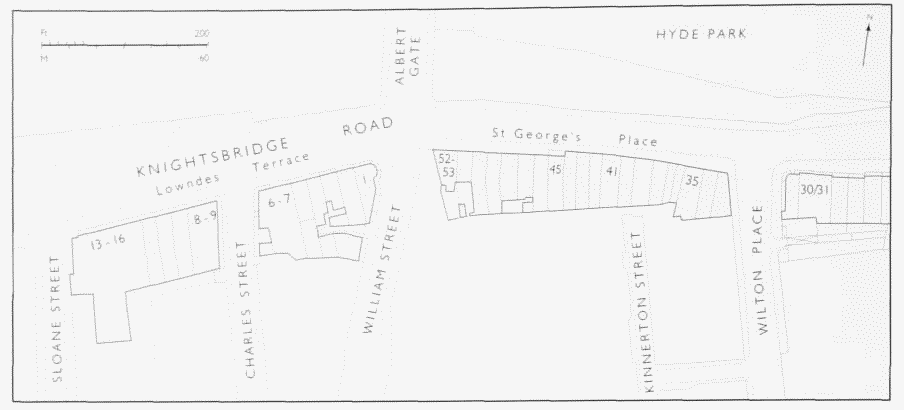
Knightsbridge, south side, Wilton Place to Sloane Street in 1869 (top) and 1991. Buildings in 1869 are numbered in St George's Place and Lowndes Terrace
The exterior of Harvey Nichols is a mixture of somewhat lacklustre late Victorian and inter-war styles. Woollands, a much livelier turn-of-the-century building, has been replaced by the Sheraton Park Tower hotel, which, while sometimes likened to a gasometer, has a certain space-age verve.
Spring Gardens
In the seventeenth century the area now occupied by the Sheraton Park Tower and Harvey Nichols was the northernmost part of the Spittlefields, then belonging to the Crown but before the Reformation part of the estate of Westminster Abbey. In 1668 these fields were leased to Sir William Poultney (who also held, as lessee of the Dean and Chapter, most of the ground fronting the south side of the road between here and Hyde Park Corner). The development of the northern end was begun in or soon after 1670 by Poultney's tenant Henry Swindell, who built a house there with extensive pleasure grounds. (fn. 1)
This well-known place of resort, originally called Spring Gardens, (fn. 2) survived in one form or another until the early nineteenth century. Horwood's map of 1794 shows a large building on the site, then called the Rural Retreat or Rural Castle and later Knightsbridge Grove or Grove House (see Plate 5c). It was here that Theresa Cornelys, the Germanborn singer whose balls and masques at Carlisle House in Soho Square had once attracted the cream of fashionable society, made a last attempt to restore her fortunes after her fall from grace. In 1795 she surfaced in Knightsbridge as Mrs Smith, retailer of asses' milk, and opened a suite of breakfast rooms, but the business failed and she died in the Fleet Prison in 1797. Her successor was William Ick, or Hicks, a 'sporting character', who had an archery ground at the rear and attracted the custom of the Prince Regent. The gunmaker Durs Egg, who lived at Knightsbridge Green, is said to have carried out balloon experiments in the grounds. (fn. 3)
In the mid-eighteenth century a floorcloth factory was set up on part of Spring Gardens, where Harvey Nichols now is (see Plate 5c). Following the creation of Sloane Street in the 1770s, terrace-houses were erected along the west side of Spring Gardens, and a row of six houses was also built at the north end, with gardens fronting Knightsbridge, on the site of the Sheraton Park Tower hotel. In 1815 shops were built over the front gardens and named Waterloo Market: they did not survive many years. A development scheme was already in hand for the Spittlefields, or, as they had become, the Lowndes estate, and in 1823 the shops and houses, together with the floorcloth factory, were pulled down for the building of Lowndes Terrace. (fn. 4)
Downing's Floorcloth Factory (demolished)
In 1761 Richard Rolt wrote in his New Dictionary of Trade, 'There is a considerable manufactory of floor-cloths at Knightsbridge'. The factory Rolt was referring to stood close to the road just north-west of Grove House, on the site now occupied by Harvey Nichols. Established more than ten years earlier by William Spinnage, a painter-stainer, it was the first of two important floorcloth factories set up in Knightsbridge during the eighteenth century (for the other see page 105). Spinnage took a lease of the site, where there was already a house, in 1748; ratebooks record a workshop there by 1750, and a warehouse by the 1760s. (fn. 5) From the early 1750s Spinnage was in partnership with Benjamin Crompton, working from premises in Charles Street off St James's Square, and near Charing Cross. Crompton and Spinnage were primarily wallpaper makers, becoming 'paper hanging manufacturers' to George III, but they also supplied all manner of decorations and furnishings, from papier mâché ceiling ornaments to specially woven Axminster carpets. Floorcloth manufacture involved coating canvas in thick layers of paint, and their trade-card shows that this was seasonal work, advertising 'Painted Floor Cloths of all Sorts & Sizes Painted in the Summer at their Manufactory at Knightsbridge, dry and fit for immediate use'. (fn. 6)
After the dissolution of their partnership and Spinnage's retirement, Crompton carried on in business in the West End with his son, James, but seems to have given up floorcloth manufacture in order to concentrate on wallpaper. (fn. 7) The Knightsbridge factory was let, in 1782–3, to John Harrison and Company, and then to Thomas Morley, both floorcloth manufacturers. (fn. 8) Morley acquired the head lease of the premises in 1791, and in 1794 opened a second factory, on the site of Wellington Square, Chelsea. In addition to floorcloth, he manufactured awnings and 'temporary rooms'. (fn. 9)
Morley's business was taken over in 1799 by Thomas Downing, who went into partnership at about this time with James Baber at the other Knightsbridge floorcloth factory. Downing carried on making floorcloth for many years at Morley's old premises, as well as awnings and 'all kinds of Temporary Erections, put up in any part of the kingdom, and Pack'd for Exportation'. The Knightsbridge factory (the original lease of which had expired several years earlier) was pulled down in 1823 for the building of Lowndes Terrace, in which Downing had showrooms. The business seems to have closed about 1873, when the Chelsea factory (by then rebuilt on the north side of King's Road) was destroyed by fire. (fn. 10)
Almost nothing of detail is known about the appearance of the Knightsbridge factory. When Crompton sublet it to Harrison the buildings included two brick-and-timber warehouses, one with 'offices communicating'. There is some suggestion that Morley rebuilt the factory. According to a description of 1813 the buildings, which included stables and a lean-to weaving shed, were mainly of timber. Some thirty years after the factory had been demolished, H. G. Davis, the Knightsbridge historian, wrote of it as 'a pleasant detached house, with a clean white front, and conspicuous green verandahs'. (fn. 11)
Lowndes Terrace (demolished)
Along the frontage to Knightsbridge now occupied by the Sheraton Park Tower hotel and Harvey Nichols were formerly two rows of houses and shops, together called Lowndes Terrace but each originally independently numbered. Built in the 1820s, these buildings were the first stage in the comprehensive development of the Spring Gardens site and the rest of the two Spittlefields.
In 1692 the Spittlefields (see page 19) had been assigned to William Lowndes (1652–1724), a Treasury official, who in 1723 obtained the right of reversion from the Crown. (fn. 12) When development of the Lowndes estate began, the property was in the hands of trustees for Lowndes' greatgrandson William Lowndes, whose debts had brought him to the point of bankruptcy a few years before his father's death in 1808. The estate worked in with the much bigger Grosvenor estate adjoining: initial plans were formulated by the Lowndes surveyor, Henry Rhodes (a former pupil of the Grosvenor surveyor, William Porden), and negotiations between the two parties for co-ordinated develop ment were in progress by 1810. An Act of Parliament was obtained in 1813 to expedite the improvement of the Lowndes estate by allowing parts to be sold or let on long lease, but it was not until 1819 that the development process was set under way, with a joint application by the two estates for permission to lay drains. (fn. 13)
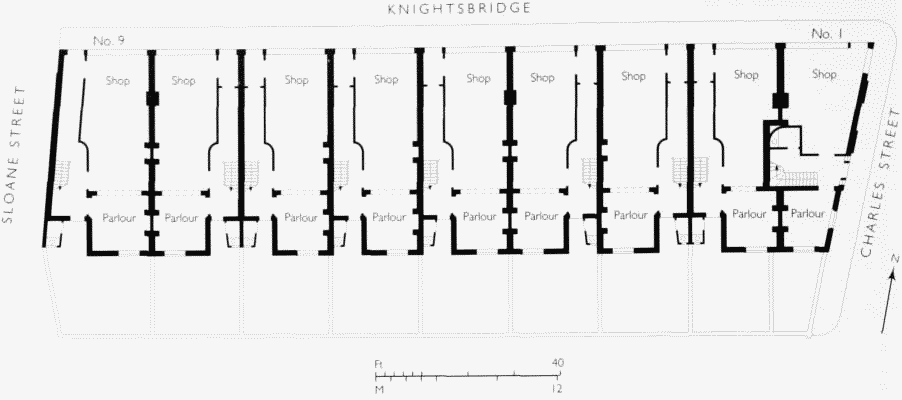
Nos 1–9 (later Nos 8–16) Lowndes Terrace, ground-floor plan as proposed in 1824. Thomas Goodall, builder, for Benjamin Brecknell and Samuel Turner, 1824–6. Demolished
Lowndes Terrace and the two roadways connecting the rest of the estate to Knightsbridge, William and Charles (now Seville) Streets, were the only parts of the plan to be carried out by 1826, when the development was taken over by Thomas Cubitt under a building agreement with the Lowndes trustees. Most of Cubitt's building activities here were left until the 1830s and '40s, when he built up much of Lowndes Square and the rest of the estate to the southeast. (fn. 14)
The construction of Lowndes Terrace began with the eastern range, where six of the seven houses and shops were erected in 1823–4: the nine-house western range followed in 1824–6. The eastern terrace was completed in 1828 9 by the building of No. 1 at the William Street corner. Erected under the general supervision of Henry Rhodes, who as estate surveyor approved the plans and elevations and may have been their author, the two halves of Lowndes Terrace presented two nearly symmetrical and unified façades to Knightsbridge (Plate 30c). The fronts were very plain, with hip-roofed pavilions at each end and attics set back behind balustrading. For the most prominent parts of the enterior, the building agreements specified 'best picked second Malm facing stocks laid with a very close joint', and York, Bath and Portland stone for the dressings. There were iron balconies at first-floor level on the fronts, and the roofs were slated. (fn. 15)
A single developer was responsible for the western terrace, where plans dated August 1824 were submitted by Thomas Goodall, builder, on behalf of Benjamin Brecknell and Samuel Turner, tallow chandlers to members of the royal family, for whose Haymarket premises Rhodes had designed a shop-front in 1821. The whole range was leased to Brecknell, but Turner later inherited some of his partner's properties here and in other parts of London. (fn. 16) By contrast the eastern range was the work of several different builders and developers, among them James Howard and William Thomas Nixon, builders and carpenters of St Martin's Lane, and Thomas Cubitt, who built No. 1, giving its return to William Street a prominent bow. (fn. 17)
The shops in the western range (and probably also those in the eastern) were all similarly planned, each with a back parlour and basement store room (fig. 7), but in both halves of the terrace shop premises were customized to suit individual business requirements. In the eastern terrace Nos 6 and 7 were built as showrooms for George Downing, whose floorcloth factory west of Charles Street was pulled down about this time. Downing employed the services of the local architect W. F. Pocock for this work. A covenant in the lease barred him from carrying out there any of his manufacturing processes, which he thereafter concentrated at his works in Chelsea. (fn. 18) In the western terrace the shops at Nos 1 and 2 (later Nos 8 and 9) were thrown together by a firm of linen drapers, to make one big ground-floor shop, and at No. 4 (later 11) Brecknell installed for a haberdasher a shopfront with a single door in the middle, instead of the approved pattern which had doors at either side. Later, in 1837, an 'expensive' shopfront of mahogany, brass and plate glass was fitted at No. 3 (later No. 10), another draper's shop. (fn. 19)
The business character of the shops was originally quite mixed, but from early on there were harbingers of future specialization. By the 1840s four linen drapers and a firm of silk mercers together occupied a total of seven shops, and this trend continued until just two drapers occupied all sixteen shop premises. Both halves of Lowndes Terrace were pulled down in the late nineteenth century for the rebuilding of Woollands and Harvey Nichols, the two stores which by then had taken them over in their entirety.
Woollands (demolished)
The firm of Woolland Brothers began modestly in 1869, when Samuel and William Woolland, from Bridford in Devon, took over a draper's shop at No. 2 Lowndes Terrace. Though the shop was apparently aimed chiefly at the needs of servants, (fn. 20) it soon attracted notice in the trade press for its 'exceptionally good' window display:
'The fancy window was dressed close up to the pane, and divided into tiers, with a long ticket right across the width, dividing the several classes of goods — piles of ribbons at the bottom, then a long stretch of flowers, scarves next, two or three rows of gloves, and rows of broad striped linen cuffs in conclusion; in the next window a bottom of blocked dress goods, with a row of light grenadines looped up along the front, cambrics at the back and side, the lobby being occupied in one pane with cuffs and lace goods and in the other with hosiery.' (fn. 21)
Over the years the shop expanded into the neighbouring houses, until by 1892 it had taken over the entire eastern half of Lowndes Terrace (from 1903 Nos 95–107 Knightsbridge). The Woollands — three bachelor brothers, Samuel, William, and Moses, and their spinster sister Mary — were then living round the corner at No. 17 William Street. (fn. 22)
By this time the original drapery business had diversified to encompass household linens, soft furnishings, outfitting, haberdashery and accessories; and its clientele had become high-class, even aristocratic. The Duchess of Portland was spotted there in 1893, 'patronising the afterseason sale'. (fn. 23)
In 1896 began the first phase of a programme of complete rebuilding, which continued into 1900–01, the final phase, covering the sites of houses at the rear of Lowndes Terrace in William Street (including No. 17). The new store was designed by Henry L. Florence and ereeted by W. Cubitt & Company. Of fireproof construction throughout, it was built on a steel frame and faced in Portland stone, with a profusion of carved baroque ornamentation and copper-covered domes at the corners. Other than on the ground floor, where there was a continuous run of plateglass display window, it had all the appearance of a traditional masonry building, with a conventional pattern of fenestration (Plate 14). (fn. 24)
The interior was elegantly ornamented and furnished, with panelling, decorative plasterwork and wall-mirrors, tall glazed display cabinets and upholstered chairs for customers' use. Following the conventional design of such stores, there was a top-lit showroom area at the head of the rather grand main stair (Plate 14b). As originally laid out, the ground floor was arranged as 'shop' space, with display rooms and fitting-rooms on the first and second floors, workrooms on the next two floors, and a kitchen, diningroom and assistants' sitting-rooms at the top. There was, however, no sleeping accommodation for staff, who lodged in nearby houses.
In the early 1900s Edward VII's mistress, Alice Keppel, would bring her two young daughters down from Edinburgh four times a year to shop at Woollands. Sonia Keppel recalled:
'In those days, the 'Juvenile Department' at Woollands was situated on the third or fourth floor. Grimly, the lift man shut his concertina-gates on us, and very, very slowly we ascended to our appointment with 'No. 10'.
'We never discovered whether 'No. 10' had had Christian baptism and a name of her own. To Violet and me, she remained a numerical cypher that sucked pins. Always she was bent double at our feet, measuring our skirts, slithering round on her poor, old knees.' (fn. 25)
Up-to-date at the turn of the century, by the 1930s Woollands had come to seem old and cramped. (fn. 26) No further rebuilding took place, although in 1913 the firm had acquired the freehold, not only of the store, but of almost the entire block between William and Seville Streets, including the houses on the north side of Lowndes Square (these last, however, were disbarred by covenant from being put to business use). (fn. 27) In 1949 Woollands was acquired by the Debenham group, already in possession of its next-door rival, Harvey Nichols. For some years Debenhams maintained the distinctive character of each establishment, but by the mid-1960s the co-existence of the two large stores had ceased to be viable, and in 1967, the site having been sold for redevelopment, Woollands closed. The premises were demolished two years later for the building of what is now the Sheraton Park Tower hotel. (fn. 28)
Sheraton Park Tower Hotel
Plans for a hotel on the island site then occupied by Woollands store and residential buildings on the north side of Lowndes Square were drawn up by Seifert & Partners for Capital and Counties Property in 1966. The present rather stocky building (Plates 17c, 112), reminiscent of Seifert's earlier Space House in Kingsway, was conceived in 1968, successive designs for a much taller hotel having failed to obtain planning consent. Construction, by Y. J. Lovell & Company, began in 1970, and the hotel was opened in 1973 as the Skyline Park Tower Hotel, part of the Canadianowned Skyline chain. (fn. 29)
The 300-bedroom hotel consists of a fifteen-storey rotunda of pre-cast concrete components, built around a reinforced-concrete core and carried on pilotis descending through the two-storey 'podium' and basement floors. Its most distinctive features are the projecting window units, faced in ceramic mosaic, a characteristic Seifert motif giving the building a cellulated appearance likened by Charles Jencks to corn-on-the-cob. (fn. 30)
Along with many of the large hotels of the early 1970s, most of them the beneficiaries if not the actual progeny of the Development of Tourism Act of 1969, which provided government subsidies for hotel-building, the Park Tower was generally not well received by the architectural press (though the architectural qualities of the rotunda were acknowledged here and there). Critics saw it as 'gasometric' and 'keep-like', with a top storey 'like the stopper on a scent bottle'. (fn. 31) The themed interior decoration, by the Canadian designer Allan Edwards, which included a Tudor-style 'half-timbered' restaurant, was dismissed by some as not much more than kitsch. (fn. 32)
Harvey Nichols
The founder of the famous store on the corner of Knightsbridge and Sloane Street, Benjamin Harvey, was one of two Ipswich-born brothers both of whom became prominent drapers in Victorian London. (fn. 33) Joseph, the elder by a few years, built up a large establishment in Westminster Bridge Road, Lambeth, which did not long survive his death in 1876 at the age of 84. Benjamin, in contrast, died relatively young, but his store continued to flourish, reaching its peak many years later. The precise origins of their involvement in the drapery trade are obscure, but they were probably apprenticed at a London draper's. They had a close association with the firm of White and Greenwell, linendrapers and haberdashers of Commerce House, Great Surrey Street, Blackfriars.
Benjamin Harvey (c.1796–1850) set up shop in Knightsbridge in 1831, at No. 9 (later 16) Lowndes Terrace, on the corner of Sloane Street. From this site he expanded, taking over the adjoining shop by 1835, and within ten years the next one as well, the combined premises being known as Commerce House. At about the same time as this third building was acquired, Harvey took into partnership his shopman, James Nichols, then in his late twenties. In 1848 Nichols married Harvey's wife's niece, consolidating his position in the business, which became Benjamin Harvey & Company.
Harvey was seemingly enlightened as well as expansionist, taking an active role in the Metropolitan Drapers' Association (from 1845 the Metropolitan Early Closing Association), which sought to improve the lot of shopworkers. But it was not until 1851, after his death, that 'early closing' was introduced at Commerce House, and trading ceased at 7 p.m. (instead of eight or nine o'clock, according to the season, then customary in the drapery trade). (fn. 34)
After Harvey's death the firm was run by his widow Ann and James Nichols, and in about 1854 it was redesignated Harvey Nichols & Company.
The growing prosperity of the business was reflected in the social aspirations of the two families. In the late 1850s Nichols, now styling himself 'esquire', left his rooms over the shop and moved to No. 10 The Boltons, South Kensington; some years later Mrs Harvey became his near neighbour at No. 5. She died in 1872, and Nichols himself died early in 1873, whereupon the Harveys' son, Benjamin Charles, turned the firm into a limited company.
The expansion of the shop premises continued over the years. Considerable building work was carried out in 1874 (when only one house in the terrace still eluded the company). The architect, for some of it at least, was Alfred Williams, District Surveyor for South Kensington. (fn. 35) From 1878 Harvey Nichols occupied the entire Knightsbridge frontage between Seville Street and Sloane Street, and in the 1880s further adjoining properties were acquired in Sloane Street. In 1889 it was decided to undertake complete rebuilding.
By this time the business had long since begun to diversify. Brussels carpets, striped rugs, eiderdown quilts, evening dresses and millinery were among the lines displayed in the shop windows in 1873. (fn. 36) Diversification, however, did not lead to Harvey Nichols becoming a 'universal provider' like Whiteleys or Harrods. Drapery remained the core of the business, and the firm continued to be described in directories simply as 'drapers' until 1914.
The new shop (Plates 1, 15a, 17c, 112), built in stages between 1889 and 1894, was designed by the local architect C. W. Stephens, later responsible for the new Harrods store and Claridge's hotel, who produced a conventionally imposing edifice with pavilion roofs in the French style (Plate 15a). At least two firms of contractors were employed, Higgs & Hill in 1892–3, and John Shillitoe & Son of Bury St Edmunds in 1893–4. (fn. 37)
The plan was essentially L-shaped, with a large central light-well above first-floor level in the main range, fronting Knightsbridge. Alongside Sloane Street redevelopment was hampered by the firm's failure to obtain an uninterrupted run of frontage. Two sites at the north end, Nos 211 and 212, were incorporated into the overall architectural scheme; but the façade at Nos 208 and 209, cut off by a recalcitrant bootmaker's shop at No. 210, was treated separately, in an Italianate style.
Sales and display space was concentrated on the ground and first floors, and part of the second floor (fig. 8). The basement was given over to stockrooms, and the remainder of the second floor, and the whole of the upper floors, were used as staff accommodation, including bedrooms, and workrooms. Fire regulations at the time made it virtually impossible to have open showrooms in the upper storeys.
The first major alterations were made following the firm's acquisition of the freehold, and additional property in Harriet Mews and Seville Street, in 1904. (fn. 38) In 1910–11 the light-well was largely filled in to give more showroom space on the first floor, and in 1913 more room, for sales and for a tea-room on the third floor, was freed by the acquisition of two houses in Queen's Gate for use as staff hostels. (fn. 39)
Harvey Nichols was one of several important department stores to lose its independence after the First World War. In 1920 it was taken over by Debenham & Freebody, to whose wholesale division it had become heavily indebted. A consequence of this was that Harvey Nichols, which held a royal warrant from Queen Mary, became a little more populist in character, and for the first time advertisements began to appear, in journals such as the Lady (where the still independent Woollands advertised). The many departments, said a contemporary account, 'provide for practically every aspect of home and personal adornment':
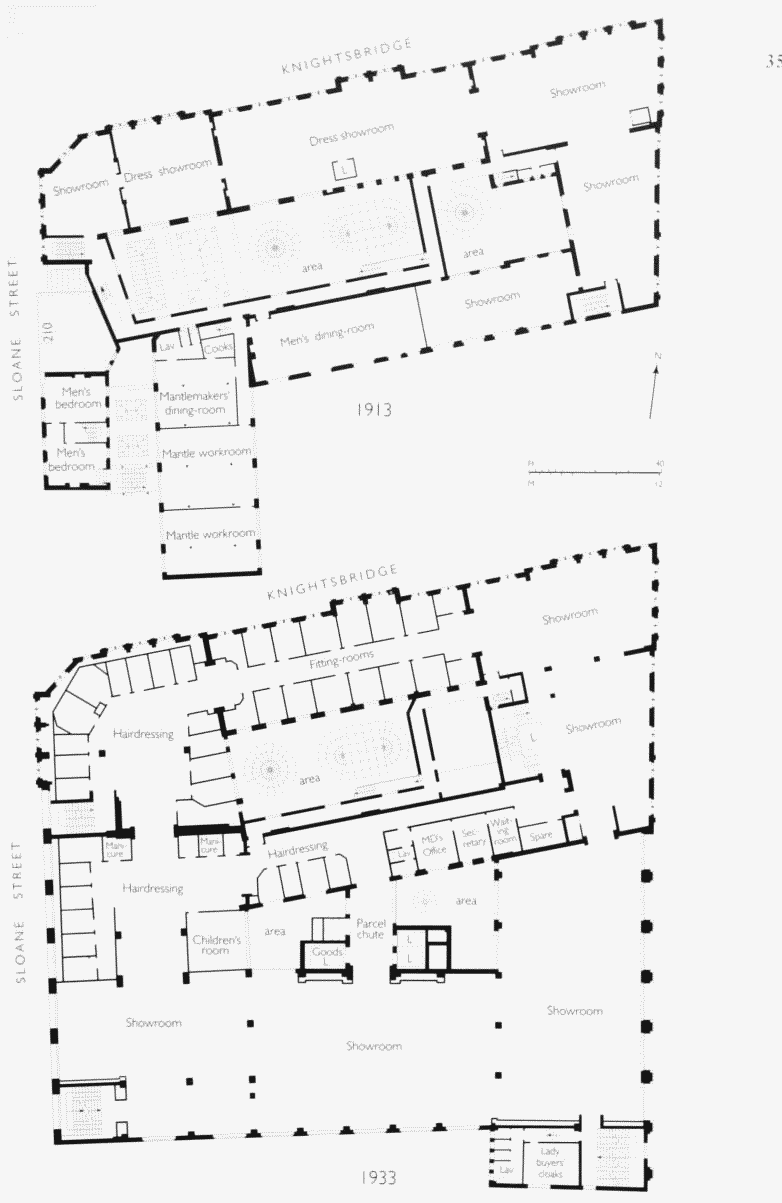
Harvey Nichols, second floor, plans in 1913 and 1933
'The [carpet] salons have been an important feature from the inception of the business, and a wonderful variety and assortment of Oriental and British varieties, modern and antique, can always be seen. Their soft furnishing department is replete with decorated fabrics that display wonderful colours and skilful designs of all periods at extremely moderate prices, while the section of the house devoted to antique furniture is one of the first places visited when American and Continental connoisseurs come to London. Their fashion departments need no introduction . . . the choicest models of Paris, London, and New York in gowns, furs, footwear and hosiery are here gathered under one roof. The restful charm of the firm's Louis Seize Restaurant, well-known to the habitués of the store, and thetout ensemble, now form one of the finest and most popular shopping centres of the West End.' (fn. 40)
Debenhams embarked on a scheme of capital investment, further expanding the site and undertaking an extensive programme of rebuilding in both Sloane Street (1922–8) and Seville Street (1928–34). Externally, the new work was carried out under the influence of the Beaux-Arts classicism of Selfridges, which had become the prototype for new British department stores (Plate 15c). The architects were Frederick Ernest Williams and Alfred Cox, successors to Alfred Williams' practice. Higgs & Hill were the builders. (fn. 41)
The rebuilding in Sloane Street, covering the sites of Nos 206–210, was possibly envisaged as the first stage in a southwards expansion of the store along a street which had become 'so fashionable that it is almost a rival to Bond Street'. (fn. 42) Harvey Nichols had acquired a reversionary lease of all the properties as far south as No. 190A, no doubt with an eye to rebuilding, and the new front seems to have been designed for easy duplication as the additional sites became available. In the event this expansion was never realized.
An odd feature of the rebuilding along Sloane Street was the addition of a second pavilion dome at the Knightsbridge corner, positioned on top of the short return front of the 1890s building and in the same, by then out-dated, style (Plates 15c, 112).
As work on the Sloane Street side came to an end in 1928, redevelopment began in Seville Street. Somewhat delayed by a dispute with the Lowndes Estate over the realignment of Harriet Mews (renamed Harriet Walk in 1932), it was completed in 1934. The clock in the middle of the Knightsbridge front was installed at this time, as one of the final touches. (fn. 43)
The revitalized Harvey Nichols was one of the most up-to-date department stores in London. There was one showroom in the basement, while the ground and first floors were entirely given over to display and sales areas.
On the second floor (fig. 8) were the fashion showrooms and fitting-rooms, each one 'decorated and furnished in the style of a different period, making delightful backgrounds for new frocks, and providing inspiration for decorative schemes at the same time'. Also on this floor was an extensive hairdressing and beauty department. The general colour scheme was green and pale yellow, with 'roomy and light' cubicles each done in a different pastel scheme. (fn. 44) A large restaurant was located on the third floor. Workrooms and facilities for employees occupied the fourth and fifth floors. These included common rooms, a restaurant for 'staff' and separate canteens for 'workers' and 'juniors'. (fn. 45)
Considerable internal reorganization followed the closure in 1967 of Woollands (by then also part of the Debenham group), and the transfer of some of its specialized departments and exclusive product lines, as well as most of its staff, to Harvey Nichols. Extensive and costly modernization was carried out in the 1970s, involving much internal demolition. In 1975 Maurice Broughton Associates were called in to redesign the ground floor and make other improvements. The object was to cater for a younger, more international clientele, and, following Harrods' lead, to provide 'shops-within-shops' for top specialist firms. On the fifth floor was created a restaurant and bar with a 'garden atmosphere', partially screened from the shop by a glass wall and curtain of running water. The window displays, designed by Andrew Wiles, became the most consistently striking in London, a tradition continued by Mary Portas.
In 1979, having reinforced Harvey Nichols' separate identity at enormous expense, Debenhams, by then suffering from the effects of out-of-town competition and unsuccessful diversification within their shops, put the store on the market. An offer from a property development consortium, who wished to redevelop the site, was ultimately rejected, and in 1985 Debenhams was taken over by the Burton Group. Under Burtons, Harvey Nichols continued to lose money and it required another change of ownership of the store (to Dickson Poon of Hong Kong, in 1991), and a yet more expensive make-over, to turn operating losses into profits. This remodelling, by the architects Wickham & Associates, involved the creation of a food hall, restaurant, café and bar, all on the fifth floor (Plate 15b). The food hall in particular, because of its upper-floor location, was seen as something of a gamble, though it has proved very successful. (fn. 46)
Harvey Nichols has long ceased to be a department store in the conventional sense and has become more of a 'fashion house', with a collection of designer-label counters occupying its otherwise anonymous-seeming sales floors. It has, with Harrods, done much to reinforce the reputation of Knightsbridge as an international shopping centre, and is probably better known now than at any time in its history.