Survey of London: Volume 45, Knightsbridge. Originally published by London County Council, London, 2000.
This free content was digitised by double rekeying. All rights reserved.
'Knightsbridge Green Area: Scotch Corner and the High Road', in Survey of London: Volume 45, Knightsbridge, ed. John Greenacombe (London, 2000), British History Online https://www.british-history.ac.uk/survey-london/vol45/pp79-88 [accessed 30 April 2025].
'Knightsbridge Green Area: Scotch Corner and the High Road', in Survey of London: Volume 45, Knightsbridge. Edited by John Greenacombe (London, 2000), British History Online, accessed April 30, 2025, https://www.british-history.ac.uk/survey-london/vol45/pp79-88.
"Knightsbridge Green Area: Scotch Corner and the High Road". Survey of London: Volume 45, Knightsbridge. Ed. John Greenacombe (London, 2000), British History Online. Web. 30 April 2025. https://www.british-history.ac.uk/survey-london/vol45/pp79-88.
In this section
Scotch Corner and the High Road
The High Road
Until 1903, the properties along the south side of Knightsbridge between Brompton Road and Trevor Street were mostly numbered as part of the High Road, sometimes known as the High Street. At the east end, on the Brompton Road corner, a terrace of houses, then recently replaced by Park Mansions, had been separately numbered under the name Middle Row, or Middle Row North, since its construction in the 1720s (fig. 22). (fn. 3) At the other end of the High Road, on the corner of Trevor Street, the last few houses formed the eastern half of Trevor Terrace, built in the early nineteenth century (see page 97). When the old names were abolished and the premises all renumbered as part of Knightsbridge, High Road was coming to the end of a period of piecemeal redevelopment, begun in the 1870s, which transformed the character of this part of Knightsbridge, socially and commercially as well as architecturally.
By the 1860s, the High Road had become one of the least salubrious parts of Knightsbridge, a centre for low pleasures in sharp contrast to the increasingly select character of the district in general. From Knightsbridge Green all along the High Road was 'a succession of music-halls, taverns, beer-stores, oyster saloons, & cheap tobacconists', that would have been 'a disgrace to any portion of London', the nightly meeting-place of disorderly men and women whose behaviour made the area 'quite as unseemly as the Haymarket'. (fn. 4) Not three hundred yards long, the south side of the High Road accommodated five public houses, two or three of them with purpose-built music-halls attached, while on the north side there was a concentration of shops, pubs and lodging-houses adjoining Knightsbridge Barracks in and around Park Place and Mills's Buildings.
The High Road's rambunctious nocturnal character stemmed naturally enough from the combined presence of several old inns and the cavalry barracks. The Marquis of Granby, the immediate precursor of the present-day Paxton's Head, was one of the oldest-established of these inns, dating back at least as far as 1632, when it was called the King's Arms – it was later known as the Golden Lion, the Red Lion and the Sun. (fn. 5) Perhaps the earliest was the Rose and Crown, formerly the Rose, a few doors along at No. 16 High Road, said in the 1850s to have been licensed more than 300 years. This establishment, reputedly used as quarters by Cromwell's troops, was called the Oliver Cromwell in the 1840s. (fn. 6) Further west, the King's Head or Old King's Head, No. 24 High Road, was certainly in existence by the 1790s. (fn. 7) Both the Rising Sun at No. 26, and the Trevor Arms in Trevor Terrace, had opened comparatively recently, the former about 1830, and the latter in 1844. (fn. 8)
A harbinger of things to come was Mr Neat's concert room at the Old King's Head, opened by about 1840 and conducted by Mr Paulyneo, manager or proprietor of several London concert rooms and 'himself a very good comic singer'. (fn. 9)
In 1849 residents of High Row, Lowndes Terrace, Trevor Terrace, Rutland Gate and elsewhere petitioned against the granting of music and dancing licences to various public houses in the district, including the Marquis of Granby, Rose and Crown, King's Head and Rising Sun, on the grounds that 'if such licences were granted immorality of all kinds in the neighbourhood already greatly abounding owing to its close proximity to the Barracks would be vastly increased'. (fn. 10) They referred to police action the previous year to put a stop to unlicensed music and dancing carried on in some of these pubs. But local opposition notwithstanding, the High Road enjoyed a musical heyday through the 1850s and '60s, echoes of which were still to be heard in the late 1880s.
The Rose and Crown was licensed for music and dancing from 1852 to 1876, and the King's Head from 1851 until 1858. (fn. 11) The Sun Music Hall began as a concert room built at the back of the Rising Sun in 1851, and was rebuilt on a grander scale in the 1860s. At the rear of the Trevor Arms, the Trevor Music Hall was first licensed in 1854.
The High Road's popularity as a place of entertainment in early to mid-Victorian days does not seem to have done much to improve its general appearance, nor to have resulted in any significant rebuilding along the road frontage. Middle Row in the 1850s was 'a medley of very inferior houses' and the buildings further along were 'generally of a mean description'. (fn. 12) The new concert halls were obscurely placed, at the back of narrow sites.
Probably the oldest structure at this time was the Rose and Crown, which bore the date 1679, and had timberbuilt galleries at the rear, overlooking a spacious stableyard (Plate 48a). (fn. 13) The building then occupied as the Rising Sun was also, apparently, of seventeenth-century date. Another old house, between the Rising Sun and the King's Head, had been pulled down about 1801 and a row of three houses built on the site. (fn. 14)
Chatham House, No. 13A High Road, had been built in 1688 on the site of a tavern called the Grave Maurice. Adjoining Chatham House at Nos 12 and 13 was a pair of houses built in 1736–7 along with a row of small houses behind on the west side of Knightsbridge Green. (fn. 15) A photograph of c. 1904 shows Nos 12 and 13 as plain, rendered houses of three storeys, two windows wide, both in a state of some dilapidation. (fn. 16) They were then the last-surviving old buildings in the High Road.
Redevelopment of the High Road got under way in the mid-1870s, shortly before the rebuilding of the barracks and the widening of the roadway at that point. The Rose and Crown and the adjoining houses, west of Chatham House, were pulled down and rebuilt in 1874–5 on a much larger scale. The new buildings, six storeys high, were designed by Henry Pafoot Foster, architect, and erected by Thomas Elkington of Golden Lane. The Rose and Crown itself was re-created as the Rose and Crown Coffee Palace, later a 'temperance hotel'; it was 'practically rebuilt' in 1917 as the Royal Park Hotel. (fn. 17)

Knightsbridge Green area in the mid-1860s
In 1876 Chatham House was rebuilt for Captain Charles Mercier, an artist who resided in High Row. The new Chatham House was designed by the architect Alexander Payne and constructed by Robert Lacy of Clapham. A curious building with a shaped gable of eccentric design on the street front, it apparently incorporated a top-lit studio for Captain Mercier on the second floor. Though considerably loftier than the old houses next door at Nos 12 and 13 High Road, it was nevertheless out of scale with redevelopment in the High Road generally. Foster's buildings dwarfed it, as in time did Park Mansions, on the other side of Knightsbridge Green. (fn. 18)
Gradually, the whole of the High Road was pulled down and largely replaced by mansion flats and shops, one of the last parts to go being the new Chatham House itself. Together with its decrepit neighbours, Chatham House was demolished a few years before the First World War for the building of the Knightsbridge Palace (later Normandie) Hotel.
Not all redevelopment, however, was of this sort, and the High Road continued to provide places of public amusement. In the 1880s Humphreys' Hall, which evolved from a former roller-skating rink on land behind the King's Head, became an important venue for high-class exhibitions and bazaars, including the famous Japanese Village, before being redeveloped as the exclusive sports centre Prince's Club.
In general, shops, restaurants, tea-rooms, hotels and residential apartments characterized the former High Road until the Second World War, and a little of this character remains at the east end today. Rutland Yard, formerly the stable-yard of the Rose and Crown, continued to be used for stabling into the twentieth century. It was latterly converted for warehousing and garaging before being obliterated in the 1950s, along with much of the rest of the High Road, for the building of Mercury House. Nos 171 and 173, part of H. P. Foster's 1870s rebuilding, survived, at least in part, into the 1990s.
The Marquis of Granby was rebuilt or remodelled in 1851 and renamed the Paxton's Head, in honour of the designer of the Crystal Palace: (fn. 19) it was again rebuilt in the early 1900s as part of the Park Mansions development. It is the only public house in Knightsbridge which originated as a village inn.
Statue of Lord Strathnairn (removed)
As long ago as 1836 the intersection of the Kensington and Brompton roads had been identified as an eligible spot for a public monument, (fn. 20) but it was not until 1895 that one was erected, and then the site was a substitute for the more prestigious one originally intended.
Hugh Rose, Field Marshal Lord Strathnairn, one of the chief suppressors of the Indian Mutiny, died in 1885 at the age of 84, and a few years later steps were taken to provide a public memorial. There was some suggestion that this should take the form of funding for some useful purpose connected with the Army, and, chairing a meeting to inaugurate the project in May 1890, the Duke of Cambridge remarked that statues were 'very expensive and not always good'. However, this idea was set aside. During that summer some £2,700 was raised in subscriptions, including 50 guineas from the Prince of Wales, and later in the year the sculptor E. Onslow Ford was commissioned to design an equestrian statue. It was hoped this would stand in Whitehall between the Horse Guards and the Admiralty. Official sanction was not forthcoming, and in due course the memorial committee settled for the Brompton Road corner site offered by Westminster Vestry. (fn. 21)
Ford's statue, showing Strathnairn in uniform with the helmet prescribed for Indian service, was unveiled by the Duke of Grafton on 19 June 1895 (Plates 11, 37a, 38a). It was cast by G. Broad & Son, using bronze from guns taken in 1858 by the Central India Field Force (under Strathnairn's command) and presented by the Indian Government. The Portland-stone pedestal bore panels with the names of the Field Marshal's principal battles. Much gilding was used on both horse and rider, which, in the words of the Builder, 'though it may be objected to as too realistic, certainly gives a better decorative effect, in London atmosphere, than a bronze statue in its ordinary state'. (fn. 22)
Taken down in 1931, during work on a new subway for Knightsbridge underground station, the monument languished in storage until 1964, when Westminster Council decided to give it away on condition of reasonable public access. The successful bidder was Vernon E. Northcott, on whose estate at Foley Manor in Liphook, Hampshire, it still stands. (fn. 23)
Park Mansions
The triangle east of Knightsbridge Green is largely occupied by Park Mansions, a block of flats and shops erected in 1897–1902. The site was assembled in 1887–90 by Frederick Yeats Edwards of Hampstead and Robert Clarke Edwards, an architect then in practice in Norfolk Street, Strand – presumably with an eye to complete redevelopment. Some of the old buildings on the corner of Brompton Road and Knightsbridge were pulled down at this time. Whatever plans the Edwardses had came to nothing, and the property – 'long disfigured by unsightly hoardings and sheds of corrugated iron' – was acquired in 1897–8 by Abram or Abraham Kellett, a contractor of Castle Bar, Ealing and Old Oak Wharf, Willesden. (fn. 24)
Kellett, his architect G. D. Martin, and their solicitor were originally to have undertaken the development through a specially formed company, backed by the lightopera impresario and property developer Richard D'Oyly Carte. However, this scheme seems to have fallen through, possibly because of Carte's illness early in 1897, and at least part of the project was financed by a loan to Kellett from the Bradford Commercial Joint Stock Bank, whose successor, the Knightsbridge and Bradford Estate Company Ltd, subsequently owned Park Mansions until its dissolution in the 1930s. (fn. 25)
The site was developed in two phases: the eastern corner in 1897–8, and the western part in 1900–2. The Paxton's Head public house was rebuilt as part of the western section. Between the two parts was built the Park Mansions Arcade, with a central octagon under a glazed cupola. The arcade was originally to have had an entrance on Knightsbridge Green, as well as on Knightsbridge and Brompton Road, but this was abandoned, along with a proposed third section on the site of All Saints' School – a plan to which the toothing of the brickwork on the south-west corner of the mansions still testifies. The old school building, however, was subsequently incorporated into the Park Mansions premises. (fn. 26)
The completed Park Mansions provided space for nearly forty shops, with a mezzanine for showrooms and basement stores. Well over a hundred flats of one and two bedrooms, most with an additional servant's room, were arranged on the six upper floors (fig. 23). The smaller suites, without kitchens, were intended for bachelors and clubmen, for whom a service room and a large kitchen 'fitted with every requisite' were situated on the top floor. (fn. 27) Among the first residents were numerous military men, a sprinkling of peers and gentlemen, and many 'Misses'. The eighteen apartments at Nos 159 and 161 Knightsbridge (on the corner of Knightsbridge Green) were known as 'Hyde Park Chambers': in the 1960s these were converted into the Knightsbridge Green Hotel.
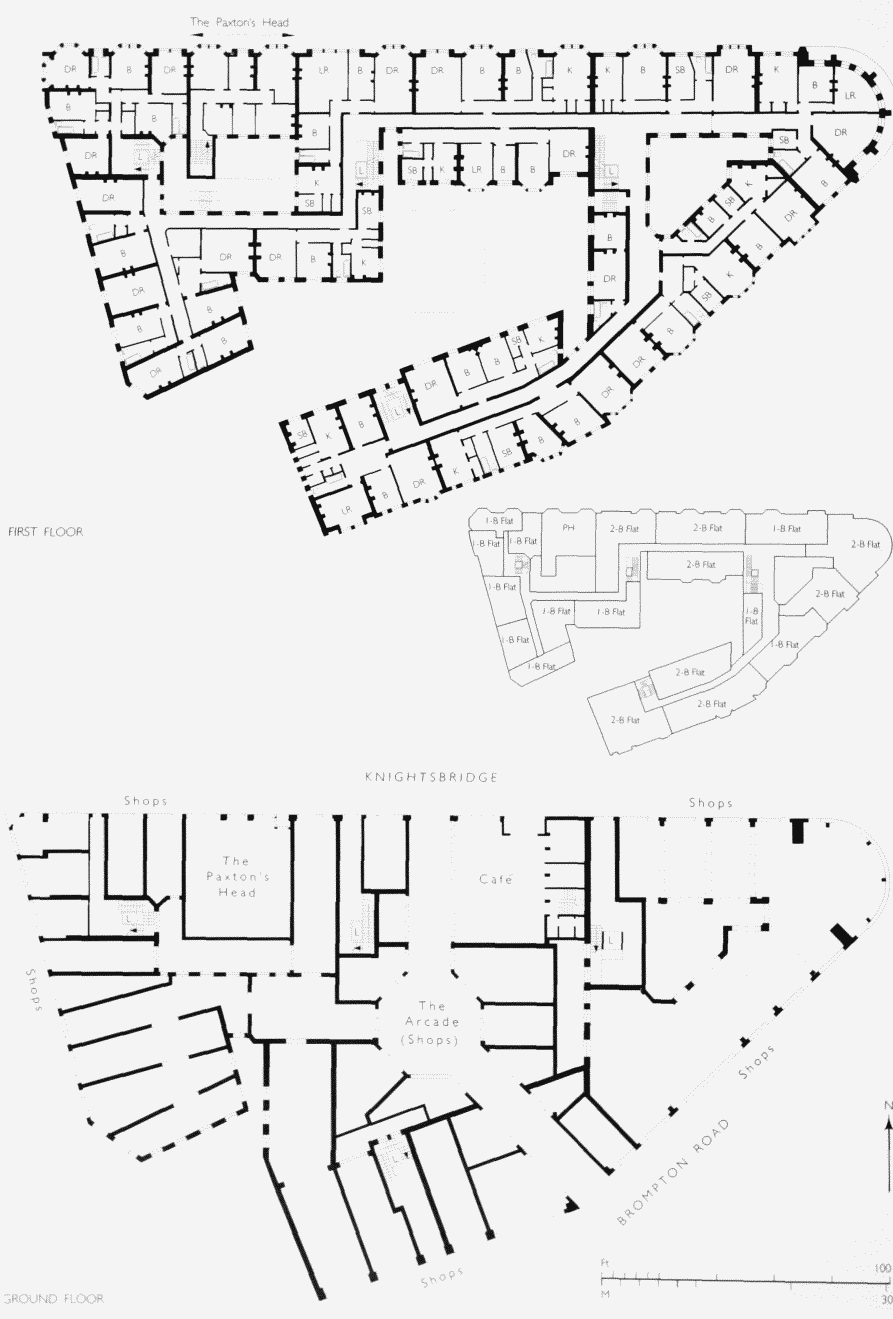
(opposite). Park Mansions, ground- and first-floor plans as originally designed by G. D. Martin, c. 1897, and diagram showing arrangement of flats. The design was modified before construction, particularly by the addition of rominent corner bay windows on the first floor
G. D. Martin dealt pragmatically with the architectural and commercial requirements of the development, producing a conventionally ornamental edifice, faced in redbrick and Bath stone, with red granite pilasters, but with an abundance of glass in the ground-floor shopfronts (Plates 36b, 37a). This necessary concession to the needs of the retail trade inevitably affronted the purists, among them a correspondent to the Pall Mall Gazette, Percy A. Johnson:
Where there should be stone, there is glass; where strength is expected, there is weakness, where lightness, an overpowering weight … The feeling of insecurity is paramount; it is as if a mammoth were seen to be reposing on cucumber-frames. (fn. 28)
The first commercial tenant was the clothing firm of Gardiner & Company Ltd, which took the prime corner site at Nos 2–8 Brompton Road for its Scotch House shop, which has given the informal name Scotch Corner to the junction of Knightsbridge and Brompton Road. Among the other early business occupants were East India merchants Cursetji & Cooverji, a hat manufacturer, an art dealer, and several automobile companies. The Scotch House was modernized in 1958 with a front in the Festival of Britain style, by Charles Baker & Company Ltd of Edmonton. (fn. 29)
Park Mansions Arcade (latterly Knight's Arcade) was closed in the early 1990s. The octagon and southern arm have now been incorporated into the Jaeger shop on Brompton Road; the northern portion has been subsumed into the Isola restaurant on Knightsbridge.
Former Normandie Hotel, Nos 163–169 Knightsbridge
The Normandie was built as the Knightsbridge Palace Hotel in 1910–11 for the Land and Leasehold Securities Company Ltd, and leased to the West End Hotel Syndicate Ltd, which ran several London hotels. The contractors were E. G. and F. C. Simpson of Chandos Street, trading as the General Building Company. (fn. 30)
The hotel was designed by the Viennese-born architect Paul Hoffmann, a specialist in large office and apartment blocks, and, appropriately for Knightsbridge with its equestrian traditions, a well-known owner of hackney and show horses. (fn. 31) According to an early report, the building was to have been faced in 'solid English granite', but in the event red brick with stone dressings was used. The style has some flavour of Edwardian Baroque (Plate 50d). Suites of rooms for guests were arranged around a central core containing a lift and stairs, with bay-windowed sittingrooms overlooking Knightsbridge. The principal public rooms (Plate 51) were fairly richly decorated: a large dining-room with a rather overbearing Jacobethan ceiling, a colonial-looking ground-floor lounge, and in the basement a 'charming' ballroom for up to 300 dancers, decorated in rose-pink and white. Private rooms, though 'furnished in excellent style', were unpretentious. (fn. 32)
In 1937 the Knightsbridge Hotel ('Palace' having been dropped by 1918) was renamed the Normandie. It closed c.1977 and the upper floors were then converted to apartments for 'holiday' lets. Since 1987 the building has been awaiting redevelopment. (fn. 33)
Humphreys' Hall and Albert Gate Mansions (demolished)
Humphreys' Hall and Albert Gate Mansions occupied the small detached eastern portion of the Trevor estate, the mansions later expanding into the freeholds on either side. The ground was previously occupied by old houses and shops along the High Road, including the King's Head public house at No. 24, and by Dungannon Cottage (named after one of the Trevor family titles), which stood in a large garden at the rear of the High Road buildings (fig. 22).
Humphreys' Hall became well known to the late-Victorian public as the venue for a series of exhibitions: the longest-running and most remarkable of these was the Japanese Native Village of 1885–7 (see below); others included a War Exhibition, the Food Exhibition of 1882, and the Medical and Pharmaceutical and Bread Reform Exhibitions of 1884. (fn. 34) The original building, previously used for roller-skating, and greatly enlarged before the opening of the Japanese exhibition, was destroyed in May 1885 when the village caught fire. Both hall and village were subsequently rebuilt. After the final closure of the Japanese Village, the new Humphreys' Hall was extensively reconstructed as Prince's Racquets and Tennis Club. Albert Gate Mansions were built along the High Road frontage when the original hall was enlarged in the early 1880s; they too were later extended.
The roller-skating rink which became the first Humphreys' Hall probably originated with premises at Dungannon Cottage used for manufacturing bicycles and sports equipment. Thomas Sparrow, bicycle maker and agent for the Coventry Machinists Company Ltd, and the firm of Sparrow & Spencer, manufacturers of gymnastic apparatus and government contractors for military gymnasia, occupied these premises, known as No. 21A High Road, for several years in the early and mid-1870s (at which time they also had a shop in Piccadilly). The skating rink, known as Dungannon Rink or Dungannon Cottage Skating Rink, was set up about 1876, during a brief mania for the sport. (fn. 35)
Like many others, this rink had fallen out of use by 1880, when it was refitted, by Edward Witts, architect, for the United Service Provision Market Ltd. This concern, soon defunct, supplied cut-price food and general produce to its shareholders and their friends. (fn. 36) In 1882 Dungannon Hall, as the premises had become known, was taken over by James Charlton Humphreys, the iron-buildings manufacturer, who adapted or rebuilt it for public use. Samples of his buildings were displayed on the ground adjoining. (fn. 37)
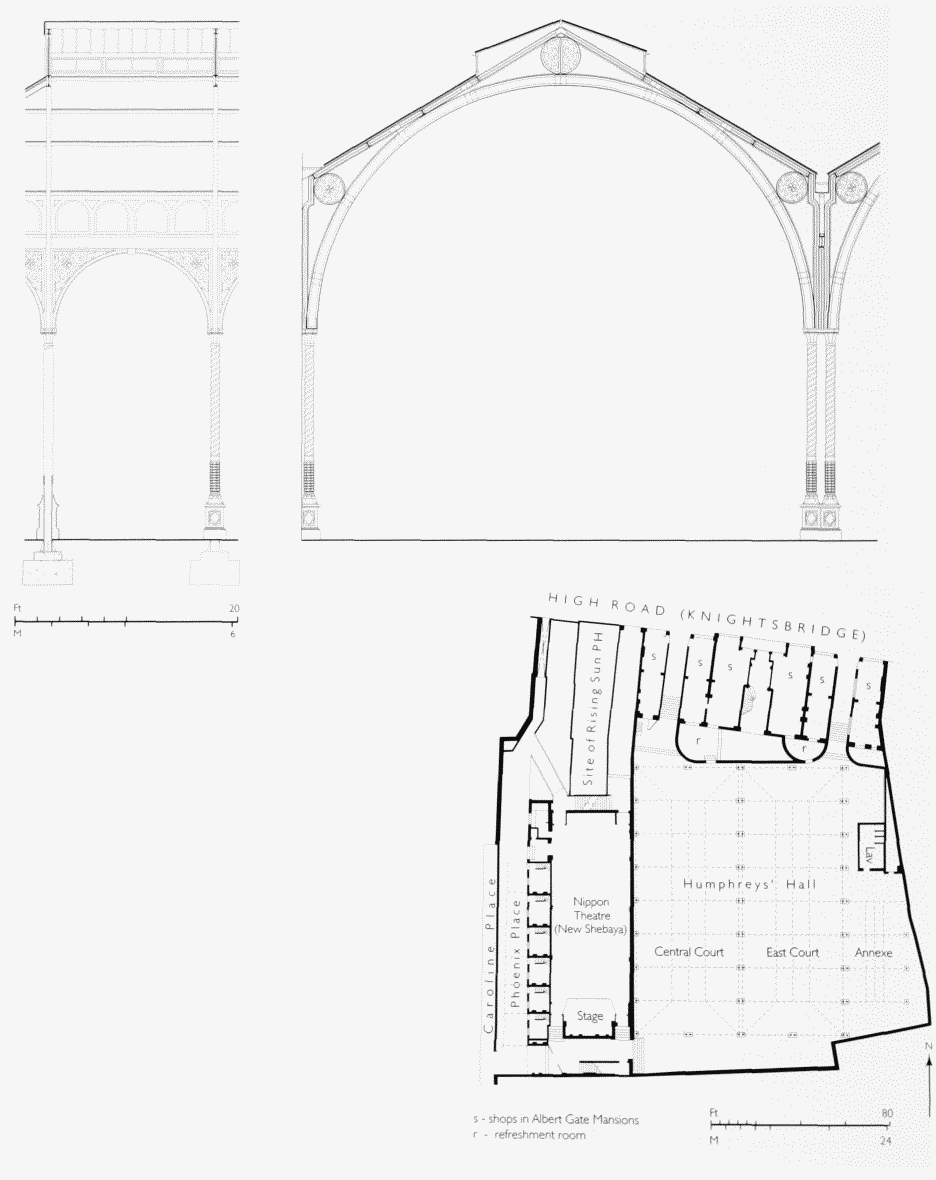
Humphreys' Hall and adjoining premises belonging to J. C. Humphreys. Plan in early 1886, and part sections through Humphreys' Hall. All demolished
Humphreys' building was said to be 'externally, a handsome one', and internally 'very open, light, and exceedingly well ventilated', with a single-span arched roof, a raised skylight and a white marble floor. There was a gallery at either end. One of the first functions held there, in October 1882, was a banquet given by prominent local residents for the 1st Life Guards, recently returned from Egypt. (fn. 38)
The success of the hall encouraged Humphreys to build a second hall, of similar construction, alongside the old in 1883–4. The two halls were available separately or might be thrown together for large functions. As a further part of the development (carried out on long leases from Lord Trevor, the freeholder), the buildings on the High Road north of the hall were replaced with flats. These were at first known as Humphreys' Mansions or Humphreys' Hall Mansions, but soon took the more up-market name of Albert Gate Mansions. (fn. 39)
Designed by Romaine-Walker and Tanner in a northern Renaissance style, the flats were faced in rubbed and gauged red brick, with balconies, oriels and ornamentation of Portland stone (Plate 37c). Their construction generally was carried out by Humphreys' own workforce; the carving was by J. W. Scale of Walworth. Humphreys Ltd had offices in the building, which included a row of shops (fig. 24). On the first, second and third floors were high-class flats, offered at rentals of between £100 and £300 per annum, while the top floor (originally to have included a reception room for residents or societies) was divided into artists' studios, with large north-facing windows at the front and 'chambers' behind. Directories do not suggest that these studios found favour with artists. There was extensive provision for kitchens in the basement and an 'elaborately decorated' restaurant above, with a service lift to the other floors. (fn. 40)
Following the disastrous fire in May 1885, Humphreys employed the architect Spencer Chadwick to design a new hall conforming to the Metropolitan Board of Works' stringent safety regulations. The new building, with an iron roof in three arched spans, was constructed by Humphreys Ltd between June and December 1885 (fig. 24). (fn. 41)
Further development was carried out by Humphreys over the next few years on the ground adjoining to the west, then occupied by the Rising Sun public house and Nos 27–28 High Road, the Sun Music Hall and Phoenix Place. (fn. 1) He had acquired all or most of this property just before the fire. A block of apartments was built here in 1886 fronting the High Road, with a large restaurant on the ground floor occupying the site of the Rising Sun (fig. 25). These new premises were briefly run as the Princes Gate Hotel by the caterers Bertram & Company, but the apartments were later let as private flats, becoming part of Albert Gate Mansions. The restaurant and the Sun Music Hall at the rear were subsequently used as public rooms under the collective name Knightsbridge Hall (see below). (fn. 43)
In 1898 Nos 19–21 High Road were rebuilt as an eastern extension of Albert Gate Mansions. The architect of the new building, which was in the same style as the original block, was C. W. Stephens. (fn. 44)
The Japanese Native Village
The last and most ambitious show at Humphreys' Hall was the Japanese Native Village of 1885–7, a working replica of a Japanese village centre, inhabited by Japanese craftsmen and artistes and their families – more than a hundred people in all. The promoter was Tannaker Buhicrosan of Lewisham, a Japan merchant with premises in Milton Street, Finsbury, and for some years the proprietor and director of a travelling 'Japanese Troupe'. In December 1883 Buhicrosan set up The Japanese Native Village Exhibition and Trading Company Limited with a number of associates, including Cornelius B. Pare, a Japan and China merchant in the City, Ambrose Austin, a concert agent, and John Miles, a Wardour Street printer. As managing director of the new venture, Buhicrosan was to receive a salary of at least £1,000. Although to all appearances set up as a commercial venture, the Japanese Village exhibition opened, a little under a year later, under a banner of altruism. Buhicrosan, it was reported, proposed to give the profits to his wife, a Japanese who had converted to Christianity and wanted to organize a mission to improve the social position of women in her native country. (fn. 45)
The exhibition was formally opened on 10 January 1885 by Sir Rutherford Alcock, former consul-general in Japan and the author of Art and Art Industries in Japan. (fn. 46) Housed in the older part of Humphreys' Hall, and built by Japanese workmen from authentic Japanese materials, the village comprised a broad street of houses and shops set against backdrops of painted scenery. These were constructed of bamboo, wood, and paper, with shingled or thatched roofs. There were further rows of smaller shops along one side, a Buddhist temple at the end, and a Japanese garden (Plate 53a). Individual shops displayed all manner of manufactures – including pottery, carvings in wood and ivory, toys, fans, cabinets, chased and inlaid metalwork and cloisonné, lacquer-work, textiles and embroidery. One shop was devoted to music and musical instruments.
Everything possible was done to bring the village to life: those attending could watch craftsmen at work in their shops (although the 'wares' were not actually for sale), and take refreshment Japanese-style in traditional tea-houses, where tea was served from lacquer trays by attendants in kimonos (Plate 53b). Priests officiated at the temple daily. A further attraction was in the newer part of the hall, where displays of kendo and other martial arts were staged.
The exhibition took place at the height of a vogue for Japanese arts and crafts; indeed, by this time Western demand for Japanese goods had already led to vulgarization and over-production in some manufacturing fields. An early visitor was the designer Christopher Dresser, who had been to Japan and had done much to promote appreciation of Japanese design and craftsmanship. He was generally impressed by the replica village, especially the 'manner in which the industries are carried on in the little open shops, where the goods would be sold'. (fn. 47)
The opportunity offered to study Japanese culture at first hand was not missed by W. S. Gilbert, whose idea for The Mikado coincided with the exhibition's arrival. When the new opera opened at the Savoy Theatre in March 1885 the cast had been coached in authentic deportment and use of the fan by inhabitants of the village, as the programme duly acknowledged. (fn. 48)
The exhibition was an immediate success, attracting 250,000 visitors in its first few months (and in time spawning 'many wretched imitations' – as Buhicrosan's publicity called them – in provincial towns). (fn. 49)
The Metropolitan Board of Works had been pressing for some time for structural improvements to the hall to bring it up to the required safety standards when, on 2 May 1885, the village burned down, destroying Humphreys' Hall, damaging Albert Gate Mansions, and killing a Japanese woodcarver. Buhicrosan at once announced his intention of reconstructing the village. It had earlier been arranged that the Japanese would take their exhibition to the continent, and, pending the rebuilding, they travelled to Berlin, setting up new quarters at the Exhibition Park. (fn. 50)
By the end of the year Humphreys' Hall had been rebuilt and a new Japanese village erected, taking up the entire space. It re-opened on 2 December. In addition to several streets of shops (where goods were now offered for sale), there were two temples and various free-standing idols, and a pool spanned by a rustic bridge. The Sun Music Hall adjoining, which had been acquired by J. C. Humphreys just before the fire, was re-opened in conjunction with the new village as the Nippon Theatre or New Shebaya (fn. 2) concert hall, promising 'astounding entertainments' by Japanese artistes. (fn. 51)
Buhicrosan's company ran into financial difficulties, however, and in February 1887 went into liquidation. The exhibition was taken over by a new company with which he seems not to have been directly involved. The Nippon Theatre was turned over in part to conventional music-hall and concert entertainers, including the comic singer Charles Coborn (writer and performer of 'Two Lovely Black Eyes') and George Bohee, 'banjoist to their Royal Highnesses the Prince and Princess of Wales'. The band of the Victoria Rifles and the Italian Opera Company also performed there. It was reported in May that the Japanese Village was as popular as when it first opened, but it closed soon afterwards, on 25 June. (fn. 52)
Prince's Racquets and Tennis Club (demolished)
In 1888–9 Humphreys' Hall was converted into a clubhouse and sports centre for Prince's, one of the most august and exclusive of English sporting clubs, which had been forced to relinquish its old grounds on the Cadogan estate in Chelsea for redevelopment. A long lease of the hall was negotiated with J. C. Humphreys, and the new club premises, designed by the architect Edward Herbert Bourchier and constructed by Peto Brothers, was formally opened by its most celebrated member, the Prince of Wales, on 18 May 1889. (fn. 53)
Although patronized by the prince, the club in fact took its name from the brothers George and James Prince, who seem to have founded it at their wine and cigar shop in Regent Street about 1853. Whatever its original character, Prince's was established within a few years as a sports club with spacious premises including a cricket pitch and tennis and racquets courts off Hans Place; the site is now largely covered by Lennox Gardens, Clabon Mews and part of Cadogan Square. The club was incorporated in 1864 as Prince's Racquets & Tennis Club Company Ltd by George, James and Theodore Prince and others, among them (Sir) William Hart-Dyke, a distinguished racquets player, later president of the club. In time, the range of the club's facilities was expanded to include squash racquets, lawn tennis and ice-skating. Prince's became famous not only for sports but for its snobbish exclusivity. (fn. 54)
By the mid–1880s Prince's Club was occupying new or greatly reduced premises in Pont Street. One of the founders, George Prince, was acting as secretary. The prime mover in the relocation to Knightsbridge, however, was Robert Hippisley Cox of the Coldstream Guards, surgeon, the vice-chairman of the club company, which was reconstituted in April 1888. (fn. 55)
Bourchier's adaptation of Humphreys' Hall involved cutting away many of the stanchions carrying the three arched roofs, and sub-dividing the space along new lines (Plate 53c). The principal sports facilities, designed in consultation with the tennis champion Charles Saunders, comprised two courts for racquets and one for real tennis (including the traditional 'dedans' for viewing), with a high-level gallery arranged so as to overlook play in all three.
In addition, there were grand club-rooms, comparable to those at the largest of the West End clubhouses. The entrance from Knightsbridge gave on to the Lounge, a high pillared hall with a barrel-vaulted roof. Adjoining this was the 45ft-square Oak Room, occupying the full width of one of the two main bays of the original structure of the building. This was a lofty saloon in the Elizabethan style, panelled and tapestry-hung, with a music-gallery at one end. Its coffered ceiling was designed by a member of the club, George Donaldson, who was responsible for overseeing the decoration and furnishing throughout the building, some of which was carried out by Campbell, Smith & Company.
Not the least impressive part of the clubhouse was the accommodation for bathing. As well as a range of hot and cold water baths, sitz and needle baths and a Russian vapour bath, there was a Turkish bath, 'without doubt the most elegant in London', decorated in the Pompeian style with painting and mosaic work executed by 'Signor Marolda and a staff of Italian artists', and a Roman-style plunge bath, 5ft 2ins deep throughout, lined in blue glass mosaic. Finally, there was a bath for the private use of the Prince of Wales, made entirely of marble. The contractor for the baths and other plumbing and sanitary fittings was John Smeaton of Great Queen Street (grandson of the civil engineer John Smeaton, of Eddystone Lighthouse fame).
In 1889–90 a second tennis court and a gymnasium were built, to Bourchier's designs, on the site of cottages in Phoenix Place, Caroline Place and Petwin Place, separated from the main club premises by the Sun Music Hall (figs 22, 28; Plate 57b). Later Prince's Club rented the basement of Knightsbridge Hall, as the Sun Music Hall became, for a bowling alley. (fn. 56)
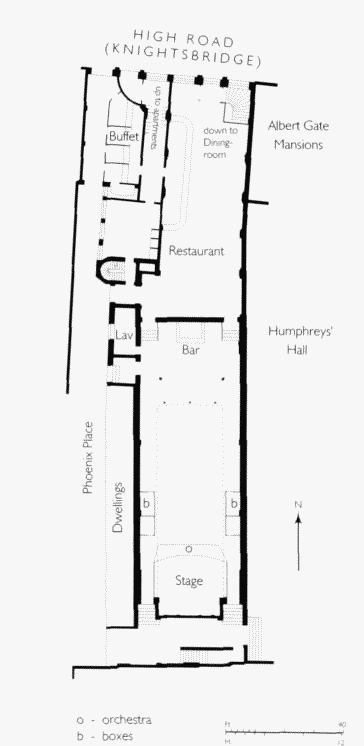
Sun Music Hall, plan in 1889. Demolished
Prince's Club remained in existence until just before the Second World War, during which the clubhouse was requisitioned by the War Department as headquarters for the Army Post Office. It continued in use by the army until about 1952, and was subsequently pulled down for the construction of Mercury House. (fn. 57)
The Rising Sun, Sun Music Hall and Knightsbridge Hall (all demolished)
The Rising Sun tavern at No. 26 High Road was opened about 1830 in an old red-brick house of 'neat appearance', containing 'much carved work' and 'a plain, old-fashioned staircase'. It was probably built in the seventeenth century – an indistinct inscription on the coping was variously interpreted as 16– or 1611: in recent years it had been occupied by Major Robert Eyre, a veteran of the American War of Independence and the founder, in 1803, of the Knightsbridge Volunteers. (fn. 58)
In 1851 the Rising Sun was licensed for music and dancing, and a concert room was erected at the rear of the premises. This 'Sun Music Hall' was rebuilt in 1864–6 to designs by the architects Finch Hill & Paraire. Ranking 'with the first class establishments of the metropolis', the new Sun Music Hall was 100ft long and 35ft wide with a cantilevered gallery along three sides, and ornamented with wall panels of allegorical reliefs and a decorative balcony front of carton pierre. It was at the Sun that George Leybourne first performed 'Champagne Charlie', in 1867, and G. H. Macdermott the great hit of 1878, 'By Jingo'. (fn. 59)
Extensive improvements to bring the hall up to firesafety standards were ordered by the Metropolitan Board of Works in 1884, but before they were carried out the premises were sold, in April 1885, to J. C. Humphreys, owner of Humphreys' Hall adjoining, which was destroyed a few days later, when the Japanese Village exhibition there caught fire. (fn. 60)
Humphreys refitted the Sun Music Hall as a concert room for 'musical entertainments of a high class'. By January 1886 the old Rising Sun had been demolished, to be replaced later in the year by a restaurant or coffee-room with apartments above – effectively a western extension to Albert Gate Mansions with which it was later united. This work seems to have been carried out by Humphreys' architect for the rebuilding of Humphreys' Hall. Spencer Chadwick, in conjunction with the theatre and restaurant architect Thomas Verity. The new apartments, together with the restaurant, were run for a time as the Princes or Princes Gate Hotel. (fn. 61)
With the Japanese Village exhibition recreated in the new Humphreys' Hall, the refurbished Sun Music Hall became the Nippon Theatre, or New Shebaya concert hall, used for Japanese as well as conventional Western-style musical entertainments.
Following the closure of the village in 1887 the theatre enjoyed a brief renaissance under its old name the Sun Music Hall. On Boxing Night 1888 the Great Vance, clad in judicial robes and wig, sang his last song. 'Are You Guilty?', before collapsing in the wings with a fatal heart attack. (fn. 62) Figure 25 shows the Sun Music Hall in its latter days, when the premises were apparently associated with the restaurant and buffet on the ground floor of the Princes Gate Hotel.
The Sun, together with the former restaurant and buffet, was subsequently hired out for receptions and meetings as Knightsbridge Hall, Humphreys having given an undertaking to the London County Council that it would never again be used as a music-hall. (fn. 63) Knightsbridge Hall was later taken over by the John Griffiths Cycle Corporation Ltd as a cycle-riding school and showroom, which it remained for some years. In 1905 a plan to use the building as a restaurant was abandoned when Humphreys was refused a renewal of the licence, which he had held for ten years without making use of it. (fn. 64)
An extension to Knightsbridge Hall, on the sites of Nos 225–229 Knightsbridge (the former Nos 1–3 Trevor Terrace), was erected in 1918 by J. C. Humphreys' firm, Humphreys Ltd. About 1921 the enlarged premises, known as the Knightsbridge Halls, were taken by the decorators and furnishers Robersons Ltd and fitted out as galleries for displaying panelled interiors salvaged from historic houses. (fn. 65)
By the late 1930s the Knightsbridge Halls were used for motor-trading. They were demolished after the Second World War for the building of Mercury House.