Survey of London: Volume 45, Knightsbridge. Originally published by London County Council, London, 2000.
This free content was digitised by double rekeying. All rights reserved.
'Montpelier Square Area: Deutsche Evangelische Christuskirche, Montpelier Place', in Survey of London: Volume 45, Knightsbridge, ed. John Greenacombe (London, 2000), British History Online https://www.british-history.ac.uk/survey-london/vol45/pp124-127 [accessed 2 May 2025].
'Montpelier Square Area: Deutsche Evangelische Christuskirche, Montpelier Place', in Survey of London: Volume 45, Knightsbridge. Edited by John Greenacombe (London, 2000), British History Online, accessed May 2, 2025, https://www.british-history.ac.uk/survey-london/vol45/pp124-127.
"Montpelier Square Area: Deutsche Evangelische Christuskirche, Montpelier Place". Survey of London: Volume 45, Knightsbridge. Ed. John Greenacombe (London, 2000), British History Online. Web. 2 May 2025. https://www.british-history.ac.uk/survey-london/vol45/pp124-127.
In this section
Deutsche Evangelische Christuskirche, Montpelier Place
This attractive Edwardian building on the north side of Montpelier Place (fig. 36) came into being in unusual and somewhat controversial circumstances.
The church traces its origins to the late 1660s, when a Lutheran congregation was formed from within the German and Scandinavian merchant community in the City of London. The first building, in Trinity Lane (erected on the site of Holy Trinity-the-Less, which had been destroyed in the Great Fire), survived until the 1860s, when it was replaced by the Hamburg Lutheran Church, adjoining the German Hospital in Dalston. (fn. 1)
The German offshoot of this congregation from which the church in Montpelier Place derives enjoyed a long royal association, meeting for several years at the Savoy Chapel, and later at St James's Palace. From 1781 the church met in what is now the Queen's Chapel, adjoining Marlborough House, which became known as the German Chapel (or German Chapel Royal). (fn. 2) In 1901 Edward VII, who before his accession had been a regular attender at the Anglican Sunday-morning service there, brought this custom to an abrupt end. (fn. 3)
Natural enough in Hanoverian days, by the early twentieth century the existence of a German Chapel Royal might, in view of the growing imperial rivalry between Great Britain and Germany, have come to seem anomalous, and tradition has it that the King put a stop to the German services on the grounds that their continuance was incompatible with his position as head of the Church of England. There is, however, little doubt that the closure of the German Chapel Royal was brought about essentially to reduce expenditure in the Lord Chamberlain's department. Such other considerations as there were seem to have been personal rather than nationalistic.
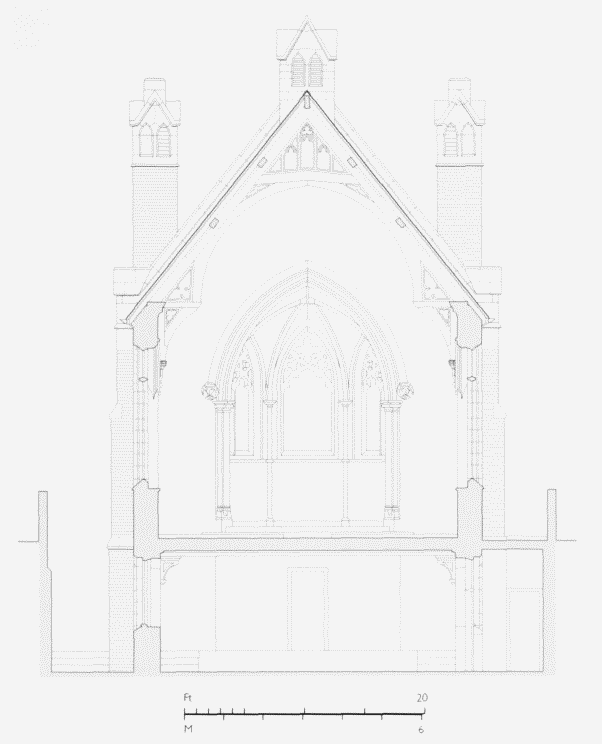
Deutsche Evangelische Christuskirche, Montpelier Place, section looking north
In April 1901 Dr Edgar Sheppard, Sub-Dean of the Chapels Royal, proposed two money-saving measures: a reduction in the number of sinecures associated with the Chapels Royal, and the 'eventual abolition' of the chaplaincy attached to the German Chapel. Such was Sheppard's official line, but in a private note to the Comptroller of the Lord Chamberlain's department, he urged that the chaplaincy should be abolished 'in the immediate present'. (fn. 4)
The weekly German service attracted only a small congregation, drawn mainly from the suburbs, yet the associated costs, met by the department, were substantial. They included the pay of the chaplain and chapel staff, and the maintenance of furnished rooms in St James's Palace for the chapel-keeper and organist, Dr Weber. These rooms, in earlier times the Sub-Dean's official lodgings, had been given up by a predecessor of Sheppard's, much to the annoyance of successive Bishops of London, as well as of Sheppard himself, who had to live at a distance. In 1895 he had attempted to oust Dr Weber, but there was a 'rumpus' and the scheme fell through. By 1901 the circumstances were more favourable to change: the chaplain, the Rev. Dr Frisius (who was also the minister at Dalston), was a fairly recent appointee with no local connections – his predecessor having been, like Weber, elderly and long-serving.
As a result of Sheppard's recommendations, a royal decree dated 1 July 1901 required the German services to cease in three weeks; and on the same day the Lord Chamberlain gave notice that the chapel-keeper's rooms would again become the Sub-Dean's lodgings. The staff were at once pensioned off or otherwise discharged. Diplomatic pressure was brought to bear on the King to postpone the closure until after Easter, but the deadline was merely shifted from 22 July to 4 August. Dr Frisius (who was to become the first pastor of the Christuskirche) subsequently complained, with some justice, of the 'insulting manner' in which a long tradition had been ended. (fn. 5) That the Danish services were allowed to continue there made it all the more galling, but then Queen Alexandra was Danish. Thenceforth the building was known as Marlborough House Chapel. (fn. 6)
For some time the congregation met in Eccleston Hall in Victoria. (fn. 7) The present church was erected at the expense of the Anglo-German merchant banker Baron Sir John Henry William Schröder (1825–1910), who had been involved in the negotiations over the closure of the German Chapel Royal. It was intended both to provide a permanent home for the congregation and to serve as a memorial to his late wife, Evelina.
The building was designed jointly by Edward Boehmer and a comparatively obscure architect, Charles G. F. Rees. Boehmer (who Anglicized his name to Bomer during the First World War) was born in Philadelphia of Pennsylvanian-German parents, and was educated and trained in Germany. He completed his training in London, in the office of Archer and Green. Rees, an architect, surveyor and estate agent with an office near Stanmore railway station from the 1890s, designed at least one other church for the Schröders, the Markuskirche in Kelvedon Road, Fulham (1911). He was also surveyor to the German Hospital in Dalston (of which the Schröders were benefactors), designing two substantial additions to that institution in 1911–12. (fn. 8)
The Knightsbridge church is the only work Rees and Boehmer are known to have done in collaboration, and their respective roles in this presumably ad hoc partnership (based apparently in Boehmer's Spring Gardens office), are not known, although there are indications that Rees's was the senior position. His name appears before Boehmer's on the contract drawings (fn. 9) and on a perspective view of the building (Plate 64a), as well as in their initial application to the London County Council regarding the church. Rees alone was named as architect in published reports of the consecration ceremony. And he, moreover, received a decoration from the Kaiser on the completion of the church. (fn. 10) There is, however, nothing in the comparatively coarse design of Rees's other known buildings to suggest affinity with the Christuskirche, and Boehmer's may be presumed to have been the guiding hand in the finer points of the design. It is a building of quality, and may perhaps be seen as something of an architectural riposte to the King's action. There was no prestige in the location, however, for Montpelier Place in the early 1900s was at best an indifferent address.
The site, then occupied by Nos 18–20 Montpelier Place and Nos 1–3 Alfred Cottages, was acquired about 1903, the plans of the new building being approved by the LCC in November that year. (fn. 11) Construction was carried out by Dove Brothers at a cost of more than £8,600. (fn. 12) The foundation-stone was laid at a ceremony in June 1904 and the building consecrated in the following November, the service being attended by Kaiser Wilhelm II's representative Count Bernstorff, Prince Christian, Princess Louise Augusta of Schleswig-Holstein, Prince and Princess Louis of Battenburg, and Baron von Schröder. (fn. 13)
The Christuskirche is a diminutive church, Decorated in style and built of orange brick with plentiful stone dressings (Plate 64a, 64b). Short staircase turrets with stone spirelets flank the entrance and the geometrical 'west' window. Along the frontage are iron railings with sliding gates (fig. 45). Despite the confines of the site, it is very much a church 'in the round', the sides being as well finished as the front. There is no tower, but a ventilation-shaft rises, belfry-like, over the chancel arch.
The aisleless interior (figs 43–4; Plates 64c, 65a) is simply treated, with a plain hammer-beam roof with arched braces, white-painted walls and a tessellated floor bearing a fleur-de-lis motif. A late addition to the design was the inclusion of the German ambassador's or 'royal' pew, set to the side of the chancel behind an archway and a balustrade of curvilinear tracery (Plate 65c). (fn. 14)
Beneath the church is a large meeting-room with wellpreserved original features, tiled to dado level in coloured Burmantofts faience, together with various ancillary rooms (fig. 43, Plate 65d).
Fittings and furnishings
Many of the interior fixtures and fittings, and all the stained and painted windows, were made in Germany.
Two Munich glass-workshops, F. X. Zettler, glasspainters to the Bavarian court (Königliche Bayerische Hofglasmalerei), and Ostermann & Hartwein, made the figurative glass for the three chancel windows and the two central windows of the nave. A Cologne firm of glass-makers, Schneiders & Schmolz (Kunstglasmalerei), produced the leaf-patterned glass in greenish monochrome which fills the remaining windows in the nave, and the large west window (Plate 125e). All the glass is signed by the makers. The figurative glass illustrates New Testament subjects:
Chancel. The Nativity and the Crucifixion (Zettler, Plate 125d, 125f); the Resurrection (Ostermann & Hartwein; Plate 125b)
Nave. 'Suffer Little Children' (Zettler; Plate 125a): the Good Samaritan (Ostermann & Hartwein; Plate 125c)
The communion vessels, with a crucifix and other pieces of plate, were given by the Kaiser, from whose own designs they were made by Professor Otto Rohloff. (fn. 15) The brass memorial plaque to Baroness von Schröder in the entrance lobby was cast in 1904 by P. Stotz of Stuttgart.
The conventional octagonal wooden pulpit was carved in Berlin.
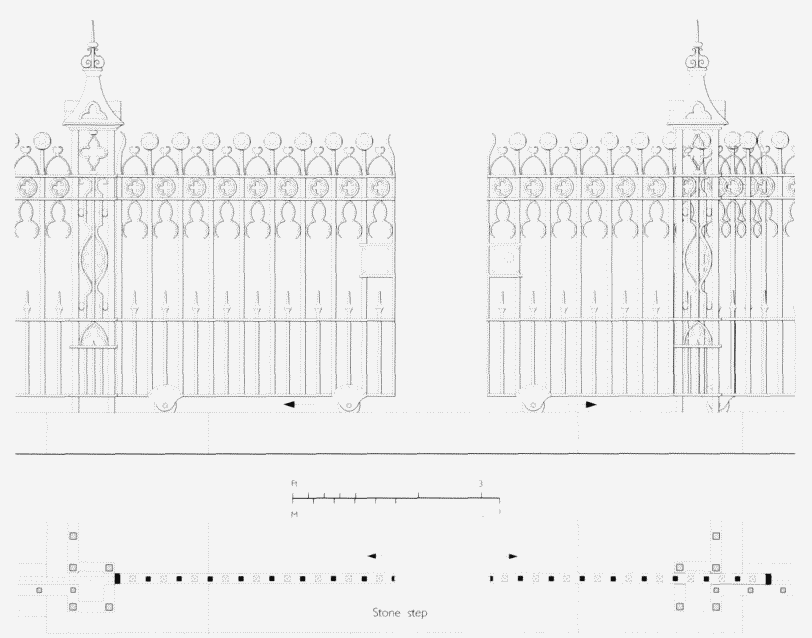
Deutsche Evangelische Christuskirche, Montpelier Place, sliding gates and railings
The font, a stone basin with a bulbous wooden cover, the whole mounted on a wooden stand with barley-sugar twist uprights, is said to be of late-seventeenth-century date and a relic of the German church in Trinity Lane (Plate 65b).
In 1980 the original organ, made in Germany, was replaced by a new and highly regarded baroque-style instrument by the Danish organ-builders Peter Bruhn & Son (Plate 65a).