
Survey of London: Volume 45, Knightsbridge. Originally published by London County Council, London, 2000.
This free content was digitised by double rekeying. All rights reserved.
'Rutland Gate: John Elger's Development, 1853-59', in Survey of London: Volume 45, Knightsbridge, (London, 2000) pp. 151-152. British History Online https://www.british-history.ac.uk/survey-london/vol45/pp151-152 [accessed 12 April 2024]
John Elger's Development, 1853–59
By the end of the 1840s building in Rutland Gate had petered out, but early in 1851 an agreement was drafted between Elizabeth Manners and John Elger, who had been developing the adjoining Kingston House estate since the mid-1840s, for completing the southern part of the street. However, it was not until 1853 that work got under way. Several houses were started in the autumn, and soon afterwards Elger bought the freehold of all the remaining vacant ground from the Manners family. (fn. 2)
During the next six years the whole of southern Rutland Gate was built up by Elger (Plate 73b), together with Rutland Mews East and West and a roadway linking Rutland Gate with his development on the Kingston House estate. It was presumably at this time that the high brick wall along the south side of Ennismore Street was built, shutting off Brompton Road and its northern hinterland from the exclusive culs-de-sac opposite Hyde Park. (fn. 1)
Elger also acquired the two little villas, Nos 21 and 23, to the south of Clytha House, rebuilding them in the late 1850s. The new houses (wider, but otherwise similar to the rest of Elger's houses in Rutland Gate) were numbered 23 and 25. This rather suggests that there was some idea of building a new No. 21 to the north, on part of the Clytha House garden. Whether or not this formed part of his plans, Elger appears to have been sufficiently determined to replace the existing villas that he had resort to strongarm tactics. E. H. Corbould, 'extremely comfortable' in his home and studio at No. 21, refused to sell, whereupon Elger seems to have pulled down the adjoining house and dug out new foundations. In Corbould's version of the story, his 'unpleasant neighbour started to dig a tremendously deep hole under the house, which shattered and cracked the walls', forcing him to leave. Corbould complained that Elger was in breach of the law in building forward of the established building line, and he was apparently successful in gaining substantial compensation. (fn. 3)
That Elger was, strictly speaking, the 'builder' of all the houses in lower Rutland Gate is not perhaps quite accurate, for by 1858 the building work seems to have been at least partly in the hands of the firm of Welchman & Gale, whose partners were former clerks of Elger and who shared premises or next-door premises with him in Rutland Gate for a while. However, they do not appear to have had any significant speculative interest in the development. (fn. 4)
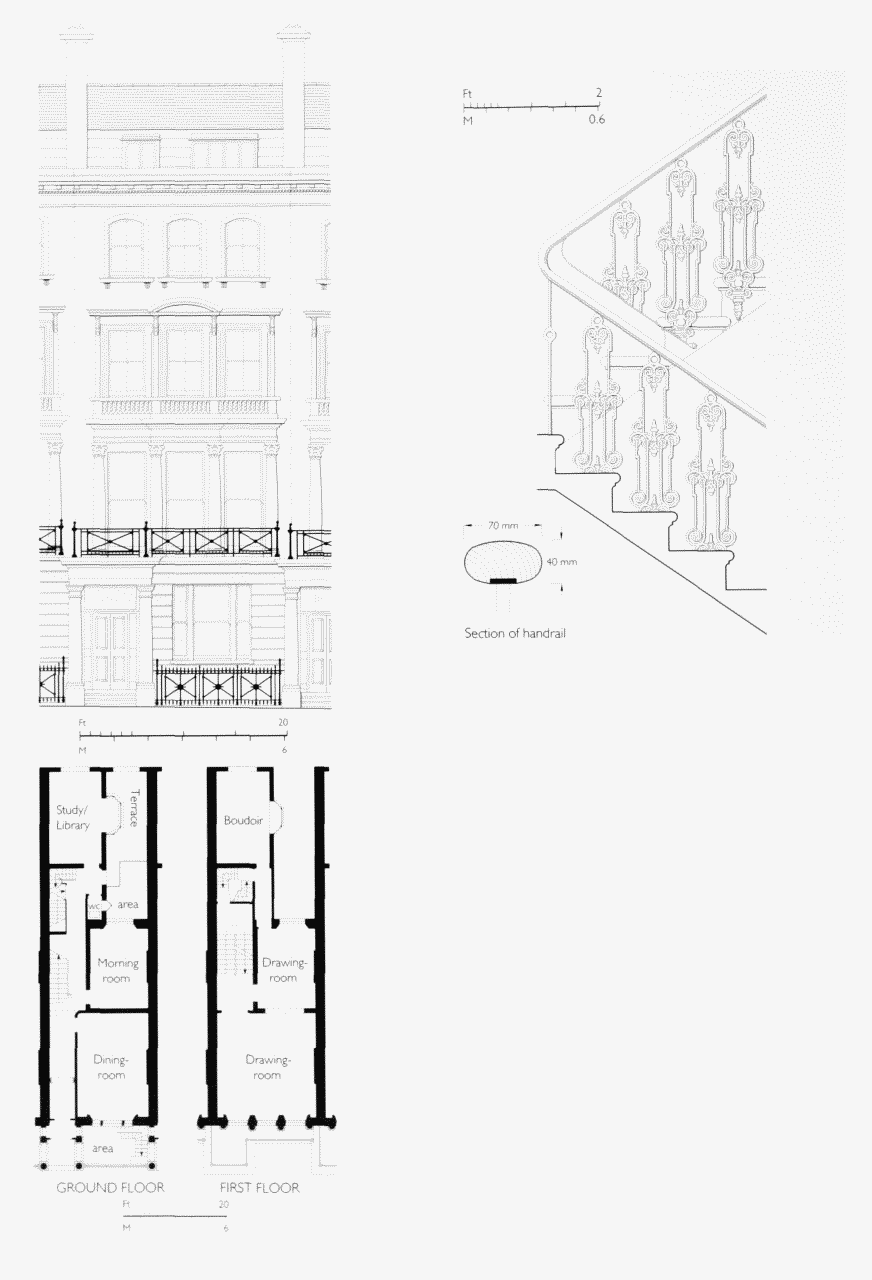
Nos 27–47 Rutland Gate, typical elevation, plans and staircase detail. John Elger, builder, 1853–9
It is not known who designed the houses, but their standard elevation clearly derives from designs made for Elger by H. L. Elmes in the 1840s (see page 165), and which provided the basis for the fronts of the houses built by Elger and others on the Kingston House estate. They are much more. 'Victorian' in style than Tombs's houses of the late 1830s and '40s, including the putative Matthew Wyatt houses at Nos 1–7, both in their breaking away from strict Georgian proportions and in their ornamentation and robust ironwork (fig. 60, Plate 75a, 75b).
Inside, in their original state, the houses were of conventional side-passage plan with main and service staircases of stone. As with houses on the Kingston House estate, they are of considerable depth, which allowed for a third main room at the rear on the ground and first floors, ideally suited to uses requiring privacy and quiet (fig. 60). (fn. 5)