Survey of London: Volume 45, Knightsbridge. Originally published by London County Council, London, 2000.
This free content was digitised by double rekeying. All rights reserved.
'Princes Gate and Ennismore Gardens: The Kingston House Estate, The area since the 1920s', in Survey of London: Volume 45, Knightsbridge, ed. John Greenacombe (London, 2000), British History Online https://www.british-history.ac.uk/survey-london/vol45/pp182-186 [accessed 1 May 2025].
'Princes Gate and Ennismore Gardens: The Kingston House Estate, The area since the 1920s', in Survey of London: Volume 45, Knightsbridge. Edited by John Greenacombe (London, 2000), British History Online, accessed May 1, 2025, https://www.british-history.ac.uk/survey-london/vol45/pp182-186.
"Princes Gate and Ennismore Gardens: The Kingston House Estate, The area since the 1920s". Survey of London: Volume 45, Knightsbridge. Ed. John Greenacombe (London, 2000), British History Online. Web. 1 May 2025. https://www.british-history.ac.uk/survey-london/vol45/pp182-186.
In this section
The area since the 1920s
William Radford's failure to sell his large houses in northern Ennismore Gardens in the 1880s and after may have been a sign of over-supply in the market. The conversion of one of these houses into flats in 1893 was the precursor of a trend in Ennismore Gardens generally, which gathered pace in the years following the First World War, as demand for town mansions fell. 'Lateral' conversions of pairs of houses were favoured, so as to provide floor-space sufficient for high-class tenants, a number of properties in the south and west ranges of Ennismore Gardens being so altered in the 1920s. (fn. 1) Most of Ennismore Gardens had become flats by the 1960s. A long-time resident at one of these flats, at No. 34, was the film-star Ava Gardner. The actor, Jack Hawkins, also had a flat at No. 34, and another actor, Charles Gray, occupied a flat in No. 30. Gentrification of the mews buildings in this area was largely delayed until after the Second World War. (fn. 2)
Kingston House, Princes Gate and the big houses in northern Ennismore Gardens attracted property developers during the flat-building boom of the 1930s. Two schemes were proposed, one involving the rebuilding of the eastern range of Princes Gate and the other the immediate redevelopment of Kingston House itself, and, as leases fell in, the adjoining properties south and east. In neither case, though for different reasons, did the buildings do justice to their sites.
Nos 1–7 Princes Gate
Redevelopment of the entire eastern range of Princes Gate was planned in the mid-1930s by the builder Harry Neal, with Septimus Warwick as his architect. But Warwick's architecturally coherent scheme was compromised by Neal's failure to secure the entire site, and an intended monumental block of flats became two blocks, separated first by the incongruous presence of Kelk's surviving central house (No. 6), and subsequently by its modish 1970s replacement (Plates 109a, 114c).
Warwick's original design in 1936 was for a ten-storey block with stepped-back upper floors and a mansard roof. Already modified to satisfy the requirements of the London County Council, the design underwent further alterations when it became clear that the building would have to be erected in sections as the individual properties were acquired, starting with the ends and working towards the centre. Consequently the intended block plan was superseded by a more open arrangement of two H-shaped blocks – one on each side of the one remaining house (fig. 82). (fn. 3)
Building began in 1937–8 with the western block (No. 7). The eastern half of the eastern block (No. 1) followed in 1939–40 (leaving the old house at No. 4 still standing, though not the old No. 5). The western half of this block (No. 5), on the site of the old Nos 4–5, was not built until 1949. This last was carried out under the supervision of Ernest W. Banfield & Son, successors to Warwick's practice. (fn. 4)
The Princes Gate flats are a more monumental version of Warwick's contemporary Albion Gate flats in Bayswater Road, also designed for Harry Neal. (fn. 5) They would have been more monumental still had not the LCC vetoed the two top storeys of the ten originally planned, so that, as Warwick himself put it, 'the main architectural feature of the scheme had to be abandoned': this despite the fact that the site was 'much less congested' than those north of the park in Bayswater where taller blocks had been permitted. Warwick used his experiences in the building of the Princes Gate flats to illustrate a sharp critique of the convoluted and sometimes perverse bureaucratic processes of the LCC. (fn. 6)
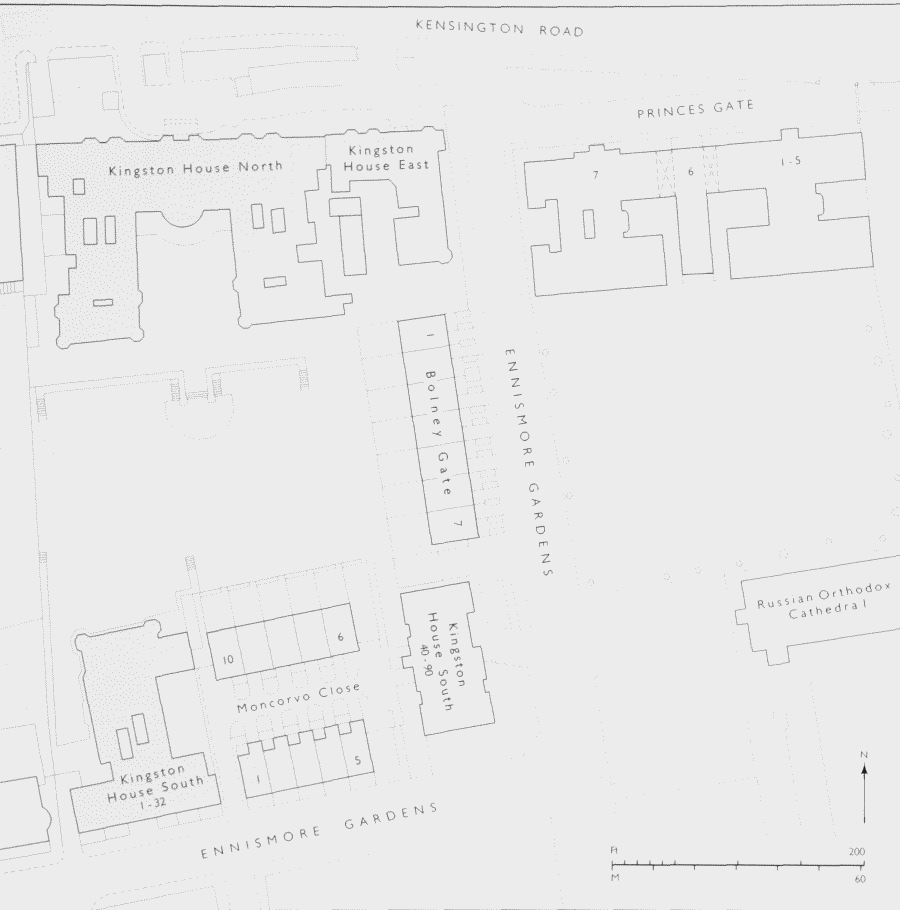
Princes Gate and Ennismore Gardens in 1991: plan showing inter-war and post-war redevelopments
The buildings are of steel-framed construction, clad in silver-grey bricks and Portland stone, the principal elevational features being Lutyens-esque entrance porches framed by pairs of six-storey stone 'oriels', and columned aedicules capped with stone vases at the fifth- and sixthfloor levels.
No. 7 (the only part of the development to be occupied as flats from the start) contains three flats on a typical floor, the largest having, as originally planned, a drawing-room, dining-room and library overlooking the garden at the rear (fig. 83). The entrance halls and other common areas are sumptuously decorated, with fireplaces, floors, skirtings and architraves all of marble, mirror-lined walls and coffered ceilings (Plate 109b, 109c). The tunnel-vaulted garden hall and glass doorway was designed in 1939 by Braddell, Deane & Bird. (fn. 7) Two penthouse flats were added in 1987, by Chapman Taylor Partners. (fn. 8)
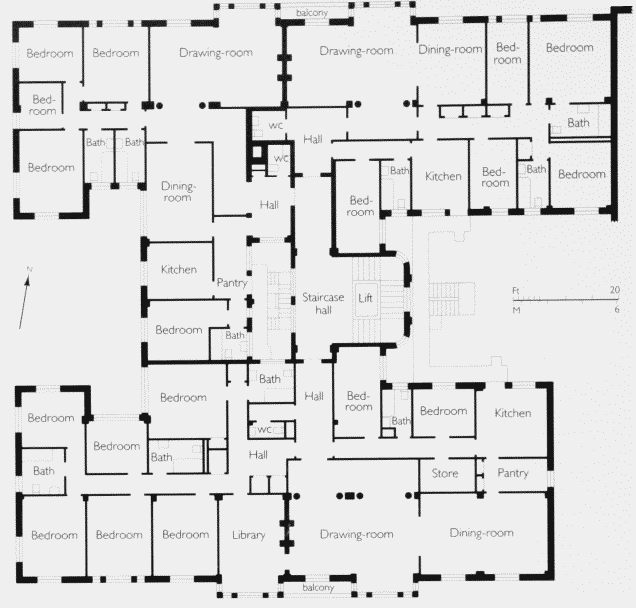
No. 7 Princes Gate, typical floor-plan. Septimus Warwick, architect, 1938
On completion, the shell of No. 1 was taken over by the Combined Operations Branch and partitioned into offices; it was made into flats in 1965–6 and a penthouse flat was added in 1985–6. No. 5 was used initially as offices by the Ministry of Works, and remains in office use. (fn. 9)
Kelk's old house at No. 6 survived into the early 1970s, when it was replaced by the present building, erected in 1972–4 by J. M. Hill & Sons. Designed by Turner Lansdown Holt & Partners, the new No. 6 has been mistaken for the rebuilding of a portion of a complete original block, and perhaps, therefore, for a bolder piece of architecture than it actually is. (fn. 10) The building has bronzed aluminium curtainwalling with reflective double glazing. The lower floors are used as offices, and the three upper floors comprise a penthouse with a swimming-pool and a roof terrace. (fn. 11)
Kingston House redevelopment
The redevelopment of Kingston House and northern Ennismore Gardens began in 1937 and continued in stages over the next thirty years as leases fell in. All the buildings are the work of the Viennese-born architect. Michael Rosenauer. They are, considering the opportunity offered by such a large-scale development, disappointingly bland. Of the six matching blocks of flats for the site originally designed by Rosenauer, only three were built, two before the war and one in the mid-1950s. The later buildings are another apartment block and three rows of town-houses (fig. 82). (fn. 12)
Tentative plans for flats on the Kingston House and Alford House sites, by O. Howard Leicester, were put forward by the contractors Sir Lindsay Parkinson & Company Ltd in January 1935, but at that stage no firm agreement for the sale of the property had been made. This first scheme was objected to by the London County Council as too dense and, at ten storeys over a basement, too high.
In September 1935 the Hare family and their trustees agreed to sell Kingston House and the adjoining properties on the north and west sides of Ennismore Gardens to Guardian Properties Ltd (a subsidiary of an investment company) for redevelopment. The price was £375,000. At the time Kingston House itself was still occupied by the elderly Dowager Countess of Listowel, as tenant for life under the will of her husband, the 3rd Earl. As she could not be disturbed, completion of the sale was held back until after her death in December 1936. Construction began in 1937, under the acgis of a new company, Kingston House Ltd; the final stage was not completed until 1967. (fn. 13)
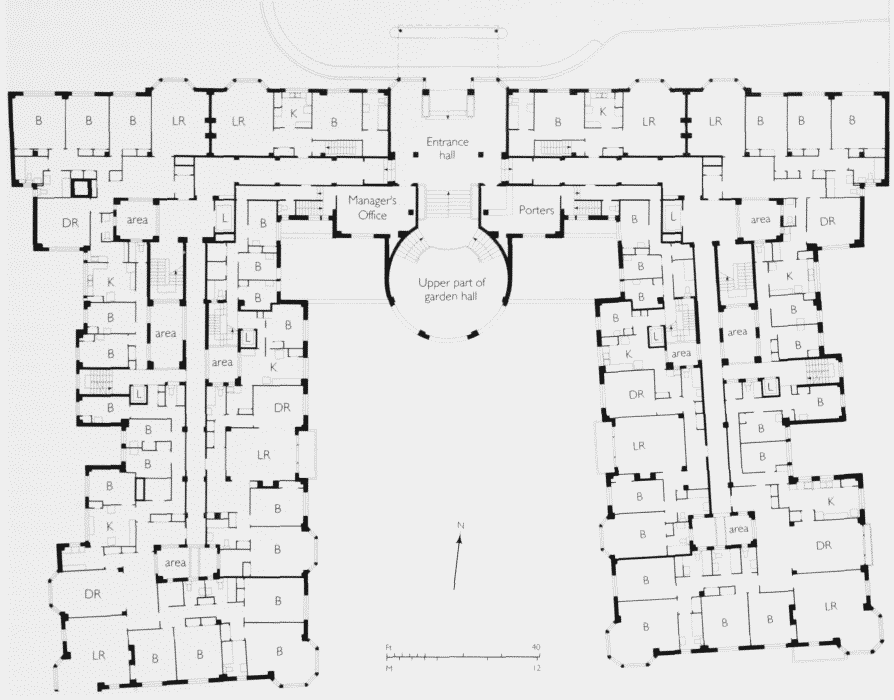
Kingston House North, lower-ground-floor plan. Michael Rosenauer, architect, 1937
It was reported in January 1936 that the property was to be rebuilt, to designs by Messrs Gordon Jeeves, with family flats arranged around a central garden court, planned so as to contain 'a number of smaller rooms rather than a few large ones'. This was the essence of the scheme submitted to the local authorities in August 1936, but by that stage Jeeves had been supplanted by Michael Rosenauer. (fn. 14)
The first phase of building, carried out in 1937–8 by Holloway Brothers, comprised two blocks of flats, Kingston House North and Kingston House South (Nos 1–32). (fn. 15) Both buildings are of eight full storeys above the basements, steel-framed with brick cladding and Portland-stone dressings. Owing to the north-south fall of the site, Kingston House North has an additional, semi-basement, floor. The chief features of the exterior are fullheight canted bays, doubled at the corners to give a turret effect, and cantilevered balconies with horizontal railings (Plate 110b). At the main entrances are flat canopies carried on bronzed-steel piers.
Kingston House North, the centrepiece of the development, is built around a south-facing court. A circular hall, with a terrace above and communal lounges at either side on the lower-ground floor, looks out over the court and gardens, but the enclosure is too deep for its width to make the arrangement really effective. The building was planned with eight flats to a floor, varying in size from one-bedroom apartments to family suites containing four bedrooms, two reception rooms and accommodation for two or three maids (fig. 84).
Kingston House South (Nos 1–32) was intended as the western half of a symmetrical U-shaped block. A small wing at the north-east corner of the ground floor was added to the design at an early stage, presumably at the request of a prospective tenant; it was planned to comprise a musicroom with an organ, and a dining-room. (fn. 16)
It was intended that both buildings should have groundfloor restaurants, but neither was fitted out and the spaces for them were converted into flats after the war.
Kingston House East, on the site of Alford House, was erected in 1955, by Gee, Walker & Slater Ltd. It matches Kingston House North in both internal organization and exterior style, and, indeed, the two buildings viewed from Kensington Road appear to be one.
With the completion of Kingston House East, no further attempt was made to complete the development on the pre-war lines, and Rosenauer drew up new plans for the remaining sites, which were built up in 1965–7. (fn. 17)
An eleven-storey tower block (Nos 40–90 Kingston House South) was built on the site of Moncorvo House. There are eight flats on each floor, mostly of two or three bedrooms. Externally, there is little, apart from some unobtrusive balconies and full-height stair-tower glazing, to relieve the plain brick cladding.
The remainder of the development took the form of short terraces of town-houses: Nos 1–10 Moncorvo Close on the site of Nos 67–69 Ennismore Gardens and the eastern part of Ennismore Gardens Mews North (Ennismore Place), and Nos 1–7 Bolney Gate on the site of Bolney House. They are all very plain brick buildings, loosely neo-Georgian in style, with integral ground-floor garages. Those forming Bolney Gate are the largest, with spacious accommodation arranged over five storeys, large bowed first-floor rear windows, and pedimented doorcases at the front.
Kingston House North accommodated the wartime Norwegian government-in-exile and, over the same period, Stephen Lanigan O'Keeffe, the Rhodesian High Commissioner. Post-war residents have included the actor Kenneth More and the writer Margaret Pedler. Lord Trenchard lived at No. 9 Kingston House South in the 1940s.