Survey of London: Volume 36, Covent Garden. Originally published by London County Council, London, 1970.
This free content was digitised by double rekeying. All rights reserved.
'The Bedford Estate: Covent Garden and the seven acres in Long Acre', in Survey of London: Volume 36, Covent Garden, ed. F H W Sheppard (London, 1970), British History Online https://www.british-history.ac.uk/survey-london/vol36/pp19-21 [accessed 30 April 2025].
'The Bedford Estate: Covent Garden and the seven acres in Long Acre', in Survey of London: Volume 36, Covent Garden. Edited by F H W Sheppard (London, 1970), British History Online, accessed April 30, 2025, https://www.british-history.ac.uk/survey-london/vol36/pp19-21.
"The Bedford Estate: Covent Garden and the seven acres in Long Acre". Survey of London: Volume 36, Covent Garden. Ed. F H W Sheppard (London, 1970), British History Online. Web. 30 April 2025. https://www.british-history.ac.uk/survey-london/vol36/pp19-21.
Covent Garden and the Seven Acres in Long Acre
The garden of the Convent of St. Peter, Westminster, consisted of about 40 acres (fn. 2) between St. Martin's Lane and 'Aldewichstrate' (now Drury Lane). (fn. 3) The boundary is roughly defined by Drury Lane, Floral Street, St. Martin's Lane and a line drawn south of Chandos Place, Maiden Lane, Exeter Street and thence via Aldwych back to Drury Lane. It was marked by an earth or mud wall, the top of which was thatched with straw. (fn. 4) There was at least one gate on the east side, (fn. 3) probably where Aldwych now meets Drury Lane, near the east end of White Hart Yard (see Plate 7), and it is likely that another gate stood where later (Little) Chandos Street entered St. Martin's Lane.
At what time these 40 acres came into the possession of the monastery is not known, but the earliest document which refers to the convent garden is attributed to the time of King John (1199–1216). (fn. 5) During the thirteenth and fourteenth centuries the garden was a mixture of orchard, arable, meadow and pasture land. The orchard yielded apples, pears, and probably cherries, plums, medlars and nuts, which the 'gardinarius' supplied to the monks' table. (fn. 6) Surplus produce such as fruit, barley, dredge, (fn. 1) hay, vetches and straw was sold, and additional income was derived from the rents of pasturage and the occasional sale of trees blown down by the wind. (fn. 7) The earliest known 'keeper' of the garden was Reginald de Hadham, who in 1307 was accused of having expropriated 100 marks (£66 13s. 4d.) out of the profits. (fn. 8) The largest annual receipt recorded was nearly £12 in 1327– 1328; (fn. 9) later income varied from £4 14s. in 1336–7 to £8 2s. 4d. in 1398–9. (fn. 10) By 1336 the custody of the garden had been allocated to the cellarer and so continued for the duration of the abbey's ownership. (fn. 11)
The monks of Westminster retained the convent garden in their own hands much later than the manors and estates which they owned outside London. (fn. 12) What appears to have been the first lease was granted by the abbot and convent in 1465 to George Neville, who was enthroned in that year as Archbishop of York. The lease, which was for life, included 7 acres attached to the garden on the north side, but outside the enclosing wall (the first mention of this piece of property which has been found); the rent for the whole was 66s. 8d. a year. (fn. 13) Neville died in 1476 and a lease was granted to (Sir) John 'Forthku' (i.e. Fortescu), his wife, Alice, and William Boleyn for thirty years at an increased annual rent of 100 shillings. (fn. 14) A new lease was granted in 1492 to Fortescu (then knight of the King's body) and to his son John, for sixty years at a further increased rent of £5 6s. 8d. (fn. 15) This is the earliest lease of which full details survive, and it presumably repeats what earlier lessees had agreed to, namely, to send every year, on the feast of St. James (25 July), one measure of apples and one of pears to the high altar of the abbey church for blessing. It was no doubt the Fortescus' tenancy which gave rise to their name being applied during the early part of the sixteenth century to Drury Lane; they also allowed the citizens of London to convey part of the City's water supply through Covent Garden (see page 31).
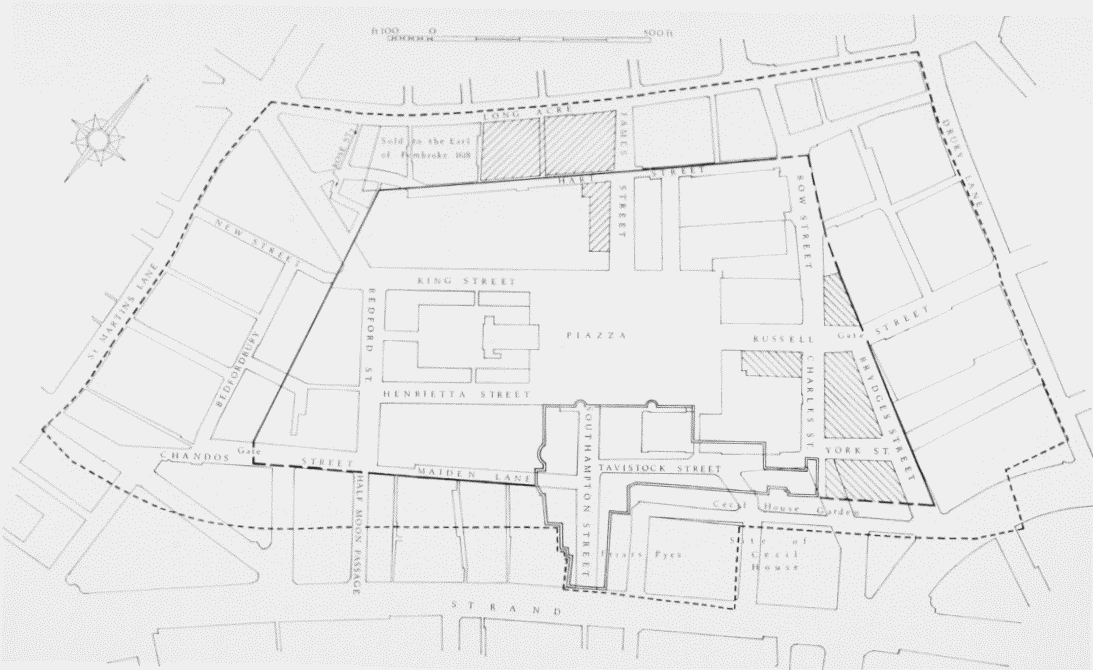
The Bedford Estate
By 1516 the Fortescus' interest in Covent Garden and the 7 acres had evidently lapsed, for in that year a new lease was granted to the Prior of the Hospital of St. John of Jerusalem, (Sir) Thomas Docwra, (fn. 16) and in 1530 another lease was granted to Sir Richard Weston, UnderTreasurer of England. (fn. 17) Weston was the convent's last lessee. On 1 June 1536 Henry VIII took possession of Covent Garden and the 7 acres, giving the abbey, in exchange, lands in Berkshire which had formerly belonged to Hurley Priory. (fn. 18) But Weston had conveyed his interest to one Henry Dingley who had granted a lease to Richard Broune or Browne, a servant to the King. Browne was ordered to quit, 'for that the same premysses lyeth so nygh to the kinges manor of Westm. verey myche Comodious for his grace sundry ways', (fn. 19) and accepted the offer of an annuity of £10 as recompense. (fn. 20)
For the rest of Henry VIII's reign Covent Garden and the 7 acres were in the charge of (Sir) Anthony Denny, bailiff of the King's Manor of Westminster, who rendered accounts annually for the fixed rent of £5 6s. 8d. (fn. 21) Denny continued to account for the property to King Henry's son, Edward VI, and recorded in his last account, for 1547–8, that the land had been reserved for his Majesty's use and that 'certain large sheep' had been grazing there. (fn. 22) The sheep may have belonged to the King's uncle, Edward Seymour, Duke of Somerset and Lord Protector, who on 22 July 1547 was granted Covent Garden and the 7 acres with other lands, in fulfilment of Henry VIII's dying wish, (fn. 23) and who, at the beginning of 1548, began to build Somerset House on the opposite side of the Strand. Nothing more is heard of Covent Garden until, after Somerset's execution, 'le Covent Garden' and the - acres 'called Long acre' were granted by the King on 28 May 1552 to John Russell, Earl of Bedford, Lord Privy Seal, to hold to him and his lawful male heirs for ever. (fn. 24)