Survey of London: Volume 36, Covent Garden. Originally published by London County Council, London, 1970.
This free content was digitised by double rekeying. All rights reserved.
'The Architecture of the Piazza and St. Paul's Church', in Survey of London: Volume 36, Covent Garden, ed. F H W Sheppard (London, 1970), British History Online https://www.british-history.ac.uk/survey-london/vol36/pp64-76 [accessed 30 April 2025].
'The Architecture of the Piazza and St. Paul's Church', in Survey of London: Volume 36, Covent Garden. Edited by F H W Sheppard (London, 1970), British History Online, accessed April 30, 2025, https://www.british-history.ac.uk/survey-london/vol36/pp64-76.
"The Architecture of the Piazza and St. Paul's Church". Survey of London: Volume 36, Covent Garden. Ed. F H W Sheppard (London, 1970), British History Online. Web. 30 April 2025. https://www.british-history.ac.uk/survey-london/vol36/pp64-76.
In this section
CHAPTER III
The Architecture of the Piazza and St. Paul's Church
Confronted with the bustling activity of Covent Garden Market and the diffuse collection of buildings that form its setting, it is not easy to recognize the lineaments of Inigo Jones's great Piazza, the first and finest of London's long sequence of residential squares. Unsurpassed for the uniformity and architectural quality of its buildings, it remained unique in its axially related combination of open space, church, and palatially fronted houses. Here, with the market soon afterwards established on the south side, were to be found all the elements regarded as desirable in each major suburban development during the following century.
The first comprehensive description of the Piazza is almost certainly of late seventeenthcentury date, though made familiar by its inclusion in Strype's 1720 edition of Stow's Survey, where it is stated that 'Covent Garden, particularly so called, is a curious, large, and airy Square, enclosed by Rails, between which Rails and the Houses runs a fair Street. The Square is always kept well gravelled for the Accommodation of the People to walk there, and so raised with an easy Ascent to the Middle, that the Rain soon draineth off, and the gravelly Bottom becomes dry, fit to walk on…. On the North and East Sides are Rows of very good and large Houses, called the Piazzo's, sustained by Stone Pillars, to support the Buildings. Under which are Walks, broad and convenient, paved with Freestone. The South Side lieth open to Bedford Garden, where there is a small Grotto of Trees, most pleasant in the Summer Season; and in this Side there is kept a Market for Fruits, Herbs, Roots, and Flowers, every Tuesday, Thursday, and Saturday; … And on the West Side is the Church of St. Paul's Covent Garden,… At the Entrance into this Church out of the Garden, there is a curious Portico ascended up by Steps, as well the Front Part, as both Sides: The Portico is sustained by four large Stone Pillars; the two Middlemost being round, and the others square, having a Door at each Side this Way, for Entrance; as also there be Doors on each Side of the Church, made uniform, for a Passage into the Church-yard…. The Builder of this famous Church was that rare Architect Mr. Inigo Jones, one of the greatest Restorers of the ancient Roman Way of Building, and this the first. How magnificent and great doth it present itself to the Beholder. The Portico is magnificent…. It is the only View, in Imitation of the Italians, we have in or about London.' (fn. 3)
The dimensions of the quadrangular open space were precisely defined in the grant of market rights (see page 130) as being 420 feet from east to west, and 316 feet from north to south. Jones's architectural scheme was balanced on the long east-west axis with its focus in the portico of the church, projecting centrally from the west side where low screen walls, flanking monumental gateways to the churchyard, linked the church to single houses. These ended the north side of Henrietta Street and the south side of King Street, both 50-feet-wide streets entering the Piazza from the west. The tall and uniformly fronted portico houses lined the north and east sides, which were broken centrally by streets intended to be 60 feet wide, James Street on the north and Russell Street on the east, the latter continuing an existing street leading from Drury Lane. The garden wall of Bedford House formed the south side, and the fourth Earl of Bedford probably never intended that this side should be built upon. But it is not unreasonable to assume, nonetheless, that Jones himself envisaged the building there of portico houses responding to those on the north side.
The layout owed much to Jones's first-hand knowledge of formally designed Italian piazze with churches, such as those in Venice, Florence (Piazza SS. Annunziata) and Leghorn (Piazza d'Arme, see fig. 2). In fact, John Evelyn's diary for 21 October 1644 records an impression of Leghorn, where the late sixteenth-century piazza 'with the Church, whose 4 Columns at the Portico are of black marble Polish'd, is very fayre & commodious; and gave the first hint to the building both of the Church & Piazza in CoventGarden with us, though very imperfectly pursu'd'. (fn. 4) (fn. 1) The Leghorn piazza had already influenced town improvements in France, especially in Paris where Henri IV and his queen, Marie de Médicis, had promoted the building of the Place Royale in 1605 and the Place Dauphine in 1607 (both designed by Claude de Chastillon). Jones presumably knew these French examples as well, for the arcaded and groin-vaulted walks below the portico buildings of Covent Garden closely resembled those of the Place Royale, intended by the French king to provide a public promenoir. But while it is reasonable to accept Leghorn as a prototype for the plan of Covent Garden, and to recognize the influence of the Place Royale's promenoir in the covered walks of the portico buildings, their arcaded and pilastered fronts may well be regarded as 'Tuscan' versions of two markedly similar palace fronts in Bologna, Domenico Tibaldi's Palazzo Salem Magnani of 1577 and Floriano Ambrosini's Palazzo Rossi of 1594. These fronts, probably derived in their turn from Sanmicheli's Palazzo Guastaversa of 1555 in Verona, are composed alike of a tall rusticated arcade opening to a groin-vaulted loggia, surmounted by a two-storeyed face divided into equal bays by pilasters. As fairly new buildings they might well have interested Jones when he visited Bologna during his second Italian journey. Even if this apparent affinity can be proved coincidental, there is no questioning the fact that the Covent Garden facades owed most to Italian palace fronts of this Sanmichelian type and least to the Place Royale houses which, though uniform, are astylar, individually articulated, and crowned separately with high pavilion roofs.
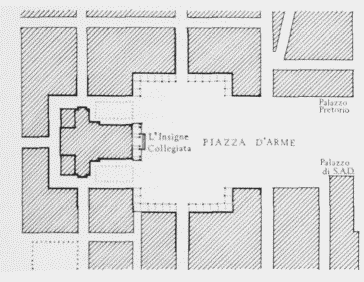
Piazza d'Arme, Leghorn, plan. Redrawn from an engraving in the King's Topographical Collection in the British Museum, vol. lxxx, no. 12
While indebtedness to his contemporary sources must be recognized, some important features of Covent Garden show that Jones's inspiration was rooted in antiquity, especially in the combinations of temple and forum that his adopted master, Palladio, described and illustrated in the Quattro Libri. As S.E. Rasmussen truly observed 'Covent Garden Piazza is just the monumental square which a classically trained artist of those days would want to create. It is an antique forum governed by the large one-cell-building of a temple…. He has followed the indications of architectural theorists (Vitruvius) for a "temple of the Tuscan order of columns" and has given the building enormous eaves.' (fn. 6) Moreover, as Sir John Summerson has demonstrated, Covent Garden could be regarded as 'a comprehensive essay in the Tuscan mood—Tuscan all the way from the high sophistication of the portico to the vernacular of the houses'. (fn. 7)
Some early views combine to give a fairly complete picture of the Piazza before any major changes were made to the original buildings except, perhaps, the church. Hollar's prospect of the west side (Plate 12a) is not an accurate representation and was probably made in Antwerp, hence the Flemish character of the gabled houses in the adjoining streets, but his pictorial map (Plate I) offers a convincing bird's-eye view of the whole Piazza and its surroundings as seen from the southwest. It also shows, most effectively, the striking contrast in scale between the nobly proportioned fronts of the Piazza's portico buildings and the majority of the houses in the adjacent streets. All the buildings as they appeared before 1666–7 are delineated with seeming accuracy in a painting at Wilton House, reproduced on Plate 11. The evidence presented by these views is largely confirmed and supplemented by the plans and elevations, presumably based on Colen Campbell's own measurements, given in Vitruvius Britannicus (Plate 13). (fn. 8)
St. Paul's Church and the West Side of the Piazza
Plates 11, 12, 13, 14, 15, 16, 17, 18, 19, 20, 21, 22, 23, 24, 25, 26, 27b, 28a, 29b, 30a, 34b, 35
In any detailed description of the Piazza, St. Paul's Church should be given precedence, for despite its modest size it dominated the whole scheme by virtue of its salient position, and by the bold simplicity and superior scale of its design. Jones's adoption of the temple form for this church (one of the first to be built in London for Protestant worship) seems to confirm his having conceived the Piazza as an antique forum. There was, moreover, precedent in the Huguenots' use of similar classical forms for their conventicles, such as Salomon de Brosse's basilican Temple de Charenton, Paris.
Hawksmoor's version of 'The Tuscan Temple in Covent Garden' (fig. 3) is a poor and inaccurate recording of St. Paul's, but it can be properly regarded as a fair interpretation of Jones's original conception, for it shows the rectangular temple structure of cella and portico uncluttered by the vestries and porches projecting from either side. Hawksmoor exaggerated, however, in describing St. Paul's as a Tuscan temple, which Vitruvius states should be five parts wide and six parts deep, half this depth being taken up by a portico, tetrastyle with two rows of columns, leading to three small cellae in parallel arrangement. St. Paul's is a single-cell temple with a portico in antis, measuring externally some 135 by 58 feet. The cella, or church interior, is a double square in plan, 50 by 100 feet, its height of 35 feet to the flat ceiling being about three quarters of the square. The cella's east wall conforms with the west frontage line of the Piazza, so that the portico projects for its full depth of 23 feet into the open space. Unlike Leghorn, the church portico was not closely related to the arcaded walks below the houses of the Piazza.
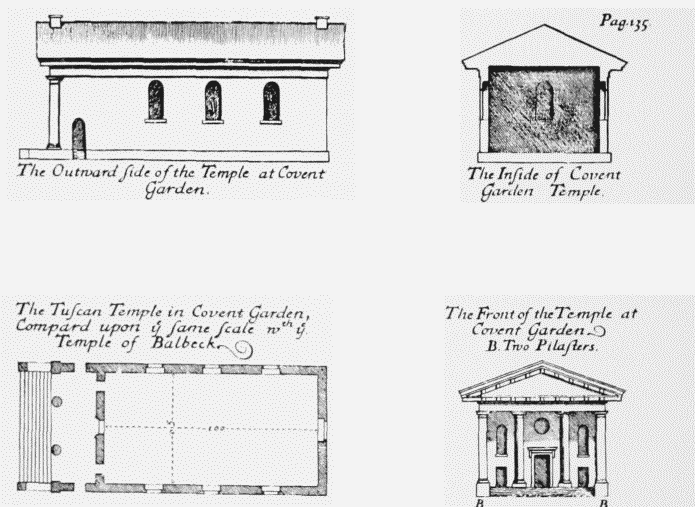
St. Paul's Church as a Tuscan temple. From Henry Maundrell's A Journey from Aleppo to Jerusalem, third edition, 1714
Much has been written about the true function of the portico in relation to the church, in view of the fact that it has never served as the principal entrance, the great doorway being a sham. Because of this, Jones has had his detractors and apologists, but sufficient evidence has now been found in a work of William Prynne's to show that this anomaly resulted from an enforced change of orientation during the building (see page 99). Confirmation appears in the Earl of Bedford's accounts (see pages 271–81), which show that the bricklayers were paid 'for the alterations of the doores and windowes at the east and west end of ye church' and for 'workeing upp the doore at the east end in the portico'. The carpenters also were paid for 'saweing of the timber and frameing fower windowes for ye east and west end of ye church occacioned by the alteracion'. (fn. 9)
The Earl's reputedly parsimonious attitude towards building the church, to the effect that he 'would not have it much better than a barn', is the traditional reason for Jones's use of the Tuscan order for the portico. But although St. Paul's was originally an austere structure of brick, sparingly dressed with stone, stucco and wood, it had nothing of meanness in its effect of grand simplicity. Sir John Summerson has suggested that the Tuscan, being the simplest and most primitive of the five orders, might well have appealed to both patron and architect as the one most appropriate to the 'fundamental character of the Protestant religion'. Such a view is consistent with Jones's rejection of the sophisticated nearDoric versions of the Tuscan order produced by Serlio and Scamozzi, in favour of the Vitruvian formula so faithfully interpreted by Palladio in his illustration of a Tuscan temple front, made for Barbaro's 1556 edition of the Dieci Libri.
Several of the masque designs show that Jones made undisguised borrowings from the works of other designers, and for the portico of St. Paul's he was apparently content to translate Palladio's crude but clear engraving into the reality of stone and timber, preserving the bold rustic character of the order, but reducing the over-squat effect of Palladio's portico by decreasing the intercolumniation widths and increasing the pediment's rake. In one important respect Jones deserted Palladio for Scamozzi, by designing his portico in antis and giving the engaged outer columns square shafts. John Hiort's measured drawing of St. Paul's, made before the alterations of 1788–9 (Plate 14b), gives the superior diameter of the columns as 3 feet 11¾ inches, and their overall height as 29 feet 10½ inches, or seven and a half diameters. This accords with Scamozzi but not with Vitruvius, who specifies a column height of seven diameters, as shown in the front row of Palladio's portico. But Palladio also shows a column of the inner row which is seven and a half diameters high, and this was probably Jones's prototype.
The column bases and capitals are each half a diameter high and are moulded in conformity with Palladio's Vitruvian profiles, but the bases have square plinths instead of the circular form decreed by Vitruvius. Each shaft, square as well as round, is boldly entasized in its upper two-thirds, reducing the top diameter to 3 feet. The middle and side intercolumniations are respectively four and a half and three and a half diameters wide as compared with Palladio's seven and five diameters. As Vitruvius specified, the stone columns supported a trabeation of wooden beams, probably painted at first but now faced with stone slabs, forming a plain architrave, 3 feet high. Above this a small flat fascia breaks slightly forward, out of which the plain wooden mutules or cantilevers, spaced at five-and-a-half-feet centres, project for nearly 7 feet to support the flat wooden eaves that serves the Tuscan order as a cornice, and here frames the pediment. Below the soffit of the eaves runs a small moulding, returned round the mutules, and above the raking eaves is a simple cymatium. The eaves projection is only slightly less than the one quarter of the column height given by Vitruvius, and the horizontal eaves is supported by eleven mutules, as shown by Palladio. The pediment's tympanum, now faced with stone, was originally of brick coated with 'morter' and painted, while painted pseudocoffers relieved the severity of the 'planchier' or eaves soffit. (fn. 9) This decoration was repeated all round the eaves. Above the pediment's apex was placed a small stone pedestal bearing a wooden cross.
Inside the portico, the east wall of the church is dominated by the great doorway in the centre, now filled with stonework and obviously a sham, but originally furnished with a fixed wooden door of two leaves. (fn. 9) The stone doorcase appears to be as designed by Jones, with a wide moulded architrave, plain frieze, and a bold cornice, its corona resting on a pair of scroll-ended consoles rising from acanthus leaves, these being the only carved ornaments. Above the great door is a round window within a moulded architrave matching those of the tall round-headed windows on either side. Below these windows there were originally small doorways, their openings simply dressed with unchamfered long-and-short stones. These doorways, which were inserted to compensate for the closing up of the great door, were restored with moulded architraves by Hardwick and altogether eliminated by Butterfield in 1871–2.
The side walls of the portico have been completely altered, the present wide and lofty stone arches having been introduced during the alterations of 1878–82 (see page 120 and Plate 18). The original openings were much smaller, nearly matching in size and proportions the arch-headed windows of the church, and having a basic resemblance to the side arches of Palladio's porticoes at Vicenza (the Villa Rotonda and Palazzo Chiericati), Maser (Villa Barbaro, chapel), and Lonedo (Villa Piovene). With Palladio, however, these arches do not serve as entrances but as unglazed windows, and the openings at St. Paul's may have been designed for the same purpose: as these arches were splayed on the inside it is worth noting that the bricklayers' account makes a special reference to 'hewing bricks for the splayes and heads of ye portico windowes'. It remains to add that the wall surfaces within the portico, now faced with ashlar, were originally of brick coated with 'morter … for the painter to woorke upon' while the plain plaster ceiling was whitewashed. (fn. 9)
Successive rises in the level of the Piazza have gradually eliminated the stepped approach which must have added considerably to the impressive effect of the portico. Campbell's Vitruvius Britannicus (plates (fn. 8) and the Crowle Pennant plan (fn. 10) both show a wide flight across the front, having seven risers between massive pedestals with moulded cappings, projecting from below the bases of the outer columns. This corresponds closely with the mason's account for '341 foote 2 inches of stepp goeing upp into the portico' and for the ashlar, moulding, and 'flatt stone to cover the pedistalls'. (fn. 9) Nothing in the accounts, however, seems related to the small but elaborate twodirectional flights of steps flanking the portico, shown by both pictorial sources mentioned. These steps met in a landing level with the portico floor, in front of a short flight rising to a side porch serving a gallery staircase. The side galleries were additions to the church, the south in 1647–9 and the north before 1655, and similar dates apply to the staircases and external steps serving them. In this connexion it is worth noting that Hollar's etching of the Piazza's west side, and a drawing of the same view in the Westminster City Library (Plate 12), show steps and a porch only on the south side of the portico, suggesting that both views were made from notes taken after 1649 but before the north gallery was added.
When the church was oriented, the west front was finished to a design generally resembling the portico's inside face, below an eaves-framed pediment having a pedestal and cross on its apex. There were no small doors below the roundheaded windows that flank the great doorway (now the principal entrance), and long-and-short stones with chamfered arrises were used to quoin the angles. The bricklayers' account, however, refers to 'the frontespeece on the west deducting the windowes and the arch at first left into the chappell'. (fn. 9) This suggests that the great door replaced a large round-headed window or, possibly, an arched opening intended to frame a shallow chancel. The stone quoins were criticized by Batty Langley for their unorthodox and unconstructional character, being equally long or short on both faces. (fn. 11) Although Paul Sandby's fine view of 1766 (Plate 15a) corrects this lapse of taste, the mason's account seems to confirm Langley's observation by mentioning the provision of '64 great quoines' and '64 little quoines'. (fn. 9) Some of them were used to dress the outer angles of the wings, square in plan, that project from each side of the church, recessed about 4 feet from the west front. These wings were built at the same time as the body of the church, the north to serve as a vestry and the south for a belfry, each having a plain west face, a round-headed window in the north or south side, and a similar window in the east face above a small doorway approached by a stair rising alongside the side wall of the church. These were probably the 'two paire of little stayres on the north and south side' for which the mason supplied 95 feet of 'steppe' and 108 feet 11 inches of 'paveing'. Like the wide flight with seven risers serving the great west door, these little stairs were bounded by brickwork capped with a 'raile' of stone, the west front stair alone having 'plinths and pedestals'. Both wings were finished alike with a 'cornishment about the eaves …, with the seeleing joysts in the same', which suggests something very similar to the mutuled eaves-cornice of the 'portico buildings'. These cornices were later replaced by the entablature of Ionic character seen in Sandby's view, which also shows the hipped roof, originally covered with red and black Flanders tiles, and an arcaded and pedimented bellcote of wood rising out of the belfry roof. This can be identified as the 'lanthorne for the bell' mentioned in the original accounts of the carpenters and plumbers. (fn. 9)
The north and south sides of the church were alike in their very simple composition. Just east of the projecting square wing, the plain brick wall face was pierced at 24-feet centres by four tall and proportionately narrow round-headed windows, followed by the arch opening to the portico, of similar form but placed in a lower position beneath a plain oblong sunk panel. All the windowopenings, and the portico arches, were dressed alike with moulded stone architraves unbroken by imposts or keystones, giving them an early Florentine Renaissance character. The timberframed windows were furnished with iron saddlebars and opening casements of iron, 3 feet 10 inches high and 2 feet 7 inches wide, (fn. 9) and their appearance was probably much as depicted by Sutton Nicholls in his view of the Piazza (Plate 26). The Tuscan architrave and mutulesupported eaves, extending in unbroken lines from above the east portico's square column to the quoined west angle, mitigated the disturbing effect of the projecting west wings.
Although it is usually stated that the brickwork generally was finished with stucco at the time of building, there is no evidence confirming this in the accounts, where the plasterer's stated areas allow only for the walls and ceilings within the church, vestry and belfry, and the ceiling of the portico. It may be that the exterior brickwork, like that of the Queen's House, Greenwich, was at first limewhited, and, the bricks proving porous, was later covered with stucco. It is true that most early views seem to suggest a stucco facing, but it is evident that none is quite contemporary with the first completion of the building, as they also show the shallow two-storeyed bays containing the gallery staircases, projecting between the easternmost two windows on either side of the church: these bay projections, each having a 'croisée' window in its upper face and a pedimentended roof, could only have been necessary additions when the side galleries within the church were constructed between 1647 and 1655. Hollar's mid seventeenth-century pictorial map (Plate 1) shows the south side of the church with the staircase-bay, and below the window to the west appears a small doorway approached by steps rising from the west. The steps are very sketchily indicated and there is no obvious reference to the door in the building accounts apart from John Long's charge of 10s. for 'workeing up two little doore waies on each side of the church and finishing over them'. The doors shown by Hollar would have given direct entrance to the chancel space.
Lacking pictorial records or dependable contemporary descriptions, any attempt to construct a verbal picture of the original interior must depend on an interpretation of such evidence as the building accounts contain. To begin with, there were no galleries, even across the west end, to mar the simple nobility of Jones's finely proportioned room, with its plain walls, wainscot pews and dado, and flat ceiling painted with grotesque ornament framing a false perspective scene.
The accounts show that Martin Estbourne, the plasterer, was paid £38 11s. 'for lathing and laying 771 yards on the ceeleing of the church portico vestry and bellfrey' at 12d. the yard and £23 16s. 8d. for having 'laid on bricke and rendered 1,114 yardes at 5d the yard, alloweing in the workmanshipp bestowed in the laying the archatrave round about the inside of the church.' This architrave of plaster, laid on hewn brickwork, was possibly the 'Cornish' lined by Peter Penson, one of the joiners, with 'leaves of wainscott'. Estbourne also whitewashed and sized the ceiling of the church before it was painted, 'and then ye walls of the church bellfrey and vestry and ceeleing of ye portico'. Mathew Goodericke (Goodrich) and Edward Perce (Peirce), two skilful decorative painters employed elsewhere by Jones, were paid £80 for 'painting the perspective groteske and other ornaments on the ceeleing of the church in water collours', that is, distemper. (fn. 9)
The east part of the church floor was raised by a 'Portland stepp wrought with a moulding' to form a chancel, 35 feet 7 inches deep, (fn. 12) where the communion table was placed on another stepping paved with black and white marble squares, and (probably) enclosed by a wainscot railing with turned and carved balusters. (fn. 9) The table and railing were made by Peter Penson, who shared the joinery work with Jeremie Kellett. Penson also constructed wainscot screens or lobbies in front of the two small east doors, which were finished with architraves and cornices of wainscot. Kellett made the 'upper part of the readers pew with the deske' and the stepps into the readers pewe' as well as the 'Joyners woorke of the pullpitt with the type and collomes to support it, and the stepps of wainscotte seene above the pewes upp into the same'. The two joiners shared responsibility for the wainscot dado extending round the church, and the 'particons' forming the pews. For fitting these up, Penson supplied '59 seats desks and kneelers at 6s. 3d. the pew, while Kellett provided 'the deskes braketts and kneelers of 55 pewes', again at 6s. 3d. the pew. There were some pews on either side of the chancel, reached by 'ovell' steps, but most were in the body of the church, grouped to form a central range having a 'long particion running through the middle', and ranges of short pews against the walls. The aisles serving the pews were paved with Purbeck stone.
The churchyard lying north, west and south of St. Paul's was screened from the Piazza by walls extending north and south in line with the inside face of the portico. Hollar's etching and the drawing in the Westminster City Library (Plate 12) both show the high brick walls that evidently preceded the simple iron railings and low walls depicted in later views. These screens, linking the church with the single houses terminating the west side of the Piazza, were broken centrally by pedimented gateways executed in cut brickwork, perhaps with cement dressings. For the 'workmanshipp of the two gates and walls' John Benson, junior, received £54, and for 'syment for the two gates' 3s. 6d. As Sir John Summerson has pointed out, the design was probably based on the rusticated Tuscan order decorating the lowest arcade of the Roman amphitheatre at Verona, recorded by Serlio and Palladio. Here the brick face was striated with V-jointing to suggest masonry courses, and the opening, 4 feet wide and about 10 feet high, had an arched head rising from moulded imposts and formed of eight voussoirs with a projecting keystone. Instead of engaged columns, as at Verona, Jones used Tuscan pilasters with rusticated shafts placed centrally against the arch piers to support the entablature and triangular pediment (Plate24). These gateways originally had stone thresholds and were furnished with panelled doors of painted wood. (fn. 9)
Campbell's elevation of the west side of the Piazza (Plate 13a) ends with single houses having matching fronts, three storeys high and three windows wide. These fronts, being only some 30 feet high to the eaves, appear to be properly subservient in scale to the church, and in height to the portico houses on the north and east sides, although well related to the latter by their architectural details. The ground storey, where the doorway is placed between two windows, is less than half the height of the arcades but its face is rusticated to the same scale, and although the upper face is astylar and has long-and-short quoined angles, the windows are dressed to correspond with those in the pilastered bays above the arcades. The same plain modillioned eavescornice is employed, beneath a hipped roof with three pedimented dormers like those of the portico houses. The north-west house was rebuilt to a different design in 1689–90, but to restore the original symmetry Campbell delineated both houses in the same ideal form, just as he included a south side of portico houses to render Jones's design complete. Nevertheless, the west-side houses in the Wilton painting and the south-west house in the foreground of Sutton Nicholls's view of c. 1717–28 (Plates 11, 26) correspond very closely with what Campbell shows, except for the treatment of the ground storey and the omission of the first-floor balconies. These various sources can be regarded as convincing evidence that both the west-side houses were originally built to the same Jonesian design, particularly as Nicholls was careful to record the rebuildings and alterations that had already disrupted the original uniformity of the Piazza. The Hollar view of the west side, and the Westminster City Library drawing, although incorrect in many details, both show the west-side houses with 'purgulas' above the ground storey, and so does the Wilton painting. If a balcony was still existing on the south-west house when Campbell made his drawings, he might well have regarded it as an accretion, since he omitted those on the north side of the Piazza.
The Piazza, North and East Sides: the portico houses
Plates 1, 11, 13, 26, 27a, 28b, 29a, 30b, 31, 32, 33, 34a
The north and east sides were lined with the celebrated portico buildings described in Strype as 'stately Buildings for the dwelling of Persons of Repute and Quality'. (fn. 13) Although these houses differed one from another in plan and frontage width, they shared a facade of uniform and repetitious design, composed of a lofty arcaded base of rusticated stonework sustaining a two-storeyed upper face of red brick, divided by plain pilasterstrips into bays, one window wide, corresponding to the arched openings below. Both sides were divided into two equal terraces by the wide streets entering the Piazza axially. Each of the northside terraces had twelve bays, those on the shorter east side had eight, and towards the entering streets there were return fronts of one bay, being about half the depth of the houses.
According to the elevation in Vitruvius Britannicus, the fronts were 50 feet high to the top of the eaves-cornice, with the 40-degrees pitched roof adding another 11 feet. The arcaded face of rusticated stonework was 22 feet high, including the finishing bandcourse. Campbell analyses with approval the proportions of the buildings, stating that 'The Rustick Arcade round the Square is of an excellent Composition, the Arches are 10 Feet wide, and 20 high, the Piers are four Feet in Front, which is two fifths of the Arch, and eight at the Angles; above the Arcade is one grand Story and an Attick; the Windows are dress'd with a regular Entablature, in Width are equal to the Piers, and two Diameters in Height; the Attick Windows are under the Square. It were to be wished, our Artificers would observe this just Proportion in Piers and Windows, which would prevent the Lanthorn Way of Building, so much in Practice of late Years.' (fn. 14)
Despite minor differences between them, the more obviously reliable graphic representations of the Piazza, together with the accounts relating to the fourth Earl's building of the north-east range (Nos. 13–14, 16–19 on fig. 45), (fn. 15) make it possible to augment Campbell's very brief description. All the evidence shows that the arcade's piers were formed of a plain plinth, nine channeljointed courses, and a plain impost. Each arch was formed with six channel-jointed voussoirs on either side of a plain projecting keystone which merged with the storey bandcourse. For the stonework of the north-east arcade, with eight bays to the Piazza and one to Russell Street, William Mason charged 2s. 8d. per foot for 'workeing and setting' the ten piers, plinths, springers and keystones, while 2s. 6d. per foot was charged for the bandcourse or 'fascia', which was made 'one inch more in height then was agreed by Covenant which was appointed by Mr. Decause'. (fn. 2)
To conform with the arcade spacing, the twostoreyed upper face of brick was divided into bays by plain pilaster-strips, 2 feet wide, round which were returned the plinth of the principal-storey pedestal and the bed-mouldings of the eavescornice. Although the pilasters and principalstorey window-aprons are generally depicted with what appears to be a stucco finish, there is no evidence of this in the fourth Earl's building accounts. The principal-storey windows had plain pedestal-aprons, and the openings, 4 feet 6 inches wide and 9 feet high, were dressed alike with a sill, moulded architrave, pulvinated frieze, and cornice, all of stone, the same architrave being used to frame the upper-storey windows, which were 4 feet 6 inches wide and 4 feet high. The mason's charges per foot were 2s. 8d. for the sill, 2s. 8d. for the architrave 'Jaumes and heads', 2s. 4d. for the frieze, and 5s. for the cornice. The openings were furnished with iron casements in frames of wood, presumably oak. For the wooden eaves-cornice, with its plain modillions or 'Cartouses', Richard Vesey the carpenter charged 3s. 4d. per foot. In the tiled roof were dormer or 'Lucarne' windows, placed to range with the windows in the front below. The carpenter charged £3 each for making and fixing these 'Lucarne' windows, which were furnished alike with a pair of iron casements hung flush in a narrow frame finished with a triangular pediment and dressed with lead.
The portico walks were 21 feet wide inside, and high enough to embrace the ground storey (hall floor) and second storey (mezzanine) of the houses. Raised two steps above the level of the open space, these walks were paved with Mitchells ('Purbeck stones … picked all of a Size, from fifteen Inches to two Feet' (fn. 16) ). The arcade piers, without channelling on the inside face, apparently had no responds on the opposite wall face to which they were linked by plain transverse arches of semi-elliptical form, springing from forward breaks in the arcade impost, these resting on concave-profiled brackets called 'Chaptarells' in the accounts of John Taylor, the bricklayer responsible for forming them. The transverse arches divided the semi-elliptical vaulted ceiling into oblong bays, each intersected by a transverse vault of semi-circular section. Martin Estbourne, plasterer, charged 1s. 5d. per yard for executing in lath and plaster the vaulted ceiling of the north-east portico walk. The brickwork of the inside wall was probably plastered, but there is no conclusive evidence to settle the disposition and dress of the doors and windows. Sutton Nicholls follows Campbell in showing doors and windows placed in alternate bays, the doorways dressed with jambs of long-and-short rustic blocks and a lintel broken by a quintuple keystone, and the windows with band architraves broken by three voussoirs. There is, however, nothing relating to this in the accounts, although Campbell's delineation of plain segmental-headed mezzanine windows can be identified with Richard Vesey's 'Clearestory lights in the Portico at 3s 6d the light haveing compasse heads'. The north-east range originally consisted of three houses, each provided by Richard Vesey with a 'paire of double doores into the Portico at 30s the peece', although only two were provided with iron knockers.
Most of the surviving evidence concerning the internal planning and finishing of the portico houses relates to those in this north-east range, erected as three houses by the fourth Earl to advance the building scheme and serve as models for other builders to follow, and completed in 1635. From the building accounts (which are printed on pages 282–92), (fn. 15) and more particularly from the inventories prepared in connexion with the first leases to (Sir) Edward Sydenham and Sir Edmund Verney, (fn. 17) it has been possible to suggest plans of these houses (figs. 4–5). although some inconsistencies are unresolved. The plans have been fitted to the building shapes shown on Lacy's plan of 1673 (Plate 3) which are to some extent confirmed by later surveys. All the houses contained a basement having vaulted cellars below the portico walk. There were four main storeys, the first and third evidently loftier than the others, and garrets were provided in the roof.
The 'upper' house, leased to Edward Sydenham, was the largest of the three, having a frontage of 52 feet to the portico walk, and a wide north front facing an extensive garden. In the basement was a large kitchen, lit by two iron casements. It contained two ovens of Reigate stone, and a pipe and cock for water. There was a larder under the great stairs, a little larder, a pastry lit by one casement, and a wash-house with water laid on. The wine and beer cellars were probably below the portico walk. On the ground or hall floor, a 'pair of double doors' opened from the portico walk into the hall, a room having two iron casements and a door leading to the great stairs, which were contained in a compartment having a door to the back yard. Another door opened to a passage and thence to a buttery. The principal ground-floor room was the parlour, its walls 'all wainscotted', which must have faced north with three iron casements and a 'Balcony doore' to the garden. From the parlour one door opened to the study, and another to the inner hall. The closet, evidently on the west side of the parlour, had four iron casements, three on the north side and one on the south. Its walls were 'wainscotted about the windowes and the Peeres … And likewise the Jambes and over the heade of the doore', and the walls were 'Crested with wainscott aboute for the hangings'. The inner hall, similarly finished, had a wainscot chimneypiece, two casements, and a door to the back stairs. Nearby was a little store and a small room paved with tiles, having one casement.
The second storey, or mezzanine, began with a 'little' room on the left of the great stairs, having two iron casements with shutters, and wainscoting about the windows and chimneypiece, the walls being ledged for hangings. On the right of the great stairs was an outer room, finished like the last, and having a chimneypiece, one window, an outer door towards the great stairs, and a door towards the back stairs. This outer room served a suite extending across the north front, with windows overlooking the garden. First came an inner room with a chimneypiece, two casements, and a balcony door opening to a balustraded 'Purgula'. On the left (west) was another 'Inner Roome' with three casements, and on the right (east) a chamber, with three casements, a chimneypiece, and a door from the back stairs. All the rooms of this suite were finished with wainscot about the piers, windows, doorways and chimneypieces, the walls being ledged for hangings. An inner chamber, very simply finished, had an iron casement on the back stairs and a 'sydeboorde' for the window.
The best rooms were in the third storey, a piano nobile extending above the portico walk. On the left of the great stairs was a room wainscoted about the two casements, piers and chimneypiece, and ledged for hangings. At the head of the great stairs, a two-leaved door opened to the dining-room, where two windows of two leaves overlooked the Piazza. This room was wainscoted about the windows, doors and chimneypiece, and the walls were 'double Crested for hangings'. The withdrawing-room, similarly finished, had a chimney, and at the north end were two casements and a 'Balcony door' opening to a recessed loggia, furnished with 19½ feet 'of greater Rayle and ballister' and finished with 19½ feet 'of Cartouse Cornish'. Materials were prepared for a similar feature at the east end of the north front, but not used. For the rest of the third storey, the arrangement of that below appears to have been repeated, with a room on the right of the great stairs, a lodging chamber within, another lodging within the last, a closet, and an inner chamber. All of these rooms, except the inner chamber, were handsomely finished with wainscoting, the walls being crested or ledged for hangings.
There were three rooms on the west side of the fourth storey, the middle one being entered from the great stairs through a 'Wainscott Portall' or lobby. This room contained two cupboards, and had one window to the Piazza and doors to rooms on the north and south. The inner room to the south had one window to the Piazza. The north room, described as the 'Lodginge upon the same Range towards the Garden', had a chimneypiece, two casements, an outer door towards the great stairs, and an adjacent closet with one casement. The rooms facing east and north were again similar in size, sequence, and finish to those of the lower storeys. There were five garrets in the roof, on the north end of which was a platform covered with lead.
Robert Linton, the joiner employed to finish the interior of Edward Sydenham's house, charged 2s. 7d. per yard for 951½ yards of wainscot 'in the severall roomes about the windowes shutting windowes frices Chimney peeces, and Portalls'. For the great staircase of ninety-one steps 'with Ravles and ballisters', one of the three made for these houses, Richard Vesey charged 3s. 4d. the step, and for the back stairs 3s. the step.
In addition to the piped water within the house, there was a well in the back yard, where the inventory lists a leaden pump and a house of office. The stable and coach-house were beyond the garden, fronting Hart Street.
The 'middle' and 'lower' houses, leased by the fourth Earl to Sir Edmund Verney, were treated as one in the inventory attached to the lease, although it is clear that they were designed and originally built as separate houses of almost identical plan and accommodation, having frontages of 42 feet and 49 feet, respectively. In the basement, the inventory lists a beer cellar, strong-beer cellar, scullery, kitchen, pastry (by stair foot door), larder and wash-house, although the mason's account states that Reigate stone was supplied for one oven in the middle house and one oven in the lower house next Russell Street.
At the south end of the ground or hall storey was a study, wainscoted and having two windows to Russell Street and a door to the first staircase compartment, which was entered from the portico walk through a double door. North of the first stair was a hall or passage, wainscoted 5 feet 9 inches high, with two casements and a door to an 'entryinge roome for servants', presumably a servants' hall linked by stairs with the basement. Next to the entering room was the servants' dining-room, with three casements. A door at the north end of the hall opened to the second staircase, originally intended to serve the middle house. North of this stair was a buttery and store-house.
At the south end of the second storey, or mezzanine, was a room with two casements to Russell Street and a door to the first stairs. Wainscot was used for the chimneypiece and about the windows, the walls being ledged with deal for the hangings. North of the first stairs was a passage, the room by it having one casement and a chimneypiece, wainscoted. Adjoining was a closet, made with a wainscot partition, having one casement. An inner room, next to the second stairs, had two casements finished like the chimneypiece with wainscot. On the right (north) of the second stairs was a room with two casements and a chimney, finished with wainscot which was also used to partition off a closet.
The rooms in the third storey, above 'the Mezato corner', were listed from south to north in two sequences, east and west. The east sequence begins with a room having two casements to Russell Street and a door to the first stairs, and containing a closet 'parted with tymber'. The chimneypiece and windows were wainscoted and the walls were 'double crested' for hangings. A little dining-room, north of the first stairs, had two windows and a chimneypiece, finished with wainscot. The next room 'which cometh to the 2nd Staires' was generally similar to the last but had a closet formed with a wainscot partition. On the right (north) of the second stairs was a room with two casements and a chimneypiece, finished with wainscot. The west sequence began with the dining-room next Russell Street, with two of its three two-leaved windows overlooking the Piazza. Here the windows, the double door to the first stairs, and the chimney with its returns, were wainscoted and the walls were double crested or 'Cornished' for hangings. The next room north was the withdrawing-room, where the finishings were similar to those of the dining-room, and one two-leaved window looked into the Piazza. In the middle house, north of the withdrawing-room, were two rooms linked by a large closet, probably the arrangement originally intended for both houses. Each room had a two-leaved window and a chimneypiece, and was finished in the same handsome manner as the dining-room. The closet had a two-leaved window with wainscoted jambs, head, sills and under-sill.
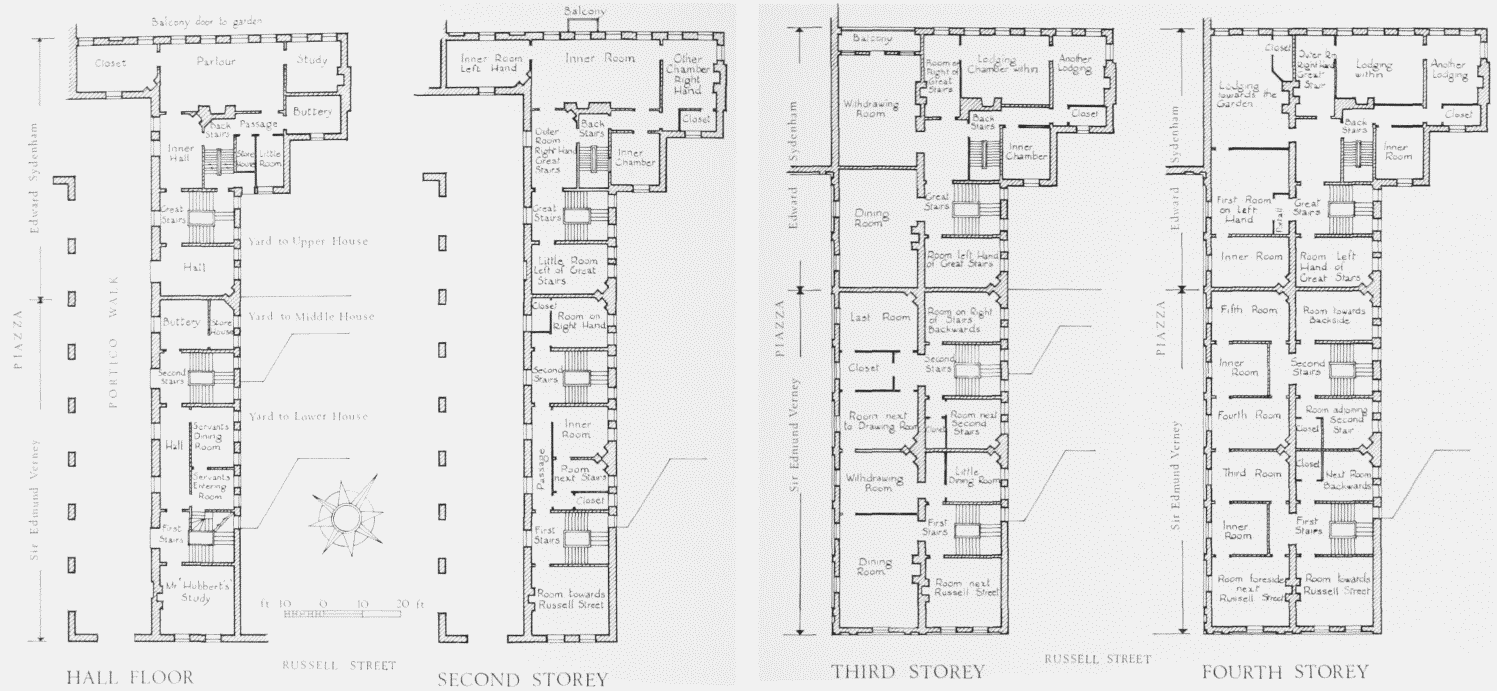
Conjectural plans of the houses in the Piazza built by the fourth Earl of Bedford. Based on the inventories attached to the leases granted in 1634 to Edward Sydenham and Sir Edmund Verney, and on the building accounts
In the fourth storey, the east rooms on either side of the two staircases were basically similar to those below, the middle pair alone having closets parted with wainscot. The rooms in the west front sequence formed two groups, consistent with the original arrangement of the two houses. Each group consisted of an inner room, at the head of the stairs, and a room on either side. The inner rooms were without fireplaces and all had one window, except for the southernmost room where a second window overlooked Russell Street. The roof contained six garrets.
In the yard was a pump, with shed, houses of office, stables, an outer yard, and two coachhouses with chambers for the grooms.
The building accountsafford further information on the general construction and finishing of these houses. The bricklayer, John Taylor, dug and made the drains and 'downeright Sinks' in the back yards, and made drains below the cellars and kitchens, the great drains from the latter being carried under the portico walk into the common sewer. Eaves-gutters of lead were provided by the plumbers, who also made a gutter through the garret towards Russell Street, a middle gutter to the second (Verney) house, and installed three pipes to convey rainwater from the roofs to the cellars, probably into storage tanks.
The bricklayer lathed and plastered the wings of the dormer windows, and the eaves soffit, and plastered the brickwork between the 'Cantelivers' or modillions, all of which work was painted. The walls of the houses varied in thickness from four to one and a half bricks, and the party walls above the portico walks were supported by oak truss partitions. The walls of the two-storeyed stables were generally one and a half bricks in thickness.
Working in the three houses, Richard Vesey, the carpenter, provided three two-leaved doors from the staircases to the dining-rooms, seventeen architrave doorcases with doors, and twenty-five plain doorcases with doors. Frames were supplied for 420 plain window lights, and besides special items such as the balcony windows and balcony door in Edward Sydenham's house, there were frames for the nine windows 'standing in the stoneworke'. These were the tall mullionedand-transomed 'Italian' windows of the principal storey, each containing two large and two small lights with iron casements, fitted with 'shutting windows' of wainscot, and furnished by the smith with rods, spring bolts and staples. Two kitchens were furnished with a dresser and a great stool to chop meat on.
The houses of office appear to have had two floors, the lower one containing the privies, for which four doors were supplied.
The various leaseholders were responsible for building the north side's two ranges of portico houses, and the east side's south range, the last becoming known as the Little Piazza. However much these houses may have differed in frontage, plan and internal finish, they all conformed with the fa¸ade design established by the north-east range, and the body of each house had the standard depth of two rooms in its upper storeys. Beginning at the west end of the north side, the first house fronted 60 feet and embraced four bays of the arcade. According to Lacy's plan it had no back wing on either side of its extensive garden. Fronting 30 feet 6 inches, the second house occupied two bays and its back wing was on the west side. The third house, fronting 45 feet, and the fourth house, fronting 49 feet 2 inches, were each three bays wide. Neither had a back wing because of the staggered lines of their garden plots, but the fourth house had the advantage of a return front to James Street. The fifth house, also with a return front to James Street, fronted only 18 feet 8 inches to the Piazza, and was one bay wide. The sixth house, fronting 39 feet 5 inches, was three bays wide and had a back wing on the east side. The seventh, eighth, ninth and tenth houses, respectively 28 feet 10 inches, 30 feet 3 inches, 29 feet 7 inches, and 29 feet 5 inches wide, had each a two-bay front to the Piazza. Lacy's plan suggests that these four houses were planned in similar mirrored pairs, each house having a back wing with a closet extension, those of the middle houses adjoining. In the Little Piazza each house was two bays wide, the southern pair sharing a frontage of 62 feet 6 inches and having mirrored plans, with extensive back wings built to face each other across the garden wall.
The South Side
Except for the houses at each end, the south side of the Piazza was open to the raised terrace-walk of the Bedford House garden, its long front wall broken at equal intervals by two semi-circular bastions projecting into the Piazza. Various pictorial sources show that at each end of the terrace there stood a domed pavilion of octangular plan, its angle faces concave and its cardinal faces dressed with pedimented frontispieces. If this terrace and its pavilions, or banqueting houses, were to be ascribed to any one, it would be Isaac de Caus rather than Inigo Jones.
While no view includes the east end of the south side, the house at the west end, built in 1631 for Sir Humphrey Foster, appears, on the evidence of a mezzotint of 1690 (Plate 46a), to have had a front three windows wide and three storeys high, each dressed with an order, the composition being crowned with a semi-circular pediment-gable rising against the steeply pitched roof. Although such a front is quite typical of its time, it could have had no place in Jones's well-ordered scheme for the Piazza.