Survey of London: Volume 36, Covent Garden. Originally published by London County Council, London, 1970.
This free content was digitised by double rekeying. All rights reserved.
'Covent Garden Market', in Survey of London: Volume 36, Covent Garden, ed. F H W Sheppard (London, 1970), British History Online https://www.british-history.ac.uk/survey-london/vol36/pp129-150 [accessed 30 April 2025].
'Covent Garden Market', in Survey of London: Volume 36, Covent Garden. Edited by F H W Sheppard (London, 1970), British History Online, accessed April 30, 2025, https://www.british-history.ac.uk/survey-london/vol36/pp129-150.
"Covent Garden Market". Survey of London: Volume 36, Covent Garden. Ed. F H W Sheppard (London, 1970), British History Online. Web. 30 April 2025. https://www.british-history.ac.uk/survey-london/vol36/pp129-150.
In this section
CHAPTER VI
Covent Garden Market
In 1926 the Town Clerk of Westminster presented a sixty-page report to the City Council upon the subject of Covent Garden Market, the owners of which were then proposing to remove it to a more suitable site. (fn. 15) The history of the market, he concluded, 'bristles with illegality, fraud and oppression'. The powers by which the market was regulated had been 'obtained by none too creditable means', and the owners had 'thereby established a stranglehold on a large proportion of the fruit and vegetable trade of London'. They levied 'an unjust tribute on a substantial proportion of the food of the people' by means of tolls imposed on traders who had built up a vast world-wide business 'to which the owners of the Market have in no way contributed either by their efforts or by risking their money'. (fn. 16)
The Town Clerk's attitude reflected the long prevalent hostility of public opinion towards the private ownership of markets. In 1926 Covent Garden Market was (with one exception (fn. 1) ) the only great wholesale food market in London still in private hands. The Dukes of Bedford had owned it until 1918, but during the previous half century they had had increasing difficulty in providing for its ever growing requirements. As early as 1867 the Duke's agents had been 'at their wits' ends about "room, room", being made a leading cry of public opinion'. (fn. 17) They had greatly enlarged the area of the market and (despite the Town Clerk's assertions to the contrary) spent large sums on improvements as well as drawing a handsome revenue. But still successive Dukes had been unable to satisfy the inexorable voracity of the fungoid Frankenstein's monster which they had inherited. They were fully conscious of the anomaly of private ownership of a great food market, but their offers, made in 1882–3, to sell the market to a public authority had been rejected by both the City Corporation and the Metropolitan Board of Works. (fn. 18) In 1891 a Royal Commission had urged that local authorities should be empowered to buy privately owned markets, (fn. 19) but no legislation had implemented this recommendation, and a tract written in the same year for the Fabian Society by Sidney Webb had denounced the Duke of Bedford's income from the market as 'an utterly unjustifiable tax on the food of the people' (fn. 20) —a slogan which later became so generally accepted that the Town Clerk of Westminster could incorporate it almost verbatim in his report on the market some thirty years later.
In this dilemma, possessed of a lucrative but increasingly unpopular property the complex requirements of which, particularly in such matters as external communications, control of traffic and prevention of fire, no private individual could ever satisfy, yet which no public local authority would buy, the eleventh Duke of Bedford at last, in 1914, entered into a contract to sell the market and surrounding property to Sir Joseph Beecham. Sir Joseph died in 1916 before the purchase had been completed, and the sale was eventually made in 1918 to the Covent Garden Estate Company Limited, a private company of which Sir Joseph's two sons, Sir Thomas, the musician, and Henry, were directors. Thus, at a time when the interminable problems of London's other great wholesale vegetable mart were about to be resolved by the purchase of Spitalfields Market by the City Corporation in 1920, the continued private ownership of Covent Garden Market received a new lease of life. It was not until 1962 that this, 'the principal national market in the United Kingdom', was vested in the public ownership of the Covent Garden Market Authority, (fn. 21) and the resolution of its problems could be attempted with some hope of success.
The first known reference to the market occurs in 1654, when Thomas Cotton was described as living 'about the new market in Covent Garden'. (fn. 22) The picture reproduced on Plate 11 shows that wooden rails had been erected round the Piazza and that a few small groups of traders with baskets, trestles and a cart were already congregating on the south side outside the rails. In the centre of the Piazza the picture shows a small tree surrounded by benches; in 1656–7 the churchwardens paid 3s. for painting 'the Benches and seates in the Markett place'. (fn. 23) Ten years later they paid 3s. 'For digging up the roote of the old tree in the broad place', (fn. 24) which makes it possible to date this picture as anterior to 1666–7. The square was already becoming a place of popular concourse—Pepys records having visited an Italian puppet play there in 1662, 'the best that ever I saw, and great resort of gallants'. (fn. 25) (fn. 2) In 1668–9 the churchwardens were concerned in the erection of a column in the centre of the Piazza (see page 79).
By 1667 the volume of business transacted on the south side of the Piazza was generating so much 'great ffylth' that it attracted the attention of the Commissioners for Highways and Sewers who met at the Office of the King's Works in Scotland Yard. The fifth Earl of Bedford, on being 'desired to finde some expedient to remove the same', proposed to build shops beside the garden wall of Bedford House, and prepared a plan which was approved by the Commissioners. (fn. 27) It is clear, however, that the shops were not built until ten years later.
The little gathering of buyers and sellers on the south side of the Piazza was still not, in strict law, a market at all, (fn. 28) and for this reason the Earl of Bedford derived no revenue from it. In the seventeenth century markets were usually established by a grant of letters patent on the authority of the royal prerogative, and on 12 May 1670 the Earl obtained such a grant. He and his heirs were authorized to hold for ever a market in the Piazza on every day in the year except Sundays and Christmas Day for the buying and selling of all manner of fruit, flowers, roots and herbs, together with all liberties and free customs, tolls, stallage, pickage, and all other profits and emoluments to such market in any way belonging, or with the same used, held, or enjoyed. (fn. 29)
This grant is the founding charter of Covent Garden Market. It was written in Latin and was phrased in the same loose terms as the charters of other markets established at this period—so vaguely, indeed, that in 1817 even the owner's very right to levy tolls was challenged in the courts. (fn. 30) But there was one important difference in the wording of the Covent Garden charter. Whereas in other grants the area in which the market franchise might be exercised was only vaguely indicated, (fn. 3) the area at Covent Garden was most precisely defined as extending over the whole of the Piazza—420 feet eastward from St. Paul's Church and 316 feet northward from the garden wall of Bedford House, and no more.
This precise definition of area was to have an important bearing on the future history of the market, but quite apart from the terms of the grant there were other peculiarities at Covent Garden which help to explain why the market there survived when others (such as St. James's, Newport and Lowndes Markets) declined into unregretted extinction, and why Covent Garden eventually achieved its modern supremacy. Perhaps most important of all, the area of the Piazza was (with the exception of Smithfield) more than twice as large as the area of any other London market, and so for well over a century there was no physical obstacle to expansion. Only at Covent Garden did the owner of the market franchise continue to own almost all the surrounding land. Here the market was a part of an efficiently managed estate in the continuous ownership of one prodigiously wealthy family. Neither the freehold of the site of the market nor the freehold of the market franchise were ever sub-divided or separated from each other (as they were in different ways, for instance, at Spitalfields and Newport Markets), and even the leasehold interest in the market franchise was never granted away by the Dukes of Bedford for more than comparatively short terms. This continued concentration of all proprietary interests in and around the market was immensely important in the history of Covent Garden. In the early nineteenth century, when the market had extended over the whole of the Piazza and congestion first became a problem, the sixth Duke was able, in 1828–30, to take direct control of both its day-to-day and long-term management, and to provide it with what were then model new buildings. Through their ownership of the surrounding ground later Dukes were able, by the demolition of many buildings in the adjoining streets, to extend the market far beyond the area defined in the grant of 1670. By the end of the nineteenth century, when successive Dukes of Bedford had virtually completed these developments, Covent Garden had already achieved its unique national position.
Nine months after the grant of 1670 the fifth Earl of Bedford granted a lease of his market rights —the first of a series extending down to 1827. This first lease, dated 10 February 1670/1, was to George Collop of Gray's Inn, esquire, and Sarah Bennett of St. Paul's, widow, for seven years from the previous Christmas, at a rent of £5 per annum. It recited that although the royal letters patent authorized the market to be held anywhere within the Piazza, the Earl 'did not intend that the market people should be at liberty to sit in any part thereof', and therefore stipulated that the lessees should compel the market people to sit in two parallel rows, one beside the garden wall of Bedford House (which then formed the southern boundary of the Piazza) and the other on the outer side of the rails. A 'convenient way and passage' was to be left between the two rows, carts were to stand at either end, outside the rails, and the lessees covenanted to clean the area occupied by the market. In return they were to enjoy the liberties and profits of the market, but there was no scale of tolls, and they were presumably allowed to charge whatever they could get. (fn. 32)
During the 1670's the trade of the market evidently increased very greatly, for in the next lease, granted in December 1677 for twenty-one years to Adam Pigott and James Allen, citizens and cutlers of London, the annual rent was increased from £5 to £80, and there was also a premium of 100 guineas. The lessees covenanted to pave and repair the ground used for the market, and they were now allowed, under stringent conditions, to build permanent shops against the garden wall. These shops were to form one uniform range not more than eight feet wide; their roofs were to be one foot lower than the top of the garden wall, and chimneys were prohibited. (fn. 33) By July 1678 the shops—twenty-two of them, and equipped with cellars—had been erected; the flat roofs of two of them which backed on to the two semi-circular projections of Bedford House garden wall were adorned with wooden rails 'for the more ornament'. In return for this outlay the lessees' interest was extended to twenty-six years—the longest term for which any of the Dukes of Bedford ever leased their market rights. (fn. 34)
When this lease expired in 1704 Bedford House was about to be demolished and its site and garden built over. The fronts of the houses to be erected along the south side of the square (later known as Tavistock Row) were to range along the line of the old garden wall, and in order to provide space for access to the houses the market shops had to be removed to the area inside the rails of the Piazza. In 1705–6 a row of forty-eight shops, brickbuilt with slate roofs, and many of them with cellars, was erected parallel to and a few feet inside the rails on the south side of the Piazza (Plates 26, 27). The shops were built by the second Duke of Bedford, and cost nearly £1,200. (fn. 35) (fn. 4)
The market had now been recognized as a valuable asset to the ducal revenues, and in order to gain the full profit from its constant expansion the Dukes of Bedford began in 1705 to lease their market rights for only one year at a time. During the years 1705–12 the rents ranged from £500 to £800 per annum, and in 1708 and 1710 the lessees also agreed to pay the Duke one eighth of their profits as well. (fn. 36) Burdened with these heavy charges the lessee was complaining that in the last quarter of 1709 he had made a loss. (fn. 37)
By the unexacting standards of the time the degree of control exercised by the ground landlord in the first half of the eighteenth century was probably stricter than in many other markets. The Dukes of Bedford employed salaried agents whose instructions the lessee covenanted to obey, but both the pictures and engravings of the Piazza reproduced on Plates 26, 27, 28 and documentary records show that the number of shops, sheds and removable stands was constantly increasing. There were enlargements, encroachments, excavations for wells and boghouses, excavations for more cellars, particularly for the potters who were allowed to establish a crockery mart in this supposedly exclusively fruit and vegetable market (fn. 38) (Plate 26), and even the column in the centre of the Piazza was debased for a few years by the erection of a shanty which entirely enclosed its lower half. (fn. 5) It is evident, in fact, that by about 1740 the control exercised by the Dukes or their agents had been greatly relaxed, and in 1741 the fourth Duke was content to lease his rights for the unusually long term of seven years at a rent of £1,200 per annum—the highest yet to be obtained. (fn. 39)
The Duke's leases were granted by open competitive tender to the highest bidder, and at about this time two unsuccessful tenderers complained that they had been at a disadvantage because the previous lessee had 'very cautiously concealed from the Publick the Real Value of the Market'. (fn. 40) The Duke perhaps felt that he too was in the dark, so when the lease of 1741 unexpectedly reverted to him three years later he inserted a covenant in the new lease compelling the lessee to provide a written statement of his income from the tolls and the rents of the shops and standings. (fn. 41) Early in 1748 the vestry of St. Paul's presented to the Duke a memorial signed by sixty-two inhabitants complaining of 'the Nusances of the Market', (fn. 42) and the way was now open for one of those periodic renovations which have characterized the history of Covent Garden.
The inhabitants complained that for some years past many of the shops, sheds and stalls had 'Contrary to Originall Usage' been occupied by 'Bakers, Haberdashers, Cook Shops, Retailers of Geneva and Other Spiritous Liquors, and Sundry other Trades', and that this 'could never be Intended by Your Grace to be permitted in an Herb-Markett such as Covent Garden Markett Originally was'. Some of the new stands had been erected outside the rails, thereby greatly obstructing the streets surrounding the Piazza, and many of the occupiers of the shops had converted their lofts into bed chambers, whereby 'divers persons have … become Burdensome and Chargable to the parish'. The 'stench and filth of the Markett, the Offensive Smoke of the Chimneys of the said several Sheds and the Disturbances which frequently happen, by the great Number of profligate and Disorderly people, who frequent the Square, and particularly that part of it called Irish Row', were all great annoyances to the inhabitants living round the market. The leasehold value of their houses had 'Abated in proportion as the Nusances have Encreased, and … sundry Houses in the parish are let to persons of Ill fame and others remain untenanted through the decay of trade.' For all these reasons they humbly requested the Duke to take steps for 'reviving the Decayed Credit of the parish and restoring it to its pristine flourishing State'. (fn. 42)
This petition was favourably received, (fn. 43) and in 1748 the Duke spent nearly £4,000 in rebuilding or repairing the market shops and sheds. (fn. 44) (fn. 6) The new buildings had low-pitched or slightly curved roofs, from which low chimneys were allowed to project, and their appearance recalls the converted railway carriages sometimes to be seen in modern shanty towns (Plate 29). Nevertheless the appearance of the market must have been greatly improved, at least for a while, and as an earnest of stricter control the lease of the market granted by the Duke in September 1748 contained a schedule of the rents and tolls which the lessee was entitled to collect. The lease shows that there were now 106 shops and 229 stands; the rent-charge had declined slightly to £1,170 per annum. (fn. 45)
During the second half of the eighteenth century the market continued to grow, and by 1798 the lessees were paying a rent of £2,500 per annum. (fn. 46) The rate of growth of the potato trade was particularly rapid, it being estimated that in 1819 the consumption of potatoes had increased ten-fold during the previous sixty years. (fn. 47) (fn. 7) There were occasional complaints from the vestry, usually about cleansing or obstruction, (fn. 49) and in 1781 the lessee of the market attended a meeting of the vestry to discuss their grievances. He promised that in future 'No Exhibition of Wild Beasts or other Shews' would be permitted, and, he sadly continued, 'The Mountebank has orders to quit but it will be a loss of about Ten Guineas a year in case he is removed. If he should be permitted to stay, he promises the shed shall be always taken down so soon as he has done his business, and put into a Cellar.' (fn. 50) 'Other Shews' did not, of course, include parliamentary elections, and polling for the two members for Westminster continued to be held at the hustings erected in front of St. Paul's Church from at least 1701 until 1868, the last general election before the introduction of the secret ballot in 1872. Nor could the Dukes of Bedford prevent Covent Garden becoming, in the words of a contemporary writing in 1776, 'the great square of Venus … One would imagine that all the prostitutes in the Kingdom had pitched upon this blessed neighbourhood for a place of general rendezvous. For here are lewd women in sufficient numbers to people a mighty colony. And that a fuel for the natural flame may not be wanting, here is a great variety of open houses whose principal employment is to minister incitements to lust.' (fn. 51) And here in 1763, beneath the portico houses, James Boswell 'sauntered up and down for a while in a sort of trembling suspense' as he waited for his inamorata of the hour. (fn. 52)
In the latter part of the eighteenth century Covent Garden had become 'the greatest market in England for herbs, fruit and flowers'. (fn. 53) It was divided by customary usage into different sectors, the herb shops and better-class fruiterers in the south row and the florists on the west side. The north side was devoted to roots and kitchengarden produce (except potatoes, which were on the south side), the east to peas and beans or cherries and strawberries according to the season, while in the centre were the 'bird-sellers, dealers in old iron, and large displays of crockery-ware'. (fn. 54) By the early nineteenth century Covent Garden was already the focal point of a highly diverse trade. Within ten miles of London there were 15,000 acres of market garden ground, in which up to 60,000 labourers were employed at certain seasons. The growers loaded their carts at sunset and between ten o'clock at night and one o'clock in the morning they set out, often accompanied by their wives. 'All the roads round London, therefore, are covered with market-carts and waggons during the night, so that they may reach the markets by three, four, or five o'clock, when the dealers attend.' By six or seven o'clock the growers had sold their produce, which was then dispersed to the retail shops 'by the aid of ill-paid Irish women, who carry loads of a hundredweight to all parts of London on their heads'. The fragile strawberry crop had to be carried into the market as well as out of it, and hundreds of women, many of whom had walked to London from Shropshire or Wales for the soft fruit season, were employed in this drudgery. Like an army of moving caryatids they carried on their heads basket-loads weighing up to fifty pounds, and in the course of the three or four journeys a day which they made from farm to market they often walked thirty miles. (fn. 55)
Covent Garden Market had, in fact, become too large and complex for it to be managed by simply leasing the collection of the tolls to the highest bidder. In 1812 the vestry of St. Paul's complained to the sixth Duke that much of the market was occupied by dealers in 'China and other Crockery Ware, Poultry, Old Iron, and a variety of articles not enumerated in the Grant', (fn. 56) and that in consequence even the roadways round the Piazza were 'occupied by the Stalls and Baskets of those who cannot find Room within the Rails'. The market was dirty, there had been constant disputes about the tolls, and 'much ill-will and litigation' had ensued. As a result the Duke's lessee, 'conceiving he had not been paid his fair Tolls', had refused to pay any more rent, and in 1813 the Duke had decided to promote an Act of Parliament 'to ascertain and settle the Tolls'. (fn. 57)
As originally drafted the sixth Duke's Bill contained a schedule of the tolls to be charged in future, and it therefore encountered considerable opposition from the users of the market, particularly the growers, who claimed that it would establish 'an exorbitant toll … and enhance the price of all vegetables and fruits to the inhabitants of London and Westminster'. At a public meeting of market gardeners held at the Freemasons' Tavern in Great Queen Street a committee was formed to oppose the Bill, and the schedule of tolls was in consequence withdrawn. In this emasculated form the Bill received the royal assent on 21 May 1813. (fn. 58)
This Act proved of very little value. There were provisions for the removal of obstructions, for the better cleaning of the market and for the recovery of unpaid tolls, but so far as the actual tolls were concerned the Act merely authorized the Duke or his lessee to collect from the vendors of goods 'all such Toll and Tolls as is or are usually taken or collected within the said Market'. The difficulty was that there was no uniform, generally accepted scale of charges. Fresh litigation soon ensued in which it emerged that the tolls varied from one part of the market to another. The legal position of the Duke or his lessees, as plaintiffs in court actions for the payment of tolls, was much weakened by their continued toleration of stall-holders not engaged in the fruit and vegetable trade, and by the ambiguous wording of the original grant of 1670, which the courts held had not been clarified by the Act of 1813. The right to collect any tolls at all was even questioned in 1817, (fn. 59) and probably as a result of these uncertainties the highest rent which the Duke could obtain for the lease of his market rights declined from £2,900 to £2,500 per annum. (fn. 60) Meanwhile the volume of business had become so large that it could no longer be restricted to the area defined in the grant of 1670, and in 1825 the Duke's lessee failed in an action to collect tolls for goods sold in James Street. (fn. 61)
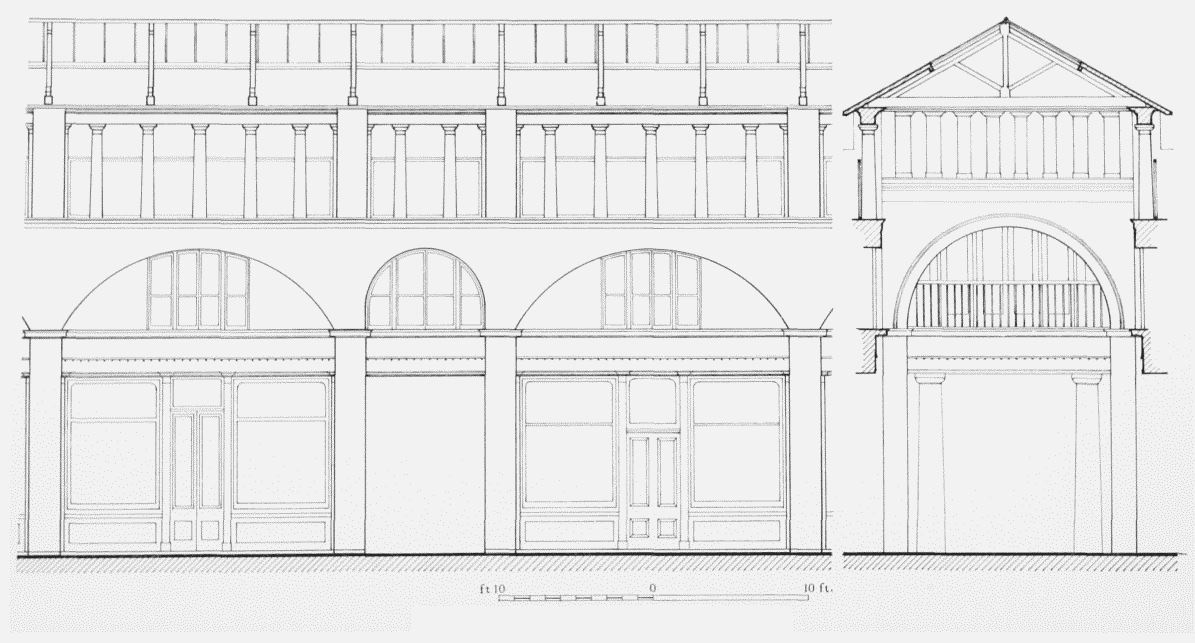
Covent Garden Market, Central Avenue, sections
There were three causes for the unsatisfactory state of the market at this time—uncertainty about the tolls, inadequate management and uneconomical use of the space available. These defects could only be remedied by another Act of Parliament and at considerable expense to the sixth Duke of Bedford. In 1826 an Act had authorized the Commissioners of Woods and Forests (who had been concerned in the formation of Regent Street) to buy land needed for the widening of the Strand, (fn. 62) and in 1827 the Duke had agreed with the Commissioners to sell the required property for some £29,000. He evidently decided to use this windfall for the improvement of the market, (fn. 63) and in the winter of 1827–8 he and his staff were considering the various designs submitted by Charles Fowler, the architect whom the Duke had selected for the rebuilding. (fn. 64) Fowler's first proposals for the layout of the market were considerably altered at the suggestion of Mr. Charlwood, the Duke's clerk of the market, 'who was employed to arrange the ground-plan, distribution, and appropriation of the different departments of the market…', (fn. 65) while for the elevations the Duke insisted on the acceptance of some of his own ideas—notably the balustrade above the colonnades. (fn. 8) Ultimately Fowler's early designs were substantially modified.
In February 1828 a petition was presented to the House of Commons for leave to bring in a Bill 'for the Improvement and Regulation of Covent Garden Market'. (fn. 67) The Bill met with little opposition, for the requirements of the market had evidently been closely studied, and it received the royal assent on 27 June 1828. (fn. 68)
The Act (which repealed that of 1813) authorized the sixth Duke to demolish the existing buildings in the market and to erect new ones in accordance with a ground plan attached to the Act. This plan formed part of Fowler's designs. It provided for three parallel ranges of buildings containing shops, offices and cellars, and for the rest of the ground to be divided into a network of rectangular standings separated from each other by footpaths and gangways, the use to which each stand could be put being clearly marked on the plan. The Act also authorized the Duke to build 'Terraces' at the east and west ends of the market, but these do not appear on the plan and in fact only one, at the east end, was erected (fig. 16).
The Duke's right to collect tolls was firmly established. A schedule to the Act contained a scale of the tolls which might be charged in the different parts of the market known as the casual cart stands (i.e., those let by the day), the yearly cart stands, the potato stands, the fruit market, the yearly pitching stands and the flower stands. The rents which might be charged for each type of stand were also precisely laid down, but those for the shops, offices and cellars in the buildings could be determined by the Duke as he should see fit.
The Act also contained provisions for the dayto-day management of the market. The Duke was empowered to make bye-laws, and (with certain minor exceptions) nothing was to be sold in the market but fruit, vegetables and flowers. Waggons were only to be placed on the standings provided for them, and obstructions placed in the gangways of the market or in the surrounding carriageways could be seized.
In June 1828 the last of the long series of leases granted by successive Dukes of Bedford of their market rights expired, (fn. 69) and for nearly a century afterwards the market was managed by their own paid employees. Rebuilding of the market began in September 1828 and was completed in May 1830 (Plate 36a), William Cubitt of Gray's Inn Road (brother of Thomas Cubitt, who had recently developed much of the Dukes of Bedford's Bloomsbury estate), being the contractor. His tender was for £34,850.
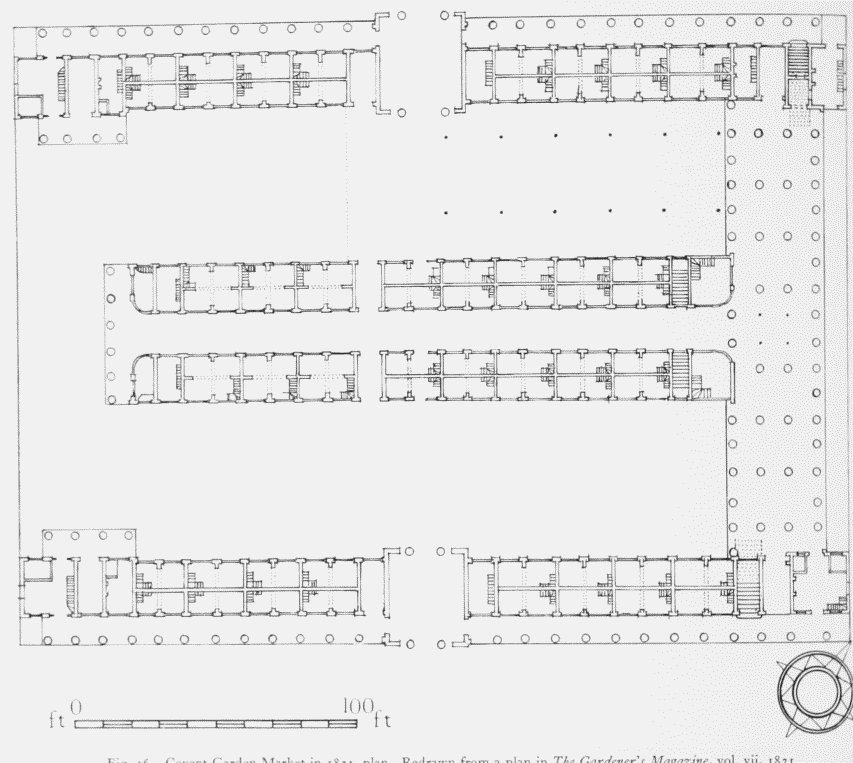
Covent Garden Market in 1831, plan. Redrawn from a plan in The Gardener's Magazine, vol. vii, 1831
The Duke's outlay on rebuilding the market amounted to some £61,000, which was very considerably more than his advisers had expected. (fn. 70) He had eventually received £32,793 from the Commissioners of Woods and Forests for the sale of his ground required for the improvements in the Strand, and had therefore had to find the balance from his own resources. Nevertheless this outlay probably proved to be a good investment. For some thirty years after 1830 no further alterations were needed in the market, apart from the erection in 1839–40 of a corrugated iron covering (designed by Fowler) to protect the flower stands at the west end (fn. 71) (Plate 37a); and the seventh Duke's net profit in the year 1861 had risen to £6,752. (fn. 72) The three problems of the market—uncertainty about the tolls, inadequate management and uneconomical use of the space available—were all for the time being resolved, and a brief early Victorian heyday supervened between the market's raffish, haphazard past and the onset of new problems and new criticisms in the 1860's. There was still a considerable volume of retail trade, and the flower stands, the shops of the centre arcade and the conservatories at the east end in particular soon proved favourite resorts for all classes of Londoners (Plate 37b). 'The epicure may here feast his eyes with delight', wrote a contemporary, 'and, if he is wealthy enough, purchase the natural produce of April or May while the snows of February are whitening the ground.' Here 'Many a poor man has often expended his shilling when he could ill spare it, to purchase a choice tulip or dahlia, which he treasured as the pride of his garden'; and here too, intent on an unneeded bargain and titillated perhaps by the rare opportunity to rub shoulders with the 'lower orders' of that class-ridden age, came 'the aristocratic lady, who treads with "mincing gait" through the arcade, attended by John the page, and all his "eruption of buttons'". (fn. 73)
These halcyon days, when a visit to Covent Garden in early summer was almost a part of the London social season, were coming to an end in the late 1850's. Congestion in the streets approaching the market was the most urgent problem, and in 1858 the seventh Duke of Bedford sold some of his property in Long Acre, Rose Street and King Street to the Metropolitan Board of Works for the formation of a new thoroughfare (now Garrick Street) from St. Martin's Lane to King Street. From the proceeds of this sale—£20,892—the Duke made a voluntary contribution of £15,000 to the Board of Works in recognition of the benefit which his estate in Covent Garden would receive from the new street. Between 1856 and 1861 he also spent £6,051 on a smaller street improvement of his own, at the south-east corner of the market, where he bought out the leaseholders of a number of houses for an extension of Burleigh Street from Exeter Street to Tavistock Street, and the formation of a covered passage on the east side of Tavistock Court leading into the south-east corner of the Piazza. (fn. 74)
During these years the seventh Duke and his agent, Charles Parker, evidently became more aware of both the new needs of the market and of the new opportunities to enlarge the revenue from it. In 1858–60 they installed gas lighting; when the demolition of Hungerford Market for the formation of Charing Cross Station became imminent they were concerned to enlarge the legitimate business of Covent Garden by providing space in Hart Street for warehouses for the displaced seed merchants; and in order to provide more space in the market itself, as well as to reduce drunkenness, they gave notice to quit to the occupants of three of the public houses there, and removed the market superintendent's office to a house in an adjoining street. Parker consulted the salesmen about their requirements and even prepared a model for the erection of an upper storey over the existing buildings. (fn. 75)
There were also two new departures which were to prove of paramount importance for the longterm future of the market. Firstly, in 1860, the seventh Duke caused to be erected upon the vacant site of the recently demolished Imperial Hotel at the south-east corner of the Piazza a temporary canvas-roofed structure for the accommodation of some of the flower dealers for whom there was not enough room in their allotted standings at the west end of the market. This was the first time that any Duke of Bedford had provided accommodation outside the area of the market as specifically designated by the original grant of 1670; and although at first only temporary, the new flower market at once became a permanency, for in 1862–3 it was roofed with iron and enlarged eastwards to take in two houses in Wellington Street. (fn. 76)
Secondly, and at about the same time, the Dukes of Bedford began to insert a new covenant in leases granted to tenants who were concerned in the fruit and vegetable trade and who wished to store their goods in warehouses on any of the Dukes' property in streets adjacent to the market. The Dukes now insisted that besides the rent tenants should also pay the same tolls on any goods brought to their premises as they would have paid if the goods had been brought into the area of the charter market. (fn. 9) The exact date of this innovation is not known, but the second example of it was in 1862, when a potato merchant took over the premises at No. 3 Maiden Lane recently vacated by Messrs. Godfrey and Cooke, chemists, and was obliged, in addition to his rent of £70, to agree to pay tolls which the eighth Duke's agent anticipated would yield another £50 per annum. (fn. 77)
Once the principle of using part of their land around the original chartered area for the expansion of the market had been accepted, the Dukes of Bedford could (as their tenants' existing leases expired) enlarge the area of the market over as much of their Covent Garden estate as they pleased. By this means, for nearly fifty years after 1860, it was possible for successive Dukes to cope with the relentless demands of the market for more space, and by piecemeal additions to double the total area of the market under their direct control, as well as receiving tolls from those tenants in the fruit and vegetable business who rented their own premises in the adjacent streets. (fn. 78)
In the late 1860's and early 1870's Covent Garden and its noble owners became the objects of frequent public criticisms which continued with little intermission until the eleventh Duke sold virtually the whole estate in 1918. These critics ignored both the Dukes' difficulties and the gigantic costs involved, and often contradicted each other. Some said that enlargement on the existing site was impossible, but the market could not be allowed to 'remain as it is, because it happens to belong to a powerful nobleman', and it should therefore be removed to Seven Dials, where the removal of the existing slums would 'purify the social and moral atmosphere …' (fn. 79) (fn. 10) Others contended that the market should remain in Covent Garden, 'but not with its present noble proprietor' who should be 'with all due speed disestablished and disendowed' in favour of the Metropolitan Board of Works. (fn. 81) Even the market gardeners, shopholders and salesmen who worked in the market disagreed about what should be done; they formed rival trade associations and committees, held public meetings and lobbied the Duke. (fn. 82)
At last, in 1871, a start was made when a contract was placed by the eighth Duke's new steward, Thomas Davison, with William Cubitt and Company for the thorough renovation of the buildings in the charter market at a cost of £9,694. This at least proved uncontroversial, but when in the same year the Duke decided to enlarge and improve the Flower Market which had been erected in 1860, Davison's consultations with the market tradesmen evoked both eager support and strenuous opposition. 'An influential body of tenants' even threatened to remove their trade elsewhere, (fn. 83) but the Duke persevered, and in 1871–2 a large new iron and glass Flower Market was erected upon the site of the old one, now enlarged by the addition of the back premises of the Old Hummums Hotel and of a third house in Wellington Street. With this enlarged eastern frontage it was possible to erect a permanent brick facade to Wellington Street, but at the western end facing the Piazza there was as yet only 'a structure of a temporary character'. The building (Plate 43a, 43b) was constructed by William Cubitt and Company to the designs of one of their own staff, William Rogers, and cost £17,710. (fn. 84) The opposition of the tenants gradually subsided, and Davison reported that it was 'not too much to hope that the wholesale Flower trade of the Metropolis has been permanently re-established and attached to the Duke's Covent Garden Estate so as to be moderately remunerative to the Duke, and satisfactory to the Tenants'. (fn. 83)
Davison also made other improvements. In 1872 barriers in Southampton Street and Burleigh Street were removed, (fn. 85) and in the same year the policing of the market, hitherto performed by beadles in the Dukes' employment, was taken over by the Metropolitan Police. One sergeant and six constables were required; their annual wages (paid by the Duke) amounted to £682. More important was the gradual abatement of the opposition of the shopkeepers and salesmen to the roofing-in of the uncovered areas of the charter market. (fn. 86) This opposition had been maintained ever since roofing-in had first been mooted in 1858, (fn. 87) on the improbable grounds of danger to health, while the market gardeners had as consistently demanded protection for their goods. (fn. 88) In 1871 Davison was able to resolve these difficulties; the shopkeepers and salesmen agreed to acquiesce ('perhaps not too cordially in some cases'), (fn. 89) and in 1874–5 an iron and glass roof enclosing the whole of the area between the Central Avenue and the southern range of buildings was erected by William Cubitt and Company at a cost of £10,209 (fn. 90) (Plate 41a, b).
Davison died in 1877. His successor as steward, John Bourne, at once reported to the ninth Duke that the constantly increasing volume of business was testing existing capacity to its utmost and that 'The great want of the General Market is more space.' He considered and rejected the idea of using the area underground beneath the Piazza to win more room within the charter market and instead he began to allow tenants engaged in the fruit and vegetable trade who occupied premises in the vicinity of the market to sell their goods on these premises subject to their paying the same tolls as would have been charged within the chartered area. (fn. 91) He foresaw that in 1883 the leases of a large block of the Duke's property on the south side of the Piazza would expire, and that this would provide an opportunity to enlarge the market yet again. But before embarking on the great capital expenditure which this would involve the ninth Duke decided to offer to sell the market to the Metropolitan Board of Works. In correspondence which began in December 1882 he informed the Board of the impending opportunity for improvements and suggested that these works 'should include Street widening and other alterations that should properly be carried out by Municipal Authority'. (fn. 92)
In adopting this course he may well have been influenced by continuing public hostility towards the existing régime at Covent Garden, against which Punch at about this time had mounted a prolonged campaign. 'Mud-Salad Market belongs to his Grace the Duke of Mudford'—so began an article in August 1880 which, after allowance is made for exaggeration, probably presents a reasonable picture of the prevailing conditions. 'Mud-Salad Market, like its own vegetables, has now sprouted out in all directions. You may start from Cabbage-leaf Corner, near the site of Temple Bar, on a market-morning, and may go as far as Turnip-top Square in Bloomsbury, or Cauliflower-place at Charing Cross, and it is all Mud-Salad Market. Houses are barricaded with mountainous carts of green-stuff, cabs lose themselves in vain attempts to drive through the maze of vegetables, the costermonger makes temporary gardens on the pathway, while the roads are blocked with waggons, carts, donkeytrucks, and porters staggering under the weight of huge baskets. Carrots, turnips, vegetablemarrows, potatoes, lettuces, and onions are masters of the situation. Vegetable refuse, ankle deep, carpets the pathway in every direction, mixed with mud and rain-water, and trampled into a pulpy slimy muck by thousands of hobnailed boots … It is not too much to say that Mud-Salad Market is a disgrace to London, a special disgrace to his Grace of Mudford, and about the greatest nuisance ever permitted in a great City of Nuisances.' (fn. 93)
After seven months' thought the Metropolitan Board of Works decided not to buy the market. (fn. 11) So also in November 1883 did the City Corporation, to which the Duke had made a similar offer after being rebuffed by the Board. (fn. 95) The price to be paid was never discussed at all by either authority; what was lacking was the will to accept responsibility for a peculiarly intractable problem, which the Duke of Bedford was now left to solve for himself as best he might.
The next twenty years proved to be the greatest period of expansion in the whole history of the market. In 1884–5 six houses on the north side of Tavistock Street and the Old Hummums Hotel at the south-east corner of the Piazza were demolished and a contract was placed with William Cubitt and Company for the enlargement of the Flower Market over their site. (fn. 96) This work included the erection of a permanent western facade to the building in place of the temporary one built in 1871–2, (fn. 97) and the rebuilding of the covered passage along the western end of the building; it was completed in 1887 at a cost of £31,856 (Plate 43c). (fn. 98) Simultaneously all the houses (some twenty-six) in the block bounded by Tavistock Row, Tavistock Court, Tavistock Street and Southampton Street were demolished and the open space converted into a temporary 'lay bye' (fn. 12) for market vehicles. (fn. 99) The cost of these works, which were not completed until 1891, was £15,709. (fn. 100)
Meanwhile Bourne was also arranging another equally large extension in the north-east corner of the market. After the destruction of Covent Garden Theatre by fire in 1856 the manager, Frederick Gye, had taken from the seventh Duke of Bedford a lease of an extended site, and had rebuilt the theatre upon the northern part of it. Upon the southern portion he had fulfilled a longcherished ambition by the erection of a great iron and glass hall with entrances in both Bow Street and the north side of the Piazza (fn. 13) (Plate 42b). Gye had intended this building to be used as a flower market, (fn. 101) and it was therefore called (very confusingly, as events turned out) the Floral Hall. But it had proved to be a complete failure commercially and at last in 1887, when the leases of several adjoining buildings had conveniently expired, the ninth Duke of Bedford bought back the lease from the tenant of the theatre (Gye now being dead) for £20,000. (fn. 102) After buying out several other properties he and Bourne were able to clear away almost all the buildings in the block bounded by the Floral Hall, Bow Street, Russell Street and the Piazza. Only six houses within this block remained, all at its south-east corner, and among those demolished were the Bedford and Russell Hotels and the offices of the Strand Union Board of Guardians. (fn. 103) The Floral Hall was at once converted into a foreign fruit market, (fn. 104) and most of the rest of the cleared area was left uncovered, to be used for loading and unloading. (fn. 105) The total cost of this extension, including purchase of the Floral Hall, conversion of the building, demolitions and road-works (not completed till 1893) was £57,498. (fn. 103)
The fruit market had hitherto been held in the north-eastern part of the charter market, between the northern range of buildings and the Central Avenue and under the cover of a wooden and slated roof erected in 1828–30. This old roof was now removed and part of it was re-erected as a covering for the vacant ground at the north corner of Russell Street and the Piazza, where it still remains. At the same time, in 1888–9, an iron and glass roof was built by William Cubitt and Company over the whole length of the area between the northern range of buildings in the charter market and the Central Avenue. This cost £7,288. (fn. 106)
The twenty-year period of expansion which had begun in 1884 ended with the erection of the Foreign Flower or Jubilee Market between Tavistock Row and Tavistock Street in 1904 (fn. 107) (Plate 47c) and yet another extension of the Flower Market in 1904–5, at the south-west corner of Russell and Wellington Streets, where the upper floors were used as offices. (fn. 108) Both were designed by Messrs. Lander, Bedells and Crompton. A number of temporary corrugated iron coverings have also been erected over part of the vacant ground between the Floral Hall and Russell Street. Since the opening years of the twentieth century there has been hardly any further change in the outward aspect of the market buildings (see Plate 39).
The Dukes of Bedford were, indeed, on the horns of an intractable dilemma, and this is probably why the eleventh Duke decided in the early years of the twentieth century to call a halt to the enlargement of the market area. Despite all their efforts in the 1880's and 1890's, the expansion of accommodation had always trailed behind the expansion of trade. (fn. 109) Around 1880 the rapid outward growth of the suburbs of London was steadily driving the market gardeners further out into the country, and more and more goods were being brought to London by rail, instead of by cart, from distant parts of England. These rail-transported goods arrived at all times of the day and so greatly extended the working hours of the wholesale market. In 1879 four offices had to be provided in the market for the accommodation of the railway companies, and in this new age of the electric telegraph and the telephone (the latter first introduced at Covent Garden in 1886), the wholesale salesman was rapidly replacing the grower and becoming an increasingly important element in the market. 'It is not difficult to see', Bourne recorded in 1879, 'that a complete revolution will in time be worked out in the method of conducting business.' (fn. 110)
It was in the 1880's and 1890's, too, that imported foreign produce first arrived at Covent Garden on a large scale. Between 1878 and 1884 the ninth Duke's market revenue rose by no less than 41 per cent, largely through the growth of foreign imports, of which American apples were one of the most important items. Fear that the inadequacy of the existing accommodation at Covent Garden might result in the removal elsewhere of this lucrative new trade dictated the decision to buy and convert the Floral Hall into a foreign fruit exchange in 1887. (fn. 111) It was in this new mart that bananas, Tasmanian apples, Californian pears, (fn. 112) and early vegetables from Madeira, the Canaries and the Channel Islands were sold in ever increasing quantities during the next few years. (fn. 113) With the introduction of cool chambers and the increased speed of steamers every year opened up fresh sources of supply, and by 1892 Australia, South Africa, Florida and California were beginning to compete with France and Spain in the provision of old-established Mediterranean commodities such as grapes, oranges and peaches. (fn. 114)

Covent Garden Market in 1926, plan. Redrawn from a plan in Report on Covent Garden Market by the Town Clerk of the City of Westminster, 1926
Nor was this all. In 1889 the superintendent of the market stated that English growers were planting fruit trees on an extensive scale, and 'putting up Acres of Glasshouses, especially for Grapes, Tomatoes and Cucumbers, which are now reckoned by the Tons instead of lbs… .' (fn. 115) Within four years English fruit grown under glass was important enough to lower the price of foreign grapes, tomatoes and cucumbers, (fn. 116) and in 1895, the largest English apple season then known, the volume of foreign produce sold at Covent Garden declined while that of home grown goods continued to increase. (fn. 117) In this same year, too, the rapid growth of trade in cut flowers, chiefly from the Scillies, the Channel Islands and France, required the erection of a temporary corrugated iron building in the Tavistock Row area. (fn. 118)
This colossal increase in the scale and complexity of operations at Covent Garden more than counterbalanced the simultaneous expansion of the area of the market buildings; like the Red Queen in Alice Through the Looking Glass, the Dukes of Bedford had to be forever running merely to stay in the same place. Congestion grew worse, particularly in James Street, where several houses on the west side did not belong to the Duke and the occupants constantly obstructed access to the market by spreading their goods (free of toll) over the road. (fn. 119) The police were unhelpful, and in 1886 the First Commissioner informed Bourne that he would 'be glad to receive any suggestion you may have to make as to any method by which the present scandalous condition of the Market arrangements can be mitigated. It is quite evident', he continued with more optimism than foresight, 'that the time cannot be far distant when some fresh arrangements will have to be made to enable the people of London to buy their fruit and vegetables without the loss of time, the inconvenience and the danger which at present exist.' (fn. 120)
But it was not only the police who were criticizing the Dukes of Bedford towards the end of the nineteenth century. Punch, of course, maintained its attacks on the condition of Covent Garden, but there were more important critics. Under the Metropolitan Board of Works and the vestries and district boards the standards of local administration in London had fallen behind those of great provincial cities like Birmingham or Manchester, but in the late 1880's there arose a formidable demand, led by the Fabian Society, for the re-assertion of London's municipal preeminence. The London County Council was established in 1889, just too soon for it to be endowed at birth with the powers recommended in 1891 by a Royal Commission on Market Rights and Tolls. This Commission had spent several years in collecting evidence and had subjected John Bourne to prolonged examination over Covent Garden before recommending that local authorities ought to be empowered to purchase privately owned markets, if necessary by compulsion. (fn. 121) Armed with the facts which the Commission had elicited and published, Sidney Webb wrote for the Fabian Society (and also for the second elections to the London County Council, due to be held in 1892) a devastating pamphlet entitled The Scandal of London's Markets.
He began by quoting the evidence given by Bourne to the Royal Commission that the ninth Duke's average annual net profit from the market during the three years 1884–6 had been £15,000 (fn. 122) and stated flatly that this was 'an utterly unjustifiable tax on the food of the people'. Private property in markets, he continued, ought, 'like private property in mints, courts of justice, post offices, telegraphs, public offices, pocket boroughs, votes, army commissions, and so many other things, finally to cease out of the land'. What London needed was a public authority for the control of all metropolitan markets, and 'The County Council appears to be the authority best suited for this work'. (fn. 20)
The Progressive majority group of members of the London County Council was extremely sympathetic to views of this kind, and soon after the elections of 1892 the Council decided to seek statutory power to purchase markets compulsorily. (fn. 123) A Bill was introduced in the House of Commons in 1893 but did not reach its second reading before the end of the session. (fn. 124) Meanwhile the short-lived Liberal Government had appointed a Royal Commission to consider 'the Amalgamation of the city and the county of London', and the whole question was adjourned. (fn. 125) Shortly afterwards the Conservatives under Lord Salisbury returned to power, and in due course they rejected the Royal Commission's recommendations. In 1899 they established the twenty-eight metropolitan borough councils as a counterweight to the County Council, whose radicalism they so much disliked. (fn. 126) The Conservatives at Westminster remained in office until 1905, and the Progressives at County Hall were therefore unable to obtain power over markets, but in the year after the great Liberal victory of 1906 the Progressives lost their majority on the Council to the Municipal Reformers (or Conservatives), who retained their ascendancy until 1934. (fn. 127) And so once again, as in 1883 when the ninth Duke of Bedford had offered to sell his market to the municipal authorities, Covent Garden continued in private ownership.
But the ideas expressed in Sidney Webb's pamphlet were gaining increasing public acceptance. Bourne's arguments before the Royal Commission on Market Tolls in 1888, that through the recent clearances around the market the ninth Duke had forfeited a rental of £5,000 per annum, that the toll payable on a bunch of carrots was only 1/32 of a penny, and that the Duke's market income was no more a tax on the public's food than the rent received by the landlord of a shop, had not entirely convinced his audience. (fn. 128) The fact remained that the Duke made a handsome profit, and so, when the demand for public ownership reached its climax in 1891–3, Alfred Stutfield, Bourne's successor as steward, compiled figures which purported to show that the net market revenue was not substantially greater than that which would accrue if the whole area were let on building lease. He calculated that since 1828 successive Dukes had laid out £260,383 in capital expenditure. The net income in 1894 was £29,786, which after deduction of interest at 3 per cent on the capital sum, left an actual net income of £21,975. The superficial area of all the markets (the chartered area, the Floral Hall, the Flower Market and the Tavistock Row and Russell Street areas) was 189,687 square feet, which if let at 2s. per square foot would produce an annual income of £18,968. It appears, however, that the total area of the market was really larger than that stated, and Stutfield's calculations took no account of the large reversionary value which the buildings would in due course yield if the whole site were let. (fn. 100) There was no denying that the Duke's market property yielded an exceptionally high return; Stutfield's figures were not published.
Many years later the eleventh Duke's very distinguished agent-in-chief, Rowland Prothero (sometime M.P. for Oxford University, President of the Board of Agriculture and Fisheries, and created Baron Ernle in 1919), made a much better defence, though it would not have impressed the Fabians, who wanted to reconstruct the whole social fabric of the country. In his autobiography, published in 1938, he pointed out that the market had been only one limb of a huge and preponderantly agricultural family estate, and that during the prolonged farming depression of 1879–98 the agricultural properties had become 'practically insolvent'. During these years successive Dukes had granted enormous remissions of rent to their tenants and made very substantial donations for the promotion of their well-being (see page 49). In the single year of 1895 the eleventh Duke had received no income from his agricultural estates, but had paid out over £7,000 in expenses. (fn. 129) Viewed in this perspective the Covent Garden revenues assume a rather different aspect.
These facts were not, of course, publicly known until long afterwards, and meanwhile Dukes were becoming unpopular. 'A fully equipped duke', observed Mr. (later Earl) Lloyd George during the budget crisis of 1909, 'costs as much to keep up as two Dreadnoughts, and dukes are just as great a terror, and they last longer.' (fn. 131) In Prothero's less picturesque language, 'Public opinion was setting strongly against the accumulation of large landed properties in the hands of individuals.' During the early twentieth century the eleventh Duke sold half his agricultural estates, mostly to the tenants in occupation, and at last, in 1918, the Russells' connexion with Covent Garden and its market, now likely to become 'a dangerous property for an individual to hold', was ended. (fn. 131) The Duke's net revenue from the market in 1914 had been £48,724 (fn. 132) — a far cry from the early days of the market when the fifth Earl had leased his rights to George Collop and Sarah Bennett for £5 a year.
The negotiations for the sale of both the market and virtually the whole of the surrounding estate, which had been proceeding for five years, are described on page 50. In 1914 Sir Joseph Beecham, owner of the famous proprietary brand of pills, had entered into an agreement to buy the market and surrounding estate from the eleventh Duke for £2,000,000, but had died in 1916 before the completion of the purchase. Sir Joseph's executors at once instituted a Chancery action for the settlement of the estate and in 1918 the Duke's Covent Garden property was conveyed to a private company called the Covent Garden Estate Company Limited, of which Sir Joseph's sons, Sir Thomas, the musician, and Henry Beecham were directors. (fn. 133) Sir Thomas's musical affairs were under a temporary cloud occasioned by his father's financial entanglements, and so he 'decided to give the community of Art a miss for a while'. For several years he attended daily at the offices of the Covent Garden Estate Company and superintended the sale of the outlying portions of the estate and the enlargement of the revenue of the remainder. (fn. 134) In 1924 the Covent Garden estate and the pill manufacturing business were united by the flotation of a public company called Beecham Estates and Pills Limited, which now became the owner of the market. (fn. 135)
Meanwhile the market was for the first time the object of attacks from Whitehall—appropriately in duplicate. Shortly after the end of the war, when the price of food was extremely high, the London County Council urged the Government to investigate the facilities and ownership of the metropolitan markets. (fn. 136) In the autumn of 1919 the Ministry of Food set up a departmental committee for this purpose, (fn. 137) and a short while later the Ministry of Agriculture and Fisheries established a similar committee on the Distribution and Prices of Agricultural Produce. Before either of these committees could report the Covent Garden Estate Company Limited offered, in the summer of 1920, to sell the market to the County Council. But by this time the company had already sold much of the property adjacent to the market which would be needed for its enlargement, and as the area offered was not large enough to permit any improvement in either access to or accommodation in the market, the Council declined the offer. (fn. 138)
In due course the Ministry of Agriculture's committee reported that Covent Garden was 'a confused and unorganised anachronism … wholly inadequate to deal efficiently with the volume of produce handled. In no other country is the accommodation so deficient and the congestion so acute. The market is owned privately by a company which has not set itself to make the necessary alterations.' Nevertheless the committee admitted that the company's heavy initial programme of renovations and improvements (including the installation of electric light) had for several years prevented the payment of any dividend, and that in the three years 1920–2 the return on the capital value of the market averaged slightly less than 5 per cent per annum. (fn. 139) The committee on the Wholesale Food Markets of London reported in much the same sense and concluded firmly that markets 'ought to be administered not in the interest of Private Owners or of Separate Local Authorities, but in the public interest', and that a statutory market authority for the whole of Greater London should be established. (fn. 140)
Neither of these reports produced any results in Covent Garden, chiefly because in August 1921 the Government had set up an equally abortive Royal Commission to examine the whole question of the government of London, (fn. 141) and until its views were known it would have been premature to establish a new metropolitan market authority. But the two departmental reports are nevertheless important because they recognized, firstly, that in the matter of markets the principles of Fabian Socialism propounded by Sidney Webb in the 1890's had now been officially accepted as public policy; and secondly, that Covent Garden had become a national problem. In some markets, reported the Minister of Food's committee, 'improvements and extensions are urgently required which cannot be carried out under their present ownership and management'. (fn. 140) The ninth Duke of Bedford had been fully aware of this fact in the 1880's. Now, forty years later, it had at last received governmental recognition. Another forty years were to elapse before it received governmental action.
During the interim period between recognition and action the owners of the market made two attempts to solve the problems of Covent Garden. In 1925–7 Beecham Estates and Pills Limited negotiated to buy a large site at the Foundling Hospital, St. Pancras, to which the market should be removed. A Bill to give effect to this proposal was introduced in Parliament, but the company met with such widespread opposition from public, professional, commercial and private bodies that it was withdrawn in February 1927. (fn. 142) (fn. 14)
Removal being rejected, the only alternative was extension around the existing site. But this too was impracticable for a commercial company, for unlike the Dukes of Bedford in earlier years, Beecham Estates and Pills owned very little property in Covent Garden not already in market use, and to buy sites was impossible for a management unendowed with statutory compulsory powers. In 1928 the pill manufacturing side of the business was sold, the name of the company was changed to Covent Garden Properties Company Limited and as a firm dealing exclusively in real estate this company had soon acquired much property elsewhere in London. (fn. 143) It at once prepared a scheme for the development of the market on its existing site, but soon found itself in much the same dilemma as the Duke of Bedford in 1883. Before work could begin the Corporation of the City of London (now the owners of Covent Garden's sole rival, Spitalfields Market) objected to the proposed alterations on the grounds that they would contravene the company's rights under the charter of 1670. In due course the Corporation 'intimated that they might like to purchase the market' but the sole result of a year of negotiation was the abandonment of the proposed improvements. (fn. 144)
In desperation the company therefore decided in 1930 that it was 'desirable that the market should be administered either by the Government or by some properly constituted authority', and turned to Westminster City Council for support. But the Council would only agree to the company's alternative proposal, to request the Minister of Agriculture and Fisheries and the Minister of Transport to institute an enquiry into the future administration of the market 'with a view to the formation of a public utility company'. Unfortunately, however, the Minister of Agriculture had just published another report on the markets of London, (fn. 144) so nothing more was done, and the company was left to cope (like the Dukes of Bedford before) as best it might.
It or its subsidiary continued to own the market until 1962, but although the amount of merchandise handled at Covent Garden had more than doubled between 1910 and 1929 (fn. 145) the sole important extension of the market which it was able to achieve was made possible only by the normal course of real estate management—in this case the expiry in 1928 of the lease of the Tavistock Hotel, which the company already owned and upon the site of which Mart Street was laid out in 1932–3. (fn. 146)
It was a Conservative government which at last took Covent Garden Market into public ownership. In 1955 the Home Secretary, the Secretary of State for Scotland and the Minister of Agriculture set up a committee under the chairmanship of Viscount Runciman to investigate the existing methods of marketing vegetables, fruit and flowers and to make recommendations for their improvement. After a very detailed enquiry the Runciman Committee recommended that, in order to reduce the volume of trade concentrated at Covent Garden, a new wholesale market should be created to serve the north-west of London. It would then be possible to reorganize the Covent Garden site to provide proper facilities for the market to perform its functions as the most important price-setting market in the country. To achieve these and other improvements elsewhere the committee urged that a statutory London markets authority should be established forthwith. (fn. 147)
In June 1958 the Government announced its acceptance of the Runciman Committee's view that Covent Garden Market should not be moved, but it rejected the proposals for a new market in north-west London and for the establishment of 'a London Horticultural Markets Authority to be responsible for planning and general supervision of all the existing markets'. It did, however, accept the need for a Covent Garden Market Authority, and legislation was promised in a White Paper published in November 1959. (fn. 148)
The Covent Garden Market Bill was introduced in the 1960–1 session of Parliament and received the royal assent on 27 July 1961. (fn. 159) Under the powers of the Act the Minister of Agriculture, on 30 October 1961, constituted the Covent Garden Market Authority with eight members under the chairmanship of Sir Ian Jacob. (fn. 150) On a date to be determined by the Minister the lands shown on fig. 18 were to be vested in the Authority, and the market rights conferred by the letters patent of 1670 and the Act of 1828 were to be extinguished. The new Authority was then to take over the duty of managing the market. (fn. 149)
The vesting day was 25 March 1962. On the following day the Authority paid to Covent Garden Market Limited (a subsidiary company of Covent Garden Properties Company Limited) the sum of £3,925,000 in compensation for the loss of its property and market rights. Public ownership had at last been achieved. During its last complete year of working in private ownership (the year ending 30 September 1961) the net market revenues were £138,765, and those from the estate £59,941. The profit before taxation amounted to £197,158. (fn. 151)
The duties of the Market Authority were firstly, to provide a market within the designated Covent Garden Area (the large area around the market, shown on fig. 18); secondly, to improve the existing facilities or to provide better ones elsewhere in that area; and thirdly, to provide storage facilities for bulk produce and empty containers, if possible outside the Covent Garden Area. Within seven years the Authority was to reduce the area of the market to 10 acres; it was also to reduce fire risk and traffic congestion and, so far as possible, the volume of produce brought in bulk to the market, while increasing the amount of business done there. (fn. 152)
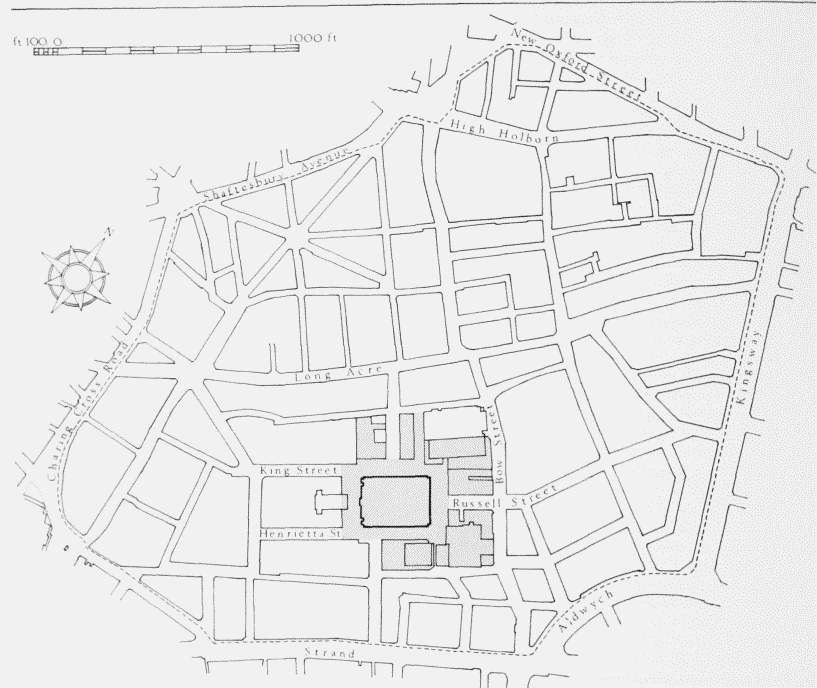
Covent Garden Market Act, 1961, areas. Redrawn by permission from a plan in Covent Garden Market Authority First Report 1961–1962. Stippled area denotes land vested in Covent Garden Market Authority. Broken line denotes the boundary of the Covent Garden area
In order to prevent any further unofficial outward extension of the market the Authority at once introduced a licensing system which applied to the land used for market purposes within the designated area but outside the area actually vested in the Authority. (fn. 153) The archaic system of tolls and rents (the former still wholly based on the Act of 1828, and the latter partly so) was revised, and an attempt was made to relieve congestion by the provision of a marshalling yard for lorries on the south side of the Thames. (fn. 154)
But these activities were overshadowed by the question of the future site of the market itself. The Act of 1961 imposed upon the Authority the duty either to improve the facilities on the existing market lands or to provide better ones elsewhere within the adjacent designated Covent Garden Area. But during the debates in Parliament on the Bill there had been strong opposition to the retention of the market anywhere within the designated area, and the Government had therefore undertaken that if the Authority were in due course to recommend that the market should be altogether removed from the area, the Minister would allow the Authority to promote a Bill to make this possible. The Authority was therefore able to examine possible sites anywhere in London, and in March 1962 it commissioned the Fantus Company International Division to undertake this examination. (fn. 155)
The Fantus Company investigated five sites— at Seven Dials (within the designated Covent Garden Area), Nine Elms, Wood Lane, Beckton and King's Cross, the last of which had been suggested as a possible site some years earlier. In its report, presented in the spring of 1963, the Fantus Company recommended removal to Beckton, where the capital and operating costs would be far lower than elsewhere. The Authority's Market Management and Market Workers' Committees did not view this proposal favourably, but before any decision was taken British Railways informed the Authority that another site at Nine Elms, much larger than that investigated by the Fantus Company, might become available. The Authority therefore decided to undertake an intensive feasibility study of this new site, (fn. 156) and in April 1964 it recommended to the Government that the market should be removed to Nine Elms. The Government accepted this view (fn. 157) and in November 1964 the necessary Bill was presented to the House of Commons. (fn. 158) It received the royal assent on 10 March 1966, and provided for the removal of the market to Nine Elms by the end of 1971. (fn. 159)
Architectural Description
Fowler's Market Buildings
Plates 36, 37, 38, 39, 40, 41, 42 figs. 15–16
Charles Fowler's connexion with the building of markets dated from 1824–5, when he was working on designs for the rebuilding of Hungerford Market, Charing Cross. Through this work he received the sixth Duke of Bedford's commission to design the new buildings at Covent Garden, and these were actually built in 1828–30, before those at Hungerford Market, which were not erected until 1831–3. Subsequently he designed the Lower Market at Exeter, and was executive architect for the Higher Market in the same city. (fn. 160)
His engraved plan for Covent Garden (Plate 40a), from which the executed design obviously developed, provided three parallel ranges of shop buildings extending east-west, having between them two open market places for stalls. Each of the long and narrow outer ranges ended with small square lodges, intended for offices or coffee houses, and in the centre was a large pavilion forming a vestibule to the open markets. These outer ranges were to be divided into small square shops arranged back to back, whereas the shorter but wider middle range was to contain two rows of deeper shops separated by a spinal passage. All the shops were to be fronted by colonnaded walks, and the three ranges linked across the east and west ends by quadruple colonnades or porticoes. In execution, however, the plan was varied by the provision of some two-bay shops and the substitution of a Middle Row, or arcade, 16 feet wide and lined with shops, instead of the spinal passage originally intended for the middle range. Furthermore, objection having been raised by the Duke's adviser, Mr. Charlwood, to 'the occupation of so much space by the colonnades', those facing the inner market places were omitted together with the quadruple colonnade at the west end. This last was criticized by The Gardener's Magazine, where it was said to be wanting 'to complete the symmetry of the building'. (fn. 161)
Like all Fowler's market buildings, Covent Garden was skilfully planned and architecturally distinguished. The buildings, designed in the Graeco-Roman style of the period, were executed in grey granite and yellow brick with dressings of Yorkshire freestone and some painted stucco. The north and south fronts, being similar, have each a prominent central feature consisting of a Serlian or Venetian archway flanked by wide piers supporting a triangular pediment, containing a cartouche carved with the Russell family arms. On either side of the central feature extends a range of shops, behind a Tuscan colonnade of twelve bays with a single-bay return against a lodge, or square pavilion of two storeys. The columns of the colonnades are monoliths of grey granite on unmoulded bases, and they support a simple entablature and balustrade of stone. Each lodge has a ground storey of grey granite built in chamfer-jointed courses, and an upper face of mock-jointed cement finished with an eavescornice. A leaded roof of low pyramidal form rises to a pedestal chimney-stack.

General view of Covent Garden Market area
While the central feature of the north range is east of the centre of James Street, the axis of the lofty middle range of buildings conforms with that of St. Paul's Church and Russell Street. The Middle Row, or Central Avenue, is entered from the east through the quadruple colonnade linking the three ranges. Before the addition of a second storey, the flat roof of this colonnade formed a terrace reached by staircases in the north-east and south-east lodges. The rear part of this terrace was taken up by twin conservatories of iron and glass flanking the upper part of the east front where, below a pediment decked with symbolic urns and a sculptured group by R. W. Sievier, an arched opening afforded a view into the Central Avenue. From there, in turn, could be seen the handsome fountain of Devonshire marble which formed a central feature on the terrace (Plate 41c).
The Central Avenue is a well-designed shopping arcade, with its walls finished in stucco jointed to resemble masonry. The three-bay shop fronts and mezzanine windows are framed in wide segmental-headed recesses, their unmoulded arches rising from bold imposts above plain piers. A moulded stringcourse underlines the attic stage, where windows are set in groups of five behind dwarf Doric columns. The partly glazed roof of low pitch rests on a series of wooden king-post trusses. An iron and glass shelter of utilitarian character, extending across the west end of the market, largely conceals the original west front of the middle range. This has a Tuscan colonnade of five bays projecting below an upper storey of seven bays, the middle one an open arch rising into a pediment-gable which extends above the first of the three bays (each containing a window) that flank the arch.
The market was provided with all desirable amenities, the shops having ample cellarage as well as upper rooms for offices or storage. The cellarage, which extended below the greater part of the site, included facilities for storing fruit and vegetables, and for washing potatoes. The entire market could be cleaned and flushed with water supplied by an artesian well, 280 feet deep, in the centre of the site.
The eastern half of the northern market space, where the fruit market was held, was originally covered in with a wooden 'roof in three parts, open at the sides for ventilation and light…, supported by cast-iron pillars, from which spring circular ribs, instead of horizontal tie-beams'. (fn. 162) The southern market space was roofed in 1874–5 and the northern in 1888–9, when the original wooden roof at the east end of this space was removed and re-erected at the north corner of Russell Street and the Piazza, where it still stands. All this work was executed by Cubitt's, whose elegant cast-iron and glass structures resemble the contemporaneous railway station sheds. Two rows of tall columns, placed against the brick walls to conform with Fowler's bay spacing, are linked laterally by skeleton arches below an unglazed clerestory having two small arches to each bay. These arcades support the semi-circular trusses on which the roof rests, its slopes, partly slated and partly glazed, being broken near the ridge by a raised skylight with open sides.
The Flower Market
Plate 43
In its existing form, the Flower Market is an extensive structure of cast-iron arcades with glazed clerestories, supporting slated roofs and skylights, planned in the form of two wide and lofty naves extending northwards between three aisles. The short east nave returns to form a transept which crosses the west nave. The Tavistock Street front is a bold and effective design, Victorian Renaissance with a Roman flavour, executed in red brick with stone dressings. The nave and aisle divisions are marked by pilasters, between which are spaced seven round-arched openings, a pair of windows to each nave, a window to the west aisle, and doors with fanlights to the middle and east aisles. Above each of the wide bays, containing the paired windows, rises a pedimented attic with a large lunette window. A similar feature, ending the west transept, is the dominant note in the long west elevation. The earlier east front to Wellington Street is most impressive, with three lofty round-arched recesses framing, respectively, two doors and a window below radial fanlights. This front, built of stone and white brick, is finished with a panelled and bracketed entablature and an open balustrade.
The 1904–5 extension to the Flower Market has a lofty ground storey given over to the market, and three floors of offices reached by a circular staircase and lift in the pavilion at the corner of Wellington and Russell Streets. The Edwardian Baroque exterior, in red brick and stone, has an arcaded ground storey, paired windows to the two upper storeys, and wide dormers in the steep roof. The faceted corner pavilion, where the windows rise to follow the spiral staircase, is finished with a concave-buttressed attic and a helmet-shaped dome.
The Foreign Flower Market
Plate 47c
The Foreign Flower Market, or Jubilee Market, of 1904, is a free-standing oblong building of two lofty storeys, both divided longitudinally by a row of widely spaced columns. The ground storey is largely open to the surrounding streets, the upper one lit by clerestory windows and two long roof-lights. The red brick and stonedressed exterior, Edwardian Baroque in style, has at each corner a pavilion feature of two pedimented stages surmounted by a small dome.