Survey of London: Volume 36, Covent Garden. Originally published by London County Council, London, 1970.
This free content was digitised by double rekeying. All rights reserved.
'Southampton Street and Tavistock Street Area: Tavistock Street', in Survey of London: Volume 36, Covent Garden, ed. F H W Sheppard (London, 1970), British History Online https://www.british-history.ac.uk/survey-london/vol36/pp218-222 [accessed 30 April 2025].
'Southampton Street and Tavistock Street Area: Tavistock Street', in Survey of London: Volume 36, Covent Garden. Edited by F H W Sheppard (London, 1970), British History Online, accessed April 30, 2025, https://www.british-history.ac.uk/survey-london/vol36/pp218-222.
"Southampton Street and Tavistock Street Area: Tavistock Street". Survey of London: Volume 36, Covent Garden. Ed. F H W Sheppard (London, 1970), British History Online. Web. 30 April 2025. https://www.british-history.ac.uk/survey-london/vol36/pp218-222.
In this section
Tavistock Street
Of the present Tavistock Street only the western half, from Wellington Street to Southampton Street, represents the street laid out under that name on the site of Bedford Ground in the early eighteenth century. The eastern half is the former York Street and its extension (see pages 48, 196). In 1937 both parts of York Street were renamed Tavistock Street and the entire street was renumbered.
The street was laid out for building between December 1706 and March 1713/14 under the Bedford leases tabulated on pages 316–21, except for No. 24, which was built and paid for by the second Duke. A few of the houses were in occupation by 1709 but the street was not filled up until 1715. (fn. 1) There is no contemporary picture of Tavistock Street and as none of the original houses have survived their appearance must be judged from what is known about the buildings elsewhere on Bedford Ground (see pages 38–9). They were all almost certainly four storeys high but varied in width from 17 to over 30 feet. One of the last to be demolished was a large house on the south side, which was occupied by Sir John Cotton in 1716 (fn. 1) (No. 5 on fig. 32). Although this house was not rebuilt before 1912 it had evidently been refaced and a handsome shop front of an early nineteenthcentury character inserted into the ground floor (Plate 59b).
As with the other streets on Bedford Ground the early inhabitants were mostly respectable tradesmen. Mortimer's Universal Director for 1763 listed seven inhabitants of whom six were mercers or milliners, including Bingley and Bragg, linen drapers to the King. Writing in 1835 Thomas Walker recalled that 'Tavistock Street, Covent Garden, was once the street of fashionable shops—what Bond Street was till lately, and what Bond Street and Regent Street together are now.' (fn. 2)
From c. 1709 there was a tavern called the Salutation on the west corner of Tavistock Court (No. 31 on fig. 32), which survived until 1881, (fn. 3) and on the opposite side of the street in a house called the Harlequin and Pierot (No. 2–3 on fig. 32) was the coffee house kept between 1714 and 1736 by Richard Leveridge, the singer and composer. (fn. 4)
An increasing number of complaints to the parish committee of management in the early nineteenth century points to a decline in the social character of the street and this impression is supported by a report from the sixth Duke's agent in 1829 that the inhabitants of the street were mostly very poor. (fn. 5) In 1837 the parish surveyor of pavements reported to the committee that on market mornings the streets surrounding the market were blocked up and that the inhabitants of Tavistock Street had complained 'that there was so much noise from the heavy carts, and their drivers, from one a. m. that sleep was impossible in the front rooms'. (fn. 6)
By 1885 all the houses on the north side of the street had been demolished to make room for the continually expanding market. (fn. 7) The south side of the street was largely rebuilt during the late nineteenth and early twentieth centuries.
Tavistock Court
This was the name given to a footway from Tavistock Street into the Piazza which was laid out in 1706–7 immediately to the west of the old east wall of Bedford House garden (see fig. 32). Originally there were seven houses in the court, including the four corner houses—three on the east side, which were demolished in 1859–60, and four on the west side, which were demolished in 1884–5. (fn. 8)
Inhabitants of Tavistock Street and Court include: Dr. John Hays, 1709–13; Captain William Hewet, 1709–10; Richard Leveridge, 1714– 1736, singer and composer; Dr. Robert Welsted, 1714–35, physician; Sir John Cotton, 1716; Sir Thomas Wheatt, 1717; Lady Ross, 1718; Colonel Henry Skelton, 1718–23; Barton Booth, 1720, actor; Lady Fermanagh, 1720; Colonel George Treby, 1721–8; Boyle Godfrey, 1731– 1753, alchemist; Dr. Philipson, 1732–3; Hannah Glasse, c. 1748–55, writer on cookery; George Carter, 1779–85, painter; Thomas Hardy, 1795–7, radical politician; Thomas Dodd, 1800– 1806, auctioneer and printseller; Antoine Claudet, 1828, photographer; Thomas Gaspey, 1831–3, novelist and journalist.
Nos. 2–10 (even) Tavistock Street: Country Life
On 8 January 1897 appeared the first number of a weekly magazine called Country Life Illustrated, in succession to Racing Illustrated. Its creator was Edward Hudson, a director of the printing firm of Hudson and Kearns of Southwark, in collaboration with Sir George Newnes, whose publishing offices were in Southampton Street. The new magazine was printed in Southwark and published from Southampton Street, but the editorial offices were on part of the present site, then Nos. 20–21 Tavistock Street. (fn. 9) The new weekly (its name shortened to Country Life from 1901) was well received, and in 1903 Sir George Newnes arranged to take a building lease of the site of Nos. 17–21 (consec.) Tavistock Street from the eleventh Duke of Bedford. (fn. 10) Here new offices were erected for the editing, printing and publishing of the magazine by Country Life Limited, a company (formed in 1905) with Hudson as chairman and William Hudson and Sir George and Frank Newnes as co-directors. (fn. 9)
Edward Hudson, as well as being founder and part-owner of Country Life, was deeply interested and involved in all aspects of its development, and it was the architect whose career Hudson delighted to further who was commissioned to design the new offices. A recent article in Country Life has observed that the sympathetic 'presentation' in its pages of each new major work by Sir Edwin Lutyens was founded in Hudson's admiring wish to foster his friend's fame: but 'while Hudson loved to do so, it also seems to have been understood that Lutyens should design Hudson's own commissions for love too'. (fn. 11)
At Deanery Garden, Sonning, Lutyens had just created for Hudson an attractive example of his freely composed eclecticism, but in Tavistock Street Lutyens had his first commission for a monumental design in London; and working in a more classical vein he produced here one of the earliest examples of his 'Wrenaissance' manner.
In April 1904 Lutyens submitted his design, on behalf of Sir George Newnes, to the London County Council for its consent to a small encroachment on the footway. Lutyens wished the building line to be thus set forward to permit his main cornice to be returned against the adjacent building eastward without 'mutilation', but consent was refused. An amended application was submitted in May, and in June the Westminster City Council recommended the London County Council again to refuse consent. In July Lutyens appealed to W. E. Riley, the London County Council's Superintending Architect. He claimed to have been obliged 'practically to redesign' the entrance—'I fear to its detriment'. Now he had learnt that a committee of the Westminster City Council had ruled that the application must go before yet another committee, and wrote to Riley: 'It is rather cruel this careless indifference on the part of the City of Westminster and a very serious matter for my client. Could you advise me what to do. I could easily get questions asked in the House of Commons or Lords—and make the "devils own" fuss. Should I write a strong protest to the Council of the C. of W. Your advice would be invaluable. . . .' A few days later the London County Council, having been informed that the Westminster City Council had changed its mind, gave conditional approval to Lutyens's amended application, and formal consent followed in September. (fn. 12)
It would seem, on the evidence of a letter and sketch printed by Mr. Hussey in his Life of Lutyens, that the architect was still working on his design early in 1905. Lutyens describes his difficulties in getting the height of the chimney stacks right: "I funk the chimneys", he said (February 4, 1905) "and they are going up up up and they look enormous, like two campaniles perched on my big roof and if I reduce the height a—b it throws the proportion c-d all out and wrong-looking. I am nerving myself to some decision on Monday"'. (fn. 13)
The building was completed in that year and an eighty-year lease (from Christmas 1903) was granted by the Duke of Bedford to Country Life Limited in 1906. (fn. 14)
The Tavistock Street front, four storeys high and seven windows wide, is built of fine narrowcoursed red brick above a ground-storey face of Portland stone, this material also being used for the window dressings and crowning cornice (Plate 72a). The windows are grouped in threes to flank the imposing 'frontispiece' of the entrance and the emphasized windows above. Channel joints course the ground-storey face, returning into the reveals and dividing the voussoirs of the straight heads to the windows. These have tall keystones, each differently carved with a pendant of flowers, birds and fishes, below a scrolled cartouche bearing the cypher C L. The 'frontispiece', a large-scaled variant of the conventional early-Georgian pedimented doorcase, frames the round-arched doorway, its moulded archivolt rising from cornice-imposts above panelled jambs. The doorway is recessed between tall plainshafted Composite pilasters, projecting from flanking half-pilasters. These support entablature-blocks which are united by the cornice of an almost semi-circular pediment, its open tympanum containing the middle window of the second (mezzanine) storey. The pilaster capitals are linked by a frieze carved with wreaths and festoons of flowers, palms and husks; the archivolt keystone is carved with a small scrolled cartouche; and the pediment cornice is conventionally enriched with carved mouldings. The two-leaved door and radial fanlight demonstrate Lutyens's love of geometrical patterns.
The three second-storey windows on either side of the 'frontispiece' pediment are set in small openings of straight-sided oval form, each being framed by a moulded architrave lugged top and bottom at the sides and broken by a small keystone carved with a human head. These windows are linked below to the plain bandcourse and blocking of stone, finishing the ground storey, and above to the pedestal-aprons of the thirdstorey windows, the plain bases and moulded sills of which are linked across the brick face by plain stone bands. The tall window-openings are dressed alike with a boldly moulded architrave, plain frieze and cornice, the middle window alone being enriched with foliated scrolls flanking the architrave, and a triangular pediment resting on richly carved scroll-trusses. The square windows of the fourth storey are completely framed with moulded architraves, that of the middle window being lugged at each angle. The brick face is handsomely finished with a bold cornice of stone, richly moulded but uncarved. This was originally surmounted by a high parapet of brick, its plain surface broken only by two narrow openings centred above the third window from either end. The pantiled roof, its swept eaves slightly oversailing the parapet, was originally hipped at both ends and broken only by the two monumental chimney-stacks, their brick shafts resembling grouped pilasters, rising from stone-dressed pedestals and finishing with stone cornices.
The building in 1935 of Tower House next door resulted in the loss of the hitherto exposed west wall, with its cornice and parapet, and the hipped return of the roof, thereby depriving the building of its original effect of design in depth so carefully contrived by Lutyens. In 1956–7 his original conception was further impaired by the insertion of windows in the attic parapet, by Robert Lutyens and Greenwood, who reconstructed the roof and inserted an extra floor. It remains to add that, except for the ground storey, most of the windows retain their original smallpaned sashes. (fn. c1)
The entrance hall, although small in scale, is monumental in its design, with a cross-vaulted ceiling, and pedimented doorcases in the side walls (Plate 72b). A Doric screen opens to the staircase, which rises round a lift-shaft and has a double tier of turned and twisted balusters, moulded handrail and brass ball-finials to the newels. The first half-landing forms a small balustraded gallery overlooking the entrance hall. The plan is limited by the unusual shallowness of the site and the rooms are arranged on each side of a central corridor. The suite of five interconnecting editorial rooms on the second floor is of double-storey height, lit by the tall piano nobile windows (which, like all the windows, have thick glazing-bars of late seventeenth-century pattern). These rooms (Plate 73) have coved ceilings, doorways with full entablatures and tall overmantels with moulded panels. Several of the chimneypieces have simple bolection-moulded surrounds of the Wren period and others are based on later eighteenth-century models with mantel shelves and plain tablets. Some of the furniture designed by Lutyens for the building is still in use, notably two glass-fronted bookcases and a set of wheel-backed chairs.
At the same time as the Country Life building (in 1904) Lutyens also designed for George Newnes Limited the large double-fronted bracket clock projecting from No.3 Southampton Street, which forms an agreeably conspicuous feature of the view from the Strand (fig. 39). Its faces originally bore the twelve letters of GEORGE NEWNES in place of hour-numerals. (fn. 15) The pedimented clock-case of Baroque design is carved in dark wood. It is supported on a timber beam, treated as an entablature with a pulvinated frieze, breaking into a segmental curve below the clock, with a fretted pendant below containing cherubs' heads facing each way. The border of the clock-case on each face is carved with garlands and flowers, with shells in the corners. The moulded surround rises from scrolls, which are supported on the backs of tortoises standing on the beam. The upper corners are eared and shouldered while between them the frame is swept up into the tympanum with concave sides and flat top. Above the ears small triglyph-like corbels support the base mouldings of the pediment, the upper mouldings of which are formed by two curved members finishing in scrolls linked by garlands to an urn in the centre. The pierced tympanum has fretted carving in the lower part and contains a double-faced scrolled cartouche, supporting the urn and standing on the upswept clock-case frame.
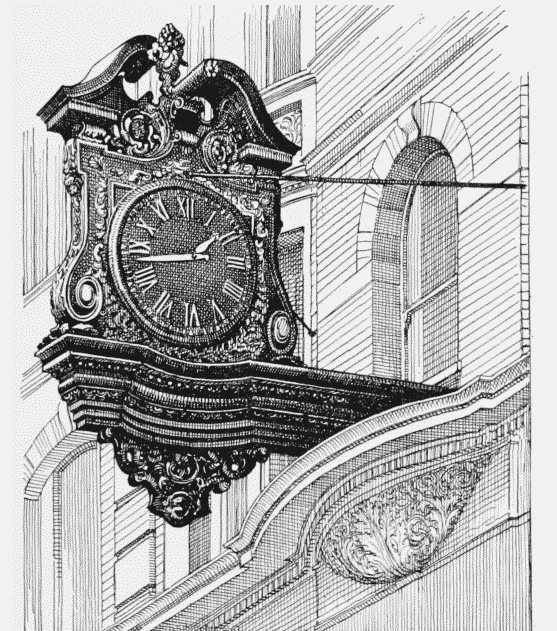
Clock designed by Sir Edwin Lutyens at No. 3 Southampton Street
No. 22 Tavistock Street
Formerly the offices of Strand District Board of Works
This building on the east corner with Burleigh Street is dated 1857 and was erected to the designs of the surveyor to the Board, G. F. Fry, after a building committee had decided not to employ an outside architect. The contractor was W. T. Purkiss, whose tender was accepted at £3,472. The Board took an eighty-year building lease from the seventh Duke of Bedford in January 1858. (fn. 16)