
Survey of London: Volume 36, Covent Garden. Originally published by London County Council, London, 1970.
This free content was digitised by double rekeying. All rights reserved.
'Southampton Street and Tavistock Street Area: Burleigh Street', in Survey of London: Volume 36, Covent Garden, (London, 1970) pp. 223-225. British History Online https://www.british-history.ac.uk/survey-london/vol36/pp223-225 [accessed 26 April 2024]
In this section
Burleigh Street
The street laid out by Lord Burghley in 1673 extends northwards from the Strand only as far as Exeter Street and no part of it lies within the former parish of St. Paul. The short northern arm of the present street, which does lie within the parish, is a mid nineteenth-century extension. It was laid out by the seventh Duke of Bedford in 1856–9, at a cost of over £6,000, to improve the access to Covent Garden Market, (fn. 3) and was opened on 16 August 1859. (fn. 4) Until 1872 there was a bar across the street at the entrance to the new extension, where market tolls could be collected. (fn. 5)
The buildings on the west side of the street were designed and built by Charles Gray in 1859–60: (fn. 6) of these Nos. 11 and 13 still survive.
St. Michael's Church, Burleigh Street
Demolished
St. Michael's was erected by the Church Building Commissioners in 1831–3 on a site at the south-west corner of Burleigh Street and Exeter Street, (fn. 7) and was initially a chapel within the parish of St. Martin in the Fields. The site was conveyed by the Commissioners of Woods and Forests to the Church Building Commissioners on 26 April 1831. (fn. 8) (fn. 1)
St. Michael's was designed by James Savage in a style he described as fourteenth-century Gothic (fig. 40). The body of the church was faced with white brick, with a corner spirelet and dressings of Bath stone. A brick tower at the south-east corner was surmounted by a Bath stone spire. Inside, the north, south and west galleries were supported by cast-iron girders, the aisle floors were paved with Yorkshire stone, and the pews, pulpit and desk were of painted deal. An organgallery and children's gallery were also built at the west end.
The church was initially intended to accommodate 934 adults and children, and the cost was estimated at some £5,534. In building, the length was slightly reduced and accommodation was provided for 877 persons. The bill of the contractor, George Ward, amounted to only some £4,760. (fn. 7) (fn. 2)
The church was consecrated as St. Michael's chapel, on 26 September 1833. (fn. 9) A district chapelry was assigned to it in 1848 (fn. 10) and the living became a vicarage in 1868.
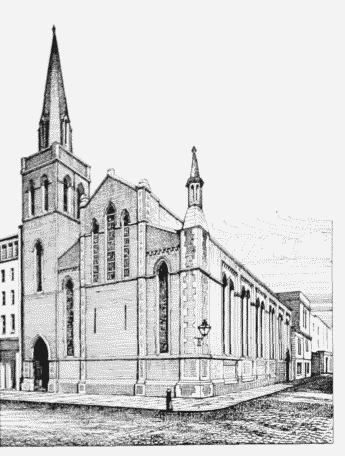
St. Michael's Church, Burleigh Street. Redrawn from a photograph in the possession of the Trustees of the Bedford Settled Estates
In 1903 a commission appointed by the Bishop of London to enquire into the union of the parish with that of St. Paul, Covent Garden, reported that, the population of the two parishes having declined from 5,947 to 3,085 in the period 1881– 1901, the union should be effected. This was done by an Order in Council of 7 August 1905 (fn. 11) and the closing service was held on 10 September 1905 (fn. 12) The site and fabric of the church were sold by the Ecclesiastical Commissioners on 27 March 1906 for £20,500, which was more than they had expected to obtain. (fn. 13) The church was demolished and its site now forms part of the Strand Palace Hotel.
At the time of demolition a photograph was taken and survey-drawings made of the church for the Bedford estate by P. E. Pilditch. An article in Notes and Queries records that the east window had been given by Baroness Burdett-Coutts and some parishioners in memory of the Duke of Wellington. The organ had been moved from the west gallery to the north side of the sanctuary. About £300 had been spent very recently in restoring and beautifying the church. (fn. 14) Some fittings were installed in the church of St. Michael's, Sutton Court, Chiswick, which was built with the aid of funds realized by the sale of the old church. (fn. 15)
No. 14 Burleigh Street: Rectory of St. Paul's, Covent Garden
The present rectory of St. Paul's, Covent Garden, was built by private subscription in 1859–60 as the clergy-house of St. Michael's, Burleigh Street, at that time a district chapelry in the parish of St. Martin in the Fields. (fn. 16) The architect was William Butterfield. (fn. 17) In 1887 the vicar of St. Michael's said that the house had been built in 1856. (fn. 18) This is too early for the date of construction but possibly indicates when the design was prepared, as it was in 1855 that the seventh Duke of Bedford had agreed to donate the site. (fn. 19) This he did by conveying it to the Ecclesiastical Commissioners in March 1859. (fn. 20) The Duke also gave £250 towards the cost of the building. (fn. 21)
In 1905 the house became the clergy-house of St. Paul's, Covent Garden, and in about 1934 the rectory of that parish. (fn. 22)
This small but conspicuous building, containing a semi-basement and four storeys, has an L-shaped plan that ignores the curving frontage line of Burleigh Street to produce a bold threedimensional effect, in striking contrast to its orthodox neighbours (Plate 62b). The Victorian Gothic exterior, so typical of its architect, is built of red bricks partly diapered with white bricks, stone being used for the weathered sillbands at each storey, for the plate tracery and hood-mouldings of the ground-storey openings, for the flush impost-bands and voussoirs of the windows in the upper storeys, and for the copings of the west and south gables. The ground storey is the most richly treated, the doorway in the south face of the north-west wing having a segmental-headed opening recessed below a tympanum of gauged brickwork in a wide twocentred arch. The west window of the wing is framed by a similar arch, here enclosing two cuspheaded lancets and a foliated circle carved with a bas-relief of St. Michael. In the main face, south of the wing, are two windows with sashes recessed in moulded and cusp-headed arches. All the openings in this storey are dressed with simple hood-mouldings. The second-storey windows, one in the south face of the wing, and a group of three in the main face, have straight-headed sashes in openings with chamfered reveals and straight-sided two-centred arches, their brick and stone voussoirs being flush with the wall faces. In the third storey the fenestral pattern is again varied, with a window of two sashed lights in the south face of the wing, and a pair of sashed windows in the main face, their openings being treated in a similar manner to those of the second storey. In the low fourth storey interest is concentrated on the west gable of the wing, where the window of two sashed lights is set in an opening having a stone lintel-band and a flush tympanum of brick below a relieving arch of brick and stone voussoirs. The gable coping is moulded at the apex to form a base for the iron cross. The south gable of the main block is also finished with a stone coping, but the slate roofs are finished with an eaves gutter.
The restricted and irregular site has affected the plan and the form of the southern rooms. The staircase is in the north-east angle, with one room at the back on each storey. The number of rooms in front varies from storey to storey, the ground and second each having one, and the third and fourth having two. The simple finish of the interior is evidence of a strict economy in the building costs. The entrance-hall has two chamfered two-centred arches over the passage to the staircase. This last has a railing of turned balusters and a moulded handrail, with newels and pendants. The principal room is the L-shaped apartment in the front of the second storey. There are no cornices or decorative chimneypieces in the building.