Survey of London: Volume 36, Covent Garden. Originally published by London County Council, London, 1970.
This free content was digitised by double rekeying. All rights reserved.
'Henrietta Street and Maiden Lane Area: Maiden Lane', in Survey of London: Volume 36, Covent Garden, ed. F H W Sheppard (London, 1970), British History Online https://www.british-history.ac.uk/survey-london/vol36/pp239-252 [accessed 9 May 2025].
'Henrietta Street and Maiden Lane Area: Maiden Lane', in Survey of London: Volume 36, Covent Garden. Edited by F H W Sheppard (London, 1970), British History Online, accessed May 9, 2025, https://www.british-history.ac.uk/survey-london/vol36/pp239-252.
"Henrietta Street and Maiden Lane Area: Maiden Lane". Survey of London: Volume 36, Covent Garden. Ed. F H W Sheppard (London, 1970), British History Online. Web. 9 May 2025. https://www.british-history.ac.uk/survey-london/vol36/pp239-252.
In this section
Maiden Lane
Maiden Lane almost certainly occupies the site of an ancient track from Drury Lane through the convent garden to St. Martin's Lane. The south side of the street probably marks the line of the old mud wall of the garden and, after c. 1610, the line of the brick boundary wall built by the third Earl of Bedford. The street was laid out in 1631 between this brick wall on the south and the rear premises of leasehold sites in Henrietta Street on the north; (fn. 3) the eastern end (beyond the modern Nos. 4 and 41) was blocked by Bedford House. Apart from a short section on the north side near the corner of Bedford Street no building leases were granted (see tables on pages 294–5 under Nos. 37–40 Bedford Street and fig. 45). The street was first called Maiden Lane in 1636: (fn. 4) the origin of this name is unknown.
The ground on the south side of the street, exposed when the brick wall was pulled down in c. 1634–5, had been let as gardens by the third Earl. (fn. 5) But by 1635 many of these gardens had buildings on them, chiefly stables, coach-houses and haylofts (especially behind the Black Bull Inn in the Strand). In 1635–6 most of the land on the south side was granted away in fee farm by the fourth Earl and its subsequent development was thus removed from the control of the Bedford estate. (fn. 6) Some of this land was immediately sublet for building. In March 1635, for example, Sir David Cunningham leased the whole of his fee-farm grant (now occupied by Nos. 18–19 Maiden Lane and part of the Adelphi Theatre) to Henry Bailey (Bayley), a speculative builder, who in 1635 erected several new brick houses there. (fn. 7)
At the same time a number of alleys were built between the Strand and Maiden Lane. Two of these original alleys still survive as Exchange Court and Bull Inn Court: a third, Bailey's Alley (built by Henry Bailey in 1635) (fn. 7) has been obliterated by the Adelphi Theatre. Lumley Court was not opened into Maiden Lane until c. 1870.
By 1666 all of the south side of Maiden Lane between the modern Nos. 6 and 25 (inclusive) except for one site (No. 20) had been granted away in fee farm. (fn. 7) The effect of these alienations upon the later appearance of the street was described by John Bourne, steward of the Duke of Bedford's London estate, in his evidence to the Select Committee on Town Holdings in 1887. Comparing the buildings in Maiden Lane which still belonged to the estate with those on fee-farm sites, Bourne said a blind man 'could almost put his hand upon the houses that were let out on fee farm and those let out on lease, the difference is so great between them'. (fn. 8)
Hollar's mid seventeenth-century bird's-eye view (Plate 1) shows Maiden Lane as almost completely built up with houses, but this is misleading, for it is clear from other evidence that before 1670 many of the buildings on the north side of the street were only the stables and rear premises of houses on the south side of Henrietta Street. (fn. 9) After 1670 houses fronting onto Maiden Lane were built over these back premises, (fn. 10) a process which was completed in 1728 when No. 37 was built on the site of stables and a kitchen previously leased with No. 7 Henrietta Street. (fn. 11) By this time the number of 'back houses' assessed for rates suggests that one or two little courts were already in existence behind the houses on the north side. (fn. 12) Rocque does not show any, but two appear on a Bedford estate plan of 1795 and on the first edition of Horwood (1799):- Hand Court, with an entrance under No. 27 and Frances Court (sometimes called Cock Court) with an entrance under No. 32. Both were swept away in the improvements of the late nineteenth century.
After the demolition of Bedford House in 1705–6 Maiden Lane ceased to be a cul-de-sac. In 1706–7 a narrow foot-passage flanked with houses and called Southampton Court was laid out between the east end of Maiden Lane and Southampton Street (fig. 32 and lease table on pages 320–1). This passage was made into a roadway in 1857, apparently in order that the Queen's carriage would not have to turn round in Maiden Lane after having set down its occupants at the royal entrance of the Adelphi Theatre. (fn. 13) But the Dukes of Bedford refused to allow the new exit to be used as a general thoroughfare and until 1872 the east end remained closed to vehicles with a bar across the street. (fn. 14)
A considerable amount of rebuilding took place in the street during the eighteenth century but nothing earlier than 1806 survives today. The majority of the present rather dreary buildings date from the latter part of the nineteenth century. Most of those on the north side were built after 1872, when the Bedford estate initiated the widening of Maiden Lane by setting back the frontages of all new buildings erected on sites belonging to the estate. (fn. 15) By 1893 most of the north side had been rebuilt and the street widened by about 8 feet, except at the west end between No. 27 and the corner of Bedford Street, where it retains its original width.
Although Maiden Lane was never a fashionable address, a number of distinguished people have lived there. In c. 1647 Sir Cornelius Vermuyden, the Dutch engineer employed by the fourth Earl of Bedford on the drainage of the Bedford Level, occupied a house on the site of the present No. 28. (fn. 12) William Sancroft, later Archbishop of Canterbury, lodged in 1663 at Mr. Clarke's house on the site of the present No. 25 Maiden Lane. (fn. 16) Poverty was evidently the reason for the residence of several other writers or artists in this street—Andrew Marvell, the poet and satirist, in 1677, at Mr. James Shaw's house on the site of the present No. 9; (fn. 17) Voltaire in 1727–8 at the White Wig on an unidentified site on the south side; (fn. 18) and perhaps Thomas Proctor, the painter and sculptor, who is said to have died here in privation in 1794. (fn. 19) In 1775 J. M. W. Turner was born in a house on the site now numbered 21, on the south side, where his father, William Turner, a barber, was living from 1773 to 1776. (fn. 20) After some years' residence elsewhere William Turner had by 1790 returned to another house in Maiden Lane, No. 26, evidently on the left side of Hand Court (fn. 21) (Plate 57b). When in London J. M. W. Turner lived here, in apartments described by Joseph Farington as 'small and ill calculated for a painter', from at least 1790 until 1799, when he removed to lodgings of his own in Harley Street. (fn. 22)
The premises which William Turner occupied from 1773 to 1776 formed the smaller part of a building which had recently been divided, probably when his period of residence began in 1773. The larger part contained an auction room which had been let by a previous occupant to the Free Society of Artists for their annual exhibitions in 1765 and 1766. From 1769 to 1773 the Incorporated Society of Artists of Great Britain hired 'Moreing's late Auction Room' for their academy of painting, drawing and modelling, (fn. 23) and subsequently, from 1844 to 1909, this site was occupied by the Maiden Lane Synagogue. (fn. 24) In the basement of the building was a tavern known as the Cider Cellar, much frequented by theatregoers and a favourite resort of Richard Porson, the Greek scholar, which survived until 1863. (fn. 25) Today there are still two public houses elsewhere in Maiden Lane—the Peacock at Nos. 13 and 14, a site which has been occupied as licensed premises since at least 1690 and which was known as the Three Compasses in the eighteenth century; and the Bedford Head (now Henri's Bedford Head) which was established in Maiden Lane as a tavern and coffee house under this name in about 1740, and which removed to its present site at No. 41 in 1747. (fn. 26)
The parish charity school for girls occupied a hired house in Hand Court from 1836 to 1868. (fn. 12)
Ratepaying occupants of Maiden Lane have included: Captain Penrudick, 1636—c. 1641; Sir Cornelius Vermuyden, c. 1647, Dutch engineer employed on the drainage of the Bedford Level; Lady Pickering,c. 1650—1; Sir Theodore Devaux, 1666—c. 1673; Captain George Goldsbury, 1670—c. 1674; Dr. William Stockham, c. 1675— c. 1696; 'Lady Devoe', c. 1698–1722; John James, 1718–c. 1735, bricklayer; Charles Mosley, 1749–56,? engraver employed by Hogarth; John Ireland, 1769–80, watchmaker and biographer of Hogarth.
Corpus Christi Roman Catholic Church, Maiden Lane
In 1872, when the widening and improvement of Maiden Lane was being undertaken by the Duke of Bedford, an application was made to the Bedford estate on behalf of Archbishop Manning for a site on the south side of the street, on which to erect a church and school. (fn. 27) By February 1873 the ninth Duke had agreed to grant a building lease for a church and presbytery but not for a school. The lease (which was finally signed in May 1875 after the church had been built (fn. 28) ) was made to Archbishop Manning, his Vicar General, the Very Rev. Daniel Gilbert, the Rev. James Bamber, and the priest-in-charge of the new church, the Rev. C. J. Keenes. The term was eighty years from Lady Day 1873 at a peppercorn rent for the first twenty-one months, and then £ 220 per annum. The building was to cost not less than £6,000. (fn. 29) In fact, the cost was £8,000. (fn. 30)
The foundation stone was laid in the autumn of 1873 by Bishop Weathers, the Bishop Auxiliary of Westminster, and the church was completed a year later, when the bishop celebrated Pontifical High Mass at the opening ceremony on 20 October 1874 and Archbishop Manning preached the sermon. The report of the event in The Tablet records that the dedication of the church was intended 'as an act of reparation for the indignities offered to the Blessed Sacrament in this country in the sixteenth century and since'.
The Rev. C. J. Keenes had hitherto officiated at the mission schools in Charles Street (now Macklin Street), St. Giles in the Fields, and it was intended that at the new church he should continue his work in 'one of the very poorest and most neglected parts of London'. (fn. 31)
The architect (whose health was drunk at the opening luncheon) was Frederick Hyde Pownall, and the builders Sharpington and Cole. The High Altar of Caen stone was carved by Earp. (fn. 32) The report of the opening in The Tablet dwells on the difficulties presented to the architect by the badness of the foundations, and the lack of adequate lighting occasioned by the confinement of the site.
In the latter part of the century the congregation of market employees was augmented by foreign visitors staying in the hotels in the neighbourhood but by 1916 the Duke's agent-in-chief noted that this source of support was much diminished. (fn. 33)
The freehold was acquired in 1922.
The church, of tawny brick with stone dressings, is in an individual thirteenth-century style (Plate 62a). It is rectangular in plan with a nave flanked by aisles, a chancel flanked by two chapels, and a (liturgically) western narthex crowned with a tower. The nave is of four bays, with alternately round and octagonal piers with crocket capitals and moulded abaci, supporting double-chamfered arches. Above each nave arcade is a clerestory of four pairs of lancet windows, each pair divided by a detached colonnette. The open timber roof has arched collarbraced trusses with king posts and struts. The aisles have unpierced walls and lean-to roofs. The double-chamfered arch to the narthex, rising the height of the nave, is supported on responds in the form of twin colonnettes. Similar arches lead from the central compartment, beneath the tower, to the northern and southern compartments of the narthex. Due to the line of the road in Maiden Lane, the western wall of the narthex is set askew, restricting the interior of the narthex at its northern end. In order to accommodate this architecturally, the capitals and responds on the western ends of the northern nave arcade and the northern narthex arch are omitted, and the arches die into the tower piers.
The windows are severely simple in form and spare in detail. The (liturgically) west window has four lancets below a tympanum containing a large, traceried, cinquefoil light with a small trefoil light on each side. Each side compartment of the narthex is lit by a two-light window surmounted by a quatrefoil light.
The double-chamfered arch to the chancel is supported on responds of twin colonnettes, resting on plain corbels. The north wall of the chancel has a two-bay arcade, with responds of clustered columns, each arch divided by a trumeau, with a blind quatrefoil in the spandrel. In the clerestory are two lancets, flanked by colonnettes. The south wall contains, to the east, a blind arch, retaining the capital and arches of the trumeau, and the blind quatrefoil, with, beneath, a door to the sacristy and a space for the sedilia. To the west is an arch occupying the full height of the chancel, and containing a small gallery. Beneath the gallery the arch opens across a passageway to a small chapel. The north chapel has blind arcading in its north wall, reflecting the articulation of the facing wall, and a cinquefoil rose window in its east wall. In the chancel itself, the upper half of the east wall is occupied by a rose window with four large quatrefoil openings, and seven small circular ones, in plate tracery. Below this is a reredos which comprises a gable, supported by two marble columns with elaborate stiff-leaf capitals, flanked by crocketed pinnacles, and surmounted by a floriated cross. Recessed beneath the gable is a cusped arch, supported on similar marble columns; both gable and arch are enriched with ball-flower moulding. The moulded abaci of the two pairs of columns are joined by a continuous moulding. The tympanum of the arch has a carving of three angels, censing the tabernacle beneath. The space between the inner pair of marble columns, which support the cusped arch, and either side of the tabernacle, is enriched with stone panels carved in a diaper pattern, surmounted by a frieze of leaf decoration. On either side of the reredos are carved figures of Saints Peter and Paul.
The interior of the church is of red brick with stone dressings. The stone has been painted white, and the brickwork has been rendered pale pink. The reredos has been painted white, with gilt enrichments. At present used as a stoup is an old stone font, Early English in style with octagonal column-base and bowl, which is said to have been found on the site. (fn. 34) Each side of the bowl is carved with a religious motif in a quatrefoil surround in low relief. The motifs, now somewhat mutilated, include a lamb, an eagle, a dove, a lion, and the Annunciation.
Externally, the only part of the church which is easily visible is the front to Maiden Lane, expressing the internal articulation of the west wall to the narthex, and surmounted by a massive square tower. The upper stage is dressed with clasping buttresses, linked at the top by a machicolated corbel table. The recessed side faces are plain, but the front and back faces are each pierced with a group of three tall openings, stone-dressed, their moulded and gabled arches resting on colonnettes. Brick corbelling finishes the shaft and carries the short four-sided spire of slate, which has a small lucarne projecting from each face.
The entrance to the church, a moulded and chamfered arch opening to a vaulted passage, is in the adjoining presbytery. This has a front of four storeys above a semi-basement. Built to match with the church, it is severely simple in design, the windows generally having flat stone heads below gauged-brick relieving arches. The top-storey windows rise into stone-coped gables.
The Vaudeville Theatre
This theatre abuts on to both the Strand and Maiden Lane, but only the northern part of its site is within the former parish of St. Paul, Covent Garden.
It was built in 1869–70 by William Wybrow Robertson on the site of a short-lived billiards club, of which he was the proprietor, behind Nos. 403 and 404 Strand. (fn. 35) The architect was C. J. Phipps, the builder Hyde and the principal decorator George Gordon. (fn. 36)
The main entrance to the theatre was constructed through the ground floor of one of the houses fronting the Strand (No. 404); the gallery entrance and stage door were in Lumley Court. (fn. 37)
The auditorium (Plate 66c) was said to have seated a total of 1,046 in the stalls, pit, ten boxes, and two circles. The lower circle, which had a serpentine-curving parapet, was divided into two tiers by a raised barrier, and the gallery had a semi-circular parapet that formed a continuation of the entablature above the side boxes and proscenium. There were five boxes on either side, two at pit level and three flanking the dress circle, the straight-headed openings of the latter being surmounted by painted lunettes. A quadrant cove, painted with coffer-like panels, formed a sounding-board above the stage apron and orchestra pit, and the main ceiling was fan-shaped, with wedge-shaped panels radiating from the sun-burner. The decorative work by Gordon, said to be 'Romanesque' in style, showed the influence of Crace's later manner. A notable innovation was the concealed footlights which would shut off if the glass in front of them was broken. (fn. 38)
Robertson leased the theatre to three actors, H. J. Montague, David James and Thomas Thorne, and it opened under their joint management on 16 April 1870 with a production of Andrew Halliday's comedy For Love or Money and a burlesque, Don Carlos or the Infante in Arms. (fn. 39) In the following year Montague resigned from the management but James and Thorne continued in partnership until James's retirement in 1882, when Thorne became sole lessee. Reviewing the first nineteen years Barton Baker concluded that of all the new theatres the Vaudeville 'has probably been the best conducted; it has scored the greatest number of legitimate successes and kept together the best stock company'. (fn. 40)
Thorne's lease of the theatre included the two old houses fronting the Strand (Nos. 403 and 404), but because of an already existing sub-lease he did not obtain possession of No. 403 until 1889. (fn. 41) In the following year he demolished both houses and built a new front to the theatre on the site. (fn. 42) The architect was again C. J. Phipps, (fn. 37) who designed the four-storey façade of Portland stone which is derived from his front for the Shaftesbury Theatre of 1887. (fn. 43) Behind the façade Phipps constructed a more spacious entrance vestibule, a first-floor loggia, offices and a suite of rooms for the lessee. (fn. 44). The auditorium was redecorated and some of the private boxes removed. Other changes included the removal of the small rooms on either side of the amphitheatre and the coved sounding-board over the proscenium; they were said by The Era to have 'entirely changed the character of the theatre'. (fn. 45) It re-opened on 13 January 1891 with a performance of Jerome K. Jerome's comedy Woodbarrow Farm preceded by Herbert Keith's one-act play The Note of Hand. (fn. 39)
In April 1891 Thorne renewed his lease of the theatre for a further term expiring in December 1914, (fn. 46) but in September 1892 he sold both the lease of the theatre and of Nos. 9–10 Maiden Lane at the rear to Agostino and Stefano Gatti, the restaurateurs and lessees of the Adelphi Theatre. (fn. 47) In addition to their other interests the Gatti brothers were also proprietors of an electricity supply corporation which had built a generating station adjoining the theatre in Bull Inn Court, and the noise of their generator was causing trouble with Thorne. Litigation was only avoided because the Gattis purchased the lease. (fn. 48) The first production under their management was a successful revival of H. J. Byron's comedy Our Boys, which opened on 14 September 1892. (fn. 39)
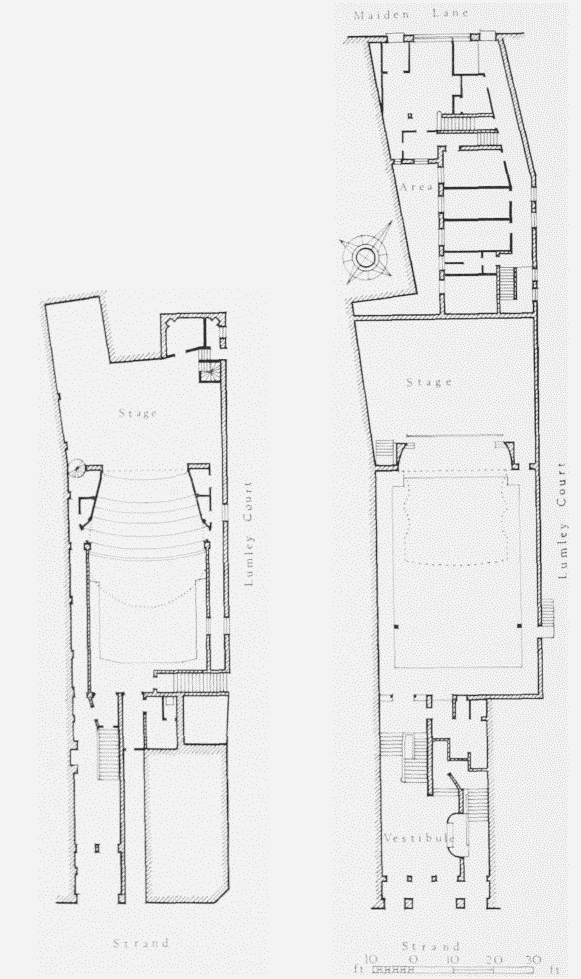
Vaudeville Theatre, Strand, plans in 1870 (left) and in 1926 (right). Redrawn from plans in the possession of the G.L.C. and from a plan in The Architect and Building News, 19 March 1926, pages 228–9
In 1916 the Gatti brothers acquired the freehold of the site of the theatre. (fn. 49)
The present appearance of the theatre is largely due to the reconstruction carried out between November 1925 and February 1926 to the designs of Robert Atkinson, with Messrs. Bovis Limited as the main contractor. The auditorium was gutted, the floor lowered, the proscenium enlarged, and a new oblong-shaped auditorium contructed with seats almost parallel to the stage (fig. 43). The cove and ceiling over the auditorium of 1890 were retained. The decorative work was neo-Adam in character with a colour-scheme in gold and dove grey. Phipps's Strand front was retained but behind the stage a completely new block of dressing-rooms and administrative offices was erected, with an Adamesque front to Maiden Lane (Plate 66b). This front, built in yellow brick and Portland stone, has for its principal feature a large Venetian window with a fan-lunette. The window lights Messrs. Gatti's boardroom, a large apartment handsomely decorated in the Adam manner. (fn. 50) (fn. c1) The theatre re-opened on 23 February 1926 under the management of J. M. and R. Gatti with Archie de Bear's revue R.S.V.P., although the new buildings in Maiden Lane had not been completed. (fn. 51) In 1927 the old pedimented canopy erected on the Strand front in 1897 was replaced by the present one. (fn. 52)
Nos. 16 and 17 Maiden Lane
These two houses were probably built in 1806–7. (fn. 12) Each has a nondescript shop front inserted in 1876 (fn. 53) and an upper face of yellow stock brick. No. 16 has three windows to each storey whereas the narrower front of No. 17 has only two. The windows, some retaining their original barred sashes, have plain openings with flat gauged arches, and the fronts are uniformly finished with a narrow stone coping.
Adelphi Theatre
This theatre fronts on the Strand and only the northern part of its site is within the former parish of St. Paul, Covent Garden, the remainder being in St. Martin in the Fields.
The present theatre (except for the rear wall on Maiden Lane and the side wall on Bull Inn Court) was built in 1930: the Strand front was altered seven years later. The history of the theatre here, which is mainly that of a successful appeal to popular tastes, goes back, however, to the first decade of the nineteenth century.
In 1802 John Scott, a prosperous colourman at No. 417 Strand, bought the lease of eleven houses in Bailey's Alley behind No. 411 Strand. (fn. 54) As well as his dyes, Scott dealt in magic lanterns, (fn. 39) and this interest in entertainment was doubtless strengthened by pride in the dramatic and musical talents of his daughter, Jane Margaret. About 1804 Scott began to build a theatre for her on this site, and opened it in November 1806 as the Sans Pareil. The first evening's 'Amusements' were in three parts, an 'Entertainment consisting of Recitation and Song, entitled The Rout', featuring Miss Scott, followed by 'Tempest Terrific, which will introduce an Optical Exhibition of Visionary Objects', and finally 'The Vision in the Holy Land, or Godfrey of Bouillon's Dream… . To conclude with an elegant new constructed Artificial Fire Work, in a Temple superbly illuminated'. Scott charged 5s. in the 'boxes' and 3s. in the pit: there was no gallery. (fn. 39) He soon had to drop his prices to 4s. and 2s., but under his daughter's management the theatre flourished sufficiently for him to buy the freehold in 1808, (fn. 55) and build a gallery in the following year. (fn. 39) In 1813 he bought another plot, behind No. 409 Strand, (fn. 56) and by 1814 had obtained a lien on a frontage to the Strand, at No. 411, where he made an entrance to his theatre through a Greek Doric portico of three bays, wide between narrow, which projected from the ground storey of the house front. The auditorium had two straight-sided galleries and was also decorated in the Grecian taste. Proscenium doors, with boxes above them, flanked the stage apron (Plate 64a). No architect is known but a bricklayer in Henrietta Street, John Faulkner, was associated with Scott in his tenure of the site. After this reconstruction it was asserted that the theatre would hold over 1,800 persons, seated and standing, or £200 a night. Scott claimed to have spent £25,000 on the site and building. (fn. 57) In 1815 he bought the freehold of No. 411 Strand. (fn. 58) For the next few years the theatre was sometimes known as the Strand rather than the Sans Pareil. (fn. 59)
In October 1819 Scott sold the theatre, including some leasehold adjuncts, to T. Willis Jones, and J. T. G. Rodwell the playwright, for £25,000. (fn. 60) At the re-opening of the theatre in that month it was announced that 'the class of performances to be acted in it is changed, and will henceforward approach as near the regular drama as the exclusive privileges of the two great theatres [Drury Lane and Covent Garden] will permit.' The name was also changed, to the Adelphi. (fn. 39)
The theatre continued to prosper, with melodramas, adaptations from Sir Walter Scott, and such popular successes as Tom and Jerry, 'the first play to run a hundred consecutive performances'. (fn. 61) The rateable value of the theatre was increased in 1819–20 and 1822–3 from £68 to £200, and in 1824 a dress circle was formed and the 'stage department' improved by the acquisition on lease of No. 19 Maiden Lane. (fn. 62)
In 1825 J. T. G. Rodwell died and was succeeded by his brother, the composer, George Herbert Buonaparte Rodwell, whose operas and burlettas were later staged here. (fn. 63) He and Jones, however, disposed of the ownership in August, to two successful actors, Frederick Yates and Daniel Terry: £20,000 of the purchase price was left on mortgage with the vendors. (fn. 64) Yates and Terry evidently made alterations to the property, as the assessment for rates was increased to £300, and the drawing reproduced on Plate 64b shows the portico screened by Doric columns with more slender and attenuated shafts standing on square pedestals. This drawing also shows the house front, four storeys high and two windows wide, stucco-faced in the Grecian taste and finished with a triangular pediment.
Yates's share in the ownership of the theatre lasted until his death in 1842. Terry, however, was soon in difficulties. His sympathising guarantor, Sir Walter Scott, wrote: 'no part of his conduct is incorrect... he was just indolent and let interest be added to principal', and by 1828 he had withdrawn to Boulogne. (fn. 65) His moiety of the ownership was, however, a very valuable property and was bought by the comedian Charles Mathews in July of that year for £17,000. (fn. 1) (fn. 66) Under Yates and Mathews 'the palmy days of the Adelphi' were renewed, with a mixed fare of comedy, melodrama, opera and dramatised versions of Dickens's novels. (fn. 67) The artistic level of the presentations was very variable, however, and for some months in the winter of 1829–30 the 'leading lady' was a female elephant. (fn. 68)
At this time the front property at No. 411 Strand was still partly occupied by one or other of the proprietors as a private residence. (fn. 12) In 1826 Sir Walter Scott went to see that roaring success, The Pilot (adapted from Fenimore Cooper's novel), but his daughter Anne was overcome by the insufferable heat of his friend's theatre and 'was obliged to be carried into Terry's house, a curious dwelling no larger than a squirrel's cage, which he has contrived to squeeze out of the vacant space of the theatre, and which is accessible by a most complicated combination of staircases and small passages. There we had rare good porter and oysters …' (fn. 69) Edmund Yates later recollected 'that queer little private house' in which he spent his childhood, with its glimpses of 'the fairy world beyond' where his parents followed the calling they so much disliked. (fn. 70)
In 1834 the stage was again enlarged, through the acquisition of No. 18 Maiden Lane, and a 'moveable' or 'sinking' section installed. (fn. 71) The ceiling of the auditorium was heightened into a dome in 1838. (fn. 72)
The plain pedimented front was now oldfashioned and in 1840 was replaced by a kind of profane elaboration of the Exeter Hall façade nearby. The designer of this essay in narrowshouldered assertiveness was the architect-playwright, Samuel Beazley, one of whose pieces had inaugurated the Yates-Mathews management twelve years before. (fn. 73) The new front (Plate 65c) provided a wide elliptically arched entrance, opening to a deep porch. The two-storeyed upper stage, containing a three-light window surmounted by a segmental balcony and a single window, was flanked by boldly projecting Corinthian pilasters, having decorated panels on their shafts. The rich entablature was broken forwards above each pilaster to support a seated figure, Momus and Erato, by the sculptor Edward Davis. These flanked the attic storey, which contained one small, round-arched window, and was finished with a crested pediment. The builder was John Jay of London Wall. (fn. 74)
Mathews's moiety had passed on his death in 1835 to his son C. J. Mathews, who in 1836 sold it to a Thomas Gladstane. In 1844 members of Gladstane's family, together with Yates's widow and the secretary of the Institution of Civil Engineers, Charles Manby, granted a lease of the property to Benjamin Nottingham Webster, a fine actor who at that time was manager of the Haymarket Theatre. (fn. 75). Webster's connexion with the Adelphi was to last into the 1870's.
Until Webster's retirement from the Haymarket in 1853 the artistic direction of the Adelphi was partly in the hands of the actress, Madame Celeste. (fn. 76) Manby, however, whose connexion with the Adelphi derived from 'certain testamentary dispositions' (perhaps by Yates), retained a responsibility for the business management of the theatre and interested himself in its improvement. (fn. 77) In 1846 Webster bought some property on the east side of the theatre, in Bull Inn Court, and late in the following year Manby was having a scene-shed erected here by the builders Holland, Winsland and Holland, to the design of the architectural partnership of T. H. Wyatt and David Brandon. (fn. 78) In the following year, 1848, the theatre itself was redecorated and partly reconstructed. The supervision of the whole was credited to Manby, the decorative design to Wyatt's younger brother, Matthew Digby Wyatt, and its execution to Frederick Sang. The stage was again enlarged, the wooden stairs were rebuilt in slate, and the dress-circle seats given backs. The remodelled auditorium (Plate 65a) contained two circles with straightsided horseshoe parapets. The lower circle was divided into two tiers and had two boxes on either side, above similar boxes flanking the pit. There were also three boxes stacked on either side of the stage apron, these alone having projecting parapets. French Rococo motifs seem to have prevailed in the decorative scheme. The saucer-domed ceiling, from which depended a great chandelier, was decorated with treillage and flower motifs, giving the interior 'a semblance of some lofty floral conservatory'. Crimson predominated in the warm colouring of the auditorium, while the entrance from the Strand was decorated in green and furnished with gilt chandeliers. (fn. 79)
In about 1852 Benjamin Webster obtained the freehold of the site (fn. 80) and from 1853 assumed the sole actor-managership. Barton Baker wrote of him: 'Webster was an actor of consummate ability, and would have been an acquisition even to the Comédie Française in its best days… . It was by the acting, and the acting only, that the old Adelphi won its fame.' (fn. 81) Success led Webster in 1858 to undertake an extensive rebuilding in which the greater breadth of site available since 1846 was utilized to allow a wider proscenium opening and an auditorium approaching more nearly to the desired semi-circular form (Plate 65b, fig. 44). In the summer the theatre was closed, and re-opened on Boxing Day, 27 December. The architect was T. H. Wyatt, assisted by Stephen Salter, junior, and the decorative work was executed by Frederick Sang and J. H. Parsons. Clarkson Stanfield provided an act-drop. The builder was John Willson of Southwark, who employed a wrought-iron roof-structure carried on cast-iron stanchions rising from ground level independently of the brick walls. The reconstructed theatre, which attracted much comment, had three circles supported on widely spaced and slender-shafted iron columns, the front part of the dress circle being cantilevered. The additional tier was accommodated by excavating the ground and placing the pit below the Strand street level. The entrance from the Strand was evidently not completely rebuilt, and access to the stalls henceforward required an ascent to the dress circle and then down again, a notable nuisance that endured for the next forty years. The gallery entrance was moved to Bull Inn Court. (fn. 82)
In the widened auditorium (where the private boxes on the stage were abolished) the chief architectural effect derived from the lyre-shaped plan of the dress-circle parapet and the serpentinecurved parapets of the proscenium boxes. This sinuosity on plan, which was criticized by C. J. Phipps and others for its obstruction of sightlines, was facilitated by the use of riveted iron construction. The domed ceiling was intersected above its base by a series of small groined arches, the lunettes being decorated with classical figures. A gas sun-burner replaced the chandelier. The front of the dress circle was 'an iron railing of elaborate pattern, cast and decorated in white and gold'. The Queen's box, and that opposite, had balusters of cut glass. (fn. 82)
The theatre had seating accommodation for 1,408 persons, at prices that ranged from 6d. to 5s. (or two guineas for a box holding six). Most of the seats tipped up and all but the pit and gallery benches had arm-rests and some upholstery. (fn. 82)
It is uncertain whether Beazley's front to the Strand was remodelled.
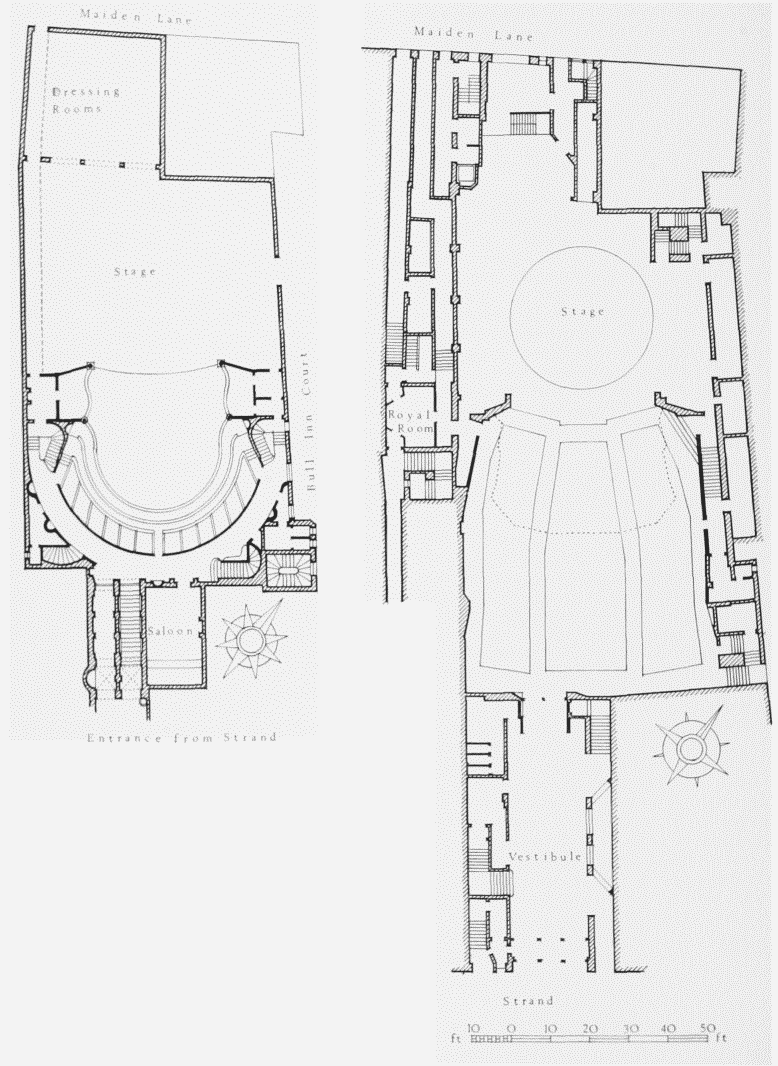
Adelphi Theatre, Strand, plans in 1858 (left) and in 1930 (right). Redrawn from plans in The Builder, 11 Dec. 1858, page 834 and The Architects' Journal, 3 Dec. 1930, page 830.
A great success under Webster's management was The Colleen Bawn in 1860–1, significant as 'the first serious drama in which the actor became of secondary importance to the mechanist and scene-painter'. (fn. 81) In 1867 Webster took a Bedford building lease (from 1865) of another adjacent house in Maiden Lane, No. 20, (fn. 83) and in 1868–9 work of unknown extent was done by the architect Joseph Lavender. (fn. 84) The rateable value of the theatre was greatly increased and the residential parts on the Strand front, which had been unoccupied for some years, ceased to be separately assessed. (fn. 12) It was presumably at this time that the royal entrance was built at No. 20 Maiden Lane, surely one of the least regal spots in London. (fn. 2)
In 1869 Webster assumed the management of the Princess's Theatre also, (fn. 86) but was soon in difficulties and took F. B. Chatterton, the manager of Drury Lane, as partner. In 1872 Webster retired, but Chatterton (who had taken a lease from Webster at £3,500 per annum) found the supervision of three theatres beyond him and in about 1877 sold his lease to the restaurateurs, Agostino and Stefano Gatti. (fn. 87) In 1878 the Gattis acquired the mortgage interest in the freehold (which by now included Nos. 18 and 19 Maiden Lane) and ground leases, (fn. 87) and in the following year assumed control of the Adelphi. (fn. 89) In 1881 they bought the freehold from Webster's son-in-law, Edward Levy-Lawson (later the first Lord Burnham): the price is said to have been £48,000. (fn. 90)
It was soon necessary for the Gattis to employ their surveyor, the architect Spencer Chadwick, to carry out alterations demanded by the Chief Officer of the London Fire Brigade in his report to the Metropolitan Board of Works in 1882. (fn. 91) These alterations were executed in the following year by Langmead and Way. At the same time the behind-stage accommodation at Nos. 18–20 Maiden Lane was rebuilt, probably by John Clemence of Villiers Street, and the gloomy, many-windowed façade here no doubt dates from that period. (fn. 92) On stage, 'Adelphi dramas' continued to be presented with great success: Harbour Lights ran for 510 performances from December 1885. (fn. 76) Prices now ranged from 1s. to 10s. (or three guineas for a box). (fn. 39) In 1886–7 another reconstruction of the theatre took place, carried out by W. Cubitt and Company to Spencer Chadwick's designs. The Gattis had acquired the lease of Nos. 409 and 410 Strand immediately east of the existing entrance, as well as of the Nell Gwynne tavern in Bull Inn Court, and were able to enlarge the pit considerably, to give total seating accommodation for more than 1,900. An entrance to the pit was made in the Strand, in the western bay of No. 410. The remainder of the newly acquired Nos. 409–410 was opened by the Gattis as the Adelphi Theatre restaurant. For this Spencer Chadwick provided a symmetrical façade, with a narrower matching façade for the theatre at No. 411. (fn. 93) The façade of Nos. 409–410 survives, slightly altered.
In 1891 the Gattis bought the freehold of No. 20 Maiden Lane and property in Heathcock Court on the west side of the theatre, where they made an additional gallery staircase. (fn. 94)
Melodramas continued to be presented until 1900 but by the latter part of that year the theatre had been leased to George Edwardes of the Gaiety and an almost complete rebuilding marked the supersession of the Victorian tradition by lighter, musical fare. The architects were E. Runtz and G. M. Ford of Ernest Runtz and Company. The work took a year, and only the front and rear walls were retained. The confined entrance from the Strand was at last replaced by a spacious vestibule, and the up-and-down approach to the stalls was finally levelled. This was made possible by the acquisition of the adjacent site at No. 412 Strand: the façade was extended westward in a Norman Shaw-Baroque style. (fn. 95)
Inside, the proscenium boxes above dress-circle level were abolished. The circles were cantilevered, dispensing with supporting columns. The decoration aspired to an 'Adam' style, with a colour-scheme in white, yellow, old gold and peacock blue. The proscenium-opening was smaller than before but the stage now ran right back to the rear wall on Maiden Lane. (fn. 95)
The theatre re-opened in September 1901 as the Century but the name Adelphi was restored in the following year. (fn. 24)
Musical comedy and, later, light-hearted revue were the most successful offerings here until the theatre's closure for its last major rebuilding, in 1930. The architect for the lessees, Musical Plays Limited, was Ernest Schaufelberg, and the builders the Pitcher Construction Company. Only the side and rear walls were retained. The new house had two circles above stalls-level, all of concrete construction, in place of the previous three tiers, and gave seating accommodation for 1,500. The architectural treatment was called 'the latest thing in futuristic design' by The Stage, and the Architects' Journal, under the heading 'Trigonometry in the Theatre' remarked that 'externally and internally the entire conception is carried out in straight lines and angles, the angle of 32 degrees being used as the master note'. The interior, where marble, plain polished wood, and chromium were much used, presented a colourscheme of green, gold, black and deep rose. Although intended for the 'legitimate theatre', a cinematographic projection-room was provided. The proscenium-opening was again widened, but made lower, and the depth of the stage was reduced, so that it no longer reached back to Maiden Lane. The working mechanism included an electrically driven revolving stage, installed partly at the instigation of C. B. Cochran, whose production of Ever Green inaugurated the new theatre on 3 December 1930. (fn. 96)
Schaufelberg's façade to the Strand was a striking design in the same manner as the interior. It was an asymmetrical composition having, on the right, a vertical feature of open V-shaped plan, faced with black marble. This projected from a splay-sided recess in the main wall, which was faced with grey marble. Below the feature, and above the entrance canopy, was a large window of complex form, largely made up of hexagons and lozenges. In 1937 this front was replaced by one of terra-cotta, surmounted by the name of the theatre and containing 'a recessed wall prepared for a large interchangeable sign frame': the architects were T. P. Bennett and Son. (fn. 97)
In 1955 the Gatti family sold the freehold to F. W. Woolworth and Company. The London County Council refused permission to replace the theatre by a retail store and in 1960 a plan was announced by Mr. Jack Cotton's City Centre Properties for the redevelopment, in association with Woolworth's, of a large site comprising Nos. 408–422 Strand. This was to include a new theatre. (fn. 98)
Nos. 23 and 24 Maiden Lane
These strange buildings, erected on the freehold of the Corps of Commissionaires, were constructed, as the dates on them indicate, in 1882 and 1887 respectively. The builder of No. 23 was F. Higgs of Loughborough Junction and of No. 24 W. Shepherd of Bermondsey New Road. (fn. 99) Nothing is known of the architect or architects.
No. 23 is a tall narrow building of brick and stone, six storeys high and two windows wide (Plate 71d). Above a modern shop front is a mezzanine storey crowned by a clumsy blocked cornice terminated by brackets in the manner of a shop fascia. All the windows have stone heads and sills, those of the top three storeys having, in addition, stone balconies with oddly carved fronts carried on triglyphed brackets. The whole is crowned by a crude heavily dentilled cornice. Despite the details, the effect of this curious front is reminiscent of an early Gothic palazzo in a minor Venetian rio.
The front of No. 24 is five storeys high and one window wide. It is of brick with stone-mullioned windows, those in the top three storeys having stone balconies. The third-storey balcony has a carved foliated front in Jacobean style, and plain dies at the angles; the other two have plain fronts and angle dies. A dentilled cornice crowns the whole.
No. 25 Maiden Lane
See Nos. 41 and 42 Bedford Street.
Nos. 28–32 (consec.) Maiden Lane
See Nos. 16–12 Henrietta Street respectively.
Nos. 34 and 35 Maiden Lane
Both these sites are now occupied by Rule's Restaurant but when first built No. 34 was occupied by a chemical-apparatus maker (fn. 24) and only recently became part of Rule's. It was built in 1875–6, together with No. 33, under a Bedford building lease made to H. D. Clark of Bedford Square, esquire. (fn. 100) The architect was John Wimble. (fn. 101) It has since been much altered.
No. 35 was built in 1873 (fn. 102) for occupation by Benjamin Rule in his trade as fishmonger and proprietor of a well-known oyster bar. Rule had previously had premises at No. 36, and before that at No. 38, back to 1828. (fn. 12) In January 1874 he was granted an eighty-year Bedford building lease from Lady Day 1872. (fn. 103) The architect was Alfred Cross, and the lowest tender, at £2,146, was submitted by William Howard. (fn. 104)
No. 34 has been largely reconstructed, but No. 35 retains its original yellow-brick front of 1873. Four storeys high, each upper floor has three casement windows set in plain openings with plastered reveals and segmental arches of gauged yellow brick. The casements of the second and third storeys are leaded to simulate quarries. The windows of the third and fourth storeys have prominent sills resting on coarsely channelled brackets, the sills being linked by a slightly projecting band and the brackets rising from a roll moulding. A cornice supported by ribbed brackets completes the front. All of these dressings are of painted stone or stucco, as are the ribbed bracketstops to the entablature-fascia above the shop front. This is flanked by narrow plain-shafted pilasters with foliated caps. The shop fronts of Nos. 33 and 34 have a similar architectural frame.
In No. 35 the ground-storey room extends into the rear area, and is lit by a wooden-framed domical roof-light, of which eight lights are decorated with painted cartouches and trophies in sepia monochrome. The second and third storeys now have one large room each. Both are lined with decorative panelling, oak panelling of an early Renaissance character, with small panels set in moulded framing on the second storey, tall rectangular panels in plain framing, above a moulded chair-rail and dado, and an overmantel enriched with figures of vineyard workers, on the third storey. The stair has a heavy swept and moulded mahogany handrail, and elaborate and delicately turned balusters. The restaurant still retains a number of its nineteenth-century fittings, together with an extensive collection of drawings, prints, and photographs, relating to the literary and theatrical associations of its early patrons. Nothing of note survives in No. 34.
Nos. 36–39 (consec.) Maiden Lane
Sussex Mansions were built as residential chambers in 1886–8. (fn. 12) The enterprise was evidently undertaken by Harry Stapley, of Twineham, Sussex, who was one of the first occupants, (fn. 24) but the Bedford lease granted in May 1887 (for seventy-one and a half years from Lady Day 1883, without the usual peppercorn term) (fn. 105) was made to M. N. Buttanshaw of Budge Row, a lawyer, (fn. 24) perhaps Stapley's financial backer. (fn. 106) The site was leased in two sections of unequal frontage corresponding to the construction of the building with a cross-wall separating the chambers approached by each of the two entrances. The architect was Walter Stair, and the builders Perry and Company, whose tender was accepted at £8,750. (fn. 107)
This building, containing a semi-basement and four storeys, has a striking and boldly modelled front of eclectic character, executed in red brick with Bath stone dressings. The semi-basement and ground-storey windows are recessed behind a screen of elliptically headed arches, arranged in three pairs separated by the two doorways, both of which are emphasized by pediments. The three upper storeys are lit by large windows, each divided by stone mullions and a transom into two tiers of three or two lights. These windows are appropriately arranged in wide or narrow bays between shafted piers, the wide bays above the two entrances being elaborated by the introduction of trifoliate arches above the third-storey windows and Gothic lights in the fourth storey.
No. 42 Maiden Lane
This building was erected in 1873, under an eighty-year Bedford building lease to E. Y. and T. Cox, to form an extension to their adjacent premises at Nos. 28–29 Southampton Street. Cox and Sons (later Cox, Sons and Buckley) were church-furniture and stained-glass manufacturers. The architect was S. J. Nicholl, who also designed Roman Catholic churches in London and elsewhere. The contractor was the local builder, Howard, whose tender was accepted at £2,297. (fn. 108)
Four storeys high, with two further storeys in the roof, the lofty appearance of the building is emphasized by its architectural treatment. Although stylistically the details are flamboyant French Gothic, the size and arrangement of the openings clearly indicate the functional requirements of the building. The front is two bays wide, one of which is a double bay, and is of red brick with stone dressings. At ground-storey level, the recessed main entrance occupies the single bay, the double bay containing a pair of large display windows with cast-iron mullions and transoms. The first- and second-storey openings are grouped together in panels slightly recessed behind the main face of the building; those above the entrance are floor-to-ceiling height, and were clearly intended for the ingress and egress of goods, while the double bay contains pairs of six-light mullioned and transomed windows. All these openings have rounded top corners, with plain rubbed brick arches over, and the secondstorey openings are surmounted by hood moulds in the form of much flattened ogee arches, enriched with carved foliage and mouldings. The third-storey openings are rectangular, but otherwise are similar to those below; their heads are additionally enriched with corbelling carved in the brickwork. The main section of the front is capped by shallow blind arcading of small brick arches supported on brick and stone corbels, above which rises a pair of two-storey gables, one at either end of the front, flanking large studio windows. The fine cast-iron hopper head dated 1873, at the level of the blind arcading, is worth noting. The original staircase survives; it is quite plain, apart from some very contrived Gothic ornament on the bottom newel post.