Survey of London: Volumes 43 and 44, Poplar, Blackwall and Isle of Dogs. Originally published by London County Council, London, 1994.
This free content was digitised by double rekeying. All rights reserved.
'Public Housing in Poplar: The 1940s to the early 1990s', in Survey of London: Volumes 43 and 44, Poplar, Blackwall and Isle of Dogs, ed. Hermione Hobhouse (London, 1994), British History Online https://www.british-history.ac.uk/survey-london/vols43-4/pp37-54 [accessed 30 April 2025].
'Public Housing in Poplar: The 1940s to the early 1990s', in Survey of London: Volumes 43 and 44, Poplar, Blackwall and Isle of Dogs. Edited by Hermione Hobhouse (London, 1994), British History Online, accessed April 30, 2025, https://www.british-history.ac.uk/survey-london/vols43-4/pp37-54.
"Public Housing in Poplar: The 1940s to the early 1990s". Survey of London: Volumes 43 and 44, Poplar, Blackwall and Isle of Dogs. Ed. Hermione Hobhouse (London, 1994), British History Online. Web. 30 April 2025. https://www.british-history.ac.uk/survey-london/vols43-4/pp37-54.
In this section
- Reconstruction and Retrenchment: The 1940s to the Early 1990s
- After the Blitz: The Post-war Emergency
- Poplar Transformed: The Housing Programme, 1945–1980s
- Post-war Slum Clearance
- Post-war Design and Layout
- Post-War Rents
- Post-Transformation: Changes in the 1980s and early 1990s
- In Place of the Council House
Reconstruction and Retrenchment: The 1940s to the Early 1990s
After the Blitz: The Post-war Emergency
The Housing Crisis
As a result of the war, the conditions in which many families in Poplar were living were so bad that it was almost as if the public housing drive of the 1930s had never been. It was initially estimated that 10,000 houses had been lost in the borough as a result of war damage, although the figure was subsequently revised to 8,500. (fn. 4) A large number of the remaining houses had suffered some damage, so that many which had previously been occupied by two families were now only fit for one. For the LCC, with its London-wide involvement, the problem was even greater; of its total stock of 98,000 homes, 89,000 were damaged during the war and 2,500 were totally destroyed. (fn. 5) Consequently, large numbers of Poplar families were temporarily staying with friends or neighbours under cramped and difficult conditions. (fn. 6) The situation was exacerbated by the start of demobilization, the return of evacuated families, and a rise in the marriage rate, all of which meant that more families were competing for fewer houses. In addition, the building work-force had been halved during the war, and there was an enormous backlog of housing repair and maintenance work. (fn. 7) To meet this desperate need, the Minister of Health announced in March 1944 that 'the Government propose to authorize local authorities to undertake a substantial amount of emergency housing both by adapting existing buildings and by providing temporary accommodation of various kinds'. (fn. 8) Responding to the immediate urgency of the problem and prompted by the plans already formulated by the Borough Engineer and Surveyor S. A. Findlay and his staff, Poplar Borough Council acted quickly.
Repairing the Damage
Existing housing could meet only a very small part of the shortage. Nevertheless, it was important that, wherever feasible, war-damaged houses should be repaired and made habitable as quickly as possible. The Borough Council was responsible for carrying out that work under the provisions of the Housing (Emergency Powers) Act of 1939, and the Repair of War Damage Act of 1941, the cost being met by the War Damage Commission, although in some cases such work was carried out within the borough by contractors working directly to the Ministry of Works. (fn. 9) In October 1944 the Borough Surveyor reported that all 'first-aid' repairs to houses damaged in the flying-bomb attacks had been completed and that over 3,000 houses had received secondary repairs. Almost 1,500 men were engaged on the work. (fn. 10) Bombardment of Poplar continued until the early part of 1945, and some repaired properties sustained further damage, while repair work was limited by the Government's rationing of labour and materials. (fn. 11) During the latter half of 1945 the Borough Council assumed responsibility for all repair work on war-damaged properties, (fn. 12) and in that year the average number of men engaged on such work in the Borough was well over 2,000. The expenditure paid out by the Council on behalf of the War Damage Commission then totalled about £1,850,000, that is, £20,000 per week. (fn. 13) By February 1946, 13,274 war-damaged houses had been reglazed, (fn. 14) and the repair of bomb-damaged properties was completed early in 1947. (fn. 15)
Requisitioned Houses
With effect from August 1939 the Minister of Health delegated to the Borough and County Councils his powers to requisition empty houses to provide accommodation for those people who had been bombed out, (fn. 16) and by May 1944 the Borough had 797 houses under requisition. (fn. 17) Those who were rehoused in this way were not deemed to be statutory tenants of the Council but merely 'licensees'. The local authorities could also acquire premises and subdivide them into extra dwellings; thus, in July 1944 the Borough proposed to convert 18 premises into 36 dwellings. (fn. 18) But by February 1945 it was found that 'the supply of dwellings which are both habitable and empty is exhausted and there are only some thirty requisitioned houses not awaiting repair'. (fn. 19) The power of local authorities to requisition without prior reference to the Ministry was withdrawn in 1948. (fn. 20) By that time the Borough Council had requisitioned some 1,375 houses, but in 1949 it began handing them back, with the occupiers becoming normal tenants of the owners. (fn. 21) By the end of that year 343 requisitioned properties had been returned, but thereafter de-requisitioning was slow and by December 1954 only a further 29 houses had been relinquished. (fn. 22) The Requisitioned Houses and Housing (Amendment) Act, 1955, was designed to speed up the process and all the requisitioned properties in Poplar had been handed back by 31 March 1960, the date stipulated in the Act. The occupiers were rehoused by the local authority or accepted as statutory tenants by the owners, who then received compensation for loss of vacant possession. (fn. 23)
Temporary Housing
Huts
The Housing (Temporary Accommodation) Act of 1944 provided £150 million to be made available nationally for prefabricated dwellings, to be erected by the Ministry of Works and managed by local authorities, who were to provide the sites and necessary services. (fn. 24) In 1944 Poplar applied for 2,000 temporary houses, but at that time it did not possess any sites, although it hoped to have them within a year. (fn. 25)
Intended to be a very temporary measure, prefabricated huts, similar to those used for many wartime military installations, were constructed as dwellings. In September 1944 three different types of hut (sometimes confusingly referred to as 'box bungalows') were put up in Glengall Grove (now Tiller Road) for demonstration purposes. (fn. 26) The shells of these, complete with roof, could be erected in one-and-a-half days and could be made ready for occupation within a week. Two of the huts were of the experimental Uni-Seco type, adapted for domestic use at great speed by the Borough Engineer and Surveyor. They were 23ft 6in. by 19ft 7in. and consisted of a wooden frame, with walls made of two asbestos panels, packed with wood wool for insulation, standing on a concrete base. Construction could be carried out by two men. (fn. 27) The third hut was a Nissen. All three huts contained a living-room with an open fireplace, two bedrooms, and a 'kitchenette' (that is, a kitchen recess off the living-room), with the w. c. and coal bunker in an outhouse. The News Chronicle concluded that all of them had one fundamental fault: 'they are too small and cramping'. (fn. 28) All the same, following a visit by the Ministers of Health, Reconstruction, Works, and Supply, the experiment was deemed a success and the Borough started laying concrete bases for huts on 2 October 1944, (fn. 29) while the first family moved into one of the experimental huts towards the end of the same month. (fn. 30)
Huts were erected at the rate of 1.75 per day and by November 1944 the Ministry of Health had allocated to Poplar 200 Uni-Seco and 100 Nissen huts. By then the Borough had requisitioned 660 individual plots (sufficient to provide sites for the 300 huts), 173 bases had been completed and 18 huts had been finished. (fn. 31) A total of 304 huts was erected within the borough for the Borough Council. As with the requisitioned houses, the occupants of the huts were 'licensees' of the Council, and the initial weekly inclusive charge was 10s. Huts were only offered to inhabitants of Poplar who had been rendered homeless or were inadequately housed as a result of the war, and who were still residing in the Greater London area. (fn. 32)
The huts had no glass, the windows being filled with wire-reinforced cellophane, and the waterclosets were built in blocks of four to serve adjacent huts. In December 1944 the vicar of Christ Church, Cubitt Town, predicted: 'These huts are only temporary – but there will be the temptation to allow their continuance far beyond the three or four years prescribed.' (fn. 33) Those housed in the huts expected to be transferred to the temporary bungalows as they were built, but the Borough Council regarded hut-dwellers as having been rehoused, at least for the time being. (fn. 34) The huts soon became a serious embarrassment to the Council and a source of complaint for the occupants. (fn. 35) In particular, the Nissen huts, which had curved walls and lacked headroom, did not prove popular with prospective occupants and as there were 23 huts of that type still unlet by the middle of May, the range of possible applicants had to be extended. (fn. 36) The poor conditions under which those in huts had to live was such that by February 1947 the Borough Council was prepared to consider rehousing people from the huts in the poorest state. (fn. 37) Again it was the Nissen huts which proved the most unsatisfactory and the Council sought the Minister of Health's permission to demolish the worst of them, but in view of the acute housing shortage he wanted the huts to be retained and repaired. (fn. 38) Eventually, after further representations from the Council, the Minister agreed to the demolition of the worst huts. By the end of 1949, 31 had been removed, but there were still 207 in March 1952, and the last did not go until 1958. (fn. 39)
Prefabs
With the construction of huts under way, in November 1944 the Minister of Health informed the Borough Council that Poplar was to receive a preliminary allocation of 1,000 temporary prefabricated, or emergency factory made (E.F.M.) bungalows, popularly known as prefabs. They were to be built by the Ministry of Works, which was to retain ownership of the prefabs, but the Borough and County Councils were responsible for acquiring the sites and for managing these temporary dwellings. It was agreed that any site capable of taking two or more prefabs might be used, and under the Housing (Temporary Accommodation) Act of 1944 the local authorities could take possession of such sites in advance of actual purchase. (fn. 40) By December a start had been made on the foundations for the first of the prefabs, on two corner sites in Poplar High Street at its junctions with Hale Street and Dolphin Lane, and by February 1945 the first superstructure was under construction in Hale Street. (fn. 41) The first ten prefabs were ready for occupation by the middle of March 1945, making Poplar, together with Greenwich, the first borough to have prefabricated bungalows. (fn. 42) By November 1945, 300 prefabs had been completed in Poplar and handed over to the Borough and County Councils, and a further 100 were under construction (Plate 128b). (fn. 43)
In the middle of 1946, difficulties began to occur. Until then bungalows of the Uni-Seco type had been supplied to Poplar. These were of similar timber-frame construction to the same firm's huts. The external measurements were 32ft 4in. by 21ft 3in. and the accommodation consisted of an entrance hall, living-room, two bedrooms, bathroom, and w.c. (fn. 44) Because of a shortage of the UniSeco type, from 1 July 1946 Arcon temporary bungalows (of a totally different type of construction, employing a tubular steel frame) were delivered to bridge the gap, and 98 of that type were supplied. (fn. 45) Then there was a shortage of internal fittings – particularly plumbing units – for the prefabs, and finally the Ministry of Works had difficulty in obtaining painters. (fn. 46) Despite the difficulties, the construction programme of temporary bungalows for Poplar was completed by December 1947. In all, 942 prefabs were provided throughout the borough, 541 controlled by the Borough Council and 401 by the LCC. Of the other Metropolitan Boroughs, only Camberwell, Lewisham, Wandsworth, and Woolwich had more prefabs than Poplar. (fn. 47)
The Borough Council agreed that families of up to five people should be eligible for accommodation in temporary bungalows or huts, but that larger families might also be offered accommodation if the age of the children involved made it 'reasonable and proper'. The deciding factor was the size of family and 'preference must be given to families who will fill the accommodation available and that applications from married couples without children and other two-person families be not entertained for the present'. (fn. 48) Otherwise the Council agreed to adopt the same criteria for rehousing as those used by the LCC. The priority cases included people made homeless by the war and living in unsatisfactory conditions: those who had given up their homes on joining the Forces or taking up work of national importance; exservice men or women who had married during the war and were without adequate accommodation; families living in substandard or overcrowded conditions; and people whose medical condition required alternative accommodation. (fn. 49)
The LCC decided that the net rents of its prefabs in Poplar should range from 9s 3d to 9s 6d a week, according to situation, and the Borough Council followed by charging the lower figure. (fn. 50) The LCC also decided to treat the temporary housing managed by the Borough Council in the same way as housing provided for slum clearance or the abatement of overcrowding, and it therefore made a supplementary contribution to the Borough of £4 per dwelling for ten years. (This was extended in 1954 for as long as the dwellings remained available for occupation.) (fn. 51)
The prefabs proved popular with tenants. They were remarkably well equipped, and even had refrigerators. (fn. 52) Nevertheless, they had only been intended to last for about ten years after the war, and in 1952 the first of the Borough's prefabs was demolished. Others were gradually removed thereafter, though by February 1965 the Borough still had 323. (fn. 53) These had far outlasted their allotted span and, like the huts, they had become an embarrassment to the Council. Stories of the damp, rat-infested prefabs in Stebondale Street appeared in the local press in 1967 and again in 1970, (fn. 54) when Tower Hamlets Borough Council (which had inherited the dwellings) agreed to take action. (fn. 55) The last of the Borough Council's prefabs had gone by 1977, though the Greater London Council (GLC) still had ten such dwellings in Tower Hamlets, removed by the early 1980s. (fn. 56)
Poplar Transformed: The Housing Programme, 1945–1980s
When the two Councils resumed their permanent housing programmes in Poplar, both had to resort initially to expedients. The Borough Council had originally adopted prefabricated Orlit housing as an extension of its temporary housing programme (see page 449), but in September 1945 it decided that the first 66 of those dwellings should form the initial instalment of its permanent programme. They included what is said to have been the first block of flats with a precast-concrete frame to be built in this country (Rawalpindi House in Mellish Street). The Orlits were very well equipped and, like the temporary prefabs, were provided with refrigerators (Plate 128c).
Although the LCC had agreed new post-war standard types of dwellings in 1945, it decided that to avoid delays its initial building programme should continue to make use of the pre-war standard designs. (fn. 57) Thus, in 1946, when the County Council agreed to proceed with the St Vincent Estate (straddling the Poplar-Limehouse border), the plans provided for neo-Georgian four-and five-storey blocks of the 1934 standard type, with only a few minor post-war improvements. (fn. 58) The last of them was not completed until 1950. Little other public housing was built in the parish during the 1940s, apart from two small blocks of flats by the Borough Council: Clara Grant and Gilbertson Houses, Mellish Street (1948–50).
The estates begun in the early 1950s marked the beginning of the almost total transformation of much of Poplar and the Isle of Dogs. The wholesale sweeping away of the old was inspired by the County of London Plan of 1943, which, together with the Greater London Plan of 1944, indicated how the capital was to be rebuilt after the war. Although these were not actually statutory plans, they nevertheless guided the County Council's planning policies and decisions, as well as laying the basis for the later statutory Administrative County of London Development Plan, published in 1951. The 1943 Plan identified as one of the major defects to be rectified after the war the 'depressed housing areas and obsolescence of the East End', the main fault of which was their 'general drabness and dreariness'. (fn. 59) The Plan went on:
The decentralisation area [which included Poplar] comprises those parts of London which, because of obsolescence, congestion, bomb damage and lack of repairs, are considered to be ready for comprehensive redevelopment. Even though there may be in these areas a number of dwellings which are not yet sufficiently decayed as to appear to warrant immediate demolition, we consider it would be wrong from social, practical, and economic points of view, to redevelop obsolete areas in any way other than comprehensively. The retention of a relatively small number of dwellings – excepting perhaps as temporary quarters during the transitional stage while rebuilding takes place – because they have not reached acute slum condition, would obstruct proper and economic redevelopment of the whole district, and would tend to lessen the advantages and amenities of the new dwellings. (fn. 60)
To try to increase the rate of rebuilding, the first postwar Conservative Government, with Harold Macmillan heading the newly created Ministry of Housing and Local Government, set a national target in 1951 of 300,000 new houses a year to be built by public and private efforts. Each local authority, instead of being given a maximum allocation beyond which it could not go, was given a 'target' representing its minimum responsibility. (fn. 61) The rate of rebuilding in Poplar did indeed increase dramatically in the later 1950s and early 1960s; between 1946 and 1955 the two Councils had completed 1,078 dwellings in the area, but during the next ten years they completed 2,364.
The early 1950s saw the completion of the first part of the LCC's showpiece Lansbury Estate (1949–52), with major extensions to the northern part of the same estate in the later 1950s and early 1960s (see Chapter IX). In the later 1950s the LCC was also developing or extending a series of estates along Poplar High Street – the Birchfield, Galloway, St Matthias, and Will Crooks Estates. In addition, in the early 1960s it was constructing the Manchester and Schooner Estates on the southern part of Cubitt Town. Throughout the 1950s and early 1960s the Borough's housing activities were largely concentrated on two large-scale schemes: the St John's Parish Area in Cubitt Town (from 1952), and the Bazely Street Area, north of Poplar High Street (from 1953).
The London Government Act of 1963 reorganized local government in the capital. The arrangements took effect in April 1965, when the LCC was succeeded by the GLC, and the Metropolitan Borough of Poplar was combined with the Boroughs of Bethnal Green and Stepney to form the London Borough of Tower Hamlets. The new Borough became the primary housing authority within its own area for all housing purposes, as it was felt that housing was essentially a local service, best administered in conjunction with personal health and welfare services. The GLC's main role in housing was considered to be as a strategic authority dealing with London-wide matters. It also inherited, on a temporary basis, certain housing powers from the LCC, and indeed was to continue building houses in Poplar almost up to the mid-1980s, when the GLC's entire housing stock in Tower Hamlets was handed over to the Borough Council (see below). (fn. 62)
The later 1960s saw Tower Hamlets Borough Council completing the major remaining part of the St John's Estate. However, building activity in Poplar in the late 1960s and early 1970s was dominated by the GLC. In the later 1960s it completed the Birchfield Estate, very rapidly constructed the Samuda Estate on the east side of the Isle of Dogs, and began work on the Barkantine Estate, an extensive housing development on the west side of the Island, adjacent to Westferry Road. In the early 1970s it was engaged in the further development of the Barkantine Estate, the development of the southern part of the Lansbury Estate (the first phase of the Lansbury Market extension and the Gough Grove scheme), the completion of the St Matthias Estate, and the completion of Robin Hood Gardens, close to the northern entrance to the Blackwall Tunnel. The period 1966–75 marked a peak in council-house building, with the construction of a total of 2,564 dwellings and the GLC's contribution being almost four times as great as that of the Borough Council. A few houses were included on the Barkantine and St John's Estates, but otherwise developments were again a mixture of flats and maisonettes, with a number of blocks more than 20 storeys high built by the GLC (see page 45).
The Government's housing allocation for the whole of the Greater London area declined from £1,618 million in 1977–8, to £1,036 million by 1980–1, fell dramatically in the next financial year to £ 669 million, (fn. 63) and by 1984–5 was down to £617 million. (fn. 64) This reflected both the Conservatives' aim of limiting local authority spending, and their philosophy that many services were better provided by organizations other than local authorities. The number of new houses being built by local authorities in London began to decline from 1976, and in 1979 the GLC severely curtailed its programme of new building, restricting it to three areas in London, one of which was Docklands. (fn. 65) The GLC's Saltwell Street scheme, which effectively joined up the Birchfield and Will Crooks Estates, was completed in about 1976, and was the last large Council development. The number of completions by the two local authorities in Poplar between 1976 and 1985 showed a dramatic fall on the figure for the previous ten-year period, to a mere 454 dwellings, and no new council housing has been built since the early 1980s. (fn. 66)
By 1985 the local authorities had erected a total of 8,411 dwellings in the parish. Of these, 384 had been built before the First World War, 1,567 between the two World Wars, and 6,460 after 1945.
Post-war Slum Clearance
As the County of London Plan had recognized, slum clearance legislation was less significant in post-war, as compared with inter-war, redevelopment. Bombing, although indiscriminate, had destroyed many slum properties in Poplar. Equally, the local authorities could now use the powers of compulsory purchase given to them under the Planning Acts of 1944 and 1947. In 1956, for instance, the LCC decided that it was quicker to clear the Pennyfields area, which lay within the StepneyPoplar Comprehensive Development Area, using mainly compulsory purchase powers under the Planning Acts, rather than declaring slum clearance areas under the Housing Acts. (fn. 67) In fact, the declaration of a slum clearance area was often merely a device to obtain a government subsidy for rehousing displaced families and in a number of instances in Poplar the LCC declared as clearance areas groups of properties which they already owned.
Even so, in 1949 Poplar Borough Council, with the LCC's agreement, carried out a survey of possible slum clearance areas within the borough and identified 64 areas, containing over 3,000 properties, as suitable for action by itself or the LCC. (fn. 68) From 1951 onwards, the LCC and Poplar Borough Council drew up a series of five-year slum clearance programmes to be carried out by the two authorities, with the LCC taking responsibility for clearing the overwhelming majority of properties. (fn. 69) The GLC inherited temporary powers to continue slum clearance, and in conjunction with Tower Hamlets Borough Council formulated and implemented clearance programmes for the years 1966–70 and 1971 5, with the latter optimistically described as 'the last major slum clearance programme London will need'. In fact, by then only a very small percentage of the properties involved actually lay within the parish of Poplar – about 2 per cent for 1966–70, and about 5.5 per cent for 1971 5. (fn. 70)
In 1941 the LCC had suspended the allocation of any further dwellings for nomination of tenants by the Borough Councils and it was not until 1948 that such allocations resumed. (fn. 71) Although general nominations ceased in 1955, the LCC and GLC continued to assist with rehousing in respect of Borough Council slum clearance schemes. (fn. 72)
Post-war Design and Layout
Early Difficulties
The slow rate of council-house building until at least the mid-1950s in Poplar can be attributed to three main reasons. First, an increasingly serious national economic situation (including a major balance of payments crisis in 1948) forced the Government to cut back severely on its house-building programme, (fn. 73) and in October 1949 an annual reduction of £35 million in the national housing budget was announced. (fn. 74) The effects of those reductions on a single scheme can be seen in the case of some terraced housing in Alpha Grove (Nos 85–131) (Plate 128d). Acquisition of the site was agreed in 1947, and plans for the new houses were published in the Builder in December 1948. (fn. 75) By then the original designs had already been altered for economic reasons (despite the emphasis placed on quality by Aneurin Bevan, Minister of Health in the post-war Labour Government), so that a number of interesting features–such as shingles to face part of the front elevation, half-projecting balconies, and purpose-made windows– all had to be omitted. It was not until May 1950 that the Council was able to give approval for the scheme to proceed and the 24 houses involved were not completed until September 1952. (fn. 76)
Secondly, despite the Government's post-war control (until 1953 4) of the allocation of vital building materials, (fn. 77) the rebuilding programmes of both Councils were often hampered by acute shortages. In 1950 the LCC reported problems in obtaining softwood, cement, bricks and steel. (fn. 78) Considerable difficulties were experienced in procuring building materials for the first part of the Lansbury Estate, despite the priority this was given as part of the Festival of Britain, timber being in particularly short supply. The LCC continued to have problems with shortages of bricks and steel until at least 1956. (fn. 79) The Borough Council faced similar difficulties, and in 1956 it experienced delays in completing one of the blocks on the St John's Estate because of a shortage of glass. (fn. 80)
Thirdly, there was the difficulty in assembling suitable sites for redevelopment schemes. This caused most delay and also led to the somewhat piecemeal appearance of the housing estates of the 1950s and 1960s in Poplar, with a lack of any clear form or apparent logic. The County of London Plan and the Town and Country Planning Acts of 1944 and 1947 (fn. 81) seemed to presage an orderly and carefully planned redevelopment of London. But despite the Borough and County Councils efforts to draw up redevelopment schemes and try to work to an overall strategy, the post-war rebuilding of Poplar was largely a mixture of expediency, opportunism, and compromise.
The immediate priority after the war was to provide at least some sort of accommodation for the vast numbers made homeless. Ironically, the rapid success of the temporary housing programme made the creation of suitable sites for permanent housing much more difficult. The local authorities, when planning redevelopments, found themselves faced with acquiring a bewildering patchwork of bombed sites, derelict buildings, occupied dwellings (some by their original tenants, some requisitioned and let to 'licensees'), and sites with temporary housing on them. As in pre-war days, the normal legal processes had to be followed, negotiations had to be carried out, very often with many different owners (some of whom, because of the dislocation caused by the war, were difficult to trace), and where there were objections, a public inquiry was necessary. The difficulties of rehousing those displaced by clearance, combined with the prospect of a reduced housing stock caused by demolition, were extremely daunting in a period of such acute housing shortages.
The problem regarding the temporary housing was aggravated by the fact that sites owned by the Borough and County Councils were often interspersed, requiring much exchanging of sites before a suitable area for redevelopment could be created. In such a situation it was not always immediately apparent which authority should be responsible for the redevelopment of a particular area. For instance, in the case of the Tetley Street Area (now the Brownfield Estate and just outside the parish), the Borough Council proposed in 1951 a tenyear plan to erect 300 dwellings in the area, yet a year later it aborted the scheme because the LCC had plans for the area. (fn. 82) Similarly, although the Borough Council began the redevelopment of the St John's Parish Area in 1952, it was not until 1962 that it finally came to an agreement with the LCC about who should develop what in that area (see page 540).
All the LCC's and Poplar Borough Council's major housing estates of the 1950s and 1960s were developed in an ad hoc fashion and consequently took a long time to complete. Even at the LCC's Lansbury Estate, various expedients had to be adopted and, although completion was planned for 20 years after building work began in 1949, it was not finished until 1983. In the case of the Borough Council's first two major housing schemes within the parish, the Bazely Street scheme took ten years, and the initial plans for the St John's Parish Area were agreed in 1949, work began in 1952, and the final block was not finished until 1969. The long time-scale meant that completion of those estates was susceptible to further delays as a result of the rising costs of land, materials and labour, and economic restraints imposed by the Government.
Another factor contributing to the piecemeal appearance of the post-war estates was that the local authorities, while not seeking to re-create the existing street layout, were unable to carry out the sweeping redevelopments envisaged in the Plans of 1943 and 1951, and so were prevented from creating a new overall pattern. Mixed development and Radburn layouts, which may have been admirable in themselves, only helped to destroy the old pattern and make the new one more incoherent (see below). Here, too, the long time-scale of so many developments did not help; as an estate proceeded, new planning theories or architectural fashions might be adopted to produce a final jumble of layouts and styles This can be seen in its most acute form on the Lansbury Estate, but it is evident to a lesser degree on most of the others.
Nor was the speed of development improved by the post-war expansion of local authority bureaucracy. Despite the formation of housing sections and departments, (fn. 1) schemes and policies still involved a number of officers and, as late as 1968, Tower Hamlets Council appointed an officer in the Town Clerk's Department to co-ordinate the housing work of the Borough's departments, in an attempt to speed up the housing programme. (fn. 85) Similarly, several committees might have to be consulted over housing matters, and by 1973 Tower Hamlets Borough Council and the GLC each had two housing committees, one dealing with development and the other with management. (fn. 86)
Mixed Development
Most of the post-war council estates in Poplar are examples of mixed developments in one form or another. Mixed developments laid out in a more open, informal way on 'Radburn' principles, (fn. 2) had been advocated by the LCC's County of London Plan of 1943, the 1944 Dudley Report (prepared by a Committee set up by the Government to recommend new standards for post-war housing), and the 1944 and 1949 Housing Manuals issued by the Ministry of Health (then still responsible for housing). Enthusiasm for mixed development was not purely for aesthetic reasons, nor were its champions confined to professional planners and architects. In fact, it was for social reasons that Bevan wanted to re-create the traditional village atmosphere on modern developments, 'where the doctor, the grocer, the butcher and the farm labourer all lived in the same street. I believe it is essential for the full life of a citizen . . . to see the living tapestry of a mixed community.' (fn. 88) In 1949 he introduced a Housing Act which for the first time removed all references to the working classes in the Housing Acts, enabling local authorities to take into account 'the housing conditions and housing needs of all members of the community'. Until then all council housing officially had been only for the working classes. After the Second World War, it became increasingly difficult to decide exactly who was working class, and in practice many authorities, including the LCC, abandoned any attempt to do so. (fn. 89)
Despite these developments, the inhabitants of councilbuilt estates in Poplar remained almost exclusively working class. Starting from an almost wholly workingclass base–with local employment concentrated on the docks and the railways (and subsequently with high levels of unemployment), and with poor transport facilities–it was unlikely that the middle classes would be attracted to the area. Another factor governing its social character was the local authorities' priority schemes for the allocation of new accommodation, a long-term measure set up in response to the overwhelming demand for council housing. Inevitably, most of those having the greatest priority, particularly those in inadequate accommodation, were from the working classes. The aspiration of the middle classes to own their own homes, residual snobbishness about council housing, and the few houses included in Poplar's mixed development before the later 1970s, all combined to keep the estates working class. In 1966 the GLC concluded that 'there is now very little housing occupied by the middle-income group in this part of London'. (fn. 90)
Low-rise mixed developments did sometimes include a small number of houses, more especially in the immediate post-war period. They usually took the form of terraced housing, which provided variety while being more economical in terms of space and costs than detached or semidetached houses. Terraced housing was championed by the County of London Plan, and by the 1944 and 1949 Housing Manuals. (fn. 91) The 1949 Manual particularly favoured the three-storey terraced house 'where development has to be at relatively high densities'. (fn. 92) That type of highdensity terraced housing was adopted with enthusiasm by the Borough Council, eager as it was to avoid high-rise flats, while being equally anxious not to force too many local people to live elsewhere. The first such scheme was for 24 three-storey high-density terraced houses, Nos 85–131 (odd) Alpha Grove (1950–2) (Plate 128d). (fn. 93) Most of the houses in the Bazely Street Area are also in threestorey terraces, as are a number on the St John's Estate. Variations are provided on the LCC's Lansbury Estate; Nos 30–70 (even) Saracen Street, designed by Norman & Dawbarn, are apparently three-storey terraced houses, but, in fact, are two-storey houses with flats above (Plate 132a, 132b), while in Chilcot and Elizabeth Closes there is a mixture of three-storey houses and ground-floor flats with maisonettes above, designed by Geoffrey Jellicoe. In the 1970s, with high-rise out of favour, the Saltwell Street scheme (GLC) and the Julian Place development (Tower Hamlets Borough Council), again included a number of conventional three-storey houses arranged in terraces.
Even so, developments in Poplar were predominantly a mixture of flats and maisonettes (Plate 134b). The maisonette in particular seemed to provide the most satisfactory compromise between the tenant's ambition for a house and the local authorities' need to build flats. It is the four- and six-storey blocks of one maisonette above another which are the most characteristic feature of post-war housing estates in the area.
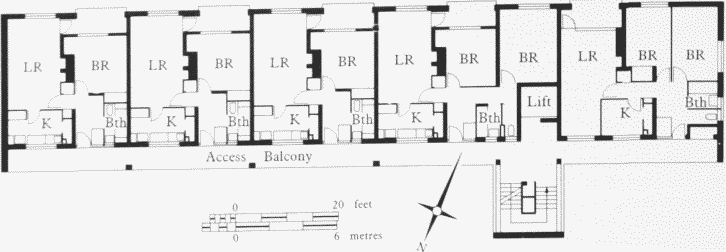
Michigan House, Millwall (now Kingsbridge) Estate, typical upper-floor plan.Built by the LCC, 1958–60
The large number of flats was largely due to the County of London Plan (1943) and its contention that areas such as Poplar should be redeveloped at a figure of 136 persons per acre. That figure was a compromise between the desire to provide a reasonable proportion of houses in any new developments, and the need to maintain the population at an acceptable level after decentralization. The compilers of the Plan proposed an ideal density of 100 persons per acre, in order to obtain a mixture of roughly half houses and half flats, but that would have entailed decentralization on too large a scale. (fn. 94) The dilemma was aggravated by the generous provision of open spaces, as advocated in the Plan. These were seen not only as public amenities but also as a means of physically dividing one community from another, to preserve the distinct character of each and break up the continuous urban development. (fn. 95) In addition, the postwar philosophy of looser estate layouts put great emphasis on creating space around individual blocks or groups of buildings. In the event, many of the public and semipublic open spaces proved to be difficult to maintain against vandalism, provided opportunity for other antisocial behaviour, and were of limited or doubtful recreational or visual value (see below and page 241).
The most serious implication of setting a figure of 136 persons per acre was the relatively high proportion of people who would have to live in high-rise flats. The Plan concluded that 'a large percentage of flats must be included in the new layouts', and one of the figures showing how an existing area of 93 acres might be developed at a density of 136 persons revealed that 62 per cent of the people would be housed in high flats of eight and ten storeys. (fn. 96) Not surprisingly, such propositions did not find favour in Poplar, and during the war the representatives of at least three local churches pleaded that houses rather than flats should be built when peace came. (fn. 97)
Poplar Borough Council opposed the views on highrise flats expressed in the County of London Plan, commenting that 'we are convinced that this sort of dwelling is not conducive to a full family life, apart from the many social evils which can be traced to this form of housing of the working classes'. Its own preliminary investigations showed that if large schemes were designed upon the basis of persons per floor area, per acre, a good standard of housing could be achieved with a far smaller proportion of flats than the Plan suggested. (fn. 98) In 1949 the Borough Council did contemplate building a six-storey block of flats in Blair Street (outside the parish), using a reinforced-concrete frame. But in the end it abandoned the scheme and concluded that, in general, the construction of flats in blocks of five storeys or more, using frame construction and providing the amenities suggested in the Housing Manual (including the installation of lifts), was too expensive. (fn. 99) Incidentally, lifts became a standard feature in post-war blocks of flats, although into the 1970s access to individual dwellings continued to be from communal balconies or 'decks'. The LCC, following the lead of its own Plan of 1943, was always more enthusiastic about high-rise flats, (fn. 100) and as an experiment built eightstorey blocks in the late 1940s at Woodberry Down, Hackney, and the Ocean Estate, Stepney. (fn. 101) However, the Housing Committee would not sanction further high-rise blocks until the results of that experiment could be assessed. It therefore refused to allow flats of more than six storeys to be included in the Festival part of the Lansbury Estate (see page 215).
Mixed developments continued in the 1950s, but with certain differences: only a very small proportion of houses was included, and from the later 1950s the LCC normally developed the land immediately around blocks of flats or maisonettes into individual gardens for the tenants of ground-floor dwellings. (fn. 102) Most importantly, the LCC employed a new type of mixed development incorporating high-rise blocks. That change is seen most dramatically on the Lansbury Estate, and can be attributed to the fact that the Council's housing architect, H. J. Whitfield Lewis, was a strong advocate of high-rise mixed development. (fn. 103) The key component in the LCC's high-rise mixed developments was the point block of flats (Plate 134b). The LCC, largely influenced by Swedish examples built in the 1940s, included point blocks on the Ackroyden Estate, Putney (1950–4), (fn. 104) and, more spectacularly, on the Alton East Estate, Roehampton, where the initial 11storey blocks were completed in 1953. The square-plan point block employed at Roehampton, with four flats to a floor, was designed to use ground space economically, while providing plenty of daylight for all dwellings. (fn. 105) In adopting its new form of mixed development of highrise point blocks and lower blocks of maisonettes and terraced houses for the Barchester and Alton Street schemes on the Lansbury Estate, the LCC was turning the original argument for high-rise blocks on its head. The high-rise blocks at Roehampton had been introduced to preserve a mature landscape, at Lansbury they were used so that such a landscape might be created (although in fact it never was).
Many local authorities were influenced by the LCC's championing of high-rise, but, despite building some nine-storey blocks of flats in the early 1950s outside the parish (such as Currie House in East India Dock Road, 1952–3), (fn. 106) Poplar Borough Council remained largely unconvinced. In 1956 it opposed the LCC's 11-storey point blocks on the Lansbury Estate, as well as proposals for a 19-storey block in the Tidey Street Area on the Barnfield Estate outside the parish. It continued to maintain that such developments were out of place in the local surroundings and, moreover, that they were unpopular with local people, who were 'not very happy in these tall buildings where they find the living conditions, particularly on the upper floors, far from satisfactory'. It also repeated its belief that tall blocks were unsuitable for families with children. (fn. 107) In both cases the Borough's objections were overruled by the Minister, (fn. 108) but by then the Borough had decided to restrict its own blocks of flats, as a general rule, to no more than four storeys. (fn. 109) Nor, in fact, did Poplar Borough Council build any high blocks of flats within the parish. At the other extreme, the LCC, in addition to the six point blocks on the Lansbury Estate (1957–61), built the seven-storey Storey House on the St Matthias Estate (1958–60), the tenstorey Anglesey House on the Lindfield Estate (1959– 61), the 11-storey Thornfield House on the Birchfield Estate (1960–2) (Plate 135a), and the 11-storey Galleon House on the Schooner Estate (1962–3).
High-rise and Industrialized Systems
The 1960s witnessed both a boom in the construction of high-rise flats and the advent of a new and ultimately disastrous phase in their development. Between 1962 and 1965 increasing government pressure was placed on local authorities to build high blocks of flats and embrace the industrialized building systems which were then being developed. (fn. 110) Also, the greater space that was demanded for individual dwellings by the Parker Morris Report (see below) created a need to increase densities and further encouraged high-rise developments. (fn. 111) The GLC, thus encouraged by the Government, and following the LCC's lead, erected in Poplar a series of much taller blocks of flats: the 19-storey Fitzgerald House, set on a podium, on the Lansbury Estate (1968–71), the four 21-storey point blocks (Bowsprit, Knighthead, Midship, and Topmast Points) on the Barkantine Estate (1968–70), the 25-storey Kelson House (an example of the 'scissors'type of maisonettes that were developed by the LCC in the early 1960s) on the Samuda Estate (1965–7) (Plate 136d), and, tallest of all, Erno Goldfinger's 26-storey Balfron Tower, just outside the parish, on the GLC's Brownfield Estate (1966–8). None of them employed patent industrialized building systems. Indeed, in Poplar parish the GLC only used such systems for three considerably lower blocks: the Sundh system for the tenand seven-storey slab blocks at Robin Hood Gardens (1968–72) (Plate 137a), and the Larsen-Nielsen system for the ten-storey Kedge House in Tiller Road (later 1960s).
Tower Hamlets Borough Council was not as opposed to high-rise flats as Poplar Borough Council had been, but nevertheless adopted a cautious approach. The newly formed Council, together with the Boroughs of Hackney, Havering, Barking, Redbridge, Newham, Waltham Forest, Enfield, and Haringey, was assigned to the North London Housing Group, one of three London groups set up to co-operate on industrialized building systems. (fn. 112) However, the only industrialized multi-storey block built within the parish by Tower Hamlets Borough Council was the ten-storey Alice Shepherd House in Manchester Road (1968–9), where John Laing Construction's SECTRA system was used. It cannot be deemed a success, for in 1980 a Dangerous Structures Notice was served on the building and emergency repairs had to be carried out. (fn. 113)
Yet even by the time that these very tall blocks were going up in Poplar, opinion was beginning to turn against such dwellings, (fn. 114) and the collapse in 1968 of Ronan Point, a multi-storey system-built block of flats in Newham, finally undermined public confidence in highrise flats. (fn. 115) The design of system blocks then in preparation, such as the two blocks of Robin Hood Gardens, had to be modified in the light of the Ronan Point disaster (see page 199). The only local authority highrise flats to be commenced in Poplar after 1968 were the relatively modest Ennis and Kilmore Houses, built by the GLC, on the Lansbury Market Extension scheme. They were both eight storeys high, set on a podium, and were begun in 1971.
A New Attitude
From the late 1960s, the idea of mixed development was called into question, (fn. 116) and this reaction led to a move away from the concept of informal clusters of housing to more formal layouts with rectilinear footpaths and rectangular courtyards. (fn. 117) Vandalism of the landscaped open spaces and planted areas in and around housing estates had provoked this change of attitude. A depressing note was struck as early as 1956, when Poplar Borough Council reported that it had planted grass, trees, and shrubs on its estates, but that those areas were often damaged soon after planting, and the sites became mud patches. As a result, it decided that 'whilst every endeavour will be made to retain the idea of planted areas in the planning of further housing estates, the provision of amenity open spaces must be on a much more modest scale in view of past experience'. (fn. 118) In 1957 the Borough's Housing Estates Management Committee, responding to a report about damage to a grassed area in front of Llandovery House, a block of flats on the St John's Estate, stated that 'we feel . . . that so little care is taken of planted areas around housing estates that no useful purpose would be served in replanting this area', and decided to pave it over instead. (fn. 119) The more enclosed type of layout was, therefore, to some extent an attempt to shut out vandalism, while at the same time recognizing most people's desire for privacy. Early examples of the new type of development are Kingdon and Lingard Houses on the St John's Estate, which were designed for Poplar Borough Council by Harry Moncrieff in the early 1960s and completed during the mid-1960s (Plate 136b). They have blocks of dwellings arranged around rectangular courtyards protected by high brick walls. On the whole, the effects of the new influences were noticeable in the 1970s and 1980s, when architects and planners were also reacting against high-rise and were looking to more domestic-scale, low-rise housing. The 1970s also saw the beginnings of a 'vernacular revival' and a return to traditional ideas of a dwelling with a pitched roof, brick-faced walls, and its own private garden. (fn. 120)
Most of those trends are well demonstrated by the Gough Grove scheme on the Lansbury Estate, designed by Shepheard, Epstein & Hunter for the GLC. Plans were approved in 1969 and the scheme was completed by 1975. The four-storey blocks of maisonettes and flats are in brick, with pitched and slated roofs, and are arranged in a formal rectangular fashion around grassed courtyards. The self-contained character of the development is emphasized by the footbridges which link one part to another across Hind Grove and Gough Walk (Plate 134a). It contrasts sharply both with the much more open, loose layouts of the LCC's 1951 flats immediately to the south and with the point blocks mixed with lower blocks of the Barchester and Alton Street schemes to the north-east. It is, however, to some extent a return to the original character of much of the Festival housing at Lansbury.
Typical of the schemes completed in the later 1970s and early 1980s is a much higher proportion of houses than in the earlier developments. That is the case on the Empire, Alpha and Grosvenor Wharves development by Tower Hamlets Borough Council (Plate 138a), and the Grundy Street site development on the Lansbury Estate by the GLC. In both schemes the houses are given their own gardens and there are pedestrian courtyards and narrow walkways which do not invite entry by the casual visitor. The Borough's scheme is much more informally laid out, however, with the houses arranged in echelons and with a variety of roof levels (fig. 205, page 546).
Changing Standards
The council dwellings of the post-war period, until about 1950, were rather larger than their immediate pre-war predecessors: 5 per cent larger in the case of a flat and 20 per cent larger for a house, according to the LCC. As a result, the second and third bedrooms were more spacious than before, as was the kitchen, which was fitted with storage cupboards and work surfaces. Indeed, there was a more widespread provision of fitted cupboards throughout dwellings. (fn. 121)
From 1950 housing standards were lowered, with minimum measurements for dwellings and rooms generally being abandoned, and in 1951 the new Conservative Government stressed that new houses designed with less overall space could be erected more quickly and more economically. (fn. 122) In some respects the local authorities were as eager to lower standards, if not more so. The LCC had already waived its own building regulations to allow some of the housing on the first part of the Lansbury Estate to have rooms with a height of only 8ft instead of 8ft 6in. (fn. 123) Similarly, in 1953 Poplar Borough Council sought to save money by installing a lift which served only alternate floors in Llandovery House on the St John's Estate, but the Ministry refused a subsidy unless the lift stopped at every floor. (fn. 124)
Setting New Standards: The Parker Morris Report
The Parker Morris Report Homes for Today and Tomorrow was issued by the Ministry of Housing and Local Government in 1961 and aimed to provide new standards for housing, reflecting the increased affluence of many people. The underlying aim of the report was to provide homes which gave as much flexibility as possible for occupiers to use the rooms available to them in whichever way they wished. To that end the report particularly recommended more space and better heating. Parker Morris standards were intended to be applied to both private and public housing, but their introduction was gradual and they were not made mandatory for local authorities until 1969. (fn. 125) In 1964 the LCC accepted most of the Report's recommendations, (fn. 126) and when a revised brief was given by the GLC to the Smithsons for the design of Robin Hood Gardens, in 1966, they were required to incorporate Parker Morris standards (fig. 70, and see page 197). Similarly, the newly formed Tower Hamlets Borough Council agreed that the future design of its housing should be 'generally in accordance' with Parker Morris standards. (fn. 127) The flexibility advocated by Parker Morris was frustrated by increasing economic cut-backs and the growing use of industrialized building techniques and Parker Morris standards were eventually abandoned by the Government in 1981. (fn. 128)
Heating
The gradual introduction of central heating into new post-war dwellings was given fresh impetus by the Parker Morris Report, while another stimulus was the eventual designation of most of Poplar and the Isle of Dogs as Clean Air Zones. On the first part of the Lansbury Estate, only the Lansbury Lodge old people's home had central heating; all the other dwellings were given fireplaces. However, in 1955, for the subsequent Alton Street scheme on the same estate, the Council resolved that each point block 'will have an oil-fired boiler which will supply hot water to a radiator in the living room and to the bath, wash basin and kitchen sink in each flat'. (fn. 129) In the late 1950s and early 1960s the LCC installed electric underfloor heating in some of its blocks of flats and maisonettes, such as Anglesey House (1959–61) on the Lindfield Estate, and Galleon House (1962–3) on the Schooner Estate. Similarly, the Isle of Dogs Housing Society installed underfloor heating in Betty May Gray House (1960–2). Such systems proved expensive to run, and from about the mid-1960s many local authority blocks of flats and maisonettes were provided with warmair heaters from a central boiler, which was gas- or oilfired. Normally electric immersion heaters were also provided to heat the water in summer, when the central heating was off. The GLC's Barkantine Estate was begun in the mid-1960s, and by 1974, of the 710 dwellings, 617 had warm-air units served by a central oil-fired boiler, 48 had central or individual gas-fired warm-air units, 40 had electric storage heaters, and five had radiators served by a central gas-fired boiler. (fn. 130) In contrast, on the Birchfield Estate, begun by the LCC in the 1950s and early 1960s and completed by the GLC, none of the 324 dwellings completed by 1974 had any central heating, except for 89 which had electric underfloor heating. (fn. 131)
In addition, from the mid-1960s some council dwellings were given individual boilers and radiators, so that the tenants had full control over the heating of their dwellings. On the GLC's Samuda Estate, begun in 1965, 422 of the 505 dwellings completed by 1974 had individual oil-fired boilers and radiators. (fn. 132) Similar provision was made by Tower Hamlets Borough Council at its Empire, Alpha, and Grosvenor Wharves housing scheme (1978–81). (fn. 133)
In the early 1950s the LCC had hoped to incorporate a district heating scheme into the first post-Festival phase of the Lansbury Estate, but found that it was too expensive. (fn. 134) Nevertheless, 20 years later, a district heating system served by an oil-fired boiler was included in the Gough Grove scheme on the same estate (1970– 5), (fn. 135) and the system was subsequently extended to serve the adjacent Pigott Street scheme. (fn. 136)
Living with the Car
The Parker Morris Report was also concerned about the provision of garages for dwellings. The failure of the local authorities in planning their estates to foresee and then to cope with the rapid increase in car ownership, resulted in vehicles, often parked in unauthorized areas, blocking up and disfiguring Council developments. Until 1954 the LCC only made provision in its housing schemes for garages for up to 5 per cent of dwellings. (fn. 137) On the first phase of the Lansbury Estate, completed in 1951–2, one scheme for 57 houses included only three garages. In that instance the lack of foresight seems to have been on the part of the Councillors who overruled the professional planners. (fn. 138) Already, by 1953, the lack of garages and car parks in residential areas in London was beginning to cause serious problems. (fn. 139)
In 1954 the LCC did increase its provision of garages for future schemes to 10 per cent of dwellings. (fn. 140) Thereafter, provision increased only slowly. For example, on the next phases of Lansbury, facilities for tenants' vehicles were still woefully inadequate; the Alton Street Scheme, built in 1958–61, contained 560 dwellings, but only 92 garages and parking spaces were provided (16.4 per cent). The reluctance to make adequate provision for garages was based on the assumption that council tenants did not own cars, and on the fact that garages were relatively expensive to build and took up valuable space. It was convenient to see them as desirable extras rather than as essentials and when economies were required, the provision of garages was often the first thing to be affected. During the later 1950s, because of government restrictions on capital expenditure, only the foundations of the 43 garages included in one housing scheme on the LCC's St Matthias Estate in Poplar could be built at first, and the construction of the superstructures had to be held in abeyance. (fn. 141)
In 1961 the Parker Morris Report recommended that every new home should have space for a car, (fn. 142) and in 1964 the LCC accepted that a garage should be provided for every dwelling, wherever possible. (fn. 143) Estates built in Poplar by both the Borough and County Councils in the 1960s do show a steady increase in the provisions made for cars. On the LCC's Manchester Estate, opened in 1961, only 15 garages and 9 parking spaces were provided for 128 dwellings (18.75 per cent), and on its nearby Schooner Estate, opened in 1963, 22 garages and 19 parking spaces were provided for 156 dwellings (26.3 per cent). (fn. 144) The Pennyfields development on the Birchfield Estate, built by the LCC and GLC in 1963–6, included 27 garages for 78 dwellings (34.6 per cent), (fn. 145) while a contemporary scheme for 189 dwellings on the Borough Council's St John's Estate had a total of 64 parking spaces and garages (33.9 per cent). (fn. 146)
At Alice Shepherd House, completed in 1969, Tower Hamlets Borough Council was able to provide each of the 72 dwellings with a lockable garage. This was achieved by incorporating some garages into the ground floor of the main building and others in precast-concrete units in the forecourt. But this was exceptional and some estates completed by the GLC in the 1970s did not, by any means, provide sufficient garages for every dwelling (for example, at the Barkantine Estate and Robin Hood Gardens).
Because of competing demands for space on housing estates, underground garages were adopted in several schemes completed by the GLC in the later 1960s and first half of the 1970s, although they were expensive. (fn. 147) They were built at Norwood House on the Galloway Estate, on the Samuda Estate (where 200 garages and 31 motorcycle stores were provided in a large semi-basement area), and at the Gough Grove Scheme on the Lansbury Estate (where 280 underground garages provided a garage for every dwelling in the scheme).
Despite these efforts, many of the garages have proved unpopular with the tenants and remain unlet. (fn. 148) This is due partly to an understandable reluctance to pay additional rent for a garage. But it is also because many of the garages, particularly those underground, are set away from dwellings, where they are not overlooked by tenants themselves or subject to regular scrutiny by passers-by. (fn. 149) By the mid-1970s, the GLC had decided to abandon building garages in favour of providing parking areas for tenants' vehicles, (fn. 150) and the final major scheme on the Lansbury Estate, the Grundy Street site, demonstrates that policy. Tower Hamlets Borough Council followed suit on its Empire, Alpha, and Grosvenor Wharves site scheme (1978–81). Despite various preventive measures by the local authorities, unauthorized car parking on housing estates has remained a problem. (fn. 151)
The Prefab Returns: Mobile Homes
Ironically, in 1963 and 1964, shortly after the publication of the Parker Morris Report, mobile homes were erected by the LCC on various sites around Poplar as part of a London-wide temporary accommodation programme designed to alleviate the acute housing shortage. (fn. 152) Five were installed on the Birchfield Estate (in Pennyfields), (fn. 153) 12 on the west side of Wade Street on the Will Crooks Estate, (fn. 154) four on the Brownfield Estate (on the Chrisp Street site), and 19 in Duff Street, Ellesmere Street, and Upper North Street on the Lansbury Estate. (fn. 155) In addition, 96 mobile homes were placed on vacant land on the south side of Poplar High Street between Cruse House and the Technical College, where Stoneyard Lane was reopened and extended to accommodate them. (fn. 156)
The mobile homes were designed by the LCC in conjunction with the Timber Development Association. The structure was based on the principle of two selfcontained boxes which could be moved from site to site (Plate 135b). Requiring no foundations, they could rest on small piles of paving stones, on to which the two sections were then lowered into position by crane and bolted together. The homes were faced externally with tough plastic on asbestos panels, the floors and roof were plywood, insulated with foamed polystyrene, and the flat roof was finished with bituminous felt. The accommodation consisted of an entrance hall, lounge, two bedrooms, a kitchen, and a bathroom with w.c. and washbasin. A store and all the normal services were also provided. The average cost per home was £387 for site works and £1,239 for the structure. (fn. 157)
Despite the fact that such homes were only intended to last for 15 years at the most, the five in Pennyfields were still occupied as dwellings in 1993, while the 11 in Brabazon and Ellesmere Streets stood until 1992, although not then used for housing purposes.
Housing the Elderly
In 1942 Sir William Beveridge's Report on Social Insurance and Allied Services, which was to form the basis of the post-war Welfare State, drew attention to the fact that the number of old people was likely to increase and suggested that the services concerned with the welfare of the old, including the provision of special housing, needed to be developed. (fn. 158) So, in 1946, when the LCC had to revise its pre-war plans for the St Vincent Estate, one innovation was the provision of eight ground-floor bedsitter flats for old or single people. (fn. 159) More generous and more specific provision was made on the first part of the Lansbury Estate where, on either side of Grundy Street, an old people's home (Lansbury Lodge) and a block of old people's flats (Shepherd House) were built. The LCC did build a terrace of three old people's bungalows on the Birchfield Estate (Nos 1–5 Pinefield Close, 1958–9), but otherwise the old people's dwellings in Poplar have been in the form of flats. Nor was it really until the late 1950s and 1960s that regular provision began to be made on council developments for specially designed old people's dwellings. For example, 80 old people's flats were provided in two-storey blocks in the Alton Street scheme on the Lansbury Estate, built between 1958 and 1963 (see page 243). Thereafter, most large housing schemes included at least a small proportion of old people's dwellings, sometimes–as at Alton Street–in a special block (for example, Capstan House on the Schooner Estate, 1962–3, and in the Pennyfields scheme on the Birchfield Estate, 1963–6), and sometimes on the ground floor of a more general block (as at Robin Hood Gardens, 1966–72, and at Norwood House on the Galloway Estate, 1965–9). Both the LCC and the GLC frequently provided accommodation for a resident warden on estates where old people's dwellings were included, and from the mid-1960s the GLC normally included an old people's clubroom on its estates (for instance at Robin Hood Gardens and on the Barkantine and Samuda Estates).
To assess exactly what provisions were made for housing the elderly by Poplar Borough Council is not as simple. Although, for example, Discovery House, a block of 42 flats on the Bazely Estate (1961–3), included 12 old people's dwellings, in 1977 Tower Hamlets Borough Council was unable to give any indication of how many old-age pensioners' and single-person flats there were within its own housing stock. At that time it gave no priority on the housing waiting-list to the elderly as such, but, because of health quotas and Social Service nominations, a large number of old people were, in fact, rehoused. In practice, of course, any one-bedroom dwelling, especially at ground-floor level, might be suitable for able-bodied pensioners. (fn. 160) John Tucker House in Mellish Street (completed by Tower Hamlets Borough Council in 1978), is an example of the more recent development of sheltered housing, where to some extent the distinction between old people's homes and old people's dwellings has become blurred (Plate 137b). Nine ground-floor flats are fitted out for the physically handicapped, there is a resident warden, and the block includes a common-room, drying-room, and guest-room. Mention should also be made of St John's House, Pier Street, erected by the Isle of Dogs Housing Society (1972–4), which provides 30 old people's flats in a two-storey block, together with a warden's flat and common-room.
Architects: Public or Private
In March 1944 the structure of the technical staff of Poplar Borough Council was reorganized to allow for the expected expansion which would be necessary for the post-war building programme. As a result, A. E. Williams, who was by then described as 'Assistant Architect', became Principal Assistant Architect. (fn. 161) He left in July 1946, (fn. 162) and in the following year S. A. Findlay, the Borough Engineer and Surveyor, also left, to become the first General Manager of the Scottish Special Housing Association, his evident success with the emergency housing programme in Poplar commending him to this new post. (fn. 163) Findlay was succeeded by William J. Rankin, who had been his deputy since 1938. As a pupil engineer, Rankin had attended Poplar Technical College. He was a civil and municipal engineer, and in 1945 had also gained a Town Planning diploma, but he had no architectural qualifications. He held the post of Borough Engineer and Surveyor for the rest of Poplar Council's existence, and indeed was to hold the same post with its successor, the London Borough of Tower Hamlets. (fn. 164)
It was Williams's successor as Principal Assistant Architect, C. H. Weed, who was credited in 1953 with having 'supervised the planning and design of the majority of the Council's post-war housing schemes under the direction of the Borough Engineer and Surveyor'. (fn. 165) Certainly, Weed's name usually appears on the plans of that period for Borough Council housing schemes alongside those of Findlay or Rankin. (fn. 166) After Weed's departure, his post was held in quick succession by V. A. Brown (1953–5), Mrs E. M. Cameron (1956–8), and F. W. Singleton (1958–61). (fn. 167) In the 1960s the Council had difficulty in recruiting architectural staff and after August 1961 the post of Principal Architectural Assistant remained unfilled. (fn. 168) Later that year it therefore appointed an architect in private practice, Harry Moncrieff, to complete the major remaining part of the St John's Estate (where Adams, Holden & Pearson were also employed), and to take over the design and construction of Discovery House on the Bazely Estate. (fn. 169) Tower Hamlets appointed John D. Hume to the newly created post of Borough Architect and Planning Officer. He was a qualified architect and planner, with considerable experience in local authorities, (fn. 170) and eventually, in 1973, his post was redesignated as Director of Development. (fn. 171) Hume retired in October 1980, and was succeeded in 1981 by James R. G. Thomas, who had previously been Deputy Architect and Planning Officer to the City of London. (fn. 172)
At the LCC, the design of all new housing was handed over to the Director of Housing and Valuer at the end of the war, in an attempt to speed up post-war reconstruction, and the architects employed on that work were transferred to his department. In 1950 the design of housing again became the responsibility of the Council's Architect, (fn. 173) with H. J. Whitfield Lewis, previously in private practice, becoming the Principal Housing Architect. (fn. 174) He was followed in 1959 by Kenneth Campbell, who also occupied the same position under the GLC until 1974, when he was succeeded by Gordon Wigglesworth. (fn. 175) The LCC and GLC continued to rely heavily on standard and 'preferred' dwelling-plans, which were seen as a means of accelerating the production of new housing and allowed contract particulars to be re-used. (fn. 176)
The LCC and GLC also experienced shortages of professional staff in the 1960s and early 1970s, and employed architects in private practice to design housing schemes: (fn. 177) Stewart, Hendry & Smith for Pennyfields on the Birchfield Estate; Norman & Dawbarn for the Cordelia Street site on the Lansbury Estate; Trevor Dannatt for Norwood House on the Galloway Estate; Alison & Peter Smithson for Robin Hood Gardens; Sir John Burnet, Tait & Partners for the Samuda Estate on the Isle of Dogs (although the main block is a scissors-type developed by the LCC), and Shepheard, Epstein & Hunter for the Gough Grove Scheme on the Lansbury Estate. The last three schemes were the largest. From 1976, as the GLC's housing programme dwindled, the use of outside architects was drastically curtailed. (fn. 178)
Post-War Rents
Despite earlier rationalizations, by the end of 1953 Poplar Borough Council again had a bewilderingly diverse rent structure. To take the case of a two-bedroom house, the net weekly rent for one newly completed in that year was 215 (because of the heavy cost of development), whereas for other post-war houses with the same accommodation it was 20s. For the two-bedroom prefabs the rent was between 12s 3d and 12s 9d, while for two-bedroom prewar houses the charge was 11s 9d to 12s 3d. (fn. 179)
The subject of council-house rents had always been contentious and from the 1950s it became the centre of an increasingly bitter controversy, revolving around what constituted a 'reasonable' or 'fair' rent. In the post-war period a reasonable rent was regarded as one striking a fair balance between the three groups which funded local authority housing: the taxpayers (through government housing subsidies), the ratepayers (through the local council's contribution from the general rate fund), and the tenants (through rents). But what actually represented an equitable distribution of the burden of housing costs provided scope for endless arguments.
The problem was compounded by the escalation of costs after the war, when new sites cost more to acquire and new dwellings cost more to construct. Loans were essential to fund new building and interest rates increased. (fn. 180) To some extent the dispensation given by the 1936 Housing Act–that there was no longer any statutory obligation to fix rents according to the particular Act under which dwellings were built–allowed councils to pool their rent fund. In this way, increased rents from the pre-war dwellings, which had been built relatively cheaply, could be used to keep the rents of the more expensively built post-war properties at a reasonable level. (fn. 181) It was the increasing cost of maintaining and repairing the existing housing stock which did most to raise rents in the post-war period. For example, the figure per dwelling contributed by the LCC to its Repairs and Renewal Fund doubled from £18 in 1952, to £36 in 1963, (fn. 182) and increased even more dramatically under the GLC, from £33 10s for 1965–6 to £50 by 1970–1. (fn. 183)
The District Auditor, in reporting on Poplar Borough Council's accounts for 1961–2, stated that the deficiency to be met from the General Rate Fund had been increasing over the years and now amounted to about £27 per dwelling. He commented that 'in the circumstances, it must be a matter of great doubt whether the Council did not unduly favour their tenants at the expense of the ratepayers'. Even the increases proposed by the Council from January 1963 would only bring the general rent level up to about 1.66 times the gross value, whereas the Auditor considered that a reasonable rent should be between 2 and 2.66 times. (fn. 184)
Both the GLC and Tower Hamlets Borough Council inherited the dilemma of setting rents in the face of increasing deficits on their housing accounts, but, initially at least, both preferred to take larger contributions from the general rate fund rather than implement rent rises. Consequently, figures calculated by the District Auditor show that the total deficit on the housing revenue account for the Tower Hamlets area had risen from £380,000 (£32 per dwelling) in 1963–4 to £965,465 (£73 per dwelling) in 1966–7. While rents were increased during this period, they failed to keep pace even with the rising costs of repairs, supervision, and management. (fn. 185)
As the debate continued to rage with ever-growing bitterness over what was a 'fair' rent, so the friction between the Councils and their tenants increased, with protests and rent strikes in Poplar in the late 1960s. (fn. 186) At the same time, both Councils found that their freedom to fix their own levels of rent was increasingly limited by government intervention: the 'Prices and Incomes' policies of the Labour Government, which restrained or prohibited local authority rent increases, (fn. 187) and the 1972 Housing (Finance) Act of the Conservative Government, which took away local authorities' freedom to determine their own rent levels. (fn. 188) The overall effect was that in the late 1960s and the 1970s council rents rose very sharply. This is demonstrated by the figures for the average net weekly rents of the GLC and Tower Hamlets Borough Council, which also reveal the considerably lower rents charged by the Borough Council. In 1968, the Borough's rent for a three-bedroom post-war flat built before 1964 was £1 9s 2d (£1.46), while the GLC's was £2 17s 4d (£2.87). (fn. 189) By March 1970 the comparable rents charged for the same flat were £2.21 by the Borough and £3.80 by the GLC, (fn. 190) and by April 1975 they were £4.15 and £5.75 respectively. (fn. 191) In fact, actual GLC rents in that year ranged from £2 to £9. (fn. 192) In 1976, Tower Hamlets Borough Council had the lowest overall average weekly net rent of any London Borough at £4.45, while the comparable figure for the GLC was £5.45. (fn. 193)
Post-Transformation: Changes in the 1980s and early 1990s
The Transfer of the GLC Housing Stock and Administrative Reorganization in Tower Hamlets
As a result of the London Boroughs becoming the primary housing authorities in their own areas, the London Government Act of 1963 stipulated that by 1 April 1970 the GLC must submit to the Minister of Housing and Local Government a programme for the transfer of part of its estates to the local authorities in whose area the properties were situated, or to a housing association. The GLC set up working parties with the London Boroughs and, following their reports, a phased scheme of transfers was agreed by the GLC in January 1969. (fn. 194) In fact, in 1968 Tower Hamlets Borough Council had asked for all of the GLC's housing within the Borough to be transferred to it in an unsuccessful attempt to prevent the rents of GLC dwellings in Tower Hamlets being raised. (fn. 195) However, when in the following year the details of the GLC's proposed scheme for transferring about 46,000 dwellings were sent to London Boroughs, Tower Hamlets and Hackney were the only two authorities to refuse the offer outright. (fn. 196) Some dwellings were transferred to various boroughs in April 1971, (fn. 197) but the main transfers took place in 1980 and 1981. (fn. 198)
The GLC accepted that Tower Hamlets was a special case, in view of the many social and economic difficulties there and also because of the sheer numbers of council dwellings involved. In the period leading up to the transfer, the GLC undertook to provide additional sums for improvements to the management and maintenance of the local authority housing stock in Tower Hamlets. It also agreed to carry out developments on certain sites, including the Grundy Street area on the Lansbury Estate (see page 245). (fn. 199) As an interim measure, from October 1979 the Greater London Council and Tower Hamlets Borough Council Joint Housing Management Committee, drawn from representatives of both Councils, was responsible for the total management and maintenance of all local authority dwellings in Tower Hamlets (except for the fixing of rent levels). (fn. 200) Difficulties and disagreements beset the Committee, and in May 1983 the borough Council withdrew. (fn. 201) Eventually, as originally proposed, 30,926 dwellings were handed over by the GLC to Tower Hamlets Borough Council on 1 July 1985, which, with its own stock of 19,044 dwellings, thereby became landlord of eight out of every ten homes in the borough. (fn. 202)
Shortly after the transfer, in 1986 the newly elected ruling Social and Liberal Democrats group on Tower Hamlets Council set up Neighbourhood Committees. It was intended that they should become increasingly autonomous bodies, with their own budgets and staff, and that in their own areas they would assume most of the responsibilities previously undertaken by the main Council. Neighbourhood Housing Officers have been appointed, Neighbourhood Building Services have been established, using staff from the Borough's Building Services and Architects' Departments, and estate-based housing offices have been set up. Most of the housing estates in the parish of Poplar came within the Isle of Dogs Neighbourhood, but the Lansbury and Lindfield Estates were absorbed into Poplar Neighbourhood. In the case of the Isle of Dogs, the 21 existing estates were reorganized in 1987 into eight much larger ones: Barkantine, Birchfield-St Vincent's, Cubitt Town, Poplar, Robin Hood, Samuda, St John's, and West Ferry. (fn. 203)
Sale of Council Houses
Since at least the early 1920s it had been part of Conservative philosophy that housing was better provided by private agencies than by local authorities, and from at least 1951, when the first post-war Conservative Government came to power, that philosophy expanded to embrace the promotion of owner occupation. (fn. 204) But throughout their existence, neither the LCC nor Poplar Borough Council was prepared to sell any of its housing. (fn. 205) Between 1967 and 1973, and again from 1977, Conservative administrations on the GLC did sell some council housing. (fn. 206) In 1979 the GLC agreed to two schemes in Poplar, on sites at Seyssel and Woolmore Streets, to build dwellings for immediate sale at discounted prices to its existing tenants or to people displaced by redevelopment or clearance schemes. (fn. 207) However, with the inauguration in 1981 of the London Docklands Development Corporation (LDDC), the former site was developed privately (as Francis Close), and the latter has yet to be redeveloped. The election in 1979 of a Conservative Government committed to privatization and to the encouragement of home ownership brought a new impetus to sales of council houses. The Housing Act of 1980 gave all council tenants of more than three years' residence a statutory right to buy their dwelling and it permitted councils to give discounts of up to 50 per cent on the assessed value of the property. (fn. 208)
One of the avowed reasons for selling GLC dwellings was to broaden the type of tenure in some inner London Boroughs and to counter what the Conservative group on the Council saw as deliberate attempts by Labour councils to 'municipalize' their areas and turn them into one vast council estate. Tower Hamlets was singled out as providing, allegedly, the most extreme example of such a process. (fn. 209) Yet 80 per cent of the GLC housing sales between 1977 and 1981 (some 16,340 dwellings) took place in the outer London Boroughs, (fn. 210) and sales of properties in Tower Hamlets were comparatively few. High unemployment in the area made it impossible for some tenants to buy their homes, while others were, for various reasons, unwilling to purchase. In addition, would-be purchasers had a strong preference for buying houses rather than flats, yet the local authority housing stock in Poplar, as elsewhere in Tower Hamlets, consisted overwhelmingly of flats. (fn. 211) Clearly, neither the locality nor the type of dwelling appealed to tenants wishing to become house owners, nor did a property in Poplar seem to be a good investment, at least before the Docklands boom. Tower Hamlets Borough Council, like Poplar Borough Council before it, refused to sell its dwellings until forced to do so by the 1980 Housing Act. (fn. 212) By 1985, when the GLC finally handed over its housing in the area to the Borough Council, there had been little depletion in the total local authority housing stock in Tower Hamlets, and four-fifths of dwellings were still in council possession. (fn. 213) Nevertheless, certain developments have proved attractive to purchasers–for instance, only 22 of the 50 houses in the Kingfield Street area remained in council ownership by 1989. (fn. 214)
Repair and Modernization
Post-war modernization and improvement schemes have altered, often radically, the original appearance of much of the council housing in the area. The process began in the 1950s when the Housing Repairs and Rents Act of 1954 made government grants available for the improvement of older property, acknowledging that such property could make a useful contribution to the housing stock. Improvement grants were available for private and local authority housing, and in 1955 the LCC launched a programme (completed by the GLC) intended to give tenants of inter-war dwellings an opportunity to have improved hot-water systems fitted. (fn. 215) In the late 1950s, for instance, gas water heaters were installed in dwellings on the West Ferry Estate. (fn. 216) More general modernization of Ottawa Buildings, Preston's Road, was agreed by the LCC in 1958, (fn. 217) while in the late 1960s the West Ferry Estate (1932–6) was extensively modernized by the GLC, when the number of flats in each block was reduced, all dwellings were given their own bathroom, and the courtyards were improved. Also in the late 1960s, Cruse House in Poplar High Street, built in the early 1930s, was extensively modernized by Tower Hamlets Borough Council, and the accommodation was rearranged. (fn. 218) From the mid-1970s the GLC implemented what were known as 'package improvements' to a number of its older blocks, including those on the Will Crooks Estate (between 1978 and 1981). The work was executed without the tenants having to be moved out and a tenant could refuse the improvements. The normal 'package' mainly involved the installation of central heating and the modernization of kitchens and bathrooms. In addition, on the Will Crooks Estate, all the windows were overhauled. (fn. 219) Similarly, Tower Hamlets Borough Council had to carry out improvements to a number of Poplar Borough Council's housing developments.
From 1977 government restrictions on public spending stopped widespread refurbishment and modernization of the existing housing stock for a time, despite the increasing age of many of the dwellings and the defects of a significant number of the more modern buildings. Although some refurbishment work was carried out in the early 1980s, such as the electrical rewiring of the 1920s cottage estates at Chapel House Street and Kingfield Street, (fn. 220) in general the condition of local authority housing in Tower Hamlets worsened dramatically between 1980 and 1986, the proportion categorized as unsatisfactory rising from 15 per cent to 49 per cent. In most cases the properties were not unfit for human habitation, nor did they lack the basic amenities suggested by the Department of the Environment, but they were in need of major renovation involving capital expenditure in excess of £6,000 per dwelling. (fn. 221)
The 1980s, therefore, saw Tower Hamlets Borough Council demolish at least three of its inter-war blocks of flats – Providence House (Emmett Street), Ditchburn House (Ditchburn Street), and Dunbar House (Tiller Road) – rather than carry out major refurbishment and modernization. In other cases, the Council sold inter-war blocks so that the purchasers could carry out the necessary refurbishment. Naval Row Flats were sold to a private developer, while Holmsdale and Constant Houses in, or just off, Poplar High Street were sold in the early 1980s to the Oxford House Housing Association, which converted them into dwellings mainly for single people, with the Council retaining the right to nominate 50 per cent of the tenants. (fn. 222) Yet another alternative was adopted by the GLC, which handed over the management and maintenance of Birchfield House to a tenants' cooperative in 1981. (fn. 223)
From the mid–1980s, however, considerable funds were available for the refurbishment of council housing in Poplar, and more especially within the Isle of Dogs Neighbourhood. The work included roof repairs (notably the replacement of flat roofs with pitched ones), the renewal of windows, and the installation of security systems (sometimes involving the construction of new entrance porches). Internally, the most common improvements were electrical rewiring and the installation of new kitchens and bathrooms. Such remedial works were carried out as much, if not more, on post-war buildings as on pre-war ones. The external transformation was dramatic in some cases. For example, at Urmston and Salford Houses (a series of four-storey 1960s blocks of maisonettes on the former Manchester Estate) Tower Hamlets Borough Council not only replaced the flat roofs with hipped ones and installed stained wooden-framed windows, but completely reclad the main elevations with smooth yellow panels and brown metal retaining strips, so that the blocks could now be mistaken for modern, privately built, Docklands housing (Plate 138b).
The money for repair and renewal came from a number of sources. In the first place, and for a limited period, until 31 March 1989, funds were made available for the repair and improvement of the former GLC housing stock, as one of the conditions under which Tower Hamlets Borough Council accepted the transfer of those properties. (fn. 224) Secondly, additional funds were made available through various government schemes aimed at improving run-down inner city areas, including a Priority Estate Project, sponsored by the Department of the Environment, for the Isle of Dogs Neighbourhood. (fn. 225)
The other major source of funding for the recent refurbishment and improvement of council housing on the Isle of Dogs has been the London Docklands Development Corporation. In its Annual Report for 1982–3, the Corporation stated that it intended 'to help improve older council housing so that living standards are raised for more people and new homes more quickly integrated into the existing community'. (fn. 226) Initially, however, it felt constrained to fund only environmental improvements around individual blocks or estates, or community projects. (fn. 227) During 1987 and 1988 the Corporation explored ways of assisting with the external and internal refurbishment of the actual buildings on the Council's estates, although the costs of the Docklands Highway initially absorbed the money earmarked by the Corporation for those purposes. (fn. 228) Nevertheless, following the appointment in November 1988 of a Director of Community Services (whose remit included housing), (fn. 229) in 1989 the Corporation appointed a Housing Refurbishment Manager to liaise with local authorities and secure funding for refurbishment programmes. (fn. 230) The Corporation's Housing Strategy Review gave a programme for the three financial years from 1990 to 1993, totalling £3 million for refurbishment of housing on the Isle of Dogs. (fn. 231) In 1990 the LDDC decided to reallocate its funding for the period 1990–4, and devote 80 per cent to refurbishment instead of the 28 per cent proposed in 1989. (fn. 232)
Purchasers of council houses have often been eager to assert individual tastes and make their property as little like an ex-council house, and as different from its neighbours, as possible. Even quite minor changes can quickly alter the character of a whole estate. For example, on the Chapel House Street Estate, built in 1919–20 for the Borough Council, and still perhaps the best council estate in Poplar, it is now impossible to find a single group of houses where at least one dwelling has not had some external alterations (usually to the windows and doors). On other estates the amount of change to individual houses has often been more drastic. An article on property in Poplar published in 1988 observed:'. . . you will notice the amazing difference in privately-owned ex-council houses – little bow windows, leaded lights, bright shining front doors, brass knockers.' (fn. 233) To this list could be added other features such as louvred window-shutters, stick-on plastic stone cladding, and various types of smooth or roughcast render. A striking example of the effect of such alterations is to be found on the Lansbury Estate, where Nos 15–25 (odd) Duff Street is a terrace of two-storey houses designed by Geoffrey Jellicoe for the Festival part of the estate in 1951. All but one of the houses has been so altered externally – including in one case applied 'timber-framing' – that the group is no longer even recognizable as a terrace (Plate 137c). Subsequently, some of the local authorities' recent schemes for refurbishing blocks of flats have been inhibited by some of the dwellings having passed into private ownership.
In Place of the Council House
Housing Associations since 1945
As in the inter-war years, the public housing built by the local authorities in Poplar has been supplemented by various schemes run by housing associations. From the 1950s until the early 1970s such schemes were confined to additional new accommodation provided by two of the associations already based in the area. In the first half of the 1950s Presbyterian Housing Ltd added three further blocks of flats (Goodfaith, Goodhope, and Winant Houses) to augment their existing blocks and to replace their old, converted properties in Poplar High Street and Simpson's Road that had been damaged during the war. In the early 1960s the Isle of Dogs Housing Society, finding its pre-war undeveloped site at Samuda and Stewart Streets compulsorily purchased by the LCC, built Betty May Gray House on a site at the junction of Manchester Road and Pier Street, with 55 flats and maisonettes in two multi-storey blocks. Subsequently, on an adjacent site in Pier Street, the Society added St John's House, a lower, two-storey block of sheltered housing, with a resident warden. (fn. 3) By 1975, housing associations had provided a total of 121 dwellings in Poplar parish.
In the case of St John's House, the GLC made the first approach to the Society, suggesting that it might like to be involved in developing the site. From the 1960s both the GLC and the Government – particularly when the Conservatives were in power – saw housing associations first as a useful supplement to local authority housing programmes, and then as a substitute for them. In the later 1970s and early 1980s, 283 dwellings were erected in Poplar parish by housing associations, well over twice the number built in the previous 30 years. They were mostly erected on the Isle of Dogs, the exceptions being the Springboard Housing Association's 20 flats on the corner of East India Dock Road and Woodstock Terrace, and the 45 single-person flats at Mary Jones House in Garford Street, built by the Look Ahead (Beacon Hostels) Housing Association. Between 1976 and 1982 the East London Housing Association built 124 flats and maisonettes on a riverside site on the east side of the Island, at River Barge, Ovex, and New Union Closes. At the foot of the Island, on opposite sides of Ferry Street, the Circle 33 Housing Trust built 46 flats and maisonettes, while the New Islington and Hackney Housing Association erected 48 flats.
In the 1980s housing associations were responsible for a number of conversions of existing properties, including two in East India Dock Road, where No. 133 was converted in 1981–3 by the Rodinglea Housing Association into small flats for single people and childless couples, and No. 153 was adapted as a hostel by the Circle 33 Housing Trust in 1983–4. Mention has already been made of the conversion of existing council flats by the Oxford House Housing Association during 1986–7. As with local authority housing, no new dwellings were completed by housing associations for a number of years after 1983, although the block of 15 dwellings erected by the Victoria Park Housing Association in Manchester Road was completed in 1991.
The length of time it took for some of the housing association schemes to come to fruition is noticeable. It often required many years of negotiations before the land could be purchased at an acceptable price. The diverse requirements of national and local government had to be met before a housing scheme could proceed, and then it often proved difficult to raise the necessary money, and different possible sources of finance might have to be investigated. For example, the initial site for the River Barge-Ovex-New Union Closes development was purchased in 1971, but the whole scheme was not completed until 11 years later. In the same way, the much smaller scheme of the Circle 33 Housing Trust at Ferry Street took eight years from the acquisition of the site in 1975 to completion in 1983.
The housing associations had built 606 dwellings in the parish by 1991, 187 of them between 1919 and 1939, and the remainder after 1945. This was a relatively modest contribution to Poplar's housing, representing only 6.7 per cent of the combined total of 9,017 dwellings provided by the associations and the local authorities by the early 1990s.
Social Housing: A New Era
The London Docklands Development Corporation saw one of its objectives as being to 'help a faster council building rate', and in 1986 stated that it had offered land for house building to Newham, Southwark, and Tower Hamlets Borough Councils. It went on, however, to say that 'because the authorities are having problems allocating the necessary cash to develop them, the LDDC will help in creating partnership arrangements between the councils and private developers to build mixed schemes for rent and sale'. (fn. 234) Shortly afterwards, 'social housing' began to be considered in government circles as an alternative to local authority housing and the concept was eagerly taken up by the Development Corporation. The term, which originated on the Continent, tends to be applied to housing schemes subsidized by agencies other than local authorities and designed to provide rented accommodation or a home for sale for those on lower incomes who would otherwise not be able to afford such property: for example, housing association, cooperative, equity-sharing, and self-build schemes, or a combination of those elements. Housing associations' involvement in social housing had been facilitated by the fact that since 1980 they had been able to provide houses for sale through special low-cost schemes, such as shared ownership. One result of all this on the Isle of Dogs is the Masthouse Terrace project, where 171 rented dwellings have been provided by the East London Housing Association. Funding has come partly from the Housing Corporation, partly from a grant given by the LDDC, and partly from a private loan, while part of the site has been donated by Tower Hamlets Borough Council and the rest purchased from the LDDC. The Borough Council has the right to nominate tenants to 50 per cent of the dwellings (see page 490) (Plate 136c).
This kind of arrangement may be a precursor of a wholesale transfer of local authority housing to housing associations (and similar organizations) or to private landlords, envisaged by the Housing Act of 1988 and the Local Government and Housing Act of 1989. But Tower Hamlets Borough Council has not yet shown an inclination for any mass-disposal of its housing. At the same time, the financial position of the LDDC forced it, at the Government's request, to review its social housing strategy and to cut its 1990–4 new-build programme to 19 per cent, compared with the 72 per cent envisaged in its 1989 strategy (see above). Overall, the social housing programme for the period was cut by more than half, from £49 million to £21.9 million. (fn. 235) In April 1991 Eric Sorenson, the newly appointed Chief Executive of the LDDC, after pointing out that Urban Development Corporations (UDCs) were only set up 'as temporary or short-life organizations with a remit to promote development as fast as reasonably possible', stated that 'it is not consistent with that objective to also require UDCs to engage in a wide range of investment and social provision programmes'. Significantly, he saw a continuing role for local authorities, arguing that matters such as the provision of subsidized rented housing remained their responsibility. (fn. 236)