
Survey of London: Volumes 43 and 44, Poplar, Blackwall and Isle of Dogs. Originally published by London County Council, London, 1994.
This free content was digitised by double rekeying. All rights reserved.
'The Lansbury Estate: Post-Festival development', in Survey of London: Volumes 43 and 44, Poplar, Blackwall and Isle of Dogs, (London, 1994) pp. 239-246. British History Online https://www.british-history.ac.uk/survey-london/vols43-4/pp239-246 [accessed 23 April 2024]
In this section
Lansbury: Post-Festival Development
With the completion of the Festival phase of the estate the focus of attention moved away from Lansbury, which then became little more than just another LCC housing estate. For several reasons, the coherent approach demonstrated in this first stage was quickly abandoned. In particular, the sense of urgency disappeared, and although the whole estate – and indeed the entire 1,300 acres of the Stepney-Poplar Reconstruction Area (fn. 1) – was due to be finished by 1970, (fn. 3) it was not until 1983 that the final major housing scheme at Lansbury was completed, almost 35 years after the estate was begun (fig. 86).
The contrast between the all-out effort to acquire the first 30 acres in time for the Live Architecture Exhibition, and the much slower rate of acquisition thereafter is especially striking. In a period of rising inflation and interest rates, and restrictions on public spending, and with the post-war redevelopments of the County and Borough Councils pushing up the value of the remaining undeveloped land, the increasing cost of property inhibited the rate of acquisition still further. For example, in 1961 the commercial nature of many of the existing buildings on the site for the Lansbury shopping centre extension meant that the cost of purchase was very high – the equivalent of £265,000 per acre – well in excess of the average then being budgeted by the Council for redevelopment schemes. (fn. 4) Walter Bor rightly argued: 'If all the 1,300 acres designated for compulsory purchase had been bought in the late 1940s and 50s when the land was still cheap, major savings could have been made and the area partly redeveloped and partly rehabilitated within the 20 year period as programmed.' (fn. 5) That this did not happen was due in part to the complex procedures required to acquire sites, and also because the LCC was over-stretched by too many concurrent projects. (fn. 6) But given both the overwhelming housing shortages caused by the war throughout London and the Council's London-wide responsibilities, it is difficult to see how the LCC could have concentrated so much effort and resources on a single area.
Shops, open spaces and parks, and schools were to have been developed simultaneously with the housing, but, because of the adverse financial situation, they failed to keep pace. (fn. 7) Thus, the Lansbury Market Square and shopping centre, after the initial development for the Festival, was not finally completed until the early 1970s Similarly, the development of Bartlett Park, the major open space associated with the estate, was painfully slow, while Government policy decreed that until 1959 no old schools could be replaced, however inadequate they might seem by modern educational standards. (fn. 8)
After the Festival, the interdisciplinary team that had planned the initial stage of Lansbury was broken up, and the LCC quickly returned to its old departmentalism, with each department, and indeed each division within a department, fiercely fighting for its own independence. Arthur Ling found that the planners tended to be ignored or overruled, and his suggestion that, in order to eliminate professional antagonisms, teams of both planners and architects should be formed to serve particular communities was brushed aside. (fn. 9) Instead the transfer of responsibility for the design of the LCC's housing from its Housing Department back to the Architect's Department in 1950 meant, according to Ling, that the architects 'were now more concerned showing their independence as architects than relating to an overall town planning scheme, and they wanted to keep up with the latest trends in point blocks'. He concludes: 'As a result the carefully considered neighbourhood plan and design conception for the whole of Lansbury, which was on show at the exhibition, was virtually ignored.' (fn. 10) Certainly the models prepared for the initial stage of Lansbury show that no high-rise blocks were originally envisaged, (fn. 11) and indeed at that time the LCC's Housing Committee would not allow blocks above six storeys. (fn. 12) Yet the first postFestival developments at Lansbury – the Barchester and Alton Street sites on the northern part of the estate, mainly built in the mid- to late 1950s – are high-rise mixed developments, with a predominance of 11 storey point blocks and four-storey blocks of maisonettes (see Chapter II) (Plate 134b).

The Lansbury Estate, plan showing the post-Festival of Britain developments, 1955–89
This abrupt change in design indicated that, as far as the LCC was concerned, few lessons were to be learnt from the Festival section of Lansbury. This largely explains why, although the Live Architecture Exhibition had been seen as an experiment in post-war reconstruction, no attempt was made to monitor the results or to assess whether particular house-plans and individual types of layout were successful. (fn. 13) Subsequent developments have only added to the hotch-potch appearance, mainly as a consequence of the time taken to complete the estate. Over such a long period it was inevitable that Lansbury would be subject to changing trends in housing policy, architectural design, and planning concepts. For example, the estate had been planned at a time when, in accordance with the 1943 County of London Plan, it was envisaged that many Londoners would be decanted to the New Towns. Yet by 1960, when the extension to the Lansbury shopping centre was being designed, there were thought to be too few dwellings left in central London. As part of an attempt to rectify this, the density of the housing in the scheme was increased to approximately 154 persons per acre (compared with 70 persons for the housing in the original part of the shopping precinct), and a 19-storey block of maisonettes was included, which is totally out-of-scale with Gibberd's original 1951 scheme. (fn. 14) However, from the late 1960s onwards the final three housing schemes – the Gough Grove, Brabazon Street and Grundy Street sites – demonstrate an increasing tendency to return to the principles and scale of the Festival phase of the estate; low-rise, built of stock brick, and, in the first and third cases, with pitched roofs.
In contrast, some of the other shortcomings of the Lansbury Estate are the result of rigid adherence to the original planning concepts. Walter Bor suggested that too many 'non-conforming' and industrial users were removed to make room for 'pure' housing, and that this led to a lack of local employment, which was aggravated by the decline of the docks. (fn. 15) Also, the obsession with the need to make a generous provision of public or semipublic open spaces meant that the actual housing had to be built to the unsatisfactorily high density of 136 persons per acre. In fact, the Festival part of Lansbury was developed at lower densities than this, so that the subsequent housing had to compensate by adopting densities above the prescribed level. (fn. 16) Yet, when the acreage of planned open space is taken into account, the overall density of the estate would have been reduced to approximately 75 persons per acre. (fn. 17) Undoubtedly, were Lansbury being planned anew, public-open-space provision would be reduced in order to give more acreage for housing, which could then be at lower densities and with far more private gardens. Indeed, this trend is evident again in the later phases of Lansbury, where there are either grassed areas which are enclosed and do not invite general public entry, or individual gardens.
Given that the intention behind Lansbury was to recreate the old community, and that the main reason for generally insisting on yellow stock brick and slates for the Festival section of the estate was to maintain continuity with the older traditional housing of the East End, it is a fair criticism that some of the older housing could and should have been retained and modernized. Yet the LCC's 1951 Development Plan acknowledged that the new environment would be very different from the old, not only in terms of design, layout, and amenities, but also as regards dwelling-type. Where the old Lansbury had been almost exclusively terraced houses, the Plan recognized that after redevelopment only onethird of the population of the area would be accommodated in houses and the remainder would be in flats. (fn. 18)
Many of the old houses on the Lansbury site were
damaged by enemy action during the war, and a number
were undoubtedly slums best cleared away, but there
were some which could have been retained. (fn. 19) In this
connection, the evidence given at a public inquiry relating
to the 1951 Development Plan is very telling. Among the
objectors was Alfred Egan, a retired engineer of Plimsoll
Street, Poplar. His house had recently been repaired at
the expense of the War Damage Commission, yet, as he
complained: 'It seems that we who were fortunate enough
to escape Hitler's bombs did so, only to have our houses
knocked down by the L.C.C.'. He also pointed out that:
'it has always been the desire of people to own their own house.
I have been one of them and I now own my house which is
freehold. I can live for the rest of my life in some degree of
comfort as I have a small income apart from my old age pension.
But it has taken me years of careful living to bring this about.'
When Egan challenged the LCC on two points he
received revealing answers. A Council officer admitted
first that with regard to the houses in the area where
Egan lived: 'There's no suggestion they are slum property
but we do feel it's an area which should be developed.'
Secondly, to the question 'Are your new houses as large
or as good as mine?', the reply, on behalf of the LCC,
was 'I have to admit that they do not have quite so much
room. I wish they did but we cannot afford to build such
large houses'. (fn. 20)
The emphasis of post-war reconstruction was on wholesale redevelopment, and at Lansbury this was linked with too much concern with physical reconstruction and insufficient attention to social and economic factors. As late as 1963, when announcing plans to complete the Stepney-Poplar Area, the LCC's Housing Committee Chairman, Norman Prichard, said: 'This is the new East End, an area in which the old communities are being preserved but in a new physical environment worthy of the pride and spirit of the people who live there.' (fn. 21)
The general move away from total demolition towards partial refurbishment and sympathetic new-build, came too late to affect the redevelopment of Lansbury. As a result, there is now remarkably little from pre-Festival days in the area. There are a few older public buildings along East India Dock Road: St Saviour's Church is marooned in the midst of Bartlett Park (although it was bastioned by self-build houses in the late 1980s), two older schools remain, the one in Upper North Street and now known as Mayflower Primary School, the other in Grundy Street, and four older public houses are dotted about the estate. The only remaining housing to have survived post-war clearance are a single, detached villa dating from the 1830s (No. 153 East India Dock Road), the terraced almshouses in Upper North Street (and these were originally scheduled to go in order to allow the Trinity Garden open space to be extended), (fn. 22) and Heckford House in Grundy Street, a 1920s block of flats by Poplar Borough Council.
People's acceptance of their new environment seems to have depended on their age. The old found Lansbury less sociable than did younger people; they missed their little backyards where they could sit, and the children seemed more of a nuisance. On the other hand, a young mother said: 'Lansbury is giving my little girl a good start – I dreaded bringing her up in a back to back house, with the light on in the kitchen all day, and a backyard lavatory, with one of those noisy cisterns to keep the neighbours informed.' (fn. 23)
Under the London Government Act of 1963, the new London Borough of Tower Hamlets would have become the planning authority for the area from April 1965. The Borough Council fiercely opposed the Greater London Council (GLC) assuming control of development in the four Comprehensive Development Areas in Tower Hamlets, including the Stepney-Poplar one, as these covered the major part of the new borough. Despite this, the Minister of Housing and Local Government decided that the GLC should be the planning authority in those areas. (fn. 24) Nevertheless, by 1976 the GLC had delegated most of its development-control powers in the Comprehensive Development Areas to the Borough Council, and in that year agreed in principle to relinquish its responsibility as local planning authority for the StepneyPoplar Area. However, the GLC continued its programme of housing development within the area, (fn. 25) and in fact the last major housing scheme at Lansbury, on the Grundy Street site, was completed in 1983 by the GLC, during the interim period leading to the transfer of all its housing to the Borough Council. For a time under the GLC the estate was known as the Lansbury Market Estate and embraced the Pigott Street extension to the Gough Grove Scheme. (fn. 26) Under Tower Hamlets the whole of Lansbury is, in 1994, divided into three 'community bases': the south-western part forms the Hind Grove Area, the south-eastern the Chrisp Street Market Area, and the northern section the Lansbury Area.
Gazetteer of Post-Festival Developments
Barchester Street Scheme
This consists of Nos 2–126 (even) Barchester Street; Nos 170–270 (even) Chrisp Street; Nos 1–23, 25–47, 49–71, 73–95, and 97–103 (all odd) Brabazon Street; Nos 2–60 and 62–140 (both even) Broomfield Street; and Busbridge and Colebrook Houses. The scheme was designed by the LCC's Architect. Properties were being acquired by the Council from the second half of 1951, (fn. 27) but building did not commence until 1955. Construction work was carried out by Rush & Tompkins of Sidcup, at an estimated cost of £699,600 (£631 per room), and was completed in 1957–8. (fn. 28)
All the blocks are in yellow flint brick and have flat roofs. Busbridge House and Colebrook House are 11storey point blocks of 42 flats, named after Blackwallbuilt ships. (fn. 29) The other blocks are of four storeys, except Nos 2–126 (even) Barchester Street and Nos 170–270 Chrisp Street which are six-storey blocks of maisonettes, with prominent fluted concrete verticals running from top to bottom on one elevation. Also included in this scheme were four single-storey shops (Nos 97–103, odd, Brabazon Street). The density is 37 dwellings to the acre. (fn. 30)
Alton Street Scheme
The main part of this scheme, again designed by the LCC's Architect, was divided into three contracts. In January 1958 the lowest tender for Contract A was accepted, from W. & C. French of Chigwell, Essex, and this gave a total estimate for all three contracts of £1,286,400 (£669 per room). (fn. 31) The layout for this part of the estate also included an open space running through the middle, intended to be a part of the parkway running from East India Dock Road to Bartlett Park. The first maisonettes were occupied in May 1959 and this main part of the scheme had been built by 1960–1. (fn. 32) The development was completed in 1962–3, under a further contract, executed by C. Miskin & Sons of St Albans, at a total estimated cost of £115,200 (£1,412 per room). (fn. 33)
The six 11-storey point blocks in the Alton Street scheme are Essex, Maidstone, Norwich, Osterley, Salisbury, and Talbot Houses (Plate 135a). They are virtually identical with the point blocks on the Barchester Street site (see above), but each contain 44 one- and twobedroom flats. The blocks are also called after Blackwallbuilt ships, as are the two new streets: Carron Gardens and Flora Close. (fn. 34) Nos 2–52 (even) Augusta Street, Nos 1–24 (consec) Elgin House (Bygrove Street), Nos 2–38 (even), Nos 41–89 (odd), and Nos 91–141 (odd) Cordelia Street, Nos 1–27 (odd) Giraud Street, Nos 2–44 (even) Carron Street, and Nos 2–48 (even) Carmen Street are four-storey blocks of three-, four-, and five-bedroom maisonettes. Nos 1–87 (odd) Carron Close (arranged around three sides of a grassed courtyard), Nos 37–59 (odd) Chrisp Street, and Nos 1–24 (consec) Flora Close are two-storey blocks of one-bedroom, old people's flats. Finally, Nos 2–30 (even) Giraud Street, Nos 1–23, 27– 35 (odd) and Nos 50–74 (even) Carmen Street, and Nos 139–161 (odd) Chrisp Street are two-storey terraced houses. All the blocks in this scheme are flat-roofed, and are mainly of dark brown or red brick, with some buff flint brick. The overall density of the development is 42.5 dwellings (146 persons) to the acre.
Cordelia Street Scheme
This was designed by Norman & Dawbarn for the LCC, and links the narrow northern end of Market Way with the more open layout of the housing on the Alton Street site. Construction was carried out during 1962–3 by Gray, Conoley & Company of West Ham, at a total estimated cost of £116,808 (£1,052 per room). (fn. 35) The two shops (Nos 27 and 52 Market Way) and eight flats above, in two storeys, spanning Market Way (Nos 4–7 and Nos 13–16, both consec, Clarissa House) are faced in yellow stock brick on the south elevation facing towards Market Way, but are rendered in smooth concrete on the northern elevation. The two four-storey blocks of maisonettes, Aurora House and Nos 1–3, 8–12 (both consec) Clarissa House, and the Young Prince public house, with a manager's flat, are in red brick and have flat roofs. (fn. 36) The density of the development is 26 dwellings (98 persons) per acre. (fn. 37)
Lansbury Market Square and Shopping Centre Extension
Although part of the original plans, it was not until May 1967 that the GLC finally approved the extension to the Market Square and shopping centre. The scheme was designed by the Council's Architect and was divided into two phases with a year between them, to allow shopkeepers on the site of the second phase to be moved to shops provided in the first one. The initial phase consisted of Fitzgerald House, 15 of the flats on the south side of the Market Square, and Nos 2–30 (even) Kerbey Street, together with 17 shop bays and a bank. (fn. 38) Work began in mid-1968, and the first phase was completed by 1971. (fn. 39) Construction of the second phase, which consisted of Ennis and Kilmore Houses, plus a further ten flats along the Market Square, the remaining shop bays, and further garages, began in 1971. (fn. 40) The main contractor for both phases was F. G. Minter Ltd of Westminster, (fn. 41) and the final total estimated cost of construction was £1,343,871. (fn. 42)
Fitzgerald House is a 19-storey block, clad in smoothfaced concrete panels. Ennis and Kilmore Houses are eight-storey blocks, and are faced in dark brownish, earthy-coloured stock brick. All the other housing blocks are similar to these latter two blocks but are only of three storeys. In every case the number of storeys is that of actual housing accommodation, although in fact all the blocks are placed on top of a single-storey podium.
Gough Grove Scheme
The Gough Grove scheme was designed by Shepheard, Epstein & Hunter (Gabriel Epstein, partner in charge; John Thacker, job architect) for the GLC on a 6.83-acre site, bounded by Stainsby, Lindfield and Saracen Streets, and the existing part of the Lansbury Estate. (fn. 43) Construction work commenced in July 1970, with Wilson Lovatt (London) Ltd as the main contractor. (fn. 44) However, the firm went into receivership in February 1971 while work was in progress, and the contract was completed in February 1975 by the Council's own direct labour Construction Branch. (fn. 45) Because of the delay involved, the total estimated cost had to be increased from £1,654,700 to £1,829,900. (fn. 46)
As part of this scheme, Gough Grove was pedestrianized and renamed Gough Walk. The development comprises Nos 1–75 (odd) and Nos 2–212 (even) Hind Grove, Nos 1–107 (consec) Gough Walk, and Nos 2–58 (even) Canton Street. The spine blocks running eastwest contain maisonettes and are mainly of four storeys (fig. 87). Three-storey blocks of flats are set at rightangles to the spine blocks, forming small south-facing courtyards. Existing trees were retained and new ones planted, and private terraces and gardens, as well as public lawns and toddlers' play areas, were laid out in the courtyards. The construction of all these blocks is generally of load-bearing brickwork and blockwork, with in situ concrete floors. They are faced in Chailey yellow multi-stock brick from Sussex, and the pitched roofs are covered in dark grey asbestos-cement slates. Footbridges across Gough Walk and Hind Grove link the access decks and allow elevated circulation all round the development (Plate 134a). The density of the housing is 136 persons per acre. The scheme was highly commended in the Good Design Housing Awards of the Department of the Environment in 1977 and in the same year received an award from the Royal Institute of British Architects, London Region. (fn. 47)
This scheme was subsequently extended in a similar manner westwards across Stainsby Street, where, on a site of 4.781 acres, a further 170 dwellings were built, as well as a small public square, with shops and medical facilities: Nos 1–76 (consec) Kildare Walk and Nos 2– 176 (even) Pigott Street. The Construction Branch of the GLC's Housing Department erected the buildings in 1977–82, at an estimated cost of £3,542,020. The scheme won a commendation from the Belgian Institute of Housing. (fn. 48)
In September 1983 the GLC agreed a scheme for a further 18 two-person flats, plus associated parking space and landscaping, and by May 1984 a tender for the work had been accepted and an estimate of £559,200 agreed. (fn. 49) Nos 2–36 (even) Farrance Street is a two-storey block faced in mottled red-brown-black brick, with a pitched roof covered in artificial slates. The front doors are protected by prominent hipped porches.
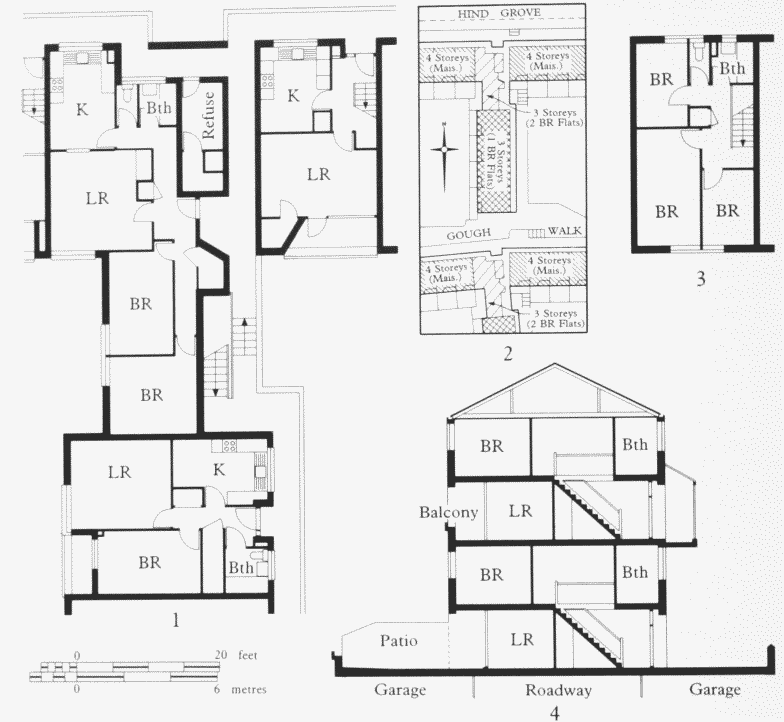
Gough Grove Scheme. Shepheard, Epstein & Hunter, architects, 1970–5 (1) Typical second-floor layout at junction of three- and four-storey blocks of flats and maisonettes: (2) Part of site layout, showingtypical junctions of blocks: (3) Typical third-floor layout of individual maisonette (in the four-storey blocks the lower tier ofmaisonettes has no balcony): (4) Section through four-storey block
Brabazon Street Scheme
This scheme was designed by the GLC's Architect, and in March 1976 a tender for its construction was accepted from Rush & Tompkins, (fn. 50) the final estimated cost being £952,888. (fn. 51) The development consists of Nos 16–44 Brabazon Street, a terrace of 15 three-storey, fourbedroom houses, together with Nos 1–19 (odd) Alton Street and Nos 2–36 (even) Hobday Street, which are both three-storey blocks each of 18 dwellings, giving in all 24 one-bedroom old people's flats and 12 threebedroom flats. All the blocks have flat roofs and are faced in yellow stock brick. The net area of the site is 1.047 acres and the density is 122 persons per acre. (fn. 52)
Grundy Street Scheme
Although the LCC officially declared the Grundy Street clearance areas in June 1964, (fn. 53) construction of the new housing, designed by the GLC's Architect, did not take place until 1982–3, at an estimated cost of £1,148,000. (fn. 54)
Nos 24, 26 Duff Street, Nos 147, 149 East India Dock Road, Nos 48–74 (even) Grundy Street, Nos 2– 18 (even) and Nos 49–59 (odd) Plimsoll Close, and Nos 2, 4, 9–15 (odd) Sturry Street are two-storey terraced houses in yellow stock brick, with pitched roofs covered in artificial slates. Nos 1–35 (odd) Plimsoll Close is a three-storey block of flats in similar materials which backs on to, and is set back from, East India Dock Road. One bungalow, No. 16 Sturry Street, is also included in the scheme. The heart of the development is Plimsoll Close, a largely enclosed and pedestrianized area, and access to the fronts of many of the houses is via narrow walkways.
Bartlett Park
Bartlett Park is the major open space on the Lansbury Estate and occupies just over 15 acres. It was named in honour of Prebendary Philip M. Bartlett, who died in 1958 and had been vicar of the nearby St Saviour's Church for 39 years (see page 204). (fn. 55) Because of economic restraints and difficulties in clearing the site, the laying out of the park was delayed, and then only gradually carried out in several phases. Work by the LCC did not begin until 1959, and the first parts of the park were not opened until 1961. (fn. 56) Further extensions were made by the LCC and GLC in the 1960s (fn. 57) (including the construction of a lodge to the park, No. 52 Stainsby Road), (fn. 58) but as late as 1977 Walter Bor complained: 'The parts scheduled for future extension of this open space are derelict … the open space so far created … is a dull flat green expanse'. (fn. 59) Bartlett Park was finally completed in the early 1980s by Tower Hamlets Borough Council, which had taken over responsibility for it in April 1971. (fn. 60)
The Lindfield Estate
North and south of Bartlett Park are two more LCC housing blocks completed in the 1960s, which, although forming the separate Lindfield Estate, can be regarded as adjuncts to the post-Festival part of Lansbury.
To the south, Anglesey House, at the west end of Lindfield Street on the south side, together with Denison House on the adjacent Farrance Estate, was built by the LCC as the Pelling Street scheme. (fn. 61) A tender for construction from J. M. Hill & Sons of Wembley was accepted in January 1959, the estimated cost for the two blocks being £189,900, and the scheme was completed in 1961. (fn. 62)
Denison House, which in fact was assigned to the Farrance Estate, is a three-storey block of 21 flats, (fn. 63) while Anglesey House is a ten-storey block of 60 flats, (fn. 64) and both are built in dark brown brick and have a flat roof. The overall density of the two blocks is 41 dwellings (107 persons) to the acre. (fn. 65)
Nos 1–94 (consec) Cotall Street, overlooking the northern edge of Bartlett Park, was built by the LCC as the Arcadia Street scheme, on a site of approximately 2.17 acres, at a density of 44 dwellings (145 persons) per acre. (fn. 66) The tender for construction, from Frank Bilton (London) Ltd of Beckenham, was accepted in January 1961, and the total estimated cost was £275,000 (£877 per room). (fn. 67) The six-storey, flat-roofed block contains 84 maisonettes and 10 flats. To improve the appearance of the exposed concrete columns and beams, and in order to reduce future maintenance costs, Derbyshire spar was used instead of smooth-faced concrete. A shop with a three-room flat over (No. 89 Stainsby Road), in red brick and with a flat roof, was built in connection with this development. (fn. 68)
Arcadian Self-Build Housing Scheme
Although not part of the Lansbury Estate, the self-build housing which wraps around St Saviour's Church is dealt with here (Plate 135c). It consists of Nos 1–34 (consec) Bartlett Close (formerly parts of Arcadia and Northumbria Streets). Jill Palios, who was involved in setting up the Great Eastern Self-Build Association on the Isle of Dogs (see page 701), also played a leading part in the formation of the Arcadian Self-Build Association. This group was formed in 1983 from local people who had expressed an interest in the Riverside Self-Build scheme at Wapping, and she helped to obtain the site, which was offered by Tower Hamlets Borough Council in 1984. Less than 20 per cent of the members were already owner-occupiers, the majority being council tenants.
A number of difficulties were encountered in developing the site, concerning site boundaries, access over church land, and road adoption. A more serious problem was obtaining the necessary finance. As with the Great Eastern scheme, the number of members, at 34, was larger than that recommended by the Housing Corporation, who refused to fund the Arcadian scheme. Many building societies were equally reluctant, but eventually the Halifax Building Society gave a loan of £1.6 million on condition that the project was managed by professional self-build management consultants approved by the Building Society – in this case Wadsworth & Cudd.
Construction was carried out from 1987 to 1989. A considerable number of the members of the Arcadian Association were in the building trade, while those who were not attended a training course. Almost all the work was, therefore, carried out by the members, although because of the difficult soil conditions some of the groundwork was initially sub-contracted. As with other schemes the members worked communally in their spare time, mostly at weekends, but in contrast to the Great Eastern scheme, wives were not only involved in the book-keeping and secretarial work, but provided meals for all the workers in a site canteen.

Three sketches published in 1950 for housing in the Lansbury neighbourhood designed by Geoffrey Jellicoe
a Three-storey houses in Chilcot Close
b Patio roof-garden at Nos 2–36 Bygrove Street
c Four-storey blocks of flats in Ricardo Street
The architects, the Beavan Sutters Partnership (project architect Trevor Sutters), deliberately produced a scheme which offered a wide range of housing types (25 different designs) of varying size (from 900 to 2,000 sq.ft), and of either two or three storeys. The design and the main materials seem to have been influenced by the church and the former vicarage (now St Saviour's Court). Mottled pale brown-black brick is employed, with red brick dressings, stained wooden window frames, and hipped or pitched roofs, covered in artificial slates Dormer windows and bracketed, slated porch canopies are other notable features, as is a large gabled archway at the western end of the development. The massing of the individual houses and the way in which they are stepped backwards or forwards disguises the fact that they are largely arranged in terraces. The accommodation was varied to suit individual owners, who might, for instance, have three or four bedrooms, and could opt for an integral garage or just a parking space. (fn. 69)