Survey of London: Volumes 43 and 44, Poplar, Blackwall and Isle of Dogs. Originally published by London County Council, London, 1994.
This free content was digitised by double rekeying. All rights reserved.
'The West India Docks: Historical development', in Survey of London: Volumes 43 and 44, Poplar, Blackwall and Isle of Dogs, ed. Hermione Hobhouse (London, 1994), British History Online https://www.british-history.ac.uk/survey-london/vols43-4/pp248-268 [accessed 1 May 2025].
'The West India Docks: Historical development', in Survey of London: Volumes 43 and 44, Poplar, Blackwall and Isle of Dogs. Edited by Hermione Hobhouse (London, 1994), British History Online, accessed May 1, 2025, https://www.british-history.ac.uk/survey-london/vols43-4/pp248-268.
"The West India Docks: Historical development". Survey of London: Volumes 43 and 44, Poplar, Blackwall and Isle of Dogs. Ed. Hermione Hobhouse (London, 1994), British History Online. Web. 1 May 2025. https://www.british-history.ac.uk/survey-london/vols43-4/pp248-268.
In this section
The Historical Development of the West India Docks
Planning the Docks, 1793–9
The building of the West India Docks between 1799 and 1806 marked the culmination of a campaign which had begun in the early 1790s. The West India merchants had become especially concerned about conditions in the Pool of London. Their vessels were second only in size to the East Indiamen and, because of the prevailing winds, were in the Thames for little more than four months of each year. Their trade was the most valuable in the Port, and discontent over congestion and delays was increased by their losses through pilferage, estimated at between £250,000 and £500,000 per annum during the 1790s. (fn. 3) The outbreak of the war with France prompted the merchants to take action, perhaps anticipating government support because of the loss of customs revenue caused by the theft of goods. In September 1793 they formed a committee to press for 'more adequate Provision for the Discharge of Shipping and the Warehousing of Produce'. (fn. 4)
The decision to build enclosed docks owed much to the vigorous and able advocacy of William Vaughan (1752–1850), a naval architect, trader and director of the Royal Exchange Assurance Corporation, and Robert Milligan (c1746–1809), a former Jamaica planter who had returned to London in 1780. (fn. 5) In his influential pamphlet On Wet Docks, Quays, and Warehouses, for the Port of London, published in 1793, Vaughan proposed four possible sites for docks; at Wapping, the Isle of Dogs, Rotherhithe, and St Katharine's, his preference being for Wapping. Though Vaughan thought that the Isle of Dogs was too far from the City, the area was favoured by Milligan, who, in the same year, prepared a plan for an enclosed wet dock there, comprising a single rectangular basin, 776ft by 453ft, surrounded by ranges of threestorey warehouses. (fn. 6) Much of the debate during the remainder of the 1790s concerned the relative merits of Wapping and the Isle of Dogs.
In 1794 the merchants engaged John Powsey, the engineer of the Brunswick Dock. He submitted his own proposals for the Isle of Dogs, together with a plan for docks at Wapping. The merchants evidently favoured the latter site, and in early 1796 they promoted a Bill in Parliament for docks there. The promoters were confident of obtaining adequate finance, having received £800,000 in subscriptions. (fn. 7)
The momentum which the Wapping scheme had gathered stung the Corporation into defensive action, for if the proposals were to be implemented its control over the Port would be weakened. In 1794 it appointed a committee 'to consider whether any and what Improvements are necessary and proper to be made in the Port of London' and it canvassed the support of William Pitt, the Prime Minister and Chancellor of the Exchequer, who favoured the extension of the facilities at the Port, presumably for the sake of tax revenue. To resist the Wapping proposals, the Corporation was obliged to put forward an alternative, if only as a spoiler. (fn. 8)
The City's plans were hurriedly prepared by George Dance (1741–1825), Clerk of Works to the Corporation, and John Foulds (1742–1815), his engineer assistant, with James Peacock, Assistant Clerk of Works, and James and William Mountague, clerks. (fn. 9) Foulds, formerly a millwright at London Bridge, had little experience in civil engineering, but in 1796 Dance paid him for an 'invention', of an unknown nature, for half-tide docks. (fn. 10) William Jessop (1745–1814), who had wide experience as a canal and dock engineer, was brought in as a consultant, although he may not have visited the Isle of Dogs at that stage. (fn. 11) This group put forward two plans, one for a single basin to hold 500 ships, estimated at £280,000, the other for three basins to hold loaded ships, empty ships and colliers, estimated at £305,000. A canal from Blackwall to Limehouse was also considered. (fn. 12) The proposals were designed to allow the City to keep foreign trade up-river, with the canal giving improved access.
Opposition to the Wapping Bill and the intervention of the City led to the appointment of a Select Committee of the House of Commons to consider the rival plans, as well as other dock proposals. The Committee's report, presented in May 1796, accepted without dissent that improvements were necessary, and that this almost certainly meant building wet docks. It did not express a preference for any one of the eight plans submitted, perhaps because none was yet anything more than an outline proposal. (fn. 13)
The scheme on which the City had settled was a variant that comprised a T-plan dock for empty ships, timber ships and rafts of timber, covering 102 acres on the Isle of Dogs, with two half-tidal entrance basins, and a similar dock at Rotherhithe. (fn. 14) Trinity House opposed these docks as being too far from the metropolis, but they were defended by Jessop and Dance as being large enough to anticipate future increases in trade, as well as presenting less of a fire risk than the relatively cramped arrangements proposed in the merchants' plan for Wapping. (fn. 15) That plan, prepared by Daniel Alexander, included a ship canal running north of Poplar from the river at Blackwall, (fn. 16) which was condemned as a cumbersome means of access. Another plan for docks in Wapping was presented by Ralph Walker (1749–1824), who was to be a key figure in the planning of the West India Docks. A former captain in the West India trade and Jamaica planter, he had designed an improved mariner's compass, but had no experience as an engineer. (fn. 17) His proposal was for two parallel 45-acre rectangular docks, surrounded by warehouses set back from the quays, with an eastern entrance basin and a western lighter dock. He suggested a perimeter wall 18ft high, and, in a strikingly innovative suggestion, proposed fireproof construction for the warehouses, with cast-iron 'arches' that he had designed. He also included a canal from the docks to Blackwall, and another across the Isle of Dogs capable of expansion to form a timber dock. Walker's plan was sound enough to gain the approval of Trinity House, whose Surveyor, Samuel Wyatt, had submitted his own plan for three parallel docks with entrance basins on the Isle of Dogs. Unlike other witnesses, Wyatt had addressed the question of financing the works, suggesting that 'as it appears to be a great National Concern, Parliament may be induced to give it general or partial Aid'. (fn. 18) Robert Milligan, who withheld his support from any of the plans, told the Committee that 'the Whole of the West India Trade should be taken out of the River, and accommodated with Wet Docks and Warehouses at the Isle of Dogs — Without Warehouses I don't think we should be at all benefitted by any Alteration of the present system'. He thought that a dock on the Isle of Dogs with surrounding warehouses 'would put a total Stop to embezzlement of every Kind'. He also considered an adjacent canal, as proposed by Walker, to be a good idea. (fn. 19)
Rival Bills were introduced in the next session of Parliament, by the merchants for docks at Wapping, but without the canal to Blackwall, and by the City for docks and basins on the Isle of Dogs and elsewhere, including a ship canal across the Isle of Dogs. (fn. 20) There were few opposing interests on the Isle of Dogs, and so the City's Bill excited less opposition. Nevertheless, in July 1797 both Bills were deferred.
In the meantime, Robert Milligan had persuaded others of the perspicacity of his ideas, most notably George Hibbert (1757–1837), a Port 'improver' since 1793, who had previously backed the Wapping plan. Hibbert was a vital convert; he was a leading West India merchant, an important wharfinger, and, from 1798, a City Alderman. Hibbert later testified that in 1795, within days of the decision being taken to build docks in Wapping, 'Mr. Milligan called upon me, and he suggested to me those reasons and those considerations, which finally led to the construction of a separate dock for the West India trade'. (fn. 21) Milligan's arguments against Wapping were that the size of West India ships made their passage so far up the river impractical, and that most thefts of cargo took place in the upper reaches. With such reasoning, distance from London became an advantage, especially as a relatively remote site would allow the building of an entirely enclosed and isolated dock. Hibbert gave Milligan all credit for planning the docks and for seeing the plan through to execution. On his death in 1809 the West India Dock Company eulogized Milligan, 'by whose intelligent mind the original plan of this great and useful establishment was designed and to whose admirable perseverance and indefatigable exertions . . . it is principally indebted for the legislative sanction for the arrangement of its business, and for its present prosperity'. (fn. 22)
Hibbert came to the fore as one of a group of West India merchants who, in June 1797, presented to the City's Port Committee a paper proposing two wet docks on the Isle of Dogs exclusively for the West India trade, with an adjacent canal for all other shipping. The first dock would be surrounded by warehouses to receive dutiable imports, the second would hold empty ships West India planters and merchants would raise the capital for the docks, offering 5 per cent interest, produced by charging rates on shipping using the docks. A tonnage duty on all shipping would fund the canal. The scheme was to be carried forward by a Joint Committee of the West India trade, the City and the Treasury. (fn. 23)
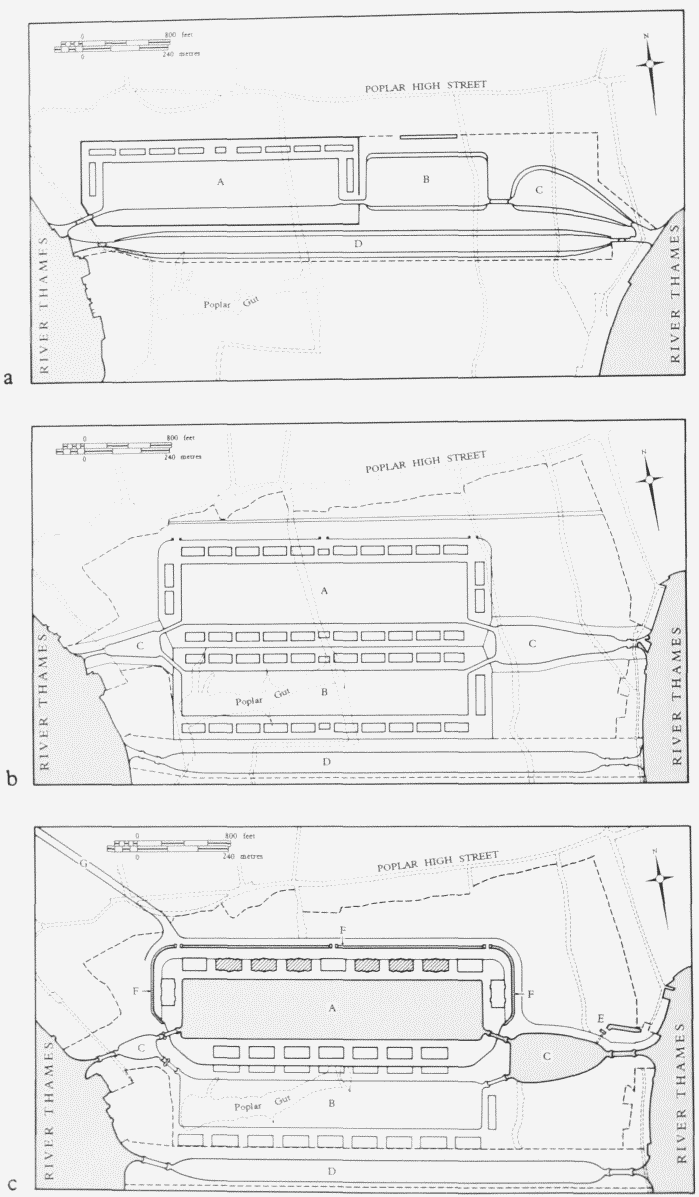
(opposite). West India Docks and City Canal, early proposals and plans a As projected in 1797: b As projected in 1799: c As built and projected in 1802 Key: A Import Dock: B Export Dock: C Basins: D City Canal: E Steam-engine House and Reservoir: F Boundary Ditch: G Proposed line of Commercial Road
In advance of an agreement, Dance, Foulds and Jessop, for the City, and Ralph Walker, appointed by the West India merchants on the strength of the proposals he had made in 1796, combined to devise and publish a plan for this scheme (fig. 90a). (fn. 24) It incorporated a number of elements from Walker's earlier plan, and it was evidently prepared by him, for it was drawn to the same base as his submission of 1796, with the canal on precisely the same lines. (fn. 25) The import dock — which was to cover 21 acres and be 23ft deep — was sited closer to the City, to minimize cartage. A preliminary plan showed 25 warehouses all round the dock, but this was almost immediately revised to eight sugar warehouses with rum vaults on the north quay and single coffee warehouses to east and west. There were to be quays 60ft wide, and roads behind the warehouses within a perimeter wall that was to be 30ft high. An office for Customs and dock officers would be placed in the centre of the north quay. To the east, an ungated cut would link to a dock for empty ships, covering 10 acres, to be equipped with rigging-houses and sail-lofts. A gate from the river at Blackwall would lead to an entrance basin. There would be locks between the basin and the 'Light Ship Dock', and from the river at the Limehouse end. The canal was to be 23ft deep and 176ft wide, with double gates at each end. The estimated cost of the whole scheme was £523,033, consisting of £241,800 for the warehouses, £217,587 for the docks and £63,646 for the canal. (fn. 26)
As the plans were developed, Dance and Peacock worked on the design of the warehouses, the former visiting wharves to sketch 'Loop Holes, Heights and substances of floors', and to measure puncheons of rum and loads of sugar, and the latter looking into the possibility of making the warehouses fireproof by means of iron floors. (fn. 27) The Mountagues gathered names of occupiers, lessees and landlords of the premises that would have to be purchased, and Dance and Walker met brickmakers at the Isle of Dogs to take sample borings. Dance and his staff also canvassed the views of residents and property owners, preparing detailed tables of 'Assent, Dissent or Neutrality' for submission to Parliament, presumably intended to contrast with the opposition to the Wapping scheme. Owners were recorded as 43 assenting, 5 dissenting, 17 neutral and 26 others; occupiers as 34 assenting, 9 dissenting, 11 neutral and 20 others. (fn. 28)
A general meeting of West India merchants in December 1797 considered the new plan. Milligan's views were stressed, as were the difficulties of the Wapping plan, and the savings in time and money that could be made by building on the Isle of Dogs. It was suggested that the capital be raised by subscription, with a proportion reserved for subscribers to the Wapping plan. The scheme was so alluring that, with little difficulty, it gained the approval of many who had already committed support and money to the Wapping project. The City's Common Council approved the scheme, and the Corporation and the West India merchants jointly introduced a Bill into Parliament. (fn. 29)
Numerous representations were made to Pitt on behalf of the Bill, and many undertakings were given relative to the proposed docks, including statements to the effect that there would be no quay sheds — perceived as a fire risk — and that exports would continue to be handled up-river. This last concession was made in deference to the Commissioners of Customs, who did not wish to move their operations to the Isle of Dogs. The Board of Excise also raised objections to the plan, prompting Walker to alter it. The import dock was enlarged to 28 acres and moved to the east of the 'Light Ship Dock', now 15 acres, as this was thought likely to be more secure. (fn. 30) These changes caused the estimate to be revised upwards by £52,056. (fn. 31)
Pitt declined to choose between the Wapping and Isle of Dogs schemes, and the Bills were deferred until 1799. The rival promoters met to try to reach an agreement and the possibility of amalgamating the schemes was explored, but their attempts failed, perhaps because of resistance from the City. The Isle of Dogs Bill began to encounter a swell of opposition from merchants and shipowners who feared the consequences of a 'compulsory clause' that would forbid the unloading of West India imports anywhere but at the new docks. (fn. 32) Its promoters campaigned hard to retain the clause, defended as the keystone of the whole venture, which was said to be not a speculative scheme but a vital public work to prevent trade leaving London. It was argued that the clause would ensure the success of the project and thereby bring great tax income through the prevention of theft, as well as considerable relief to the congestion in the rest of the Port. (fn. 33) It also, of course, made the scheme virtually riskfree as an investment. Hibbert and Milligan persuaded Pitt that if the 'compulsory clause' was not included 'the measure would be an imperfect one'. (fn. 34) There was also opposition from those who foresaw the uselessness of the canal and believed that it formed a part of the Bill only because the merchants had used it to lure the City into approval of their docks. (fn. 35) However, support for the Bill was considerable. A petition in favour of the Isle of Dogs scheme was signed by 43 merchants and 39 planters, claiming to own two-thirds of all the ships in the West India trade. (fn. 36)
On 1 May 1799 Pitt referred the Bills to a House of Commons Select Committee for a decision. The Committee reported a month later, recommending that both the Wapping and the Isle of Dogs schemes should proceed. (fn. 37) The latter was given precedence, ostensibly because it was cheaper and more quickly achievable, but perhaps also because of the City's involvement. The 'compulsory clause' was accepted, with support from Customs officials, who believed that it would simplify their task. The rate on shipping proposed by the City to finance construction of the canal was considered impossibly high, so it was halved, and the Consolidated Fund was called upon to provide a loan for the cost of construction and three years' maintenance. (fn. 38) Ralph Walker had affirmed the suitability of the Isle of Dogs for dockbuilding; the land was cheap and largely free of buildings, the soil was good for brickmaking, and there was a good bed of gravel suitable for pile-driving. The warehouses would be built with a view to the eventual adoption of the 'warehousing system' or bonding, whereby duty would not be paid on goods unless they were brought out of warehousing and into circulation. This had been a point of discussion for much of the eighteenth century. (fn. 39)
The Act for Rendering more Commodious and for Better Regulating the Port of London, which received the Royal Assent on 12 July 1799, (fn. 40) set out the framework for both the physical arrangements and the process of construction at the docks. The land required was to be purchased by the City within strictly defined limits on the north, east and west sides — protecting existing properties in Limehouse, Poplar and Blackwall — although no southerly limit was specified. Where necessary, the value of properties would be settled by jury. The land needed for the docks, but not the canal, would then be sold on to the West India Dock Company through trustees. Any surplus land might be leased out, provided it was applied to a use consistent with the improvement of the Port. The dock company was to be a joint stock company, with an initial capital of £500,000, to be increased to £600,000 if necessary. Interest was set at 5 per cent until the completion of the works. The maximum dividend was fixed at 10 per cent, with the intention of limiting the benefits to the company that would ensue from the 'compulsory clause', which required all vessels arriving from the West Indies to unload their cargoes (except tobacco) in the new docks, subject to penalty, for 21 years. Extra profits were to be eschewed in favour of reduced rates. The company was to be directed by any 13 of those who had subscribed at least £2,000, together with four Aldermen and four Common Councillors, thereby giving the City a voice in its deliberations. The docks were to be completed within five years, with the import dock and its warehouses surrounded by a wall, 30ft high, outside which there would be a ditch at least 12ft wide and containing 6ft of water. No buildings were to be erected within 300ft of the outside of the wall, and no fires, candles or lamps were to be allowed on the dock premises. The company was not to be in any way concerned with building or repairing ships, and so could not construct slips or dry docks. In an unprecedented use of public money, the Consolidated Fund was to provide compensation to those whose interests were damaged, and the loan of £72,000 towards making the canal. The tonnage rate, payable to the government for 14 years, would be offset against the cost of the canal, which would remain free of transit rates until three years after its completion. Lighters were exempted from paying the ship rate in the docks. This 'free-water clause' was inserted at the insistence of lightermen and private wharfingers whose business would be lost to the docks, and it brought many problems for the dock owners in later years. The combination of private and government investment and the enforced allocation of a particular trade to the docks made the company an undertaking of a new type. The detailed provisions of the Act concerning the physical, financial, administrative and operational particulars created a regulative model for the redistribution of control over the Port of London.
Launching the West India Dock Company was an enormous undertaking at a time of wartime austerity. It was one of the most ambitious public works projects hitherto attempted in England, with an authorized capital on a par with that approved for the Grand Junction Canal in 1793. (fn. 41) In terms of dock-building, nothing of a comparable scale had been undertaken, although the Wapping project had shown that there was a willingness to invest in docks in London. Canal companies and the Hull Dock Company provided models of privately financed public utility companies, the examples of which may have helped to frame the terms of the 1799 Act. The West India Dock Company, like most canal companies, obtained much of its finance from those who had direct or related interests. The 'compulsory clause' removed much of the speculative risk, and there was little difficulty in raising the initial capital of £500,000.
By the time that the company held its first meeting, in August 1799, all of the £500,000 had been subscribed by 353 investors. (fn. 42) Only about £150,000 was accounted for directly by West India merchants and planters. The Corporation of London advanced £29,000, ensuring adequate representation at general meetings, and a number of Aldermen, Common Councillors and Corporation staff, including George Dance, James Peacock and James and William Mountague, invested their own money. Amongst the other investors who had professional contact with the West India trade was the banking house of Smith, Payne & Smith, which had strong contacts in Jamaica, had been Milligan's bank, and was to become the company's bankers. The bank subscribed £10,000 and the partners invested a further £10,000 privately, but they were not acting as financial contractors. (fn. 43) Several other bankers and financiers invested, and, although they did not account for a large proportion of the total, they may have influenced others. Shipbrokers and a wide range of shipping-related trades were well represented. Edward and James Ogle, wharfingers, and Robert Wigram, shipbuilder, each invested £6,000, and Peter Mellish, shipbuilder, £5,000. Many other merchants, professionals and tradesmen, far too numerous to examine in detail, invested what, for many of them, must have been large sums. Perhaps a half of the total came from this predominantly City-based 'commercial' sector. Very few of the subscribers had addresses outside London and, although the net spread wider than with the relatively local issues of canal stock, the investment did not achieve the high degree of social penetration achieved by issues of railway stock in later years.
Directors were appointed at the company's first meeting. The Port Committee was prevented from making recommendations for the places allocated to the City, which were offered for election. The 13 elected stockholders were all West India merchants. They each received well over 200 votes, and no other candidate received more than 40, suggesting a previously agreed list. The eclipse of the City was assured the next day when Hibbert was appointed Chairman, with Milligan as Deputy Chairman. Shortly afterwards, Ralph Walker was appointed Resident Engineer and Inspector of the Works. (fn. 44)
The plan for the docks had to be altered. The Board of Excise had allowed that exports could be handled at the docks, but, for security reasons, only in a wholly separate dock. This created a precedent, for no earlier British dock had formally separated imports and exports. It was embodied in a clause in the Act requiring both docks to have independent communications with the Thames on both sides of the Isle of Dogs. Thus, one dock had to be north of the other, and the canal had to be moved further south. Walker had started to adapt the plan in May 1799 and in July Dance, Jessop and Walker together staked out a new line for the canal. (fn. 45) At the end of August a plan of the rearranged and somewhat larger docks was approved (fig. 90b). (fn. 46) The layout of the docks, very similar to that of Walker's 1796 scheme for Wapping, was essentially the one used when they were built. Walker submitted worked-up plans with estimates and quantities in November 1799. The 'great Dock for unloading Inwards' was to be surrounded by five-storey warehouses, and the 'Dock for light Ships and loading outwards' would be given similar warehouses as necessary. The cost of building the two large docks, two entrance basins and the first ten warehouses along the north quay was estimated at £523,658. (fn. 47)
The development of the docks is shown in figs 90c95, and on plan B in the end pocket of volume XLIV.
Building the Docks, 1799–1806
The building of the West India Docks was a formidable organizational challenge. The project had little by way of a model, for the Liverpool docks had grown piecemeal, and there was no domestic or foreign precedent for the construction of such a large system of wet docks. Nevertheless, the speed with which the work was carried out was in marked contrast to the sluggishness of the earlier deliberations. (fn. 48)
The City acquired the land, which consisted largely of fields, but also included timber-yards, ropewalks and houses. (fn. 49) Most of the transactions were agreed by March 1800, although a few of the owners' claims were not settled until 1802. A general conveyance from the City to the dock company was made in October 1800, and by the middle of 1801 the company had paid £71,615 for land. (fn. 50) The system worked smoothly enough to allow the dock works to proceed without significant delay. It ended, however, in acrimony and litigation, as the City had difficulty extracting from the company the last of the money owed. (fn. 51)
The company's works management devolved from a subcommittee of five directors that included Milligan and Hibbert, and the former evidently devoted much of his time to direct supervision. Arrangements for the engineering developed in a circumstantial way. In late 1799 Walker was acting alone in supervising preparations for the works. Dance's involvement was then limited to land acquisition and work on the City Canal, and Jessop was not in London. Experienced engineers were scarce, but it is astonishing that the inexperienced Walker was given sole responsibility for such a large project. He soon required help. In September 1799 the company asked John Rennie to advise on the dock entrances, and at about the same time Thomas Morris, Dock Surveyor to the Port of Liverpool since 1789, was asked to submit plans for the docks. (fn. 52) Morris anticipated problems with silting and stressed the importance of keeping up the water level in the docks. His proposals included reservoirs with steam-engine pumps. Walker obtained Rennie's support in rejecting Morris's suggestions as costly and unnecessary, though Jessop confirmed that there was no inexpensive way of keeping the water clean, advising that dredging was the most practical solution to the problem. The company stood by Walker's plan, and he acknowledged, 'I have had the assistance of Mr. Jessop in the projecting of the Plans of the Docks, and Mr. Rennie and Mr. Morris have also been consulted'. (fn. 53)
Excavation began on 3 February 1800, and a week later the company appointed Jessop to the post of Civil Engineer, to oversee Walker, for three years at a salary of £500 per annum. (fn. 54) Shortly afterwards, Walker's annual salary, which had to cover two assistants, was increased from £250 to £850. (fn. 55) Josias Jessop was taken on in December 1800, as an assistant to his father, at £100 per annum. (fn. 56) It was standard practice on large projects to employ a planning engineer with a less eminent resident engineer, and it is not clear why the company did not adopt that arrangement from the outset. (fn. 57) Dock design, including all the constructional detail, became the elder Jessop's responsibility, and he was employed almost constantly at the docks during the construction period. Initially, the day-to-day management of the work remained in Walker's hands, and he had responsibility for a number of contractors working on dock and basin excavation and construction. Jessop's direct supervision gradually increased at Walker's expense, however, as the latter steadily lost the executive subcommittee's confidence. In August 1800 Jessop was given full responsibility for the works and told to issue precise directions. The practice of contracts being arranged through Walker was thought to be one cause of slow progress with the work and so, in October 1800, the subcommittee decided to issue contracts itself, with Jessop as overseer. (fn. 58) By 1802 Jessop was on site nearly as much as Walker. They were under enormous pressure and occasionally had differences of opinion. When they exchanged 'improper language' during a discussion of the cause of an accident at the Limehouse Basin in October 1802, Jessop's version of events was preferred and Walker was made to resign. (fn. 59)
The building of the warehouses was managed separately (see page 284). In 1800 George Gwilt & Son were appointed architects for four years, at 1,000 guineas per annum. The younger Gwilt, also George, was to act as Clerk of the Works. (fn. 60) They devoted their full attention to the warehouses and associated buildings. From the outset, the contracts for the warehouses were arranged through the executive subcommittee.
On the whole, the contractors employed at the West India Docks kept to a particular trade. The principal exception was the partnership of William Adam and the brothers Alexander and Daniel Robertson, who contracted for a wide range of works, overstretching themselves to the point of bankruptcy. Adam was 62 years old in 1800, and the only survivor of the four brothers who had formed William Adam & Company. (fn. 61) This firm of developers and builders' suppliers operated on a very large scale, employing between 2,000 and 3,000 men, with its own timber wharf, brickyards and quarrying interests. Since the building of the Adelphi, in 1768–72, it had courted financial disaster, but had survived. Around 1800 William, who had been the most businesslike of the four, took into partnership the much younger Robertson brothers, who were probably relatives on his mother's side. (fn. 62) William Adam's financial record cannot have impressed the commercial men of the dock company, but there were few, if any, other building firms large enough to contract for the major works of the docks.
In May 1800 Adam and the Robertsons took a contract to build five warehouses, four months later they agreed to make 40 million bricks for the dock and lock walls, and in January 1801 to build the same walls. These contracts amounted to a huge commitment. By September 1801 they were not supplying themselves with enough bricks to maintain progress on the dock walls, having made only 9.5 million of the 24 million bricks they had undertaken to supply by that date. Not only did they have to purchase bricks from elsewhere, but, by the terms of their contract, they owed the dock company £12,300. This would have been crippling if, as Walker believed, there was a cartel amongst London's brickmakers, possibly involving the 'Wapping Gentlemen' (the London Dock Company), then also making huge demands on brickmaking capacity. Adam was forced to stop paying other creditors, and in early November 1801, at the height of the dock works, the contracts were abandoned as impracticable. The workmen and creditors of Adam and the Robertsons were paid by the dock company, and the partnership's materials were expropriated. At their own suggestion the dock company kept Adam and the Robertsons on as supervisors of direct labour, working under the Gwilts and Jessop, and ordering materials through the executive subcommittee. The dock company acknowledged that they had exerted themselves and were unfortunate rather than irresponsible. They were even given new building contracts, and from 1800 to 1803 were responsible for works at the docks worth more than £200,000. (fn. 63) Adam and the Robertsons survived as an unsteady partnership for another 20 years, although William Adam was bankrupted in 1817. (fn. 64)
In November 1799 Walker calculated that each of ten warehouses required 2,183,000 bricks. (fn. 65) The company had already begun to consider the question of brick supply, and had approached William Trimmer, a brickmaker whose family had an extensive and long-standing brickmaking business in Brentford and Chiswick. He was asked to see if the clay at the Isle of Dogs was suitable for brickmaking and, after trials, he reported that it was not. In February 1800 the company gave Trimmer a contract to supply 20 million stock bricks from Brentford for the warehouses. (fn. 66) (fn. 1)
Nevertheless, the company, keen to use the spoil from its excavations, continued to experiment with brick earth on the Isle of Dogs and, in July 1800, directed Walker to proceed with brickmaking on site. (fn. 68) The contract given to Adam and the Robertsons was for bricks made from locally excavated clay. Their bricks were inferior to Trimmer's, and were used for the dock and lock walls. By December 1800 all the dock company's fields west of Harrow Lane were being used for brickmaking. (fn. 69)
Trimmer's bricks were delivered by barge at Limehouse and transported to the warehouses by a timber railway. (fn. 70) Jessop recommended that the railway be made of iron, extended to Blackwall, with a branch to the brickfield, and re-laid as a permanent railway from the docks to Whitechapel when the works were completed, but his idea was rejected as too expensive. (fn. 71) Trimmer was consistently unable to supply as many bricks as he had promised and, by early 1801, small subcontracts were agreed with other suppliers at Trimmer's expense. When the brickmaking contract with Adam and the Robertsons collapsed in late 1801 the dock company was forced to obtain large numbers of bricks from outside suppliers, just when the London Dock Company was beginning to add to the huge demand for bricks. (fn. 72) The West India Dock Company even had to consider 'borrowing' bricks from its rival, but avoided that ignominy by assigning John Fentiman, of Kennington, to take over Adam and the Robertsons' brickmaking operations. (fn. 73) Fentiman became the company's most reliable supplier, producing more than 22 million bricks by 1804. (fn. 74) From 1803 the Trimmers took new contracts to supply bricks for the building of the Export Dock. By the end of 1803 the company had laid out more than £100,000 on bricks, and it spent another £100,000 on about 38 million more between 1804 and 1810. (fn. 75)
When work on the docks started it was intended that they should be ready for the arrival of the West India trade in the summer of 1802. (fn. 76) The first stages were completed smoothly, and on the first anniversary of the Act, 12 July 1800, William Pitt and Lord Loughborough, the Lord Chancellor, ceremonially laid the foundation stone of the first warehouse, at the south-east corner of what became No. 8 Warehouse. (fn. 77) The stone carried a commemorative inscription, later replicated at the base of the clock-turret on No. 5 Warehouse, at the centre of the north quay (Plate 52a). (fn. 2)
In August 1801 Jessop felt that work had not progressed sufficiently to make opening in 1802 a possibility. However, the directors were adamant that they should then be able to begin reaping their profits, and they drove Jessop, Walker and the Gwilts very hard from late 1801 to get the works completed. The third anniversary of the Act, 12 July 1802, was scheduled as the opening date, but this had to be deferred twice. (fn. 79) At last, on 27 August 1802 a crowd of tens of thousands, including many of the country's most eminent figures, gathered for a grand opening ceremony. Invited guests were accommodated in No. 8 Warehouse and two ships entered the docks with great pomp. The occasion was regarded as a national event of the first importance and was reported in superlatives. Indeed, the scale of the work stupefied some contemporary observers: The Times referred to 'the stupendous scale on which it has been planned' and noted that the dock itself, 'appearing like a great lake, was an object of beauty and astonishment'. (fn. 80) The Import Dock, Blackwall Basin, Blackwall entrance locks and three warehouses were essentially complete and already formed the largest wet-dock system ever seen.
Primary building work continued for some time after the official opening. It was clear in 1802 that the £600,000 capital stock permitted to the company was not going to be sufficient. It had already called on £400,000, but the Export Dock and many of the warehouses had not been started. (fn. 81) An amending Act, passed in June 1802, (fn. 82) raised the maximum capital to £800,000, extended the time limit for completing the works to 1807, and revised the requirements for the boundary walls. In 1803 the Warehousing Act was passed, (fn. 83) in anticipation of the completion of the north quay warehouses. By the terms of the Act the Treasury undertook to grant certificates to approved secure warehouses to permit the stowage of bonded goods. This made unloading and stowage much simpler. It also had enormous implications for the reexport trade and the development of London as an entrepot. A further Act, in 1804, allowed the company to increase its capital to £1,200,000, to enable it to complete the Export Dock. (fn. 84) The full amount had been raised by 1806, when, with the opening of that dock, the company declared its works complete. (fn. 85)
After Ralph Walker's resignation in 1802, engineering was in the sole charge of William Jessop. Daniel Vaux and a Mr Lepard served as assistant engineers for short spells in 1803, the latter being ignominiously dismissed for stealing brickbats. (fn. 86) The building of the Export Dock was supervised by Thomas Morris, appointed Resident Engineer in November 1803 at an annual salary of 800 guineas. William Pillgrem was made his clerk at 150 guineas per annum. (fn. 87) The engagement of the Gwilts was renewed in 1804, suggesting that it was intended that many more warehouses should be built. (fn. 88) However, shortly afterwards, the younger Gwilt said something offensive to an officer in the Tower Hamlets Militia and, refusing to apologize, was dismissed. His father went with him, so Morris was given charge of the Surveyor's Department, thenceforward subsumed within the Engineer's Department. (fn. 89) In fact, there was little further call for an architect. Once work on the Export Dock was safely under way, in 1804 the dock company made further savings by summarily terminating Jessop's appointment as Chief Engineer. (fn. 90) His expensive talents were no longer required, for engineering at the West India Docks had become essentially supervision, maintenance and alteration rather than design.
An Act of 1807 provided for a loan of £30,000 from the Consolidated Fund to allow the company to build Customs and Excise offices, barracks for the Military Guard, and a wall to enclose the Export Dock. (fn. 91) The use of public money was considered justified because these structures were all required for the security of bonded goods. They were completed by 1809. The company's total capital expenditure by 1810 was £1,222,291, of which £94,058 was for land, £309,894 for the Import Dock and entrance basins, £205,056 for the Export Dock. and £583,709 for warehouses, walls and other buildings, with the remaining £29,574 spent on repairs. (fn. 92)
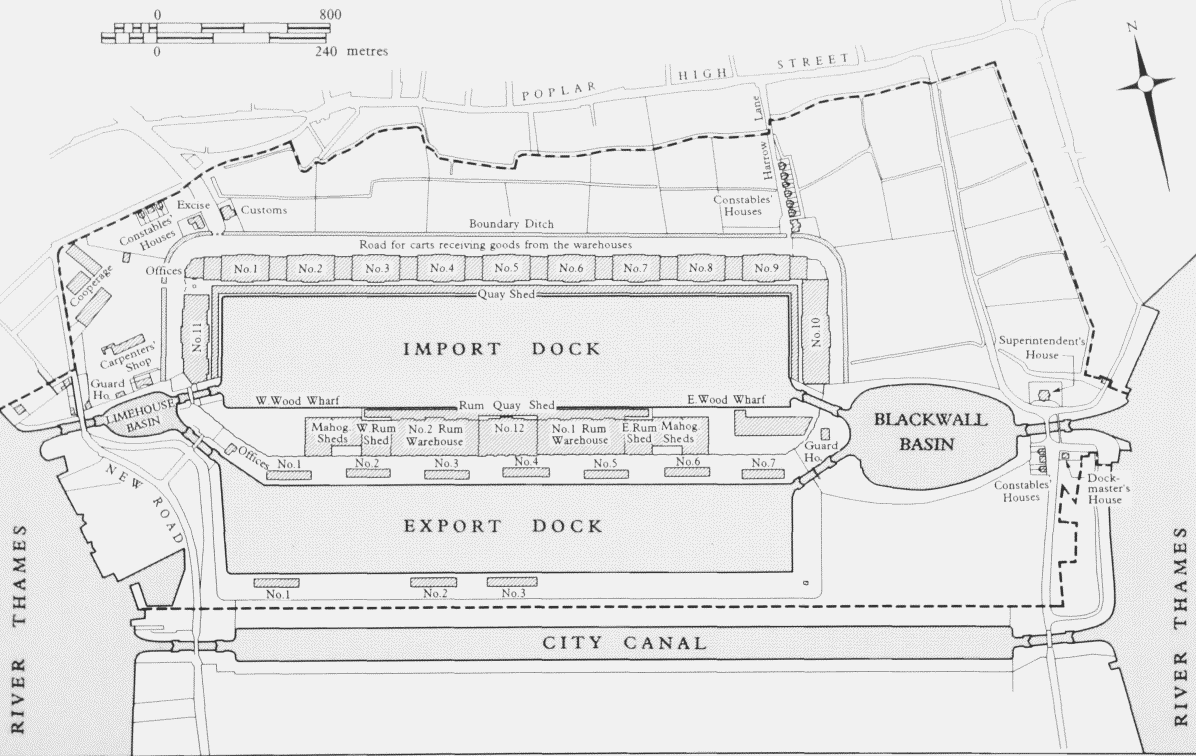
West India Docks and City Canal in 1822
Meanwhile, in 1800–5, the Corporation of London had built the City Canal (see page 275). The arrangement for financing its construction had proved wholly inadequate. (fn. 93) By 1802 the City had spent the £72,000 advanced from the Consolidated Fund, and on four separate occasions between 1802 and 1807 it obtained parliamentary sanction for further loans for Port improvements totalling £255,000, much of which was allocated to the building of the canal. Its cost was later put at £168,813, including the acquisition of land. (fn. 94)
The Development of the Docks, 1806–1980
Business boomed at the West India Docks in their early years. Sugar imports increased steadily, rum and coffee imports dramatically. The number of ships discharged in the docks rose from 354 in 1804, to 598 in 1808, and to an early peak of 641 in 1810. (fn. 95) In 1808 the warehouses were full, as blockades prevented the re-export of goods. (fn. 96) The dock company calculated that the almost total prevention of theft made possible by the building of the docks was saving West India merchants almost £400,000, and the Exchequer about £150,000, each year. The efficiency of operations brought considerable further savings. (fn. 97) The West India Docks were seen as a model of the warehousing system, with their orderly stacks kept rigorously secure. A Customs officer reported in 1823 that 'Since the West India Docks were opened for business, the system, both with regard to the revenue and the West India Dock Company, has been brought to a state of perfection scarcely to be surpassed'. (fn. 98)
The company's monopoly status brought it huge profits. The maximum dividend of 10 per cent was first distributed in 1803 and continued to be paid without interruption until 1829. Nevertheless, the company was flush with money; profits beyond the dividend limit amounted to £210,623 in 1809, £329,421 in 1813 and £177,539 in 1817, and by 1818 there was nearly £800,000 of reserve capital. (fn. 99) Rather than reduce its rates, as the legislators had intended that it should, the company turned to a programme of works, to complete the development of the docks roughly along the lines originally intended, but for which capital had been insufficient in the first decade. A Committee of Lands, Works and Buildings was formed in 1811, and in 1813–18 there was a campaign of expensive new work, much of it for the rum trade and largely on the south quay of the Import Dock (Plate 45a). (fn. 100) Between 1810 and 1822 the cost of new works was £221,902. (fn. 101)
From 1805 until 1809 the company's works were in the hands of Thomas Morris, with assistance from Pillgrem and Thomas Shadrake (c1768–1835), the foreman of carpenters. (fn. 102) Morris's experience was as a dock engineer and so Pillgrem may have been given much of the architectural work. The buildings of those years are architecturally undistinguished, and the drawings feebly executed. (fn. 103) Morris frequently employed the firm of Howkins, Barker, Morris & Constable as building contractors. When the pace of building work began to slow down in 1805, the works staff of 83 carpenters, 19 bricklayers and 6 masons was reduced to 20 carpenters, 6 bricklayers and 5 masons. This staff came to form the Engineer's Department, further reduced in 1819 to 7 carpenters and 12 labourers. (fn. 104)
John Rennie was Engineer to the West India Dock Company from 1809 to 1821. His appointment may have stemmed partly from dissatisfaction with Morris, but it may also have been due to the company's prosperity and the scope this gave for new works; an eminent engineer had again become a worthwhile investment. In London alone Rennie had, by 1809, engineered the London Docks and the East India Docks. (fn. 105) Morris resigned as Resident Engineer in 1811, perhaps because of poor relations with Rennie, perhaps because of ill health. Rennie then took sole responsibility for engineering and surveying work, with Pillgrem as his assistant until 1816, when he was succeeded by Shadrake, as Resident Engineer. (fn. 106) (Sir) John Rennie (1794–1874) took over from his father at the West India Docks in 1821, with the understanding that his brother George should share the appointment. (fn. 107) George Rennie (1791–1866) reputedly had the greater technical mind, but he was physically disabled, and it was John who was the partnership's more public face; he accepted the knighthood that his father had refused. The Rennies' office employed hundreds, so designs cannot easily be attributed to a single hand. (fn. 108) Shadrake continued as Resident Engineer until 1835, although in 1822 his accounts were found to be suspect and it was thought necessary to put him 'more under the Eye and control' of the Dock Superintendent, Captain Charles Compton Parish. (fn. 109) From 1825 the Engineer's Department was accommodated in the stores quadrangle (Cannon Workshops). It then comprised a stores foreman, seven carpenters and a foreman, a wheelwright, a painter, a glazier and ten labourers. (fn. 110)
Monopoly privilege was the root of the dock company's prosperity, but the 'compulsory clause' was due to expire in 1823. As this date approached, conspicuous expenditure was avoided and rates were reduced, to appease opposition. Many shipowners and West India merchants resented not only the monopoly, but also the autocratic management of the West India Docks. The company's large surplus made the monopoly difficult to defend. (fn. 111) In 1822–3 Parliamentary Select Committees considered that monopoly, aware that, as other dock company charters were due to come up for renewal, the decision would set an important precedent. It was resolved that the 'compulsory clause' should be allowed to lapse. Thereafter, the company was obliged to compete for the West India trade and to attract shipping of other origins. It consoled itself that its superior security arrangements would stand it in good stead against its competitors. (fn. 112)
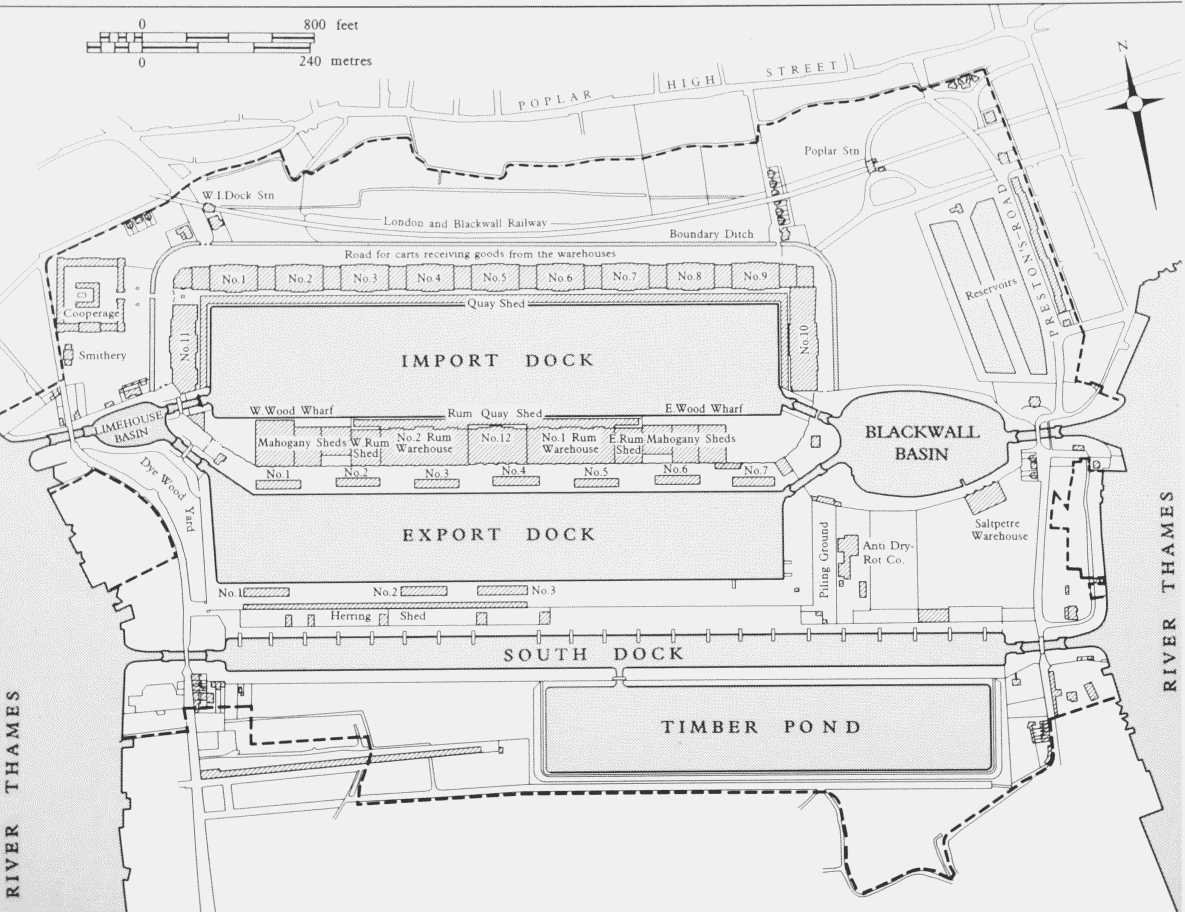
West India Docks in 1841
The expiry of the East India Dock Company's monopoly in 1827 led the West India Dock Company to reach an agreement with the East India Company regarding the landing and warehousing of certain East India goods at the West India Docks. (fn. 113) Nos 1 and 9 Warehouses were enlarged for that purpose, at considerable cost.
Despite its straitened circumstances, the West India Dock Company acquired the City Canal in 1829. The canal had been a dismal failure, unable to attract sufficient shipping even to pay for its own maintenance, let alone the interest on the borrowed money. The company bought it largely to prevent it from falling into other hands. Proposals for collier docks immediately south of the City Canal, and the opening of the St Katharine Dock in 1828, had heightened the company's awareness of the threat represented by other dock interests. To meet the cost of buying the canal, which was renamed the South Dock, and that of other necessary works, the company obtained an Act to allow it to raise £288,000 by issuing £180,000 of new stock at 160 per cent. (fn. 114)
Having used its monopoly profits to build up premises suited to a particular trade, the West India Dock Company found it difficult to adapt to general trade. The London and St Katharine dock companies used steamships to tow vessels up-river past the West India Docks, and the East India Company saw to it that East India shipping continued to use the East India Docks; such few East India goods as did come to the West India Docks were simply brought in by lighter. (fn. 115) The effects of competition were keenly felt by 1831, when the dividend had to be cut to 6 per cent and rates further reduced. There was a great fall in the price of the company's stock, and the dividend was lowered to 4 per cent in 1833. Accounts submitted to Parliament stopped giving detailed information, 'considering the active and keen competition'. The company was obliged to reduce its establishment considerably and the Committee of Lands, Works and Buildings was abolished 'as it conveys the idea that the Company is extensively engaged in works'. (fn. 116) In 1834 Sir John Rennie's salary was stopped and thereafter the Rennies devoted very little time to the West India Docks. (fn. 117) Joseph Gwilt (1784–1863), best known for his Encyclopedia of Architecture of 1842, was regularly employed by the West India Dock Company as a surveyor in the 1830s. He was another of the elder George Gwilt's sons, and a friend of Sir John Rennie. (fn. 118)
Competition enforced a narrowing of outlook. In terms of investment and development, the middle third of the nineteenth century was a quiet period at the West India Docks. The company became increasingly dependent on timber. It had always handled Caribbean hardwoods, but now Baltic softwood was floated in the South Dock, which was extended with the addition of a timber pond in 1832–3, the last major building work at the docks for 20 years. Timber was relatively unprofitable, however, and the cessation of the East India Company's commercial functions in 1833 gave the dock company hope that it might attract more of the East India trade. In fact it found itself obliged to buy some of the East India Company's warehouses in the City, just to maintain its existing share. One of them was acquired jointly with the East India Dock Company in 1835. (fn. 119) Amalgamation of the two dock companies became an increasingly obvious strategy for mitigating the debilitating effects of competition. A lack of warehousing at the East India Docks was neatly met by surplus warehouse space at the West India Docks. An agreement to unite the two companies was sealed in February 1838 and took effect in the following July, on the basis that the East India Docks were sold to the West India Dock Company for £685,668 of West India Dock stock. (fn. 120)
The East and West India Dock Company had 32 directors, of whom 20, including the Chairman, George Hibbert the younger (who remained on the Board until 1877), came from the West India Dock Company. (fn. 121) Authority at the docks rested largely with Simon Knight, Superintendent from 1838 to 1861. (fn. 122) The Engineer's Department was reorganized in 1838. John S. Adams retained the post of Resident Engineer that he had held at the West India Docks since 1835, and Henry Daniel Martin, from the East India Docks, was appointed Surveyor. Within months, however, both men were given equal and joint responsibility for engineering and surveying. (fn. 123) Following a suggestion from Martin, in 1845 the Engineer's Department was reduced from 24 to 11 men, and ordinary repair work was put out to contract for the first time. (fn. 124) Contracts for new works were arranged, as previously, through invited tenders, and very few contracts were put out to open tender. This was the practice followed throughout the working life of the docks.
During the 1840s and early 1850s shipping and tonnage handled at the docks increased dramatically, and dividends of 5 and 6 per cent were paid. Relatively unprofitable bulk goods, such as timber, grain and guano, accounted for much of the increase in imports. Rising consumer demand meant that goods passed through the docks quickly and little new warehousing was needed, except for guano. (fn. 125)
The London and Blackwall Railway, opened in 1840, improved connections between Poplar and the City, but provided no direct link to the docks. Such a link was not regarded as worthwhile when the railway did not have wide connections. The first rail link to any of London's docks was tardy in relation to developments elsewhere in the country, not coming until 1851, when the East and West India Docks and Birmingham Junction Railway Company's Railway (Poplar) Dock was opened (see page 336). Henry Daniel Martin was the engineer for the dock, having been instrumental in the formation of the railway company. The line connected the West India Docks to north London and provincial manufacturing districts. Poplar Dock was immediately in heavy use, particularly by colliers.
The only other significant construction project at the West India Docks during the 1850s was the formation of the Junction Dock in 1853–5. This followed an accident at the Blackwall entrance, which highlighted the vulnerability of a dock system dependent on one entrance, and caused the company to bring in James Meadows Rendel (1802–56) as a consultant engineer. He had established his credentials as a dock engineer in the 1840s at Birkenhead and Grimsby. (fn. 126) Rendel engineered the Junction Dock and was the inspiration for the adoption of hydraulic machinery at the West India Docks in 1854–5.
From 1854 the Engineer's Department, reduced to seven, was headed by Henry Daniel Martin, with his son Charles as his assistant until 1860, when Charles took prime responsibility. (fn. 127) The careers of both men with the company came to an abrupt end in 1861. They were dismissed when fraud was detected in their relationship with Charles and William Hack, contractors for numerous works at the docks since the 1830s. It emerged that, between 1852 and 1861, the Martins had certified overcharging to a total of £12,200. (fn. 128)
The extension of bonding privileges to private wharves, in 1853, led to the establishment of many new warehouses along the Thames and damaged business at the enclosed docks, particularly as goods brought in to the docks could be lightered out to wharves free of charge. Additional competition came with the opening of the Royal Victoria Dock in 1855. The established dock companies reacted by agreeing to reduce their rates, also making the first of many unsuccessful joint applications for the repeal of the 'free-water clause'. (fn. 129) With the loss of guano and other business to the Royal Victoria Dock, the late 1850s and early 1860s saw a slackening off of the import trade at the West India Docks. The dock company's position was sustained by export business, largely based at the East India Docks, which more than doubled in volume between 1855 and 1864. (fn. 130)
In 1864 the East and West India Dock Company's rivals amalgamated as the London and St Katharine Dock Company, and plans for the Millwall Docks were approved. The latter development aroused surprisingly little concern, but the need to stem the competitive threat through capital expenditure on works of improvement was recognized as unavoidable. The increasing number of large ships in the Port had, for some years, required a larger entrance and deeper water than the company could offer. Plans for the enlargement of the East India Docks were abandoned in favour of a scheme for rebuilding the South Dock with an enlarged east entrance lock, deep-water quays, and new warehouses. The dock company had, since 1830, carried over the power to raise new stock of £320,000, successfully issued at 120 per cent in 1867, despite the general financial depression. This covered most of the £418,500 initially estimated as necessary for the works, but the company needed recently obtained powers to borrow £320,000 more, as the cost of the improvements escalated to £644,140. The rebuilt South Dock opened in 1870. (fn. 131)
The dock company had no staff engineer in the 1860s. From 1864 to 1872 (Sir) John Hawkshaw (1811–91), the eminent railway engineer, was retained as a Consulting Engineer, in the first instance with respect to proposals for the Millwall Extension Railway, but secondly, and more importantly, for the rebuilding of the South Dock. Hawkshaw had worked with Jesse Hartley at Liverpool, built Penarth Docks near Cardiff, and was building the Albert Dock at Hull. Much railway work at the West India Docks was done by Harrison Hayter (1825–98), Hawkshaw's Chief Assistant and, from 1870, partner. (fn. 132) The Resident Engineer for the South Dock rebuilding was Leveson Francis Vernon-Harcourt. William Strong was Clerk of Works in 1861–3, and was succeeded by Edward J. Leonard, who, in 1854–5, when employed by Sir William Armstrong & Company, had supervised the installation of hydraulic machinery at the West India Docks. He was described as a 'superior fitter' and had no experience of building. (fn. 133) After the discovery of the Martins' frauds, the directors of the company took a close interest in the letting of even small contracts. Leonard was accused of general inefficiency, and resigned in 1871. He was succeeded by George Richardson, Clerk of Works until 1873. (fn. 134)
From 1861 onwards, building work in the docks was subject to the scrutiny of the Fire Insurance Offices' London Wharf and Warehouse Committee and its surveyors, Charles Freeman, and, from about 1870, Edwin Arthur Brassey Crockett. The insurers acted very much like a planning committee, reviewing plans and suggesting alterations.
In the 1870s the East and West India Dock Company promoted its revitalized facilities with vigour, under the leadership of its Secretary, John L. Du Plat Taylor (d. 1904). It abandoned a rates agreement with the London and St Katharine Dock Company, and began to compete for the warehousing of Australian wool. Wool warehouses were built at the South Dock, and a rates war loomed. (fn. 135) In an increasingly competitive port, the company was obliged to offer regular berths to large shipping companies. The South Dock was let on that basis and, for a short time, it was a success.
The principal goods handled at the West India Docks in the late nineteenth century were still sugar, rum, mahogany, teak and coffee, with the addition of wool in the 1870s and frozen meat in the 1880s. The bulk goods brought to the docks during the middle period of the century, softwoods and grain, had been lost to the Millwall and Surrey Docks during the rebuilding of the South Dock.
Both the Millwall Docks and the Royal Victoria Dock had the advantage of facilities for ship repair. Prompted by shipowners, in 1874 the East and West India Dock Company gained the repeal of the prohibition on the repair of ships in its docks. (fn. 136) This allowed construction of the West India Dock Graving Dock, built under lease and opened in 1878. The Act also gave borrowing power of £475,000, and permitted the creation of debenture stock to finance a programme of improvements whereby the East Wood Wharf was developed and more warehouses were built at the South Dock. (fn. 137) All the debenture stock had been issued by 1878 and so power was obtained for the issue of up to £750,000 more. (fn. 138) Separately, in 1875–7, the North London Railway Company extended Poplar Dock and built large new warehouses on its quays.
The need for additional South Dock warehouses, and concern that the Engineer's Department was not being adequately managed, led in 1872 to the appointment of a permanent Superintending Engineer, Augustus George Sackville Manning. (fn. 139) As numerous improvements were put in train, the Engineer's Department grew. From 1875, Manning was assisted by R. L. Berwick, Assistant Engineer, and Brice Tydeman (d.1898), Clerk of Works. (fn. 140)
A reduction in trade, together with the opening of the London and St Katharine Dock Company's Royal Victoria Dock Extension (Royal Albert Dock) in 1880, brought gloom to the East and West India Dock Company. The Port was over-provided with warehouses, in which goods were being kept for shorter periods, thereby reducing rental income. The West India Docks were hampered by their inability to accommodate the largest ships using the river; the insufficiently enlarged South Dock entrance was obsolescent within a decade of its opening, and its shipping transferred to the Royal Albert Dock. Any significant rebuilding of the docks would have involved temporary closure and the risk of huge losses. It was against this background that in 1881 the East and West India Dock Company decided to build a dock at Tilbury, rather than call a halt to damaging competitive expansion. (fn. 141) Tilbury Dock opened in 1886, having absorbed more than twice its projected cost, and during a trough in the trade cycle. Peripheral properties at the East and West India Docks were sold to offset some of the capital costs of Tilbury. (fn. 142)
A further squeeze came with the need to follow the London and St Katharine Dock Company in a reduction in rates. The financial situation became a crisis in 1887, and cuts were made to expenditure on repairs, staff and salaries. (fn. 143) Amalgamation with the London and St Katharine Dock Company, previously spurned, now seemed desirable. A scheme was produced whereby the two companies' docks would be operated by a Joint Committee, but as the East and West India Dock Company was to be the poor relation in the arrangement, its shareholders initially rejected it as inequitable. The company went into receivership on 5 March 1888, but avoided liquidation, kept its property and continued its dock business. The terms for the Joint Committee were finally accepted and, in August 1888, the arrangement was confirmed. (fn. 144)
The London and India Docks Joint Committee controlled operations and works at the East and West India Docks from 1 January 1889. The Chairman and Secretary both came from the London and St Katharine Dock Company. (fn. 145) The East and West India Dock Company continued to manage its finances and to provide capital for new works.
During the 'Great Dock Strike' of 1889, public attention and sympathy were enlisted in support of the poorly paid, yet well-organized, dock labourers. (fn. 146) The vision of magnificence and order for which the docks were praised at their opening had long since faded. The early nineteenth-century structures of the West India Docks had come to be perceived quite differently, as represented by Conrad: 'The stony shores ran away right and left in straight lines, enclosing a sombre and rectangular pool. Brick walls rose high above the water — soulless walls, staring through hundreds of windows as troubled and dull as the eyes of over-fed brutes'. (fn. 147)
Working agreements in the 1890s between the Joint Committee and the Millwall Dock Company and Surrey Commercial Dock Company designated particular types of traffic as belonging to one or other dock and harmonized rates. (fn. 148) Existing specialisms were reinforced, and so each dock continued to receive the business that it had already made its own. As the earlier fierce competition abated, improvement works again became possible. The width of the entrance locks (38ft) and the depth of water (23ft) in the West India Import and Export Docks made them inaccessible to large ships. In 1892–4 the Blackwall entrance lock was rebuilt, and an impounding station was formed to raise the water level in the docks. Tonnage handled in the Import and Export Docks improved dramatically from 124,000 in 1892 to 236,000 in 1895. (fn. 149) To make better use of the deep water in the South Dock, its eastern entrance lock was also enlarged, in 1900–2. Other major works were the installation of refrigerating plant in No. 5 Warehouse on the north quay, and the erection of large open sheds for teak and other woods near the Junction Dock. The general decline in the importance of warehousing continued. From 1878 to 1898, goods in stock at the London and India Docks as a proportion of goods landed declined from 53 per cent to 22 per cent. (fn. 150) Increasingly, goods had to be transferred quickly from ship to consumer, and so greater emphasis was placed on transit handling, requiring sheds rather than warehouses.
Augustus Manning resigned as East and West India Dock Company's Superintending Engineer in 1887, with 'a large reputation' following the completion of Tilbury Dock. He was succeeded by C. R. Walker, who had no scope for enterprising work. (fn. 151) In 1889 the Joint Committee appointed Robert Carr (1827–97) as Engineer in Chief, with Joseph Thomas (1838–1901) as Resident Engineer. (fn. 152) Carr and Thomas had been responsible for much of the London and St Katharine Dock Company's work at the Royal Docks in the 1880s. Carr suffered a mild stroke in 1892 and was relieved of his duties, save continuing responsibility as Consulting Engineer for the rebuilding of the Blackwall entrance lock. Others involved in this work also had Royal Albert Dock credentials: (Sir) Alexander Meadows Rendel (1829–1918), son of James Meadows Rendel, brought in to design the lock gates, and the contractors, Lucas & Aird. (Sir) Hay Frederick Donaldson (1856–1916), previously Resident Engineer for the first section of the Manchester Ship Canal, was Joint Committee Engineer from 1893 to 1898, H. C. Baggallay took up that post in 1898, and he was succeeded by Charles E. Vernon in 1900. (fn. 153)
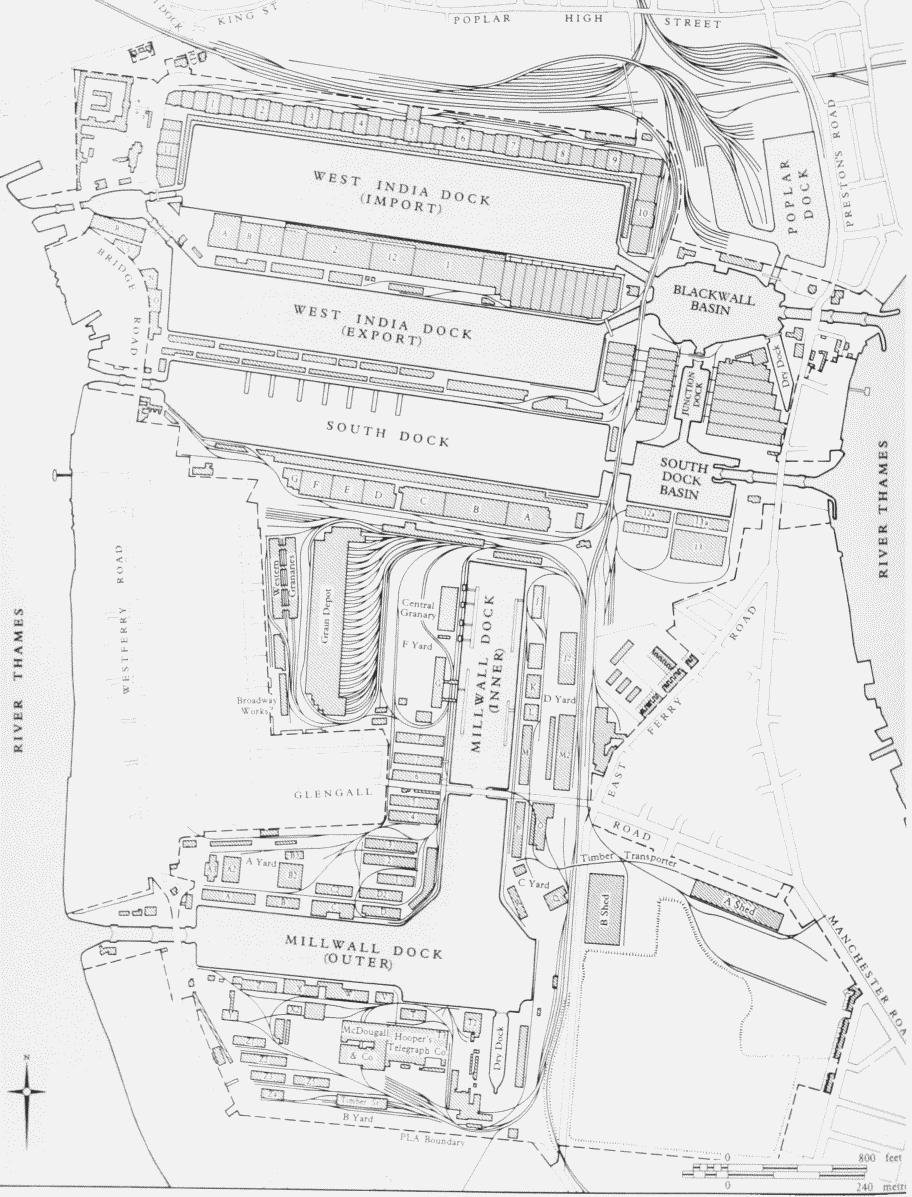
West India and Millwall Docks in 1910
The cumbersome working union had always been intended as a move towards amalgamation. However, it was not until late 1898 that the East and West India Dock Company accepted full amalgamation, a step that was regarded as 'rather like being married in church after you have been married at the registry office'. (fn. 154) The London and India Docks Company came into being on 1 January 1901 with the acquisition of the East and West India Dock Company by the London and St Katharine Dock Company. Nevertheless, the inefficiencies associated with free competition still threatened a loss of trade to foreign ports. This, and the long-standing grievance against the 'free-water clause', led to the appointment of a Royal Commission on the Administration of the Port of London which, in 1902, recommended the incorporation of a port authority to purchase and manage all London's docks. (fn. 155) The recommendation received influential backing, despite dock company objections, yet the projected reforms ran into serious difficulties. (fn. 156) The government was determined that the new body should be commercial, along the lines of the Mersey Docks and Harbour Board, rather than municipal, as the London County Council wished it to be.
The uncertainty deterred the dock proprietors from undertaking improvements. Frustrated by the lack of progress, the London and India Docks Company prepared its own Bills for reform of the port and, in 1906, proposed amalgamation with the Millwall Dock Company. (fn. 157) A government scheme for a self-supporting public authority under the control of the Board of Trade was put forward in 1907. The Port of London Bill was steered through in 1908 by David Lloyd-George and his successor at the Board of Trade, Winston Churchill. (fn. 158) The government bought the docks, and the new Port of London Authority (PLA) assumed control on 31 March 1909.
The PLA, under the chairmanship of Sir Hudson Kearley, later Viscount Devonport (1856–1934), managed the docks through its Dock and Warehouse Committee, which until 1920 was chaired by (Sir) J. G. Broodbank (1857–1944), who had been Secretary of the East and West India Dock Company and the London and India Docks Company from 1889 to 1909. (fn. 159) Building work was the responsibility of the Works and Improvements Committee. (fn. 160) (Sir) Frederick Palmer (1862–1934), who had overseen major works as Chief Engineer to the Port of Calcutta, was appointed Chief Engineer to the Port of London. (fn. 161) Palmer reported to the Secretary and General Manager, Robert P. Philipson, who in turn reported to the main committees. (Sir) Cyril R. S. Kirkpatrick (1872 1957), previously Engineer to the City of Newcastleupon-Tyne, became Chief Assistant Engineer, and Magnus Mowat (1875–1953), who had served at the Millwall Docks as Assistant Engineer from 1902, then Chief Engineer from 1905, was Resident Engineer at the India and Millwall Docks until 1920. (fn. 162) The PLA created five dock groups, the West India, East India and Millwall Docks forming one of them, known as the India and Millwall Docks. (fn. 163)
The PLA declared its long-term plans for London's docks in January 1911, with the publication of Palmer's 'Proposals for Improvement and Extension of Dock Accommodation in the Port of London'. These were presented as a three-stage scheme that would cost £14,400,000. An important part of the plans was an extensive programme of works at the 'almost, if not quite, deserted' West India Docks, which had the valuable asset of good communications with the City. Palmer initially proposed a large entrance basin to link the Import, Export and South Docks, but it was later decided to keep the docks separate. The first-phase West India Dock improvements, large sheds on widened north quays at the Import and Export Docks, were largely complete by 1915, at a cost of £268,447. (fn. 164) These works, and others at the East India Docks, were intended to facilitate an overhaul of the South Dock, for which the £894,000 required was not yet available. Palmer's plans for the South Dock involved rebuilding the east entrance lock, basin and passage, eight large quay sheds with a new south quay, and a dry dock. (fn. 165)
Having pushed through his ambitious plans, and following disagreements with Lord Devonport, Palmer resigned as PLA Engineer in 1913. The nature of the disagreements is suggested by Broodbank's comment that 'the materialization of the ideals of engineers, if unchecked by commercial expediency, might easily be the ruin of the greatest port in the world'. (fn. 166) Kirkpatrick was promoted to Chief Engineer and H. J. Deane became Chief Assistant Engineer. (fn. 167) In 1914 Kirkpatrick revised the proposals for the South Dock, reverting to Palmer's original idea, with a large turning basin linking the docks. He also included for the first time a communicating passage from the South Dock to the Millwall Inner Dock. Despite the outbreak of war, and an estimate revised to £1,631,000, the South Dock redevelopment remained set to proceed 'so soon as the financial situation will permit'. (fn. 168) An enabling Act was obtained in 1917, but it did not encompass arrangements to meet the expense of improving the South Dock. Soaring building costs and a sharp drop in trade at the end of the First World War brought further difficulties. (fn. 169) The PLA suspended all new works in 1920, and authorization for the South Dock work was revoked. (fn. 170)
From 1921 to 1938 the day-to-day affairs of the Port, including questions of dock improvement, were the responsibility of (Sir) David John Owen (1874–1941) as General Manager. (fn. 171) He was succeeded by (Sir) J. Douglas Ritchie (1885–1983), who held the post until 1946. Viscount Devonport was succeeded as Chairman by Lord Ritchie of Dundee (1866–1948, Chairman 1925–41).
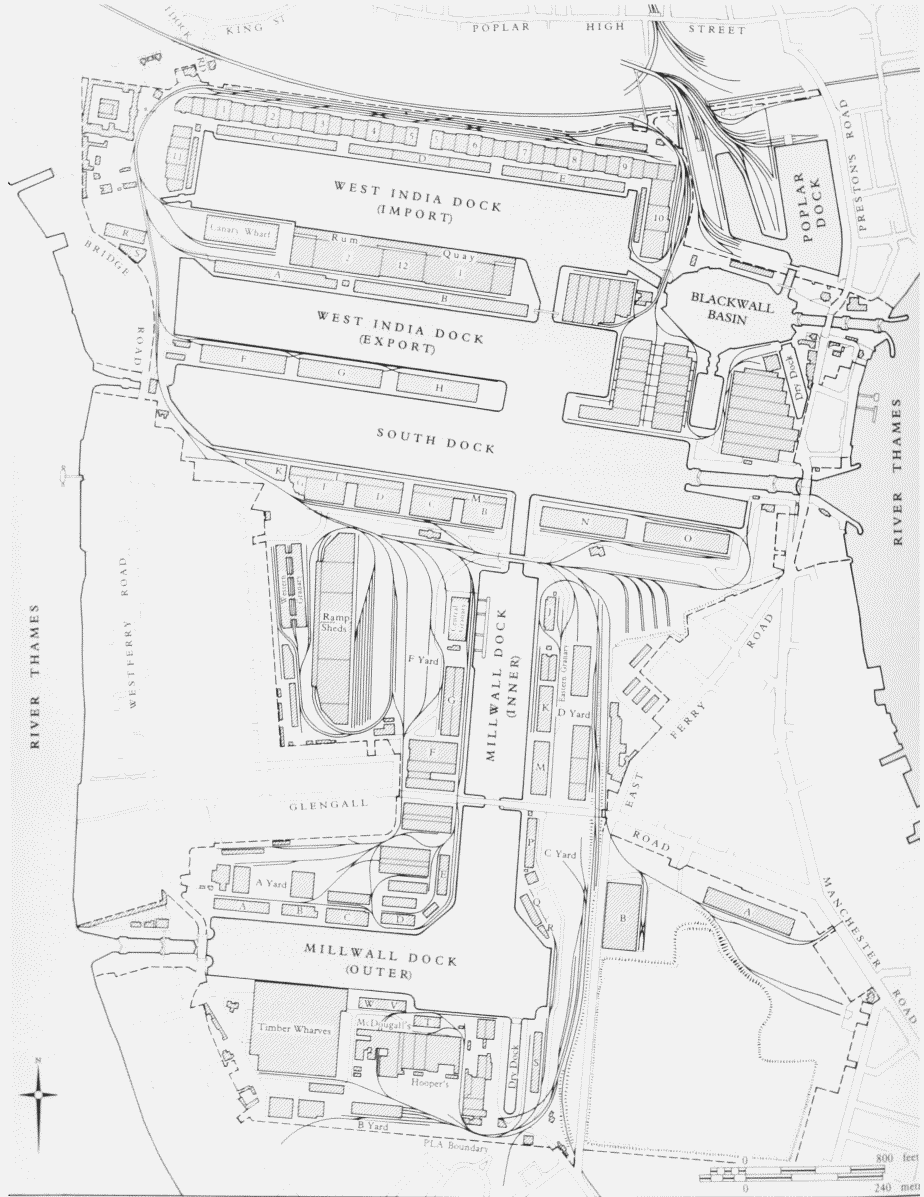
West India and Millwall Docks in 1938
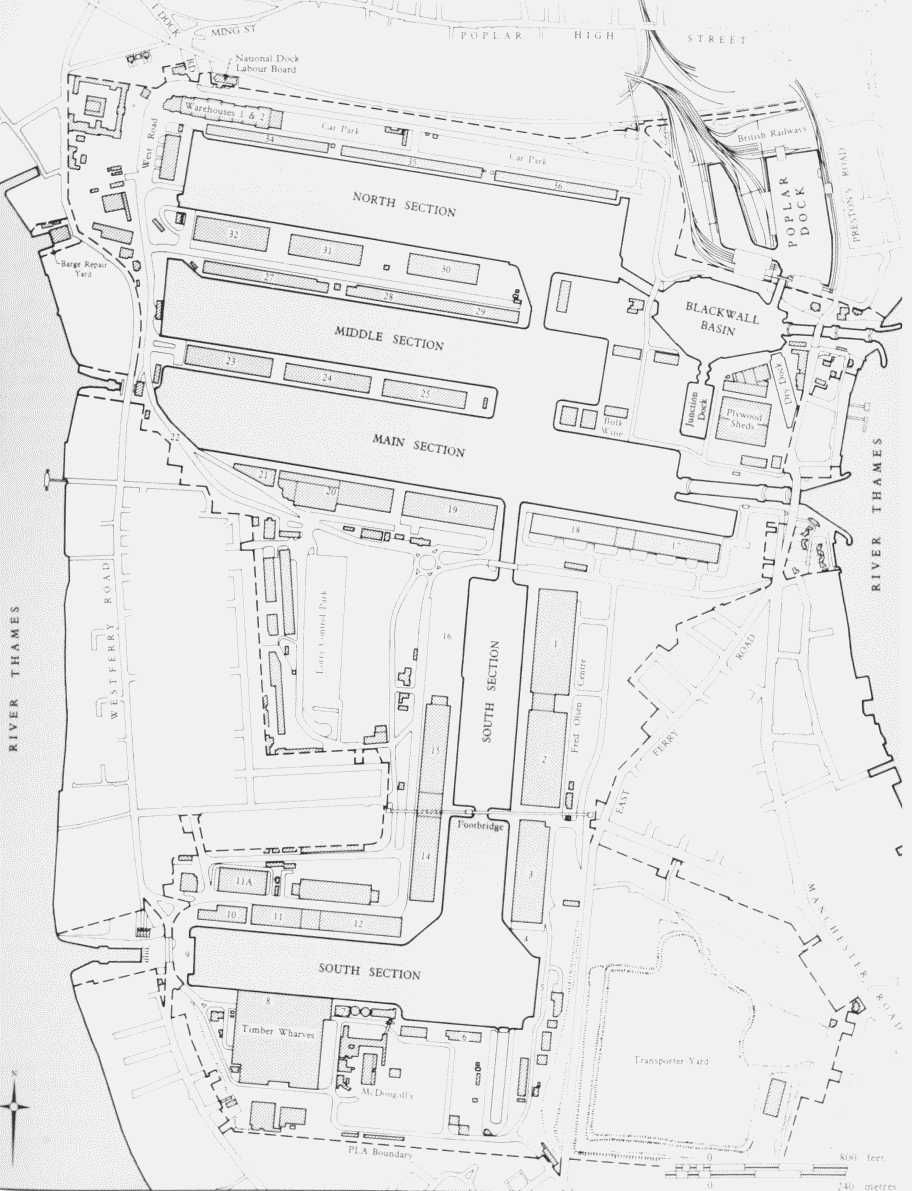
West India and Millwall Docks in 1973
The PLA Engineering Department was reorganized in the early 1920s. From 1921 all marine and mechanical engineering repair and maintenance was carried out under contract, by Harland & Wolff, on 12 leased sites throughout the dock system. This allowed the PLA to reduce its engineering and stores staff. (fn. 172) It did not, however, cover buildings, for which there was a considerable catalogue of deferred maintenance work. In 1923 Asa Binns (1873– 1946), who had been Resident Engineer for the construction of the King George V Dock (opened in 1921), took up the new post of Mechanical and Maintenance Engineer. (fn. 173) George A. Webster, newly appointed as Quantity Surveyor, prepared a schedule for the maintenance of the docks and warehouses and, in November 1923, a three-year contract for civil engineering and building maintenance work was given to John Mowlem & Company, for £254,092 per annum. (fn. 174) Despite doubts as to its efficacy, maintenance and repair by contract, rather than by direct labour, was continued, with Harland & Wolff and John Mowlem & Company retaining the contracts. The latter were responsible for maintenance at the India and Millwall Docks until such work was suspended in 1976. (fn. 175)
The 1923 reorganization brought more redundancies, including the loss of H. J. Deane. By the end of 1924 the changes had led Kirkpatrick to resign. Palmer was re-employed as Consulting Engineer for a revived programme of improvements, initially at Tilbury, but soon also at the West India Docks. (fn. 176) Further appointments were made with particular regard to these improvements. George Corderoy & Company were appointed as quantity surveyors, Frederick William Daniel Davis took the post of New Works Engineer, and A. P. Lambert that of Resident Engineer for the India and Millwall Docks improvements, succeeded by R. R. Liddell in 1929. (fn. 177) Additionally, Sir Edwin Cooper (1873–1942), architect of the PLA's Trinity Square headquarters, was employed in the 1920s to design a number of office and domestic buildings in the Port. (fn. 178) These show Cooper to have been as much a master of the simple and small-scale as he was of the grandiose and opulent.
The India and Millwall Docks improvements, held in abeyance until 1924, were revived, with the spur of a shipping firm's complaint that the convenient situation and good shed and quay accommodation of the West India Docks were wasted because the entrance locks were too small. The docks were again becoming obsolete. (fn. 179) Owen and Kirkpatrick began to revise the earlier scheme. After Kirkpatrick's departure, and consultation with Palmer, a relatively modest programme of works emerged, at a projected cost of £1,030,000. It included a new South Dock east entrance lock and three passages to link the Millwall, South, Export and Import Docks, all to be engineered by Palmer. Expenditure was deferred until the Unemployment Grants Committee's approval of a grant, which was given in 1925. (fn. 180) In 1929, further expenditure of £242,882 on sheds at the South Dock was approved. These works qualified for grant aid on condition that half the labour force came from depressed areas. The whole project, divided into four contracts, was completed in 1931 at final costs of £1,311,981 for the dock works, and £295,995 for the sheds. The dock works considerably improved access to the docks, but also reduced berth and shed space. (fn. 181)
The Engineering Department was reorganized again in 1930. Asa Binns was put in charge, with F. W. D. Davis as his Chief Assistant. Binns retired in 1938, Davis in 1939. (fn. 182) The return of buoyant trade led, in 1936, to the preparation by Owen and Binns of a six-stage programme of works for the 'Modernization and Development' of the Port, at an estimated cost of £12 million. In general, these were not dock-building proposals, but schemes for quay, handling and storage improvements. In the India and Millwall Docks, only one transit shedwarehouse at the Millwall Inner Dock was completed from this programme. (fn. 183) Another transit warehouse was separately built in 1937 on the south quay of the Import Dock, for Fruit Lines Limited's Canary Islands trade. The site was named Canary Wharf.
The Luftwaffe's raids on the Port in September 1940 destroyed many buildings at the India and Millwall Docks, including most of the north quay warehouses. Further sporadic bomb damage was sustained later in the Second World War. The docks did not close, but numerous sheds, warehouses and offices were requisitioned by the War Department and, in 1943–4, the whole of the East India Import Dock was used as a 'dry dock' for the construction of 'Phoenix' prefabricated-concrete floating 'Mulberry' harbour units for the Normandy invasion, which were completed afloat in the West India Docks.
Even before the end of the war, measures were taken to reinstate some storage accommodation, including the acquisition of Marston huts. After the war, the PLA, headed by Sir John Anderson (Viscount Waverley of Westdean, 1882–1958), who was Chairman from 1946 until 1958, and (Sir) Leslie Ford, General Manager (1948–64), undertook a massive programme of reconstruction using the £13 million of compensation received from the government. (fn. 184) Post-war priorities were maintenance and the repair of damaged buildings. Those that could be reinstated without huge expense were repaired, but, with labour and materials scarce, few new works were undertaken and large-scale redevelopment was out of the question. However, 80 per cent of the covered storage at the West India Docks had been lost. Changes in the nature of goods handling made like-for-like replacement of buildings inappropriate. The north quay warehouses, for example, were unsuited to mechanized operations. The principal new buildings constructed at the India and Millwall Docks in the early post-war period were two large shed-warehouses on the south quay of the Import Dock, built in 1950–4 and designed to accommodate fork-lift trucks and mobile cranes. (fn. 185) They were used for fruit, which had become one of the principal commodities handled at the West India Docks. Sugar and hardwoods remained important, but the rum trade had shifted to the London Docks after the Blitz.
Wilfrid Philip Sheppard-Barron (1888–1979) was the PLA's Chief Engineer from 1938 to 1953. He had the unglamorous tasks of ensuring that essential repairs were carried out during the Second World War, and then of supervising post-war reconstruction works. Subsequent Chief Engineers were, from 1953 to 1967, George Ambler Wilson (1906–77) and, from 1967 to 1972, John Francis Stanbury. (fn. 186)
Post-war mechanization transformed dock operations. Fork-lift trucks and palletized cargoes were introduced in the Port of London in 1946. Together with mobile cranes, these permitted better use of shed space, but, more crucially, they expedited dock work, improving shipping turn-round and reducing working costs. Full mechanization of berths became a prime objective, (fn. 187) and it radically altered warehousing requirements. The mobile plant required single-storey buildings with large doorways, unobstructed floors and high ceilings. From 1956 to 1969 a number of constructionally innovative sheds were erected, some at the West India Docks, but more at the Millwall Docks.
Basic post-war reconstruction was completed in the mid-1950s and, during a period of increasing tonnages and prosperity, attention turned to larger improvement projects. A six-year 'long-term comprehensive development programme' for the Port was approved in 1961, with an anticipated cost of £22,750,000. The first stage of this scheme, as modified in 1963, included redevelopment of the Import Dock north quay, the East Wood Wharf, and the South Dock south quay, all for £3,550,000, with further new sheds at the Millwall Docks for £1,500,000. (fn. 188) Market research and other consultants helped to demonstrate that the continuing viability of the India and Millwall Docks depended on certain 'rationalizations', including closure of the East India Docks and the Millwall Dock Dry Dock. The development plans were again revised in 1966, when only the South Dock south quay works of the West India Dock schemes were in hand. The Import Dock north quay and East Wood Wharf plans were again promulgated, together with new berths on the east quay of the Millwall Inner Dock, and a redeveloped Transporter Yard (Mud Chute). There were high hopes for increased traffic. (fn. 189) Senior PLA personnel in this period included, as Chairman, Viscount Simon (1958–71), Lord Aldington (1971–7) and J. G. Cuckney (1977–9) and, as General Manager and DirectorGeneral, G. Dudley G. Perkins (1964–71), John Lunch (1971–6) and William Bowey (1976–8). (fn. 190)
Prospects for the future of London's up-river docks turned bleak in the mid-1960s. (fn. 191) Increasing competition from other British ports, changes in the patterns of world trade, relative distance from the sea, and, above all, the container revolution in cargo handling all contributed to the change in fortunes. The PLA had set out to make Tilbury the main container port in the UK, but the capital costs were immense, about £10 million per annum. These costs, allied to those of the decasualization and severance of dock workers, meant that the PLA's financial situation deteriorated rapidly. As containerization gathered pace from 1968 there was a decline in conventional traffic and a drop in demand for warehousing. Container handling requires large clear quay spaces, deep water and large gantry cranes. Cargoes that had been carried in conventional form for centuries were containerized in a few years, and the up-river docks and wharves were left exposed. The East India Docks closed in 1967, followed by the St Katharine, London, and Surrey Docks in 1968– 71. There was a rapid decline in traffic at the India and Millwall Docks and berths at the Import Dock north quay and the Wood Wharves had closed by 1971. Major redevelopment plans were suspended, though some new specialist facilities were provided. A Bulk Wine Terminal was established on the former East Wood Wharf in 1968– 70, and the east side of the Millwall Inner Dock was redeveloped in 1969 to handle conventional cargo in unitload form in two large sheds, for which Olsen Lines took responsibility. (fn. 192)
In 1973 the PLA committed itself to a gradual transfer of operations from the India and Millwall Docks to the Royal Docks. (fn. 193) The number of working berths was reduced to 18 (ten years earlier there had been 27) before a strike in 1975 and a continuing decline in conventional cargo traffic renewed the need for drastic action. In January 1976, with 14 berths still open, the PLA announced a plan to close the India and Millwall Docks, excepting bulk wine and tenanted berths. The Transport and General Workers' Union opposed the changes. A compromise was reached that provided for continued operations at the South Dock and Millwall Docks, with £400,000 committed to improving certain sheds and berths, while the Import Dock south quay berths and warehouses were shut down. However, the India and Millwall Docks continued to lose huge amounts of money, with ever-declining traffic, illustrated by the fact that conventional bulk tonnage in 1976 was a quarter of its 1970 volume. (fn. 194)
Facing liquidation in 1978, the PLA again proposed closing the up-river docks. The unions would not discuss closure, and the government urged compromise, refusing either to sanction closure or to subsidize useless facilities. A plan for the concentration of operations at both sets of up-river docks agreed in June 1979 involved keeping open the South Dock south quay, Bulk Wine Terminal, and Millwall Docks, but permanently closing the Import and Export Docks, the west ends of which were to be filled in. The Conservative Government that took office in 1979 responded to the PLA's plan with the imposition of limits to central financial assistance, making continued operations at both sets of docks unviable. (fn. 195) In January 1980 the PLA announced that, unless working-practice improvement targets could be met, operations would be transferred out of the India and Millwall Docks to the Royal Docks from July. In fact, a strike shut down the docks in February and closure was brought forward and carried through between March and July 1980. (fn. 196)
Most of the PLA's India and Millwall Dock estate was vested in the London Docklands Development Corporation (LDDC) in July 1981. Dock operations survived into the early 1980s at the bulk wine and tenanted berths. The PLA retained control of the water areas still in use and managed the redevelopment of parts of the estate not vested in the LDDC. The sale to the LDDC of most of the remaining PLA land and water area in the Isle of Dogs was agreed in 1983. The last of the water-dependent dock operations were closed down soon afterwards.