Survey of London: Volumes 43 and 44, Poplar, Blackwall and Isle of Dogs. Originally published by London County Council, London, 1994.
This free content was digitised by double rekeying. All rights reserved.
'The Millwall Docks: The buildings', in Survey of London: Volumes 43 and 44, Poplar, Blackwall and Isle of Dogs, ed. Hermione Hobhouse (London, 1994), British History Online https://www.british-history.ac.uk/survey-london/vols43-4/pp356-374 [accessed 3 May 2025].
'The Millwall Docks: The buildings', in Survey of London: Volumes 43 and 44, Poplar, Blackwall and Isle of Dogs. Edited by Hermione Hobhouse (London, 1994), British History Online, accessed May 3, 2025, https://www.british-history.ac.uk/survey-london/vols43-4/pp356-374.
"The Millwall Docks: The buildings". Survey of London: Volumes 43 and 44, Poplar, Blackwall and Isle of Dogs. Ed. Hermione Hobhouse (London, 1994), British History Online. Web. 3 May 2025. https://www.british-history.ac.uk/survey-london/vols43-4/pp356-374.
In this section
The Buildings
The first generation of buildings at the Millwall Docks was of modest scale and standard construction. There was nothing of the grandeur or innovation that characterized the early buildings of the West India Docks. The warehouses and sheds (designations which are interchangeable in this context) of 1867 onwards were plain and purposefully cheap single-storey structures of brick or timber, designed by F. E. Duckham and built in an ad hoc and opportunistic sequence to house all manner of goods, whether in store or transit. Taller buildings were given only passing consideration, rejected because of the general move in the docks from warehousing to transit handling. The only early two-storey warehouse was built in 1872 following a specific request from wool merchants for a storage floor over a sorting floor. It, too, was utterly standard, with cruciform-section cast-iron columns. Many of the early single-storey warehouses subsequently had similar columns and timber floors inserted. The Wharf and Warehouse Committee kept a close watch on storage arrangements, frequently intervening in building projects.
Improvements in grain handling from 1876 made more substantial structures necessary, first to facilitate a much greater volume of transit handling, then actually to house grain as demand for quayside storage increased. The Grain Depot of 1881 was a large (27-bay) metal shed with radiating-strut bowstring roof trusses, a roof type that Duckham repeated in a number of subsequent small metal sheds. The first (Eastern) granary, built in 1883, was a nine-storey block equipped with elevators and distributing tubes to store 6,000 tons of wheat. This arrangement was preferred to silos as it kept wheat drier and allowed it to remain in separate consignments. The Central Granary of 1900–3 was a similar building, but much bigger — 11 storeys with a capacity of 20,000 tons. It was also much more sophisticated, with complex grainhandling machinery integrated by Duckham. This was the Port's principal granary until 1969.
The sheds erected in the general redevelopment of 1959–69 held much greater interest than their predecessors. They were designed for mechanized handling, for which the nineteenth-century buildings were ill suited, and were thus single-storeyed. There were wide-span roofs over large clear floors, with high clearances and tall doors to facilitate the use of fork-lift trucks and mobile cranes. Designed by the PLA's engineers, these sheds were generally built with tubular-steel frames, following the successful introduction of this material at the West India Docks in 1957. Most of the steelwork was supplied by Tubewrights Limited. The sheds of 1959–64 (to the west) generally had bowstring-truss roofs. Those of 1965–9 (to the east) had elegant monopitch 'space frames' spanning up to 200ft and were then claimed to be amongst the largest dock sheds in the world.
The docks had a number of unremarkable office buildings. An exception is the two-storey block put up in 1969 for Fred Olsen Lines to designs by Norman Foster. Clad with tinted mirror glass, this simple building was extensively praised, as was an associated passenger terminal of 1970, designed by Foster and Tony Hunt as an aluminium-clad tube on concrete columns.
A distinctive feature of the Millwall Docks, arising from its origins as a site for manufacturing, was the presence of substantial factories. The two most notable were on the south quay: Hooper's Telegraph Works, where from 1871 to 1944 cable was manufactured, and McDougalls' Mill, established in 1871–2 as a fertilizer factory, but converted by 1895 to the milling of 'McDougall's Self-Raising Flour'. As Wheatsheaf Mills, this became the centre of McDougall & Company business. There was a mill of 1899–1900 with a quayside silo of 1934, which, in a novel arrangement, had pneumatic intake plant that travelled along a gantry.
From their opening the docks had hydraulically operated cranes, lock gates and bridges. The steam engine that had been used to pump the excavations was adapted for an hydraulic pumping station which was repeatedly enlarged to cope with ever-increasing machinery and which continued in operation until the 1970s. The first quay cranes were of a pillar type, but travelling cranes were introduced from 1873, amongst the earliest in the Port. The leading supplier of hydraulic equipment, much of which was innovative in character, was the East Ferry Road Engineering Works Company, a firm that had special links with the dock company through F. E. Duckham. In the period 1873 to 1903 Duckham introduced a range of mechanisms peculiar to the Millwall Docks to improve grain handling. These included platforms in the dock (dolphins) which enabled the dock company to charge for the transfer of grain from ship to barge. From 1892 there were pneumatic elevators on floating barges. Water was impounded into the docks from 1885 by the atypical method of scoop wheels. Another oddity was the Timber Transporter, a 20ft-tall structure of Swedish origins that, from 1901 to 1911, snaked half a mile from the west quay to a wood-storage ground across East Ferry Road.
The original bridges at the docks were hydraulically operated, with swing-bridges at the entrance lock and an unusual traversing drawbridge at Glengall Road. The last was succeeded by a high-level bridge of 1963–4 that was part of a 1,140ft-long glazed walkway which allowed pedestrians to cross from Millwall to Cubitt Town without entering the dock estate.
The docks had no rail link until 1871 when, after much deliberation, the Millwall Extension Railway opened. Until 1880 this line had to operate with the handicap that locomotives were not allowed through the West India Docks (see page 374).
Warehouses and Sheds
A-F, T, and V-Z Warehouses, North, West and South Quays.
Warehouse building at the Millwall Docks was initiated by G. R. Birt in late 1867 to ensure that the docks did not open without some quayside warehousing. Birt was ready to welcome virtually any goods, and so he required general-purpose shed-warehouses, for transit or long-term storage. Very little money was available, so expenditure was minimal. (fn. 4) Between November 1867 and March 1868, nine single-storey buildings were put up on both sides of the Outer Dock and on the west side of the Inner Dock, to plans by F. E. Duckham, who was working under William Wilson (Plate 57b; fig. 126b). (fn. 5) A and F were both 300ft long. B, C, D and E were all 200ft long, and the other three, V, X and Z, were all 100ft long. All were 60ft wide, with 15ft headroom and undivided interiors. They had windowless walls of stock bricks, 10ft-square doorways with sliding timber doors, and timber floors with tramways and turntables. The slate roofs had ridge skylights and rested on timber trusses with wrought-iron rods (Plates 56a, 58a; fig. 130). (fn. 6)
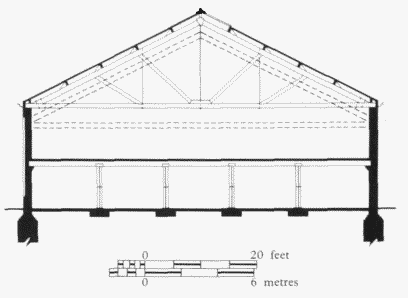
Millwall Docks, section through a typical warehouse, 1867–83
Birt defended these undistinguished buildings with the view that a general shift at the docks from warehousing to transit handling made heavy investment in warehouses foolish. Nevertheless, by 1869 they were full, and it was clear that warehousing was the dock company's best source of revenue. Against Birt's advice, C. H. Parkes advocated expansion. (fn. 7) Indeed, the 1868 lettering system implies that more sheds were always intended. In late 1869 three similar warehouses (D2, T and W) were built on a lease-back basis, by J. Langham Reed, an engineer who had links with Wilson. (fn. 8)
Early business at the Millwall Docks was fairly miscellaneous. In 1870 the north and south quay warehouses were used largely for sugar, rice, oilcake and wool, but F Warehouse, for example, housed 'rice in mat bags, some bundles of coir yarn, Russia mats, kegs of Swedish steel, and cotton seed in heaps'. (fn. 9) Lean-tos were built around A, C and D Warehouses in 1871 as an inexpensive means of extending covered storage space. Z Warehouse was lengthened in 1871–2, and again in 1901. (fn. 10)
Pressing demand for space to store grain led to the insertion of floors in these warehouses in 1884. Duckham generally used cruciform-section cast-iron columns and timber beams supporting 4in.-thick boards, omitting joists to limit the space taken by flooring. In some cases the roofs were raised by about 5ft (fig. 130). (fn. 11)
A, B, C and F Warehouses were damaged beyond repair by bombing in 1940–1, and D, D2 and E Warehouses were demolished for redevelopment in 1963–4. (fn. 12) V, X, Z, and part of W, Warehouses were demolished in 1933–6 to make way for an extension of McDougalls' Mill (see page 368). T Warehouse survived until 1985–6.
Nos 1–7 and G Warehouses, West Quay.
Birt offered to build more warehouses in 1869 to attract the wool trade to the docks. John Cousens, Francis Renshaw and Alfred Mackenzie responded by taking a lease of six acres on the west quay south of Glengall Road, and in early 1870 J. Langham Reed built two warehouses, later Nos 4 and 5, each 285ft by 60ft, like the existing ones. (fn. 13)
Increasing trade led Birt to consider building threestorey warehouses in 1871. Wilson prepared the plans, but the scheme was rejected in favour of two more of Duckham's long single-storey shed-warehouses, built on the west side of the docks. These were E2 (later No. 6) Warehouse, north of Glengall Road, and what became No. 3 Warehouse to the south, the latter let for fruit storage. No. 2 Warehouse, another similar building for fibre storage, was built by 1873, and No. 1 Warehouse was built later in the 1870s (figs 127, 128). Cousens & Company complained in 1872 that they needed twostorey buildings for their wool, an upper floor for storage and a lower one for sorting, and obliged the dock company to build for them anew. A two-storey warehouse (later No. 7) was erected north of E2 (No. 6) Warehouse. Designed by Duckham, it was 300ft by 60ft, with a 13fthigh lower storey and 10ft-high upper storey (Plate 58a). It was similar to the other warehouses, but was the first to incorporate cruciform-section cast-iron columns. It also had a brick firewall with double iron doors, large cast-iron windows on the ground-floor north side, north-facing skylights, and hydraulic wall cranes at the loopholes. (fn. 14) E2 (No. 6) Warehouse was raised a storey for Cousens & Company in 1876, with similar internal arrangements. (fn. 15) The tenants put up an iron roof between Nos 4 and 5 Warehouses in 1880. (fn. 16) Timber floors and iron columns were inserted in Nos 1–5 Warehouses in 1884. (fn. 17)
Cousens & Company were ruined in 1887, when the wool trade departed the South Dock of the West India Docks (see page 299). Nos 4–7 Warehouses then went over to general storage. (fn. 18) Nos 4 and 5 Warehouses were destroyed by bombing in 1940, Nos 6 and 7 were demolished in 1959 and Nos 1–3 in 1963. (fn. 19)
G Warehouse was built in 1883. It was a two-storey brick warehouse for general goods, 300ft long, and similar to Duckham's other warehouses (Plate 58a). (fn. 20) It was lengthened by 110ft to the south in 1911–13 with the addition on its quay side of a single-storey steel-and-iron shed, with sidings and an office, all built for the Canadian Pacific Railway Company, but used by other shippers from 1914. (fn. 21) The warehouse and its quay shed were both demolished in 1965 (see below).
A Yard.
The yard behind the north quay of the Outer Dock was developed with sheds from 1874 to 1890 (fig. 128). There were brick buildings (C2 and D3) like the quayside warehouses, timber-built sheds (A2, A4, B2 and B3) for match splint and other timber storage, and an open-sided steel-and-iron shed (A3) with 40ft-span bowstring roof trusses, for fibre and match storage. (fn. 22) A2 Shed was destroyed by fire in 1898, and replaced in 1899–1900 with an open-sided steel-and-iron curvedroofed shed. (fn. 23) From 1899 to 1955 most of A3 Shed was let to the London Keg & Drum Company as a machine shop, with additions erected in the 1930s. (fn. 24) A3 Shed was demolished in 1956–7, and its west extensions were reconstructed for paper and liner-board storage. (fn. 25) A2, A4, B2 and B3 Sheds were destroyed in the Blitz and C2 and D3 Warehouses were cleared for redevelopment in 1963–4 (see below). (fn. 26)
B Yard, Timber Wharves and T2 Shed.
From the opening of the docks the area behind the south-quay warehouses was used for the stacking of timber. Opensided timber-built sheds were erected in 1877 for hardwood and boards, and in 1886 others, designated Z1–5, were built for deals, guano and nitrates (fig. 128). (fn. 27) Z2 and Z3 Sheds were destroyed by fire in 1914 and replaced with steel-framed sheds (Z2 and X2) in 1915–16 (Plate 56a). (fn. 28)
The greater part of B Yard, with a water frontage of 435ft, was leased to Timber Wharves Limited, a company formed by Montague L. Meyer Limited, timber merchants, and redeveloped in 1937, to plans by H. J. Deane, engineer. There were nine contiguous timber storage sheds extending up to the quay, each spanning 56ft 7in. and all but the westernmost one were 507ft long. They were open-sided and steel-framed with lattice columns. (fn. 29) A delivery shed and north-lit brick sawmill were built to the south in 1940. (fn. 30) Sawdust collecting machinery with a silo was added in 1943–4. (fn. 31)
The Timber Wharves site was enlarged to the southeast in 1957 and grew to cover 11½ acres. Dependent on water access for the delivery of timber, the firm ceased operations in 1983 and the site was cleared in 1984. (fn. 32) It has been redeveloped as the Timber Wharves housing estate (see page 702).
The first T2 Shed was a twin-span iron-clad nitrate store of 1895, on the south quay west of the dry dock. (fn. 33) It was demolished in 1953 and was replaced in 1955 on the quay east of T Warehouse with a shed, the steel frame of which was supplied by Walker Brothers of Walsall. This shed was the first at the Millwall Docks designed for mechanized handling. It was 60ft wide, with 18ft headroom and large doorways to admit fork-lift trucks. (fn. 34)
C Yard.
The east side of the Millwall Docks was divided by Glengall Road into C and D Yards, largely used for timber storage. O and Q Sheds, erected in 1869, were open-sided, timber-built sheds for flooring boards. O Shed was considerably extended to the south, to a total of ten spans, in the 1870s, and Q Shed was enlarged in the 1880s. (fn. 35) Q Shed was demolished c1896–8, its extension c1929. O Shed burnt down in 1897 and was rebuilt as a smaller shed on the west section of its site. It was cleared in the late 1930s. (fn. 36)
P Shed, built in 1871, was a single-storey brick warehouse, similar to those on the west side of the docks, for grain and other bulk goods. (fn. 37) R Shed was a two-storey brick warehouse of 1883 used to store nitrates. It was extended with a twin-gabled south block in 1915–16 to meet wartime warehousing demand. (fn. 38) P and R Sheds were demolished in 1965 (see below).
The Glengall Road frontage of C Yard was developed in 1897–9 with several long steel-and-iron sheds, for and by commercial tenants, including the Buoyant Dress Company, the London Pressed Hinge Company, William Smith, a tarpaulin and sack maker of East Ferry Road, and the picture-moulding manufacturers George and Herbert Butt. (fn. 39) These had all been cleared by 1938. (fn. 40)
D Yard.
The yard to the north was developed from 1874 to 1900. A brick warehouse (M Shed) was built first at a berth reserved for Westcott & Laurence steamers. In 1883 it was doubled in length, and J, K and L Sheds were built. J Shed was a two-storey brick warehouse and K and L Sheds were of steel and iron with doubleand triple-span roofs. (fn. 41) M2 Shed was built by William Whitford & Company in 1887 and let to timber merchants, to concentrate hardwood and floorboard storage. It was a steel-and-iron building, about 500ft by 100ft, with 20ft headroom. There were twin-span bowstring trusses with radiating struts, comparable to those of the Grain Depot (see below). (fn. 42) J2 Shed was a similar structure of 1899–1900, though only 300ft long. (fn. 43)
All these buildings were gradually replaced from 1930 when K and L Sheds were cleared for a steel-framed twin-span shed. (fn. 44) The programme for redeveloping the docks devised in 1936 included as part of its first stage a two-storey shed-warehouse to replace M Shed. This was built as M Warehouse in 1937–9, by John Mowlem & Company to plans prepared under Asa Binns. Comparable to the slightly earlier Canary Wharf warehouse, it was 312ft by 100ft, with a reinforced-concrete frame, brick wall panels and a flat Ruberoid roof. (fn. 45) It was damaged by bombing in 1941 and partly rebuilt in 1942. (fn. 46) J2 Shed was a war loss, replaced in 1945–6 by two 495ft-long steel-framed units acquired from the Ministry of War Transport. (fn. 47) In 1958–9 a prefabricated steel shed, partly clad in aluminium and with 30ft headroom, was supplied and erected on the site of M2 Shed by Taylor Woodrow (Building Exports). (fn. 48) J, J2, K and M2 Sheds and M Warehouse were all demolished in 1969. (fn. 49)
A and B Sheds, Transporter Yard.
The wood yards east of the docks had been outgrown by 1900, when the north part of the dock company's land east of East Ferry Road was set aside as a timber-storage ground. It was developed by the Millwall Dock Equipment Company in 1901–2 with sheds served by a timber transporter. The 'Transporter Yard' was levelled, equipped with rail sidings and granite-set roads, and enclosed by 9ft-high timber fencing. A Shed (550ft by 100ft) and B Shed (400ft by 200ft) followed, the latter, on the site of the Millwall Athletic Club's football ground, was inaugurated with a Coronation Dinner for the poor of Cubitt Town. Designed by Duckham they were open-sided, with 20ft steel stanchions to 50ft-span timber-trussed slate roofs, of the type used by Duckham since 1867 (fig. 130). (fn. 50)
The Transporter Yard sheds were enclosed to store grain and wool from 1918 to 1928, reverting to opensided wood storage until 1947 when they were again enclosed for use as workshops and for plywood storage. (fn. 51) B Shed was demolished in the late 1960s, A Shed in 1972. (fn. 52)
North and West Quay Redevelopment (B, C, C2, F and G Sheds).
The increasingly dilapidated and outdated quayside buildings at the Millwall Docks were the subject of redevelopment proposals from 1936, with a scheme for the north and west quays prepared by W. P. Sheppard-Barron in 1938. Plans for two two-storey shedwarehouses of reinforced-concrete on the north quay were suspended upon the outbreak of war. (fn. 53) The north quay was heavily bombed in 1940–1 and Marston sheds were erected in 1946–9 as a temporary expedient. (fn. 54)
The surviving Victorian warehouses, with their low clearances and narrow doorways, became more and more inconvenient with the spread of mechanized handling. Redevelopment of the north and west quays was again proposed in 1954–5, but it was 1958 before definite plans were put forward. These set out a three-phase scheme for large single-storey transit sheds. The first phase began with a new B Shed on the north quay, built in 1959 with a tubular-steel superstructure supplied and erected by Tubewrights Limited on foundations by John Mowlem & Company. The same contractors built a new G Shed in 1959–60 on the west quay north of Glengall Grove (Plate 57c). (fn. 55)
B and G Sheds were designed by the PLA's engineers to have large unobstructed floors with tall clearances and large doors for fork-lift trucks. Tubular steel had been introduced in 1957 at No. 5 Shed at the Junction Dock as an economic alternative to conventional large-span roof framing (see page 307). It was widely adopted thereafter, but the forms of the frames differed. B Shed was 278ft long and G Shed was 350ft long. Both had bowstring-truss roofs, of 110ft and 150ft spans respectively, with clearances of 21ft 6in. to the tie beams and bay lengths of 25ft with trussed purlins. They were clad in aluminium trough sheeting with skylights and had 20ft-square sliding aluminium double doors inside the frame. (fn. 56)
The second phase of the redevelopment began with F Shed, which was built by Tubewrights Limited and John Mowlem & Company on the west quay south of Glengall Grove in 1962–4. A canopy over Glengall Grove linked it to G Shed. F Shed was 502ft by 150ft, with 20ft headroom, a tubular-steel frame and bowstring-truss roof. The roof of the 150ft-square canopy was used to support part of the Glengall Grove high-level footbridge (see page 371) (Plate 56b). This phase also included C2 Shed, built behind the north quay in 1963 with a conventional steel frame supplied and erected by Walker Brothers, with covered loading bays at both ends. (fn. 57)
The last phase of the programme included C Shed, built on the north quay in 1964 by Walker Brothers and John Mowlem & Company. It was 475ft by 110ft, with 22ft headroom, a bowstring-truss roof, and a 110ft-square canopy linking it to B Shed. (fn. 58) Finally, G Shed was extended by 150ft in 1964–5 with a covered loading bay at the north end, by Tubewrights Limited and John Mowlem & Company. (fn. 59)
B and C Sheds (redesignated Nos 11 and 12 Sheds in 1970) closed in 1978 and were cleared in 1981–2, to make way for the Daily Telegraph's printing works (see page 724). F and G (Nos 14 and 15) Sheds were dismantled in 1982 for re-erection at Tilbury. (fn. 60)
East Quay Redevelopment (J, K and P Sheds — Fred Olsen Lines Terminal).
A scheme for the redevelopment of the east-quay berths was approved in 1963, but deferred until the north- and west-quay works were complete and the question of the Glengall Grove right of way had been resolved. P Berth was tackled first, in 1965–6, Fred Olsen Limited having offered to meet the capital cost of a new shed, estimated at £180,000. In fact, P Shed cost £260,000, with the shippers contributing £59,500 and taking a lease at an annual rent of £48,000 and wharfage. The contractors were Tubewrights Limited and John Mowlem & Company. (fn. 61)
P Shed was another tubular-steel structure, but of a new type, a graceful monopitch 'space frame' designed by the PLA's engineers with the aid of a computer belonging to Stewarts & Lloyd, the parent firm of Tubewrights Limited (Plate 56b; fig. 131a). The design was also used for Nos 36 and 38 Sheds at Tilbury Docks. (fn. 62) P Shed was 550ft long, with lattice-cantilever columns at 50ft intervals towards the quay and integrated 150ft-span lattice-girder trusses, extending a further 30ft over a loading-bay canopy. The columns to the east were hinged props linked by cross-braces. The rise of the huge roof met the need for minimum headrooms of 21ft 6in. internally, for fork-lift trucks, and 31ft under the canopy, for mobile cranes. The shape also meant that economies were made in drainage and cladding. The troughed aluminium cladding served as guttering on the skylit roof. There were 11 manually operated 20ft-square sliding doors to each main elevation. Goods were transferred from ship to shed entirely by fork-lift truck, without quay cranes or tracks, one of the first such facilities anywhere. Fred Olsen Limited used the berth primarily for the Canary Islands fruit and tomato trade, previously centred at Canary Wharf, but facilities for ships' passengers were also provided within the shed. (fn. 63)
It was intended in 1966 that similar sheds would also be built at J and K Berths, and others were envisaged at a new branch dock on the Transporter Yard. Fred Olsen Lines were keen to move from Canary Wharf to centralize their London services at the Millwall Docks, desiring a passenger terminal, as well as more space for palletized cargo. (fn. 64) However, the PLA's finances precluded largescale development. In 1968 Olsen agreed to pay for and build two sheds, a passenger terminal, and an office and amenity building at J, K and M Berths. The PLA's engineers designed the sheds, and Norman Foster Associates the passenger terminal and office and amenity building (see page 366). J and K Sheds were built in 1969 along the entire east quay of the Inner Dock to a contract for £973,134 with John Mowlem & Company. Octavius Atkinson & Sons, of Starbeck, Harrogate, erected the frames with tubular steel supplied by Stewarts & Lloyds. These covered enormous clear floors, each 625ft by 200ft. Their design was similar to that of P Shed, but with a span that was 50ft greater (Plate 56b; fig. 131a). (fn. 65)
Financial difficulties, disappointing trade and labour problems caused Olsen to move to Southampton in 1976. The sheds were operated by the PLA as the Canary Islands Terminal until 1980. (fn. 66) J Shed (Olsen Shed 1) was refurbished and extended in 1984 by Maskell Warehousing. The value of the site increased to such an extent that the building was demolished and the site redeveloped as Harbour Exchange in 1987–8 (see page 717). (fn. 67)
In 1984–6 K Shed (Olsen Shed 2) was converted as the London Arena. From 1982 Lord Selsdon, Chairman of the Greater London and South East Regional Council for Sport and Recreation, and the sports promoter and commentator Ron Pickering fostered the establishment of 'the U.K.'s largest' indoor sports and leisure complex, with support from the LDDC, which gave the site at a peppercorn rent. The conversion, scheduled to cost £8 million, was funded partly by a consortium of Bovis, GEC and Mecca Entertainment, and partly by the LDDC, the Sports Council, the Amateur Athletics Association and Tower Hamlets Borough Council. Bovis were the management contractors. The facility opened in March 1986. (fn. 68) However, the original plans had been superseded by a more ambitious scheme, planned in 1985 and carried out in 1987–9. The final cost of the whole conversion was £24 million. To improve commercial viability the building was adapted for international boxing and major concerts, with Frank Warren and Harvey Goldsmith brought in as additional promoters. This involved replacement of the central bays with a tall new structure to seat 12,615. The architects were Stewart K. Riddick & Partners. The steel frame was designed by Fairhursts and assembled by Graham Wood. The main hall is an enormous hangar-like building with an uninterrupted span of 281ft (86m) on 59ft (18m) columns, the largest such hall erected in Britain since the Wembley Arena of 1934. Parts of the 1969 shed survive at the south end, the administration area, and in the North Hall (the sports complex). (fn. 69) The London Arena went into receivership in 1991, (fn. 70) but was subsequently reopened. In 1994 it was sold to Spectacor Arena Management.
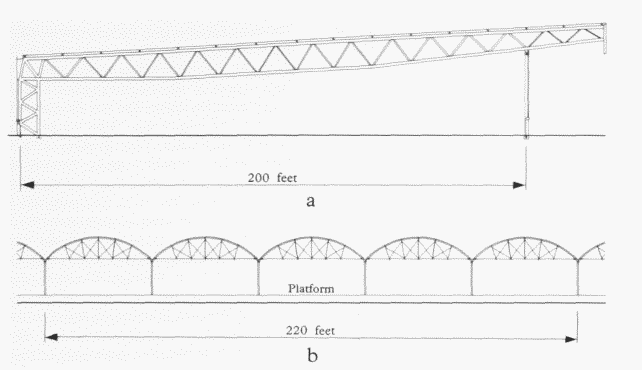
Metal-frame sheds at the Millwall Docksa J and K Sheds (Fred Olsen Lines Terminal), East Quay, typical section lookingnorth PLA engineers, 1969b Grain Depot, part of the west elevation. F. E. Duckham, architect, 1881
Granaries
Grain Depot and Grain Truck Store Sheds.
The Millwall Docks were the established centre of the Port's grain trade by the mid-1870s, functioning as a transit depot more than as a place of storage. From 1876 equipment for improved grain handling was introduced by Duckham, including about 1,300 20-ton travelling grain bins, or box wagons, on miles of new railway sidings. (fn. 71) In 1880 Birt recommended building a covered shed for the grain trucks to facilitate transit handling. This was built in 1881 as the Grain Depot, to plans by Duckham, on land west of the Inner Dock acquired from the Glengall Estate. (fn. 72) The Grain Depot was essentially a large railway shed, though unusual in its arrangements (fig. 131b). It was an open-sided steel-and-iron structure covering 5½ acres. It had 78 sidings with space for 800 grain trucks. The sidings were ramped up to a railway loading platform along the west side. There were 27 bays, all but the endmost measuring 44ft by 213ft, with radiating-strut bowstring roof trusses. (fn. 73)
Wartime pressure for warehouse space led in 1915 to the conversion of the southern half of the Grain Depot as a warehouse for War Office canned goods. This involved corrugated-iron cladding with external sliding doors, internal brick firewalls, a concrete floor and re-laying of railway lines. The rest of the building was converted by the PLA in 1917–18 for wool and grain storage. (fn. 74) Renamed the Ramp Sheds, the building had six divisions. Nos 2–4 divisions were destroyed in air raids in 1941 and the rest were demolished in 1948. (fn. 75) The site was used for open storage, then from 1965 as a parking area, where lorries were marshalled before proceeding to berths, and finally for container operations in the late 1970s. (fn. 76) Mastmaker Road was formed there in the early 1980s.
In 1885 four grain-truck store sheds were built, three of them north-east of the Grain Depot, the fourth in B Yard. They were steel-and-iron buildings with curved roofs. Those to the north were demolished in the late 1920s, the fourth in 1959. (fn. 77)
Eastern Granary.
Its grain-handling improvements caused the dock company to spend money on hired grain storage; in 1879, 5 per cent of the grain in the dock was landed, but by 1883 the proportion had risen to 47 per cent. (fn. 78) To turn the expense of hired storage into profit, the company built a granary in D Yard in 1883, to plans by Duckham (Plate 59c; fig. 132). This, later the Eastern Granary, was of nine storeys, brick-built on 25ft-deep concrete foundations, 145ft 6in. by 90ft in four divisions separated by firewalls, with a capacity of 6,000 tons of wheat. Internally it had iron columns, timber floors, iron fire-doors and timber-and-wrought-iron roof trusses. The grain was transmitted by chute from quayside grain trucks to basement hoppers. Internal bucket elevators then raised it 113ft before letting it down into hoppers in the roof spaces. From the hoppers, 112 'tubes' distributed the grain to the bin or storage floors. (fn. 79)
The Eastern Granary was converted for general storage in 1927, with the removal of machinery and distribution tubes; the elevator towers surviving until 1936. (fn. 80) It was demolished in 1965–6, to provide open ground for heavy cargo. (fn. 81)
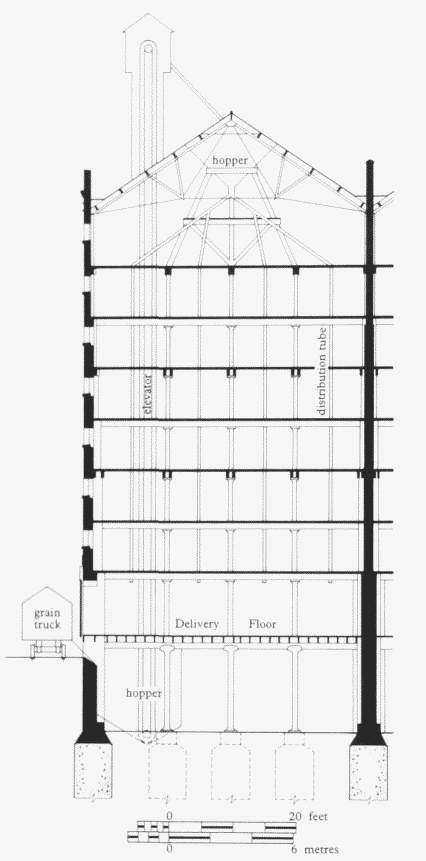
Eastern Granary, Millwall Docks, section looking north. F. E. Duckham, architect, 1883
Western Granaries.
To keep pace with the demand for grain storage, the dock company built three smaller granaries in 1884 at the north-west corner of the dock estate, west of the Grain Depot. Together these threestorey brick buildings had ten divisions (four each in Nos 1 and 2 and two in No. 3) for 14,500 tons of grain. The internal structures were timber, with beam-and-board floors on square-section posts. Grain was brought to the inner sides of the buildings by trucks on sidings and raised by hydraulic lifts. Delivery was from the outer sides, which had external staircases. (fn. 82)
Following the conversion of the Grain Depot, the Western Granaries became isolated and were little used. Most of No. 2 Western Granary was destroyed by bombing in 1940–1. No. 1 Western Granary, later renamed Western Warehouse, was demolished in 1978–9. No. 3 Western Granary was taken into the premises of G. Clark & Son (see page 369) in two phases in 1928 and 1946 (Plate 58b). It was destroyed by fires in 1946 and 1974. (fn. 83)
Central Granary.
The principal improvement undertaken through the Millwall Dock Equipment Company in 1900–3 was the building of a huge granary, to store grain and to minimize handling associated with its transfer from ship to railway or truck. John Trotter proposed the project in March 1900. Duckham first designed silos, but Trotter consulted leading corn merchants and found that they preferred open-floor granaries as better ventilated, less likely to cause overheating, and more suited to keeping different consignments of grain separate. Duckham designed a ten-storey granary with internal grain elevators, but the Wharf and Warehouse Committee insisted that the elevators be external, and that there should be a fire-proof floor. In September 1900 the dock company brought in outside professional help, appointing Ingalton Sanders, of Southampton, as architect and quantity surveyor for the granary. (fn. 84) While Sanders revised the plans for the building, Duckham designed a grainhandling system involving pneumatic elevators on a replacement of an existing dolphin (No. 2) in the dock, electrically operated bucket elevators on the building's south wall and internal conveying machinery. The Wharf and Warehouse Committee intervened again, stipulating a fire-proof roof under attic-level conveyors. In June 1901 the building contract was awarded to Holliday & Greenwood of Brixton, for £62,477. Work on the site near the north end of the west quay of the Inner Dock progressed slowly, complicated by the extensive machinery and numerous contractors. (fn. 85) (fn. 1) Duckham prepared plans for the reconstruction of No. 2 Dolphin and for quayside transit silos in front of the granary. The dolphin was rebuilt in 1902–3 by John Shelbourne & Company. The East Ferry Road Engineering Works Company supplied its pneumatic elevators and pumps, with an engine from Scott, Hodgson & Company of Manchester. (fn. 86) Designated the Central Granary, the building was first used on 1 October 1903. It cost £98,018, the silos and elevator towers £17,912, and the dolphin and elevating machinery £35,664, the total of £151,594 representing more than 75 per cent of the equipment company's capital spending. (fn. 87)
The Central Granary was a tour de force in the application of machinery to grain handling (Plate 59a; figs 133, 134). The speed of grain discharge in the docks doubled, with 550 tons of grain handled in an hour. The granary had a capacity of 20,000 tons (equivalent to a week's supply for the whole of London) and was regarded as 'an immense advance on anything then existing in London'. (fn. 88) The building itself was a shell of three million Fletton bricks with 7½ acres of floor space. It was 259ft by 103ft and 95ft tall in eleven storeys, ten for storage in five firewalled divisions, with delivery on the ground floor. The basement and the attic were for conveyors. There were mass-concrete foundations, 25ft deep, external staircases with linking galleries, and cast-iron framed windows. Most of the floors were timber, with 4in.—thick steel-tongued boards on beams, with no joists. The fireproof floor and roof were made up of steel joists in 7in.thick concrete. There were 1,960 hollow-cylindrical castiron structural columns with diameters of between 5½in. and 11 in. Rubber conveyor-bands on steel rollers transmitted the grain from the dolphin to the transit silos or to the granary and the south end bucket elevators, housed in steel towers that were 114ft tall. At the top of the elevators the grain was shot off on to conveyors running under the steel-framed and corrugated-iron-clad roof. Travelling trippers then threw it into 10in.— diameter cast-iron delivery pipes (in 1,980 storey-height sections) that fed the 50 housing sections of the building, where bulking boards separated different consignments. The delivery pipes had sleeves at the top of each storey, dropped to admit grain, and floor-level sliding doors, operated by remote levers, for the discharge of grain to sacks on the ground floor, for delivery to barge, road or rail. The south end elevator towers were cased with corrugated iron below a fifth-floor conveyor gantry to form auxiliary storage garners, to prevent delay if grain could not pass to the top. The steel transit silos — supplied by the local firm of Samuel Cutler & Sons — each had ten cells, served by bucket elevators and delivery chutes, to hold grain for short-term storage and transmission to railway wagons passing beneath. The steel-framed and corrugated-sheet roof over the quay was 311ft long with a 56ft span. (fn. 89)
No. 2 Dolphin (347ft by 24ft) rested on 60ft-deep piles of greenheart. It had a central solid foundation of mass concrete beneath rolled-steel girders supporting 750 tons of machinery. Its four steel-plated pneumatic grain elevators were comparable to others introduced by Duckham in the 1890s. Each tower comprised a 20ft-tall vacuum chamber under which patent airlocks transferred the grain to weighing hoppers. There were two boilers driving the vertical compound steam engine and four pairs of air-exhauster pumps. Girder bridges carried conveyor belts from the dolphin to the quay. (fn. 90)
The Central Granary remained the principal granary in the Port and a vital part of London's grain trade until 1969, when the opening of the Tilbury Grain Terminal made it redundant. It was demolished in 1970, and the site was empty until it was developed as Great Eastern Enterprise in the early 1980s (see page 717). (fn. 91)
Security, Offices, Works and Staff Accommodation
Security.
Commodities housed at the Millwall Docks were largely low-value bulk goods, such as grain, timber, nitrates and wool, and so high perimeter walls and other fortifications were not needed. Customs did insist, in 1871, that the east and south boundaries of the dock estate be fenced, and also required the dock company to employ its own police force, based from the early 1870s in an office near the West Ferry Road entrance to B Yard (fig. 128). (fn. 92) The boundary fences were renewed in 1930 1 and 1939–40, probably with concrete-panel fencing. (fn. 93)
Offices.
The decision to use the docks for warehousing made a Customs Office necessary. This was built in 1867–8 by Thomas Mills & Son, of Westminster, to plans by F. E. Duckham, at the north-east corner of the Outer Dock, near the principal road entrance (Plate 57b). (fn. 94) It was a single-storey building with a south entrance, skylit roof, three office rooms and a kitchen. (fn. 95) It was only partly occupied by Customs, doubling as the general dock office until 1928. It was damaged by bombing in the Second World War and, Customs having moved to a building at the northern end of A Yard, was cleared in 1957. (fn. 96)
Improvements in facilities for the grain trade in 1877 included a one-room grain office in F Yard. (fn. 97) This was superseded in 1881–2 by a larger grain office, south-east of the Grain Depot. (fn. 98) This single-storey brick building of nine bays was enlarged in 1928 to be the general office for the Millwall Docks, then, in 1958, made a canteen and staff club. The general office then moved to a new and larger single-storey building in F Yard, west of G Warehouse. (fn. 99)
There were various other small offices of 1870 to 1900, for the wool, fruit, export, wood and nitrate trades, all cleared by c1950. (fn. 100) An additional grain office was built in 1904, just south of the Central Granary (Plate 59a). It was converted to use as a gear store and dining-room in 1928, and was demolished in 1970. (fn. 101) Two-storey office buildings were put up for railway and granary staff near the Eastern Granary in 1917–18, (fn. 102) for M Warehouse in 1938–9, (fn. 103) and for Fred Olsen Lines at P Berth in 1966. (fn. 104)
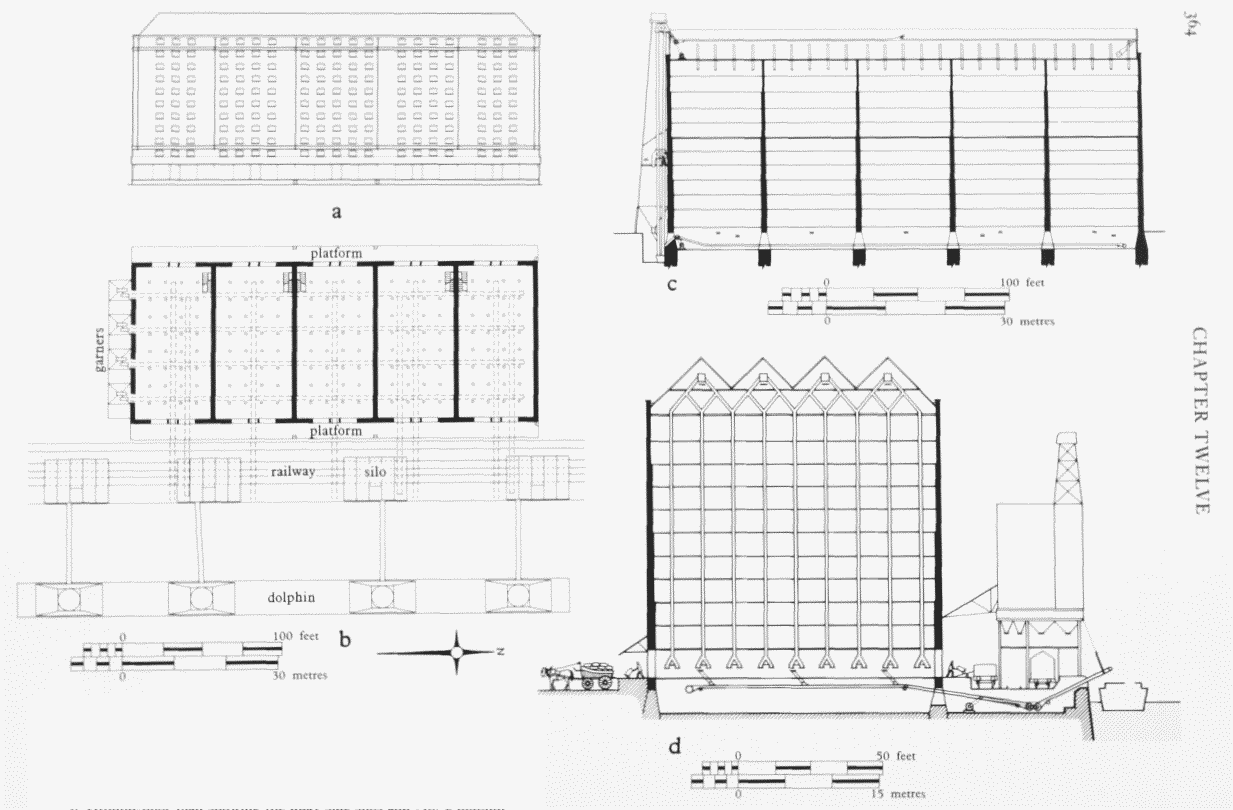
Central Granary, Millwall Docks, elevation, plans andsections in 1903. F. E. Duckham and I. Sanders, architects, 1900–3a West elevationb Ground-floor plan showing the quay-side silos and No. 2 dolphinc Section looking westd Section looking north
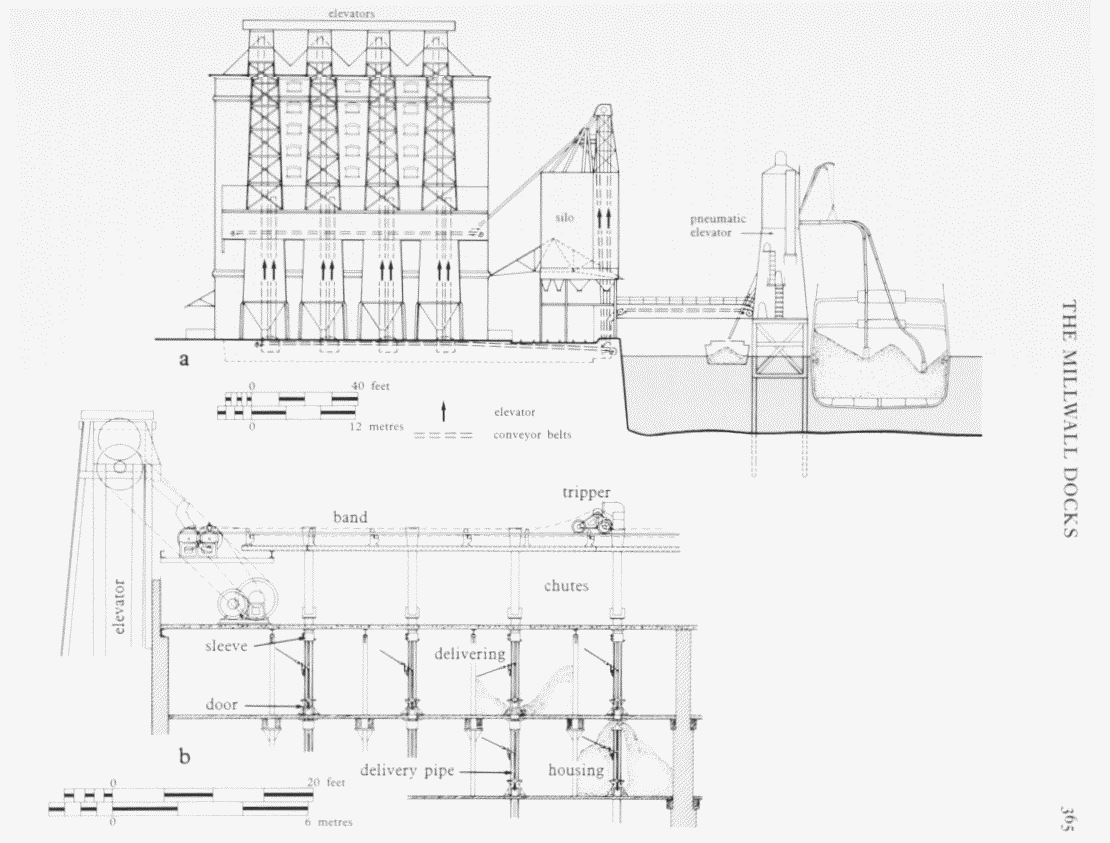
Central Granary, MilwallDocks, elevation and part section in1903. F. E. Duckham and I. Sanders,architects, 1900–3a South elevation showing themethod of housingb Section looking west through theupper part of the south bay
Olsen's redevelopment of J and K Berths in 1969 incorporated an office and dock workers' amenity block. The shippers employed their own dock workers and maintained good industrial relations. The building was designed after consultation with the workforce to provide the best facilities for dock workers in the Port. Olsen also aimed to provide good architecture, and appointed Norman Foster Associates. The building was placed in the gap of 90ft between J and K Sheds. This caused no operational inconvenience as vehicles could drive through the sheds. Bovis Limited were the main contractors, and the building cost £230,719. On the ground floor there were lockers, showers, a restaurant and a recreation room for 250 dockworkers; the first floor had offices for up to 80 staff. Internal division was flexible, as castellated steel beams spanned the block. There was a steel roof deck and the front and rear walls were clad in tinted mirror glass, supplied by Bombert, Toves & Blankley, of Pittsburgh. This simple building was extensively and internationally praised for having been designed and built quickly and economically without sacrificing quality of materials or the resulting working environment. (fn. 105) It was taken by the UDC designate (LDDC) as its office headquarters in 1980 and, in one of the many nomenclatural incongruities of the early 1980s, named West India House. It was demolished in 1987–8 to make way for the Harbour Exchange development (see page 717).
Olsen's Canary Islands fruit vessels sometimes carried passengers, and so another part of the J and K Berth development was a passenger terminal west of K Shed, also designed by Norman Foster, and built in 1970 for £53,991, with Tony Hunt as structural engineer and Bovis Limited as contractors. To keep the terminal from interfering with quay operations, the baggage and Customs halls were placed in a semi-cylindrical steelframed tube, clad in aluminium, 20ft wide, raised 16ft 6in. above the quay on concrete columns, with a ramped walkway to the south. It, too, was hailed as a simple, inventive and attractive solution to a difficult problem. (fn. 106) The terminal was demolished in 1985.
Works and Staff Accommodation.
The Millwall Docks were served from 1868 by a range of stores, workshops and stables along the west side of B Yard. The stores closed in 1921 and the buildings were demolished c1950. (fn. 107)
A site of half an acre west of the graving dock was used for ship-repair as the Millwall Docks Engineering Works. John Ryde & Company leased the plot in 1870, lending the dock company £1,000 to build two brick fitting and machine shops. Henry Milnes Rait and Patrick Gardiner were the tenants from 1878 to 1910, (fn. 108) followed by R. & H. Green & Silley Weir, who built steel-framed and corrugated-sheet-clad boiler makers' and fitting shops, with brick offices to the north. (fn. 109) In 1966–7 the site reverted to the PLA and was cleared for redevelopment. (fn. 110)
Buildings on the east side of the dry dock also came to be associated with ship-repair. S Shed, built there in 1889–90 for timber storage, was steel-framed and opensided, with a curved roof. (fn. 111) It was enclosed in 1895, let to Harland & Wolff for mechanical maintenance in 1921, and demolished in 1939, although Harland & Wolff stayed on in an office and store nearby. (fn. 112) In 1947–8 the site and land to the east were let to W. Badger Limited, marine engineers and ship-repairers, who erected sheds for workshops, offices and stores in 1949, 1955 and 1959, and remained there until the firm's liquidation in 1981. The workshop sites flanking the dry dock were redeveloped as part of the Clippers Quay housing estate in 1984–8 (see page 698). (fn. 113)
The former Great Eastern Railway Wharf at the east end of the Outer Dock was one of two sites in the Port set aside in 1947 for refuse incineration. Heenan & Froude, of Worcester, specialists in such work, designed a refuse destructor, built in 1952 as a four-cell steelframed and brick-clad incinerator and a 100ft-tall chimney, 6ft in diameter and built of Fletton bricks, with a shed for mobile bins. The chimney was built by Topping & Leggat, of Palmers Green. (fn. 114)
There were labourers' dining-shacks at the Millwall Docks from 1874 and mobile dining-rooms were introduced in 1886–7, to discourage the use of public houses. A muster shed for the call-on was built in 1877, and others with cooking facilities were put up after the Great Dock Strike of 1889. From the 1890s there was a shelter and refreshment room west of G Warehouse. A canteen was erected in C Yard in the early 1940s, and an amenity block was built in A Yard in 1969. (fn. 115)
Manufacturing Premises in the Millwall Dock Estate
Hooper's Telegraph Works.
The first serious interest in manufacturing at the Millwall Docks came in December 1869, when William Hooper sought land for a factory. (fn. 116) He had been making patent rubber-core insulator for submarine telegraph cables in Mitcham since 1862. His product was widely considered to be more durable and reliable than the gutta-percha otherwise used. (fn. 117) Hooper wanted a dockside cable factory so that he could load directly into cable-laying vessels. He formed Hooper's Telegraph Works Company and took a 99-year lease, from December 1870, of a 1½-acre plot on the south side of the docks, behind T Shed. (fn. 118) A year later he had taken another half of an acre to the west, with options on two more acres to the south (fig. 127). (fn. 119) The cable factory was built in 1871, and the western strip was separately developed in 1872, all for about £22,000. (fn. 120) Single-storey brick sheds covered most of the site, with multiple roofs spanning 232ft (Plate 56a). The sheds had large cable tanks to the north-west and storage space for jute to the north-east, with clear floor to the south for working the cable. There were secondary workshops and an engine house further south, offices to the west, and a 16ft-high wall separating the factory from the rest of the dock estate. (fn. 121)
In 1872 William Hooper commissioned the Hooper, the first purpose-built cable-laying ship, which, on its arrival at the Millwall Docks in 1873, was the largest vessel to have used the Thames, excepting the Great Eastern. Hooper prospered in 1872–4, making cable to link Portugal to Brazil and Hong Kong to Vladivostok. The option on the land south of the factory was taken up in 1875, but the firm had no new contracts, rapidly fell into financial difficulties, and was wound up in 1877. (fn. 122) Hooper died in 1878, but his son, John Pitman Hooper, who died in 1928, continued the business at the docks as Hooper's Telegraph and India Rubber Works. The undeveloped land reverted to the dock company in 1879, and was subsequently used for railway sidings. In 1882 the western part of the factory was sub-let to William Frederick Dennis & Company, cable and wire manufacturers. (fn. 123) The north-east jute shed was leased back to the dock company in 1902 and redesignated T3 Shed. (fn. 124)
The works were gutted by incendiary bombs in 1944. (fn. 125) Dennis & Company retained a wire and nail store and, from 1948, two surviving sheds were used by the City & Continental Trading Company for shipping electric cable. The site was largely levelled in 1950–1, and used to park cars for export. Dennis & Company's sheds were demolished c1965. (fn. 126)
McDougalls' Mill.
In 1871–2 five sons of Alexander McDougall leased 1½ acres to the west of Hooper's Telegraph Works. (fn. 2) The brothers — Alexander, Isaac Shimwell, James Thomas, John and Arthur — built a fertilizer factory across the northern part of the plot. It was a single-storey triple 35ft-span brick shed in which chemical compounds were mixed with sawdust, then sent to gas works to absorb ammonia, brought back, dried and packed. Disinfectant sheep-wash was also produced on the site (fig. 127). (fn. 127)
The discovery of a new type of baking powder had led Arthur McDougall into the manufacture of selfraising flour in Manchester in 1865. The Millwall Dock factory may have been partially applied to the production of 'McDougall's Self-Raising Flour' from c1879, when the dock's grain trade began to boom, but the site was not redeveloped for flour milling until c1887, when the premises were extended by half an acre to the south, or 1895, when building work was carried out. (fn. 128) The northwest quarter of the site became a three- and five-storey mill, about 130ft by 60ft, with two-storey offices. The eastern half of the shed survived, a small section being rebuilt as a three-storey store. To the south-east was added a two-storey warehouse, and to the south-west a smaller two-storey warehouse with twin roofs over an open yard. The railway ran north-south through the middle of the site. (fn. 129)
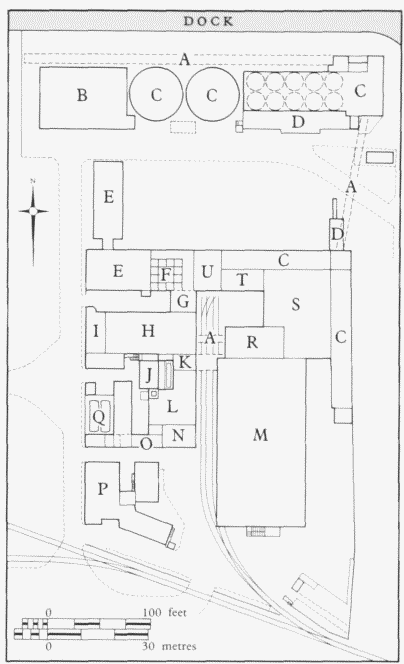
McDougall's Mill, Millwall Docks, site plan in 1961 Key: A Gantries: B Workshops: C Silos: D Wheat Banks: E. Offices: F Clean Wheat ins: G Tower: H Mill: I Stationery Store: J Boiler House: K Pump Room: L Offal Warehouses: M Warehouse: N Offal Loading Bank: O Sack Cleaning: P Canteen: Q Oil Tanks: R Process House: S Paper Warehouse: T Drier House
A fire in 1898 destroyed the mill, despite the efforts of 25 engines from all over London. (fn. 130) A new McDougall & Company flour mill was built in 1899–1900. H. Jameson Davis was the milling engineer and Robert E. Crosland the architect. The lowest tender for the building work was from Holliday & Greenwood. The mill, again on the north-west quarter of the site, was of brick, built around three sides of a yard (Plates 56a, 59b). The north range housed timber and cast-iron storage bins over wheat mixers. Its north elevation to the dock was a symmetrical façade with decorative gables. The south range had offices under the mill proper, which had 12 grain elevators, top-floor sifters for grading the flour, and second-floor purifiers with mahogany hoppers feeding 13 first-floor double-roller mills. An 82ft-tall tower linked the main ranges and housed wheat-cleaning machinery and a water tank. South of the mill there were offices, stores, a 142hp steam engine, and a chimney, 120ft tall. (fn. 131)
As Wheatsheaf Mills, this building became the centre of McDougall & Company business. The east or fertilizer premises were sublet to J. Taylor & Sons in 1914 for the production of cattle food (flour offal). (fn. 132) Two long ranges of 51ft-tall timber bin silos were erected on the northeast quarter of the site. (fn. 133) Around 1926 two-storey office, canteen and laboratory buildings were built to the southwest. (fn. 134)
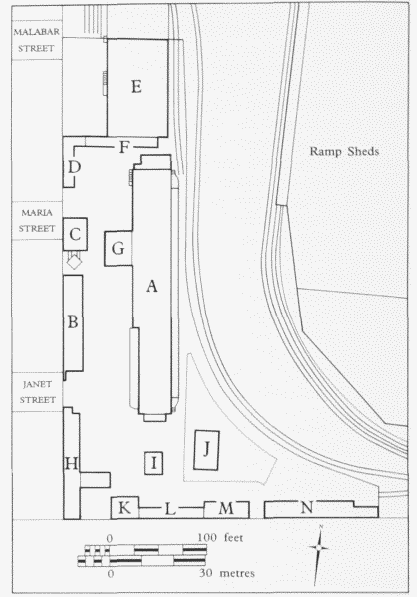
Broadway Works, Millwall Docks, site plan in 1937 Key: A Refinery: B Isinglass Warehouse: C Boiler House and Chimney: D Barrel Shed: E No. 3 Western Granary: F Engineer's Workshop: G Drum-Washing Shed: H Offices: I Laboratory: J Store Shed: K Garage: L Cart Shed: M Canteen: N Stables
A quayside silo was projected in 1899, but not built until 1934, when it displaced V Shed (Plate 59d; fig. 135). (fn. 135) The silo's civil engineer was J. H. Walker, Mark Jennings was the mechanical and electrical engineer, and the building contract went to Fred Mitchell & Son of Manchester. (fn. 3) The silo was 100ft tall and had a capacity of 8,000 tons in ten 20ft-diameter cylindrical bins on massive reinforced-concrete columns and 50ft piles. The 6in.-thick concrete walls were cast in 2ft-square metal forms. Above the silo was an enclosed conveyor gallery, from which chutes fed the bins. To the east stood a 120ft-tall intake elevator, a pump room and the threestorey receiving house, for weighing and separating grain, with its own five-storey quayside elevator. Jennings's innovative pneumatic intake plant comprised a tower that travelled about 370ft along a steel-framed quayside gantry, which covered a conveyor taking the wheat to the receiving house. Grain was transferred from the silo to the mill or barges by conveyor gantries at first-floor level. (fn. 136)
Most of the eastern half of the McDougall's site was redeveloped in 1935–6, when the nineteenth-century buildings were replaced with a three- and four-storey warehouse and, to the north, a five-storey process house, both of reinforced-concrete (fig. 135). (fn. 137) The area south of the main pump house was built up with offal warehousing in 1937–8 and c1952, when a nine-storey reinforced-concrete drier house and single-storey warehouse were erected to the north-east. (fn. 138) In 1960 two steel-bin silo cylinders, each 30ft in diameter and 50ft high, were erected west of the main silo. (fn. 139) Rank Hovis McDougall Branded Foods closed the mill in 1982, and the buildings were demolished in 1984–5. (fn. 140)
Broadway Works.
The site occupied by Tate & Lyle Sugars, off Mastmaker Road at the east end of Janet and Malabar Streets, was at the south-western corner of land acquired from the Glengall Estate by the Millwall Dock Company in 1880. The Lead Warrant Company held 1½ acres here from 1882 to 1896 as a yard with railway sidings, the only buildings were small sheds along the southern boundary. (fn. 141) In 1897 the site was let to John Badger Clark, trading as George Clark & Son. (George Clark had been a grocer in Westminster Broadway with a business manufacturing brewing sugar.) (fn. 142) The site was developed as Broadway Works in 1898–9, when Dove Brothers built a refinery and ancillary buildings for invert sugars, priming sugars and caramels (Plate 58b, d; fig. 136). The long main building housed, from south to north, caramel tanks, a factory with priming and refrigeration plant, warehousing space, and a three-storey racking and invert department with a sugar store. There were loading platforms on both sides and railway sidings to the east. Perimeter buildings included a two-storey isinglass factory and warehouse, with cutting and rolling rooms and offices near the entrance gate, and an engine house with a chimney that was 87ft tall. (fn. 143)
Broadway Works was extended in 1928 with the lease of the south half of No. 3 Western Granary, altered for cooperage, printing, packing and storage. (fn. 144) This part of the former granary was gutted by fire in 1946, and so the northern half of the building was leased. (fn. 145) Broadway Works was largely reconstructed between 1948 and 1955; there had been some bomb damage, and George Clark & Son were diversifying into the supply of sugars for food manufacture. The architects were J. Ernest Franck, for the new construction, and Derek Humphreys, for the reinstatement of the damaged buildings. The southern end of the factory was rebuilt as a three- and four-storey steel-framed and brick-faced block to house a research department and cold chambers for crystallizing liquid invert into solid invert. Other parts of the old building were retained and raised with new plant, for the introduction of raw materials at the north end, refining in the middle and loading out at the south end. The upper parts of the former isinglass warehouse were rebuilt and a new two-storey office was put up south-east of the main block. The southern half of the former granary was rebuilt for caramel manufacturing, with steel and concrete inside surviving brick walls. (fn. 146)
Brown & Polson Limited acquired George Clark & Son in 1956, and in 1964 the Millwall premises were sold to Tate & Lyle. (fn. 147) The northern half of the former granary was destroyed by fire in 1974 and replaced with a single-storey warehouse, but that also burnt down. In 1981 Tate & Lyle acquired the freehold of the whole site, with an additional acre to the north-east, to make a rectangular plot. (fn. 148) The works were improved in 1982–4 with new shedding and brown-sugar production plant at the centre of the main building, a shed on the site of the former granary and, to the east, a large store shed and tanker-lorry facilities. The production sequence was altered again, the main building serving from north to south as racking, processing, treacle production, brownsugar production and packing space. Road access shifted to the newly formed Mastmaker Road, partly to keep lorries off residential streets. (fn. 149)
Power and Transport
Hydraulic Pumping Station and Accumulator Towers.
A pumping steam-engine, for draining the dock excavations, was erected in 1865 in a building south-west of the dry dock. This was reconstructed in 1867 as the pumping station for the dock hydraulic system. It had a pair of W. G. Armstrong & Company horizontal engines, and an accumulator tower on its north side. The same firm supplied the lock-gate, bridge and quayside hydraulic machinery for the docks (Plate 57b). (fn. 150) In 1871 a 20ftdiameter accumulator, supplied by Armstrong & Company, was placed in a 55ft-tall tower on the west side of the docks south of Glengall Road, to serve the wool warehouses. (fn. 151)
The pumping station was enlarged in 1877–8 to cope with rapid growth in hydraulic appliances. The original building became the boiler house, and a new engine house and a chimney, 121ft tall, were built to its southeast (fig. 137). The Armstrong engines were supplemented by a larger Abbott & Company engine. (fn. 152) Continuing growth in demand for hydraulic power brought further expansion. A second boiler house was built in 1882–3, east of the 1865 building and north of the engine house, and fitted with three Rait & Gardiner boilers. (fn. 153) In 1884–5 four more boilers were installed in another new building, east of the dry dock pump house, and a third pumping engine, supplied by the East Ferry Road Engineering Works Company to Duckham's specification, was placed in a new engine house on the site of the dry-dock boiler house. The same firm also supplied two vertical pumps for the sump into which the dry dock drained, to divert water to the hydraulic system, additionally compounding the Abbott & Company engine in 1886–7. (fn. 154) The system was further extended in 1890–1 with a third accumulator in a tower at the north-east corner of the estate. It had grown to require engines of 1,080hp and nine boilers. (fn. 155)
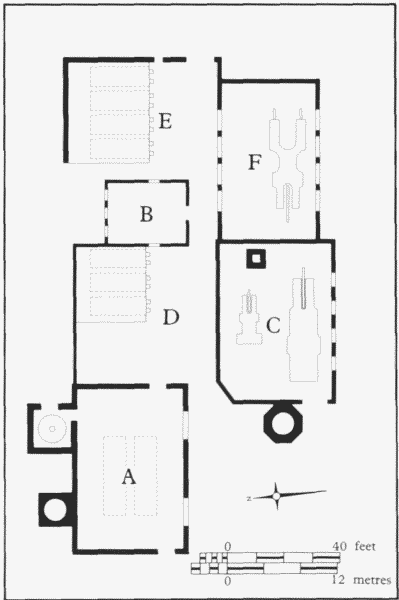
Hydraulic Pumping Station, Millwall Docks, site plan in 1885 Key: A Engine House of 1865, with Chimney and Accumulator Tower of 1867: B Dry-Dock Pump House of 1870: C Engine House and Chimney of 1877: D Boiler House of 1882–3: E Boiler House of 1884–5: F Engine House of 1884–5
The pumping station was improved in 1919–20 with two new boilers and an engine house west of the existing ones, for an electric pump and two inverted vertical triple-expansion steam pumps, made by Glenfield & Kennedy, of Kilmarnock. The 1884–5 boiler house was demolished. (fn. 156) Another large engine from the East Ferry Road Engineering Works Company was added c1930, by which time all the early engines had been removed. The last steam plant was disposed of in 1954 and the loss of power was made up through the London Hydraulic Power Company. The electric engines continued to supply hydraulic power until the 1970s. (fn. 157) The remaining buildings were demolished in the early 1980s, when the site became part of the Clippers Quay housing estate (see page 698).
A small secondary hydraulic pumping station had been built in 1902, west of the Glengall Road accumulator tower. Mather & Platt, of Manchester, supplied a 60hp electric engine. This station was badly damaged by bombing in the Second World War and was demolished in 1950. The adjacent accumulator tower was pulled down in 1962. (fn. 158)
Impounding Station.
An impounding system was introduced at the Millwall Docks in 1885 to remedy the loss of water through locking, and to allow larger ships to use the docks. After looking at pumping machinery at the Albert Dock, Duckham visited the Fens, where he saw simple scoop-wheels which, although technologically archaic and untried in dock systems, he saw as an efficient and economic method of introducing to the docks clean water from close to the surface of the river. The East Ferry Road Engineering Works Company supplied two scoop-wheels, of 32ft and 36ft diameter, and five boilers, and Richardsons supplied 360hp compound marine engines. The impounding station was built by direct labour. The wheels were placed behind the wing wall on the south side of the entrance lock. Beyond was the pump house and a 9ft-diameter culvert to the dock. About 30,000 tons of water were scooped through the culvert hourly around high water, to raise the water level in the docks by 1½ft. The engine was linked to the hydraulic system in 1887, making it a secondary hydraulic pumping station. (fn. 159) The impounding station fell out of use and, in 1920, the machinery was dismantled, the culvert filled and the buildings demolished. (fn. 160) From 1930 impounding at the Millwall Docks was from the station at the South West India Dock (see page 327).
Electricity Sub-Stations.
Electric lighting was introduced to the Millwall Docks in 1900, with a generating station near G Warehouse. (fn. 161) An electricity converter house, surviving as No. 50 Marsh Wall, was built north of the Byng Street entrance to the docks by the PLA in 1919–20. It was intended to be the first part of a larger station to serve a granary that remained unbuilt. (fn. 162) The relative grandeur of the building is characteristic of early PLA work. The red brick is finely detailed and there are dressings of Portland stone. There were originally two large round-headed windows on the four-bay east side. The three-bay north gable end was originally blind, save for large entrance doors and a keyed oculus in the gable. Inside there was a gantry crane below the steel-framed roof. (fn. 163) The building was converted in 1984–5, and opened as a two-storey estate agent's office in 1987.
Quay Cranes.
Hydraulic quay cranes for the Millwall Docks were supplied by Armstrong & Company in 1867–8; one of 15 tons, two of 5 tons, and 12 of 35-cwt capacity. These had fixed pillars with separate, timber, operator's boxes (Plate 57b). (fn. 164) At the same time, a set of patent steam-powered iron sheer legs, to raise up to 80 tons, was supplied by Charles Arthur Day & Company of Southampton, for the south quay west of the dry dock. Rising to a height of 100ft, two legs about 30ft apart rested on the quay wall on 2ft-thick slabs of granite over 9ft of brick, their rake adjusted by a movable back leg driven by a horizontal screw and founded on 1ft 6in. of brick over a 2ft-thick concrete bed. The sheer legs had their own small engine house, which outlived the legs themselves and survived until 1955 as T4 Shed. (fn. 165) They were the largest sheer legs in London when they were erected. Intended for masting and dismasting ships, they were commonly used for loading and unloading heavy machinery, and by local shipbuilders for lowering engines into steam vessels. (fn. 166) They were dismantled in 1924. (fn. 167)
From 1874 until 1882 the East Ferry Road Engineering Works Company supplied a large number of travelling hydraulic pillar cranes, probably to Duckham's specifications (Plate 58c). These were among the earliest movable quay cranes in the Port. (fn. 168) Cranes supplied by the same firm in the 1890s were set on open bases, to ease movement on the quay. By 1900 there were 65 hydraulic cranes at the docks. (fn. 169) Others were acquired in 1912 and 1923, and some remained in use until the 1960s. (fn. 170) Stothert & Pitt 3-ton electric cranes of the 1960s still stand on the north and west quays of the Outer Dock, as well as at Harbour Exchange, where they were made a feature of the redevelopment (see page 717).
Crane Dolphins.
A free-standing staging or dolphin was put up in the Inner Dock in 1873, 40ft from the west quay (fig. 127). It was a long timber structure, about 10ft wide, supporting a travelling hydraulic crane supplied by Ratcliffe & Creighton. Originally used for handling iron ore, it allowed the transfer of goods from ship to barge by crane rather than by oversiding. This speeded discharge and generated income for the dock company from handling. (fn. 171) A similar crane platform (No. 2 Dolphin) was put up at the north end of the west quay in 1876–7, when Duckham and Birt were introducing bucket grain elevators on to ships. (fn. 172) In 1879, three more grain-handling dolphins (Nos 3–5), the largest 300ft long, were erected on the east side of the docks. A sixth dolphin was built off the north quay of the Inner Dock. The later dolphins carried timber grain hoppers as well as travelling cranes. (fn. 173)
Duckham invented a highly efficient vacuum process of pneumatically elevating grain in 1890, first applied in 1892 through elevator towers mounted on a floating barge, the Mark Lane (the address of London's Corn Exchange). (fn. 174) No. 1 Dolphin was reconstructed with pneumatic elevators as Mark Lane 2 in 1897. (fn. 175) No. 2 Dolphin was reconstructed in 1902–3 to serve the Central Granary (see page 362). By 1919 Nos 3, 5 and 6 Dolphins had been dismantled. No. 1 Dolphin (Mark Lane 2) was dismantled in 1935 and No. 4 Dolphin in 1937. (fn. 176) In 1988, to commemorate grain handling at the Millwall Docks, the LDDC and Historic Steam moved a 1930s Spencer & Company grain elevator from the Royal Victoria Dock to a site north-east of the dry dock.
Millwall Entrance Lock Bridge.
The early plans for the docks sited the Westferry Road bridge over the Millwall Dock entrance lock inside the inner lock gates. However, in 1865 it was resited over the inner lock, to give the dock a bit more space and to reduce the cost of road diversion (figs 125, 126). (fn. 177) This was opposed locally as it meant that when the inner lock was in use there would be long delays, as at the West India Docks, something the new company had undertaken not to impose. The bridge itself was ordered in 1867 as part of Armstrong & Company's contract for hydraulic machinery, and fixed by early 1868. It was a single-leaf swingbridge of solid wrought-iron plate-and-girder construction (fig. 138a). It spanned 80ft, was 150ft by 44ft overall and weighed about 600 tons. It was lifted and turned by hydraulic ram. (fn. 178)
Replacement of the bridge was considered from 1930, and in 1939 the LCC began work on a double-leaf bascule bridge, comparable to that at Manchester Road. (fn. 179) War stopped the project and, despite the revival of proposals for a replacement bridge in 1947–9 and again in the 1960s, the old bridge remained in position until 1976, when a paved surface was formed on lock fill. (fn. 180)
Glengall Road Bridge.
The need for a bridge across the north arm of the docks was conceded in the 1864 Act for the docks, to meet opposition from the Glengall Estate, which intended to construct a road to link Millwall with Cubitt Town. The first Glengall Road bridge was supplied by Armstrong & Company and was mounted by early 1868. It was a solid wrought-iron plate-andgirder bridge with timber decking and cantilevered footpaths (fig. 138b). Spanning 80ft (143ft by 30ft 7in. overall) it was a 'traversing' or rolling drawbridge, with an unusual mode of hydraulic operation in which the east or nose and was wedged into place by small hydraulic rams. These retracted and the ram to the west lifted the bridge, nose first, followed by the weighted tail. It was then hauled back on to rollers and drawn back on rails to the west. (fn. 181)
The Glengall Road bridge became a nuisance both to local people and to the dock company. Its opening was a slow manoeuvre, and it often malfunctioned. Use of the Inner Dock by commercial shipping meant heavy wear and tear for a bridge that had not been designed for frequent opening. Repairs were made on nine separate occasions before 1930, causing much public inconvenience (Plate 58c). (fn. 182) Reconstruction was due to go ahead in 1938, but it had not been carried out when war intervened. When the bridge broke down again in 1945 it was replaced with a concrete-filled barge, moored between the knuckles as a pontoon for pedestrians. (fn. 183)
The barge-bridge and the knuckles in the dock impeded the PLA's post-war modernization plans. Their replacement with an elevated walkway came under consideration from 1950, but before accepting this as necessary, the PLA sought Poplar Borough Council's agreement to the displacement of the right of way. There was strong local opposition, however, and so in 1958 the PLA asked Parliament for power to close the route. (fn. 184) The Council, the LCC and Charles Key, the local MP, forced the PLA to reconsider and prepare schemes for adapting the pedestrian crossing. (fn. 185) In 1960 the PLA suggested either high-level footways with a double bascule bridge which would cost over £100,000, a tunnel under the dock for about £400,000, or a 180ft-high aerial cable-car for about £50,000. The bridge option emerged as favourite, the tunnel being too expensive for the PLA and the cablecar unpopular with the Council. A high-level bridge would keep the public out of the docks and allow barges to pass, opening only for ships. (fn. 186)
The plans for the high-level bridge and walkway were developed in 1961–2 and amended to include a single opening span pivoting on a trunnion. John Mowlem & Company built the bridge in 1963–4, but the opening span and machinery, separately contracted to Head Wrightson, of Thornaby-on-Tees, were not operational until 1965. The bridge, which cost £256,198, comprised a walkway that was 1,140ft long, 30ft above the ground, 7ft 6in. wide at foot level, and 8ft high, with a hollowrectangular-section steel frame, aluminium roof and translucent glass sides (Plate 56b; fig. 138d). It was carried on nine precast- and prestressed-concrete supports, Tcolumns with upper sections enclosing the walkway, with support from the canopy linking F and G Sheds Lift towers at the estate boundaries and the operating tower for the 113ft-long opening section were built of reinforced-concrete with facings of Fletton brick. The bridge operated with oil hydraulic machinery. (fn. 187)
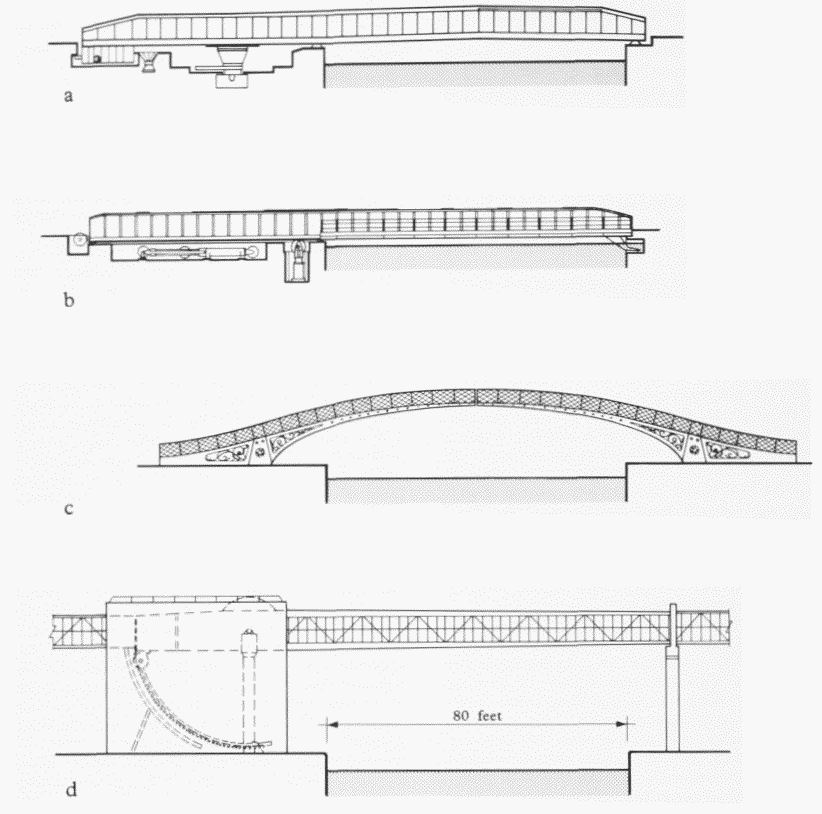
Bridges at the Millwall Docks Key: a Hydraulic Swing-Bridge, Millwall Entrance Lock, 1868: b Hydraulic Rolling Drawbridge, Glengall Road, 1868: c Foot-bridge, Millwall Entrance Lock, 1876: d High-Level Bridge, Glengall Grove, 1965
The Glengall Grove high-level bridge gave the public the dubious privilege of a walk high over the Millwall Docks in an enclosed glazed tube. The 'glass bridge' immediately became a prime target for vandals, and pedestrians were so intimidated that few used it. The PLA had to spend about £20,000 on repairs. Severe damage to the glass and the lifts in 1975–6 caused the bridge to be closed, and it was demolished by the LDDC in 1983. (fn. 188) It was temporarily replaced by a girder bridge across the knuckles, and then, from 1987, by a steel footbridge across the Inner Dock. (fn. 189) A double drawbridge of a Dutch type opened in 1990 as part of the Glengall Bridge development (see page 716).
Millwall Entrance Lock Footbridge.
A double-swing footbridge was mounted across the Millwall Dock entrance lock in 1876 to allow pedestrians to cross the lock while the road-bridge was open (fig. 138c). The installation of this bridge may have been prompted by the building of Pierhead Cottages on the north side of the lock in 1875 (see page 452). The bridge was made by Smith, Pender & Company, then tenants at the Millwall Dock dry dock. (fn. 190) Described as 'a light-looking, elegant structure of cast iron, which extends from one pier-head to the other like the arch of a rainbow' (fn. 191) it had a lattice-framed deck, ornamental open-work spandrels and two small hydraulic lifting rams. It was removed in 1939 or 1940. (fn. 192)
Timber Transporter.
The increasing amounts of timber stored at the Millwall Docks prompted the dock company in 1900 to consider improving methods of transferring timber from the docks to storage grounds. The timber trade promised sufficient continued growth to make investment pay, and so it was agreed that machinery for transporting timber should be acquired through the Millwall Dock Equipment Company. Duckham prepared initial plans, but the dock company decided to seek outside help. (fn. 193) John Trotter and Duckham went to Sweden in June 1900 to inspect various systems of transporting, sorting and piling sawn timber that were not then in use in Britain. On their return they proposed the adoption of an electrically motivated elevated timber transporter invented by the Stockholm engineers Adolf Julius Tenow and Johan Edward Flodstrom. Tenow agreed to supply the machinery through the Stockholm works of J. & C. G. Bolinders, granting the dock company exclusive use of his patent in the Port of London (thereby preventing its use at the Surrey Docks). (fn. 194) Trestled timber framework for 400 yards of transporter was ordered from Mons Aktie Bolag of Sundsvall. Consideration was given to siting the transporter in B Yard or D Yard until it was realized that in fact it enabled the dock company's land east of East Ferry Road to be used for timber storage. The transporter was fixed to run to this land from the south-east corner of the Inner Dock. Bolinders supplied a further 200 yards of transporter and Joseph Westwood & Company, of Millwall, supplied and erected steel bridges to carry the structure across the railway and road. The transporter was quickly assembled and a trial on 17 June 1901 was a success. In late 1901 it was extended 200 yards eastwards and a spur was added to serve C Yard. The whole cost was £7,798. (fn. 195)
The timber transporter was a meandering pine-framed structure, about 20ft tall, on concrete footings, with a light pitched roof (Plate 58c). There were two pairs of endless-chain claw lifts to carry deals up from the dock to a chute which fed the troughed conveyor. Rollers driven on shafting and spur gearing moved the deals along at about five miles per hour. They crossed the railway and road on two conjoined light girder bridges on trestles, each 61ft by 7ft. A movable piling machine stacked the timber at the storage ground. (fn. 196) The system proved more expensive to use than conventional trolleys. It did not save on labour, as porters had to sort the deals at the delivery end. The PLA stopped the use of the transporter in 1909 and, after a fire, it was dismantled in 1911. (fn. 197)
The Millwall Extension Railway.
The London and Blackwall Railway Company, with George Berkeley as engineer, put forward plans for a railway line into the Isle of Dogs in 1863, to run from the Blackwall line at Limehouse across the western entrances to the West India Docks and south to serve manufacturing at Millwall. The plan was strenuously opposed by the East and West India Dock Company, and rejected by Parliament in 1864 because of the effect it would have on the docks. (fn. 198) However, the line acquired additional appeal with the passage of the Bill for the Millwall Docks. The Great Eastern Railway Company acquired control of the scheme in November 1864 with a long lease of the whole of the London and Blackwall Railway. (fn. 199) The East and West India Dock Company, advised by (Sir) John Hawkshaw, reluctantly devised an alternative line across the east side of the West India Docks, where there was already a siding. (fn. 200) Another Bill was submitted and the railway companies were forced to tailor the proposals to suit the dock company, agreeing to build either a tunnel under the docks or a line on their east side, which the dock company would build and control with the right to exclude passengers and locomotives, to reduce fire risks. (fn. 201) The Millwall Extension Railway Bill was passed on 19 June 1865. (fn. 202)
There was no settled arrangement for financing the railway and the financial crash of 1866 made realization of the plan difficult. Several of the factories the line was intended to serve went out of business. The Great Eastern Railway Company tried to wriggle out of its commitment to the line, which it claimed had been 'mutilated' by the concessions made to the East and West India Dock Company. (fn. 203) The raising of capital was left to the London and Blackwall Railway Company and the Millwall Freehold Land and Docks Company, desperate to get a rail link to its docks, but in no position to find money. The rebuilding of the South Dock of the West India Docks from 1867 rendered the tunnel option impracticable. (fn. 204) The railway companies and the Millwall Freehold Land and Docks Company settled arrangements for the financing and construction of the line in May 1868. Despite its poor financial position, the latter agreed to be deemed owner of the line and holders of the powers of the Act.
The Great Eastern Railway Company would make the short northern stretch of the line, from the London and Blackwall Railway to the West India Dock estate boundary. The dock companies would build and pay for the sections of line on their own property. Running rights were reserved for the Great Eastern Railway Company. The southern section of the line and other branches were deferred. Notices for work to begin were served in July 1868. (fn. 205)
The Great Eastern Railway Company did not respond with alacrity, leaving construction of its crucial northern section of line until 1870. This included the formation of Millwall Junction Station, south of the Blackwall line and west of Harrow Lane, and a footbridge over the Blackwall line. (fn. 206) The station, enlarged in 1874, was closed in 1926. The footbridge was extended to the north in 1878 and to the south by the PLA in 1928. It survived until the early 1980s, when the site was redeveloped as the Poplar depot of the Docklands Light Railway (see page 689). (fn. 207)
The East and West India Dock Company was also slow to build its section of the railway. Plans were settled by Hawkshaw and his assistant, Harrison Hayter, and George Wythes, contractor for the South Dock rebuilding, built the line in 1869–70. The line, which followed existing sidings as far as the Blackwall Basin, was single, although the Act had stipulated a double line. A second line for internal dock use branched off to the north quay of the South Dock. (fn. 208) To serve commercial visitors to the remodelled South Dock, in 1871–2 the dock company built South Dock Station on the east side of the line, north-east of the South Dock. It was timber-built, to plans by E. J. Leonard. The Millwall Extension Railway's managing committee, appointed by the joint owners, had its offices at this station, which was destroyed by fire in 1917. (fn. 209)
The Millwall Docks section of the line was built along the eastern edge of the dock estate in 1870–1. John Langham Reed carried out the work under the supervision of William Wilson. There was a double line, one for passengers, the other for goods, with sidings to the Great Eastern Railway Wharf. Glengall Road was crossed by an iron girder-bridge with a span of 40ft. Millwall Dock Station was on East Ferry Road just south of Glengall Road (approximately the site of the Docklands Light Railway's Crossharbour Station). (fn. 210) It was extended and partly rebuilt in 1888–90 and 1892, and demolished in 1930–1. (fn. 211) The Millwall Extension Railway as far as Millwall Dock Station opened on 18 December 1871. (fn. 212)
The Great Eastern Railway Company decided to go ahead with the southern section of the line in November 1869. It was built as a single line to North Greenwich Station and opened on 29 July 1872. This stretch of the railway included a brick viaduct of 27 arches, 682 yards long, which has been adapted to carry part of the line used by the Docklands Light Railway (see page 690). (fn. 213)
During the 1870s the dock and railway companies deliberated over the running of the line. So long as horses pulled traffic through the West India Docks the railway would not pay. The Great Eastern Railway Company and Millwall Dock Company fought a long battle to get locomotives into the West India Docks and to wrest control of the line from the East and West India Dock Company. Arbitration obliged the latter to double the line up to its southern boundary in 1876, but its frustrated opponents made no further headway, even after the Wharf and Warehouse Committee sanctioned the use of locomotives across the wood wharves in 1878. (fn. 214) The question went to Parliament in 1879 and an agreement for the Great Eastern Railway Company to work the line with locomotives took effect in August 1880, although ownership of the line remained divided. (fn. 215) An engine shed was built south of the Millwall Docks hydraulic pumping station in 1880–1, and demolished c1926. (fn. 216)
Traffic on the Millwall Extension Railway declined after the introduction of motor omnibuses and the departure of Millwall Football Club in 1910. Closure of the London and Blackwall and Millwall Extension Railways was scheduled for 30 June 1926, but they did not reopen after 4 May, when the General Strike stopped services. (fn. 217)
Millwall Dock Internal Railways.
Sidings were laid on the south and west sides of the docks in 1871–2, following the completion of the dock section of the Millwall Extension Railway and the Great Eastern Railway Wharf. (fn. 218) The sidings around the docks were extended in a piecemeal fashion until by 1900 they had a total distance of about 48 miles. (fn. 219) The system was altered in association with the development of the Transporter Yard in 1900–2 and 1906. (fn. 220) Closure of the Millwall Extension Railway permitted unification of the Millwall Dock and West India Dock rail systems in 1929–30. Many lines were relaid and a new engine shed was built at the northern end of D Yard. (fn. 221) The system was again substantially altered with the redevelopment of the quays in 1959–69, but the dock railways closed in 1970.
Surviving Structures
In 1994 virtually nothing survives of the buildings of the Millwall Docks. The end sections of the 1969 frame of K Shed were adapted to form part of the London Arena. To the south-east the chimney of the 1952 refuse incinerator still stands. To the west the Broadway Works remain as manufacturing premises, with buildings of 1898–9, as rebuilt and extended in 1948–55 and 1982–4. No. 50 Marsh Wall is an electricity converter house of 1919–20, altered for office use in 1984–5. Electric quay cranes of the 1960s stand on some of the quays.