Survey of London: Volumes 43 and 44, Poplar, Blackwall and Isle of Dogs. Originally published by London County Council, London, 1994.
This free content was digitised by double rekeying. All rights reserved.
'Northern Millwall: Tooke Town', in Survey of London: Volumes 43 and 44, Poplar, Blackwall and Isle of Dogs, ed. Hermione Hobhouse (London, 1994), British History Online https://www.british-history.ac.uk/survey-london/vols43-4/pp423-433 [accessed 30 April 2025].
'Northern Millwall: Tooke Town', in Survey of London: Volumes 43 and 44, Poplar, Blackwall and Isle of Dogs. Edited by Hermione Hobhouse (London, 1994), British History Online, accessed April 30, 2025, https://www.british-history.ac.uk/survey-london/vols43-4/pp423-433.
"Northern Millwall: Tooke Town". Survey of London: Volumes 43 and 44, Poplar, Blackwall and Isle of Dogs. Ed. Hermione Hobhouse (London, 1994), British History Online. Web. 30 April 2025. https://www.british-history.ac.uk/survey-london/vols43-4/pp423-433.
In this section
Tooke Town
In a district so much the product of the dynamics of private enterprise, it is appropriate that one of the main landowners in its embryonic years should have been a leading spirit of laissez faire: Thomas Tooke, FRS (1774– 1858), co-founder with Malthus, Mill and Ricardo of the Political Economy Club, and one of the foremost opponents of the currency theory of prices.
Tooke was the elder brother of William Tooke the younger (1777–1863), a founder of London University, and prominent in the creation of St Katharine's Dock (of which Thomas became a director). Their father, the Rev. William Tooke (1744–1820), sometime chaplain to the Russia Company at St Petersburg and a distinguished historian of Russia, was the second son of Thomas Tooke of Clerkenwell (1705–73), a wine merchant, whose father, also Thomas, was a merchant who had married the daughter of Richard Chevall, citizen and draper, of London. It was through this marriage that the Isle of Dogs estate, a 20-acre field with several hundred feet of foreshore, came to the Tooke family. Chevall had acquired the land in 1660, the previous owner, Walter Bayley, having been forced to relinquish it for nonpayment of sewer rates. (fn. 4)
Thomas Tooke the economist, following his father's lead, oversaw some development of the riverside, but in 1838–9 he settled the estate on his son Charles Chevall Tooke, a barrister. Charles died in 1890 leaving the bulk of his estate of £33,200 to his daughter Jane Eleanor, Mrs Henry Padwick. The property was subsequently known as the Padwick Estate (fig. 159). (fn. 5)
Mill Wall Foundry
Dudley Clark, an engineer from Winsley near Bradford on Avon, came to Tooke's field in 1801, taking a 63-year lease of a ruined windmill and a pair of cottages formerly used as granaries. (fn. 6)
Clark, who replaced the old buildings with a house and foundry, was soon supplying cast iron for cofferdams and windows to the West India Dock Company. The foundry closed in the mid-1820s, remaining unoccupied for some years; the site subsequently became Hutching's Wharf. (fn. 7)
The Pattern of Development
Dudley Clarke had heralded the coming of industry, but not until the opening of Westferry Road c1815 was there much development, and then it was mostly in connection with traditional maritime crafts. There was no house building on any scale until the 1840s, when Charles Chevall Tooke began to sell building leases on plots fronting Westferry Road and new side streets. The name Tooke Town appears in leases from the mid-1840s.
Like so much of the Isle of Dogs, Tooke Town developed patchily. By the riverside there grew up a dense urban muddle typical of Millwall: cramped wharves; awkward, inaccessible factories and workshops; mean houses and shops cheek-by-jowl with the noise, pollution and danger of industry and wharfage. East of Westferry Road the side streets, stopping short in the marsh at the boundary of the estate, were not fully built up for many years. They were eventually extended across the Mellish Estate, but the resulting grid pattern of streets has since been broken up, largely by public-housing developments.
By 1817 William Tooke had put a road called Moiety Street (fn. 1) through his riverside land, with three turnings off Westferry Road. The probable intention was to split the estate into residential and industrial portions, Moiety Street acting as a service road to factories and wharves and the backs of terrace-houses in Westferry Road. However, only about half the main-road frontage south of the first turning was built up with houses, and most of these did not appear until the 1850s. They were small dwellings and shops of two floors, with yards or gardens reaching only about halfway to the line of Moiety Street. A few of these still stand.
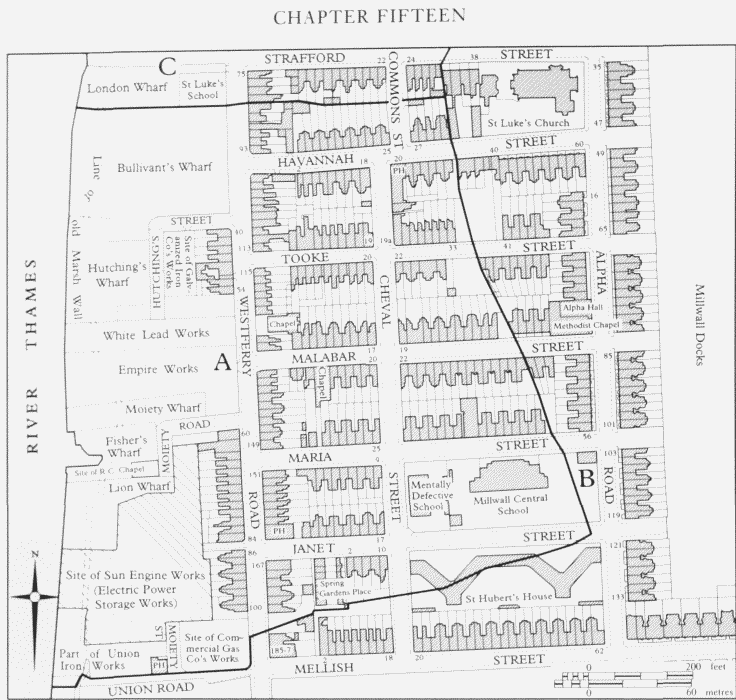
Tooke Town and part of the Mellish Estate. Based on the Ordnance Survey of 1893–4, revised 1937Key: A Tooke Estate: B Mellish Estate (part): C Byng Estate (part)
Industrial development soon obliterated most of Moiety Street, the remnants of which are the present Hutching's Street and Moiety Road. The name Moiety Street was kept by its southernmost part, which survived as a dead-end turning off Union Road until the creation of the Sir John McDougall Gardens (see page 434).
Development c1815–c1839
On the formation of a proper road to the Greenwich ferry, the inchoate development of the riverside began to take shape, with the granting of several 61-year leases by William Tooke, mostly to marine craftsmen. Benjamin Seager Coxhead, a Limehouse anchor-smith, set up a forge on a small strip off what is now Moiety Road, remaining in business there until the 1850s. On a large site further north Edward Simpson, a shipwright, laid out a timber-yard with warehouses, sheds and cottages. (fn. 8)
The site between Coxhead's and Simpson's, which already contained a timber-dock, but was otherwise only a patch of waste ground, was acquired in 1823 by Thomas Fisher, a shipwright and boatbuilder. Fisher too stayed until the 1850s. Also in 1823, ground immediately north of Simpson's was leased to Thomas Hillman, a mast- and block-maker. Soon Hillman had built a mast-house, warehouse and wharves, and by 1839 a substantial house of ground, first and attic floors, later known as Marine Villa, had been erected near the water. (fn. 9)
Further south another mast-house, belonging to John Mawman, and a row of three small houses (then or later known as Patientia Place) had been built on the marsh wall by 1817, occupying the site of the millhouse belonging to a windmill erected in the 1690s (\ 68a ). Joseph Wright, who had a smithy nearby on William Mellish's land, lived in one, James Bradshaw, a grazier, in another, and the third, later the Bricklayers' Arms public house, was occupied by Augustin Sheurer, who by the mid-1830s had built a row of nine cottages in his garden (called Sheurer's Cottages or Marsh Row). Henry Bradshaw, who now occupied the second house, followed suit in 1843–5, building five dwellings, Barn Cottages, on the site of his yard and cowshed. Bradshaw was also responsible for a number of buildings south of Marsh Row (including some cottages in Union Road and a house on the marsh wall at the south end of Patientia Place), and for embanking the foreland south of Cassell's works. (fn. 10)
In 1828 Simpson sold his premises to Hillman, and 11 years later Hillman took a 37-year lease of the meadow lying between this site and Westferry Road. A ropery was built along the northern edge of the amalgamated site, (fn. 11) the area to the south becoming Fuller & Smith's tank works. (fn. 12)
Development west of Westferry Road
Bullivant's Wharf (Express Wharf), No. 38 Westferry Road
The future Bullivant's Wharf had been embanked and partly built on by 1815, but most of the ground remained undeveloped until 1839, when the whole site was acquired by Seaward & Company for the boiler-making arm of their Canal Iron Works business. The rental for the 80year lease was £207 10s, representing a pound a foot for the frontage to Westferry Road. On the closure of the Canal Boiler Works in 1883 the site was redeveloped as an iron-and-steel wire-rope factory by William Munton Bullivant, on a 70-year lease. (fn. 13) Bullivant had worked for the wire-rope maker James Stephenson, of Binks & Stephenson (later Stephenson & Allen). He eventually took over the business and established his own works at Joad & Curling's old ropery in Cuba Street. (fn. 14)
The new works, designed by George Vigers, architect, were equipped with the latest machinery, giving a production capacity of up to 600 tons of rope a month. Rope of up to 21in. in circumference (well in excess of current demand) could be made. (fn. 15)
Galvanized or tarred wire-ropes had the advantage over hemp of having much smaller diameters for the same breaking strain; for a long time there was opposition to them on the grounds that they were too stiff, but greater flexibility had been developed by the use of steel instead of iron, the multiplication of the number of strands and the use of hemp cores both to the whole rope and the outer strands. (fn. 16)
As well as wire-rope and hawsers, Bullivants made telegraph wire, submarine cable, tramway cable, wire netting, torpedo-nets, mining plant and aerial ropeways. (fn. 17)
New buildings and additions were erected throughout the 1880s and 1890s. Bullivants also took over the adjoining premises at Hutching's Wharf (in 1917) and London Wharf. (fn. 18)
In 1926 Bullivants were taken over by British Ropes Ltd and at least part of the works closed soon afterwards. In the 1930s most of Bullivant's Wharf was occupied by Saul D. Harrison & Sons, whose activities embraced the scrap-metal trade, rag and rope dealing, and the manufacture of flock. (fn. 19)
A prominent warehouse adjoining London Wharf, apparently built in 1897, was extensively reconstructed as 'Stronghold Works' for British Ropes in 1934. Half of two tall storeys, half of four storeys, it was a substantial brick-built structure with reinforced-concrete floors. The fourth floor was used for engineering. (fn. 20)
During the air-raid on the night of 19–20 March 1941, one or two direct hits destroyed a two-storey building at the works, the ground floor of which was used as a public air-raid shelter. Two side walls were blown out and the upper floor, heavily constructed to support machinery, collapsed. About 120 people were inside, 44 of whom were killed and 60 injured. Several buildings on the wharf were damaged or destroyed in the raid, including Stronghold Works. (fn. 21)
In 1946 Bullivant's Wharf, which had been occupied by Poplar Borough Council Works Department for storage, was acquired by Freight Express Ltd, wharfingers, who renamed it Express Wharf. (fn. 22)
The London Steel Terminal, No. 38 Westferry Road. In 1973 Freight Express merged with the shipping and freight-forwarding agency Seacon to form Freight Express-Seacon Ltd. Express Wharf was redeveloped as the London Steel Terminal to handle steel cargoes from the EEC (Plate 69c ). The site is covered by two sheds, completed in 1976 and 1986 respectively, equipped with high-speed gantry cranes for unloading from ships and loading on to lorries. Canopies project beyond the quay to give cover to vessels at berth, that on the 1986 shed being four metres lower than the other, taking account of the introduction of hydraulically lowered wheelhouses on ships. The architects were I. W. Payne & Partners. (fn. 23)
Hutching's Street and Hutching's Wharf
Hutching's Street, formerly Providence Place, was so named in 1859 after A. J. Hutching & Company, wirerope makers, of Hutching's Wharf. (fn. 24)
Hutching's Wharf comprised, first, the site of Mill Wall Foundry, with the addition of a narrow entranceway from Moiety Street, and the site of a few cottages, stables and sheds on either side of this path, which were built in the early 1820s. By 1864 there was a gridiron for shiprepairing on the foreshore, and the site was accordingly known for some time as Gridiron Wharf. Second, on the ground to the south originally leased to Thomas Hillman in 1815 was a goods wharf, granaries, manager's house, smithy, stables, coach house and cart shed. (fn. 25)
Hutching's Wharf was only a loose agglomeration of sites, and was seldom, if ever, in single occupation. In the 1870s, for example, the northern part was occupied for a time by the oil and tar refiners Charles Price & Company. (fn. 26) A. J. Hutching & Company's factory covered most of the southern part, which later became known for a time as Hutching Wharf. It had been part of a wirerope and engineering works set up in 1839–41 by Andrew Smith, whose premises, acquired in stages, had also included the ropery to the south (the future No. 56 Westferry Road) and the whole area bounded by Hutching's Street and Westferry Road (including the future site of the Patent Galvanized Iron Company's works). (fn. 27)
Andrew Smith & Company had been in business from c1830 at Princes Street, Leicester Square, as smiths and engineers specializing in patent shutters and casements. Over the next decade or so the concern had expanded to manufacture a wide range of products including steamboats, steam-engines, cranes, patent flax-breaking machines, and wire-rope for standing rigging. In 1843 Smith's products included flat 'rope' 3ft wide by 3/8in. thick, capable of raising more than 250 tons. (fn. 28)
Wire-ropemaking on this site ceased in about 1886, when A. J. Hutching & Company closed down. For a few years the southern part of Hutching's Wharf, comprising the main wire-ropemaking shop, was occupied by the Electro-Metal Extracting, Refining & Plating Company Ltd, whose experiments in the electrolytic processing of scrap metal, dross and slag proved a failure. After a brief spell in the occupation of a firm of steel founders, the premises were again taken over by a metalreclamation business, which proved equally unsuccessful. (fn. 29) After some years in the occupation of a firm of wood-turners and timber merchants, the works were acquired by John George & Sons, of Whitechapel, ironmongery factors. The old part-timber buildings were torn down and substantial, if otherwise unremarkable, brick warehouses for hardware were erected. (fn. 30)
The principal warehouse, built in 1908, is shown on Plate 77b , c . A single-storey warehouse on the riverfront followed in 1909, and in 1920 another ground-floor warehouse was built opposite at No. 54A (now regarded as part of No. 56) Westferry Road. All three warehouses, which survived more or less intact until the late 1980s, were built by Howell J. Williams Ltd of Bermondsey. (fn. 31)
The northern portion of Hutching's Wharf was occupied from the mid-1890s by Squire & Calver, lightermen who also acted as wharfingers in a small way. There were two warehouses on the wharf, a former granary dating from the early nineteenth century and a large barn-like building with a pantiled roof, probably part of Mill Wall Foundry. Two three-storey houses adjoining the old granary in the 1880s had been pulled down by this time. The granary was a narrow building of three storeys and a basement, the floors being carried on iron columns; it was thoroughly dilapidated. Gaslight was laid on in part, but otherwise paraffin lamps had to suffice. Most was used for keeping tar, timber, reeds and other materials for barge-building. Goods stored for rent included bottles and coir, and, out in the yard, asphalt, timber and coconut oil. The other building, used for a time for storing hemp for Bullivants, was equally shabby. In 1912 it was let to R. Walber & Company as an iron warehouse, and later to Bullivants, who took over virtually the whole of the premises by 1917, Squire & Calver having given up wharfage. (fn. 32)
After the takeover of Bullivants by British Ropes, Hutching's Wharf was occupied by a firm of fibre merchants, during whose occupancy the granary was severely damaged by fire, and in 1937 it was again in the hands of wharfingers, storing metal and timber. The granary was badly damaged by bombing in 1941 and, with the other buildings on the site, was later demolished. After the Second World War the wharf was occupied by the General Constructional & Engineering Company (Bedford & Son) Ltd, who erected single-storey workshops and stores. (fn. 33)
The London Galvanizing Works (West Ferry Mills)
The rectangular site in the angle of Hutching's Street, at the rear of Nos 40–54 (even) Westferry Road, previously part of Andrew Smith's works, was taken over in 1844 by the Patent Galvanized Iron Company. Trading as Malins & Rawlinson, this was a large undertaking which began life in 1839 as the Porth Cawl Iron & Coal Company. In 1843 the Porth Cawl Company acquired a patent galvanizing business then carried on by the patentee, Henry Patteson, at Farnham Place in Surrey; shortly afterwards it took over a West Bromwich iron business and mines in Glamorgan. The conglomerate was reorganized in May 1844 as the Patent Galvanized Iron Company, with a nominal capital of £200,000. (fn. 34)
The Millwall works were set up by Patteson and others, including William Malins, and sold to the new company in December 1844. Premises in Birmingham and offices in the City were also acquired. Contracts carried out by the company at the Millwall works included the galvanizing of the cast-iron roof tiles of the Houses of Parliament; but the work, which involved dipping the tiles in molten zinc, was not a long-term success, and by 1860 the tiles had to be protected with paint. It soon became apparent that the company was over-stretched, and in 1848 an Act of Parliament was obtained to regulate its winding-up. (fn. 35) Adverse claims, mainly secured by mortgages (on properties assessed at some £500,000), amounted to about £200,000, but given the depressed state of the property market barely half that sum could have been realized. There were other problems too, the company and its directors having carried out various 'illegal, irregular, or informal' proceedings. (fn. 36)
In the event the Millwall works and galvanizing business were sold to George Carr, chairman of the company, and two fellow directors, John Field and Charles Tupper. Tupper and Carr obtained a 33-year lease on the works (there having been only an agreement for a lease between the company and Charles Chevall Tooke). They continued to trade there (and at Birmingham) as Tupper & Carr, before moving to premises at Regent's Canal Dock, Limehouse, a year or two later. (fn. 37)
The works, later known as West Ferry Mills, were variously occupied by chemical and colour manufacturers and a plaster maker until the end of the First World War, when they were taken over by the General Constructional & Engineering Company Ltd. This was originally an offshoot of the old-established cast-iron goods manufacturer, The General Iron Foundry Company. The works, which later included the northern part of Hutching's Wharf, were still in operation until the late 1960s. (fn. 38)
The premises consisted of a brick-built, originally earth-floored, workshop which, despite the fact that an exploding boiler wrecked the roof and smashed through a wall in 1907, appears to have survived largely intact until recent years. (fn. 39)
Nos 56 and 58 Westferry Road
In this area, between Hutching's Street and Moiety Road, three principal sites emerged: a narrow northern strip from road to river (No. 56 Westferry Road); a much larger site to the immediate south (No. 58 Westferry Road, originally Fuller & Smith's tank works); and Moiety Wharf, a sub-division of No. 58, lacking any frontage to Westferry Road.
Occupied during the 1870s by Charles Price & Company, No. 56 became Edwin Fox & Company Ltd's Magnetic Telegraph Wire Works. In 1884 Fox's took over the whole area between Hutching's Street and Moiety Road, but was forced into liquidation only a few years later. After Fox's closed, the two sites separated again, the northern part being occupied in whole or part by a number of concerns, whose activities included lighterage and iron-tank manufacture. In the mid-1890s it became the works of the Universal White Lead Syndicate Ltd, hitherto based in some railway arches in Deptford, before becoming the machine-cooperage of Bratt's Stave & Cask Syndicate Ltd. When this closed No. 56 was taken over by Levy Brothers & Knowles Ltd and merged with their Empire Works at No. 58 (formerly the Palm Candle Works). (fn. 40)
Fuller & Smith's tank works (Palm Candle Works). Fuller & Smith's works flourished from c1840 until c1850; Evan Smith, one of the partners, had died by 1850. It was quite highly mechanized, with steam-powered tools for cutting, punching, bending and shearing iron, including a manhole-cutter, together with lathes and a force pump for filling tanks with water. There was also an iron foundry with two cupolas. The battered works gateway, probably of about 1840, with stuccoed piers and a pair of riveted sheet-iron gates, was still standing in 1994 (Plate 78a ). (fn. 41)
After the closure of the tank works the premises, known by the late 1860s as the Pictorial Night Light Works or the Palm Candle Works, were occupied by a succession of chemical and candle manufacturers, before becoming part of Fox's works for a few years. A firm of lead merchants took over the works briefly in the mid1890s, and in about 1900 they became the Empire Works of Levy Brothers & Knowles Ltd. (fn. 42)
Empire Works. Levy Brothers & Knowles, whose origins dated back to 1837, occupied No. 58 Westferry Road from the beginning of the twentieth century to the end of the Second World War, expanding into No. 56, which they largely rebuilt, c1913 (Plate 78a ). (fn. 43)
Before the First World War the two great centres of sack-making were Dundee and Calcutta, but after the war sack-cleaning firms in London and elsewhere started manufacturing as well. In the mid-1920s the biggest sack and bag works were in London, Liverpool and Hull. Apart from a few men employed to do heavy work, nearly all employees were women and girls. (fn. 44)
A Home Office investigation into the trade in 1924–5 found generally deplorable working conditions. It was noted, however, that while the London workers 'insistently asked for welfare provisions', the Liverpool women, an altogether poorer and more depressed class, remained apathetic. Sack-making was inevitably dusty but fairly clean; stencilling was messy, while sack cleaning and repairing could be filthy — grain, flour and chemical sacks being particularly hated. Very few factories then possessed enclosed beating and shaking machines. (fn. 45)
Levy's works consisted of various sheds with slate or corrugated-iron roofs, generally in poor repair, in part dating from the mid-nineteenth century. Conditions inside were primitive. There was nowhere to hang wet outdoor garments, no protective clothing was provided, and the only seating was on bales of sacks. The workers, who numbered about 50, either went home for lunch or ate packed meals about the premises. In this Levy's was apparently more liberal than most factories, where workers were locked off-site at lunchtimes, employers then claiming that everyone went out for lunch and that therefore no canteen was needed. (fn. 46)
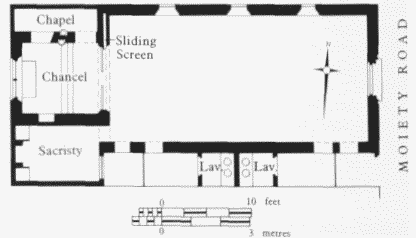
St Edward's Roman Catholic Chapel, Moiety Road,plan. W. W. Wardell, architect, 1846. Demolished
The Sacks (Cleaning and Repairing) Welfare Order, 1927 compelled employers to supply and maintain protective clothing, to make seats available for women whose work was done standing, to provide pegs for outdoor clothing, and cold-water washing facilities with soap and towels, and properly furnished mess-rooms0, together with responsible staff in attendance. (fn. 47)
Parts of Empire Works were used for fibre storage at rental in the late 1930s. After the Second World War, Empire Works were occupied until the late 1960s by a number of associated companies concerned with scrapmetal salvage, metal processing and casting. The site appears to have remained largely derelict ever since. (fn. 48)
Moiety Wharf came into separate being in the early 1890s as a hinge factory, but about 1895 it became one of the Salvation Army's workshops set up under W. Bramwell Booth's 'Darkest England' scheme. These 'elevators' — so called from their intended moral and economic effect — provided work for the unemployed. At Moiety Wharf, wood from Sweden was unloaded for distribution to other elevators where it was split for firewood or made into matches and matchboxes. (fn. 49)
After the closure of the elevator in about 1902, Moiety Wharf was used by the abortive Steam Packing & Engineers' Sundries Ltd, then until the end of the First World War by a firm of manufacturing chemists. It was later occupied, with Fisher's Wharf, by the Ocean Oil Company Ltd. (fn. 50)
Fisher's Wharf (Ocean Wharf)
Fisher's Wharf was a shipwrights' yard until the late 1850s. About that time it was amalgamated with the site to the south, formerly Coxhead's smithy (except for a portion where St Edward's Roman Catholic Chapel stood). It was probably this southern site which was occupied in 1857–8 by the British & Foreign Ships Sheathing Protection Society Ltd, which set out to produce anti-fouling coatings. Several local people had interests in this short-lived venture (which was largely owned by City merchants), including Robert Mills, a tea dealer of No. 264 Poplar High Street, and William Bain, a Blackwall surgeon. (fn. 51)
Fisher's Wharf, used principally for barge-building, was acquired in 1911 by the Ocean Oil Company Ltd, oil blenders and refiners, embanked, and renamed Ocean Wharf. It was later amalgamated with Moiety Wharf and part of Lion Wharf. Ocean Wharf has been rebuilt since the Second World War, and in 1994 was occupied by a furniture-manufacturing company. (fn. 52)
St Edward's Roman Catholic Chapel (demolished)
This small building was opened in 1846 to serve the growing Catholic community on the Isle of Dogs. Built by John H. Fisher & Son of Stratford, it was one of the earliest works of William Wilkinson Wardell (1823–99), a native of Poplar and a convert to Roman Catholicism. (fn. 53)
Designed for economy to combine the functions of schoolroom and church, the aisleless little nave (34ft by 17ft) was shut off from the chancel during the week by a sliding screen (fig. 160). The chancel was flanked by lean-tos comprising a teacher's room and a minute sacristy, with another lean-to along the south side containing lavatories. (fn. 54)
Such a small building gave little scope for elaboration. Early Decorated in style, it had deeply splayed lancets with cusped heads, three in each side wall, large traceried windows at each end (for which Wardell designed stained glass), and a bellcote over the sanctuary arch. Given the small span, the steeply pitched roof was collar-trussed only. (fn. 55)
Superseded in 1873–4 by St Edmund's Church in Westferry Road, the chapel was still standing, albeit in ruins, in the 1880s. (fn. 2) The site was later incorporated into Fisher's Wharf (see above). (fn. 56)
Lion Wharf
In 1838 Thomas and C. C. Tooke leased ground on the south side of Coxhead's smithy to John Fuller, barge builder. The lease was for the usual 61 years and was at a rental of £40. The site comprised a wharf, and three cottages and a large shed on the marsh wall. It was named Lion Wharf in 1865, when it was taken over by Fuller's three lightermen sons, whose firm remained there for 30 years. (fn. 57)
The dilapidated old premises were later occupied as an engineering works, but by the 1930s the site had been merged with the northern portion of the former Electric Power Storage Company's works to form a large timberwharf, and new buildings, mostly open-sided storage sheds, had been erected. Lion Wharf was occupied by timber merchants until the 1960s, when the site was incorporated into the Sir John McDougall Gardens (see page 434). (fn. 58)
Cassell's Patent Lava Stone Works
John Mawman's mast-house (see page 425) had a short life, for c1828 the site was taken over by John Henry Cassell as a tar and varnish works, and the mast-house had certainly disappeared by 1835 when he and his son Edwin Edward obtained a long ground lease of a large Lshaped area covering most of Mawman's former premises. The works then comprised a yard with a shed and a crane on the wharf, and a sawpit and cottage on the marsh wall. (fn. 59)
Cassell (or a relative) had been in business from c1815 at No. 45 Poplar High Street, making rainwater-pipes and gutters, and it was presumably the use of pitch for waterproofing that prompted the move into tar refining. J. H. Cassell & Company began by making pitch and varnish, also developing improved lamps and lamp oil. In 1834 Cassell patented a thermoplastic bituminous material called 'lava stone' for paving and waterproofing. (fn. 60)
'Like many other meritorious inventions of native talent', lava stone failed to catch on at first, although Cassell carried out a number of contracts, including the paving of part of Vauxhall Bridge Road and the flooring of Giblett's slaughterhouses in Bayswater. A lava-stone road was also laid down at Millwall. (fn. 61)
In 1835 Richard Tappin Claridge patented the use of Seyssel asphalt for similar purposes, having seen it employed in France and Belgium. The formation in 1838 of Claridge's Patent Asphalte Company (with a distinguished list of aristocratic patrons, and Marc and Isambard Brunel as, respectively, a trustee and consulting engineer), gave an enormous impetus to the development of a British asphalt industry. Numerous companies were floated. Cassell's invention was suddenly popular, and at least one licensee concern was set up, the Manchester Asphaltum Company. (fn. 62)
The improvements made possible by the use of natural asphalt or its coal-tar-based substitutes (generally called asphaltum) were, in their way, revolutionary, although it was still many years before asphalted roads and pavements in towns became common. As Cassell claimed of his lava stone, it was a cheap and durable paving that was 'noiseless, uniform in its condition, free from mud in Winter, and dust in Summer', while for lining drains or covering floors, it was cleaner and safer than brick or stone. (fn. 63)
Cassell's ready-made products included kerbs, window cills, coping stones, drains, grooved and guttered stones for stable floors, and even coffins — specimens of which could be seen in use in the crypt of the Brunswick Chapel, Limehouse. Lava stone was also sold by the barrel. (fn. 64) Cassell's local contracts included the paving of the footpath along the river wall in East Greenwich in 1837 for the Greenwich Commissioners of Sewers. (fn. 65)
In 1839 E. E. Cassell took a 65½-year lease of ground between Westferry Road and Moiety Street, adjoining the existing works. (fn. 66) In about 1848, however, Edwin E. Cassell & Company, as the firm had become, moved to new premises further down Millwall. The old works were later known as Patientia Wharf, afterwards forming the core of the Sun Iron Works (see below). Houses were built on part of the 1839 extension, a few of them fronting Moiety Street, but the southern end became first a gasworks and then an ironworks.
The Millwall Gasworks
In 1840–1 the Poplar Gas Light Company set up a gasworks at the corner of Westferry Road and Union Road to supply the Isle of Dogs. The company lost its monopoly of the gas supply in the parish in 1846 (see page 114), and in 1849 the rival Commercial Gas Company, of Stepney, which had earlier considered setting up its own Isle of Dogs plant, began negotiations for a take-over. New retorts were erected at the Millwall works a few months later by the Commercial Gas Company. (fn. 67)
When the former Poplar Gas Light Company's main King Street works closed in 1852, the purifying plant was reinstalled at Millwall, but in 1854 work began on new mains from Stepney to the Isle of Dogs. All the plant was dismantled in 1855, and in 1858 it was leased to Samuel Cutler, a gas engineer of West Hackney, and redeveloped as Providence Iron Works. Cutler, who made gas-holders, moved to larger premises further south in Millwall, also called Providence Iron Works, in 1873. The old site became part of the Sun Iron Works. (fn. 68)
The Sun Iron Works (Lollar Wharf)
The Sun Iron Works, later the Sun Engine Works, were set up c1856 by John and William Dudgeon (see page 532), who in 1860 obtained a 40-year lease of the ground at an annual rent of a little over £300. The premises comprised the site of Cassell's Patent Lava Stone Works, by then known as Patientia Wharf, together with Patientia Place, a stretch of Moiety Street, and land east of Moiety Street at the rear of houses in Westferry Road. An extension to the works on the south side of Marsh Row, used for boiler making, was later acquired on a short lease from 1861. In 1869–70 the main works were extended over the site of Barn Cottages, Patientia Place and Marsh Row, a new lease for 55 years being obtained. (fn. 69)
A few years later both works were acquired by Alfred Blyth, junior, and Henry David Blyth of J. & A. Blyth Ltd, of Limehouse, engineers, ship repairers and boiler makers. With the winding-up of the company in 1878– 82, the main site entered upon another phase of industrial pioneering, carried out by the Electrical Power Storage Company Ltd. (fn. 70)
Among the founders of this concern was William Munton Bullivant (see page 425). It was he who obtained a 60-year lease of the Sun Engine Works and assigned it to the company, shortly after its incorporation in March 1882. (fn. 71)
E.P.S., as it was known, was set up to exploit patents concerning batteries and accumulators, including those of Camille Alphonse Faure of Paris and Joseph Wilson Swan of the Swan Electric Light Company Ltd. Swan had invented the incandescent electric lamp in 1879, but it was only with the development of the accumulator that electric light became really practicable. Faure's invention of the pasted accumulator plate in 1880 made the supply of stored electrical power a commercial possibility. (fn. 72)
In 1881 the first practical use of accumulators in England was made, with the installation of batterypowered Swan lamps at the Junior Carlton Club. Next year the Electrical Power Storage Company, with about 300 employees, began producing accumulators at the former Sun Engine Works. The early accumulators were supplied as complete lighting plants, with gas-powered engines and dynamos to keep them charged. One of the first installations was at the Grand Hotel, Charing Cross, and soon E.P.S. batteries were powering lights in large buildings throughout London, including the Law Courts, the Bank of England, Lloyd's and many theatres. London houses with E.P.S. plants included those of the dramatist W. S. Gilbert in Harrington Gardens, while Colonel Crompton of No. 23 Porchester Gardens, who claimed to have been the first householder with electric light (in 1881), was soon using E.P.S. batteries. (fn. 73)
An early customer of the company was Rudyard Kipling, who had E.P.S. installations at his homes in Rottingdean and Burwash. Electrical power in the form of a battery — a fizzing and fuming 'big box of tanks' with a dynamo — features in his 'Below the Mill Dam' of 1902 as a symbol of the modern world with which the Tory old guard has failed to come to terms. (fn. 74)
Until the establishment of mains electricity throughout London, the Millwall works supplied temporary lighting for functions, especially during the London Season. In July 1885 the Prince of Wales gave a garden party at Marlborough House in a marquee lit using an E.P.S. battery, following which there were a number of royal clients, including Queen Victoria. (fn. 75)
In 1883 an experimental tramway was laid down at the works to test a battery-powered tramcar, which was later given a public trial on the West Metropolitan Tramway Company's track from Gunnersbury to Kew. This led to further trials and ultimately to the use of E.P.S. tramcars in Berlin, Vienna and Philadelphia. (fn. 76)
In 1914–15 the company was amalgamated with Pritchetts & Gold Ltd of Dagenham Dock and Feltham. All the Millwall plant went to Dagenham. (fn. 77)
The former E.P.S. works were occupied for a few years by the Cunard Steamship Company, as Cunard Wharf. The buildings, which had been largely reconstructed for E.P.S. in 1897–1902, by various builders to the designs of the Greenwich architect Alfred Roberts (1865–1936), (fn. 78) were described at the time as being generally of 'inferior construction'. Many were built only of timber and corrugated iron. (fn. 79)
Cunard Wharf was used partly for cargo storage at rental, partly for stowing ship's stores, including deck chairs, while other parts were occupied as engineering workshops, a laundry and offices. Towards the end of the First World War several of the buildings were used for repairing artillery wheels. (fn. 80)
Cunards expanded the wharf in 1920 by taking over Lion Wharf, but in 1922 they gave up the whole of the premises, which were subsequently occupied by Aston Grant & Company, timber merchants. (fn. 81)
From the 1930s the former Cunard Wharf was occupied by wharfingers and merchants concerned with building materials and hardware. The northern part, merged with Lion Wharf, continued in the occupation of Aston Grant, while the remainder, enlarged by the acquisition of the northern portion of the defunct Union Iron Works, took on a new identity as Lollar Wharf.
The two principal buildings were a 'warehouse' which was really a group of the old E.P.S. buildings (varying in floor heights and number of storeys) knocked into one, and a large shed. A smaller shed became a factory for tiled fireplaces and kerbs. Most of the buildings were burned out in 1940, and the wharf closed the next year. After the war it continued to be used for buildingmaterials storage until its closure in the mid-1960s, after which it became part of the Sir John McDougall Gardens (see page 434). (fn. 82)
Union Road and the Union Beerhouse
Union Road, dividing the Tooke and Mellish estates, was a narrow way with a lay-by to enable two carts to pass each other; it was little more than an access to the iron works on either side. The Union was the last of a row of small houses built by Henry Bradshaw probably in the mid-1830s. (fn. 83)
The Union and the house next door were knocked into one in about 1866, at the height of Millwall's prosperity. Subsequently the premises fell into disrepair, and in 1914 were rebuilt for Truman Hanbury & Company by W. Pringle of Bow to the designs of Bruce J. Capell. Cheaply fitted out, the new Union was a typical beerhouse of its date, the upper front cement-rendered and painted, the ground-floor front faced with glazed green tiling. There were two public bars, divided by a screen. III-placed to attract any 'jug trade', the Union nevertheless survived until the Second World War. It was still standing, albeit in a ruinous condition, in 1960. (fn. 84)
Houses and Shops in Westferry Road
Only about a half of the frontage to the west side of Westferry Road was built up with houses and shops. The earliest houses were Nos 86–96 (even) and 98–100 (even) Westferry Road, built in 1848 and leased respectively to a widow from Greenwich and the licensee of the Queen's Arms, Poplar High Street. In this terrace, originally called Hornsey Place, few houses were used for business for any length of time. There was a greengrocer's shop at No. 86 from the 1860s to the early twentieth century, and a bootmaker's at No. 98 during the 1870s and early 1880s. (fn. 85)
Canterbury Place and Prince Patrick Place (Nos 40– 54 and 60–84, even) were built up largely during the mid- and late-1850s. Building lessees included a local baker, a Blackwall Dock constable and Thomas Fisher of Fisher's Wharf. At least six houses were leased to the local builder Joseph Salt (Nos 40, 46–50 and 62–64, even). Most had shops. Nos 48 and 50 were a shipping butcher's shop from the 1860s to the 1960s. A cartway ran through No. 50 to a slaughterhouse in the back yard. No. 62 Westferry Road was a pawnbroker's for most of its existence. The proprietor acquired No. 66 in 1872 and by the First World War the business occupied No. 64 as well and was 'doing a good trade'. The yard at No. 62 had been largely roofed over and the other houses were used for storing pledges. Nos 46 and 48, 52 and 54 were still standing in 1994. (fn. 86)
East of Westferry Road
Millwall Independent Chapel, No. 127A Westferry Road (demolished)
The first place of worship built on the Isle of Dogs since the medieval chapel of St Mary, this was erected in 1817 by a congregation which had been meeting since 1812, at first in a house on the Mill Wall belonging to John Howard, a mast- and block-maker. Prominent in the founding of the chapel were Prows Broad, whose boatbuilding yard was nearby, and George Guerrier, a grazier, who contributed largely to the cost. Guerrier died in 1824 and was buried at the chapel (the only known place of interment on the Isle of Dogs since medieval times). (fn. 87)
Set back from the road, the chapel was of conventional type: oblong, with a pedimented three-bay front containing a round-arched doorway and first-floor windows. A gallery brought the total seating accommodation to 250. There was a Sunday School room at the rear, rebuilt in 1889. (fn. 88)
The chapel closed about 1908, after which it became a girls' institute and later a printing works. Disused and dilapidated by 1951, it was pulled down soon afterwards. (fn. 89) In 1981 the date-stone from the front of the chapel was in a garden at Shenfield. (fn. 90)
Nos 83–179 (odd) Westferry Road (demolished)
These houses — originally forming three terraces called Victoria Place, Albert Place and Tooke's Place were typical of the small dwellings built throughout Millwall in the nineteenth century. Most had four or six rooms, and a number were built as or converted to shops. There was one public house, the Tooke Arms, No. 165 on the corner of Janet Street. The leases were for 65 years, at rents of £2 10s per plot each with a 15ft frontage. The lessees included some local residents of comparatively long standing, notably the graziers Henry and Edward Bradshaw and marine craftsmen who had been among the newcomers to Millwall on the formation of Westferry Road. The largest lessee was John Fuller, a barge-builder, who built about ten houses north of the chapel from 1841. Two Poplar High Street builders, John Boorman Attwood and James Hardy, and the Millwall builder Joseph Salt, took building leases on a few houses. Other lessees included artisans and craftsmen in the burgeoning iron trades. (fn. 91)
By the early twentieth century the houses were nearly all in bad repair. Nos 151–163 (odd) were pulled down c1919 and a warehouse was built on the site for R. Walber & Company, iron and steel stockholders. The majority, however, survived until the Second World War, when nearly all escaped serious damage. The whole area has since been redeveloped for public housing. (fn. 92)
Havannah Street (formerly Thomas Street)
The western part of the street was mostly developed in 1846–7 on 65-year building leases at a rental of £2 per plot. The main lessee was a Limehouse builder, John Saunders Rayment, whose houses included the Pride of the Isle beerhouse, on a double plot on the corner of Chevall and Thomas Streets. Salt also agreed to take ground at this time, though not completing his houses until 1849. Some plots remained vacant for more than 20 years. (fn. 93)
The eastern part of the street, on the Mellish Estate, was laid out c1870 and built up in 1870–6 by William Line, a local carman and contractor. (fn. 94)
By the First World War most of these houses were dilapidated and coming to the end of their useful life, although a number had been fairly thoroughly refurbished. Some, if not most, were being let in two parts; it was a poor street. (fn. 95)
Tooke Street (part formerly Prospect Place)
The development of the western part of Tooke Street began in 1842 when William White, a local baker, took a building lease of four plots on its south side. As well as a terrace of four houses, he wedged in two cottages at the rear, White's Cottages. (fn. 96)
There was some further building in 1842–7 — the lessees including a butcher and an engineer, both from Limehouse, and a Millwall stonemason — then a second wave of building in the mid-1850s. In 1854 George White, an iron-founder, completed a row of plots he had agreed to take in 1846. A few years later William White built another row of houses and about the same time a couple of pairs of houses appeared, on leases granted to a Spitalfields watch-case manufacturer, and a Millwall sawyer. (fn. 97)
Almost all the western (Tooke) part of the street had been built up by the late 1860s; the eastern part, on the Mellish Estate, was laid out later and built up in 1879 with terrace houses by Abraham Cullen of Havannah Street, a house agent. (fn. 98)
Malabar Street (formerly Charles Street)
The whole of the north side of Charles Street on the Tooke Estate was built up in the mid-1860s with twostorey houses of five and six rooms (Nos 1–41, odd), and some stables adjoining No. 1. Joseph Salt, the Millwall builder, was the lessee of many, if not all, of these houses. The rents were £2 a house for 70-year terms. (fn. 99)
When building on the Isle of Dogs came to a virtual standstill in 1866, the south side of the street remained undeveloped except for four houses (Nos 22-28, even) on the corner of Chevall Street, three little cottages of three or four rooms (Nos 2–6, even), and a large singlestorey rectangular building (No. 8) adjoining the rear of houses in Victoria Place, Westferry Road. Two more houses, Nos 30 and 32, were put up in 1866 on a 70year lease at the higher rent of £6 10s the pair. The lessee was George Harvey of No. 25 Westferry Road, greengrocer and coal merchant. (fn. 100) No. 8, probably built as a warehouse, was converted to a Salvation Army Barracks in 1879. A mission hall by the early twentieth century, it was a club in the 1930s, but by the early 1950s had become a builder's store. (fn. 101)
It was not until 1878–9 that any more building took place in the street, when the nine houses at Nos 34–50 (even) — formerly Nos 14–30 (even) Charles Street — were built. The term was longer, and the rent much higher: £5 a house for 80 years. As with many Millwall houses, the lessee was a local tradesman, in this case a baker, Thomas Holman. Generally similar to the earlier houses, Nos 34–48 (even) were unusual in that the lavatories were built directly on to the rear of the main block of the house, instead of on to the back addition, or separately in the yards or gardens. (fn. 102)
Henry Pearce, a Kerbey Street carpenter, built up the remaining plots towards Alpha Grove (part of the Mellish Estate) on 80-year leases in 1880. (fn. 103)
Maria Street, Janet Street (formerly Jane Street) and Spring Gardens Place
Artizan Villas, a terrace of nine houses on the south side of Maria street, were built up by various lessees in the mid-1860s. Rather surprisingly, in view of the economic distress on the Isle of Dogs at the time, it was only in the late 1860s that house-building began on the north side of the street. About this time, too, a Primitive Methodist Chapel was built, with seats for 230. The Maria Street houses, mostly built on 70-year leases, were of typical Millwall side-street pattern, small, plain and boxy, with round-headed doorways and ground-floor windows. East of Artizan Villas, the street remained unbuilt on for many years. (fn. 104)
Janet Street, too, was never fully built up with houses, although most of the south side and the north side as far as Chevall Street had been developed by the late 1860s. The earliest houses were in Spring Gardens Place, a row of seven two-up, two-down, cottages behind houses in Westferry Road. They were built in 1847–51 on two 70year building leases granted respectively to John Hooper, gentleman, and William Whitfield, a local schoolmaster. The name was taken from Spring Gardens, Whitehall, where Thomas Tooke resided. A Millwall carpenter, Thomas Warrilow, was the lessee of more than half the later houses in the street. (fn. 105)
The large site between Maria and Janet Streets east of Chevall Street was used for a coconut-fibre works from the 1880s, but around 1900 the lease was bought by the London School Board. (fn. 106)
Millwall Central Council School (demolished)
As early as 1897 it had been apparent that if Glengall Road School was to be brought up to standard it would have to be considerably enlarged, or a new Higher Grade school would be needed elsewhere in Millwall. Compulsory-purchase powers were obtained over adjacent Millwall Dock Company land, but never used in case a heavy claim for compensation followed. When improvements at Glengall Road seemed imminent in 1902–3, powers were obtained by the London School Board to buy the Janet Street site instead, part of it to be used for a special school. The intended Higher Grade school was not built, however, partly because of the Board of Education's reluctance to approve the scheme before the responsibilities of the London School Board had been transferred to the LCC. (fn. 107)
In 1906 the LCC built the special school, and in 1913 plans for a new school partly replacing Glengall Road School were revived. This was to make good a deficiency of local places concomitant upon a scheme for reducing class sizes. It was only in the mid- to late-1920s, however, that the school at last materialized, and then on the original grounds that Glengall Road School needed modernization. It was felt, too, that Glengall Road was unsuitable for a large school because it carried diverted traffic when the dock bridges were raised, making some classrooms intolerably noisy. (fn. 108)
Opened in April 1928, the new school was designed by one of the assistant architects to the LCC, J. R. Stark, and built by G. E. Wallis & Sons of Panton Street (Plate 79a ). Because so many local children left school early, it was planned for 320 rather than the usual 400 places. This, and the need for extra foundations, pushed the cost per head above that of other contemporary schools. The building cost a little over £21,500, including furniture and fittings and a caretaker's house. (fn. 109)
Built at a time of strict economy, and therefore without ornamentation, the building showed the leading features characteristic of LCC schools before the Second World War, as Board School principles were abandoned: comparatively lightweight construction, axial planning with maximum utilization of south light, rigid adherence to symmetry and Classical proportions, and a general tendency to ape the country-mansion style associated with public schools.
Millwall Central School comprised a central two-storey block with side wings stepping back to ground-floor pavilions. Its English-bond brickwork, hipped pantiled roofs with deep eaves, small window panes, and firstfloor windows pushed through the eaves to emerge as dormers, reinforced an overall impression of domesticity. There was no grand central entrance, and on the south side the classrooms opened directly on to the playground through partly glazed double doors, revealing the inadequacies of the country-mansion prototype and a more uncompromisingly functional character beginning to assert itself. (fn. 110)
The school comprised six classrooms, a hall, rooms for art, science, crafts, cookery and laundry, together with ancillary accommodation including a medical inspection room and a kitchen. (fn. 111)
The site of the building, which, with the old special school, was bombed in the Second World War, is now partly occupied by Seven Mills Primary School. This was opened in 1968, having cost an estimated £102,030.
The special school, officially known as Janet Street (Mentally Defective) Council School, was erected in 1906–7 at a cost of £3,118 to take 60 children. By 1922 it was coping with far more than its official capacity and the school hall had been brought into use as a temporary classroom. There were then nearly 100 children classed as mentally handicapped living on the Isle of Dogs. (fn. 112)
By 1931 the roll had fallen to 14 as a result of public housing relocations, the school was closed and the children transferred to a school in Pigott Street, Limehouse. The building was later used as the Infants' Department of Glengall Road School, eventually closing in March 1945. (fn. 113)