Survey of London: Volumes 43 and 44, Poplar, Blackwall and Isle of Dogs. Originally published by London County Council, London, 1994.
This free content was digitised by double rekeying. All rights reserved.
'Southern Millwall: Drunken Dock and the Land of Promise', in Survey of London: Volumes 43 and 44, Poplar, Blackwall and Isle of Dogs, ed. Hermione Hobhouse (London, 1994), British History Online https://www.british-history.ac.uk/survey-london/vols43-4/pp466-480 [accessed 30 April 2025].
'Southern Millwall: Drunken Dock and the Land of Promise', in Survey of London: Volumes 43 and 44, Poplar, Blackwall and Isle of Dogs. Edited by Hermione Hobhouse (London, 1994), British History Online, accessed April 30, 2025, https://www.british-history.ac.uk/survey-london/vols43-4/pp466-480.
"Southern Millwall: Drunken Dock and the Land of Promise". Survey of London: Volumes 43 and 44, Poplar, Blackwall and Isle of Dogs. Ed. Hermione Hobhouse (London, 1994), British History Online. Web. 30 April 2025. https://www.british-history.ac.uk/survey-london/vols43-4/pp466-480.
In this section
Drunken Dock and the Land of Promise
In the early eighteenth century the Land of Promise estate (fig. 176), consisting of marsh, with reed beds and osier hope along the foreland, belonged to Simon Lemon, a haberdasher of St Martin's-in-the-Fields. A windmill was built at the north end, beside Drunken Dock, about 1722, together with a house and granaries. They were replaced c1766 by a warehouse, dwelling house, and cottages, which became the centre of a large mast-works that flourished for a century. (fn. 5)
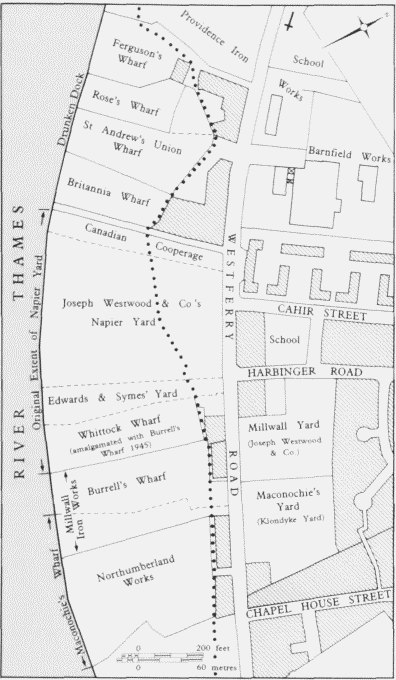
The former Drunken Dock and Land of Promise, and adjoining areas. Plan showing the principal riverside sites,development on the Barnfield Estate and part of the MellishEstate, before redevelopment in the 1980s. Broken lines showsub-division of sites. Hatched areas indicate housing
Robert Todd, mastmaker of Wapping, bought the estate in 1771 and on his death left it to his partner Thomas Todd and his late wife's cousin, Elizabeth, wife of Charles Augustin Ferguson of Poplar, also a mastmaker. Ferguson and Todd continued to run the mast works, using most of the foreland as ponds for storing timber. After the formation of Westferry Road, land was acquired from William Mellish to give the estate a greater road frontage. (fn. 6)
'Smoke-stack' industry arrived in 1824, with the construction of a chemical-processing works of the Imperial Gas Light & Coke Company. In 1835–6 the estate passed to Ferguson's son, Charles Augustus, who sold the undeveloped greater part of the ground to the Scottish engineers William Fairbairn and David Napier. Their respective establishments made Millwall an important centre of iron shipbuilding. The culmination of the shipbuilding boom was the creation of the Millwall Iron Works complex, which fragmented into miscellaneous wharves and works after the financial crash of 1866.
Later industrial activities included jam making, oil refining, metal-working and the manufacture of paint and colours. Wharfage became important, with large wharves given over to oil and building materials. Decline in industry and wharfage was swift from the 1970s, the Docklands property development boom of the 1980s hastening the process.
The pattern of nineteenth-century building in this part of Millwall was slightly different from that in the north, mainly because industrialization occurred more abruptly. Apart from the Mast House buildings, there was little existing development to affect the layout of industrial sites in the first half of the nineteenth century. The marsh wall had some influence, still apparent at Burrell's Wharf. A handful of houses and public houses was built along Westferry Road, and a substantial villa was built at Napier Yard, but there were no off-road developments of cottages and small workshops.
In 1994 most of the land is covered by recent housing projects or lies vacant. The last significant industrial relics are the remnants of the Millwall Iron Works and the Venesta factory at Burrell's Wharf, and part of one of the Great Eastern slipways on Napier Yard. Post-war industrial sheds stand derelict at Ferguson's Wharf, on the site of the Mast House.
Drunken Dock
The origins of the name, which as early as the sixteenth century was also given to an inlet on the south-east bank of the Isle of Dogs, (fn. 7) are not known, but it probably simply means a tidal dock. Until the early to midnineteenth century it was regarded as a public dock, used by anyone for mooring boats and barges, though it was also used for timber storage, with the permission of the Thames Conservators. Willows grew along the banks, and animals could graze down to the water's edge. In the early nineteenth century a man and his wife lived there for several years in a houseboat. So long as the Mast House continued in operation, the dock was needed for floating masts and spars, but when it closed the basin was filled in. (fn. 8)
The Mast House Property
Local tradition had it that the Mast House was built by a Mr Harris, formerly proprietor of the mast-works, but it may have originated as a warehouse, built on the site about 1766 by John Gomm, a City merchant who acquired the Land of Promise estate in 1764 (Plate 74; fig. 177). Harris was Robert Todd's partner and they may well have altered or enlarged Gomm's building, which they held on lease at a rental of £56. (fn. 9)
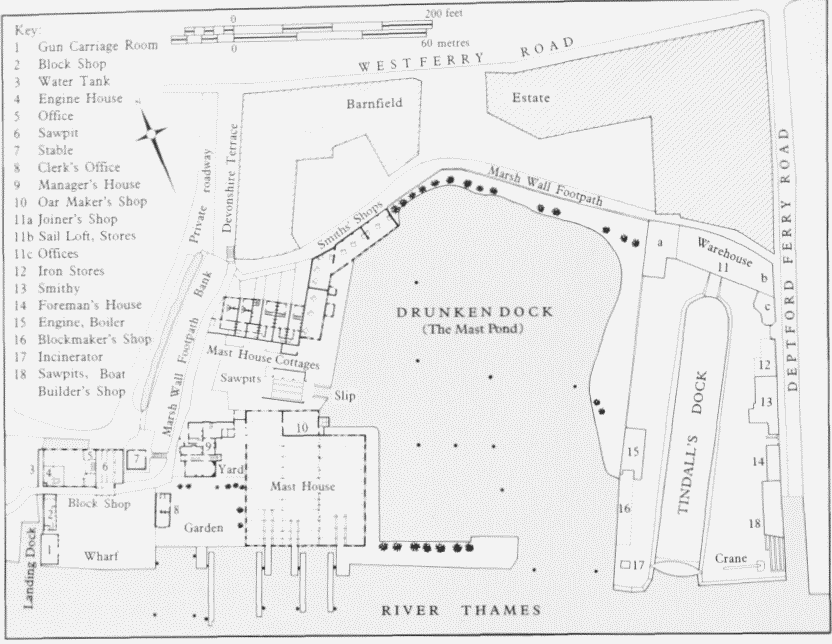
Drunken Dock, the Mast House property and Tindall's Dock, c1863
The Mast House comprised three parallel ranges, timber-built, each with a double-span roof and its own slipway to the river. (fn. 10) In general form it was similar to other eighteenth-century mast-houses, such as those surviving at Chatham Dockyard.
Beside the Mast House was the mastmaker's residence, also built c1766. Brick-built and stuccoed, it had a diningroom, drawing-room, kitchen and pantry on the ground floor and three bedrooms, a nursery and w.c. on the first. There was also a basement or semi-basement, containing a kitchen, larder and dairy. Three wooden cottages, also contemporary with the Mast House, were replaced by the end of the eighteenth century with a row of six stucco-fronted dwellings, the Mast House Cottages, which provided accommodation for employees and their families. Other buildings at the Mast House included a range of brick-built smithies, and a large timber-sided sawpit with a concrete floor. (fn. 11)
Robert Todd lived at the mastmaker's house until about 1787, when he seems to have retired to Greenwich. Although the name Harris & Todd continued to be used until the late 1790s, the active partners in the firm appear to have been Charles Augustin Ferguson, who took up residence in Todd's house, and Todd's godson Thomas Todd, who had a new house built for himself on nearby land belonging to George Byng. Thomas Todd's house, held on a 99-year lease at a ground rent of £6, was in three bays with a mansard roof and comprised ground, first and attic floors. Standing just south of the Willow Bridge Ferry and a summer-house belonging to Ferguson and Todd, it looked towards the river across a small garden bounded by a kink in the marsh wall path. (fn. 12)
The rest of the plot, which had a river frontage of 200ft, was laid out partly as garden, partly as a timberyard with a wharf and a drawdock. The ground remained largely open until the early 1840s, but was subsequently covered by a number of buildings for making marine blocks and gun-carriages. Chief among these was the block factory, a slated brick building of three floors. (fn. 13)
Todd's house was occupied in 1817 by the firm of Brown & Lenox, whose chain-cable works were nearby. In 1846 it was let on a 40-year lease at a peppercorn rent by Charles Augustus Ferguson to the builder William Cubitt. It was pulled down in the 1880s or early 1890s, at which time it formed part of Providence Iron Works (see page 458), probably to make way for a new riveting shop. (fn. 14)
The closure of the Mast House in 1861, when Ferguson became insolvent, provided a golden opportunity for the Ironmongers' Company, which had taken legal proceedings against him for trespass and encroachment on part of the foreland at Drunken Dock. It bought the Mast House at auction, obtained a licence from the Thames Conservancy for enclosing the dock, and sold the property to the newly formed Millwall Iron Works, Ship Building & Graving Docks Company Ltd. Among prospective purchasers had been John Scott Russell, builder of the Great Eastern, who had hoped to set up his son in business there as a shipbuilder. (fn. 15)
After his financial crisis and the sale of the Mast House, Charles Augustus Ferguson appears to have reestablished his business at the block and gun-carriage works under the name Charles Ferguson & Company, continuing until about 1871. Parts of the works were subsequently occupied by Laing, Howlett & Company, gun-carriage makers, and others, but from 1873 the main occupiers were Samuel Cutler & Sons of Providence Iron Works.
After the collapse of the Millwall Iron Works, Ship Building & Graving Docks Company Ltd, the Mast House property was occupied for some years by N. J. & H. Fenner of Fenner's Wharf, who briefly let it to a ship-breaker. In 1877 they began using it for storing barrels of petroleum, carrying out conversion work to the Mast House, including the erection of brick internal walls. A large pit was sunk on the site of the Mast Pond, also for the storage of petroleum in barrels. The name Mast Pond Wharf was used briefly, but was soon changed to St Andrew's Wharf, probably to avoid confusion with Mast Pond Wharf in Woolwich. (fn. 16)
St Andrew's Wharf was broken up into the following: Ferguson's Wharf, comprising the Mast House, Ferguson's house and the cottages; Rose Wharf, covering the north-western half of the Mast Pond, but excluding an area to the north-east occupied by a coconut-desiccating works; and the other half of the Mast Pond, known as St Andrew's or St Andrew's Union Wharf.
Ferguson's Wharf was so named in 1886 when this part of St Andrew's Wharf was taken by Mark H. Winkley & Company, public wharfingers and warehouse keepers. Winkley's used it for storing lubricating and vegetable oils, wax, tallow, resin and tar. (fn. 17) From 1895 it was occupied by the Vacuum Oil Company for storage of their own goods, (fn. 1) and later by Chetwin & Newark, lubricating-grease manufacturers. Part of the site, occupied by the British Oil & Turpentine Corporation Ltd, lubricating-oil blenders, was later known as Speedwell Wharf. Both wharves were largely wrecked by fire in 1935. (fn. 19)
Rose Wharf took its name from its occupiers of many years, Sir W. A. Rose & Company, manufacturers of paint, white lead, colour, varnish and grease, tar merchants, and refiners of oil and tallow. Their main premises were in Upper Thames Street. Several buildings were erected in 1893–4, the principal one being a six-storey oil refinery, which was destroyed by fire in 1896. A substantial replacement, comprising basement and three floors, was built in the following year. Brick-built, with concrete floors carried on iron joists and concrete-cased iron columns, it had a corrugated-iron roof on steel trusses, and was served by an outside iron staircase. (fn. 20) After Rose's departure in the late 1920s the wharf was disused until 1932, when it was taken by International Shipping & Transport Ltd, to replace its premises at Vauxhall. Like several local wharves, Rose Wharf had begun as a purpose-built factory, and was turned over to storage with a minimum of conversion work. The wharfingers simply carried out some repairs, and stowed the derelict paintmaking machinery in the refinery basement. Goods stored included celluloid toys and Christmas crackers; by 1937 the wharf was used exclusively for waste paper. (fn. 21) The premises were later occupied by the Thames Oil Wharf Company of St Andrew's Wharf.
St Andrew's Works adjoined Rose Wharf. Formerly the coconut-desiccating works of G. Davis & Son, after the First World War the premises were occupied by Chetwin & Newark of Ferguson's Wharf. In 1937 they became part of St Andrew's Wharf. (fn. 22)
St Andrew's Wharf was bought in 1899 by Young & Marten Ltd, builders' merchants and manufacturers of Stratford, Essex. The largest of several wharves owned by the company at that time, it was used mainly for storing building materials, including cement, ballast, timber, slates, tiles, felt, laths, hair and plaster. (fn. 23) Most of the wharf was open, the only substantial buildings being a small brick-built cement warehouse and a cottage. (fn. 24)
In 1919 the wharf was acquired by the Thames Oil Wharf Company Ltd, oil and general wharfingers. It was used mainly as a petroleum wharf, despite the 'flimsy and combustible nature' of some of the storage sheds erected, and the proximity of Rose's oil and paint factory. Wood and vegetable oils, tar, asphalt, paper and building materials were also handled. (fn. 25)
Thames Oil, which also ran Glengall Wharf, Westferry Road, was one of the last big wharfage concerns in Millwall. By the early 1960s, when the company had also taken over Rose Wharf, the local oil-storage business was suffering from the decline of the Port of London. One company in particular, on which Thames Oil depended heavily for business, pulled out of London altogether. Part of Rose Wharf had to be let. The company's financial position was further weakened by the expense of refronting the river wall, and by the severe winter weather of 1962–3, which caused considerable damage to plant and goods. Finally, in the face of government import restrictions, the wharf was closed, the plant was scrapped and Thames Oil ceased trading early in 1968. (fn. 26)
Britannia Dry Dock.
The site of the dock was bought in 1839 from Charles Augustus Ferguson by David Napier and shortly afterwards sold by him to William Tindall, who in 1841 built a wharf, a 160ft-long dry dock and various workshops and warehouses which were plain, mostly brick buildings with hipped roofs, of two or three floors, some open on the ground floor. (fn. 27) The name Britannia Dock dates from 1863, when the premises were sold to the Rotherhithe shipbuilder and shipowner, William Walker. The dock later formed part of the Millwall Iron Works conglomeration. Too small for later needs, it closed in 1935. The filled-in site became a timber-yard, known as Britannia Wharf. (fn. 28)
Napier Yard
David Napier, marine engineer, bought the site of Napier Yard, undeveloped except for a row of old cottages, in 1837, laying it out as a shipyard for his sons John and Francis. By 1843 it contained a workshop, a substantial Classical-style villa (called Millwall House, Plate 84c), and some dwellings along Westferry Road. The works remained in operation until destroyed by fire in 1853; most of the yard was then leased to John Scott Russell as the building site of the Great Eastern, and was later bought by the Millwall Iron Works, Ship Building & Graving Docks Company Ltd. (fn. 29) It seems to have been wholly or partly unoccupied for some years after the collapse of that company. However, by the 1880s it was partly occupied by ship- and barge-builders, to whom building slips were leased by the Millwall Iron Works Company, successor to the earlier limited company. (fn. 30)
A narrow strip alongside Deptford Ferry Road, where sawmills and a joiners' shop had stood, subsequently became the works of the Guelph Patent Cask Company Ltd (later the Guelph Cask, Veneer & Plywood Company Ltd). The premises, known as the Canadian Cooperage, comprised a range of one- and two-storey buildings. Burned out in 1900, they were replaced by a warehouse, cask store and mill, all of corrugated-iron construction, and a two-storey brick-built office block. (fn. 31)
The greater part of Napier Yard, which retained the old name, was occupied for many years from the mid1880s by Joseph Westwood & Company, engineers, contractors, stockholders and manufacturers of constructional iron- and steelwork. Important contracts of Westwood's included the Sukkur Bridge, a cantilever bridge erected across the River Indus in 1889, which helped to open up trade between India and Afghanistan. Armitage & Crosland Ltd, a subsidiary of Westwood's at Napier Yard in the early twentieth century, made calendering machines, probably for the laundry trade and wallpaper-making. (fn. 32)
Another business carried on at Napier Yard was the manufacture of safety treads for stairs and steps. Joseph Westwood, junior, made wooden treads, under the name Hawksley's Patent Treads, from about 1885, supplying institutional and commercial buildings all over the country. From 1895 Hawksley's Treads were manufactured, together with an improved version, invented by a Greenwich civil engineer, J. T. Andrews, by the Andrews-Hawksley Patent Tread Company Ltd. A number of local people took shares in the new company, including Harry Hooper, the Millwall surveyor and estate agent, and Horace Bradshaw, a carman and contractor. Andrew's Treads, extensively used in railway stations and other buildings, and on bus and tram platforms, comprised wooden cubes in wrought-iron framing. They were said to be stronger than comparable treads using cast-iron frames, with the additional advantage that the blocks could be reversed when worn. Manufacture was transferred after a few years to premises in Wharf Road, Cubitt Town. (fn. 33)
Extensive building and rebuilding was carried out by Westwood's from 1885, but much of the site remained covered by jetties and building slips until 1900, when the ground was levelled and a river wall was constructed. Large steel-framed buildings were put up in the 1930s. Westwood's also occupied the former Millwall Iron Works premises in Westferry Road for many years. (fn. 34)
South of Westwood's was Britannia Yard, a small shipyard occupied by Forrestt & Sons from the early 1880s. The premises included the former foundry, engine factory and smithies of the Millwall Iron Works, which were pulled down c1906 for the Venesta factory; the yard itself was occupied from the late 1880s by Edwards & Symes (later Edwards & Company), and remained in use for boat- and barge-building until the 1930s. It was subsequently used for experimental work by British Smokeless & Oil Fuels Ltd, and after the Second World War was absorbed by Westwood's. (fn. 35)
William Fairbairn's Millwall Iron Works. In 1836–7 the engineer (Sir) William Fairbairn (1789–1874, baronet 1869) laid out an ironworks on a three-acre site, purchased from Charles Augustus Ferguson. (fn. 36)
The Millwall venture, which grew out of experiments in the early 1830s with a small iron boat on the Forth and Clyde Canal and the Mersey, was Fairbairn's second attempt to succeed in London. A quarter of a century earlier, as a young millwright, he had been prevented from taking up John Rennie's offer of employment in connection with Waterloo Bridge because of the Millwrights' Society's closed-shop policy. Later he found work at Greenwich (and must therefore have known Millwall), but left the London area in 1813, setting up in business in Manchester as a manufacturing engineer in 1817. (fn. 37)
Fairbairn, together with his sons, carried out some innovative work at Millwall, not only in the construction of iron ships, but also including such projects as model tests for Robert Stephenson's Menai Bridge. His main engineering works, however, remained at Manchester. In 1841 William Fairbairn, Sons, & Company exhibited at the works a corn mill designed by Fairbairn, which was, he later claimed, the first all-iron building of its kind in England, and the prototype of iron churches, houses and warehouses. The mill-house was constructed of a framework of hollow cast-iron pillars, the walls of the ground floor being formed of cast-iron plates, and those of the upper two floors of wrought-iron plates, riveted to flanges on the pillars. The floors were formed of iron beams supported on columns, and the roof was of corrugated iron. (fn. 38)
More than 100 ships, mostly under 2,000 tons, were built by Fairbairn at Millwall, including vessels for the Admiralty, the merchant marine, the Tsar of Russia and the King of Denmark. The works were not a financial success, however, for which Fairbairn blamed 'opposition from every quarter'. (fn. 39) Whatever the cause, it was certainly true that the amount of personal attention he could give to the works was limited by the demands of the Manchester works and by foreign travel. Profits from Manchester made good a loss of £100,000 incurred at Millwall. (fn. 40)
The arrangement of the works in 1840 is shown in fig. 178. The smithies and ship-joiners' sheds were temporary wooden buildings, and the latter had been taken down by 1845. The iron warehouse, put up in 1840, was also of timber, but substantially built, slate roofed, and intended to be permanent; it too had been removed a few years later. The boat-building and boiler-making shed showed an attempt to prettify and disguise an essentially utilitarian structure. Timber-framed and partly built of brick, it had an open-fronted ground floor, and a slated, lantern-light roof. The upper floor had two rectangular windows per bay, resembling terraced housing, and there was an attempt at a Classical treatment of the front. (fn. 41)
The central chimney, designed to draw smoke through underground ducts from furnaces throughout the premises, was octagonal in section, rising from an arcaded base to a height of about 150ft, terminating in a flared funnel. (fn. 42) The stump of the chimney has been preserved as a feature of the Burrell's Wharf redevelopment (see page 478).
Fairbairn's works were for sale by 1845, and it was only the local shortage of accommodation for workmen that deterred one firm of marine steam-engine makers from taking them. (fn. 43) In 1848 the premises were occupied by John Scott Russell and his partners, the engineers Albert and Richard Alexander Robinson (later J. Scott Russell & Company). Their products included sugarcane crushing machinery, but the best-known part of the business was shipbuilding, in both wood and iron. Unusually, vessels were launched from the yard fully fitted out. Ships built by the Robinsons and Russell included the iron steamer Taman, completed in 1848 for the Russian government to operate from the Black Sea ports. (fn. 44)
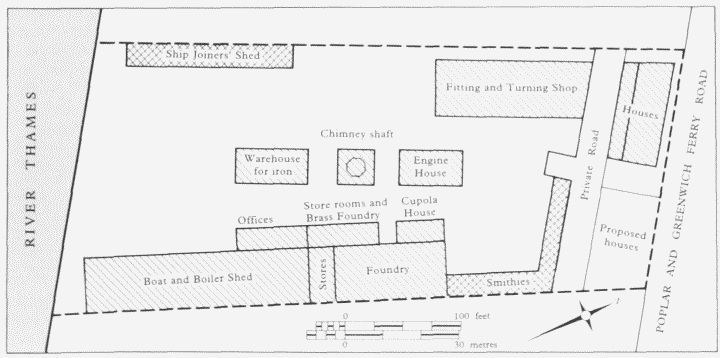
William Fairbairn's Millwall Iron Works, site plan in 1840 Cross-hatching indicates 'temporary' buildings
The building of the Great Eastern.
(fn. 2) From 1854 until 1859 the Millwall Iron Works and Napier Yard were dominated by the construction and fitting-out of the Great Eastern, conceived and designed by Isambard Kingdom Brunel (1806–59) for the Eastern Steam Navigation Company and built by John Scott Russell. The completion of the ship was fraught with troubles, chief of which was the launch. The project bankrupted the company, and ultimately Scott Russell, and brought about Brunel's early death (worn out, he suffered a stroke while on deck the day before the maiden voyage began, and died a few days later).
Because of the constraints of the yard and the river — the overall length of the ship was not very much less than the width of the river at low water — the ship was built broadside on to the Thames. The sideways launch this involved proved technically difficult and financially ruinous to Eastern Steam Navigation. After the hull had been floated, the Great Ship Company was set up to raise the £300,000 required for completion (about a sixth of this sum being contributed solely by small investors whose imagination had been caught by the ship).
In the end, the Great Eastern never went to India, the route for which it had been designed, but made a few transatlantic crossings in the early 1860s before being used for cable-laying in the North Atlantic. Disused for years, in 1886 it was briefly opened as a public attraction at Liverpool, and was then broken up.
The launch of the Great Eastern was perhaps the most exciting public spectacle in London since the Great Exhibition, which had closed just over six years earlier; while the construction of such a huge ship was comparable in its technological significance to the building of the Crystal Palace itself. (Sir Joseph Paxton, designer of the Crystal Palace, was himself a shareholder in the Eastern Steam Navigation Company.) At some 21,000 tons burden, 692ft long with a beam of 83ft, the Great Eastern was vastly bigger than any existing vessel, and more than four times the weight of the most up-to-date longdistance mail ships. It was designed to hold 4,000 people, and the lavishness of the first-class accommodation and the Grand Saloon surpassed anything previously floated.
The building of ever-larger ships — Brunel's own Great Western, constructed in 1838, measured only 240ft by 57ft but was then well in excess of the largest extant paddle-steamer — was given impetus by the realization that bigger ships could be faster, a principle established in the early 1850s on the transatlantic route by American shipowners.
The concept of the Great Eastern, however, came about specifically as an attempted solution to the problem of the pre-Suez Canal routes to India and Australia. Brunel had a few years earlier advised the construction of 5,000ton ships for the Australian Mail Company. For Indian traffic, P. & O. had led the way with the introduction in 1836 of a steamship service to Alexandria, from where a trek through the desert had to be made for embarkation on a second steamship, to continue the voyage down the Red Sea. The Eastern Steam Navigation Company was set up to compete with P. & O., but after failing to obtain a government mail contract the company set its sights on a steamship service round the Cape of Good Hope. Its viability depended on fuelling, which with the existing ships would have called for coal depots to be set up along the route. The scale of the Great Eastern was dictated by the space needed for enough coal to make the whole round voyage without refuelling.
A novel feature was that the hull, divided by bulkheads into a series of watertight compartments, was doubleskinned — and this almost certainly saved the ship from sinking when it struck a reef. Driven by a combination of paddle-wheels (58ft in diameter) and a screw-propeller (of 24ft diameter), each powered by separate engines, the ship had the additional benefit of sail, intended for auxiliary use in an emergency. It was, for all its innovative aspects, a hybrid of old and new technology, and in this respect similar to existing large steamships.
Building began on 1 May 1854, and on the afternoon of 3 November 1857, after a difficult construction, marked by several serious fires (which necessitated extensive reconstruction of buildings at the yard), the attempted launch took place before a huge anticipant crowd. The excitement was vividly recorded by Charles Dickens:
A general spirit of reckless daring seems to animate the majority of the visitors. They delight in insecure platforms; they crowd on small, frail, house-tops; they come up in little cockle-boats, almost under the bows of the great ship. In the yard, they take up positions where the sudden snapping of a chain, or the flying out . . . of a few heavy rivets, would be fraught with consequences that they either have not dreamed of, or have made up their minds to brave. Many in that dense floating mass on the river and the opposite shore would not be sorry to experience the excitement of a great disaster, even at the imminent risk of their own lives. Others trust with wonderful faith to the prudence and wisdom of the presiding engineer, although they know that the sudden unchecked falling over or rushing down of such a mass into the water would, in all probability, swamp every boat upon the river in its immediate neighbourhood, and wash away the people on the opposite shore. (fn. 45)
The uncertainties involved in the launch were considerable, as there was no close precedent. It was realized that the slipways would need to be strong enough to take the full weight of the ship for some time, if its descent had to be slowed or halted. The work was carried out in 1857 by Messrs Treadwell of Gloucester to Brunel's specifications. A 300ft-long stretch of foreshore from the ship down to the low water mark was cleared of mud and debris, to a gradient of one in twelve, and two 80ftwide slipways laid down, 160ft apart. Each was formed of rows of square timber piles, varying in length from about 25ft beside the ship to about 6ft at the other end, rammed into the gravel bed and secured longitudinally by baulks bolted to their sides. The spaces between the timbers were concreted, and lateral baulks were fixed on top of the exposed pile heads. Towards the waterfront, rows of longitudinal baulks were set in concrete. On this foundation was laid a crosswork of somewhat lighter baulks to carry the iron rails on which the ship's cradles were to slide and planking to provide a complete floor for the workmen. Iron bars, 1in. thick and 7in. wide, were fixed to the underside of the cradles. By the time of the launch the slipways had each been widened by 20ft on both sides, so that they were 120ft wide and 120ft apart. (fn. 46)
The plan was that the ship, supported on cradles, should slide down the slipways using a combination of pushing and pulling, with large windlasses (the 'brake drums') to check its progress as necessary (Plate 75b). There were, initially, two hydraulic rams to push, two shore-mounted steam-winches pulling chains worked via barges moored in the river, and four further barges hauling at the hull direct from the river. The procedure started well, but within minutes there was disaster as workmen were knocked flying — one was killed instantly by the whirling handles of one of the brake drums. When the second brake was applied, the ship came to an abrupt halt, and the launch had to be abandoned.
It was suggested at the time (fn. 47) that Brunel's calculations had made insufficient allowance for the great increase in friction caused by distortions in the bearing surfaces. The cradles were constructed by laying the iron bars on the rails and timbers on the bars, and then fitting timber shores. Consequently, any distortion in the rails had a corresponding distortion in the cradles, forming a locking joint. The iron-on-iron technique, even though the surfaces were carefully lubricated with blacklead and oil, may simply have needed preciser construction than the traditional method of timber on timber, greased with tallow. More powerful hydraulic rams proved unable to do more than move the ship a little at a time, and it was not until 31 January 1858 that the Great Eastern was finally launched. The main fitting-out contract was won by Scott Russell, and the ship remained at moorings off Deptford slightly downstream of his yard until 6 September 1859.
Although the iron rails and decking were probably dismantled soon after the launch, the main structure of the slipways remained. Napier Yard continued to be used for shipbuilding for some years, initially by Scott Russell, and there was still a small shipyard on part of the south end until the 1930s, occupied by Edwards & Company. In 1984, during site clearance at the former Edwards shipyard, part of the southern slipway was uncovered. The remains, comprising a section of the concrete-andtimber sub-structure, have been preserved on site for public display. The refurbishment work was carried out by Livingstone McIntosh Associates and Feilden & Mawson with guidance from the LDDC's Wapping and Isle of Dogs landscape team. (fn. 48)
The Millwall Iron Works, Ship Building & Graving Docks Company Ltd.
From c1859, following Scott Russell's bankruptcy, the Millwall Iron Works were in the occupation of C. J. Mare & Company, and then its successor the Millwall Iron Works Ship Building & Graving Docks Company Ltd. After the collapse of that company, the works were occupied by various ship- and barge-building, iron-working and scrap-iron companies. (fn. 49) Most of the site of Fairbairn's original works was sold in 1888 to become Burrell's Wharf. The division of the Fairbairn site was permanent: when Burrell's Wharf expanded, it was into the former Napier Yard, the irregular south-eastern portion of Fairbairn's works having been absorbed into Maconochie's Wharf and redeveloped.
On 31 December 1862 the Millwall Iron Works & Ship Building Company Ltd was incorporated, with a nominal capital of £300,000 in £1,000 shares. All the shares were allocated among the ten subscribers, who included David and Arthur Chapman and Robert Birkbeck — all partners in Overend Gurney & Company, the bankers and money dealers and the railway contractors Sir Samuel Morton Peto, Edward Betts and Thomas Brassey. Thomas Brassey, junior, and George Harrison, manager of the Millwall Iron Works, had small shareholdings. Mare himself took no shares, but he was presumably somewhere in the background. A £500 call on shares had been made by March 1864, and fully paid up. (fn. 50)
Within a few weeks the company was in liquidation and the Millwall Iron Works, Ship Building & Graving Docks Company Ltd was floated in its stead, with a nominal capital of two million pounds in £50 shares, attracting hundreds of subscribers. David Chapman of Overend Gurney & Company was, as before, the largest shareholder. (fn. 51) As well as the Millwall Iron Works, bought for £575,000, the new company purchased Britannia Dry Dock and Ferguson's Mast House and Mast Pond. (fn. 52)
By May 1865 every share had been subscribed, but after the financial crisis following the collapse of Overend Gurney & Company in May 1866 there were heavy defaults on calls, and in 1871 the company was liquidated and the works broken up. (fn. 53)
The Millwall Iron Works of the 1860s was the most ambitious industrial concern ever established in Millwall, employing between 4,000 and 5,000 men, who enjoyed conditions remarkable for the period, with half-day Saturday working, a canteen, sports clubs and works band. Like the Thames Iron and Shipbuilding Works, the Millwall Iron Works not only built ships but also manufactured the iron from which they were built. The two establishments were, according to a contemporary view, 'of infinitely greater national importance' than the royal dockyards, with a production capacity for iron ships and armour greater than that of the whole of France. (fn. 54)
The works were on either side of Westferry Road, linked by a horse-tramway. On the riverside were building slips, landing wharves, sawmills, joiners' shops, an engine factory, foundries, pattern-, mould- and sail-lofts and a mast factory. On the landside was concentrated the heavy plant for iron forgings, including hammered armour-plate, rolling mills for turning out bar-iron and angle-iron, armour plate and the rough bars used in the forge and the rolling mills. The scale of the armour-plate mill was vast, with a flywheel 36ft in diameter, weighing more than 100 tons. When the works closed, the mill was bought at scrap value and reinstalled at the Thames Iron Works. (fn. 55)
North of Westferry Road, Millwall Yard and Klondyke Yard were occupied for many years by Westwoods and Maconochies respectively. Westwoods' alterations to the premises included the erection of a machine shop, 155ft long, in 1939 (Plate 76a). Part of the old Millwall Iron Works on Millwall Yard remained in use into the 1990s for steel stockholding and fabrication. Although partly rebuilt, the premises fronting the road are still decorated with C. J. Mare's plaque and retain some original structural ironwork (Plate 76c).
Beyond Klondyke Yard, the old Millwall Iron Works buildings were mostly occupied from 1912 to c 1919 by the BDP Syndicate Ltd as Florencia Works. Owned by William Petersen, a shipowner, the company carried out experimental metallurgical work. (fn. 56)
The Venesta Factory (Whittock Wharf), No. 242 Westferry Road.
The southernmost portion of Napier Yard, immediately south of the Great Eastern slipway, was used by various metal-refining and metal-working concerns from the late 1880s. In 1906 it was acquired by Venesta Ltd, manufacturers of wood and metal cases, boxes and barrels. The company redeveloped the whole site and also bought two old houses with shops, built about 1847, adjoining the Robert Burns public house (Nos 244 and 246 Westferry Road). (fn. 57)
The new factory comprised two long parallel ranges of two- and three-storey workshops and stores, linked by gangway bridges (Plate 73c). At the Westferry Road end were partly galleried ground-floor workshops, with toplit open timber-truss roofs carried on iron columns. Through them a glazed passageway led to the open way between the main blocks, leading to the wharf front. Brick-built, with concrete floors and slated roofs, these very plain and solid buildings (fn. 3) were designed by a civil engineer, John J. Robson, and built by Holloway Brothers in 1907–8. (fn. 58)
In 1935, after 'many years' of disuse, the former Venesta factory was acquired by a firm of wharfingers (in which Mr Calder, of Calder's Wharf, had an interest), renamed Eastern Wharf, and thoroughly refurbished. In 1937 the name Whittock Wharf was adopted. After the Second World War the premises were amalgamated with Burrell's Wharf. (fn. 59)
Burrell's Wharf
Burrell & Company, oil refiners and manufacturers of paints, varnishes and colours, grew out of a marine-stores business established in the Minories in 1852. By the time that the firm came to Millwall factories had been opened in Southwark and Mile End, and Garford Wharf in Limehouse had also been acquired. With the business concentrated at Burrell's Wharf, extensive building was carried out. From the late 1880s until the early 1920s a succession of stores, warehouses, workshops and minor ancillary buildings appeared (Plates 72–3). Earlier buildings on the site were adapted and retained. The result was characteristic of Victorian industrial development at its most ad hoc (fig. 179). (fn. 60)
Over the years, colour making took over as the principal activity at Burrell's Wharf, partly as a result of the unavailability of German-made aniline dyes during the First World War. After the war, protectionist legislation encouraged further concentration on colours. A factory for the production of organic reds, Barnfield Works, was built near Burrell's Wharf at No. 333 Westferry Road, and production of certain colours was transferred to a factory in Stratford. The riverside works expanded with the acquisition after the Second World War of Whittock Wharf. During the war, the works produced a variety of chemicals for the government, including a constituent of flame-thrower fuel. Paint production ceased in 1943, but after the war distemper became an important product for a time. (fn. 61)
Burrell & Company Ltd was incorporated in 1912 and became a public company in 1947. It was latterly a holding company for pigment businesses in Essex and Cheshire as well as Millwall, but was wound up in 1981. Blythe Burrell Colours Ltd, a subsidiary of Johnson Matthey plc, continued to make colours at Burrell's Wharf until the closure of the works there in 1986. Production of Burrell's range of classic pigments was continued elsewhere by Ciba-Geigy. (fn. 62)
When the colour-works closed the site was covered by buildings of several periods, much altered and added to. From Fairbairn's works there remained the stump of the octagonal chimney. Some of the general layout of Fairbairn's works survived, too. From Scott Russell's day there remained what is now the Plate House, and the office block and house adjoining (Nos 264 266 Westferry Road). The other buildings on the south-eastern side of the site, none of them of particular architectural interest, had been erected by Burrells from the late 1880s. On the north-western side there stood, little altered, the Venesta factory of 1907–8.
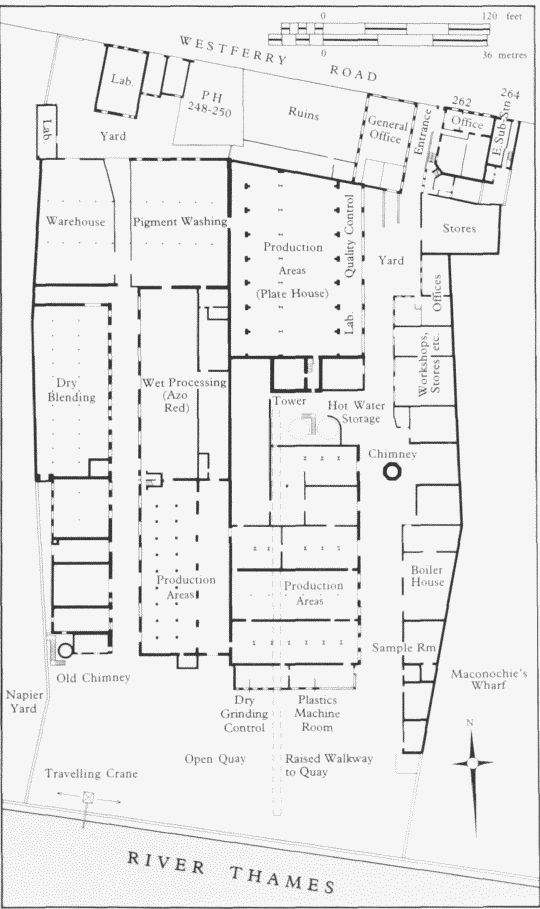
Burrell's Wharf, plan of the works c1982, before closure and redevelopment
Running immediately in front of the Venesta factory and the Plate House was a patch of waste ground, the remains of a private access roadway on the line of the marsh wall path at the rear of the buildings in Westferry Road. A row of workmen's dwellings, originally called Manchester Terrace — later Nos 252–260 (even) Westferry Road — had been built between the Robert Burns public house and the ironworks entrance by Fairbairn in the late 1830s. The two end houses, next to the main works entrance, had been replaced in 1899 by a two-storey warehouse; a third floor, added in 1935–6, was used as offices. (fn. 63)
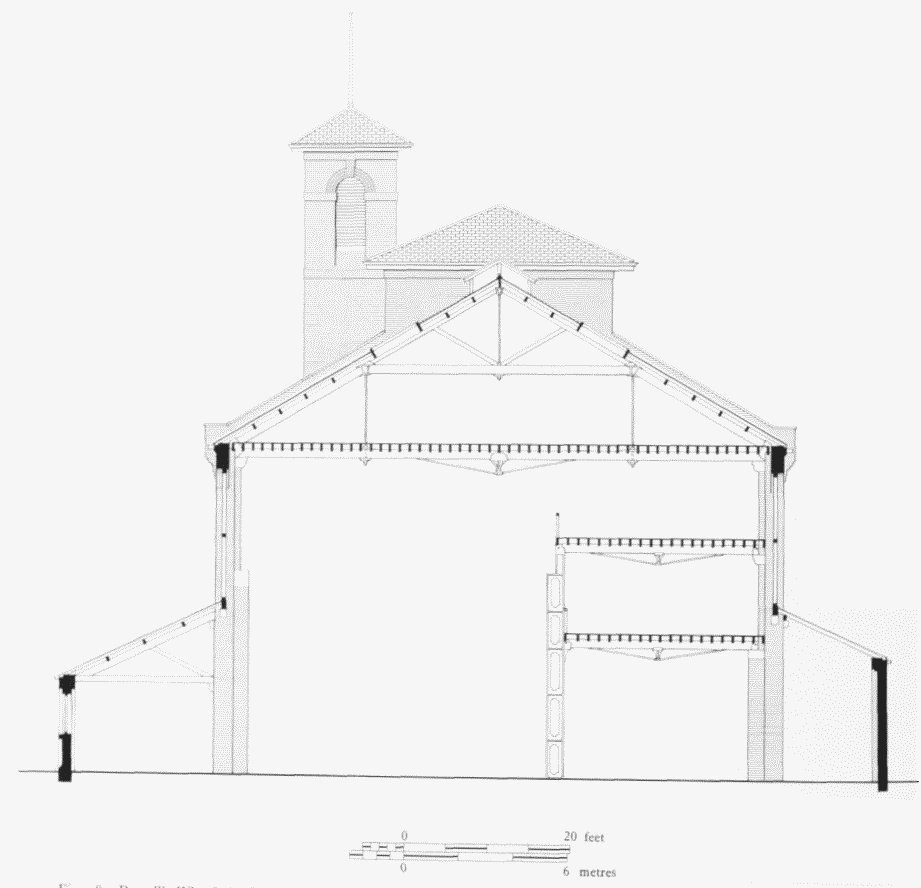
Burrell's Wharf, the Plate House, section looking south showing the structure as it probably was c1888, when Burrell &Company acquired the premises
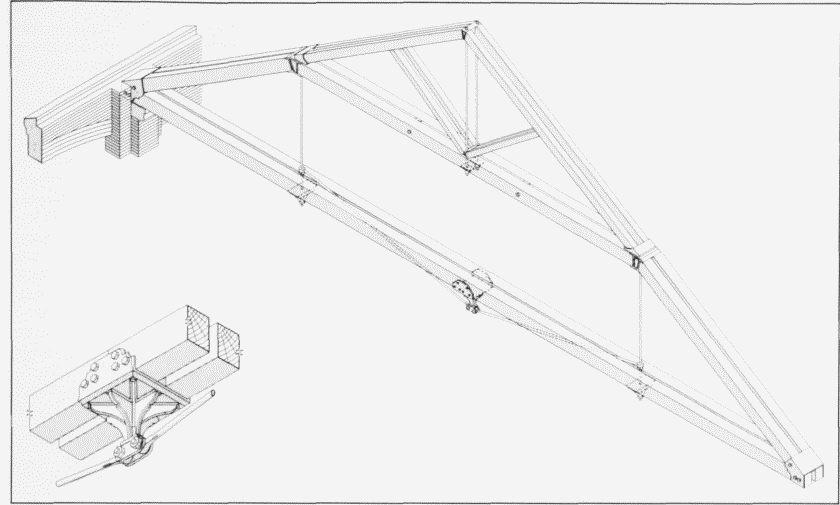
Burrell's Wharf, the Plate House, typical roof truss and detail of an iron boss
The building now called the Plate House, known by Burrells simply as the 'Big Shop', was built for Scott Russell by William Cubitt & Company on the site of William Fairbairn's fitting and turning shop of c1837. The front, west side and back walls of the main structure follow the line of the earlier building, which had been gutted in the fire, started at the Millwall Iron Works, which razed most of Napier Yard in September 1853. (fn. 64)
The building as it was in the mid–1880s, before its acquisition by Burrell's, and essentially as it was when new, is shown in figs 180 and 182a. The two gallery floors were extended c1930, using steel beams carried on stanchions, over the full span of the building. (fn. 65) The top floor, carried on the tie-beams of the roof trusses, was probably used as a pattern-shop or mould loft, and, reputedly, old patterns remained there until the Second World War.
The coupled queen-rod roof trusses are an example of the hybrid iron-and-timber construction used for many large roof spans in the nineteenth century (fig. 181). Single iron rods are held between cast-iron shoulderpieces at the junction of the rafters and collar-beams, and secured with iron bosses beneath the tie beams. King rods are similarly used between collar and ridge. Iron rods are also fixed between the queen rods and cast-iron studs beneath the tie beams: similar iron reinforcement is used for the gallery floors.
The tower was used for water storage from at least the late 1920s, when it contained a 24,000–gallon tank on the top floor. Until the Second World War it retained an Italianate pyramidal roof and matching turret over the staircase, which has been restored as part of the refurbishment of the building for Kentish Homes.
Nos 264–266 Westferry Road were built by the Robinsons and Russell in the early 1850s, as a house and offices, on a site probably intended originally for workmen's cottages like those in front of the Plate House (fig. 182b). (fn. 66)
The house, set back slightly, was of conventional plan with a side passage, back stairs, two rooms to each floor, and a rear extension, partly of two storeys. In the 1930s, before it was converted to an electricity sub-station, the ground floor contained kitchens, while on the first floor was the board-room, an office and a store-room; the second-floor and attic rooms were all used as stores.
The offices were much altered at various times, but in the mid–1930s still comprised four rooms on each of the upper floors; on the ground floor were a large messroom, a store and the timekeeper's lodge. The export office and three private offices occupied the first floor; above were a kitchen and three dining-rooms. Later, bicycles were parked downstairs and both upper rooms were devoted to cooking and dining. (fn. 67)
Kentish Homes' Burrell's Wharf Development.
Of all the residential developments projected on the Isle of Dogs in the 1980s. Kentish Homes' Burrell's Wharf was, for several reasons, one of the most remarkable. The site was the richest in terms of historical association, and the development was unique, both in the extent to which it involved the retention of old buildings and in its preservation of an intricate, organic pattern of building. It was notable, too, for the diversity of its architectural forms and its intended range of uses in addition to housing. Stylistically, it sought to avoid the cliches and excesses of Post-Modernism in favour of a robust postindustrial vernacular: 'dockland in Docklands', as Kentish put it. (fn. 68)
Burrell's Wharf was intended to redress the lack of amenities and community focus for middle-class newcomers. With a complex of recreational, social and artistic facilities, it was to have become a cultural hub for the new Isle of Dogs. Its greatest significance, however, lay in its place in the story of the Docklands boom.
Kentish was controlled by Keith Preston and his wife Kay, who had acquired the house-builders Kentish Homes in 1980, with full control from 1985. A surveyor by training, Preston described himself as 'really a frustrated architect'. (fn. 69) From refurbishing terrace houses, the Prestons went on to carry out a series of increasingly ambitious schemes, all in East London, from the modest conversion into flats of Bowbrook School in Bow, to Cascades in Millwall, where Transatlantic techniques of fast-track construction and pre-completion marketing were employed, in conjunction with an assertively original design (see page 697).
In July 1987 Kentish Property Group plc was floated, achieving a peak share price in October that year, just before the stock market crash on 'Black Monday'. Undeterred, Kentish pressed on with Burrell's Wharf. After a rise in interest rates had badly affected the housing market, sales at Burrell's Wharf ceased, and in July 1989 Kentish sought suspension from the stock market. The Halifax Building Society, which had loaned £25 million for Burrell's Wharf, thereupon appointed a receiver to the development. Simultaneously, Security Pacific, which had financed Kentish's Bow Quarter, called in receivers to that development. By the end of July Kentish was in receivership (see page 696). J. A. Elliott, the main contractors for both Burrell's Wharf and Bow Quarter, later went into administrative receivership. The partly completed development, somewhat modified, was relaunched by Halifax New Homes Services in 1992.
Designed by Jestico & Whiles, the scheme, when completed, will comprise seven large residential buildings, with a mixture of smaller shop, office and residential premises fronting Westferry Road. The two main build ings of the Venesta factory, Slipway House and Port House (formerly Forge and Foundry), converted to 40 and 53 apartments respectively, were intended to convey, through exposed beams and brickwork, the sought-after atmosphere of genuine warehouse conversions such as those on the Pool of London riverfront.
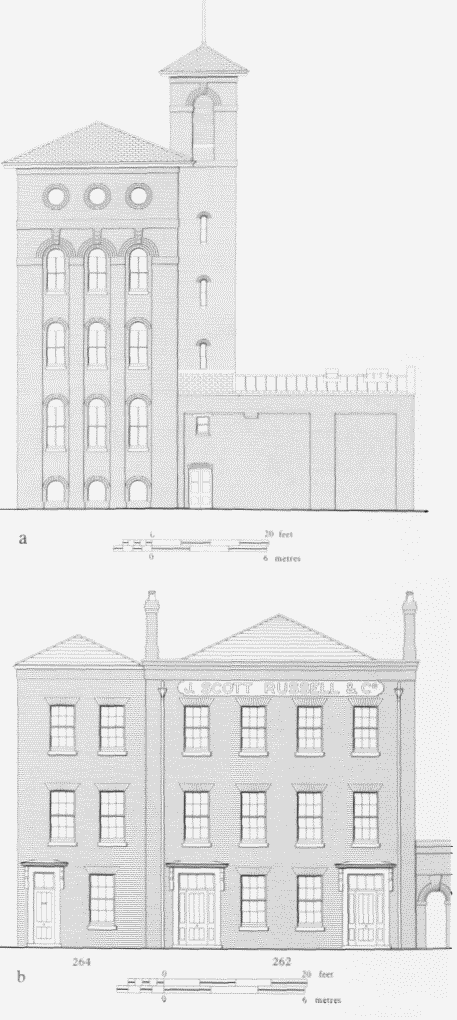
Burrell's Wharf a The Plate House, south (riverside) elevation as in c1888 b Nos 262–264 (even) Westferry Road, north (front) elevation in 1986. Former house and offices erected by A. and A. R. Robinson & J. Scott Russell in the early 1850s
Beacon, built around the ironworks chimney, and a smaller block behind it, Port House, are new buildings designed to have the same 'warehouse' feel. Both have reinforced-concrete frames with brick cladding. At the riverside are two new nine-storey blocks, Chart House and Deck House (formerly Bridge and Wheelhouse), each comprising 70 apartments. Here, 'designer sophistication' was aimed at, rather than warehouse ruggedness. Both blocks are of reinforced-concrete framing clad externally with concrete panels.
At the centre of the development, the Plate House was intended to contain, in addition to 19 small apartments and a penthouse in the tower, the 'Island Club' complex, comprising swimming pool and gymnasium, sauna and sunbed, function room and wine bar. Finally, the 'Plate House Gallery' promised work and display space for residential artists, craftsmen and designers. On Westferry Road, the Quarters, a new building with a distinctive corner rotunda, was to contain 21 shop and business units, and 16 split-level apartments above. The former warehouse and offices beside the entrance to the wharf, renamed the Gatehouse, is to be refurbished to provide three floors of offices. Between it and the former Robert Burns public house, the ground was cleared to provide a new tree-flanked entrance to the Plate House. Nos 264– 266 Westferry Road are to be remodelled as Gantry House and Mast House, both comprising offices. Behind them, Loft House, formerly a warehouse and first-floor pattern room, has been refurbished, also for use as offices.
The Robert Burns Public House, Nos 248–250 Westferry Road
The Robert Burns was built in 1839 by Patrick Heyns, a Limehouse cooper, on a 99–year lease from the Napier family. It was extended in 1853 by the local grazier Henry Bradshaw, the two bays on the left in Plate 84d, built on the site of an entranceway to the marsh wall path. Bradshaw, and later his son, ran the public house for some years, when the name Robert Burns seems to have been adopted. In 1994 the building is disused. (fn. 70)
The Imperial Gas Light & Coke Company's Chemical Works
In 1824–7 the Imperial Gas Light & Coke Company set up a chemical works on land leased from William Mellish and Messrs Ferguson and Todd. The Mellish ground, later to become Nelson Wharf, contained a couple of cottages, stables, and outbuildings, built about ten years before by George Guerrier, a local grazier. (fn. 71)
New buildings, probably designed by Francis Edwards (1784–1857), surveyor to the company, were put up by Messrs Lee & Sons. They seem to have been open-sided, part-weatherboarded sheds for boilers and vats. High hopes were entertained of the profitable conversion of the tarry and ammoniacal by-products from gas manufacture into saleable chemicals. But the works ran at a loss and were sold in 1829. The eventual purchaser (a public auction having failed to draw a single bid) was George Elliot, chemist and druggist of Fenchurch Street. As a shareholder, he had earlier taken an interest in the chemical side of the company's business. Elliot continued to occupy the works for many years, presumably as a chemical works. (fn. 72)
Maconochie's Wharf (formerly Northumberland Works), No. 288 Westferry Road and Houses in Westferry Road
In 1837 the northern portion of Elliot's ground, which was to become Northumberland Works, was mortgaged to William Fairbairn by Charles Augustus Ferguson. Over the next couple of years the frontage to Westferry Road was largely built up with houses on 99–year leases. Most of these — a terrace of 11, called Island Row had been pulled down and the site annexed to Maconochie's Wharf before the First World War. A row of narrow, three-storey houses, originally called Ebenezer Terrace, survived until after the Second World War. The building lessee of Ebenezer Terrace was Benjamin Moulton of Bishopsgate, a shipwright. They were meanly proportioned houses of three storeys, each with a roundarched doorway and single window on the ground floor, and a small central window on each floor above. The first two were later rebuilt as The Ship public house (No. 290 Westferry Road). (fn. 73)
Northumberland Yard was laid out for shipbuilding as part of the Millwall Iron Works in the early 1860s. The frigate Northumberland was built in the larger of the slips in 1863. In 1873 the Northumberland Graving Docks & Engineering Company Ltd was set up by several London and Tyneside shipowners to take over the works, where the slips were undergoing conversion into graving docks. The company was short-lived, but the same men were prominently involved in Dudgeon & Company Ltd, which took over the works in 1878. This new venture, headed by two engineers, Alexander and William Dudgeon, and with considerable support from local businessmen, also failed after a short time. (fn. 74)
Northumberland Works, as the site became known, was subsequently occupied by the electrical-engineering company Latimer Clark, Muirhead & Company Ltd, and the Lorenz Ammunition & Ordnance Company Ltd, a partly German-owned associate company of Latimer Clark & Muirhead, set up to exploit patents taken out by a Karlsruhe engineer, Wilhelm Lorenz. Alexander Dudgeon was managing director of the works, which closed about 1894. (fn. 75)
The site was occupied from about 1896 by Maconochie Brothers (Limited from 1901). Maconochies, with premises in Fraserburgh, Stornoway, Lowestoft and elsewhere, were wholesale provision merchants and manufacturers of pickles, potted meat and fish, jam, marmalade and other preserved foods. A family business until the 1920s, Maconochies was wound up in the early 1970s, but the firm had left Millwall some years before. The coopers Tyson & Company, who had premises in Harbinger Road, were a subsidiary. (fn. 76) From 1902 to 1920 Maconochies completely redeveloped the site, building a pickle factory, a jam, peel and candy factory, vegetable kitchens, riverside warehouses, stores, workshops, a large cooperage, and offices. (fn. 77)
After the Second World War, in which part of the premises was bombed, Maconochie's Wharf was used for wool storage. A Marston shed was erected on the bombed area. (fn. 78) The wharf was redeveloped in the late 1980s by the Great Eastern Self-Build Housing Association (see page 701). In 1990–1 a public walkway was laid out at the riverside by the LDDC. (fn. 79)