Survey of London: Volumes 43 and 44, Poplar, Blackwall and Isle of Dogs. Originally published by London County Council, London, 1994.
This free content was digitised by double rekeying. All rights reserved.
'Cubitt Town: Riverside area, from Cubitt Town Pier to the Graving Docks', in Survey of London: Volumes 43 and 44, Poplar, Blackwall and Isle of Dogs, ed. Hermione Hobhouse (London, 1994), British History Online https://www.british-history.ac.uk/survey-london/vols43-4/pp532-539 [accessed 30 April 2025].
'Cubitt Town: Riverside area, from Cubitt Town Pier to the Graving Docks', in Survey of London: Volumes 43 and 44, Poplar, Blackwall and Isle of Dogs. Edited by Hermione Hobhouse (London, 1994), British History Online, accessed April 30, 2025, https://www.british-history.ac.uk/survey-london/vols43-4/pp532-539.
"Cubitt Town: Riverside area, from Cubitt Town Pier to the Graving Docks". Survey of London: Volumes 43 and 44, Poplar, Blackwall and Isle of Dogs. Ed. Hermione Hobhouse (London, 1994), British History Online. Web. 30 April 2025. https://www.british-history.ac.uk/survey-london/vols43-4/pp532-539.
In this section
From Cubitt Town Pier To The Graving Docks
Cubitt Town Pier
In 1857 William Cubitt erected a timber pier roughly three-quarters of a mile along the shore from Potter's Ferry, and by 1858 had hired a steamboat to ferry passengers to Greenwich and other places on the opposite shore. This was intended to serve the new inhabitants of Cubitt Town without diverting passengers from the established ferry at Potter's Ferry, but it appears that the new ferry was used mainly by dock workers, and as a result the older one lost more than half its income Litigation followed in the early 1860s, with the ferry company as successful plaintiffs, although Cubitt retained his right to ferry to and from the Isle of Dogs. (fn. 2) However, services must have ceased well before 1891, when the Thames Conservancy asked for Cubitt's Pier, which was in a dilapidated and dangerous condition, to be repaired. The pier was demolished c1892. (fn. 3)
Millwall Wharf
The current extent of Millwall Wharf and the remaining Grade II listed warehouses there are the legacy of James W. Cook & Company, wharfingers, lightermen and shipping agents, of the Minories. Cooks, who also held property at Orchard Wharf, Blackwall, were occupants of part of the present Millwall Wharf site from 1883 and of the whole from 1900 until 1964. This extensive wharf, reaching from (and eventually subsuming) Pier Street in the south to London Yard to the north was originally composed of three wharves and two inland plots. (fn. 4)
The southernmost wharf, with a river frontage of 200ft immediately north of Cubitt Town Pier, was taken by James Ash, shipbuilder, in 1862. (fn. 5) Ash, who had been naval architect to both C. J. Mare and the Thames Iron Works Company, established an impressive yard here, with an extensive two-storey brick office and works building. (fn. 6) In setting up the business Ash had borrowed heavily from Overend Gurney & Company, and he was one of the many yard-owners forced to close following the failure of that company in 1866. (fn. 7) In 1875 the lease was purchased by the Millwall Wharf & Warehouse Company, (fn. 8) and James Cook took over the premises, by then known as Millwall Wharf, early in 1883. (fn. 9) At that time the wharf comprised four brick-built and slateroofed warehouses (sheds A-C2). Between 1883 and 1892 Cook & Company erected a further seven brick warehouses (sheds D-J), a travelling crane, and a corrugated-iron landing-shed facing the river. (fn. 10) The wharf was used for storage, mainly of jute and other fibres.
Immediately to the north of the original Millwall Wharf was Plough Wharf, a combination of three plots with a river frontage of 150½ft, leased by Cubitt to the London Manure Company between 1853 and 1861. (fn. 11) The wharf contained an engine house, a boiler house, and the burners, chemical chambers and sheds required for the manufacture of artificial manures from crushed bones and sulphuric acid. (fn. 12) A jetty was later added for manure barges. In 1868 the freehold of Plough Wharf was acquired by the Millwall Dock Company as part of its proposal for an eastern arm of the Millwall Docks (fig. 126, page 347), (fn. 13) and the manure company's wharf was later extended to Manchester Road by a lease of land including Nos 8–11 London Terrace. (fn. 14) The London Manure Company went bankrupt in 1892, (fn. 15) and James Cook annexed Plough Wharf in 1896. Cook & Company rebuilt two existing riverside sheds as sheds L and M of Millwall Wharf. (fn. 16) Further redevelopment took place between 1897 and 1900 (Sheds N-S). (fn. 17)
The third component was a wharf of over 150ft of river frontage, occupied by the National Guaranteed Manure Company since 1858. (fn. 18) This site was also purchased by the Millwall Dock Company, which leased a further inland plot to the manure company in 1875. (fn. 19) In 1900 the wharf, with nine brick, iron, and wood warehouses, was taken by Cook & Company, which thus completed its acquisition of the present-day Millwall Wharf. (fn. 20)
Having obtained these properties, the firm embarked upon a new building programme. In 1900 and 1901 plans for a series of riverside warehouse buildings were prepared by Edwin A. B. Crockett, Surveyor to the London Wharf and Warehouse Committee. Holland & Hannen of Bloomsbury built four new pairs of brickand-slate warehouse units (Nos 1–8); Nos 1–4 were completed in December 1901, and Nos 5–8 in February 1902, the latter apparently incorporating remnants of the earlier nineteenth-century sheds of Plough Wharf (Plate 88a; fig. 200). (fn. 21) These single-storey, twin-gabled warehouses form four-fifths of the extant riverside range. The units are divided in two by fire walls with double iron doors, and have what were by 1901–2 rather old-fashioned roofs of paired queen-post trusses supported on rows of cast-iron columns. Curiously, the roof to the southern half of Shed 7 is carried on king-post trusses. The warehouses are devoid of any decorative features save to the river, where each gabled bay encloses a high-set Diocletian window framed by brick pilasters. These sheds were bonded and used for storage, initially of sugar and fibres. (fn. 22)
During the first quarter of the twentieth century Cook & Company continued to expand and develop its business. In 1907 and 1908 it annexed two areas of land formerly belonging to Yarrow & Company to the north of Millwall Wharf, and erected a further brick warehouse, designated L, adjoining Sheds 1 and 2. This is of a similar style to the earlier ones, but with the roof carried on steel trusses and stanchions. (fn. 23) Further developments included the rebuilding of D Warehouse following a fire in 1908, and the erection in 1911 of a group of six further brick warehouse units (Q—S and 10–12) inland of sheds Nos 4–8, with a roadway for vehicles between them. (fn. 24)
Cook & Company remained in occupation of Millwall Wharf until 1964, when the leases to the property were assigned to Cory Associated Wharves Ltd. (fn. 25) After lengthy negotiations the PLA sold the freehold of Millwall Wharf to Cory Associated Wharves' parent company, Ocean Transport & Trading Ltd, which still owns the wharf as Ocean plc. The extensive warehouse buildings on Millwall Wharf survived the Second World War, but they were demolished in the 1970s, with the exception of the riverside range, Sheds 1–8 and L.
London Yard
In 1856–7 Robert Baillie and Joseph Westwood, subcontractors and managers at Ditchburn & Mare's shipyard at Orchard Place (see page 672) for nearly 18 years, set up in business as shipbuilders, boilermakers and ironworkers, in partnership with James Campbell, in a new yard at Cubitt Town. Westwood, Baillie, Campbell & Company's London Yard was a parcel of land between Manchester Road and the Thames with a river frontage of 450ft, and by the end of 1857 it was already considerably developed, with a smiths' shop, boiler shop, machine shop, iron store, engine- and boiler-houses, furnace shed, offices and a gridiron. The name London Yard derived from London Street, which originally gave access to the yard. (fn. 26) In 1859 the firm leased a smaller site adjoining to the north. (fn. 27)
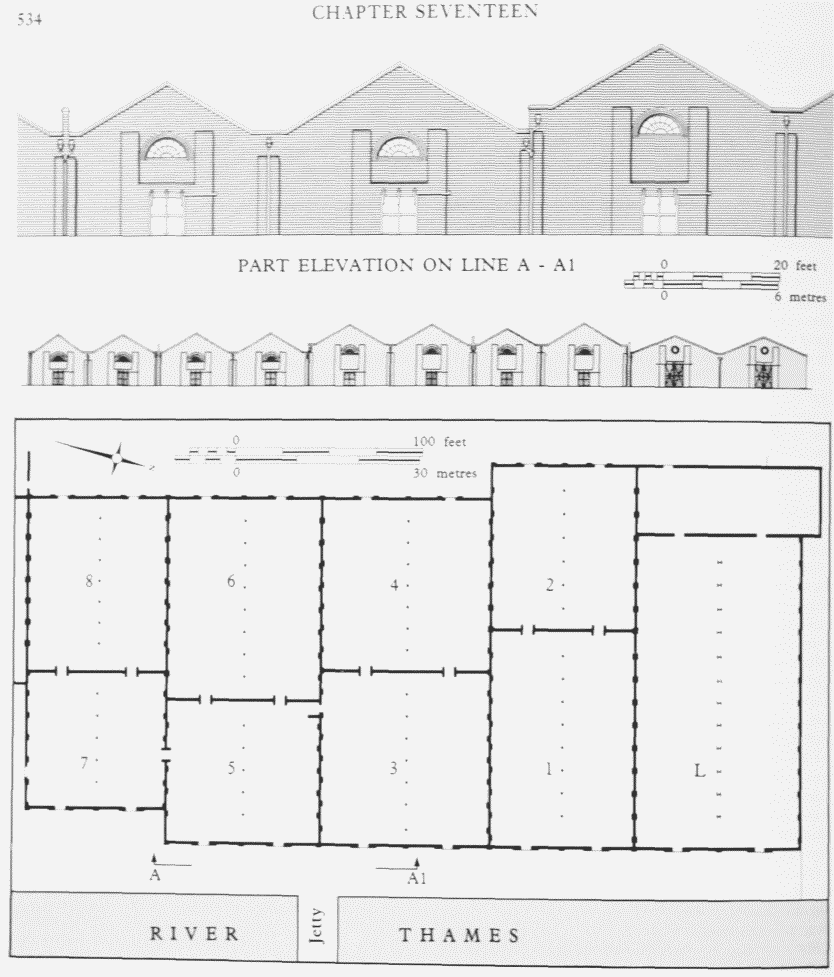
Millwall Wharf, plan of the warehouse sheds, and river-front (east) elevations. Sheds 1–8, E. A. B. Crockett, architect, 1901–2; shed L was added in 1907–8
Campbell retired from the business in 1861. (fn. 28) A lithograph by N. Newberry shows the arrangement and extent of the yard c1862–4 (Plate 87c). Smiths' shops and boiler shops ran west-east between Manchester Road and the river, with offices and other buildings facing the road, and stores, machine shops, and joiners' shops in the yard behind. Besides shipping, a large domed structure was under construction - probably part of a palace built by Westwood & Baillie for the Sultan of Turkey and erected at Istanbul. (fn. 29)
In common with many other local firms, Westwood, Baillie & Company had difficulty surviving the decline in Thames shipbuilding of the 1860s, and the partnership suffered a period of financial stress and reorganization. Between 1865 and 1871 production at the yard continued with Westwood and Baillie acting as managers for the London Engineering & Iron Shipbuilding Company Ltd. (fn. 30) Westwood, Baillie & Company regained nominal control of London Yard in 1872, continuing mainly with civil-engineering projects, in particular the construction of prefabricated iron and steel bridges for developing countries. (fn. 31) However, the firm was wound up in 1893 and the yard and its contents were sold at an auction at which more than 1,300 lots were offered. The extensive machinery, including a long range of ten radial drillingmachines and large hydraulic plate-beating presses, revealed the magnitude of the work once handled by the company. (fn. 32) (Westwoods continued in the engineering industry at Napier Yard, Millwall, where a branch had been established in 1889.)
In 1898 the property was taken over by the local shipbuilding firm of Yarrow & Company. (fn. 33) Yarrows had been eager to move from their small Folly Wall Yard (see below) to larger premises, negotiating unsuccessfully with the Millwall Dock Company for a new site before moving to London Yard. (fn. 34) Redevelopment took place between 1898 and 1901. Some of the existing buildings on Manchester Road were retained and extended, but most of the yard was cleared for redevelopment. (fn. 35) Dominating the new yard was a large group of four workshop units in a single building, over 200ft by 360ft, of brick and cast iron, with glazed roofs (Plate 88b). They were built by Sir William Arrol & Company, and housed the engineers', boiler makers' and shipbuilders' departments. (fn. 36)
Yarrow's did not remain long at London Yard, however. Alfred Yarrow's business had suffered badly during the engineers' strike of 1897–8, and the high rates in London, coupled with the increasing costs of materials and labour, eventually made it impossible for him to compete with the firms on Clydeside and Tyneside. Between 1906 and 1908 the Poplar yard was gradually shut down and the firm moved to new premises at Scotstoun in Glasgow, accompanied by most of its machinery and 300 of the work-force. (fn. 37)
In 1917 the freehold wharf was purchased by C. & E. Morton, of Millwall, manufacturers of soups, pickles and jams. (fn. 38) Yarrow's large warehouse unit was converted into a case-making plant, and the other buildings were used mainly for storage. (fn. 39) Mortons decided to sell the wharf in 1936, (fn. 40) and after the Second World War it was acquired by D. Badcock (Wharves) Ltd of Greenwich, which had previously occupied part of the site as a tenant of Mortons. (fn. 41) It was then known as London Wharf. By the early 1960s Badcocks had been joined by a variety of other firms, all of which made use of existing buildings. (fn. 42)
By 1972 the wharf was unoccupied, derelict and badly polluted. Despite a proposal in 1977 to transform the site into a combined water-sports centre and boat-building yard, London Yard was eventually acquired by the LDDC (see page 701). (fn. 43)
Samuda's Wharf (Samuda's Yard)
Joseph D'Aguilar Samuda was born in 1813, the son of an East and West India merchant of Finsbury. He became an engineer, shipbuilder, MP and founder-member (and later Vice-President) of the Institution of Naval Architects. In the 1830s he joined his brother Jacob as partner in an ironworks and engineering yard at Southwark. Samuda Brothers began shipbuilding in 1843 in a yard at Orchard Place, Blackwall, and, despite the deaths in 1844 of Jacob and nine of his foremost engineers and workmen, Joseph continued with the business, establishing the firm as iron and steel shipbuilders in a new yard at Cubitt Town in 1852. (fn. 44)
The original yard was a plot of 370ft frontage to the Thames with a drawdock adjoining to the north, taken from December 1852 at £538 per annum. (fn. 45) Samuda Brothers were pioneers in their use of steel in shipbuilding, gaining a reputation for constructing warships, steampackets, and other special-purpose craft of iron and steel. Expansion was an almost inevitable consequence. In 1860 the yard was extended to the north and west to meet Manchester Road and Davis Street, and a smaller, irregularly shaped plot to the north of the drawdock was added in 1862, (fn. 1) giving Samuda a combined riverside frontage of over 500ft. (fn. 46) According to P. Barry, by 1863 Samuda's Yard was producing nearly double the output of the other London dockyards combined. (fn. 47) Many of Samuda's orders came from emerging foreign naval powers such as Germany, Russia and Japan, and the specialized nature of their merchandise enabled the firm to survive the 1866 financial crash and the subsequent decline in Thames shipbuilding.
Samuda's main yard was well arranged; the firm had built steadily on the site in the 1850s and 1860s, (fn. 48) and by c1871 there were long ranges of workshops, masthouses and rigging shops to the north and south flanking a large open yard for construction work. A further group of buildings faced Manchester Road. A plan of c1884 shows the riverside section of the yard, with the travelling-cranes, slipways and jetty used in the construction and launching of vessels. (fn. 49)
Samudas continued in business until Joseph's death in 1885. Once existing contracts had been honoured the yard was closed and, although an attempt was made to sell the business as a going concern, the yard and its contents were sold as 1,300 separate lots at a five-daylong auction in 1893. (fn. 50) The wharf was subsequently occupied by the Haskin Wood Vulcanizing Company, specialists in the 'vulcanizing, seasoning, or preserving of wood'. They remained at Samuda's Yard until c1912–13, when the lease of the premises reverted to the landlord. (fn. 51)
The tenancy of the site during the early twentieth century was complex, with as many as five separate industries sharing buildings on the premises at one time. Among these were the Star and Sterling Manufacturing Companies, which produced toys, prams and domestic appliances in a complex of factory buildings bordering Davis Street and the drawdock; and the Motor Packing Company, a subsidiary of Claridge, Holt & Company, which occupied the central area of the wharf. Coventrybuilt automobiles were driven to Cubitt Town, where they were dismantled, packed in crates and shipped abroad. This site was dominated by a packing warehouse unit of brick, with segmental corrugated-iron roofs on timber trusses. Riverside cranes with a lifting capacity of 18 tons enabled as many as eight barges to be loaded simultaneously. (fn. 52)
Samuda's Wharf was badly damaged by enemy action in August 1941, and all but a handful of the buildings were demolished. After the war the wharf was used by various companies for the storage of fibres and other goods. (fn. 53) In the 1950s the vacant site was purchased by the LCC for new housing, (fn. 54) and it is now occupied by the Samuda Estate (see page 542).
The Folly House Tavern, Folly Wall
In August 1753 Thomas Davers, esquire, of the Middle Temple, acquired the copyhold of 1½ acres of the Osier Hope, a parcel of riverside land south of Blackwall, where he built, 'at vast expense, a little fort . . . known by the name of Daver's folly'. (fn. 55) In financial difficulty, Davers surrendered his property in August 1754. (fn. 56)
The first occupant to sell liquor was Henry Annis, who became copyholder in 1755 and obtained a licence in 1758. (fn. 57) The name Folly House first occurs in 1763. (fn. 58) Nothing is known of the original structure, which was apparently altered by Annis by 1757. (fn. 59) Additional buildings for the accommodation of 'Friends and Customers' were erected in the mid-1760s by William Mole, who also made use of the surrounding foreland as a garden. (fn. 60) Perhaps because of its convenient riverside location between Greenwich and Blackwall, the Folly House was a popular venue for whitebait suppers throughout the late eighteenth and early nineteenth centuries. (fn. 61)
When the property was auctioned by Mole's widow around 1788 it contained a variety of rooms 'for the accommodation of genteel company', an extensive pleasure- and kitchen-garden, a paved causeway, and a landing-place leading to a terrace of 186ft in front of the river. (fn. 62)
In 1800 possession of the Folly House and surrounding land passed to Benjamin Granger, the Blackwall coal merchant, who appears to have added to the existing group of buildings almost immediately. (fn. 63) A plan of 1817 shows the public house, its outbuildings and gardens (which at the time included a cockpit), (fn. 64) with smaller buildings flanking to the north and south. (fn. 65) Pictorial representations of the Folly House of this period are somewhat inconsistent and the tavern may have been considerably altered or even rebuilt on a number of occasions. However, the evidence indicates that it was a two-storey main building of three bays facing the river, with a shallow gable roof surmounted by a balustraded balcony. The building was extended to the south, further away from the riverside, where the terrace featured a row of triangular shelters or bowers for patrons (Plate 89c). (fn. 66)
Further alterations and additions to the property in the 1830s and 1850s included the building of a new causeway, 60ft long. (fn. 67) The tavern enjoyed a resurgence in business with the growth of shipbuilding yards on the riverfront in the 1850s and 1860s, until it was closed in 1875 (Plate 88c).
New Union Wharf (Folly Wall Yard)
The shipbuilding firm of Yarrows, one of the successful businesses in Cubitt Town in the late nineteenth century, was established by Alfred Fernandez Yarrow (1842–1932) in the mid-1860s. The inventiveness which he displayed as a young man developed into considerable engineering skills - he served an apprenticeship with the marine engineers Ravenhill & Salkeld - and he supervised both the technical and business sides of the firm. (fn. 68)
In 1866 Yarrow established a small engineering firm in partnership with Robert Hedley. The partnership became increasingly uneasy, however, and was dissolved in 1875. Following the withdrawal of Hedley, the firm became Yarrow & Company; it was converted into a private limited company in 1897. (fn. 69)
In 1866 the partners took a lease of a barge-builder's yard between the river and the Folly Wall which had been briefly occupied by Joseph Temple. Known as Hope Yard, this plot had a river frontage of only a little over 90ft and the further drawback that a right of way ran across it to the Folly House. The freehold of both the yard and the adjoining area on which the Folly House stood was purchased in 1875, however, and the residue of the lease of the public house was acquired soon after. The yard then became known as Folly Shipyard. (fn. 70) A lease of the ground between the yard and Samuda Street, taken in 1866, was renewed in 1878, with the addition of a strip of ground along the southern edge of the premises. (fn. 71) The yard was further enlarged by the purchase in 1875 of the residue of the lease of land to the north from the widow of Nathaniel John Hudson, a barge-builder. (fn. 72) Hudson had acquired the lease in 1861 from Charles Ross, who had used the land as a stone-wharf. (fn. 73)
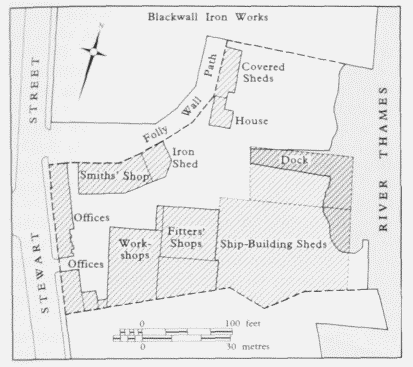
Yarrow & Company's Yard, Stewart Street (Folly Shipyard), site plan c1883
The original site was constricted and contained two cottages and some sheds, all in a fairly dilapidated condition. An engineers' shop was erected, using some salvaged timber, galvanized iron and glass. In 1872–3 the land on the west side of the Folly Wall was enclosed and an office was built upon it. (fn. 74) Despite the disadvantages of the yard, the firm quickly established itself as a builder of steam launches and achieved an 'unrivalled position' in the production of such vessels, which it still held in the 1890s. (fn. 75)
The premises were substantially redeveloped following the acquisition of the extra land in 1875 (fig. 201). Much of the building work was carried out by Harris & Wardrop and W. Whitford & Company, both of Limehouse. Workshops were erected on the southern part of the site and open sheds over the boat-building slips. (fn. 76) The Folly House was initially used by the firm, with the front rooms becoming its drawing offices, but by 1881 it had been demolished (Plate 88c). (fn. 77) The development of the foreshore included the construction of a small dock and the reclamation of some additional ground. (fn. 78)
The enlargement of the yard in 1875 also coincided with a broadening of the range of vessels constructed by the company, with the production of river steamers and gunboats, especially for service in Africa and South America. Yarrows was also a leading builder of torpedoboats, which developed in the early 1890s into destroyers; the firm supplied the Royal Navy's first two destroyers in 1893. Both torpedo-boats and destroyers were sold to many foreign navies, as well as to the Admiralty. (fn. 79)
The problem of space was eased when that part of Samuda's Yard as far south as the drawdock was leased following the death of Joseph Samuda in 1885, increasing the river frontage by 150ft. (fn. 80) Nevertheless, even larger premises were needed and in 1898 a lease of London Yard was acquired and the business was transferred there, the Folly Shipyard being completely vacated. (fn. 81)
Yarrows successor was the Union Lighterage Company of Blackwall, with the name of the premises changed to New Union Wharf. (fn. 82) The new occupiers used the wharf for the repair of their boats, gradually replacing most of the buildings. (fn. 83) The alterations included, in 1923, the construction of three slipways, for repairing barges, and their roofing over. (fn. 84)
That part of the wharf formerly held by Samuda was occupied by Messrs Joseph F. Ebner, who took a 40-year lease from the Union Lighterage Company. (fn. 85) Ebners let part of the wharf for commercial storage (fn. 86) and used the remainder for their manufacture of parquet and woodblock flooring. A drying-shed was built in 1901 by H. Groves of Greenwich (fn. 87) and other sheds were extended or replaced. (fn. 88) There were fires at the premises in 1917 and 1927. (fn. 89)
Ebners left their part of the wharf during the early 1940s and the lighterage company occupied the whole until they vacated it c1970. (fn. 90)
John Stewart & Sons, Blackwall Iron Works
The Blackwall Iron Works was established by John Stewart in the 1850s for the manufacture of marine engines. The business specialized in engines for tugboats, but also engaged in shipbuilding.
In 1854 Stewart acquired a block of land 120ft long between the river and the Folly Wall. He added a narrow strip to the south in 1858, and larger ones to the north in 1860 and 1864, bringing the river frontage to 395ft. (fn. 91) The ground on the west side of the Wall was also acquired in a number of stages. A lease was taken of a small parcel in 1857 and, by further leases of 1860, 1862 and 1864, Stewart became tenant of all of the ground between the two short streets off the east side of Stewart Street, with a frontage of 503ft along the western side of the property. (fn. 92)
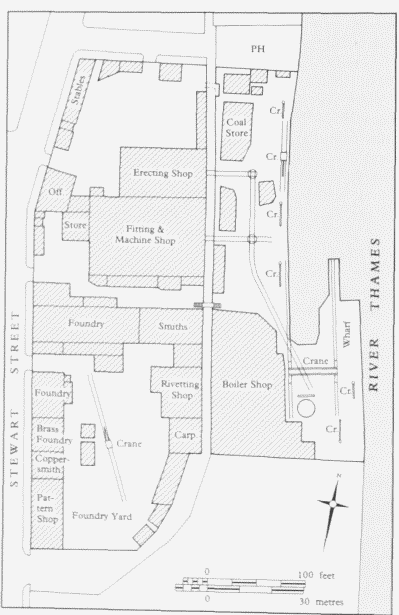
Blackwall Iron Works, Stewart Street, site plan in1902
The buildings were mostly erected in the late 1850s and early 1860s, reportedly to Stewart's own designs. The principal ones were a large three-storey workshop of brick and tile described as an 'engine factory', 150ft by 120ft, built by John Morris & Son in 1861, and a boiler foundry, constructed on the east side of the Folly Wall in 1863. (fn. 93) There were a few additions to the buildings in the late nineteenth century, (fn. 94) and an erectingshop of brick, roofed in sheet iron, was built following the negotiation of a new agreement with the Cubitt Town Estate Company in 1900. (fn. 95) There was a rough ision on the site between the boiler-making functions se to the river and the engine manufacturing workshops on the west side of the Folly Wall (fig. 202).
In 1893 Stewarts acquired the shipyard of Thomas Westbrook to the north. (fn. 96) This comprised a strip of ground with a river frontage of 272ft which Westbrook had purchased in two parcels, in 1843 and 1845, for £2,035. (fn. 97) His father, also Thomas, had been part-occupier of the ground from at least 1817. (fn. 98) The elder Thomas was also tenant of a plot of a little over an acre between the Folly Wall and Manchester Road, which his son retained on a yearly tenure until 1860. (fn. 99) The two men were in partnership as builders of wooden ships until the father's death in 1839 and Thomas junior continued the business thereafter. (fn. 100)
The area of Westbrook's yard was increased slightly by the embankment of the river front, licensed in 1850, (fn. 101) which added approximately 17ft to the width of the site, which was originally only 75ft wide. The embanking included the provision of two slips.
The few buildings erected on the site included a boiler shop (1857), a blacksmiths' shop (1860), angle and plate furnaces (1885), and a house and office. (fn. 102) This left most of the wharf empty for shipbuilding, although its limited area restricted the size of the vessels that could be constructed.
By 1888 the company was trading as Steward & Latham, although Westbrook remained the owner until the sale to Stewarts. (fn. 103)
In 1891 Stewarts had acquired Pitcher's former yard, north of the Folly Wall (see page 601). This, and the acquisition of Westbrook's, considerably extended the company's river frontage and, with the two dry docks on Pitcher's site, greatly increased its shipbuilding and shiprepairing capacity. In 1912 the PLA bought the premises, when Stewarts went into liquidation, as part of its proposals to improve the entrance to the South Dock of the West India Docks, but a new company, John Stewart & Sons, operated there as its tenants. (fn. 104) The works closed in 1924 and the contents were auctioned early in the following year. (fn. 105) The remaining buildings were demolished by the end of 1926. (fn. 106)
Ovex Wharf
The southern part of the Blackwall Iron Works site was occupied from c1910 by the Ovex Fuel Company, which carried out some repairs and building, but left c1913. (fn. 107) In 1920 the Ross Smith Steamship Company was using part of the wharf for storage, although the buildings were by then 'rather dilapidated'. (fn. 108)
The newly formed Thames Plaster Mills Ltd described as a manufacturer and dealer in plaster of Paris, cements and 'ceramic ware of all kinds' - took a lease of the wharf in 1931. (fn. 109) It surrendered the lease in 1938, however. A new one was then granted to Robert Abraham Ltd, but damage by enemy bombing in 1940 rendered the wharf 'unfit for the purposes' for which it had been let, and the remaining buildings were hit by a V1 flying bomb later in the war. Abraham's successor was the Rye Arc Welding Company, a ship-repairing and engineering firm, which moved on to the site in 1946 and was granted a new lease in 1947. (fn. 110) It carried out a redevelopment, erecting some new buildings and reconstructing 181½ ft of wharf frontage. (fn. 111) The company remained at the wharf until c1973 (see page 542). (fn. 112)
Storm Water Pumping Station, Stewart Street
The lack of adequate drainage on the Isle of Dogs and the consequent flooding of houses from the overcharged sewers prompted the Metropolitan Board of Works to erect a storm-water pumping station beside the river. A site on the east side of Stewart Street was purchased in 1886. (fn. 113) The buildings were designed by the MBW Engineer's department and built by Perry & Company of Bow, on their contract of £16,100. (fn. 114) J. Watt & Company of Birmingham provided the engines and machinery. (fn. 115) As a temporary arrangement, two small engines were set up in a shed at Cubitt Town, until the permanent station was completed in 1888, at a cost of £21,000. (fn. 116)
The engine house was a tall severe Italianate brick building with a louvred roof, oriented east-west with the gable-end facing the river. Adjoining this to the south was a smaller brick boiler house of the same design, aligned north-south. Both buildings were lit by simple round-headed windows. From the boiler house a flue led south to a fluted chimney, 120ft high. A workshop and store-sheds completed the group (Plate 85c). (fn. 117)
The machinery included a pair of steam-driven pumps capable of lifting 70 tons of water per minute, but by 1911 they were found to be inadequate. The LCC decided to enlarge the pumping station, proposing two extra gasdriven centrifugal pumps in a second building adjoining the station to the south. (fn. 118) The work was begun in 1914, but the First World War and difficulties with contractors delayed the completion of the new plant and building, executed by Mowlem & Company, until 1928. (fn. 119) The extension has square windows and a steel-truss and timber roof containing a glass skylight. This simple low brick building forms the southern half of the present group.
The extension of the station involved the truncation and reconstruction of the original engine- and boiler house, and in the 1930s two further sets of engines and centrifugal pumps were added in the new pump house. (fn. 120)
By December 1953 the engine house was vacant and the chimney had gone, with all the work being done by electric machinery in the extension building. (The boiler house was used as a coal store.) (fn. 121) The plant was obsolescent by 1969, when the GLC decided to construct a new pumping station for the Isle of Dogs on an adjoining site. (fn. 122) The old engine house was demolished in the 1980s.
The GLC's plans did not mature and it was the LDDC, in association with Thames Water, that commissioned the replacement building, which was erected in 1987–8 to the designs of John Outram at a cost of £4 million, including equipment. The main contractors were Peter Birse and the engineers Sir William Halcrow & Partners.
The windowless steel-framed building, designed to be vandal-proof, has the air of a mausoleum and can be best described as Post-Modern Egyptian Monumental, featuring columns, capitals, pediment and overhanging eaves, and having an overall symmetry (Plate 59b). It is very colourful, with the capitals of the columns picked out in red, yellow and green and the walls having bands of striped brickwork of yellow, red and purple. The roof is of glazed clay pantiles.
The overall effect is of a grand, if somewhat unconventional, structure. But the grand architectural features are both decorative and functional: the fat half-columns that rise to the pediment carry the steps and ducts connected with the gantry that runs the length of the turbine hall, and the roundel in the pediment is a gently rotating propeller-like fan which extracts methane gas from the building. Externally, the building echoes and develops themes explored by Outram in the refurbishment of the Harp building at Swanley, Kent, completed in 1987. (fn. 123)
The interior is arranged in three bays. The pump room, a subterranean chamber 30ft deep, occupies the central bay and houses 14 large water pumps that pump water to the large surge tank, housed in the western bay on ground-floor level, which drains into the Thames. An electricity control room and staff areas on two floors fill the third bay. Durable materials and bright colours continue inside the building, with exposed facing brickwork, terrazzo floor tiles and brightly painted steel work.
The station was designed to appear half submerged in symbolic recognition of both its function as a 'temple to summer storms' and the machinery hidden beneath it. (fn. 124) It stands within a gated walled compound which also contains a smaller transformer building. The new pumping station attracted a Civic Trust Award in 1989.