
Survey of London: Volumes 43 and 44, Poplar, Blackwall and Isle of Dogs. Originally published by London County Council, London, 1994.
This free content was digitised by double rekeying. All rights reserved.
'Blackwall Yard: Development, to c.1819', in Survey of London: Volumes 43 and 44, Poplar, Blackwall and Isle of Dogs, (London, 1994) pp. 553-565. British History Online https://www.british-history.ac.uk/survey-london/vols43-4/pp553-565 [accessed 26 April 2024]
In this section
CHAPTER XIX - Blackwall Yard
When the ship-repairing firm Blackwall Engineering closed its establishment at Blackwall Yard in 1987, it brought to an end a tradition of shipbuilding and shiprepairing on this site which had begun over 350 years before with the laying-out of a shipyard here in the second decade of the seventeenth century. The original Blackwall Yard was created by the East India Company for the building and repair of its own ships. In the 1650s it passed into private hands, and under successive owners developed into one of the largest and most celebrated mercantile shipyards on the Thames (Plate 94a). Until the West India and East India Docks were built in the first decade of the nineteenth century, Blackwall Yard was the largest establishment in Poplar.
The Blackwall Yard which survived into the 1980s represented only a small portion of the yard which had existed at the end of the eighteenth century. The first major curtailment of the site occurred in 1803, when much of the eastern part, including the late-eighteenthcentury Brunswick Dock, was bought by the East India Dock Company for its new Export Dock. In the late 1830s the northern area was sold after it had been cut off from the rest of the yard by the new London and Blackwall Railway, whose tracks sliced the premises in two. The oldest part of the yard had not been touched by these developments, but in 1843 it was partitioned to create two separate shipbuilding establishments, and in 1877 the western and most historic portion was bought by the Midland Railway and completely redeveloped as a collier-dock, which in its turn was swept away in the 1950s.
The East India Company and the Construction of Blackwall Yard
The 'Governor and Company of London Merchants trading into the East Indies' were first granted a licence to trade by Elizabeth I in 1600. There were several reasons for the formation of the East India Company. One was the exclusion of English merchants from Lisbon after 1585, which prevented access to the Portuguese spice trade (a similar ban was imposed on Dutch merchants in 1594). This encouraged attempts to establish direct trading links with the East Indies, and Dutch successes, marked by the rapid rise in the number of voyages made from Holland and Zeeland to the East Indies in the late 1590s, produced a growing fear that they would monopolize the spice trade. Coupled with this was a growing national consciousness of maritime power, which was heightened by the defeat of the Spanish Armada. A further factor was the desire to find new extra-European markets for English woollen cloth. The main purpose of the trade to the Indies, however, was to import products from Asia, and also to re-export certain goods, notably pepper and indigo, to other European markets. To purchase those goods the East India Company exported silver: in fact, precious metals constituted over threequarters of the value of its exports.
Within 20 years of its foundation the company had more than ten trading bases or 'factories' in Asia, and two shipyards on the Thames, at Deptford and Blackwall. It operated as a joint-stock enterprise, the individual investors receiving 'divisions', or profits, of a General or Joint-Stock at the winding-up of each voyage or series of voyages. The company was run — through the Governor, the Council and Committees — by a small group of London merchants. But the capital investment which allowed it to trade came from a wide range of interests: City merchants, aristocrats and courtiers, and tradesmen, attracted by the prospect of high returns. This was certainly achieved in the early years, profits for 1601–23 averaging 100 per cent. The company's fortunes then went through a difficult period, however, and by the end of the seventeenth century profits were more modest. (fn. 9)
For the first few voyages to the East Indies the company purchased ships from private individuals. These were men-of-war converted to armed merchantmen, a clear distinction between the two kinds of vessel not having yet developed. The company also commissioned vessels from the shipyards of East Anglia, most frequently from Woodbridge. Contemporary merchant ships generally displaced between 50 and 200 tons, but the East India Company preferred larger ships of between 300 and 600 tons, and in the first two decades of the seventeenth century even employed vessels of up to 1,200 tons. By 1608 it realized that a yard on the Thames was needed, not just for fitting out vessels, but also for building ships, and a lease for a dockyard at Deptford was obtained by the company's shipwright, William Burrell, at a rent of £30 per annum. (fn. 10) It was at Deptford that the first ships were constructed specifically for the East Indies trade, and repairs to returning vessels were also carried out there.
By 1614 the scale of the company's operations, the numbers of ships employed, and the general expansion in trade, made the reliance on Deptford impractical. There was simply not enough space in that yard to repair, construct and load the out-going ships. Burrell was therefore ordered to dig another dock, and it was he who suggested Blackwall as a possible location for this. (fn. 11) At that time Blackwall was little more than a few taverns serving travellers embarking and disembarking at Blackwall Stairs from ships moored in the river. Land was available there on the east side of the Causeway leading from the Stairs to Poplar High Street (part of the East Marsh), which could be had at a reasonable cost. (fn. 1) But, more importantly, Blackwall was further down-river than Deptford, with a greater depth of water, so that vessels, and especially those laden with cargo, could moor closer to the dock without risk of damaging their hulls on the mud and ooze of the Thames.
In April 1614 the company obtained some copyhold land of the manor of Stepney from Roger Jones, gentleman, of Limehouse. It was located in three scattered units: 'Babland', a portion of 6½ acres in the East Marsh of Poplar; a parcel of three acres; and part of the river wall with a hoppet of one acre. (fn. 2) A small amount of land was also bought from a Mr Mowse, presumably to consolidate the holdings acquired from Jones. (fn. 12) The company was unable to acquire the freehold, and four members were named as feoffees in the copyhold transaction. (fn. 13) A house was also rented (and later purchased) from Roger Jones for £5 per annum. (fn. 14)
Throughout May and June 1614 William Burrell supervised the digging of a dry dock at Blackwall. Construction proved difficult, and problems were caused by the underground springs that broke through the clay which had been rammed over tarpaulins to form the floor of the dock. These difficulties were overcome with the advice of 'some skillful person', consulted by the committee in charge of dockyards in late July 1614, and the dock was ready to receive the Dragon for repairs in August. The committee had suggested erecting a brick wall 'to enclose the yarde and keepe yt private towards the highwaye', but it appears they settled instead for a wooden pale. (fn. 15) At first Deptford was considered more suitable for the building of new ships, but following the completion of the necessary workshops in 1618, ships were both constructed and finished on the slips at Blackwall as well. (fn. 16)
In 1615 Burrell lengthened the dry dock so that it could take three ships, and the entrance was widened to allow larger ships in to be repaired. (fn. 17) A second, smaller, dock that was mentioned in 1621 may have been built in 1618. (fn. 18) The larger one was lengthened again in 1624 'to bring in great ships'. (fn. 19) In May 1625 it was proposed to extend the wharf between the two docks, thereby enlarging the yard outwards into the Thames by 12ft, and giving greater security to the western dock, which was suffering from flooding at spring tides. This work was carried out at an estimated cost of £43. (fn. 20)
In 1630–1 a 'little new dock' was built to the east of the first dry dock (known by that date as the 'great' or 'double' dock). (fn. 21) In 1634 it was ordered that the little dock should be widened and gates fitted. (fn. 22) William Stevens, the company's shipwright, had estimated that this work would cost £150, but in September 1634 he was questioned by the Court of Committees, for £500 had been spent already and it was still not finished. (fn. 23) In 1636 the 'great' dock was repaired at a cost of £60. (fn. 24) Indeed, repairs to the three docks were a continuing expense. Sometimes high tides damaged the great wooden gates and occasionally ships harmed the docks as they entered. (fn. 25) Whatever the cause, the docks were always speedily repaired to prevent further damage.
The Causeway running from Blackwall Stairs to Poplar High Street was bought for £100 by William Burrell in 1618. He offered the eastern side to the company for £50, intending to retain the western half, but his offer was refused as the company wished to have the whole Causeway. (fn. 26) The matter dragged on until January 1622, when Burrell conceded the point and, for £200, granted a lease of the Causeway to the company for 463 years at an annual rent of 2s 6d. (fn. 27) In an attempt to raise money during the years of poor trade in the early 1640s, the company erected a gate at the Poplar end of the Causeway and introduced tolls at the rate of 2d per cart. The Causeway was said to be in decay and the tolls were to be used in repairing the way. Foot passengers were not charged, but had to climb the 3ft-high stile erected beside the gate. (fn. 28) The right to collect these tolls was still one of the hereditaments of the yard in 1779, and may not have been extinguished until the early nineteenth century (the road remained gated until at least 1817). (fn. 29)
The Buildings within Blackwall Yard, 1614–52
Following the construction of the first dock in 1614, several buildings were erected within the yard. In September 1615 a smiths' shop and forge for making anchors, nails, cables and working tools was built. (fn. 30) At this early date there was also a spinning house for the manufacture of cordage from hemp (most of which came from the Baltic), and a range of storehouses for the safe keeping of timber, canvas and provisions on the western side of the yard next to the Causeway. On the north side of the yard were slaughter- and salting-houses, used for preserving and preparing meat for the voyages, which was stored in oak barrels provided by the cooper. (fn. 31)
There was much building activity at Blackwall in 1618. A range of buildings, with a turret in the centre, was completed on the north side of the yard running eastward from the Causeway, and a dwelling house was erected in the north-west corner of the yard at the western end of this range. This house was 70ft long and two-and-a-half storeys high, and accommodated the company's servants in the yard. (fn. 32) Later known as the mansion house, it survived in an altered state until the 1870s (Plate 94b). Also in 1618, a 12ft-high brick wall was built along the western side of the yard for the better security of the company's property, replacing the earlier wooden pale. A ditch separated this wall from the adjacent Causeway. In the middle of the wall was a gatehouse linked to the Causeway by a bridge over the ditch, 'arched out with brick'. (fn. 33) The company's coat-of-arms, carved in stone, was placed over the gateway, which was capped by a turret, matching the lesser turret which had already been built on the north side of the yard. (fn. 34) The gatehouse consisted of the porter's lodge on one side and rooms for the Clerk of the Yard on the other. The Clerk's accommodation on the ground floor included a study 'to keep his books and accounts in, with a window into the gate to call the workmen', a hall, a kitchen and a cellar; on the first floor there were three chambers, with one more over the gate beneath the turret. (fn. 35)
During the early 1660s the then owner, Henry Johnson, erected a third range of buildings on the eastern side of the yard. This range also had a central turret, and completed a neat symmetrical three-sided group of buildings (see fig. 208). (fn. 3)
Other work undertaken in 1618 included the construction of a tar-house, a barber-surgeon's room, a tap house 'for the workmen', and, on the neighbouring wharf, a pit for sawing wood for masts. (fn. 37) When ready, the masts were stored floating in the large ditches that surrounded the yard. Alterations to buildings hastily put up in 1614 were also undertaken in 1618; both the reed-house and smiths' forge were stripped of their thatched roofs and tiled, as, not surprisingly, they were 'continually subject to fire'. (fn. 38)
The problem of providing food and drink for the workmen was debated throughout the period 1616–19. It was customary for the men to leave the yard to take their breakfast and dinner in Poplar, and so a tap house was built in 1618 'to prevent their going out of the yard to victual'. This did not solve the problem, however, and the company made many complaints about the two hours lost each day 'in going up to the Towne'. (fn. 39) In June 1619, therefore, a victualling house was built at the end of the long sawpit, between the two docks, (fn. 40) and the company ruled that workmen were not to leave the yard to take breakfast or dinner, on pain of dismissal, but should 'eyther bring their meat and drink with them in the morning or take it in the yard'. (fn. 41) This must have proved difficult to enforce, for a later order allowed them 'to go out to dyner while the days are long, but when the days shorten not to leave the yard'. (fn. 42) The eating room was 46ft long and 28ft wide, and within it small tables and seats were set 'crosse along both sides of the room from end to end with a space of 4 or 6 foot [wide] along the middle of the Room to passe along to serve the tables'. The room was enclosed from the yard with rails at 'breast' height and was lined from rail height down with deal boards. (fn. 43) This was evidently an early example of a staff canteen.
Within the yard there was a wide variety of sheds, buildings and stores. Accommodation in turrets, chambers, and dwelling houses with gardens was provided for many of the more important of the company's servants. In 1621, when Stevens, the shipwright, built his first ship at the yard, he was given two rooms 'to make private draughts of his modells'. (fn. 44) Nevertheless, at no time during the company's occupation of the yard were there any warehouses for imported goods and commodities at Blackwall. The company leased many repositories to take stores of pepper, indigo and spices; but they were all in the City, often in cellars beneath the houses of merchants and Livery Companies' halls. An isolated dockyard, even one with a 12ft-high wall, was not considered a sufficiently secure place to keep high-value commodities.
The yard at Blackwall was fully operational by 1617. It was a large-scale unit, employing many men directly, and requiring a wide range of goods and indirect labour services. Indeed, during the first 20 years of operations there, between 200 and 400 men could be found working in the yard at any one time. (fn. 45) Blackwall Yard, although not unique in early seventeenth-century England (Deptford, Plymouth and Chatham all had large shipyards), was the largest employer of men in the London area during the first half of the century. Not only were the men employed in shipbuilding and repairs, but also there was construction work on the yard and buildings themselves, and many were involved in the victualling of the ships bound for the East Indies.
The yard faced a number of problems, some of them perhaps due to the scale of the operations there. They included difficult labour relations, bad management, theft, fluctuations in demand for and supply of workers, and constant demands from the Governor and Council of the company to cut costs, work faster, and be more efficient. With so many men employed, the company often became involved in negotiations respecting pay and conditions of employment. For example, in 1617 it received a petition from the 25 salters, requesting an increase in their wages because they had to make the daily journey from London to Blackwall, and when 'the weather falleth out' still had to work the same hours as when they had been accommodated nearer the yard. They were granted 1d per night to pay for lodgings close by to save them the journey from London. (fn. 46)
The Years of Crisis and the Sale of Blackwall Yard
The East India Company was extremely successful until the mid-1620s, but from then until after the Civil War faced something of a crisis, and the number of voyages to the east fell. Indeed, in the 1630s the company was in a reduced and relatively impoverished condition. This was partly due to Anglo-Dutch rivalry. The numbers of Dutch ships trading to the East Indies rose steadily, and although the Dutch East India Company's fortunes went through a difficult period following the renewal of the war with Spain in 1621, they had revived in the 1630s and the company was again paying large dividends in the second half of the decade. The East India Company also faced criticism directed at its export of silver bullion, and, more importantly, competition from a rival body, the Courteen Association, formed in 1635 by Endymion Porter and Sir William Courteen, with the full support of Charles I's government. The Association breached the company's monopoly and was allowed to trade anywhere in the East Indies where the company had not already established a factory. The competition at first lowered the value of the company's shares and it was unable to secure enough capital to carry on its trade. Its 'divisions' or profits also fell. Nevertheless, after the initial high expectations the Courteen Association proved to be a complete failure, and by 1639 the outlook for the East India Company had become more favourable. (fn. 47)
Its declining fortunes seem to have been the immediate cause of its ceasing to build ships on its own account, for the years of crisis had planted seeds of doubt in some company men about the need to maintain a costly shipyard at Blackwall. Many thought that much expense could be spared by freighting ships (hiring them for individual voyages) rather than building and repairing their own.
As early as 1628 it had been suggested that the company should 'build ships by the great [that is, at a fixed price] in other mens docks as the Turkey Company do', although at that stage it was deemed essential to keep the yards 'for the repairing of their ships'. (fn. 48) During the mid-1630s complaints were made that 'Blackwall ... doth daily exhaust their treasure in a very great proportion'. (fn. 49) At the same time, arguments in favour of freighting were voiced in the Court. By October 1641 the Court had decided that 'the freighting of ships will be of most advantage to the Company and save them the expense of Blackwall and other charges to about £600 per annum'. It was also decided that the ships still owned by the company were to be continued in service rather than 'to suffer them to lye and rot or sell them to disadvantage'. (fn. 50)
In 1645, when the contracts of the officers of the yard were renewed, a proviso was made that they could be given three months' notice because 'the companies stock is small and they cannot tell whether they shall continue the keeping of Blackwall Yard'. (fn. 51) In addition to the generally impoverished state of the company, the other main reason for the sale of the yard was the Civil War, which did little to encourage investment in an uncertain trade. (fn. 52)
A final decision on the future of Blackwall was made in June 1650. When the company was drawing the fourth General Stock to a conclusion, the Court resolved to dispose of the yard. (fn. 53) Before it was sold, the company increased the value of its leasehold by adding four lives to the lease, at a cost of £300. (fn. 54)
The yard was first offered to the Admiralty, which had no need for it, and negotiations in 1651–2 to sell it to Benjamin Worsley for £5,600 also fell through. (fn. 55) (fn. 4) In 1653 the shipwright Henry Johnson leased the docks and part of the yard, (fn. 56) and in 1655 the company agreed to sell him all of its interest in the premises for £4,350. (fn. 57) This was considerably less than the valuation of £6,000 made only four years earlier. (fn. 58) The sale to Johnson was completed in 1656, when the description of the property mentions 'three docks, two launching slips, two cranes, storehouses'. (fn. 59)
The Years of Expansion: Henry Johnson, senior, and Blackwall Yard, 1653–83
Henry Johnson was just 30 years old when he purchased Blackwall Yard. He was, however, already an experienced shipwright, having served his apprenticeship at Deptford with his cousin Phineas Pett, the Royal Shipwright. In 1649–50 Johnson had constructed two ships of over 500 tons at Deptford for the government. (fn. 60) His purchase of Blackwall Yard proved to be a shrewd investment. The size of the merchant marine grew considerably in the period following the Restoration, and the demands for naval shipping during the Dutch Wars enabled Johnson to expand his yard to build both privately commissioned vessels for trading purposes and warships.
East India Company ships continued to be built and repaired at Blackwall throughout the 1650s and 1660s. The commissioning was not done directly by the company, but by ship's husbands (managing owners), who arranged the finance and apportioned shares in the vessels engaged in the East India trade. In fact, from 1662 Henry Johnson became a leading part-owner of many of the ships produced in his yard for freighting by the East India Company. Although the yard had passed into private hands, the connection with the company was maintained, as Johnson became an increasingly powerful and influential member of the company, attending committee meetings right up until his death in 1683. His son, also Henry, was likewise to become powerful within the company, which he joined by patrimony in 1684. By the early eighteenth century he owned more than 90 onethirty-second parts or shares in his 39 ships, 33 of which were employed in the eastern trade. (fn. 61)
Henry senior also began to build for the Navy. During the mid-seventeenth century the building of warships of the third rate and above was a major financial undertaking. The official view was that such ships were better built in the royal dockyards than by contract in the merchant yards, but the Second and Third Dutch Wars, in 1665–7 and 1672–4, put too much pressure on the royal yards, and the Navy Board was forced to place contracts with Johnson for third-rates. In 1665–6 the 62-gun Warsprite was built at Blackwall, at a cost of £6,090. (fn. 62) From 1662 merchant shipbuilding was further encouraged by Charles II, who offered as bounty to anyone building ships a remission of the customs on any goods carried. This bounty, which did not expire until 1704, was very attractive to those involved in the low-bulk and high-value goods imported from the Indies. Between 1670 and 1677, 12 ships were built at Blackwall, while refits and repairs were carried on much as normal. (fn. 63)
In 1666 Johnson's great friend, Samuel Pepys, in his role as a senior Clerk in the Navy Office, commissioned a survey of the merchants' yards on the Thames capable of building ships-of-the-line. This found that Henry Johnson had four docks, two of which were capable of handling third-rates and the other two of taking fourthrates. (There were, in fact, only three dry docks at this date, but one of them was a double dock, which may account for the number given in the survey, or perhaps the surveyor included Johnson's new wet dock, described below, in his total.) According to this survey, Blackwall Yard had the greatest capacity of any of the commercial yards on the Thames. (fn. 64) Pepys also estimated that there were 598 shipwrights, 244 servants and 98 caulkers at work on the river between Gravesend and London Bridge. (fn. 65)
During the 1670s and 1680s the yards on the Thames were very busy and there was a shortage of skilled labour. Like the owners of the other private yards, Johnson feared the impress, when workers were commandeered into the king's yards, and he often secured guarantees to prevent men in his yard being impressed. In 1672, for example, when the refitting of five ships for a voyage to the East Indies was being undertaken at Blackwall, he obtained assurances that the 40 carpenters and caulkers working there were to be undisturbed. (fn. 66)
As soon as he took over the yard, Johnson began alterations and improvements. In August 1654 he leased to three shipwrights, Ralph Prickett, Thomas Coulson and John Bristowe, part of the storehouses on the western side of the yard, which he did not need, for 19 years at £25 per annum. The storehouses consisted of 14 bays and were 203ft long. The tenants undertook to fill up the ditch between the storehouses and the Causeway, and they fenced off their ground from the rest of the yard. (fn. 67)
Johnson expanded the site northwards by buying land beyond the original East India Company Yard. Between 1653 and 1656 he built the Globe Tavern and the coopers' buildings and a slaughter house, all outside the curtilage of the yard. (fn. 68) At about that time he renovated the mansion house in the north-west corner of the yard, where he lived.
In 1659 Johnson commissioned George Sammon of Wapping, a carpenter, to 'digg, erect new build' a large wet dock at Blackwall Yard for the repairing and careening of ships. (fn. 5) This was an ambitious project, which swallowed up a substantial area of the yard, as can be seen in Gascoyne's map of 1703 (fig. 208). The new dock was dug 33ft from the head of the easternmost dry dock,
to range from thence towards the Sluce which lyeth on the East side of the said docke and soe to leade up towards the Slaughter house Northwards Twoe Hundred Twenty and five foote or thereabouts And from thence towards the Garden wall . . . Westward on the North side Three Hundred and Tenne foote or thereabouts And from thence Southward on the West ende One Hundred Threescore and fifteene foote or thereabouts and from thence to the side of the said docke Eastward and to leade upp by the Tapphouse. (fn. 69)
A wharf was constructed around the dock and timber posts were placed along its sides to provide careening facilities for four ships, 'after the same manner as those posts and pieces of tymber are placed in the States yard at Deptford'. The dock gates were also of the latest design, 'to be done in every respect as those . . . at Deptford'. (fn. 70) New launching slips were built and a gibbet crane erected beside the gates of the new dock.
In January 1661 Pepys 'went to blackwall and viewed the dock[yard] and the new wett dock which is newly made there, and a brave new merchantman which is to be launched shortly'. (fn. 71) The new dock, which was not quite completed at the time of his visit, was finished in March. The excavation alone had cost £1,057 10s, and Johnson's total expenditure on the works in the yard came to more than £4,741. (fn. 72)
With a surface area of 1½ acres, the new dock was said in 1669 to be 'the largest wet dock in England'. (fn. 73) It remained the largest on the Thames until the Howland Great Wet Dock, which covered 10½ acres, was constructed at Rotherhithe in the late 1690s. Johnson's dock was primarily designed for incoming ships of the East India Company and was a place where they could be laid up between voyages, as well as somewhere they could receive minor repairs. It was evidently not a great success at first, for in 1664 Pepys noted that the dock had been of little profit to Johnson. (fn. 74)

Blackwall Yard in 1703. A diagrammatic plan reproduced from Joel Gascoyne's Survey of the Parish of St Dunstan, Stepney. The plan shows the ranges of buildings around three sides of the yard, the Great Wet Dock of 1659–61 (with East Indiamen in it), and, along the river-front (from west to east), the 'great' or 'double' dry dock of 1614 (extended 1615 and 1624), the 'little new' dry dock of 1630–1, the 'second' dry dock of 1618, and a launching slip
By 1665 storehouses were being built in the yard for 'the laying of goods out of the East India ships when they shall be unloaden'. (fn. 75) The construction of storehouses and warehouses for the safe keeping of imported goods at Blackwall was an innovative move by Johnson. By 1686 at least some of the storehouses were three-storey buildings, as stock was described as being 'on the midle flower' and 'in the gallery'. (fn. 76) Some merchants, though not the East India traders, stored imports in these buildings. In 1669 Charles Marescoe leased two warehouses at Blackwall for three years at an annual rent of £50, in order to store goods supplied by the Stockholm Tar Company. (fn. 77) The East India Company had its own warehouses in the City and did not therefore require storage facilities for imported goods at the yard. (fn. 6)
Throughout the later seventeenth century Henry Johnson had a variety of business partners in the yard All were working shipwrights, and no doubt partnership enabled Johnson to spread his construction costs and raise capital, as well as to undertake more work. These partners included William Christmas (an old schoolfellow of Pepys) for a short time in the mid-1650s. Francis Barham from 1658, and William Collins during the 1660s and 1670s. In January 1677 Collins relinquished his partnership and was appointed manager of the yard, with an annual salary of £50 and a one-eighth share in the business. In addition, he had the use of a house there at a peppercorn rent. (fn. 79) This was probably the mansion house in the north-west corner.
The mansion house was again repaired, and a new house erected, between 1677 and 1679, when Johnson paid two builders, John Rogers and Thomas Marchant, for 'the Alterations of the new house and Repairing the ould'. When the new house was built, Richard Gibbs was paid £26 4s 10d for 'painters work' of a highly decorative nature about the property. One room was painted 'olive wood and tortell shell' and murals depicted battles and ships built at the yard. (fn. 80) The new house was probably the detached house to the east of the wet dock which can be seen in Francis Holman's mid-eighteenth-century painting of the yard (Plate 146a) and which survived into the 1840s (see fig. 210). It was in the new house that Johnson was knighted by Charles II in 1679 when he entertained the King there. (fn. 81) In 1677–8 the wharves and docks were extensively repaired, (fn. 82) and when Johnson died in 1683 he left the business in a burgeoning and prosperous state, the order books full, and the yard itself in good repair.
Henry Johnson, junior, and Blackwall Yard, 1683–1719
From 1683 the building and repair of ships went on much as usual under the proprietorship of Johnson's son and heir, the younger Henry, who was knighted in 1685. The business prospered and the younger Johnson amassed a huge personal fortune. When his only child, Anne, married Thomas Wentworth, Earl of Strafford, in 1711, she took with her a dowry reputed to be £60,000 and the reversion of her father's estate after his death. (fn. 83) By 1708 Johnson no longer lived at Blackwall, preferring the delights of his house in the West End, his country estate at Friston in Suffolk, and the responsibilities of the House of Commons, where he and his younger brother, William (c1660–1718), were the Members for Aldeburgh. (fn. 84)
Throughout the years 1683–1719 Johnson must have left the day-to-day running of the yard to a manager and, for a part of the period, to his brother William, for, unlike his father, Henry was not a shipwright. Pepys described him as 'An ingenious young gentleman, but above all personal labour, as being too well provided for to work much'. (fn. 85) William was living in a house in the yard from at least 1705, from where he oversaw the running of the business. (fn. 86) As a young man he had been a successful factor for the East India Company in Bengal, and on his return to England in 1683 had set up as a merchant trading with Africa. Between 1704 and 1710 William built five ships-of-the-line and six other vessels at Blackwall. In 1710 naval officers surveyed a ship there 'built by Wm Johnson esq.'. (fn. 87) He left England in 1716 to become the Governor of Cape Coast Castle, Guinea, for the Royal African Company, having been tempted by the huge salary offered for the three-year posting. The primary aim of the post was to supervise the procurement of the highly esteemed Gold Coast slaves. He survived the voyage but, like many before him, died at the fort, in 1718. (fn. 88)
From about 1709 there appears to have been some surplus capacity in the merchant yards on the Thames, with ships even being speculatively built. The Admiralty frequently received offers of ships that were on the stocks and almost complete. Blackwall produced several such ships that were evidently intended for trade, but were finished off as fifth- or sixth-rates for the Navy. (fn. 89) (fn. 7) Shipbuilding at Blackwall Yard continued right up to the death of Sir Henry Johnson in 1719, the last vessel being sold in 1720. (fn. 91) There was also building activity in the yard in 1719, when renovation and repair work was being carried out by sawyers, bricklayers and labourers. (fn. 92)
Years of Peace and Times of Crisis: Blackwall 1719–39
Though not immediate in its effect, the death of Sir Henry Johnson in 1719 precipitated a period of uncertainty in the yard's fortunes which lasted until the mid1720s. During this time few if any new ships were built there. The effect on the local economy was considerable. In 1723 it was reported that:
Henry Johnson did for several years live and inhabit at Blackwall and kept a dock and yard and several other conveniences for the building of ships there and imployed great numbers of people in the trade or business of building ships which was a great support and advantage to the said Hamlet, but since his death the Hamlet, and particularly that part called Blackwall, is gone very much to decay. (fn. 93)
The situation had not improved much by 1725, when the decline of the yard was mentioned in a petition from the inhabitants of Poplar and Blackwall, which stated that the parish rates were falling 'very heavy upon some, particularly those that possess the yards and Docks, the Rents wherof are high, and the Business precarious and uncertain'. (fn. 94)
The immediate reason for the decline seems to have been that ownership of the yard had passed into the hands of Johnson's heirs, his daughter, Anne, and her aristocratic husband the Earl of Strafford, who were somewhat remote. Although 'willing and desirous that the trade and business of building of ships should be revived at Blackwall', (fn. 95) they were mainly concerned to sell the yard, but this was not completed until 1724, after several years of uncertainty.
A more long-term reason advanced for the decline in Blackwall's fortunes was that several large docks had been built higher up the river, which had taken much of the business. (fn. 96) The docks referred to undoubtedly included the Howland Dock at Rotherhithe, opened in 1699, and run for the Dukes of Bedford by several generations of the Wells family, and Thomas and Peter Bronsden's dock at Deptford. Because of the uncertainties at Blackwall Yard after the departure of William Johnson and the death of the younger Sir Henry Johnson, the most important ship's husbands were not using it for the construction of their East Indiamen. The busiest and most prosperous yard on the Thames by the third decade of the eighteenth century was no longer Blackwall, but that of the Bronsdens at Deptford, where 30 ships for the East India trade were built between 1715 and 1736. (fn. 97)
Another reason for the decline in trade at Blackwall was that Britain was at peace, the years 1718 to 1739 being the longest period of peace during the eighteenth century. During peacetime, construction of naval vessels was confined to the naval yards at Chatham, Portsmouth and Plymouth, and private yards on the Thames, like Johnson's, which had built for the Navy during times of war, now had to make do with the work generated by the merchant marine.
In the mid-1730s a rumour that the yard's managing shipwright, Philip Perry (see below), was about to leave to join the Bronsdens, revived memories of the troubled times after 1719 and caused the hamlet to be 'in the Utmost Consternation for fear the Dock should remain unoccupied, their Chief Subsistance arising from the several Artificers employ'd in the Ship Building way'. (fn. 98) But Perry did not leave, and, fortunately for the shortterm prosperity of Blackwall Yard, England went to war with Spain in 1739 and the naval orders soon resumed. By the end of 1739 the Navy was investigating 'at what merchant yards it may be most proper to build four, twenty gun ships'. (fn. 99)
The Ownership of Blackwall Yard, 1724–79
In June 1724 the Earl and Countess of Strafford sold the yard, with 20½ acres, for £2,800, to Captain John Kirby, a shipbuilder already resident there, whose agreement to purchase the property is dated August 1722. (fn. 100) The eighteen-month delay between agreement and sale was evidently caused by a law suit brought by Kirby to determine if the purchaser would be liable to carry out certain obligations under the will of Sir Henry Johnson senior, which had not been honoured by his son (see page 552). Kirby's purchase of the yard was made on behalf of a four-man syndicate, of which he was one, all of whom were retired sea captains who had worked for the East India Company and were members of London's shipping community. On the same day as the sale, therefore, Kirby assigned three quarter-shares in the yard to his three partners, Jonathan Collett, Richard Boulton and Edward Pierson Collett, an active ship's husband, was described as a gentleman of Trinity Minories, and Pierson as a gentleman of Stratford Langthorne in Essex. In 1720 Pierson had been the instigator of an abortive scheme to establish a company trading to India from the Continent. The fourth partner, Boulton, was a London merchant and an important figure in the East India Company, of which he was a director from 1718 to 1736 and on the Committee for Shipping from 1723 until 1726. He was also a member of the Honourable Company of Shipwrights. (fn. 101)
The original partnership lasted just two years, until 1726, when John Kirby died. At the time of his death Kirby was the lessee of a dockyard in Shadwell, as well as a shareholder in Blackwall Yard, and was described in a brief obituary as 'an eminent shipbuilder'. (fn. 102) Kirby left his quarter-share in Blackwall Yard to two trustees, one of whom was Collett, to be sold to pay off a mortgage. By 1731, however, his estate was in Chancery and was eventually ordered to be sold in 1744. Meanwhile, in 1730 Pierson had disposed of his share to Collett and Boulton for £12,000, the value of a quarter-share having risen considerably in just six years. By this sale Collett and Boulton gained possession of three-quarters of the shares in Blackwall Yard, and Collett had effective control as the trustee of Kirby's quarter. (fn. 103) In fact, in the Land Tax assessments Blackwall Yard is recorded as being in Collett's possession until 1745. (fn. 104) Both Collett (with his partner Richard Gosfreight) and Boulton were important ship's husbands in early eighteenth-century London and their connections with the East India Company no doubt provided a stimulus to the yard, with orders for new ships, as well as regular repair work.
Collett and Boulton both died in 1746, bequeathing their shares in the yard to relatives. Boulton's threeeighths descended to a second cousin, Henry Crabb, who took the additional name of Boulton, and who in 1748 purchased one half of Kirby's share, thereby giving him ownership of half the yard. Collett's three-eighth's share was inherited by his grandson, Jonathan Pytts, who in 1753 also acquired the remaining half of Kirby's share, which his father, Edmund Pytts (Collett's son-in-law), had purchased in 1751. Thus by 1753 Blackwall Yard was jointly owned in two equal shares by Henry Crabb Boulton (1709–73) and Jonathan Pytts, and this remained the position until 1768, when Pytts conveyed his share to Boulton, who thereby became sole owner of the yard. (fn. 105) A life-long employee of the East India Company, Boulton was Clerk to the Committee for Shipping between 1737 and 1752, and a director from 1753. From 1754 until his death he was also MP for Worcester. (fn. 106) None of these later owners were professional shipbuilders, and the dayto-day business of the yard in the eighteenth century was increasingly in the hands of members of the Perry family, managing shipwrights at the yard from the early 1720s. It was not until 1779, when John Perry II purchased the yard from Henry Boulton (H. C. Boulton's nephew and heir), for £8,000, that ownership was again vested in a professional shipbuilder. (fn. 107)
The Perry Family: Shipbuilders at Blackwall
The Perry family is central to the history of Blackwall Yard in the eighteenth century, even though its members had no freehold interest in the property until 1779. This family of shipwrights, most of whom were called either John or Philip, expanded and diversified the business throughout the century and, under their direction, Blackwall regained the pre-eminence it had held in the seventeenth century, as the most important private shipyard on the Thames.
By the early 1720s, members of the Perry family were managing shipwrights at Blackwall Yard. Philip Perry I (1678–1742) is reputed to have managed the yard for Henry Johnson, junior, but there is no evidence of his being at Blackwall before 1722. Perry, a working shipwright, was employed in the Naval Yard at Plymouth during the first years of the eighteenth century. He was posted to Kinsale in Ireland in March 1702, and remained there as a principal shipwright until June 1705, when he was discharged and returned to England. (fn. 108) He had been sent to Ireland with other shipwrights for the purpose of 'their taking shipping there' at the beginning of the War of the Spanish Succession. Kinsale was strategically important for repairing vessels until the Treaty of Utrecht was signed in 1713, when it was 'discharged and all the officers and workmen sett for home'. (fn. 109) By 1722 Perry was living in Blackwall Yard, where he occupied the mansion house 'and garden adjacent with the garden and terrace walk on the east side of the same'. (fn. 110) During the 1720s he worked as manager for John Kirby and was later employed in a similar capacity by Collett and Boulton. By 1732 the company operating from Blackwall, comprising Philip Perry and his son John Perry I, was known as Philip Perry & Company. In the mid-1730s, when it was rumoured that Philip Perry was about to desert Blackwall for Deptford, he was described as 'the Great Builder'. (fn. 111) He died in 1742, leaving bequests to Captains Jonathan Collett and Richard Gosfreight, the principal ship's husbands for whom he had built many ships in the yard. (fn. 112) Philip's sons Philip Perry II and John Perry I took over the business at Blackwall and the firm continued as Philip Perry & Company until Philip Perry II died in 1746.
The surviving brother, John Perry I (1713–71), then took over the business, which he renamed John Perry & Company in 1746. (fn. 113) In that year John Perry & Company first appear as ratepayers for Blackwall Yard and it may therefore have been the year in which the Perry family took out a lease of the yard, having been undertenants hitherto. (fn. 114) It was John who expanded the business during the mid-eighteenth century, and much of the later success of Blackwall Yard must be credited to him. He was aided during the 1760s by his younger son John Perry II (1743– 1810) and possibly by his elder son, Philip Perry III (1739–76).
When John Perry I died in 1771 the yard was prosperous, and there were at least two officers supervising it: Michael Topping and Philip Parker. John left substantial cash sums to his children, and to his son John Perry II 'all his part shares and interest of and in several ships and parts and shares of ships and other capital stock belonging to the partnership trade of a shipwright now carried on in the Great Yard at Blackwall', together with his shares in other ropemaking and shipwright businesses there. (fn. 115)
Philip Perry III died unmarried soon afterwards, in 1776, and his brother John Perry II inherited his share of their father's wealth. It was the fortune inherited by John during the 1770s, together with the continued prosperity of the yard, that made it possible for him to contemplate the purchase of the freehold interest. This was completed in 1779, when he became the owner of the shipyard in which his family had been building ships for over 50 years. (fn. 116)
The Fortunes of Blackwall Yard from 1739
In June 1742 the Royal Navy undertook a survey of all merchant yards on the Thames, to find out which were capable of building for the fleet. Perry & Company at Blackwall had the greatest capacity, having one double and two single dry docks, capable of finishing four ships, of 80, 70, 60 and 20 guns, simultaneously. The double dock was 303½ft in length, the two singles 176ft and 152ft. The Perrys' nearest rivals were still the Bronsdens, now Bronsden & Wells, who could build 70-, 50-, 40and 20-gun ships in their double and single docks. (fn. 117)
The value of the work carried out in Blackwall Yard in 1748 was £19,908. It included the building of three East Indiamen: the Griffin (544 tons), the Boscawen (651 tons) — of which John Perry I was himself part-owner — and the Shaftesbury (642 tons). Other work performed in that year included the repair of three other East India ships and repairs to four ships owned by the West India Company. (fn. 118) In 1756 the yard built two 632-ton ships for the East India Company, the Hawke and the Worcester, as well as two ships for the Royal Navy, and repaired 14 ships for the East India and West India Companies. (fn. 119) Between 1756 and 1767 Perry built at least 31 large ships at Blackwall, 27 of them East Indiamen of approximately 650 tons each. (fn. 120) As the century progressed, so too did the value of work being performed at Blackwall, albeit rather erratically, as the following table shows:
| Value of Work at Blackwall 1747–91 (fn. 121) | |||
|---|---|---|---|
| 1747–51 | £ 79,857 | 1772–76 | £ 96,645 |
| 1752–56 | 68,797 | 1777–81 | 188,486 |
| 1757–61 | 101,584 | 1782–86 | 443,053 |
| 1762–66 | 174,061 | 1787–91 | 160,897 |
| 1767–71 | 148,245 | ||
Soon after John Perry II purchased Blackwall Yard in 1779 he undertook repairs to the existing wet dock. William Blake, a carpenter of Deptford, Obadiah Reeves, a timber merchant of Limehouse Hole, and William Bennett, of the starch factory at the Howland Dock, entered into a bond with Perry for finishing the wing wharf and repairing the apron, and in June 1779 Blake undertook additional work at the wet dock, to the value of £350. By 1782 the yard contained at least six building launches. (fn. 122) Perry's most enduring contribution was the construction of a fourth dry dock, some 500ft to the east of the entrance to the wet dock (see fig. 209). This was the first new dry dock built in the yard since the seventeenth century, and is the only one still surviving (Plate 95c). The exact date of construction is not known, but it was probably built by John Perry II after he had bought the yard in 1779. The dock is shown on the Ordnance Surveyor's drawings dated May 1799.
For the men working in the yard during the later eighteenth century conditions were very similar to those experienced by the employees of the East India Company in the yard's earliest days. In 1781 all labourers worked from 6 o'clock in the morning until 6 o'clock at night. In winter they came half-an-hour later and left at 5.30. Breaks of 20 minutes were allowed at 7 o'clock, 11 o'clock and 4 o'clock and at those times the men left the yard to take refreshment at the inns and taverns which were scattered around Blackwall. Horses employed in the yard worked slightly fewer hours, from 7 o'clock until 5 o'clock in the afternoon. The labourers were supervised by a foreman, who was also responsible for the keeping of the horses. Each morning he had to report to John Perry and the manager of the yard, William Larkin, for instructions, and to inform them 'how many horses are coming out and to receive his orders as how to proceed'. (fn. 123) There were also three officers, Messrs Hilman, Garrett and Wollaston, in charge of the men and ships in the yard. Each officer had general responsibilities, as well as the oversight of specific docks and launches.
The tasks undertaken by the labourers included watching the wet- and dry-dock gates and preparing to open and close them when shipping was moved. They washed and cleansed the docks and launches, and removed any rubbish. They also carried waste away from the sawpits, helped the shipwrights and cleared chips away from ships being constructed. The horses dragged timbers from the sawpits and also moved timber beams for the shipwrights. (fn. 124)
From at least the 1770s the shipwrights working within Blackwall Yard were not employed directly by the Perry family. Various master shipwrights worked with their own men in teams, and agreed with the Perrys to work on specific orders. In 1778 John Perry II made an agreement with Morgan and mates and Syers and mates 'to finish the fireship' at 30s per ton. In the following year Perry 'lett to Portaway and mates the Crown of 64 guns to be built for 41s 6d per ton for the whole, 12 men to be concerned and a written agreement signed, and when there is work sufficient 24 men will be employed upon the ship'. (fn. 125) Thus. the skilled work in the yard was sub-contracted to companies of men, while the labouring, horse-power, and provision of tools and building materials were directly controlled by Perry & Company.
The 1780s was a decade of great expansion in the yard (Plate 146a). Not only were increasing numbers of East Indiamen and naval vessels being built and repaired, but the value of the work undertaken rose. During the 1780s the shipwrights in Blackwall Yard, under Perry's supervision, built a number of ships-of-the-line. In 1780 the Belliqueux, a 64-gun ship of 1,376 tons, was completed, followed in 1783 by the Powerfull, a 74-gun ship, and in 1784 by the Vennable, another 74-gun ship, of 1,652 tons. The Hannibal, also of 1,652 tons, was built at Blackwall between June 1782 and April 1786 at a cost of £31,509. (fn. 126)
During those years the building of warships was as important for Blackwall Yard as was the construction of ships for the East India Company. During the 1780s John Perry II was at the height of his success. Order books were full, business was increasing, and he could contemplate the eighteenth-century's most ambitious private dock-building project on the Thames. This was the creation of the Brunswick Dock, a very large wet dock which was built in 1789–90 on marshland already owned by Perry to the east of the old yard.
The Building of Brunswick Dock
Before embarking on this expensive undertaking Perry had sought to spread the risk by entering into a partnership, or, as he termed it, a 'connexion' with another firm of Thames shipbuilders, Randall & Brent. Perry gave as his reasons for such a partnership:
his desire to combine the interest of persons of respectability and professional judgement with that of my family so that in case of an accident to me their welfare be as secure as possible . . . to lessen my concern in East India Shipping and my Statue on the Company . . . to possess a greater command of ready money . . . and, perhaps most importantly, to acquire more Employment at Blackwall in order to produce an additional income for the expense of making the new Wet Dock. (fn. 127)
Perry was concerned that the effect of the new dock, which he deemed necessary 'to establish the true value of Blackwall premises', (fn. 128) would be to deprive Randall & Brent of their 'natural interest' in the business of repairing East Indiamen. At that date, Perry regularly built and repaired approximately 28 East Indiamen each year, while Randall & Brent's quota was about 11. (fn. 129) The proposed partnership between Perry and Randall & Brent did not materialize, however, and John Perry alone undertook the risk of building the new dock.
Although the idea for the dock must have come from Perry, the dock and associated structures were designed by the builder, engineer and surveyor John Powsey (b. c1734), who also supervised the construction work. In 1799 Powsey said that he 'had been honoured with Mr Perry's confidence' for 30 years. During that time he had designed and supervised alterations at the yard, including, presumably, Perry's new dry dock. The list of Powsey's known works is extremely short and the Brunswick Dock is by far the most important of them. He was assisted there by Thomas Wilkins, an employee of Perry's. (fn. 130)
In preparation for the construction of the new dock, Perry applied to the Thames Conservancy Committee in 1788 for a licence to make an embankment adjoining his yard at Blackwall, and was granted permission, on a 99year lease at an annual charge of £5. (fn. 131) Excavation and building work began early in 1789. Powsey later commented that the project was undertaken 'at a very great expense' and that 'we had very great difficulties to struggle with, and some unforeseen; and if we had not surmounted those difficulties, it must have been the ruin of the whole scheme, and proved fatal to Mr Perry's fortune and prospects'. (fn. 132) One problem had been the discovery, 12ft below the surface, of fossilized trees, including a hazel tree with quantities of nuts still on its branches. Throughout 1790 'people came from far and near to collect the nuts, and pieces of trees'. (fn. 133) The dock walls were built with timber piles and sheeting, held back by land ties. (fn. 134)
Named Brunswick Dock, in honour of the ducal house of George III, the new dock was formally opened on 20 November 1790 with a ceremony which was widely reported:
At exactly twelve o'clock, the General Elliot East Indiaman slipped her adjoining moorings in the river, and was warped into the Bason Dock with great facility, amidst the acclamations of a vast concourse of spectators. The Barrington and Warley Indiamen followed in succession; afterwards a general discharge of cannon was given, while bands of martial music played 'God save the King' and 'Rule Britannia'. (fn. 135)
The fine weather encouraged large parties of ladies and gentlemen to be present for the opening, which concluded with 'an elegant entertainment and a bumper of burgundy to the success of the wet docks of Perry and Company'. (fn. 136)
Brunswick Dock is well recorded in William Daniell's view of 1803 (Frontispiece to Vol. XLIII), which shows an extensive yard — it covered almost 18 acres — bustling with activity. The dock itself comprised two basins of unequal size with a surface area of eight acres. There was room in the larger basin for 30 East Indiamen, and in the smaller, eastern, basin for 30 lesser vessels. In the larger basin the gates were 44ft 6in. wide, while those in the smaller basin were 31ft 8in. wide. The buildings in the yard were entirely functional, rustically constructed from brick and weatherboard, but having nevertheless a certain elegance and symmetry. White picket fencing separated the yard from the tree-lined road leading to Orchard House. On the north quay were two small but stylish lodges, one at each end of the dock, where the watchmen lived and the sailors prepared their provisions.
Dominating everything else, however, was the great timber-and-brick mast-house on the western quay of the new dock. Rising to 120ft, this building contained a revolutionary masting machine for removing and installing masts, which were kept in the long mast-store to the rear of the masting-tower. So striking was this masthouse that for many years it was perhaps the most frequently reproduced image of Blackwall (Plate 64a). The building itself survived into the age of the camera and can just be seen in a panoramic photograph taken from Greenwich in the early 1860s. This gave John Perry dominance in the mast trade on the Thames because the machine could mast a ship in less than four hours; a job that previously had taken two days. (fn. 137) After the construction of Brunswick Dock, the old wet dock built by Henry Johnson became a store for masts.
The creation of Brunswick Dock allowed Perry to expand his business interests. Few ships other than East Indiamen had been fitted out and repaired in the old wet dock, but the new dock had the capacity to refit and repair many other small vessels in its eastern portion. The overall reliance on East India ships therefore was lessened, although the numbers of East Indiamen using the dock actually increased. It also enabled the minorrepairing side of Perry's business to expand. West and East Indiamen, Greenland whaling-boats and coastal traders alike could be floated into Brunswick Dock when needing minor attention, rather than having to be taken into dry dock for repairs. In 1792 the yard built just two ships but repaired 89 others, only 19 of which were for East India service. The income from the yard in that year was £53,010. (fn. 138) In 1799 six new ships were built (only one of them for the East India Company) and 64 ships were repaired, at a total value of £75,241. (fn. 139)
Costs for harbourage in the Brunswick Dock were £1 10s per week for vessels between 900 and 1,000 tons, and a further 9s 6d per week was paid for the care of stores on board. It was estimated that the charge was about equal to the expense of employing a ship-keeper, but the security was much better, as there were eight watchmen at night and six during the day. In addition, another man looked after four or five ships, cleaning and airing them, and preventing strangers from embarking. (fn. 140)
In the early 1790s Perry leased a part of the east quay to the Mather family for the landing of whale products from the Greenland ships (see page 652).
The Ownership of the Yard, 1797–1819
In the late 1790s John Perry II began withdrawing from the day-to-day business of the yard where he had spent most of his working life, and in 1797 he bought himself a country seat, Moor Hall, near Harlow, which he immediately set about extending and renovating. (fn. 141) At the same time his two sons, John Perry III and Philip Perry IV, became partners in the firm, together with their brother-in-law, George Green (1767–1849), a former apprentice in the yard who had married John Perry II's daughter Sarah in 1796. John Perry II retained the freehold in his own hands, but the firm became known as Perry, Sons & Green. By then John Perry II was in declining health, and in 1798 he sold one half of the yard to the Rotherhithe shipbuilder John Wells (1761–1848) and his brother, William, junior (1768–1847), the name of the firm being changed to Perry, Wells & Green. (fn. 142)
When John Perry II finally retired in 1803 he sold the remaining half-share of the yard, and his interest in the business to the Wells brothers, who formed a new company with the same name, in which the partners were themselves, John Perry III, Philip Perry IV, and George Green. (fn. 143) (fn. 8)
A plan of 1803 (fig. 209) shows the maximum size and development of Blackwall Yard, just before a large part of it was sold by the Wells brothers to the East India Dock Company for the new East India Docks. The dock company paid £35,660 for the eastern portion of the yard, including the Brunswick Dock, and a large piece of ground to the north of the road to Orchard House. Although not part of the working yard, the latter piece had belonged to John Perry II and had been acquired from him by the Wellses. It had long been used for exercising horses and grazing sheep and cattle. Another consequence of this sale was the loss of the tree-lined road to Orchard House where the local inhabitants used to promenade. The East India Import Dock was built on the land to the north while the Brunswick Dock was heavily remodelled to make the Export Dock (see Chapter XX).
In February 1805 John and William Wells sold the yard to Robert Wigram (1744–1830), though they retained an interest in the business. A former physician on East India Company ships, Wigram had been forced to abandon medicine when an infection damaged his eyesight, and he had subsequently pursued a successful career as a drug merchant. After 1788 he became an important shipowner, and in 1803 he was one of the initial subscribers in the East India Dock Company, later becoming a director. Wigram entered Parliament in 1802, and was created a baronet in 1805. (fn. 144) At Blackwall Yard he was assisted by two of his sons, Money Wigram (1790– 1873) and Henry Loftus Wigram (b.1791), both of whom actively worked there from 1806. By 1812 the partners in the business were Sir Robert Wigram (6/16 shares), John Wells - William having retired - (4/16 shares), George Green (4/16 shares) and John Wigram - another of Sir Robert's sons, who died in that year — (2/16 shares). When John Wells retired in 1814 he sold his quarter-share to Sir Robert Wigram, and the firm's name was changed to Wigram & Green. (fn. 145)
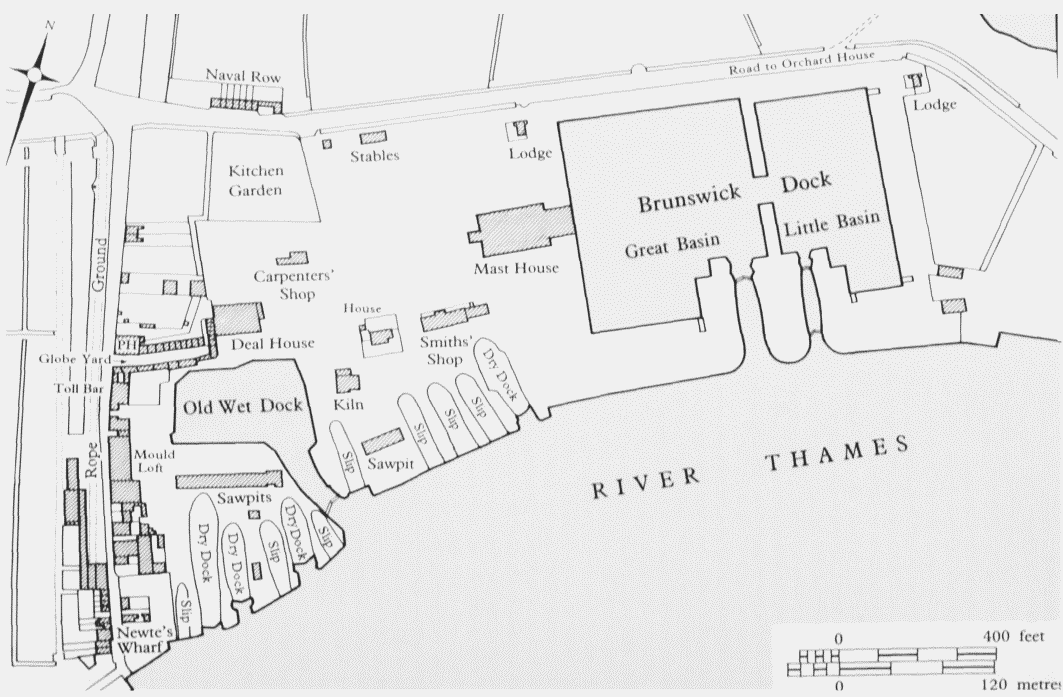
Blackwall Yard and Brunswick Dock in 1803
Sir Robert himself retired in 1819 and spent his remaining 11 years surrounded by the surviving members of his enormous family of 25 children and 32 grandchildren. (fn. 146) On retiring he sold Blackwall Yard to George Green, Money Wigram and Henry Loftus Wigram for £39,500; Green taking half and the two Wigrams a quarter-share each. (fn. 147)
The Revolutionary and Napoleonic Wars and their Aftermath
The Revolutionary and Napoleonic wars generated a great deal of extra work for the shipbuilding industry. Throughout the wars Blackwall Yard played an important role, both as a place of embarkation for regiments ordered on foreign service and for building government ships. In 1805, for example, the government contracted with Perry, Wells & Green for the construction of three 74-gun ships, the Magnificent, the Elizabeth and the Valiant, built at a price of £36 per ton. (fn. 148)
Although the wars increased shipbuilding opportunities on the Thames, all was not well after 1813. In 1814 a Commons Select Committee found that the merchants' yards on the Thames were in deep crisis. One shipwright stated that 'they are in a deplorable state . . . with not a ship building . . . specially Wigram and Greens yard with its seven slips, four docks . . . is absolutely without employment'. (fn. 149) The principal reason given for the dearth of employment on the Thames was that 'so many ships [are] being built abroad that has brought home the produce to this country, which has prevented our merchants from embarking in the same line'. (fn. 150) Indian-built ships constructed for use in the East Indies trade were considered the sole reason for the collapse in the Thames yards. It was estimated that upwards of 60 ships had been built in India since 1803, thus denying England's yards the construction of new East Indiamen. Problems on the Thames were made worse by the fact that the Indian ships were built of Malabar teak, which needed little repair because the oils in the wood helped to repel woodworm. (fn. 151)
The problem was particularly acute at Blackwall Yard. In March 1814 it employed just 18 shipwrights and workmen, whereas at the same time in the previous year, around 400 men had been engaged in the construction of ten frigates and one Indiaman. The total numbers of workmen employed at the yard (including shipwrights, caulkers, joiners, blacksmiths and labourers) had averaged 758 during 1813, but by the early months of 1814 the average was just four men, and during April no work at all was being carried on there. (fn. 152)