Survey of London: Volumes 43 and 44, Poplar, Blackwall and Isle of Dogs. Originally published by London County Council, London, 1994.
This free content was digitised by double rekeying. All rights reserved.
'Brunswick Wharf', in Survey of London: Volumes 43 and 44, Poplar, Blackwall and Isle of Dogs, ed. Hermione Hobhouse (London, 1994), British History Online https://www.british-history.ac.uk/survey-london/vols43-4/pp593-600 [accessed 30 April 2025].
'Brunswick Wharf', in Survey of London: Volumes 43 and 44, Poplar, Blackwall and Isle of Dogs. Edited by Hermione Hobhouse (London, 1994), British History Online, accessed April 30, 2025, https://www.british-history.ac.uk/survey-london/vols43-4/pp593-600.
"Brunswick Wharf". Survey of London: Volumes 43 and 44, Poplar, Blackwall and Isle of Dogs. Ed. Hermione Hobhouse (London, 1994), British History Online. Web. 30 April 2025. https://www.british-history.ac.uk/survey-london/vols43-4/pp593-600.
In this section
CHAPTER XXI - Brunswick Wharf
In the early 1830s the river frontage between Blackwall Yard and the upper entrance to the East India Docks basin was rebuilt as a steam wharf by the East India Dock Company. Called Brunswick Wharf, it was intended to cater for the burgeoning steam-packet trade, which was already causing overcrowding in the Pool, and within a few years of opening in 1834, the new wharf was linked to the City by a frequent rail service (Plates 61b, 120–1; fig. 221). Sited on the wharf, the railway terminus was one of Blackwall's more distinguished architectural compositions, while the earlier river wall was a notable example of late-Georgian engineering. Brunswick Wharf survived into the late 1940s, when, together with the East India Export Dock, it was redeveloped as part of the site of the Brunswick Wharf Power Station. (fn. 1)
The East India Dock Company's decision to rebuild its long and largely under-used river frontage — then called the Anchor Wharf and Gun Wharf (fn. 2) — was prompted in part by the need to replace the existing river wall, a decaying wooden structure of the 1780s which was proving increasingly expensive to maintain. Turning the river frontage into a steam wharf would not only secure the rebuilding of the wall, but also, it was hoped, provide a useful source of additional income at a time when the company's dock revenues were in decline. (fn. 9) After 'considerable discussion', and careful examination of the plans and a model prepared by James Walker, the company's Engineer and Surveyor, the decision to go ahead was taken in November 1832. By the time the work was finished, in October 1834, it had cost £42,033, more than double Walker's original estimate. (fn. 10) The directors nevertheless confidently predicted a 'very adequate' return on the capital outlay. (fn. 11)
The River Wall
Walker proposed replacing the existing wall with one constructed of cast-iron sheet-piling backed by mass concrete. The use of iron had apparently been suggested by Joseph Cotton, the company's Chairman, on account of its relatively low cost. Because of the depth of water required to enable ships to use the wharf at all states of the tide, the alternative would have been a masonry wall, necessitating the construction of an expensive coffer dam. The use of iron for quay walls was not in itself an innovation. Iron sheet-piling had been introduced about 1820 by the engineer David Matthews for the foundations of the north pier at Bridlington Harbour, and Walker himself had used it in this way — for the first time on the Thames — in rebuilding part of Down's Wharf in 1824. Its use at Brunswick Wharf is particularly notable because of the large scale of the undertaking and the fact that the iron sheeting was not confined to the foundations but was used for the entire face of the wall. (fn. 12)
The wall was made in two sections (fig. 222). The bottom part consisted of cast-iron sheet piles, 22ft by 1ft 4¾in., driven some 8ft into the river bed. A flange on one side of each pile overlapped the adjacent pile. Between this piling and the Devonshire granite coping along the top of the wall, the upper 14ft consisted of three rows of cast-iron plates, each 6ft by 4ft 6½in. These plates were bolted to long iron piles in the river bed and partly secured by land ties to the old wooden wall behind. For ease of handling, the long piles were cast in two parts and bolted together. The lower part was 24ft long and weighed 28cwt, the upper part was 12ft long. The gap between the new iron wall and the old wooden one behind was filled with concrete.
The contract for supplying the cast-iron work was won by the Birtley Iron Company of Newcastle-upon-Tyne, and that for the wrought-iron work (such as the tie rods) by Messrs Gordon & Company of Old London Street. The contracting work, including the pile driving, was in the hands of Hugh McIntosh, who had excavated the East India Docks. Birtley's first batch of iron piles, delivered by ship, proved defective — some broke during driving — and to minimize the delay Walker ordered piles from the Horseley Iron Company of Tipton in Staffordshire. In the end Horseleys contributed over a third of the cast-iron work by value. Their bill was £2,237 and Birtley's £3,838; Gordons received £775 and McIntosh £6,118. (fn. 13) Over 900 tons of iron was said to have gone into the wall. (fn. 14)
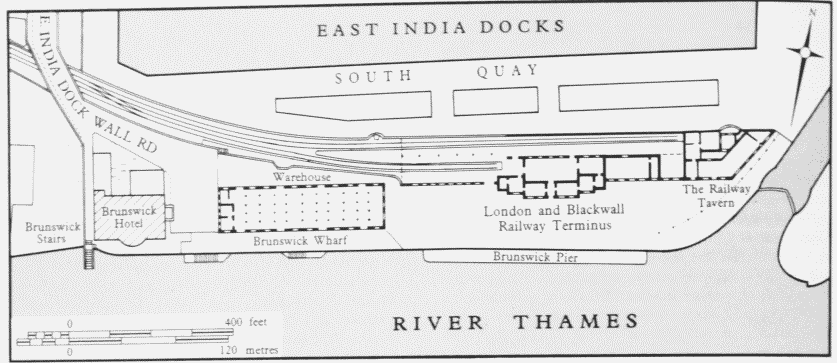
Brunswick Wharf Plan based on the Ordnance Survey of 1867–70
Although Walker was in overall charge of the work, the day-to-day supervision of the project was in the hands of the resident engineer, George Parker Bidder. He had been assistant engineer at the London Docks in the 1820s and had worked for Walker and his partner Alfred Burges on railway surveys in 1831. Bidder's diaries show that he was employed at Brunswick Wharf from December 1832 to September 1834, when he joined Robert Stephenson on the London and Birmingham Railway. (fn. 15)
Construction began early in 1833. The failure of Birtley's piles in April—May inevitably caused some delay, but from June onwards work proceeded smoothly. Dredging in front of the wall to obtain the necessary depth of water began in December, and by the end of March 1834 the wharf was 'nearly completed', being ready for use in April. (fn. 16) Two pairs of wooden landing steps erected in 1835 to facilitate the embarkation and landing of passengers at most states of the tide also protected the iron plates from being damaged by direct contact with the steam boats. (fn. 17) A 'dumb barge' or floating pier served the same dual purpose for part of the long stretch of wall further downstream. This was replaced at various times — in 1880 by a floating iron landing-stage supplied by Messrs R. & H. Green. (fn. 18) At the west end of the wharf the dock company built a causeway extending 60ft into the river, approached by stone steps called Brunswick Stairs. The steps and the passage leading to them were closed in 1885, having been 'used at night for improper purposes', and the steps were dismantled in 1890–1. (fn. 19)
Although the iron sheet-piling was not trouble-free, it survived until the 1940s, when the wharf was redeveloped. In 1903–4, following the collapse of a section of the wall (Plate 121c), timber piles were inserted in front of the original cast-iron main piles, with intermediate timber piles to secure the iron plates, and the base was buttressed with heavy ballast. (fn. 20)
Road and Rail Links
The commercial success of the venture depended on the willingness of the steam packet companies to use the new wharf, and they required good transport links with the City. The construction of a road connecting Brunswick Wharf to East India Dock Road was, therefore, a priority. The directors had hoped to build it entirely on the dock company's property, but this proved impossible, and for the southern end a strip of land was bought from the owners of Blackwall Yard. (fn. 21) Emerging from the north-west corner of the wharf the new road - later called East India Dock Wall Road clung to the boundary walls of the East India Docks, joining the East India Dock Road just in front of the main dock gate. The line of the road took it right through the middle of the old Brunswick Dock masthouse, severing the building in two. The east-west stretch along the southern boundary wall of the Import Dock presented problems because of lack of space between the dock wall and the existing roadway of Naval Row, and the south-west corner of the dock wall had to be taken down and rebuilt further back. (fn. 22) Both the road and the wharf itself were lit by gas supplied by the Poplar Gas Company. Thomas Edge of Great Peter Street, Westminster, supplied the lanterns and the reeded iron lamp-standards. (fn. 23)
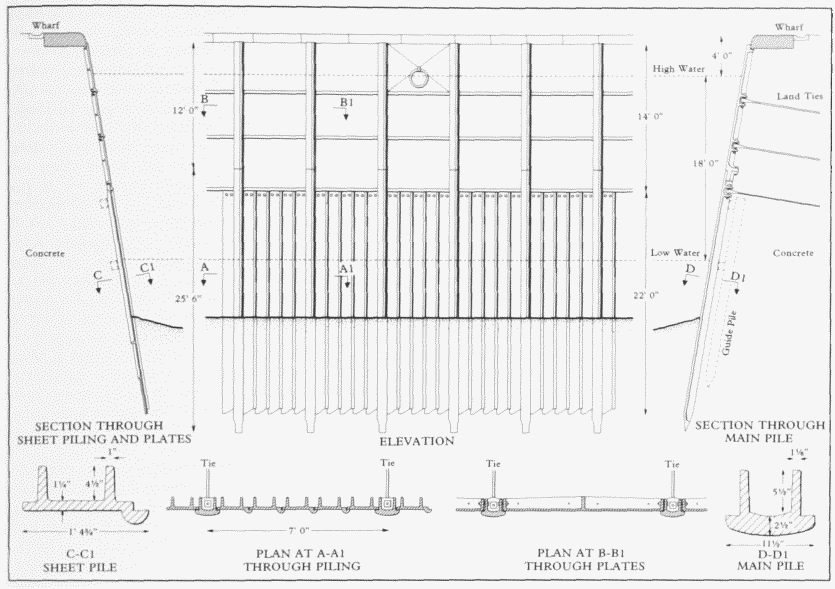
Iron river wall at Brunswick Wharf, part elevation and constructional details. James Walker and George ParkerBidder, engineers, 1832–4. Demolished
To encourage carriers and horse-drawn omnibus operators to provide a service between the wharf and the City, the dock company built stables on the wharf itself and also on the south side of the new road near Naval Row. They were originally leased by Robert Lambert, a local coach proprietor. (fn. 24) By 1836 omnibuses were leaving Brunswick Wharf for the City almost every five minutes. The journey to Leadenhall Street took 50 minutes and cost 6d. According to the Chairman of the Edinburgh Steam Packet Company, one of the first shipping companies to use the wharf regularly, most passengers travelled up to the City from Blackwall by omnibus, but half of those arriving at the wharf came in their own carriages. Goods were conveyed by cart. For some, however, the long journey to and from the City was still a deterrent. The Margate steamers did not stop at the wharf because passengers would not take the trouble to go to Blackwall, and the proprietor of the Leith and London steamboats said he would not like to land his cargoes of meat there on account of the distance and difficulty. (fn. 25)
In July 1840 the London and Blackwall Railway opened its terminus on Brunswick Wharf itself. Operating originally out of the Minories — and from 1841 out of Fenchurch Street — the railway cut the journey time from the City to the wharf to only 15 minutes. In June 1841 the directors produced figures to show the increasing use being made of the railway: in the six months following the opening of the station more than 170,000 embarked or disembarked at Brunswick Wharf, while the number for April and May 1841 alone was over 115,000. (fn. 26)
An agreement between the dock company and the railway company in June 1840 granted the latter a right of perpetual use and occupation of the eastern half of the wharf. This half became known as Brunswick Pier, to distinguish it from the western portion, which remained under the management of the dock company. The railway company was only allowed to use the wharf for the reception of passengers and goods; it was not permitted to compete with the dock company by acting as wharfingers and warehousekeepers. (fn. 27)
Hotels, Taverns and other Amenities
As well as constructing the new link road, the directors of the dock company promoted the building of hotel and tavern accommodation and baggage warehouses to encourage use of the wharf. The provision of a 'commodious' hotel and tavern was seen as an essential amenity for the success of the undertaking, and measures were taken to expedite the work so that the building was ready in time for the opening of the wharf (see below). (fn. 28) Further evidence of the directors' concern to exploit the wharf's economic potential to the full was their rapid reversal of an early decision to close it to steamboats on Sundays. The secretary of the Old Margate and Gravesend Steam Vessel Company had written to complain of the inconvenience 'so long as the Public are allowed to indulge their propensity for Sunday excursions'. (fn. 29)
Within a few years of the opening of the railway the wharf had become a very popular destination for 'excursionists', who went there to see the docks and 'parade up and down the pier', and for whom a second, less exclusive, public house — the Railway Tavern — was built in the mid-1840s (see below). It could become very crowded — on summer Sundays in 1855 the Blackwall trains regularly carried 25–30,000 passengers — and the police occasionally experienced difficulty in keeping order. (fn. 30) The closing of the hotel and tavern in the 1870s did not deter the visitors to the wharf, which was known in the neighbourhood as 'East end by the Sea'. In 1897 a police inspector told Charles Booth's investigators that many local doctors recommended it to incipient consumptives because 'you can always get a good healthy blow there'. (fn. 31) After 1918 the already dwindling number of visitors was further reduced by the closure of the railway to passenger traffic in 1926 and by the LCC's withdrawal of the 'penny steamer' service. By 1930 the nearest public transport was the bus service in the East India Dock Road. (fn. 32)
Buildings on Brunswick Wharf
The Brunswick Hotel and Tavern
This was the earlier and best known of the two public houses on the wharf. Designed by Walker, it was erected in 1833–4, the building contract being awarded to Messrs William & Lewis Cubitt, who estimated the cost at £7,800. To save time tenders had been dispensed with. The first tenant was Samuel Lovegrove, proprietor of the West India Docks Tavern in Coldharbour. (fn. 33)
Situated at the western end of Brunswick Wharf, the Brunswick Hotel and Tavern, as it was officially called, was one of Blackwall's more elegant buildings, with a fully stuccoed river front, five bays in width, and a shallow central bow rising through all three storeys (Plates 120a, 121b). (fn. 34) On the ground storey the stucco was channelled. The main entrance was on the east side, under a columned portico — a late substitution for the intended but more expensive 'extended porch'. (fn. 35) The earliest views show only the first-floor front windows fitted with iron balconies; later, they were also added to the second-floor front windows and to some windows on the east side. In 1842 Lovegrove enclosed the terrace in front of the hotel within a single-storey extension, whose five large windows gave good views over the river. (fn. 36) At the back was a range of buildings including offices, stables (for 25 horses) and coach-houses, an ice-house and a bar or tap later known as the Brunswick Tap. (fn. 37) The stables and coachhouses were built on a separate contract by Horne & Gates. (fn. 38)
No plan of the building has been found, and little is known about the interior, which Lovegrove claimed to have fitted up 'without regard to expense'. (fn. 38) An advertisement for the sale of fittings and furniture in 1874 mentions ormolu, bronze and crystal chandeliers, 'large and handsome' chimney-glasses and pier-glasses, mirrors, sideboards, and other contents. (fn. 40) In 1920, long after the building had been converted to other uses, the ground floor contained eleven rooms, the first floor eight, and the top floor nine. (fn. 41)
The first few years of the Brunswick were not easy ones for Lovegrove, who threatened to quit unless the rent was reduced, which it was, from £680 to £500 a year. (fn. 42) Thereafter business picked up and the Brunswick gained a high reputation 'among city Apicii and connoisseurs in gastronomy' as a gourmet establishment, much patronized by the nobility and gentry. It was also one of the venues for the famous Blackwall Whitebait Suppers. (fn. 43) In 1849, faced with competition from the taverns at Greenwich, Lovegrove's sons built some additional dining-rooms 'for small parties' above the Tap. (fn. 44)
The hotel closed in 1873, but the Tap continued to operate and was still in business in 1900, in spite of serving bad beer which was said to have driven the river tug-men and the Blackwall Yard workmen, its principal customers, to seek out other hostelries. (fn. 45) In 1874 the main part of the former hotel was let to representatives of the New Zealand Government for an emigrants' depot, and this use continued until about 1900, (fn. 3) when the Managers of the Poplar and Stepney Sick Asylum leased the premises for a children's convalescent home. (fn. 46) During the First World War the building was occupied as a barracks, and in the 1920s as offices by the adjoining firm of shipbuilders, R. & H. Green & Silley Weir Ltd of Blackwall Yard. (fn. 47) It was demolished in 1930, having then stood empty for several years. (fn. 48)
The Brunswick Wharf Warehouse
To the east of the Brunswick Hotel the dock company erected a large shed-warehouse. Designed by Walker, and built in 1834, (fn. 49) it was originally intended to be one of a pair, and indeed some early views of the wharf show two identical warehouses standing side by side on the quay (Plate 120a). But the absence of the eastern warehouse from plans of the docks in 1836 and 1838 (which show a steam-engine there) throws doubt on whether it was ever built. (fn. 50) It would, in any case, have been a very shortlived structure, its site being required for the Blackwall Railway terminus by 1838. On the other hand, the East India Dock Company's records show payments for warehouses to two different contractors — William & warehouses to two different contractors — William & Lewis Cubitt and Horne & Gates. (fn. 51) The warehouse that certainly was built survived until 1947. Two storeys high, it was 205ft by 55ft, and built of brick — Walker had originally proposed to use wood — with a slate roof which culminated in a glazed lantern or clerestorey 170ft long (Plate 121a). The floor joists were supported on cylindrical iron columns (probably supplied by Gordon & Company). (fn. 52) Four double-height doors (loopholes) at both front and back allowed carts and other vehicles to pass through the building.
The warehouse was built to provide storage for luggage and goods carried by the steam packet companies, as well as shelter for the passengers. In 1841 the warehouse was taken over by the Blackwall Railway Company for the storage and examination of luggage, but for many years it was used chiefly for the 'accommodation of cattle'. (fn. 53) The dock company regained possession in 1877, and in the following year the building was used to store hay (ground floor) and Peek Frean's biscuits (first floor). (fn. 54)
Early in 1884 the upper floor and part of the ground floor were leased to the representatives of the New Zealand emigrants' depot, already established in the former Brunswick Hotel, who were expecting a great increase in the number of emigrants and had run out of space in their existing premises. The first floor was required as a dormitory for married couples — this involved boarding-over the cartways through the building. A dormitory for single men was provided on the ground floor. (fn. 55) From about 1901 the warehouse was leased to firms for storage.
The London and Blackwall Railway Terminus
This was the largest and architecturally the most impressive of the buildings on Brunswick Wharf. It was designed by William Tite, the architect to the London and Blackwall Railway, and built by the prominent public works contractors, Grissell & Peto, whose tender was for £10,482. Robert Stephenson, the railway company's engineer, supervised the construction. Stephenson had previously approved the plans and may have been responsible for the general layout and various technical details. (fn. 56) Building work started late in December 1839 and the station was opened for public use on 6 July 1840, although alterations and additions continued for several more months. (fn. 57)
The building had a long, symmetrically composed elevation to the wharf nearly 350ft in length, comprising a central two-storey office block of seven bays, flanked by long single-storey arcaded wings (Plate 120b). It was of stock brick with dressings of Portland stone, the latter being mainly lavished on the central five bays, whose Renaissance palazzo treatment might have passed for a contemporary club-house in the West End. (fn. 6) The arches in the flanking wings were filled with doors of 'imitative oak' surmounted by round-headed windows of plate glass. The later brick infill which appears in photographs of the building may have replaced these doors quite early on; a proposal to close up the arcades was approved in August 1840. (fn. 58) On the ground floor of the office block were waiting-rooms, an 'extensive' booking hall, and apartments for the superintendent. The first floor was largely given over to a single room 'intended for the use of the foreign-steam boat passengers and their luggage while being examined by the proper officers of the Customs'. There were two loopholes on the river side for taking in luggage and a trap door above the track for letting down the luggage into the railway wagons below. (fn. 59) Luggage handling was soon transferred to the nearby warehouse, and between 1841 and 1844 this room was used for unlicensed refreshments. (fn. 60)
The arrival and departure sheds were sited between the long façade of the building and the boundary wall of the East India Export Dock. They were separated from each other by a stone platform. The sheds' roofs were light iron constructions, assembled from 'iron rafters, braces and ties' manufactured locally by Messrs Ditchburn & Mare in Orchard Place. (fn. 61) At the eastern end, over the turntables, the roofs were flat so as not to disturb 'the Architectural effect of the building'. (fn. 62)
During its hundred-odd years of existence the building was altered many times. The early closing of the arcades has already been mentioned. In 1844 the turntables were sacrificed and the eastern ends of the sheds curtailed to make a site for the new Railway Tavern (see below). The ground-floor plan of the office block c1870 shows several deviations from the original layout, including the addition of a large room (possibly a workshop) to the east, on part of the site of one of the sheds (fig. 221). In 1906 much of the original roof structure was replaced by conventional umbrella-type awnings. (fn. 63)
The still substantial remains of the station were demolished in 1947. (fn. 64)
The Railway Tavern
In 1844 the dock company decided to build a second tavern on Brunswick Wharf. Initially opposed by the railway company, which would have preferred to convert the refreshment room at the Blackwall Terminus to this purpose and so keep the profits in its own hands, the new tavern was deliberately pitched to suit 'the condition of the parties travelling on the . . . railway', and to the 'middling classes' who 'habitually resort to the Wharf for amusement' but did not frequent the more exclusive Brunswick Hotel. (fn. 65)
An early proposal, for which a drawing survives, sited the new tavern on top of the warehouse in an additional storey with Italianate facades and tall round-headed windows. (fn. 66) This scheme was not adopted and the tavern was built at the eastern end of the railway terminus, parts of which were demolished to make a large enough site. (fn. 67) The new building, designed by Adams and Martin, the dock company's surveyors, was erected by the local builders Carden & Hack, whose tender was for £3,355. The first lessees were Samuel and James Lovegrove, the elder Samuel's sons and his successors at the Brunswick Hotel. (fn. 68)
Standing at the opposite end of the wharf from the Brunswick Hotel, the Railway Tavern, as the new tavern was called, was a severely detailed, stone-faced building of two storeys, whose south and east elevations displayed a much higher proportion of window to wall than usual (Plate 120b).
The tavern was closed in 1871, after complaints from ship owners and others that it encouraged drunkenness in sailors, (fn. 69) and for several years its future remained uncertain. Conversion to a baggage warehouse was proposed but deferred, and the upper floor was occupied as a shipping office. In 1875 the Metropolitan Police considered taking the building for a river police station. (fn. 70) Renamed Brunswick Buildings, the premises eventually were remodelled for a dockmaster's house. The building was demolished in 1947.
Virginia Settlers' Memorial
In 1928 a bronze tablet was fixed to the westernmost pier of Brunswick Buildings by the Association for the Preservation of the Virginia Antiquities, to commemorate the embarkation in December 1606 'from near this spot' of the 105 'adventurers' who founded the first permanent English colony in America. In 1951 this tablet was incorporated in a new memorial erected by the Port of London Authority (PLA) on a site about 100 yards further east. Designed by the sculptor Harold Brown, it consisted of a pile of granite blocks, 'hewn from the old quay wall of the historic West India Docks', surmounted by a bronze mermaid sitting in a sea shell. The granite expressed the strength and hardiness of the original settlers, and the mermaid the call of the sea. (fn. 71) (fn. 7)
Brunswick Wharf Power Station
From the 1950s to the 1980s Brunswick Wharf Power Station was one of the most prominent landmarks in Poplar, whether viewed from the river or from various parts of the Isle of Dogs. It stood at the end of Naval Row, on the site of the East India Export Dock. First conceived in 1939, just before the outbreak of hostilities, and largely designed during the war, its construction was delayed by the difficulties of the immediate post-war years, so that work did not begin until 1947. The station, which represented a fittingly spectacular culmination to the Borough Council's years as an electricity undertaker, did not come into service until 1952, and was not completed until 1956 (Plate 122). It had a relatively short working life, with generating ceasing in 1984, and was demolished in 1988–9.
Brunswick Wharf Power Station was built under the South East England Electricity (Alteration and Extension) Scheme of 1939, which provided for five new generating stations to be built in the region. These stations were to be 'selected' ones — that is, whilst they would continue to be owned and operated by the local undertakings, they would supply electricity to the National Grid. Because of this they were to be subject to the direction of the Central Electricity Board (CEB), which, in return, would pay all the costs, including capital charges. At the suggestion of Robert Illingworth, the Borough's Electrical Engineer since 1934, Poplar Borough Council resolved in July 1939 to make representations to the CEB that one of the new stations should be built on a site of 16½ acres at Blackwall, which the PLA was prepared to sell. (fn. 72)
Although the Board indicated that it might be several years before such a station could be considered, the Council decided to prepare a detailed report, and it was considered advisable that an outside engineer, John Bruce of John Bruce & Staff of London, should be engaged for the purpose. (Bruce was subsequently appointed as Consulting Engineer for the project.) This initial scheme, produced in conjunction with Illingworth and L. G. Mouchel & Partners, retained as consulting civil engineers, was not ready until 1943. (fn. 73) The new station was to be built on the site of the East India Export Dock, with Brunswick Wharf providing a frontage to the River Thames. Bruce considered that the advantages of the site were an abundant supply of water for condensing purposes (thus avoiding the need for expensively constructed cooling-towers), deep-water berthing facilities for the largest existing types of coastal colliers, plenty of space for coal storage, facilities for the economic disposal of ashes, and accessible routes for the transmission of power to the areas served by the South East England Grid System, both north and south of the river. In addition, the site was served by rail, with extensive sidings nearby, and, rather more questionably, it was considered to have excellent road access. Bruce thought that the price of £205,000 at which the land was offered compared very favourably with land values for power station sites in the London area. From the Borough Council's point of view, the main advantage was that a selected station would provide a valuable rateable asset contributing, it was estimated, about £40,000 per annum. Although the site was capable of providing room for a 240,000-kilowatt generating station, the initial report proposed a station of only half of that capacity. The total estimated costs were £3,734,000. (fn. 74) Subsequently, at the behest of the CEB's engineers, Bruce had to redesign the scheme for larger turbine and boiler plant than originally envisaged. (fn. 75) In October 1943 the Electricity Commissioners' representative reported very favourably on the site, his only reservation being that the costs of civil engineering involved in building over the old dock might prove to be uneconomically high. (fn. 76)
Nevertheless, in August 1945 Poplar Borough Council was given instructions by the CEB to proceed with the acquisition of the Brunswick Wharf site. The value of the land had now increased, and it was finally acquired for £225,000. (fn. 77) The LCC gave planning approval to the scheme in principle in November 1945, but found the architectural treatment unacceptable and required amended drawings showing a design 'which as regards mass, composition and silhouette was more appropriate to the importance and prominent position of the building'. (fn. 78) The Secretary to the Electricity Commission, referring to this decision, suggested to the Borough Council in December 1945 that it should call in 'an architect of standing to advise on the question of architectural design in consultation with the Undertaker's Consultant' and that the sketch plans and elevational drawings should be submitted to the Royal Fine Art Commission for its advice. (fn. 79) So far the architectural design work had been carried out by D. Hulbert Lewis, a qualified architect with Bruce's own firm, (fn. 80) but not surprisingly Bruce took the Commissioners' advice and retained Farmer & Dark as consultant architects. F. Quentery Farmer and Frankland Dark had formed their partnership in 1934: both men had close connections with the electrical industry and the firm made something of a speciality of designing power stations. However, their situation at Poplar paralleled Giles Gilbert Scott's at Battersea Power Station, of being called in at the last moment to tidy up and make more presentable an already well-advanced project. The changes they could make were, of necessity, little more than cosmetic, their most significant contribution being to adjust the heights of the buildings in order to create a much simpler elevational treatment. (fn. 81)
In 1946 two objections were raised which threatened the whole future of the scheme. The first came from the LCC, which was concerned about possible pollution and demanded that gas-washing plant be installed. It refused to be convinced by the argument advanced by the Electricity Commission and various government departments that the heavy extra costs of installing such equipment were not justified. Finally, the LCC withdrew its opposition, after Poplar Borough Council agreed to make joint representations to the Minister of Health for an inquiry by an independent body into the problems of sulphurous pollution. (fn. 82)
The other objection presented an even more serious threat: the Civil Defence Department of the Home Office and the Air Ministry both made strong objections on strategic grounds to the construction of a new generating station in the docks area. The Air Ministry felt that this was the worst possible site and was opposed to 'a further addition to the concentration of power undertakings on Thamesside and particularly in an area which proved so vulnerable during the war to bombing, flying bombs and long range rockets'. Moreover, there was the new danger posed by the atomic bomb. The Minister of Fuel and Power was drawn into the argument but, unable to resolve the deadlock, he referred the dispute to the Cabinet Office. The Committee at first sided with the Air Ministry and ruled that the station should not go ahead, a decision which so perturbed the Electricity Commissioners that they pressed the Minister to get the matter reconsidered. Impressing upon him 'the serious plant position which is likely to arise over the next few years, which must inevitably lead to the risk of load shedding with consequential effects on industry and employment', they went on to point out that it could possibly take eighteen months to two years before work could commence on any alternative site. Such dire prospects in the already difficult economic conditions of the time were sufficient to override even the military arguments and the Cabinet Defence Committee reversed its previous decision by authorizing the station's construction. The Electricity Commissioners promptly issued their formal consent on 5 November 1946 and planning permission was granted on 6 December. Meanwhile, the revised elevations had also been submitted to the Royal Fine Art Commission which, having secured some minor alterations, declared itself satisfied. (fn. 83)
At the end of 1946, the Borough Council agreed to purchase approximately 1½ additional acres from the PLA at a cost of £15,000. This allowed the wharfage facilities to be expanded and the whole line of the site to be straightened. (fn. 77) In 1950 the site was slightly rounded out by the addition of narrow strips along the river frontage and its western side, plus a small triangular plot alongside the East India Import Dock, giving a total additional area of almost an acre. (fn. 85) The development of the site also meant the closure of the southern extremity of East India Dock Wall Road. (fn. 86)
Work began in March 1947. The main building contractor was Peter Lind & Company, with Redpath Brown & Company supplying the structural steelwork, and Tileman & Company acting as contractors for the reinforced-concrete chimneys. while Marples Ridgeway & Partners were the main civil engineering contractors. (fn. 87) With the nationalization of the electricity supply industry from 1 April 1948. responsibility for completion of Brunswick Wharf Power Station passed to the British Electricity Authority (London Division). (fn. 88) It had been envisaged that the station would be built in four phases, with the first planned to be in commission by October 1948. (fn. 89) In the event, the station did not begin supplying electricity until 26 March 1952; it was officially opened on 6 October 1954 by Lord Citrine, Chairman of the British Electricity Authority, and was not completed until 1956. (fn. 90) The estimated cost was £5½ million. (fn. 91)
Brunswick Wharf was one of a number of power stations built just after the Second World War in what had become the rather dated monumental tradition of the brick-built 'cathedrals of power' established by Scott at Battersea (Plate 122a). The main building, the principal elevation of which was to the river, actually occupied two-thirds of the old dock, necessitating foundations of spread concrete bases resting on London clay 38ft below the level of the old quay. (fn. 92) As a result, the basement of the turbine hall was, unusually for a power station, a proper basement, with the operating floor for the turbines at ground level (Plate 122c). (fn. 93) The main building was 740ft long overall, requiring two expansion joints, and at its highest point (other than the chimneys) stood 101ft tall. Both the main building and the original subsidiary buildings were of steel-frame construction, except for the welfare building, which had a reinforced-concrete frame. The massing of the brickwork was particularly impressive, all the walls being clad with external facings, mainly of reddish brown Southwater bricks. To break up such large areas of brickwork, darker brown bricks were used for dressings: at the bases to suggest a plinth; laid in soldier courses to give a feature at eaves level; again in soldier courses around the two large archways in the riverside elevation; to form a series of square relief panels set just below the top of the tallest block (the boiler house); and between the projecting verticals to provide shading even when there was no sunlight. These projecting verticals offset the predominantly horizontal emphases of the buildings and gave them a streamlined appearance.
The interiors of the station reflected the austerity of the period in which it was built (Plate 122b, 122C). Fletton bricks were used throughout for internal work and were often, as in the case of the boiler house, left largely exposed. The walls of the turbine hall were, however, clad in plain beige faience tiles with matching grey ones around the bases. The steelwork was generally left unclad and the steel-framed windows were by Henry Hope & Sons Ltd of Berners Street. (fn. 94) The two 300ft-high chimneys were of reinforced concrete with an inner lining of 'Nori' acid-resisting bricks from Accrington.
The generating plant, the design of which was virtually obsolete by the time of its completion, (fn. 95) was supplied by Metropolitan-Vickers Electrical Company of Manchester. It consisted of six turbo-alternators, four of which, rated at 52.5 megawatts, had been installed by the opening in 1954, while the other two, rated at 60 megawatts, were installed in 1955 and 1956. These were uprated on 1 May 1957 to 55 and 63 megawatts respectively. They were driven by steam power provided by 11 boilers, which had an output of 900lbs per sq.in. and a temperature of 900 degrees Fahrenheit. The boilers were supplied by Clarke, Chapman & Company of Gateshead, and John Brown & Company (Clydebank) of Sheffield, and were originally designed to be fired by pulverized coal, the station having its own crushing plant. It was estimated that each boiler would consume 36,700lbs of coal per hour.
A new wharf, 855ft long, was constructed in reinforced, precast, and massed concrete. Here coal brought by river could be unloaded by three high-speed, level-luffing cranes, supplied by Stothert & Pitt of Bath, each capable of handling 200 tons an hour. The coal was distributed by a travelling bridge with conveyor belts, supplied by Fraser & Chalmers of Erith. Part of the old dock was adapted to store coal, some of which could be actually stored underwater as a precaution against fire. (fn. 96)
During 1970–1 the boilers were converted to burn oil, (fn. 97) and about the same time the Central Electricity Generating Board had plans to extend Brunswick Wharf. (fn. 98) However, the rising cost of oil meant that the station became increasingly expensive to run. Moreover, the 1970s saw the electricity supply industry with considerable spare capacity and the CEGB began to phase out less economic stations. (fn. 99) Brunswick Wharf, therefore, ceased generating in March 1984, and closed in October of that year. (fn. 100) The site was sold in 1987 for redevelopment and the power station was demolished during 1988–9, although the switchgear house to the north remains. (fn. 101)