Survey of London: Volumes 43 and 44, Poplar, Blackwall and Isle of Dogs. Originally published by London County Council, London, 1994.
This free content was digitised by double rekeying. All rights reserved.
'Southern Blackwall: Coldharbour', in Survey of London: Volumes 43 and 44, Poplar, Blackwall and Isle of Dogs, ed. Hermione Hobhouse (London, 1994), British History Online https://www.british-history.ac.uk/survey-london/vols43-4/pp607-624 [accessed 30 April 2025].
'Southern Blackwall: Coldharbour', in Survey of London: Volumes 43 and 44, Poplar, Blackwall and Isle of Dogs. Edited by Hermione Hobhouse (London, 1994), British History Online, accessed April 30, 2025, https://www.british-history.ac.uk/survey-london/vols43-4/pp607-624.
"Southern Blackwall: Coldharbour". Survey of London: Volumes 43 and 44, Poplar, Blackwall and Isle of Dogs. Ed. Hermione Hobhouse (London, 1994), British History Online. Web. 30 April 2025. https://www.british-history.ac.uk/survey-london/vols43-4/pp607-624.
In this section
Coldharbour
Described by Ian Nairn as 'a tiny loop off Preston's Road', (fn. 9) Coldharbour is virtually the sole remaining fragment of Old Blackwall. Until relatively recently it was little known and little seen, being obscured by the nondescript industrial premises on the east side of Preston's Road. These have now been mostly cleared away, exposing what is left of Coldharbour to passers-by in the newly widened Preston's Road.
The roadway here is the only surviving section of an old riverside road leading southwards from Blackwall Stairs before petering out somewhere near the present entrance to the South Dock of the West India Docks (fig. 206). This old road almost certainly originated as a pathway along the top of the medieval river embankment called the Blackwall. A deed for a house on the east side, leased in 1626, describes the house as having been built on 'part of the wall commonly called Blackwall', and the street as 'the way which lieth on the same wall called Blackwall'. (fn. 10) The name Coldharbour — a fairly common and selfexplanatory one — was in use by the early seventeenth century. (fn. 11) (fn. 1) It formerly applied to the whole stretch of roadway, and was only restricted to the southern section after the road had been cut by the construction of the Blackwall entrance to the West India Docks (fig. 226).
Buildings had begun to appear in Coldharbour by the second decade of the seventeenth century, as the wave of development encouraged by the opening of the East India Company's shipbuilding yard at Blackwall in 1614 gradually spread southwards along the riverfront, and the opening of Browne's (later Rolt's) shipyard in the late 1660s probably gave a further boost to the process.
Information about the early development is, however, very scanty. What appears to have been one of the earliest houses, on the site of the present No. 1, was erected under a lease granted in 1626. (fn. 13) In 1664 there is a reference to a house having been built, seemingly quite recently, by the local landowner. (The sewer commissioners wanted it demolished so that repairs could be made to the Coldharbour sluice, which drained the area to the west and entered the Thames at a point now beneath the southern end of North Wharf.) (fn. 14)
The construction of the West India Docks (opened in 1802) and the City Canal (opened in 1805) severed the old riverside roadway, leaving the section now called Coldharbour as a backwater, bypassed before 1817 by the construction of Bridge (later New, now Preston's) Road. Although this isolation may have helped to preserve something of the old character of the street, Coldharbour did not escape redevelopment in the nineteenth and twentieth centuries, to the extent that there are now no surviving structures older than the early nineteenth century. But whereas in parts of Poplar it is very difficult to relate even the nineteenth-century pattern of riverside development to the present layout, in Coldharbour many of the riverside sites retain an integrity which can be traced back to the seventeenth and eighteenth centuries. One aspect which has been lost — though it can still be appreciated in photographs — is the sense of a narrow enclosed street (Plate 101a).
Land Ownership
From at least the early seventeenth century until the early years of the nineteenth, both sides of Coldharbour, except for a tiny pocket of copyhold at the north end of the west side, (fn. 15) were held in a single freehold ownership, being part of an estate with a long river frontage, which extended northwards almost to Blackwall Stairs and southwards as far as the present Stewart Street. The early seventeenth-century owners were William Burrell, the shipbuilder who played a leading role in the establishment of Blackwall Yard, and his son and heir, Andrew. In 1636 Andrew Burrell sold the estate to Henry Hall of Blackwall, an anchor-smith, and it remained in the Hall family for five generations, each successive owner having the name Henry Hall. (fn. 16) The Hall family lost the property in 1750, following a law suit which ended with the Court of Chancery ordering its immediate sale to raise money to pay off debts secured on a mortgage of the estate. (fn. 17) The purchaser, who bid £750 10s for the property, was George Steevens, a well-to-do retired East India captain and director of the East India Company, who lived in a large house in Poplar High Street. (fn. 18) He was the father of George Steevens, the Shakespearean and literary scholar, who inherited the estate in 1768 but sold it in 1769 to Charles Foulis of Woodford Row, Essex, another East India captain, and a director of the Sun Fire Office. (fn. 19) When Foulis died, in 1783, he bequeathed the property to a fellow resident of Woodford, (Sir) Robert Preston, who, like himself, and George Steevens before him, had made his fortune as a captain with the East India Company. Preston, who succeeded to a baronetcy in 1790, and became one of the first directors of the East India Dock Company, was the last owner of the estate: it was broken up in the first decade of the nineteenth century, after the territorial integrity of the property had been destroyed by the sale of substantial chunks of land to the West India Dock Company and the City Corporation for the Blackwall entrances to the West India Docks and the City Canal. An auction sale was held in October 1802, but the conveyances of the various properties from Preston to their new owners range in date from 1802 to 1815. (fn. 20) (fn. 2)

Coldharbour area a Plan based on the Ordnance Survey of 1870 b Plan based on the Ordnance Survey of 1969–70
East Side
On Gascoyne's plan of 1703 the riverside frontage at Coldharbour forms part of a ribbon of development extending from Blackwall Stairs to Rolt's Yard, interrupted only by Johnson's upper dock. In fact development was neither as continuous nor as built up as Gascoyne implies, but was more of a mixed assemblage in which dwelling houses, public houses, storehouses and warehouses were interspersed with wharves, yards and even gardens. The highly picturesque appearance of the Coldharbour riverfront at the very end of the eighteenth century was recorded by William Daniell in his panorama of the West India Docks, published in 1802, and the southern section in a lively drawing by Rowlandson (Plates 100, 147a). The Daniell is the earliest illustration of Coldharbour and also one of the best. Some of the buildings are shown in considerable detail and with an accuracy confirmed by other documentary evidence. Only once or twice, notably at the southern end, does the artist falter. Particularly distinctive are the eighteenth-century brick warehouses with their gable-mansard roofs. Several buildings had large bays or bows jutting out over the river, which were a feature of many riverside premises in the eighteenth and early nineteenth centuries.
How much this changed during the nineteenth century can be seen by comparing Daniell's view with the elevational drawings of the river frontage made in connection with the Thames (Flood Prevention) Act in the early 1880s (Plate 100). Only two of the buildings shown by Daniell are still recognizable, and one of those — the double-stack warehouse on the site of No. 19 — was about to be demolished. Another wave of redevelopment between the early 1880s and 1906 saw the construction of two large riverside warehouses, a big public house (at No. 9), a river-ambulance station and a river-police station, of which only the last two still survive. Since 1945 the only new buildings have been private housing. Nos 9–13, erected on the site of Crown Wharf in 1971, were the harbingers, followed ten years later by the block of flats at No. 19A. (The surviving buildings on this side, and some earlier ones, are described below.)
West Side
Gascoyne gives the impression that the west side of the present street had been completely built up by the end of the seventeenth century, but the much more detailed and careful cartography of the 1740 sewer plan clearly shows that this was not so, (fn. 21) and that the buildings which did then exist were mostly at the northern end of the street (fig. 206, page 549). By 1800 there were some 20 small houses on this side (all at the north end), a couple of warehouses, a rigging-house and a large cooperage. (fn. 22) Although a few of the houses may have been replaced during the nineteenth century, later surveys nearly always describe them as 'old' or 'very old', and in 1935 No. 10, which was leaning at an acute angle, was said to be 'obviously one of the oldest houses in the district'. (fn. 23) Some were fairly primitive. No. 28, a narrow three-storey house with one small room on each floor, long used as a mastmaker's workshop, had brick party walls, and a brick front (above the ground storey), but the back wall and the staircase projection were 'merely boarded in'. (fn. 24) Nos 30 and 32 were likened to lighthouses, since 'they entirely consist of a dark and winding staircase — it is really a circular staircase running up the middle of this queer shaped building, with a room put on here and there where there happened to be room for it'. (fn. 25) The structural and sanitary condition of the surviving houses left much to be desired, and in 1935–6 they were demolished under a slum-clearance order, and the inhabitants rehoused. (fn. 26) Their sites have remained unoccupied.
At the back of some of these houses there had been a small court, laid out by, and named after, Joseph Hanks, a builder of Ratcliff, who bought the freehold in 1803 and erected four small brick-built cottages there, each with two rooms and a wash-house. They were demolished in 1881, being deemed 'unfit for habitation'. (fn. 27)
By the end of the nineteenth century much of the area between the west side of Coldharbour and the east side of Preston's Road was occupied by a mixed group of industrial premises, now largely demolished. In 1884–5 this area had been split in two by the newly formed Managers Street. The northern part, between the houses in Coldharbour and Preston's Road, belonged to the West India Dock Company, and it was here, near the northwest corner, that the company built a dockmaster's house in 1809–10, for which Isle House, on the east side of Coldharbour, was a replacement (see below). From 1895 until about 1930 a boat-building yard with a longish frontage to Preston's Road occupied a large part of this area. The original proprietors were J. M. Jackson & Sons, shipwrights, joiners, mast- and blockmakers, and ship's smiths, whose business was previously based at No. 15 Coldharbour. Later proprietors were Messrs Leslie & Hamblin, boat builders, and their successors W. & J. Leslie. (fn. 28)
The earliest industrial concern on the west side of Coldharbour was the Stewart family's cooperage. Founded by Richard Stewart in the 1760s, the works originally occupied a site further to the south which had to be given up for the making of the City Canal, and in the early years of the nineteenth century new cooperage buildings were erected on the west side of Coldharbour opposite the family's house (see below, under Stewart's Wharf). The cooperage closed in 1831, and for several decades the General Steam Navigation Company used the site in connection with its cattle wharf on the opposite side of the street. It was brought back into semi-industrial use by a firm of oil merchants in the mid-1880s, and, under the name Concordia Works, was occupied latterly by a tar- and turpentine-distillery and works, established here in the 1920s. In the late nineteenth century the area to the west was occupied by the Smithfield Engineering Works of D. W. Forbes & Company, a firm of mechanical engineers also describing themselves as coppersmiths, wholesale ships' ironmongers and 'sole manufacturers of sea-water distilling apparatus'. (fn. 29) Formerly based in Upper East Smithfield, this firm moved to Preston's (then New) Road in 1874, where their works included a two-storey warehouse next to the street (latterly No. 93 Preston's Road), a coppersmiths' shop, an engineers' shop, a tinsmiths' shop, a boilermakers' shop and a forge (fig. 227). They were erected for the company in 1874 and 1876 by a builder from Deptford. (fn. 30) In 1889 the company leased a small part of this site to George Roberts, the proprietor of dining-rooms in Poplar High Street, who built some coffee- and dining-rooms there (latterly No. 95 Preston's Road). This plain three-storey brick building, erected by a builder from south London, survived until the 1980s. (fn. 31) By 1896 Forbes & Company were in liquidation, but some of their premises, including the warehouse and the coppersmiths' shop, were still standing in 1951, when they were being used as a sack warehouse by Levy Brothers & Knowles, the sack- and bag-manufacturers. (fn. 32)

D. W. Forbes & Company's engineering works, Preston's Road, site plan and south elevation in 1892. Demolished
Inhabitants and Social Character
The little that is known about the early inhabitants of Coldharbour suggests, not surprisingly, that many earned their livelihoods in occupations closely allied to shipbuilding and the river. Among the occupations represented there in the eighteenth century were fishermen, watermen, lightermen, river pilots, shipwrights, boat builders and ship-chandlers. Some of these inhabitants were quite prosperous. The Clippingdales, river pilots who lived in a house on the site of No. 15 in the eighteenth century, were reputed to have made a substantial fortune out of their profession, (fn. 33) and the Stewart family, proprietors of the cooperage on the west side of Coldharbour, could afford to build themselves a large double-fronted house in the street about 1770. On the other hand, the wealthy East India merchants who owned riverside warehouses in Coldharbour did not choose to live there.
In the nineteenth century Coldharbour had sufficient respectability for the East and West India Dock Company to build a house there for one of its dockmasters. and subsequently to buy or lease properties in the street for occupation by other dockmasters. These dockmasters' residences were all on the east of the street, where the bigger and better houses were located. It is clear from the census returns that the smaller houses on the west side were not 'well inhabited' and were often overcrowded. In 1851 the inhabitants included dock labourers, watermen, a tinplate worker, a night watchman, a 'chymical labourer' and a woman on 'parochial relief'. Several houses were in multi-occupancy. In the same year the inhabitants of the east side included two dockmasters, two master mariners, a successful retired lighterman, and a master blockmaker and joiner employing six men. (fn. 34) In the late 1880s Booth's investigators characterized the inhabitants as 'respectable', and noted that several were 'well to do'. (fn. 35)
Individual Buildings and Sites in Coldharbour
No. 1 (formerly No. 32): Isle House.
This former dockmaster's residence was built for the West India Dock Company in 1825–6, to the designs of their Principal Engineer, (Sir) John Rennie. It replaced an earlier dockmaster's house erected in 1809–10 near the south corner of Coldharbour and Preston's Road. The earlier house, designed by Thomas Morris, was so badly built - by the local firm of Howkins, Barker, Morris & Constable - that in 1823 it needed the support of temporary braces 'to prevent its being blown down'. (fn. 36) In 1824, therefore, the dock company decided to demolish the old house and erect a new one on the riverside site in Coldharbour next to the dock entrance, which the company had bought in 1815. (fn. 37)
During most of the seventeenth and eighteenth centuries this riverside site had been in two separate tenancies. The southern and smaller part was held under a 195-year lease granted in 1626 by William Burrell to Hellonor Lambert of Wapping Wall, widow. By 1769, when this lease was bought by a local waterman and lighterman, Edward Wood, the property comprised a wharf, a dwelling house and a back house. (fn. 38) Wood lived there briefly (until 1771) and in 1789 he sold the lease to two wealthy East India merchants, Captain Thomas Newte of Gower Street and Charles Cameron of Ilford in Essex. (fn. 39) Newte and Cameron were already the tenants of the adjoining wharf on the north side, under a lease of 1770 to Newte's father-in-law, Sir Charles Raymond, baronet, a highly successful and very influential East India merchant, who died in 1788 worth £200,000. (fn. 40) The main buildings here were two warehouses, one dating from about 1760, the other erected by Raymond some ten years later. (fn. 41) On gaining possession of Wood's property, Newte and Cameron exchanged their two existing leases for a new 60-year lease of the whole site. (fn. 42) After Cameron's death in 1797, (fn. 3) his son assigned his father's half-share in the Coldharbour premises to Newte, who bought the freehold from Sir Robert Preston in 1803. (fn. 44)
Newte's premises are shown in Daniell's view of 1802 (Plate 100). Next to the river is a two-storey, partly arcaded building, with ten windows on its bowed-andbayed first floor and a little hexagonal turret on the roof. Adjoining it on the south side is Wood's former house, a narrow four-storey building set back from the river. Hardly discernible are the two warehouses, which were at the back of the site, next to the street: a covered yard separated them from the arcaded building. The northern end of the arcaded building was occupied by a groundfloor counting-house which Daniell shows with only one small window facing the river. (fn. 45) In addition to the two warehouses here Newte owned four others at Lower (later Ashton's) Wharf, a copyhold property next to Blackwall Stairs (see fig. 210, page 566). (fn. 46)
Newte died in Bath in 1806, (fn. 4) and in 1813, after a protracted legal tussle to regain possession from the executors, his heirs offered the Coldharbour premises for sale. (fn. 48) In 1815 the West India Dock Company bought them for £3,000. The old buildings, by then in a dilapidated state, were demolished in 1816, but the site does not appear to have been used by the company until the new dockmaster's house was built there in the mid1820s. (fn. 49)
As the dock company's Principal Engineer and Architect, John Rennie drew up the plans and specifications for the new house in 1825. The building was completed in the summer of 1826. The contractors were Messrs Johnson & Sons, who were already engaged on several other buildings in the West India Docks, including the Stores Quadrangle and Cooperage and No. 10 Warehouse. (fn. 50) Rennie submitted Messrs Johnson's accounts to the dock company Secretary in December 1826 with the comment, 'The whole of the work appears sound and well finished and will I trust prove so'. (fn. 51)
Architecturally, No. 1 is the finest house in Coldharbour. Smaller than nearby Bridge House - the Principal Dockmaster's residence, designed by Rennie's father in 1819 - it has a plain but satisfying exterior, a well-preserved interior, and an unusual plan (Plates 101, 102a, 103a; fig. 228). (fn. c1) The plan was doubtless devised to give the dockmaster-occupant clear views of the Thames and the Blackwall entrance to the Docks. Thus the ground floor is raised up high over a tall basement, and all the main rooms are on the east side of the building facing the river; those at the north end also overlook the dock entrance. In the centre of the east and north fronts are full-height bows whose windows command an even wider field of view. Though functional in purpose, these bows are an attractive feature, softening the otherwise severe outline of the exterior. In 1898 the London Argus thought it 'one of the few houses in Blackwall that can be called picturesque'. (fn. 52)
Built over a raised basement, Isle House is two storeys high, with a shallow-pitched roof, whose wide eaves are carried on pairs of wooden brackets. The roof timbers are original, the queen-post trusses being similar to those at the contemporary Stores Quadrangle and Cooperage (also designed by Rennie) (fig. 228). (fn. 53) The external walls are faced with grey bricks - 'best second Malm facings of an uniform colour' were called for in the specifications (fn. 54) - and the roof is slated, duchess slates being specified. Portland stone is used for the window sills and for the plain bandcourse which runs through between the ground and first floors. Almost the only architectural decoration on the exterior is reserved for the front entrance, in the centre of the west elevation. Approached up a flight of seven stone steps, (fn. 5) the six-panel front door, under a rectangular fanlight, is framed by mouldedstone architraves under a stone hood supported on stone console-brackets. The fanlight, which is not mentioned in the specifications, has an alternating pattern of circles and diamonds, very similar to design no. 30 in Underwood & Doyle's catalogue of c1813.
Inside, the entrance hall takes the form of a northsouth corridor against the street elevation. At its rounded southern end a simple deal staircase leads up to the first floor, where there is another access corridor above the entrance hall. The staircase has straight strings, squaresection balusters, originally painted grey, and a mahogany handrail (Plate 103a). Another stair leading down to the basement - which has the same plan as the upper two floors - was furnished with a firwood handrail of 'grained Mahogany colour'. (fn. 56) The original interior finish was not elaborate. On the ground floor the walls were plastered and painted, and on the second floor they were papered 'with good Paper such as allowed usually for Houses of this description with bordering complete'. The specifications called for 'vein Marble profile Chimney pieces' on the ground floor and stone chimneypieces on the first floor. (fn. 57) Although in 1992 the interior was in a poor decorative state, much of the joinery was as originally specified. There were four- and six-panel doors, splayed shutters, closets on the first floor, and dwarf closets on the ground floor. Some original stone chimneypieces survived in the basement and on the first floor, but the marble chimneypieces on the ground floor did not. The greenhouse or conservatory which partly encloses the eastern bow is first mentioned in 1904. (fn. 58)
The house was occupied as a dockmaster's residence from 1826 until the 1880s, the first inhabitant, until 1832, being Captain Thomas Harrison, the West India Dock Company's recently appointed Blackwall Dockmaster. (fn. 59) From 1889 to 1904 the Superintendent of the Dock Police lived here. (fn. 60) In 1904 the London and India Dock Company let the house to a dredging company on a yearly tenancy, and in 1935 the PLA granted a 21-year lease of Nos 1 and 3 to the Bethnal Green and East London Housing Association, which divided up the properties for letting to weekly tenants. (fn. 60)

(opposite). No. 1 Coldharbour, Isle House. Plans, west (street) elevation and east-west section through roof showing truss. The drawing omits modern partitioning but shows the demolished south flight of steps to the front door. (Sir) John Rennie, architect, 1825–6
The earliest-known occurrence of the name Isle House is in 1871. (fn. 61)
No. 3 (formerly No. 33): Nelson House.
Built about 1820, No. 3 is an amalgamation with extensive recasting of two existing houses. In Daniell's 1802 view the older houses are shown as narrow buildings of three or four storeys, the northern house having a canted east elevation and the southern house a ground storey extending up to the river wall (Plate 100). Since the 1670s the southern house had been held on a 147½-year lease granted in 1674 to John Shute of Poplar, shipwright, and his wife. Later occupants included a fisherman, William Roberts (c1740–c1754), and a waterman, Nicholas May (1762–c1782). May's widow was still living there in 1814, when Richard Gibbs, a local shipwright and shipchandler, who already owned the adjoining house to the south (No. 5), bought the freehold from Sir Robert Preston. (fn. 62) Little is known about the history of the northern house (apart from the occupants' names) until 1802, when Samuel Granger of Poplar, variously described as lighterman and coal merchant, purchased the freehold at the Preston sale, and took up residence there. (fn. 63) In 1817 Granger bought the southern house from Gibbs, (fn. 64) and subsequently recast the two properties into a single dwelling.
Explicit testimony for this conversion survives in an affidavit made in 1861 by Thomas Riddall, an octogenarian lighterman formerly employed both by Samuel Granger and his father, Benjamin. Riddall recalled that after buying the southern house Samuel Granger 'converted the two Houses into one Dwelling House and premises and he continued to reside in the said Dwelling House and premises when so converted for many Years'. The ratebooks suggest that this work was carried out about 1821. (fn. 65)
What emerged from the remodelling was virtually a new house, but a seemingly close adherence to the existing structures has left its mark in certain awkwardnesses and idiosyncrasies in both the plan and the street elevation (Plate 101a; fig. 229). (fn. c2) For its width (30ft) the street elevation appears under-fenestrated, having only two windows per floor, and Granger attempted to improve its appearance by stuccoing the entire facade and embracing the windows within tall shallow arches. The result, while amateurish, is not without a certain charm. Granger's treatment of the riverfront is more successful (Plates 101b, 103b). Here he added two bows to the two upper storeys, and a full-width veranda at first-floor level, supported on slim iron columns. The bows, which are of timber-frame construction, infilled with brick and stuccoed, abut, but are not keyed into, the east wall of the house.

No. 3 Coldharbour, Nelson House, ground- and first-floor plans in 1988. Cross-hatching denotes twentieth-centuryalterations
Granger gave the house a dignified new front entrance whose large semi-circular fanlight has a simple but effective pattern of radiating spokes (Plate 102b; fig. 230). Flanking the doorway were two partially fluted wooden columns with Doric capitals (stolen in 1990). These were surmounted by a broad lintel, with a decorated soffit, on which the base of the fanlight rests. A wide, single-leaf, front door opens into an unusually large entrance hall. On the south side there is a chimney-stack which probably antedates Granger's remodelling. Other evidence of the older building survives in the south cellar wall, where the (red) brickwork - including some narrow 2in. bricks is certainly earlier than 1800 and may be seventeenth century. Under the staircase there are indications of an older and steeper staircase against the south wall.
The interior is pleasant but architecturally modest. There have been many changes, and some features are difficult to explain. For example, in the hall the 'umbrella' fanlight above the double doors into the passage breaks into the cornice under the staircase, perhaps indicating that the cornice predates Granger's work (Plate 103c). In the passage beyond are the remains of another doorway or partition, also with an 'umbrella' fanlight, which interrupts the dado panelling. There is a typical early nineteenth-century geometrical staircase, with plain square-section wooden balusters and a sinuous mahogany handrail; unfortunately this was damaged by fire in 1990 (Plate 103b; fig. 230).
A curiosity which fell victim to theft in the late 1980s was a handsome blue-and-white china water-closet - an Excelsior Washdown Pedestal.
Granger himself occupied the house until 1828, when he moved to Blackheath, but he later returned to Coldharbour and was still living here at the time of his death in 1855. (fn. 66) In the following year his widow let the house to William Watkins, a steam-tug owner, on a 21-year lease. At that time one of the bowed rooms on the first floor was a dining-room and the other a drawing-room, while the two rooms on the street front were used for a storeroom and a bedroom. The kitchen, scullery and parlour were on the ground floor. In the cellar there were 'brick divisions and shelves forming wine bins', which still survive. (fn. 67)
The East and West India Dock Company bought the house from Granger's widow in 1861, and for nearly 30 years it was used for a dockmaster's residence. (fn. 68) In 1924–5 the house was converted into two dwellings, for occupation by PLA police families, by the introduction of a glazed screen (burnt in the fire in 1990) across the first-floor landing, and the conversion of the north-west room on the first floor to a bathroom and the south-west room on the top floor to a kitchen. (fn. 69) In 1935 the PLA granted a 21-year lease of Nos 1 and 3 to the Bethnal Green and East London Housing Association, which divided the properties for letting to weekly tenants. (fn. 70)

No. 3 Coldharbour, Nelson House, section, elevation and plan of the front entrance, and planand section of the staircase in 1988
The present name of No. 3 suggests an association with Lord Nelson for which there appears to be no foundation. The earliest known use of the name Nelson House is in 1881. (fn. 71)
Nos 5 and 7 (formerly Nos 34–35)
Nos 5 and 7 (formerly Nos 34–35) are probably the two houses built here in 1809 by Richard Gibbs, a local shipwright, but a rebuilding in the early 1820s cannot be ruled out. The houses erected about 1809 replaced the two shown in Daniell's view. By 1799 the northern house, whose site had been leased to Ralph Mayne in 1637, was 'empty and ruinous', and it was pulled down before 1807, when Gibbs bought the freehold of the empty site, together with the standing house to the south. (fn. 72) Gibbs's two new houses were first occupied in 1810 (No. 7) and 1812 (No. 5). Between 1817 and 1823 the houses are either omitted from the ratebooks or shown as empty properties, perhaps because they were being rebuilt or altered by Gibbs. They were occupied again from 1823. (fn. 73)

No. 5 Coldharbour, ground- and first-floor plans in1988
Both houses are four storeys high and one window wide, with plain stock-brick fronts and round-headed doorways with simple fanlights (Plates 101a, 102c). Each floor contains two rooms separated by an inadequately top-lit staircase compartment (fig. 231). In 1834 the two ground-floor rooms at No. 5 were called parlours, and the kitchen was in the basement. (fn. 74) At No. 5 there is a wooden dog-leg staircase with cut-strings, simple squaresection balusters and a moulded handrail, partly in mahogany. Other pieces of original joinery include the first-floor doorcases, which have reeded architraves. (The probably similar interior at No. 7 has not been inspected.)
In 1834 No. 5 was let to the West India Dock Company for an Assistant Dockmaster's house, and No. 7 was similarly occupied from 1851. The dockmasters left when the leases expired in 1871. (fn. 75) Between 1877 and 1890 one, or possibly both, of the properties were partly occupied as a coffee house. (fn. 76) According to the directories, the proprietor in 1881 was William Keld, but the census shows that there were two William Kelds, one at each house. At No. 5 was a 32-year-old lighterman with a family of seven, a nurse and female servant, and at No. 7 a 55-year-old boat proprietor, presumably the former's father. (fn. 77)
Nos 9–13
Nos 9–13 form a row of five tall town-houses with 'weather-boarded' elevations and integral garages (Plate 101b). They were built in 1971, to the designs of Bernard Lamb, and occupy a site which had stood vacant for more than 20 years. GLC officers commented that the development as proposed was 'very satisfactory as concerns adjoining historic buildings'. (fn. 78)
The previous buildings here had included (at No. 9) a substantial public house called the Fishing Smack, whose site had been in the hands of licensed victuallers since at least 1750. In the 1760s it was called the Fisherman's Arms. Daniell's view of 1802 shows a twostorey flat-roofed building with a row of five windows on the first floor but unenclosed on the ground floor. This was a detached structure, separated from the rest of the premises by a yard and served by a partly covered passage along the north side of the site. On a plan of 1807 the ground floor is designated a 'Drinking room'. (fn. 79) A complete rebuilding took place in 1893, to a joyless design, probably by M. F. Saunders, the surveyor to the freeholders, Watney Combe Reid & Company. (fn. 80) The Inland Revenue's valuation of 1909–15 described it as a 'modern house in good order', but added that there was 'no trade to speak of'. (fn. 81) It was demolished about 1948; a section of the brown glazed brickwork which was once part of the street front survives at the south corner of No. 7.
The site between the Fishing Smack and No. 15 was occupied latterly by an oil wharf (Crown Wharf). This comprised a two-storey brick warehouse (No. 13) erected in 1876 by Edwin Hawthorn of Mile End, lighterman, an open yard next to the river, and two small houses (Nos 11 and 11A) between the warehouse and the Fishing Smack. (fn. 82)
In the eighteenth century, and for much of the nineteenth, the Crown Wharf site was occupied by four small houses. Daniell's view is unreliable here, for it shows only two houses, the northern one having a bay window overhanging the river (Plate 100). With the break-up of the Preston estate in the early nineteenth century all four houses were sold, the two northern houses being acquired by Richard Gibbs, the ship-chandler, who also bought one of the houses on the site of No. 3 (see above). (fn. 83) The adjoining house to the south was sold in 1803 to a local shipbuilder, Benjamin Wallis, who had been living there since the mid-1790s, and the house next to No. 15 was bought in 1806 by a fisherman, Edward Cross, also for his own occupation. (fn. 84) Hawthorn erected his warehouse on the sites of these last two houses.
In 1849 the northern of the two houses bought by Gibbs - then known as No. 31 - was demolished by the parish Overseers after the District Surveyor had declared the building dangerous. (fn. 85)
No. 15 (formerly No. 52).
Described in 1845 as 'lately erected', No. 15 is substantially the house built in 1843–4 for his own occupation by Benjamin Granger Bluett, a joiner, mast- and blockmaker. The previous house on this site - categorized for insurance purposes in 1779 as a brick-and-timber structure (fn. 86) - can be seen on Daniell's view (Plate 100). From 1776 until c1800 this older house was occupied by Thomas Clippingdale, a member of the well-known family of Thames river pilots, and from then until 1805 by his son John Clippingdale junior (1774– 1835), who is buried at St Matthias's, where there was a window to his memory. (fn. 87) Meanwhile, in 1802 Benjamin Granger, a local coal merchant, bought the freehold of various properties in Coldharbour at the Preston sale, including the site of No. 15 and some premises opposite on the west side of the road (see page 613). (fn. 88) Granger did not live in the house, and from 1805 to 1843 the occupant was James Bluett, a blockmaker, who was probably the father of Benjamin G. Bluett. In 1810 James Bluett's premises in Coldharbour comprised a house, wharf, boat shed, gun- and stone-yard, warehouse and blockmaker's shop. (fn. 89)
By mid-1843, Benjamin Granger Bluett, whose middle name suggests that he was related to the former owner, seems to have had an interest in the freehold, and in 1845, after the rebuilding, he was confirmed as the freeholder. (fn. 90) As rebuilt by Bluett, No. 15 was both a workshop and a dwelling-house, which accounts for its unusual layout. The domestic quarters were on the three upper floors - the kitchen, scullery and parlour being on the first floor - while the whole of the ground floor (including the single-storey extension on the river side) was one undivided mastmaker's shop, the weight of the upper floors being carried on four wooden beams spanning the space between the outer walls. The mastmaking shop was open to the river, and enclosed by gates at the street end. There was a sawpit in the basement. The premises on the west side of the street (latterly No. 28), which Bluett also acquired, but does not appear to have rebuilt, were used for a blockmaker's workshop and for storage. In 1894 they were described as 'very rough'. (fn. 91)
Bluett remained at No. 15 until 1852. In 1851, when he was 48, his business was employing six men. (fn. 92) His successor in the house was a wire-rope maker. A later occupant, from the mid-1860s until 1894, when he moved to No. 25, was a shipwright, Joseph M. Jackson. (fn. 93)
In 1894 the Metropolitan Asylums Board (MAB), which occupied the adjoining wharf to the south as an ambulance station, bought the freehold of No. 15, (fn. 94) and in 1895 it enclosed the former mastmaking shop, subdividing the area to make dressing-rooms, bathrooms, waiting-rooms and stores. It also built a range of waterclosets and an observation ward against the south wall of the house. Edwin T. Hall (1851–1923) designed and supervised these alterations. (fn. 95) Ownership of No. 15 passed to the LCC in 1929, when it took over the MAB's responsibilities. In 1969 the GLC transferred the property to the borough council, which still owns it, the upper floors being let to a tenant.
No. 15 is a tall, plain, narrow-fronted house of three storeys with a basement and roof garrets. It has rendered walls and a slated mansard roof. The front door opens from the street on to a long, steep, strictly utilitarian staircase leading to the domestic quarters on the first floor. It is built against the north wall and enclosed on the south by broad wooden planking. The staircase from the first floor to the top of the house is slightly more elegant, with old-fashioned square-section wooden balusters and a mahogany handrail. On the upper floors there are full-width rooms at front and back, and a smaller room on the south side. In the parlour - the first-floor room overlooking the river - the French windows and doors have heavily moulded wooden architraves. On the top floor the room partitions are made of wooden planks, whose use, here and elsewhere in the house, may perhaps owe something to Bluett's occupation. The ground floor still retains many of the divisions inserted by the MAB.
The sites of North Wharf and Nos 19 and 19A before their acquisition by the General Steam Navigation Company.
These two sites, immediately to the south of No. 15, can be identified in Daniell's view as the whole range of wharves and buildings - some 210ft of river frontage - between and including the two eighteenthcentury warehouses, the latter recognizable by their distinctive gabled-mansard roofs. The northern warehouse was erected (before 1767) by Charles Foulis, the East India captain who bought the freehold of most of Coldharbour in 1769 and who occupied this site himself from the mid-1760s until his death in 1783. The double stack of warehouses at the south end was built, probably in the early 1790s, by Foulis's heir, (Sir) Robert Preston, who also erected a range of stores here. (fn. 96)
In 1803 Preston sold the freehold for £2,700 to Richard Govey the elder, of Poplar - variously described as cooper, esquire, and gentleman - who within six months had disposed of it to John Raymond Snow, esquire, of Greenwich, for £3,300. (fn. 97) But Snow fell behind with the repayments on his mortgage and in 1806 the premises were sold at auction in three lots. (fn. 98) The sale advertisement drew attention to the location of the property between the West India Docks and the City Canal, 'in a situation so rapidly improving' - and commended the existing buildings as 'admirably adapted for the East and West India Shipping trade'. (fn. 99)
As a result of this sale, three separate freeholds were created. The smallest, with a river frontage of 23ft, was at the north end, next to No. 15. This site comprised Foulis's old brick warehouse and, probably, a dwelling house. A description of the property in 1858 mentions a dwelling house as well as the warehouse, which was then being used for stabling and as a cart-house. (fn. 100) The middle freehold, with a river frontage of 77ft, was occupied by some low warehouses along the street front, a gateway with a sail loft above it, and, at the north end, a dwelling house, possibly of some antiquity, with two large chimney-stacks projecting from the north wall. The chimney-stacks are clearly indicated in Daniell's view, which shows the house with a five-light bow window on the first floor, overlooking the river. The purchaser here was Michael Larkin of Blackheath, described as 'esquire', who was probably a merchant. (fn. 101) In 1830 a mastmaker, Blois Evans, bought the premises, which he occupied himself until his death in 1846. (fn. 102) This freehold was reunited with the smaller piece to the north under the ownership of the General Steam Navigation Company in 1859 (see below). Together they now constitute the site of North Wharf.
The largest of the three freeholds created by the 1806 sale was bought by Andrew Timbrell, a merchant of Upper Guildford Street, Marylebone. (fn. 103) It had a river frontage of 107ft and was then occupied by three low storehouses and the double stack of brick warehouses built by (Sir) Robert Preston. In 1820 the West India Dock Company bought the freehold from Timbrell (fn. 104) and let the premises to tenants, who included a ship owner of Ratcliff Cross, Stepney, George Brown, after whom the site was known as Brown's Wharf, a name which persisted long after he had left and was later also extended to the adjoining wharves. Brown leased the site for 21 years from 1831 for a steam-packet wharf, but in 1839 he assigned this lease to Captain Richard Bourne, RN, proprietor of the Dublin & London Steam Packet Company. (fn. 105) Bourne was one of the founding directors of the Peninsula & Orient Steam Navigation Company, and in 1841 he made over the leases of Brown's Wharf and the adjoining Stewart's Wharf (see below) to that company. The P & O's tenure was, however, very shortlived, for in 1842 the company assigned the leases to the General Steam Navigation Company (GSNC). (fn. 106)
Between 1842 and 1881 Brown's Wharf formed part of the GSNC's Cattle Wharf at Coldharbour (see below). Its later independent history as the site of the river-police station is described under Nos 19–19A.
Stewart's Wharf.
So called after the family of coopers who lived and worked in Coldharbour from the mid1760s until the early 1830s, Stewart's Wharf is now (1994) the northern 125ft of the vacant site between the old river-police station at No. 19 and the Gun public house at No. 27. The corresponding site in Daniell's view is the range of buildings extending southwards from the double stack of warehouses, up to and including the large three-storey house with a full-height canted bay, which was the Stewart family's own residence. The three trees shown by Daniell were in the garden of the family house.
The Stewart family also leased a wharf upstream of the Gun public house, and a range of property on the west side of Coldharbour, which, in terms of the present topography, extended from the south side of Managers Street to beyond the Blue Bridge, and included the sites of Nos 27–51 Coldharbour and the entrance to the South Dock of the West India Docks. The cooperage workshops were situated on the west side of the street, the site of the eighteenth-century buildings (demolished for the City Canal) being to the west and south-west of the Gun. Westwards of the workshop range was an L-shaped timber-pond known as the 'canal'. Among the buildings was a buoy-store erected in 1787–8 by John Stewart for Trinity House and designed by the Corporation's surveyor, Thomas Mutter. The Stewarts had been storing buoys here for Trinity House since the mid-1760s, when John's father, Richard Stewart, the founder of the cooperage, was appointed buoy-maker to the Corporation. Trinity House also had the use of Stewart's Wharf and its cranes for landing and shipping the buoys. (fn. 107)
The Stewart family's own dwelling house (latterly No. 23) was the largest in Coldharbour. Erected about 1770, it was a three-storey double-fronted property, with a north-facing principal elevation and a shorter return front to the street (Plate 100). The front door, in the centre of the north elevation, opened into a central hallway leading to a staircase at the back (south). There were four rooms on the ground floor: a breakfast parlour and a diningroom in the north-west and north corners respectively, and two kitchens in the south corners. The dining-room and the corresponding bed-chambers above it extended into a full-height canted bay overlooking the river. A description of the house in 1807 mentions a brick basement and 'capacious cellars for wine, malt liquors, coal and wood'. In the eighteenth century there was a large garden on the opposite side of the street. (fn. 108)
In 1799 the family lost more than half of its premises in Coldharbour, including the cooperage workshops, the buoy store and the wharf, when the City Corporation acquired the land for the City Canal. Replacements for the old workshops were erected in the garden opposite the family house, and consisted of two parallel northsouth ranges, capable of accommodating 50 coopers' lofts, separated by a yard, a covered sawpit for six sawyers, and a row of five 'neat brick dwelling houses' for employees. (fn. 109) These houses were on the west side of the road facing the site of No. 19A.
After John Stewart died in 1799, aged only 39, his widow Elizabeth carried on the business, and in 1807 she bought the freehold of the premises from Sir Robert Preston. Under Elizabeth Stewart, later assisted by her sons, the cooperage continued in business until 1831, when she assigned all her property in Coldharbour to her son-in-law, Miles Stringer of Effingham in Surrey. (fn. 110) In 1838 Stringer let the site for 60 years to the steamship owner Captain Richard Bourne, who was already operating a steam-packet service from the adjoining Brown's Wharf (see above). (fn. 111)
For the next 40 years Stewart's Wharf and Brown's shared a common history, being for most of that time part of the General Steam Navigation Company's Cattle Wharf at Coldharbour. The later independent history of Stewart's Wharf is described below under Nos 21–23.
The General Steam Navigation Company's Cattle Wharf.
At its fullest extent the General Steam Navigation Company's Cattle Wharf at Coldharbour comprised the entire river frontage between Nos 15 and 25 and a large tract of land on the west side of the street. Acquired between 1842 and 1868, partly by lease and partly by freehold purchase, it was used mainly for the landing of live sheep and cattle, particularly from the Continent, for the meat trade. The General Steam Navigation Company (GSNC), which had been founded in the early 1820s as a passenger carrier, pioneered this trade in imported livestock. It proved highly lucrative and contributed significantly to the company's nineteenth-century prosperity. (fn. 112)
The GSNC first came to Coldharbour in 1842, when it acquired the Peninsula & Orient Company's leases of Brown's Wharf and Stewart's Wharf. This move followed a disagreement with the East and West India Dock Company in 1841 over the use of Brunswick Wharf, Blackwall, which led the GSNC to look for an alternative wharf for its non-passenger trade with Edinburgh. The Coldharbour site was approved in August 1841, and in January 1842 the construction of two piers was ordered, one in front of Brown's Wharf, the other in front of Stewart's Wharf. These were designed by Robert Palmer Browne (1803–72), the GSNC's architect and surveyor. (fn. 113) (fn. 6) There is no record of any other major works being undertaken for the GSNC at either wharf; indeed, when the company gave up the wharves 40 years later some of the old buildings shown in Daniell's view of 1802 were still standing. It did, however, demolish most of the former cooperage buildings on the west side of Coldharbour.
During the GSNC's tenure both parts of the wharf, and the adjoining property to the north acquired in the late 1850s, were referred to as 'Brown's Wharf'. After the lease of the original Brown's Wharf expired in 1852 the GSNC rented the site directly from the East and West India Dock Company.
In 1858 the GSNC made its first freehold purchase in Coldharbour. This was the small property with a river frontage of 23ft immediately to the south of No. 15. As it was separated from the rest of the wharf by another property, with a river frontage of 77ft, not in the GSNC's occupation, it was not of immediate use to the company, whose directors justified the purchase as 'a favourable investment for the future'. In 1859 the GSNC was able to buy the intervening plot, this purchase being trumpeted as 'of great prospective advantage in connection with the branch of the company's business conducted in that locality'. (fn. 116)
On their own freehold the directors did not shrink from the capital expenditure which they seem to have found unnecessary on the leasehold parts of the wharf. All the old buildings on the freehold wharf were removed, being replaced by a range of four open-sided sheds with curved corrugated-iron roofs supported on cast-iron columns (Plate 100). Under the sheds the surface of the wharf was laid with granite paving sets. Probably the most expensive undertaking, however, was the reconstruction of the river wall. Just over 100ft long, this was rebuilt in concrete with a facing of wrought-iron plates, and, unlike the sheds, it survives (Plate 104a). The large overlapping iron facing plates, each measuring 8ft by 2½ft, are rivetted together and further secured by 12in.square timber piles driven into the river bed in front of the plates. Each plate overlaps the plate above it by 2in. In all there are five rows of plates, the bottom row being partially submerged below the river bed.
Although they cannot be precisely dated, both the river wall and the iron sheds probably date from the early 1860s, soon after the company bought the freehold. They presumably were erected under the supervision, and perhaps to the design, of R. P. Browne (c1802–72), who also constructed the company's wharf at London Bridge in the 1860s. (fn. 117)
In the mid-1860s the live-cattle trade was hit by a blow from which it never really recovered. This was the appearance in England in 1865 of Continental cattle plague or Rinderpest, which had been carried over by infected cattle shipped through Dutch and German ports. To prevent the spread of this fatal and highly contagious disease the government was forced to introduce a series of restrictive measures which brought about an abrupt end to the 'free trade' in imported cattle, and eventually led to the closure of the cattle wharf at Coldharbour. (fn. 118) Although the GSNC was able to continue trading at Brown's Wharf, albeit under strict regulations, business inevitably was depressed, and in 1867 the directors complained that the Coldharbour wharf - 'which at great expense had been made the most convenient place of its kind in the Port of London' for landing cattle - had been 'rendered useless' by official restrictions on the movement of cattle. (fn. 119) In 1868 a government directive requiring imported cattle to be kept in quarantine for 12 hours at the place of landing obliged the company to buy a large plot on the west side of the street (opposite its own freehold) where cattle could be isolated before being officially inspected. (fn. 120) In 1877 the East and West India Dock Company considered extending the dock-railway system to Brown's Wharf with a view to the wharf being used for the temporary storage of wool intended for export to the Continent in the GSNC's ships. The dock company wanted the GSNC to build suitable warehouses in return for a new long lease of the site, but nothing came of these proposals. (fn. 121)
Although the GSNC continued to land cattle at Brown's Wharf until 1883, its last years were ones of steadily declining trade as new regulations took their toll. In 1881 the government's decision to concentrate the foreign cattle trade at the City of London's Foreign Cattle Market in Deptford (opened in 1871) 'so far curtailed the business to be done at the company's premises at Brown's Wharf', that the directors decided to give up the central section of the wharf, rented from the East and West India Dock Company. The GSNC closed the rest of the wharf in 1883, following a government order totally prohibiting the cattle trade with France, 'which during 1882 formed an important item in the Company's business'. (fn. 122)
North Wharf and the making of Managers Street.
In 1884, within a year of closing the cattle wharf at Coldharbour, the General Steam Navigation Company (GSNC) sold all its freehold property there to the Metropolitan Asylums Board (MAB). (fn. 123) This purchase comprised the riverside site known as Brown's Wharf, and the large irregularly shaped plot opposite, on the west side of the street, which the GSNC had acquired in 1868 as a place for keeping imported cattle in quarantine. The MAB wanted the riverside site for an ambulance wharf where smallpox patients from north London could be brought for transfer by boat to the Board's hospital ships moored at Long Reach, and to the convalescent hospital at Darenth. South London was already served by Acorn Wharf at Rotherhithe. (fn. 124) In 1885 these two wharfs were prosaically renamed North Wharf and South Wharf. (fn. 125)
The East and West India Dock Company was dismayed at the prospect of highly contagious patients being brought to North Wharf along the narrow confines of Coldharbour, where several of the company's dockmasters lived. (fn. 126) This potential source of conflict was averted when the MAB decided to make a new road between Coldharbour and New (now Preston's) Road over their land on the west side of the street, and the dock company readily consented to give up the small strip required to make the opening into New Road. (fn. 127) Laid out in 1884–5, under the superintendence of the Board's architects, A. & C. Harston of East India Dock Road and Leadenhall Street, the new road was called Managers Street, after the Managers of the Metropolitan Asylums Board. The contractors were Beadle Brothers of Erith. On the north side a site was appropriated for a pair of semi-detached houses, latterly Nos 1 and 2 Managers Street, for the pier-master and his men. They were designed by the Harstons, in the manner of a double-fronted suburban villa, and erected in 1885 by Ward & Lamb of Holloway, whose tender was for £1,175. (fn. 128) The men's accommodation, in the eastern house, comprised a mess, three bedrooms and a bathroom, but was hardly needed for in 1887 the only two staff were the pier-master, who looked after the wharf during the day, and a pier-man, who acted as night watchman. (fn. 129)
At the wharf itself the MAB's main requirement was a floating pier or pontoon, so that the transfer of patients could take place at all states of the tide. It was connected to the wharf by a gangway. Both these features were designed by the MAB's own engineer, Adam Miller (also described as a naval architect), who had devised the ventilation system for the hospital ship Castalia. The construction work was carried out in 1884–5 by Messrs Jukes, Coulson, Stokes & Company, ironmongers and manufacturers of London and Sheffield, whose tender was for £2,800: this included the cost of the two wooden dolphins which held the pontoon in place. (fn. 130) Both pontoon and gangway survived into the 1960s.
Initially, the only new building on the wharf, apart from a small cistern-room, was a patients' receivingroom. Erected in 1885, from the Harstons' designs, this single-storey brick building with, originally, a slated roof, stood immediately to the south of the point where the former gangway joined the wharf (Plate 104a). (fn. 131)
A galvanized-iron canopy was built in 1887 to protect patients, who were getting soaked through waiting for ambulances in the rain. (It seems that the open-sided sheds which the GSNC erected here had been removed before the MAB bought the wharf.) The new canopy was built by Walter Jones of Magnet Wharf, Bow Bridge, at a tender cost of £290 15s. (fn. 132) Its steel trusses were supported by iron columns. The surface of the wharf, extending up the south side of No. 15, is paved with granite sets laid (probably in the early 1860s) by the GSNC. (fn. 133)
By 1893 the MAB required more accommodation at North Wharf, where two pantechnicons had been fitted up as temporary receiving-rooms, and in 1894 it bought the adjoining No. 15 and a small house opposite (No. 28) which no longer survives. (fn. 134) In about 1915 two fourbed single-storey wards were built on the wharf, one to the north of the gangway, the other adjoining the south side of the 1885 receiving-room. Both buildings were wooden structures with slate roofs. The southern ward was for infectious cases and the various adjoining structures included a disinfector and a boiler room.
When the MAB was wound up in 1929 its properties, as well as its responsibilities, passed to the LCC. In 1969 the GLC transferred North Wharf to the borough council, which still owns it. All the remaining structures were demolished in 1992–3.
Nos 19 and 19A are respectively the former Blackwall river-police station, built in 1893–4 and now converted to residential flats, and a block of new flats erected in the station yard in 1982. Both stand on the original Brown's Wharf, earlier occupied as part of the General Steam Navigation Company's cattle wharf (see above). The GSNC surrendered its lease in 1881, and in 1891 the East and West India Dock Company, which owned the freehold, sold the wharf to the Metropolitan Police for a new river-police station. At that time the only buildings still standing on the wharf (but soon to be demolished) were the eighteenth-century brick warehouses shown in Daniell's view of 1802. (fn. 135)
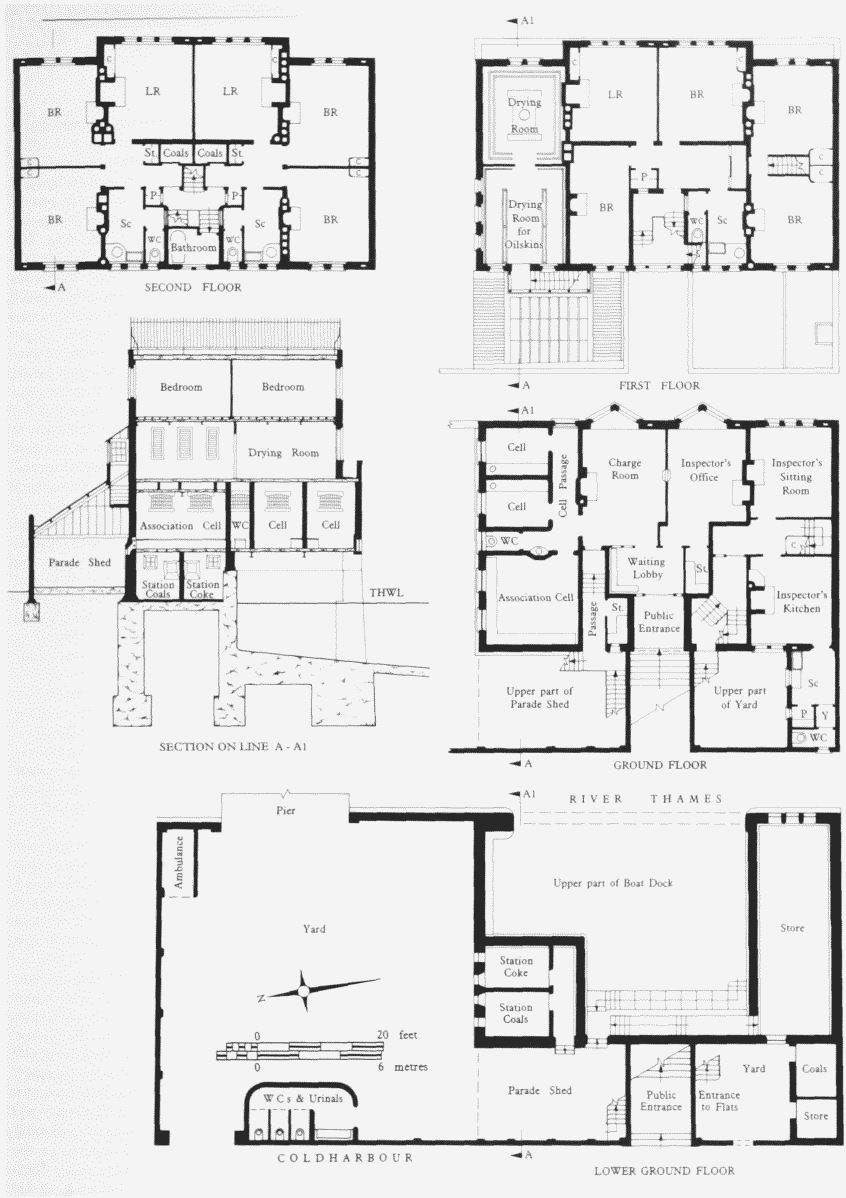
No. 19 Coldharbour (former River Police Station), site plan, floor plans and section in 1893. John Butler, architect, 1893–4
The Blackwall Station, one of only two permanent river-police stations ever built on the Thames (the other was at Wapping), was designed to accommodate a division of the Thames police formerly based on board The Royalist, a hulk moored off Folly Wall. The inconvenience of this floating headquarters had long been felt, and in 1875 it was suggested that the station should be relocated on shore in the former Railway Tavern at Brunswick Wharf. This proposal was rejected, and it was not until 1889 that other land sites were seriously considered, the choice of Brown's Wharf being approved in 1890. (fn. 136)
The new station was designed by John Butler (c1828– 1900). Architect and Surveyor to the Metropolitan Police since 1881, and built by Holloway Brothers. Erected on deep concrete foundations, it has elevations of red brick with stone dressings. On the principal fronts the brick and stonework are arranged in horizontal bands, presumably under the influence of Norman Shaw's recently completed Metropolitan Police Headquarters at New Scotland Yard, where Butler had been involved with the preliminary planning (Plate 104b). (fn. 137)
The particular needs of the river police called for some careful and ingenious planning (fig. 232). The boat-dock under the building had to be usable at all states of the tide, and in order to leave sufficient headroom in the dock at high tide. Butler raised the ground floor of the station several feet above street level. Thus the public entrance from Coldharbour was at the top of a flight of steps. The various parts of the building were strictly segregated, with their own separate entrances. The felons' entrance was in the parade shed. From there a passage led directly to the charge room and the cells, bypassing the front lobby where respectable members of the public might be waiting, and the entrance to the self-contained living accommodation for married policemen was in the yard to the south of the public entrance. On the first floor, above the cells, two rooms were set aside for drying clothes and oilskins.
The station was closed in the late 1970s, and the building was divided into flats in 1982. At the same time a block of flats (No. 19A), in a style faintly reminiscent of a Victorian riverside warehouse, was erected on the site of the former station yard to the north of the old building (Plate 104a). Both the conversion work and the new flats were designed by Rothermel Cooke for Downshire Properties. (fn. 138)
Nos 21 and 23: Concordia Wharf (formerly Stewart's Wharf).
The former Stewart's Wharf emerged from its 40—year spell as part of the General Steam Navigation Company's cattle wharf in the early 1880s. By then the cooperage workshops and the five small houses on the west side of the street had been demolished, but the Stewart family's old riverside residence (No. 23) was still standing, and remarkably this eighteenth-century house survived into the twentieth century.
In 1886 the freehold was acquired by the oil merchants J. W. Cook & Sons, who renamed the premises Concordia Wharf and built a range of iron-covered open-sided stores on the west side of the street before relinquishing the wharf in 1890. (fn. 139) Their immediate successors here. The Granulin Company Ltd, recently incorporated 'dealers in and treaters of grain for use in brewing', stayed for only a few years in the mid-1890s. (fn. 140) In 1898 the wharf was taken over by Charles Grant Tindal, an Australian stock farmer and grazier living in England, whose company, the Australian Meat Company, combined livestock farming in Australia with the importing of tinned and fresh meat and the manufacture of meat extracts and preserves. (fn. 141) In 1899 Tindal built a five-storey brick warehouse (No. 21) on the northern part of the riverside site. Erected by Perry & Company of Bow, it was 50ft high, with wooden floors strengthened by steel joists and a loophole to each floor. Blue bullnosed bricks were used for the door surrounds and other openings. (fn. 142)
The Australian Meat Company remained at Concordia Wharf until about 1920, latterly sharing the premises with the Ayres Quay Bottle Company. (fn. 143) In 1921 the British Bluefries Wharfage & Transport Ltd, a firm of wharfingers, took over the wharf, but after a major fire here in January 1924 completely destroyed Tindal's warehouse, the firm moved to Bermondsey. (fn. 144) The warehouse was never rebuilt and the riverside section of the wharf was concreted over and used for storage.
Concordia Wharf was later occupied by the White Sea & Baltic Company (P. & I. Danischewsky Ltd), a firm of pine-tar refiners and distillers established in Russia in the later nineteenth century. By 1933 it had erected on the west side of the street 'a most up-to-date distillery' for refining pine tar, the riverside area of the wharf being used for storing barrels (Plate 104b). (fn. 145)
No. 25: Hawthorn's Wharf.
In 1993 this site comprises the southern 35ft of the vacant lot between the former river-police station at No. 19 and the Gun public house at No. 27. The most recent building here, demolished in 1978–9. (fn. 146) was a warehouse of 1905–6, which replaced a house of early nineteenth-century character, though possibly with an older core.
At the end of the eighteenth century the site was occupied by two houses, (fn. 147) neither of which is shown in Daniell's view. Both were acquired by the City of London as part of the properties purchased from Sir Robert Preston in 1800 in connection with the making of the City Canal, the smaller being used for a lock-keeper's house, while the larger was occupied, rent free, by James Mountague in his capacity as the first Surveyor and Superintendent of the canal. (fn. 148) Mountague also enjoyed the use of a large plot of garden ground opposite on the west side of Coldharbour (see below, under West India Dock Tavern) and of a small wharf to the south of the Gun public house. In 1806 a 'Canal Office' was established in his ground-floor front-room, 'in which lock-keepers enter Minutes and where a person always attends'. (fn. 149)
By 1814 'not more than' £1,500 had been laid out in repairs, additions, alterations and improvements at Mountague's house, which presumably included the eastward extension and rebuilding of the riverfront with a canted bay. (fn. 150) It was further enlarged about 1827 by the annexation of the small lock-keeper's house to the south. (fn. 151) (fn. 7) Among the features listed in 1828 were a leaded roof-lantern, deal trellis-work on the parapets, and a 'trellis work verandah', (fn. 153) but these had disappeared before the river front was sketched in the early 1880s (Plates 100, 147a).
Mountague was succeeded here in 1828 by Samuel Lovegrove, the vintner and tavern proprietor, who leased all the property in Coldharbour formerly occupied by Mountague, and who built the large West India Dock Tavern on part of the garden plot on the west side of the street (see below). (fn. 154) Although he paid the rates on Mountague's old house, (fn. 155) Lovegrove may not have lived there himself, and it was probably sub-let to tenants. In 1847 Lovegrove's executors surrendered the lease to the East and West India Dock Company, successors to the City Corporation. (fn. 156) The house was then in the occupation of Captain William Drayner, a master mariner and ropemaker. (fn. 157) He left in 1853 and for the next 40 years the dock company used it as a dockmaster's residence. The last occupant, in the 1890s, was a shipwright, Joseph M. Jackson, previously at No. 15. (fn. 158)
By 1904 Montague House - as it was then called— was found to be 'beyond profitable repair'. The dock company's Works Committee recommended its demolition, and in 1905 the site was sold to Edwin Hawthorn of Snaresbrook, who erected a warehouse there in 1905–6. (fn. 159) This was Hawthorn's second warehouse in Coldharbour. His first, at No. 13, was built in 1876, when he was a lighterman living in Mile End. The warehouse at No. 25 was a five-storey brick structure with concrete floors supported on steel joists, a teak staircase, a flat asphalt roof, and a loophole to each of the upper floors (Plate 104b). (fn. 160) In the 1920s and 1930s the building was being used as a collecting depot by Hawthorn Wharf Ltd, an exporting firm which specialized in the export of motor car and cycle accessories. The firm also handled imported dutiable goods intended for re-export, which were stored on bonded floors specially set aside and secured for this purpose. (fn. 161)
The West India Dock Tavern Site.
The lands acquired by the City for the making of the City Canal included a large plot on the west side of Coldharbour, previously part of Stewart's cooperage (see above). Not all of this land, which lay to the west and south-west of the Gun tavern, was needed for the new canal, and the northern end, cleared of the cooperage workshops, was afterwards used as a garden by James Mountague, whose official residence at No. 25 lacked this amenity (see above). He erected several buildings there, including a chaise-house and stable (rebuilt in 1813), a laundry and a greenhouse. On the west side there was a long narrow fishpond, called the canal, which had been a timber-pond when the Stewart family occupied the ground. (fn. 162)
Mountague's tenancy of this land was originally only a temporary one, as the City's Port Committee planned to let the site for building houses. In 1813 the ground was made ready for building, plans and elevations prepared, and a noticeboard erected inviting contractors to apply for leases. But when none was forthcoming, Mountague took it upon himself to remove the noticeboard and rebuild his stables, which had been pulled down in anticipation of the development. The Port Committee, Mountague's employer, was understandably annoyed by his actions, and a sub-committee went so far as to recommend his eviction, but he was allowed to stay on, although he had to pay rent for the garden thereafter. (fn. 163)
Following Mountague's departure in 1828, the City agreed to let the ground for building to Samuel Lovegrove, and by January 1830 he had built a large tavern here, immediately in front of Mountague's stable block. (fn. 164) (The site is now covered by Nos 37–45 Coldharbour.) Called the West India Dock Tavern, it was a big, plain, well-fenestrated building, three storeys high and nine windows wide (Plate 105a). On the long east-facing front elevation the many windows gave views over the river and the entrance to the City Canal. Lovegrove may have reckoned that the proximity of the West India Docks would be good for business, but it seems that the tavern was never very successful. After his death in the mid1840s it failed to attract a tenant, and the stable block was let separately for livery stables. (fn. 165) In 1854 the tavern, which had then stood vacant for 'many years', was demolished, the fishpond filled with spoil from the Junction Dock excavations, and the site, newly fenced, used for storing 'colonial deals'. (fn. 166) Lenantons, the Millwall timber merchants, acquired the northern part of the site in the 1870s for a timber-yard, and later used it for boatbuilding. (fn. 167)
No. 27: The Gun public house.
A public house, under a variety of names, has occupied this site since at least the second decade of the eighteenth century. In 1722 it was called the King and Queen, by 1725 the Rose and Crown, and from about 1745 until 1770 the Ramsgate Pink. (fn. 8) It was renamed the Gun in 1771. (fn. 168) Daniell omitted the building from his view of Coldharbour in 1802 (Plate 100). A plan of about 1800 shows that it occupied the northern 35ft of the site and had two bay windows on the river front. (fn. 169)
The present undistinguished structure appears to be predominantly nineteenth century in date, although vestiges of earlier building may still be present. The oldest part is the low slate-roofed northern end. This presents only a single-storey elevation to the street, but it rises to two storeys on the riverfront, where there is a large clubroom on the first floor, connected to the ground floor by an internal circular staircase. In 1875 a two-storey two-bay extension in brick with stucco dressings was added on the south side of the building (Plate 105c), and the existing single-storey street elevation was refronted in the same style. F. Frederick Holsworth of Kentish Town was the architect for this work, which was carried out by J. H. Johnson of Limehouse. (fn. 170)
Nos 29–51 (odd)
(No. 51 demolished). Originally called South Dock Terrace, this row of two-storey cottages was built in 1889–90 on what had previously been part of the pierhead alongside the entrance to the South Dock. The site was one of several pieces of land released for sale by the East and West India Dock Company in the 1880s to help offset the costs of making Tilbury Docks. It was bought in 1888 by William Warren, an estate agent in the East India Dock Road, who developed the site in association with George Larman of Plaistow, builder. (fn. 171) The same partnership was also responsible for developing nearby Glen Terrace, begun a few months earlier.
Built of stock brick, intermixed with a little red brick in the fronts, the houses here are flat-fronted and plain, with paired entrances, two-storey extensions at the back and three rooms on each floor. The roofs were originally slated. The early occupants were all weekly tenants on average rents of 8s 6d. (fn. 172) In 1891, when about half of the houses were still in the hands of their first inhabitants, the tenants included three engine fitters, three labourers, two lightermen, a boat-builder, a blacksmith, a sign writer and wood-grainer, and an office keeper. (fn. 173) In March 1890 the freehold of the entire terrace was bought by Thomas Gray, a surgeon living in Mountague Place. (fn. 174)
The westernmost house (No. 51) originally abutted westwards on the back gardens of a row of four older cottages in New (now Preston's) Road, which were swept away when the road was re-aligned in the late 1920s. Numbered 1–4 New Road, they had been erected in 1876 by the East and West India Dock Company, to rehouse workmen displaced by the demolition of Canal Row for road widening. One cottage was required by the dock company for one of its own gatemen; the others were let to the Merchant Shipping Company, based at the Canal Dockyard, for their foremen. (fn. 175) Designed by the dock company's engineer, Augustus Manning, and built by Messrs Lewis & Bostock of Plaistow at a cost of £880, (fn. 176) these cottages were two storeys high, with a single-storey kitchen extension at the back. They were built of stock brick, with red-brick dressings, slated roofs and red ridge tiles. The accommodation, typical of this type of house, comprised a front parlour, a living-room, a kitchen, an outside w.c., and, on the first floor, two bedrooms. (fn. 177)