
Survey of London: Volumes 43 and 44, Poplar, Blackwall and Isle of Dogs. Originally published by London County Council, London, 1994.
This free content was digitised by double rekeying. All rights reserved.
'Southern Blackwall: Preston's Road area', in Survey of London: Volumes 43 and 44, Poplar, Blackwall and Isle of Dogs, (London, 1994) pp. 624-634. British History Online https://www.british-history.ac.uk/survey-london/vols43-4/pp624-634 [accessed 24 April 2024]
In this section
Preston's Road Area
The area discussed here comprises mainly the strip of ground between Blackwall Way and Preston's Road, which was bounded on the north by Ditchburn Street and on the south by Yabsley Street (fig. 233). Much of this area was laid out for house building early in the nineteenth century, but nothing survives from that phase of development, apart from the street pattern. A few houses disappeared as early as 1839–40 to make way for the London and Blackwall Railway, which effectively cut the area in two, while others succumbed to redevelopments initiated by the North London and Midland Railway Companies in the late 1860s and early 1880s. But the largest batch of demolitions took place in the 1890s, in the wake of the decision to site part of the route of the first Blackwall Tunnel under the area (see fig. 243). The redevelopments which followed these demolitions have themselves been mostly swept away, and today the area presents a rather forlorn appearance which recent landscaping and tree planting have yet to mitigate.
The early pattern of development reflected the fact that the ground was divided into two independent land holdings, one having a road frontage to Brunswick Street (as Blackwall Way was called until 1937), and the other a frontage to Preston's Road. The eastern and larger of the two properties, which had long been the site of a ropeground, was the first to be developed, being laid out for building in 1809. On the smaller, western, holding development did not begin until 1830. Here the land belonged to the West India Dock Company, whose rerouting of Preston's Road in 1827–9 had left this long narrow strip of ground sandwiched between the new roadway and the boundary with the former ropeground to the east.
Blackwall Way and Gaslee Street Area: The Former Ropeground
For nearly 200 years the land on the west side of Blackwall Way was occupied by a large ropeground established in the early seventeenth century following the opening of the East India Company's new shipbuilding establishment at Blackwall Yard, on the opposite side of the road. The site, which covered an area of more than five acres, was a long rectangular one, over 1,200ft in length, from north to south, and with an average width of about 200ft. Ropemaking continued here until the first decade of the nineteenth century, when the then owner, the shipbuilder John Wells, released the ground for speculative building. In July 1809 a consortium of local builders entered into an agreement with Wells to cover most of the area with 'good and substantially built brick dwelling houses'. (fn. 1) The builders involved were William Barker, Robert Watson, Thomas Morris and William Constable, all of Limehouse, and John Howkins of Poplar. Their agreement with Wells included a plan showing the proposed layout of new streets and sites for at least 180 houses, of which 20 had to be completed by January 1810 and a further 80 by July 1811. The house sites were grouped in short terraces ranged along the west side of Brunswick Street, and along the north and south sides of ten new roads opening off Brunswick Street. Although the new roads extended no further westwards than the ditch or common sewer which formed the boundary with the West India Dock Company's property, they were not culs-de-sac, being linked together in pairs by short stretches of roadway adjacent to the boundary ditch. (fn. 6)
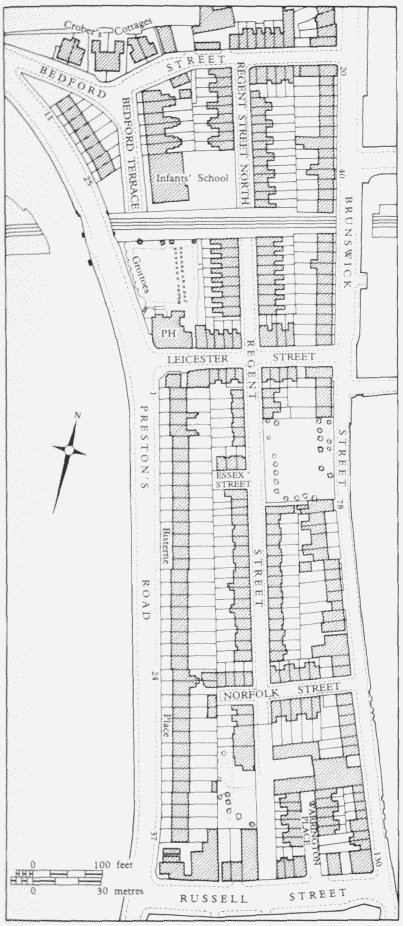
Preston's Road area. Plan based on the Ordnance Survey of 1867–70
In the event this rather complicated fret-like pattern of streets was soon superseded by an altogether simpler arrangement. A feature which had been present in the original scheme in the form of a narrow alley behind the terraces in Brunswick Street, was widened and shifted westwards to become a long north-south spine road, parallel to Brunswick Street, and the ten cross streets were reduced to just four, all of them culs-de-sac, terminating at the dock company's boundary ditch. In the course of development even this layout was slightly modified. The long north-south street was originally called Regent Street, and the four short cross streets Bedford, Leicester, Essex and Norfolk Streets. After being severed by the building of the London and Blackwall Railway in 1839–40, the northern end of Regent Street was known as Regent Street North. Except for Essex Street (which does not in any case survive), all these streets were later renamed, their new names being Gaselee (formerly Regent) Street, Ditchburn (formerly Bedford) Street, Duthie (formerly Leicester) Street, St Lawrence (formerly Norfolk) Street, and Lumsden Street (formerly Regent Street North). At the southern end, Yabsley (formerly Russell) Street was not laid out as part of this development, but was cut through in the early 1840s.
Building work began in 1809–10 and by 1817 over 100 houses had been erected on the former ropeground, most of them in Regent Street — in the central section between Norfolk and Leicester Streets - and at the northern end of Brunswick Street, north of Leicester Street. Two of the builders in the consortium, Thomas Morris and William Constable, themselves occupied new houses in Regent Street. Not all the new buildings were houses. Constable's premises in Regent Street included carpenter's shops and a counting-house, while in Bedford Street, where ten houses had been built, five on each side, some ground on the north side was used to erect a cooperage which was let to William Emery. At this point, with about half the area still awaiting development, the members of the consortium got into financial difficulties and the work was interrupted. According to Howkins's clerk the partners had been in 'embarrassed Circumstances' since the beginning of 1817. Harassed by creditors, like the bricklayer who turned up at the counting-house in Regent Street declaring that 'he wanted money very bad and money he must have', the three surviving partners. Howkins, Morris and Constable, (fn. 2) went into hiding in February 1818, and before the end of the month they were formally declared bankrupt. Among their many creditors - some of whom, it may be surmised, must have participated in the development — were a surveyor in Everett Street, Russell Square (Samuel Ainger), brickmakers from Bonner Hall, Middlesex, and Iver in Buckinghamshire, and various local building tradesmen and suppliers. (fn. 8)
When building work resumed in the 1820s, Howkins was no longer involved, and the development was carried on mainly by William Constable and Thomas Morris, working independently, having apparently divided up the remaining parcels of ground between themselves. In January 1823 the sites, mostly in Regent Street, for which Constable was responsible were included in a new agreement between the builder and the ground landlords. (fn. 9) Some of Morris's sites were leased to his son John, also a builder, who was presumably helping his father. (fn. 10) The development was largely completed by the 1830s, though not every plot had been covered with buildings. At the north end of Regent Street some land on the west side was let to the adjoining infants' school in Bedford Terrace for a playground, while another plot opposite the main entrance to Blackwall Yard, with frontages to both Brunswick Street and Regent Street, appears from the Ordnance Survey of 1868–70, to have been laid out as a walled garden. This site, immediately to the north of the present Brunswick Arms public house, finally succumbed to development pressure in 1873–4, when William Harris, a builder from Limehouse, erected fifteen two-storey houses there, eight in Regent Street (latterly Nos 32–46, even, Gaselee Street) and seven in Brunswick Street (latterly Nos 1–7 Landseer Terrace, Blackwall Way). (fn. 11)
At the south end the short cul-de-sac of Warrington Place, opening northwards off Russell (later Yabsley) Street, was not formed until 1857, and the name not approved until 1861, although the foundations for the five houses on the east side had been laid down early in 1844. These houses were completed in the late 1850s by Morris & Son, who also built another six houses on the west side. (fn. 12)
Little is known about either the appearance or planning of the houses built on the ropeground site. They were all originally terraced houses, and the great majority lacked front gardens, abutting directly on to the streets. A house in Brunswick Street, sold at auction in 1821, was probably fairly typical in having only two storeys and a basement. In this particular case the ground floor was occupied by a shop and a parlour, the basement by a kitchen and a cellar, and the first floor by three bedchambers. (fn. 13) Some houses with back extensions built on the west side of Regent Street in the 1820s had spiral staircases, fitted into small semicircular compartments opening off the entrance passage. (fn. 14) The reason for adopting this inconvenient arrangement seems to have been to save space in what were quite small houses, with frontages of under 15ft. (fn. 3)
In 1821 the auctioneers had described Brunswick Street as 'a very Eligible Spot for Business', and by 1850 ten houses on the west side between Bedford Street and Russell Street were occupied as shops or commercial premises. By the early 1880s this number had risen to fifteen, which included three coffee rooms, and four beer shops — the Vulcan (at No. 20), the Eastern Star (at No. 40), the Brunswick Arms (at No. 78) and the White Swan (at No. 130). (fn. 15) The White Swan and the Brunswick Arms eventually became fully fledged public houses. The latter is still in business, but its premises were completely rebuilt on an enlarged site in the late 1930s: W. Stewart, FRIBA, designed the new building. (fn. 16)
Former Hydraulic Pumping Station, Duthie Street and Blackwall Way
In the early 1880s the area between the London and Blackwall Railway and Duthie Street was redeveloped by the Midland Railway Company, which built branch lines and a hydraulic pumping station there, serving the company's new collier dock and coal-handling depot at Blackwall Yard. Erected in 1881–2, the pumping station is the only substantial relic of this entire enterprise, although the stretch of brick wall along the east side of Blackwall Way is another survival. (fn. 17) Like all the other new buildings and structures at the coal depot it was designed by John Underwood, the Midland Railway's engineer, who also supervised its construction. (fn. 18) The builders were Messrs Merritt & Ashby of London Wall, the principal contractors for the new works, whose tender price was £5,022. (fn. 19)
The pumping station is a single-storey structure with, at the east end, an integral oblong accumulator tower, 45ft high: the west end is gabled (Plate 108a, 108b; fig. 234). It is built of reddish-brown stock brick with some Staffordshire blue brick dressings. The brick corbelling and the distinctive iron tracery in the upper windows of the accumulator tower are both typical features of the Midland Railway's 'house style' at this period. The interior is divided into two equal-sized compartments. The western compartment is the former boiler-room, and the white-tiled eastern compartment the former machinery-room. Underground flues connected the boiler to a free-standing chimney, now demolished, which stood to the west of the building. The hydraulic machinery for the station, which included two accumulators of 1½ft diameter by 20ft stroke, was supplied by the experienced firm of Sir W. G. Armstrong & Company. Though not the cheapest, Armstrong's tender, at £15,327, was still well under the engineer's estimate of £20,630. (fn. 20)
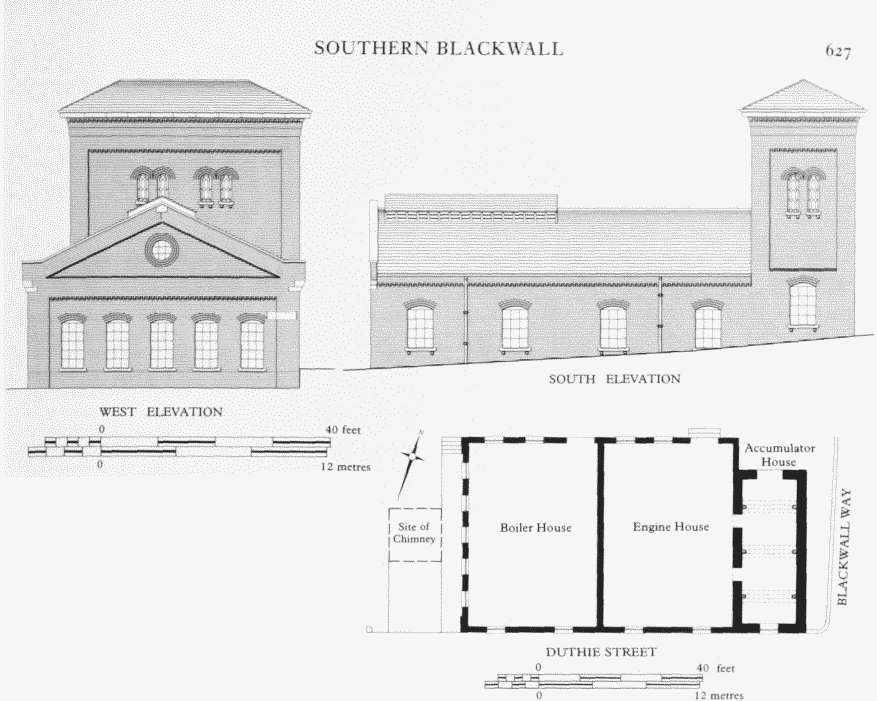
Former Midland Railway Hydraulic Pumping Station, north corner of Duthie Street and Blackwall Way, south and west elevations and plan in 1986. John Underwood, engineer, 1881–2
As part of the same development, the Midland Railway Company also bought some ground on the south side of Duthie Street on which it erected a two-storey goods office facing Blackwall Way (see fig. 243). Designed by Underwood, it was built in 1882 by Oliver Fawkes of Somers Town at a cost of £2,362, including the fittings. This brick building, with concrete floors, survived into the 1960s. (fn. 21)
Preston's Road, West Side
The three developments described here were all connected in some way with the West India Docks: an anchor and chain-cable testing station, accommodation for dock employees, and a dockmaster's house.
Lloyd's Register Proving House and Chain-Testing Shed
From 1862 to 1875 there was an anchor and chain-cable proving house on the west side of Preston's (late New) Road, north of the South West India Dock (see fig. 226a). A Select Committee of the House of Commons enquired into the manufacture of anchors and cables in 1860, following complaints about the quality of equipment supplied for merchant shipping. It found that the proving (that is, testing) of anchors and cables was unreliable, and was generally carried out on machines controlled by the manufacturers, and recommended that this should be done by an independent authority. The Committee of Lloyd's Register of British and Foreign Shipping had, since 1846, insisted on the testing of chain cables, so it was the appropriate body to undertake the public proving of chain cables and anchors. (fn. 22) Lloyd's Register anticipated that Parliament would institute the testing of all anchors and chain cables on public machines and, in January 1862, decided to erect and manage a public testing machine in London. Thomas M. Gladstone, engineer, was employed to oversee this. (fn. 23)
A site at the West India Docks was leased from the East and West India Dock Company. It was a 55ft-wide strip of ground along the west side of Preston's Road between the South Dock east entrance and Longley Place. George James Watts built a two-storey five-bay proving house and office at the south end of the site and, to its north, a 600ft-long testing shed, of timber and galvanized corrugated-iron sheeting, over a trough in which chain cable could be stretched. The chain-testing machinery was supplied by Thomas Dunn & Company of Manchester. It comprised an 11ft-long cylinder within which hydraulic pressure moved a piston to tighten 450ft lengths of chain. The proving house opened in November 1862 with Gladstone as Superintendent. Another testing machine was acquired from William Mitcheson in 1863, for which additional shedding was erected. Water access was initially by a jetty in the Blackwall Basin, but in 1864 the dock company granted a wharf on the north bank of the South Dock. Rails were laid to a jetty equipped with a 5-ton travelling-crane, known as the 'Dromedary' and thus perhaps a Fairbairn 'swan-neck' crane. (fn. 24)
After proving houses were made subject to Board of Trade licensing in 1864, (fn. 25) inspectors found the South Dock machinery to be inaccurate. To meet the criticisms, in 1865 the chain-testing machine was altered and its testing length reduced to 90ft. (fn. 26) The whole shed was no longer needed and the northern half of the site reverted to the dock company in 1869.
The licensing system permitted ironmasters to set up proving houses at the points of anchor and chain cable manufacture, in Staffordshire, Glamorgan, and on the Tyne. Wear and Clyde. The West India Docks establishment, remote from these areas, came to be little used. It became a drain on the finances of Lloyd's Register, particularly after the financial crash of 1866, which reduced shipbuilding in London, and the simultaneous closing of the South Dock for rebuilding. Closure of the proving house was discussed from 1869. (fn. 27) and by 1872 Lloyd's Register had made it clear to the Board of Trade that it intended to close it, without arranging for testing elsewhere in London. Trinity House was persuaded to take on the testing, agreeing to manage the proving house until new premises could be built at Blackwall (see page 681). but the establishment was closed in 1875. even before the Blackwall building was ready. The dock company dismantled the shed and used the former proving house, which had been cement rendered in 1870–1, to accommodate its Deputy Superintendent of Police. (fn. 28) From 1887 the house was occupied by the London and Tilbury Lighterage Company Limited, reverting to being a police house before its demolition was begun c1930. (fn. 29)
Longley Place
A group of five cottages, identical to those surviving in Garford Street (see page 402), stood on the west side of Preston's Road, just south of the West India Docks Blackwall entrance lock (see fig. 226a). Known as Longley Place, they were built in 1821 for West India Dock Company policemen, to plans by John Rennie. The builders were Thomas Johnson & Son and James Broomfield & Company. (fn. 30) The larger central superintendingconstable's cottage was divided in 1856 to form two dwellings. In 1890 the central and southern pairs of cottages were let to the London Graving Dock Company. The southern pair was demolished and the central pair was reunited to form an office. The northern pair was subsequently let to the London Graving Dock Company and was demolished in 1942. (fn. 31)
Bridge House
Bridge House was built in 1819–20 for the West India Dock Company's Principal Dockmaster, or Superintendent. John Rennie advised the dock company to build a new house in preference to enlarging an old one, preparing plans with an estimate of £3.712. A strategic site on the north side of the bridge over the Blackwall entrance was chosen to give the Superintendent uninterrupted views of the river and the docks (see figs 91, 92 on pages 256, 258). Thomas Johnson & Son were the builders. (fn. 32)
To make the most of the vantage points afforded by the site, Rennie designed Bridge House with its principal rooms on a raised ground floor with large full-height bows facing the docks and the river (Plate 106b, 106c; fig. 235). In these arrangements, and in its form as a threestorey box symmetrically arranged under a pyramidal roof, Bridge House follows eighteenth-century Thamesside villas in type. However, the stuccoed distyle-in-antis Greek Doric porch is unmistakably early nineteenth-century. The north-east corner of the house accommodated a large cantilevered open-well staircase. Much original internal and window joinery survives, including fret-patterned window shutters. Heavily moulded reeded architraves on the ground floor may date to 1838, and the more ornate cornice mouldings are 1987 replacements of Victorian work. The basement was entirely devoted to services. (fn. 33)
As a part of the re-routing of Preston's Road to the east of Bridge House in 1827–9, 8ft-high boundary walls and piers were built on the east side of the garden, and westwards from the west pier of the entrance gate to link up with the Blackwall Basin boundary wall. (fn. 34) In 1878 a new Superintendent observed of his house that 'the rooms [are] so large and numerous as to be quite beyond the requirements and means of one holding his position'. Plans for dividing the house were prepared, but abandoned. and the Superintendent was granted an extra £100 annual salary to cover the expense of occupying the large house. The road south-east of the house was diverted in 1881 to improve the approach to the bridge, so the garden wall was rebuilt by the Poplar District Board of Works. The south end of the wall was again rebuilt in 1893–5 as part of the work associated with the replacement of the Prestons's Road bridge by the LCC. (fn. 35)
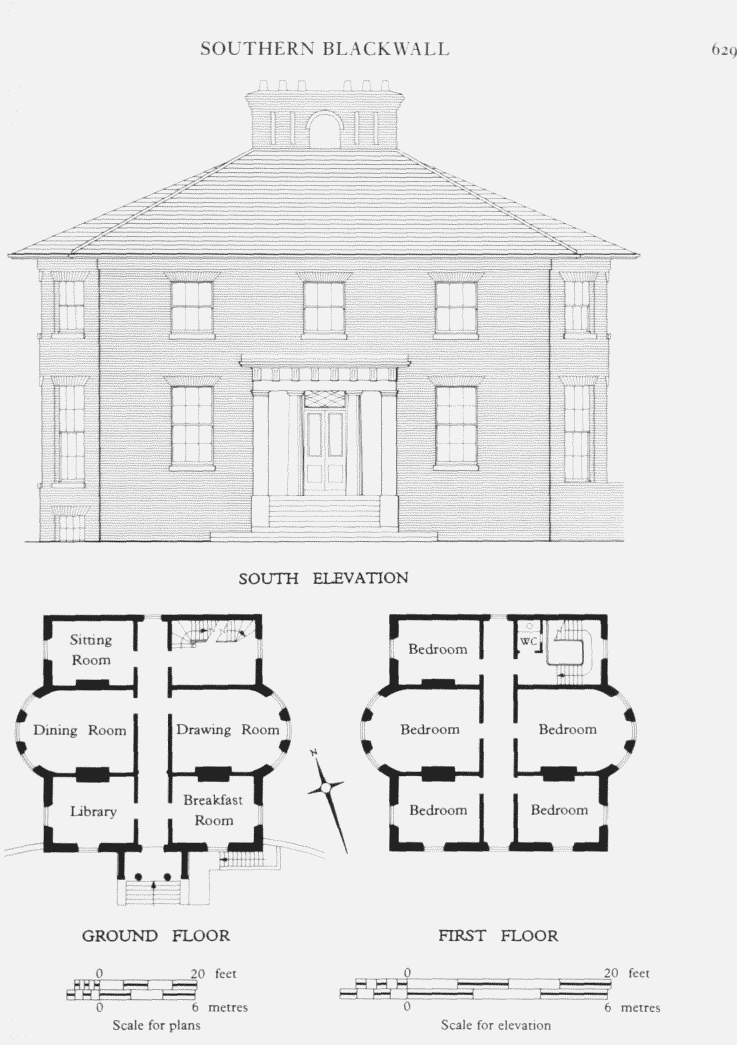
Bridge House, Preston's Road, south elevation as built, and plans in 1878. John Rennie, architect, 1819–20
The conversion of Bridge House to two dwellings, for a dockmaster and his assistant, was carried out in 1894–5 to plans prepared under H. F. Donaldson. The house was divided into east and west halves. with new northeast entrances and a new staircase in the spine corridor. (fn. 36) A north-east block was added in 1899–1900. providing an extra room on each storey. (fn. 37) By 1938 the house was regarded as old and expensive to maintain and its demolition was proposed. but this had not been done by the outbreak of the Second World War. when it was requisitioned by the War Department for the National Fire Service. (fn. 38)
Bridge House was converted in 1954–5 as the PLA's Chief Police Office and Police Training School. Blind windows in the basement were opened and a garage was built, all by John Mowlem & Company. (fn. 39) The Customs tool tenancy of the building in 1965. The roof was destroyed by fire in 1972: it was replaced with a flat one. (fn. 40)
The PLA sold Bridge House to Whittam, Cox, Ellis & Clayton, architects, in 1981. This firm used it as offices and designed its conversion to six luxury flats, carried out in 1987 for Birse Homes (London) Limited. The principal staircase was removed and the secondary corridor stair was rebuilt. The north entrance was blocked and an external iron fire-escape stair erected. A hipped roof was reconstructed along the original lines. The flats, offered for a total of almost £1.5 million, were not sold, and in 1990 the house was let as offices for the London Federation of Boys' Clubs. (fn. 41)
Preston's Road, East Side: The West India Dock Company's Estate
The stretch of Preston's Road between Poplar High Street and the bridge over the Blackwall entrance to the West India Docks was laid out in 1827–9 by the West India Dock Company, replacing the existing road whose route lay some 300ft to the west. This former road was built for the West India Dock Company in 1808 and was an extension of an old trackway leading south out of Poplar High Street called Clifton Lane (see figs 139. 91 and 921 In 1809–10 the dock company widened and improved the road, but a plan to replace it with a new, straighter, one, first mentioned in 1811, remained in abeyance until 1827, when the company decided to construct the reservoirs that later became Poplar Dock, to the north-east of the dock basin, obliging it to find a new route for Preston's Road further to the east. Planned by (Sir) John Rennie, the company's Surveyor, the new road was built by Daniel Pritchard and William Hoof, the contractors responsible for excavating the reservoirs, and early in 1829 was handed over to the parish Trustees, in exchange for the old road. On the east side, a number of short turnings-off linked up with existing roads on the old ropeground site, but Rennie's plan for a cross-road at the southern end connecting Preston's Road with Brunswick Street was not carried into effect until the early 1840s when Russell (from 1887 Yabsley) Street was laid out.
At its northern end the new Preston's Road originally followed a more serpentine route which included two sharpish bends. Probably for this reason it was soon bypassed, being replaced by a short stretch of straight roadway laid out further to the west. The superseded section survived as Bedford Terrace and the north-west arm of Bedford Street. Until the building of the London and Blackwall Railway in 1839–40 turned it into a culde-sac, Bedford Terrace presumably had a southern opening into Preston's Road. In 1890 Bedford Terrace lost its own name and became part of Bedford Street, which was itself renamed Ditchburn Street in 1939.
After the re-routing of Preston's Road in 1827–9 the West India Dock Company was left with a narrow strip of land on the east side which it proposed to let for development. This began in 1830 with the construction of three pairs of semi-detached houses along the north side of Bedford Street, whose north-western arm was at that time still part of Preston's Road. Later known as Crober's Cottages, these houses were built by John Crober of Poplar High Street, victualler, the site being leased to him for 61 years at an annual rent of £21. (fn. 42) Joseph Gwilt (1784–1863), the West India Dock Company's Acting Surveyor, provided the designs, Crober undertaking to erect 'two houses agreeably to Mr. Gwylt's Plan No.1 and four others of the same elevation, but of less depth, on either side of them'. (fn. 43) After taking possession of the site, Crober objected to Gwilt's specifications, and told the dock company that he intended to build small houses. Gwilt nevertheless insisted on adherence to certain minimum standards, and the houses were completed by October 1830. (fn. 44) The company had earlier expressed the hope that in selecting tenants for the houses and premises built on its property beyond the dock walls, preference would be given to 'persons whose business may be essentially connected with the Ships which frequent the Docks'. (fn. 45)
Photographs of Crober's Cottages show that the development was architecturally a quite stylish one (Plate 106a). All three pairs of houses had identical fronts, but the larger central pair, which had a deeper site, contained four bedrooms each instead of three. (fn. 46) Built of brick, the houses were villa-like in appearance, with two full storeys, plus an attic storey contained within a slated mansard roof. The street elevation was plain but carefully composed, with only one centrally positioned windowopening in each storey, that on the ground floor being dressed with a small pediment. The front was finished with a cornice and parapet, the latter balustraded where it passed in front of the attic window. In 1880 the East and West India Dock Company bought these houses from Crober's trustees with the intention of using them for the accommodation of officers who wished to be near the docks. But it seems that the dock staff were none too keen to live there and in 1884 the dock company sold the freehold. (fn. 47) Renumbered 1–11 (odd) Bedford Street in 1890, Crober's Cottages were still standing in the 1950s.
Apart from Crober's Cottages, the only other developments along Preston's Road in the early 1830s were an infants' school, built on the bypassed section which became Bedford Terrace, and a house erected in 1831–2 by William Cook, the plans for which were altered by Gwilt. (fn. 48) Cook's house occupied a site, since redeveloped for industrial use, towards the southern end of Preston's Road, at what is now the north corner with Yabsley (formerly Russell) Street.
The infants' schools, one of several local schools paid for by George Green, the Blackwall shipbuilder, was built in 1831–2 on a 58–year lease. (fn. 49) To erect the school Green employed the services of a local contractor, William Constable, who received £800 for the work between September 1831 and January 1832, and further payments totalling £240 in 1834–5. (fn. 50) It was a single-storey building containing one schoolroom and two classrooms: (fn. 51) at the back, but mostly on land not belonging to the West India Dock Company, was a large playground with an entrance from Regent Street North. The original school, latterly known as the Regent Street British Infants' School, closed in 1885, and in 1887 the premises were bought by the Rector of Poplar (for the Trustees of the Bishop of London's Fund). (fn. 52) Under the name All Saints' Mission Hall, the old building continued in use as a school and mission hall until the mid-1920s, when Poplar Borough Council bought the site and erected a block of flats there, later named Ditchburn House (see below). The Council's purchase did not include the old playground, whose site had been sold to the MBW in 1891 for the Blackwall Tunnel. (fn. 53)
Northwards of the school, the ground on the east side of Bedford Terrace remained undeveloped until the mid1840s, when a row of six two-storey houses with paired rear-projections and small front gardens was erected there under leases granted in 1846 to a number of different building lessees. (fn. 54) These houses, latterly Nos 4–14 (even) Ditchburn Street, survived into the 1950s.
The re-alignment of the northern end of Preston's Road left a triangular plot of land between the former route and the new one which was not built on until 1865, when the East and West India Dock Company used the site for a row of eight dock constables' residences (later Nos 11–25, odd, Preston's Road). Erected by a local builder, John Atherton of Chrisp Street, at a cost of £2,420, these were two-storey, six-room houses, with gardens stretching back to Bedford Terrace and Bedford Street. (fn. 55) They were demolished in the 1960s.
Ditchburn House (demolished)
Built on the site of the old school in Bedford Street, this was a block of nine two-bedroom flats erected in 1926–7 by Poplar Borough Council. It was designed by Harley Heckford, the Borough Engineer and Surveyor, and was in the simple neo-Georgian style favoured by the Borough Council in the 1920s, with sash windows incorporating glazing-bars. The builder was R. A. Reader of Hackney, and the final cost, including the purchase of the site, was £5,897. (fn. 56)
The building comprised a three-storey block whose southern third was set back. On the main part there was a hipped roof, and on the set-back part a pitched roof. Entry was from the rear (east side), where a projecting staircase tower was treated as a 'feature', and given a circular window with glazing-bars similar to those on the Chapel House Street Estate. Short balconies opening off the tower gave access to the upper flats. The accommodation was fairly tight, and in the three central flats the smaller bedroom was only 6ft 9in. wide.
The name Ditchburn House was adopted only in 1939, the block having previously been known (at least informally) as Bedford Street Buildings. (fn. 57) It had ceased to be occupied by October 1978, and was demolished in 1982. (fn. 58)
Southwards of the London and Blackwall Railway the east side of Preston's Road was not built up until the early 1840s. Here the frontage between the railway tracks and William Cook's house was developed by Francis Mills, esquire, of Middle Scotland Yard. (fn. 59) Mills used the plot between the railway and Leicester (now Duthie) Street to build a public house called the Marshal Keate (see below), and along the frontage between Duthie Street and Cook's house he erected a terrace of 37 houses known as Bisterne Place, for which he was granted a 63-year building lease by the East and West India Dock Company in January 1842. (fn. 60) These were mostly two-storey houses, almost certainly raised over semi-basements, with steps up to their front doors and small gardens at both front and back. At least four houses were occupied as shops, but were reconverted to private residences in the mid1850s. (fn. 61) The development also included a baker's shop and premises at the corner with Leicester (now Duthie) Street, opposite the Marshal Keate public house, which are listed in the Post Office Directory from 1845. (fn. 62) In the late 1860s the North London Railway Company purchased, and subsequently demolished, Nos 24–37 Bisterne Place for an intended (but unexecuted) entrance lock into the company's coal dock at Poplar Dock (see page 340). (fn. 63) Nos 1–23 Bisterne Place and the old baker's premises were pulled down by the LCC in the 1890s in order to clear the site for the building of the Blackwall Tunnel.
Mills had originally intended to include the stretch of Preston's Road to the south of Yabsley Street in his development, but withdrew after the dock company insisted that only 'superior' houses should be erected there, 'as the site interferes with the prospect from the Superintendent's House' (now Bridge House). (fn. 64) The northern part of this frontage, which was not directly opposite the Superintendent's House, was subsequently used for the construction of Russell Place, a terrace of 14 two-storey houses erected in 1846 (see fig. 243). (fn. 65) Shorn of its southernmost house, and renumbered 43–67 (odd) Preston's Road, this terrace survived into the 1950s.
The Marshal Keate Public House (demolished)
Built in 1840–1, and leased to the developer Francis Mills, the Marshal Keate occupied a prominent site at the north corner of Preston's Road and Duthie Street. (fn. 66) Though unmistakably a public house, it was a fairly lowkey two-storey building with stuccoed street elevations, linked in typical fashion by a rounded corner, and roundheaded windows along the first floor, including a tripartite window on the corner (Plate 105b; fig. 236). The designer may have been Samuel Beazley, who witnessed the lease of the property to Francis Mills, in October 1841. (fn. 67) Behind the building was a large garden extending up to the railway, with a sequence of 'grottoes' ranged along the west side, adjacent to Preston's Road. (fn. 68) In the early 1880s this garden was drastically shortened by the Midland Railway Company, which wanted the northern part of the site for railway sidings to be used in connection with its new collier dock at Blackwall Yard, and in order to obtain the land it needed the company bought both the lease and the freehold of the premises in 1881. (fn. 69) Even in its shortened state, the garden was considered worthy of mention by Philip Norman of the London Survey Committee in his East London notebook of 1900–3; by then, however, it had ceased to be used by the public. (fn. 70)
A comparison between the little elevational drawing attached to the original lease and the building in its last days shows how little the external appearance of the Marshal Keate had changed over the years. The main difference was that on the ground floor the original stucco had given way to ceramic tiles, probably in the 1950s, which were subsequently painted over. The building was demolished in the late 1980s.
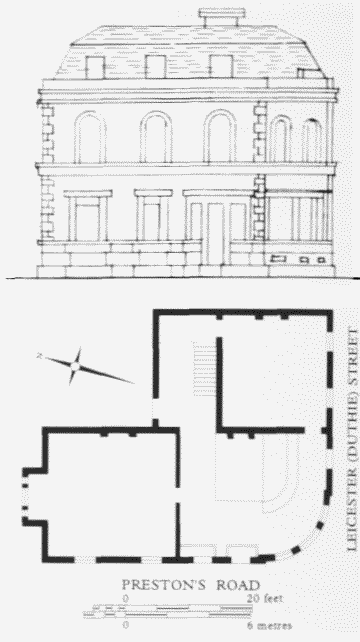
Marshall Keate Public House, Preston's Road, sketchelevation and ground-floor plan of 1841. Demolished
The Effect of the Blackwall Tunnel on Housing
The preparations for the building of the Blackwall Tunnel and its approach roads in 1892–7 necessitated the acquisition, by the Metropolitan Board of Works and its successor the London County Council, of land on the north side of the Thames (see page 640). This included the area between the east side of Preston's Road and the west side of Gaselee Street, which contained much working-class housing, all of which was demolished. Following the completion of the tunnel, blocks of public housing were erected on the site.
The Metropolitan Board of Works had planned to accommodate displaced artisans locally in empty houses or rooms, (fn. 71) but by 1892 the LCC had decided to rehouse 500 workers in Poplar and 761 in Greenwich, in dwellings to be erected on surplus clearance sites offered at public auction. (fn. 72) However, when the sites failed to sell, the LCC's Architect's Department under Thomas Blashill (1830–1905), produced its own plans for a new housing block at Yabsley Street (in fact, in Raleana Road) and invited tenders for its construction. These were considered unreasonable, and the LCC, dissatisfied at the manner in which contractors tendered for such works, resolved to retain the vacant sites and to undertake the erection of the new artisans' dwellings themselves, without the use of contractors (fig. 243). (fn. 73) This contributed directly towards the LCC's important decision later that year to create its own Works Department.
Council Buildings, Raleana Road, Yabsley Street (demolished).
Despite the determination to proceed without contractors, the difficult subsoil at Blackwall demanded special concrete foundations. These were provided by Reed, Blight & Company of Westminster. (fn. 74)
Council Buildings comprised a five-storey block of 31 three-room and 19 two-room self-contained tenements providing accommodation for 240 people. Each livingroom had cupboards, a cooking-range and a coal bunker, and each bedroom contained a corner fireplace (fig. 237). The closet was approached from an open lobby. In general the design was a development of that used for the contemporary LCC housing at Beacheroft Buildings, Limehouse; however, the addition of a fifth storey (to squeeze in more people), the use of coloured brick and projecting bays, and an attempt to introduce a more domestic style of roofing all gave the elevation a little more character (Plate 123a). The buildings were completed and opened in April 1894 and remained in use as public housing until 1974, when the GLC's Housing Division approved their demolition. (fn. 75) (fn. 4)
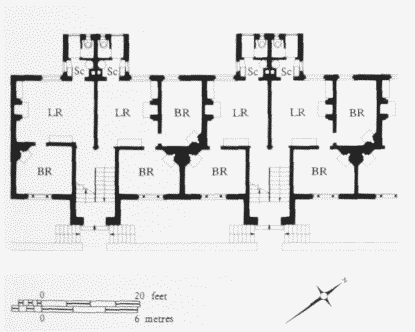
Council Buildings, Raleana Road, ground-floor plan (part) showing arrangement of two- and three-room tenements. Built by the LCC. 1893—4 Demolished
Toronto Buildings and Montreal Buildings, Cotton Street (demolished). Between 1891 and 1899 two more housing blocks, Montreal and Toronto Buildings, were designed by Blashill for surplus LCC land at the corner of Cotton and Manisty Streets, and were erected by Perry & Company between 1899 and 1901 (fig. 243). These two five-storey blocks of stock-brick balcony-dwellings comprised a combined total of 40 three-room and 30 two-room tenements, providing accommodation for up to 360 people. (fn. 77) Each tenement was self-contained, with a scullery and w.c. The style of the Cotton Street housing was much plainer than that of the earlier block at Yabsley Street, and Blashill admitted that the architectural appearance of the buildings had 'not been considered' in an attempt to produce the cheapest possible dwellings. (fn. 78)
During the Second World War major structural repairs were required at Cotton Street as a result of heavy bombing. (fn. 79) By the early 1960s the LCC had decided to adapt the buildings as temporary accommodation for homeless families, (fn. 80) but they were demolished to make way for the Smithsons' Robin Hood Gardens development (see page 196).
The Preston's Road Estate (demolished) and St Lawrence Cottages.
In June 1899 W. E. Riley (1852–1937), the new LCC Architect, presented sketch plans for two housing blocks to be erected on vacant LCC land between Preston's Road and Gaselee Street (directly above the tunnel), to rehouse working-class people about to be displaced by improvement schemes in Poplar. (fn. 81) Riley later revised his designs to comprise one large and one small dwelling block of five-storey balcony-dwellings with accommodation for 360 people, the initial stage of a larger plan for six such housing blocks on the Preston's Road site. (fn. 82)
Late in 1900 the LCC was asked by the School Board for London to provide accommodation for 1,030 persons displaced by new school buildings in south-east London, offering for the purpose three empty sites at Old Ford, Shadwell and Peckham. The Council, reluctant to build on the three sites offered, eventually agreed to use the four blocks planned for the remainder of the Preston's Road site in conjunction with 14 new three-room cottages to be built on a narrow strip of vacant ground opposite, fronting Norfolk Street. (fn. 83)
The six blocks were named Ottawa, Baffin, Ontario, Hudson, Quebec and Winnipeg Buildings (often referred to as the 'Canadian Estate') and were built by F. & T. Thorne of Manchester Road between 1902 and 1904 (Plate 123b). (fn. 84) In plan they were very similar to the Raleana Road and Cotton Street housing, with a combination of two- and three-room tenements, each with its own w.c., scullery and ventilated lobby (fig. 238), but in this instance access to the buildings was via a staircase entered from the yard on the ground floor, with balconies running along the top four storeys facing the yard.
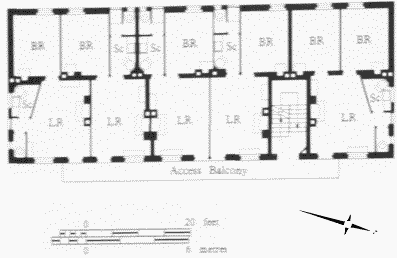
Baffin Buildings, Preston's Road, first-floor plan. Built for the LCC, 1902–4. Demolished
Winnipeg Buildings were damaged during the Second World War, and during the 1950s and early 1960s the estate was modernized by the LCC. (fn. 85) In 1972 the GLC declared Preston's Road a clearance area, and the buildings were demolished in 1980, despite a 'Mum's Army' campaign and visits by deputations of tenants to the local authorities. (fn. 86)
St Lawrence Cottages were completed by F. & T. Thorne in 1904 (Plate 123c). (fn. 87) Along with the earlier Blackwall Tunnel cottages at East Greenwich, they reflect, on a small scale, the LCC's gradual adoption of cottage estates to house the working classes, rather than the often unpopular block dwellings (see page 23). Each brickbuilt cottage had two floors, with a living-room, scullery, w.c. and lobby on the ground floor, and two bedrooms above. Food-cupboards, shelves, coppers and coal bunkers were provided, and each cottage had its own back garden. (fn. 88)
In 1963 a scheme was approved by the LCC to modernize the cottages, and the 14 original units (considered to be 'sub-standard') were repaired, and converted into eight modern cottages. (fn. 89) Although extant, in 1994 they were threatened with demolition to make way for the London Docklands Development Corporation's new road scheme for the Isle of Dogs.
St Nicholas's Church, Yabsley Street (demolished)
The church of St Nicholas, Yabsley Street, was built as a chapel of ease to All Saints', Poplar, to provide a mission church for a population which was expanding as a result of the new housing created by the tunnel scheme. In 1898 the Rev. Arthur Chandler of All Saints' purchased from the LCC a vacant site adjoining Council Buildings (fig. 243). and the church was built in 1899–1900 by J. W. Faulkner & Sons to the designs of J. & S. F. Clarkson of Bloomsbury and Poplar. (fn. 90)
The building was a basic rectangle of six bays with a semi-circular apse at the east end. It was of red brick, with narrow round-headed windows and strong buttresses running from ground to eaves. The apse was separated from the main church by a large arch, and was covered by a plastered semi-dome. The high-pitched roof was covered with grey-green Westmorland slates, and a small wooden bell-turret was added at the western end as a special gift of Miss Trevor, a local benefactress. (fn. 91) The interior was considered plain and uninspiring; later photographs show additions described as 'cheap statues, bits of brocade, potted palms and candles by the dozen', (fn. 92) Adjoining the church to the south was a group of parish buildings which differed architecturally from the church, being built of Kentish yellow stock bricks and ordinary purple slates, with flat-arched openings. All the buildings were provided with hot-water heating, and were the first buildings in the area to be lit by electricity. (fn. 93)
St Nicholas's, described in 1924 as a 'struggling mission church with very few keen communicants', (fn. 94) was badly damaged during air raids in 1940 and 1941. It was officially closed in 1952 and was later demolished. (fn. 95)