Survey of London: Volumes 43 and 44, Poplar, Blackwall and Isle of Dogs. Originally published by London County Council, London, 1994.
This free content was digitised by double rekeying. All rights reserved.
'Modern Docklands: Docklands housing', in Survey of London: Volumes 43 and 44, Poplar, Blackwall and Isle of Dogs, ed. Hermione Hobhouse (London, 1994), British History Online https://www.british-history.ac.uk/survey-london/vols43-4/pp691-696 [accessed 1 May 2025].
'Modern Docklands: Docklands housing', in Survey of London: Volumes 43 and 44, Poplar, Blackwall and Isle of Dogs. Edited by Hermione Hobhouse (London, 1994), British History Online, accessed May 1, 2025, https://www.british-history.ac.uk/survey-london/vols43-4/pp691-696.
"Modern Docklands: Docklands housing". Survey of London: Volumes 43 and 44, Poplar, Blackwall and Isle of Dogs. Ed. Hermione Hobhouse (London, 1994), British History Online. Web. 1 May 2025. https://www.british-history.ac.uk/survey-london/vols43-4/pp691-696.
In this section
Docklands Housing
Planning Background
As far as the local authorities were concerned, the closure of the docks provided an opportunity to use the dock estate to meet the housing needs of the local people. The 1976 London Docklands Strategic Plan recognized the need to extend the range of tenure in the area, but argued that simply to introduce private housing would not help most of those in need, because it would be beyond their economic means. For Tower Hamlets, therefore, the plan tentatively suggested that while 40 per cent of new Docklands housing should be local authority and 20 per cent should be for owner occupation, a further 40 per cent should have some form of 'middle tenure', such as equity-sharing, housing association, or co-operative schemes. (fn. 2) Tower Hamlets Borough Council's own plan for the Isle of Dogs, published in 1981, broadly endorsed the views of the 1976 joint plan, but emphasized that in any new housing development programme 'there should be a high proportion of local authority and housing association developments'. (fn. 3) As a result of the 1976 plan, between that date and 1981 some 1,300 houses were built in Docklands and in 1981 another 900 were under construction, mostly for rent. (fn. 4)
One immediate result of the setting up of the LDDC was that it acquired more than 600 acres of public land, mostly owned by the local authorities and intended for public housing. (fn. 5) Although apparently there were some initial thoughts that the LDDC might build houses itself, to set a standard and encourage developers to follow its example, private house-builders quickly came forward and made this unnecessary. (fn. 6) In its public pronouncements the Corporation emphasized that it was not a housing authority and had no remit to build houses. Nevertheless, it did have a housing role, which was primarily to provide sites for development by private builders or by housing associations. According to the Secretary of State for the Environment in July 1980, the LDDC could, when disposing of such sites, impose conditions on the developers, which 'might specify the type of housing to be provided or the purchase price, and might give nomination rights either to LDDC or to the local housing authority, enabling preference to be given to those in housing need, key workers etc.'. (fn. 7)
In terms of land use and geography, the new housing of Docklands followed the pattern set in the 1970s and early 1980s by a series of housing schemes (instigated by various agencies), in being built on redundant wharves and industrial sites on the east side of the Isle of Dogs; indeed, those sites were suggested for residential development in Tower Hamlets Borough Council's Isle of Dogs plan. (fn. 8) Of the 12 housing schemes begun after the inception of the LDDC and before the end of 1986, nine were on the eastern half of the Island, and six of these were built on former industrial riverside sites. The 14 schemes begun from 1987 show an almost complete reversal, with only four on the east side of the Island and ten on the west side — where the London Borough of Tower Hamlets had wished to retain sites in industrial use (fn. 9) — and a total of only five riverside sites (although there are permissions for residential developments on several more, not yet implemented). In part this reflects the fact that as the price of land in Docklands rose the existing industrial firms on the west side of the Island were more ready to relocate elsewhere and sell their old sites for residential development. The designation in 1982 of the land immediately around the docks as an Enterprise Zone offering tax and rate concessions to business developments had the effect of virtually excluding new housing from that area. For this reason only four of the housing developments so far built actually have dockside locations.
'Affordable' Homes
The type of tenure of the new housing was very different from that already built or envisaged by the local authorities. One of the assumptions behind the LDDC's housing policy was that it needed to provide dwellings for sale in order to help redress the apparent imbalance created by the presence of so much council-owned, rented accommodation in the area. (fn. 10) According to the LDDC's own figures, from 1982 until 31 March 1988, of a total of 2,819 housing starts on the Isle of Dogs, 2,737 were for sale, 22 were for shared ownership, and only 60 were available for renting. (fn. 11) While, for Docklands as a whole, between 1981 and 1990 the proportion of owner-occupier households rose from 5 per cent to 36 per cent and the proportion of households living in local authority dwellings had dropped from 83 per cent to 44 per cent. (fn. 12)
Nevertheless, one of the LDDC's roles was to improve conditions for the existing population and it sought to ensure that a reasonable proportion of the new housing would be occupied by local people. On a number of developments on the Isle of Dogs, therefore, priority was given to local applicants living in rented accommodation. In several instances the Corporation also required that a certain number of dwellings in a scheme should be 'affordable' housing — the Corporation's definition of affordable being below £40,000. On the Isle of Dogs, the Glengall Place and Friars Mead schemes were intended to provide affordable housing, and in 1984 and 1985 twobedroom houses could be obtained on those developments for no more than £37,000. On the more desirable dockside or riverside sites the LDDC allowed developers to charge high prices for the best positions overlooking the water in return for offering the rest of the housing at affordable prices. (fn. 13) Thus, in 1984 a two-bedroom flat could be obtained at Clippers Quay for £39,495, (fn. 14) while even in 1986 properties for £40,000 or less were available on the riverside developments at Caledonian Wharf, Compass Point and London Yard. (fn. 15)
However, as house prices in Docklands rapidly escalated, so the proportion of affordable new dwellings dropped. For example, on sites owned by the LDDC, by September 1985, 74 per cent of the dwellings sold cost less than £40,000, but by the end of 1987 only 42 per cent were at an 'affordable' figure, (fn. 16) and only 12 per cent of those went to former council tenants. (fn. 17) The rapid rise in house prices also meant, of course, that dwellings originally offered at 'affordable' levels were well above the £40,000 mark when they were resold. (fn. 18) Indeed, in 1988 the Corporation had to admit 'it is increasingly difficult, if not impossible, for homes to be offered at "affordable" prices', (fn. 19) and in 1989 the affordable-homes scheme was abandoned in favour of a 'social' housing programme (see page 54). (fn. 20)
Docklands-based groups argued that these policies of local priority and affordable prices were of little use to those already living in the area, and in any case were subject to widespread abuse. A dwelling of £40,000 was beyond the means of many local people and ignored the need for more rented accommodation. The LDDC did not deny that the local-priority system had been abused, but disputed that such abuse was as widespread as was alleged. (fn. 21) Nevertheless, it was said that people outside the area gave local addresses to qualify for priority or tenants sold their rent books to others, that however well-intentioned the policy was, it allowed speculators to acquire cheap dwellings which they never occupied and sold on for a quick profit. (fn. 22) At the end of 1985 the LDDC did tighten up the system to try to stop speculators, and, among other things, required those who resold within five years to pay back a proportion of any profit made. (fn. 23) In 1990 the LDDC claimed that 58 per cent of those who had moved to live in Docklands since 1981 had come from Docklands boroughs. (fn. 24) On the other hand, in 1991 a report that was critical of the LDDC claimed that only 2,253 of the 15,200 flats and houses built in Docklands since 1981 had been for local people. (fn. 25)
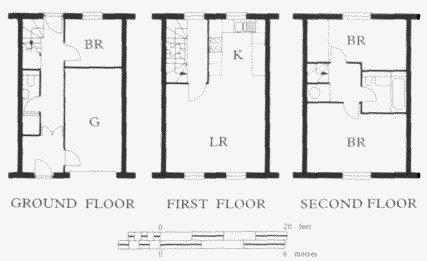
Ambassador Square, plans of a typical three-bedroom house. Developed by Laing Homes using standard dwelling types, 1988
Development and Design
Of the 26 housing schemes to be built on the Isle of Dogs since 1981, only six were actually on land owned by the LDDC and all were begun in the mid-1980s. On two of these, at the Mudchute and Maconochie's Wharf, self-build schemes were carried out, and in both instances those promoting the projects made the first approach to the Corporation. Of the private developers responsible for residential schemes on the Isle of Dogs, Kentish Property Group was the only one which specialized in Docklands projects. The firm had already been active in East London with a number of residential schemes, either involving the conversion of old buildings or the erection of new ones. Its Cascades development on the Island seemed a brilliant success (fn. 1) and in the summer of 1987 the company was able to make a share-issue valued at £37 million. (fn. 27) It then set about converting and redeveloping Burrell's Wharf, but this was to prove its downfall (see page 478).
The overwhelming majority of housing schemes built under the LDDC regime have been developed by the national, volume house-builders such as Barratts, Wates, Costains, Fairclough, Groveside Homes, Ideal Homes, Laing and Wimpey. This was probably due in part to the fact that Sir Nigel Broackes and his next two successors as Chairman of the LDDC, Christopher Benson and David Hardy, all came from the property industry. (fn. 28) In stylistic terms, some of the house-builders have made little concession to the area and have been content to employ their own standard dwelling-types (see fig. 263). Most, though, have engaged outside architects to design schemes specifically for particular sites. Nevertheless, in comparison with the new commercial developments on the Isle of Dogs, the housing has — apart from a few exceptions — been quite conservative in design, and there are rather more traditional-style houses than might be expected. Materials have tended to be equally traditional: walls faced in red, brown, yellow, or buff brick, often relieved by dressings in a contrasting colour; pitched or hipped roofs covered in slates (albeit often artificial) or tiles. Construction methods have also generally been conventional, partly because many developers acted as their own building contractors, although both Cascades and Cyclops Wharf employed 'fast-track' methods, pioneered in North America, which made extensive use of precast concrete and prefabricated components. At Cascades, a central concrete core was constructed to the full 20 storeys, and structural floor-slabs were then cast from the bottom up. Not only was the system fast (Cascades was completed in just over 18 months), but floors could be occupied as they were completed, and while work on the upper floors continued (Plate154a ). (fn. 29) Another device adopted to speed up building work at Cascades and The Anchorage was the installation of fully complete, prefabricated bathrooms (with all fittings and even with tiles on the walls). (fn. 30)
The presence of the river and the docks had a powerful influence on the design of much of the housing. Few designers were able to resist at least one or two 'nautical' touches, usually metal balconies with brightly painted railings and an occasional 'porthole' window. Only The Anchorage and Cascades (Plate 155b) exhibit a more fullblooded treatment in this style, however. At least five developments (Felstead Gardens, Glengall Bridge, Jamestown Harbour, Luralda Gardens and Plymouth Wharf) have blocks which seek to re-create the appearance of traditional riverside and dockside warehouses (see Plate 158a). Beginning with Compass Point, a number of housing schemes have, to varying degrees, Classical aspirations. Compass Point (Plate 142b) and De Bruin Court are more Regency in feel, while parts of Timber Wharves employ a reworking of the traditional Georgian-London terraced house (Plate 144b), and Lockes Field attempts to re-create an eighteenth-century mews (Plate 142d). The layouts at Compass Point and Timber Wharves are also Classically inspired and both have an impressive central axis (Plates 142a,142b,143a). However, apart from Lockes Field, the other three developments all have touches of Modernism as well.
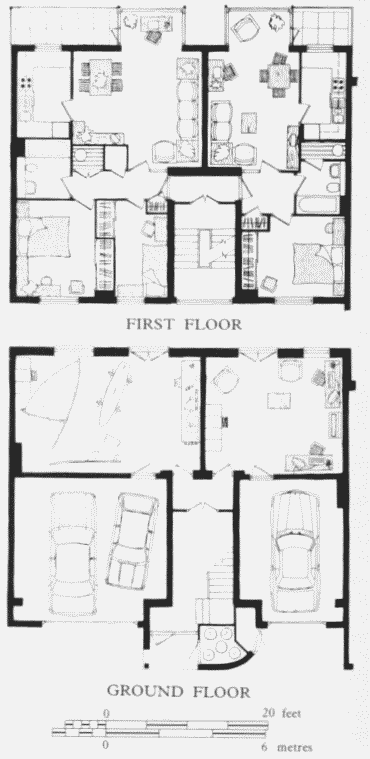
. Jamestown Harbour. Plans of one- and two-bedroom flats as envisaged by the developers, Wates, 1985
Some of these schemes were designed very defensively, most notably at Luralda Gardens, where the closed gates are apparently guarded by two gatehouses (which actually each contain a studio-flat), and at Cumberland Mills, where there is a sophisticated television surveillance system with a control centre by the entrance gates (again normally shut), which is manned continuously. It is not clear whether these installations were just part of the general demand for protection against crime and vandalism, or were more specifically intended as a defence against the supposed threat of local hostility, fuelled by newspaper stories at the time. Certainly, in 1989 security was a major concern of would-be purchasers on the Isle of Dogs. (fn. 31)
So far, most of these developments have been exclusively residential, another result, to some extent, of the designation of the Enterprise Zone. The major exception is Glengall Bridge, conceived as a 'Business Village', a mixed development of residential, commercial and retail space. This is, indeed, the only new housing as yet built within the Enterprise Zone. Otherwise three housing schemes also included some shops (Cascades, Cyclops Wharf and London Yard — where there is also a restaurant), while The Anchorage incorporated four commercial units, and the Burrell's Wharf scheme was also intended to have a number of business and commercial units. (fn. 32) These last two, together with Cascades and Cyclops Wharf, offered leisure centres as an integral part of their schemes.
Selling Docklands
The LDDC, the developers and estate agents engaged in a high-powered marketing campaign which received widespread coverage in the media and was designed to persuade house-buyers to come to Docklands, more especially to the Isle of Dogs. The proximity of the river and the docks influenced not only design, but was also seen as a major marketing feature. An image was presented of residents mooring their motor boats or yachts alongside their homes, and indulging in water sports such as sail-boarding and water-skiing. Similarly, the names given to these Docklands housing schemes usually invoke a waterside connection: 'Quay' and 'Wharf' are the most favoured, but there is also London Yard (the former name of the site) and Jamestown Harbour (a new name), as well as the more obviously nautical The Anchorage and Compass Point (where the old name of Dudgeon's Wharf could hardly have appealed to a developer). In fact, all this is fairly illusory. Most of the riverside sites have no direct access to the river and, as already mentioned, only four housing developments enjoy dockside situations. In any case, the tidal nature and fast currents of the river and the state of the water in the docks can make leisure activities dangerous, (fn. 33) while until the completion of the Docklands Sailing Centre in 1989 there was little in the way of facilities for water sports. Even on a development such as Clippers Quay, with its own private moorings, scarcely any boats are actually to be found there. Surprisingly, a survey taken in 1988 revealed that the presence of water was not the most significant attraction for most Docklands home-buyers. (fn. 34)
The Island is only about 2½ miles from the heart of the City, and this was another selling-point for houses in Docklands. The 'Big Bang' of October 1986 (see page 704) in the City created a large potential house-buying market of highly paid workers seeking to live close to the City (fn. 35) — many of them young and, in social terms, upwardly mobile (the so-called 'yuppies'). However, the notoriously inadequate road and rail systems made the Isle of Dogs less immediately accessible to the City than its position suggested. Nevertheless, the 1988 survey indicated that about half of the house-buyers in Wapping, Surrey Docks and the Isle of Dogs were professionals or worked in the City, and their main reason for living in Docklands was its proximity to the City or their place of work. (fn. 36)
So, Docklands was promoted as offering a luxurious way of life, aimed especially at City 'whizz-kids' looking to enjoy the fruits of their hard work and wanting relaxation from their hectic lifestyles — hence the attraction of glamorous water sports and the inclusion on a number of the later developments of leisure centres. The extensive media coverage helped to suggest that Docklands was the fashionable place to live. The dwellings themselves were promoted as the last word in luxury, but this claim did not always bear close scrutiny. In 1989, when large numbers of new homes were still empty, housing associations began to consider taking them over but found that many were below their normal standards. (fn. 37) Of all the recent housing, Cascades was the most explicit and most successful in promoting an image of unashamed luxury. Purchasers of apartments there were less impressed when they subsequently found that some dwellings in the block were being rented to people receiving housing benefit, (fn. 38) while the majority of dwellings at Timber Wharves were occupied by council tenants rehoused from the St Vincent Estate, Limehouse (see page 408).
A Speculators' Market
Another major incentive for house-buyers, until 1988 at least, was that dwellings on the Isle of Dogs seemed to offer a profitable investment. (fn. 39) The initial development of Docklands coincided with a rapid increase in house prices in London and the South East, but those in Docklands — including the Isle of Dogs — rose more dramatically than anywhere else in London, except Westminster. (fn. 40) Indeed, house prices on the Island between 1985 and 1987 far outstripped the hopes of the most sanguine developers. One of the early housing schemes, Clippers Quay, saw some of the most startling increases: the price of a two-bedroom flat, which when new in 1984 was available at the 'affordable' price of £39,495, more than tripled in two years, so that by 1986 it was £125,000, while a year later it had risen to £199,995. (fn. 41) The price of land similarly rose: in 1985 the Great Eastern Self-Build Housing Association was able to buy a riverside site of 1.4 acres at Maconochie's Wharf for a little over £250,000 an acre, in 1986 Ideal Homes paid over £1 million an acre for the 14.4-acre nonriverside Timber Wharves, while by May 1987 the cost of riverside land suitable for residential development was approaching £3 million per acre, (fn. 42) and a record £4 million an acre was paid for the prime Cumberland Mills site overlooking Greenwich. (fn. 43)
Such quick profits attracted considerable numbers of speculators, or 'dealers', (fn. 44) who added to the priceinflation. Usually such speculators would put down retainers on a number of dwellings, even before work began on site, expecting to sell them at a higher figure before they had to complete the original sale and pay the full price. (fn. 45) According to the Financial Times in December 1987, research showed that about 60 per cent of advance sales of new dwellings in Docklands had been to speculators. (fn. 46) As a result, little less than a mania was created, (fn. 47) which at its height saw second-hand flats on one development on the Island being offered at £35,000 more than a new one could be purchased for when bought direct from the developer. (fn. 48)
Difficult Times
During 1987 and 1988 several factors combined to depress the Docklands housing market. The crash on the Stock Market in October 1987, when the value of shares tumbled, slowed down house sales on the Isle of Dogs. By this time higher-priced properties, over £120,000, were becoming increasingly difficult to sell, and speculators were beginning to relinquish their options to buy unfinished dwellings. (fn. 49) Also, from the early 1970s onwards, the special attraction of Docklands had been the novelty of living in redundant warehouses, but by 1987 there were few of these left to convert. (fn. 50) Ironically, on the Isle of Dogs, the only conversion of old industrial premises into residential — at Burrell's Wharf — was then being launched.
The large number of new housing schemes which became available in Docklands during 1987 and 1988 aroused fears of a massive over-supply. To compound developers' problems, building costs were rising rapidly, by about 20 per cent a year, threatening the economic viability of those schemes under construction and deferring some which had not been started. (fn. 51) Simultaneously, in 1988, potential purchasers were discouraged when the double tax-relief on a single mortgage for a couple was withdrawn and interest rates were raised. As house prices dropped nationally, those in Docklands - just as they had risen more steeply than elsewhere - now began to fall more rapidly. (fn. 52) By late 1988, therefore, directly or indirectly, a number of developers were giving considerable price reductions in an attempt to sell their properties, (fn. 53) and some owners re-selling two-bedroom flats overlooking the river on the Isle of Dogs had to accept prices between 4 per cent and 16 per cent below those they had expected. (fn. 54)
House sales in the area continued to fall: (fn. 55) in 1988, 205 new dwellings had been sold in Docklands during one month, but throughout the first 7½ months of 1989 only 300 were sold, out of more than 2,000 available. (fn. 56) Strangled by slow sales, high interest rates, and escalating building costs, the Kentish Property Group found itself in trouble with its Burrell's Wharf development, and in July 1989 went into receivership. (fn. 57) The psychological effect of this was far reaching, and dramatically altered the popular perception of Docklands. (fn. 58) There had previously been some criticisms, but they now became more widespread, and began to come from the least likely sources. Very soon after the Kentish crash, a director of a leading merchant bank expressed the fear that 'the risk and nightmare is that a ghost city is being created down in docklands, an environment where people will not want to live and work'. Even the chief executive of another house-building company involved in developments on the Isle of Dogs complained that the Island was one great building site and hardly seemed the ideal place to live. (fn. 59) Until then the difficulties had seemed only temporary, now it seemed that they might prove terminal.
As the seller's market changed to a buyer's one, so developers had to resort to greater incentives in an attempt to sell new properties. This process can be traced particularly well at Cyclops Wharf, where in the second half of 1988 Fairclough Homes offered purchasers £1,000 a month for a year, to cover payments on the first year's mortgage. (fn. 60) In the following year they introduced an equity participation scheme; not only was 10 per cent of the purchase price deferred, but the mortgage was subsidised by fixing the interest rate at 10.5 per cent for the first two years. Even so, by January 1990, only 39 of the 200 flats had been sold in almost two years, and so a 'Fair Share' scheme was introduced whereby buyers paid 50 per cent of the asking price at the outset and the remainder at any time during the next five years at the then market value. (fn. 61) A few months later, in May 1990, on top of the 50-per-cent scheme, Fairclough also offered mortgages at 7.5 per cent (half the normal interest rate at the time) for 18 months. (fn. 62) Apartments in this development were still being advertised, with various inducements, in July 1992. (fn. 63)
In their desperation, developers turned to other expedients. On the Cumberland Mills development, Building Design reported in September 1989 that two half-completed blocks were being sealed without internal fixtures and fittings. (fn. 64) At Timber Wharves, where only 37 dwellings had been sold to private buyers, Ideal Homes preferred to offer them their money back, and sell all the other 421 new homes to the LDDC, which paid £65 million in 1989 so that it could rehouse Council tenants displaced by the Limehouse Link road. (fn. 65) In 1992 the LDDC sold some of the dwellings at Timber Wharves to three housing associations for letting to council tenants who wanted a move. (fn. 66) In 1991, 40 flats at The Anchorage were let to Tower Hamlets Council for housing teachers. (fn. 67)
As house sales dwindled, so the number of residential properties available for rent increased. In the autumn of 1989, for example, one- and two-bedroom flats at Clippers Quay were offered at rents of between £125 and £135 per week. (fn. 68) New legislation in that year increased the attractiveness of renting out properties by enabling landlords to charge market rents and introducing 'assured shorthold' tenancies for a minimum of six months (with a new contract after the agreed period). (fn. 69)
By October 1990 construction of new dwellings for sale in Docklands had virtually ceased, with about 1,500 completed dwellings still unsold, and it was estimated that the existing rate of sales would have to increase by 50 per cent to clear this over-supply by the end of 1991. (fn. 70) Among the sites where plans for residential developments have been drawn up and agreed, but had not been implemented by March 1994, are Arnhem Wharf, Britannia Dock, Clyde & Langbourne Wharves, Cubitt Town Wharf, Ferguson's Wharf, Hutching's Wharf, Millwall Wharf, Ocean Wharf and Winkley's Wharf - the majority being riverside sites on the west side of the Island. At Glengall Bridge West, a block intended as housing was remodelled as 'Business Apartments', complete with kitchens and bathrooms, while at Timber Wharves show houses and flats were demolished in 1991, to make way for a proposed office block. (fn. 71)
Equilibrium?
In 1989–90 the future of the residential developments on the Isle of Dogs, as much as the commercial ones, was thought to be dependent on the success or otherwise of Canary Wharf. (fn. 72) Yet, despite the fact that Canary Wharf went into administration in May 1992, there were some signs of a revival in the housing market in Docklands. (fn. 73) House sales began to pick up during the first half of 1991 and continued in 1992, although, at Cumberland Mills, at least, this was only achieved by dropping prices in 1991 by as much as 40 per cent and arranging lowinterest mortgages. (fn. 74) This upturn encouraged developers to resume the construction of new housing, with the commencement of another 120 dwellings at Burrell's Wharf in 1992 and more than 100 low-cost starter homes in the Corn Mill Quay scheme at Timber Wharves in 1993. (fn. 75) The latter, however, are in stark contrast to the luxurious Docklands apartments of the 1980s and mark something of a return to 'affordable' homes.
Undoubtedly, several developers were caught out by the sudden slump in the housing market and suffered serious financial damage as a result. Similarly, those buyers who purchased dwellings at the height of the boom saw the value of their properties drastically eroded. However, the Independent concluded in May 1992 that in Docklands:
Prices have fallen more than 30 per cent since the boom - but that is no worse than elsewhere in London. People who paid as little as £50,000 for a flat and £110,000 for a four-bedroomed house on the Isle of Dogs in 1985 are still ahead of the game. (fn. 76)