A New History of London Including Westminster and Southwark. Originally published by R Baldwin, London, 1773.
This free content was digitised by double rekeying. Public Domain.
John Noorthouck, 'Book 2, Ch. 8: Bishopsgate Ward', in A New History of London Including Westminster and Southwark(London, 1773), British History Online https://www.british-history.ac.uk/no-series/new-history-london/pp554-558 [accessed 1 May 2025].
John Noorthouck, 'Book 2, Ch. 8: Bishopsgate Ward', in A New History of London Including Westminster and Southwark(London, 1773), British History Online, accessed May 1, 2025, https://www.british-history.ac.uk/no-series/new-history-london/pp554-558.
John Noorthouck. "Book 2, Ch. 8: Bishopsgate Ward". A New History of London Including Westminster and Southwark. (London, 1773), British History Online. Web. 1 May 2025. https://www.british-history.ac.uk/no-series/new-history-london/pp554-558.
In this section
CHAP. VIII.
Bishopsgate ward.
Boundaries.
This ward is called from the gate which stood nearly in the centre of it: for being of large extent it is distinguished into Bishopsgate without the wall, and Bishopsgate within; though both under the same alderman. It is bounded on the east by Aldgate ward, Portsoken ward, and part of the Tower liberty; on the south by Langbourn ward; on the west by Broad-street ward, and Moorfields; and on the north by Shoreditch. It extends from the bars at the north end near Spital-square, on both sides of the way, including almost half of Houndsditch, as far as the pump, at the corner of St. Martin's Outwich; and then winding by the west corner of Leadenhall, down Gracechurch-street, to the southwest corner opposite Fenchurch-street. The ward without the wall is divided into four precincts; and the part within into five.
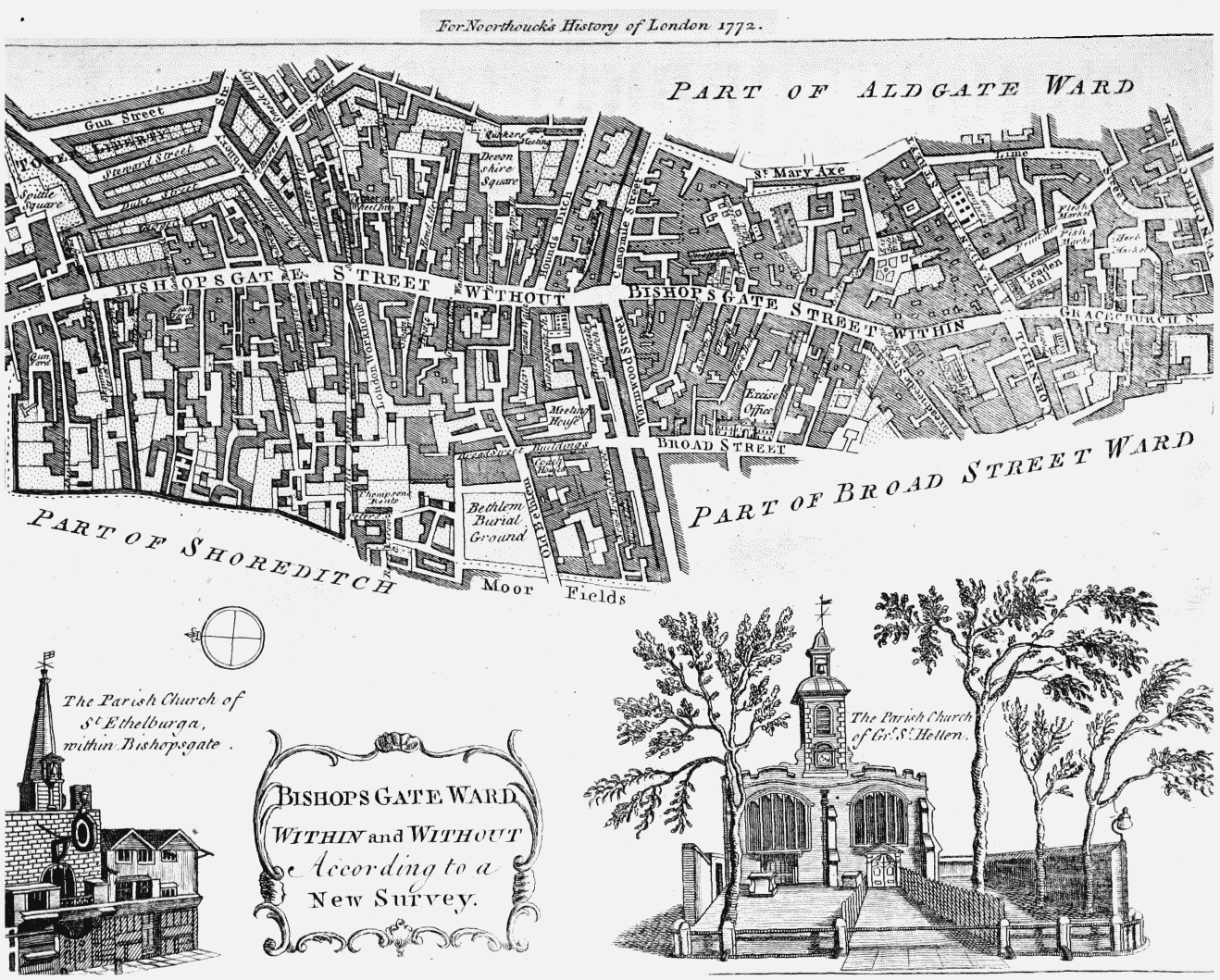
Plan of Bishopsgate ward
Principal places in this ward.
The herb market belonging to Leadenhall, which is as large and well supplied as any in London, is in this ward: but the other divisions of Leadenhall market are in Lime-street ward.
Bishopsgate-street is a long open street; but as it all escaped the great fire, excepting the south west corner; many of the houses still remain specimens of the old irregular wooden buildings, that composed the town before that memorable æra. The south end was again burnt in 1765; and on the west side within two or three doors from Cornhill was erected that grand spacious house of public entertainment, now known by the name of the London tavern.
Great St. Helens, in which stands the church of the same name, is a handsome large court on the east side of Bishopsgate-street within, well inhabited; and is made more agreeable by the rows of trees round the churchyard in the centre.
Little St. Helens adjoining is another large court, with several good timber houses in it. It was formerly a convent of black nuns founded in the reign of king Henry III. the remains of which were purchased by the Leathersellers company, where they have their hall, as will presently be mentioned.
Following the east side of the street, without the wall is Devonshire square at the bottom of a narrow street called Devonshire-street. Here was formerly a large house built by Jasper Fisher one of the six clerks in Chancery; whose fortune not being answerable to his house, it was called Fisher's Folly. This house afterward belonged to the earl of Oxford, and lastly to the countess of Devonshire; whose name is still preserved to the street and square built on the spot. The square consists of good buildings, inhabited by merchants, and persons of wealth: in the middle stands a gilt Mercury upon a pedestal carved with other figures on each side, and ascended by three steps, inclosed with iron rails.
About 300 yards north east from this square, was antiently a large close called Tassel close; from its being planted with tassels or teazels for the use of clothworkers. This close was afterward lett to the cross-bow-makers, who used to exercise a game here of shooting at the popinjay. On the invention of gun powder and the decline of archery, it was surrounded with a brick wall, and served as an Artillery ground, where the gunners of the Tower used weekly to fire with brass pieces of cannon against a butt of earth: the last prior of St. Mary Spital granted over this Artillery ground for thrice 99 years for the exercise of great and small artillery; and hence this ground became subject to the Tower. King Henry VIII. gave the company a charter which was afterward confirmed by queen Elizabeth; and in 1622 an armoury was erected in it, containing 500 fetts of arms. The company at length grew so numerous that this ground was too small for them; and when they removed to the present Artillery ground, this spot was distinguished by the name of the Old Artillery ground. It is now occupied by Duke street and Stuart-street; which composing one of the Tower liberties, the inhabitants are under the Tower jurisdiction.
On the west side of Bishopsgate-street without the wall, is a street and several courts known by the general name of Old-Bethlehem or Bedlam: here formerly stood a priory, founded A. D. 1246, by Simon Fitzroy, alias Fitzmary, sheriff of London, for the support of a community of brothers and sisters that wore a star upon their outer garments; and dedicated to St. Mary of Bethlehem. At the dissolution of monasteries, Henry VIII. gave this house to the city of London, who converted it to an hospital for the cure of lunatics. In the year 1569, Sir Thomas Rowe, lord mayor, caused about an acre of ground belonging to the hospital, to be inclosed within a brick wall; as a common burial ground for the use of such parishes as had not convenient grounds of their own (fn. 1). The inconvenient situation of this hospital, with its incapacity to receive the number of unhappy objects that offered, proved the occasion of erecting a building in the neighbourhood better adapted to the purpose. Old Bethlehem the principal street has of late been much improved in its buildings.
Excise Office.
On the spot where Gresham college stood in Broad-street, is now erected a large uniform convenient stone fronted building for the Excise office; which was removed hither from the Old Jewry (fn. 2). It consists of three stories; so that there are four extensive ranges of offices for clerks in the several departments of the Excise; for the ready finding of which, the business transacted in the respective rooms is expressed over the doors. This office is conducted by nine commissioners whose salaries are 1000 l. each; who have under them a great number of subordinate officers and clerks both within and without the house. These receive the produce of excise on beer, ale, and spirituous liquors; on tea, coffee, and chocolate; on malt, hops, soap, starch, candles, paper, callicoes, gold and silver wire, vellum, parchment, hides and skins, plate, and wheel carriages, collected all over England; and pay it into the exchequer. For the collecting, surveying, &c. of which monies, and things exciseable, they have an incredible number of out-door officers in all parts of the kingdom, stationed within certain districts, to gauge, and to prevent frauds and loss in the duties of excise. Before the commissioners are tried all frauds committed in the several branches of the revenue under their direction; without any appeal, except to the commissioners of appeal for a re-hearing.
London Workhouse.
On the west side of Bishopsgate street without, is the London workhouse; a large commodious building, established for the relief and employment of the poor, and the punishment of vagrants and disorderly persons. A corporation for this purpose was erected by the house of commons in 1649, by the name of the president and governors for the poor of the city of London and liberties thereof. After the restoration, the institution was formed by the full legislative authority (fn. 3); and the governors were constituted a body corporate, with a common seal. The lord-mayor for the time being was appointed president; the corporation was allowed to purchase lands or tenements to the annual value of 3,000l. and the common-council were impowered to rate the respective wards, precincts, and parishes of this city, for the support of this workhouse.
The several parishes formerly paid 1s. a week for each child they had in the workhouse, beside their assessments: but, at Michaelmas, in 1751, the governors came to a resolution, that no more children paid for by the parishes to which they belong should be taken into the house: and it has been further resolved, that only such children shall be taken in as are committed by the magistrates of the city, found begging in the streets, pilfering on the keys, or lying about in glass-houses, and uninhabited places. They are dressed in russet cloth, with a round badge upon their breasts, representing a poor boy and a sheep, with this motto, God's providence is our inheritance. And when arrived at a proper age, the boys are bound out apprentices, to trades or sea service; and the girls placed in honest families.
In another part, called the Keeper's side, are confined beggars and vagrants, who have no honest means of support; and lewd women taken up in the streets, who are kept to hard labour, in beating of hemp and washing of linen. All of which are not only supported, but in case of sickness, and other accidents, have advice, physic, aud surgery, gratis. Since Ludgate prison has been pulled down, the debtors, citizens of London, are imprisoned here, in apartments allotted for that purpose.
Leather-feller's hall.
Between Great and Little St. Helens but properly in the latter, stands Leatherfeller's-hall, being part of the old nunnery before mentioned; which was purchased by the company from the crown; and notwithstanding its antiquity, it may be said to vie with most of the halls in London, for neatness and convenience; for a magnificent screen adorned with six columns of the Ionic order, and for a ceiling of fretwork.
There are three parish churches in this ward.
Church of Great Helens.
In Great St Helens is the parish church of the same name, so denominated from its dedication to St. Helen the mother of Constantine the Great. The patronage of this church appears to have been anciently in lay hands; for one Ranulph, about the year 1180, granted it to the dean and canons of St. Paul's, by whom it was some time after granted to William, son of William, the Goldsmith, who founded the priory of St. Helen; on the prioress and nuns of which he conferred the advowson thereof, in whom it continued till the suppression of their convent in 1539, when it came to the crown. Edward VI. in the year 1551, granted the advowson to Nicholas, bishop of London, and his successors; which was confirmed by queen Mary in the year 1553. But it having been since re-granted to the dean and chapter of St. Paul's they now collate to the vicarage.
This church escaped the fire of London in 1666, and is a gothic structure of the lighter kind, consisting of a plain body, with large windows. The tower was not built till the year 1669, and is wrought with rustic at the corners, crowned with a turret and dome, with a bell in it. In this church are several very curious monuments; particularly that of Francis Bancroft; one of the lord-mayor's officers, who having in a course of years amassed a very considerable fortune by oppressive means, left the principal part of it in trust to the draper's company to found and maintain an alms-house and a school, and to keep this monument in repair. He is embalmed, in a chest made with a lid having a pair of hinges without any fastening; and a piece of square glass in the lid just over his face. It is a very plain monument, almost square; and has a door for the sexton, on certain occasions, to go in and clear it from dust and cobwebs. The minister has twenty shillings for preaching a sermon once a year in commemoration of Mr. Bancroft's charities; on which occasion the alms-men and scholars attend at church, and are entertained with a good dinner.
St Ethelburg's church.
Near the corner of Little St. Helens, with the front to Bishopsgate-street, is the church of St. Ethelburg; so called from its dedication to Ethelburga, the first christian Saxon princess, daughter to Ethelbert king of Kent, the first christian Saxon prince, and patron to Austin the monk, the English apostle. The advowson, which is a rectory, was in the prioress and nuns of St. Helen, till the suppression of their convent; when coming to the crown it was granted by queen Elizabeth to the bishop of London and his successors, who have ever since collated and inducted to the living.
This church is very ancient, having escaped the fire of London: the body is irregular in the gothic style, with very large windows; and the steeple is a small spire, on a low square tower.
St. Botolph Bishopsgate.
On the west side of Bishopsgate-street just without the wall, and opposite to the north end of Houndsditch, stands the parish church of St. Botolph Bishopsgate, which appears to be of very ancient foundation, dedicated to St. Botolph, an English Saxon Saint, who died about the year 680. But the first rector we have any account of was John of Northampton, who resigned the same on the 4th of June 1323, at which time it was, and still remains, in the gift of the bishop of London. The old church, which was built of brick and stone, escaped the fire of London, but became so ruinous, that the parishioners thought it necessary to apply to parliament to enable them to raise a new church: which was begun in 1725, and finished two years after.
The present structure is massy and spacious; the body is built with brick, and well enlightened, and the roof hid by a handsome balustrade. The steeple though heavy has a magnificent appearance; but it has been justly remarked that in the centre of the front under it, where every spectator would expect to find a principal entrance, he is shut out by a dead wall, and must enter the church by small side doors (fn. 4) Instead of a door, in the centre of the front is a large, plain, arched window, decorated at a distance with pilasters of the Doric order. Over this window is a festoon, and above that an angular pediment: on each side is a door, crowned with windows, and over these are others of the port hole kind; above which rises a square tower, crowned with a dome, whose base is circular, and surrounded by a balustrade in the same form; by the side of which, on the corners of the tower, are placed urns with flames. From this part rises a series of coupled Corinthian pillars, supporting other urns like the former, and over them rises the orgive dome, crowned with a very large vase, with flames. The roof within-side is arched, except over the galleries, and two rows of Corinthian columns support both the galleries and arch, which extends over the body of the church, neatly adorned with fret work.