A New History of London Including Westminster and Southwark. Originally published by R Baldwin, London, 1773.
This free content was digitised by double rekeying. Public Domain.
John Noorthouck, 'Book 2, Ch. 15: Cheap Ward', in A New History of London Including Westminster and Southwark(London, 1773), British History Online https://www.british-history.ac.uk/no-series/new-history-london/pp587-593 [accessed 30 April 2025].
John Noorthouck, 'Book 2, Ch. 15: Cheap Ward', in A New History of London Including Westminster and Southwark(London, 1773), British History Online, accessed April 30, 2025, https://www.british-history.ac.uk/no-series/new-history-london/pp587-593.
John Noorthouck. "Book 2, Ch. 15: Cheap Ward". A New History of London Including Westminster and Southwark. (London, 1773), British History Online. Web. 30 April 2025. https://www.british-history.ac.uk/no-series/new-history-london/pp587-593.
In this section
CHAP. XV.
Cheap-ward.
The Saxon word Chepe signifies a market; and one being antiently held in the principal street of this ward, Cheapside, it was known by the name of Westcheap, to distinguish it from the market also kept in Eastcheap (fn. 1) : the street now called the Poultry was the Poultry market, and Milk street, the milk market, belonging to Westcheap.
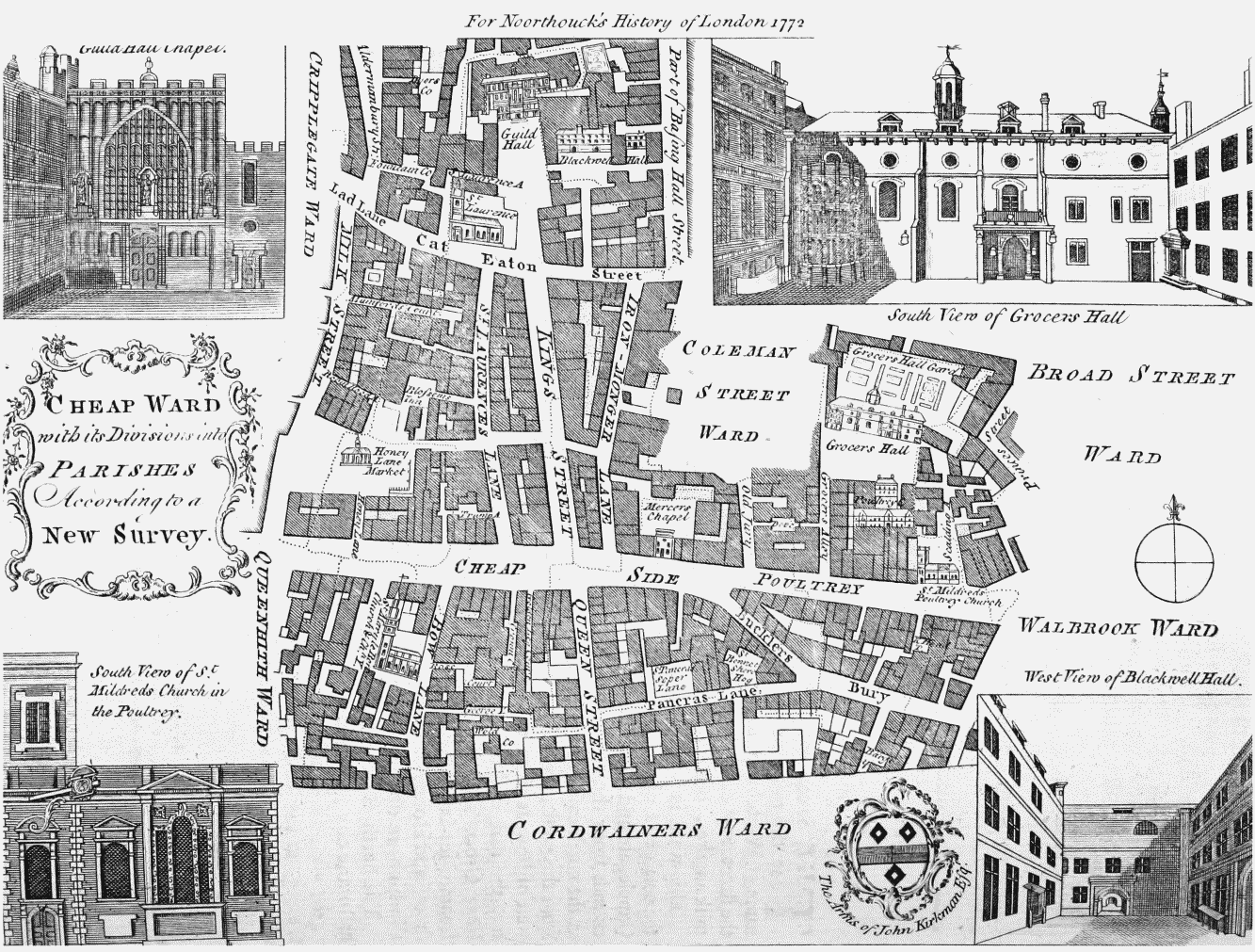
Plan of Cheap ward
Boundaries and extent.
This ward is bounded on the east by Broad-street and Wallbrook wards; on the north by Coleman-street, Bassishaw and Cripplegate wards; on the west by Cripplegate and Queenhithe wards; and on the south by Cordwainer's ward. It extends from the entrance of St. Mildred's court, formerly called Scalding alley, in the north east, to near the east corner of Milk-street, on the north west; and from the west corner of the Mansion-house on the south east to within 33 feet west of Bow-lane on the south west: within which circuit is included the Poultry, the east end of Cheapside, part of Pancras-lane, Queen-street and Bowlane; Grocer's-alley, about 136 feet of the south end of the Old Jewry (fn. 2); Ironmonger-lane, King-street, Laurence-lane, the principal part of Cateatonstreet, and Honey-lane market; with the courts, and alleys, within these limits: all which are divided into nine precincts.
Guildhall
The north extremity of King-street is terminated by the front of the Guildhall of the city; a more favourable situation than any other public building within the walls of London. It is seen from Cheapside, the principal thoroughfare in the city, at the end of an agreeable vista, which shews the building to great advantage. There is not indeed much to praise in the outside of the structure, which is old and gothic; but allowing for the taste in which it is built, the hall within is a fine room. Two obvious defects however appear on entering it; the one, that the door being in the middle of the side instead of being at one end, the beauty of the perspective is lost; the other, that the ascent of the steps from the great hall up to the council chamber is not exactly opposite the gate from the street; which the regularity of the plan required (fn. 3).
The Guildhall formerly stood in the street called Aldermanbury; which being known by that name in 1189, it is supposed to have been built by Edward the Confessor: his arms being in several parts of the present building. The present structure was begun by the city about the year 1411 (fn. 4), and several benefactions were given toward the completion of it.

Guildhall and the Mansion House
The fire in 1666 greatly injured this noble pile, which was said to have appeared at a distance for several hours conspicuous during that terrible conflagration, like a bright shining coal, or a palace of burnished brass: the timber being such solid oak, that it did not flame (fn. 5). The building afterward was thoroughly repaired within and without at the expence of 2500l. and in its present state appears as follows.
The entrance into the hall is by a large gate, under a gothic arch; and above this is raised a frontispiece truly in the antient gothic style. There are two niches for images on each side the gate; and the figures placed in them represent the four cardinal virtues. Over the arch is a balcony, above which rises a second stage, decorated also with niches, and irregular ornaments; in two of these niches stand the statues of Moses and Aaron. Over the whole is a large tablet with the royal arms, adorned with scrolls at the sides, and covered with an arched pediment; from the top of which rises an urn with flames.
Through this gothic arch is the entrance into the great hall, which is 153 feet long, 48 feet broad, and 55 feet high; and is capacious enough to hold 7000 persons. This room on account of its size is well fitted for assembling the livery for the election of members of parliament, lord-mayor, sheriffs, and other city officers: here also the corporation give public entertainments to our kings and other great personages. The roof is flat, divided into pannels, and the north and south sides are adorned with gothic demi pillars. At the east end is held the court of hustings, and before that, the court of conscience; at the west end, are held the sheriffs courts for Woodstreet and the Poultry compters. Over the court of hustings are painted the king's arms, between two fine pictures lately hung up, of their present majesties king George III. and queen Charlotte; close by the first is the picture of queen Caroline; and by the latter his late majesty king George II. And at the same end of the hall, on the south side, are the pictures of king George I. and queen Mary; directly opposite to which, on the north side, are those of king William III. and queen Anne. The inter columns are embellished with the pictures, in full proportion, of the following judges, which were put up by the city in gratitude for their signal services in determining differences between landlords and tenants, without the expence of law-suits, in rebuilding the city, after the fire of London (fn. 6).
To these the city of London has added the picture, in full proportion, of the late chief justice Pratt, now lord Camden.
Over the sheriffs court, at the west end of the hall, was lately placed a white marble statue of alderman Beckford, who died in 1770, during his second mayoralty (fn. 7). He is represented as large as the life, in the robes of his mayoralty, and in the attitude he stood when he made his famous reply to the king, after his majesty had given his answer to the city remonstrance May 23d, 1770 (fn. 8). There are two figures sitting in languishing attitudes, one on each side the statue, on the pedestal. That on the right hand represents the city of London, distinguished by resting her right arm, which supports her head, on an escutcheon containing the city arms; by holding the city sword inverted in her left hand; by the cap of maintenance; and by the mace lying by her. The figure on the other side is to represent Commerce in a drooping state. Her head is adorned with a mural crown; her right arm, which holds a cornucopia almost empty, rests on the mariner's compass; and her left supports an anchor. A tablet of black polished marble underneath contains the address.
On the opposite side to the entrance into this hall, a little to the right, is a slight of steps leading to the particular offices; over which is a balcony or gallery, supported by twelve iron pillars in the form of palm trees. A small inclosure is made on each side the steps by means of these pillars, which serve occasionally as offices for clerks to write in; and one of them is used as a stand for the common crier's deputy to repeat proclamations from, when the livery are assembled. Underneath is a prison called Little Ease, to which the chamberlain may commit disobedient apprentices; and is so termed, because the ceiling is so low that the prisoner cannot stand upright in it. From the middle of the balcony projects a square clock elegantly carved round the case, with the figure of Time on the top. But the most extraordinary decorations of this balcony are two uncouth gigantic images, which stand one at each end on the outside of the rails. These enormous figures are made of pasteboard and painted in antient military dresses: the one holds a spear in his hand, the other a ball set round with spikes, hanging by a chain from a long staff; and are supposed to represent an antient Briton and a Saxon. The colours taken at the battle of Ramilies were hung round the hall, but being decayed they have been all taken away. At the top of the steps above mentioned, on the right hand, is the Chamberlain's office; and on the left is the office of Auditors of the city accounts; between which is the lord-mayor's court office, where the lord chiefjustice occasionally sits on trials by nisi prius. On the west side of the mayor's court office is the court of Orphans, where the lord chief-justice of the Common Pleas occasionally sits. Adjoining to this court on the north is the Old Council Chamber, now used by the commissioners of bankrupts; contiguous to which is the New Council Chamber. Beneath the mayor's court is the Town clerk's office, where are deposited the city archives. To the east and north are the residences of the chamberlain and town clerk; near which are two rooms wherein the business of bankrupts is executed. Adjoining to the north-west is the kitchen; in the porch is the comptroller's office; over it the Irish chamber: and over the piazzas on the west are the offices belonging to the common ferjeant, remembrancer, and city solicitor.
Guildhall chapel.
At the east end of the front of Guildhall, and at a right angle with it, is Guildhall chapel, between that hall and Blackwell hall. This chapel was founded in the year 1299, dedicated to St. Mary Magdalen and All Saints, and called London college. A chauntry was established in this chapel for four chaplains, and lands and tenements left for their support. It was rebuilt in the reign of Henry VI. and received new endowments: but at the suppression of religious houses it reverted to the crown, and was bought of king Edward VI. with other lands and tenements, by the mayor and commonalty of London; who have service performed there weekly, and on other particular occasions. It was much injured though not totally destroyed by the fire of London in 1666, and has been since repaired.
This edifice is perfectly in the gothic taste. In several niches in the front are set the figures in stone of king Edward VI. of queen Elizabeth, with a phœnix under her; and of king Charles I. treading on a globe. The windows are extremely large, and on the inside the walls are hung with tapestry. Over the aldermen's seats there is a wainscot covering, and a particular seat for the lord-mayor, adorned with cartouches. There is a gallery at the west end, a handsome wainscot pulpit and desk, and a neat altar piece inclosed with rails.
Poultry Compter.
Between the Poultry and Grocers-hall is one of the city prisons of great antiquity, called the Poultry Compter; the other being situated in Woodstreet: they are supposed to be called compters, because prisoners are obliged to account or give satisfaction for the cause of their confinement, before they can obtain a discharge from them.
The charge of these prisons is committed to the sheriffs, under whom there are divers other officers, belonging alike to both compters, who give security to the sheriffs for the true and faithful execution of their several offices.
The poorer sort of prisoners, as well in this compter as in that in Wood-street, receive daily relief from the sheriffs table, of all the broken meat and bread; and there are several charities given for their subsistence, as well as to release such as happen to be detained in prison until their fees are discharged, or who are confined for small debts.
Grocers hall.
A little westward of the Poultry Compter is a neat paved alley called Grocers alley which leads to Grocers-hall, at the back of a square court behind the compter. The spot on which it is built was formerly occupied by the mansionhouse of Robert lord Fitzwalter, who sold it to the company in the year 1411, for 320 marks. The building is well designed and executed for the purposes of a common-hall, and so capacious, that for many years the Bank of England was kept in it till an office was purposely built in Threadneedle-street. The ancient stone and brick building at the north-west corner of the garden, inhabited by the beadle of the company, is probably part of the ancient city mansion of the family of Fitzwalter, and in that case is the oldest building within the walls of the city.
Mercers hall and chapel.
Between the Old Jewry and Ironmonger-lane, in Cheapside, stand Mercers hall and chapel, on the ground once occupied by an hospital dedicated to St. Thomas of Acars, or Acons (fn. 9), founded by Thomas Fitz-Theobald de Heili, and his wife Agnes, sister to Thomas-à-Becket, who was born on the same spot in the reign of king Henry II. On its surrender in the reign of Henry VIII. it was purchased by the Mercers company, and opened under the name of Mercers chapel.
Mercers hall and chapel were involved in the general destruction in 1666. Their school was re-established and built over or near the scite of St. Mary Colechurch, at the south west end of the Old Jewry. The hall and chapel were rebuilt upon their former foundation, with one front in Ironmonger-lane, and another front toward Cheapside. In Cheapside is a very handsome entrance; the door-case being enriched with two cupids mantling the company's arms, and with festoons, &c. and over it the balcony is adorned with two pilasters of the Ionic order, and a pediment, with the figures of Faith, Hope, and Charity, and other embellishments. The inner court is decorated with piazzas, formed of columns of the Doric order: the hall-room and great parlour are wainscotted with oak, and ornamented with Ionic pilasters, and the ceiling with fretwork. The chapel is neatly wainscotted, and paved with black and white marble.
Honey-lane market.
Nearly opposite to Bow church, on the north side of Cheapside, is Honey-lane which leads into the market to which it gives name. After the great fire, this market was formed in a square, open on the west side to Milk-street, and the old market in Cheapside already mentioned, removed thither (fn. 10). The spot now converted into this market was formerly covered with buildings, particularly two churches, that of St. Mary Magdalen in Milk-street, and Allhallows Honey lane; the parishes belonging to which were annexed to others, as will be mentioned in their proper places. This is the smallest market in the city, being but 193 feet in length, from east to west, and 97 from north to south. In the middle is a market house which stands on pillars, has rooms over it, and is crowned with a bell tower. In this market are a number of standing stalls for butchers covered over, with other stalls for fruiterers; and the passages into it are inhabited by fishmongers, poulterers, &c. It is famous for the goodness of the provisions sold there, with which it is well supplied on Mondays, Wednesdays, Fridays, and Saturdays.
There are two parish churches in this ward, which remain to be mentioned.
St. Mildred Poultry.
On the west side of the court formerly called Scalding alley, from having a scalding house in it for the use of the Poulterers in the Poultry, stands the church of St. Mildred Poultry; a rectory dedicated to a Sixon princess. This appears to be a very antient foundation: for in the 18 Edward III. we find it with the chapel of Corpus Christi and St. Mary de Coney-hope annexed. Which chapel of Corpus Christi and St. Mary stood at the end of Coney-hopelane, or the rabbet-market, now called Grocer's-alley; and being suppressed by king Henry VIII. on account of a fraternity founded therein, it was purchased by one Thomas Hobson, haberdasher, who turned the chapel into a warehouse. The patronage of St. Mildred's, before the Reformation, was in the convent and prior of St Mary Overies: but from the suppression of that religious house, it is in the crown, and the lord chancellor presents to the living. The old church, which had been rebuilt in 1450, was burnt down in 1666; and when this was rebuilt, the legislature annexed to it the parish of St. Mary Cole-church.
The present church, built at the public charge, but finished by the contributions of the parishioners, is a plain substantial stone building, enlightened by a series of large windows, and strengthened with rustic at the corners. The tower is crowned with a plain course, without pinnacles, turret, or any other ornament; except a clock, whose dial projects over the street. The rivulet called Wallbrook, which flowed through the city above ground until about the middle of the 14th century, when it was arched over, runs with a rapid stream under the steeple of this church, at the depth of about 16 feet.
St. Laurence Jewry.
At the south west corner of Guildhall-yard, stands the parish of St. Laurence Jewry, which runs westward on the north side of Cateaton-street. It is dedicated to Laurence, a Spanish saint, who, after having suffered severe usage in the persecution under Valerian the emperor, was said to be broiled to death upon a gridiron, over a flow fire, for his adherence to Christianity: the additional epithet of Jewry was given to this church from its situation, to distinguish it from the church of St. Laurence Poulteney, now no longer in being. This church, which was anciently a rectory, being given by Hugo de Wickenbroke to Baliol college in Oxford, anno 1294, the rectory ceased; therefore Richard, bishop of London, converted it into a vicarage: the advowson whereof still continues in the master and scholars of Baliol college.
This church sharing the common fate in the dreadful fire in 1666, has since been beautifully restored, and the parish of St. Mary Magdalen, Milk-street, united to it. It was built at the parish expence, with a very considerable benefaction by Sir John Langham; and measures 81 feet long, 68 broad, 40 high to the roof; and the steeple is 130 feet high. The body is enlightened by two series of windows; the lower ones large and uniform, and the upper small. At the east end is a pediment, with niches, supported by Corinthian columns. The tower, which is lofty, is terminated by a balustrade, with plain pinnacles, and within this balustrade rises a kind of lanthorn, which supports the base of the spire.