Survey of London: Volume 38, South Kensington Museums Area. Originally published by London County Council, London, 1975.
This free content was digitised by double rekeying. All rights reserved.
'Albert Memorial: Design and commissioning', in Survey of London: Volume 38, South Kensington Museums Area, ed. F H W Sheppard (London, 1975), British History Online https://www.british-history.ac.uk/survey-london/vol38/pp148-159 [accessed 30 April 2025].
'Albert Memorial: Design and commissioning', in Survey of London: Volume 38, South Kensington Museums Area. Edited by F H W Sheppard (London, 1975), British History Online, accessed April 30, 2025, https://www.british-history.ac.uk/survey-london/vol38/pp148-159.
"Albert Memorial: Design and commissioning". Survey of London: Volume 38, South Kensington Museums Area. Ed. F H W Sheppard (London, 1975), British History Online. Web. 30 April 2025. https://www.british-history.ac.uk/survey-london/vol38/pp148-159.
In this section
CHAPTER X - Albert Memorial
THE Prince Consort died at the age of forty-two on 14 December 1861, of an illness diagnosed as typhoid fever. Eight years earlier, when it had been suggested that his statue should be erected in Hyde Park as part of a memorial to the 1851 Exhibition, he had disliked the idea. He wrote: 'I can say, with perfect absence of humbug, that I would much rather not be made the prominent feature of such a monument, as it would both disturb my quiet rides in Rotten Row to see my own face staring at me, and if (as is very likely) it became an artistic monstrosity, like most of our monuments, it would upset my equanimity to be permanently ridiculed and laughed at in effigy.' (fn. 11) The story of the memorial that posthumously realized much of the Prince's foreboding is one well documented in some of its aspects, but not perhaps greatly illuminating the central fact of an artistry inadequate to the high and difficult aim of the designer. (For this chapter see the Frontispiece and Plates 40, 41, 42, 43, 44, 45, 46, 47.)
Early ideas
The Prince's devotion to schemes for social and educational advancement made his former associates turn initially to some institutional form of commemoration. One of the first to formulate a plan was Henry Cole of the South Kensington Museum. He wanted to develop an idea of the Prince's own by establishing an 'Albert University' at South Kensington for the award of diplomas to practising technologists and manufacturers. (fn. 12) Another favoured idea was to associate the memorial with the completion of the museum itself. (fn. 13) From Edinburgh one of the Prince's former helpers, Professor Lyon Playfair, recommended a further scheme of the Prince's—the establishment of a system of international exchange scholarships. (fn. 14) Other suggestions ranged downwards to a project for brightening-up the Brompton Road. (fn. 15) It immediately became clear, however, that the general wish, and also the Queen's, (fn. 16) was for a memorial 'in the common sense of the word', (fn. 17) whether or not this 'personal memorial' were combined with an institution or 'work of utility'.
While those closest to the throne were deliberating, the first practical step towards a national memorial was, rather to the regret of some leading statesmen, taken at the Mansion House. The memorial to the 1851 Exhibition had been sponsored by the Lord Mayor in 1853 and now the present Lord Mayor, William Cubitt, assumed a similar role. He called a meeting on 14 January 1862 and a committee was appointed to raise a subscription for building a memorial to a design to be approved by the Queen. (fn. 18) Cole was one of this committee, but his influence was not to be placed behind any attempt to make it the instrument for procuring a design. (fn. 19) He was in close touch with the Queen's secretary, General Charles Grey (formerly the Prince's secretary), and it was to be around Grey and his colleague Sir Charles Phipps, keeper of the privy purse, that ideas for the memorial were to be effectively discussed. Grey and Phipps, recalling that the Prince's qualities had been more readily appreciated by the middle classes than by the political aristocracy, did not share the irritation at the Mansion House initiative. (fn. 20) But they did not want the form of memorial to be debated by the committee. A very strong motive with Grey and his friends at that time was a wish to avoid 'controversy' and 'competition'. This was partly from respect for the Prince's opinion that competition among artists excluded the best work and partly to protect the Queen from the spectacle of public wrangling over the memorial. (fn. 21) Cubitt himself proved amenable, (fn. 22) and although a faction of the Mansion House committee led by George Godwin, the editor of The Builder, was restive, the committee disclaimed participation in the choice of design in February. (fn. 23) The Builder continued to grumble for many years at the relegation of the Mansion House committee to a fund-raising role. (fn. 24) But henceforward the overall direction was firmly in the hands of the Queen's servants, Grey, Phipps, and (after their deaths in 1870 and 1866) Sir Henry Ponsonby and Sir Thomas Biddulph.
The first settled idea for the personal memorial was that it should feature an obelisk on the site of the 1851 Exhibition. Grey was favourable, recollecting that the Prince had wished so to commemorate that event. The idea was supported by Cole, whose locus standi was less his membership of the Mansion House committee than the fact that Grey and Phipps liked him, and found him useful. Specifically, he backed an obeliscal design by the sculptor John Bell (of Douro Place, Kensington). (fn. 25) Bell had unsuccessfully made such a design to commemorate the 1851 Exhibition and had since then 'been eagerly and rather unnaturally striving to erect an obelisk somewhere'. (fn. 26) It appears that the Queen was less favourable to an obelisk than Grey supposed, but her wish for this form was communicated to the Lord Mayor in February. (fn. 27) In the same month a four-man committee was appointed to pursue the matter. To respect 'Mansion House' opinion the Lord Mayor had a place upon it (fn. 28) although his successor was deliberately not chosen to replace him when he died in 1863. (fn. 29) The chairman was the leader of the Conservative Opposition, the Earl of Derby, and another member was the Earl of Clarendon. The 'acting Man', however, was to be the President of the Royal Academy and former associate of the Prince, Sir Charles Eastlake. (fn. 30) Until his death in 1865 Eastlake had the chief advisory responsibility for the artistic aspect of the memorial.
The intention was that the obelisk should be surrounded by statuary, with an equestrian statue of the Prince prominently placed. (fn. 31) To out-do all ancient or modern examples, the obelisk was to be monolithic. The preferred colour was reddish. (fn. 32) The search for a suitable stone was carried as far as Russian Finland, (fn. 33) but it was soon known that a granite monolith of the required size and hardness was likely to be found only in the Ross of Mull on a property of the Duke of Argyll, where there was the prospect of quarrying a shaft 150 feet long. (fn. 34) This hope was disappointed, however, when it was realized that testing the quarrymen's optimism would itself use up most of the available funds. In April 1862, therefore, Lord Derby's committee made a discouraging report. (fn. 35) Grey, who had looked forward to the raising of the obelisk as a great event in itself, (fn. 36) was disappointed. The Queen was relieved; (fn. 37) but her advisers evidently felt that a rather bad mistake had been made in committing her to the public expression of a wish that was not to be fulfilled. (fn. 38) Their hopes for smooth unargued progress were at an end and it was necessary to start again.
The disappearance of the obelisk seems to have been generally welcomed by artists who probably thought that scheme an unhopeful field for their talents. Hitherto the names mentioned in connexion with the memorial had chiefly been those of sculptors—the Queen's favourites Baron Marochetti and William Theed, J. H. Foley, and the ageing expatriate, John Gibson. Grey had had the idea that the statuary round the obelisk should be by various hands, (fn. 39) and had accepted the suggestion from Cole that each sculptor should sketch an overall layout, perhaps assisted, Cole thought, by a painter. Cole at one time suggested his friend Maclise, and a layout featuring an obelisk was in fact produced by Cole's artist colleague (and the Queen's surveyor of pictures) Richard Redgrave, which the Queen liked. (fn. 40) The fresco-painter, J. R. Herbert, may also have produced a design. (fn. 41) Among the interested public at that period there seems, indeed, to have been a lack of faith in the nation's sculptural talent, (fn. 42) and Eastlake had thrown his influence decisively in favour of consulting an architect on the relation between an obelisk and its statuary. (fn. 43) In April the Queen indicated to Lord Derby's committee that in seeking an alternative to the obeliscal memorial it should take the advice of architects. (fn. 44)
What funds would be available was still uncertain: a wider appeal than the Lord Mayor's was being planned by the Society of Arts, which Grey in March told the Queen would raise £200,000 (fn. 45) (in fact, it yielded about £14,000); (fn. 46) and the prospect of a Parliamentary grant was not yet clear. Partly in hope of a surplus beyond what would be needed for the personal memorial and partly to stimulate popular and Parliamentary contributions, thoughts were in spring 1862 reverting to the association of the personal memorial with a 'work of utility'. Grey was particularly enthusiastic, thinking of the Prince's schemes for the 1851 Exhibition Commissioners' estate, and more specifically of the hall that might be erected at its northern end. Grey especially wanted a hall of sculpture, perhaps with the personal memorial inside or in front of it. (fn. 47) At any rate, the wish to foster 'South Kensington' drew the proposed site of the memorial westward from the 1851 Exhibition site, and opinion settled more or less spontaneously on the elevated ground north of the Kensington Road opposite the Commissioners' estate, at the crossing of the axes of that estate and the 1851 building. (fn. 48)
The committee of architects
In May seven architects were asked to advise— T. L. Donaldson, who was the oldest at sixtyseven, William Tite, Sydney Smirke, James Pennethorne, G. Gilbert Scott, M. D. Wyatt and P. C. Hardwick, the youngest at forty. (fn. 49) (A superseded list by Eastlake includes William Burn and E. M. Barry instead of Donaldson and Pennethorne. (fn. 50) ) Victorian classicism and eclecticism were thus well represented but enthusiastic Gothicism was represented only by Scott. He was quite conscious of his singularity and suggested to Eastlake that they should be consulted individually, not collectively. He did not hesitate to point out that three of his fellows, including Tite and Smirke, had opposed his Gothic design for the Government offices. (fn. 51) The architects' deliberations were probably embarrassed by the thought that each might subsequently be asked for a design. Tite presided but did not find the task to his liking. ('I hope I shall never have such another job as long as I live. "Tot homines" is as true now as always.') (fn. 52) In June they reported to Eastlake. (fn. 53) By then some £50,000 or £60,000 was available from subscriptions, which they thought sufficient only for the personal memorial. This should be a group of statuary, on the present site, either of bronze in the open or of marble within a protective structure. Obeliscal and other approximately columnar forms of memorial were reviewed and rejected, but Scott's dissent was probably responsible for the failure to discuss the 'Gothic Cross' form conclusively. The hesitant and obscure discussion of this type of memorial was criticized by the Civil Engineer and Architect's Journal, which was already advocating it strongly. (fn. 54) Scott told Eastlake that he signed the report only pro forma and reserved his right to press for a 'Gothic Cross'. (fn. 55) A hall on about the site of the Albert Hall was also recommended if funds became available.
The architects strongly recommended that the Kensington Road should be straightened between the memorial and hall sites. Despite the uncertainty about the hall the two were closely associated. Eastlake was conceiving them as a single ornamental area neatly bisected, (fn. 56) and a bridge over the road—an idea the Prince had contemplated—was long under consideration. (fn. 57) In the early years of the memorial design it was thought of with a strongly southward orientation, ceremonially marking the northern end of the 1851 Commissioners' cultural enclave.
Architects rather than sculptors were now clearly in control of the design and in July nine were invited to submit proposals. The architectural profession was as averse to a formal 'competition' as the Queen's servants (although essentially that is what it was), and each of the participants was to receive a hundred guineas for his design. (fn. 58) From Rome John Gibson had suggested that the invitations should be select but international. (fn. 59) Far from this, they were sent to the architects already consulted, plus the brothers Charles and E. M. Barry in consideration of Tite's and Smirke's known unwillingness to participate. These nine rather unexciting nominees were to submit designs for 'an architectural base for groups of sculpture surmounted by the [Prince's] statue, which is required to be conspicuous' : the architects were expected to suggest an ornamental setting, including fountains. Plans and an elevation for the hall were to be supplied. No other specifications were laid down beyond a reference to Grey's correspondence with Lord Derby's committee, and to the importance of the limit (unstated) of the funds available.
The choice of Scott's design
When the designs were examined early in 1863 most of them were found to be elaborate, placing marble statuary within a protective architectural setting which naturally received more of the designer's attention than the sculpture to be provided by other hands. Hardwick alone confined himself to an uncovered statue (standing or equestrian, of gilded bronze), raised above a terrace-garden (Plate 40b). Wyatt and Charles Barry also offered uncovered statues, the former a seated figure of gilded bronze and the latter an equestrian statue of bronze for the horse and of 'the new metal, aluminium' for the Prince. Each of them, however, offered more elaborate designs—Wyatt both a classical temple and an Italian Gothic 'cross' or shrine, and Charles Barry a cupola-crowned building in a North Italian Renaissance style. Like most of the designs this deployed very variegated decorative modes and materials, authorized by reference to the Prince's interest in the cultivation and interplay of the arts. The other four offered only designs featuring 'buildings'—Donaldson, Pennethorne and E. M. Barry more-or-less classical temples, and Scott a design close to what was built (Plate 40a). (fn. 1)
Scott had the advantage of an engagement by the Queen on the conversion of the 'Wolsey Chapel' at Windsor into an Albert Memorial chapel: while there in May 1862 he had let the Queen know that he thought an obelisk too difficult to 'Christianize' but asked Dean Wellesley to show her the result of his attempt to do so 'as a slight memento of the relinquished scheme'. (fn. 60) Unlike his fellows, who invoked the Prince's 'pure and Classic taste', (fn. 61) Scott had told Eastlake that the Prince had approved a 'Gothic Cross' designed by him for a Guards' Memorial in Hyde Park. (fn. ) Nevertheless he was still worried by his isolation as a Gothicist. In December 1862, when the designs were about to be shown to the Queen, he wrote to Eastlake on 'a very delicate point'. Tite's and Smirke's withdrawal made him fear that they might be consulted as judges, a distressing idea when 'those who follow our Art are openly and distinctly divided into two conflicting parties as to preference of style'. (fn. 62) In fact, no judges were called in. (Donaldson told Eastlake in January 1863 that he, Wyatt, Hardwick and Charles Barry had seen each other's drawings. (fn. 63) ) (fn. 2)
Scott later said that he had made his design 'con amore, and before I was invited to compete for it'. (fn. 64) There is no need to doubt his profession that 'I have thrown myself into the subject with all the earnestness and enthusiasm of which I am capable', (fn. 65) and that it was the work of 'my highest and most enthusiastic efforts'. (fn. 66) Indeed, he said that the 'long and painful' conception of the design 'made me positively ill'. (fn. )
Like the other architects, he accompanied his design with an explanation, characteristically ardent. (fn. 66) As introduction, he said, rather misleadingly, 'I have not hesitated to adopt in my design the style at once most congenial with my own feelings, and that of the most touching monuments ever erected in this country to a Royal Consort—the exquisite "Eleanor Crosses'". He continued: 'The great purpose of an architectural structure, as a part of the Memorial, is to protect and overshadow the Statue of the Prince. This idea is the key-note of my design, and my next leading idea has been to give to this overshadowing structure the character of a vast shrine, enriching it with all the arts by which the character of preciousness can be imparted to an architectural design, and by which it can be made to express the value attached to the object which it protects. The idea, then, which I have worked out may be described as a colossal statue of the Prince placed beneath a vast and magnificent shrine or tabernacle, and surrounded by works of sculpture illustrating those arts and sciences which he fostered, and the great undertakings which he originated.' Subsequently it occurred to Scott that the ideal he aimed at might be 'more fitly compared to the magnificent "Ciboria" which overshadow the Altars of the ancient Basilicas'. This led on to the idea of his design as realizing on monumental scale the aedicules in precious metals in what he thought the noblest of ancient shrines, those of Germany (he mentions Aachen, Cologne and Marburg)—'to translate back again into a real building, the idea which must have floated in the imagination of those ancient shrine-workers'. (fn. 67) In fact, he was enlarging 'jeweller's architecture' to full size. (fn. 68) The style Scott selected was a 'very free' version of that of the thirteenth century, 'the finest period of the indigenous architecture of the countries of Northern Europe, and that which is especially characteristic, through its successful revival, of our own country during the reign of Queen Victoria'. (fn. 69)
Scott offered a single design but suggested that it might be executed on an alternative smaller scale, rising to 148 instead of 185 feet, and this was the version adopted. (fn. 70) Throughout the preparation of the design he had insisted that the subscription-fund would be insufficient for both hall and memorial. (fn. 71) In submitting his design he declared that he assumed that it would be concentrated on one or the other. He thought fountains undignified, and omitted them. (fn. 61) His lowest estimate for the memorial was some £70,000– that is, £35,000 for the structure and a conjectural minimum of £35,000 for the sculpture. (fn. 72)
In only one really important respect did Scott's design differ from what was executed. The flèche was lower, confining the whole to a more pyramidal composition.
The designs were evidently submitted by Lord Derby's committee to the Queen without comment. (fn. 73) Early in February 1863 she viewed them at Windsor, accompanied by Eastlake, Grey, and Princess Alice. Two days later the other members of Lord Derby's committee saw them. In her journal the Queen mentions discussing the memorial with the French sculptor, Baron Triqueti, who was working on the Albert Memorial chapel. (fn. 74) The other person she is known to have consulted was her eldest daughter, the Crown Princess of Prussia, whose arrival in England later that month the decision awaited. (fn. 75)
The Queen's first thought had been that 'there were only 2 that would at all do, and only one that is really applicable'. (fn. 76) The latter was evidently Hardwick's, the only dual design of memorial and hall that promised to be realizable with the available funds. The Queen told the Crown Princess it 'might be made very handsome. The idea is handsome.' The other design was evidently Scott's, which was also 'very handsome, but too much an imitation of W. Scott's [Sir Walter Scott's in Prince's Street, Edinburgh] and too like a market cross'. (fn. 77) Grey told Eastlake that the Queen thought the other designs too like mausoleums. (fn. 78)
By the end of the month, however, the Queen was agreeing with Eastlake and Grey (who was not wholly satisfied with any one design) that Scott's must be chosen, 'at any rate', as she said, 'as a basis upon which to form another monument'. (fn. 79) Much later Cole, who visited Windsor during that month, said that this was owing to the influence of the Crown Princess. (fn. 80) (John Bell said in 1872 that he had heard the same, (fn. 81) but this may possibly have originated from Cole.) A contributory cause was the associated decision to abandon the hall, which was not proving a very popular idea, and concentrate on the personal memorial: this made Scott's design more feasible. (fn. 82)
There was a dissentient voice. The Prime Minister did not like any of the designs, and in March wrote to tell the Queen so. Lord Palmerston thought a memorial should enforce 'the memory and image' of its subject, 'but all those Plans fritter away that leading Idea by a Multitude of complicated Details'. He would have preferred 'an open Grecian Temple' containing a statue of the Prince. Above all, the memorial should be 'simple and concentrated'. (fn. 83)
His criticisms had no effect. He spoke for a bygone generation, and no doubt the Queen apprehended that economical considerations lay behind his words. A year earlier the Government had been sounded about a vote in aid of the memorial. The Chancellor of the Exchequer, Gladstone, who rather resented Grey's and Phipps's mediation in 'a great public as well as personal question', had conceded that it was a 'very tender subject' but nevertheless raised objections of principle, finding but meagre precedent for the State's participation in such matters. The Queen had been indignant when in May 1862 Palmerston had suggested a vote of only £20,000, and the memorial was being associated with a hall or 'work of utility' partly to evoke more sympathy from his Chancellor of the Exchequer. (fn. 84) In December the Queen was asking for some £30,000, and to this Palmerston agreed in January 1863, subject to Gladstone's approval. (fn. 85)
In February, however, William Theed, whom Scott had asked to check his estimates for the sculptural parts of the memorial, returned some very high figures: Scott tried to controvert them, but it was clear that the whole memorial would cost at least £110,000. (fn. 86) This was some £50,000 more than the subscriptions in hand. (Their rather disappointing total was attributed to the diversion of benefactions to local memorials and to the relief of the 'cotton famine' in Lancashire and the Hartley Colliery disaster. (fn. 87) ) Thoughts turned to building only the hall. (fn. 88) Scott was vehement, telling Eastlake 'I am so convinced that my design is just what ought to be erected, and that it is what the public would be satisfied with as really a memorial to the Prince Consort, that I would do anything and everything in my power to remove difficulties'. (fn. 89) Lord Derby was willing, as leader of the Conservative Opposition, to back a vote of £50,000, (fn. 90) and in April his committee, 'stretching their consciences', (fn. 91) formally recommended Scott's 'magnificent design' rather than Hardwick's less expensive scheme. (fn. 92) They noticed, however, a lack of originality in the former.
It may be noted that the similar Albert Memorial in Manchester, designed by Thomas Worthington, had been described and illustrated in The Builder in the autumn of 1862, (fn. 93) when, however, if Scott is to be believed, his design was presumably already formulated (see above). In May 1863 Grey was impressed when Richard Redgrave showed him a drawing in the South Kensington Museum of a shrine in a Florentine church thought to be so close to the approved design, less its flèche, that 'it certainly deprives Scott of all claim to originality', and mentioned the discovery to Phipps. (fn. 94) Possibly this was Pieraccini's drawing of Orcagna's shrine in Or San Michele, as the resemblance of this to Scott's design was remarked upon by Captain Fowke of the Museum when he visited Italy later that year. (fn. 95)
The committee's recommendation was evidently the first clear intimation to the other architects of the Queen's choice, although its substance had appeared in The Times on 28 March, to the committee's annoyance. (fn. 96) Their report to the Queen was back-dated to 25 March but not actually submitted until 21 April after re-wording at the Queen's request to make the preference for Scott's over Hardwick's design more decided. (fn. 97) The Queen had asked Palmerston for £50,000 in March and expressed 'pain and disappointment' when he stuck at the 'utterly unworthy' sum of £30,000. (fn. 98) Gladstone thought that unless the memorial embraced 'some auxiliary purpose' a request for £50,000 might be 'unwise and unsafe' in respect of the long-term interests of the Crown. (fn. 99) (fn. 3) However, the Cabinet agreed to the request, and in April, after the designs had been exhibited to Members of Parliament and a day or two after Lord Derby's committee had recommended Scott's design, the vote of £50,000 was obtained, without difficulty. (fn. 100) Gladstone was anxious for the Queen to know that in the end he had been a party to the decision. (fn. 101) But her gratitude was reserved for the 'beautiful' speeches by Palmerston and (from the Opposition benches) Disraeli. (fn. 102)
Scott, whose expensiveness was rather feared by his employers and associates, (fn. 103) was made to understand that he must not go beyond the available funds (fn. 104) and in the same month was formally appointed. (fn. 105)
His and the other designs had not been published, in an attempt to leave the scheme for which funds were being raised as vague and flexible as possible. In consequence there was much uncertainty in the press about the dimensions and details of the chosen design. Scott's telling but rather inapposite puffing of it as an 'Eleanor Cross' now rebounded on him and he was irritated by adverse comments on that form of memorial. (fn. 106)
Scott's fee for his own services, £5,000, was considered moderate at 5 per cent on £100,000. (fn. 107) His clerk of works and former pupil, Richard Coad—later himself a practising architect, was paid £600 out of the memorial funds. (fn. 108) Coad prepared the working drawings with Scott's second son, John Oldrid. (fn. ) (In the final years of the work the latter conducted much of his father's correspondence, and many office letters were also written by A. B. Thompson.) Regarding Scott's method of work, a campaign of wearisome pertinacity was mounted by Henry Cole in 1863–4 for models to be prepared before the working drawings. (fn. 109) Scott was by no means averse to the use of models, and had a fine one of plaster made for the Queen's approval by Farmer and Brindley between July and December 1863. (fn. 110) (Coloured by March 1864, (fn. 111) it was exhibited at the Paris Exhibition of 1867 and bought by the South Kensington (now Victoria and Albert) Museum, where it remains. (fn. 112) ) He told Grey in 1868 that 'the carving and ornamental work has been done chiefly by correcting models till they pleased me rather than directly by drawings, excepting rough sketches'. (fn. 113)
The executive committee
Later in 1863 the Queen appointed a five-man executive committee to be responsible for building the memorial. Grey was chairman, and the other members were Phipps, Biddulph, Sir Alexander Spearman (controller general of the national debt office) and Eastlake. The Queen also appointed trustees to whom the funds were transferred— Viscount Torrington, Phipps, Spearman and the ex-Lord Mayor, Cubitt. (fn. 114) The executive committee's secretary was an official of the privy purse, Doyne C. Bell, who possessed considerable self-confidence respecting the aesthetic aspects of the memorial which he was not afraid to exercise. The 'Art element' was, however, always avowedly represented on the committee, and when Eastlake died late in 1865 he was succeeded in January 1866 by (Sir) Henry Layard. The choice not of an artist but of an art-loving Liberal statesman had the merit of enlisting an enthusiast for the memorial design who was also a prominent member of the party that was generally less sympathetic to the project than the Conservatives. Like Doyne Bell, his care was chiefly given to the sculptors. Layard's reputation as an archaeologist enabled him to voice an antiquarian and academic critique of their work. When in 1869 he resigned his office as First Commissioner of Works and went as Minister to Madrid, his place as art's spokesman was taken not by an artist or public man but an academic figure, (Sir) Charles Newton, keeper of Greek and Roman antiquities at the British Museum.
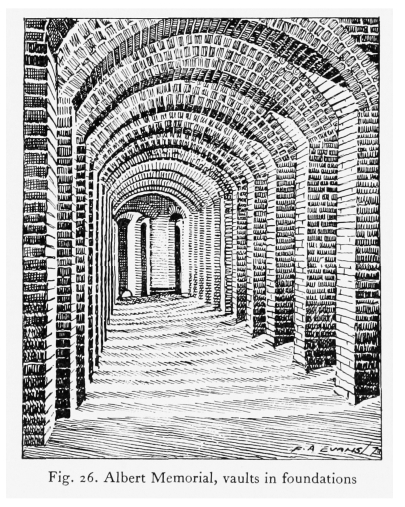
Albert Memorial, vaults in foundations
The outline chronology of the committee's work is that the foundations were begun in May 1864, the cross fixed in June 1868, the upper groups of marble statuary put in place in the summer and autumn of 1870, and the lower, outlying groups between autumn 1870 and summer 1872. In the spring of the latter year the podium reliefs (begun in late summer 1866) were also finished and the memorial was opened to the public on 3 July 1872. The statue of the Prince was not then in place. The ungilded bronze effigy was installed, under tarpaulins, in November 1875 and after gilding was uncovered in March 1876 (Plate 41b).
The builder's work and materials
The builder was John Kelk. Immediately upon the vote of the £50,000 he had written to Grey offering to do the work at cost price and himself bear any excess over his estimate of £85,508. Kelk had recently executed major works at South Kensington under the auspices of his friend Cole, and he explained that it was at Cole's suggestion that he now made his offer. This was promptly accepted without others being invited. (fn. 115) (fn. 4) Scott, however, was suspicious. He knew that Kelk was hand-in-glove with Cole, of whose interference he was reputed to have 'the greatest dread'. (fn. 116) Kelk was himself wary of Scott's liability to 'run riot' regardless of cost. (fn. 117) In the outcome, Kelk's part in the work was one of its more satisfactory features. Although only forty-five, he had already gained a large enough fortune to go into semi-retirement, and as the son of a Soho ironsmith his ambition was now chiefly the acquisition of honour and social advancement. (fn. 118) It soon became a commonplace that the memorial's construction was exemplary. Kelk's relations with Scott improved until Scott became his vehement champion. To crown all, Kelk finally performed his contract for £1,077 less than his estimate (fn. 119) and in addition gratuitously included the wide flight of granite steps leading down to the Carriage Road. (fn. 120)
It is not clear how Kelk recruited his admirable workmen. His business had been taken over by Messrs. Smith and Taylor (Joseph Taylor having been his foreman), and his 'Director of Works' at the memorial, (fn. 121) William Cross, was in 1870 said to be 'the director of Messrs. Smith and Co's works', (fn. 122) but Smith and Taylor do not occur in the records before that date.
One of the most admired parts of Kelk's work was the pyramid or 'vast honeycomb' of 868 brick arches which was built up, on a foundation of concrete 17 feet thick, to support the granite steps, and which seemed to show that the English could construct brickwork, whatever self-doubtings they might have about art (Plate 41a, 41c; fig. 26). Scott called it 'a curiously intricate and picturesque series of catacombs', (fn. 123) and Cole indeed suggested to Grey that 'you and I might be buried there'. (fn. 124) The foreman of the brick-layers was William Jacobs, (fn. 125) and the bricks were made by Messrs. Richardson of Shepherd's Bush. (fn. 126)
Kelk's handling of the granite was also greatly admired. The blocks were worked to fine joints 'almost like cabinet work' and bolted with copper. (fn. 127) Scott (whose clerk of works, Coad, was 'an excellent Geologist' (fn. 128) ) thought that 'the workmanship put upon the [column-] bases of Irish granite is really quite marvellous.' (fn. 129) Unusually, the working (all 'wrought by the axe') and the polishing (all by hand) was done on the site (Plate 42c). According to The Builder, it was the first granite to be polished in London. (fn. 130) The official history describes how, as soon as the granite was delivered, 'the masons were crowded round these masses, and worked incessantly in relays, night and day, during the severe winter of 1866–67, fires being lighted around them to prevent the water which was being used from freezing'. (fn. 131)
Obtaining the granite, however, caused much trouble. Orders were placed in Scotland and Ireland by September 1864, but when news of this reached the Scottish quarries the workmen promptly struck for higher wages. (fn. 132) Soon the granite company in Mull was enraging Scott by failures of supply, blaming the 'immense difficulty in getting a Steamer adapted for the Harbours at Mull and capable of taking such large blocks'. (fn. 133) The Scottish supply righted itself, and the early difficulties there faded into insignificance compared with the problem of getting the Irish granite to London.
An offer had been received from a quarry-master, Thomas Scott (himself Scottish), to supply granite from a property of Lord Annesley's near Castlewellan in County Down. Somewhat as was the case with the Ross of Mull Granite Company, the committee subsequently found that Thomas Scott did not have a lease of the land when he offered, and only thereafter obtained the owner's permission to open the quarry, specifically for the memorial. To secure the subcontract with Kelk he accepted, according to Doyne Bell, 'an absurdly low price' and then took the first chance to hold out for a much higher one, at the cost of 'bitter personal feelings' between him, Kelk, and the London granite-broker, a lawyer called Brady. (fn. 134)
By June 1865 a hiatus in the supply had caused Gilbert Scott to plunge into 'the West of Ireland', in search of a suitable truck to transport the stone—a puzzling action attended with the degree of success that might have been foreseen. After 'considerable trouble' he bought one, and dispatched it by rail to Ulster. Some time later it had not arrived, and when located en route was immobilized for want of a rope to fasten it to the engine. Eventually the truck, the granite, and a ship were all brought together in the small port of Newcastle: without avail, however, as there was no sufficient crane to load the ship, and by the time a suitable hoist had been brought over from Liverpool the ship, specially chartered, had disappeared. As Brady explained, it had not been heard of since. (fn. 135) When some granite finally reached London Kelk found part of it unsuitable, and had to send his men to Ireland (as he had to Scotland) to secure sound stone for his column-bases. (fn. 136) His foreman went to Castle-wellan seven times. (fn. 137) An intervention by Lord Annesley helped matters (fn. 138) (as had the Duke of Argyll's in Mull) and by September 1866 Doyne Bell was looking forward to the arrival of two more cargoes. (fn. 139) In fact, the vessels in question were not at sea, but stuck on the bottom of Newcastle harbour, which, in consequence of an unfortunate disagreement between the Irish Board of Works and the County Down authorities about the responsibility for dredging, was filling up with sand. One suggestion thrown out by Thomas Scott was that the committee should persuade the Treasury to influence the Lord Lieutenant of Ireland to instruct the Board of Works to do the job and charge it to the county. Suspecting exaggeration and doubtless thinking harbour-maintenance to be beyond the committee Grey declined to intervene. (fn. 140) Even more seriously than in Mull the badness of the harbour at Newcastle increased the reluctance of ships' masters to carry what they evidently regarded as an unattractive cargo, (fn. 141) and the arrival of ship-loads of granite in the Thames became a matter of congratulation to the committee. In the equinoctial storms of autumn and spring 1866–7 the Passage of the Irish Sea was difficult and one cargo went astray when the Lancashire-bound vessel was dismasted and driven into a small Scottish port, where there were facilities neither for the repair of the ship nor for the transport of the granite overland. (fn. 142) There were other causes of delay. Brady was eloquent about the difficulties of quarrying on the Mourne mountains and his troubles before 'my men [sic] could be brought to work on the mountain sides next the sea, and where it would probably take one man's labour to hold the other down in his place, against the gales'. (fn. 143) In November 1866 the Queen was commenting on the failure of the Irish to fulfil their contract (fn. 144) and by January 1867 Grey had lost patience, longing 'to leave them and their harbour to their fate'. (fn. 145) During that year this course was taken. Abandoning hope of a full supply from Ireland the committee replaced some of the intended stone in the columns and lower steps with granite from Cornwall and Kirkcud-brightshire. (fn. 146) (fn. 5)
Gilbert Scott's doubts about Kelk had been the stronger because his first task on his appointment had been to fight off a bold attack on his design by Kelk's ally, Cole. The latter had thought Scott's the best of the submitted designs, (fn. 147) although he criticized the disparities of scale indicated for the sculptural work. (fn. 148) Now, however, he mounted a dual campaign. (fn. 149) He advocated an 'internal' treatment of the Prince's statue, that is, its enclosure within a protective structure. This would preserve the decorative materials from deterioration and at the same time avoid the effect that he objected to in Sir Walter Scott's memorial in Edinburgh, that of 'a Man sitting in the rain under an Umbrella'. (fn. 150) Cole also wanted a great increase in the height of the memorial to make it a landmark. (fn. 151) He combined these ideas by proposing the substitution of a Gothic spire some 235 feet high, with the statue in a decorated apartment at its base. (fn. 152) His confident assertions (supported by Marochetti (fn. 153) ) that statuary marble and brilliant materials would not stand exposure—that Scott was 'defying common sense' (fn. 154) —had some effect on the Queen and the Crown Princess. (fn. 155) Cole's arguments also half-convinced Grey and Phipps, (fn. 156) although they interposed to shield Scott, so far as they could, from his more irritating shafts. (fn. 157) Scott was eventually able to convince them that his memorial would be adequately resistant to exposure and easily cleaned by 'a simple fire engine'. (fn. 158)
Thereafter Cole's interventions became less significant although Grey in particular continued to seek his advice: Cole's knack of provoking resentment had always made it desirable to keep him in the background, (fn. 159) and he was now arousing considerable suspicions of intrigue. (fn. 160) A wish not to associate the memorial too openly with his 'South Kensington' kingdom perhaps explains the failure to invite his Science and Art Department to submit a design, as he had requested. (fn. 161) Tentative moves towards the participation of the Department in the mosaic work of the memorial also came to nothing. (fn. 162) Hence-forward Cole's energies were in any event turned increasingly to the creation of the 'Albert Hall', where his subsequent dealings with Scott had a chequered history. But evidently his arguments now had one important success. He judiciously interlarded his criticisms with flattery, to which Scott was vulnerable, (fn. 163) and it seems that in June 1863 he prevailed on Scott to increase the height of the fléche. This increased height was the one feature of the memorial that Scott later regretted. (fn. 6) (fn. 164)
It was probably this intended increase in the size of the metal fleche that brought the authorities in the summer of 1863 to a difficulty that was not resolved for three years. This was the proposed grant by the Government of old bronze guns at Woolwich Arsenal to be melted down for use in the memorial. In April Palmerston had seen no objection to it. (fn. 165) Then Gladstone intervened. By a Treasury ruling, grants in kind were to be regarded as grants of money, and required a Parliamentary vote. (fn. 166) As Parliament had been led to suppose that the vote of £50,000 would be final, it would transgress 'the rules of good administration' to ask for more, even in metal. (fn. 167) Indeed, Lord Derby himself had been insistent that no supplementary vote of money should be requested. (fn. 168) In June Scott told Palmerston that he wanted 100 tons. (fn. 169) Gladstone was adamant, confessing himself 'the jealous and rude guardian' of Treasury rules. (fn. 170) By the autumn the Queen had reduced the request to 50 tons, (fn. 171) but by then Gladstone was seeing the issue as one, also, of 'political prudence', (fn. 172) and induced Palmerston to remind the Queen in December of the risk of the Commons' hostility. (fn. 173) The Cabinet was averse to the grant, (fn. 174) and although in July 1864 Palmerston with manifest reluctance said he would, if the Queen wished, 'take all chances' with the Commons, the committee, making a change in the design that eliminated some of the bronze, thought it best to let the matter drop. (fn. 175) It remained in abeyance until 1866. Then there was a revival of hope, possibly because Layard had joined the committee. (fn. 176) In May Grey asked the Prime Minister, Lord John Russell, for 50 tons. (fn. 177) Gladstone was as stiff against it as ever. (fn. 178) But in June the Government was defeated and Derby, with Disraeli as his Chancellor of the Exchequer, came in. Disraeli was willing to propose the vote without delay. Gladstone again refused his support, telling Grey that the sovereign had a greater interest in administrative strictness than anyone. (fn. 179) Disraeli proposed the vote on 25 July—shrewdly, at dinner-time—and exultantly reported his success to Grey. '. . . There was a suspicious-looking band, headed by Ayrton, below the gangway, who would stay. When Ayrton rose and urged Gladstone's points, I thought it was all up—but I played with the fish, tickled it, and landed it! Thank God! I never was so nervous in my life . . .' (fn. 180) He frustrated a Liberal attempt to reverse the vote on the following day, and was puzzled by Gladstone's inflexibility ('I cannot comprehend what influences Gladstone in the matter. You would suppose I was doing him a personal injury.') The quantity voted, moreover, was not 50 tons but 71, valued at £70 a ton, or £4,970 in all. The valuation of £100 per ton or more by Palmerston's Government, had, it seems, been discreetly scaled down. (fn. 181)
Apart from the heightened fleche, another change made in the original design was the greater appearance of strength given, in 1864, to the clustered columns supporting the canopy. Many, including Cole's architect at South Kensington, Captain Fowke, (fn. 182) thought they looked inadequate. In face of this criticism Scott increased the number of shafts in each pillar to eight instead of four and also added a concealed central shaft (Plates 40a, 41b). (fn. 183) Structurally, he thought the change unnecessary, as the apparent arches were not really so in construction, and the weight of the metal fléche was taken by a large cruciform boxgirder of wrought iron, concealed within the canopy (Plate 41d). (fn. 184) (fn. 7) This, of course, got him into trouble with the advocates of truth of construction. (fn. 185)
Other revisions eliminated the intended decoration of the lower part of the columns (in 1869 (fn. 186) ), and the designs proposed on the faces of the outer corner pedestals. (It was only in 1873, after the memorial had been opened to the public, that the panels of red Mull granite were inserted in these pedestals. (fn. 187) )
The greatest discussion centred, not so much on the form of Scott's design, which Grey and Phipps soon came to think very beautiful, (fn. 188) as on his materials and, in consequence, the chromatic and textural effect of the memorial. Scott said that 'the use of brilliant and richly coloured materials externally has been viewed as one of the great desiderata in modern architecture' and cited the 'praiseworthy' attempt (largely of Cole's sponsoring) to decorate the 1862 Exhibition building with mosaic pictures. (fn. 189) But beyond a determination for richness and polychromy it seems that he may not have visualized this aspect in sharp focus. For the architectural part of the memorial his first idea had been 'a light-coloured granite, the foliage probably being of gilt bronze'. (fn. 190) Then he aspired to a finer material and in April 1863 answered Cole's questioning of the memorial's durability: 'I propose that the mass, or ground work, of the architecture shall be in Sicilian marble . . . This is my building material, my plain ground-work'; while the 'roof covering and tabernacle work' would be of 'copper thickly gilt with pure gold and enamelled'. (fn. 189) But he professed himself uncommitted to any particular material, (fn. 190) and with Cole doubting the permanence of exposed glass mosaic considered Minton's ceramic mosaic as an alternative to Venetian. (fn. 191) Grey was deeply impressed by the 'continental researches' of Cole and Richard Redgrave when Cole reported in autumn 1863 that they had found that the only outdoor mosaic they knew of north of the Alps—14th-century work on Prague cathedral—had greatly deteriorated, (fn. 192) and Grey told Cole that Scott's proposed use of semi-precious stones in the upper parts of the flèche was 'simply absurd'. He thought 'all the gaudy decorations of Mosaics, brass etc. must be abandoned, and . . . Scott will have to come at last to simple Architectural beauty, executed in granite'. (fn. 193) This attitude doubtless contributed to Scott's fears early in 1864 for the prospects of his 'precious shrine' concept ('I trust to be directed aright', he wrote (fn. 194) ). The change of material that he did make in 1863–4 was the replacement of marble in the canopy by Portland stone. (fn. 8) (fn. 195) The motive, however, was largely economical (related, no doubt, to the increased height of the flèche) and in the end Scott retained his glittering variegated materials—the polished granites, the bronze, the enamels, the pietra dura, the gilding (which was eventually applied more liberally to the flèche than first intended (fn. 196) ), and his glass mosaic.
The materials did not, of course, include exposed brick. Nor did they include terra-cotta, for which in 1864 Scott offered a practical reason. (fn. 197) The effect was to emphasize that, so far as its intrinsic features went, the memorial was not a part of Cole's 'South Kensington'.
Although the durability and tastefulness of some of Scott's effects were questioned the natural polychromy of his materials was generally relished. Even Grey when in Sweden in 1868 became an active collaborator in a frustrated attempt to obtain porphyry of precisely the right tints from Elfdal. (fn. 198) Much importance was given to the colours of the granites, which Scott particularized appreciatively in the official history. (fn. 9) The general approbation of his polychromy was shown—and also, perhaps, the occasional flaws in his apparent self-confidence—when late in 1865 the very dark grey Irish granite that he had intended for the monolithic column-bases was proving difficult to obtain. It was then Doyne Bell and the committee who insisted on the retention of that chromatic accent rather than accept, as Scott was prepared to do, the substitution of a pink granite. (fn. 199)
The present tonal and textural contrasts of the memorial seem to some tastes ill-judged, and disturbing to both eye and mind (Plate 47b). The lower and (visually) supporting parts are in light colours and the superincumbent parts in dark and weighty-seeming tones. At the same time the most prominently exposed groups of sculpture are in marble while the Prince's statue under its protective canopy is of gun-metal bronze. This arrangement was criticized at the time, (fn. 200) and it is perhaps worth remarking that the un-rational-seeming composition might be more acceptable if the authorities had adopted the extravagant but imaginative suggestion of John Bell, made in 1863. This was that the memorial should be placed in the centre of the Round Pond, approached by four causeways. (fn. 201)
In part, the disquieting effect is now caused by the disappearance of the gilding with which the Prince's statue was originally covered (as well as most of that on the flèche), but, again, there may have been some vagueness of visualization on Scott's part. Initially, he thought that the Prince's statue would be of marble. (fn. 202) In the spring of 1863, immediately following the informal selection of his design, Scott was hoping that marble would also be used for some at least of the sculptured groups. (fn. 203) He certainly wanted the podium reliefs to be in marble or stone, not bronze, (fn. 204) and later defended this choice against the criticism that it made the podium a weak element in the composition by the notional argument that the sculpture there 'is the very soul of the design, and is well worth a minor sacrifice'. (fn. 205) Regarding the Prince's statue, Scott was by 1869 uncertain about the reason for the change to bronze, but thought it had been to meet Marochetti's wishes. (fn. 206) As early as May 1863, however, when Marochetti was only in the wings, the Queen was exclaiming that Scott proposed a gilt statue, (fn. 207) which he had thought 'very magnificent' if doubtfully acceptable to English taste. (fn. 208) At all events, the intended material of the statue was thenceforward gilded bronze and in 1869 Scott was unresponsive to queries from the Queen whether marble might not after all be preferable. (fn. 209) Regarding the podium and groups, Cole's doubts about the durability of uncovered marble, supported by the researches of Professor Hofmann of the Royal College of Chemistry, had for a time some effect: it was in fact a very general supposition that the unprotected statuary would have to be of bronze, and attention was chiefly directed to finding a type that would not darken unduly. Eastlake, for example, wrote to Waagen in Berlin to ask for the ingredients of the bronze of Rauch's much admired statue of Frederick the Great, (fn. 210) while Scott thought that electro-deposited copper or bronze, in which the Prince had had great faith, might answer. (fn. 211) In the latter part of 1863 and early part of 1864 Scott expected gun-metal from the Government and accepted that the groups and possibly all the other statuary might be of bronze, although he still would have preferred marble for the podium and the eight figures attached to the pillars and in the niches of the canopy. (fn. 212) Then two developments switched the groups to marble. The hope of Government bronze became very uncertain, and Scott in summer 1864 found a marble that he thought capable of standing exposure. This was a type of 'Sicilian' marble (in fact from the Calonnata and Paleri quarries at Carrara) called 'campanella'. He had been impressed when shown a fragment of it from the cathedral at Pisa, (fn. 213) but it was not normally imported on account of its intense hardness. Scott was glad of the change to marble and so were most of the sculptors of the groups, although the sculptor of one of the upper groups would have preferred bronze. (fn. 214) In July the use of 'campanella' for all the sculpture was settled, the Queen accepting it on the assurance that it offered 'as great a degree of durability as can be obtained for works executed by man'. (fn. 215) The change of intention was noted with regret by The Athenaeum (fn. 216) (and later by other journals (fn. 217) ), and would perhaps have been more judicious had the Prince's statue still been intended to be of marble and the main structure also of marble rather than the red and grey granites under the enlarged flèche of the building as then intended. A further change in autumn 1866, whatever its merits, tended to increase the top-heavy effect. The Government bronze had, after all, become available, and this enabled Scott to meet the wishes of the sculptors of the upper marble groups, on the corners of the podium, by altering the intended material of the figures on the pillars and in the niches above them. This was now changed back from marble to bronze, to avoid confusion with the forms of the groups below. (fn. 218) (fn. 10)
The degree of control exercised by Scott over the form of the sculptural work (or the 'high art' as he called it) varied, but was everywhere considerable. Layard was especially careful to bring him into discussions of the sculpture.