
Register and Records of Holm Cultram. Originally published by T Wilson & Son, Kendal, 1929.
This free content was digitised by double rekeying. All rights reserved.
'The Register: Kirkgunzeon (Galloway)', in Register and Records of Holm Cultram, (Kendal, 1929) pp. 48-56. British History Online https://www.british-history.ac.uk/n-westmorland-records/vol7/pp48-56 [accessed 26 April 2024]
Kirkgunzeon, Galloway.
120. (C. p. 99; D. art. 81).—Huctred f. Fergus, with consent of Roland his heir, grants to Holmcoltran abbey the vill called Kirkgunnin in fee farm by its right bounds, with all appurtenances, etc. Also a saltwork outside the bounds in a suitable place, and pasture for pigs within all the woods of the demesne, without paying pannage. Rendering £6 yearly to him and his heirs as long as the monks like to hold the land, namely £3 at Easter and £3 at Martinmas. They pay him 10 marks as deposit, on the condition that if they find the place not to their liking in three years' time, he will return the said marks cum bono [i.e. with a bonum or gift asked]. Service to the king of Scotland will be paid by himself and his heirs. Witnesses—Christian, bishop of Galloway, etc. [Kirkgunzeon (pronounce 'Kirkgunnion') anciently written Kirkgunnin, Kirkwinny, etc., the church of St. Finnian, an Irish cleric who died in Ayrshire 579, is in the Stewartry of Kirkcudbright, between Kirkconnell and Dalbeattie. The date of the grantor is 1161–74.]
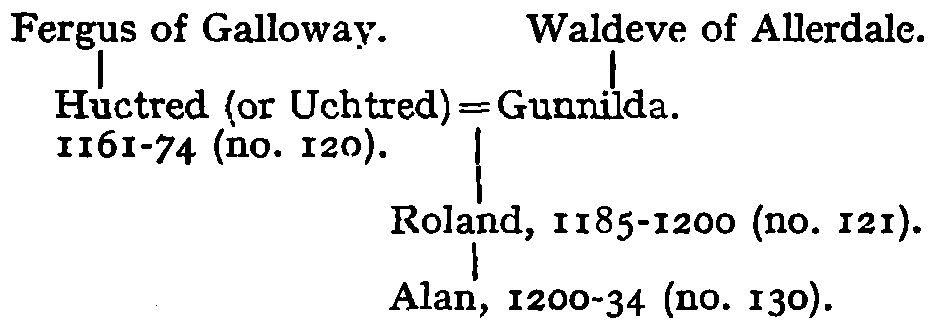
[Pedigree of Fergus of Galloway]
120 a. (H. 2).—Christian, bishop of Candida Casa, states that he was with Everard, abbot of Holm, and Uctred f. Fergus when Uctred perambulated the bounds of Kirkewinni; but afterwards Uctred withdraw a large part of the land then set out and granted it to Walter de Berkeley. On which, the abbot complained to William [the Lion], King of Scotland, who ordered Uctred f. Fergus and Roger de Mimeto to summon elderly men of that district who knew the right ancient bounds of Kirkwinni, and make them perambulate them. This they did as Uctred had done at first, including the land granted to Walter. The bounds are as a burn falls from a place called Culuen [Culwen, now Colvend] to Poladkertin [now the burn at Carton Bridge]. Nevertheless the abbot is not profited, for Walter still holds the land [1174–86].
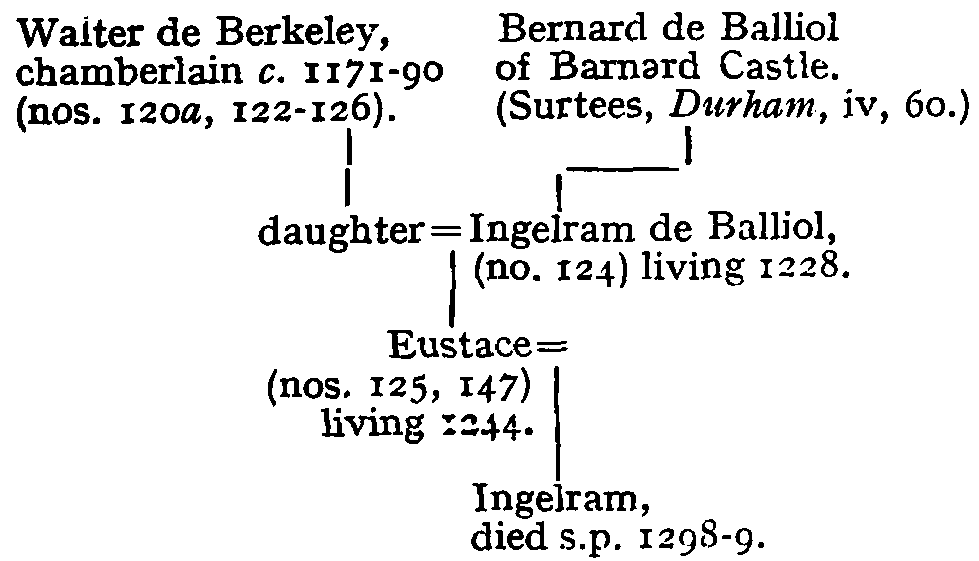
[Pedigree of Walter de Berkeley]
121. (C. pp. 99, 100; D. art. 81).—Roland f. Huctred grants to Holm abbey to fee farm the vill of Kirkegunni by these bounds:—the road leading from the bridge of Polatkertin to Crosgile ultan; thence by the direct way to Cloenchonechro [now Barbey], and going down by the stream called Grenethfalde as the stream [the Lawston burn] runs into the water that comes from Lochartur, and as Polnechauc falls into the same water to the foot of Lochartur, and from Polnechauc to Munimuch [now Lotus hill] and from Munimuch by the top of the hill of Glasteri [Long fell] straight to Poldereduf, and so across, to the source of Poldereduf, and as Poldereduf falls into the great water which runs between Culwen and Boelewinin [Falgunzeon] and then down to the water which runs between Blareguke and Haclthecoste (?), and so up by the middle of the alder wood to the great moss, and across the moss to Polnehervede, and as Polnehervede falls into Polchillebride and the last into Dufpole [Kirkgunzeon lane] and so up stream to Polatkertyn. Also one saltwork outside the said bounds in Locchendelo, and wood as needed, and pasture for 4 oxen and 500 swine yearly, without paying pannage, from St. Michael's day to St. Andrew's, and easements in his wood of Preston and in Lochildela as far as Pollesteresheved, of material, etc. needed for the house of Holm and its own use. Also right of way between landing-places on the sea-coast and the grange for men, beasts, carts and packhorses. Rent £10 yearly. Witnesses [from H. 1) —Christian, bishop of Candida Casa, etc. [The identifications of places have been traced by Mr. R. C. Reid, who finds that the bounds are those of the present parish. Date 1185–86].
122. (C. p. 101; D. art. 81).—Roland f. Huctred confirms to the monks of Holm the land given by Walter de Berkeley, chamberlain of Scotland, by these bounds:—by the highway from the bridge of Pollatkertin going to Letegilultan, and as this road reaches to the crossed oak near Cloenchonechro, and thence as a valley runs in the wood to a sike, and down by that sike to Poladkertin, and down by Poladkertin to the said bridge of Poladkertin [1185-c. 1190].
123. (C. p. 101; D. art. 81).—Walter de Berkeley, chamberlain to the king of Scotland, grants to the monks of Holm land which they hold of him by these bounds [as no. 122]. The grant is made for the souls of the king of Scotland and all the grantor's kin. [H. 1 reads the bounds:—'from Poladkertyn to Lechtigilulty by the highway, to the crossed oak at Cloen kone cro,' etc. Before 1190.]
124. (C. p. 102; D. art. 81).—Ingelram de Baylliol grants to the monks of Holm land in Galweia which Walter de Berckelay gave, i.e. by the highway [as no. 122]. Witnesses [from H. 1]— Alan de Galwidia, etc. [Alan was 'of Galloway' 1200–34.]
125. (C. p. 102; D. art. 81).—Eustace de Baylliol confirms [no. 123. See pedigree (no. 120) for this Eustace, who must be distinguished from his namesake, the sheriff and crusader who witnessed no. 202. The date of this is c. 1244 ?]
126. (C. p. 103; D. art. 18).—William, king of Scotland, confirms the grant of his chamberlain, Walter de Berkele, of land in Galweia [c. 1185–90].
127. (C. p. 103).—Patrick f. Thomas de Wirkington confirms to the monks of Holm all his land in Galweia called Lochentur [or Lochencur] by the same bounds as that which Adam de Arder and William f. Leveric held. [Patrick dates c. 1212–58.]
128. (C. p. 104; D. art. 81).—Rolland f. Huctred grants to the monks of Holm a saltwork in Salternes [Southerness] and a fishery between Polben and Suithayc [Southwick] wherever convenient, except the land of Robert f. Symon; and one acre where they may build a house, and common pasture for 12 cows with their calves, one bull, four oxen and 12 horses, with all necessary easements and rights of way to and from Kyrkegunni. Granted for the souls of king David and his heirs and for the grantor's kin [1185–1200].
129. (C. p. 104).—Alexander, king of Scots, confirms the grant of Roland f. Huctred to the monks of Holm of the vill of Kirkegunni in fee farm, and Roland's grant of a saltwork in Salternes and a fishery between Polben and Suthayk [as in no. 128; 1214–49].
129 a. (H. 1 and 2; D. art. 32).—Pope Innocent III confirms to Holmcoltran the chapel of Kyrkewynni in Galwithia, which the abbey has held for forty years in peace, by concession of Jocelin, bishop of Glasgow. Rome, at St. Peter's, iii Non. Feb. in his 8th year [1216].
130. (C. p. 105; D. art. 81).—Alan f. Roland, constable of Scotland, confirms to the monks of Holm the land about which there was a dispute between him and them; i.e. from the place where Grenefaude falls into the water which comes out of Lochartur; up the same water to a place where it comes out of Lochartur; up Lochartur to a burn which falls into Lochartur on the southern side, which burn—because of this dispute—has been newly named by us Pollenchos newa; up by the burn as far as it is in view to the place where it first forks; then straight to Munenemuch by the bounds named in the charter of his father Roland. Witnesses—Walter, bishop of Candida Casa, etc. [1200–34.]
131. (C. p. 106).—Gilbert f. Cospatric quitclaims to the monks of Holm all rights in land by these bounds:—from the top of the hill to south of Glasteri, as the outer dyke to the south descends from that hill, straight as dykes and crosses mark the bounds, to the sike which is at the south of Poldereduf; and so as that sike falls into Poldereduf. [Gilbert f. Cospatric f. Orm was de Southaic (see St. Bees, nos. 42, 60; and the Rev. F. W. Ragg in C. & W. Trans. N.S. xvii, 230) and dates before and after 1200.]
132. (C. p. 106).—Patrick f. Gilbert de Suthayc confirms to the monks of Holm the quitclaim which his father Gilbert made [as in no. 131. This Patrick was probably as given in the pedigree p. 19; later on, there was a better known namesake, born 1298, died 1333; and this charter must date c. 1220–30.].
133. (C. p. 107).—Agreement between the abbeys of Holm and Dundraynan. The latter made a claim on Kyrkewinni, held by the former from Huctred f. Fergus. It is agreed that Holm shall not acquire more land or build more houses or sheepcotes on the western side of the Nid [river Nith]. But on the eastern side, on land that belonged to Radulph f. Duvenald, neither house shall acquire more without the consent of the other. Dundraynan shall have power to increase on the west side of the river, outside the land of the grange of Holm. The flocks of Holm are not to go into the adjacent pastures so far that they cannot return at night to their own grange, until Dundraynan has got land for a grange, to enclose these pastures and prevent intrusion by the flocks of Holm. The pigs of Kirkewinni can go into the woods of Huctred between the grange and the Nid, but in time of pannage the pigs of both abbeys shall get pannage outside the aforesaid wood. [Dundrennan abbey was founded in 1142; see the history of the abbey by the Rev. A. H. Christie (Dalbeattie, 1914). The land of Radulph f. Duvenald is mentioned in no. 133a. As Huctred appears to be still alive the date must be 1161–74.]
133 a. (H. 2).—Pope Alexander [III] to Everard, abbot, and the brothers of the monastery of Holm grants his sanction to their holding the island of Holm, granted them by king Henry (II), and Kirkewinni, held in fee farm from Uctred f. Fergus, and the saltwork, pasture, etc. there, and the lands of Colnehath and Karlaveroc granted by Radulph f. Donegal and confirmed by king Malcolm. [Conheath and Carlaverock are 5 miles S.S.E. of Dumfries; the latter was acquired by John de Maccuswell (or Maxwell) who died in 1241, and by no. 133 we see that Holm abbey gave up these two places in consequence of the rivalry of Dundrennan. Mr. R. C. Reid finds that all the land between the Nith and the Deil's Dyke or Britons' Walls, which earthwork runs near the junction of the parishes of Cummertrees and Ruthwell, was held directly from the Crown, and that great part of it had belonged to Duvenal or Donegal, while the lords of Annandale held the land east of the dyke. The original grant to Holm of Conheath and Carlaverock, confirmed by king Malcolm, must have been made 1153–65, and this no. 133a dates by the pope 1159–81.]
133 b. (H. 2).—Pope Alexander to all clergy of Scotland. They are to forbid their parish priests, under pain of anathema, to interfere with the monks and lay brothers of Holm abbey. [If Alexander IV, 1254–61].
133 c. (H. 2).—Pope Alexander to the bishops of Glasgow and Galloway, bidding them to protect the abbot and brothers of Holm in their dioceses, and not to allow them to be prosecuted in a secular court [date as the last].
134. (C. p. 107; D. art. 81).—Jocelin, bishop of Glasgow, confirms the grant of Walter de Berkeley [no. 123; 1174–99].
135. (C. p. 108).—Jocelin, bishop of Glasgow, on the petition of Roland f. Huctred, confirms to Holm abbey the saltwork in Salternes and the fishery between Polben and Suithayk [1174–99].
136. (C. p. 108; D. art. 81).—Jocelin, bishop of Glasgow, confirms to Holmcoltran the place and chapel in Galweia called Kyrkewinnin, free of synodals and all other episcopal dues [1174–99].
137. (C. p. 109; D. art. 81).—Walter, bishop of Glasgow, confirms Kyrkewinni to the monks of Holm; they are to hold the chapel there in peace. He curses anyone who molests them or carries off their goods (catella). Witnesses—W[ ], prior of Melros, R[ ], dean of Tevidal, Alan and John, chaplains, etc. [Kirkgunzeon was in the archdeaconry of Teviotdale. Probably 1224.]
138. (C. p. 110; D. art. 81).—Hugh the dean and the chapter of Glasgow confirm to Holm abbey the land of Kyrkewinni and the chapel of St. Winninus therein, granted by Jocellin and Walter, bishops of Glasgow. Dated 1224.
139. (C. pp. 110, 111; D. art. 82).—Walter, bishop of Candida Casa, and John, archdeacon of the same and abbot of Glenlus of the Cistercian order in the diocese of Candida Casa, recite the following:—Pope Honorius [III] to his brother, bishop of Candida Casa, and his son, abbot of Glenlus and archdeacon of Candida Casa. The bishop of Glasgow has told him that the monks of Holm have usurped parochial churches in his diocese and made them into granges and chapels, expelling the clergy and the tenantry. He therefore asks the bishop of Candida Casa to take the necessary action. Dated at Alat[ri], vi Kal. Jun. in his 6th year [May 27, 1222].—The monks of Holm being summoned and appearing by their proctor, the bishop of Glasgow said that Kyrkewinni chapel had been a parochial church under Glasgow, and ought to be restored; but finally agreed that for the sake of religion he would permit Holm abbey to hold the land of Kyrkewinni and the chapel of St. Winninus according to the consent of Jocelin, late bishop of Glasgow and the confirmation of pope Innocent. [1222.]
140. (C. p. 112; D. art. 46).—V. [i.e. William] king of Scots to all justices, sheriffs, provosts, ministers and all good men. Know that I have given my firm peace to the monastery and brethren of Holm and their goods throughout all my lands, and licence to carry their wool and merchandise which they have on sale into my land, to sell in my towns wherever they please. Wherefore I firmly prohibit all interference with them in going or returning, or any infringement of this my order [1165–1214].
140 a. (H. 2)—W[illiam], king of Scotland, confirms to Holm abbey Kirkewinni, granted by Huctred f. Fergus, the saltwork in Culwene and easements in the wood from the port of Hur to Polsturshevid and rights of way granted by the same [c. 1185].
141. (C. p. 112; D. art. 19).—Christian, bishop of Candida Casa, confirms to Holm, where he is to be buried, the grange of Kyrke Winni. Any who oppose this will be excommunicated. Witness—J[ohn], archdeacon. [1186 or earlier.]
141 a. (H. 1 and 2; D. art. 83).—Robert [Wischard], bishop of Glasgow [1271–1316], to the abbot and convent of Holmcoltran. Bishop Jocelin his predecessor confirmed to them a place and chapel in Galloway named Kyrkewyny, free of all burdens; they had held it for 40 years and it had been confirmed to them by pope Innocent III. Walter, bishop of Glasgow, successor to Jocelin and predecessor of Robert, complained to the Apostolic See that the monks of Holm and other Cistercians of the diocese of Carlisle and Glasgow had usurped certain parish churches, expelled clergy and tenantry, and turned the places into granges of their own. He procured orders from Rome for the bishop of Candida Casa and the abbot of Glenlus and archdeacon of Candida Casa to summon the parties and try the case. The trial ended thus:—bishop Walter yielded Kyrkewynny and the chapel of St. Wynynius to the monks of Holm to hold free of all burdens; the grants of bishops Jocelin and Walter were confirmed by the dean and chapter of Glasgow after full discussion, and no further steps can be taken by the bishops of Glasgow to upset the judgment. He acknowledges the right of the abbey to Kyrkewyny chapel with all tithes, etc., and the dean and chapter of Glasgow, after further examination at his instance, unanimously agree and put their seal to their consent, as the bishop does to this brief [c. 1296].
141 b. (H. 2).—The dean and chapter of Glasgow recite [no. 141a] and confirm it [c. 1296].
141 c. (H. 1 and 2).—Robert, bishop of Glasgow, agrees that Kyrkewyny chapel, the cemetery and the altars of the chapel, may be consecrated by any catholic bishop and reconsecrated when necessary, although it is in his diocese. Dated at Pertheck [Partick] February 18th, 1296.
141 d. (H. 2).—Edward de Brus, lord of Galloway, quitclaims to Holm Abbey his right to a rent of £10 sterling yearly, which the monks used to pay to the lords of Bothil for land in Kyrke Wynny in Galwidia, granted them by Roland f. Huctred and others. [Bothil is taken by the Rev. F. W. Ragg in C. & W. Trans. N.S. xvii, 225f. to be Bothel in Cumberland, "or, less probably, Buittle" in the Stewartry of Kirkcudbright. Date 1308–18.]
141 e. (H. 1 and 2; D. art. 20).—Robert [Bruce], king of Scots, especially for the soul of his father who is buried at Holm abbey, confirms the quitclaim of £10 a year which the monks used to pay to the lords of Botyl for lands in Galwidia. Dated at Holywood abbey (Sacri Nemoris, near Dumfries), January 14th in his 15th year [1319].
141 f. (H. 2).—For the information of John, bishop of Glasgow, the abbot, etc. of Holm state that the church or chapel of Kirkewynny in the diocese of Glasgow has been in their possession, both in spirituals and in temporals, free of bishop's jurisdiction, by title from the bishop, the king of Scotland and other lords, their founders, with consent of the chapter of Glasgow appropriated to them. They have held it time out of mind as is well known to all in that part of Galwidia and neighbourhood. Moreover, the charters can be produced. Consequently they desire that no attempt on their rights may now be made. [c. 1329?]
141 g. (H. 2).—The abbot, etc. of Holm, disturbed by a communication from the bishop of Glasgow, fear that he or his archdeacon may take steps against them, and appeal to the Apostolic See for protection. [c. 1329?]
141 h. (H. 2).—The abbot, etc. of Holm have held Kirkewynny chapel time out of mind (etc. as above); but fearing the commination and exactions of the archdeacon of Glasgow, they appeal to the Apostolic See. Later, however, the archdeacon of Glasgow having attacked them by citations, etc. they now so appeal [c. 1329?]
141 i. (H. 1 and 2; D. art. 84).—Inquisition at Kirkwynnin on Monday after Michaelmas 1329, before John de Berwyk and Adam de Boldene, clerks of J[ohn], bishop of Glasgow. The following—Gilmor Macwynnyn, G. Med[icus?], T. Mac Dali, G. Mac Mal T. Dalij—swore before Sir Gilbert f. Sir Gonewald and John his son that all the lands and revenues of Holm abbey amounted to £35 1s. 8d., except demesne land and returns from the chapel and the mill. The value of the chapel is 100s. and of the demesne land 40s. [1329.].
141 j. (H. 1).—The abbot and convent of Holmcoltrane grant to fee farm to Sir John Heriz, lord of Travereglys [Terregles] in Galway the revenues of their church of Kirkgonzin, April 15th, 1387.